

ISO 4211-6:2025
(Main)Furniture — Tests for surface finishes — Part 6: Assessment of resistance to scratching
General Information
- Abstract
This document specifies two methods for the assessment of surface resistance to different kinds of visible scratches. It is applicable to the rigid surfaces of all finished products, regardless of their material. It does not apply to finishes on leather and fabrics. Method A is suitable for all types of surface coatings and coverings except for melamine faced boards (in accordance with EN 14322) and HPL (in accordance with EN 438-1). It simulates measurable penetrating and/or deforming scratches. Method B is suitable for all types of surfaces. It simulates first visible traces (e.g. scratches, marks) that can also be a change in the gloss. The test is intended to be carried out on a part of finished furniture. It can, however, be carried out on test panels of the same material, finished in an identical manner to the finished product, and of a size sufficient to meet the requirements of the test. The test is carried out on unused surfaces without any defects or damages.
- Status
- Published
- Publication Date
- 04-Sep-2025
- Technical Committee
- ISO/TC 136 - Furniture
- Drafting Committee
- ISO/TC 136 - Furniture
- Current Stage
- 6060 - International Standard published
- Start Date
- 05-Sep-2025
- Due Date
- 24-Jul-2026
- Completion Date
- 05-Sep-2025

Overview
ISO 4211-6:2025 - Furniture - Tests for surface finishes - Part 6: Assessment of resistance to scratching - defines standardized laboratory methods to assess how rigid furniture surfaces resist visible scratches. The standard applies to finished products (or representative test panels) of any material except leather and fabrics. It specifies two complementary test methods: Method A (linear), which simulates measurable penetrating or deforming scratches, and Method B (circular), which simulates the first visible traces or gloss changes.
Key topics and technical requirements
- Two test methods
- Method A (Linear): Suitable for most surface coatings and coverings except melamine faced boards (EN 14322) and HPL (EN 438‑1). It measures the minimum load producing a measurable scratch width (≥ 0.30 mm).
- Method B (Circular): Applicable to all surface types and targets the first visible traces (scratches, marks or gloss change).
- Apparatus and parameters (examples from the standard)
- Diamond scratching tip geometry specified (e.g., rounded radius ~0.30 mm and defined tip angle).
- Load range and increments (Method A: 1.0–20.0 N with 1 N steps), controlled movement (linear or circular), minimum travel length and tip speed.
- Optical measurement equipment capable of ±0.05 mm precision and suitable illumination for trace-width measurement.
- Preparation and conditioning
- Tests performed on unused, defect-free surfaces.
- Conditioning in a standard atmosphere (23 ± 2 °C and 50 ± 5 % RH) for at least one week before testing.
- Assessment and reporting
- Defined procedures for preliminary, intermediate and final assessments (Method A) and criteria for Method B (e.g., number of visible slots).
- Test report requirements and an informative annex with tip checks, result calculation and example protocol.
Practical applications and users
ISO 4211-6:2025 is relevant to:
- Furniture manufacturers and finish applicators - for product qualification and production quality control.
- Coating and laminate formulators - to compare scratch resistance during R&D and batch release.
- Independent testing laboratories and certification bodies - to provide repeatable, comparable scratch-resistance data.
- Procurement teams, spec writers and designers - to set performance requirements, compare suppliers and support warranty claims.
Typical uses include durability testing, finish selection, supplier acceptance testing, failure analysis and marketing claims backed by standardized test data.
Related standards
- ISO 4211 series (other parts for furniture surface tests)
- ISO 1518-1 (reference method for scratch resistance - constant-loading method)
- EN 14322 (melamine faced boards)
- EN 438-1 (high-pressure laminates, HPL)
Keywords: ISO 4211-6:2025, furniture surface finishes, resistance to scratching, scratch resistance test, Method A, Method B, test panels, scratching tip, conditioning, optical measurement.
Frequently Asked Questions
ISO 4211-6:2025 is a standard published by the International Organization for Standardization (ISO). Its full title is "Furniture — Tests for surface finishes — Part 6: Assessment of resistance to scratching". This standard covers: This document specifies two methods for the assessment of surface resistance to different kinds of visible scratches. It is applicable to the rigid surfaces of all finished products, regardless of their material. It does not apply to finishes on leather and fabrics. Method A is suitable for all types of surface coatings and coverings except for melamine faced boards (in accordance with EN 14322) and HPL (in accordance with EN 438-1). It simulates measurable penetrating and/or deforming scratches. Method B is suitable for all types of surfaces. It simulates first visible traces (e.g. scratches, marks) that can also be a change in the gloss. The test is intended to be carried out on a part of finished furniture. It can, however, be carried out on test panels of the same material, finished in an identical manner to the finished product, and of a size sufficient to meet the requirements of the test. The test is carried out on unused surfaces without any defects or damages.
This document specifies two methods for the assessment of surface resistance to different kinds of visible scratches. It is applicable to the rigid surfaces of all finished products, regardless of their material. It does not apply to finishes on leather and fabrics. Method A is suitable for all types of surface coatings and coverings except for melamine faced boards (in accordance with EN 14322) and HPL (in accordance with EN 438-1). It simulates measurable penetrating and/or deforming scratches. Method B is suitable for all types of surfaces. It simulates first visible traces (e.g. scratches, marks) that can also be a change in the gloss. The test is intended to be carried out on a part of finished furniture. It can, however, be carried out on test panels of the same material, finished in an identical manner to the finished product, and of a size sufficient to meet the requirements of the test. The test is carried out on unused surfaces without any defects or damages.
ISO 4211-6:2025 is classified under the following ICS (International Classification for Standards) categories: 97.140 - Furniture. The ICS classification helps identify the subject area and facilitates finding related standards.
ISO 4211-6:2025 is available in PDF format for immediate download after purchase. The document can be added to your cart and obtained through the secure checkout process. Digital delivery ensures instant access to the complete standard document.
Standards Content (Sample)
International
Standard
ISO 4211-6
First edition
Furniture — Tests for surface
2025-09
finishes —
Part 6:
Assessment of resistance to
scratching
Reference number
© ISO 2025
All rights reserved. Unless otherwise specified, or required in the context of its implementation, no part of this publication may
be reproduced or utilized otherwise in any form or by any means, electronic or mechanical, including photocopying, or posting on
the internet or an intranet, without prior written permission. Permission can be requested from either ISO at the address below
or ISO’s member body in the country of the requester.
ISO copyright office
CP 401 • Ch. de Blandonnet 8
CH-1214 Vernier, Geneva
Phone: +41 22 749 01 11
Email: copyright@iso.org
Website: www.iso.org
Published in Switzerland
ii
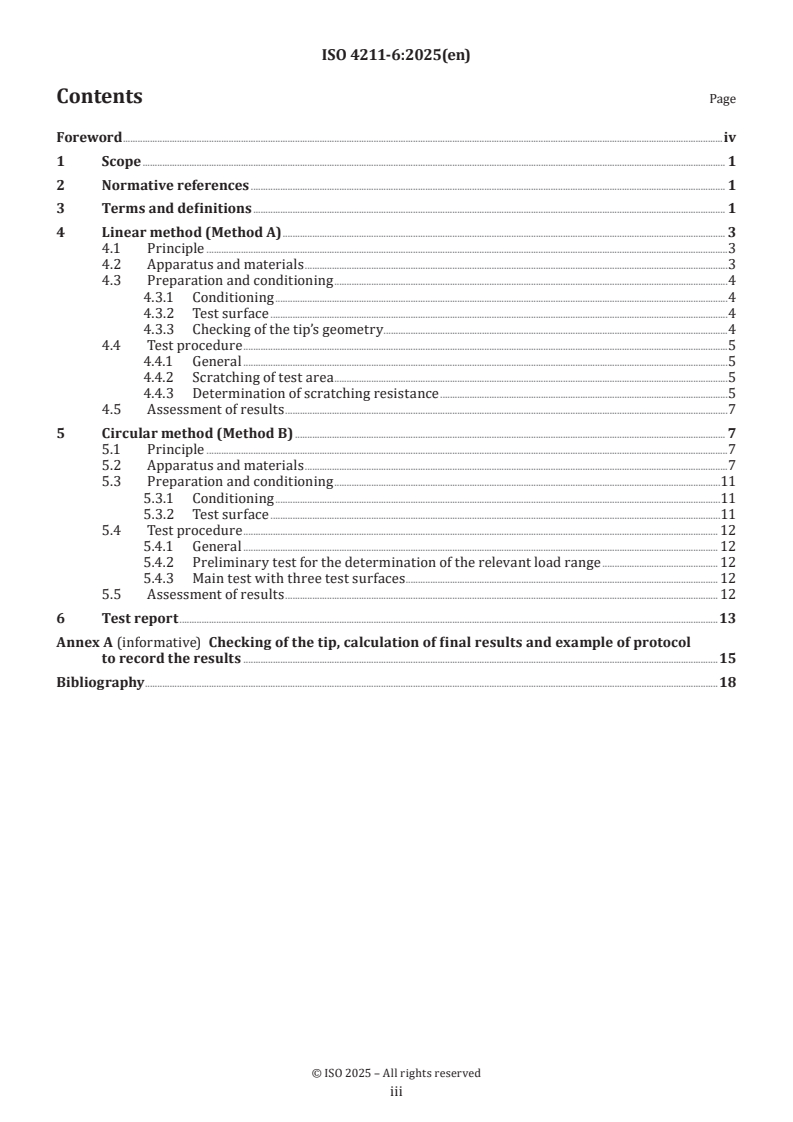
Contents Page
Foreword .iv
1 Scope . 1
2 Normative references . 1
3 Terms and definitions . 1
4 Linear method (Method A) . 3
4.1 Principle .3
4.2 Apparatus and materials .3
4.3 Preparation and conditioning .4
4.3.1 Conditioning .4
4.3.2 Test surface .4
4.3.3 Checking of the tipʼs geometry .4
4.4 Test procedure .5
4.4.1 General .5
4.4.2 Scratching of test area .5
4.4.3 Determination of scratching resistance .5
4.5 Assessment of results .7
5 Circular method (Method B) . 7
5.1 Principle .7
5.2 Apparatus and materials .7
5.3 Preparation and conditioning .11
5.3.1 Conditioning .11
5.3.2 Test surface .11
5.4 Test procedure . 12
5.4.1 General . 12
5.4.2 Preliminary test for the determination of the relevant load range . 12
5.4.3 Main test with three test surfaces . 12
5.5 Assessment of results . 12
6 Test report .13
Annex A (informative) Checking of the tip, calculation of final results and example of protocol
to record the results .15
Bibliography .18
iii
Foreword
ISO (the International Organization for Standardization) is a worldwide federation of national standards
bodies (ISO member bodies). The work of preparing International Standards is normally carried out through
ISO technical committees. Each member body interested in a subject for which a technical committee
has been established has the right to be represented on that committee. International organizations,
governmental and non-governmental, in liaison with ISO, also take part in the work. ISO collaborates closely
with the International Electrotechnical Commission (IEC) on all matters of electrotechnical standardization.
The procedures used to develop this document and those intended for its further maintenance are described
in the ISO/IEC Directives, Part 1. In particular, the different approval criteria needed for the different types
of ISO document should be noted. This document was drafted in accordance with the editorial rules of the
ISO/IEC Directives, Part 2 (see www.iso.org/directives).
ISO draws attention to the possibility that the implementation of this document may involve the use of (a)
patent(s). ISO takes no position concerning the evidence, validity or applicability of any claimed patent
rights in respect thereof. As of the date of publication of this document, ISO had not received notice of (a)
patent(s) which may be required to implement this document. However, implementers are cautioned that
this may not represent the latest information, which may be obtained from the patent database available at
www.iso.org/patents. ISO shall not be held responsible for identifying any or all such patent rights.
Any trade name used in this document is information given for the convenience of users and does not
constitute an endorsement.
For an explanation of the voluntary nature of standards, the meaning of ISO specific terms and expressions
related to conformity assessment, as well as information about ISO’s adherence to the World Trade
Organization (WTO) principles in the Technical Barriers to Trade (TBT), see www.iso.org/iso/foreword.html.
This document was prepared by Technical Committee ISO/TC 136, Furniture.
A list of all parts in the ISO 4211 series can be found on the ISO website.
Any feedback or questions on this document should be directed to the user’s national standards body. A
complete listing of these bodies can be found at www.iso.org/members.html.
iv
International Standard ISO 4211-6:2025(en)
Furniture — Tests for surface finishes —
Part 6:
Assessment of resistance to scratching
1 Scope
This document specifies two methods for the assessment of surface resistance to different kinds of visible
scratches.
It is applicable to the rigid surfaces of all finished products, regardless of their material.
It does not apply to finishes on leather and fabrics.
Method A is suitable for all types of surface coatings and coverings except for melamine faced boards (in
accordance with EN 14322) and HPL (in accordance with EN 438-1). It simulates measurable penetrating
and/or deforming scratches.
Method B is suitable for all types of surfaces. It simulates first visible traces (e.g. scratches, marks) that can
also be a change in the gloss.
The test is intended to be carried out on a part of finished furniture. It can, however, be carried out on test
panels of the same material, finished in an identical manner to the finished product, and of a size sufficient
to meet the requirements of the test.
The test is carried out on unused surfaces without any defects or damages.
2 Normative references
The following documents are referred to in the text in such a way that some or all of their content constitutes
requirements of this document. For dated references, only the edition cited applies. For undated references,
the latest edition of the referenced document (including any amendments) applies.
ISO 1518-1, Paints and varnishes — Determination of scratch resistance — Part 1: Constant-loading method
3 Terms and definitions
For the purposes of this document, the following terms and definitions apply.
ISO and IEC maintain terminology databases for use in standardization at the following addresses:
— ISO Online browsing platform: available at https:// www .iso .org/ obp
— IEC Electropedia: available at https:// www .electropedia .org/
3.1
test surface
part of the test panel (3.2)
3.2
test panel
panel including the test surface (3.1)
Note 1 to entry: The panel may be cut from a finished item of furniture or it may be a separate panel produced in the
same manner as the finished item of furniture.
3.3
test area
part of the test surface (3.1) under the equipment, where the measurement is carried out
3.4
scratching tip
needle with a point of defined geometry
Note 1 to entry: See 4.2.2 for Method A.
Note 2 to entry: See 5.2.1.5 for Method B.
3.5
scratching trace
visible and measurable scratch on the tested surface, which is produced under the specified
load of the scratching tip (3.4)
Note 1 to entry: The shapes of the traces’ edges can be different depending on the substrate and coating type as shown
in Table 2.
3.6
scratching trace
first visible traces on the tested surface (e.g. scratches, marks), which may also be a change in
the gloss
3.7
scratching resistance
minimum load applied to the scratching tip (3.4), which produces a measurable trace of the
width (W) of ≥ 0,30 mm
Note 1 to entry: It is expressed in N.
3.8
scratching resistance
minimum load applied to the scratching tip (3.4), which produces a continuous visible trace in at
least six of eight slots of the template
Note 1 to entry: It is expressed in N.
3.9
preliminary assessment of scratching resistance
assessment of the minimum load causing the specified width of the scratch on the test surface (3.1)
3.10
intermediate assessment of scratching resistance
mean value of preliminary assessments of the test surface (3.1)
3.11
final result of scratching resistance
mean value of intermediate assessments of three test surfaces (3.1)
Note 1 to entry: See Figure A.2.
4 Linear method (Method A)
4.1 Principle
Surface scratching resistance is defined as the minimum load in N (Newton) applied to the tip with specified
geometry, which produces a specified scratch width (see 4.4.2).
The width of the scratching trace is the result of the assessment of the series of scratches produced by the tip.
4.2 Apparatus and materials
The following apparatus and materials shall be used.
4.2.1 Equipment for linear method, without hand movement of the scratching tip or the test surface,
according to the principle of ISO 1518-1.
The technical parameters of the apparatus shall be as specified in Table 1.
Table 1 — Technical parameters
Parameter Description/values
Tip/test surface movement Linear
Load range (N) 1,0 to 20,0
Increment of load (N) 1,0 ± 0,1
Speed of the tip’s/test surface movement (mm/s) 20 ± 10
Travel length of the tip or test surface (mm) Minimum 20
4.2.2 Scratching tip, made of diamond, with a radius (R) of (0,30 ± 0,01) mm.
The coupling between the spherical part of the tool and the truncated cone section shall allow the width of
the trace produced by the tool on the test area to be higher than 0,30 mm, without disturbing this truncated
cone section.
An example of this tool is shown in Figure 1.
The tip shall be mounted in the holder with the flat part on the leading side of the shank facing the working
direction.
Key
α tipʼs angle α = (60,0 ± 1,0)°
R radius of tip’s rounded part R = (0,30 ± 0,01) mm
Figure 1 — Scratching tip of the cone type
4.2.3 Optical measurement equipment.
Any suitable equipment (e.g. a microscope) for measuring the trace’s width with ±0,05 mm precision.
4.2.4 Suitable illumination, for measuring the trace’s width with ±0,05 mm precision.
4.2.5 Conditioning chamber, with a standard atmosphere of (23 ± 2) °C and relative humidity of
(50 ± 5) %.
4.2.6 Cleaning cloth, white, soft, absorbent.
4.3 Preparation and conditioning
4.3.1 Conditioning
Conditioning of the test surface shall begin at least one week before testing. Conditioning shall be carried
out in air with a temperature of (23 ± 2) °C and relative humidity of (50 ± 5) %.
The conditioning time shall be stated in the test report.
NOTE Some finishing systems do not fully cure after one week of conditioning.
4.3.2 Test surface
Three test surfaces shall be prepared.
The test surface shall be taken at least 20 mm from the edge.
Each test surface shall be a piece of the test panel, shaped to fit the type of clamping device used.
The test surface shall be carefully wiped with a cleaning cloth (see 4.2.6) before the test without scratching
the surface.
The test surface shall be substantially flat. If the original thickness of the test panel is reduced, the bottom
side shall be parallel to the test surface.
4.3.3 Checking of the tipʼs geometry
The tip’s geometry shall be inspected (see Figure 2). If any flatness, holes or other kind of damages are found,
the scratching tip shall be rejected and replaced by a new one.
Figure 2 — Correct shape o
...