

ISO/TS 24972:2026
(Main)Cork — Sustainable management in cork oak (Quercus suber L.) forests
General Information
- Abstract
This document provides guidance to manage cork oak forests in a sustainable way. This document provides orientation for protecting cork oak forest while allowing appropriate use of the resources. It describes practices mainly focused on cork production while promoting cork oak forest regeneration, multiple benefits and mitigating global change. This document also points out practices to avoid or that are forbidden. The information given in this document can be also used for assessing future development of cork oak forests under different management scenarios as a guidance on how trade-offs between different forest functions should be dealt with.
- Status
- Published
- Publication Date
- 02-Feb-2026
- Technical Committee
- ISO/TC 87 - Cork
- Drafting Committee
- ISO/TC 87/WG 15 - Sustainable development in the cork field
- Current Stage
- 6060 - International Standard published
- Start Date
- 03-Feb-2026
- Due Date
- 05-Dec-2026
- Completion Date
- 03-Feb-2026

Overview
ISO/TS 24972:2026 – Cork - Sustainable management in cork oak (Quercus suber L.) forests is an International Organization for Standardization (ISO) technical specification. This document offers comprehensive guidance on the sustainable management of cork oak forests, primarily focusing on promoting cork production alongside forest regeneration and ensuring multiple ecosystem benefits. It serves as a valuable orientation tool for forest owners, managers, policy-makers, and anyone involved in the cork value chain.
By addressing best practices, regional policies, common threats, and sustainable silviculture, ISO/TS 24972:2026 aims to secure the long-term viability of cork oak ecosystems – vital for economic development, biodiversity, and climate change mitigation in the Mediterranean region.
Key Topics
Sustainable Forest Management
The specification emphasizes the importance of managing cork oak forests to balance resource extraction (primarily cork) with conservation, regeneration, and ecosystem services.Forest Typology & Structure
It differentiates between cork oak woodlands and denser cork oak forests, detailing their characteristics and management implications.National and Regional Legislation
The document summarizes country-specific cork forestry regulations in Spain, Portugal, France, and Italy, including mandatory practices, restricted operations, administrative requirements, and local management plans.Silvicultural Treatments
Guidance includes silvicultural systems appropriate for cork oak, such as shelterwood and selection systems, along with recommendations for regeneration, thinning, pruning, disease and pest management, and appropriate cork harvesting cycles.Threats and Challenges
ISO/TS 24972:2026 identifies major risks, including climate change, forest aging, diseases (e.g., Phytophthora), declining workforce skills, fire hazards, and unsustainable human practices.Ecosystem Services
The standard highlights the crucial environmental and social roles of cork oak landscapes, such as biodiversity conservation, carbon sequestration, soil protection, water regulation, and cultural values.
Applications
The guidance provided by ISO/TS 24972:2026 is especially relevant for:
Forest Managers and Landowners
Supports decision-making for sustainable cork harvest, regeneration efforts, and habitat conservation while complying with applicable regulations.Cork Industry Stakeholders
Enables the cork sector to align sourcing and harvesting with sustainable practices, supporting the circular economy and responsible supply chains.Policy Makers and Government Administrators
Provides a reference for developing or updating legal frameworks and policies on cork oak forestry and for evaluating the sustainability of various management scenarios.Conservation and Environmental Organizations
Offers baseline practices for ecosystem restoration, climate action, and promoting resilience of Mediterranean forests to global change.Rural Development Agencies
Encourages practices that bolster rural livelihoods through diverse forest products and ecosystem services while maintaining long-term forest productivity.
Related Standards
- ISO 14055-1 – Environmental management systems, providing general guidelines for sustainable land use and site management.
- FSC and PEFC Schemes – International certifications for responsible forest management widely applied to cork oak landscapes, referenced for complementary requirements.
- National Frameworks – Regional and national forest management standards in Portugal, Spain, France, and Italy, many of which are integrated or harmonized with ISO/TS 24972:2026 guidance.
Practical Value
By following ISO/TS 24972:2026, landholders, industries, and authorities contribute to:
- Maintaining productive, resilient cork oak forests.
- Strengthening the sustainability and traceability of cork production.
- Enhancing biodiversity and vital ecosystem services.
- Mitigating and adapting to the impacts of climate change.
- Supporting rural economies and traditional landscapes in the Mediterranean.
For optimal cork oak forest management and sustainable value chain development, ISO/TS 24972:2026 serves as a critical reference aligned with international best practices and the needs of diverse stakeholders.
Get Certified
Connect with accredited certification bodies for this standard

BSI Group
BSI (British Standards Institution) is the business standards company that helps organizations make excellence a habit.

Bureau Veritas
Bureau Veritas is a world leader in laboratory testing, inspection and certification services.

DNV
DNV is an independent assurance and risk management provider.
Sponsored listings
Frequently Asked Questions
ISO/TS 24972:2026 is a technical specification published by the International Organization for Standardization (ISO). Its full title is "Cork — Sustainable management in cork oak (Quercus suber L.) forests". This standard covers: This document provides guidance to manage cork oak forests in a sustainable way. This document provides orientation for protecting cork oak forest while allowing appropriate use of the resources. It describes practices mainly focused on cork production while promoting cork oak forest regeneration, multiple benefits and mitigating global change. This document also points out practices to avoid or that are forbidden. The information given in this document can be also used for assessing future development of cork oak forests under different management scenarios as a guidance on how trade-offs between different forest functions should be dealt with.
This document provides guidance to manage cork oak forests in a sustainable way. This document provides orientation for protecting cork oak forest while allowing appropriate use of the resources. It describes practices mainly focused on cork production while promoting cork oak forest regeneration, multiple benefits and mitigating global change. This document also points out practices to avoid or that are forbidden. The information given in this document can be also used for assessing future development of cork oak forests under different management scenarios as a guidance on how trade-offs between different forest functions should be dealt with.
ISO/TS 24972:2026 is classified under the following ICS (International Classification for Standards) categories: 13.020.10 - Environmental management; 65.020.40 - Landscaping and silviculture. The ICS classification helps identify the subject area and facilitates finding related standards.
ISO/TS 24972:2026 is available in PDF format for immediate download after purchase. The document can be added to your cart and obtained through the secure checkout process. Digital delivery ensures instant access to the complete standard document.
Standards Content (Sample)
Technical
Specification
ISO/TS 24972
First edition
Cork — Sustainable management in
2026-02
cork oak (Quercus suber L.) forests
Liège — Gestion durable des forêts de chênes-lièges (Quercus
suber L.)
Reference number
© ISO 2026
All rights reserved. Unless otherwise specified, or required in the context of its implementation, no part of this publication may
be reproduced or utilized otherwise in any form or by any means, electronic or mechanical, including photocopying, or posting on
the internet or an intranet, without prior written permission. Permission can be requested from either ISO at the address below
or ISO’s member body in the country of the requester.
ISO copyright office
CP 401 • Ch. de Blandonnet 8
CH-1214 Vernier, Geneva
Phone: +41 22 749 01 11
Email: copyright@iso.org
Website: www.iso.org
Published in Switzerland
ii
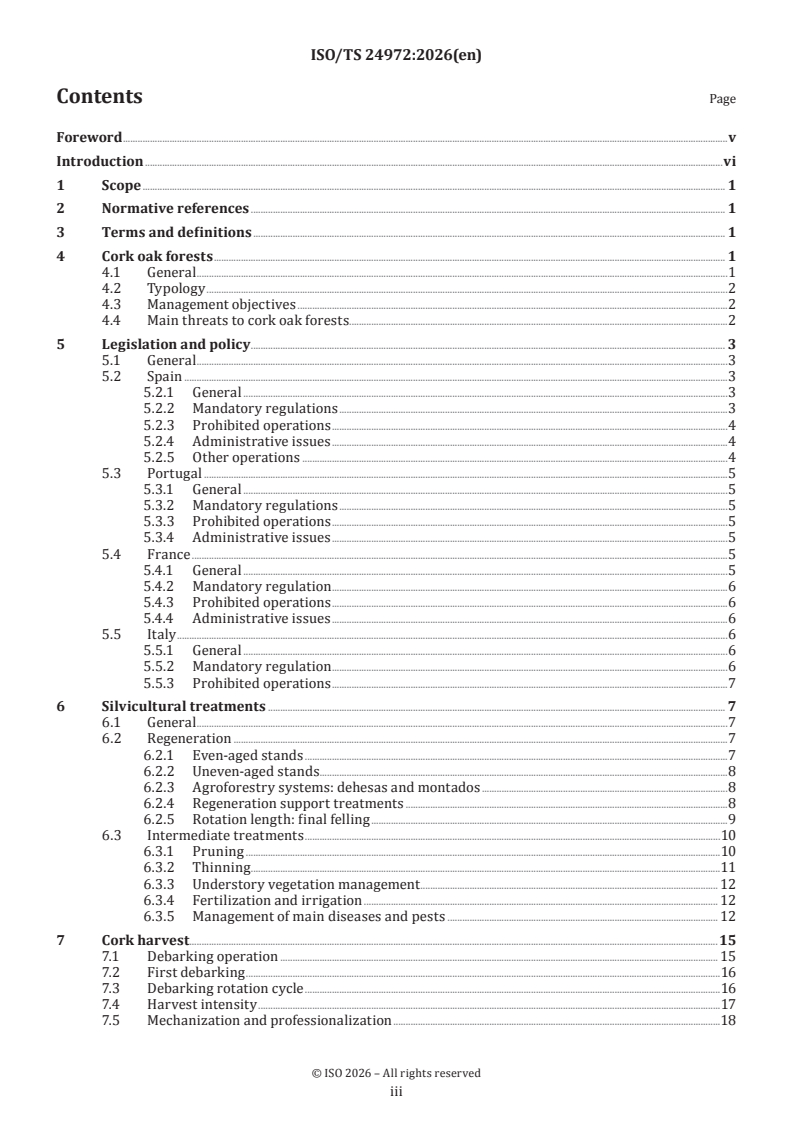
Contents Page
Foreword .v
Introduction .vi
1 Scope . 1
2 Normative references . 1
3 Terms and definitions . 1
4 Cork oak forests . 1
4.1 General .1
4.2 Typology .2
4.3 Management objectives .2
4.4 Main threats to cork oak forests.2
5 Legislation and policy . 3
5.1 General .3
5.2 Spain .3
5.2.1 General .3
5.2.2 Mandatory regulations .3
5.2.3 Prohibited operations .4
5.2.4 Administrative issues .4
5.2.5 Other operations .4
5.3 Portugal .5
5.3.1 General .5
5.3.2 Mandatory regulations .5
5.3.3 Prohibited operations .5
5.3.4 Administrative issues .5
5.4 France .5
5.4.1 General .5
5.4.2 Mandatory regulation .6
5.4.3 Prohibited operations .6
5.4.4 Administrative issues .6
5.5 Italy .6
5.5.1 General .6
5.5.2 Mandatory regulation .6
5.5.3 Prohibited operations .7
6 Silvicultural treatments . 7
6.1 General .7
6.2 Regeneration .7
6.2.1 Even-aged stands .7
6.2.2 Uneven-aged stands . .8
6.2.3 Agroforestry systems: dehesas and montados .8
6.2.4 Regeneration support treatments .8
6.2.5 Rotation length: final felling .9
6.3 Intermediate treatments .10
6.3.1 Pruning .10
6.3.2 Thinning .11
6.3.3 Understory vegetation management . 12
6.3.4 Fertilization and irrigation . 12
6.3.5 Management of main diseases and pests . 12
7 Cork harvest.15
7.1 Debarking operation . 15
7.2 First debarking .16
7.3 Debarking rotation cycle .16
7.4 Harvest intensity .17
7.5 Mechanization and professionalization .18
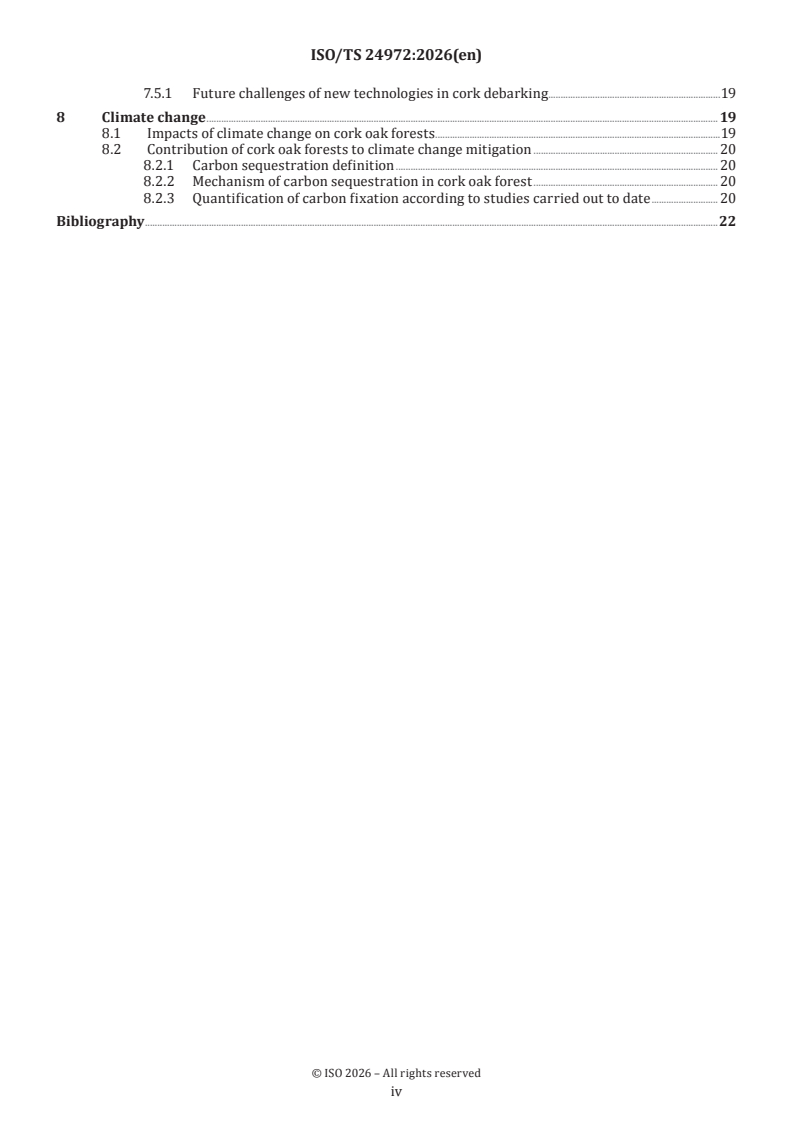
iii
7.5.1 Future challenges of new technologies in cork debarking .19
8 Climate change . 19
8.1 Impacts of climate change on cork oak forests .19
8.2 Contribution of cork oak forests to climate change mitigation . 20
8.2.1 Carbon sequestration definition . 20
8.2.2 Mechanism of carbon sequestration in cork oak forest . 20
8.2.3 Quantification of carbon fixation according to studies carried out to date . 20
Bibliography .22
iv
Foreword
ISO (the International Organization for Standardization) is a worldwide federation of national standards
bodies (ISO member bodies). The work of preparing International Standards is normally carried out through
ISO technical committees. Each member body interested in a subject for which a technical committee
has been established has the right to be represented on that committee. International organizations,
governmental and non-governmental, in liaison with ISO, also take part in the work. ISO collaborates closely
with the International Electrotechnical Commission (IEC) on all matters of electrotechnical standardization.
The procedures used to develop this document and those intended for its further maintenance are described
in the ISO/IEC Directives, Part 1. In particular, the different approval criteria needed for the different types
of ISO document should be noted. This document was drafted in accordance with the editorial rules of the
ISO/IEC Directives, Part 2 (see www.iso.org/directives).
ISO draws attention to the possibility that the implementation of this document may involve the use of (a)
patent(s). ISO takes no position concerning the evidence, validity or applicability of any claimed patent
rights in respect thereof. As of the date of publication of this document, ISO had not received notice of (a)
patent(s) which may be required to implement this document. However, implementers are cautioned that
this may not represent the latest information, which may be obtained from the patent database available at
www.iso.org/patents. ISO shall not be held responsible for identifying any or all such patent rights.
Any trade name used in this document is information given for the convenience of users and does not
constitute an endorsement.
For an explanation of the voluntary nature of standards, the meaning of ISO specific terms and expressions
related to conformity assessment, as well as information about ISO's adherence to the World Trade
Organization (WTO) principles in the Technical Barriers to Trade (TBT), see www.iso.org/iso/foreword.html.
This document was prepared by Technical Committee ISO/TC 87, Cork.
Any feedback or questions on this document should be directed to the user’s national standards body. A
complete listing of these bodies can be found at www.iso.org/members.html.
v
Introduction
Cork oak forests are the basis of cork value chain, one of the most relevant within the Mediterranean forest
area. Cork is a very important forest product whose economic activities are efficient in the use of resources
and are integrated into the circular economy and the bioeconomy. Cork production constitutes a basic
source of income in these forests being their main use. However, they are also efficiently exploited for acorn
production, cattle grazing, firewood and hunting. Cork oak forests are valuable reservoirs of biodiversity
and play a key role in the maintenance of other natural resources, such as soils, air and water, as well as,
contribute significantly to the rural development of the areas, and ecosystem services such as carbon
sequestration.
The ISO Technical Committee 87 (TC 87) deals with the standardization of cork, both raw material and
manufactured products. According with its business plan (ISO, 2005), one of the expected benefits of the
work developed by the TC 87 is to promote cork oak plantations and protect the existing cork oak forest in
order to increase cork production. Therefore, in 2010 the Working Group 15 (WG 15) was created with the
main aim of tackle the topic of sustainable management of cork oak forests.
This document has been developed to inform and aid the sustainable management of cork oak forests, by
giving management guidelines for protecting cork oak forest while allowing appropriate use of the resources.
It describes practices mainly focus on cork production while promoting cork oak forest regeneration,
multiple benefits and mitigating global change. The document also points out practices which should be
avoided or that are forbidden. The information given in this document could be also used for assessing
future development of cork oak forests under different management scenarios as a guidance on how trade-
offs between different forest functions should be dealt with.
The target audience for this document are landowners and forest managers, but it can also be useful for other
stakeholders of the cork value chain. Since there could be readers without a basic knowledge of forestry, an
effort has been made for explaining the basic concepts related to forest management.
It must be highlighted that this document is not a standard. There are standards about forest management
available at international and national level developed by FSC (Forest Stewardship Council) and PEFC
(Programme for the Endorsement of Forest Certification). Regarding ISO, the related currently available
standard is the ISO 14055-1 about environmental management.
vi
Technical Specification ISO/TS 24972:2026(en)
Cork — Sustainable management in cork oak (Quercus suber
L.) forests
1 Scope
This document provides guidance to manage cork oak forests in a sustainable way.
This document provides orientation for protecting cork oak forest while allowing appropriate use of the
resources. It describes practices mainly focused on cork production while promoting cork oak forest
regeneration, multiple benefits and mitigating global change. This document also points out practices to
avoid or that are forbidden. The information given in this document can be also used for assessing future
development of cork oak forests under different management scenarios as a guidance on how trade-offs
between different forest functions should be dealt with.
2 Normative references
There are no normative references in this document.
3 Terms and definitions
No terms and definitions are listed in this document.
ISO and IEC maintain terminology databases for use in standardization at the following addresses:
— ISO Online browsing platform: available at https:// www .iso .org/ obp
— IEC Electropedia: available at http:// www .electropedia .org/
4 Cork oak forests
4.1 General
Cork oak forests and woodlands can only be found in the western Mediterranean basin, mainly in the Iberian
Peninsula (Portugal and Spain), being also important in other two European countries: Italy and France, and
[1]
in three northern African countries: Morocco, Algeria and Tunisia. Altogether more than 2 million ha are
cover by cork oak stands, although the area is not known with exactitude and the natural distribution area
[2]
of the species is even more extent .
From an ecological point of view, the cork oak is a climax species, meaning that remain unchanged in terms
of species composition for as long as the site remains undisturbed, and its seedlings present a moderate
[3]
tolerance to develop and grow in the shade of the parent trees. It shares its natural distribution area
with other Mediterranean Quercus stands, mainly holm oak (Quercus ilex L.). Cork oak forests are located
between sea level and 800 m, rarely appearing at higher altitudes. They require a mild oceanic climate, with
average annual rainfall of between 600 mm and 1 000 mm, with average annual temperatures around 15 °C.
[4]
The main limitation for the presence of cork oak forests is the number of days of frost and its intensity.
As for the substrate, its calcifugous character characterizes the cork oak, although it can be found in basic
[4]
substrates generally washed. In addition, it prefers a sandy or loose soil texture .
4.2 Typology
Two types of forest can be distinguished in cork oak stands, fundamentally based on their density but also
[5]
on their ecological, productive and forestry characteristics: woodlands and cork oak forests .
The cork oak woodlands are savannah-type forests, with a sparse tree cover approximately 20 to 100 trees
per hectare, a 10 % to 50 % fraction of canopy covered, and with a well-developed herbaceous layer. In these
stands, pastoral use (acorns and/or pasture) is combined, both by domestic and wild cattle, with cork use.
[6]
These two productions are made compatible and prioritized by regulating tree density. This system is
located mainly in the west and southwest of the Iberian Peninsula where is called ‘montado’ in Portugal and
[7]
"dehesa" in Spain, and also can be found in Sardinia .
The cork oak forests have a higher density of trees than woodlands and an important understory composed
of, among others, Arbutus unedo L., Phillyrea latifolia L., Cistus sp., Erica sp., etc. The main use is cork, so the
[6]
management of these stands is aimed at optimizing cork production. This system is distributed mainly in
the northeast and the very south of the Iberian Peninsula, in North Africa and in the rest of the distribution
area.
4.3 Management objectives
Cork is a renewable resource, and as such it is inexhaustible, as long as it is managed in a sustainable way.
Sustainable forest management is based on extracting income (growth) without affecting natural capital
(stocks). This means that conditions necessary to favour regeneration should be created for maintaining an
adequate number of trees per hectare.
In sustainable forest management, various ecosystem services, i.e. benefits that people obtain from
forests, need to be considered. Cork oak forests of any kind provide multiple goods and services including
economic, ecological and social benefits. Besides cork, pasture and acorns, cork oak forests can provide
firewood, hunting, mushrooms, beekeeping and understory plants. The economic activity linked to these
goods contributes significantly to rural development by generating productive fabric and employment in the
territories where cork oak grows. Furthermore, they fulfil an important ecological function by regulating
climate and water, controlling erosion, sequestering carbon and sustaining biodiversity. They also provide
cultural services being the frame for leisure activities.
The main goals of forest managements are production, protection, and/or recreation. The production-
focused management is often associated with capital investments and include treatments such as, thinning
to maximize growth, formative pruning to get a straight and smooth trunk and the treatments applied for the
establishment and tending of plantations, i.e. fertilization, irrigation, site preparation, control of competition,
and planting of genetically improved stock. The protection-focused management has lower impacts, as well
as costs and economic returns, and include treatments for preserving biodiversity and habitats, improving
forest carbon balance, promoting hydrological and soil protection and preventing from forest fires. The
recreation-focused management include treatments to accelerate the growth of large diameter trees or for
developing recreational access or infrastructures. These main goals are not exclusive and can be compatible
in the same stand by choosing specific management objectives. For example, biodiversity conservation or
the improvement of carbon balance can be compatible with cork production.
4.4 Main threats to cork oak forests
The main threats that cork oak forests face are the following, ranked by importance:
[8]
— Climate change: it is affecting the natural regeneration capacity of the cork oak forests, it is less and
less frequent that a good weather year coincides with a good acorn harvest and that, moreover, the cork
oaks born from these acorns get rid of the tooth of the cattle or of other circumstance. This threat is
further treated in Clause 4.
— Phytosanitary problems: the main one is the disease caused by Phytophthora, an exotic pathogen that
is endangering numerous areas of cork oak forests. There are also other problems such as attacks by
cerambycids, defoliators, borers and cork shingles, which, without endangering the life of the tree,
[9]
depreciate the cork considerably .
— Aged forests: in most of the cork oak forest territory, the youngest age classes are missing and the forest
[6][10]
age class structure is skewed towards older age classes, close to the end of the rotation .
[11]
— Shortage of workers: specialized in cork oak forest management and specifically in cork debarking.
There are fewer and fewer skilled workers for cork debarking, and few regions such as Andalusia have
training initiatives taken place in this regard, but the number of new-trained workers is very low.
[12]
— Forest fires: large fires are occurring with increasing frequency and sometimes affect cork oak areas.
Although cork oak forests are naturally adapted to fires, effective active prevention is necessary.
— Human pressure: on many occasions, the degradation of cork oak forests has its origin in bad silvicultural
practices that are mainly applied due to ignorance far more than bad faith. Examples of these bad
practices are harrowing with heavy machinery and pruning of adult trees. In addition, excessive human
[13]
pressure leads to degradation, for example livestock overload .
5 Legislation and policy
5.1 General
In this clause a summarize of the legislation and policy of the European cork producing countries is showed.
5.2 Spain
5.2.1 General
In Spain, the regulation of cork oak forestry, especially cork removal, is covered by regional regulations:
— In Andalusia (AND) Order of September 26, 1988, by which instructions are given for the execution of
certain works in forests, in a private regime, populated with holm oaks and cork oaks.
— In Extremadura (Junta de Extremadura): Law of the Dehesa of 1986 and decree 134/2019 which
regulates the performance of certain forestry actions in the area of the Autonomous Community of
Extremadura and the Registers of Cooperatives, Companies and Forest Industries and Protection Forests
of Extremadura.
— In Catalonia (CAT): Order of May 11, 1988, on the regulation of the production of cork and the improvement
of cork oak forests.
— In Castilla-La Mancha (CLM): Order of March 9, 2011 approving special specifications of technical-
facultative conditions, for the regulation of the execution of forest exploitation (timber and wood,
including forest biomass, and cork).
5.2.2 Mandatory regulations
— First cork debarking: circumference at breast height >65 cm (70 cm in EXT) and debarking coefficient <2
(see 7.4 for debarking coefficient definition).
— Second cork debarking: debarking coefficient <2,5 (all regions).
— Third cork debarking and onwards: debarking coefficient <3 (all regions).
— Minimum branch perimeter: 65 cm for AND, CAT and CLM; 60 cm for EXT.
— Gradual debarking: a cork oak is debarked in two or more times, several years apart. (The portion of cork
removed each time is called mesa in Spain): prohibited in AND; each debarking separated at least 3 years
in EXT.
— Partial and punctual brush clearing around the cork oak to be debarked (AND, CAT, optional CLM).
— Phytosanitary precautions:
— Cork oaks affected by external circumstances that have caused their extreme weakening should
not be debarked (EXT).
— After stripping the trees attacked by the fungus Biscogniauxia mediterranea, the axes and cutting
instruments used should be disinfected to avoid the transmission of the disease to unaffected
trees (AND).
— The trees affected by diseases will be uncorked separately from the rest and with special
attention to tools disinfection (EXT).
— The tools used for debarking and applying silvicultural treatments in cork oak forests affected
by fungi of the genera Biscogniauxia, Phytophtora and Diplodia, will be disinfected with a
solution of 50 % ferrous sulphate or other suitable products (CAT).
— Cork debarking period defined for the following periods:
— Andalusia and CLM: June 1 to September 1.
— Extremadura: May 15 to August 15.
— Catalonia: May 15 to October 30.
— Minimum period of debarking rotation for one tree:
— Andalusia: 9 years.
— Extremadura: (9 to15) years.
— Catalonia: (12 to 16) years.
— Castilla-La Mancha: 10 years.
5.2.3 Prohibited operations
— Cork debarking when is cannot be easily separated from the tree.
— Damaging the mother-cell layer.
— Cork debarking on rainy or windy days (AND, EXT, CLM).
— Leaving cork pieces in the base of the trunk above the roots (zapatas) (AND, CAT, CLM).
— Hitting with the reverse of the axe (AND, CLM).
— Cork debarking on the roots (AND, CAT, CLM).
— Cork debarking on trees pruned less than 3 years ago (EXT, CLM).
5.2.4 Administrative issues
— Prior notification to the administration (AND and EXT, usual cork debarking; CLM and CAT, cork oak
forests with management plan).
— Authorization request (AND and EXT, sometimes for cork debarking; CLM and CAT, cork oak forests
without management plan).
— Final inspection by forest agents (all regions).
5.2.5 Other operations
— References to mechanized uncorking (EXT).
5.3 Portugal
5.3.1 General
Cork debarking in Portugal is regulated by Decree-Law no. 169/2001.
5.3.2 Mandatory regulations
— First cork debarking: circumference at breast height >70 cm and debarking coefficient <2 (see 7.4 for
debarking coefficient definition).
— Second cork debarking: debarking coefficient <2,5.
— Third cork debarking and onwards: debarking coefficient<3.
— Minimum branch perimeter allowed for debarking: 70 cm.
— Gradual debarking: a cork oak is debarked in two or more times, several years apart. (The portion of cork
removed each time is called "meça" in Portugal): prohibited from 2030.
— It is mandatory to mark the tree with the last number of the year in which it was debarked.
— Cork debarking period: when the cork is easily separated from the tree, from May to August.
— Minimum debarking rotation allowed: 9 years.
— Owners are responsible for maintaining cork oak forests in good vegetative conditions through active
management and proper exploitation.
5.3.3 Prohibited operations
— Pruning is not authorized in principle, being allowed only when it improves the productive characteristics.
In this case, this operation must be carried out between November 1 and March 31, and it cannot be done
two seasons before the debarking year or in the two following ones.
— Deep soil movements that affect trees root systems or those that cause destruction of natural regeneration.
— Mechanical soil mobilizations on slopes greater than 25 %.
— Interventions that eliminate or remove the surface soil layer.
— It is forbidden to damage the mother-cell layer during cork debarking.
5.3.4 Administrative issues
— It is required an authorization when cork debarking for the first time.
— Compulsory to carry out the cork production declaration to Instituto da Conservação da Natureza e
Florestas (ICNF), broken down into three cork classes: virgin cork, secondary cork and reproduction or
mature cork ("amadia").
5.4 France
5.4.1 General
In France, 100 % of public cork oak forests and numerous of private ones are PEFC certified, which has a
specific standard for cork oak forests and cork.
5.4.2 Mandatory regulation
— First cork debarking: circumference at breast height >70 cm and <200 cm, and coefficient <1,5 (see 7.4
for debarking coefficient definition).
— Second cork debarking and onwards: debarking coefficient <2.
— Minimum branch perimeter allowed for debarking: 70 cm.
— Minimum cork thickness allowed for debarking: 30 mm.
— Cork debarking period defined from sunrise to 2:00 p.m. for the following periods:
— For Aquitaine: from July 15 to August 31, and can be extended from June 15 to September 15,
depending on seasonal or climatic conditions.
— For Corsica, Languedoc and PACA: from June 1 to August 15, and can be extended from May 15 to
August 31, depending on seasonal or climatic conditions.
— Minimum period of debarking rotation for one tree:
— 10 years in Aquitaine and Corsica.
— 12 years in Languedoc and PACA.
5.4.3 Prohibited operations
— It is forbidden to damage the mother-cell layer during cork debarking.
— Cork debarking on rainy or windy days or during prolonged drought periods.
— Leaving cork pieces in the base of the trunk above the roots.
— For the task of scratching (making vertical and horizontal cuts in cork) is not allowed the use of a
conventional chainsaw. This task cannot be done immediately after debarking.
5.4.4 Administrative issues
Cork oak forests larger than 25 ha must have a simple management plan.
5.5 Italy
5.5.1 General
Uncorking is regulated in Italy by LEGGE 18 luglio 1956, n. 759 Coltivazione, difesa e sfruttamento della
sughera.
5.5.2 Mandatory regulation
— First cork debarking: circumference at breast height >60 cm and coefficient <2 (see 7.4 for debarking
coefficient definition).
— Second cork debarking: debarking coefficient <2,5.
— Third cork debarking and onwards: debarking coefficient <3.
— Minimum neck perimeter allowed for debarking: 45 cm.
— Cork debarking period defined May 15 to August 31.
5.5.3 Prohibited operations
— Cutting cork oaks without authorization.
— Pruning when the tree can be harmed.
— Agricultural crops and pastures without authorization.
— Make fire between June and October.
6 Silvicultural treatments
6.1 General
Silvicultural treatments are those practices applied at the scale of forest stands to achieve the management
objectives. The key to effective forest management planning is determining a silvicultural system, which is
a scheduled program of silvicultural treatments designed to achieve specific stand structure characteristics
[14]
to meet management objectives during the whole life of a stand. Although these systems are typically
described by the method and organization of felling and regeneration employed, the entire silvicultural
[15]
system involves also the intermediate treatments. There are four main silvicultural systems. The
clearcutting system, which consists in cutting the entire stand at one time and naturally or artificially
regenerate. The seed-tree system is like clearcutting, but with some larger or mature trees left to provide
seed for establishing a new stand. These seed trees can be removed at a later date. The shelterwood systems
consists in removing most of the trees in two or more cuttings for allowing new seedling to grow up under
a shelterwood of maturing trees. The system is characterized by a preparatory cut (optional), seeding cut(s)
which create gaps for regeneration, and the final cut after regeneration is established. Finally, the selection
system requires individual or groups of trees to be harvested to make space for natural regeneration. The
clearcutting, seed-tree, and shelterwood systems produce even-aged stands of primarily one age class
(assuming seed trees and shelterwood trees are eventually removed). The selection system produces even-
aged stands of several to many age classes.
In the case of cork oak forests, besides felling, regeneration and intermediate treatments, it should be
included the organization of cork harvesting, which adds complexity to the traditional timber-oriented
management systems.
The choice of a silvicultural system would depend on the existing stands conditions, such as cork oak forest
type, trees features (age, size and health) and site conditions (site quality, slope, aspect, stand density, soil,
climate, proximity to industries and access for use), but also on the ability to make the investments needed
in each system. The term site refers to a geographic location that is considered homogeneous in terms of its
physical and biological environment. In forestry, site quality is defined as the location’s potential to sustain
[16] [17][18]
tree growth, and it is usually measured by the site index .
6.2 Regeneration
The main aim of management is to ensure long term sustainability and persistence of cork oak forests by
guaranteeing regeneration. The regeneration period is the time between the initial regeneration cutting and
the successful re-establishment of a new age class by natural means, planting, or direct seeding. In order to
facilitate management and if the forest area is large, the first step would be divided the land into suitable
management units or compartments. The definition of management units should be based in variables
determinant for tree growth and forest management such as soil, topography and the site productivity. The
size of compartments should vary with the management objectives, total forest area and the diversity of
[19]
forest types, soils and topography .
6.2.1 Even-aged stands
[3]
Taking into account that cork oak shows moderate shade tolerance, the most appropriate silvicuture
system for producing even-aged cork oak forests is shelterwood. This system can be applied as uniform
shelterwood to the whole stand at the same time, or as group shelterwood where gaps are created in the
stand. It can be implemented for the regeneration of existing cork oak stands, or the implementation of new
ones by changing tree species composition. In both cases, the establishment of young cork oak trees takes
advantage of the adult trees shade and microsite conditions provided by them. Cuttings are carried out in
[20]
the autumn-winter after cork debarking. The number of cuts to carry out and the number of trees that
can be cut in each of them will depend on stand density at the beginning of the regeneration period. Thus,
the preparatory cuts will only be carried out when the density is very high. The goal after the final cut is to
leave a few good cork-producing trees. The number of years of the regeneration period should be a multiple
of the duration of the cork rotation, not only for practical reasons, but also for making coincide the first cork
debarking, with the last cork harvest carried out in the good cork-producing trees which would be cut in the
[21]
following year .
6.2.2 Uneven-aged stands
Most of the cork oak forests that have not been under active management present an uneven distribution of
ages with a heterogeneous aggregation pattern from tree-by-tree mixtures to a mosaic of even-aged groups.
The most appropriate silviculture system in uneven-aged cork oak forests is tree selection, which consists
in making selective regeneration cuts during a determined period and a determined area. The duration of
that period will be the same as the cork debarking rotation. Therefore, every year after each cork harvest,
regeneration cuts will be carried out with a selective criterion in all diameter classes (DC) in an area equal
to the compartment area (or the whole area if the stand is small) multiplied by the cork debarking rotation
[21]
and divided by the cutting cycle. The cutting cycle is the planned interval between partial cuttings in an
[22]
uneven-aged stand .
[23]
As a general rule, the following considerations should be taken into account :
— The number of trees that can be cut is variable according to the frequency of interventions. The
recommendation is to leave a basal area above (20 to 25) m under cork per hectare.
— The following dimensional groups should be well represented: juveniles (DC < 20 cm, young adults
(DC 20 cm to 30 cm) and adults in full production (DC > 30 cm).
— Given that continuous regeneration is a necessary condition, the youngest group is especially important,
since it determines recruitment and ensures the stand continuous improvement. In addition, if a fire
occurs, juveniles would allow the cork oak forest management to be restarted.
— The proportion of trees in full production should be as large as possible without compromising the
uneven-aged character of the stand.
6.2.3 Agroforestry systems: dehesas and montados
The management to be carried out to ensure regeneration in woodlands is fundamentally based on dividing
it into equal size parts, so that there is always a part of the stand fenced to prevent livestock from accessing
[24]
it. The number of parts will be equal to the quotient of the number of years of the cutting cycle divided
by the regeneration period. The duration of the regeneration period will be equal to the period of time that
it takes for the cork oaks located in the fenced part to reach enough height to prevent them from losing the
aerial part due to livestock browsing. This time lapse will vary depending on livestock type and site quality.
An alternative to fencing the regeneration compartment would be to protect trees individually using
treeshelters or guards. This option has the advantages that is compatible with livestock use, understory
vegetation management could be done by grazing and trees are easier to locate. However, it could be costly
for large areas.
6.2.4 Regeneration support treatments
Due to the aforementioned particular characteristics of cork oak natural regeneration, it is necessary to carry
out treatments for guaranteeing a minimum density that ensure stand persistence and the achievement of
management objectives. These treatments are:
— Soil scarification: this operation is done by harrowing. It aims to reduce soil compaction of the upper
layers in order to increase water infiltration and tree root development and establishment. It should
only be done occasionally, and restricted to sites with little slope and never on the line of maximum
slope, and the implements should be disinfected to prevent pathogen propagation. It is very important
to highlight that it should never be done under the canopy of adult cork oaks since when it is done only
up to 20 cm deep causes about 40 % loss of root volume, limit water absorption capacity and weaken the
[25]
tree, which facilitates the entry of diseases. This practice also increases the rate of soil organic matter
decomposition of the upper soil layers and for this reason showed be restricted to specific conditions.
— Fencing for containing livestock in regeneration areas: the period would depend on livestock type and
site quality. The re-opening to grazing will be done gradually in early autumn and spring when grass is
abundant and fresh.
— Individual protection for young plants: it is recommended the use of thorny wire mesh shelters, a cheap
adaptation of the classic tree guards wire mesh which is efficient, long-lasting and cost-efficient because
of the lower need of thermo-mechanically-treated iron bars. The use of refuges done by stacki
...