


ISO/FDIS 14577-2
(Main)Metallic materials — Instrumented indentation test for hardness and materials parameters — Part 2: Verification and calibration of testing machines
Metallic materials — Instrumented indentation test for hardness and materials parameters — Part 2: Verification and calibration of testing machines
ISO 14577-2:2015 specifies the method of verification and calibration of testing machines for carrying out the instrumented indentation test in accordance with ISO 14577‑1:2015. It describes a direct verification method for checking the main functions of the testing machine and an indirect verification method suitable for the determination of the repeatability of the testing machine. There is a requirement that the indirect method be used in addition to the direct method and for the periodic routine checking of the testing machine in service. It is a requirement that the indirect method of verification of the testing machine be carried out independently for each test method. ISO 14577-2:2015 is also applicable for transportable testing machines.
Matériaux métalliques — Essai de pénétration instrumenté pour la détermination de la dureté et de paramètres des matériaux — Partie 2: Vérification et étalonnage des machines d'essai
L'ISO 14577-2:2015 spécifie la méthode de vérification et d'étalonnage des machines d'essai destinées à la réalisation de l'essai de pénétration instrumenté conformément à l'ISO 14577‑1:2015. Elle décrit une méthode de vérification directe pour contrôler les fonctions principales de la machine d'essai et une méthode de vérification indirecte appropriée pour la détermination de la répétabilité de la machine d'essai. Il est exigé que la méthode indirecte soit utilisée en sus de la méthode directe et pour le contrôle de routine périodique de la machine d'essai en service. Il est exigé que la méthode indirecte de vérification de la machine d'essai soit réalisée de façon indépendante pour chaque méthode d'essai. L'ISO 14577-2:2015 est également applicable aux machines d'essai transportables.
General Information
- Status
- Not Published
- Technical Committee
- ISO/TC 164/SC 3 - Hardness testing
- Drafting Committee
- ISO/TC 164/SC 3 - Hardness testing
- Current Stage
- 5020 - FDIS ballot initiated: 2 months. Proof sent to secretariat
- Start Date
- 21-Jan-2026
- Completion Date
- 21-Jan-2026
Relations
- Effective Date
- 12-Feb-2026
- Effective Date
- 25-Jun-2022
Overview
ISO/FDIS 14577-2, titled "Metallic materials - Instrumented indentation test for hardness and materials parameters - Part 2: Verification and calibration of testing machines," is an international standard published by ISO aimed at ensuring accurate and reliable operation of instrumented indentation testing systems. This part of the ISO 14577 series focuses specifically on the verification and calibration of testing machines used for instrumented indentation hardness testing, as described in ISO 14577-1.
The standard specifies both direct and indirect verification methods to validate the performance of indentation hardness testing machines. Proper application of this standard guarantees repeatability, accuracy, and consistency in indentation measurements of metallic materials, thereby supporting quality assurance in metallurgical testing and materials science.
Key Topics
Scope and Purpose
ISO 14577-2 applies to all machines performing instrumented indentation tests on metallic materials per ISO 14577-1. This includes both stationary and transportable testing machines.Direct Verification and Calibration
This method involves detailed and traceable calibration of:- The test force, calibrated at multiple points across the full force range using nationally traceable standards (e.g., ISO 376 compliant force-proving instruments).
- The displacement measuring device, with calibration done at multiple depths to ensure precise depth measurement resolution.
- The machine compliance (conformity), which characterizes the machine’s elastic deformation under load.
- The indenter's geometry and area function, critical for accurate hardness and material parameter determination.
- The testing cycle, including controlled application, holding, and removal of force without shock or vibration.
Indirect Verification
Designed to assess the repeatability and stability of the machine's performance during routine use, this method is a mandatory complement to direct verification and is recommended for periodic checks.Environmental and Installation Requirements
To minimize measurement uncertainties, the testing machine should be installed in an environment free of significant vibrations, air currents, and temperature fluctuations, particularly for micro- and nano-indentation tests.Calibration Intervals and Routine Checks
The standard defines appropriate intervals for direct verification, indirect verification, and routine machine checks to maintain measurement fidelity over time.
Applications
ISO/FDIS 14577-2 is applied primarily in the fields of:
Metallurgical and Materials Testing Laboratories
Ensuring that instrumented indentation machines produce reliable hardness and material parameter data aligned with international traceable standards.Quality Control in Manufacturing
Verification and calibration methodologies enable manufacturers to certify material hardness and mechanical properties during production and before delivery.Research and Development
Precise calibration supports advanced material characterizations, including studies involving micro- and nano-scale deformation mechanisms.Field and Portable Testing
Calibration protocols are also defined for transportable indentation testing equipment, enhancing in-situ material property verification capabilities.
Related Standards
ISO 14577-2 should be used in conjunction with other standards in the ISO 14577 series and related documents:
- ISO 14577-1: Specifies the instrumented indentation test method for hardness and materials parameters - the primary testing procedure standard.
- ISO 14577-3: Covers calibration of reference blocks for indentation testing to ensure standardization of test materials.
- ISO 376: Defines calibration methods for force-proving instruments used in uniaxial testing machines, important for traceable test force calibration.
Other referenced standards and resources include:
- ISO/IEC Directives: Guidance on the development and maintenance of ISO standards.
- National metrology institutes: For traceability of measurement instruments and reference standards.
By adhering to ISO/FDIS 14577-2, organizations can ensure that their instrumented indentation hardness testing machines deliver quantitatively accurate, repeatable, and internationally comparable data. This enhances confidence in hardness testing results, critical for material certification, compliance, and innovation in metallic materials engineering.
Buy Documents


ISO/FDIS 14577-2 - Metallic materials — Instrumented indentation test for hardness and materials parameters — Part 2: Verification and calibration of testing machines Released:7. 01. 2026

REDLINE ISO/FDIS 14577-2 - Metallic materials — Instrumented indentation test for hardness and materials parameters — Part 2: Verification and calibration of testing machines Released:7. 01. 2026

ISO/FDIS 14577-2 - Matériaux métalliques — Essai de pénétration instrumenté pour la détermination de la dureté et de paramètres des matériaux — Partie 2: Vérification et étalonnage des machines d'essai
Get Certified
Connect with accredited certification bodies for this standard

Element Materials Technology
Materials testing and product certification.

Inštitut za kovinske materiale in tehnologije
Institute of Metals and Technology. Materials testing, metallurgical analysis, NDT.
Sponsored listings
Frequently Asked Questions
ISO/FDIS 14577-2 is a draft published by the International Organization for Standardization (ISO). Its full title is "Metallic materials — Instrumented indentation test for hardness and materials parameters — Part 2: Verification and calibration of testing machines". This standard covers: ISO 14577-2:2015 specifies the method of verification and calibration of testing machines for carrying out the instrumented indentation test in accordance with ISO 14577‑1:2015. It describes a direct verification method for checking the main functions of the testing machine and an indirect verification method suitable for the determination of the repeatability of the testing machine. There is a requirement that the indirect method be used in addition to the direct method and for the periodic routine checking of the testing machine in service. It is a requirement that the indirect method of verification of the testing machine be carried out independently for each test method. ISO 14577-2:2015 is also applicable for transportable testing machines.
ISO 14577-2:2015 specifies the method of verification and calibration of testing machines for carrying out the instrumented indentation test in accordance with ISO 14577‑1:2015. It describes a direct verification method for checking the main functions of the testing machine and an indirect verification method suitable for the determination of the repeatability of the testing machine. There is a requirement that the indirect method be used in addition to the direct method and for the periodic routine checking of the testing machine in service. It is a requirement that the indirect method of verification of the testing machine be carried out independently for each test method. ISO 14577-2:2015 is also applicable for transportable testing machines.
ISO/FDIS 14577-2 is classified under the following ICS (International Classification for Standards) categories: 77.040.10 - Mechanical testing of metals. The ICS classification helps identify the subject area and facilitates finding related standards.
ISO/FDIS 14577-2 has the following relationships with other standards: It is inter standard links to FprEN ISO 14577-2, ISO 14577-2:2015. Understanding these relationships helps ensure you are using the most current and applicable version of the standard.
ISO/FDIS 14577-2 is available in PDF format for immediate download after purchase. The document can be added to your cart and obtained through the secure checkout process. Digital delivery ensures instant access to the complete standard document.
Standards Content (Sample)
FINAL DRAFT
International
Standard
ISO/TC 164/SC 3
Metallic materials — Instrumented
Secretariat: BSI
indentation test for hardness and
Voting begins on:
materials parameters —
2026-01-21
Part 2:
Voting terminates on:
2026-03-18
Verification and calibration of
testing machines
Matériaux métalliques — Essai de pénétration instrumenté pour
la détermination de la dureté et de paramètres des matériaux —
Partie 2: Vérification et étalonnage des machines d'essai
RECIPIENTS OF THIS DRAFT ARE INVITED TO SUBMIT,
WITH THEIR COMMENTS, NOTIFICATION OF ANY
RELEVANT PATENT RIGHTS OF WHICH THEY ARE AWARE
AND TO PROVIDE SUPPOR TING DOCUMENTATION.
IN ADDITION TO THEIR EVALUATION AS
BEING ACCEPTABLE FOR INDUSTRIAL, TECHNO-
ISO/CEN PARALLEL PROCESSING LOGICAL, COMMERCIAL AND USER PURPOSES, DRAFT
INTERNATIONAL STANDARDS MAY ON OCCASION HAVE
TO BE CONSIDERED IN THE LIGHT OF THEIR POTENTIAL
TO BECOME STAN DARDS TO WHICH REFERENCE MAY BE
MADE IN NATIONAL REGULATIONS.
Reference number
FINAL DRAFT
International
Standard
ISO/TC 164/SC 3
Metallic materials — Instrumented
Secretariat: BSI
indentation test for hardness and
Voting begins on:
materials parameters —
Part 2:
Voting terminates on:
Verification and calibration of
testing machines
Matériaux métalliques — Essai de pénétration instrumenté pour
la détermination de la dureté et de paramètres des matériaux —
Partie 2: Vérification et étalonnage des machines d'essai
RECIPIENTS OF THIS DRAFT ARE INVITED TO SUBMIT,
WITH THEIR COMMENTS, NOTIFICATION OF ANY
RELEVANT PATENT RIGHTS OF WHICH THEY ARE AWARE
AND TO PROVIDE SUPPOR TING DOCUMENTATION.
© ISO 2026
IN ADDITION TO THEIR EVALUATION AS
All rights reserved. Unless otherwise specified, or required in the context of its implementation, no part of this publication may
BEING ACCEPTABLE FOR INDUSTRIAL, TECHNO-
ISO/CEN PARALLEL PROCESSING
LOGICAL, COMMERCIAL AND USER PURPOSES, DRAFT
be reproduced or utilized otherwise in any form or by any means, electronic or mechanical, including photocopying, or posting on
INTERNATIONAL STANDARDS MAY ON OCCASION HAVE
the internet or an intranet, without prior written permission. Permission can be requested from either ISO at the address below
TO BE CONSIDERED IN THE LIGHT OF THEIR POTENTIAL
or ISO’s member body in the country of the requester.
TO BECOME STAN DARDS TO WHICH REFERENCE MAY BE
MADE IN NATIONAL REGULATIONS.
ISO copyright office
CP 401 • Ch. de Blandonnet 8
CH-1214 Vernier, Geneva
Phone: +41 22 749 01 11
Email: copyright@iso.org
Website: www.iso.org
Published in Switzerland Reference number
ii
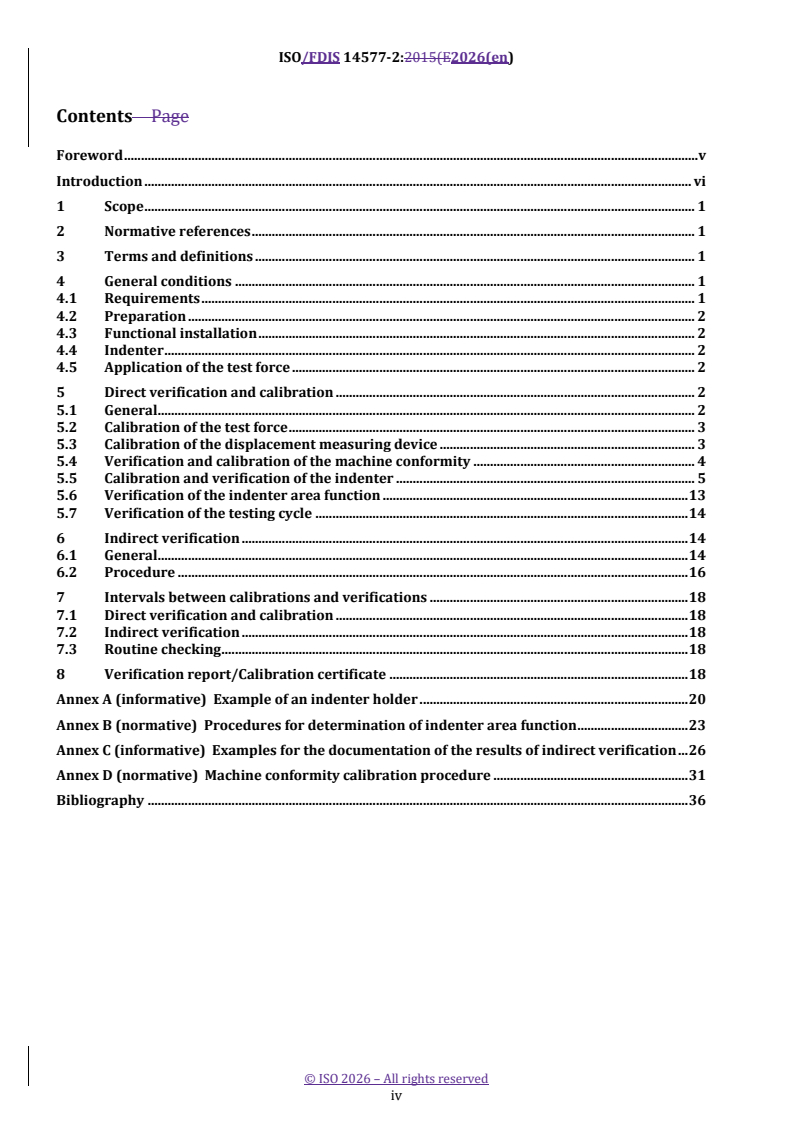
Contents Page
Foreword .iv
Introduction .v
1 Scope . 1
2 Normative references . 1
3 Terms and definitions . 1
4 General conditions . 1
4.1 Requirements .1
4.2 Preparation .2
4.3 Functional installation .2
4.4 Indenter . . .2
4.5 Application of the test force .2
5 Direct verification and calibration . . 2
5.1 General .2
5.2 Calibration of the test force .3
5.3 Calibration of the displacement measuring device .3
5.4 Verification and calibration of the machine conformity .4
5.4.1 General .4
5.4.2 Procedure .4
5.5 Calibration and verification of the indenter .5
5.5.1 General .5
5.5.2 Vickers indenter .6
5.5.3 Berkovich, modified Berkovich, and corner cube indenters .8
5.5.4 Ball indenters .8
5.5.5 Spheroconical indenters .9
5.6 Verification of the indenter area function .10
5.6.1 General .10
5.6.2 Procedure .10
5.7 Verification of the testing cycle .11
6 Indirect verification .11
6.1 General .11
6.2 Procedure . 12
7 Intervals between calibrations and verifications . 14
7.1 Direct verification and calibration .14
7.2 Indirect verification .14
7.3 Routine checking .14
8 Verification report/Calibration certificate . 14
Annex A (informative) Example of an indenter holder .15
Annex B (normative) Procedures for determination of indenter area function .16
Annex C (informative) Examples for the documentation of the results of indirect verification .18
Annex D (normative) Machine conformity calibration procedure .21
Bibliography .25
iii
Foreword
ISO (the International Organization for Standardization) is a worldwide federation of national standards
bodies (ISO member bodies). The work of preparing International Standards is normally carried out through
ISO technical committees. Each member body interested in a subject for which a technical committee
has been established has the right to be represented on that committee. International organizations,
governmental and non-governmental, in liaison with ISO, also take part in the work. ISO collaborates closely
with the International Electrotechnical Commission (IEC) on all matters of electrotechnical standardization.
The procedures used to develop this document and those intended for its further maintenance are described
in the ISO/IEC Directives, Part 1. In particular, the different approval criteria needed for the different types
of ISO document should be noted. This document was drafted in accordance with the editorial rules of the
ISO/IEC Directives, Part 2 (see www.iso.org/directives).
ISO draws attention to the possibility that the implementation of this document may involve the use of (a)
patent(s). ISO takes no position concerning the evidence, validity or applicability of any claimed patent
rights in respect thereof. As of the date of publication of this document, ISO had not received notice of (a)
patent(s) which may be required to implement this document. However, implementers are cautioned that
this may not represent the latest information, which may be obtained from the patent database available at
www.iso.org/patents. ISO shall not be held responsible for identifying any or all such patent rights.
Any trade name used in this document is information given for the convenience of users and does not
constitute an endorsement.
For an explanation of the voluntary nature of standards, the meaning of ISO specific terms and expressions
related to conformity assessment, as well as information about ISO's adherence to the World Trade
Organization (WTO) principles in the Technical Barriers to Trade (TBT), see www.iso.org/iso/foreword.html.
This document was prepared by Technical Committee ISO/TC 164, Mechanical testing of metals,
Subcommittee SC 3, Hardness testing, in collaboration with the European Committee for Standardization
(CEN) Technical Committee CEN/TC 459 Test methods for steel (other than chemical analysis),in accordance
with the Agreement on technical cooperation between ISO and CEN (Vienna Agreement).
This third edition cancels and replaces the second edition (ISO 14577-2:2015), which has been technically
revised.
The main changes are as follows:
— New procedure for indirect verification.
— New method 6 for machine conformity calibration.
— Replacement of tungsten carbide balls by balls in general.
A list of all parts in the ISO 14577 series can be found on the ISO website.
Any feedback or questions on this document should be directed to the user’s national standards body. A
complete listing of these bodies can be found at www.iso.org/members.html.
iv
Introduction
Hardness has typically been defined as the resistance of a material to permanent penetration by another
harder material. The results obtained when performing Rockwell, Vickers, and Brinell tests are determined
after the test force has been removed. Therefore, the effect of elastic deformation under the indenter has
been ignored.
[2]
ISO 14577 (all parts) has been prepared to enable the user to evaluate the indentation of materials by
considering both the force and displacement during plastic and elastic deformation. By monitoring the
complete cycle of increasing and removal of the test force, hardness values equivalent to traditional hardness
values can be determined. More significantly, additional properties of the material, such as its indentation
modulus and elasto-plastic hardness, can also be determined. All these values can be calculated without the
need to measure the indent optically. Furthermore, by a variety of techniques, the instrumented indentation
test allows to record hardness and modulus depth profiles within a, probably complex, indentation cycle.
ISO 14577 (all parts) has been written to allow a wide variety of post test data analysis.
Part 2 of ISO 14577 specifies the methods of verification and calibration of instrumented indentation testing
machines.
v
FINAL DRAFT International Standard ISO/FDIS 14577-2:2026(en)
Metallic materials — Instrumented indentation test for
hardness and materials parameters —
Part 2:
Verification and calibration of testing machines
1 Scope
This document specifies the method of verification and calibration of testing machines for carrying out the
instrumented indentation test in accordance with ISO 14577-1.
It specifies a direct verification method for verifying and calibrating the main functions of the testing
machine and an indirect verification method suitable for the determination of the repeatability of the testing
machine.
The methods in ISO 14577 are applicable to all systems that comply with the requirements of this part of
ISO 14577.
2 Normative references
The following documents are referred to in the text in such a way that some or all of their content constitutes
requirements of this document. For dated references, only the edition cited applies. For undated references,
the latest edition of the referenced document (including any amendments) applies.
ISO 376, Metallic materials — Calibration of force-proving instruments used for the verification of uniaxial
testing machines
ISO 14577-1, Metallic materials — Instrumented indentation test for hardness and materials parameters —
Part 1: Test method
ISO 14577-3, Metallic materials — Instrumented indentation test for hardness and materials parameters —
Part 3: Calibration of reference blocks
3 Terms and definitions
No terms and definitions are listed in this document.
ISO and IEC maintain terminology databases for use in standardization at the following addresses:
— ISO Online browsing platform: available at https:// www .iso .org/ obp
— IEC Electropedia: available at https:// www .electropedia .org/
4 General conditions
4.1 Requirements
There is the requirement that an indirect verification method be used in addition to the direct method and
for the periodic routine checking of the testing machine in service.
4.2 Preparation
The machine shall be designed in such a way that it can be verified.
Before verification and calibration of the testing machine, it shall be checked to ensure that the conditions
laid down in 4.3 to 4.5 are met.
4.3 Functional installation
The testing machine shall be configured to operate in conformity with and shall be installed in an
environment that meets the requirements of this document, ISO 14577-1, and, where applicable, ISO 14577-3.
The testing machine shall be protected from vibrations that would significantly affect the test results. For
testing in the micro and nano ranges, the testing machine shall also be protected from air currents and
temperature fluctuations (see ISO 14577-1:202X, 7.1).
The influence of environment on the data, i.e. the noise floor, shall be estimated by performing a low force
(e.g. equivalent to the usual initial contact force) indentation on a Certified Reference Material (CRM) and
analysing the displacement over time. The force variability is the indent stiffness (obtained from force
removal curve) multiplied by the standard deviation of the displacement once any background drift in
mean displacement has been subtracted. These uncertainties shall then be included in the total combined
uncertainty as calculated in ISO 14577-1:202X, Clause 4, Clause 8 and Annex H.
4.4 Indenter
In order to get repeatable measurements of the force/indentation depth data set, the indenter holder shall
be firmly mounted into the testing machine.
The indenter holder should be designed in such a way that its contribution to the overall conformity is
minimized (see Annex A).
4.5 Application of the test force
The test force shall be applied and removed without shock or vibration that can significantly affect the test
results. It shall be possible to verify the process of increasing, holding, and removal of the test force.
5 Direct verification and calibration
5.1 General
5.1.1 Direct verification and calibration shall be carried out at the temperature of use, which is typically
held at a stable value over the time of measurement in the range 10 °C to 35 °C, but preferably in the range
(23 ± 5) °C. If a range of operating temperatures is required, then direct calibration and verification should
be carried out at suitable points over that temperature range to determine the calibration validity as
a function of temperature. If necessary, a calibration correction function or a set of calibrations valid at
specific operating temperatures can be determined.
5.1.2 The instruments used for direct calibration and verification shall be traceable to National Standards
as far as available.
5.1.3 Direct verification and calibration involves
a) calibration of the test force,
b) calibration of the displacement measuring device,
c) verification and calibration of the machine conformity,
d) verification of the indenter,
e) calibration and verification of the indenter area function, if the indentation depth is less than 6 µm, and
f) verification of the test cycle.
5.2 Calibration of the test force
5.2.1 Each range of force used shall be calibrated over the whole force range for both application and
removal of the test force. A minimum of 16 evenly distributed points in the test force range shall be calibrated,
i.e. 16 during application and 16 during removal of the test force. The procedure shall be performed at least
three times. The average of all the measured values at each force point shall be used as the calibration value
for the machine. The difference between the force value from the testing machine and the force value from
the calibration device shall not exceed half of the tolerances given in Table 1.
5.2.2 The test force shall be measured by a traceable method, for example, one of the following:
a) measuring by means of an elastic proving-device in accordance with class 1, or better according to
ISO 376;
b) balancing against a force with an uncertainty ≤ 0,2 % applied by means of calibrated masses with
mechanical advantage;
c) electronic balance with an uncertainty ≤ 0,1 % of the minimum calibrated test force or 10 µg (0,1 µN)
for the nano range.
For each individual measured point used to calculate the calibration value, the difference between the
measured and the nominal test force shall be within the tolerances given in Table 1.
Table 1 — Tolerances for test forces
Range of the test force Tolerances
F
N %
F ≥ 2 1,0
0,001 ≤ F < 2 1,0
a
F < 0,001 2,5
a
For the nano range, a tolerance of 1 % is strongly recommended.
5.3 Calibration of the displacement measuring device
5.3.1 The resolution required for the displacement measuring device of the testing machine depends on
the size of the smallest indentation depth being measured. For the micro range, this value is by definition
h = 0,2 µm; for the macro range it is typically larger than 2 µm.
The scale of the displacement measuring device shall be graduated to permit a resolution of indentation
depth measurement in accordance with Table 2.
5.3.2 The displacement measuring device of the testing machine shall be calibrated for every range used
by means of a suitable method and a corresponding system traceable to SI. The device shall be calibrated at
a minimum of 16 points in each direction evenly distributed throughout its indentation displacement range.
The procedure shall be performed three times.
Some testing machines have a long-stroke displacement measuring device where the location of the
indentation range of the displacement measuring device varies to suit the sample. For these types of
machines, it shall be verified that the calibration is valid in accordance with Table 2 for all of the used
measurement positions in the travel range.
The following methods are recommended for the measurement of the relative displacement of the indenter:
laser interference method, inductive method, capacitive method, and piezotranslator method.
The calibration device shall have an uncertainty of ≤ 0,2 % in the displacement measurement in the applied
measurement range.
For each measured point used for calibration, the difference between the measured and the nominal
displacement shall be within the tolerances given in Table 2.
Table 2 — Resolution and tolerances of the displacement measuring device
Resolution of the displacement meas-
Range of application uring device Tolerances
nm
Macro ≤100 1 % of h
Micro ≤10 1 % of h
a
Nano ≤1 2 nm
a
For the nano range, a tolerance of <1 % of h (displacement of the measuring device) is strongly recommended.
5.3.3 Changes in temperature are commonly a dominant source of displacement drift. To minimize
thermally induced displacement drift, the temperature of the instrument shall be maintained such that the
displacement drift rate remains constant over the time period of one calibration cycle. The drift rate shall
be measured during, immediately before, or immediately after each calibration cycle, e.g. by monitoring
displacement during a suitable hold period. The displacement calibration data shall be corrected for thermal
drift and the product of variation in drift rate and the duration of one calibration cycle shall be less than
the tolerance given in Table 2. The drift rate uncertainty shall be included in the displacement calibration
uncertainty calculation.
5.4 Verification and calibration of the machine conformity
5.4.1 General
See normative Annex D and ISO 14577-1:202X, Annex C.
This verification and calibration shall be carried out after the test force and the displacement measuring
system have been calibrated in accordance with 5.2 and 5.3.
5.4.2 Procedure
The calibration and verification of machine conformity is carried out by the measurement of indentation
modulus at a minimum of five different test forces. Method 3 as specified in Annex D is recommended. In
all cases, a suitable Certified Reference Material (CRM) shall be mounted into the instrumented indentation
test system in the same way as future test samples will be mounted. This is to ensure that the CRM provides
a faithful reproduction of each particular total machine conformity.
The conformity of the testing machine can be affected by the particular construction and mounting of an
indenter and also the method used to mount a sample. For instance, mounting in plastics (e.g. PVC) can
introduce an extra conformity into the measurement loop. The verification and calibration of machine
conformity should be performed using the indenter that will be used for subsequent measurements.
For contact depths, h > 6 µm, it is not necessary to take into account the real contact area function. For the
c
verification and calibration of the machine conformity, a reference material with certified indentation
modulus, independent from the indentation depth, shall be used. The laboratory for the certification of the
reference material should be certified according to ISO 17025 (Ref [4]). A material with a high ratio of
EH/ (such as tungsten) is recommended. The range for the test force is defined by the minimum test
IT IT
force that correlates to 6 µm contact depth and the maximum possible test force of the testing machine.
Large indentation depths have the advantage that errors in the area function are likely to be smaller;
however, care shall be taken that the test is not biased by pile-up in the reference material. The measured
conformity of the indentation shall then be compared with the calculated conformity for the indentation
using the certified value of modulus. To recalibrate machine conformity, the product of the applied force and
the detected difference in machine conformity is applied to the displacement data to refine the estimate of
contact depth and, therefore, the machine conformity estimate at each force. This process is iterated until
self-consistent values of machine conformity and contact depth are reached.
For contact depths, ≤ 6 µm, the method above shall be applied, except that the actual area of contact, as
calculated from the calibrated indenter area function, shall be used to calculate the contact conformity
using the certified modulus of the CRM.
In many nano and micro range instruments, the machine conformity value is independent of force. However,
if this is not the case, then a machine conformity function may be determined using the above procedure
over a wider range of forces. The range for the test forces is defined by the indentation depths, >0,5 µm, and
the maximum test force of the testing machine or the maximum test force for which no unusual test piece
response (e.g. pile-up of metals or cracking of ceramics or glasses) occurs.
If the machine conformity is recalibrated, then an indirect validation shall be performed before use.
The calibration procedures detailed in the normative Annex D require the use of reference materials (see
ISO 14577-3) that shall be isotropic and homogeneous. It is assumed that the indentation modulus and
Poisson’s ratio are independent of the indentation depth.
5.5 Calibration and verification of the indenter
5.5.1 General
The indenter used for the indentation test shall be calibrated traceable to SI. This requirement may be
satisfied by a calibration certificate from a qualified calibration laboratory or by the user following the
verification methods described in Annex B using suitable certified reference materials.
Over time indenters can change shape. Evidence that the indenter continues to conform with the requirements
of this part of ISO 14577 is fulfilled by evidence that the indenter passes an indirect verification over the
operating range of indentation depth. This may be provided using the verification methods described in
Annex B and suitable certified reference materials.
The indenter shall meet the following requirements:
— The material shall be homogeneous and fully dense;
— The elastic modulus and Poisson ratio of the indenter material shall be known;
— The indenter shall be significantly harder than the sample material. The indenter should have a higher
elastic modulus than the sample material.
— The indenter geometry shall conform to the requirements of this standard
If the angle of the indenter deviates from the nominal value for an ideal geometry of the indenter, the average
of certified angles for that indenter should be used in all applicable calculations at contact depths h > 6 µm.
c
NOTE An error of 0,2° in the Vickers angle of 136° (2α) results in a 1 % systematic error in area.
Indenters for use in the nano range and in the micro range shall have their area function calibrated over
the relevant indentation depth ranges of use. The indenter performance shall be verified periodically (see
Clause 6).
Where non-diamond indenters are used, the values of elastic modulus and Poisson ratio shall be obtained
and used instead of the diamond values in the appropriate analyses.
The angle for pyramidal and conical indenters shall be measured within the indentation depth ranges given
in Table 3 and illustrated in Figure 1.
Table 3 — Values for the measuring ranges for the angle of pyramidal and conical indenters
Dimensions in micrometres
Indentation depth Macro range Micro range
h 6 0,2
Specified max. indenta-
h 200
tion depth
Figure 1 — Illustration of measuring ranges given in Table 3
5.5.2 Vickers indenter
5.5.2.1 The four faces of the right square-based diamond pyramid shall be smooth and free from surface
defects and contaminants that significantly alter the area function. For notes on cleaning of the indenter
surface, see also ISO 14577-1:202X, Annex D.
The surface roughness of the indenter has a similar effect on measurement uncertainty as test piece
roughness. When testing in the nano range, the indenter surface finish should be taken into consideration.
5.5.2.2 The angle between the opposite faces of the vertex of the diamond pyramid shall be 136° ± 0,3°
(see Figure 2) (α = 68,0° ± 0,2°).
The angle shall be measured in the range between h and h (see Table 3 and Figure 1). The geometry and
1 2
finish of the indenter shall be controlled over the whole calibrated indentation depth range, i.e. from the
indenter tip, h , to the maximum calibrated indentation depth, h .
0 2
5.5.2.3 The angle between the axis of the diamond pyramid and the axis of the indenter holder (normal to
the seating surface) should not exceed 0,5°.
5.5.2.4 The four faces shall meet at a point. The maximum permissible length of the line of conjunction
between opposite faces is given in Table 4 (see also Figure 3).
5.5.2.5 The radius of the tip of the indenter shall not exceed 0,5 µm for the micro and nano range (see
Figure 4).
5.5.2.6 The verification of the shape of the indenter shall be carried out using microscopes or other
suitable devices. If the indenter is used for testing in the micro or nano range, a verification by a closed loop
controlled atomic-force-microscope (AFM) is recommended.
NOTE An area function derived by indentation in a certified reference material has high uncertainty in the nano
range.
Table 4 — Maximum permissible length of the line of conjunction
Range of the contact depth Maximum permissible length
of the line of conjunction
µm µm
h > 30 1
c
a
30 ≥ h > 6 0,5
c
b
h ≤ 6 ≤ 0,5
c
a
This can be assumed to have been achieved when there is no detectable conjunction when the indenter is verified by an
optical microscope at 400 × magnification.
b
This shall be included when the correction of the shape of the indenter is taken into account; see ISO 14577-1:202X, C.2.
Figure 2 — Angle of the Vickers diamond pyramid
a
Line of conjunction.
Figure 3 — Line of conjunction on the tip of the indenter — Schematic
Figure 4 — Radius of the tip of the indenter
5.5.3 Berkovich, modified Berkovich, and corner cube indenters
5.5.3.1 In practice, there are two types of Berkovich pyramidal diamond indenters in common use. The
Berkovich indenter (see Reference [5]) is designed to have the same surface area as a Vickers indenter at
any given indentation depth. The modified Berkovich indenter (see Reference [11]) is designed to have the
same projected area as the Vickers indenter at any given indentation depth. The most common Berkovich
geometry in use is the modified Berkovich indenter. This is often for convenience referred to as a “Berkovich”
indenter.
5.5.3.2 The three faces of the triangular based diamond pyramid shall be smooth and free from surface
defects and from contaminations that significantly alter the area function. For notes on cleaning of the
surface, see also ISO 14577-1:202X, Annex D.
The surface roughness of the indenter has a similar effect on measurement uncertainty as does test piece
roughness. When testing in the nano range, the indenter surface finish should be taken into consideration.
5.5.3.3 The radius of the tip of the indenter shall not exceed 0,5 µm for the micro range and shall not
exceed 0,2 µm for the nano range (see Figure 4).
5.5.3.4 The angle between the axis of the diamond pyramid and the three faces is designated α. The angle
between edges of the triangular base of the diamond pyramid shall be 60° ± 0,3° (see Figure 5).
a
α = 65,03° ± 0,30° for Berkovich indenter.
α = 65,27° ± 0,30° for modified Berkovich indenter.
α = 35,26° ± 0,30° for corner cube indenters.
Figure 5 — Angle of the Berkovich and corner cube indenters
NOTE The most common Berkovich geometry in use is the modified Berkovich indenter. This is often for
convenience referred to as a “Berkovich” indenter.
5.5.3.5 The verification of the shape of the indenter shall be carried out using microscopes or suitable
devices. If the indenter is used for testing in the micro and nano range, a measurement by a closed-loop
controlled atomic-force-microscope (AFM) is recommended.
NOTE An area function derived by indentation in a certified reference material has high uncertainty in the nano
range.
5.5.4 Ball indenters
The balls shall have a certified geometry. Batch certification methods are sufficient. The certificate shall
show the diameter of the average value of at least three measured points of different positions. If any value
differs from the permissible values of the nominal diameter (see Table 5), the ball (and/or the batch) shall
not be used as an indenter.
Table 5 — Tolerances for ball indenters
Dimensions in millimetres
Ball diameter Tolerance
10 ±0,005
5 ±0,004
2,5 ±0,003
1 ±0,003
0,5 ±0,003
5.5.5 Spheroconical indenters
The characteristics of spheroconical indenters shall be as given in Table 6 (see also Figure 6).
Table 6 — Tolerances for spheroconical indenters
Feature Tolerance
R ≤ 50 µm 0,4 R
av av
a
500 µm > R > 50 µm 0,2 R
av av
Cone included angle, 2α
a
120° 5°
90° 5°
60° 5°
Cone flank angle, α
60° 2,5°
45° 2,5°
30° 2,5°
a [1]
Rockwell diamond indenters (see ISO 6508-2) fulfil this requirement.
The centreline of the cone to the centreline of the mount shall be within 0,01 mm.
The instantaneous radius of curvature, R(h), of the spherical cap at any indentation depth, h, measured from
the point of first contact shall not vary by more than a factor of two from the average radius, R , as given by
av
the condition in Formula (1):
0,5 ≤ |R(h)/R | ≤ 2 (1)
av
Indentation analysis that requires an accurate radius shall use a radius function R(h ).
c
Indenters with a spherical tipped cone shape are useful for many applications. These indenters are normally
made from diamond but can also be made from other materials, e.g. ruby, sapphire, or hardmetal (WC-Co
cemented carbide). If Hertzian contact mechanics are being used to interpret the indentation response, the
value used for the indenter radius is critical. It is, therefore, recommended that the shape of each indenter
be determined directly by a suitable measurement system, or indirectly by indentation into a certified
reference material.
Surface roughness, Ra, should be minimized. Roughness causes an uncertainty in the actual area of contact
and in the definition of the first contact point of the indenter with the test piece. Asperities have radii of
contact vastly different from the average radius of the spherical cap and, therefore, behave very differently.
If possible, the Ra of the diamond surface should be less than 1/20 of the usual indentation depth for an
indenter.
NOTE Geometry suggests that the depth of the spherical cap, h , on a cone of included angle, 2α, and radius, R , is
s av
given by Formula (2):
h = R [1 − sin(α)] (2)
s av
In practice, there is a gradual transition from spherical cap to cone geometry that is hard to specify. Given this and the
uncertainties in R and α allowed (see Table 6), caution should be exercised whenever the depth exceeds 0,5 h .
av s
a
α angle between the axis of the cone and its face.
h depth of the spherical cap.
s
h local depth.
R(h) local radius.
R radius of the spherical cap.
av
Figure 6 — Representation of the features of spheroconical indenters
5.6 Verification of the indenter area function
5.6.1 General
See ISO 14577-1:202X, Annex C.
5.6.2 Procedure
Procedures for the determination of indenter area function are given in Annex B.
The verification of the indenter area function consists of a comparison of the measured indenter area
function with a documented indenter area function determined for the newly certified and calibrated
indenter.
NOTE The indenter area function and machine conformity correction can be determined simultaneously using an
iterative procedure and multiple reference materials (see Reference [8]).
The indenter area function shall be recalibrated when the area function used for the measurement of a
reference material generates modulus results that deviate by more than 5 % from the specified reference
modulus value.
A pyramidal indenter shall no longer be used in the nano- or micro-ranges when the tip radius significantly
exceeds the respective values given in 5.5.2 and 5.5.3. In the macro range the indenter should be discarded
when the face angle significantly deviates from the respective values given in 4.5.2 and 4.5.3.
A ball or spherical indenter shall be discarded when the calibrated tip radius deviates more than 3 times the
specified tip radius tolerances in table 5 and 6.
5.7 Verification of the testing cycle
The testing machine shall be able to acquire data with a valid time stamp. The testing cycle (application of
the test force, holding of the maximum test force, and removal of the test force) shall be measured with a
tolerance not greater than 0,1 s. The duration of each part of the testing cycle during the experiment shall
meet the requirements of ISO 14577-1.
6 Indirect verification
6.1 General
Indirect verification shall be carried out at the temperature of use by means of reference blocks calibrated for
elastic modulus using non-indentation methods in accordance with ISO 14577-3 and within the temperature
range for which the calibration of the reference blocks is valid, typically (23 ± 5) °C. Indirect verification
using a reference material shall be made to ensure the direct verification is valid and that no damage or
contamination has occurred to the indenter tip.
Before measuring on the reference block, it is recommended to inspect and clean the indenter first using the
procedure recommended in ISO 14577-1:202X, Annex D. If the results of these initial indentations indicate
the presence of contamination or damage, then the indenter should be cleaned again before further trial
indentations are made. If after further cleaning, indentation into the reference material still indicates the
presence of contamination or damage, then inspection with an optical microscope at a magnification of
400x is recommended. Detection of sub-microscopic damage or contamination is possible using appropriate
microscopy of indents or the indenter. Where damage is detected, the indenter shall be replaced.
For an indirect validation decision tree, see Figure 7. The procedures for the determination of the machine
conformity, C , and the area function, A (h ), calibration/verification shall be implemented before a new
F p,UL c
indenter is used. If, after applying the currently valid correction for machine conformity and indentation
area function (obtained using a variable epsilon and a radial displacement correction, ISO 14577-1:202X,
Annex I), a measured value from a reference block deviates from the certified value of the test piece by
more than the maximum permissible amount of the limits specified in Table 7 (see Note 2) and repetition
of the procedure using a newly verified and certified indenter and valid machine conformity correction
corresponding to that indenter) also fails to reproduce the certified value, the testing machine shall be
serviced and a full, direct calibration be performed.
NOTE 1 The use of control charts is a sensitive way to determine changes in performances before a control limit is
breached (see Annex C).
Figure 7 — Flow chart of decisions and actions to be taken for indirect verification
NOTE 2 A reference indenter is a calibrated indenter used infrequently and only for checking the instrument and
test indenter performance through indirect validation comparison.
6.2 Procedure
6.2.1 Indirect verification shall be carried out on at least one reference block of a CRM. It is highly
recommended to use two reference blocks, and the certified values of these blocks differ significantly, e.g.
by a factor of two. The indirect verification shall be carried out at two or more test forces that are an order
of magnitude different or at le
...
ISO/TC 164/SC 3 1347
Date: 2025-07-02
ISO/DIS 14577-2:2025(en)
ISO/TC 164/SC 3
Secretariat: DIN BSI
Date: 2026-01-06
Metallic materials — Instrumented indentation test for hardness and
materials parameters —
Part 2:
Verification and calibration of testing machines
Matériaux métalliques — Essai de pénétration instrumenté pour la détermination de la dureté et de
paramètres des matériaux — Partie 2: Vérification et étalonnage des machines d'essai
Partie 2: Vérification et étalonnage des machines d'essai
ThiThiThiThiThiThis drs drs drs drs drs drafafafafafaft is t is t is t is t is t is submitted tsubmitted tsubmitted tsubmitted tsubmitted tsubmitted toooooo a a a a a a p p p p p parallel arallel arallel arallel arallel arallel vovovovovovote in ISOte in ISOte in ISOte in ISOte in ISOte in ISO, CE, CE, CE, CE, CE, CEN.N.N.N.N.N.
FDIS stage
ISO/DISFDIS 14577-2:20252026(en)
All rights reserved. Unless otherwise specified, or required in the context of its implementation, no part of this publication
may be reproduced or utilized otherwise in any form or by any means, electronic or mechanical, including photocopying,
or posting on the internet or an intranet, without prior written permission. Permission can be requested from either ISO
at the address below or ISO'sISO’s member body in the country of the requester.
ISO Copyright Officecopyright office
CP 401 • Ch. de Blandonnet 8
CH-1214 Vernier, Geneva
Phone: + 41 22 749 01 11
Email: E-mail: copyright@iso.org
Website: www.iso.org
Published in Switzerland.
iii
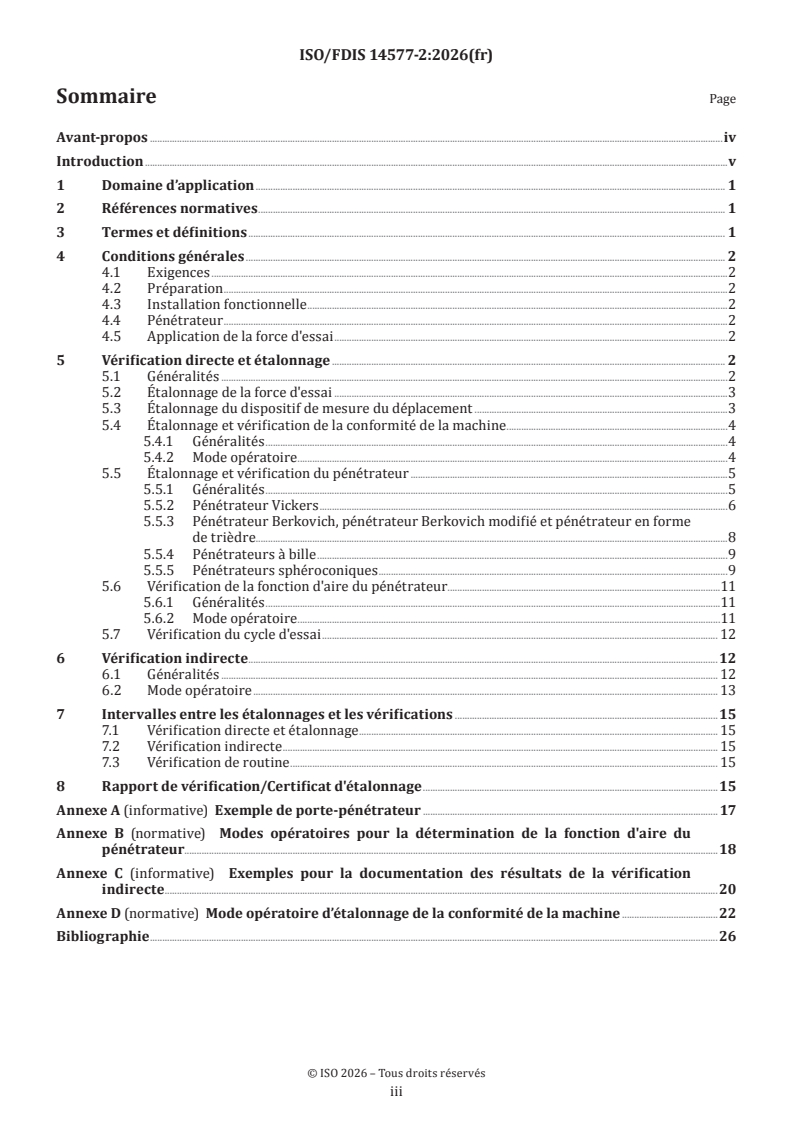
Contents Page
Foreword . v
Introduction . vi
1 Scope . 1
2 Normative references . 1
3 Terms and definitions . 1
4 General conditions . 1
4.1 Requirements . 1
4.2 Preparation . 2
4.3 Functional installation . 2
4.4 Indenter . 2
4.5 Application of the test force . 2
5 Direct verification and calibration . 2
5.1 General . 2
5.2 Calibration of the test force . 3
5.3 Calibration of the displacement measuring device . 3
5.4 Verification and calibration of the machine conformity . 4
5.5 Calibration and verification of the indenter . 5
5.6 Verification of the indenter area function . 13
5.7 Verification of the testing cycle . 14
6 Indirect verification . 14
6.1 General . 14
6.2 Procedure . 16
7 Intervals between calibrations and verifications . 18
7.1 Direct verification and calibration . 18
7.2 Indirect verification . 18
7.3 Routine checking . 18
8 Verification report/Calibration certificate . 18
Annex A (informative) Example of an indenter holder . 20
Annex B (normative) Procedures for determination of indenter area function . 23
Annex C (informative) Examples for the documentation of the results of indirect verification . 26
Annex D (normative) Machine conformity calibration procedure . 31
Bibliography . 36
iv
ISO/DISFDIS 14577-2:20252026(en)
Foreword
ISO (the International Organization for Standardization) is a worldwide federation of national standards
bodies (ISO member bodies). The work of preparing International Standards is normally carried out through
ISO technical committees. Each member body interested in a subject for which a technical committee has been
established has the right to be represented on that committee. International organizations, governmental and
non-governmental, in liaison with ISO, also take part in the work. ISO collaborates closely with the
International Electrotechnical Commission (IEC) on all matters of electrotechnical standardization.
The procedures used to develop this document and those intended for its further maintenance are described
in the ISO/IEC Directives, Part 1. In particular, the different approval criteria needed for the different types of
ISO document should be noted. This document was drafted in accordance with the editorial rules of the
ISO/IEC Directives, Part 2 (see www.iso.org/directives).
ISO draws attention to the possibility that the implementation of this document may involve the use of (a)
patent(s). ISO takes no position concerning the evidence, validity or applicability of any claimed patent rights
in respect thereof. As of the date of publication of this document, ISO had not received notice of (a) patent(s)
which may be required to implement this document. However, implementers are cautioned that this may not
represent the latest information, which may be obtained from the patent database available at
www.iso.org/patents. ISO shall not be held responsible for identifying any or all such patent rights.
Any trade name used in this document is information given for the convenience of users and does not
constitute an endorsement.
For an explanation of the voluntary nature of standards, the meaning of ISO specific terms and expressions
related to conformity assessment, as well as information about ISO's adherence to the World Trade
Organization (WTO) principles in the Technical Barriers to Trade (TBT), see www.iso.org/iso/foreword.html.
This document was prepared by Technical Committee ISO/TC 164, Mechanical testing of metals,
Subcommittee SC 3, Hardness testing., in collaboration with the European Committee for Standardization
(CEN) Technical Committee CEN/TC 459 Test methods for steel (other than chemical analysis),in accordance
with the Agreement on technical cooperation between ISO and CEN (Vienna Agreement).
This third edition cancels and replaces the second edition (ISO 14577--2:2015), which has been technically
revised.
The main changes are as follows:
— New procedure for indirect verification.
— New method 6 for machine complianceconformity calibration.
— Replacement of tungsten carbide balls by balls in general.
A list of all parts in the ISO 14577 series can be found on the ISO website.
Any feedback or questions on this document should be directed to the user’s national standards body. A
complete listing of these bodies can be found at www.iso.org/members.html.
v
Introduction
Hardness has typically been defined as the resistance of a material to permanent penetration by another
harder material. The results obtained when performing Rockwell, Vickers, and Brinell tests are determined
after the test force has been removed. Therefore, the effect of elastic deformation under the indenter has been
ignored.
[ [2]]
ISO 14577 (all parts) Error! Reference source not found.) has been prepared to enable the user to
evaluate the indentation of materials by considering both the force and displacement during plastic and elastic
deformation. By monitoring the complete cycle of increasing and removal of the test force, hardness values
equivalent to traditional hardness values can be determined. More significantly, additional properties of the
material, such as its indentation modulus and elasto-plastic hardness, can also be determined. All these values
can be calculated without the need to measure the indent optically. Furthermore, by a variety of techniques,
the instrumented indentation test allows to record hardness and modulus depth profiles within a, probably
complex, indentation cycle.
ISO 14577 (all parts) has been written to allow a wide variety of post test data analysis.
Part 2 of ISO 14577 specifies the methods of verification and calibration of instrumented indentation testing
machines.
vi
DRAFT International Standard ISO/DIS 14577-2:2025(en)
Metallic materials — Instrumented indentation test offor hardness
and materials parameters —
Part 2:
Verification and calibration of testing machines
1 Scope
This document specifies the method of verification and calibration of testing machines for carrying out the
instrumented indentation test in accordance with ISO 14577--1.
It specifies a direct verification method for verifying and calibrating the main functions of the testing machine
and an indirect verification method suitable for the determination of the repeatability of the testing machine.
The methods in ISO 14577 are applicable to all systems that comply with the requirements of this part of ISO
14577.
2 Normative references
The following documents are referred to in the text in such a way that some or all of their content constitutes
requirements of this document. For dated references, only the edition cited applies. For undated references,
the latest edition of the referenced document (including any amendments) applies.
ISO 376, Metallic materials — Calibration of force-proving instruments used for the verification of uniaxial
testing machines
ISO 14577--1, Metallic materials — Instrumented indentation test for hardness and materials parameters —
Part 1: Test method
ISO 14577--3, Metallic materials — Instrumented indentation test for hardness and materials parameters —
Part 3: Calibration of reference blocks
3 Terms and definitions
No terms and definitions are listed in this document.
ISO and IEC maintain terminology databases for use in standardization at the following addresses:
— — ISO Online browsing platform: available at https://www.iso.org/obp
— — IEC Electropedia: available at https://www.electropedia.org/
4 General conditions
4.1 Requirements
There is the requirement that an indirect verification method be used in addition to the direct method and for
the periodic routine checking of the testing machine in service.
4.2 Preparation
The machine shall be designed in such a way that it can be verified.
Before verification and calibration of the testing machine, it shall be checked to ensure that the conditions laid
down in 4.34.3 to 4.54.5 are met.
4.3 Functional installation
The testing machine shall be configured to operate in conformity with and shall be installed in an environment
that meets the requirements of this document, ISO 14577--1, and, where applicable, ISO 14577--3. The testing
machine shall be protected from vibrations that would significantly affect the test results. For testing in the
micro and nano ranges, the testing machine shall also be protected from air currents and temperature
fluctuations (see ISO 14577-1:202X, 7.1).
The influence of environment on the data, i.e. the noise floor, shall be estimated by performing a low force (e.g.
equivalent to the usual initial contact force) indentation on a Certified Reference Material (CRM) and analysing
the displacement over time. The force variability is the indent stiffness (obtained from force removal curve)
multiplied by the standard deviation of the displacement once any background drift in mean displacement has
been subtracted. These uncertainties shall then be included in the total combined uncertainty as calculated in
ISO 14577--1:202X, Clause 4, Clause 8 and Annex H.
4.4 Indenter
In order to get repeatable measurements of the force/indentation depth data set, the indenter holder shall be
firmly mounted into the testing machine.
The indenter holder should be designed in such a way that its contribution to the overall
complianceconformity is minimized (see Annex AAnnex A).).
4.5 Application of the test force
The test force shall be applied and removed without shock or vibration that can significantly affect the test
results. It shall be possible to verify the process of increasing, holding, and removal of the test force.
5 Direct verification and calibration
5.1 General
5.1.1 5.1.1 Direct verification and calibration shall be carried out at the temperature of use, which is
typically held at a stable value over the time of measurement in the range 10 °C to 35 °C, but preferably in the
range (23 ± 5) °C. If a range of operating temperatures is required, then direct calibration and verification
should be carried out at suitable points over that temperature range to determine the calibration validity as a
function of temperature. If necessary, a calibration correction function or a set of calibrations valid at specific
operating temperatures can be determined.
5.1.2 5.1.2 The instruments used for direct calibration and verification shall be traceable to National
Standards as far as available.
5.1.3 5.1.3 Direct verification and calibration involves
a) a) calibration of the test force,
b) b) calibration of the displacement measuring device,
c) c) verification and calibration of the machine complianceconformity,
ISO/DISFDIS 14577-2:20252026(en)
d) d) verification of the indenter,
e) e) calibration and verification of the indenter area function, if the indentation depth is less than
6 µm, and
f) f) verification of the test cycle.
5.2 Calibration of the test force
5.2.1 5.2.1 Each range of force used shall be calibrated over the whole force range for both application and
removal of the test force. A minimum of 16 evenly distributed points in the test force range shall be calibrated,
i.e. 16 during application and 16 during removal of the test force. The procedure shall be performed at least
three times. The average of all the measured values at each force point shall be used as the calibration value
for the machine. The difference between the force value from the testing machine and the force value from the
calibration device shall not exceed half of the tolerances given in 0Table 1. .
5.2.2 5.2.2 The test force shall be measured by a traceable method, for example, one of the following:
a) a) measuring by means of an elastic proving-device in accordance with class 1, or better
according to ISO 376;
b) b) balancing against a force with an uncertainty ≤ 0,2 % applied by means of calibrated masses
with mechanical advantage;
c) c) electronic balance with an uncertainty ≤ 0,1 % of the minimum calibrated test force or 10 µg
(0,1 µN) for the nano range.
For each individual measured point used to calculate the calibration value, the difference between the
measured and the nominal test force shall be within the tolerances given in 0Table 1.
Table 1 — Tolerances for test forces
Range of the test force Tolerances
F
N %
F ≥ 2 1,0
0,001 ≤ F < 2 1,0
a
F < 0,001 2,5
a For the nano range, a tolerance of 1 % is strongly recommended.
5.3 Calibration of the displacement measuring device
5.3.1 5.3.1 The resolution required for the displacement measuring device of the testing machine depends
on the size of the smallest indentation depth being measured. For the micro range, this value is by definition
h = 0,2 µm; for the macro range it is typically larger than 2 µm.
The scale of the displacement measuring device shall be graduated to permit a resolution of indentation depth
measurement in accordance with 0Table 2.
5.3.2 5.3.2 The displacement measuring device of the testing machine shall be calibrated for every range
used by means of a suitable method and a corresponding system traceable to SI. The device shall be calibrated
at a minimum of 16 points in each direction evenly distributed throughout its indentation displacement range.
The procedure shall be performed three times.
Some testing machines have a long-stroke displacement measuring device where the location of the
indentation range of the displacement measuring device varies to suit the sample. For these types of machines,
it shall be verified that the calibration is valid in accordance with 0Table 2 for all of the used measurement
positions in the travel range.
The following methods are recommended for the measurement of the relative displacement of the indenter:
laser interference method, inductive method, capacitive method, and piezotranslator method.
The calibration device shall have an uncertainty of ≤ 0,2 % in the displacement measurement in the applied
measurement range.
For each measured point used for calibration, the difference between the measured and the nominal
displacement shall be within the tolerances given in 0Table 2.
Table 2 — Resolution and tolerances of the displacement measuring device
Resolution of the displacement
Range of application measuring device Tolerances
nm
Macro ≤100 1 % of h
Micro ≤10 1 % of h
a
Nano ≤1 2 nm
a For the nano range, a tolerance of <1 % of h (displacement of the measuring device) is strongly recommended.
5.3.3
5.3.45.3.3 5.3.3 Changes in temperature are commonly a dominant source of displacement drift.
To minimize thermally induced displacement drift, the temperature of the instrument shall be maintained
such that the displacement drift rate remains constant over the time period of one calibration cycle. The drift
rate shall be measured during, immediately before, or immediately after each calibration cycle, e.g. by
monitoring displacement during a suitable hold period. The displacement calibration data shall be corrected
for thermal drift and the product of variation in drift rate and the duration of one calibration cycle shall be less
than the tolerance given in 0Table 2. The drift rate uncertainty shall be included in the displacement
calibration uncertainty calculation.
5.4 Verification and calibration of the machine complianceconformity
5.4.1 General
See normative Annex DAnnex D and ISO 14577--1:202X, Annex C.
This verification and calibration shall be carried out after the test force and the displacement measuring
system have been calibrated in accordance with 5.25.2 and 5.35.3.
5.4.2 Procedure
The calibration and verification of machine complianceconformity is carried out by the measurement of
indentation modulus at a minimum of five different test forces. Method 3 as specified in Annex DAnnex D is
recommended. In all cases, a suitable Certified Reference Material (CRM) shall be mounted into the
instrumented indentation test system in the same way as future test samples will be mounted. This is to ensure
that the CRM provides a faithful reproduction of each particular total machine complianceconformity.
The complianceconformity of the testing machine can be affected by the particular construction and mounting
of an indenter and also the method used to mount a sample. For instance, mounting in plastics (e.g. PVC) can
introduce an extra complianceconformity into the measurement loop. The verification and calibration of
ISO/DISFDIS 14577-2:20252026(en)
machine complianceconformity should be performed using the indenter that will be used for subsequent
measurements.
For contact depths, h > 6 µm, it is not necessary to take into account the real contact area function. For the
c
verification and calibration of the machine complianceconformity, a reference material with certified
indentation modulus, independent from the indentation depth, shall be used. The laboratory for the
certification of the reference material should be certified according to ISO 17025 (Ref [Error! Reference
source not found. [4]).]). A material with a high ratio of 𝐸 ⁄ 𝐻 (such as tungsten) is recommended. The
√
IT IT
range for the test force is defined by the minimum test force that correlates to 6 µm contact depth and the
maximum possible test force of the testing machine. Large indentation depths have the advantage that errors
in the area function are likely to be smaller; however, care shall be taken that the test is not biased by pile-up
in the reference material. The measured complianceconformity of the indentation shall then be compared with
the calculated complianceconformity for the indentation using the certified value of modulus. To recalibrate
machine complianceconformity, the product of the applied force and the detected difference in machine
complianceconformity is applied to the displacement data to refine the estimate of contact depth and,
therefore, the machine complianceconformity estimate at each force. This process is iterated until self-
consistent values of machine complianceconformity and contact depth are reached.
For contact depths, ≤ 6 µm, the method above shall be applied, except that the actual area of contact, as
calculated from the calibrated indenter area function, shall be used to calculate the contact
complianceconformity using the certified modulus of the CRM.
In many nano and micro range instruments, the machine complianceconformity value is independent of force.
However, if this is not the case, then a machine complianceconformity function may be determined using the
above procedure over a wider range of forces. The range for the test forces is defined by the indentation
depths, >0,5 µm, and the maximum test force of the testing machine or the maximum test force for which no
unusual test piece response (e.g. pile-up of metals or cracking of ceramics or glasses) occurs.
If the machine complianceconformity is recalibrated, then an indirect validation shall be performed before
use.
The calibration procedures detailed in the normative Annex DAnnex D require the use of reference materials
(see ISO 14577--3) that shall be isotropic and homogeneous. It is assumed that the indentation modulus and
Poisson’s ratio are independent of the indentation depth.
5.5 Calibration and verification of the indenter
5.5.1 General
The indenter used for the indentation test shall be calibrated traceable to SI. This requirement may be satisfied
by a calibration certificate from a qualified calibration laboratory or by the user following the verification
methods described in Annex BAnnex B using suitable certified reference materials.
Over time indenters can change shape. Evidence that the indenter continues to complyconform with the
requirements of this part of ISO 14577 is fulfilled by evidence that the indenter passes an indirect verification
over the operating range of indentation depth. This may be provided using the verification methods described
in Annex BAnnex B and suitable certified reference materials.
The indenter shall meet the following requirements:
— — The material shall be homogeneous and fully dense;
— — The elastic modulus and Poisson ratio of the indenter material shall be known;
— — The indenter shall be significantly harder than the sample material. The indenter should have a higher
elastic modulus than the sample material.
— — The indenter geometry shall conform to the requirements of this standard
If the angle of the indenter deviates from the nominal value for an ideal geometry of the indenter, the average
of certified angles for that indenter should be used in all applicable calculations at contact depths h > 6 µm.
c
NOTE An error of 0,2° in the Vickers angle of 136° (2α) results in a 1 % systematic error in area.
Indenters for use in the nano range and in the micro range shall have their area function calibrated over the
relevant indentation depth ranges of use. The indenter performance shall be verified periodically (see
6Clause 6).).
Where non-diamond indenters are used, the values of elastic modulus and Poisson ratio shall be obtained and
used instead of the diamond values in the appropriate analyses.
The angle for pyramidal and conical indenters shall be measured within the indentation depth ranges given in
0Table 3 and illustrated in 0Figure 1.
Table 3 — Values for the measuring ranges for the angle of pyramidal and conical indenters
Dimensions in micrometres
Indentation depth Macro range Micro range
h 6 0,2
Specified max.
h 200
indentation depth
Figure 1 — Illustration of measuring ranges given in 0Table 3
ISO/DISFDIS 14577-2:20252026(en)
5.5.2 Vickers indenter
5.5.2.1 5.5.2.1 The four faces of the right square-based diamond pyramid shall be smooth and
free from surface defects and contaminants that significantly alter the area function. For notes on cleaning of
the indenter surface, see also ISO 14577--1:202X, Annex D.
The surface roughness of the indenter has a similar effect on measurement uncertainty as test piece
roughness. When testing in the nano range, the indenter surface finish should be taken into consideration.
5.5.2.2 5.5.2.2 The angle between the opposite faces of the vertex of the diamond pyramid
shall be 136° ± 0,3° (see 0Figure 2)) (α = 68,0° ± 0,2°).
The angle shall be measured in the range between h and h (see 0Table 3 and 0Figure 1).). The geometry and
1 2
finish of the indenter shall be controlled over the whole calibrated indentation depth range, i.e. from the
indenter tip, h , to the maximum calibrated indentation depth, h .
0 2
5.5.2.3 5.5.2.3 The angle between the axis of the diamond pyramid and the axis of the indenter
holder (normal to the seating surface) should not exceed 0,5°.
5.5.2.4 5.5.2.4 The four faces shall meet at a point. The maximum permissible length of the line
of conjunction between opposite faces is given in 0Table 4 (see also 0Figure 3).).
5.5.2.5 5.5.2.5 The radius of the tip of the indenter shall not exceed 0,5 µm for the micro and
nano range (see 0Figure 4).).
5.5.2.6 5.5.2.6 The verification of the shape of the indenter shall be carried out using
microscopes or other suitable devices. If the indenter is used for testing in the micro or nano range, a
verification by a closed loop controlled atomic-force-microscope (AFM) is recommended.
NOTE An area function derived by indentation in a certified reference material has high uncertainty in the nano
range.
Table 4 — Maximum permissible length of the line of conjunction
Range of the contact depth Maximum permissible length
of the line of conjunction
µm µm
h > 30 1
c
a
30 ≥ h > 6 0,5
c
b
hc ≤ 6 ≤ 0,5
a This can be assumed to have been achieved when there is no detectable conjunction when the indenter is verified by an optical
microscope at 400 × magnification.
b This shall be included when the correction of the shape of the indenter is taken into account; see ISO 14577--1:202X, C.2.
Figure 2 — Angle of the Vickers diamond pyramid
Key
a line of conjunction
a
Line of conjunction.
Figure 3 — Line of conjunction on the tip of the indenter — Schematic
ISO/DISFDIS 14577-2:20252026(en)
Figure 4 — Radius of the tip of the indenter
5.5.3 Berkovich, modified Berkovich, and corner cube indenters
5.5.3.1 5.5.3.1 In practice, there are two types of Berkovich pyramidal diamond indenters in
common use. The Berkovich indenter (see Reference [Error! Reference source not found.[5])]) is designed
to have the same surface area as a Vickers indenter at any given indentation depth. The modified Berkovich
indenter (see Reference [Error! Reference source not found.[11])]) is designed to have the same projected
area as the Vickers indenter at any given indentation depth. The most common Berkovich geometry in use is
the modified Berkovich indenter. This is often for convenience referred to as a “Berkovich” indenter.
5.5.3.2 5.5.3.2 The three faces of the triangular based diamond pyramid shall be smooth and
free from surface defects and from contaminations that significantly alter the area function. For notes on
cleaning of the surface, see also ISO 14577--1:202X, Annex D.
The surface roughness of the indenter has a similar effect on measurement uncertainty as does test piece
roughness. When testing in the nano range, the indenter surface finish should be taken into consideration.
5.5.3.3 5.5.3.3 The radius of the tip of the indenter shall not exceed 0,5 µm for the micro range
and shall not exceed 0,2 µm for the nano range (see 0Figure 4).).
5.5.3.4 5.5.3.4 The angle between the axis of the diamond pyramid and the three faces is
designated α. The angle between edges of the triangular base of the diamond pyramid shall be 60° ± 0,3° (see
0Figure 5).).
a
α = 65,03° ± 0,30° for Berkovich indenter.
α = 65,27° ± 0,30° for modified Berkovich indenter.
α = 35,26° ± 0,30° for corner cube indenters.
a
α = 65,03° ± 0,30° for Berkovich indenter.
α = 65,27° ± 0,30° for modified Berkovich indenter.
α = 35,26° ± 0,30° for corner cube indenters.
Figure 5 — Angle of the Berkovich and corner cube indenters
NOTE The most common Berkovich geometry in use is the modified Berkovich indenter. This is often for
convenience referred to as a “Berkovich” indenter.
5.5.3.5 5.5.3.5 The verification of the shape of the indenter shall be carried out using
microscopes or suitable devices. If the indenter is used for testing in the micro and nano range, a measurement
by a closed-loop controlled atomic-force-microscope (AFM) is recommended.
NOTE An area function derived by indentation in a certified reference material has high uncertainty in the nano
range.
5.5.4 Ball indenters
The balls shall have a certified geometry. Batch certification methods are sufficient. The certificate shall show
the diameter of the average value of at least three measured points of different positions. If any value differs
from the permissible values of the nominal diameter (see 0Table 5),), the ball (and/or the batch) shall not be
used as an indenter.
Table 5 — Tolerances for ball indenters
Dimensions in millimetres
Ball diameter Tolerance
10 ±0,005
5 ±0,004
2,5 ±0,003
1 ±0,003
0,5 ±0,003
5.5.5 Spheroconical indenters
The characteristics of spheroconical indenters shall be as given in 0Table 6 (see also 0Figure 6).).
ISO/DISFDIS 14577-2:20252026(en)
Table 6 — Tolerances for spheroconical indenters
Feature Tolerance
R ≤ 50 µm 0,4 R
av av
a
500 µm > R > 50 µm 0,2 R
av av
Cone included angle, 2α
a
120° 5°
90° 5°
60° 5°
Cone flank angle, α
60° 2.,5°
45° 2,5°
30° 2,5°
[ [1]
a Rockwell diamond indenters (see ISO 6508--2) Error! Reference source not found.)
]
fulfil this requirement.
The centreline of the cone to the centreline of the mount shall be within 0,01 mm.
The instantaneous radius of curvature, R(h), of the spherical cap at any indentation depth, h, measured from
the point of first contact shall not vary by more than a factor of two from the average radius, R , as given by
av
the condition in 0Formula (1)::
0,5 ≤ |R(h)/R | ≤ 2 (1)
av
Indentation analysis that requires an accurate radius shall use a radius function R(h ).
c
Indenters with a spherical tipped cone shape are useful for many applications. These indenters are normally
made from diamond but can also be made from other materials, e.g. ruby, sapphire, or hardmetal (WC-Co
cemented carbide). If Hertzian contact mechanics are being used to interpret the indentation response, the
value used for the indenter radius is critical. It is, therefore, recommended that the shape of each indenter be
determined directly by a suitable measurement system, or indirectly by indentation into a certified reference
material.
Surface roughness, Ra, should be minimized. Roughness causes an uncertainty in the actual area of contact
and in the definition of the first contact point of the indenter with the test piece. Asperities have radii of contact
vastly different from the average radius of the spherical cap and, therefore, behave very differently. If possible,
the Ra of the diamond surface should be less than 1/20 of the usual indentation depth for an indenter.
NOTE Geometry suggests that the depth of the spherical cap, h , on a cone of included angle, 2α, and radius, R , is
s av
given by 0Formula (2)::
h = R [1 − sin(α)] (2)
s av
In practice, there is a gradual transition from spherical cap to cone geometry that is hard to specify. Given this and the
uncertainties in R and α allowed (see 0Table 6),), caution should be exercised whenever the depth exceeds 0,5 h .
av s
a
α angle between the axis of the cone and its face.
h depth of the spherical cap.
s
h local depth.
R(h) local radius.
R radius of the spherical cap.
av
ISO/DISFDIS 14577-2:20252026(en)
a
α angle between the axis of the cone and its face.
hs depth of the spherical cap.
h local depth.
R(h) local radius.
Rav radius of the spherical cap.
Figure 6 — Representation of the features of spheroconical indenters
5.6 Verification of the indenter area function
5.6.1 General
See ISO 14577--1:202X, Annex C.
5.6.2 Procedure
Procedures for the determination of indenter area function are given in Annex BAnnex B.
The verification of the indenter area function consists of a comparison of the measured indenter area function
with a documented indenter area function determined for the newly certified and calibrated indenter.
NOTE The indenter area function and machine complianceconformity correction can be determined simultaneously
using an iterative procedure and multiple reference materials (see Reference [Error! Reference source not
found.[8]).]).
The indenter area function shall be recalibrated when the area function used for the measurement of a
reference material generates modulus results that deviate by more than 5 % from the specified reference
modulus value.
A pyramidal indenter shall no longer be used in the nano- or micro-ranges when the tip radius significantly
exceeds the respective values given in 5.5.25.5.2 and 5.5.35.5.3. In the macro range the indenter should be
discarded when the face angle significantly deviates from the respective values given in 4.5.2 and 4.5.3.
A ball or spherical indenter shall be discarded when the calibrated tip radius deviates more than 3 times the
specified tip radius tolerances in 0table 5 and 06.
5.7 Verification of the testing cycle
The testing machine shall be able to acquire data with a valid time stamp. The testing cycle (application of the
test force, holding of the maximum test force, and removal of the test force) shall be measured with a tolerance
not greater than 0,1 s. The duration of each part of the testing cycle during the experiment shall meet the
requirements of ISO 14577--1.
6 Indirect verification
6.1 General
Indirect verification shall be carried out at the temperature of use by means of reference blocks calibrated for
elastic modulus using non-indentation methods in accordance with ISO 14577-3 and within the temperature
range for which the calibration of the reference blocks is valid, typically (23 ± ± 5) °C. Indirect verification
using a reference material shall be made to ensure the direct verification is valid and that no damage or
contamination has occurred to the indenter tip.
Before measuring on the reference block, it is recommended to inspect and clean the indenter first using the
procedure recommended in ISO 14577--1:202X, Annex D. If the results of these initial indentations indicate
the presence of contamination or damage, then the indenter should be cleaned again before further trial
indentations are made. If after further cleaning, indentation into the reference material still indicates the
presence of contamination or damage, then inspection with an optical microscope at a magnification of 400x
is recommended. Detection of sub-microscopic damage or contamination is possible using appropriate
microscopy of indents or the indenter. Where damage is detected, the indenter shall be replaced.
For an indirect validation decision tree, see 0Figure 7. The procedures for the determination of the machine
complianceconformity, C , and the area function, A (h ), calibration/verification shall be implemented
F p,UL c
before a new indenter is used. If, after applying the currently valid correction for machine
complianceconformity and indentation area function (obtained using a variable epsilon and a radial
displacement correction, ISO 14577--1:202X, Annex I), a measured value from a reference block deviates from
the certified value of the test piece by more than the maximum permissible amount of the limits specified in
0Table 7 (see Note 2) and repetition of the procedure using a newly verified and certified indenter and valid
machine complianceconformity correction corresponding to that indenter) also fails to reproduce the certified
value, the testing machine shall be serviced and a full, direct calibration be performed.
NOTE 1 The use of control charts is a sensitive way to determine changes in performances before a control limit is
breached (see Annex CAnnex C).).
ISO/DISFDIS 14577-2:20252026(en)
Start
( ) and C
f
Indirect verification on
Pass
validation if
Certified Reference Materials
indenter is new
Fail
Recalibrate
Change or
Calibrate indenter Clean
recalibrate
indenter
indenter
Inspect
e ect
Damaged
indenter
indenter
magni ication
Undamaged
Pass
Repeat indirect verification on
Certified Reference Materials
Fail
Pass
Choose
Indirect verification on
between direct
Certified Reference Materials
calibration and or indenter
using reference indenter
change vs. reference
indenter
Fail
Keep indenter
Change indenter
Repeat indirect verification on
Direct
Pass
calibration Certified Reference Materials
F , h, test cycle
using test indenter
Fail
Proceed
with test
Figure 7— — Flow chart of decisions and actions to be taken for indirect verification
NOTE 2 A reference indenter is a calibrated indenter used infrequently and only for checking the instrument and test
indenter performance through indirect validation comparison.
6.2 Procedure
6.2.1 6.2.1 Indirect verification shall be carried out on at least one reference block of a CRM. It is highly
recommended to use two reference blocks, and the certified values of these blocks differ significantly, e.g. by
ISO/DISFDIS 14577-2:20252026(en)
a factor of two. The indirect verification shall be carried out at two or more test forces that are an order of
magnitude different or at least span the range of indentation forces or depths being measured. This shall be
done on each reference block used for the verification. For tests with indentation depths ≤ 6 µm, this provides
some verification of the contact area function.
For the indirect verification in the nano and micro range, only CRMs certified for elastic modulus shall be used.
6.2.2 6.2.2 If a testing machine is used only at one test force, it may be verified only at this test force on at
least two reference blocks with certified values that span the range of values of the test pieces being tested.
6.2.3 6.2.3 On each reference block, at least five measurements shall be made in accordance with
ISO 14577--1. For contact depths <6 µm, at least 10 measurements at each test force on each block are
recommended to reduce the uncertainty in repeatability of the measurement mean.
NOTE When a CRM is used for daily check of testing machine before routine measurements, three to five
indentations are considered sufficient.
6.2.4 6.2.4 For each reference block, an arithmetic mean value, ,𝑞¯, from n values q , ., q (where q
1 n
represents the materials parameters) is calculated as given in 0Formula (3)::
𝑞 + ⋯ + 𝑞
1 𝑛
𝑞¯ =
𝑛
(3)
The relative deviation, R , of an individual measured value is expressed as a percentage, given by
i
0Formula (4)::
(4)
𝑞 − 𝑞¯
𝑖
6.2.5 𝑅 = × 100
𝑖
𝑞¯
(4)
6.2.5 The repeatability of the testing machine is assessed by making 10 sequential measurements of a CRM,
preferably at the same position or within a region of minimal samp
...
PROJET FINAL
Norme
internationale
ISO/TC 164/SC 3
Matériaux métalliques — Essai de
Secrétariat: BSI
pénétration instrumenté pour la
Début de vote:
détermination de la dureté et de
2026-01-21
paramètres des matériaux —
Vote clos le:
2026-03-18
Partie 2:
Vérification et étalonnage des
machines d'essai
Metallic materials — Instrumented indentation test for hardness
and materials parameters —
Part 2: Verification and calibration of testing machines
LES DESTINATAIRES DU PRÉSENT PROJET SONT
INVITÉS À PRÉSENTER, AVEC LEURS OBSERVATIONS,
NOTIFICATION DES DROITS DE PROPRIÉTÉ DONT ILS
AURAIENT ÉVENTUELLEMENT CONNAISSANCE ET À
FOURNIR UNE DOCUMENTATION EXPLICATIVE.
OUTRE LE FAIT D’ÊTRE EXAMINÉS POUR
ÉTABLIR S’ILS SONT ACCEPTABLES À DES FINS
INDUSTRIELLES, TECHNOLOGIQUES ET COM-MERCIALES,
AINSI QUE DU POINT DE VUE DES UTILISATEURS, LES
PROJETS DE NORMES
TRAITEMENT PARALLÈLE ISO/CEN
INTERNATIONALES DOIVENT PARFOIS ÊTRE CONSIDÉRÉS
DU POINT DE VUE DE LEUR POSSI BILITÉ DE DEVENIR DES
NORMES POUVANT
SERVIR DE RÉFÉRENCE DANS LA RÉGLEMENTATION
NATIONALE.
Numéro de référence
PROJET FINAL
Norme
internationale
ISO/TC 164/SC 3
Matériaux métalliques — Essai de
Secrétariat: BSI
pénétration instrumenté pour la
Début de vote:
détermination de la dureté et de
2026-01-21
paramètres des matériaux —
Vote clos le:
2026-03-18
Partie 2:
Vérification et étalonnage des
machines d'essai
Metallic materials — Instrumented indentation test for hardness
and materials parameters —
Part 2: Verification and calibration of testing machines
LES DESTINATAIRES DU PRÉSENT PROJET SONT
INVITÉS À PRÉSENTER, AVEC LEURS OBSERVATIONS,
NOTIFICATION DES DROITS DE PROPRIÉTÉ DONT ILS
AURAIENT ÉVENTUELLEMENT CONNAISSANCE ET À
FOURNIR UNE DOCUMENTATION EXPLICATIVE.
DOCUMENT PROTÉGÉ PAR COPYRIGHT
OUTRE LE FAIT D’ÊTRE EXAMINÉS POUR
ÉTABLIR S’ILS SONT ACCEPTABLES À DES FINS
© ISO 2026 INDUSTRIELLES, TECHNOLOGIQUES ET COM-MERCIALES,
AINSI QUE DU POINT DE VUE DES UTILISATEURS, LES
Tous droits réservés. Sauf prescription différente ou nécessité dans le contexte de sa mise en œuvre, aucune partie de cette
PROJETS DE NORMES
TRAITEMENT PARALLÈLE ISO/CEN
INTERNATIONALES DOIVENT PARFOIS ÊTRE CONSIDÉRÉS
publication ne peut être reproduite ni utilisée sous quelque forme que ce soit et par aucun procédé, électronique ou mécanique,
DU POINT DE VUE DE LEUR POSSI BILITÉ DE DEVENIR DES
y compris la photocopie, ou la diffusion sur l’internet ou sur un intranet, sans autorisation écrite préalable. Une autorisation peut
NORMES POUVANT
être demandée à l’ISO à l’adresse ci-après ou au comité membre de l’ISO dans le pays du demandeur.
SERVIR DE RÉFÉRENCE DANS LA RÉGLEMENTATION
NATIONALE.
ISO copyright office
Case postale 401 • Ch. de Blandonnet 8
CH-1214 Vernier, Genève
Tél.: +41 22 749 01 11
E-mail: copyright@iso.org
Web: www.iso.org
Publié en Suisse Numéro de référence
ii
Sommaire Page
Avant-propos .iv
Introduction .v
1 Domaine d’application . 1
2 Références normatives . 1
3 Termes et définitions . 1
4 Conditions générales . 2
4.1 Exigences .2
4.2 Préparation .2
4.3 Installation fonctionnelle .2
4.4 Pénétrateur .2
4.5 Application de la force d'essai .2
5 Vérification directe et étalonnage . 2
5.1 Généralités .2
5.2 Étalonnage de la force d'essai .3
5.3 Étalonnage du dispositif de mesure du déplacement .3
5.4 Étalonnage et vérification de la conformité de la machine .4
5.4.1 Généralités .4
5.4.2 Mode opératoire . .4
5.5 Étalonnage et vérification du pénétrateur .5
5.5.1 Généralités .5
5.5.2 Pénétrateur Vickers .6
5.5.3 Pénétrateur Berkovich, pénétrateur Berkovich modifié et pénétrateur en forme
de trièdre.8
5.5.4 Pénétrateurs à bille .9
5.5.5 Pénétrateurs sphéroconiques .9
5.6 Vérification de la fonction d'aire du pénétrateur .11
5.6.1 Généralités .11
5.6.2 Mode opératoire . .11
5.7 Vérification du cycle d'essai . 12
6 Vérification indirecte .12
6.1 Généralités . 12
6.2 Mode opératoire . 13
7 Intervalles entre les étalonnages et les vérifications .15
7.1 Vérification directe et étalonnage . 15
7.2 Vérification indirecte . 15
7.3 Vérification de routine . 15
8 Rapport de vérification/Certificat d'étalonnage .15
Annexe A (informative) Exemple de porte-pénétrateur . 17
Annexe B (normative) Modes opératoires pour la détermination de la fonction d'aire du
pénétrateur.18
Annexe C (informative) Exemples pour la documentation des résultats de la vérification
indirecte .20
Annexe D (normative) Mode opératoire d’étalonnage de la conformité de la machine .22
Bibliographie .26
iii
Avant-propos
L'ISO (Organisation internationale de normalisation) est une fédération mondiale d'organismes nationaux
de normalisation (comités membres de l'ISO). L'élaboration des Normes internationales est en général
confiée aux comités techniques de l'ISO. Chaque comité membre intéressé par une étude a le droit de faire
partie du comité technique créé à cet effet. Les organisations internationales, gouvernementales et non
gouvernementales, en liaison avec l'ISO participent également aux travaux. L'ISO collabore étroitement avec
la Commission électrotechnique internationale (IEC) en ce qui concerne la normalisation électrotechnique.
Les procédures utilisées pour élaborer le présent document et celles destinées à sa mise à jour sont
décrites dans les Directives ISO/IEC, Partie 1. Il convient, en particulier, de prendre note des différents
critères d'approbation requis pour les différents types de documents ISO. Le présent document
a été rédigé conformément aux règles de rédaction données dans les Directives ISO/IEC, Partie 2
(voir www.iso.org/directives).
L’attention est appelée sur le fait que la mise en œuvre du présent document peut impliquer l’utilisation d’un
ou de plusieurs brevets. L’ISO ne prend pas position relativement aux preuves, à la validité ou à la capacité
d’application de quelconques droits de propriété revendiqués par ceux-ci. À la date de publication du présent
document, l’ISO n’a connaissance d’aucun brevet éventuel pouvant être exigé pour la mise en œuvre du
présent document. Les personnes responsables de la mise en œuvre sont toutefois averties que les toutes
dernières informations peuvent ne pas être connues; celles-ci peuvent être obtenues dans la base de données
de brevets disponible à l’adresse www.iso.org/patents. L’ISO ne saurait être tenue pour responsable de ne
pas avoir identifié tout ou partie de tels droits de propriété.
Les appellations commerciales éventuellement mentionnées dans le présent document sont données pour
information, par souci de commodité, à l’intention des utilisateurs et ne sauraient constituer un engagement.
Pour une explication de la nature volontaire des normes, la signification des termes et expressions
spécifiques de l'ISO liés à l'évaluation de la conformité, ou pour toute information au sujet de l'adhésion de
l'ISO aux principes de l’Organisation mondiale du commerce (OMC) concernant les obstacles techniques au
commerce (OTC), voir le lien suivant: www.iso.org/iso/fr/avant-propos.
Le présent document a été élaboré par le comité technique ISO/TC 164, Essais mécaniques des métaux, sous-
comité SC 3, Essais de dureté, en collaboration avec le comité technique CEN/TC 459, Méthodes d’essai pour
l’acier (autres que l’analyse chimique) du Comité européen de normalisation (CEN) conformément à l’Accord
de coopération technique entre l’ISO et le CEN (Accord de Vienne).
Cette troisième édition annule et remplace la deuxième édition (ISO 14577-2:2015), qui a fait l'objet d'une
révision technique.
Les principales modifications sont les suivantes:
— nouveau mode opératoire de vérification indirecte;
— nouvelle méthode 6 pour l’étalonnage de conformité des machines;
— remplacement des billes en carbure de tungstène par des billes en général.
Une liste de toutes les parties de la série ISO 14577 se trouve sur le site internet de l'ISO.
Il convient que l’utilisateur adresse tout retour d’information ou toute question concernant le présent
document à l’organisme national de normalisation de son pays. Une liste exhaustive desdits organismes se
trouve à l’adresse www.iso.org/fr/members.html.
iv
Introduction
La dureté a été typiquement définie comme la résistance d'un matériau à la pénétration rémanente par un
autre matériau plus dur. Les résultats obtenus lors d'essais Rockwell, Vickers et Brinell sont déterminés
après retrait de la force d'essai. En conséquence, l'effet de la déformation élastique sous le pénétrateur a été
ignoré.
[2]
L’ISO 14577 (toutes les parties) a été préparée pour permettre à l'utilisateur d'évaluer la pénétration des
matériaux en prenant en compte la force et le déplacement pendant les déformations plastique et élastique.
En suivant le cycle complet d'augmentation et de retrait de la force d'essai, il est possible de déterminer des
valeurs de dureté équivalentes aux valeurs traditionnelles de dureté. Plus important encore, on peut aussi
déterminer des caractéristiques supplémentaires du matériau telles que son module de pénétration et sa
dureté élastoplastique. Toutes ces valeurs peuvent être calculées sans qu'il y ait à mesurer l'empreinte par
des moyens optiques. De plus, l’essai de pénétration instrumenté permet d’enregistrer des profils de dureté
et de module en fonction de la profondeur, par une variété de techniques, lors d’un cycle de pénétration
probablement complexe.
L'ISO 14577 (toutes les parties) a été rédigée pour permettre une grande diversité d'analyses des données
après essai.
La Partie 2 de l’ISO 14577 spécifie les méthodes de vérification et d’étalonnage des machines d'essai de
pénétration instrumentée.
v
PROJET FINAL Norme internationale ISO/FDIS 14577-2:2026(fr)
Matériaux métalliques — Essai de pénétration instrumenté
pour la détermination de la dureté et de paramètres des
matériaux —
Partie 2:
Vérification et étalonnage des machines d'essai
1 Domaine d’application
Le présent document spécifie la méthode de vérification et d'étalonnage des machines d'essai destinées à la
réalisation de l'essai de pénétration instrumenté conformément à l'ISO 14577-1.
Il spécifie une méthode de vérification directe pour vérifier et étalonner les fonctions principales de la
machine d'essai et une méthode de vérification indirecte appropriée pour la détermination de la répétabilité
de la machine d'essai.
Les méthodes de l’ISO 14577 sont applicables à tous les systèmes conformes aux exigences de la présente
partie de l’ISO 14577.
2 Références normatives
Les documents suivants cités dans le texte constituent, pour tout ou partie de leur contenu, des exigences
du présent document. Pour les références datées, seule l'édition citée s'applique. Pour les références non
datées, la dernière édition de la publication à laquelle il est fait référence s'applique (y compris tous les
amendements).
ISO 376, Matériaux métalliques — Étalonnage des instruments de mesure de force utilisés pour la vérification
des machines d'essais uniaxiaux
ISO 14577-1, Matériaux métalliques — Essai de pénétration instrumenté pour la détermination de la dureté et
de paramètres des matériaux — Partie 1: Méthode d’essai
ISO 14577-3, Matériaux métalliques — Essai de pénétration instrumenté pour la détermination de la dureté et
de paramètres des matériaux — Partie 3: Étalonnage des blocs de référence
3 Termes et définitions
Aucun terme n’est défini dans le présent document.
L’ISO et l’IEC tiennent à jour des bases de données terminologiques destinées à être utilisées en normalisation,
consultables aux adresses suivantes:
— ISO Online browsing platform: disponible à l'adresse https://www.iso.org/obp
— IEC Electropedia: disponible à l'adresse https://www.electropedia.org/
4 Conditions générales
4.1 Exigences
Il est exigé qu'une méthode de vérification indirecte soit utilisée en plus de la méthode directe et pour le
contrôle périodique de routine de la machine d'essai en service.
4.2 Préparation
La machine doit être conçue de manière à ce qu'elle puisse être vérifiée.
Avant vérification et étalonnage de la machine d'essai, elle doit être contrôlée pour s'assurer que les
conditions indiquées en 4.3 à 4.5 sont satisfaites.
4.3 Installation fonctionnelle
La machine d'essai doit être configurée pour fonctionner conformément aux exigences du présent document,
ISO 14577-1 et, le cas échéant, de l'ISO 14577-3 et doit être installée dans un environnement qui satisfait ces
exigences. La machine d'essai doit être protégée de vibrations qui pourraient affecter les résultats d’essai de
manière significative. Pour les essais dans les micro et nano-intervalles, la machine d'essai doit également
être protégée des courants d'air et des fluctuations de température (voir l'ISO 14577-1:202X, 7.1).
L’influence de l’environnement sur les données, par exemple, le seuil de bruit, doit être estimé en réalisant
une pénétration avec faible force (par exemple équivalente à la force de contact initial courante) sur un
matériau de référence certifié (MRC) et en analysant le déplacement en fonction du temps. La variabilité
de la force est la rigidité de l’empreinte (obtenue à partir de la courbe de suppression de la force) multipliée
par l’écart-type du déplacement une fois que la dérive de fond pour le déplacement moyen a été soustraite.
Ces incertitudes doivent ensuite être incluses dans l'incertitude combinée totale telle que calculée dans
l'ISO 14577-1:202X, Article 4, Article 8 et Annexe H.
4.4 Pénétrateur
Afin d'obtenir des mesurages répétables de la série de données force/profondeur de pénétration, le porte-
pénétrateur doit être solidement fixé à la machine d'essai.
Il convient de concevoir le porte-pénétrateur de manière à ce que sa contribution à la conformité globale soit
réduite le plus possible (voir l’Annexe A).
4.5 Application de la force d'essai
La force d'essai doit être appliquée et supprimée sans choc ou vibration qui pourrait influencer d'une
manière significative les résultats d'essai. Il doit être possible de vérifier le processus d'accroissement, de
maintien et de suppression de la force d'essai.
5 Vérification directe et étalonnage
5.1 Généralités
5.1.1 L’étalonnage et la vérification directe doivent être effectués à la température d’utilisation, qui est
habituellement maintenue à une valeur stable pendant la durée du mesurage comprise entre 10 °C à 35 °C,
mais de préférence dans l’intervalle (23 ± 5) °C. Si un intervalle de températures de fonctionnement est
requis, il convient alors de procéder à l’étalonnage et à la vérification directe pour des points appropriés
dans cet intervalle de température pour déterminer la validité de l'étalonnage en fonction de la température.
Si nécessaire, une fonction de correction de l'étalonnage ou un ensemble d'étalonnages valables à des
températures de fonctionnement spécifiques peuvent être déterminés.
5.1.2 Les instruments utilisés pour l'étalonnage et la vérification directe doivent pouvoir être raccordés à
des normes nationales, pour autant qu'elles soient disponibles.
5.1.3 L’étalonnage et la vérification directe comprennent
a) l’étalonnage de la force d’essai,
b) l’étalonnage du dispositif de mesure du déplacement,
c) l'étalonnage et la vérification de la conformité de la machine,
d) la vérification du pénétrateur,
e) l'étalonnage et la vérification de la fonction d’aire du pénétrateur, si la profondeur de pénétration est
inférieure à 6 µm, et
f) la vérification du cycle d’essai.
5.2 Étalonnage de la force d'essai
5.2.1 Chaque intervalle de force utilisé doit être étalonné sur tout l'intervalle de force pour l'application
et la suppression de la force d'essai. Un minimum de 16 points également distribués sur l'étendue de force
d'essai doit être étalonné, c'est-à-dire 16 lors de l'application et 16 lors de la suppression de la force d'essai.
Le mode opératoire doit être effectué au moins trois fois. La moyenne de toutes les valeurs mesurées à
chaque point de force doit être utilisée comme valeur d'étalonnage pour la machine. La différence entre la
valeur de la force de la machine d’essai et la valeur de la force du dispositif d’étalonnage ne doit pas dépasser
la moitié des tolérances données au Tableau 1.
5.2.2 La force d'essai doit être mesurée par une méthode vérifiée par exemple, l’une des suivantes:
a) mesure au moyen d'un instrument de mesure de force élastique conforme de classe 1 ou, mieux encore,
selon l'ISO 376;
b) équilibrage par rapport à une force, avec une incertitude ≤ 0,2 %, appliquée au moyen de masses
étalonnées avec gain mécanique;
c) équilibrage électronique, avec une incertitude ≤ 0,1 % de la force d'essai minimale étalonnée, ou 10 µg
(0,1 µN) pour le nano-intervalle.
Pour chaque point individuel mesuré utilisé pour la valeur d’étalonnage, la différence entre la force d'essai
mesurée et la force d'essai nominale doit être dans les tolérances données dans le Tableau 1.
Tableau 1 — Tolérances pour les forces d'essai
Étendue de la force d'essai Tolérances
F
N %
F ≥ 2 1,0
0,001 ≤ F < 2 1,0
a
F < 0,001 2,5
a
Pour le nano-intervalle, une tolérance de 1 % est fortement recommandée.
5.3 Étalonnage du dispositif de mesure du déplacement
5.3.1 La résolution requise du dispositif de mesure du déplacement de la machine d'essai dépend de la
dimension de la plus petite profondeur de pénétration à mesurer. En ce qui concerne la micro-intervalle,
cette valeur est par définition h = 0,2 µm; pour le micro-intervalle elle est généralement plus large que 2 µm.
L'échelle du dispositif de mesure du déplacement doit être graduée de façon à permettre une résolution pour
le mesurage de la profondeur de pénétration conforme au Tableau 2.
5.3.2 Le dispositif de mesure du déplacement de la machine d'essai doit être étalonné pour chaque
étendue utilisée au moyen d'une méthode appropriée et d'un système correspondant pouvant être raccordé
au système SI. Le dispositif doit être étalonné en au moins 16 points dans chaque direction, également
distribués tout au long de l'étendue de déplacement de la pénétration. Le mode opératoire doit être effectué
trois fois.
Certaines machines d'essai sont équipées d'un dispositif de mesure du déplacement à intervalle long dont
l'emplacement de l'étendue de pénétration varie en fonction de l'échantillon. Pour ces types de machines, il
faut vérifier que l'étalonnage est valable conformément au Tableau 2 pour toutes les positions de mesurage
utilisées dans l'étendue de déplacement.
Les méthodes suivantes sont recommandées pour le mesurage du déplacement relatif du pénétrateur:
méthode d’interférométrie laser, méthode inductive, méthode capacitive, méthode avec capteur
piézoéléctrique.
Le dispositif d'étalonnage doit avoir une incertitude ≤ 0,2 % du mesurage du déplacement dans l’intervalle
de mesurage appliquée.
Pour chaque point mesuré utilisé pour l’étalonnage, la différence entre le déplacement mesuré et le
déplacement nominal doit se situer dans les tolérances données dans le Tableau 2.
Tableau 2 — Résolution et tolérances du dispositif de mesure du déplacement
Résolution du dispositif de mesure
Intervalles d'application du déplacement Tolérances
nm
Macro ≤ 100 1 % de h
Micro ≤ 10 1 % de h
a
Nano ≤ 1 2 nm
a
Pour le nano-intervalle, une tolérance de < 1 % de h (déplacement du dispositif de mesure) est fortement recommandée.
5.3.3 Les changements de température sont communément une source prépondérante de dérive du
déplacement. Pour réduire le plus possible la dérive du déplacement induite thermiquement, la température
de l'instrument doit être maintenue de manière à ce que la vitesse de la dérive du déplacement demeure
constante pendant la durée d'un cycle d'étalonnage. La vitesse de dérive doit être mesurée pendant,
immédiatement avant ou immédiatement après chaque cycle d'étalonnage, par exemple en surveillant le
déplacement pendant une période de maintien appropriée. Les données d’étalonnage du déplacement doivent
être corrigées pour la dérive thermique et le produit de la variation de la vitesse de la dérive et de la durée
d’un cycle d'étalonnage doit être inférieur à la tolérance donnée dans le Tableau 2. L’incertitude relative à la
vitesse doit être incluse dans le calcul de l’incertitude d’étalonnage du déplacement.
5.4 Étalonnage et vérification de la conformité de la machine
5.4.1 Généralités
Voir l’Annexe D normative et l’ISO 14577-1:202X, Annexe C.
Cette vérification et cet étalonnage doivent être effectués après que la force d'essai et le système de mesure
du déplacement aient été étalonnés conformément à 5.2 et 5.3.
5.4.2 Mode opératoire
L'étalonnage et la vérification de la conformité de la machine sont réalisés par le mesurage du module de
pénétration pour au moins cinq forces d'essai différentes. La méthode 3 telle que spécifiée à l’Annexe D
est recommandée. Dans tous les cas, un Matériau de Référence Certifié (MRC) approprié doit être monté
dans le système d’essai de pénétration instrumenté de la même manière que les futurs échantillons d’essai
seront montés. Cela permet de s’assurer que le MRC fournit une reproduction fidèle de la conformité totale
spécifique de la machine.
La conformité de la machine d'essai peut être influencée par la conception et le montage particuliers d'un
pénétrateur et également par la méthode utilisée pour disposer un échantillon. Par exemple, des montages
en plastique (par exemple en PVC) peuvent introduire une conformité supplémentaire dans la boucle de
mesurage. Il convient d'effectuer la vérification et l'étalonnage de la conformité de la machine au moyen d'un
pénétrateur qui sera utilisé pour les mesurages ultérieurs.
Pour des profondeurs de contact h ≥ 6 µm, il n'est pas nécessaire de prendre en compte la fonction d'aire de
c
contact réelle. Pour la vérification et l'étalonnage de la conformité de la machine, un matériau de référence
avec valeur de module de pénétration certifiée, qui est indépendante de la profondeur de pénétration, doit
être utilisé. Il convient que le laboratoire de certification du matériau de référence soit certifié conformément
à l’ISO 17025 (Réf [4]). Un matériau avec un rapport EH/ élevé (tel que le tungstène) est recommandé.
IT IT
L’intervalle pour les forces d'essai est défini par la force d'essai minimale correspondant à une profondeur
de contact de 6 µm et la force d'essai maximale possible de la machine d'essai. Les profondeurs de pénétration
élevées ont l’avantage que les erreurs sur la fonction d’aire sont susceptibles d’être plus petites; toutefois, il
doit être veillé à ce que l’essai ne soit pas biaisé par un tassement du matériau de référence. La conformité
mesurée de la pénétration doit alors être comparée à la conformité calculée de la pénétration au moyen de la
valeur certifiée du module. Pour réétalonner la conformité de la machine, le produit de la force appliquée et
de la différence détectée pour la conformité de la machine est appliqué aux données de déplacement pour
affiner l’estimation de la profondeur de contact et donc l’estimation de la conformité du bâti pour chaque
force. Ce processus fait l’objet d’une itération jusqu’à ce qu’une valeur auto-cohérente de la conformité de la
machine et de la profondeur de contact soit obtenue.
Pour des profondeurs de contact < 6 µm, la méthode mentionnée ci-avant doit être appliquée, sauf que
l’aire effective de contact, calculée à partir de la fonction d’aire étalonnée, doit être utilisée pour calculer la
conformité du contact au moyen du module certifié du MRC.
Pour de nombreux instruments pour les nano et micro-intervalles, la valeur de la conformité de la machine
est indépendante de la force. Cependant, si ce n’est pas le cas, une fonction de conformité de la machine
peut alors être déterminée au moyen du mode opératoire ci-avant sur un intervalle plus large de forces.
L’intervalle pour les forces d'essai est défini par les profondeurs de pénétration > 0,5 µm et la force d'essai
maximale de la machine d'essai ou la force d'essai maximale pour laquelle aucune réponse inhabituelle de
l'éprouvette (par exemple tassement des métaux ou fissuration de céramiques ou de verres) ne se produit.
Si la conformité de la machine est réétalonnée, une vérification indirecte doit alors être réalisée avant
utilisation.
Les modes opératoires d’étalonnage détaillés dans l’Annexe D normative exigent l’utilisation de matériaux
de référence (voir l’ISO 14577-3) qui doivent être isotropes et homogènes. Le module de pénétration et le
coefficient de Poisson sont présumés être indépendants de la profondeur de pénétration.
5.5 Étalonnage et vérification du pénétrateur
5.5.1 Généralités
Le pénétrateur utilisé pour l'essai de pénétration doit être étalonné en correspondance avec le système SI.
Cette exigence peut être satisfaite par un certificat d'étalonnage délivré par un laboratoire d'étalonnage
qualifié ou par l'utilisateur suivant les méthodes de vérification décrites à l’Annexe B en utilisant des
matériaux de référence certifiés appropriés.
Au fil du temps, les pénétrateurs peuvent changer de forme. La preuve que le pénétrateur reste conforme
aux exigences de la présente partie de l'ISO 14577 est vérifiée par la preuve que le pénétrateur réussit une
vérification indirecte sur la plage de fonctionnement de la profondeur de pénétration. Cette dernière peut
être apportée au moyen de méthodes de vérification décrites à l’Annexe B et de matériaux de référence
certifiés appropriés.
Le pénétrateur doit satisfaire aux exigences suivantes:
— Le matériau doit être homogène et complètement dense;
— Le module d’élasticité et le coefficient de Poisson du matériau du pénétrateur doivent être connus;
— Le pénétrateur doit être sensiblement plus dur que le matériau d'échantillon. Il convient que le pénétrateur
ait un module d'élasticité plus élevé que le matériau d'échantillon.
— La géométrie du pénétrateur doit être conforme aux exigences de la présente norme.
Si l'angle du pénétrateur s'écarte de la valeur nominale pour une géométrie idéale du pénétrateur, il convient
que la moyenne des angles certifiés pour le pénétrateur en question soit utilisée dans tous les calculs
applicables pour des profondeurs de contact h > 6 µm.
c
NOTE Une erreur de 0,2° dans l’angle Vickers de 136° (2α) entraîne une erreur systématique de 1 % pour l’aire.
Les pénétrateurs pour utilisation dans le nano-intervalle et dans le micro-intervalle doivent avoir leur
fonction d’aire étalonnée sur les intervalles de profondeurs de pénétration utilisées. La performance du
pénétrateur doit être vérifiée périodiquement (voir l’Article 6).
Lorsque des pénétrateurs qui ne sont pas en diamant sont utilisés, les valeurs du module d’élasticité et
du coefficient de Poisson doivent être obtenues et utilisées à la place des valeurs pour le diamant dans les
analyses appropriées.
L'angle des pénétrateurs de formes pyramidale et conique doit être mesuré dans les intervalles de
profondeurs de pénétration données dans le Tableau 3 et illustrées à la Figure 1.
Tableau 3 — Valeurs pour les intervalles de mesure relatives à l'angle des pénétrateurs de formes
pyramidale et conique
Dimensions en micromètres
Profondeur de pénétra-
Macro-intervalle Micro-intervalle
tion
h 6 0,2
Profondeur de pénétration
h 200
maximale spécifiée
Figure 1 — Illustration des intervalles de mesure donnés au Tableau 3
5.5.2 Pénétrateur Vickers
5.5.2.1 Les quatre faces du diamant en forme de pyramide droite à base carrée doivent être polies et
exemptes de défauts de surface et d'impuretés qui modifient de manière significative la fonction d'aire. Pour
les indications relatives au nettoyage de la surface du pénétrateur, voir également l'Annexe D de l'ISO 14577-
1:202X.
La rugosité de surface du pénétrateur a un effet similaire sur l'incertitude de mesurage que la rugosité de
l'éprouvette. Il convient de tenir compte de la finition de surface du pénétrateur pour les essais dans le nano-
intervalle.
5.5.2.2 L'angle entre deux faces opposées au sommet de la pyramide en diamant doit être égal à 136° ± 0,3°
(voir la Figure 2) (α = 68,0° ± 0,2°).
L'angle doit être mesuré dans l'intervalle entre h et h (voir le Tableau 3 et la Figure 1). La géométrie et la
1 2
finition du pénétrateur doivent être contrôlées sur tout l'intervalle de profondeur de pénétration étalonné,
c'est-à-dire de la pointe du pénétrateur, h , jusqu'à la profondeur de pénétration maximale étalonnée, h .
0 2
5.5.2.3 Il convient que l’angle entre l’axe de la pyramide en diamant et l’axe du porte-pénétrateur
(perpendiculairement à la face d’appui) soit inférieur à 0,5.
5.5.2.4 Les quatre faces doivent se rencontrer en un point. La longueur maximale admissible de la ligne de
conjonction entre faces opposées est donnée dans le Tableau 4 (voir également la Figure 3).
5.5.2.5 Le rayon de la pointe du pénétrateur ne doit pas dépasser 0,5 µm pour les micro et nano-intervalles
(voir la Figure 4).
5.5.2.6 La vérification de la forme du pénétrateur doit être effectuée à l'aide de microscopes ou d'autres
dispositifs appropriés. Si le pénétrateur est utilisé pour des essais dans les micro ou nano-intervalles,
une vérification à l'aide d'un microscope à force atomique (AFM) avec contrôle en boucle fermée est
recommandée.
NOTE Une fonction d'aire déduite par pénétration dans un matériau de référence certifié présente une incertitude
élevée dans le nano-intervalle.
Tableau 4 — Longueur maximale admissible de la ligne de conjonction
Intervalle de profondeur de contact Longueur maximale admissible de la ligne de
conjonction
µm µm
h > 30 1
c
a
30 ≥ h > 6 0,5
c
b
h ≤ 6 ≤ 0,5
c
a
On peut présumer que cela a été réalisé lorsqu'il n'y a aucune conjonction détectable dans le cas où le pénétrateur est vérifié
à l'aide d'un microscope optique de grossissement × 400.
b
Ceci doit être inclus lorsque la correction de la forme du pénétrateur est prise en compte, voir C.2 de l'ISO 14577-1:202X.
Figure 2 — Angle de la pyramide en diamant Vickers
a
Ligne de conjonction.
Figure 3 — Schéma de la ligne de conjonction à la pointe du pénétrateur
Figure 4 — Rayon de la pointe du pénétrateur
5.5.3 Pénétrateur Berkovich, pénétrateur Berkovich modifié et pénétrateur en forme de trièdre
5.5.3.1 Dans la pratique, il existe deux types de pénétrateurs Berkovich en diamant en forme de pyramide
d'usage courant. Le pénétrateur Berkovich (voir Référence [5]) est conçu pour avoir la même aire de surface
qu'un pénétrateur Vickers pour toute profondeur de pénétration donnée. Le pénétrateur Berkovich modifié
(voir Référence [11]) est conçu pour avoir la même aire projetée que le pénétrateur Vickers pour toute
profondeur de pénétration donnée. La géométrie Berkovich la plus communément utilisée est le pénétrateur
Berkovich modifié. Par commodité, celui-ci est souvent appelé pénétrateur “Berkovich”.
5.5.3.2 Les trois faces de la pyramide en diamant à base triangulaire doivent être polies et exemptes
de défauts de surface et d'impuretés qui modifient de manière significative la fonction d'aire. Pour les
indications relatives au nettoyage de la surface, voir également l'Annexe D de l'ISO 14577-1:202X.
La rugosité de surface du pénétrateur a un effet similaire sur l'incertitude de mesurage que la rugosité de
l'éprouvette. Il convient de tenir compte de la finition de surface du pénétrateur pour les essais dans le nano-
intervalle.
5.5.3.3 Le rayon de la pointe du pénétrateur ne doit pas dépasser 0,5 µm pour le micro-intervalle et 0,2 µm
pour le nano-intervalle (voir la Figure 4).
5.5.3.4 L'angle entre l'axe de la pyramide en diamant et les trois faces est désigné par α. L'angle entre les
trois faces de la pyramide en diamant doit être de 60° ± 0,3° (voir la Figure 5).
a
α = 65,03° ± 0,30° pour le pénétrateur Berkovich
α = 65,27° ± 0,30° pour le pénétrateur Berkovich modifié
α = 35,26° ± 0,30° pour les pénétrateurs en forme de trièdre
Figure 5 — Angle des pénétrateurs Berkovich et des pénétrateurs en forme de trièdre
NOTE La géométrie Berkovich la plus communément utilisée est le pénétrateur Berkovich modifié. Par commodité,
celui-ci est souvent appelé pénétrateur “Berkovich”.
5.5.3.5 La vérification de la forme du pénétrateur doit être effectuée à l'aide de microscopes ou de
dispositifs appropriés. Si le pénétrateur est utilisé pour des essais dans les micro et nano-intervalles, un
mesurage à l'aide d'un microscope à force atomique (AFM) avec contrôle en boucle fermée est recommandé.
NOTE Une fonction d'aire déduite par pénétration dans un matériau de référence certifié présente une incertitude
élevée dans le nano-intervalle.
5.5.4 Pénétrateurs à bille
Les billes doivent avoir une géométrie certifiée. Des techniques de certification par lot sont suffisantes. Le
certificat doit indiquer le diamètre de la valeur moyenne d'au moins trois points mesurés en des positions
différentes. Si une valeur donnée diffère des valeurs admissibles du diamètre nominal (voir le Tableau 5), la
bille (et/ou le lot) ne doit pas être utilisée comme pénétrateur.
Tableau 5 — Tolérances pour pénétrateurs à bille
Dimensions en millimètres
Diamètre de la bille Tolérance
10 ±0,005
5 ±0,004
2,5 ±0,003
1 ±0,003
0,5 ±0,003
5.5.5 Pénétrateurs sphéroconiques
Les caractéristiques des pénétrateurs sphéroconiques doivent être telles que données dans le Tableau 6
(voir également la Figure 6).
Tableau 6 — Tolérances pour pénétrateurs sphéroconiques
Caractéristique Tolérance
R ≤ 50 µm 0,4 R
av av
a
500 µm > R > 50 µm 0,2 R
av av
Angle d'ouverture du cône, 2α
a
120° 5°
90° 5°
60° 5°
Angle de flanc du cône α
60° 2,5°
45° 2,5°
30° 2,5°
a [1]
Les pénétrateurs Rockwell en diamant (voir l’ISO 6508-2) satisfont à cette exigence.
L'axe du cône par rapport à l'axe de montage doit être comprise entre 0,01 mm.
Le rayon de courbure instantané R(h) de la calotte sphérique, quelle que soit la profondeur de pénétration
h mesurée à partir du point de premier contact, ne doit pas s'écarter de plus d'un facteur de deux du rayon
moyen, R , tel que donné dans la Formule 1:
av
0,5 ≤ |R(h)/R | ≤ 2 (1)
av
L’analyse d’indentation qui exige un rayon précis doit utiliser une fonction de rayon R(h ).
c
Les pénétrateurs en forme de cône, à pointe sphérique sont utiles pour un grand nombre d'applications.
Ces pénétrateurs sont normalement en diamant, mais peuvent également être fabriqués à base d'autres
matériaux, par exemple rubis, saphir ou métaux durs (carbure cémenté WC-Co). Si des techniques de contact
de Hertz sont à utiliser pour interpréter la réaction de pénétration, la valeur utilisée pour le rayon du
pénétrateur est déterminante. Il est donc recommandé que la forme de chaque pénétrateur soit déterminée
directement au moyen d'un système de mesurage approprié ou, indirectement, par pénétration dans un
matériau de référence aux caractéristiques connues.
Il convient de réduire le plus possible la rugosité de surface, Ra. La rugosité produit une incertitude relative
à l'aire de contact réelle du pénétrateur et à la définition du premier point de contact avec l'éprouvette.
Les aspérités ont des rayons de contact largement différents du rayon moyen de la calotte sphérique et,
par conséquent, se comportent très différemment. Si possible, il convient que la rugosité Ra de la surface du
diamant soit inférieure à 1/20 de la profondeur de pénétration courante pour un pénétrateur donné.
NOTE La géométrie suggère que la profondeur de calotte sphérique, h , sur un cône d'angle aigu de 2α et de rayon
s
R est donnée par la Formule 2:
av
h = R [1 − sin(α)] (2)
s av
En pratique, il y a une transition graduelle de la calotte sphérique à la géométrie du cône qui est difficile à spécifier.
Cela étant donné, et les incertitudes pour R et α étant permises (voir le Tableau 6), il convient d'être prudent chaque
av
fois que la profondeur dépasse 0,5 h .
s
α
angle α entre l'axe et la face du cône.
h profondeur de la calotte sphérique.
s
h profondeur locale.
R(h) rayon local.
R rayon de la calotte sphérique.
av
Figure 6 — Représentation des caractéristiques des pénétrateurs sphéroconiques
5.6 Vérification de la fonction d'aire du pénétr
...
Questions, Comments and Discussion
Ask us and Technical Secretary will try to provide an answer. You can facilitate discussion about the standard in here.
Loading comments...