

ISO 15084:2003
(Main)Small craft — Anchoring, mooring and towing — Strong points
General Information
- Abstract
ISO 15084:2003 specifies requirements for strong points for attaching chains, cables and lines for anchoring, mooring and towing small craft. It does not specify the requirement for the strong point from which the craft can tow other vessels. This standard is applicable to small craft with a hull length up to 24 m. ISO 15084:2003 does not define anchor weights or the length of chains and lines.
- Status
- Published
- Publication Date
- 23-Feb-2003
- Technical Committee
- ISO/TC 188 - Small craft
- Drafting Committee
- ISO/TC 188 - Small craft
- Current Stage
- 9093 - International Standard confirmed
- Start Date
- 22-Jul-2026
- Completion Date
- 29-Aug-2026
Buy Documents
ISO 15084:2003 - Small craft -- Anchoring, mooring and towing -- Strong points
ISO 15084:2003 - Small craft — Anchoring, mooring and towing — Strong points/24/2003
ISO 15084:2003 - Petits navires -- Mouillage, amarrage et remorquage -- Points d'ancrage
ISO 15084:2003 - Petits navires — Mouillage, amarrage et remorquage — Points d'ancrage/24/2003
Overview
ISO 15084:2003 - Small craft - Anchoring, mooring and towing - Strong points specifies minimum requirements for strong points used to attach chains, cables and lines for anchoring, mooring and towing on small craft up to 24 m hull length (per ISO 8666). It defines what a strong point is, required minimum numbers and locations of strong points by craft size, structural and corrosion-resistance expectations, and owner‑manual information. The standard does not set anchor weights or line lengths and does not specify requirements for strong points used to tow other vessels.
Key topics and technical requirements
- Scope and definitions
- Applies to small craft with hull length up to 24 m.
- Defines “strong point” (bollards, cleats, samson posts, bow eyes, winches, etc.) and design categories A–D.
- Minimum strong-point provision
- All craft: one anchoring/towing point forward.
6 m: at least one aft mooring point.
12 m: at least one additional mooring point forward and aft.
18 m: additional mooring points port and starboard.
- Strength assessment
- Breaking-strength assessment may be by: formulaic horizontal-load calculation, direct calculation (considering windage, hull form and intended area), or matching strength when stronger lines are supplied.
- Design-category coefficients: A/B = 1.0, C = 0.9, D = 0.75.
- If manufacturer supplies lines/chains exceeding base requirements, the strong point must be at least 125% of the supplied line/chain breaking strength.
- Owner/operational limit: supplied lines/chains generally should not exceed 80% of the strong point breaking strength.
- Detailed requirements
- Reinforce surrounding structure (doubling plates/washers) where loads concentrate.
- Use corrosion‑resistant materials; UV‑stabilize non‑metallic fittings and replace on signs of deterioration.
- Label strong points where intended use is not obvious.
- Owner’s manual
- Must include breaking-strength data, labeling guidance, towing cautions (slow speed, release under load), and replacement guidance for non‑metallic fittings.
- Synthetic rope guidance
- Annex B provides reference mechanical properties for common synthetic ropes and points to ISO rope standards.
Applications and users
ISO 15084:2003 is intended for:
- Boat builders, naval architects and marine engineers designing secure attachment points.
- Shipyards and fit-out suppliers selecting and installing cleats, bollards, winches and bow eyes.
- Marine surveyors, classification societies and regulators verifying compliance.
- Boat owners/operators and marina managers who need correct line/chain selection and safe operational guidance.
Keywords: ISO 15084, strong points, small craft anchoring, mooring, towing, breaking strength, synthetic ropes, corrosion resistance, owner’s manual.
Related standards
- ISO 8666 - Small craft - Principal data
- ISO 1140, ISO 1141, ISO 1346 - Rope material specifications (polyamide, polyester, polypropylene)
Relations
- Effective Date
- 25-Aug-2026
- Effective Date
- 25-Aug-2026
- Effective Date
- 25-Aug-2026
- Effective Date
- 25-Aug-2026
- Effective Date
- 25-Aug-2026
- Effective Date
- 25-Aug-2026
- Effective Date
- 25-Aug-2026
- Effective Date
- 25-Aug-2026
- Consolidates
EN ISO 15084:2003 - Small craft - Anchoring, mooring and towing - Strong points (ISO 15084:2003) - Effective Date
- 12-Feb-2026
- Effective Date
- 06-Jun-2022
Buy Documents
ISO 15084:2003 - Small craft -- Anchoring, mooring and towing -- Strong points
ISO 15084:2003 - Small craft — Anchoring, mooring and towing — Strong points/24/2003
ISO 15084:2003 - Petits navires -- Mouillage, amarrage et remorquage -- Points d'ancrage
ISO 15084:2003 - Petits navires — Mouillage, amarrage et remorquage — Points d'ancrage/24/2003
Get Certified
Connect with accredited certification bodies for this standard

DNV
DNV is an independent assurance and risk management provider.

Lloyd's Register
Lloyd's Register is a global professional services organisation specialising in engineering and technology.

FSC International
Forest Stewardship Council certification.
Sponsored listings
Frequently Asked Questions
ISO 15084:2003 is a standard published by the International Organization for Standardization (ISO). Its full title is "Small craft — Anchoring, mooring and towing — Strong points". This standard covers: ISO 15084:2003 specifies requirements for strong points for attaching chains, cables and lines for anchoring, mooring and towing small craft. It does not specify the requirement for the strong point from which the craft can tow other vessels. This standard is applicable to small craft with a hull length up to 24 m. ISO 15084:2003 does not define anchor weights or the length of chains and lines.
ISO 15084:2003 specifies requirements for strong points for attaching chains, cables and lines for anchoring, mooring and towing small craft. It does not specify the requirement for the strong point from which the craft can tow other vessels. This standard is applicable to small craft with a hull length up to 24 m. ISO 15084:2003 does not define anchor weights or the length of chains and lines.
ISO 15084:2003 is classified under the following ICS (International Classification for Standards) categories: 47.080 - Small craft. The ICS classification helps identify the subject area and facilitates finding related standards.
ISO 15084:2003 has the following relationships with other standards: It is inter standard links to EN ISO 10240:2024, EN ISO 6185-4:2011, EN ISO 6185-4:2018, EN ISO 6185-3:2014, EN ISO 10240:2020, EN ISO 10240:2004, EN ISO 6185-3:2018, EN ISO 6185-3:2024, EN ISO 15084:2003, ISO 10938:1998. Understanding these relationships helps ensure you are using the most current and applicable version of the standard.
ISO 15084:2003 is available in PDF format for immediate download after purchase. The document can be added to your cart and obtained through the secure checkout process. Digital delivery ensures instant access to the complete standard document.
Standards Content (Sample)
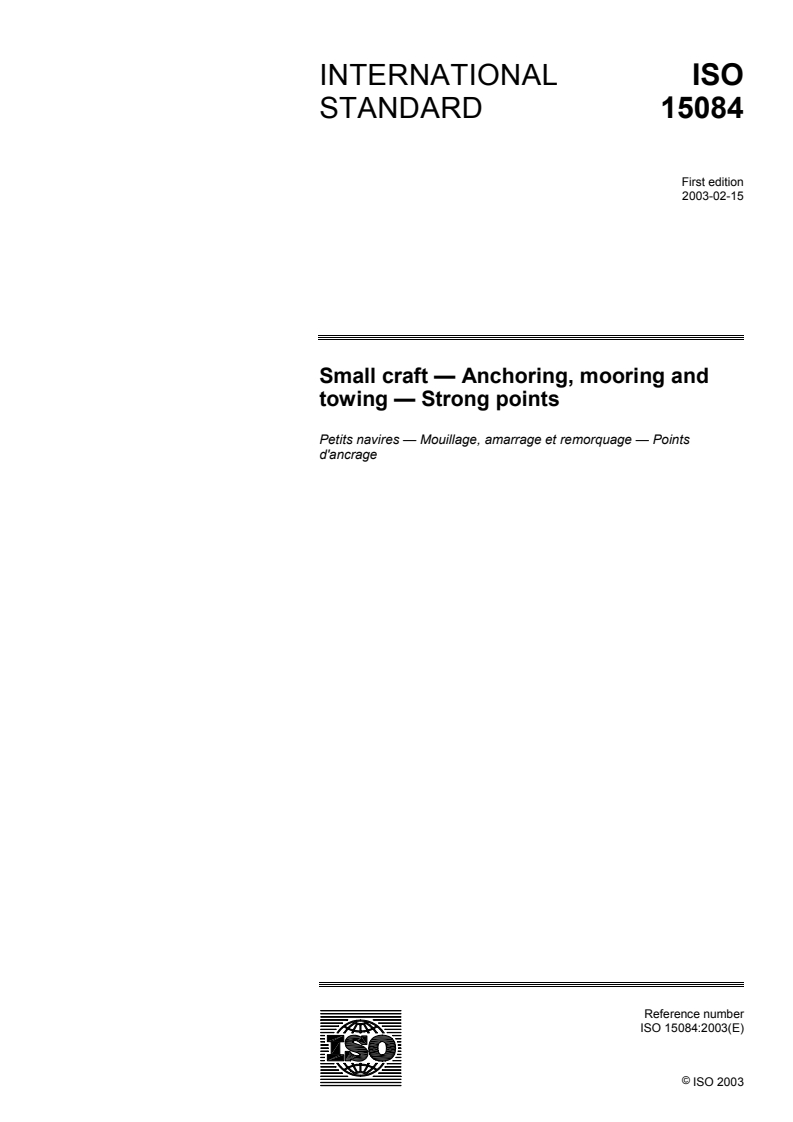
INTERNATIONAL ISO
STANDARD 15084
First edition
2003-02-15
Small craft — Anchoring, mooring and
towing — Strong points
Petits navires — Mouillage, amarrage et remorquage — Points
d'ancrage
Reference number
©
ISO 2003
PDF disclaimer
This PDF file may contain embedded typefaces. In accordance with Adobe's licensing policy, this file may be printed or viewed but
shall not be edited unless the typefaces which are embedded are licensed to and installed on the computer performing the editing. In
downloading this file, parties accept therein the responsibility of not infringing Adobe's licensing policy. The ISO Central Secretariat
accepts no liability in this area.
Adobe is a trademark of Adobe Systems Incorporated.
Details of the software products used to create this PDF file can be found in the General Info relative to the file; the PDF-creation
parameters were optimized for printing. Every care has been taken to ensure that the file is suitable for use by ISO member bodies. In
the unlikely event that a problem relating to it is found, please inform the Central Secretariat at the address given below.
© ISO 2003
All rights reserved. Unless otherwise specified, no part of this publication may be reproduced or utilized in any form or by any means,
electronic or mechanical, including photocopying and microfilm, without permission in writing from either ISO at the address below or
ISO's member body in the country of the requester.
ISO copyright office
Case postale 56 • CH-1211 Geneva 20
Tel. + 41 22 749 01 11
Fax + 41 22 749 09 47
E-mail copyright@iso.org
Web www.iso.org
Published in Switzerland
ii © ISO 2003 — All rights reserved
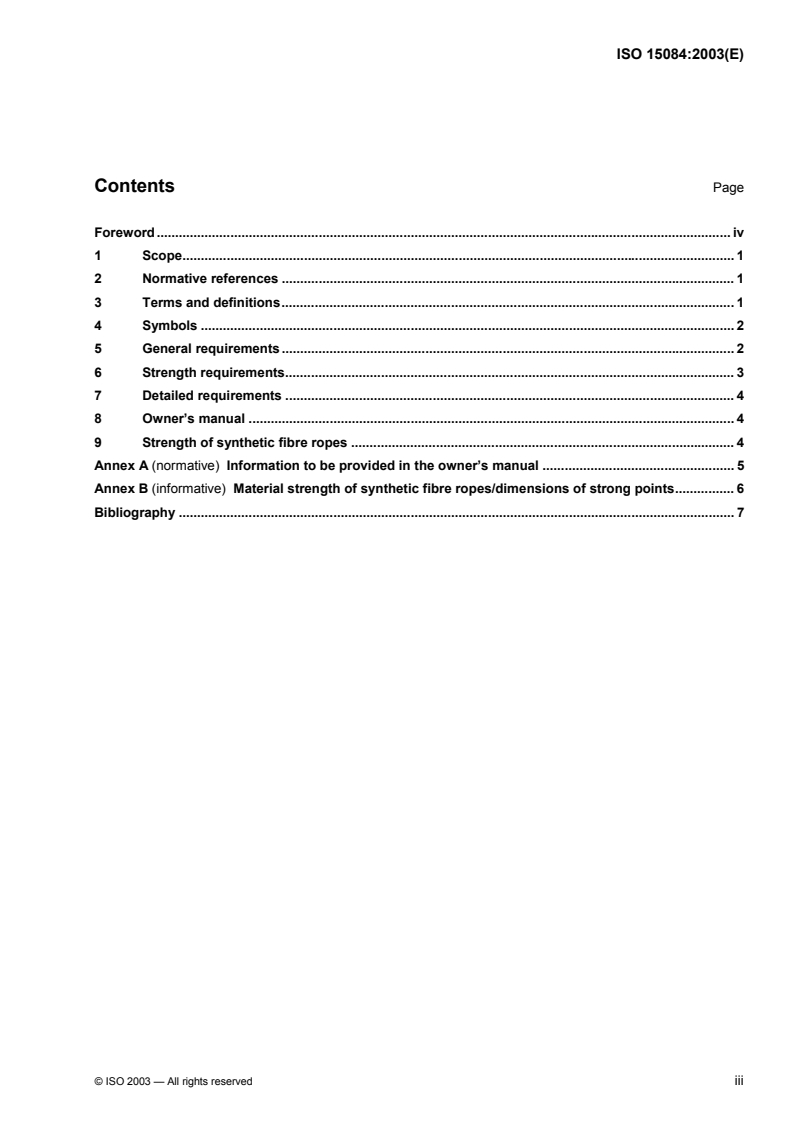
Contents Page
Foreword. iv
1 Scope. 1
2 Normative references . 1
3 Terms and definitions. 1
4 Symbols . 2
5 General requirements . 2
6 Strength requirements. 3
7 Detailed requirements . 4
8 Owner’s manual . 4
9 Strength of synthetic fibre ropes . 4
Annex A (normative) Information to be provided in the owner’s manual . 5
Annex B (informative) Material strength of synthetic fibre ropes/dimensions of strong points. 6
Bibliography . 7
Foreword
ISO (the International Organization for Standardization) is a worldwide federation of national standards bodies
(ISO member bodies). The work of preparing International Standards is normally carried out through ISO
technical committees. Each member body interested in a subject for which a technical committee has been
established has the right to be represented on that committee. International organizations, governmental and
non-governmental, in liaison with ISO, also take part in the work. ISO collaborates closely with the
International Electrotechnical Commission (IEC) on all matters of electrotechnical standardization.
International Standards are drafted in accordance with the rules given in the ISO/IEC Directives, Part 2.
The main task of technical committees is to prepare International Standards. Draft International Standards
adopted by the technical committees are circulated to the member bodies for voting. Publication as an
International Standard requires approval by at least 75 % of the member bodies casting a vote.
Attention is drawn to the possibility that some of the elements of this document may be the subject of patent
rights. ISO shall not be held responsible for identifying any or all such patent rights.
ISO 15084 was prepared by Technical Committee ISO/TC 188, Small craft.
iv © ISO 2003 — All rights reserved
INTERNATIONAL STANDARD ISO 15084:2003(E)
Small craft — Anchoring, mooring and towing — Strong points
1 Scope
This International Standard specifies requirements for strong points for attaching chains, cables and lines for
anchoring, mooring and towing small craft. It does not specify the requirement for any strong point from which
the craft can tow other vessels. This standard is applicable to small craft with a hull length up to 24 m.
This International Standard does not define anchor weights or the length of chains and lines.
2 Normative references
The following referenced documents are indispensable for the application of this document. For dated
references, only the edition cited applies. For undated references, the latest edition of the referenced
document (including any amendments) applies.
ISO 8666:2002, Small craft — Principal data
3 Terms and definitions
For the purposes of this document, the following terms and definitions apply.
3.1
strong point
any fitting on a boat designed to be used for the attachment of anchor chains, anchor lines, tow lines, and
warps
EXAMPLES Bollards, cleats, samson posts, mast steps, bow eyes on trailerable craft, winches, windlasses, capstans
and similar devices
3.2
design category
sea and wind conditions for which a boat is assessed to be suitable
3.2.1
design category A
category for “ocean” sailing
category of boats considered suitable for significant wave heights above 4 m and wind speeds in excess of
Beaufort Force 8, but excluding abnormal conditions, e.g. hurricanes
3.2.2
design category B
category for “offshore” sailing
category of boats considered suitable for significant wave heights up to 4 m and wind speeds of Beaufort
Force 8 or less
3.2.3
design category C
category for “inshore” sailing
category of boats considered suitable for significant wave heights up to 2 m and wind speeds of Beaufort
Force 6 or less
3.2.4
design category D
category for sailing in “sheltered” waters
category of bo
...
INTERNATIONAL ISO
STANDARD 15084
First edition
2003-02-15
Small craft — Anchoring, mooring and
towing — Strong points
Petits navires — Mouillage, amarrage et remorquage — Points
d'ancrage
Reference number
©
ISO 2003
PDF disclaimer
This PDF file may contain embedded typefaces. In accordance with Adobe's licensing policy, this file may be printed or viewed but
shall not be edited unless the typefaces which are embedded are licensed to and installed on the computer performing the editing. In
downloading this file, parties accept therein the responsibility of not infringing Adobe's licensing policy. The ISO Central Secretariat
accepts no liability in this area.
Adobe is a trademark of Adobe Systems Incorporated.
Details of the software products used to create this PDF file can be found in the General Info relative to the file; the PDF-creation
parameters were optimized for printing. Every care has been taken to ensure that the file is suitable for use by ISO member bodies. In
the unlikely event that a problem relating to it is found, please inform the Central Secretariat at the address given below.
© ISO 2003
All rights reserved. Unless otherwise specified, no part of this publication may be reproduced or utilized in any form or by any means,
electronic or mechanical, including photocopying and microfilm, without permission in writing from either ISO at the address below or
ISO's member body in the country of the requester.
ISO copyright office
Case postale 56 • CH-1211 Geneva 20
Tel. + 41 22 749 01 11
Fax + 41 22 749 09 47
E-mail copyright@iso.org
Web www.iso.org
Published in Switzerland
ii © ISO 2003 — All rights reserved
Contents Page
Foreword. iv
1 Scope. 1
2 Normative references . 1
3 Terms and definitions. 1
4 Symbols . 2
5 General requirements . 2
6 Strength requirements. 3
7 Detailed requirements . 4
8 Owner’s manual . 4
9 Strength of synthetic fibre ropes . 4
Annex A (normative) Information to be provided in the owner’s manual . 5
Annex B (informative) Material strength of synthetic fibre ropes/dimensions of strong points. 6
Bibliography . 7
Foreword
ISO (the International Organization for Standardization) is a worldwide federation of national standards bodies
(ISO member bodies). The work of preparing International Standards is normally carried out through ISO
technical committees. Each member body interested in a subject for which a technical committee has been
established has the right to be represented on that committee. International organizations, governmental and
non-governmental, in liaison with ISO, also take part in the work. ISO collaborates closely with the
International Electrotechnical Commission (IEC) on all matters of electrotechnical standardization.
International Standards are drafted in accordance with the rules given in the ISO/IEC Directives, Part 2.
The main task of technical committees is to prepare International Standards. Draft International Standards
adopted by the technical committees are circulated to the member bodies for voting. Publication as an
International Standard requires approval by at least 75 % of the member bodies casting a vote.
Attention is drawn to the possibility that some of the elements of this document may be the subject of patent
rights. ISO shall not be held responsible for identifying any or all such patent rights.
ISO 15084 was prepared by Technical Committee ISO/TC 188, Small craft.
iv © ISO 2003 — All rights reserved
INTERNATIONAL STANDARD ISO 15084:2003(E)
Small craft — Anchoring, mooring and towing — Strong points
1 Scope
This International Standard specifies requirements for strong points for attaching chains, cables and lines for
anchoring, mooring and towing small craft. It does not specify the requirement for any strong point from which
the craft can tow other vessels. This standard is applicable to small craft with a hull length up to 24 m.
This International Standard does not define anchor weights or the length of chains and lines.
2 Normative references
The following referenced documents are indispensable for the application of this document. For dated
references, only the edition cited applies. For undated references, the latest edition of the referenced
document (including any amendments) applies.
ISO 8666:2002, Small craft — Principal data
3 Terms and definitions
For the purposes of this document, the following terms and definitions apply.
3.1
strong point
any fitting on a boat designed to be used for the attachment of anchor chains, anchor lines, tow lines, and
warps
EXAMPLES Bollards, cleats, samson posts, mast steps, bow eyes on trailerable craft, winches, windlasses, capstans
and similar devices
3.2
design category
sea and wind conditions for which a boat is assessed to be suitable
3.2.1
design category A
category for “ocean” sailing
category of boats considered suitable for significant wave heights above 4 m and wind speeds in excess of
Beaufort Force 8, but excluding abnormal conditions, e.g. hurricanes
3.2.2
design category B
category for “offshore” sailing
category of boats considered suitable for significant wave heights up to 4 m and wind speeds of Beaufort
Force 8 or less
3.2.3
design category C
category for “inshore” sailing
category of boats considered suitable for significant wave heights up to 2 m and wind speeds of Beaufort
Force 6 or less
3.2.4
design category D
category for sailing in “sheltered” waters
category of bo
...
NORME ISO
INTERNATIONALE 15084
Première édition
2003-02-15
Petits navires — Mouillage, amarrage et
remorquage — Points d'ancrage
Small craft — Anchoring, mooring and towing — Strong points
Numéro de référence
©
ISO 2003
PDF – Exonération de responsabilité
Le présent fichier PDF peut contenir des polices de caractères intégrées. Conformément aux conditions de licence d'Adobe, ce fichier
peut être imprimé ou visualisé, mais ne doit pas être modifié à moins que l'ordinateur employé à cet effet ne bénéficie d'une licence
autorisant l'utilisation de ces polices et que celles-ci y soient installées. Lors du téléchargement de ce fichier, les parties concernées
acceptent de fait la responsabilité de ne pas enfreindre les conditions de licence d'Adobe. Le Secrétariat central de l'ISO décline toute
responsabilité en la matière.
Adobe est une marque déposée d'Adobe Systems Incorporated.
Les détails relatifs aux produits logiciels utilisés pour la création du présent fichier PDF sont disponibles dans la rubrique General Info
du fichier; les paramètres de création PDF ont été optimisés pour l'impression. Toutes les mesures ont été prises pour garantir
l'exploitation de ce fichier par les comités membres de l'ISO. Dans le cas peu probable où surviendrait un problème d'utilisation,
veuillez en informer le Secrétariat central à l'adresse donnée ci-dessous.
© ISO 2003
Droits de reproduction réservés. Sauf prescription différente, aucune partie de cette publication ne peut être reproduite ni utilisée sous
quelque forme que ce soit et par aucun procédé, électronique ou mécanique, y compris la photocopie et les microfilms, sans l'accord écrit
de l'ISO à l'adresse ci-après ou du comité membre de l'ISO dans le pays du demandeur.
ISO copyright office
Case postale 56 • CH-1211 Geneva 20
Tel. + 41 22 749 01 11
Fax. + 41 22 749 09 47
E-mail copyright@iso.org
Web www.iso.org
Publié en Suisse
ii © ISO 2003 — Tous droits réservés
Sommaire Page
Avant-propos. iv
1 Domaine d'application. 1
2 Références normatives. 1
3 Termes et définitions. 1
4 Symboles . 2
5 Exigences générales. 2
6 Exigences de résistance . 3
7 Exigences détaillées. 4
8 Manuel du propriétaire . 4
9 Résistance des cordages synthétiques. 4
Annexe A (normative) Informations à fournir dans le manuel du propriétaire. 5
Annexe B (informative) Résistance des cordages synthétiques/Dimensions des points d'ancrage . 6
Bibliographie . 7
Avant-propos
L'ISO (Organisation internationale de normalisation) est une fédération mondiale d'organismes nationaux de
normalisation (comités membres de l'ISO). L'élaboration des Normes internationales est en général confiée
aux comités techniques de l'ISO. Chaque comité membre intéressé par une étude a le droit de faire partie du
comité technique créé à cet effet. Les organisations internationales, gouvernementales et non
gouvernementales, en liaison avec l'ISO participent également aux travaux. L'ISO collabore étroitement avec
la Commission électrotechnique internationale (CEI) en ce qui concerne la normalisation électrotechnique.
Les Normes internationales sont rédigées conformément aux règles données dans les Directives ISO/CEI,
Partie 2.
La tâche principale des comités techniques est d'élaborer les Normes internationales. Les projets de Normes
internationales adoptés par les comités techniques sont soumis aux comités membres pour vote. Leur
publication comme Normes internationales requiert l'approbation de 75 % au moins des comités membres
votants.
L'attention est appelée sur le fait que certains des éléments du présent document peuvent faire l'objet de
droits de propriété intellectuelle ou de droits analogues. L'ISO ne saurait être tenue pour responsable de ne
pas avoir identifié de tels droits de propriété et averti de leur existence.
L'ISO 15084 a été élaborée par le comité technique ISO/TC 188, Petits navires.
iv © ISO 2003 — Tous droits réservés
NORME INTERNATIONALE ISO 15084:2003(F)
Petits navires — Mouillage, amarrage et remorquage — Points
d'ancrage
1 Domaine d'application
La présente Norme internationale spécifie des exigences relatives aux points d'ancrage des chaînes, câbles
et lignes de mouillage, d'amarrage et de remorquage du bateau. Elle ne spécifie pas d'exigence relative à tout
point d'ancrage destiné au remorquage d'autres bateaux. La présente Norme internationale est applicable aux
bateaux ayant une longueur de coque inférieure ou égale à 24 m.
La présente Norme internationale ne définit pas la masse des ancres ni la longueur des chaînes ou des lignes.
2 Références normatives
Les documents de référence suivants sont indispensables pour l'application du présent document. Pour les
références datées, seule l'édition citée s'applique. Pour les références non datées, la dernière édition du
document de référence s'applique (y compris les éventuels amendements).
ISO 8666:2002, Petits navires — Données principales
3 Termes et définitions
Pour les besoins du présent document, les termes et définitions suivants s'appliquent.
3.1
point d'ancrage
toute fixation située à bord d'un bateau et servant à retenir des chaînes d'ancre, des lignes de mouillage, des
câbles de remorquage ou des amarres
EXEMPLES Bollards, taquets, bittes d'amarrage, emplantures de mâts, anneaux d'étrave sur les bateaux
remorquables, treuils, guindeaux, cabestans et autres dispositifs similaires.
3.2
catégorie de conception
conditions de mer et de vent auxquelles le bateau est considéré comme approprié
3.2.1
catégorie de conception A
catégorie pour navigation en haute mer
catégorie de bateaux considérés comme aptes à naviguer dans une mer présentant des creux de plus de 4 m
et par des vents de plus de force 8 sur l'échelle de Beaufort, à l'exclusion toutefois de conditions anormales,
par exemple ouragans
3.2.2
catégorie de conception B
catégorie pour navigation au large
catégorie de bateaux considérés comme aptes à naviguer dans une mer présentant des creux jusqu'à 4 m et
par des vents jusqu'à la force 8 sur l'échelle de Beaufort
3.2.3
catégorie de conception C
catégorie pour navigation à proximité de la côte
catégorie de bateaux considérés comme aptes à naviguer dans une mer présentant des creux jusqu'à 2 m et
par des vents jusqu'à la force 6 sur l'échelle de Beaufort
3.2.4
catégorie de conception D
catégorie pour navigation en eaux abritées
catégorie de bateaux considérés comme aptes à naviguer dans une mer présentant des creux jusqu'à 0,30 m,
avec occasionnellement
...
NORME ISO
INTERNATIONALE 15084
Première édition
2003-02-15
Petits navires — Mouillage, amarrage et
remorquage — Points d'ancrage
Small craft — Anchoring, mooring and towing — Strong points
Numéro de référence
©
ISO 2003
PDF – Exonération de responsabilité
Le présent fichier PDF peut contenir des polices de caractères intégrées. Conformément aux conditions de licence d'Adobe, ce fichier
peut être imprimé ou visualisé, mais ne doit pas être modifié à moins que l'ordinateur employé à cet effet ne bénéficie d'une licence
autorisant l'utilisation de ces polices et que celles-ci y soient installées. Lors du téléchargement de ce fichier, les parties concernées
acceptent de fait la responsabilité de ne pas enfreindre les conditions de licence d'Adobe. Le Secrétariat central de l'ISO décline toute
responsabilité en la matière.
Adobe est une marque déposée d'Adobe Systems Incorporated.
Les détails relatifs aux produits logiciels utilisés pour la création du présent fichier PDF sont disponibles dans la rubrique General Info
du fichier; les paramètres de création PDF ont été optimisés pour l'impression. Toutes les mesures ont été prises pour garantir
l'exploitation de ce fichier par les comités membres de l'ISO. Dans le cas peu probable où surviendrait un problème d'utilisation,
veuillez en informer le Secrétariat central à l'adresse donnée ci-dessous.
© ISO 2003
Droits de reproduction réservés. Sauf prescription différente, aucune partie de cette publication ne peut être reproduite ni utilisée sous
quelque forme que ce soit et par aucun procédé, électronique ou mécanique, y compris la photocopie et les microfilms, sans l'accord écrit
de l'ISO à l'adresse ci-après ou du comité membre de l'ISO dans le pays du demandeur.
ISO copyright office
Case postale 56 • CH-1211 Geneva 20
Tel. + 41 22 749 01 11
Fax. + 41 22 749 09 47
E-mail copyright@iso.org
Web www.iso.org
Publié en Suisse
ii © ISO 2003 — Tous droits réservés
Sommaire Page
Avant-propos. iv
1 Domaine d'application. 1
2 Références normatives. 1
3 Termes et définitions. 1
4 Symboles . 2
5 Exigences générales. 2
6 Exigences de résistance . 3
7 Exigences détaillées. 4
8 Manuel du propriétaire . 4
9 Résistance des cordages synthétiques. 4
Annexe A (normative) Informations à fournir dans le manuel du propriétaire. 5
Annexe B (informative) Résistance des cordages synthétiques/Dimensions des points d'ancrage . 6
Bibliographie . 7
Avant-propos
L'ISO (Organisation internationale de normalisation) est une fédération mondiale d'organismes nationaux de
normalisation (comités membres de l'ISO). L'élaboration des Normes internationales est en général confiée
aux comités techniques de l'ISO. Chaque comité membre intéressé par une étude a le droit de faire partie du
comité technique créé à cet effet. Les organisations internationales, gouvernementales et non
gouvernementales, en liaison avec l'ISO participent également aux travaux. L'ISO collabore étroitement avec
la Commission électrotechnique internationale (CEI) en ce qui concerne la normalisation électrotechnique.
Les Normes internationales sont rédigées conformément aux règles données dans les Directives ISO/CEI,
Partie 2.
La tâche principale des comités techniques est d'élaborer les Normes internationales. Les projets de Normes
internationales adoptés par les comités techniques sont soumis aux comités membres pour vote. Leur
publication comme Normes internationales requiert l'approbation de 75 % au moins des comités membres
votants.
L'attention est appelée sur le fait que certains des éléments du présent document peuvent faire l'objet de
droits de propriété intellectuelle ou de droits analogues. L'ISO ne saurait être tenue pour responsable de ne
pas avoir identifié de tels droits de propriété et averti de leur existence.
L'ISO 15084 a été élaborée par le comité technique ISO/TC 188, Petits navires.
iv © ISO 2003 — Tous droits réservés
NORME INTERNATIONALE ISO 15084:2003(F)
Petits navires — Mouillage, amarrage et remorquage — Points
d'ancrage
1 Domaine d'application
La présente Norme internationale spécifie des exigences relatives aux points d'ancrage des chaînes, câbles
et lignes de mouillage, d'amarrage et de remorquage du bateau. Elle ne spécifie pas d'exigence relative à tout
point d'ancrage destiné au remorquage d'autres bateaux. La présente Norme internationale est applicable aux
bateaux ayant une longueur de coque inférieure ou égale à 24 m.
La présente Norme internationale ne définit pas la masse des ancres ni la longueur des chaînes ou des lignes.
2 Références normatives
Les documents de référence suivants sont indispensables pour l'application du présent document. Pour les
références datées, seule l'édition citée s'applique. Pour les références non datées, la dernière édition du
document de référence s'applique (y compris les éventuels amendements).
ISO 8666:2002, Petits navires — Données principales
3 Termes et définitions
Pour les besoins du présent document, les termes et définitions suivants s'appliquent.
3.1
point d'ancrage
toute fixation située à bord d'un bateau et servant à retenir des chaînes d'ancre, des lignes de mouillage, des
câbles de remorquage ou des amarres
EXEMPLES Bollards, taquets, bittes d'amarrage, emplantures de mâts, anneaux d'étrave sur les bateaux
remorquables, treuils, guindeaux, cabestans et autres dispositifs similaires.
3.2
catégorie de conception
conditions de mer et de vent auxquelles le bateau est considéré comme approprié
3.2.1
catégorie de conception A
catégorie pour navigation en haute mer
catégorie de bateaux considérés comme aptes à naviguer dans une mer présentant des creux de plus de 4 m
et par des vents de plus de force 8 sur l'échelle de Beaufort, à l'exclusion toutefois de conditions anormales,
par exemple ouragans
3.2.2
catégorie de conception B
catégorie pour navigation au large
catégorie de bateaux considérés comme aptes à naviguer dans une mer présentant des creux jusqu'à 4 m et
par des vents jusqu'à la force 8 sur l'échelle de Beaufort
3.2.3
catégorie de conception C
catégorie pour navigation à proximité de la côte
catégorie de bateaux considérés comme aptes à naviguer dans une mer présentant des creux jusqu'à 2 m et
par des vents jusqu'à la force 6 sur l'échelle de Beaufort
3.2.4
catégorie de conception D
catégorie pour navigation en eaux abritées
catégorie de bateaux considérés comme aptes à naviguer dans une mer présentant des creux jusqu'à 0,30 m,
avec occasionnellement
...