

ISO/PRF 23974-3
(Main)Leather — Red hair sheep skins — Part 3: Guidelines for grading on the basis of mass and size
- Abstract
This draft standard prescribes guidelines for grading raw red hair skins on the basis of their mass and size.
- Status
- Not Published
- Technical Committee
- ISO/TC 120/SC 1 - Raw hides and skins, including pickled pelts
- Drafting Committee
- ISO/TC 120/SC 1 - Raw hides and skins, including pickled pelts
- Current Stage
- 5020 - FDIS ballot initiated: 2 months. Proof sent to secretariat
- Start Date
- 22-Sep-2026
- Completion Date
- 10-Oct-2026
Buy Documents
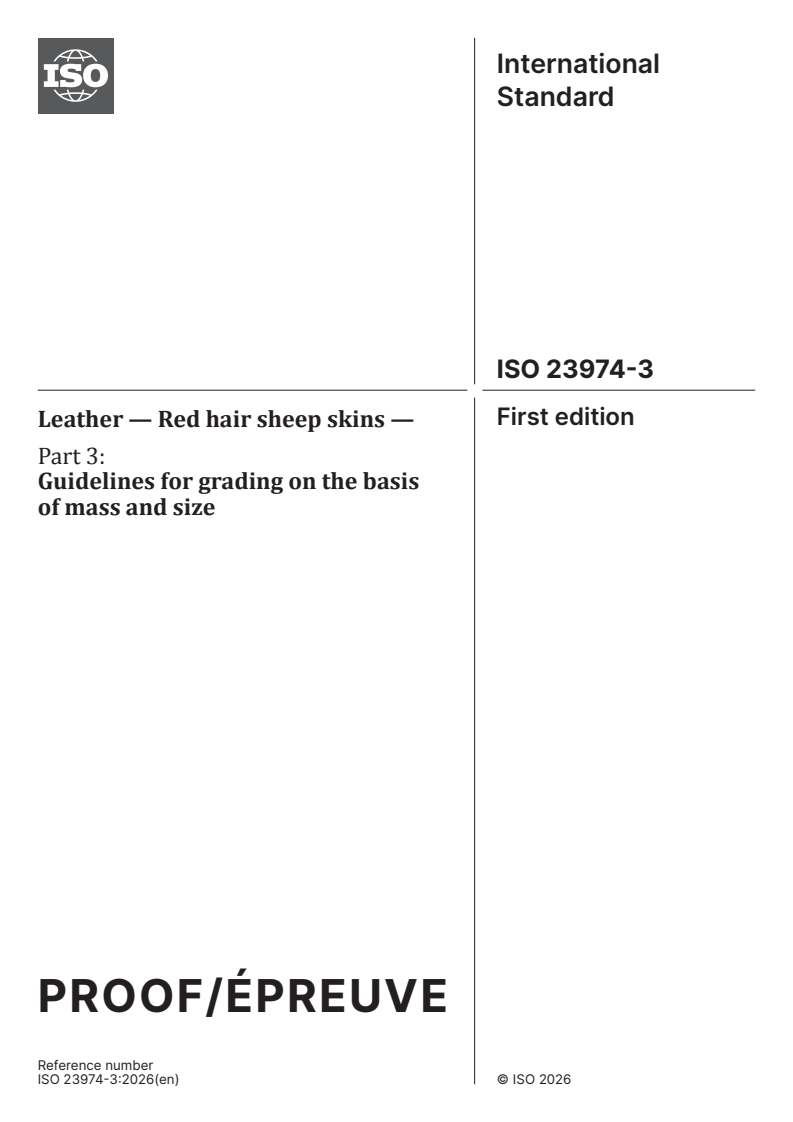

ISO/PRF 23974-3 - Leather — Red hair sheep skins — Part 3: Guidelines for grading on the basis of mass and size
REDLINE ISO/PRF 23974-3 - Leather — Red hair sheep skins — Part 3: Guidelines for grading on the basis of mass and size
ISO/PRF 23974-3, published by ISO, gives guidelines for grading raw red hair sheep skins by mass and size. It is written for people who sort, buy, sell, or inspect these skins and need a common way to describe lot size and weight.
What does ISO/PRF 23974-3 specify?
ISO/PRF 23974-3 specifies how raw red hair sheep skins are presented and graded on the basis of size and mass. The document is organized into five clauses: Scope, Normative references, Terms and definitions, Presentation, and Grading. Clause 5 contains the grading methods, and the document includes two tables for the size and mass categories.
What are the key requirements of ISO/PRF 23974-3?
ISO/PRF 23974-3 sets out a practical grading method that starts with how the skin is prepared, then shows how to measure it, and finally assigns a grade. In practice, this gives processors and buyers a repeatable way to compare skins from different lots.
Presentation before grading
ISO/PRF 23974-3 requires red hair sheep skins to be presented in a defined form before grading. The head is cut straight behind the ears, the shanks are cut off at right angles above the knee and hock, and the tail is cut no more than 40 mm from the butt. This matters because grading only works well when the skins are trimmed consistently.
Size grading and measurement
ISO/PRF 23974-3 grades skins by size using length and area. The skin is folded lengthwise along the backbone line and laid flat, then the length is measured from the root of the tail to the widest point of the front part of the throat, and the width is measured from the midpoint of the backbone line to the end of the belly. Both measurements are taken to the nearest 1 cm with a standard measuring tape, so graders can record the same skin in the same way.
The document then calculates area from the measured length and width and uses Table 1 to assign the size category. Table 1 classifies skins as extra small, small, medium, large, or extra-large. For trade and sorting, this means the size label reflects both the skin's length and its overall spread.
Mass grading and weighing
ISO/PRF 23974-3 also grades skins by mass. Dry salted skins and wet salted skins are unfolded, shaken to remove surplus salt, brushed, and then weighed individually to the nearest 0.1 kg. Raw skins are made free from excess water and weighed to the nearest 0.1 kg. This keeps salt and moisture from distorting the weight category.
Mass categories
ISO/PRF 23974-3 uses Table 2 to classify mass for wet salted, dry salted, and sun-dried skins. The table assigns the same category names across the three preservation states, which helps buyers compare skins even when they have been prepared differently. In practice, a lot can be sorted by the preservation state that matches how it was received.
What terms does ISO/PRF 23974-3 define?
ISO/PRF 23974-3 defines the key skin-condition terms used in grading.
- Dry salted skin - a skin dried in air after treatment with common salt so it can be preserved for a definite period.
- Raw skin - a skin after body heat has dissipated and after trimming, defatting, and cleaning of dung and other foreign material.
- Shanks - the part of the skin covering the leg between the knee and the ankle.
- Sun-dried skin - a skin dried in the sun or in air for preservation for a definite period.
- Wet salted skin - a skin treated with salt to reduce moisture content for preservation for a definite period.
Who uses ISO/PRF 23974-3?
ISO/PRF 23974-3 is used in the leather supply chain by people who handle raw red hair sheep skins. That includes graders, processors, traders, buyers, and quality managers who need to describe size and mass in a consistent way. It is particularly relevant where skins are received, sorted, priced, or recorded for delivery.
What does the ISO/PRF 23974-3 document contain?
ISO/PRF 23974-3 contains the presentation rules, measurement methods, and grading tables needed to classify raw red hair sheep skins. Clause 5.1 gives the length-and-area method for size grading, and Clause 5.2 gives the weighing method for mass grading. The document also includes Table 1 for size classes and Table 2 for mass classes across wet salted, dry salted, and sun-dried skins.
It is a short operational standard rather than a broad theory document. Its main value is that it turns visual sorting into a defined procedure with fixed preparation, measurement, and category names.
Buy Documents
ISO/PRF 23974-3 - Leather — Red hair sheep skins — Part 3: Guidelines for grading on the basis of mass and size
REDLINE ISO/PRF 23974-3 - Leather — Red hair sheep skins — Part 3: Guidelines for grading on the basis of mass and size
Get Certified
Connect with accredited certification bodies for this standard

Control Union Certifications
Global certification for agriculture and sustainability.

Hohenstein Institut
Textile testing and certification.

Bureau Veritas Bangladesh
Bureau Veritas certification services in Bangladesh.
Sponsored listings
Frequently Asked Questions
ISO/PRF 23974-3 is a draft published by the International Organization for Standardization (ISO). Its full title is "Leather — Red hair sheep skins — Part 3: Guidelines for grading on the basis of mass and size". This standard covers: This draft standard prescribes guidelines for grading raw red hair skins on the basis of their mass and size.
This draft standard prescribes guidelines for grading raw red hair skins on the basis of their mass and size.
ISO/PRF 23974-3 is classified under the following ICS (International Classification for Standards) categories: 59.140.20 - Raw skins, hides and pelts. The ICS classification helps identify the subject area and facilitates finding related standards.
ISO/PRF 23974-3 is available in PDF format for immediate download after purchase. The document can be added to your cart and obtained through the secure checkout process. Digital delivery ensures instant access to the complete standard document.
Standards Content (Sample)
International
Standard
ISO 23974-3
First edition
Leather — Red hair sheep skins —
Part 3:
Guidelines for grading on the basis
of mass and size
PROOF/ÉPREUVE
Reference number
ISO 23974-3:2026(en) © ISO 2026
ISO 23974-3:2026(en)
© ISO 2026
All rights reserved. Unless otherwise specified, or required in the context of its implementation, no part of this publication may
be reproduced or utilized otherwise in any form or by any means, electronic or mechanical, including photocopying, or posting on
the internet or an intranet, without prior written permission. Permission can be requested from either ISO at the address below
or ISO’s member body in the country of the requester.
ISO copyright office
CP 401 • Ch. de Blandonnet 8
CH-1214 Vernier, Geneva
Phone: +41 22 749 01 11
Email: copyright@iso.org
Website: www.iso.org
Published in Switzerland
PROOF/ÉPREUVE
ii
ISO 23974-3:2026(en)
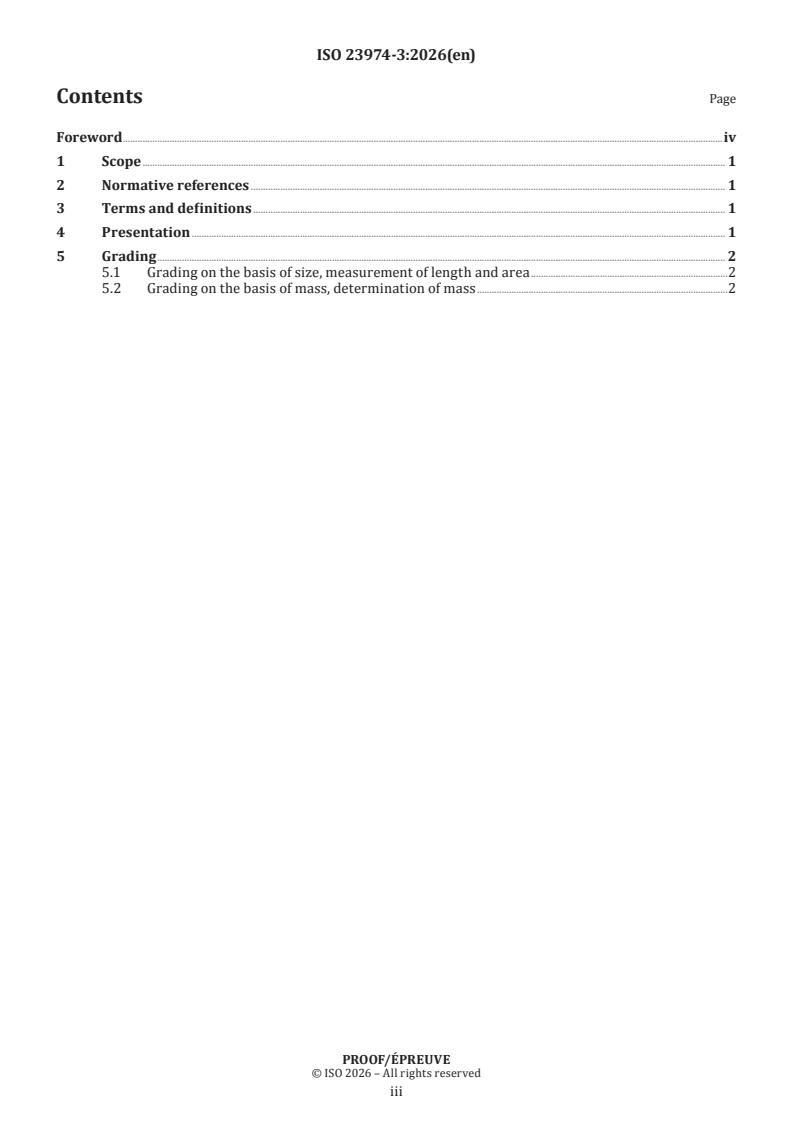
Contents Page
Foreword .iv
1 Scope . 1
2 Normative references . 1
3 Terms and definitions . 1
4 Presentation . 1
5 Grading . 2
5.1 Grading on the basis of size, measurement of length and area .2
5.2 Grading on the basis of mass, determination of mass .2
PROOF/ÉPREUVE
iii
ISO 23974-3:2026(en)
Foreword
ISO (the International Organization for Standardization) is a worldwide federation of national standards
bodies (ISO member bodies). The work of preparing International Standards is normally carried out through
ISO technical committees. Each member body interested in a subject for which a technical committee
has been established has the right to be represented on that committee. International organizations,
governmental and non-governmental, in liaison with ISO, also take part in the work. ISO collaborates closely
with the International Electrotechnical Commission (IEC) on all matters of electrotechnical standardization.
The procedures used to develop this document and those intended for its further maintenance are described
in the ISO/IEC Directives, Part 1. In particular, the different approval criteria needed for the different types
of ISO document should be noted. This document was drafted in accordance with the editorial rules of the
ISO/IEC Directives, Part 2 (see www.iso.org/directives).
ISO draws attention to the possibility that the implementation of this document may involve the use of (a)
patent(s). ISO takes no position concerning the evidence, validity or applicability of any claimed patent
rights in respect thereof. As of the date of publication of this document, ISO had not received notice of (a)
patent(s) which may be required to implement this document. However, implementers are cautioned that
this may not represent the latest information, which may be obtained from the patent database available at
www.iso.org/patents. ISO shall not be held responsible for identifying any or all such patent rights.
Any trade name used in this document is information given for the convenience of
...
Formatted: Spanish (Uruguay)
ISO/DISPRF 23974-3
Formatted: Spanish (Uruguay)
ISO/TC 120/SC 1
Secretariat: BIS
Date: 2026-05-1809-09
Leather — Red hair sheep skins —
Part 3:
Guidelines for grading on the basis of mass and size
DIS stage
PROOF
VVVVototototiiiinnnngggg b b b beeeeggggiiiinnnnssss on on on on:::: 2222000022225555----00009999----11118888
VVVVooootintintintingggg te te te termrmrmrmiiiinnnnaaaatetetetessss o o o onnnn:::: 2 2 2 2000022225555----11112222----11111111
ISO/DISPRF 23974-3:2026(en)
All rights reserved. Unless otherwise specified, or required in the context of its implementation, no part of this publication
may be reproduced or utilized otherwise in any form or by any means, electronic or mechanical, including photocopying,
or posting on the internet or an intranet, without prior written permission. Permission can be requested from either ISO
at the address below or ISO’s member body in the country of the requester.
ISO copyright office
CP 401 • Ch. de Blandonnet 8
CH-1214 Vernier, Geneva
Phone: + 41 22 749 01 11
Formatted: French (Switzerland)
E-mail: copyright@iso.org
Website: www.iso.org
Published in Switzerland
ii
ISO/DISPRF 23974-3:2026(en)
Contents
Foreword . iii
Scope . iii
Normative references . iii
Terms and definitions . iii
Presentation . iii
Grading . iii
Grading on the basis of size . iii
Grading on the basis of mass . iii
Foreword . iv
1 Scope . 1
2 Normative references . 1
3 Terms and definitions . 1
4 Presentation . 1
5 Grading . 2
5.1 Grading on the basis of size, measurement of length and area . 2
5.2 Grading on the basis of mass, determination of mass . 2
iii
ISO/DISPRF 23974-3:2026(en)
Foreword
ISO (the International Organization for Standardization) is a worldwide federation of national standards
bodies (ISO member bodies). The work of preparing International Standards is normally carried out through
ISO technical committees. Each member body interested in a subject for which a technical committee has been
established has the right to be represented on that committee. International organizations, governmental and
non-governmental, in liaison with ISO, also take part in the work. ISO collaborates closely with the
International Electrotechnical Commission (IEC) on all matters of electrotechnical standardization.
The procedures used to develop this document and those intended for its further maintenance are described
in the ISO/IEC Directives, Part 1. In particular, the different approval criteria needed for the different types of
ISO document should be noted. This document was drafted in accordance with the editorial rules of the
ISO/IEC Directives, Part 2 (see www.iso.org/directives).
ISO draws attention to the possibility that the implementation of this document may involve the use of (a)
patent(s). ISO takes no position concerning the evidence, validity or applicability of any claimed patent rights
in respect thereof. As of the date of publication of this document, ISO had not received notice of (a) patent(s)
which may be required to impl
...