


ISO 11987
(Main)Ophthalmic optics - Contact lenses - Determination of shelf-life
Ophthalmic optics - Contact lenses - Determination of shelf-life
ISO 11987:2012 specifies test procedures for determining the stability of contact lenses once placed in their final packaging during storage and distribution.
Optique ophtalmique — Lentilles de contact — Détermination de la durée de conservation
L'ISO 11987:2012 spécifie des modes opératoires d'essai permettant de déterminer la stabilité des lentilles de contact lorsqu'elles se trouvent dans leur emballage final, pendant le stockage et la distribution.
General Information
- Status
- Not Published
- Technical Committee
- ISO/TC 172/SC 7 - Ophthalmic optics and instruments
- Drafting Committee
- ISO/TC 172/SC 7/WG 9 - Contact lenses
- Current Stage
- 6000 - International Standard under publication
- Start Date
- 29-Nov-2025
- Completion Date
- 10-Jan-2026
Relations
- Effective Date
- 10-Aug-2024
Overview
ISO 11987 (Ophthalmic optics - Contact lenses - Determination of shelf-life) defines test procedures to determine the shelf-life and stability of contact lenses in their final packaging during storage and distribution. The standard focuses on assessing the stability of the lens material, the packaging solution, and the packaging system to ensure safety, efficacy and acceptability up to the labelled expiry date. ISO 11987 complements contact-lens measurement and labelling standards and informs expiry-date claims and recommended storage conditions.
Key topics and requirements
- Scope and principle
- Stability testing targets the contact lens material and packaging integrity rather than lens design; demonstrated stability of a material/packaging system can cover multiple lens designs with appropriate risk assessment.
- Risk assessment and protocol
- A documented risk assessment identifies critical properties and selects test parameters, measurement media and acceptance criteria.
- Test media and measurements
- Measurements can be made in the manufacturer’s packaging solution, standard saline (ISO 18369-3), or dry; the same medium must be used throughout a study.
- Typical lens parameters: back vertex power, diameter, curvature, visible-light transmittance, and other properties relevant to safety or label claims.
- Packaging solution properties (e.g., pH, osmolality) are monitored.
- Storage conditions
- Real-time studies at controlled conditions (e.g., 25 °C ± 2 °C) with humidity control; accelerated ageing studies at elevated temperatures (e.g., 35 °C ± 2 °C, 45 °C ± 2 °C) are supplementary and must be supported by real-time data.
- Packaging and sterility
- For sterile lenses, validated sterilization and periodic package-integrity testing (physical, microbial challenge or sterility tests) are required.
- Sampling and traceability
- Lenses should be representative of production, sampled from at least two traceable batches; extreme powers and production variability are considered in selection.
- Results and reporting
- Test results are compared to tolerances (ISO 18369-2); any excursions, re-evaluations and test conditions must be documented in the test report.
Applications and users
ISO 11987 is essential for:
- Contact lens manufacturers (product development, stability and shelf-life claims)
- Quality assurance and regulatory affairs teams preparing submissions or declarations of conformity
- Packaging engineers assessing container permeability and integrity
- Test laboratories performing stability, sterility and accelerated ageing studies
- Notified bodies and regulators reviewing expiry-date justification
Keywords: ISO 11987, contact lenses, shelf-life determination, stability testing, accelerated ageing, real-time studies, packaging integrity, contact lens standards.
Related standards
- ISO 18369‑1: Vocabulary, classification and labelling
- ISO 18369‑2: Tolerances
- ISO 18369‑3: Measurement methods
- ISO 18369‑4 (referenced for extractables and leachables considerations)

ISO/FDIS 11987 - Ophthalmic optics — Contact lenses — Determination of shelf-life Released:19. 09. 2025
REDLINE ISO/FDIS 11987 - Ophthalmic optics — Contact lenses — Determination of shelf-life Released:19. 09. 2025

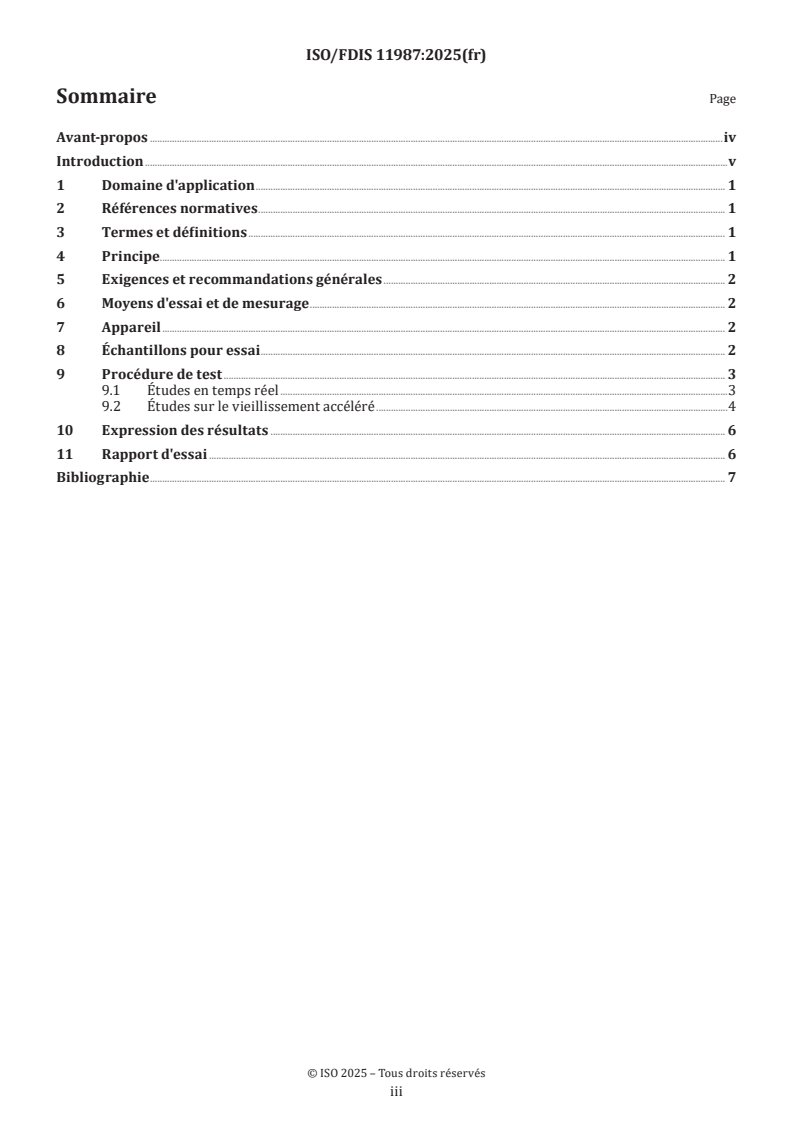
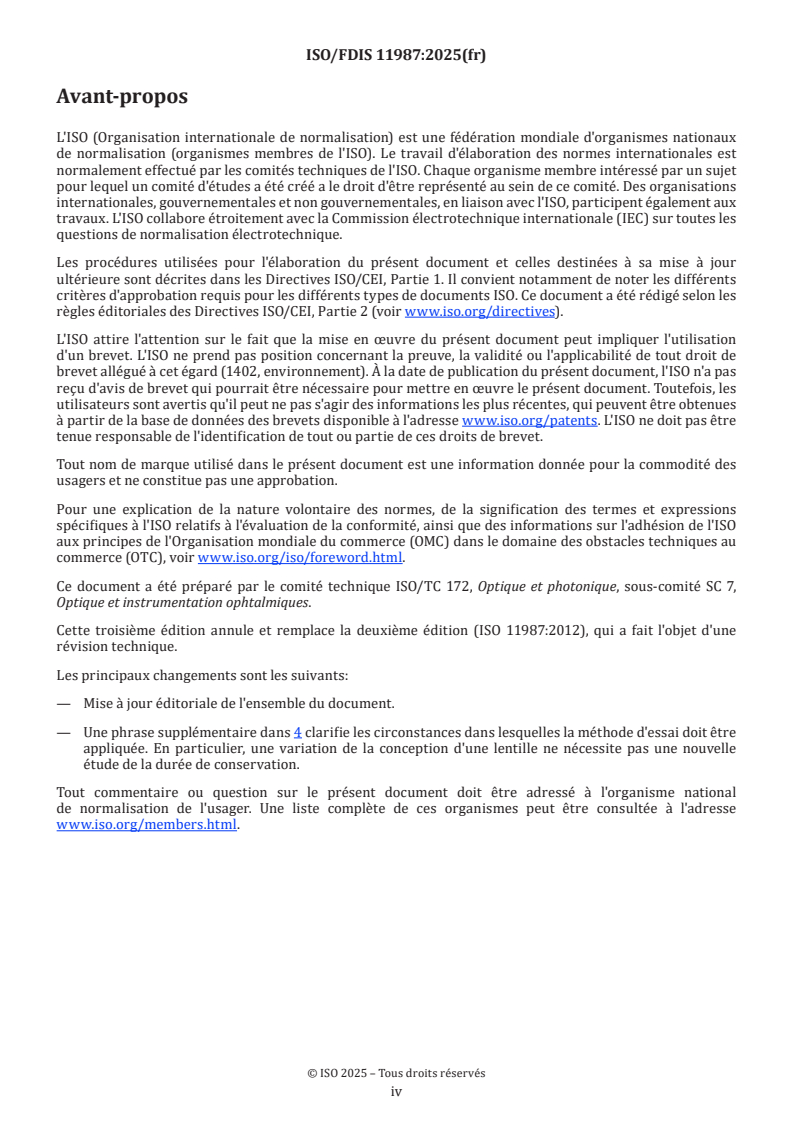
ISO/FDIS 11987 - Optique ophtalmique — Lentilles de contact — Détermination de la durée de conservation Released:10/11/2025
Frequently Asked Questions
ISO 11987 is a draft published by the International Organization for Standardization (ISO). Its full title is "Ophthalmic optics - Contact lenses - Determination of shelf-life". This standard covers: ISO 11987:2012 specifies test procedures for determining the stability of contact lenses once placed in their final packaging during storage and distribution.
ISO 11987:2012 specifies test procedures for determining the stability of contact lenses once placed in their final packaging during storage and distribution.
ISO 11987 is classified under the following ICS (International Classification for Standards) categories: 11.040.70 - Ophthalmic equipment. The ICS classification helps identify the subject area and facilitates finding related standards.
ISO 11987 has the following relationships with other standards: It is inter standard links to ISO 11987:2012. Understanding these relationships helps ensure you are using the most current and applicable version of the standard.
ISO 11987 is available in PDF format for immediate download after purchase. The document can be added to your cart and obtained through the secure checkout process. Digital delivery ensures instant access to the complete standard document.
Standards Content (Sample)
FINAL DRAFT
International
Standard
ISO/FDIS 11987
ISO/TC 172/SC 7
Ophthalmic optics — Contact lenses
Secretariat: DIN
— Determination of shelf-life
Voting begins on:
Optique ophtalmique — Lentilles de contact — Détermination de 2025-10-03
la durée de conservation
Voting terminates on:
2025-11-28
RECIPIENTS OF THIS DRAFT ARE INVITED TO SUBMIT,
WITH THEIR COMMENTS, NOTIFICATION OF ANY
RELEVANT PATENT RIGHTS OF WHICH THEY ARE AWARE
AND TO PROVIDE SUPPOR TING DOCUMENTATION.
IN ADDITION TO THEIR EVALUATION AS
BEING ACCEPTABLE FOR INDUSTRIAL, TECHNO
ISO/CEN PARALLEL PROCESSING LOGICAL, COMMERCIAL AND USER PURPOSES, DRAFT
INTERNATIONAL STANDARDS MAY ON OCCASION HAVE
TO BE CONSIDERED IN THE LIGHT OF THEIR POTENTIAL
TO BECOME STAN DARDS TO WHICH REFERENCE MAY BE
MADE IN NATIONAL REGULATIONS.
Reference number
ISO/FDIS 11987:2025(en) © ISO 2025
FINAL DRAFT
ISO/FDIS 11987:2025(en)
International
Standard
ISO/FDIS 11987
ISO/TC 172/SC 7
Ophthalmic optics — Contact lenses
Secretariat: DIN
— Determination of shelf-life
Voting begins on:
Optique ophtalmique — Lentilles de contact — Détermination de
la durée de conservation
Voting terminates on:
RECIPIENTS OF THIS DRAFT ARE INVITED TO SUBMIT,
WITH THEIR COMMENTS, NOTIFICATION OF ANY
RELEVANT PATENT RIGHTS OF WHICH THEY ARE AWARE
AND TO PROVIDE SUPPOR TING DOCUMENTATION.
© ISO 2025
IN ADDITION TO THEIR EVALUATION AS
All rights reserved. Unless otherwise specified, or required in the context of its implementation, no part of this publication may
BEING ACCEPTABLE FOR INDUSTRIAL, TECHNO
ISO/CEN PARALLEL PROCESSING
LOGICAL, COMMERCIAL AND USER PURPOSES, DRAFT
be reproduced or utilized otherwise in any form or by any means, electronic or mechanical, including photocopying, or posting on
INTERNATIONAL STANDARDS MAY ON OCCASION HAVE
the internet or an intranet, without prior written permission. Permission can be requested from either ISO at the address below
TO BE CONSIDERED IN THE LIGHT OF THEIR POTENTIAL
or ISO’s member body in the country of the requester.
TO BECOME STAN DARDS TO WHICH REFERENCE MAY BE
MADE IN NATIONAL REGULATIONS.
ISO copyright office
CP 401 • Ch. de Blandonnet 8
CH-1214 Vernier, Geneva
Phone: +41 22 749 01 11
Email: copyright@iso.org
Website: www.iso.org
Published in Switzerland Reference number
ISO/FDIS 11987:2025(en) © ISO 2025
ii
ISO/FDIS 11987:2025(en)
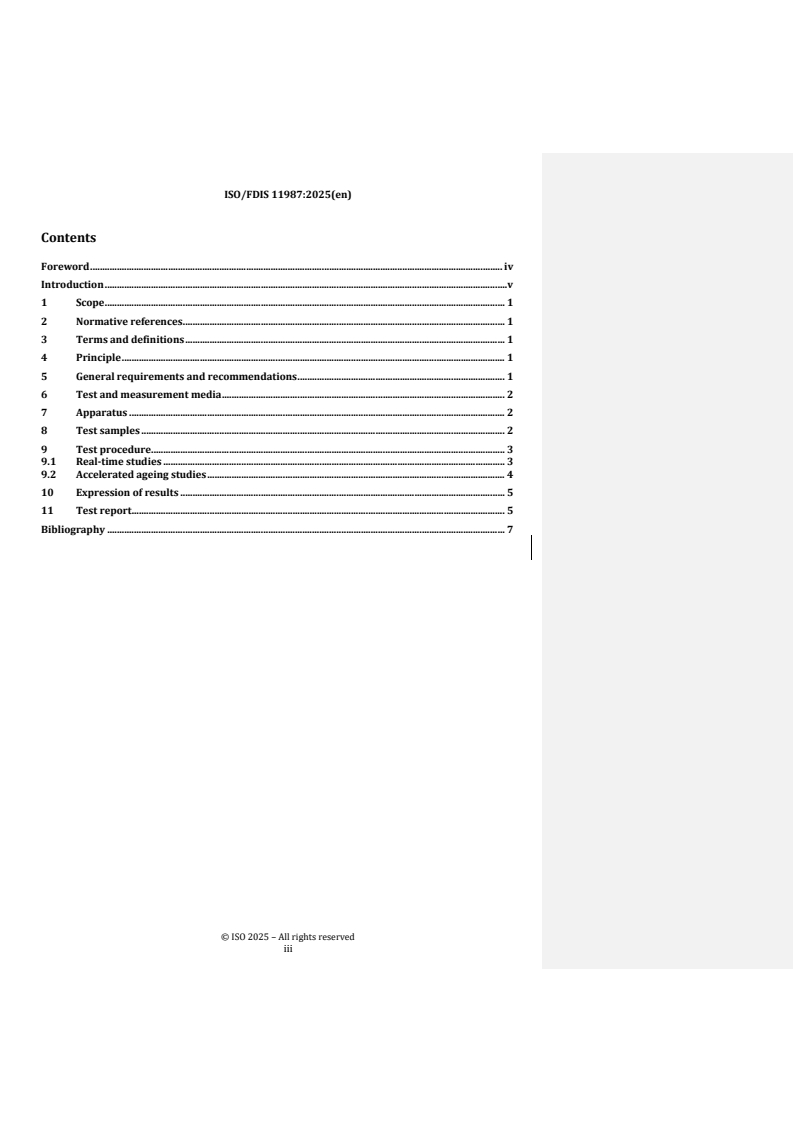
Contents Page
Foreword .iv
Introduction .v
1 Scope . 1
2 Normative references . 1
3 Terms and definitions . 1
4 Principle . 1
5 General requirements and recommendations. 2
6 Test and measurement media . 2
7 Apparatus . 2
8 Test samples . 2
9 Test procedure . 3
9.1 Real-time studies .3
9.2 Accelerated ageing studies .4
10 Expression of results . 5
11 Test report . 5
Bibliography . 7
iii
ISO/FDIS 11987:2025(en)
Foreword
ISO (the International Organization for Standardization) is a worldwide federation of national standards
bodies (ISO member bodies). The work of preparing International Standards is normally carried out through
ISO technical committees. Each member body interested in a subject for which a technical committee
has been established has the right to be represented on that committee. International organizations,
governmental and non-governmental, in liaison with ISO, also take part in the work. ISO collaborates closely
with the International Electrotechnical Commission (IEC) on all matters of electrotechnical standardization.
The procedures used to develop this document and those intended for its further maintenance are described
in the ISO/IEC Directives, Part 1. In particular, the different approval criteria needed for the different types
of ISO documents should be noted. This document was drafted in accordance with the editorial rules of the
ISO/IEC Directives, Part 2 (see www.iso.org/directives).
ISO draws attention to the possibility that the implementation of this document may involve the use of patent.
ISO takes no position concerning the evidence, validity or applicability of any claimed patent rights in respect
thereof. As of the date of publication of this document, ISO had not received notice of patent which may be
required to implement this document. However, implementers are cautioned that this may not represent the
latest information, which may be obtained from the patent database available at www.iso.org/patents. ISO
shall not be held responsible for identifying any or all such patent rights.
Any trade name used in this document is information given for the convenience of users and does not
constitute an endorsement.
For an explanation of the voluntary nature of standards, the meaning of ISO specific terms and expressions
related to conformity assessment, as well as information about ISO's adherence to the World Trade
Organization (WTO) principles in the Technical Barriers to Trade (TBT), see www.iso.org/iso/foreword.html.
This document was prepared by Technical Committee ISO/TC 172, Optics and photonics, Subcommittee SC 7,
Ophthalmic optics and instrument.
This third edition cancels and replaces the second edition (ISO 11987:2012), which has been technically
revised.
The main changes are as follows:
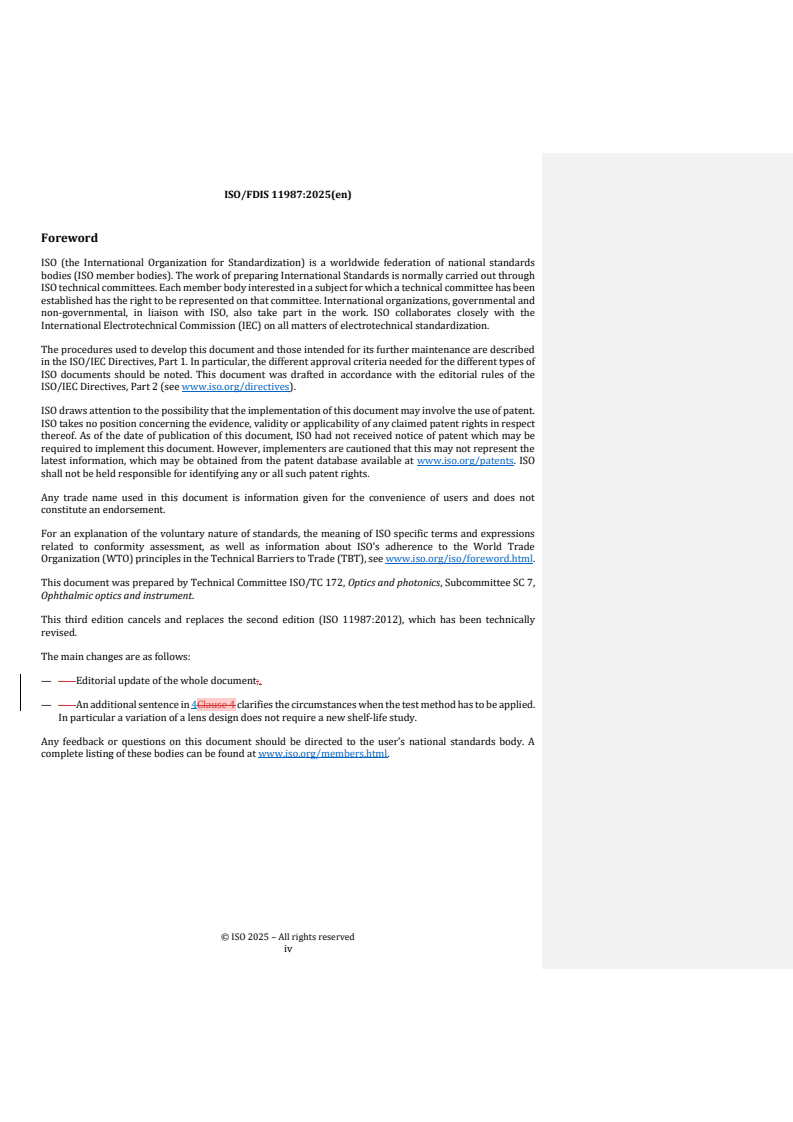
— Editorial update of the whole document.
— An additional sentence in Clause 4 clarifies the circumstances when the test method has to be applied. In
particular a variation of a lens design does not require a new shelf-life study.
Any feedback or questions on this document should be directed to the user’s national standards body. A
complete listing of these bodies can be found at www.iso.org/members.html.
iv
ISO/FDIS 11987:2025(en)
Introduction
The tests included in this document are designed to obtain information that enables proposals to be made
for the shelf-life of a contact lens, and storage conditions to be recommended. However, in practical terms,
it is the stability of the material from which the contact lens is made that is being tested, along with the
integrity of the packaging that maintains the environment necessary for the contact lens.
The purpose of the stability studies is to ascertain how the quality of the contact lens varies as a function
of time and under the influence of a variety of environmental factors. On the basis of the information thus
obtained, storage conditions can be recommended that guarantee the maintenance of the quality of the
contact lens in relation to its safety, efficacy and acceptability throughout the proposed shelf-life (i.e. during
storage and distribution until the moment of dispensing).
v
FINAL DRAFT International Standard ISO/FDIS 11987:2025(en)
Ophthalmic optics — Contact lenses — Determination of
shelf-life
1 Scope
This document specifies test procedures for determining the stability of contact lenses once they are placed
in their final packaging during storage and distribution.
NOTE The results obtained can be used for determining the expiry date.
2 Normative references
The following documents are referred to in the text in such a way that some or all of their content constitutes
requirements of this document. For dated references, only the edition cited applies. For undated references,
the latest edition of the referenced document (including any amendments) applies.
ISO 18369-1, Ophthalmic optics — Contact lenses — Part 1: Vocabulary, classification system and
recommendations for labelling specifications
ISO 18369-2, Ophthalmic optics — Contact lenses — Part 2: Tolerances
ISO 18369-3, Ophthalmic optics — Contact lenses — Part 3: Measurement methods
3 Terms and definitions
For the purposes of this document, the terms and definitions given in ISO 18369-1 apply.
ISO and IEC maintain terminology databases for use in standardization at the following addresses:
— ISO Online browsing platform: available at https:// www .iso .org/ obp
— IEC Electropedia: available at https:// www .electropedia .org/
4 Principle
The stability of contact lenses, packaging solution and packaging is established under controlled storage
conditions in order to determine their shelf-life under those conditions.
The design of the stability tests is based on the known properties of the material from which the contact
lens is made, the packaging system, and the recommendations for storing the contact lens.
Stability assessment, with respect to contact lens, refers to material, not design. Having demonstrated the
stability of a single material and packaging system with one or more lens designs, risk assessments shall be
examined to determine whether or not additional stability testing should be performed for any substantial
change to lens designs.
ISO/FDIS 11987:2025(en)
5 General requirements and recommendations
A risk assessment shall be performed to evaluate the critical properties and parameters, and a test protocol
prepared.
NOTE 1 A knowledge of the quantity and identity of extractable substances (see ISO 18369-4) is of particular help
in evaluating new contact lens materials and in determining the information that is obtained from the stability testing.
The specifications of the properties and parameters evaluated in the stability study, which are claimed
at the time of manufacture and to the end of the proposed shelf-life, should reflect, as far as possible, the
results of the stability studies, particularly in relation to any parameters which could have a bearing on
efficacy, safety and product acceptability.
In designing stability tests, the manufacturer should consider any sterility requirements.
NOTE 2 Requirements for the development, validation and routine control of sterilization processes are described
in other International Standards. Additionally, sterility testing is described in monographs in various pharmacopoeias.
6 Test and measurement media
6.1 The test medium shall be the contact lens storage solution, if any, that is used by the manufacturer for
packaging the contact lens.
6.2 Measurements shall be made either in the test medium (packaging solution), or in the standard saline
solution specified in ISO 18369-3 after equilibration in this solution, or dry. The same measurement medium
shall be used at all test stages. The choice of measurement medium shall be discussed in the risk assessment
and test protocol.
7 Apparatus
7.1 Controlled storage chamber, capable of being maintained at 25 °C ± 2 °C, and eq
...
ISO/FDIS 11987:2025(en)
ISO/TC 172/SC 7
Secretariat: DIN
Date: 2025-09-10XX
Ophthalmic optics — Contact lenses — Determination of shelf-life
Optique ophtalmique — Lentilles de contact — Détermination de la durée de conservation
FDIS stage
ISO/FDIS 11987:2025(en)
All rights reserved. Unless otherwise specified, or required in the context of its implementation, no part of this publication
may be reproduced or utilized otherwise in any form or by any means, electronic or mechanical, including photocopying,
or posting on the internet or an intranet, without prior written permission. Permission can be requested from either ISO
at the address below or ISO’s member body in the country of the requester.
ISO copyright office
CP 401 • Ch. de Blandonnet 8
CH-1214 Vernier, Geneva
Phone: + 41 22 749 01 11
EmailE-mail: copyright@iso.org
Website: www.iso.org
Published in Switzerland
ii
ISO/FDIS 11987:2025(en)
Contents
Foreword . iv
Introduction . v
1 Scope . 1
2 Normative references . 1
3 Terms and definitions . 1
4 Principle . 1
5 General requirements and recommendations . 1
6 Test and measurement media . 2
7 Apparatus . 2
8 Test samples . 2
9 Test procedure . 3
9.1 Real-time studies . 3
9.2 Accelerated ageing studies . 4
10 Expression of results . 5
11 Test report . 5
Bibliography . 7
iii
ISO/FDIS 11987:2025(en)
Foreword
ISO (the International Organization for Standardization) is a worldwide federation of national standards
bodies (ISO member bodies). The work of preparing International Standards is normally carried out through
ISO technical committees. Each member body interested in a subject for which a technical committee has been
established has the right to be represented on that committee. International organizations, governmental and
non-governmental, in liaison with ISO, also take part in the work. ISO collaborates closely with the
International Electrotechnical Commission (IEC) on all matters of electrotechnical standardization.
The procedures used to develop this document and those intended for its further maintenance are described
in the ISO/IEC Directives, Part 1. In particular, the different approval criteria needed for the different types of
ISO documents should be noted. This document was drafted in accordance with the editorial rules of the
ISO/IEC Directives, Part 2 (see www.iso.org/directives).
ISO draws attention to the possibility that the implementation of this document may involve the use of patent.
ISO takes no position concerning the evidence, validity or applicability of any claimed patent rights in respect
thereof. As of the date of publication of this document, ISO had not received notice of patent which may be
required to implement this document. However, implementers are cautioned that this may not represent the
latest information, which may be obtained from the patent database available at www.iso.org/patents. ISO
shall not be held responsible for identifying any or all such patent rights.
Any trade name used in this document is information given for the convenience of users and does not
constitute an endorsement.
For an explanation of the voluntary nature of standards, the meaning of ISO specific terms and expressions
related to conformity assessment, as well as information about ISO's adherence to the World Trade
Organization (WTO) principles in the Technical Barriers to Trade (TBT), see www.iso.org/iso/foreword.html.
This document was prepared by Technical Committee ISO/TC 172, Optics and photonics, Subcommittee SC 7,
Ophthalmic optics and instrument.
This third edition cancels and replaces the second edition (ISO 11987:2012), which has been technically
revised.
The main changes are as follows:
— — Editorial update of the whole document;.
— — An additional sentence in 4Clause 4 clarifies the circumstances when the test method has to be applied.
In particular a variation of a lens design does not require a new shelf-life study.
Any feedback or questions on this document should be directed to the user’s national standards body. A
complete listing of these bodies can be found at www.iso.org/members.html.
iv
ISO/FDIS 11987:2025(en)
Introduction
The tests included in this document are designed to obtain information that enables proposals to be made for
the shelf-life of a contact lens, and storage conditions to be recommended. However, in practical terms, it is
the stability of the material from which the contact lens is made that is being tested, along with the integrity
of the packaging that maintains the environment necessary for the contact lens.
The purpose of the stability studies is to ascertain how the quality of the contact lens varies as a function of
time and under the influence of a variety of environmental factors. On the basis of the information thus
obtained, storage conditions can be recommended that guarantee the maintenance of the quality of the contact
lens in relation to its safety, efficacy and acceptability throughout the proposed shelf-life (i.e. during storage
and distribution until the moment of dispensing).
v
ISO/FDIS 11987:2025(en)
Ophthalmic optics — Contact lenses — Determination of shelf-life
1 Scope
This document specifies test procedures for determining the stability of contact lenses once they are placed
in their final packaging during storage and distribution.
NOTE: The results obtained can be used for determining the expiry date.
2 Normative references
The following documents are referred to in the text in such a way that some or all of their content constitutes
requirements of this document. For dated references, only the edition cited applies. For undated references,
the latest edition of the referenced document (including any amendments) applies.
ISO 18369--1, Ophthalmic optics — Contact lenses — Part 1: Vocabulary, classification system and
recommendations for labelling specifications
ISO 18369--2, Ophthalmic optics — Contact lenses — Part 2: Tolerances
ISO 18369--3, Ophthalmic optics — Contact lenses — Part 3: Measurement methods
3 Terms and definitions
For the purposes of this document, the terms and definitions given in ISO 18369-1 apply.
ISO and IEC maintain terminology databases for use in standardization at the following addresses:
— — ISO Online browsing platform: available at https://www.iso.org/obp
— — IEC Electropedia: available at https://www.electropedia.org/
4 Principle
The stability of contact lenses, packaging solution and packaging is established under controlled storage
conditions in order to determine their shelf-life under those conditions.
The design of the stability tests is based on the known properties of the material from which the contact lens
is made, the packaging system, and the recommendations for storing the contact lens.
Stability assessment, with respect to contact lens, refers to material, not design. Having demonstrated the
stability of a single material and packaging system with one or more lens designs, risk assessments shall be
examined to determine whether or not additional stability testing should be performed for any substantial
change to lens designs.
5 General requirements and recommendations
A risk assessment shall be performed to evaluate the critical properties and parameters, and a test protocol
prepared.
NOTE 1 A knowledge of the quantity and identity of extractable substances (see ISO 18369-4) is of particular help in
evaluating new contact lens materials and in determining the information that is obtained from the stability testing.
ISO/FDIS 11987:2025(en)
The specifications of the properties and parameters evaluated in the stability study, which are claimed at the
time of manufacture and to the end of the proposed shelf-life, should reflect, as far as possible, the results of
the stability studies, particularly in relation to any parameters which could have a bearing on efficacy, safety
and product acceptability.
In designing stability tests, the manufacturer should consider any sterility requirements.
NOTE 2 Requirements for the development, validation and routine control of sterilization processes are described in
other International Standards. Additionally, sterility testing is described in monographs in various pharmacopoeias.
6 Test and measurement media
6.1 6.1 The test medium shall be the contact lens storage solution, if any, that is used by the
manufacturer for packaging the contact lens.
6.2 6.2 Measurements shall be made either in the test medium (packaging solution), or in the standard
saline solution specified in ISO 18369-3 after equilibration in this solution, or dry. The same measurement
medium shall be used at all test stages. The choice of measurement medium shall be discussed in the risk
assessment and test protocol.
7 Apparatus
7.1 7.1 Controlled storage chamber, capable of being maintained at 25 °C ± 2 °C, and equipped
with means for continuously recording temperature and humidity.
Additional storage conditions, for example at 35 °C ± 2 °C and 45 °C ± 2 °C, are required for accelerated
studies.
Low relative humidity, for example 10 % RH to 20 % RH, can adversely affect products packed in semi-
permeable containers; consideration should be given to appropriate testing under such conditions.
7.2 7.2 Lens/lens packaging measuring equipment, as required, for the determination of back
vertex power, total diameter, curvature, spectral transmittance and other parameters of the lens and
packaging system (to be determined from the risk assessment). The equipment shall incorporate, if necessary,
the ability to condition the contact lens within the measurement media before and during measurement, under
the controlled conditions specified in the measurement method.
7.3 7.3 Solution measuring equipment, as required, to measure the properties of the packaging
solution (to be determined from the risk assessment).
8 Test samples
8.1 8.1 Test lenses shall be representative of the normal production. The parameters of the contact
lenses being studied shall be representative of the range of parameters normally produced, in particular high
and low back vertex powers. Additional properties, e.g. ultraviolet light transmi
...
PROJET FINAL
Norme
internationale
ISO/FDIS 11987
ISO/TC 172/SC 7
Optique ophtalmique — Lentilles
Secrétariat: DIN
de contact — Détermination de la
Début de vote:
durée de conservation
2025-10-03
Ophthalmic optics — Contact lenses — Determination of shelf-life
Vote clos le:
2025-11-28
LES DESTINATAIRES DU PRÉSENT PROJET SONT
INVITÉS À PRÉSENTER, AVEC LEURS OBSERVATIONS,
NOTIFICATION DES DROITS DE PROPRIÉTÉ DONT ILS
AURAIENT ÉVENTUELLEMENT CONNAISSANCE ET À
FOURNIR UNE DOCUMENTATION EXPLICATIVE.
OUTRE LE FAIT D’ÊTRE EXAMINÉS POUR
ÉTABLIR S’ILS SONT ACCEPTABLES À DES FINS
INDUSTRIELLES, TECHNOLOGIQUES ET COM-MERCIALES,
AINSI QUE DU POINT DE VUE DES UTILISATEURS, LES
PROJETS DE NORMES
TRAITEMENT PARALLÈLE ISO/CEN
INTERNATIONALES DOIVENT PARFOIS ÊTRE CONSIDÉRÉS
DU POINT DE VUE DE LEUR POSSI BILITÉ DE DEVENIR DES
NORMES POUVANT
SERVIR DE RÉFÉRENCE DANS LA RÉGLEMENTATION
NATIONALE.
Numéro de référence
ISO/FDIS 11987:2025(fr) © ISO 2025
PROJET FINAL
ISO/FDIS 11987:2025(fr)
Norme
internationale
ISO/FDIS 11987
ISO/TC 172/SC 7
Optique ophtalmique — Lentilles
Secrétariat: DIN
de contact — Détermination de la
Début de vote:
durée de conservation
2025-10-03
Ophthalmic optics — Contact lenses — Determination of shelf-life
Vote clos le:
2025-11-28
LES DESTINATAIRES DU PRÉSENT PROJET SONT
INVITÉS À PRÉSENTER, AVEC LEURS OBSERVATIONS,
NOTIFICATION DES DROITS DE PROPRIÉTÉ DONT ILS
AURAIENT ÉVENTUELLEMENT CONNAISSANCE ET À
FOURNIR UNE DOCUMENTATION EXPLICATIVE.
DOCUMENT PROTÉGÉ PAR COPYRIGHT
OUTRE LE FAIT D’ÊTRE EXAMINÉS POUR
ÉTABLIR S’ILS SONT ACCEPTABLES À DES FINS
© ISO 2025 INDUSTRIELLES, TECHNOLOGIQUES ET COM-MERCIALES,
AINSI QUE DU POINT DE VUE DES UTILISATEURS, LES
Tous droits réservés. Sauf prescription différente ou nécessité dans le contexte de sa mise en œuvre, aucune partie de cette
PROJETS DE NORMES
TRAITEMENT PARALLÈLE ISO/CEN
INTERNATIONALES DOIVENT PARFOIS ÊTRE CONSIDÉRÉS
publication ne peut être reproduite ni utilisée sous quelque forme que ce soit et par aucun procédé, électronique ou mécanique,
DU POINT DE VUE DE LEUR POSSI BILITÉ DE DEVENIR DES
y compris la photocopie, ou la diffusion sur l’internet ou sur un intranet, sans autorisation écrite préalable. Une autorisation peut
NORMES POUVANT
être demandée à l’ISO à l’adresse ci-après ou au comité membre de l’ISO dans le pays du demandeur.
SERVIR DE RÉFÉRENCE DANS LA RÉGLEMENTATION
NATIONALE.
ISO copyright office
Case postale 401 • Ch. de Blandonnet 8
CH-1214 Vernier, Genève
Tél.: +41 22 749 01 11
E-mail: copyright@iso.org
Web: www.iso.org
Publié en Suisse Numéro de référence
ISO/FDIS 11987:2025(fr) © ISO 2025
ii
ISO/FDIS 11987:2025(fr)
Sommaire Page
Avant-propos .iv
Introduction .v
1 Domaine d'application . 1
2 Références normatives . 1
3 Termes et définitions . 1
4 Principe. 1
5 Exigences et recommandations générales . 2
6 Moyens d'essai et de mesurage . 2
7 Appareil . 2
8 Échantillons pour essai . 2
9 Procédure de test . 3
9.1 Études en temps réel .3
9.2 Études sur le vieillissement accéléré .4
10 Expression des résultats . 6
11 Rapport d'essai . 6
Bibliographie . 7
iii
ISO/FDIS 11987:2025(fr)
Avant-propos
L'ISO (Organisation internationale de normalisation) est une fédération mondiale d'organismes nationaux
de normalisation (organismes membres de l'ISO). Le travail d'élaboration des normes internationales est
normalement effectué par les comités techniques de l'ISO. Chaque organisme membre intéressé par un sujet
pour lequel un comité d'études a été créé a le droit d'être représenté au sein de ce comité. Des organisations
internationales, gouvernementales et non gouvernementales, en liaison avec l'ISO, participent également aux
travaux. L'ISO collabore étroitement avec la Commission électrotechnique internationale (IEC) sur toutes les
questions de normalisation électrotechnique.
Les procédures utilisées pour l'élaboration du présent document et celles destinées à sa mise à jour
ultérieure sont décrites dans les Directives ISO/CEI, Partie 1. Il convient notamment de noter les différents
critères d'approbation requis pour les différents types de documents ISO. Ce document a été rédigé selon les
règles éditoriales des Directives ISO/CEI, Partie 2 (voir www.iso.org/directives).
L'ISO attire l'attention sur le fait que la mise en œuvre du présent document peut impliquer l'utilisation
d'un brevet. L'ISO ne prend pas position concernant la preuve, la validité ou l'applicabilité de tout droit de
brevet allégué à cet égard (1402, environnement). À la date de publication du présent document, l'ISO n'a pas
reçu d'avis de brevet qui pourrait être nécessaire pour mettre en œuvre le présent document. Toutefois, les
utilisateurs sont avertis qu'il peut ne pas s'agir des informations les plus récentes, qui peuvent être obtenues
à partir de la base de données des brevets disponible à l'adresse www.iso.org/patents. L'ISO ne doit pas être
tenue responsable de l'identification de tout ou partie de ces droits de brevet.
Tout nom de marque utilisé dans le présent document est une information donnée pour la commodité des
usagers et ne constitue pas une approbation.
Pour une explication de la nature volontaire des normes, de la signification des termes et expressions
spécifiques à l'ISO relatifs à l'évaluation de la conformité, ainsi que des informations sur l'adhésion de l'ISO
aux principes de l'Organisation mondiale du commerce (OMC) dans le domaine des obstacles techniques au
commerce (OTC), voir www.iso.org/iso/foreword.html.
Ce document a été préparé par le comité technique ISO/TC 172, Optique et photonique, sous-comité SC 7,
Optique et instrumentation ophtalmiques.
Cette troisième édition annule et remplace la deuxième édition (ISO 11987:2012), qui a fait l'objet d'une
révision technique.
Les principaux changements sont les suivants:
— Mise à jour éditoriale de l'ensemble du document.
— Une phrase supplémentaire dans 4 clarifie les circonstances dans lesquelles la méthode d'essai doit être
appliquée. En particulier, une variation de la conception d'une lentille ne nécessite pas une nouvelle
étude de la durée de conservation.
Tout commentaire ou question sur le présent document doit être adressé à l'organisme national
de normalisation de l'usager. Une liste complète de ces organismes peut être consultée à l'adresse
www.iso.org/members.html.
iv
ISO/FDIS 11987:2025(fr)
Introduction
Les tests inclus dans le présent document sont destinés à obtenir des informations permettant de faire des
recommandations sur la durée de conservation d'une lentille de contact et sur les conditions de stockage.
Toutefois, dans la pratique, c'est la stabilité du matériau à partir duquel la lentille de contact est fabriquée
qui est testée, ainsi que l'intégrité de l'emballage qui maintient l'environnement nécessaire à la lentille de
contact.
L'objectif des études de stabilité est de déterminer comment la qualité de la lentille de contact varie en
fonction du temps et sous l'influence de divers facteurs environnementaux. Sur la base des informations
ainsi obtenues, on peut recommander des conditions de stockage qui garantissent le maintien de la qualité
de la lentille de contact en ce qui concerne sa sécurité, son efficacité et son acceptabilité tout au long de la
durée de conservation proposée (c'est-à-dire pendant le stockage et la distribution jusqu'au moment de la
délivrance).
v
PROJET FINAL Norme internationale ISO/FDIS 11987:2025(fr)
Optique ophtalmique — Lentilles de contact — Détermination
de la durée de conservation
1 Domaine d'application
Ce document spécifie les procédures d'essai pour déterminer la stabilité des lentilles de contact une fois
qu'elles sont placées dans leur emballage final pendant le stockage et la distribution.
NOTE Les résultats obtenus peuvent être utilisés pour déterminer la date de péremption.
2 Références normatives
Les documents suivants sont mentionnés dans le texte de telle sorte que tout ou partie de leur contenu
constitue des exigences du présent document. Pour les références datées, seule l'édition citée s'applique.
Pour les références non datées, c'est la dernière édition du document référencé (y compris les éventuels
amendements) qui s'applique.
ISO 18369-1, Optique ophtalmique — Lentilles de contact — Partie 1: Vocabulaire, système de classification et
recommandations pour les spécifications d’étiquetage
ISO 18369-2, Optique ophtalmique — Lentilles de contact — Partie 2: Tolérances
ISO 18369-3, Optique ophtalmique — Lentilles de contact — Partie 3: Méthodes de mesure
3 Termes et définitions
Aux fins du présent document, les termes et définitions figurant dans la norme ISO 18369-1 s'appliquent.
L'ISO et la CEI tiennent à jour des bases de données terminologiques destinées à être utilisées dans le cadre
de la normalisation aux adresses suivantes:
— ISO Plate-forme de navigation en ligne: disponible à https:// www .iso .org/ obp
— IEC Electropedia: disponible sur https:// www .electropedia .org/
4 Principe
La stabilité des lentilles de contact, de la solution de conditionnement et de l'emballage est établie dans des
conditions de stockage contrôlées afin de déterminer leur durée de conservation dans ces conditions.
La conception des tests de stabilité est basée sur les propriétés connues du matériau à partir duquel la lentille
de contact est fabriquée, sur le système d'emballage et sur les recommandations relatives au stockage de la
lentille de contact.
L'évaluation de la stabilité, en ce qui concerne les lentilles de contact, se réfère au matériau et non à la
conception. Après avoir démontré la stabilité d'un matériau unique et d'un système d'emballage avec un
ou plusieurs modèles de lentilles, les évaluations des risques doivent être examinées afin de déterminer s'il
convient ou non d'effectuer des essais de stabilité supplémentaires pour toute modification substantielle des
modèles de lentilles.
ISO/FDIS 11987:2025(fr)
5 Exigences et recommandations générales
Une évaluation des risques doit être effectuée pour évaluer les propriétés et les paramètres critiques, et un
protocole d'essai doit être préparé.
NOTE 1 La connaissance de la quantité et de l'identité des substances extractibles (voir ISO 18369-4) est
particulièrement utile pour évaluer les nouveaux matériaux de lentilles de contact et pour déterminer les informations
obtenues lors des essais de stabilité.
Les spécifications des propriétés et des paramètres évalués dans l'étude de stabilité, qui sont alléguées au
moment de la fabrication et jusqu'à la fin de la durée de conservation proposée, doivent refléter, dans la
mesure du possible, les résultats des études de stabilité, en particulier en ce qui concerne les paramètres
susceptibles d'influer sur l'efficacité, la sécurité et l'acceptabilité du produit.
Lors de la conception des tests de stabilité, le fabricant doit prendre en considération les éventuelles
exigences en matière de stérilité.
NOTE 2 Les Exigences relatives au développement, à la validation et au contrôle de routine des procédés de
stérilisation sont décrites dans d'autres Normes internationales. En outre, les tests de stérilité sont décrits dans les
monographies de diverses pharmacopées.
6 Moyens d'essai et de mesurage
6.1 Le milieu d'essai doit être la solution de conservation des lentilles de contact, le cas échéant, utilisée
par le fabricant pour l'emballage des lentilles de contact.
6.2 Les mesurages doivent être effectués soit dans le milieu d'essai (solution d'emballage), soit dans la
solution saline normalisée spécifiée dans la norme ISO 18369-3 après équilibrage dans cette solution, soit
à sec. Le même moyen de mesurage doit être utilisé à toutes les étapes de l'essai. Le choix du moyen de
mesurage doit être discuté dans l'évaluation des risques et le protocole d'essai.
7 Appareil
7.1 Chambre de stockage contrôlée, pouvant être maintenue à 25 °C ± 2 °C, et équipée de moyens
d'enregistrement continu de la température et de l'humidité.
Des conditions de stockage supplémentaires, par exemple à 35 °C ± 2 °C et 45 °C ± 2 °C, sont nécessaires pour
les études accélérées.
Une faible humidité relative, par exemple de 10 % HR à 20 % HR, peut avoir une incidence sur les produits
emballés dans des conditionnements
...
Questions, Comments and Discussion
Ask us and Technical Secretary will try to provide an answer. You can facilitate discussion about the standard in here.
Loading comments...