


ISO 14457:2012
(Main)Dentistry — Handpieces and motors
Dentistry — Handpieces and motors
ISO 14457:2012 is applicable to handpieces and motors used in dentistry for patient contact, regardless of their construction. It specifies requirements, test methods, manufacturer's information, marking and packaging. ISO 14457:2012 is applicable to: straight and geared angle handpieces, including handpiece attachments; high-speed air turbine handpieces; air motors; electrical motors; prophy handpieces.
Médecine bucco-dentaire — Pièces à main et moteurs
L'ISO 14457:2012 s'applique aux pièces à main et aux moteurs utilisés en médecine bucco-dentaire pour le contact patient, quelle que soit leur construction. Elle spécifie les exigences, les méthodes d'essai, les informations du fabricant, le marquage et l'emballage. L'ISO 14457:2012 s'applique aux pièces à main rectilignes et à contre-angles, y compris aux raccordements de la pièce à main, aux pièces à main à turbines à air comprimé pour grandes vitesses, aux moteurs à air, aux moteurs électriques, et aux pièces de prophylaxie.
General Information
- Status
- Withdrawn
- Publication Date
- 10-Sep-2012
- Withdrawal Date
- 10-Sep-2012
- Technical Committee
- ISO/TC 106/SC 4 - Dental instruments
- Drafting Committee
- ISO/TC 106/SC 4 - Dental instruments
- Current Stage
- 9599 - Withdrawal of International Standard
- Start Date
- 17-Oct-2017
- Completion Date
- 12-Feb-2026
Relations
- Referred By
EN ISO 3964:2016 - Dentistry - Coupling dimensions for handpiece connectors (ISO 3964:2016) - Effective Date
- 09-Feb-2026
- Referred By
EN ISO 1797:2017 - Dentistry - Shanks for rotary and oscillating instruments (ISO 1797:2017) - Effective Date
- 09-Feb-2026
- Effective Date
- 09-Feb-2026
- Effective Date
- 12-Feb-2026
- Effective Date
- 06-Jun-2022
- Effective Date
- 03-May-2014
- Effective Date
- 21-Apr-2012
- Effective Date
- 21-Apr-2012
- Effective Date
- 21-Apr-2012
- Effective Date
- 21-Apr-2012






Get Certified
Connect with accredited certification bodies for this standard

BSI Group
BSI (British Standards Institution) is the business standards company that helps organizations make excellence a habit.

TÜV Rheinland
TÜV Rheinland is a leading international provider of technical services.

TÜV SÜD
TÜV SÜD is a trusted partner of choice for safety, security and sustainability solutions.
Sponsored listings
Frequently Asked Questions
ISO 14457:2012 is a standard published by the International Organization for Standardization (ISO). Its full title is "Dentistry — Handpieces and motors". This standard covers: ISO 14457:2012 is applicable to handpieces and motors used in dentistry for patient contact, regardless of their construction. It specifies requirements, test methods, manufacturer's information, marking and packaging. ISO 14457:2012 is applicable to: straight and geared angle handpieces, including handpiece attachments; high-speed air turbine handpieces; air motors; electrical motors; prophy handpieces.
ISO 14457:2012 is applicable to handpieces and motors used in dentistry for patient contact, regardless of their construction. It specifies requirements, test methods, manufacturer's information, marking and packaging. ISO 14457:2012 is applicable to: straight and geared angle handpieces, including handpiece attachments; high-speed air turbine handpieces; air motors; electrical motors; prophy handpieces.
ISO 14457:2012 is classified under the following ICS (International Classification for Standards) categories: 11.060.25 - Dental instruments. The ICS classification helps identify the subject area and facilitates finding related standards.
ISO 14457:2012 has the following relationships with other standards: It is inter standard links to EN ISO 3964:2016, EN ISO 1797:2017, EN ISO 18397:2016, EN ISO 14457:2012, ISO 15008:2003, ISO 14457:2017, ISO 7785-2:1995, ISO 11498:1997, ISO 7785-1:1997, ISO 13294:1997. Understanding these relationships helps ensure you are using the most current and applicable version of the standard.
ISO 14457:2012 is available in PDF format for immediate download after purchase. The document can be added to your cart and obtained through the secure checkout process. Digital delivery ensures instant access to the complete standard document.
Standards Content (Sample)
INTERNATIONAL ISO
STANDARD 14457
First edition
2012-09-15
Dentistry — Handpieces and motors
Médecine bucco-dentaire — Pièces à main et moteurs
Reference number
©
ISO 2012
All rights reserved. Unless otherwise specified, no part of this publication may be reproduced or utilized in any form or by any means,
electronic or mechanical, including photocopying and microfilm, without permission in writing from either ISO at the address below or ISO’s
member body in the country of the requester.
ISO copyright office
Case postale 56 • CH-1211 Geneva 20
Tel. + 41 22 749 01 11
Fax + 41 22 749 09 47
E-mail copyright@iso.org
Web www.iso.org
Published in Switzerland
ii © ISO 2012 – All rights reserved
Contents Page
Foreword . v
Introduction .vi
1 Scope . 1
2 Normative references . 1
3 Terms and definitions . 2
4 Classification of handpieces . 4
5 Requirements and performance . 4
5.1 General . 4
5.2 Materials . 4
5.3 Drop test . 4
5.4 Noise level . 4
5.5 Surfaces . 4
5.6 Power supply . 5
5.7 Air and water pressure . 6
5.8 Temperature . 6
5.9 Vibrations . 6
5.10 Resistance to reprocessing . 6
5.11 Leakage and/or ingress of water . 6
5.12 Electromagnetic compatibility . 6
5.13 Operating controls . 6
5.14 Usability . 7
5.15 Connection and supply . 7
5.16 Chuck system for shanks . 9
5.17 Test mandrel . 9
5.18 Speed . 11
5.19 Eccentricity . 11
5.20 Torque . 11
5.21 Dimensions of head and nose . 11
6 Sampling .12
7 Testing .12
7.1 General test conditions .12
7.2 Visual inspection .13
7.3 Power supply — Electrical .13
7.4 Power supply — Air .13
7.5 Spray air supply .13
7.6 Spray water supply .13
7.7 Air and water pressure .14
7.8 Motor cooling air .14
7.9 Connector for handpiece attachment and for air-powered handpiece .14
7.10 Connection and supply .14
7.11 Test mandrels .14
7.12 Chuck for shanks .15
7.13 Dimensions (of head and nose) .15
7.14 Eccentricity .16
7.15 Torque .16
7.16 Noise level .16
7.17 Speed .17
7.18 Temperature rise of housing .17
7.19 Temperature, excessive .17
7.20 Resistance to reprocessing .17
8 Instructions for use, maintenance and service .17
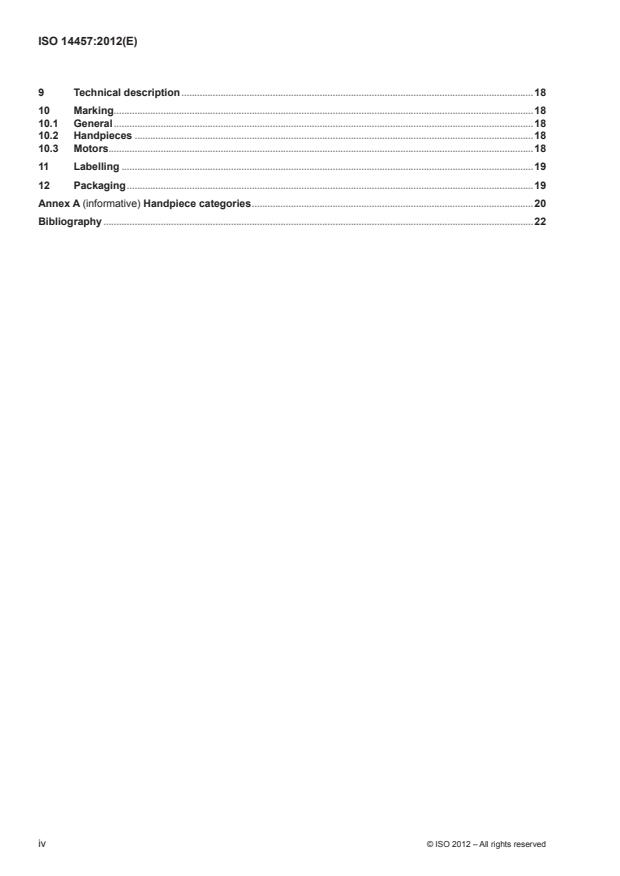
9 Technical description .18
10 Marking .18
10.1 General .18
10.2 Handpieces .18
10.3 Motors .18
11 Labelling .19
12 Packaging .19
Annex A (informative) Handpiece categories .20
Bibliography .22
iv © ISO 2012 – All rights reserved
Foreword
ISO (the International Organization for Standardization) is a worldwide federation of national standards bodies
(ISO member bodies). The work of preparing International Standards is normally carried out through ISO
technical committees. Each member body interested in a subject for which a technical committee has been
established has the right to be represented on that committee. International organizations, governmental and
non-governmental, in liaison with ISO, also take part in the work. ISO collaborates closely with the International
Electrotechnical Commission (IEC) on all matters of electrotechnical standardization.
International Standards are drafted in accordance with the rules given in the ISO/IEC Directives, Part 2.
The main task of technical committees is to prepare International Standards. Draft International Standards
adopted by the technical committees are circulated to the member bodies for voting. Publication as an
International Standard requires approval by at least 75 % of the member bodies casting a vote.
Attention is drawn to the possibility that some of the elements of this document may be the subject of patent
rights. ISO shall not be held responsible for identifying any or all such patent rights.
ISO 14457 was prepared by Technical Committee ISO/TC 106, Dentistry, Subcommittee SC 4, Dental instruments.
ISO 14457 cancels and replaces ISO 7785-1:1997, ISO 7785-2:1995, ISO 11498:1997 and ISO 13294:1997,
which have been technically revised.
Introduction
Dental handpieces and dental motors have been used in dental treatment procedures for many years.
Technical development creates handpieces and motors that are better and easier to use. The combination of
these items is very important for good performance.
This International Standard combines the content of the following four ISO standards, which have now
been withdrawn.
ISO 7785-1:1997, Dental handpieces — Part 1: High-speed air turbine handpieces
ISO 7785-2:1995, Dental handpieces — Part 2: Straight and geared angle handpieces
ISO 11498:1997, Dental handpieces — Dental low-voltage electrical motors
ISO 13294:1997, Dental handpieces — Dental air-motors
vi © ISO 2012 – All rights reserved
INTERNATIONAL STANDARD ISO 14457:2012(E)
Dentistry — Handpieces and motors
1 Scope
This International Standard is applicable to handpieces and motors used in dentistry for patient contact,
regardless of their construction. It specifies requirements, test methods, manufacturer’s information, marking
and packaging.
This International Standard is applicable to:
a) straight and geared-angle handpieces, including handpiece attachments;
b) high-speed air turbine handpieces;
c) air motors;
d) electrical motors;
e) prophy handpieces.
This International Standard is not applicable to:
1) intraoral camera handpieces;
2) powered polymerization handpieces;
3) air-powered scalers;
4) electrical powered scalers;
5) air-powder polishing handpieces;
6) multifunction handpieces (syringes).
NOTE See Annex A for clarification of the handpieces, attachments and motor types covered by this International Standard.
2 Normative references
The following referenced documents are indispensable for the application of this document. For dated
references, only the edition cited applies. For undated references, the latest edition of the referenced document
(including any amendments) applies.
ISO 1797-1, Dentistry — Shanks for rotary instruments — Part 1: Shanks made of metals
ISO 1797-2, Dental rotary instruments — Shanks — Part 2: Shanks made of plastics
ISO 1942, Dentistry — Vocabulary
ISO 3964, Dental handpieces — Coupling dimensions
ISO 5349-1, Mechanical vibration — Measurement and evaluation of human exposure to hand-transmitted
vibration — Part 1: General requirements
ISO 5349-2, Mechanical vibration — Measurement and evaluation of human exposure to hand-transmitted
vibration — Part 2: Practical guidance for measurement at the workplace
ISO 6507-1, Metallic materials — Vickers hardness test — Part 1: Test method
ISO 7405, Dentistry — Evaluation of biocompatibility of medical devices used in dentistry
ISO 7494-1, Dentistry — Dental units— Part 1: General requirements and test methods
ISO 9168, Dentistry — Hose connectors for air driven dental handpieces
ISO 9687, Dental equipment — Graphical symbols
ISO 10993-1, Biological evaluation of medical devices — Part 1: Evaluation and testing within a risk
management process
ISO 13295, Dentistry — Mandrels for rotary instruments
ISO 15223-1, Medical devices — Symbols to be used with medical device labels, labelling and information to
be supplied — Part 1: General requirements
ISO 17664, Sterilization of medical devices — Information to be provided by the manufacturer for the processing
of resterilizable medical devices
ISO 21531, Dentistry — Graphical symbols for dental instruments
IEC 60601-1:2005, Medical electrical equipment — Part 1: General requirements for basic safety and
essential performance
IEC 61672-1, Electroacoustics — Sound level meters — Part 1: Specifications
IEC 62366, Medical devices — Application of usability engineering to medical devices
IEC 80601-2-60:2012, Medical electrical equipment — Part 2-60: Particular requirements for basic safety and
essential performance of dental equipment
3 Terms and definitions
For the purposes of this document, the terms and definitions given in ISO 1942 and the following apply.
3.1
air motor
motor powered by compressed air, which is supplied by a dental unit
3.2
air-powered powder jet handpiece
handpiece powered by air, designed to transfer powder to the patient
3.3
air-powered scaler
handpiece powered by air, with an oscillating working part
3.4
angle handpiece
handpiece with an angle between the input and output axes, driven by an air motor or an electrical motor or
with an internal power supply
3.5
contra-angle handpiece
angle handpiece with one or more additional angles placed so as to bring the working part of the instrument or
tool approximately into line with the main axis of the handpiece
3.6
non-metallic chuck
handpiece chuck with non-metallic material on the contact surface of the shank holding mechanism
3.7
electrical motor
motor powered by electrical energy, which is supplied by a dental unit
2 © ISO 2012 – All rights reserved
3.8
electrical powered scaler
handpiece powered by electrical energy, with an oscillating working part
3.9
working part
part of a fixed or interchangeable instrument connected to a handpiece
3.10
handpiece
powered handheld instrument used to operate a rotary, oscillating or reciprocating working part
3.11
handpiece attachment
extension part of a handpiece designed to hold a working part
3.12
handpiece chuck
part of the handpiece designed to securely hold the shank of a working part
3.13
high-speed air turbine handpiece
handpiece propelled by a small air-powered turbine (or rotor), capable of high speed, which is integrated into
the head of the handpiece and has a chucking device coaxial with the turbine
3.14
intraoral camera handpiece
handpiece designed to take optical images in the oral cavity of the patient
3.15
motor
device, powered by air or electricity supplied by a dental unit, designed to transform energy into movement
3.16
polymerization handpiece
handpiece producing light that is applied directly to polymerizable dental materials in the oral cavity of a patient
3.17
prophy handpiece
angle handpiece used for dental prophylaxis, driven by an air motor or an electrical motor
3.18
rotary instrument
rotating instrument used in a high-speed air turbine handpiece or in a straight and geared-angle handpiece,
consisting of a shank and a working end used for dental procedures
3.19
reciprocating instrument
oscillating instrument used in a high-speed air turbine handpiece, or in a straight and geared-angle handpiece,
consisting of a shank and a working end used for dental procedures
3.20
straight handpiece
handpiece with the input and output axes in alignment, driven by an air motor or an electrical motor or with an
internal power supply
3.21
transmission part
small tool (rotary or reciprocating) designed to transmit energy from the shank to the working end
3.22
working end
distal end of a rotary or oscillating instrument intended for direct use in the oral cavity of the patient
4 Classification of handpieces
Handpieces are classified according to their gear ratio into three types as given in Table 1.
Table 1 — Gear ratios for handpieces
Type Gear ratio Resulting rotating speed Resulting torque Colour
1 >1:1 lower higher green
2 1:1 constant constant blue
3 1:>1 higher lower red
5 Requirements and performance
5.1 General
The construction of handpieces shall provide for their safe and reliable operation. Their use and manipulation
shall be easy and comfortable for the operator. These requirements shall be compliant with IEC 62366.
If field-repairable, the handpieces shall be capable of being easily disassembled and reassembled for
maintenance and repair utilizing either readily available tools or special tools supplied by the manufacturer.
Electrical requirements are only applicable to electrically powered handpieces.
5.2 Materials
Tests for biocompatibility shall be in accordance with ISO 7405 and ISO 10993-1.
5.3 Drop test
IEC 60601-1:2005, 15.3.4.1, applies.
5.4 Noise level
The A-weighted sound pressure value generated by the handpiece shall not exceed 80 dB.
Test in accordance with 7.16.
NOTE This test applies to each handpiece as a system in actual use, i.e. each attachment used with its respective
drive motor.
5.5 Surfaces
Particular attention should be given to providing secure gripping surfaces for operator manipulation under
normal conditions of use.
Test in accordance with IEC 62366.
NOTE In order to reduce glare, highly polished surfaces should be avoided.
4 © ISO 2012 – All rights reserved
5.6 Power supply
5.6.1 Electrical power supply
The following requirements are applicable for:
a) electrical motors;
b) handpieces, integrated with the motor;
c) prophy handpieces, integrated with the motor.
The requirements shall be specified by the manufacturer and shall comply with ISO 7494-1.
Test in accordance with 7.3.
5.6.2 Air supply
5.6.2.1 Air-powered handpiece
The following requirements are applicable for:
a) high-speed air turbine handpieces;
b) air motors;
c) handpieces, integrated with the air motor;
d) prophy handpieces, integrated with the air motor.
Air-powered handpieces shall be operated by a pressurized air supply in accordance with the manufacturer’s
instructions. The necessary flow rate shall be < 66 Nl/min in a pressure range of (300 ± 100) kPa [(3,0 ±1,0) bar].
Test in accordance with 7.4.
5.6.2.2 Motor cooling air
The following requirement is applicable for electrical motors.
If the electrical motor is equipped with an air cooling system, the maximum air flow rate should not be more
than 40 Nl/min and the pressure range should be 250 kPa to 500 kPa (2,5 bar to 5,0 bar). The electrical motor
should have an outlet connection for motor air cooling.
Test in accordance with 7.8.
5.6.2.3 Spray air supply
Spray air coolant capability may be provided at the discretion of the manufacturer. Handpieces having spray
air coolant capability shall direct air to the operating area of the rotary instrument. If water and air are used
simultaneously, a cooling mist shall be created and transmitted to the cutting area of a rotary instrument. The
handpiece shall be capable of attaining an air flow rate of at least 1,5 Nl/min at 200 kPa (2,0 bar).
Motors shall be equipped, if applicable, to transmit air to a handpiece attachment. The equipment shall be
capable of attaining an air flow rate of at least 1,5 Nl/min at 200 kPa (2,0 bar).
Test in accordance with 7.5.
5.6.3 Water supply
The handpiece, if applicable, shall provide a wa
...
NORME ISO
INTERNATIONALE 14457
Première édition
2012-09-15
Médecine bucco-dentaire — Pièces à
main et moteurs
Dentistry — Handpieces and motors
Numéro de référence
©
ISO 2012
DOCUMENT PROTÉGÉ PAR COPYRIGHT
Droits de reproduction réservés. Sauf prescription différente, aucune partie de cette publication ne peut être reproduite ni utilisée sous
quelque forme que ce soit et par aucun procédé, électronique ou mécanique, y compris la photocopie et les microfilms, sans l’accord écrit
de l’ISO à l’adresse ci-après ou du comité membre de l’ISO dans le pays du demandeur.
ISO copyright office
Case postale 56 • CH-1211 Geneva 20
Tel. + 41 22 749 01 11
Fax + 41 22 749 09 47
E-mail copyright@iso.org
Web www.iso.org
Publié en Suisse
ii © ISO 2012 – Tous droits réservés
Sommaire Page
Avant-propos . v
Introduction .vi
1 Domaine d’application . 1
2 Références normatives . 1
3 Termes et définitions . 2
4 Classification des pièces à main . 4
5 Exigences et performance . 4
5.1 Généralités . 4
5.2 Matériel . 4
5.3 Essai de chute . 4
5.4 Niveau de bruit . 4
5.5 Surfaces . 4
5.6 Alimentation en énergie . 5
5.7 Pression d’air et pression d’eau . 6
5.8 Température . 6
5.9 Vibrations . 6
5.10 Résistance au retraitement . 6
5.11 Fuite et/ou entrée d’eau . 6
5.12 Compatibilité électromagnétique . 6
5.13 Commandes de fonctionnement . 7
5.14 Aptitude à l’utilisation . 7
5.15 Connexion et alimentation . 7
5.16 Système de serrage pour queues . 9
5.17 Mandrin d’essai . 9
5.18 Vitesse . 11
5.19 Excentricité . 11
5.20 Couple . 11
5.21 Dimensions de la tête et du nez . 11
6 Échantillonnage .12
7 Essais .13
7.1 Conditions d’essai générales .13
7.2 Inspection visuelle .13
7.3 Alimentation en énergie — Électricité .13
7.4 Alimentation en énergie — Air .13
7.5 Alimentation en air pulvérisé .13
7.6 Alimentation en eau pulvérisée .14
7.7 Pression d’air et pression d’eau .14
7.8 Air de refroidissement du moteur .14
7.9 Connexion pour raccordement de la pièce à main et de la pièce à main à air comprimé .14
7.10 Connexion et alimentation .15
7.11 Mandrins d’essai .15
7.12 Système de serrage pour queues .15
7.13 Dimensions (de la tête et du nez) .16
7.14 Excentricité .16
7.15 Couple .16
7.16 Niveau de bruit .16
7.17 Vitesse .17
7.18 Échauffement du corps .17
7.19 Température excessive .17
7.20 Résistance au retraitement .17
8 Instructions d’utilisation, de maintenance et de réparation .17
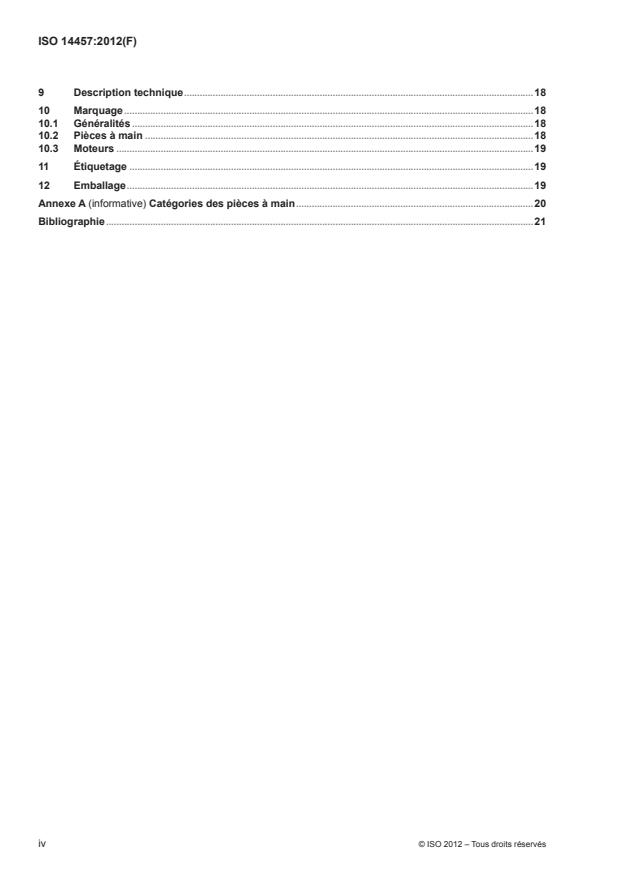
9 Description technique .18
10 Marquage .18
10.1 Généralités .18
10.2 Pièces à main .18
10.3 Moteurs .19
11 Étiquetage .19
12 Emballage .19
Annexe A (informative) Catégories des pièces à main .20
Bibliographie .21
iv © ISO 2012 – Tous droits réservés
Avant-propos
L’ISO (Organisation internationale de normalisation) est une fédération mondiale d’organismes nationaux de
normalisation (comités membres de l’ISO). L’élaboration des Normes internationales est en général confiée aux
comités techniques de l’ISO. Chaque comité membre intéressé par une étude a le droit de faire partie du comité
technique créé à cet effet. Les organisations internationales, gouvernementales et non gouvernementales,
en liaison avec l’ISO participent également aux travaux. L’ISO collabore étroitement avec la Commission
électrotechnique internationale (CEI) en ce qui concerne la normalisation électrotechnique.
Les Normes internationales sont rédigées conformément aux règles données dans les Directives ISO/CEI, Partie 2.
La tâche principale des comités techniques est d’élaborer les Normes internationales. Les projets de Normes
internationales adoptés par les comités techniques sont soumis aux comités membres pour vote. Leur publication
comme Normes internationales requiert l’approbation de 75 % au moins des comités membres votants.
L’attention est appelée sur le fait que certains des éléments du présent document peuvent faire l’objet de droits
de propriété intellectuelle ou de droits analogues. L’ISO ne saurait être tenue pour responsable de ne pas avoir
identifié de tels droits de propriété et averti de leur existence.
L’ISO 14457 a été élaborée par le comité technique ISO/TC 106, Médecine bucco-dentaire, sous-comité SC 4,
Instruments dentaires.
Cette première édition de l’ISO 14457 annule et remplace l’ISO 7785-1:1997, l’ISO 7785-2:1995, l’ISO 11498:1997
et l’ISO 13294:1997, qui ont fait l’objet d’une révision technique.
Introduction
Les pièces à main et les moteurs dentaires sont utilisés dans le domaine des soins dentaires depuis de
nombreuses années.
Les progrès techniques permettent de créer des pièces à main et des moteurs plus faciles à utiliser et plus
performants. La combinaison de ces éléments est très importante pour obtenir une bonne performance.
La présente Norme internationale combine le contenu des quatre Normes internationales suivantes qui ont
été annulées:
— ISO 7785-1:1997, Pièces à main dentaires — Partie 1: Pièces à main à turbines à air comprimé pour
grandes vitesses
— ISO 7785-2:1995, Pièces à main dentaires — Partie 2: Pièces à main rectilignes et à contre-angles
— ISO 11498:1997, Pièces à main dentaires — Moteurs électriques dentaires à basse tension
— ISO 13294:1997, Pièces à main dentaires — Moteurs dentaires à air
vi © ISO 2012 – Tous droits réservés
NORME INTERNATIONALE ISO 14457:2012(F)
Médecine bucco-dentaire — Pièces à main et moteurs
1 Domaine d’application
La présente Norme internationale s’applique aux pièces à main et aux moteurs utilisés en médecine bucco-
dentaire pour le contact patient, quelle que soit leur construction. Elle spécifie les exigences, les méthodes
d’essai, les informations du fabricant, le marquage et l’emballage.
La présente Norme internationale s’applique
a) aux pièces à main rectilignes et à contre-angles, y compris aux raccordements de la pièce à main,
b) aux pièces à main à turbines à air comprimé pour grandes vitesses,
c) aux moteurs à air,
d) aux moteurs électriques, et
e) aux pièces de prophylaxie.
La présente Norme internationale ne s’applique pas
1) aux pièces à main à caméras intrabuccales,
2) aux pièces à main alimentées en énergie pour polymérisation,
3) aux instruments pour détartrage à air comprimé,
4) aux instruments pour détartrage électriques,
5) aux pièces à main pour polissage à air comprimé, et
6) aux pièces à main multifonctions (seringues).
NOTE Voir l’Annexe A pour clarifier les types de pièces à main, de raccordements et de moteurs couverts par la
présente Norme internationale.
2 Références normatives
Les documents de référence suivants sont indispensables à l’application du présent document. Pour les
références datées, seule l’édition citée s’applique. Pour les références non datées, la dernière édition du
document de référence s’applique (y compris les éventuels amendements).
ISO 1797-1, Médecine bucco-dentaire — Queues pour instruments rotatifs — Partie 1: Queues en
matériaux métalliques
ISO 1797-2, Instruments rotatifs dentaires — Queues — Partie 2: Queues en matières plastiques
ISO 1942, Médecine bucco-dentaire — Vocabulaire
ISO 3964, Pièces à main dentaires — Dimensions d’accouplement
ISO 5349-1, Vibrations mécaniques — Mesurage et évaluation de l’exposition des individus aux vibrations
transmises par la main — Partie 1: Exigences générales
ISO 5349-2, Vibrations mécaniques ― Mesurage et évaluation de l’exposition des individus aux vibrations
transmises par la main — Partie 2: Guide pratique pour le mesurage sur le lieu de travail
ISO 6507-1, Matériaux métalliques — Essai de dureté Vickers — Partie 1: Méthodes d’essai
ISO 7405, Art dentaire — Évaluation de la biocompatibilité des dispositifs médicaux utilisés en art dentaire
ISO 7494-1, Médecine bucco-dentaire — Units dentaires — Partie 1: Exigences générales et méthodes d’essai
ISO 9168, Art dentaire — Connexions pour pièces à main dentaires à air comprimé
ISO 9687, Matériel dentaire — Symboles graphiques
ISO 10993-1, Évaluation biologique des dispositifs médicaux — Partie 1: Évaluation et essais au sein d’un
processus de gestion du risque
ISO 13295, Art dentaire — Mandrins pour instruments rotatifs
ISO 15223-1, Dispositifs médicaux — Symboles à utiliser avec les étiquettes, l’étiquetage et les informations à
fournir relatifs aux dispositifs médicaux — Partie 1: Exigences générales
ISO 17664, Stérilisation des dispositifs médicaux — Informations devant être fournies par le fabricant pour le
processus de restérilisation des dispositifs médicaux
ISO 21531, Art dentaire — Symboles graphiques pour instruments dentaires
CEI 60601-1:2005, Appareils électromédicaux — Partie 1: Exigences générales pour la sécurité de base et les
performances essentielles
CEI 61672-1, Électroacoustique — Sonomètres — Partie 1: Spécifications
CEI 62366, Dispositifs médicaux — Application de l’ingénierie de l’aptitude à l’utilisation aux dispositifs médicaux
CEI 80601-2-60:2012, Appareils électromédicaux — Partie 2-60: Exigences particulières pour la sécurité de
base et les performances essentielles des équipements dentaires
3 Termes et définitions
Pour les besoins du présent document, les termes et définitions suivants et ceux donnés dans l’ISO 1942
s’appliquent.
3.1
moteur à air
moteur actionné par de l’air comprimé, fourni par un unit dentaire
3.2
pièce à main à air comprimé à jet de poudre
pièce à main actionnée par de l’air comprimé, conçue pour envoyer un jet de poudre au patient
3.3
instrument pour détartrage à air comprimé
pièce à main actionnée par de l’air comprimé, équipée d’une partie de travail oscillante
3.4
pièce à main angulaire
pièce à main dont l’axe d’entrée et l’axe de sortie forment un angle, entraînée par un moteur à air ou électrique
ou équipée d’une alimentation interne
3.5
pièce à main à contre-angles
pièce à main angulaire comportant un ou plusieurs angles supplémentaires configurés de façon que la partie
de travail de l’instrument ou de l’outil soit approximativement alignée sur l’axe principal de la pièce à main
3.6
système de serrage non métallique
système de serrage de la pièce à main dont la surface de contact du mécanisme porte-queue est constituée
d’un matériau non métallique
2 © ISO 2012 – Tous droits réservés
3.7
moteur électrique
moteur actionné par de l’énergie électrique, fournie par un unit dentaire
3.8
instrument pour détartrage électrique
pièce à main actionnée par de l’énergie électrique, équipée d’une partie de travail oscillante
3.9
partie de travail
partie d’un instrument fixe ou interchangeable raccordée à une pièce à main
3.10
pièce à main
instrument portatif motorisé utilisé pour actionner une partie de travail rotative, oscillante ou alternative
3.11
raccordement de la pièce à main
partie d’extension d’une pièce à main conçue pour fixer une partie de travail
3.12
système de serrage de la pièce à main
partie de la pièce à main conçue pour fixer solidement la queue d’une partie de travail
3.13
pièce à main à turbines à air comprimé pour grandes vitesses
pièce à main propulsée par une petite turbine (ou rotor) à air comprimé, capable de grandes vitesses, intégrée
dans la tête de la pièce à main et possédant un dispositif de serrage coaxial à la turbine
3.14
pièce à main à caméras intrabuccales
pièce à main conçue pour réaliser des vidéos de la cavité buccale du patient
3.15
moteur
dispositif, alimenté en air ou en électricité fourni par un unit dentaire, conçu pour transformer l’énergie en mouvement
3.16
pièce à main pour polymérisation
pièce à main produisant une lumière appliquée directement dans la cavité buccale d’un patient sur des
matériaux dentaires polymérisables
3.17
pièce de prophylaxie
pièce à main angulaire utilisée pour la prophylaxie dentaire, entraînée par un moteur à air ou électrique
3.18
instrument rotatif
instrument rotatif utilisé dans une pièce à main à turbines à air comprimé pour grandes vitesses ou dans une
pièce à main rectiligne et à contre-angles, constitué d’une queue et d’une extrémité de travail utilisées pour les
procédures dentaires
3.19
instrument alternatif
instrument oscillant utilisé dans une pièce à main à turbines à air comprimé pour grandes vitesses ou dans une
pièce à main rectiligne et à contre-angles, constitué d’une queue et d’une extrémité de travail utilisées pour les
procédures dentaires
3.20
pièce à main rectiligne
pièce à main dont les axes d’entrée et de sortie sont alignés, entraînée par un moteur à air ou électrique ou
équipée d’une alimentation interne
3.21
pièce de transmission
petit outil (rotatif ou alternatif) conçu pour transmettre de l’énergie de la queue à l’extrémité de travail
3.22
extrémité de travail
extrémité distale d’un instrument rotatif ou oscillant conçue pour une utilisation directe dans la cavité
buccale du patient
4 Classification des pièces à main
Les pièces à main sont classées en fonction de leur rapport d’engrenage, en trois types de catégories indiquées
dans le Tableau 1.
Tableau 1 — Rapports d’engrenage des pièces à main
Type Rapport Vitesse de rotation obtenue Couple obtenu Couleur
d’engrenage
1 >1:1 inférieure supérieur verte
2 1:1 constante constant bleue
3 1:>1 supérieure inférieur rouge
5 Exigences et performance
5.1 Généralités
La construction des pièces à main doit garantir un fonctionnement sûr et fiable de celles-ci. Elles doivent être
simples et pratiques à utiliser et à manipuler par l’opérateur. Ces exigences doivent être conformes à la CEI 62366.
Si elles peuvent être réparées sur site, les pièces à main doivent pouvoir être facilement démontées et
remontées en vue de la maintenance et de la réparation, en utilisant soit des outils déjà disponibles, soit des
outils spéciaux fournis par le fabricant.
Les exigences électriques s’appliquent uniquement aux pièces à main électriques.
5.2 Matériel
Les essais de biocompatibilité doivent être conformes à l’ISO 7405 et à l’ISO 10993-1.
5.3 Essai de chute
La CEI 60601-1:2005,15.3.4.1, s’applique.
5.4 Niveau de bruit
Le niveau de pression acoustique pondéré A produit par la pièce à main ne doit pas dépasser 80 dB.
Soumettre à essai conformément à 7.16.
NOTE Dans la pratique, cet essai s’applique à chaque pièce à main en tant que système, c’est-à-dire chaque
raccordement utilisé avec son moteur d’entraînement respectif.
5.5 Surfaces
Il convient de prêter une attention particulière à la fourniture de surfaces de prise en main bien adhérentes en
vue de la manipulation par l’opérateur dans des conditions d’utilisation normales.
4 © ISO 2012 – Tous droits réservés
Soumettre à essai conformément à la CEI 62366.
NOTE Pour réduire l’éblouissement, il convient d’éviter d’utiliser des surfaces hautement polies.
5.6 Alimentation en énergie
5.6.1 Alimentation en énergie électrique
Les exigences suivantes s’appliquent
a) aux moteurs électriques,
b) aux pièces à main intégrées dans le moteur, et
c) aux pièces de prophylaxie intégrées dans le moteur.
Les exigences doivent être spécifiées par le fabricant et être conformes à l’ISO 7494-1.
Soumettre à essai conformément à 7.3.
5.6.2 Alimentation en air
5.6.2.1 Pièce à main à air comprimé
Les exigences suivantes s’appliquent
a) aux pièces à main à turbines à air comprimé pour grandes vitesses,
b) aux moteurs à air,
c) aux pièces à main intégrées dans le moteur à air, et
d) aux pièces de prophylaxie intégrées dans le moteur à air.
Les pièces à main à air comprimé doivent être actionnées par une alimentation en air comprimé conforme
aux instructions du fabricant. Le débit nécessaire doit être <66 Nl/min dans une gamme de pression de
(300 ± 100) kPa [(3,0 ± 1,0) bar].
Soumettre à essai conformément à 7.4.
5.6.2.2 Air de refroidissement du moteur
L’exigence suivante s’applique aux moteurs électriques.
Si le moteur électrique est équipé d’un système de refroidissement par l’air, il convient que le débit d’air maximal ne
dépasse pas 40 Nl/min et que la gamme de pression soit comprise entre 250 kPa et 500 kPa (2,5 bar et 5,0 bar).
Il convient que le moteur électrique soit muni d’un raccord de sortie pour le refroidissement par l’air du moteur.
Soumettre à essai conformément à 7.8.
5.6.2.3 Alimentation en air pulvérisé
La capacité de refroidissement à l’air pulvérisé peut être laissée à la discrétion du fabricant. Les pièces à
main ayant une capacité de refroidissement à l’air pulvérisé doivent diriger l’air sur la zone de fonctionnement
de l’instrument rotatif. Si de l’eau et de l’air sont utilisés simultanément, un spray de refroidissement doit être
produit et transmis sur la zone de coupe d’un instrument rotatif. La pièce à main doit être capable d’atteindre
un débit d’air d’au moins 1,5 Nl/min à 200 kPa (2,0 bar).
Les moteurs doivent être équipés, le cas échéant, d’un moyen de transmission de l’air à un raccordement de la
pièce à main. L’équipement doit être capable d’atteindre un débit d’air d’au moins 1,5 Nl/min à 200 kPa (2,0 bar).
Soumettre à essai conformément à 7.5.
5.6.3 Alimentation en eau
Le cas échéant, la pièce à main doit pouvoir refroidir, avec de l’eau, la zone de fonctionnement de la partie de
travail, à un débit d’au moins 50 ml/min à 250 kPa (2,5 bar).
Soumettre à essai conformément à 7.6.
5.7 Pression d’air et pression d’eau
Le cas échéant, les moteurs et les pièces à main doivent rester intacts, ce qui signifie qu’ils ne doivent pas se
casser ou exploser lorsqu’ils sont soumis à une pression 50 % au-dessus de la pression de fonctionnement
maximale recommandée par le fabricant.
Soumettre à essai conformément à 7.7.
5.8 Température
5.8.1 Échauffement du corps
La CEI 80601-2-60:2012, 201.11.1.1, s’applique.
Soumettre à essai conformément à 7.18.
5.8.2 Température excessive
La CEI 80601-2-60:2012, 201.11.2.2, s’appli
...
Questions, Comments and Discussion
Ask us and Technical Secretary will try to provide an answer. You can facilitate discussion about the standard in here.
Loading comments...