


ISO/PAS 25955
(Main)Information and documentation — Technical interoperability — Data Documentation Initiative (DDI)
Information and documentation — Technical interoperability — Data Documentation Initiative (DDI)
Information et documentation — Interopérabilité technique — Initiative de documentation des données (DDI)
General Information
- Status
- Not Published
- Technical Committee
- ISO/TC 46/SC 4 - Technical interoperability
- Drafting Committee
- ISO/TC 46/SC 4 - Technical interoperability
- Current Stage
- 6000 - International Standard under publication
- Start Date
- 10-Dec-2025
- Completion Date
- 12-Feb-2026
Overview
ISO/PAS 25955 - Information and documentation - Technical interoperability - Data Documentation Initiative (DDI) describes the common, shared features across the DDI family of metadata standards. Published as a DPAS (draft) for review, this document sets out how DDI models document variables, metadata and the data lifecycle to support technical interoperability for social, behavioural and economic (SBE) data and broader cross‑domain data integration.
Keywords: ISO/PAS 25955, Data Documentation Initiative, DDI, metadata standard, technical interoperability, data lifecycle, semantic interoperability
Key Topics
- Scope and status
- Consolidates shared features of the DDI product suite; currently distributed as a draft (DPAS) for comment.
- Metadata and variables
- Defines the common notion of a variable (roughly a data column) and how its description is organized across DDI standards.
- Variable cascade & unit cascade
- Describes hierarchical and inherited descriptions for variables and measurement units to enable reuse and consistency.
- Value domains
- Covers structures and usages of value domains (enumerated lists, ranges, rules) that constrain or describe allowed data values.
- Data lifecycle
- Identifies lifecycle phases addressed by DDI products (from collection and processing to dissemination and preservation).
- Model independence
- Explains Platform Independent Models (PIM) and Platform Specific Models (PSM) that separate logical models from syntax (XML, JSON, RDF).
- Semantic interoperability
- Emphasizes shared semantics to enable integration across systems and domains.
- Normative references
- Draws on ISO 1087, ISO/IEC Guide 2 and the DDI Glossary for terminology and guidance.
Applications
Who uses ISO/PAS 25955 and the DDI framework:
- National statistical offices and data archives for standardising survey documentation and reproducible metadata.
- University data libraries and research data centres to create interoperable codebooks and data descriptions.
- Survey methodologists and data producers to document questionnaires, sampling and weighting methods.
- Software developers and integrators implementing metadata systems in XML, JSON or RDF (via PSMs conforming to a PIM).
- Data integrators and analysts combining SBE and cross‑domain datasets who need consistent value domains and semantic mappings.
Practical benefits include improved metadata reuse, clearer data provenance across the lifecycle, and easier cross‑system data exchange and integration.
Related standards and products
- DDI-Codebook (DDI‑C) and DDI‑Lifecycle (DDI‑L)
- DDI Cross‑Domain Integration (DDI‑CDI)
- Supporting products: XKOS (extended SKOS), SDTL (Structured Data Transformation Language), controlled vocabularies
- Normative links: ISO 1087, ISO/IEC Guide 2, DDI Alliance glossary
This standard is intended as a harmonizing reference to make DDI implementations more interoperable, discoverable and reusable across multiple platforms and domains.
ISO/DPAS 25955 - Information and documentation — Technical interoperability — Data Documentation Initiative (DDI) Released:9/30/2025
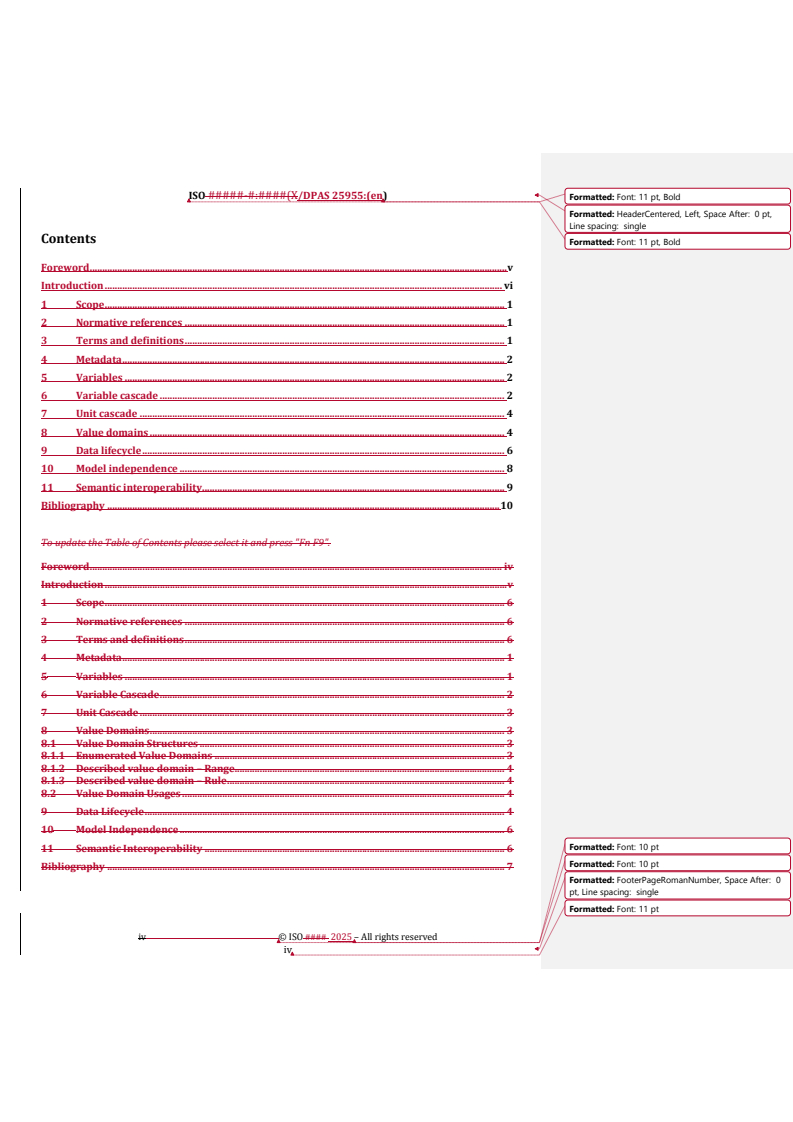
REDLINE ISO/DPAS 25955 - Information and documentation — Technical interoperability — Data Documentation Initiative (DDI) Released:9/30/2025
Frequently Asked Questions
ISO/PAS 25955 is a draft published by the International Organization for Standardization (ISO). Its full title is "Information and documentation — Technical interoperability — Data Documentation Initiative (DDI)". This standard covers: Information and documentation — Technical interoperability — Data Documentation Initiative (DDI)
Information and documentation — Technical interoperability — Data Documentation Initiative (DDI)
ISO/PAS 25955 is classified under the following ICS (International Classification for Standards) categories: 01.140.20 - Information sciences. The ICS classification helps identify the subject area and facilitates finding related standards.
ISO/PAS 25955 is available in PDF format for immediate download after purchase. The document can be added to your cart and obtained through the secure checkout process. Digital delivery ensures instant access to the complete standard document.
Standards Content (Sample)
FINAL DRAFT
Publicly
Available
Specification
ISO/DPAS 25955
ISO/TC 46/SC 4
Information and documentation —
Secretariat: KATS
Technical interoperability — Data
Voting begins on:
Documentation Initiative (DDI)
2025-10-14
Voting terminates on:
2025-12-09
RECIPIENTS OF THIS DRAFT ARE INVITED TO SUBMIT,
WITH THEIR COMMENTS, NOTIFICATION OF ANY
RELEVANT PATENT RIGHTS OF WHICH THEY ARE AWARE
AND TO PROVIDE SUPPOR TING DOCUMENTATION.
IN ADDITION TO THEIR EVALUATION AS
BEING ACCEPTABLE FOR INDUSTRIAL, TECHNO
LOGICAL, COMMERCIAL AND USER PURPOSES, DRAFT
INTERNATIONAL STANDARDS MAY ON OCCASION HAVE
TO BE CONSIDERED IN THE LIGHT OF THEIR POTENTIAL
TO BECOME STAN DARDS TO WHICH REFERENCE MAY BE
MADE IN NATIONAL REGULATIONS.
Reference number
ISO/DPAS 25955:2025(en) © ISO 2025
FINAL DRAFT
ISO/DPAS 25955:2025(en)
Publicly
Available
Specification
ISO/DPAS 25955
ISO/TC 46/SC 4
Information and documentation —
Secretariat: KATS
Technical interoperability — Data
Voting begins on:
Documentation Initiative (DDI)
Voting terminates on:
RECIPIENTS OF THIS DRAFT ARE INVITED TO SUBMIT,
WITH THEIR COMMENTS, NOTIFICATION OF ANY
RELEVANT PATENT RIGHTS OF WHICH THEY ARE AWARE
AND TO PROVIDE SUPPOR TING DOCUMENTATION.
© ISO 2025
IN ADDITION TO THEIR EVALUATION AS
All rights reserved. Unless otherwise specified, or required in the context of its implementation, no part of this publication may
BEING ACCEPTABLE FOR INDUSTRIAL, TECHNO
LOGICAL, COMMERCIAL AND USER PURPOSES, DRAFT
be reproduced or utilized otherwise in any form or by any means, electronic or mechanical, including photocopying, or posting on
INTERNATIONAL STANDARDS MAY ON OCCASION HAVE
the internet or an intranet, without prior written permission. Permission can be requested from either ISO at the address below
TO BE CONSIDERED IN THE LIGHT OF THEIR POTENTIAL
or ISO’s member body in the country of the requester.
TO BECOME STAN DARDS TO WHICH REFERENCE MAY BE
MADE IN NATIONAL REGULATIONS.
ISO copyright office
CP 401 • Ch. de Blandonnet 8
CH-1214 Vernier, Geneva
Phone: +41 22 749 01 11
Email: copyright@iso.org
Website: www.iso.org
Published in Switzerland Reference number
ISO/DPAS 25955:2025(en) © ISO 2025
ii
ISO/DPAS 25955:2025(en)
Contents Page
Foreword .iv
Introduction .v
1 Scope . 1
2 Normative references . 1
3 Terms and definitions . 1
4 Metadata . 2
5 Variables . 2
6 Variable cascade . 2
7 Unit cascade . 4
8 Value domains . 4
8.1 General .4
8.2 Value domain structures .4
8.2.1 General .4
8.2.2 Enumerated value domains .4
8.2.3 Described value domain — Range .5
8.2.4 Described value domain — Rule .5
8.3 Value domain usages .5
9 Data lifecycle . 6
10 Model independence . 7
11 Semantic interoperability . 7
Bibliography . 8
iii
ISO/DPAS 25955:2025(en)
Foreword
ISO (the International Organization for Standardization) is a worldwide federation of national standards
bodies (ISO member bodies). The work of preparing International Standards is normally carried out through
ISO technical committees. Each member body interested in a subject for which a technical committee
has been established has the right to be represented on that committee. International organizations,
governmental and non-governmental, in liaison with ISO, also take part in the work. ISO collaborates closely
with the International Electrotechnical Commission (IEC) on all matters of electrotechnical standardization.
The procedures used to develop this document and those intended for its further maintenance are described
in the ISO/IEC Directives, Part 1. In particular, the different approval criteria needed for the different types
of ISO documents should be noted. This document was drafted in accordance with the editorial rules of the
ISO/IEC Directives, Part 2 (see www.iso.org/directives).
ISO draws attention to the possibility that the implementation of this document may involve the use of (a)
patent(s). ISO takes no position concerning the evidence, validity or applicability of any claimed patent
rights in respect thereof. As of the date of publication of this document, ISO had not received notice of (a)
patent(s) which may be required to implement this document. However, implementers are cautioned that
this may not represent the latest information, which may be obtained from the patent database available at
www.iso.org/patents. ISO shall not be held responsible for identifying any or all such patent rights.
Any trade name used in this document is information given for the convenience of users and does not
constitute an endorsement.
For an explanation of the voluntary nature of standards, the meaning of ISO specific terms and expressions
related to conformity assessment, as well as information about ISO's adherence to the World Trade
Organization (WTO) principles in the Technical Barriers to Trade (TBT), see www.iso.org/iso/foreword.html.
This document was prepared by Technical Committee ISO/TC 46, Information and documentation,
Subcommittee SC 4, Technical interoperability.
Any feedback or questions on this document should be directed to the user’s national standards body. A
complete listing of these bodies can be found at www.iso.org/members.html.
iv
ISO/DPAS 25955:2025(en)
Introduction
The Data Documentation Initiative (DDI) is an ongoing program within the social, behavioural and economic
(SBE) data community for documenting their data. The program is managed by a consortium, the DDI
[5]
Alliance , that comprises university data libraries, university and national data archives, research centres,
national statistical offices, consultancies, and software development organizations. The suite of products
under DDI include several standards and other products designed to describe data and the processes used
to produce them.
DDI first began in 1995 to build a framework for describing a codebook, the document describing the
variables, questions, code lists, classifications, methodologies, usage guidance used to collect, organize, and
delimit the data in research studies. This standard was built using XML and first released in 2001 as DDI-
[6]
Codebook (DDI-C) . It has been updated periodically since and the current version is numbered 2.5.
In 2003, the DDI community realized an expanded version of DDI-C that addressed the descriptive needs of
data producers, such as national statistical offices, was needed. These requirements included descriptions
of the methodologies used in production, which include questionnaires, sampling, and weighting. These are
used in probability based statistical sample surveys, the standard design for surveys conducted by national
statistical offices. Further, the ability to reuse descriptions of variables, questions, and other artefacts was
seen as necessary to efficiently describe ongoing statistical surveys over time and program in support of
comparability, interoperability, and integration. This effort, also developed using XML, was called DDI-
[9]
Lifecycle (DDI-L). Its current version is numbered 3.3.
Reacting to a dramatic decline in response rates to their surveys, survey organisations began looking into
enhancing their data by integrating them with data from outside sources. These data come in a variety of
formats, with inconsistent quality and coverage, and often aren’t based on a probability sample. A framework
of descriptions to support data integration independent of SBE was intended to ease this problem. DDI
[8]
developed the Cross-Domain Integration (DDI-CDI) standard . It was released in early 2025.
Along with the standards, the DDI Alliance advocated the development of several supporting products,
which are:
[11]
— XKOS – eXtended Knowledge Organisation System is an extension of the W3C SKOS (Simple Knowledge
Organisation System) used to render concept systems in RDF (Resource Description Framework). XKOS
extends SKOS in 2 major ways, it
— supports levels in hierarchies, which are used to organize statistical classifications
— includes the semantics for some temporal and sequential relations;
[10]
— SDTL – Structured Data Transformation Language is a mid-level language for documenting the
processing steps in a data production environment;
[7]
— Controlled Vocabularies – A series of category sets and code lists for use as common ways to populate
some descriptors in the DDI standards. An example is the names for the kinds of sampling schemes
available.
Beginning around 1970, several researchers independently coined the term metadata. This loosely meant
“data about data”, and it refers to descriptions of data. Since then, the concept of metadata has expanded,
and the term is now applied to descriptions of any object or resource, not just to data. This expanded notion
of metadata is how the term is understood. Each of the DDI standards describes more than data.
Given this understanding of metadata, all the DDI standards are metadata standards. They address the
organisation and formats of the metadata needed for describing data. This mostly applies to SBE data, but
the DDI-CDI standard addresses data independent of the source.
This document describes several common aspects of all the DDI standards and other products. The DDI
standards all use the notion of a variable, and these roughly correspond to a column of data organised in the
rectangular format. The common notion of a variable and how its description is organized is the focus.
v
ISO/DPAS 25955:2025(en)
Each DDI standard and the other products are used to describe parts of the data lifecycle. The phases of this
lifecycle are defined, and which phases are addressed by the DDI standards and products are identified.
Of the DDI standards now managed under a UML (Unified Modelling Language) model, those models are
independent of each syntax representation (for example, XML, JSON, RDF, etc.) and are called Platform
Independent Models (PIM). Each syntax representation uses its own model, and each is an approximation
(as close as possible) to the PIM. They are called Platform Specific Models (PSM).
Using the terminology and ideas in ISO/IEC Guide 2, each PSM conforms to its PIM.
vi
FINAL DRAFT Publicly Available Specification ISO/DPAS 25955:2025(en)
Information and documentation — Technical interoperability
— Data Documentation Initiative (DDI)
1 Scope
This document describes the shared and interoperable features of the standards and other products under
the Data Documentation Initiative (DDI).
2 Normative references
The following documents are referred to in the text in such a way that some or all of their content constitutes
requirements of this document. For dated references, only the edition cited applies. For undated references,
the latest edition of the referenced document (including any amendments) applies.
ISO 1087:2019, Terminology work and terminology science — Vocabulary
ISO/IEC Guide 2:2004, Standardization and related activities — General vocabulary
DDI Alliance (2025). Available from: https:// ddialliance .org/ glossary
3 Terms and definitions
For the purposes of this document, the terms and definitions given in ISO 1087, ISO/IEC Guide 2, the DDI
Glossary and the following apply.
ISO and IEC maintain terminology databases for use in standardization at the following addresses:
— ISO Online browsing platform: available at https:// www .iso .org/ obp
— IEC Electropedia: available at https:// www .electropedia .org/
3.1
concept
unit of thought differentiated by characteristics
3.2
platform independent model
PIM
document describing the abstract model of the standardized data exchange process in a platform-
independent way
Note 1 to entry: The specific technological platform may be but not limited to a programming language or a database.
[SOURCE: ISO 10303-2:2024, 3.16.12]
3.3
platform specific model
PSM
model of a software system or business system linked to a specific technological platform
Note 1 to entry: The specific technological platform may be but not limited to a programming language, operating
system, document file format, or database.
[SOURCE: ISO 10303-2:2024, 3.16.13]
ISO/DPAS 25955:2025(en)
4 Metadata
For the DDI standards and rel
...
Style Definition
1 ISO #####:2025(E)/DPAS 25955
...
Formatted: French (Switzerland)
2 ISO/TC 46 /SC 4 / WG #
Formatted: zzCover large, Left
3 Secretariat: KATS
Formatted: Font: Not Bold, French (Switzerland)
Formatted
...
4 Date: 2025-07-0709-29
Formatted: zzCover, Left, Space After: 0 pt
Formatted: Cover Title_A1, Line spacing: single
5 Information and documentation – — Technical interoperability –
6 — Data Documentation Initiative (DDI)
8 DPAS
10 Warning for WDs and CDs
11 This document is not an ISO International Standard. It is distributed for review and comment. It is subject to
12 change without notice and may not be referred to as an International Standard.
13 Recipients of this draft are invited to submit, with their comments, notification of any relevant patent rights of
14 which they are aware and to provide supporting documentation.
17 A model document of an International Standard (the Model International Standard) is available at:
18 https://www.iso.org/drafting-standards.html
Formatted: Font: Bold
ISO #####-#:####(X)
2 © ISO #### – All rights reserved
ISO #####:2025(E/DPAS 25955:(en)
Formatted: Font: 11 pt, Bold
Formatted: Font: 11 pt, Bold
Formatted: HeaderCentered, Left, Space After: 0 pt,
Line spacing: single
Formatted: Left: 1.5 cm, Right: 1.5 cm, Bottom: 1 cm,
All rights reserved. Unless otherwise specified, or required in the context of its implementation, no part of this publication
Section start: New page, Header distance from edge:
may be reproduced or utilized otherwise in any form or by any means, electronic or mechanical, including photocopying,
1.27 cm, Footer distance from edge: 0.5 cm,
or posting on the internet or an intranet, without prior written permission. Permission can be requested from either ISO
Numbering: Restart each page
at the address below or ISO’s member body in the country of the requester.
Formatted: Indent: Left: 0 cm, Right: 0 cm, Adjust
ISO copyright office space between Latin and Asian text, Adjust space
between Asian text and numbers
CP 401 • Ch. de Blandonnet 8
CH-1214 Vernier, Geneva
Phone: + 41 22 749 01 11
Formatted: French (Switzerland)
EmailE-mail: copyright@iso.org
Formatted: French (Switzerland)
Website: www.iso.orgwww.iso.org
Formatted: French (Switzerland)
Published in Switzerland
Formatted: French (Switzerland)
Formatted: English (United Kingdom)
Formatted: Font: 10 pt
Formatted: FooterCentered, Left, Line spacing: single
Formatted: Font: 10 pt
Formatted: Font: 10 pt
Formatted: Font: 11 pt
Formatted: FooterPageRomanNumber, Left, Space
After: 0 pt, Line spacing: single
© ISO 2025 – All rights reserved
iii
ISO #####-#:####(X/DPAS 25955:(en)
Formatted: Font: 11 pt, Bold
Formatted: HeaderCentered, Left, Space After: 0 pt,
Line spacing: single
Contents
Formatted: Font: 11 pt, Bold
Foreword . v
Introduction . vi
1 Scope . 1
2 Normative references . 1
3 Terms and definitions . 1
4 Metadata . 2
5 Variables . 2
6 Variable cascade . 2
7 Unit cascade . 4
8 Value domains . 4
9 Data lifecycle . 6
10 Model independence . 8
11 Semantic interoperability . 9
Bibliography . 10
To update the Table of Contents please select it and press "Fn F9".
Foreword . iv
Introduction . v
1 Scope . 6
2 Normative references . 6
3 Terms and definitions . 6
4 Metadata . 1
5 Variables . 1
6 Variable Cascade . 2
7 Unit Cascade . 3
8 Value Domains . 3
8.1 Value Domain Structures . 3
8.1.1 Enumerated Value Domains . 3
8.1.2 Described value domain – Range. 4
8.1.3 Described value domain – Rule . 4
8.2 Value Domain Usages . 4
9 Data Lifecycle . 4
10 Model Independence . 6
Formatted: Font: 10 pt
11 Semantic Interoperability . 6
Formatted: Font: 10 pt
Bibliography . 7
Formatted: FooterPageRomanNumber, Space After: 0
pt, Line spacing: single
Formatted: Font: 11 pt
iv © ISO #### 2025 – All rights reserved
iv
ISO #####:2025(E/DPAS 25955:(en)
Formatted: Font: 11 pt, Bold
Formatted: Font: 11 pt, Bold
Formatted: HeaderCentered, Left, Space After: 0 pt,
Foreword
Line spacing: single
ISO (the International Organization for Standardization) is a worldwide federation of national standards
bodies (ISO member bodies). The work of preparing International Standards is normally carried out through
ISO technical committees. Each member body interested in a subject for which a technical committee has been
established has the right to be represented on that committee. International organizations, governmental and
non-governmental, in liaison with ISO, also take part in the work. ISO collaborates closely with the
International Electrotechnical Commission (IEC) on all matters of electrotechnical standardization.
The procedures used to develop this document and those intended for its further maintenance are described
in the ISO/IEC Directives, Part 1. In particular, the different approval criteria needed for the different types of
ISO documents should be noted. This document was drafted in accordance with the editorial rules of the
ISO/IEC Directives, Part 2 (see www.iso.org/directives).
Field Code Changed
ISO draws attention to the possibility that the implementation of this document may involve the use of (a)
patent(s). ISO takes no position concerning the evidence, validity or applicability of any claimed patent rights
in respect thereof. As of the date of publication of this document, ISO had not received notice of (a) patent(s)
which may be required to implement this document. However, implementers are cautioned that this may not
represent the latest information, which may be obtained from the patent database available at
www.iso.org/patents.www.iso.org/patents. ISO shall not be held responsible for identifying any or all such
patent rights.
Any trade name used in this document is information given for the convenience of users and does not
constitute an endorsement.
For an explanation of the voluntary nature of standards, the meaning of ISO specific terms and expressions
related to conformity assessment, as well as information about ISO's adherence to the World Trade
Organization (WTO) principles in the Technical Barriers to Trade (TBT), see www.iso.org/iso/foreword.html.
Formatted: Font color: Auto
Field Code Changed
This document was prepared by Technical Committee ISO/TC 46, Information and documentation,
Subcommittee SC 4, Technical interoperability.
This is the first edition of this international standard.
This international standard is not subdivided into parts.
Any feedback or questions on this document should be directed to the user’s national standards body. A
complete listing of these bodies can be found at www.iso.org/members.htmlwww.iso.org/members.html.
Formatted: Font: 10 pt
Formatted: FooterCentered, Left, Line spacing: single
Formatted: Font: 10 pt
Formatted: Font: 10 pt
Formatted: Font: 11 pt
Formatted: FooterPageRomanNumber, Left, Space
After: 0 pt, Line spacing: single
© ISO 2025 – All rights reserved
v
ISO #####-#:####(X/DPAS 25955:(en)
Formatted: Font: 11 pt, Bold
Formatted: HeaderCentered, Left, Space After: 0 pt,
Line spacing: single
Introduction Formatted: Font: 11 pt, Bold
The Data Documentation Initiative (DDI) is an ongoing program within the social, behavioural, and economic
(SBE) data community for documenting their data. The program is managed by a consortium, the DDI
[ ]
Alliance, 0 , that comprises university data libraries, university and national data archives, research centres,
national statistical offices, consultancies, and software development organizations. The suite of products
under DDI include several standards and other products designed to describe data and the processes used to
produce them.
DDI first began in 1995 to build a framework for describing a codebook, the document describing the
variables, questions, code lists, classifications, methodologies, usage guidance used to collect, organize, and
delimit the data in research studies. This standard was built using XML and first released in 2001 as DDI-
[ ]
Codebook (DDI-C).) 0 . It has been updated periodically since and the current version is numbered 2.5.
In 2003, the DDI community realized an expanded version of DDI-C that addressed the descriptive needs of
data producers, such as national statistical offices, was needed. These requirements included descriptions of
the methodologies used in production, which include questionnaires, sampling, and weighting. These are used
in probability based statistical sample surveys, the standard design for surveys conducted by national
statistical offices. Further, the ability to reuse descriptions of variables, questions, and other artefacts was seen
as necessary to efficiently describe ongoing statistical surveys over time and program in support of
comparability, interoperability, and integration. This effort, also developed using XML, was called DDI-
[ ]
Lifecycle (DDI-L).). 0 Its current version is numbered 3.3.
Reacting to a dramatic decline in response rates to their surveys, survey organisations began to look to
enhancelooking into enhancing their data by integrating them with data from outside sources. These data
come in a variety of formats, with inconsistent quality and coverage, and often aren’t based on a probability
sample. A framework of descriptions to support data integration independent of SBE was intended to ease this
[ ]
problem. DDI developed the Cross-Domain Integration (DDI-CDI) standard. This standard 0 . It was released
in early 2025.
Along with the standards, the DDI Alliance advocated the development of several supporting products, which
are:
[ ]
•— XKOSXKOS 0 – eXtended Knowledge Organisation System is an extension of the W3C SKOS (Simple
Knowledge Organisation System) used to render concept systems in RDF (Resource Description
Framework). XKOS extends SKOS in 2 major ways, it
o— supports levels in hierarchies, which are used to organize statistical classifications
o— includes the semantics for some temporal and sequential relations.;
[ ]
•— SDTLSDTL 0 – Structured Data Transformation Language is a mid-level language for documenting the
processing steps in a data production environment.;
[ ]
•— Controlled Vocabularies 0 – A series of category sets and code lists for use as common ways to populate
some descriptors in the DDI standards. An example is the names for the kinds of sampling schemes
available.
Beginning around 1970, several researchers independently coined the term metadata. This loosely meant
Formatted: Font: 10 pt
“data about data”, and it refers to descriptions of data. Since then, the concept of metadata has expanded, and
the term is now applied to descriptions of any object or resource, not just to data. This expanded notion of
Formatted: Font: 10 pt
metadata is how we understand the term is understood. Each of the DDI standards describes more than data.
Formatted: FooterPageRomanNumber, Space After: 0
pt, Line spacing: single
Formatted: Font: 11 pt
vi © ISO #### 2025 – All rights reserved
vi
ISO #####:2025(E/DPAS 25955:(en)
Formatted: Font: 11 pt, Bold
Formatted: Font: 11 pt, Bold
Formatted: HeaderCentered, Left, Space After: 0 pt,
Given this understanding of metadata, all the DDI standards are metadata standards. They address the
Line spacing: single
organisation and formats of the metadata needed for describing data. This mostly applies to SBE data, but the
DDI-CDI standard addresses data independent of the source.
This International Standarddocument describes several common aspects of all the DDI standards and other
products. The DDI standards all use the notion of a variable, and these roughly correspond to a column of data
organised in the rectangular format. The common notion of a variable and how its description is organized is
the focus.
Each DDI standard and the other products are used to describe parts of the data lifecycle. The phases of this
lifecycle are defined, and which phases are addressed by the DDI standards and products are identified.
Of the DDI standards now managed under a UML (Unified Modelling Language) model, those models are
independent of each syntax representation (for example, XML, JSON, RDF, etc.) and are called Platform
Independent Models (PIM). Each syntax representation uses its own model, and each is an approximation (as
close as possible) to the PIM. They are called Platform Specific Models (PSM).
Using the terminology and ideas in ISO/IEC Guide 2, we say each PSM conforms to its PIM.
Formatted: Font: 10 pt
Formatted: FooterCentered, Left, Line spacing: single
Formatted: Font: 10 pt
Formatted: Font: 10 pt
Formatted: Font: 11 pt
Formatted: FooterPageRomanNumber, Left, Space
After: 0 pt, Line spacing: single
© ISO 2025 – All rights reserved
vii
ISO/DPAS 25955:(en)
Formatted: Font: Bold
Formatted: HeaderCentered
Formatted: Font: Bold
Information and documentation – — Technical interoperability —
Formatted: Font: Bold
Data Documentation Initiative (DDI)
Formatted: Main Title 1, Space After: 0 pt
1 Scope
Formatted: Font: Bold
This International Standarddocument describes the shared and interoperable features of the standards and
other products under the Data Documentation Initiative (DDI).
Formatted: Font: Italic
2 Normative references
Formatted: RefNorm
The following documents are referred to in the text in such a way that some or all of their content constitutes
Formatted: Font: Italic
requirements of this document. For dated references, only the edition cited applies. For undated references,
Formatted: Font: Italic
the latest edition of the referenced document (including any amendments) applies.
Formatted: List Continue 1, No bullets or numbering,
ISO 1087:2019 –, Terminology work and terminology science — Vocabulary Don't keep with next
Field Code Changed
ISO/IEC Guide 2:2004 –, Standardization and related activities –— General vocabulary
Formatted: Hyperlink, No underline, Font color: Auto
DDI Alliance (2025). Available from: https://ddialliance.org/glossary
Formatted: No underline, Font color: Auto
Field Code Changed
3 Terms and definitions
Formatted: Hyperlink, No underline, Font color: Auto
For the purposes of this document, the terms and definitions given in ISO 1087, ISO/IEC Guide 2, the DDI
Formatted: No underline, Font color: Auto
Glossary (https://ddialliance.org/glossary) and the following apply.
Formatted: TermNum2
ISO and IEC maintain terminology databases for use in standardization at the following addresses: Formatted: Font color: Auto, English (United Kingdom)
Formatted: TermNum2
— ISO Online browsing platform: available at https://www.iso.org/obp
Formatted: Font: Cambria, 11 pt, Font color: Auto,
English (United Kingdom)
— IEC Electropedia: available at https://www.electropedia.org/
Formatted: Term(s)
3.1
Formatted: Font color: Auto, English (United Kingdom)
3.1
Formatted: Note, Pattern: Clear
concept
unit of thought differentiated by characteristics
Formatted: Font: Font color: Auto, English (United
Kingdom)
3.2
Formatted: Font: Font color: Auto, English (United
3.2
Kingdom)
platform independent model
Formatted: Font: Font color: Auto, English (United
PIM
Kingdom)
document describing the abstract model of the standardized data exchange process in a platform-independent
way
Formatted: Source, Font Alignment: Auto
Formatted: TermNum2
Note 1 to entry: The specific technological platform may be but not limited to a programming language or a database.
Formatted: Term(s)
[SOURCE: ISO 10303-2:2024(en),, 3.16.12]
Formatted: Font: 10 pt
Formatted: FooterCentered, Left, Line spacing: single
Formatted: Font: 10 pt
3.3 3.3
Formatted: Font: 10 pt
platform specific model
Formatted: Font: 11 pt
PSM
model of a software system or business system linked to a specific technological platform
Formatted: FooterPageNumber, Left, Space After: 0 pt,
Line spacing: single
© ISO 2025 – All rights reserved
ISO/DPAS 25955:(en)
Formatted: Font: Bold
Formatted: HeaderCentered
Note 1 to entry: The specific technological platform may be but not limited to a programming language, operating
system, document file format, or database.
[SOURCE: ISO 10303-2:2024(en),, 3.16.13]
4 Metadata
For the DDI standards and related products, metadata are data describing some object(s), and all the standards
under DDI are frameworks for organizing metadata. Some metadata are machine-actionable and others are
just readable as text. Machine-actionable metadata are those in a format that can be read and processed using
predefined code and logic.
Machine-actionable metadata are desirable, but because of
...
Questions, Comments and Discussion
Ask us and Technical Secretary will try to provide an answer. You can facilitate discussion about the standard in here.
Loading comments...