

ISO/IEC TR 30167:2021
(Main)Internet of Things (IoT) — Underwater communication technologies for IoT
General Information
- Abstract
This document describes the enabling and driving technologies of underwater communication such as acoustic communication, optical communication, Very Low Frequency (VLF)/Extremely Low Frequency (ELF) communication, and Magnetic Fusion Communication (MFC). This document also highlights: – technical overview of different communication technologies; – characteristics of different communication technologies; – trends of different communication technologies; – applications of each communication technology; – benefits and challenges of each communication technology.
- Status
- Published
- Publication Date
- 29-Jun-2021
- Technical Committee
- ISO/IEC JTC 1/SC 41 - Internet of things and digital twin
- Drafting Committee
- ISO/IEC JTC 1/SC 41 - Internet of things and digital twin
- Current Stage
- 6060 - International Standard published
- Start Date
- 30-Jun-2021
- Due Date
- 21-Dec-2022
- Completion Date
- 30-Jun-2021
Buy Documents
ISO/IEC TR 30167:2021 - Internet of Things (IoT) — Underwater communication technologies for IoT Released:6/30/2021
ISO/IEC TR 30167:2021 - Internet of Things (IoT) — Underwater communication technologies for IoT/30/2021
Overview
ISO/IEC TR 30167:2021 - "Internet of Things (IoT) - Underwater communication technologies for IoT" is a technical report that surveys enabling technologies for underwater IoT communications. It describes the technical overviews, characteristics, technology trends, applications, benefits and challenges for key underwater communication methods: acoustic, optical (wired and wireless/FSO), Very Low Frequency (VLF)/Extremely Low Frequency (ELF) radio, and Magnetic Fusion Communication (MFC). The report is intended as a consolidated reference for engineers, researchers and system designers working on underwater sensor networks and IoT applications.
Key Topics
- Acoustic communication
- Overview of underwater acoustic propagation, path loss, multipath and channel impairments
- Typical use-cases and modern trends for acoustic modems and networks
- Optical communication (wired/wireless)
- Fibre-optic cable structures and free-space optical (FSO) approaches for short-range/high-rate links
- WDM and wired fibre solutions for long-haul underwater connectivity
- VLF / ELF communication
- Principles and use for deep-penetration or very long-range signalling where higher frequencies fail
- Antenna infrastructure and operational constraints
- Magnetic Fusion Communication (MFC)
- Near-field magnetic coupling for short-range underwater links and power transfer
- PHY framing, modulation/coding considerations and network structures illustrated in the report
- Cross-cutting topics
- Comparative characteristics (bandwidth, range, latency, power)
- Layered design considerations for integrating different technologies into underwater IoT stacks
- Benefits vs. challenges for each technology (e.g., bandwidth vs. attenuation, range vs. power)
Applications and Who Uses It
ISO/IEC TR 30167:2021 is practical for:
- IoT system architects designing underwater sensor networks, AUV coordination and monitoring systems
- Marine researchers and oceanographers implementing environmental sensing platforms
- Defense and security agencies evaluating long-range undersea signalling options
- Telecommunications planners and subsea cable engineers assessing wired and wireless hybrid solutions
- Product developers building acoustic modems, underwater optical links, or MFC devices
Common applications include environmental monitoring, resource exploration, infrastructure inspection, autonomous underwater vehicle (AUV) communications, and underwater telemetry for industrial and defence use.
Related Standards
- Developed by ISO/IEC JTC 1/SC 41 (Internet of Things and Digital Twin), this report complements other IoT and electrotechnical standards. It contains no normative references but is intended to inform standardization, design and research in underwater communications and IoT deployments.
Keywords: ISO/IEC TR 30167, underwater communication, underwater IoT, acoustic communication, optical communication, VLF ELF, magnetic fusion communication, underwater sensor networks.
Buy Documents
ISO/IEC TR 30167:2021 - Internet of Things (IoT) — Underwater communication technologies for IoT Released:6/30/2021
ISO/IEC TR 30167:2021 - Internet of Things (IoT) — Underwater communication technologies for IoT/30/2021
Get Certified
Connect with accredited certification bodies for this standard

ANCE
Mexican certification and testing association.

Intertek Slovenia
Intertek testing, inspection, and certification services in Slovenia.

LNE (Laboratoire National de Métrologie et d'Essais)
French national laboratory for metrology and testing.
Sponsored listings
Frequently Asked Questions
ISO/IEC TR 30167:2021 is a technical report published by the International Organization for Standardization (ISO). Its full title is "Internet of Things (IoT) — Underwater communication technologies for IoT". This standard covers: This document describes the enabling and driving technologies of underwater communication such as acoustic communication, optical communication, Very Low Frequency (VLF)/Extremely Low Frequency (ELF) communication, and Magnetic Fusion Communication (MFC). This document also highlights: – technical overview of different communication technologies; – characteristics of different communication technologies; – trends of different communication technologies; – applications of each communication technology; – benefits and challenges of each communication technology.
This document describes the enabling and driving technologies of underwater communication such as acoustic communication, optical communication, Very Low Frequency (VLF)/Extremely Low Frequency (ELF) communication, and Magnetic Fusion Communication (MFC). This document also highlights: – technical overview of different communication technologies; – characteristics of different communication technologies; – trends of different communication technologies; – applications of each communication technology; – benefits and challenges of each communication technology.
ISO/IEC TR 30167:2021 is classified under the following ICS (International Classification for Standards) categories: 33.020 - Telecommunications in general. The ICS classification helps identify the subject area and facilitates finding related standards.
ISO/IEC TR 30167:2021 is available in PDF format for immediate download after purchase. The document can be added to your cart and obtained through the secure checkout process. Digital delivery ensures instant access to the complete standard document.
Standards Content (Sample)
ISO/IEC TR 30167
Edition 1.0 2021-06
TECHNICAL
REPORT
colour
inside
Internet of things (IoT) – Underwater communication technologies for IoT
All rights reserved. Unless otherwise specified, no part of this publication may be reproduced or utilized in any form
or by any means, electronic or mechanical, including photocopying and microfilm, without permission in writing from
either IEC or IEC's member National Committee in the country of the requester. If you have any questions about
ISO/IEC copyright or have an enquiry about obtaining additional rights to this publication, please contact the address
below or your local IEC member National Committee for further information.
IEC Central Office Tel.: +41 22 919 02 11
3, rue de Varembé info@iec.ch
CH-1211 Geneva 20 www.iec.ch
Switzerland
About the IEC
The International Electrotechnical Commission (IEC) is the leading global organization that prepares and publishes
International Standards for all electrical, electronic and related technologies.
About IEC publications
The technical content of IEC publications is kept under constant review by the IEC. Please make sure that you have the
latest edition, a corrigendum or an amendment might have been published.
IEC publications search - webstore.iec.ch/advsearchform IEC online collection - oc.iec.ch
The advanced search enables to find IEC publications by a Discover our powerful search engine and read freely all the
variety of criteria (reference number, text, technical publications previews. With a subscription you will always
committee, …). It also gives information on projects, replaced have access to up to date content tailored to your needs.
and withdrawn publications.
Electropedia - www.electropedia.org
IEC Just Published - webstore.iec.ch/justpublished
The world's leading online dictionary on electrotechnology,
Stay up to date on all new IEC publications. Just Published
containing more than 22 000 terminological entries in English
details all new publications released. Available online and
and French, with equivalent terms in 18 additional languages.
once a month by email.
Also known as the International Electrotechnical Vocabulary
(IEV) online.
IEC Customer Service Centre - webstore.iec.ch/csc
If you wish to give us your feedback on this publication or
need further assistance, please contact the Customer Service
Centre: sales@iec.ch.
ISO/IEC TR 30167
Edition 1.0 2021-06
TECHNICAL
REPORT
colour
inside
Internet of things (IoT) – Underwater communication technologies for IoT
INTERNATIONAL
ELECTROTECHNICAL
COMMISSION
ICS 33.020 ISBN 978-2-8322-9865-7
– 2 – ISO/IEC TR 30167:2021 ISO/IEC 2021
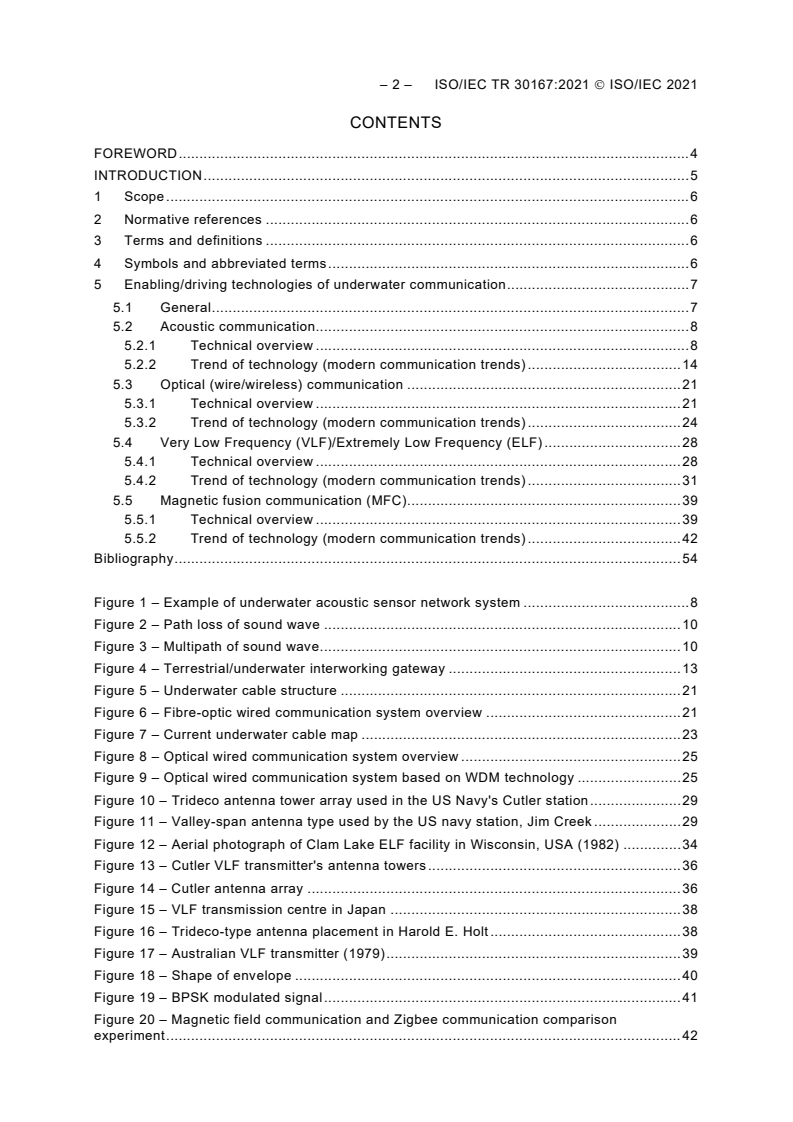
CONTENTS
FOREWORD . 4
INTRODUCTION . 5
1 Scope . 6
2 Normative references . 6
3 Terms and definitions . 6
4 Symbols and abbreviated terms . 6
5 Enabling/driving technologies of underwater communication . 7
5.1 General . 7
5.2 Acoustic communication. 8
5.2.1 Technical overview . 8
5.2.2 Trend of technology (modern communication trends) . 14
5.3 Optical (wire/wireless) communication . 21
5.3.1 Technical overview . 21
5.3.2 Trend of technology (modern communication trends) . 24
5.4 Very Low Frequency (VLF)/Extremely Low Frequency (ELF) . 28
5.4.1 Technical overview . 28
5.4.2 Trend of technology (modern communication trends) . 31
5.5 Magnetic fusion communication (MFC). 39
5.5.1 Technical overview . 39
5.5.2 Trend of technology (modern communication trends) . 42
Bibliography . 54
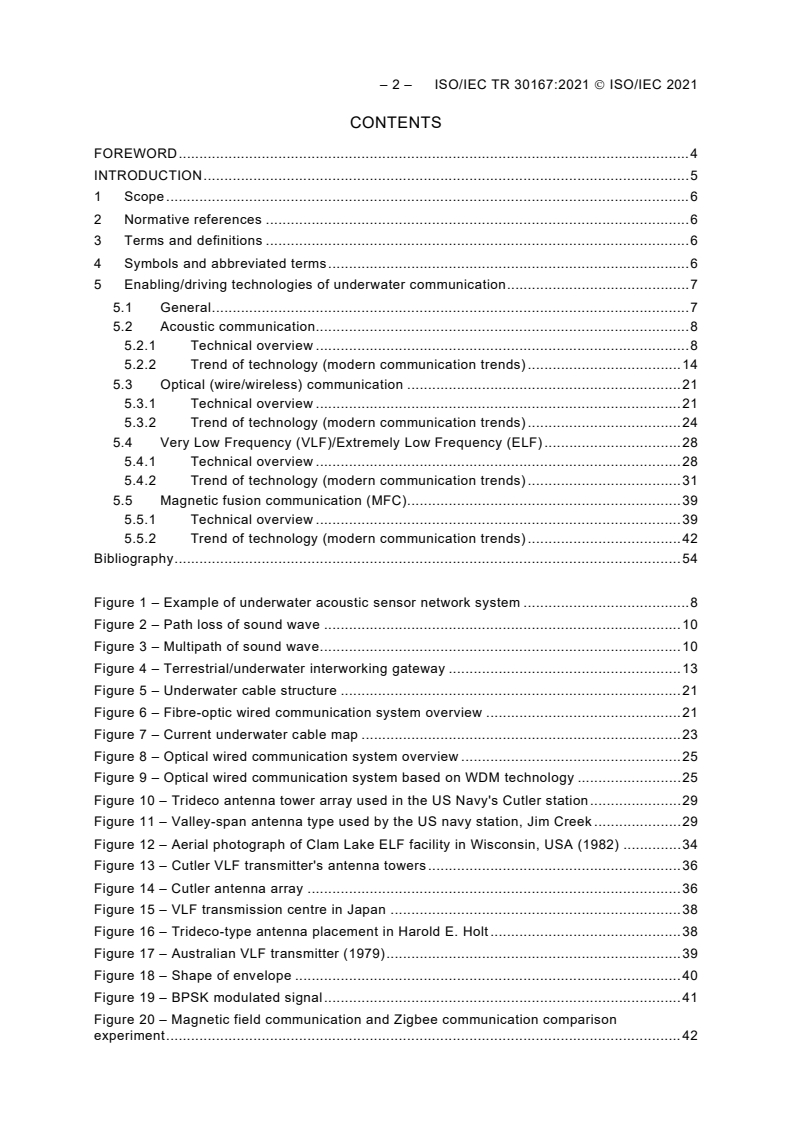
Figure 1 – Example of underwater acoustic sensor network system . 8
Figure 2 – Path loss of sound wave . 10
Figure 3 – Multipath of sound wave . 10
Figure 4 – Terrestrial/underwater interworking gateway . 13
Figure 5 – Underwater cable structure . 21
Figure 6 – Fibre-optic wired communication system overview . 21
Figure 7 – Current underwater cable map . 23
Figure 8 – Optical wired communication system overview . 25
Figure 9 – Optical wired communication system based on WDM technology . 25
Figure 10 – Trideco antenna tower array used in the US Navy's Cutler station . 29
Figure 11 – Valley-span antenna type used by the US navy station, Jim Creek . 29
Figure 12 – Aerial photograph of Clam Lake ELF facility in Wisconsin, USA (1982) . 34
Figure 13 – Cutler VLF transmitter's antenna towers . 36
Figure 14 – Cutler antenna array . 36
Figure 15 – VLF transmission centre in Japan . 38
Figure 16 – Trideco-type antenna placement in Harold E. Holt . 38
Figure 17 – Australian VLF transmitter (1979) . 39
Figure 18 – Shape of envelope . 40
Figure 19 – BPSK modulated signal . 41
Figure 20 – Magnetic field communication and Zigbee communication comparison
experiment . 42
Figure 21 – Experimental water tank for comparing magnetic field communication
characteristics according to medium and distance . 43
Figure 22 – Experimental water tank filled with water and soil . 43
Figure 23 – Strength of magnetic field due to distance in air, water, and soil . 44
Figure 24 – Physical layer packet format. 45
Figure 25 – Preamble area type . 45
Figure 26 – Header area type . 45
Figure 27 – Encoding circuit of header check cyclic redundancy code . 46
Figure 28 – Payload area format . 46
Figure 29 – Definition of Manchester coding . 47
Figure 30 – Definition of NRZ-L coding . 47
Figure 31 – Scrambler block diagram . 48
Figure 32 – ASK modulation diagram . 49
Figure 33 – BPSK modulation diagram . 49
Figure 34 – Preamble coding and modulation process . 49
Figure 35 – Process of coding and modulating headers . 50
Figure 36 – Process of coding and modulating the payload . 50
Figure 37 – Magnetic fusion communication super frame structure . 50
Figure 38 – Magnetic field communication network structure . 51
Figure 39 – Magnetic fusion (power transfer) communication network super-frame
structure . 52
Figure 40 – Magnetic fusion (power transfer) communication network structured
diagram . 53
Table 1 – Envelope parameters . 40
Table 2 – Intensity of magnetic field due to distance in air, water, and soil . 44
Table 3 – Definition of data rate and coding . 46
Table 4 – Definition of frame check cyclic redundancy code . 47
Table 5 – Data rate and coding details . 48
– 4 – ISO/IEC TR 30167:2021 ISO/IEC 2021
INTERNET OF THINGS (IoT) –
UNDERWATER COMMUNICATION
TECHNOLOGIES FOR IoT
FOREWORD
1) ISO (the International Organization for Standardization) and IEC (the International Electrotechnical Commission)
form the specialized system for worldwide standardization. National bodies that are members of ISO or IEC
participate in the development of International Standards through technical committees established by the
respective organization to deal with particular fields of technical activity. ISO and IEC technical committees
collaborate in fields of mutual interest. Other international organizations, governmental and non-governmental,
in liaison with ISO and IEC, also take part in the work.
2) The formal decisions or agreements of IEC and ISO on technical matters express, as nearly as possible, an
international consensus of opinion on the relevant subjects since each technical committee has representation
from all interested IEC and ISO National bodies.
3) IEC and ISO documents have the form of recommendations for international use and are accepted by IEC and
ISO National bodies in that sense. While all reasonable efforts are made to ensure that the technical content of
IEC and ISO documents is accurate, IEC and ISO cannot be held responsible for the way in which they are used
or for any misinterpretation by any end user.
4) In order to promote international uniformity, IEC and ISO National bodies undertake to apply IEC and ISO
documents transparently to the maximum extent possible in their national and regional publications. Any
divergence between any IEC and ISO document and the corresponding national or regional publication shall be
clearly indicated in the latter.
5) IEC and ISO do not provide any attestation of conformity. Independent certification bodies provide conformity
assessment services and, in some areas, access to IEC and ISO marks of conformity. IEC and ISO are not
responsible for any services carried out by independent certification bodies.
6) All users should ensure that they have the latest edition of this document.
7) No liability shall attach to IEC and ISO or their directors, employees, servants or agents including individual
experts and members of its technical committees and IEC and ISO National bodies for any personal injury,
property damage or other damage of any nature whatsoever, whether direct or indirect, or for costs (including
legal fees) and expenses arising out of the publication, use of, or reliance upon, this ISO/IEC document or any
other IEC and ISO documents.
8) Attention is drawn to the Normative references cited in this document. Use of the referenced publications is
indispensable for the correct application of this document.
9) Attention is drawn to the possibility that some of the elements of this ISO/IEC document may be the subject of
patent rights. IEC and ISO shall not be held responsible for identifying any or all such patent rights.
ISO/IEC TR 30167 has been prepared by subcommittee 41: Internet of Things and Digital Twin,
of IEC joint technical committee 1: Information technology. It is a Technical Report.
The text of this Technical Report is based on the following documents:
DTR Report on voting
JTC1-SC41/183/DTR JTC1-SC41/203A/RVDTR
Full information on the voting for the approval of this Technical Report can be found in the
report on voting indicated in the above table.
The language used for the development of this Technical Report is English.
This document has been drafted in accordance with the ISO/IEC Directives, Part 2, and
developed in accordance with ISO/IEC Directives, Part 1, available at
www.iec.ch/members_experts/refdocs and www.iso.org/directives.
IMPORTANT – The "colour inside" logo on the cover page of this document indicates that it
contains colours which are considered to be useful for the correct understanding of its
contents. Users should therefore print this document using a colour printer.
INTRODUCTION
Earth is the aquatic planet as water covers 70 % of its surface. Due to the rapid growth of
technology, underwater communication technologies can be used for the development of
various smart underwater applications. The underwater communication system is one of the
fastest-growing fields since many applications such as monitoring applications, military
applications, security applications, new resource exploration, etc. are continuously being
developed and used. However, many applications still need to be studied in-depth and
underwater resources also need to be explored. Therefore, the research in underwater
communication technology plays a vital role in the exploration of undersea resources and the
development of various underwater applications.
Using the radio frequency (RF) signal, the communication technology in the underwater
environment can be extremely influenced by various factors such as environmental noise,
pollution, power, etc. This can cause several issues related to attenuation, frequency fading,
Doppler shift, multipath effect, etc. Hence, acoustic communication technology has been used
by numerous researchers to solve these issues. In the case of high-speed acoustic
communication, problems like limited bandwidth, reliability in data, error rate, multipath, etc.
remain to be solved.
Optical communication technology is used for high-speed and short-range communication in
the underwater environment. The optical communication uses the laser to carry the information
through the water. In the case of long-distance communication in the underwater environment,
optical communication is not suitable. The magnetic fusion communication in the underwater
environment is only used for near-field communication. Therefore, all communication
technologies are essential for underwater communication.
The purpose of this document is to provide a technical overview of the different communication
technologies in the underwater environment such as acoustic communication, optical
communication, Very Low Frequency (VLF)/Extremely Low Frequency (ELF) communication,
and Magnetic Fusion Communication (MFC). Correspondingly, this document also provides the
characteristics of each communication technology in the underwater environment, trends of
underwater communication technology, layered design of underwater technology, and the
application development using different communication technologies.
– 6 – ISO/IEC TR 30167:2021 ISO/IEC 2021
INTERNET OF THINGS (IoT) –
UNDERWATER COMMUNICATION
TECHNOLOGIES FOR IoT
1 Scope
This document describes the enabling and driving technologies of underwater communication
such as acoustic communication, optical communication, Very Low Frequency (VLF)/Extremely
Low Frequency (ELF) communication, and Magnetic Fusion Communication (MFC). This
document also highlights:
– technical overview of different communication technologies;
– characteristics of different communication technologies;
– trends of different communication technologies;
– applications of each communication technology;
– benefits and challenges of each communication technology.
2 Normative references
There are no normative references in this document.
3 Terms and definitions
No terms and definitions are listed in this document.
ISO and IEC maintain terminological databases for use in standardization at the following
addresses:
• IEC Electropedia: available at http://www.electropedia.org/
• ISO Online browsing platform: available at http://www.iso.org/obp
4 Symbols and abbreviated terms
ACPG a specific graph technique
AUV autonomous underwater vehicle
ASK amplitude shift keying
BER bit error rate
BPSK binary phase-shift keying
CBC-MAC cipher block chaining-message authentication code
CCM-UW counter with CBC-MAC for underwater
CRC cyclic redundancy code
DTN delay/disruption tolerant network
ELF Extremely Low Frequency
FSK frequency-shift keying
FSO free space optics
HF high frequency
IM intensity modulation
ISI inter symbol interference
ITU-R International Telecommunication Union radio-communication
LED light-emitting diode
LSI large scale integration
LSB least significant bit
MAC medium access control
MANET mobile ad hoc network
MFAN magnetic field area network
MIMO multiple-input and multiple-output
MSB most significant bit
MSK minimum shift keying
NRZ non-return-to-zero
NRZ-L non-return-to-zero level
OFDM orthogonal frequency division multiplexing
OOK on-off keying
OOK/CWK on-off keying/continuous wave keying
PSK phase-shift keying
RF radio frequency
RTT round trip time
RZ return to zero
SHELF super hard ELF system
SLF super low frequency
SNR signal to noise ratio
SONAR sound and navigation and ranging
TDMA time division multiple access
UAN underwater acoustic network
ULF ultra-low frequency
UUV unmanned underwater vehicle
UWA MAC underwater acoustic MAC layer
UWASN underwater acoustic sensor network
VBF vector-based forwarding
VLF Very Low Frequency
WDM wavelength division multiplexing
WSN wireless sensor network
5 Enabling/driving technologies of underwater communication
5.1 General
Various enabling/driving technologies of underwater communication such as acoustic
communication, optical communication, Very Low Frequency (VLF)/Extremely Low Frequency
(ELF) communication, and Magnetic Fusion Communication (MFC) are discussed in Clause 5.
– 8 – ISO/IEC TR 30167:2021 ISO/IEC 2021
5.2 Acoustic communication
5.2.1 Technical overview
5.2.1.1 Technical definition
Underwater acoustic communication is a technology to transmit information wirelessly in the
underwater environment using sound or ultrasonic waves. It includes underwater acoustic
modem hardware and software, underwater acoustic communication protocol, underwater
acoustic communication network, underwater application and service technology, etc. For
decades, point-to-point communication technologies between two devices in water have been
dominantly investigated, but quite recently, underwater acoustic network systems in which
several underwater devices participate in information exchange have been studied.
Figure 1 is a conceptual diagram of underwater acoustic sensor network systems, which is one
of the representative examples of underwater acoustic communication technology [1] .
Underwater acoustic sensor network system consists of underwater sensor nodes that collect
information using underwater sensors, an underwater sink node that controls underwater sensor
nodes located in a cluster, and a water surface gateway, which connects underwater network
to terrestrial network. The main subjects of research and development are the technologies to
improve the overall efficiency and stability of the underwater acoustic communication system
and to increase communication speed and reliability between entities that constitute the system.
SOURCE: Kim Y. A Query Result Merging Scheme for Providing Energy Efficiency in Underwater Sensor Networks.
Sensors. 2011, 11, pp. 11833-11855. Reproduced with permission.
Figure 1 – Example of underwater acoustic sensor network system
____________
Numbers in square brackets refer to the Bibliography.
5.2.1.2 Characteristics of underwater acoustic channel
5.2.1.2.1 Definition and characteristics of sound wave
A wave is a physical phenomenon whereby periodic vibrations generated by an object are
transmitted through a medium. In this case, the time from crest to crest is called period and the
inverse of the period is called frequency. Technically, when the frequency of a wave
corresponds to 20 Hz to 20 kHz, since the human ear can hear it, it is classified as an acoustic
wave (sound wave). When the frequency of a wave is larger than 20 kHz, it is classified as an
ultrasonic wave. Sometimes, both sound and ultrasonic waves are referred to as sound waves
in a broad sense.
The sound wave is a longitudinal wave where the wave and vibration of the medium are in the
same direction. Further, it only propagates through a medium such as gas, liquid, or solid. Also,
the speed of the sound wave differs depending on the medium: 340 m/s in air, 1 500 m/s in the
underwater environment, and 5 120 m/s in iron.
5.2.1.2.2 Transmission characteristics of sound wave in water
The media that can transmit information wirelessly in the underwater environment are radio
waves, light waves, and sound waves. Among them, the radio wave is advantageous in that it
is easy to design a transmission protocol due to its short propagation delay and to send high-
speed data by utilizing a wide bandwidth. But due to the high conductivity in water, the
transmitted signal is rapidly attenuated and communication distance becomes restricted. The
light wave is characterized by its wavelength or its frequency, in this situation it supports very
high-speed data transfer using ultra-wideband, but it requires a line of sight path between
transceivers and is vulnerable to turbidity. Unlike radio wave or light wave, which is a kind of
electromagnetic wave, the sound wave attenuates slowly in water ensuring communication
distance of several tens of kilometres. Its main drawbacks are the low data rate and the long
propagation delay due to narrow bandwidth and the underwater medium, respectively.
Underwater data transmission technique using sound wave has been widely used for the past
several decades and its performance and functions are verified in various aspects [2].
Sound velocity, which is the speed of sound waves used in water, changes due to water
temperature, salinity, and water pressure. Specifically, the velocity of sound increases with an
increase in water temperature, salinity, and water pressure. In general, an increment of water
temperature of 1 °C causes an increase of the sound velocity of 4 m/s, an increment of salinity
of 1 ‰ causes an increase of the sound velocity of 1,4 m/s, and an increment of 1 km in depth
causes an increase of the sound velocity of 17 m/s [3]. On the other hand, there is a thermocline
layer in which the water temperature decreases rapidly as the water depth increases in the area
ranging from the water surface to hundreds of metres in depth. In the thermocline, the sound
velocity decreases as the water depth increases due to the rapid decrease of the water
temperature. Meanwhile, in the region where the water depth is deeper than the thermocline,
the sound velocity tends to increase gradually with the increase of water depth since the water
temperature is almost constant and the salinity and water pressure gradually increase [4].
The sound wave radiated in water undergoes path loss depending on the distance and the
frequency, and the path loss can be divided again into two factors: spreading loss and
absorption loss.
When it comes to spreading loss, the intensity of sound wave decreases in proportion to the
distance in shallow water and in proportion to the square of the distance in deep water [5].
Absorption loss increases rapidly with increasing frequency and depends on salinity and water
temperature partly. Figure 2 shows the ratio of received voltage to transmitted voltage (V /V )
O I
according to distance and frequency in (a) fresh water and (b) seawater. From Figure 2, it is
observed that the path loss increases greatly as distance, frequency, and salinity increase [6].
– 10 – ISO/IEC TR 30167:2021 ISO/IEC 2021
a) b)
Figure 2 – Path loss of sound wave
The sound wave in water is affected by noise, which can be classified into ambient noise and
site-specific noise. Ambient noise generated by turbulence, waves, ships, etc. is always present
in all locations and can be modelled as a Gaussian distribution. Its power spectrum density
decreases by 18 dB when frequency increases by ten times [7]. On the other hand, the site-
specific noise is irregular depending on the place, such as the icebreaking noise in the polar
region and the snapping shrimp in the warm water region.
Another transfer characteristic of the underwater sound wave is reflected. As shown in Figure 3,
the transmitted sound wave generates numerous paths due to the water surface and bottom [6].
The reflection coefficient of the water surface is theoretically "−1", which means that only the
phase is inverted. The reflection coefficient at the bottom greatly depends on the medium,
roughness, and grazing angle. Also, each sound ray experiences the phenomenon in which the
sound wave refracts to the direction having a lower speed of a sound wave due to Snell's law.
Another factor that distracts the transmission and reception of sound waves is the time-variant
characteristic of the multipath. In other words, each path between transceivers can be changed
drastically due to the movement of aquatic organisms, irregular water flow from underwater
eddies, and irregular changes in wave height from the wind on the water surface.
Key
H water depth
h depth of transmitter
t
h depth of receiver
r
Figure 3 – Multipath of sound wave
The last issue to be addressed concerning the characteristics of the underwater sound wave is
the Doppler effect caused by not only the intentional movement of the transmitter or receiver
but also the drift of the transceiver due to waves, currents, and tides. The Doppler spread is
proportional to the moving speed of the transceiver divided by sound velocity. As described
above, since the sound velocity is very low in the water, small-scale movement generates a
large Doppler effect.
5.2.1.3 Background
The origin of underwater acoustic communication technology is SONAR. SONAR is a
technology that detects the position of an object by using a sound wave in water and there has
been rapid progress of technology through two world wars. In detail, active SONAR detects the
position of an underwater object by measuring the turnaround time between source and
destination, whereas passive SONAR detects an object by listening and analysing the sound
source by using a hydrophone. The progress of SONAR technology has catalysed the research
and development of underwater acoustic communication system technology. In the early 1990s,
the interest in a mid- and long-range point-to-point underwater acoustic communication system
had increased throughout the world, especially centred on the US and Europe, which provides
the communication distance of 1 km to 20 km for marine petroleum exploration, underwater
robot control, marine structure construction and unmanned underwater vehicle operation. To
meet this trend, the mid- and long-range underwater acoustic communication modem that has
been commercialized forms the mainstream of the market related to the underwater acoustic
communication system.
Meanwhile, since the 2000s, the importance of short-range underwater acoustic sensor network
system which can provide various application services has been highlighted. Research on
underwater acoustic communication modem and system technologies for the underwater
acoustic network is continuously being expanded.
5.2.1.4 Technology classification
5.2.1.4.1 Underwater acoustic modem technology
The underwater acoustic modem is an integrated technology for designing and manufacturing
(a) a digital part in which underwater acoustic access functions are implemented, (b) an
analogue part composed of a passband filter and an amplifier, and (c) an acoustic transducer.
5.2.1.4.2 Physical layer technology for underwater acoustic communication
Physical layer technology for underwater acoustic communication includes a frame structure,
modulation and channel coding, and detection technique which are suitable for data transfer in
an underwater acoustic channel. This technology is aimed at the improvement of the efficiency
and reliability of underwater communication.
5.2.1.4.3 Data link layer technology for underwater acoustic communication
Data link layer technology for underwater acoustic communication is a technology for efficiently
using a limited underwater acoustic channel resource. It includes a medium access control
technique to overcome long propagation delay of underwater sound waves.
5.2.1.4.4 UWA MAC technology for mobility support
This is a lower layer technology of MANET for mobility support as a technology required to
support the dynamic connection of UWA communication link according to the underwater
mobility of mobile UWA nodes such as AUV and UUV or submarines. Unlike terrestrial RF-
based communications, long propagation delay, unstable time-variant underwater channel
characteristics, low data transfer rates, and energy efficiency should be considered.
– 12 – ISO/IEC TR 30167:2021 ISO/IEC 2021
5.2.1.4.5 Security technology
The security technology of terrestrial RF-based communication cannot be directly applied to
UWA communication due to the characteristics of an underwater sound wave channel such as
the long propagation delay, high error rate, and low transfer rate of underwater acoustic
communication. Therefore, this technology requires weight lightening in encryption keys,
encryption/decryption algorithms, and security protocols to reduce the processing time and
frequent communication in consideration of inherent characteristics of an underwater acoustic
wave channel, high energy consumption, and low-performance hardware characteristics.
5.2.1.4.6 UWA communication network technology
Due to the characteristics of the underwater acoustic wave channel, as described above, the
existing RF-based network schemes cannot be directly applied to the UWA communication
network. Unlike RF-based routing, the UWA communication network needs to minimize
propagation delays and transmission delays and to support the mobility of UWA nodes with the
improvement of energy efficiency.
5.2.1.4.7 Cross-layer technology
This is a technology that allows one layer to use the information of another layer in the protocol
stack, and it should consider characteristics in UWA communication and network. For example,
UWA application layer information such as underwater temperature, salinity, water pressure,
and depth information by underwater sensors can be used to control the data rate of UWA MAC
or set the shortest distance route in UWA network layer. The location information of the
neighbouring node is used to calculate the distance to the UWA node, and the UWA physical
layer in the UWA MAC can adaptively control the energy consumption by transmitting the
message with the appropriate transmission energy suitable for the distance between two nodes.
By using cross-layer, it is possible to achieve energy efficiency, reduce end-to-end propagation
delay, control QoS, provide and enhance layer functionality and performance. Besides, cross-
layer technology has advantages in that similar information generations between layers and
similar function code redundancy can be eliminated.
5.2.1.4.8 UWA DTN technology
DTN is a technology in which when the data packet is not forwarded to the destination node
due to communication instability, the node saves the packets and retransmits when
communication becomes stable again. This technology is used for reducing the packet loss and
energy consumption. In UWA communication networks, unlike conventional RF-based
communications, the research and development on this technology need to consider the specific
characteristics of underwater acoustic communication channel focusing on high delivery ratio,
short average end-to-end delay, and low energy consumption.
5.2.1.4.9 UWA MANET technology
UWA MANET refers to a network that supports dynamic routing paths depending on the
movement of the UWA node in the underwater environment. The UWA node mobility makes the
UWA communication link frequently disconnect from the existing neighbour node or connect to
a new neighbour node. The existing terrestrial MANET technology cannot be applied to UWA
MANET because of the characteristics of the underwater acoustic wave channel. Therefore, the
UWA MANET technology needs to solve dynamic routing problems caused by very long
propagation delays, very low data rates, very small packet sizes, and the frequent rerouting
with its severe overheads due to mobility.
The UWA MANET which uses only UWA communication has a limit in real-time heavy traffic
applications such as video stream transmission. To overcome this limitation, it is important to
develop a technology for interworking with other kinds of underwater communication
technologies such as optical wire/wireless technology and MFAN.
5.2.1.4.10 Terrestrial/underwater synchronization gateway technology
As shown in Figure 4, underwater data collected in the water eventually should be transmitted
to terrestrial and, if necessary, command messages or data to control UWA nodes should also
be transmitted from the terrestrial to underwater [8]. Unlike common interworking in terrestrial
RF-based communication network, interworking between terrestrial and underwater
communications can cause serious issues such as bottlenecks, data loss, communication
delays, packet size mismatches, synchronization failures and routing failures due to the big
difference in communication characteristics such as operating environment, communication
medium, propagation delay, frequency bandwidth, transmission speed, bit error rate, etc. To
solve these problems or minimize their extent, it is important to identify and reflect the
internetworking problems between two different networks caused by the characteristics of
underwater acoustic communication.
Figure 4 – Terrestrial/underwater interworking gateway
5.2.1.4.11 3D UWA location-awareness technology
Similar to the terrestrial area, location-awareness under the water can be used for numerous
applications such as underwater navigation, underwater object or area location awareness,
location-range based underwater information search, location-area based UWA node control
and management, location-based monitoring, prediction of changes in specific areas or objects
in aquatic environment changes, and others. Location information is also very useful for minimal
cost communication linking and routing. Location-awareness is very useful for intelligent
functionality and the performance of UWA MAC or UWA communication networks.
Unlike the terrestrial environment, in the underwater environment, 3D awareness technology is
required including depth information. The problem is that the terrestrial location-awareness
uses radio wave communication but the UWA location-awareness should use UWA
communication. Here, there are serious obstacles in location-awareness performance such as
long propagation delay, severe multipath problem, and the severe change of sound wave
velocity due to time-variant changes in the underwater environments. The UWA 3D technology
location-awareness should overcome those obstacles and improve the speed, accuracy, energy
efficiency, and stability for location-awareness.
– 14 – ISO/IEC TR 30167:2021 ISO/IEC 2021
5.2.1.4.12 UWASN technology
UWASN technology is a UWA network application technology that uses UWA communication.
As shown in Figure 1, the UWASN consists of UWA sensor nodes, UWA sink nodes, UWA relay
nodes, and a surface station. Each UWA sensor node senses underwater objects or
environmental conditions through one or more mounted underwater sensors and transmits the
sensed data to the terrestrial centre via the UWA sink node, relay node, and surface station.
The user command message is transmitted from the terrestrial centre to one or more UWA
sensor nodes via the reverse path of this process. Through command messages, it is possible
to control UWA nodes and operate the actuator attached to the node.
Related to UWASN technology, technologies on the UWA modem, PHY layer, UWA MAC layer,
UWA routing, UWASN architecture, and application services have been developed up to now.
5.2.2 Trend of technology (modern communication trends)
5.2.2.1 Underwater acoustic modem technology
The underwater acoustic modem that provides the long communication distance has already
been commercialized as various products after technical stabilization steps. Since the
communication distance is increased as the used frequency is lower, which is the characteristic
of underwater acoustic communication, the mid- and long-range underwater acoustic modems
supporting the communication distance of several kilometres are mainly implemented using the
frequencies within 30 kHz [9].
On the other hand, short-range underwater acoustic modems are in the introduction and growth
stages of technology. Currently, prototypes equipped with various standards and technologies
are designed, manufactured, and verified mainly in academia and research institutes. In short-
range underwater acoustic modem technology, instead of limiting the communication distance
to within 1 km, by communicating using frequencies of up to 100 kHz (or more), it is possible to
reduce the size of the underwater modem. Also, development is in the process of equipping
highly efficient physical layer transmission technology to provide improved data rates.
5.2.2.2 Physical layer technology for underwater acoustic communication
To perform stable and efficient communication using sound waves in water, it is essential to
study the physical layer transmission technology considering the transfer characteristics of
underwater sound waves.
Generally, entities participating in the underwater environment acoustic communication
systems depend on built-in batteries and should be able to be driven for a long time without
replacing batteries. Further, the data generated and transmitted by them have intermittent
characteristics. That is, in the frame-based underwater acoustic communication, a preamble
should be transmitted and received before the main data transmission and the receiver should
acquire the starting point of each frame. Accordingly, various studies are being made on a
preamble design and detection technique that makes it easy to detect a frame while using a
short length.
The acoustic signal transmitted in the water experiences distortion due to the variability in time
and frequency of the underwater channel. To overcome the physical obstacle of the underwater
channel and to ensure proper communication quality, pilot symbols are commonly utilized. That
is, based on the predetermined data sent from the transmitter, the receiver estimates the
characteristics of the channel. In this regard, integrated research and development are being
conducted such as pilot sequence design, pilot symbol allocation, and channel estimation
algorithms which are optimized for the structure and requirements of various underwater
acoustic communication systems.
To minimize the power consumption of underwater nodes and improve communication quality,
it is important to design a physical layer frame optimally. That is, by selectively using the fields
that are essentially required in the frame configuration of the physical layer, the transmitted
frame is less influenced by the change of the underwater acoustic channel and the transmission
efficiency could be improved.
Various physical layer technologies applied to data to be loaded in each physical layer frame
are actively being studied. Among them, a modulation technique is a representative example.
In the past, research has been mainly focused on the use of binary modulation such as PSK
and FSK. However, in recent years, various researches on the application of acoustic
communication have been carried out, for example, a high-order modulation technique for
transmitting a plurality of bits to a modulation symbol and a multicarrier modulation technique
for improving the efficiency and reliability of data transmission using a plurality of channels such
as OFDM. Also, studies on channel coding and MIMO for the application of underwater acoustic
communication are being studied.
5.2.2.3 Data link layer technology for underwater acoustic communication
The speed of sound waves in water is about 1 500 m/s, which is 200 000 times slower than that
of radio waves commonly used in terrestrial communications. To overcome the distortion and
entanglement of each transmitted frame, a delay-tolerant medium access control (delay tolerant
MAC) tec
...
ISO/IEC TR 30167
Edition 1.0 2021-06
TECHNICAL
REPORT
colour
inside
Internet of things (IoT) – Underwater communication technologies for IoT
All rights reserved. Unless otherwise specified, no part of this publication may be reproduced or utilized in any form
or by any means, electronic or mechanical, including photocopying and microfilm, without permission in writing from
either IEC or IEC's member National Committee in the country of the requester. If you have any questions about
ISO/IEC copyright or have an enquiry about obtaining additional rights to this publication, please contact the address
below or your local IEC member National Committee for further information.
IEC Central Office Tel.: +41 22 919 02 11
3, rue de Varembé info@iec.ch
CH-1211 Geneva 20 www.iec.ch
Switzerland
About the IEC
The International Electrotechnical Commission (IEC) is the leading global organization that prepares and publishes
International Standards for all electrical, electronic and related technologies.
About IEC publications
The technical content of IEC publications is kept under constant review by the IEC. Please make sure that you have the
latest edition, a corrigendum or an amendment might have been published.
IEC publications search - webstore.iec.ch/advsearchform IEC online collection - oc.iec.ch
The advanced search enables to find IEC publications by a Discover our powerful search engine and read freely all the
variety of criteria (reference number, text, technical publications previews. With a subscription you will always
committee, …). It also gives information on projects, replaced have access to up to date content tailored to your needs.
and withdrawn publications.
Electropedia - www.electropedia.org
IEC Just Published - webstore.iec.ch/justpublished
The world's leading online dictionary on electrotechnology,
Stay up to date on all new IEC publications. Just Published
containing more than 22 000 terminological entries in English
details all new publications released. Available online and
and French, with equivalent terms in 18 additional languages.
once a month by email.
Also known as the International Electrotechnical Vocabulary
(IEV) online.
IEC Customer Service Centre - webstore.iec.ch/csc
If you wish to give us your feedback on this publication or
need further assistance, please contact the Customer Service
Centre: sales@iec.ch.
ISO/IEC TR 30167
Edition 1.0 2021-06
TECHNICAL
REPORT
colour
inside
Internet of things (IoT) – Underwater communication technologies for IoT
INTERNATIONAL
ELECTROTECHNICAL
COMMISSION
ICS 33.020 ISBN 978-2-8322-9865-7
– 2 – ISO/IEC TR 30167:2021 ISO/IEC 2021
CONTENTS
FOREWORD . 4
INTRODUCTION . 5
1 Scope . 6
2 Normative references . 6
3 Terms and definitions . 6
4 Symbols and abbreviated terms . 6
5 Enabling/driving technologies of underwater communication . 7
5.1 General . 7
5.2 Acoustic communication. 8
5.2.1 Technical overview . 8
5.2.2 Trend of technology (modern communication trends) . 14
5.3 Optical (wire/wireless) communication . 21
5.3.1 Technical overview . 21
5.3.2 Trend of technology (modern communication trends) . 24
5.4 Very Low Frequency (VLF)/Extremely Low Frequency (ELF) . 28
5.4.1 Technical overview . 28
5.4.2 Trend of technology (modern communication trends) . 31
5.5 Magnetic fusion communication (MFC). 39
5.5.1 Technical overview . 39
5.5.2 Trend of technology (modern communication trends) . 42
Bibliography . 54
Figure 1 – Example of underwater acoustic sensor network system . 8
Figure 2 – Path loss of sound wave . 10
Figure 3 – Multipath of sound wave . 10
Figure 4 – Terrestrial/underwater interworking gateway . 13
Figure 5 – Underwater cable structure . 21
Figure 6 – Fibre-optic wired communication system overview . 21
Figure 7 – Current underwater cable map . 23
Figure 8 – Optical wired communication system overview . 25
Figure 9 – Optical wired communication system based on WDM technology . 25
Figure 10 – Trideco antenna tower array used in the US Navy's Cutler station . 29
Figure 11 – Valley-span antenna type used by the US navy station, Jim Creek . 29
Figure 12 – Aerial photograph of Clam Lake ELF facility in Wisconsin, USA (1982) . 34
Figure 13 – Cutler VLF transmitter's antenna towers . 36
Figure 14 – Cutler antenna array . 36
Figure 15 – VLF transmission centre in Japan . 38
Figure 16 – Trideco-type antenna placement in Harold E. Holt . 38
Figure 17 – Australian VLF transmitter (1979) . 39
Figure 18 – Shape of envelope . 40
Figure 19 – BPSK modulated signal . 41
Figure 20 – Magnetic field communication and Zigbee communication comparison
experiment . 42
Figure 21 – Experimental water tank for comparing magnetic field communication
characteristics according to medium and distance . 43
Figure 22 – Experimental water tank filled with water and soil . 43
Figure 23 – Strength of magnetic field due to distance in air, water, and soil . 44
Figure 24 – Physical layer packet format. 45
Figure 25 – Preamble area type . 45
Figure 26 – Header area type . 45
Figure 27 – Encoding circuit of header check cyclic redundancy code . 46
Figure 28 – Payload area format . 46
Figure 29 – Definition of Manchester coding . 47
Figure 30 – Definition of NRZ-L coding . 47
Figure 31 – Scrambler block diagram . 48
Figure 32 – ASK modulation diagram . 49
Figure 33 – BPSK modulation diagram . 49
Figure 34 – Preamble coding and modulation process . 49
Figure 35 – Process of coding and modulating headers . 50
Figure 36 – Process of coding and modulating the payload . 50
Figure 37 – Magnetic fusion communication super frame structure . 50
Figure 38 – Magnetic field communication network structure . 51
Figure 39 – Magnetic fusion (power transfer) communication network super-frame
structure . 52
Figure 40 – Magnetic fusion (power transfer) communication network structured
diagram . 53
Table 1 – Envelope parameters . 40
Table 2 – Intensity of magnetic field due to distance in air, water, and soil . 44
Table 3 – Definition of data rate and coding . 46
Table 4 – Definition of frame check cyclic redundancy code . 47
Table 5 – Data rate and coding details . 48
– 4 – ISO/IEC TR 30167:2021 ISO/IEC 2021
INTERNET OF THINGS (IoT) –
UNDERWATER COMMUNICATION
TECHNOLOGIES FOR IoT
FOREWORD
1) ISO (the International Organization for Standardization) and IEC (the International Electrotechnical Commission)
form the specialized system for worldwide standardization. National bodies that are members of ISO or IEC
participate in the development of International Standards through technical committees established by the
respective organization to deal with particular fields of technical activity. ISO and IEC technical committees
collaborate in fields of mutual interest. Other international organizations, governmental and non-governmental,
in liaison with ISO and IEC, also take part in the work.
2) The formal decisions or agreements of IEC and ISO on technical matters express, as nearly as possible, an
international consensus of opinion on the relevant subjects since each technical committee has representation
from all interested IEC and ISO National bodies.
3) IEC and ISO documents have the form of recommendations for international use and are accepted by IEC and
ISO National bodies in that sense. While all reasonable efforts are made to ensure that the technical content of
IEC and ISO documents is accurate, IEC and ISO cannot be held responsible for the way in which they are used
or for any misinterpretation by any end user.
4) In order to promote international uniformity, IEC and ISO National bodies undertake to apply IEC and ISO
documents transparently to the maximum extent possible in their national and regional publications. Any
divergence between any IEC and ISO document and the corresponding national or regional publication shall be
clearly indicated in the latter.
5) IEC and ISO do not provide any attestation of conformity. Independent certification bodies provide conformity
assessment services and, in some areas, access to IEC and ISO marks of conformity. IEC and ISO are not
responsible for any services carried out by independent certification bodies.
6) All users should ensure that they have the latest edition of this document.
7) No liability shall attach to IEC and ISO or their directors, employees, servants or agents including individual
experts and members of its technical committees and IEC and ISO National bodies for any personal injury,
property damage or other damage of any nature whatsoever, whether direct or indirect, or for costs (including
legal fees) and expenses arising out of the publication, use of, or reliance upon, this ISO/IEC document or any
other IEC and ISO documents.
8) Attention is drawn to the Normative references cited in this document. Use of the referenced publications is
indispensable for the correct application of this document.
9) Attention is drawn to the possibility that some of the elements of this ISO/IEC document may be the subject of
patent rights. IEC and ISO shall not be held responsible for identifying any or all such patent rights.
ISO/IEC TR 30167 has been prepared by subcommittee 41: Internet of Things and Digital Twin,
of IEC joint technical committee 1: Information technology. It is a Technical Report.
The text of this Technical Report is based on the following documents:
DTR Report on voting
JTC1-SC41/183/DTR JTC1-SC41/203A/RVDTR
Full information on the voting for the approval of this Technical Report can be found in the
report on voting indicated in the above table.
The language used for the development of this Technical Report is English.
This document has been drafted in accordance with the ISO/IEC Directives, Part 2, and
developed in accordance with ISO/IEC Directives, Part 1, available at
www.iec.ch/members_experts/refdocs and www.iso.org/directives.
IMPORTANT – The "colour inside" logo on the cover page of this document indicates that it
contains colours which are considered to be useful for the correct understanding of its
contents. Users should therefore print this document using a colour printer.
INTRODUCTION
Earth is the aquatic planet as water covers 70 % of its surface. Due to the rapid growth of
technology, underwater communication technologies can be used for the development of
various smart underwater applications. The underwater communication system is one of the
fastest-growing fields since many applications such as monitoring applications, military
applications, security applications, new resource exploration, etc. are continuously being
developed and used. However, many applications still need to be studied in-depth and
underwater resources also need to be explored. Therefore, the research in underwater
communication technology plays a vital role in the exploration of undersea resources and the
development of various underwater applications.
Using the radio frequency (RF) signal, the communication technology in the underwater
environment can be extremely influenced by various factors such as environmental noise,
pollution, power, etc. This can cause several issues related to attenuation, frequency fading,
Doppler shift, multipath effect, etc. Hence, acoustic communication technology has been used
by numerous researchers to solve these issues. In the case of high-speed acoustic
communication, problems like limited bandwidth, reliability in data, error rate, multipath, etc.
remain to be solved.
Optical communication technology is used for high-speed and short-range communication in
the underwater environment. The optical communication uses the laser to carry the information
through the water. In the case of long-distance communication in the underwater environment,
optical communication is not suitable. The magnetic fusion communication in the underwater
environment is only used for near-field communication. Therefore, all communication
technologies are essential for underwater communication.
The purpose of this document is to provide a technical overview of the different communication
technologies in the underwater environment such as acoustic communication, optical
communication, Very Low Frequency (VLF)/Extremely Low Frequency (ELF) communication,
and Magnetic Fusion Communication (MFC). Correspondingly, this document also provides the
characteristics of each communication technology in the underwater environment, trends of
underwater communication technology, layered design of underwater technology, and the
application development using different communication technologies.
– 6 – ISO/IEC TR 30167:2021 ISO/IEC 2021
INTERNET OF THINGS (IoT) –
UNDERWATER COMMUNICATION
TECHNOLOGIES FOR IoT
1 Scope
This document describes the enabling and driving technologies of underwater communication
such as acoustic communication, optical communication, Very Low Frequency (VLF)/Extremely
Low Frequency (ELF) communication, and Magnetic Fusion Communication (MFC). This
document also highlights:
– technical overview of different communication technologies;
– characteristics of different communication technologies;
– trends of different communication technologies;
– applications of each communication technology;
– benefits and challenges of each communication technology.
2 Normative references
There are no normative references in this document.
3 Terms and definitions
No terms and definitions are listed in this document.
ISO and IEC maintain terminological databases for use in standardization at the following
addresses:
• IEC Electropedia: available at http://www.electropedia.org/
• ISO Online browsing platform: available at http://www.iso.org/obp
4 Symbols and abbreviated terms
ACPG a specific graph technique
AUV autonomous underwater vehicle
ASK amplitude shift keying
BER bit error rate
BPSK binary phase-shift keying
CBC-MAC cipher block chaining-message authentication code
CCM-UW counter with CBC-MAC for underwater
CRC cyclic redundancy code
DTN delay/disruption tolerant network
ELF Extremely Low Frequency
FSK frequency-shift keying
FSO free space optics
HF high frequency
IM intensity modulation
ISI inter symbol interference
ITU-R International Telecommunication Union radio-communication
LED light-emitting diode
LSI large scale integration
LSB least significant bit
MAC medium access control
MANET mobile ad hoc network
MFAN magnetic field area network
MIMO multiple-input and multiple-output
MSB most significant bit
MSK minimum shift keying
NRZ non-return-to-zero
NRZ-L non-return-to-zero level
OFDM orthogonal frequency division multiplexing
OOK on-off keying
OOK/CWK on-off keying/continuous wave keying
PSK phase-shift keying
RF radio frequency
RTT round trip time
RZ return to zero
SHELF super hard ELF system
SLF super low frequency
SNR signal to noise ratio
SONAR sound and navigation and ranging
TDMA time division multiple access
UAN underwater acoustic network
ULF ultra-low frequency
UUV unmanned underwater vehicle
UWA MAC underwater acoustic MAC layer
UWASN underwater acoustic sensor network
VBF vector-based forwarding
VLF Very Low Frequency
WDM wavelength division multiplexing
WSN wireless sensor network
5 Enabling/driving technologies of underwater communication
5.1 General
Various enabling/driving technologies of underwater communication such as acoustic
communication, optical communication, Very Low Frequency (VLF)/Extremely Low Frequency
(ELF) communication, and Magnetic Fusion Communication (MFC) are discussed in Clause 5.
– 8 – ISO/IEC TR 30167:2021 ISO/IEC 2021
5.2 Acoustic communication
5.2.1 Technical overview
5.2.1.1 Technical definition
Underwater acoustic communication is a technology to transmit information wirelessly in the
underwater environment using sound or ultrasonic waves. It includes underwater acoustic
modem hardware and software, underwater acoustic communication protocol, underwater
acoustic communication network, underwater application and service technology, etc. For
decades, point-to-point communication technologies between two devices in water have been
dominantly investigated, but quite recently, underwater acoustic network systems in which
several underwater devices participate in information exchange have been studied.
Figure 1 is a conceptual diagram of underwater acoustic sensor network systems, which is one
of the representative examples of underwater acoustic communication technology [1] .
Underwater acoustic sensor network system consists of underwater sensor nodes that collect
information using underwater sensors, an underwater sink node that controls underwater sensor
nodes located in a cluster, and a water surface gateway, which connects underwater network
to terrestrial network. The main subjects of research and development are the technologies to
improve the overall efficiency and stability of the underwater acoustic communication system
and to increase communication speed and reliability between entities that constitute the system.
SOURCE: Kim Y. A Query Result Merging Scheme for Providing Energy Efficiency in Underwater Sensor Networks.
Sensors. 2011, 11, pp. 11833-11855. Reproduced with permission.
Figure 1 – Example of underwater acoustic sensor network system
____________
Numbers in square brackets refer to the Bibliography.
5.2.1.2 Characteristics of underwater acoustic channel
5.2.1.2.1 Definition and characteristics of sound wave
A wave is a physical phenomenon whereby periodic vibrations generated by an object are
transmitted through a medium. In this case, the time from crest to crest is called period and the
inverse of the period is called frequency. Technically, when the frequency of a wave
corresponds to 20 Hz to 20 kHz, since the human ear can hear it, it is classified as an acoustic
wave (sound wave). When the frequency of a wave is larger than 20 kHz, it is classified as an
ultrasonic wave. Sometimes, both sound and ultrasonic waves are referred to as sound waves
in a broad sense.
The sound wave is a longitudinal wave where the wave and vibration of the medium are in the
same direction. Further, it only propagates through a medium such as gas, liquid, or solid. Also,
the speed of the sound wave differs depending on the medium: 340 m/s in air, 1 500 m/s in the
underwater environment, and 5 120 m/s in iron.
5.2.1.2.2 Transmission characteristics of sound wave in water
The media that can transmit information wirelessly in the underwater environment are radio
waves, light waves, and sound waves. Among them, the radio wave is advantageous in that it
is easy to design a transmission protocol due to its short propagation delay and to send high-
speed data by utilizing a wide bandwidth. But due to the high conductivity in water, the
transmitted signal is rapidly attenuated and communication distance becomes restricted. The
light wave is characterized by its wavelength or its frequency, in this situation it supports very
high-speed data transfer using ultra-wideband, but it requires a line of sight path between
transceivers and is vulnerable to turbidity. Unlike radio wave or light wave, which is a kind of
electromagnetic wave, the sound wave attenuates slowly in water ensuring communication
distance of several tens of kilometres. Its main drawbacks are the low data rate and the long
propagation delay due to narrow bandwidth and the underwater medium, respectively.
Underwater data transmission technique using sound wave has been widely used for the past
several decades and its performance and functions are verified in various aspects [2].
Sound velocity, which is the speed of sound waves used in water, changes due to water
temperature, salinity, and water pressure. Specifically, the velocity of sound increases with an
increase in water temperature, salinity, and water pressure. In general, an increment of water
temperature of 1 °C causes an increase of the sound velocity of 4 m/s, an increment of salinity
of 1 ‰ causes an increase of the sound velocity of 1,4 m/s, and an increment of 1 km in depth
causes an increase of the sound velocity of 17 m/s [3]. On the other hand, there is a thermocline
layer in which the water temperature decreases rapidly as the water depth increases in the area
ranging from the water surface to hundreds of metres in depth. In the thermocline, the sound
velocity decreases as the water depth increases due to the rapid decrease of the water
temperature. Meanwhile, in the region where the water depth is deeper than the thermocline,
the sound velocity tends to increase gradually with the increase of water depth since the water
temperature is almost constant and the salinity and water pressure gradually increase [4].
The sound wave radiated in water undergoes path loss depending on the distance and the
frequency, and the path loss can be divided again into two factors: spreading loss and
absorption loss.
When it comes to spreading loss, the intensity of sound wave decreases in proportion to the
distance in shallow water and in proportion to the square of the distance in deep water [5].
Absorption loss increases rapidly with increasing frequency and depends on salinity and water
temperature partly. Figure 2 shows the ratio of received voltage to transmitted voltage (V /V )
O I
according to distance and frequency in (a) fresh water and (b) seawater. From Figure 2, it is
observed that the path loss increases greatly as distance, frequency, and salinity increase [6].
– 10 – ISO/IEC TR 30167:2021 ISO/IEC 2021
a) b)
Figure 2 – Path loss of sound wave
The sound wave in water is affected by noise, which can be classified into ambient noise and
site-specific noise. Ambient noise generated by turbulence, waves, ships, etc. is always present
in all locations and can be modelled as a Gaussian distribution. Its power spectrum density
decreases by 18 dB when frequency increases by ten times [7]. On the other hand, the site-
specific noise is irregular depending on the place, such as the icebreaking noise in the polar
region and the snapping shrimp in the warm water region.
Another transfer characteristic of the underwater sound wave is reflected. As shown in Figure 3,
the transmitted sound wave generates numerous paths due to the water surface and bottom [6].
The reflection coefficient of the water surface is theoretically "−1", which means that only the
phase is inverted. The reflection coefficient at the bottom greatly depends on the medium,
roughness, and grazing angle. Also, each sound ray experiences the phenomenon in which the
sound wave refracts to the direction having a lower speed of a sound wave due to Snell's law.
Another factor that distracts the transmission and reception of sound waves is the time-variant
characteristic of the multipath. In other words, each path between transceivers can be changed
drastically due to the movement of aquatic organisms, irregular water flow from underwater
eddies, and irregular changes in wave height from the wind on the water surface.
Key
H water depth
h depth of transmitter
t
h depth of receiver
r
Figure 3 – Multipath of sound wave
The last issue to be addressed concerning the characteristics of the underwater sound wave is
the Doppler effect caused by not only the intentional movement of the transmitter or receiver
but also the drift of the transceiver due to waves, currents, and tides. The Doppler spread is
proportional to the moving speed of the transceiver divided by sound velocity. As described
above, since the sound velocity is very low in the water, small-scale movement generates a
large Doppler effect.
5.2.1.3 Background
The origin of underwater acoustic communication technology is SONAR. SONAR is a
technology that detects the position of an object by using a sound wave in water and there has
been rapid progress of technology through two world wars. In detail, active SONAR detects the
position of an underwater object by measuring the turnaround time between source and
destination, whereas passive SONAR detects an object by listening and analysing the sound
source by using a hydrophone. The progress of SONAR technology has catalysed the research
and development of underwater acoustic communication system technology. In the early 1990s,
the interest in a mid- and long-range point-to-point underwater acoustic communication system
had increased throughout the world, especially centred on the US and Europe, which provides
the communication distance of 1 km to 20 km for marine petroleum exploration, underwater
robot control, marine structure construction and unmanned underwater vehicle operation. To
meet this trend, the mid- and long-range underwater acoustic communication modem that has
been commercialized forms the mainstream of the market related to the underwater acoustic
communication system.
Meanwhile, since the 2000s, the importance of short-range underwater acoustic sensor network
system which can provide various application services has been highlighted. Research on
underwater acoustic communication modem and system technologies for the underwater
acoustic network is continuously being expanded.
5.2.1.4 Technology classification
5.2.1.4.1 Underwater acoustic modem technology
The underwater acoustic modem is an integrated technology for designing and manufacturing
(a) a digital part in which underwater acoustic access functions are implemented, (b) an
analogue part composed of a passband filter and an amplifier, and (c) an acoustic transducer.
5.2.1.4.2 Physical layer technology for underwater acoustic communication
Physical layer technology for underwater acoustic communication includes a frame structure,
modulation and channel coding, and detection technique which are suitable for data transfer in
an underwater acoustic channel. This technology is aimed at the improvement of the efficiency
and reliability of underwater communication.
5.2.1.4.3 Data link layer technology for underwater acoustic communication
Data link layer technology for underwater acoustic communication is a technology for efficiently
using a limited underwater acoustic channel resource. It includes a medium access control
technique to overcome long propagation delay of underwater sound waves.
5.2.1.4.4 UWA MAC technology for mobility support
This is a lower layer technology of MANET for mobility support as a technology required to
support the dynamic connection of UWA communication link according to the underwater
mobility of mobile UWA nodes such as AUV and UUV or submarines. Unlike terrestrial RF-
based communications, long propagation delay, unstable time-variant underwater channel
characteristics, low data transfer rates, and energy efficiency should be considered.
– 12 – ISO/IEC TR 30167:2021 ISO/IEC 2021
5.2.1.4.5 Security technology
The security technology of terrestrial RF-based communication cannot be directly applied to
UWA communication due to the characteristics of an underwater sound wave channel such as
the long propagation delay, high error rate, and low transfer rate of underwater acoustic
communication. Therefore, this technology requires weight lightening in encryption keys,
encryption/decryption algorithms, and security protocols to reduce the processing time and
frequent communication in consideration of inherent characteristics of an underwater acoustic
wave channel, high energy consumption, and low-performance hardware characteristics.
5.2.1.4.6 UWA communication network technology
Due to the characteristics of the underwater acoustic wave channel, as described above, the
existing RF-based network schemes cannot be directly applied to the UWA communication
network. Unlike RF-based routing, the UWA communication network needs to minimize
propagation delays and transmission delays and to support the mobility of UWA nodes with the
improvement of energy efficiency.
5.2.1.4.7 Cross-layer technology
This is a technology that allows one layer to use the information of another layer in the protocol
stack, and it should consider characteristics in UWA communication and network. For example,
UWA application layer information such as underwater temperature, salinity, water pressure,
and depth information by underwater sensors can be used to control the data rate of UWA MAC
or set the shortest distance route in UWA network layer. The location information of the
neighbouring node is used to calculate the distance to the UWA node, and the UWA physical
layer in the UWA MAC can adaptively control the energy consumption by transmitting the
message with the appropriate transmission energy suitable for the distance between two nodes.
By using cross-layer, it is possible to achieve energy efficiency, reduce end-to-end propagation
delay, control QoS, provide and enhance layer functionality and performance. Besides, cross-
layer technology has advantages in that similar information generations between layers and
similar function code redundancy can be eliminated.
5.2.1.4.8 UWA DTN technology
DTN is a technology in which when the data packet is not forwarded to the destination node
due to communication instability, the node saves the packets and retransmits when
communication becomes stable again. This technology is used for reducing the packet loss and
energy consumption. In UWA communication networks, unlike conventional RF-based
communications, the research and development on this technology need to consider the specific
characteristics of underwater acoustic communication channel focusing on high delivery ratio,
short average end-to-end delay, and low energy consumption.
5.2.1.4.9 UWA MANET technology
UWA MANET refers to a network that supports dynamic routing paths depending on the
movement of the UWA node in the underwater environment. The UWA node mobility makes the
UWA communication link frequently disconnect from the existing neighbour node or connect to
a new neighbour node. The existing terrestrial MANET technology cannot be applied to UWA
MANET because of the characteristics of the underwater acoustic wave channel. Therefore, the
UWA MANET technology needs to solve dynamic routing problems caused by very long
propagation delays, very low data rates, very small packet sizes, and the frequent rerouting
with its severe overheads due to mobility.
The UWA MANET which uses only UWA communication has a limit in real-time heavy traffic
applications such as video stream transmission. To overcome this limitation, it is important to
develop a technology for interworking with other kinds of underwater communication
technologies such as optical wire/wireless technology and MFAN.
5.2.1.4.10 Terrestrial/underwater synchronization gateway technology
As shown in Figure 4, underwater data collected in the water eventually should be transmitted
to terrestrial and, if necessary, command messages or data to control UWA nodes should also
be transmitted from the terrestrial to underwater [8]. Unlike common interworking in terrestrial
RF-based communication network, interworking between terrestrial and underwater
communications can cause serious issues such as bottlenecks, data loss, communication
delays, packet size mismatches, synchronization failures and routing failures due to the big
difference in communication characteristics such as operating environment, communication
medium, propagation delay, frequency bandwidth, transmission speed, bit error rate, etc. To
solve these problems or minimize their extent, it is important to identify and reflect the
internetworking problems between two different networks caused by the characteristics of
underwater acoustic communication.
Figure 4 – Terrestrial/underwater interworking gateway
5.2.1.4.11 3D UWA location-awareness technology
Similar to the terrestrial area, location-awareness under the water can be used for numerous
applications such as underwater navigation, underwater object or area location awareness,
location-range based underwater information search, location-area based UWA node control
and management, location-based monitoring, prediction of changes in specific areas or objects
in aquatic environment changes, and others. Location information is also very useful for minimal
cost communication linking and routing. Location-awareness is very useful for intelligent
functionality and the performance of UWA MAC or UWA communication networks.
Unlike the terrestrial environment, in the underwater environment, 3D awareness technology is
required including depth information. The problem is that the terrestrial location-awareness
uses radio wave communication but the UWA location-awareness should use UWA
communication. Here, there are serious obstacles in location-awareness performance such as
long propagation delay, severe multipath problem, and the severe change of sound wave
velocity due to time-variant changes in the underwater environments. The UWA 3D technology
location-awareness should overcome those obstacles and improve the speed, accuracy, energy
efficiency, and stability for location-awareness.
– 14 – ISO/IEC TR 30167:2021 ISO/IEC 2021
5.2.1.4.12 UWASN technology
UWASN technology is a UWA network application technology that uses UWA communication.
As shown in Figure 1, the UWASN consists of UWA sensor nodes, UWA sink nodes, UWA relay
nodes, and a surface station. Each UWA sensor node senses underwater objects or
environmental conditions through one or more mounted underwater sensors and transmits the
sensed data to the terrestrial centre via the UWA sink node, relay node, and surface station.
The user command message is transmitted from the terrestrial centre to one or more UWA
sensor nodes via the reverse path of this process. Through command messages, it is possible
to control UWA nodes and operate the actuator attached to the node.
Related to UWASN technology, technologies on the UWA modem, PHY layer, UWA MAC layer,
UWA routing, UWASN architecture, and application services have been developed up to now.
5.2.2 Trend of technology (modern communication trends)
5.2.2.1 Underwater acoustic modem technology
The underwater acoustic modem that provides the long communication distance has already
been commercialized as various products after technical stabilization steps. Since the
communication distance is increased as the used frequency is lower, which is the characteristic
of underwater acoustic communication, the mid- and long-range underwater acoustic modems
supporting the communication distance of several kilometres are mainly implemented using the
frequencies within 30 kHz [9].
On the other hand, short-range underwater acoustic modems are in the introduction and growth
stages of technology. Currently, prototypes equipped with various standards and technologies
are designed, manufactured, and verified mainly in academia and research institutes. In short-
range underwater acoustic modem technology, instead of limiting the communication distance
to within 1 km, by communicating using frequencies of up to 100 kHz (or more), it is possible to
reduce the size of the underwater modem. Also, development is in the process of equipping
highly efficient physical layer transmission technology to provide improved data rates.
5.2.2.2 Physical layer technology for underwater acoustic communication
To perform stable and efficient communication using sound waves in water, it is essential to
study the physical layer transmission technology considering the transfer characteristics of
underwater sound waves.
Generally, entities participating in the underwater environment acoustic communication
systems depend on built-in batteries and should be able to be driven for a long time without
replacing batteries. Further, the data generated and transmitted by them have intermittent
characteristics. That is, in the frame-based underwater acoustic communication, a preamble
should be transmitted and received before the main data transmission and the receiver should
acquire the starting point of each frame. Accordingly, various studies are being made on a
preamble design and detection technique that makes it easy to detect a frame while using a
short length.
The acoustic signal transmitted in the water experiences distortion due to the variability in time
and frequency of the underwater channel. To overcome the physical obstacle of the underwater
channel and to ensure proper communication quality, pilot symbols are commonly utilized. That
is, based on the predetermined data sent from the transmitter, the receiver estimates the
characteristics of the channel. In this regard, integrated research and development are being
conducted such as pilot sequence design, pilot symbol allocation, and channel estimation
algorithms which are optimized for the structure and requirements of various underwater
acoustic communication systems.
To minimize the power consumption of underwater nodes and improve communication quality,
it is important to design a physical layer frame optimally. That is, by selectively using the fields
that are essentially required in the frame configuration of the physical layer, the transmitted
frame is less influenced by the change of the underwater acoustic channel and the transmission
efficiency could be improved.
Various physical layer technologies applied to data to be loaded in each physical layer frame
are actively being studied. Among them, a modulation technique is a representative example.
In the past, research has been mainly focused on the use of binary modulation such as PSK
and FSK. However, in recent years, various researches on the application of acoustic
communication have been carried out, for example, a high-order modulation technique for
transmitting a plurality of bits to a modulation symbol and a multicarrier modulation technique
for improving the efficiency and reliability of data transmission using a plurality of channels such
as OFDM. Also, studies on channel coding and MIMO for the application of underwater acoustic
communication are being studied.
5.2.2.3 Data link layer technology for underwater acoustic communication
The speed of sound waves in water is about 1 500 m/s, which is 200 000 times slower than that
of radio waves commonly used in terrestrial communications. To overcome the distortion and
entanglement of each transmitted frame, a delay-tolerant medium access control (delay tolerant
MAC) tec
...