


ISO/PAS 28005-2:2009
(Main)Security management systems for the supply chain — Electronic port clearance (EPC) — Part 2: Core data elements
Security management systems for the supply chain — Electronic port clearance (EPC) — Part 2: Core data elements
ISO/PAS 28005-2:2009 contains technical specifications that facilitate efficient exchange of electronic information between ships and shore for coastal transit or port calls. It is intended to cover safety and security information requirements related mainly to the relationships between the ship and the port and coastal state authorities as defined below. ISO/PAS 28005-2:2009 contains the definition of core data elements for use in electronic port clearance (EPC) messages. It contains definitions of core data elements for electronic messaging between ships and shore in the areas of safety, security and marine operations. It does not define any structuring of messages or provide any guidance on what information is required for a particular purpose; it is rather a general data dictionary for safety, security or operation-related maritime information. It is intended for use in XML messages and will for that reason differ somewhat from the similar trade data elements directory (TDED) International Standard (ISO 7372). The core data elements defined in ISO/PAS 28005-2:2009 are specified so that their meaning and interpretation in general shall be independent of the context they are used in. ISO/PAS 28005-2:2009 does not define the message formats required to exchange information. ISO/PAS 28005-2:2009 contains definitions of core data elements for electronic port clearance. These elements cover all requirements for ship-to-shore and shore-to-ship reporting as defined in the following. All FAL standard declarations (FAL 1 to 7) as defined in the FAL Convention. ISPS reporting requirements as defined in ISPS and MSC 1130. All general ship reporting requirements as defined in IMO A.851] Recommended reporting on ship generated waste as defined in MEPC 644 (mandatory within the European Union, as described in EU/2000/59). Required reporting as defined in the bulk loading and unloading code IMO A.862. ETA reporting to pilot station as defined in IMO A.960. ISO/PAS 28005-2:2009 can also be used for information exchanges between the ship and the ship agent, the port as well as ship operator or manager. It will not necessarily cover issues such as customs clearance of imported or exported goods or transport service provisions to goods owners.
Systèmes de management de la sûreté pour la chaîne d'approvisionnement — Operations portuaires assistées par systèmes électroniques — Partie 2: Éléments de données principaux
General Information
- Status
- Withdrawn
- Publication Date
- 13-Oct-2009
- Withdrawal Date
- 13-Oct-2009
- Technical Committee
- ISO/TC 8 - Ships and marine technology
- Drafting Committee
- ISO/TC 8 - Ships and marine technology
- Current Stage
- 9599 - Withdrawal of International Standard
- Start Date
- 25-Feb-2011
- Completion Date
- 12-Feb-2026
Relations
- Effective Date
- 05-Jun-2010
Get Certified
Connect with accredited certification bodies for this standard

BSI Group
BSI (British Standards Institution) is the business standards company that helps organizations make excellence a habit.

DNV
DNV is an independent assurance and risk management provider.

Lloyd's Register
Lloyd's Register is a global professional services organisation specialising in engineering and technology.
Sponsored listings
Frequently Asked Questions
ISO/PAS 28005-2:2009 is a technical specification published by the International Organization for Standardization (ISO). Its full title is "Security management systems for the supply chain — Electronic port clearance (EPC) — Part 2: Core data elements". This standard covers: ISO/PAS 28005-2:2009 contains technical specifications that facilitate efficient exchange of electronic information between ships and shore for coastal transit or port calls. It is intended to cover safety and security information requirements related mainly to the relationships between the ship and the port and coastal state authorities as defined below. ISO/PAS 28005-2:2009 contains the definition of core data elements for use in electronic port clearance (EPC) messages. It contains definitions of core data elements for electronic messaging between ships and shore in the areas of safety, security and marine operations. It does not define any structuring of messages or provide any guidance on what information is required for a particular purpose; it is rather a general data dictionary for safety, security or operation-related maritime information. It is intended for use in XML messages and will for that reason differ somewhat from the similar trade data elements directory (TDED) International Standard (ISO 7372). The core data elements defined in ISO/PAS 28005-2:2009 are specified so that their meaning and interpretation in general shall be independent of the context they are used in. ISO/PAS 28005-2:2009 does not define the message formats required to exchange information. ISO/PAS 28005-2:2009 contains definitions of core data elements for electronic port clearance. These elements cover all requirements for ship-to-shore and shore-to-ship reporting as defined in the following. All FAL standard declarations (FAL 1 to 7) as defined in the FAL Convention. ISPS reporting requirements as defined in ISPS and MSC 1130. All general ship reporting requirements as defined in IMO A.851] Recommended reporting on ship generated waste as defined in MEPC 644 (mandatory within the European Union, as described in EU/2000/59). Required reporting as defined in the bulk loading and unloading code IMO A.862. ETA reporting to pilot station as defined in IMO A.960. ISO/PAS 28005-2:2009 can also be used for information exchanges between the ship and the ship agent, the port as well as ship operator or manager. It will not necessarily cover issues such as customs clearance of imported or exported goods or transport service provisions to goods owners.
ISO/PAS 28005-2:2009 contains technical specifications that facilitate efficient exchange of electronic information between ships and shore for coastal transit or port calls. It is intended to cover safety and security information requirements related mainly to the relationships between the ship and the port and coastal state authorities as defined below. ISO/PAS 28005-2:2009 contains the definition of core data elements for use in electronic port clearance (EPC) messages. It contains definitions of core data elements for electronic messaging between ships and shore in the areas of safety, security and marine operations. It does not define any structuring of messages or provide any guidance on what information is required for a particular purpose; it is rather a general data dictionary for safety, security or operation-related maritime information. It is intended for use in XML messages and will for that reason differ somewhat from the similar trade data elements directory (TDED) International Standard (ISO 7372). The core data elements defined in ISO/PAS 28005-2:2009 are specified so that their meaning and interpretation in general shall be independent of the context they are used in. ISO/PAS 28005-2:2009 does not define the message formats required to exchange information. ISO/PAS 28005-2:2009 contains definitions of core data elements for electronic port clearance. These elements cover all requirements for ship-to-shore and shore-to-ship reporting as defined in the following. All FAL standard declarations (FAL 1 to 7) as defined in the FAL Convention. ISPS reporting requirements as defined in ISPS and MSC 1130. All general ship reporting requirements as defined in IMO A.851] Recommended reporting on ship generated waste as defined in MEPC 644 (mandatory within the European Union, as described in EU/2000/59). Required reporting as defined in the bulk loading and unloading code IMO A.862. ETA reporting to pilot station as defined in IMO A.960. ISO/PAS 28005-2:2009 can also be used for information exchanges between the ship and the ship agent, the port as well as ship operator or manager. It will not necessarily cover issues such as customs clearance of imported or exported goods or transport service provisions to goods owners.
ISO/PAS 28005-2:2009 is classified under the following ICS (International Classification for Standards) categories: 35.240.60 - IT applications in transport; 47.020.99 - Other standards related to shipbuilding and marine structures. The ICS classification helps identify the subject area and facilitates finding related standards.
ISO/PAS 28005-2:2009 has the following relationships with other standards: It is inter standard links to ISO 28005-2:2011. Understanding these relationships helps ensure you are using the most current and applicable version of the standard.
ISO/PAS 28005-2:2009 is available in PDF format for immediate download after purchase. The document can be added to your cart and obtained through the secure checkout process. Digital delivery ensures instant access to the complete standard document.
Standards Content (Sample)
PUBLICLY ISO/PAS
AVAILABLE 28005-2
SPECIFICATION
First edition
2009-10-15
Security management systems for the
supply chain — Electronic port clearance
(EPC) —
Part 2:
Core data elements
Systèmes de management de la sûreté pour la chaîne
d'approvisionnement — Operations portuaires assistées par systèmes
électroniques —
Partie 2: Éléments de données principaux
Reference number
©
ISO 2009
PDF disclaimer
This PDF file may contain embedded typefaces. In accordance with Adobe's licensing policy, this file may be printed or viewed but
shall not be edited unless the typefaces which are embedded are licensed to and installed on the computer performing the editing. In
downloading this file, parties accept therein the responsibility of not infringing Adobe's licensing policy. The ISO Central Secretariat
accepts no liability in this area.
Adobe is a trademark of Adobe Systems Incorporated.
Details of the software products used to create this PDF file can be found in the General Info relative to the file; the PDF-creation
parameters were optimized for printing. Every care has been taken to ensure that the file is suitable for use by ISO member bodies. In
the unlikely event that a problem relating to it is found, please inform the Central Secretariat at the address given below.
© ISO 2009
All rights reserved. Unless otherwise specified, no part of this publication may be reproduced or utilized in any form or by any means,
electronic or mechanical, including photocopying and microfilm, without permission in writing from either ISO at the address below or
ISO's member body in the country of the requester.
ISO copyright office
Case postale 56 • CH-1211 Geneva 20
Tel. + 41 22 749 01 11
Fax + 41 22 749 09 47
E-mail copyright@iso.org
Web www.iso.org
Published in Switzerland
ii © ISO 2009 – All rights reserved
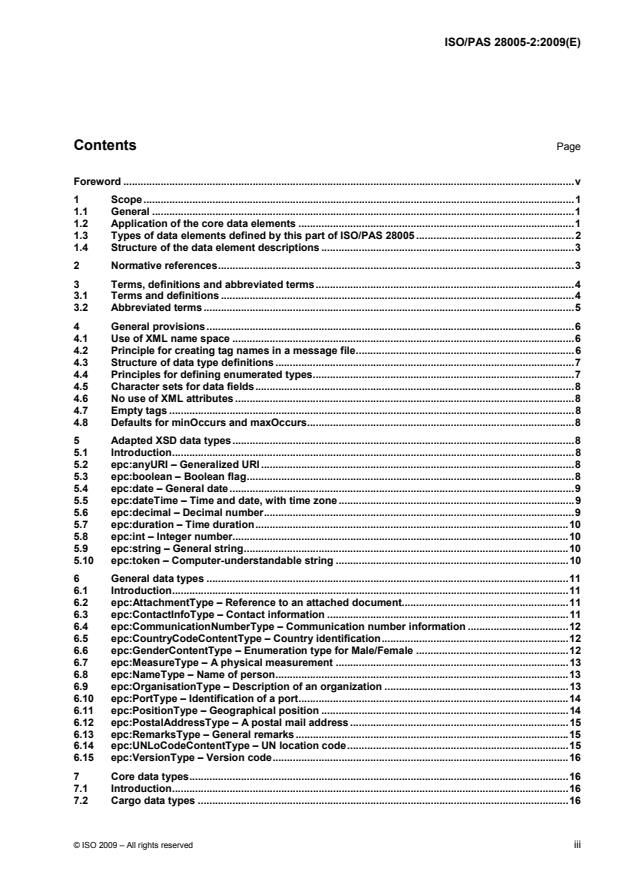
Contents Page
Foreword .v
1 Scope.1
1.1 General .1
1.2 Application of the core data elements .1
1.3 Types of data elements defined by this part of ISO/PAS 28005 .2
1.4 Structure of the data element descriptions .3
2 Normative references.3
3 Terms, definitions and abbreviated terms.4
3.1 Terms and definitions .4
3.2 Abbreviated terms.5
4 General provisions.6
4.1 Use of XML name space .6
4.2 Principle for creating tag names in a message file.6
4.3 Structure of data type definitions .7
4.4 Principles for defining enumerated types.7
4.5 Character sets for data fields.8
4.6 No use of XML attributes .8
4.7 Empty tags .8
4.8 Defaults for minOccurs and maxOccurs.8
5 Adapted XSD data types.8
5.1 Introduction.8
5.2 epc:anyURI – Generalized URI .8
5.3 epc:boolean – Boolean flag.8
5.4 epc:date – General date.9
5.5 epc:dateTime – Time and date, with time zone .9
5.6 epc:decimal – Decimal number.9
5.7 epc:duration – Time duration.10
5.8 epc:int – Integer number.10
5.9 epc:string – General string.10
5.10 epc:token – Computer-understandable string .10
6 General data types .11
6.1 Introduction.11
6.2 epc:AttachmentType – Reference to an attached document.11
6.3 epc:ContactInfoType – Contact information .11
6.4 epc:CommunicationNumberType – Communication number information .12
6.5 epc:CountryCodeContentType – Country identification.12
6.6 epc:GenderContentType – Enumeration type for Male/Female .12
6.7 epc:MeasureType – A physical measurement .13
6.8 epc:NameType – Name of person.13
6.9 epc:OrganisationType – Description of an organization .13
6.10 epc:PortType – Identification of a port.14
6.11 epc:PositionType – Geographical position .14
6.12 epc:PostalAddressType – A postal mail address .15
6.13 epc:RemarksType – General remarks.15
6.14 epc:UNLoCodeContentType – UN location code.15
6.15 epc:VersionType – Version code.16
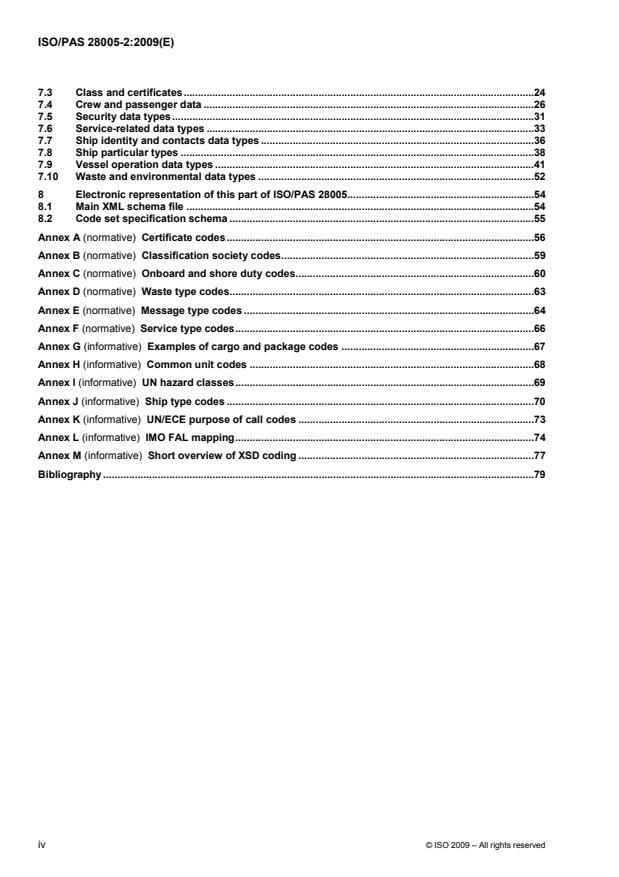
7 Core data types.16
7.1 Introduction.16
7.2 Cargo data types .16
7.3 Class and certificates.24
7.4 Crew and passenger data .26
7.5 Security data types.31
7.6 Service-related data types .33
7.7 Ship identity and contacts data types .36
7.8 Ship particular types .38
7.9 Vessel operation data types .41
7.10 Waste and environmental data types .52
8 Electronic representation of this part of ISO/PAS 28005.54
8.1 Main XML schema file .54
8.2 Code set specification schema .55
Annex A (normative) Certificate codes.56
Annex B (normative) Classification society codes.59
Annex C (normative) Onboard and shore duty codes.60
Annex D (normative) Waste type codes.63
Annex E (normative) Message type codes .64
Annex F (normative) Service type codes.66
Annex G (informative) Examples of cargo and package codes .67
Annex H (informative) Common unit codes .68
Annex I (informative) UN hazard classes.69
Annex J (informative) Ship type codes .70
Annex K (informative) UN/ECE purpose of call codes .73
Annex L (informative) IMO FAL mapping.74
Annex M (informative) Short overview of XSD coding .77
Bibliography .79
iv © ISO 2009 – All rights reserved
Foreword
ISO (the International Organization for Standardization) is a worldwide federation of national standards bodies
(ISO member bodies). The work of preparing International Standards is normally carried out through ISO
technical committees. Each member body interested in a subject for which a technical committee has been
established has the right to be represented on that committee. International organizations, governmental and
non-governmental, in liaison with ISO, also take part in the work. ISO collaborates closely with the
International Electrotechnical Commission (IEC) on all matters of electrotechnical standardization.
International Standards are drafted in accordance with the rules given in the ISO/IEC Directives, Part 2.
The main task of technical committees is to prepare International Standards. Draft International Standards
adopted by the technical committees are circulated to the member bodies for voting. Publication as an
International Standard requires approval by at least 75 % of the member bodies casting a vote.
In other circumstances, particularly when there is an urgent market requirement for such documents, a
technical committee may decide to publish other types of document:
⎯ an ISO Publicly Available Specification (ISO/PAS) represents an agreement between technical experts in
an ISO working group and is accepted for publication if it is approved by more than 50 % of the members
of the parent committee casting a vote;
⎯ an ISO Technical Specification (ISO/TS) represents an agreement between the members of a technical
committee and is accepted for publication if it is approved by 2/3 of the members of the committee casting
a vote.
An ISO/PAS or ISO/TS is reviewed after three years in order to decide whether it will be confirmed for a
further three years, revised to become an International Standard, or withdrawn. If the ISO/PAS or ISO/TS is
confirmed, it is reviewed again after a further three years, at which time it must either be transformed into an
International Standard or be withdrawn.
Attention is drawn to the possibility that some of the elements of this document may be the subject of patent
rights. ISO shall not be held responsible for identifying any or all such patent rights.
ISO/PAS 28005-2 was prepared by Technical Committee ISO/TC 8, Ships and marine technology.
ISO/PAS 28005 consists of the following parts, under the general title Security management systems for the
supply chain — Electronic port clearance (EPC):
⎯ Part 2: Core data elements
The following part is under preparation:
⎯ Part 1: Message structures
PUBLICLY AVAILABLE SPECIFICATION ISO/PAS 28005-2:2009(E)
Security management systems for the supply chain —
Electronic port clearance (EPC) —
Part 2:
Core data elements
1 Scope
1.1 General
This part of ISO/PAS 28005 contains technical specifications that facilitate efficient exchange of electronic
information between ships and shore for coastal transit or port calls. It is intended to cover safety and security
information requirements related mainly to the relationships between the ship and the port and coastal state
authorities as defined in this subclause.
This part of ISO/PAS 28005 contains the definition of core data elements for use in electronic port clearance
(EPC) messages. It contains definitions of core data elements for electronic messaging between ships and
shore in the areas of safety, security and marine operations. It does not define any structuring of messages or
provide any guidance on what information is required for a particular purpose; it is rather a general data
dictionary for safety, security or operation-related maritime information.
It is intended for use in XML messages and will for that reason differ somewhat from the similar trade data
elements directory (TDED) International Standard (ISO 7372).
The core data elements defined in this part of ISO/PAS 28005 are specified so that their meaning and
interpretation in general shall be independent of the context they are used in.
This part of ISO/PAS 28005 does not define the message formats required to exchange information.
1.2 Application of the core data elements
This part of ISO/PAS 28005 contains definitions of core data elements for electronic port clearance. These
elements cover all requirements for ship-to-shore and shore-to-ship reporting as defined in the following.
a) All FAL standard declarations (FAL 1 to 7) as defined in the FAL Convention.
b) ISPS reporting requirements as defined in ISPS and MSC 1130.
c) All general ship reporting requirements as defined in IMO A.851.
d) Recommended reporting on ship-generated waste as defined in MEPC 644 (mandatory within the
European Union, as described in EU/2000/59).
e) Required reporting as defined in the bulk loading and unloading code IMO A.862.
f) ETA reporting to pilot station as defined in IMO A.960.
Annex L gives a cross-reference between the above references and the core data elements.
This part of ISO/PAS 28005 can also be used for information exchanges between the ship and the ship agent,
the port and ship operator or manager. It will not necessarily cover issues such as customs clearance of
imported or exported goods or transport service provisions to goods owners.
1.3 Types of data elements defined by this part of ISO/PAS 28005
Figure 1 shows some of the types of elements that are defined and referenced in this part of ISO/PAS 28005.
The grey boxes represent objects that are not defined in this part of ISO/PAS 28005, but which are
respectively basis information and results of using this part of ISO/PAS 28005.
The top-most grey box represents standard data types as defined in XML Schema Part 2 (XSD-2). The
bottom-most grey box represents an electronic XML message, containing data elements defined by using this
part of ISO/PAS 28005.
Figure 1 — Elements of this part of ISO/PAS 28005
Figure 1 does not include all elements in each group, but has selected a few from each group as examples.
From the top downwards, the defined elements are as follows.
⎯ Adapted XSD types: These are basic XSD types with additional restrictions that apply for the use of these
elements in this part of ISO/PAS 28005.
⎯ General data types: These are data types that represent common concepts like a port description or a
certificate which normally need to be specialised more to be given a context-specific meaning.
⎯ Core data types: These are data types that also contain a contextual meaning to the more generic
concept, such as an arrival port instead of a general port or a reporting location instead of a general
location.
This part of ISO/PAS 28005 does not prohibit the use of other data types than the EPC Core Elements when
messages are defined (this is indicated with the thin arrows in Figure 1). However, such data elements will be
given a specific semantic meaning in the specification of the message format.
2 © ISO 2009 – All rights reserved
1.4 Structure of the data element descriptions
Figure 2 gives an outline of the structure of this part of ISO/PAS 28005. The two rectangles at the top
represent the general data types discussed in the previous clause while the row of rectangles at the bottom
represents the EPC core elements.
Adapted XSD types
(Clause 5)
General data types (Clause 6)
Cargo Class and Crew and Security Service Ship ID Ship Vessel Waste and
certificates passenger related particulars operation environment
7.2 7.3 7.4 7.5 7.6 7.7 7.8 7.9 7.10
Figure 2 — Overview of the structure of this part of ISO/PAS 28005
The groups are:
a) Cargo: data related to cargo and cargo types.
b) Class and certificates: data related to class and certificates kept onboard.
c) Crew and passenger: crew and passenger related data.
d) Security: mainly ISPS-related data.
e) Service related: data related to services requested by the ship, including message headers and clearance
request and status.
f) Ship ID: ship identification and contact details.
g) Ship particulars: static data about the ship.
h) Vessel operation: data that is dependent on current operation or voyage; also physical data that changes,
e.g. with loading such as draught.
i) Waste and environment: currently, this section contains information about waste.
The grouping of core elements is for convenience only and need not result in any particular structuring of EPC
messages. Additionally, the data elements, when defined in an XSD file, will not use any formal grouping (all
data elements will have the same name space).
2 Normative references
The following referenced documents are indispensable for the application of this document. For dated
references, only the edition cited applies. For undated references, the latest edition of the referenced
document (including any amendments) applies.
ISO 3166-1, Codes for the representation of names of countries and their subdivisions — Part 1: Country
codes
ISO 6346, Freight containers — Coding, identification and marking
ISO 9711-1, Freight containers — Information related to containers on board vessels — Part 1: Bay plan
system
Convention on the International Regulations for Preventing Collisions at Sea (COLREG), 1972 as amended,
IMO
IETF RFC 3986, Uniform Resource Identifier (URI): Generic Syntax
IMO Resolution A.851(20), General Principles for Ship Reporting Systems and Ship Reporting Requirements,
Including Guidelines for Reporting Incidents Involving Dangerous Goods, Harmful Substances and/or Marine
Pollutants
IMO Resolution A.862(20), BLU Code, Code of Practice for the Safe Loading and Unloading of Bulk Carriers
IMO Resolution A.960(23), Recommendations on Training and Certification and on Operational Procedures
for Maritime Pilots other than Deep-Sea Pilots
International Convention for the Prevention of Pollution from Ships (MARPOL), 1973, as modified by the
Protocol of 1978 relating thereto, IMO
International Maritime Dangerous Goods (IMDG) Code, IMO
MSC 1130 MSC/Circular 1130, Guidance to Masters, Companies and Duly Authorized Officers on the
Requirements Relating to the Submission of Security-Related Information Prior to the Entry of a Ship Into Port
MSC 1151 MSC/Circular.1151, 17 December 2004, Revised List of Certificates and Documents Required to
be Carried on Board Ships
UN/ECE R16 (UN/ECE Recommendation No. 16), Codes for ports and other locations.
UN/ECE R20 (UN/ECE Recommendation No. 20), Codes for Units of Measure Used in International Trade
UN/ECE R21 (UN/ECE Recommendation No. 21), Codes for passengers for Types of Cargo, Packages and
Packaging Materials with Complementary Codes for Package Names
UNTDD, United Nations Directories for Electronic Data Interchange for Administration, Commerce and
Transport
World Customs Organization, WCO HS, Harmonized Commodity Description and Coding System
3 Terms, definitions and abbreviated terms
3.1 Terms and definitions
For the purposes of this document, the following terms and definitions apply.
3.1.1
character
atomic unit of text as specified by ISO/IEC 10646:2000
NOTE Legal characters include: tab, carriage return, line feed, and the legal characters of The Unicode Standard and
ISO/IEC 10646. The editions cited in this part of ISO/PAS 28005 were current at the time of publication; new characters
could be added to The Unicode Standard or ISO/IEC 10646 by amendments or future editions.
3.1.2
core data element
data object of a type defined in Clause 7
NOTE The core data element will be represented as the contents between XML start and end tags, where the tags
have the same name as the core data type with the trailing string “Type” omitted.
4 © ISO 2009 – All rights reserved
3.1.3
core data type
data type defined in Clause 7
NOTE All core data types will have a trailing “Type” in their name which will be removed when the data type is
instantiated as a core data element.
3.1.4
data type
core data type or another data type defined in Clauses 5 or 6
NOTE All data types will have a name ending with “Type”.
3.1.5
electronic port clearance
EPC
process of exchanging information between the ship and its agent and various parties on shore to allow the
ship clearance to enter port and berth
NOTE EPC does not necessarily include customs clearance of goods that are imported or exported.
3.1.6
leg
part of a voyage between a departure port and an arrival port without any intervening port calls
3.1.7
OBO
oil-bulk-ore carrier
O/O carrier
ship whose design is similar to a conventional bulk carrier but that is equipped with pipelines, pumps and inert
gas plant so as to enable the carriage of oil cargoes in designated spaces
3.1.8
voyage
sailing of the ship from an initial departure port to a final arrival port with or without a number of intervening
port calls
NOTE 1 What constitutes a voyage is defined by the ship's operator or its owner.
NOTE 2 See also leg (3.1.6).
3.1.9
XML schema
definition of the structure of an XML document, written in the XML schema language (XSD)
NOTE The XML schema language is in itself a valid XML structure.
3.2 Abbreviated terms
1)
BLU bulk loading and unloading
2)
DG dangerous goods
HS World Customs Organization's Harmonized System
1) The BLU code is described in the annex to IMO Resolution A.862.
2) The term “harmful and noxious substances” is also sometimes used instead of “dangerous goods”.
[23]
IRI Internationalized Resource Identifier
3)
ISM international safety management
4)
ISPS international ship and port facility security
RORO Roll On – Roll Off (ship)
[2]
TDED Trade Data Elements Dictionary
URI Uniform Resource Identifier
URL Uniform Resource Locator
XML Extensible Markup Language
XSD XML Schema Definition Language
4 General provisions
4.1 Use of XML name space
4.1.1 XSD name space
[20][21]
All data elements defined in the Schema standards and which are used in this part of ISO/PAS 28005,
use the name space “xs”. Thus, the data type name will be prefixed with “xs:”. This corresponds to the XSD
definition file header including the following attribute:
4.1.2 ISO 28005-1 name space
All data types defined in this part of ISO/PAS 28005 will be defined in the namespace “epc”. Thus, the data
type name will be prefixed with “epc:”. This corresponds to the XSD file header including the following
attribute:
4.2 Principle for creating tag names in a message file
This part of ISO/PAS 28005 defines data types that can be used to construct an XML message for exchange
of information between ship and shore. Each information element in the XML file shall have a tag name
derived from the corresponding core data type defined in this part of ISO/PAS 28005. The following rules
apply:
a) If the information element in the XML file corresponds directly to a core data type defined in this part of
ISO/PAS 28005, the tag name of that information element shall be the same as that for the type name
without the trailing “Type” or “ContentType” that the core data type has.
b) If a new information element is created, it should get a name and type which reflects the principles
employed in this part of ISO/PAS 28005.
3) The ISM code is defined in Chapter IX of Reference [8].
4) The ISPS code is defined in Chapter XI-2 of of Reference [8].
6 © ISO 2009 – All rights reserved
4.3 Structure of data type definitions
4.3.1 Name
All data types defined in this part of ISO/PAS 28005 will be given a name that is also included as the first part
of the heading for the clause where the data type is defined.
[19]
The data type name follows the specifications for XML tag names , with the following additional constraints:
a) The name will always end with the string “Type”.
b) Enumerated data types will have the postfix “ContentType”.
NOTE 1 Some core data elements can also have the ending “Type”. In that case, the corresponding core data
type will have the postfix “TypeType”.
c) This part of ISO/PAS 28005 will use the "Upper Camel Case" in all core data types, i.e. the first letter will
be upper case and, when the tag name consists of a number of concatenated words, each of the words
will start with an upper case letter.
d) The name consists only of characters from the sets (A-Z), (a-z) and, exceptionally, (0-9).
NOTE 2 The names have been selected to be generally understandable in the context of ship-to-shore
communication for port clearance. The names are in normal British English without any special characters. Names
are in singular form except where the data element contains a list of items, in which case the tag name is in plural
form.
4.3.2 Definition
Each data type will have a definition that is intended to give an unambiguous description of what the data
element shall contain and in what context it is valid. This is the first paragraph after the heading of the clause.
4.3.3 Type
Each data type will be defined as a section of XSD code. This section will only cover the actual data type
definition and will not be a valid XML document in itself. Annex M gives a brief overview of the syntax
elements used, but the user of this part of ISO/PAS 28005 should refer to Reference [20] for the definitive
descriptions.
4.3.4 Representation
Additional information about how the data field shall be formatted will be contained in the representation
paragraph. This may give, for example, the normative reference to the official sources of enumeration codes.
4.4 Principles for defining enumerated types
Enumerated types, i.e. types that are associated with a fixed set of code values, are defined in one of three
ways:
a) When the code set is small and not defined and maintained by parties external to this part of
ISO/PAS 28005, the allowed code values are listed in the definition of the data type as XSD constraints.
b) If the code set is larger, but not defined by external parties, the code set is included in a normative annex.
Subclause 8.2 defines how such code sets can be put into a separate XML file.
c) When the code set is maintained by an external party, the definition will only define the data type as a
token and make a reference to where the code set can be found and how the code set shall be used in
the core data element. An informative annex will normally contain a list of some of the most common
codes. Subclause 8.2 can be used to encode the values in XML.
NOTE It will not be possible to use an XSD schema to validate the use of codes defined according to items b)
and c) above.
4.5 Character sets for data fields
This part of ISO/PAS 28005 allows all character sets that are supported by XML (see 8.1). Additional
restrictions may be specified in the representation part of the data type definitions.
4.6 No use of XML attributes
The data types defined by this part of ISO/PAS 28005 do not use XML attributes. All information is contained
within XML start and stop tags.
4.7 Empty tags
Mandatory tags, i.e. tags that are not marked with minOccurs=“0”, shall normally contain valid data. Tags that
are optional may be left out of the message, may be empty, i.e. have no end tag, or may have empty content.
The receiver of messages shall treat all forms of empty tags the same.
4.8 Defaults for minOccurs and maxOccurs
According to Reference [20], the default values for minOccurs and maxOccurs equal 1. This is used in this
part of ISO/PAS 28005 to shorten the type specifications in the data type definition clauses.
5 Adapted XSD data types
5.1 Introduction
The adapted XSD data types used in this part of ISO/PAS 28005 are defined in Reference [21].
Subclauses 5.2 to 5.10 contain additional restrictions on the use of these data types that apply in this part of
ISO/PAS 28005.
5.2 epc:anyURI – Generalized URI
Definition:
This data type contains a valid generalized URI. This may be a mail address, prefixed by “mailto:”, or an
external file, prefixed by “file:”.
Type:
Representation:
All generalized URIs (which may be encoded as an IRI) allowed by Reference [21] are also allowed in this part
of ISO/PAS 28005. However, to ensure compatibility with older systems, users are advised to use the URL
type strings (seven-bit character set) until the IRI concept is sufficiently well implemented.
5.3 epc:boolean – Boolean flag
Definition:
This data type contains a date flag that can have the logical values true or false.
Type:
Representation:
All flag values allowed in the XSD definition [21] are allowed.
8 © ISO 2009 – All rights reserved
5.4 epc:date – General date
Definition:
This data type contains a date without additional time of day or time zone information.
Type:
Representation:
This is a date in the standard XSD format, without any time zone code in the value.
Senders of date information should not include time zone information. Receivers should be prepared to accept
a time zone code, but it shall be disregarded in further processing of the data.
5.5 epc:dateTime – Time and date, with time zone
Definition:
This data type contains a date with additional time of day and time zone information.
Type:
Representation:
This is a date and time in the standard XSD format, with a time zone code in the value.
Senders of date and time information shall include time zone information. Receivers should be prepared to
accept values without time zone codes. In this case, the time zone is undefined and proper actions should be
taken by the systems processing this data.
NOTE 1 The time zone value 'Z' is a valid code and refers to GMT or UTC time.
NOTE 2 The seconds field can contain the value 60 (when leap seconds occur).
5.6 epc:decimal – Decimal number
Definition:
This data type is used to specify a quantity.
Type:
Representation:
The decimal type represents a subset of the real numbers, which can be represented by decimal numerals.
The value space of decimal is the set of numbers that can be obtained by multiplying an integer by a non-
positive power of ten, i.e. expressible as i × 10^-n where i and n are integers and n W 0. Precision is not
reflected in this value space; the number 2.0 is not distinct from the number 2.00. The order-relation on
decimal is the order relation on real numbers, restricted to this subset.
The decimal has a lexical representation consisting of a finite-length sequence of decimal digits (#x30-#x39)
separated by a period as a decimal indicator. An optional leading sign is allowed. If the sign is omitted, "+" is
assumed. Leading and trailing zeroes are optional. If the fractional part is zero, the period and following
zeroes can be omitted. For example: -1.23, 12678967.543233, +100000.00, 210. See Reference [21].
NOTE The format requires the use of the period (.) as decimal sign. Some national standards use e.g. comma (,) for
this purpose. In such cases, the sending or receiving application performs the translation.
5.7 epc:duration – Time duration
Definition:
This data type is used to specify duration in time.
Type:
Representation:
This type can specify a time period as specified in Reference [21]. The general format is
“[-]PnYnMnDTnHnMn[.n]S”, where [-] is an optional minus sign, n is a positive integer number and [.n] is an
optional decimal field.
5.8 epc:int – Integer number
Definition:
This data type is used to specify an integer quantity.
Type:
Representation:
The integer type is an integer in the range from -2147483648 to 2147483647 (inclusive).
5.9 epc:string – General string
Definition:
This data type contains a general string that is mainly intended to be read by humans. There are no
restrictions on the format of the string. See 5.10 for a string type that is intended for computer consumption.
Type:
Representation:
No restrictions on the string representation beyond what is specified in Reference [21] are enforced on the
type level. The representation field in the data type definition may put length constraints on the string.
The receiver should be prepared to accept longer strings than specified, but such strings may be truncated.
Thus, the sender cannot rely on longer strings being processed or displayed.
5.10 epc:token – Computer-understandable string
Definition:
The token data type is used for a text string that is mainly meant to be interpreted by a computer. This
includes enumerated codes as well as other structured strings.
Type:
Representation:
The representation field in the type definition clause will specify how restrictions apply.
10 © ISO 2009 – All rights reserved
6 General data types
6.1 Introduction
The data types defined in this section are not specific to any particular function. Some of them are based on
[16]
UN/CEFACT CCL version 08A . The definition contained in the text is in these cases simplified compared to
the full definition of the original types. However, they should be semantically compatible with the data model
description of CCL.
6.2 epc:AttachmentType – Reference to an attached document
Definition:
This type contains a description of and a reference to an attached document.
Type:
Representation:
This data element shall contain a valid URI (as specified in RFC 3986) that points to an attached file. The URI
should normally use the “file:./xxx.yyy” format to point to a local file with the name “xxx.yyy” (as an example).
In this case, the receiver shall find the attached file either as a parallel attachment in an electronic mail
message or as a component of an archive file on the same level as the XML message. The Description can
give a human-readable description of the attached file or it can contain the attached information itself. If a URI
is supplied, the Description is for information only and may not be read by the receiver. If the URI is empty or
does not exist, the Description contains the attached information.
6.3 epc:ContactInfoType – Contact information
Description: This data type contains contact information for either a person or a company.
Type:
Representation:
Common information for both persons and companies are address and contact numbers. Companies and
persons differ in that companies have one name in a string, while persons can have a given name, family
name, and middle name. Exactly one of Person and Company shall be included in the data item.
6.4 epc:CommunicationNumberType – Communication number information
Definition:
This data type specifies a contact point via telephone or other means.
Type:
Representation:
This element contains a list of contact points for a person or organization. Telephone numbers shall be
specified with international prefix code. The Email tag shall be a valid URI with the “mailto:” prefix.
6.5 epc:CountryCodeContentType – Country identification
Definition:
This data type gives a unique and coded representation of a country identity.
Type:
Representation:
The content of this element shall be the two-letter country code as defined in ISO 3166-1.
6.6 epc:GenderContentType – Enumeration type for Male/Female
Definition:
This enumeration type contains the values Male and Female.
Type:
Representation:
The two codes specified are the only valid ones.
12 © ISO 2009 – All rights reserved
6.7 epc:MeasureType – A physical measurement
Definition:
This data type contains one measurement of a physical quantity.
Type:
Representation:
The UnitCode is the unit code as defined in UN/ECE Recommendation 20. Examples of some commonly used
codes are given in Annex D. Content is the quantity related to the specified unit code.
6.8 epc:NameType – Name of person
Definition:
This data type contains the full name of a person.
Type:
Representation:
Represented as three text strings, whe
...
Questions, Comments and Discussion
Ask us and Technical Secretary will try to provide an answer. You can facilitate discussion about the standard in here.
Loading comments...