


ISO/PAS 12835:2013
(Main)Qualification of casing connections for thermal wells
Qualification of casing connections for thermal wells
ISO/PAS 12835:2013 is intended for assessment of casing connections for those field applications in which the design of the casing-connection system is strain-based, and in which primary axial loading is on the casing-connection system driven by constrained thermal expansion, and in which that primary loading exceeds the casing-connection system's yield envelope. Consequently, ISO/PAS 12835:2013 should be considered as a protocol that is complementary to ISO 13679, which applies to classic elastic-design applications. ISO/PAS 12835:2013 describes the structure of the Thermal Well Casing Connection Evaluation Protocol (TWCCEP) and provides guidelines for its use by new or repeat TWCCEP users, whose familiarity with the TWCCEP provisions might vary. Clause 6 describes fundamental assumptions adopted in the TWCCEP.
Qualification des raccordements de boîtiers pour les puits thermiques
General Information
- Status
- Withdrawn
- Publication Date
- 11-Dec-2013
- Technical Committee
- ISO/TC 67/SC 5 - Casing, tubing and drill pipe
- Current Stage
- 9599 - Withdrawal of International Standard
- Start Date
- 08-Mar-2022
- Completion Date
- 12-Feb-2026
Relations
- Effective Date
- 09-Jun-2018


Get Certified
Connect with accredited certification bodies for this standard

ABS Quality Evaluations Inc.
American Bureau of Shipping quality certification.

Element Materials Technology
Materials testing and product certification.

ABS Group Brazil
ABS Group certification services in Brazil.
Sponsored listings
Frequently Asked Questions
ISO/PAS 12835:2013 is a technical specification published by the International Organization for Standardization (ISO). Its full title is "Qualification of casing connections for thermal wells". This standard covers: ISO/PAS 12835:2013 is intended for assessment of casing connections for those field applications in which the design of the casing-connection system is strain-based, and in which primary axial loading is on the casing-connection system driven by constrained thermal expansion, and in which that primary loading exceeds the casing-connection system's yield envelope. Consequently, ISO/PAS 12835:2013 should be considered as a protocol that is complementary to ISO 13679, which applies to classic elastic-design applications. ISO/PAS 12835:2013 describes the structure of the Thermal Well Casing Connection Evaluation Protocol (TWCCEP) and provides guidelines for its use by new or repeat TWCCEP users, whose familiarity with the TWCCEP provisions might vary. Clause 6 describes fundamental assumptions adopted in the TWCCEP.
ISO/PAS 12835:2013 is intended for assessment of casing connections for those field applications in which the design of the casing-connection system is strain-based, and in which primary axial loading is on the casing-connection system driven by constrained thermal expansion, and in which that primary loading exceeds the casing-connection system's yield envelope. Consequently, ISO/PAS 12835:2013 should be considered as a protocol that is complementary to ISO 13679, which applies to classic elastic-design applications. ISO/PAS 12835:2013 describes the structure of the Thermal Well Casing Connection Evaluation Protocol (TWCCEP) and provides guidelines for its use by new or repeat TWCCEP users, whose familiarity with the TWCCEP provisions might vary. Clause 6 describes fundamental assumptions adopted in the TWCCEP.
ISO/PAS 12835:2013 is classified under the following ICS (International Classification for Standards) categories: 75.180.10 - Exploratory, drilling and extraction equipment; 75.200 - Petroleum products and natural gas handling equipment. The ICS classification helps identify the subject area and facilitates finding related standards.
ISO/PAS 12835:2013 has the following relationships with other standards: It is inter standard links to ISO/TS 12835:2022. Understanding these relationships helps ensure you are using the most current and applicable version of the standard.
ISO/PAS 12835:2013 is available in PDF format for immediate download after purchase. The document can be added to your cart and obtained through the secure checkout process. Digital delivery ensures instant access to the complete standard document.
Standards Content (Sample)
PUBLICLY ISO/PAS
AVAILABLE 12835
SPECIFICATION
First edition
2013-12-15
Qualification of casing connections for
thermal wells
Qualification des raccordements de boîtiers pour les puits thermiques
Reference number
©
ISO 2013
© ISO 2013
All rights reserved. Unless otherwise specified, no part of this publication may be reproduced or utilized otherwise in any form
or by any means, electronic or mechanical, including photocopying, or posting on the internet or an intranet, without prior
written permission. Permission can be requested from either ISO at the address below or ISO’s member body in the country of
the requester.
ISO copyright office
Case postale 56 • CH-1211 Geneva 20
Tel. + 41 22 749 01 11
Fax + 41 22 749 09 47
E-mail copyright@iso.org
Web www.iso.org
Published in Switzerland
ii © ISO 2013 – All rights reserved
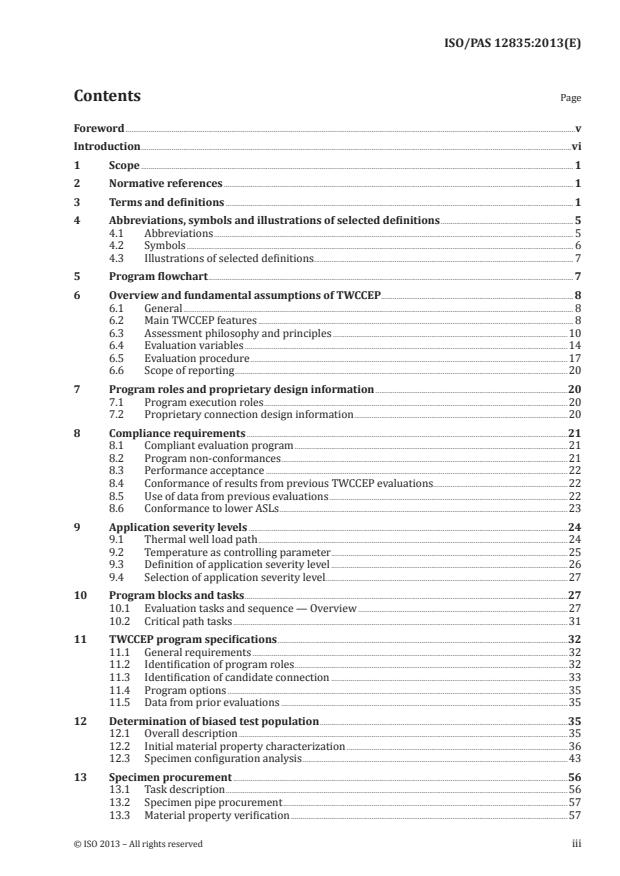
Contents Page
Foreword .v
Introduction .vi
1 Scope .1
2 Normative references .1
3 Terms and definitions .1
4 Abbreviations, symbols and illustrations of selected definitions .5
4.1 Abbreviations . 5
4.2 Symbols . 6
4.3 Illustrations of selected definitions . 7
5 Program flowchart .7
6 Overview and fundamental assumptions of TWCCEP .8
6.1 General . 8
6.2 Main TWCCEP features . 8
6.3 Assessment philosophy and principles .10
6.4 Evaluation variables .14
6.5 Evaluation procedure .17
6.6 Scope of reporting .20
7 Program roles and proprietary design information .20
7.1 Program execution roles .20
7.2 Proprietary connection design information .20
8 Compliance requirements .21
8.1 Compliant evaluation program .21
8.2 Program non-conformances .21
8.3 Performance acceptance .22
8.4 Conformance of results from previous TWCCEP evaluations.22
8.5 Use of data from previous evaluations .22
8.6 Conformance to lower ASLs .23
9 Application severity levels .24
9.1 Thermal well load path .24
9.2 Temperature as controlling parameter .25
9.3 Definition of application severity level .26
9.4 Selection of application severity level .27
10 Program blocks and tasks .27
10.1 Evaluation tasks and sequence — Overview .27
10.2 Critical path tasks .31
11 TWCCEP program specifications .32
11.1 General requirements .32
11.2 Identification of program roles .32
11.3 Identification of candidate connection .33
11.4 Program options .35
11.5 Data from prior evaluations .35
12 Determination of biased test population .35
12.1 Overall description .35
12.2 Initial material property characterization .36
12.3 Specimen configuration analysis .43
13 Specimen procurement .56
13.1 Task description .56
13.2 Specimen pipe procurement .57
13.3 Material property verification .57
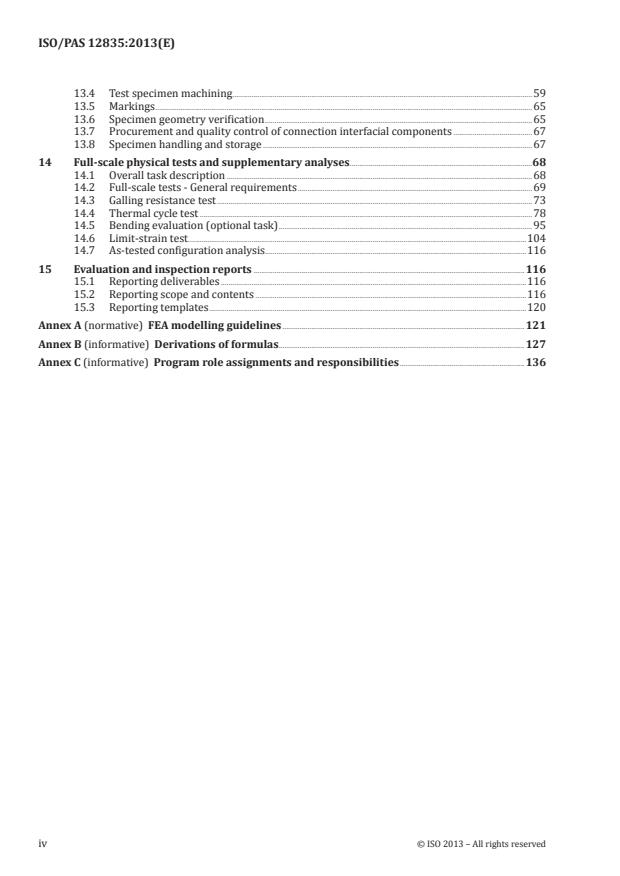
13.4 Test specimen machining .59
13.5 Markings .65
13.6 Specimen geometry verification .65
13.7 Procurement and quality control of connection interfacial components .67
13.8 Specimen handling and storage .67
14 Full-scale physical tests and supplementary analyses .68
14.1 Overall task description .68
14.2 Full-scale tests - General requirements .69
14.3 Galling resistance test .73
14.4 Thermal cycle test .78
14.5 Bending evaluation (optional task) .95
14.6 Limit-strain test .104
14.7 As-tested configuration analysis .116
15 Evaluation and inspection reports .116
15.1 Reporting deliverables .116
15.2 Reporting scope and contents .116
15.3 Reporting templates .120
Annex A (normative) FEA modelling guidelines .121
Annex B (informative) Derivations of formulas.127
Annex C (informative) Program role assignments and responsibilities .136
iv © ISO 2013 – All rights reserved
Foreword
ISO (the International Organization for Standardization) is a worldwide federation of national standards
bodies (ISO member bodies). The work of preparing International Standards is normally carried out
through ISO technical committees. Each member body interested in a subject for which a technical
committee has been established has the right to be represented on that committee. International
organizations, governmental and non-governmental, in liaison with ISO, also take part in the work.
ISO collaborates closely with the International Electrotechnical Commission (IEC) on all matters of
electrotechnical standardization.
The procedures used to develop this document and those intended for its further maintenance are
described in the ISO/IEC Directives, Part 1. In particular the different approval criteria needed for the
different types of ISO documents should be noted. This document was drafted in accordance with the
editorial rules of the ISO/IEC Directives, Part 2 (see www.iso.org/directives).
Attention is drawn to the possibility that some of the elements of this document may be the subject of
patent rights. ISO shall not be held responsible for identifying any or all such patent rights. Details of
any patent rights identified during the development of the document will be in the Introduction and/or
on the ISO list of patent declarations received (see www.iso.org/patents).
Any trade name used in this document is information given for the convenience of users and does not
constitute an endorsement.
For an explanation on the meaning of ISO specific terms and expressions related to conformity
assessment, as well as information about ISO’s adherence to the WTO principles in the Technical Barriers
to Trade (TBT) see the following URL: Foreword - Supplementary information
The committee responsible for this document is ISO/TC 67, Materials, equipment and offshore structures
for petroleum, petrochemical and natural gas industries, Subcommittee SC 5, Casing, tubing and drill pipe.
Introduction
This Thermal Well Casing Connection Evaluation Protocol (TWCCEP) provides procedures for
assessment and thereby enables evaluation of suitability of threaded casing connections for service in
intermediate or production casing strings of thermal recovery wells. The TWCCEP defines such wells
as those with operating temperatures that cyclically vary between minimum values appreciably below
180°C and maximum values that range from 180°C to 350°C, in which the casing string is cemented and
the primary axial loading is strain-based.
Throughout this document, a casing connection subject to evaluation is referred to as candidate
connection. A candidate connection denotes a product with unique design features and production
specifications for size, weight, and component materials (including pin, box, and interfacial components).
The TWCCEP assesses the candidate connection’s galling resistance, structural integrity and sealability
under loads typical for connection assembly and thermal-well service. The TWCCEP does not address
impacts of external pressure, incomplete lateral pipe support, rotational fatigue, formation-induced
shear, or environmentally-induced corrosion or cracking.
The TWCCEP’s evaluation procedure includes analysis and full-scale testing. In the analysis, worst-case
combinations of the connection geometry and material properties are determined and specifications
for test specimens are derived. In the full-scale tests, those specimens are subjected to loading
representative of thermal well operations. While the TWCCEP aims to enable a statistically significant
full-scale test, it does not demand a rigorous check of a true statistical placement of the tested sample
responses relative to field connection performance, and thus inherently assumes that the test specimens
are representative of subsequent field connections. For this reason, only connections with the same
design parameters as the candidate connection should be considered representative of the connection
assessed under this protocol.
The extensive effort involved in replicating thermal well field conditions in a laboratory environment
limits the extent of physical testing that can reasonably be undertaken in an evaluation program.
This protocol balances technical rigor and practicality to provide a baseline level of confidence in the
candidate connection’s performance. Connection users should consider the scope of this evaluation
and appropriate additions to address operation-specific conditions. Successful field use of a connection
meeting the requirements of this protocol does not preclude an operator’s need to employ appropriate
product quality assurance measures and field operating practices.
The TWCCEP is the culmination of a thorough review of factors contributing to performance of casing
connections in thermal well applications. This protocol has been developed using input from operators’
descriptions of field practices, manufacturers’ feedback on connection design and production, available
literature, knowledge of past connection qualification programs, and additional analytical and
experimental work performed in support of the protocol development. The TWCCEP is intended to be
maintained and refined as new findings surface.
vi © ISO 2013 – All rights reserved
PUBLICLY AVAILABLE SPECIFICATION ISO/PAS 12835:2013(E)
Qualification of casing connections for thermal wells
1 Scope
ISO/PAS 12835 is intended for assessment of casing connections for those field applications in which
the design of the casing-connection system is strain-based, and in which primary axial loading is on
the casing-connection system driven by constrained thermal expansion, and in which that primary
loading exceeds the casing-connection system’s yield envelope. Consequently, ISO/PAS 12835 should
be considered as a protocol that is complementary to ISO 13679, which applies to classic elastic-design
applications.
ISO/PAS 12835 describes the structure of the Thermal Well Casing Connection Evaluation Protocol
(TWCCEP) and provides guidelines for its use by new or repeat TWCCEP users, whose familiarity
with the TWCCEP provisions might vary. Clause 6 describes fundamental assumptions adopted in the
TWCCEP.
NOTE The term “user” refers to a party that uses the TWCCEP in a connection evaluation program. That
party might or might not be the same party as a later user of the evaluated connection in a field application.
2 Normative references
The following documents, in whole or in part, are normatively referenced in this document and are
indispensable for its application. For dated references, only the cited edition applies. For undated
references, the latest editions of the reference documents apply.
ASTM A370, Standard Test Methods and Definitions for Mechanical Testing of Steel Products
ASTM E8, Standard Test Methods for Tension Testing of Metallic Materials
ASTM E21, Standard Test Methods for Elevated-Temperature Tension Tests of Metallic Materials
ASTM E831-06, Linear Thermal Expansion of Solid Materials by Thermomechanical Analysis
ISO 9001, Quality management systems — Requirements
1)
ISO 11960, Petroleum and natural gas industries — Steel pipe for use as casing and tubing for wells
ISO 13679:2002, Petroleum and natural gas industries — Procedures for testing casing and tubing
2)
connections
3 Terms and definitions
For the purpose of this document, the following terms and definitions apply.
3.1
ambient temperature
ambient temperature in the facility where a physical testing task is executed
1) Based on API Specification 5CT.
2) Based on API Specification 5C5.
3.2
application severity level
connection loading specifications assumed to be representative for a range of operational conditions,
which determine the scope of analysis and testing required by the evaluation procedure (3.15) for those
operational conditions
3.3
assigner
party that commissions an evaluation program (3.16)
3.4
average string strain
average axial strain along the controlled elongation interval (3.13) of a specimen string (3.37)
3.5
bend test specimens
subset of candidate connection specimens (3.8) subjected to the optional bending evaluation (3.6) per
the TWCCEP evaluation procedure (3.15)
3.6
bending evaluation
analysis and physical testing conducted to determine a candidate connection’s (3.7) sensitivity to casing
curvature
3.7
candidate connection
casing connection product that is being evaluated by the TWCCEP, and is uniquely defined by its design
features and production specifications with respect to size, weight, and component materials
3.8
candidate connection specimens
a set of connection specimens (3.11, 3.12) that is representative of a candidate connection’s (3.7) design
and features, and is provided for an evaluation program (3.15) of that candidate connection (3.7)
3.9
casing pup
short piece of casing pipe cut from a mother joint
3.10
connection
single design-specific assembly of pin and box and interfacial component(s)
3.11
connection specimen (for threaded and coupled connections)
two connections consisting of a single coupling and two casing pups (3.9) with pin ends joined by that
coupling
3.12
connection specimen (for integral connections)
one connection consisting of one casing pup (3.9) with a box end and one casing pup (3.9) with a pin end
3.13
controlled elongation interval
portion of a specimen string (3.37), along which the elongation is measured and controlled
3.14
effective string length
portion of the total length of a specimen string (3.37) that is assumed to deform appreciably under
mechanical forces in the thermal cycle test (3.44)
2 © ISO 2013 – All rights reserved
3.15
evaluation procedure
set of analytical and testing tasks required by the TWCCEP to assess performance of the candidate
connection specimens (3.8)
3.16
evaluation program
execution of the TWCCEP to assess performance of a candidate connection (3.7)
3.17
evaluation report
collectively, all documents prepared by an evaluator (3.18), according to applicable TWCCEP reporting
requirements, that describe an evaluation program’s (3.16) execution history and results
3.18
evaluator
party that performs analytical and testing tasks required by an evaluation procedure (3.15)
3.19
excluded connection
connection (3.10) that has been evaluated in a TWCCEP full-scale test but whose performance has been
excluded from comparison with threshold performance requirements (3.45)
3.20
galling
cold welding of contacting material surfaces followed by tearing of metal during subsequent sliding
3.21
high cycle temperature
targeted highest temperature in the thermal cycle test (3.44)
3.22
inspection report
collectively, all documents prepared by an inspector (3.23), according to applicable TWCCEP reporting
requirements, that describe compliance of the executed evaluation program (3.16) with TWCCEP
requirements
3.23
inspector
party that verifies compliance of the executed evaluation program (3.16) with requirements of the
TWCCEP
3.24
interfacial component(s)
design-specific component(s) of a connection (3.10) applied to the pin and box either during their
manufacturing (e.g. coatings) or during the connection assembly (e.g. thread compound)
3.25
limit-strain specimens
subset of candidate connection specimens (3.8) subjected to the limit-strain test (3.26) per the TWCCEP
evaluation procedure (3.15)
3.26
limit-strain test
tension test, to structural failure, of the limit-strain specimens (3.25)
3.27
low cycle temperature
targeted lowest temperature in the thermal cycle test (3.44)
3.28
make-break specimens
subset of candidate connection specimens (3.8) subjected to multiple make-ups and break-outs per the
TWCCEP evaluation procedure (3.15)
3.29
make-up support pin
pin component of candidate connection (3.7) with seal removed, used to support a coupling’s open end
during make-up and break-out of that coupling’s opposite end
3.30
material coupon
cylindrical section of pipe from which material strip specimens (3.31) are cut
3.31
material strip specimen
longitudinal steel strip cut from a material coupon (3.30) and machined for use in mechanical property
characterization tests
3.32
prior evaluation data
set of data acquired in a connection performance assessment carried out by analysis and/or physical
tests prior to issuance of this protocol and/or according to a procedure/protocol different than the
TWCCEP evaluation procedure (3.15)
3.33
program roles
collective reference to the roles of assigner (3.3), supplier (3.39), evaluator (3.18) and inspector (3.23)
3.34
repairable galling
galling that can be repaired according to a supplier’s (3.39) field-repair procedure for a candidate
connection (3.7)
3.35
severe galling
galling that cannot be repaired according to a supplier’s (3.39) field-repair procedure for a candidate
connection (3.7)
3.36
specimen
used in commentary and/or descriptive context, denotes a generic reference to a connection specimen
(3.11, 3.12) or to a material strip specimen (3.31)
3.37
specimen string
collective reference to a single connection specimen (3.11, 3.12) and/or an in-series assembly of two or
more connection specimens (3.11, 3.12) in a thermal cycle test (3.44)
3.38
substantially qualified party
person/company possessing technical skills and experience necessary to perform a task, as designated
by the assigner (3.3) and the supplier (3.39)
3.39
supplier
party that manufactures a candidate connection (3.7)
4 © ISO 2013 – All rights reserved
3.40
tensile strain threshold
tensile strain value that a connection specimen (3.11, 3.12) is expected to survive during a limit-strain
test (3.26)
3.41
test specimen
used in commentary and/or descriptive context, denotes a generic reference to a connection specimen
(3.11, 3.12) that is provided for a full-scale test
3.42
thermal cycle
used in commentary and/or descriptive context, denotes a temperature excursion from a low initial
temperature to a high maximum temperature and back to the low initial temperature
3.43
thermal cycle specimens
subset of candidate connection specimens (3.8) subjected to the thermal cycle test (3.44) per the
TWCCEP evaluation procedure (3.15)
3.44
thermal cycle test
thermo-mechanical test of connection specimens (3.11, 3.12), in which several thermal cycles are applied
between the low cycle temperature (3.27) and the high cycle temperature (3.21)
3.45
threshold performance requirements
set of connection performance criteria that candidate connection specimens (3.8) must satisfy in
order for a candidate connection (3.7) to be considered as having met TWCCEP minimum performance
requirements
4 Abbreviations, symbols and illustrations of selected definitions
4.1 Abbreviations
Terms defined in Table 1 denote abbreviations used for descriptive purposes.
Table 1 — List of abbreviations
ASL application severity level
BF fast box taper
BS slow box taper
CSS cyclic steam stimulation
CTE coefficient of thermal expansion
FEA finite element analysis
max. maximum
min. minimum
PF fast pin taper
PS slow pin taper
SAGD steam assisted gravity drainage
TC threaded-and-coupled
TWCCEP thermal well casing connection evaluation protocol
TF(WGS) final make-up torque for specimen with WGS configuration
TF(WGT) final make-up torque for specimen with WGT configuration
TF(WSC-M) final make-up torque for specimen with WSC configuration and multiple make-ups
TF(WSC-S) final make-up torque for specimen with WSC configuration and single make-up
TF(WST-M) final make-up torque for specimen with WST configuration and multiple make-ups
TF(WST-S) final make-up torque for specimen with WST configuration and single make-up
WGS worst-case tolerance combination for galling in seal
WGT worst-case tolerance combination for galling in threads
WSC worst-case tolerance combination for sealability in compression at high temperature
WST worst-case tolerance combination for sealability in tension at low temperature
4.2 Symbols
Terms defined in Table 2 denote variables, which depend on the selected application severity level (ASL)
and other protocol options, procedural calculations, and interim results.
Table 2 — Symbols
CTE average coefficient of thermal expansion
a
ρ maximum test curvature
MAX
D casing outside diameter
Δε strain increment for application in the limit-strain test
LL
Δρ curvature increment
ETTE average residual post-cycle strain
a
L length of controlled elongation interval
CEI
L unsupported pup length (pup length excluding make-up loss, i.e. pin-box overlaps at each end)
p
LTTS lower-bound temperature strain increment
SLCF strain-length compensating factor
SRI temperature range strain increment
SSP(T) saturated steam pressure at temperature T
t casing wall thickness
T temperature
T ambient temperature
amb
T high cycle temperature
hc
6 © ISO 2013 – All rights reserved
T lower-bound temperature for a given application severity level
lb
T low cycle temperature
lc
T upper-bound temperature for a given application severity level
ub
4.3 Illustrations of selected definitions
Figure 1 illustrates a connection specimen (3.11, 3.12). Figure 1 a) shows a connection specimen for
a threaded-and-coupled (TC) connection (3.11), and Figure 1 b) shows a connection specimen for an
integral connection (3.12). A threaded-and-coupled connection specimen consists of one coupling and
two casing pups (3.9), and contains two connections (two leak paths). An integral connection specimen
consists of one pin-end pup and one box-end pup, and contains one connection (one leak path).
a) Threaded-and-coupled connection specimen
b) Integral connection specimen
Figure 1 — Illustration of connection specimens
When full-scale testing is conducted on strings containing multiple connection specimens assembled
in series, some casing pups are shared by two adjacent connection specimens (which might be either
threaded and coupled or integral). Each such shared casing pup is considered to consist of two halves,
with each half belonging to the connection specimen that includes the corresponding pin end or integral
box end. Figure 2 illustrates an example of a string assembly with four connection specimens. For
consistency with TWCCEP requirements for a thermal cycle test (3.44), in which a four-specimen string
(3.37) assembly may be used, the example in Figure 2 shows Specimens 3, 4, 5, and 6. For threaded
and coupled connection specimens, the two specimen leak paths can be distinguished by the specimen
number and letters “A” and “B” referring to each specimen side.
Specimen 3Specimen 4Specimen 5Specimen 6
Side A Side B
Leak path 3A Leak path 3B
Figure 2 — Illustration of connection string assembly
5 Program flowchart
Figure 3 illustrates five main components (blocks) of a TWCCEP program (3.16). A detailed description
of the TWCCEP blocks and tasks is provided in Clause 10.
General principles adopted for the TWCCEP evaluation procedure (3.15) are described in Clause 6. It is
strongly recommended that all users of this document and all parties responsible for a prospective use
of an assessed connection in a field application review Clause 6 and become aware of the assumption
basis and procedural requirements specified by TWCCEP for the assessment tasks and data reporting.
Candidate connection
Application severity level
Program specifications Optional task selection
Prior evaluation data
Program role assignments
Reference material properties
Biased test population
Specimen configuration analysis
Casing pipe selection
Specimen procurement Material property verification
Specimen machining
Galling resistance test
Thermal cycle test
Full-scale testing and
Bend test
supplementary analysis
Limit strain test
As-tested configuration analysis
Evaluation/inspection reports
Analysis and test results
Reporting
Assessment criteria
Compliance with TWCCEP
Figure 3 — TWCCEP flowchart
6 Overview and fundamental assumptions of TWCCEP
6.1 General
This Clause contains an overview of fundamental assumptions adopted for the TWCCEP, which are
provided to facilitate understanding and interpretation of TWCCEP’s provisions and procedural
requirements specified in later Clauses of this document.
6.2 Main TWCCEP features
6.2.1 Purpose of TWCCEP
The TWCCEP provides procedures for assessing suitability of threaded casing connections for
intermediate or production casing strings for thermal recovery wells. Conducting an assessment of
a candidate connection according to the TWCCEP provides data that can be interpreted by a user to
complete evaluation of the candidate connection.
8 © ISO 2013 – All rights reserved
6.2.2 Applicability to service conditions
The TWCCEP applies to those field applications in which operational temperatures oscillate between
a cold level, appreciably below 180°C, and a hot level, above 180°C, in which casing deformation is
primarily driven by thermo-mechanical strain resulting from the above temperature excursions, and in
which the casing body might or might not cyclically yield under the corresponding strain-driven loads.
Specifically, the TWCCEP applies to two thermal-recovery applications: Steam Assisted Gravity
Drainage (SAGD) and Cyclic Steam Stimulation (CSS), in which thermal expansion of the casing string
is constrained by cementing. The TWCCEP might also be used for qualifying connections for other
extreme-service wells in which tubular undergo full-body yielding and for which deformation-tolerant
design is desired; for example, wells in compacting reservoirs, steam-drive wells, geothermal wells, or
some high-pressure, high-temperature wells.
6.2.3 Rationale for TWCCEP development
Lack of a standard connection evaluation procedure for thermal-well applications was the main rationale
for developing the TWCCEP.
Loading of intermediate casing connections in thermally stimulated wells is very severe and of unique
character. Prior to issuance of the TWCCEP, no other connection evaluation procedure had been adopted
as an industry standard for those loading conditions. In particular, ISO 13679 provides procedures for
evaluating casing and tubing connections only for elastic-design applications, in which the tubular-
body stress state is assumed to remain elastic, and in which maximum operational temperatures do not
generally exceed 180°C. Despite these fundamental differences, several similarities exist between the
TWCCEP and ISO 13679. Where practical, such similarities are referred to in this document.
6.2.4 Subject of evaluation
A casing connection product subjected to an evaluation program is referred to as a candidate
connection (3.7). A candidate connection denotes a product with unique design features and production
specifications for size, weight, and component materials (including pin, box, and interfacial components
(3.24)).
In general, one or more candidate connections can be assessed in an evaluation program. For simplicity,
this document refers to a single candidate connection as a subject of evaluation. If two or more candidate
connections are included in a single evaluation program, then all of the TWCCEP provisions apply to
each candidate connection separately.
6.2.5 Application severity levels
The severity of field operating conditions varies. The TWCCEP distinguishes multiple ASLs, uniquely
defined in terms of maximum operating temperature (see 9.3).
Temperature has been recognized as the primary variable influencing severity of pipe thermo-
mechanical loading and the connection response to that loading, including sealability and structural
performance. The following arguments support this assumption:
— constrained thermal expansion of cemented casing heated to the maximum operating temperature
leads to pipe and/or connection yielding. The magnitude of the axial loads generated during
heating (and also subsequent cooling during a well intervention), as well as the degree of post-yield
deformation, strongly depend on the applied temperature range;
— in field service, applied internal pressures typically follow the saturated-steam relationship with
temperature;
— properties of casing pipe and connection materials vary with temperature – the material yield
strength typically decreases with temperature, and creep and relaxation effects become more
pronounced at elevated temperatures;
— elevated temperatures affect properties of thread compounds (dopes), and thus influence the role
of the dope in premium seal activation. Such temperatures might also affect properties of some
coatings used for dopeless connections. Higher temperatures are typically associated with faster
degradation of dopes and coatings.
— the ASL is selected at the onset of each evaluation program. Some aspects of the TWCCEP evaluation
procedure, such as severity of loading applied in numerical modelling and physical tests, depend on
the selected ASL. TWCCEP assessment criteria are independent of the selected ASL.
6.3 Assessment philosophy and principles
6.3.1 Fundamental principles
The TWCCEP fundamental assessment philosophy is to:
— distinguish between those connection types that are suitable for thermal well service and those
that are not;
— acquire key connection performance data for comparison with adopted minimum performance
requirements, and also auxiliary performance data for determination of connection service
boundaries;
— be practical to execute by analytical methods and laboratory testing.
Based on the above philosophy, the TWCCEP assumes the following principles for the evaluation basis:
Principle 1 The evaluation procedure should be conservative with respect to:
a) candidate connection samples: test specimen configurations should be chosen to have the
least-favourable characteristics possible within production manufacturing ranges;
b) loading: evaluation procedure should employ the most severe loading that is representa-
tive of cited field conditions.
Principle 2 Given that field conditions vary, the evaluation procedure should provide options to tailor
the evaluation scope to anticipated operational conditions.
Principle 3 The evaluation procedure should make the best use of available analytical and physical-
testing tools.
Principle 4 The evaluation procedure should measure a candidate connection’s performance with
respect to those performance indicators that are considered critical for reliability in field
service.
Principle 5 Assessment criteria should be chosen according to reasonable field-performance expecta-
tions. Assessment criteria should refer only to results of full-scale tests.
Principle 6 Where practical, auxiliary data should be collected to assess connection performance
boundaries and safety margins with respect to cited service conditions.
Principle 7 Where possible and practical, data acquired in prior evaluations can be used, and the evalua-
tion program scope can be reduced accordingly.
Principle 8 Execution of an evaluation program does not require the manufacturer of a candidate con-
nection to reveal confidential connection design information beyond a level that enables
third-party inspection.
Principle 9 Results of every evaluation program should be interpreted in the context of the completed
evaluation scope and anticipated service conditions.
Principle 10 Perception of conflict of interest in executing an evaluation program should be avoided.
10 © ISO 2013 – All rights reserved
Each principle listed above is further described in the following Clauses. Discussion of some principles
is also illustrated by reference to Figure 6 and Table 5 in 10.1, which describe the tasks of the TWCCEP
evaluation procedure.
6.3.2 Conservative evaluation procedure
The TWCCEP is based on the premise that the evaluation procedure should verify the adequacy of a
candidate connection’s performance under worst-case combinations of factors that affect its behaviour,
including connection geometry, manufacturing tolerances, material properties, assembly, and
operational loading. Principle 1 (6.3.1) is implemented by the following steps:
a) Determine the worst-case combinations of manufacturing and assembly variables for the candidate
connection, and treat those combinations as specifications for a biased test population.
b) Evaluate the biased test population under the established representative loading.
c) Compare the measured performance of the biased test population to adopted performance
requirements. Record acceptance if those requirements are met, or failure if those requirements
are not met.
d) Assume that any production series of the candidate connection will perform equally well or better
in relevant field service than the evaluated, biased test population.
Step a) above is referred to as the front-end determination of the biased test population. Steps b) and c)
are performed in the evaluation program by full-scale testing and supplementary analyses. Step d) is
executed based on the acquired evaluation results.
6.3.3 Mandatory and optional tasks
The TWCCEP evaluation procedure contains mandatory tasks and optional tasks, which allows the
evaluation scope to be tailored to specific operational conditions (per Principle 2 in 6.3.1):
— mandatory tasks are considered critical for evaluation of connections for all applications to which
the TWCCEP applies. Completion of all mandatory tasks is required in every evaluation program;
— optional tasks are those tasks that should be chosen so that the evaluation program provides results
most relevant for the cited operational conditions. It is mandatory to consider all program options,
consciously select an optional task scope suitable f
...
Questions, Comments and Discussion
Ask us and Technical Secretary will try to provide an answer. You can facilitate discussion about the standard in here.
Loading comments...