


ISO/IEC TR 18047-6:2006
(Main)Information technology — Radio frequency identification device conformance test methods — Part 6: Test methods for air interface communications at 860 MHz to 960 MHz
Information technology — Radio frequency identification device conformance test methods — Part 6: Test methods for air interface communications at 860 MHz to 960 MHz
ISO/IEC 18000 defines the air interfaces for radio frequency identification (RFID) devices used in item management applications. ISO/IEC 18000-6 defines the air interface for these devices operating at frequencies from 860 MHz to 960 MHz. The purpose of ISO/IEC TR 18047 is to provide test methods for conformance with the various parts of ISO/IEC 18000. Each part of ISO/IEC TR 18047 contains all measurements required to be made on a product in order to establish whether it conforms to the corresponding part of ISO/IEC 18000. For ISO/IEC TR 18047-6:2006, each interrogator needs to be assessed for operation with both types A and B, while each tag is only required to support at least one of the types A or B. It should be noted that measurement of tag and interrogator performance is covered by ISO/IEC TR 18046. ISO/IEC TR 18047-6:2006 defines test methods for determining the conformance of radio frequency identification devices (tags and interrogators) for item management with the specifications given in ISO/IEC 18000-6, but does not apply to the testing of conformity with regulatory or similar requirements. The test methods require only that the mandatory functions, and any optional functions which are implemented, be verified. This may, in appropriate circumstances, be supplemented by further, application-specific functionality criteria that are not available in the general case. The interrogator and tag conformance parameters in ISO/IEC TR 18047-6:2006 are the following: type-specific conformance parameters including nominal values and tolerances; parameters that apply directly affecting system functionality and inter-operability. The following are not included in ISO/IEC TR 18047-6:2006: parameters that are already included in regulatory test requirements; high-level data encoding conformance test parameters (these are specified in ISO/IEC 15962). Unless otherwise specified, the tests in ISO/IEC TR 18047-6:2006 are to be applied exclusively to RFID tags and interrogators defined in ISO/IEC 18000-6. ISO/IEC TR 18047-6:2006 also describes all necessary conformance tests.
Technologies de l'information — Méthodes d'essai de conformité du dispositif d'identification de radiofréquence — Partie 6: Méthodes d'essai pour des communications d'une interface d'air à 860 MHz et jusqu'à 960 MHz
General Information
- Status
- Withdrawn
- Publication Date
- 31-May-2006
- Withdrawal Date
- 31-May-2006
- Technical Committee
- ISO/IEC JTC 1/SC 31 - Automatic identification and data capture techniques
- Current Stage
- 9599 - Withdrawal of International Standard
- Start Date
- 26-Nov-2008
- Completion Date
- 12-Feb-2026
Relations
- Effective Date
- 15-Apr-2008
Get Certified
Connect with accredited certification bodies for this standard

BSI Group
BSI (British Standards Institution) is the business standards company that helps organizations make excellence a habit.

NYCE
Mexican standards and certification body.
Sponsored listings
Frequently Asked Questions
ISO/IEC TR 18047-6:2006 is a technical report published by the International Organization for Standardization (ISO). Its full title is "Information technology — Radio frequency identification device conformance test methods — Part 6: Test methods for air interface communications at 860 MHz to 960 MHz". This standard covers: ISO/IEC 18000 defines the air interfaces for radio frequency identification (RFID) devices used in item management applications. ISO/IEC 18000-6 defines the air interface for these devices operating at frequencies from 860 MHz to 960 MHz. The purpose of ISO/IEC TR 18047 is to provide test methods for conformance with the various parts of ISO/IEC 18000. Each part of ISO/IEC TR 18047 contains all measurements required to be made on a product in order to establish whether it conforms to the corresponding part of ISO/IEC 18000. For ISO/IEC TR 18047-6:2006, each interrogator needs to be assessed for operation with both types A and B, while each tag is only required to support at least one of the types A or B. It should be noted that measurement of tag and interrogator performance is covered by ISO/IEC TR 18046. ISO/IEC TR 18047-6:2006 defines test methods for determining the conformance of radio frequency identification devices (tags and interrogators) for item management with the specifications given in ISO/IEC 18000-6, but does not apply to the testing of conformity with regulatory or similar requirements. The test methods require only that the mandatory functions, and any optional functions which are implemented, be verified. This may, in appropriate circumstances, be supplemented by further, application-specific functionality criteria that are not available in the general case. The interrogator and tag conformance parameters in ISO/IEC TR 18047-6:2006 are the following: type-specific conformance parameters including nominal values and tolerances; parameters that apply directly affecting system functionality and inter-operability. The following are not included in ISO/IEC TR 18047-6:2006: parameters that are already included in regulatory test requirements; high-level data encoding conformance test parameters (these are specified in ISO/IEC 15962). Unless otherwise specified, the tests in ISO/IEC TR 18047-6:2006 are to be applied exclusively to RFID tags and interrogators defined in ISO/IEC 18000-6. ISO/IEC TR 18047-6:2006 also describes all necessary conformance tests.
ISO/IEC 18000 defines the air interfaces for radio frequency identification (RFID) devices used in item management applications. ISO/IEC 18000-6 defines the air interface for these devices operating at frequencies from 860 MHz to 960 MHz. The purpose of ISO/IEC TR 18047 is to provide test methods for conformance with the various parts of ISO/IEC 18000. Each part of ISO/IEC TR 18047 contains all measurements required to be made on a product in order to establish whether it conforms to the corresponding part of ISO/IEC 18000. For ISO/IEC TR 18047-6:2006, each interrogator needs to be assessed for operation with both types A and B, while each tag is only required to support at least one of the types A or B. It should be noted that measurement of tag and interrogator performance is covered by ISO/IEC TR 18046. ISO/IEC TR 18047-6:2006 defines test methods for determining the conformance of radio frequency identification devices (tags and interrogators) for item management with the specifications given in ISO/IEC 18000-6, but does not apply to the testing of conformity with regulatory or similar requirements. The test methods require only that the mandatory functions, and any optional functions which are implemented, be verified. This may, in appropriate circumstances, be supplemented by further, application-specific functionality criteria that are not available in the general case. The interrogator and tag conformance parameters in ISO/IEC TR 18047-6:2006 are the following: type-specific conformance parameters including nominal values and tolerances; parameters that apply directly affecting system functionality and inter-operability. The following are not included in ISO/IEC TR 18047-6:2006: parameters that are already included in regulatory test requirements; high-level data encoding conformance test parameters (these are specified in ISO/IEC 15962). Unless otherwise specified, the tests in ISO/IEC TR 18047-6:2006 are to be applied exclusively to RFID tags and interrogators defined in ISO/IEC 18000-6. ISO/IEC TR 18047-6:2006 also describes all necessary conformance tests.
ISO/IEC TR 18047-6:2006 is classified under the following ICS (International Classification for Standards) categories: 35.040 - Information coding; 35.040.50 - Automatic identification and data capture techniques. The ICS classification helps identify the subject area and facilitates finding related standards.
ISO/IEC TR 18047-6:2006 has the following relationships with other standards: It is inter standard links to ISO/IEC TR 18047-6:2008. Understanding these relationships helps ensure you are using the most current and applicable version of the standard.
ISO/IEC TR 18047-6:2006 is available in PDF format for immediate download after purchase. The document can be added to your cart and obtained through the secure checkout process. Digital delivery ensures instant access to the complete standard document.
Standards Content (Sample)
TECHNICAL ISO/IEC
REPORT TR
18047-6
First edition
2006-06-01
Information technology — Radio
frequency identification device
conformance test methods —
Part 6:
Test methods for air interface
communications at 860 MHz to 960 MHz
Technologies de l'information —
Méthodes d'essai de conformité du dispositif d'identification de
radiofréquence —
Partie 6: Méthodes d'essai pour des communications d'une interface
d'air à 860 MHz et jusqu'à 960 MHz
Reference number
©
ISO/IEC 2006
PDF disclaimer
This PDF file may contain embedded typefaces. In accordance with Adobe's licensing policy, this file may be printed or viewed but
shall not be edited unless the typefaces which are embedded are licensed to and installed on the computer performing the editing. In
downloading this file, parties accept therein the responsibility of not infringing Adobe's licensing policy. The ISO Central Secretariat
accepts no liability in this area.
Adobe is a trademark of Adobe Systems Incorporated.
Details of the software products used to create this PDF file can be found in the General Info relative to the file; the PDF-creation
parameters were optimized for printing. Every care has been taken to ensure that the file is suitable for use by ISO member bodies. In
the unlikely event that a problem relating to it is found, please inform the Central Secretariat at the address given below.
© ISO/IEC 2006
All rights reserved. Unless otherwise specified, no part of this publication may be reproduced or utilized in any form or by any means,
electronic or mechanical, including photocopying and microfilm, without permission in writing from either ISO at the address below or
ISO's member body in the country of the requester.
ISO copyright office
Case postale 56 • CH-1211 Geneva 20
Tel. + 41 22 749 01 11
Fax + 41 22 749 09 47
E-mail copyright@iso.org
Web www.iso.org
Published in Switzerland
ii © ISO/IEC 2006 – All rights reserved
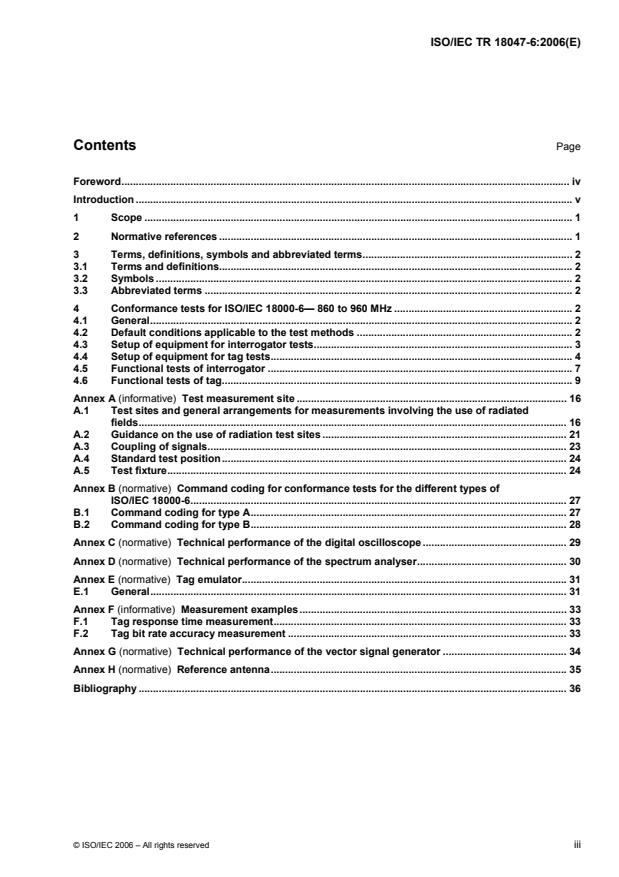
Contents Page
Foreword. iv
Introduction . v
1 Scope. 1
2 Normative references. 1
3 Terms, definitions, symbols and abbreviated terms. 2
3.1 Terms and definitions. 2
3.2 Symbols. 2
3.3 Abbreviated terms. 2
4 Conformance tests for ISO/IEC 18000-6— 860 to 960 MHz . 2
4.1 General. 2
4.2 Default conditions applicable to the test methods .2
4.3 Setup of equipment for interrogator tests. 3
4.4 Setup of equipment for tag tests. 4
4.5 Functional tests of interrogator . 7
4.6 Functional tests of tag. 9
Annex A (informative) Test measurement site . 16
A.1 Test sites and general arrangements for measurements involving the use of radiated
fields. 16
A.2 Guidance on the use of radiation test sites . 21
A.3 Coupling of signals. 23
A.4 Standard test position. 24
A.5 Test fixture. 24
Annex B (normative) Command coding for conformance tests for the different types of
ISO/IEC 18000-6. 27
B.1 Command coding for type A. 27
B.2 Command coding for type B. 28
Annex C (normative) Technical performance of the digital oscilloscope . 29
Annex D (normative) Technical performance of the spectrum analyser. 30
Annex E (normative) Tag emulator. 31
E.1 General. 31
Annex F (informative) Measurement examples. 33
F.1 Tag response time measurement. 33
F.2 Tag bit rate accuracy measurement . 33
Annex G (normative) Technical performance of the vector signal generator . 34
Annex H (normative) Reference antenna. 35
Bibliography . 36
© ISO/IEC 2006 – All rights reserved iii
Foreword
ISO (the International Organization for Standardization) and IEC (the International Electrotechnical
Commission) form the specialized system for worldwide standardization. National bodies that are members of
ISO or IEC participate in the development of International Standards through technical committees
established by the respective organization to deal with particular fields of technical activity. ISO and IEC
technical committees collaborate in fields of mutual interest. Other international organizations, governmental
and non-governmental, in liaison with ISO and IEC, also take part in the work. In the field of information
technology, ISO and IEC have established a joint technical committee, ISO/IEC JTC 1.
International Standards are drafted in accordance with the rules given in the ISO/IEC Directives, Part 2.
The main task of the joint technical committee is to prepare International Standards. Draft International
Standards adopted by the joint technical committee are circulated to national bodies for voting. Publication as
an International Standard requires approval by at least 75 % of the national bodies casting a vote.
In exceptional circumstances, the joint technical committee may propose the publication of a Technical Report
of one of the following types:
— type 1, when the required support cannot be obtained for the publication of an International Standard,
despite repeated efforts;
— type 2, when the subject is still under technical development or where for any other reason there is the
future but not immediate possibility of an agreement on an International Standard;
— type 3, when the joint technical committee has collected data of a different kind from that which is
normally published as an International Standard (“state of the art”, for example).
Technical Reports of types 1 and 2 are subject to review within three years of publication, to decide whether
they can be transformed into International Standards. Technical Reports of type 3 do not necessarily have to
be reviewed until the data they provide are considered to be no longer valid or useful.
Attention is drawn to the possibility that some of the elements of this document may be the subject of patent
rights. ISO and IEC shall not be held responsible for identifying any or all such patent rights.
ISO/IEC TR 18047-6, which is a Technical Report of type 2, was prepared by Joint Technical Committee
ISO/IEC JTC 1, Information technology, Subcommittee SC 31, Automatic identification and data capture
techniques.
ISO/IEC TR 18047 consists of the following parts, under the general title Information technology — Radio
frequency identification device conformance test methods:
⎯ Part 2: Test methods for air interface communications below 135 kHz
⎯ Part 3: Test methods for air interface communications at 13,56 MHz
⎯ Part 4: Test methods for air interface communications at 2,45 GHz
⎯ Part 6: Test methods for air interface communications at 860 MHz to 960 MHz
⎯ Part 7: Test methods for active air interface communications at 433 MHz
iv © ISO/IEC 2006 – All rights reserved
Introduction
ISO/IEC 18000 defines the air interfaces for radio frequency identification (RFID) devices used in item
management applications. ISO/IEC 18000-6 defines the air interface for these devices operating at
frequencies from 860 MHz to 960 MHz.
The purpose of ISO/IEC TR 18047 is to provide test methods for conformance with the various parts of
ISO/IEC 18000.
Each part of ISO/IEC TR 18047 contains all measurements required to be made on a product in order to
establish whether it conforms to the corresponding part of ISO/IEC 18000. For this part of ISO/IEC TR 18047,
each interrogator needs to be assessed for operation with both types A and B, while each tag is only required
to support at least one of the types A or B.
It should be noted that measurement of tag and interrogator performance is covered by ISO/IEC TR 18046.
© ISO/IEC 2006 – All rights reserved v
TECHNICAL REPORT ISO/IEC TR 18047-6:2006(E)
Information technology — Radio frequency identification device
conformance test methods —
Part 6:
Test methods for air interface communications at 860 MHz
to 960 MHz
1 Scope
This part of ISO/IEC TR 18047 defines test methods for determining the conformance of radio frequency
identification devices (tags and interrogators) for item management with the specifications given in
ISO/IEC 18000-6, but does not apply to the testing of conformity with regulatory or similar requirements.
The test methods require only that the mandatory functions, and any optional functions which are
implemented, be verified. This may, in appropriate circumstances, be supplemented by further, application-
specific functionality criteria that are not available in the general case.
The interrogator and tag conformance parameters in this part of ISO/IEC TR 18047 are the following:
• type-specific conformance parameters including nominal values and tolerances;
• parameters that apply directly affecting system functionality and inter-operability.
The following are not included in this part of ISO/IEC TR 18047:
• parameters that are already included in regulatory test requirements;
• high-level data encoding conformance test parameters (these are specified in ISO/IEC 15962).
Unless otherwise specified, the tests in this part of ISO/IEC TR 18047 are to be applied exclusively to RFID
tags and interrogators defined in ISO/IEC 18000-6.
Clause 4 describes all necessary conformance tests.
2 Normative references
The following referenced documents are indispensable for the application of this document. For dated
references, only the edition cited applies. For undated references, the latest edition of the referenced
document (including any amendments) applies.
• ISO/IEC 18000-6: Information technology — Radio frequency identification for item management —
Part 6: Parameters for air interface communications at 860 MHz to 960 MHz
• ISO/IEC 19762, (all parts), Information technology — Automatic identification and data capture (AIDC)
techniques — Harmonized vocabulary
• ISBN 92-67-10188-9, 1993, ISO Guide to the expression of uncertainty in measurement
© ISO/IEC 2006 – All rights reserved 1
3 Terms, definitions, symbols and abbreviated terms
3.1 Terms and definitions
For the purposes of this document, the terms and definitions given in ISO/IEC 19762 apply.
3.2 Symbols
For the purposes of this document, the symbols given in ISO/IEC 19762 and the following apply.
D Modulation depth of data coding pulse
M Modulation Index
Tf Fall time
Tr Rise Time
3.3 Abbreviated terms
For the purposes of this document, the abbreviated terms given in ISO/IEC 19762 and the following apply.
DUT Device under test
RCS Radar cross section
∆RCS Change in radar cross section
RBW Resolution Bandwidth
VBW Video Bandwidth
4 Conformance tests for ISO/IEC 18000-6— 860 to 960 MHz
4.1 General
This part of ISO/IEC TR 18047 specifies a series of tests to determine the conformance of interrogators and
tags. The results of these tests shall be compared with the values of the parameters specified in
ISO/IEC 18000-6 to determine whether the interrogator or tag under test conforms.
For Part 6, each interrogator needs to be assessed for operation with both types A and B, while each tag is
only required to support at least one of the types A or B.
4.2 Default conditions applicable to the test methods
4.2.1 Test environment
Unless otherwise specified, testing shall take place in an environment of temperature 23 ° +/- 3 °C and of non-
condensing humidity from 40 % to 60 %
4.2.2 Pre-conditioning
Where pre-conditioning is required by the test method, the identification tags to be tested shall be conditioned
to the test environment for an appropriate time period, which shall be recorded.
2 © ISO/IEC 2006 – All rights reserved
4.2.3 Default tolerance
Unless otherwise specified, a default tolerance of ± 5 % shall be applied to the quantity values given to specify
the characteristics of the test equipment (e.g. linear dimensions) and the test method procedures (e.g. test
equipment adjustments).
4.2.4 Noise floor at test location
Noise floor at test location shall be measured with the spectrum analyser in the same conditions as the
measurement of the DUT, with a span of 10 MHz: RBW, VBW and antenna.
The spectrum analyser shall be configured in acquisition for at least 1 minute.
The maximum of the measured amplitude shall be 20 dB below the value of the amplitude of the measured
tag backscatter operating at minimum power (P , see clause 4.6.2.2), and the tag placed at 10 λ from the
I,min
measurement antenna.
Special attention has to be given to spurious emissions, e.g., insufficiently shielded computer monitors. The
electromagnetic test conditions of the measurements shall be checked by performing the measurements with
and without a tag in the field.
4.2.5 Total measurement uncertainty
The total measurement uncertainty for each quantity determined by these test methods shall be stated in the
test report.
NOTE Basic information is given in “ISO Guide to the expression of uncertainty in measurement”, ISBN 92-67-10188-9,
1993.
4.3 Setup of equipment for interrogator tests
4.3.1 General
The DUT shall be an interrogator including an antenna.
All conformance measurements and setups shall be done in an anechoic chamber as defined in Annex A.
Dependent of the regulatory requirements all measurements shall be done at one of the test frequencies in
Table 1.
Table 1 — Test frequencies
Test carrier frequency Comment
866 MHz Recommended for tests under European regulations
910 MHz Recommended for tests under Korean or US regulations
922 MHz Recommended for tests under Australian regulations
953 MHz Recommended for tests under Japan regulations
NOTE With the test frequencies specified in Table 1 all frequencies of the entire band from 860 MHz to 960 MHz are
within ± 2,5 % of one of the test frequencies.
© ISO/IEC 2006 – All rights reserved 3
4.3.2 Sense antenna
Where applicable, tests shall be carried out using a sense antenna, which shall be a substantially non-reactive
non-radiating load of 50 Ω equipped with an antenna connector. The Voltage Standing Wave Ratio (VSWR) at
the 50 Ω connector shall not be greater than 1,2 : 1 over the frequency range of the measurement.
4.3.3 Interrogator modulation test setup
For this test the sense antenna shall always be placed and orientated for optimum field strength reception in
the direction of the major power radiation of the interrogator antenna according Figure 1 at a distance d
S
which is defined in clause 4.5.1.2.
Interrogator
Scope
Antenna
Sense
Antenna
d
S
Figure 1 — Interrogator modulation test setup
4.3.4 Interrogator demodulation and turn around time test setup
For this test the tag emulator as defined in Annex E shall be placed and orientated for optimum field strength
reception in the direction of the major power radiation of the interrogator according Figure 2 at a distance d ,
TE
which is defined in clause 4.5.2.2.
Interrogator Tag
Antenna Emulator
d
TE
Figure 2 — Interrogator demodulation and turn around test setup
4.4 Setup of equipment for tag tests
4.4.1 General
The DUT shall be a tag including all means in order to be capable to communicate with an interrogator.
When tests require use of an interrogator this shall be an interrogator including antenna that conforms to
ISO/IEC 18000-6 according to the methods defined in this part of ISO/IEC TR 18047, or it shall be a numerical
generator including antenna. Furthermore, the interrogator shall support the minimum tag response to
interrogator command turn around time.
4 © ISO/IEC 2006 – All rights reserved
The interrogator antenna shall fulfil the specification of Table 2.
Table 2 — Interrogator antenna requirements for tag tests
Symbol Parameter Minimum Value Maximum Value
L Maximum Interrogator antenna dimension 0,1 m
λ d
T
G Interrogator antenna gain 2 dBi 8 dBi
I
All conformance measurements and setups shall be done in an anechoic chamber as defined in Annex A.
Dependent of the regulatory requirements all measurements shall be done at either of the test frequencies in
Table 1.
4.4.2 Tag demodulation and turn around time test setup
For this test the tag shall be placed and oriented for optimum field strength reception in the direction of the
major power radiation of the interrogator in a distance
2 2
2L 2L
d > , d >
T ,IA T ,MA
λ λ
with L being the maximum dimension of the interrogator antenna according Figure 3.
Figure 3 — Tag demodulation test setup
© ISO/IEC 2006 – All rights reserved 5
4.4.3 Tag backscatter test setup
For this test the test interrogator antenna setup, where the interrogator may alternately also be realized with a
vector signal generator according Annex G, shall consist of a set of two mechanically assembled antennas
specifically designed to reduce the signal coupling between each other. One shall be used as interrogator
antenna while the second, shall be used as measurement antenna and shall be connected either to a
spectrum analyser or to an oscilloscope as specified according Annex C.
The main lobe axis of these two antennas cross each other with an angle value that shall be lower than 15°.
The tag under test shall be placed at this focal point and oriented for optimum field strength reception.
The distances between the tag and the antennas are d and d respectively.
T,IA T,MA
Figure 4 — Tag backscatter test setup
6 © ISO/IEC 2006 – All rights reserved
Table 3 — Tag backscatter setup parameters
Symbol Name Description
d Interrogator antenna to tag distance
T,IA
d Measurement antenna to tag distance
T,MA
G Gain of interrogator antenna The maximum antenna opening value, measured
IA
at -3 dB gain of the maximum gain shall be +/- 30°
G Gain of measurement antenna The maximum antenna opening value, measured
MA
at -3 dB gain of the maximum gain shall be +/- 30°
The residual signal coupling between the two antennas shall be less as an isolation value of 45dB
L shall be the greater value of the Interrogator and Measurement Antenna.
The spectrum analyser shall be to a RBW of 30 kHz, a VBW of 100 kHz. The minimum span should be at
least 1 MHz or 8 times the data rate, whichever is greater. The frequency analyser shall use max peak
detection.
For this test the tag shall be setup to provide only one modulation frequency. Therefore the tag shall except
for the preamble, only reply with a bit stream of zero data bits.
4.4.4 Tag response time
The setup for this test shall be as described in chapter 4.4.2.
4.4.5 Tag bit rate accuracy test setup
The setup for this test shall be as described in chapter 4.4.2.
4.4.6 Tag state storage time test setup
The setup for this test shall be as described in chapter 4.4.2.
4.5 Functional tests of interrogator
4.5.1 Interrogator modulation test
4.5.1.1 Test objective
The objective of this test is to verify that the interrogator provides the appropriate modulation waveform
required for operation of tags.
4.5.1.2 Test procedure
The interrogator shall transmit a mandatory command according Table 4 at the maximum power allowed
under the regulations of the selected carrier frequency for testing.
© ISO/IEC 2006 – All rights reserved 7
Table 4 — Mandatory commands to be used for the different types
TypeCommand Command Coding
A Init_round_all See clause B.1.1
B GROUP_SELECT_EQSee clause B.2.1
In case the interrogator is intended for operation of non-overlapping RF bands, then this test shall be done for
each RF band.
Measurements shall be done with a sense antenna positioned at a distance d = 3 λ and d = 10 λ and for
S S
each operation mode.
A digital oscilloscope as specified in Annex C and the sense antenna shall be used to record the waveform
provided by the interrogator.
4.5.1.3 Test report
The test report shall give the measured values of the parameters according Table 5 for type A and according
Table 6 for type B. The pass/fail condition is determined whether the measured values are within the
requirements as specified in ISO/IEC 18000-6. Furthermore, the DUT and the sense antenna orientation and
position, as well as the used interrogator output power and the used operation frequency shall be recorded.
Table 5 — Measurements to be made for type A
Type Parameter Conditions
A D Default modulation operation mode
A Tapr Default modulation operation mode
A Tapf Default modulation operation mode
Table 6 — Measurements to be made for type B
Type Parameter Conditions
B M Low index interrogator modulation mode
B Tr Low index interrogator modulation mode
B Tf Low index interrogator modulation mode
B M High index interrogator modulation mode
B Tr High index interrogator modulation mode
B Tf High index interrogator modulation mode
4.5.2 Interrogator demodulation and turn around time
4.5.2.1 Test objective
The objectives of this test are to verify whether the interrogator is capable of:
⎯ demodulating signals from the tags
⎯ receiving the data transmitted by the tag emulator after the minimum specified turn-around time
8 © ISO/IEC 2006 – All rights reserved
4.5.2.2 Test procedure
The interrogator shall transmit a mandatory command according Table 7 at the maximum power allowed
under the regulations of the selected carrier frequency for testing.
Table 7 — Mandatory commands to be used for the different types
TypeCommand Command CodingResponse Coding
A Init_round_all See clause B.1.1 See clause B.1.1
B GROUP_SELECT_EQ See clause B.2.1 See clause B.2.1
After the command provided by the interrogator has been sent and after the minimum turn around time, a tag
emulator as specified in Annex E shall transmit a typical response to the command according Table 7 at a
minimum ∆RCS specified in ISO/IEC 18000-6 Tag: 7d. The tag emulator does not need to demodulate the
command, but shall only detect its end to respond after the minimum turn-around time.
When the interrogator is intended for operation of non-overlapping RF bands this test shall be done for each
RF band.
Measurements shall be done with a tag emulator positioned at d = 10 λ for both the minimum and maximum
TE
tag response data rate, i.e. the turn around time from interrogator command to tag response.
In case the interrogator is design for shorter communication distances, then the distance d may be
TE
decreased and the actual used value shall be mentioned in test report.
The interrogator (digital) demodulator shall accept the tag response including verification of the CRC.
4.5.2.3 Test report
The test report shall contain the tag emulator distance to the interrogator and the ∆RCS value setup in the tag
emulator. Furthermore, also the set up turnaround time from the tag emulator, the DUT and the tag emulator
orientation and position, as well as the used interrogator output power and the used operation frequency shall
be recorded.
4.6 Functional tests of tag
4.6.1 Tag demodulation and turn around time
4.6.1.1 Test objective
The objectives of this test are to verify whether the tag is capable of:
⎯ demodulating signals from the interrogator
⎯ receiving the data transmitted by the interrogator after the minimum specified response to command turn-
around time
4.6.1.2 Test procedure
The test interrogator shall transmit a mandatory command according Table 8.
© ISO/IEC 2006 – All rights reserved 9
Table 8 — Mandatory commands to be used for the different types
TypeCommand Command Coding
A Init_round_all See clause B.1.1
B GROUP_SELECT_EQSee clause B.2.1
The tag (DUT) shall receive the command provided by the interrogator and shall provide an appropriate
response. After complete reception of the tag response the interrogator shall generate a new command
according Table 9 within the minimum specified turn around time between tag response and interrogator
command.
Table 9 — Second Mandatory commands to be used for the different types
TypeCommand Command Coding
A Next_slot See clause B.1.2
B GROUP_SELECT_EQSee clause B.2.1
Measurements shall be done by verifying that the tag detected the command appropriately by means of
evaluation of its response. Measurements shall be done at P = 1,2 P or the minimum tag activation power
I I,min
density S for each operation type of the interrogator command data rate.
T,min
The power density S is related to the test interrogator radiated power P as following:
T,min I,min
P = 4πd S
I,min T,IA T,min
G
IA
In case the interrogator is design for shorter communication distances, then the distance d may be
TE
decreased and the actual used value shall be mentioned in test report.
The test shall be seen as successful, when it could be shown that the tag sent the correct response for both
commands including verification of the CRC.
The interrogator waveform shall contain the setups of the waveform for the respective types according
Table 10.
10 © ISO/IEC 2006 – All rights reserved
Table 10 — Setups of waveforms
Type Setup number Setup description Parameter setting
A A-1 Minimum modulation depth D = Dmin
A A-2 Medium modulation depth D = (Dmax + Dmin)/2
A A-3 Maximum modulation depth D = Dmax
B B-1 Minimum modulation index for low modulation index M = Mmin
operation mode
B B-2 Maximum modulation index for low modulation index M = Mmax
operation mode
B B-3 Minimum modulation index for high modulation index M = Mmin
operation mode
B B-4 Maximum modulation index for high modulation index
M ≥ 99% * Mmax
operation mode
4.6.1.3 Test report
The test result shall be recorded as successful or unsuccessful. The test report shall contain the tag distance
to the interrogator. Furthermore, also the set up turn around time from the tag response to interrogator
command, the DUT and the interrogator orientation and position, as well as the used interrogator output
power and the used operation frequency shall be recorded.
4.6.2 Tag backscatter
4.6.2.1 Test objective
The objective of this test is to verify that the tag provides the appropriate modulation waveform and
backscatter strength required to be successfully detected and received by the interrogator.
4.6.2.2 Test procedure
The interrogator shall transmit a mandatory command according Table 11 at the minimum power (P ) where
I,min
a successful tag response can be identified with the spectrum analyser.
Table 11 — Mandatory commands to be used for the different types
Type Command Command Coding
A Init_round_all See clause B.1.1
B GROUP_SELECT_EQSee clause B.2.1
Measurements shall be done with a tag positioned d = 3 λ and d = 3 λ away from the interrogator
T,IA T,MA
antenna at
P = 1,2 P
I I,min
for each operation mode.
The setup of figure 4 shall be used. The interrogator may be replaces by a vector signal generator according
Annex H.
© ISO/IEC 2006 – All rights reserved 11
A digital scope as specified in Annex C shall be used to record the waveform provided by the tag.
A spectrum analyser as specified in Annex D shall be used to record the power spectrum responded by the
tag.
Delta RCS shall be measured by using the parameters as defined in Table 12.
Using the setup of Figure 4, the RCS is given by the following formula:
⎡⎤
(4ππdd) (4 )
PP4π
TI,,A TMA
MM
RCS== .⎢⎥. .K
PG G P
⎢⎥
λ
IIA MA I
⎣⎦
Table 12 — Parameters used for Delta RCS test
Symbol Name Description
PM Measured power at the carrier frequency Power measured by the spectrum analyser at the
measurement antenna
PI Delivered power at the carrier frequency Power delivered by the Vector Signal Generator
K Calibration factor Factor depending on the distances, gains of the
antennas and the wavelength.
In order to measure RCS for evaluation of ∆RCS, the following procedure shall be applied for the
measurement of the RCS corresponding to the two states of the tag.
⎯ The tag shall shown in Figure 4 shall be placed by the reference antenna described in Annex H.
⎯ The UHF transmission shall be calibrated in order to extract the calibration factor K to be used for the
determination of RCS.
⎯ For all following tests the tag to be tested shall be used.
⎯ The interrogator shall send mandatory command according Table 11 and the spectrum analyser shall be
setup to measure the tag response with the appropriately selected triggering parameters recording the
response maximum and minimum transmission occurring around the carrier frequency.
⎯ The maximum of the recorded value shall be RCS1m.
⎯ The minimum of the recorded value shall be RCS0m.
⎯ RCS1 and RCS0 shall be calculated from RCS1m and RCS0m considering the measured calibration
factor K.
⎯ ∆RCS shall be calculated as ∆RCS = RCS1 - RCS0.
In case the interrogator is intended for operation of non-overlapping RF bands, then this test shall be done for
each RF band.
4.6.2.3 Test report
The test report shall give the measured values of ∆RCS. The pass/fail condition is determined whether the
measured values are within the requirements as specified in figures in ISO/IEC 18000-6 and the evaluated
12 © ISO/IEC 2006 – All rights reserved
∆RCS is at least above the value from ISO/IEC 18000-6. Furthermore, the DUT and the interrogator
orientation and position, as well as the used interrogator output power and the used operation frequency shall
be recorded.
4.6.3 Tag response time
4.6.3.1 Test objective
The objective of this test is to verify the tag response time according to Table 13 referencing the parameters in
ISO/IEC 18000-6.
Table 13 — Minimum turn-around times for the different types
Type Parameter
A Trs
B Quiet
4.6.3.2 Test procedure
The interrogator shall transmit a mandatory command according Table 14 at the maximum power allowed
under the regulations of the selected carrier frequency for testing.
Table 14 — Mandatory commands to be used for the different types
Type Command Command Coding
A Init_round_all See clause B.1.1
B GROUP_SELECT_EQSee clause B.2.1
The measurements shall be done using the tag backscatter test setup, the tag positioned d = 3 λ and
T,IA
d = 3 λ away from the test interrogator antennas.
T,MA
The response time shall be measured by a scope as specified in Annex C.
NOTE An example for the measurements is given in clause F.1.
4.6.3.3 Test report
The test report shall give the measured values of turn around time. The pass/fail condition is determined
whether the measured values are within the requirements for the response time specified to the respective
part.
4.6.4 Tag bit rate
4.6.4.1 Test objective
The objective of this test is to verify the bit rate accuracy and data rate of the return link by verification of the
parameters listed in Table 15.
© ISO/IEC 2006 – All rights reserved 13
Table 15 — Parameters for the different types
Type Parameter
A Trlb
B Trlb
4.6.4.2 Test procedure
The interrogator shall transmit a mandatory command according Table 16 at the maximum power allowed
under the regulations of the selected carrier frequency for testing.
Table 16 — Mandatory commands to be used for the different types
TypeCommand Command Coding
A Init_round_all See clause B.1.1
B GROUP_SELECT_EQSee clause B.2.1
The tag response waveform shall be recorded by a oscilloscope as specified in Annex C using the tag
backscatter test setup, the tag positioned d = 3 λ and d = 3 λ away from the test interrogator antennas.
T,IA T,MA
The bit rate accuracy shall be measured on the preamble of the tag response for each type respectively.
The average on the first seven bits of preamble shall be used to measure the bite rate accuracy.
4.6.4.3 Test report
The test report shall give the measured values of bit rate calculated according the following formulas:
T = 7
B7 Trlb
bit rate =
7⋅T
B7
The pass/fail condition is determined whether the measured values are within the requirements as specified in
clause 6.5.4 for type A and type B in ISO/IEC 18000-6.
4.6.5 Tag state storage time
4.6.5.1 Test objective
The objective of this test is to verify the state storage time of the tag if the energising field is absent or
insufficient.
4.6.5.2 Test procedure
The interrogator shall transmit a mandatory command according Table 17 at the maximum power allowed
under the regulations of the selected carrier frequency for testing.
14 © ISO/IEC 2006 – All rights reserved
Table 17 — Mandatory commands to be used for the different types
Type Command
A Init_round_all
B READ
After the end of mandatory command sent by the generator, the field shall be shut down for a specified time
during two tag states:
For type A the following shall be done:
a) Quiet state
The test shall be executed for shutoff time equal to the lower limit value of time defined in
ISO/IEC 18000-6 on which the tag has to keep the Quiet-state.
b) Other states
The test shall be executed for shutoff time equal to the lower limit value of time defined in
ISO/IEC 18000-6 during which the tag has to retain its state.
NOTE An example for the measurements is given in clause F.2
For type B the following shall be done:
⎯ The test shall be executed for a shutoff time of t defined in ISO/IEC 18000-6 and the flag DE_SB
DE_SB
shall be still be set when verified.
4.6.5.3 Test report
The test report shall give the tested values of limit storage state time. The pass/fail condition is determined
whether the measured values are within the requirements in the ISO/IEC 18000-6 Timing Specification for Tag
state storage for Type A and t for Type B.
DE_SB
© ISO/IEC 2006 – All rights reserved 15
Annex A
(informative)
Test measurement site
A.1 Test sites and general arrangements for measurements involving the use of
radiated fields
This annex describes the three most commonly available test sites, an anechoic chamber, an anechoic
chamber with a ground plane and an Open Area Test Site (OATS), which may be used for radiated tests.
These test sites are generally referred to as free field test sites. Both absolute and relative measurements can
be performed in these sites. Where absolute measurements are to be carried out, the chamber should be
verified.
NOTE: To ensure reproducibility and tractability of radiated measurements only these test sites should be
used in measurements in accordance with the present document.
A.1.1 Anechoic chamber
An anechoic chamber is an enclosure, usually shielded, whose internal walls, floor and ceiling are covered
with radio absorbing material, normally of the pyramidal urethane foam type. The chamber usually contains an
antenna support at one end and a turntable at the other. A typical anechoic chamber is shown in figure A.1.
Turntable
Test
antenna
Radio
absorbing
material
Antenna support
Antenna support
Figure A.1 — A typical Anechoic Chamber
16 © ISO/IEC 2006 – All rights reserved
The chamber shielding and radio absorbing material work together to provide a controlled environment for
testing purposes. This type of test chamber attempts to simulate free space conditions.
The shielding provides a test space, with reduced levels of interference from ambient signals and other
outside effects, whilst the radio absorbing material minimizes unwanted reflections from the walls and ceiling
which can influence the measurements. In practice it is relatively easy for shielding to provide high levels
(80 dB to 140 dB) of ambient interference rejection, normally making ambient interference negligible.
A turntable is capable of rotation through 360° in the horizontal plane and it is used to support the test sample
(DUT) at a suitable height (e.g. 1 m.) above the ground plane. The chamber shall be large enough to allow the
measuring distance of at least 3 m or 2(d +d ) /λ (m), whichever is greater (see subclause A.2.5). The
1 2
distance used in actual measurements shall be recorded with the test results.
The anechoic chamber generally has several advantages over other test facilities. There is minimal ambient
interference, minimal floor, ceiling and wall reflections and it is independent of the weather. It does however
have some disadvantages which include limited measuring distance and limited lower frequency usage due to
the size of the pyramidal absorbers. To improve low frequency performance, a combination structure of ferrite
tiles and urethane foam absorbers is commonly used.
All types of emission, sensitivity and immunity testing can be carried out within an anechoic chamber without
limitation.
A.1.2 Anechoic chamber with a conductive ground plane
An anechoic chamber with a conductive ground plane is an enclosure, usually shielded, whose internal walls
and ceiling are covered with radio absorbing material, normally of the pyramidal urethane foam type. The floor,
which is metallic, is not covered and forms the ground plane. The chamber usually contains an antenna mast
at one end and a turntable at the other. A typical anechoic chamber with a conductive ground plane is shown
in figure A.2.
This type of test chamber attempts to simulate an ideal Open Area Test Site whose primary characteristic is a
perfectly conducting ground plane of infinite extent.
Antenna
mast
Test
antenna
Radio
absorbing
material
1,5 m
Turntable
Figure A.2 — A typical Anechoic Chamber with a conductive ground plane
© ISO/IEC 2006 – All rights reserved 17
Range length 3 or 10 m
1 to 4 m
In this facility the ground plane creates the wanted reflection path, such that the signal received by the
receiving antenna is the sum of the signals from both the direct and reflected transmission paths. This creates
a unique received signal level for each height of the transmitting antenna (or DUT) and the receiving antenna
above the ground plane.
The antenna mast provides a variable height facility (from 1 m to 4 m) so that the position of the test antenna
can be optimised for maximum coupled signal between antennas or between a DUT and the test antenna.
A turntable is capable of rotation through 360° in the horizontal plane and it is used to support the test sample
(DUT) at a specified height, usually 1,5 m. above the ground plane. The chamber shall be large enough to
allow the measuring distance of at least 3 m or 2(d +d ) /λ (m), whichever is greater (see subclause A.2.4).
1 2
The distance used in actual measurements shall be recorded with the test results.
Emission testing involves firstly 'peaking' the field strength from the DUT by raising and lowering the receiving
antenna on the mast (to obtain the maximum constructive interference of the direct and reflected signals from
the DUT) and then rotating the turntable for a 'peak' in the azimuth plane. At this height of the test antenna on
the mast, the amplitude of the received signal is noted. Secondly the DUT is replaced by a substitution
antenna (positioned at the DUT's phase or volume centre), which is connected to a signal generator. The
signal is again 'peaked' and the signal generator output adjusted until the level, noted in stage one, is again
measured on the receiving device.
Receiver sensitivity tests over a ground plane also involve 'peaking' the field strength by raising and lowering
the test antenna on the mast to obtain the maximum constructive interference of the direct and reflected
signals, this time using a measuring antenna which has been positioned where the phase or volume centre of
the DUT will be during testing. A transform factor is derived. The test antenna remains at the same height for
stage two, during which the measuring antenna is replaced by the DUT. The amplitude of the transmitted
signal is reduced to determine the field strength level at which a specified
...
Questions, Comments and Discussion
Ask us and Technical Secretary will try to provide an answer. You can facilitate discussion about the standard in here.
Loading comments...