


ISO/PRF 2230
(Main)Rubber products — Guidelines for storage
Rubber products — Guidelines for storage
This International Standard give guidelines for the inspection, recording procedures, packaging and storage of products, assemblies and components made from vulcanized or thermoplastic rubber prior to being put into circulation. It is applicable to both solid and cellular rubber products prepared from dry raw rubber, latex or other sources. It is subject only to the requirements or recommendations of product specifications in which details of storage requirements for specific products are given. This standard is not intended for use with raw rubber in bale, liquid (solution or emulsion) or particulate form, storage guidance for which is given in ISO 7664. The recommendations for packaging form an integral part of the controlled storage procedure, as well as providing means of identifying the material and product.
Produits à base d'élastomères — Lignes directrices pour le stockage
General Information
- Status
- Not Published
- Technical Committee
- ISO/TC 45/SC 4 - Products (other than hoses)
- Drafting Committee
- ISO/TC 45/SC 4/WG 7 - Material specification
- Current Stage
- 5020 - FDIS ballot initiated: 2 months. Proof sent to secretariat
- Start Date
- 09-Jan-2026
- Completion Date
- 17-Jan-2026
Relations
- Effective Date
- 09-Mar-2024
Overview
ISO/PRF 2230:2026 sets forth comprehensive guidelines for the storage of rubber products, providing essential procedures for inspection, packaging, and storage of vulcanized and thermoplastic rubber items before distribution. This international standard applies to both solid and cellular rubber products derived from dry raw rubber, latex, or other sources, excluding raw rubber stored in bale, liquid, or particulate forms-which are covered by ISO 7664.
The standard emphasizes minimizing property degradation through controlled storage conditions, appropriate packaging, and routine inspection. It also supports maintaining detailed records of storage data to ensure product integrity and traceability throughout their lifecycle.
Key Topics
Scope and Applicability
ISO/PRF 2230 focuses on rubber products including assemblies and components made of vulcanized or thermoplastic rubber. It specifically excludes guidance on raw rubber in liquid or particulate forms. The recommendations apply universally across industries handling packaged rubber goods.Classification of Rubber Types
Rubbers are classified based on their susceptibility to deterioration by aging into three groups:- Group A: Moderate susceptibility (e.g., natural rubber, SBR, polyurethane)
- Group B: Low susceptibility (e.g., butyl rubber, neoprene, nitrile)
- Group C: Highly resistant (e.g., EPDM, silicone rubbers, fluorocarbon rubbers)
This classification guides storage handling and expected shelf life.
Packaging Requirements
Packaging is critical for protecting rubber products from environmental damage:- Sealed envelopes or pockets recommended to prevent air exposure.
- Non-degrading packaging materials free from harmful preservatives such as copper naphthenates or creosote.
- Appropriate barrier materials like polyethylene-coated kraft paper or aluminum foil to protect from moisture ingress.
- Avoid direct contact with plasticized PVC film due to plasticizer migration risk.
- Proper labelling to include manufacturer details, product specifications, vulcanization date, and rubber classification.
Storage Conditions and Control
The standard provides guidelines for optimal temperature, humidity, and protection against contaminants such as ozone, UV radiation, and mechanical damage. Storage environments should maintain relative humidity below 65% and avoid exposure to heat, light, or ozone to minimize rubber degradation. Periodic inspections and re-testing schedules are defined based on the initial and extension storage periods.Inspection and Record Keeping
Systematic inspection protocols and documentation practices ensure continued compliance with storage requirements. Inspection includes visual checks for cracking, crazing, and other signs of ageing. Detailed records support quality management systems, aligning with ISO 9000 family standards.
Applications
ISO/PRF 2230:2026 is invaluable for industries that manufacture, store, distribute, or use rubber products, ensuring product quality and extending shelf life. Relevant sectors include:
- Automotive components manufacturing (e.g., seals, gaskets, tires)
- Mechanical and industrial products incorporating rubber parts
- Medical rubber articles requiring sterile and secure storage
- Consumer goods production involving rubber assemblies
- Aerospace and electronics where rubber components must maintain reliability
By applying these guidelines, organizations can reduce waste from premature product failure, optimize inventory management, and comply with international quality standards.
Related Standards
- ISO 7664: Provides storage guidance for raw rubber in bale, liquid, or particulate forms, complementing ISO/PRF 2230.
- ISO 1629: Defines the nomenclature and classification of rubber types used to support the classification system in ISO/PRF 2230.
- ISO 4591: Specifies methods for measuring film thickness of packaging materials, important for compliance in packaging specifications.
- ISO 9001 / ISO 9004: Quality management standards that reinforce the importance of record-keeping and systematic inspection during storage.
Keywords: ISO 2230 storage guidelines, rubber product storage, vulcanized rubber packaging, thermoplastic rubber storage, rubber aging resistance, rubber inspections, packaging materials for rubber, rubber shelf life, ISO standards rubber products, controlled storage conditions rubber.
Frequently Asked Questions
ISO/PRF 2230 is a draft published by the International Organization for Standardization (ISO). Its full title is "Rubber products — Guidelines for storage". This standard covers: This International Standard give guidelines for the inspection, recording procedures, packaging and storage of products, assemblies and components made from vulcanized or thermoplastic rubber prior to being put into circulation. It is applicable to both solid and cellular rubber products prepared from dry raw rubber, latex or other sources. It is subject only to the requirements or recommendations of product specifications in which details of storage requirements for specific products are given. This standard is not intended for use with raw rubber in bale, liquid (solution or emulsion) or particulate form, storage guidance for which is given in ISO 7664. The recommendations for packaging form an integral part of the controlled storage procedure, as well as providing means of identifying the material and product.
This International Standard give guidelines for the inspection, recording procedures, packaging and storage of products, assemblies and components made from vulcanized or thermoplastic rubber prior to being put into circulation. It is applicable to both solid and cellular rubber products prepared from dry raw rubber, latex or other sources. It is subject only to the requirements or recommendations of product specifications in which details of storage requirements for specific products are given. This standard is not intended for use with raw rubber in bale, liquid (solution or emulsion) or particulate form, storage guidance for which is given in ISO 7664. The recommendations for packaging form an integral part of the controlled storage procedure, as well as providing means of identifying the material and product.
ISO/PRF 2230 is classified under the following ICS (International Classification for Standards) categories: 83.060 - Rubber. The ICS classification helps identify the subject area and facilitates finding related standards.
ISO/PRF 2230 has the following relationships with other standards: It is inter standard links to ISO 2230:2002. Understanding these relationships helps ensure you are using the most current and applicable version of the standard.
ISO/PRF 2230 is available in PDF format for immediate download after purchase. The document can be added to your cart and obtained through the secure checkout process. Digital delivery ensures instant access to the complete standard document.
Standards Content (Sample)
International
Standard
ISO 2230
Third edition
Rubber products — Guidelines for
storage
Produits à base d'élastomères — Lignes directrices pour le
stockage
PROOF/ÉPREUVE
Reference number
ISO 2230:2026(en) © ISO 2026
ISO 2230:2026(en)
© ISO 2026
All rights reserved. Unless otherwise specified, or required in the context of its implementation, no part of this publication may
be reproduced or utilized otherwise in any form or by any means, electronic or mechanical, including photocopying, or posting on
the internet or an intranet, without prior written permission. Permission can be requested from either ISO at the address below
or ISO’s member body in the country of the requester.
ISO copyright office
CP 401 • Ch. de Blandonnet 8
CH-1214 Vernier, Geneva
Phone: +41 22 749 01 11
Email: copyright@iso.org
Website: www.iso.org
Published in Switzerland
PROOF/ÉPREUVE
ii
ISO 2230:2026(en)
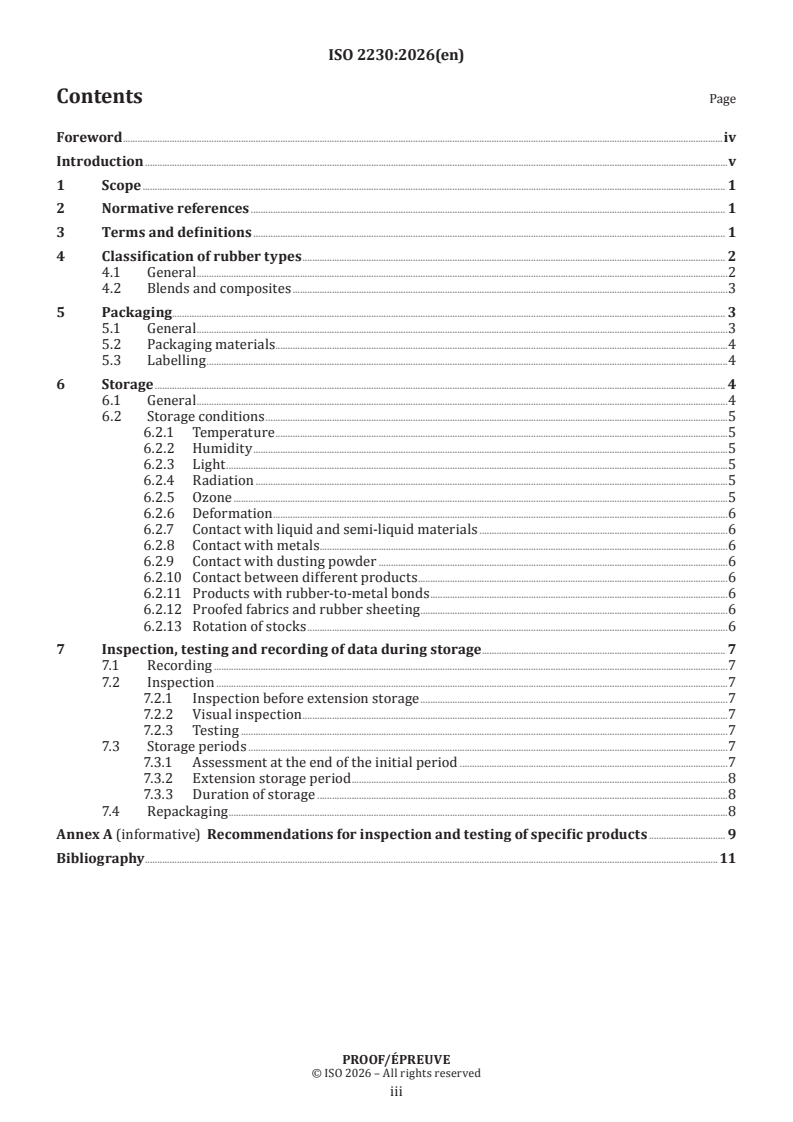
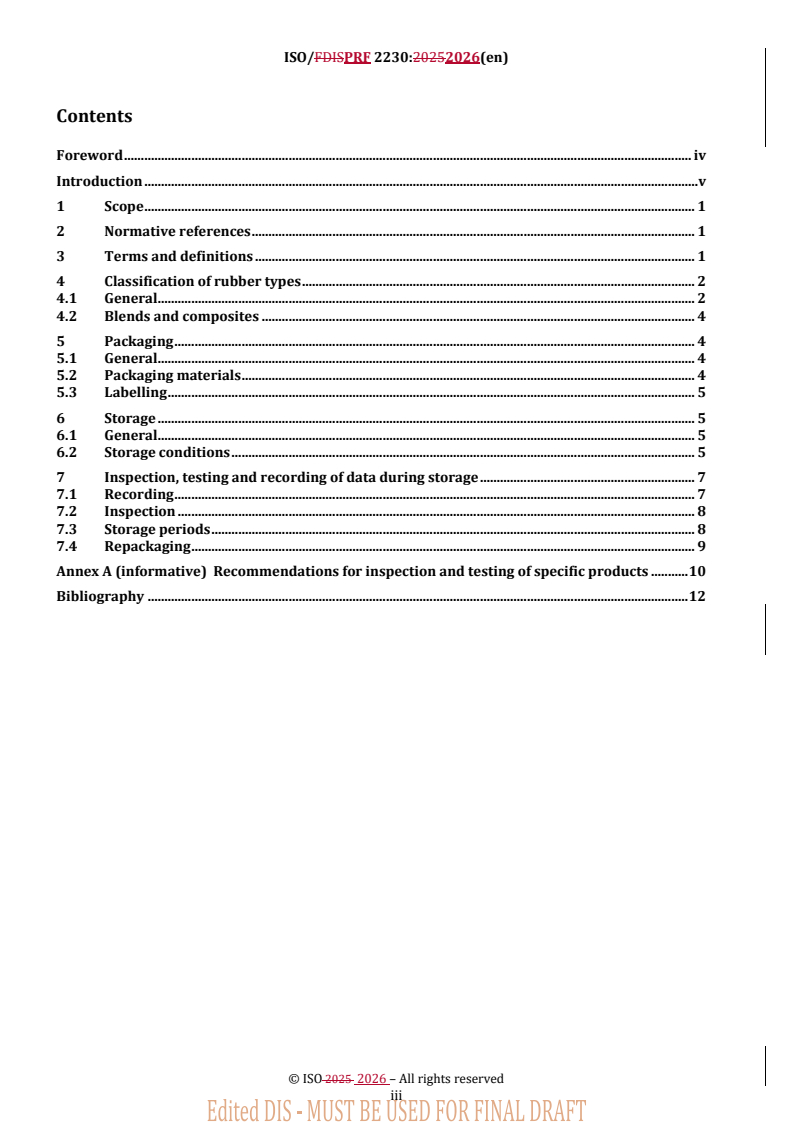
Contents Page
Foreword .iv
Introduction .v
1 Scope . 1
2 Normative references . 1
3 Terms and definitions . 1
4 Classification of rubber types . 2
4.1 General .2
4.2 Blends and composites .3
5 Packaging. 3
5.1 General .3
5.2 Packaging materials.4
5.3 Labelling .4
6 Storage . 4
6.1 General .4
6.2 Storage conditions .5
6.2.1 Temperature .5
6.2.2 Humidity .5
6.2.3 Light .5
6.2.4 Radiation .5
6.2.5 Ozone .5
6.2.6 Deformation .6
6.2.7 Contact with liquid and semi-liquid materials .6
6.2.8 Contact with metals.6
6.2.9 Contact with dusting powder .6
6.2.10 Contact between different products .6
6.2.11 Products with rubber-to-metal bonds .6
6.2.12 Proofed fabrics and rubber sheeting .6
6.2.13 Rotation of stocks .6
7 Inspection, testing and recording of data during storage . 7
7.1 Recording .7
7.2 Inspection .7
7.2.1 Inspection before extension storage .7
7.2.2 Visual inspection .7
7.2.3 Testing .7
7.3 Storage periods .7
7.3.1 Assessment at the end of the initial period .7
7.3.2 Extension storage period .8
7.3.3 Duration of storage .8
7.4 Repackaging .8
Annex A (informative) Recommendations for inspection and testing of specific products . 9
Bibliography .11
PROOF/ÉPREUVE
iii
ISO 2230:2026(en)
Foreword
ISO (the International Organization for Standardization) is a worldwide federation of national standards
bodies (ISO member bodies). The work of preparing International Standards is normally carried out through
ISO technical committees. Each member body interested in a subject for which a technical committee
has been established has the right to be represented on that committee. International organizations,
governmental and non-governmental, in liaison with ISO, also take part in the work. ISO collaborates closely
with the International Electrotechnical Commission (IEC) on all matters of electrotechnical standardization.
The procedures used to develop this document and those intended for its further maintenance are described
in the ISO/IEC Directives, Part 1. In particular, the different approval criteria needed for the different types
of ISO document should be noted. This document was drafted in accordance with the editorial rules of the
ISO/IEC Directives, Part 2 (see www.iso.org/directives).
ISO draws attention to the possibility that the implementation of this document may involve the use of (a)
patent(s). ISO takes no position concerning the evidence, validity or applicability of any claimed patent
rights in respect thereof. As of the date of publication of this document, ISO had not received notice of (a)
patent(s) which may be required to implement this document. However, implementers are cautioned that
this may not represent the latest information, which may be obtained from the patent database available at
www.iso.org/patents. ISO shall not be held responsible for identifying any or all such patent rights.
Any trade name used in this document is information given for the convenience of users and does not
constitute an endorsement.
For an explanation of the voluntary nature of standards, the meaning of ISO specific terms and expressions
related to conformity assessment, as well as information about ISO's adherence to the World Trade
Organization (WTO) principles in the Technical Barriers to Trade (TBT), see www.iso.org/iso/foreword.html.
This document was prepared by Technical Committee ISO/TC 45, Rubber and rubber products, Subcommittee
SC 4, Products (other than hoses).
This third edition cancels and replaces the second edition (ISO 2230:2002), which has been technically
revised.
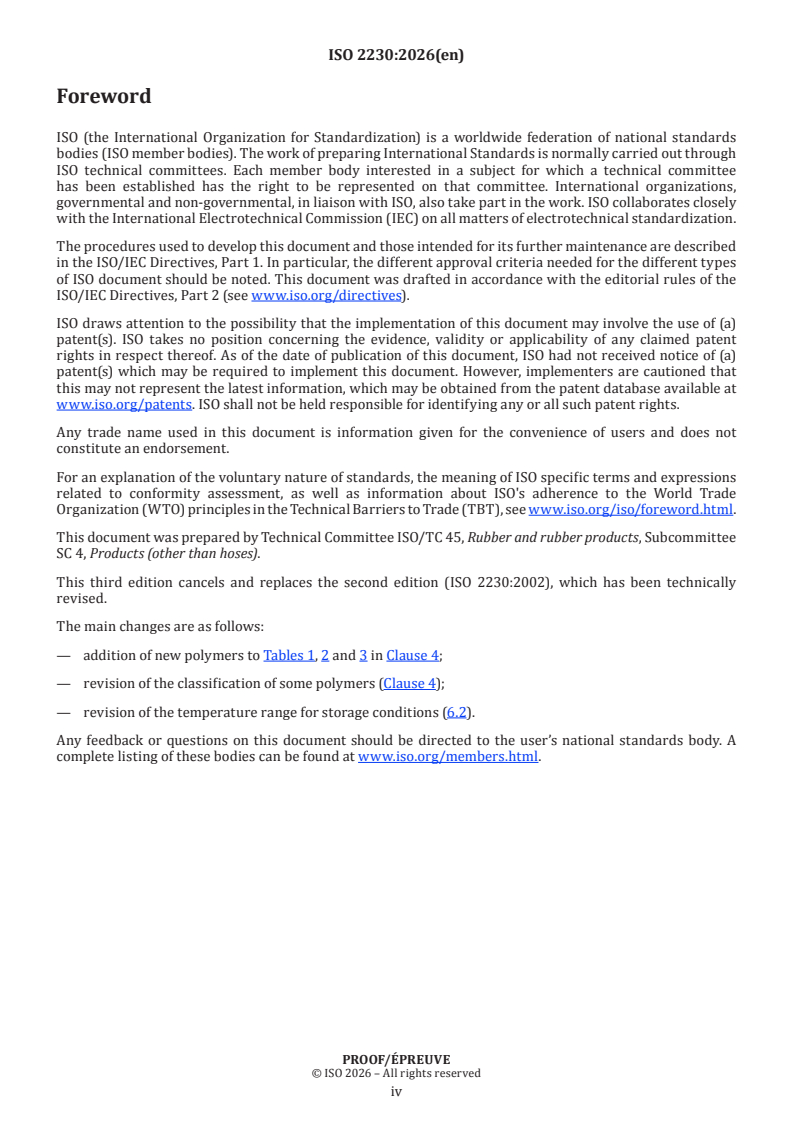
The main changes are as follows:
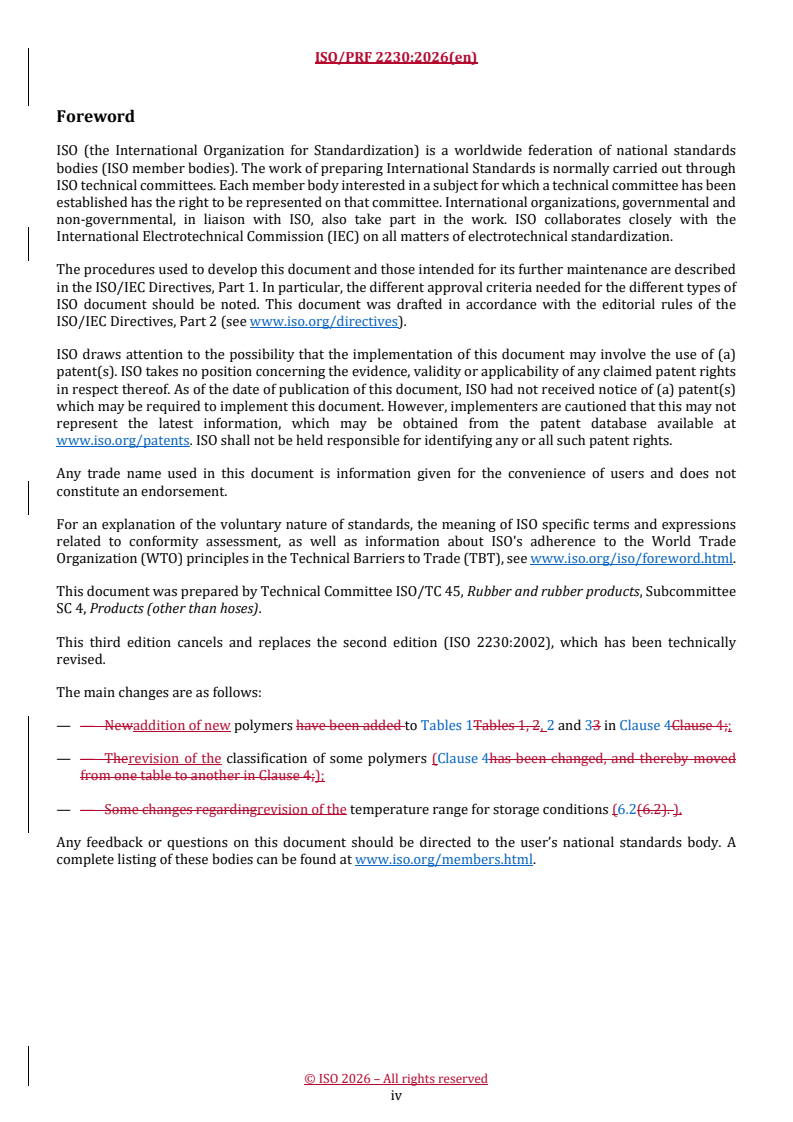
— addition of new polymers to Tables 1, 2 and 3 in Clause 4;
— revision of the classification of some polymers (Clause 4);
— revision of the temperature range for storage conditions (6.2).
Any feedback or questions on this document should be directed to the user’s national standards body. A
complete listing of these bodies can be found at www.iso.org/members.html.
PROOF/ÉPREUVE
iv
ISO 2230:2026(en)
Introduction
Many rubber products and components are stored for long periods before being put into service, and thus it
is important they are stored in conditions that minimize the unwanted changes in properties. Such changes
can result from degradation, in which case they can potentially include excessive hardening, softening,
cracking, crazing and other surface effects. Other changes can be caused by deformation, contamination or
mechanical damage.
The requirements of different users and the multiplicity of rubber types and products are factors of major
consideration in this document. It is recognized that some rubbers are more susceptible than others to
deterioration by such factors as heat, light, ozone, oxygen and humidity. Exposure to these factors should
therefore be minimized in order to extend storage life. To do so, there must be a system of storage control,
proper packaging and periodic inspection.
A system of recording, for the proper maintenance of storage and inspection data, is included in order to
assist in verifying that the provisions of this document are maintained in association with common elements
associated with product specifications and their verification through conducting of statistically significant
methods of test. Refer to ISO 9000, ISO 9001 and ISO 9004 to supplement the information contained in this
document.
In this document, only the causes of generation of deleterious influences such as ozone and radiation are
mentioned as being prohibited. Methods for measuring concentrations or intensities of these are not within
the scope of this standard.
Recommendations are included in Annex A for the inspection and testing of specific products.
PROOF/ÉPREUVE
v
International Standard ISO 2230:2026(en)
Rubber products — Guidelines for storage
1 Scope
This document gives guidelines for inspection, recording procedures, packaging and storage of products,
assemblies and components made from vulcanized or thermoplastic rubber prior to being put into
circulation.
It is applicable to both solid and cellular rubber products prepared from dry raw rubber, latex or other
sources. It is not intended for use with raw rubber in bale, liquid (solution or emulsion) or particulate form,
storage guidance for which is given in ISO 7664.
NOTE The recommendations for packaging form an integral part of the controlled storage procedure, as well as
providing means of identifying the material and product.
2 Normative references
There are no normative references in this document.
3 Terms and definitions
For the purposes of this document, the following terms and definitions apply.
ISO and IEC maintain terminology databases for use in standardization at the following addresses:
— ISO Online browsing platform: available at https://www.iso.org/obp
— IEC Electropedia: available at https://www.electropedia.org/
3.1
initial storage period
maximum period, starting from the time of manufacture, for which a rubber product, appropriately
packaged, may be stored under specified conditions before a sample must be inspected or re-tested
3.2
extension storage period
period for which a rubber product, appropriately packaged, may be stored after the initial storage period,
before further inspection and re-testing is necessary
3.3
storage life
maximum period of time that a rubber product, appropriately packaged, may be stored, after which time it is
regarded as unserviceable for the purposes for which it was originally manufactured
Note 1 to entry: The storage life of a rubber product is influenced by its shape and size as well as its composition, with
thick products usually undergoing slower change due to degradation than thinner ones.
3.4
assembly
any product or component containing more than one element, one or more of which is made of rubber
3.5
ageing
irreversible change of material properties during exposure to an environment, for a period of time
PROOF/ÉPREUVE
ISO 2230:2026(en)
4 Classification of rubber types
4.1 General
Unless otherwise specified in the product specification, rubber products should be classified (for the purpose
of storage) in terms of the relative susceptibility to deterioration of the rubber type used, as follows:
a) Group A: Rubbers with moderate susceptibility to deterioration by ageing, as listed in Table 1.
The following additional rubbers are classified as group A:
i) all new vulcanizable rubbers until their storage capabilities have been established;
ii) all thermoplastic rubbers until their storage capabilities have been established;
iii) any rubber that cannot be classified as group B or group C.
b) Group B: Rubbers with low susceptibility to deterioration by ageing, as listed in Table 2.
c) Group C: Rubbers which are highly resistant to deterioration by ageing, as listed in Table 3.
NOTE Attention is drawn to the following:
— resistance to deterioration can be influenced by compounding ingredients other than the type of base rubber;
— products can undergo changes during storage other than those caused by ageing of the rubber.
Table 1 — Group A rubbers
Abbreviation Chemical name (as per ISO 1629) Common name
BR Butadiene rubber Polybutadiene
DPNR Deproteinized natural rubber DPNR
ENR Epoxidised natural rubber ENR
IR Isoprene rubber, synthetic Polyisoprene
NR Natural rubber Natural rubber
SBR Styrene-butadiene rubber SBR
AU Polyester urethane rubber Polyurethane
EU Polyether urethane rubber Polyurethane
Table 2 — Group B rubbers
Abbreviation Chemical name (as per ISO 1629) Common name
BIIR Bromo-isobutene-isoprene rubber Bromobutyl rubber
CIIR Chloro-isobutene-isoprene rubber Chlorobutyl rubber
CO, ECO Polychloromethyloxiran and copolymer Epichlorohydrin
CR Chloroprene rubber Neoprene
HNBR Hydrogenated NBR (with some unsaturation) Hydrogenated nitrile
IIR Isobutene-isoprene rubber Butyl
NBR Acrylonitrile-butadiene rubber Nitrile
NBR/PVC Blend of acrylonitrile-butadiene rubber and poly(vi- Nitrile/PVC
nyl chloride)
XNBR Carboxylic-acrylonitrile-butadiene rubber Carboxylated rubber
PROOF/ÉPREUVE
ISO 2230:2026(en)
Table 3 — Group C rubbers
Abbreviation Chemical name (as per ISO 1629) Common name
ACM Copolymer of ethyl acrylate (or other acrylates) and Acrylic rubber
a small amount of a monomer
AEM Copolymer of ethyl acrylate (or other acrylates) and AEM
ethylene
CM Chloropolyethylene Chlorinated polyethylene
CSM Chlorosulfonylpolyethylene Chlorosulfonated polyethylene
EPDM Terpolymer of ethylene, propylene and a diene with EPDM
the residual unsaturated portion of t
...
ISO/FDISPRF 2230:2025(en)
ISO/TC 45/SC 4
Secretariat: DSM
Date: 2025-05-262026-01-09
Rubber products — Guidelines for storage
Produits à base d'élastomères — Lignes directrices pour le stockage
PROOF
All rights reserved. Unless otherwise specified, or required in the context of its implementation, no part of this publication
may be reproduced or utilized otherwise in any form or by any means, electronic or mechanical, including photocopying,
or posting on the internet or an intranet, without prior written permission. Permission can be requested from either ISO
at the address below or ISO’s member body in the country of the requester.
ISO copyright office
CP 401 • Ch. de Blandonnet 8
CH-1214 Vernier, Geneva
Phone: + 41 22 749 01 11
EmailE-mail: copyright@iso.org
Website: www.iso.org
Published in Switzerland
ii
ISO/FDISPRF 2230:20252026(en)
Contents
Foreword . iv
Introduction . v
1 Scope . 1
2 Normative references . 1
3 Terms and definitions . 1
4 Classification of rubber types . 2
4.1 General . 2
4.2 Blends and composites . 4
5 Packaging . 4
5.1 General . 4
5.2 Packaging materials . 4
5.3 Labelling . 5
6 Storage . 5
6.1 General . 5
6.2 Storage conditions . 5
7 Inspection, testing and recording of data during storage . 7
7.1 Recording . 7
7.2 Inspection . 8
7.3 Storage periods . 8
7.4 Repackaging . 9
Annex A (informative) Recommendations for inspection and testing of specific products . 10
Bibliography . 12
iii
Foreword
ISO (the International Organization for Standardization) is a worldwide federation of national standards
bodies (ISO member bodies). The work of preparing International Standards is normally carried out through
ISO technical committees. Each member body interested in a subject for which a technical committee has been
established has the right to be represented on that committee. International organizations, governmental and
non-governmental, in liaison with ISO, also take part in the work. ISO collaborates closely with the
International Electrotechnical Commission (IEC) on all matters of electrotechnical standardization.
The procedures used to develop this document and those intended for its further maintenance are described
in the ISO/IEC Directives, Part 1. In particular, the different approval criteria needed for the different types of
ISO document should be noted. This document was drafted in accordance with the editorial rules of the
ISO/IEC Directives, Part 2 (see www.iso.org/directives).
ISO draws attention to the possibility that the implementation of this document may involve the use of (a)
patent(s). ISO takes no position concerning the evidence, validity or applicability of any claimed patent rights
in respect thereof. As of the date of publication of this document, ISO had not received notice of (a) patent(s)
which may be required to implement this document. However, implementers are cautioned that this may not
represent the latest information, which may be obtained from the patent database available at
www.iso.org/patents. ISO shall not be held responsible for identifying any or all such patent rights.
Any trade name used in this document is information given for the convenience of users and does not
constitute an endorsement.
For an explanation of the voluntary nature of standards, the meaning of ISO specific terms and expressions
related to conformity assessment, as well as information about ISO's adherence to the World Trade
Organization (WTO) principles in the Technical Barriers to Trade (TBT), see www.iso.org/iso/foreword.html.
This document was prepared by Technical Committee ISO/TC 45, Rubber and rubber products, Subcommittee
SC 4, Products (other than hoses).
This third edition cancels and replaces the second edition (ISO 2230:2002), which has been technically
revised.
The main changes are as follows:
— — Newaddition of new polymers have been added to Tables 1Tables 1, 2, 2 and 33 in Clause 4Clause 4;;
— — Therevision of the classification of some polymers (Clause 4has been changed, and thereby moved
from one table to another in Clause 4;);
— — Some changes regardingrevision of the temperature range for storage conditions (6.2(6.2). ).
Any feedback or questions on this document should be directed to the user’s national standards body. A
complete listing of these bodies can be found at www.iso.org/members.html.
iv
ISO/FDISPRF 2230:20252026(en)
Introduction
Many rubber products and components are stored for long periods before being put into service, and thus it
is important they are stored in conditions that minimize the unwanted changes in properties. Such changes
can result from degradation, in which case they can potentially include excessive hardening, softening,
cracking, crazing and other surface effects. Other changes can be caused by deformation, contamination or
mechanical damage.
The requirements of different users and the multiplicity of rubber types and products are factors of major
consideration in this document. It is recognized that some rubbers are more susceptible than others to
deterioration by such factors as heat, light, ozone, oxygen and humidity. Exposure to these factors should
therefore be minimized in order to extend storage life, and to. To do so, there must be a system of storage
control, proper packaging and periodic inspection becomes necessary.
A system of recording, for the proper maintenance of storage and inspection data, is included in order to assist
in verifying that the provisions of this document are maintained in association with common elements
associated with product specifications and their verification through conducting of statistically significant
methods of test. Refer to ISO 9000, ISO 9001 and ISO 9004 to supplement the information contained in this
document.
In this document, only the causes of generation of deleterious influences such as ozone and radiation are
mentioned as being prohibited. Methods for measuring concentrations or intensities of these are not within
the scope of this standard.
Recommendations are included in Annex AAnnex A for the inspection and testing of specific products.
v
DRAFT International Standard ISO/FDIS 2230:2025(en)
Rubber products – — Guidelines for storage
1 Scope
This document gives guidelines for inspection, recording procedures, packaging and storage of products,
assemblies and components made from vulcanized or thermoplastic rubber prior to being put into circulation.
It is applicable to both solid and cellular rubber products prepared from dry raw rubber, latex or other
sources. It is not intended for use with raw rubber in bale, liquid (solution or emulsion) or particulate form,
storage guidance for which is given in ISO 7664.
NOTE The recommendations for packaging form an integral part of the controlled storage procedure, as well as
providing means of identifying the material and product.
2 Normative references
The following documents are referred to in the text in such a way that some or all of their content constitutes
requirements of this document. For dated references, only the edition cited applies. For undated references,
the latest edition of the referenced document (including any amendments) applies.
ISO 4591, Plastics — Film and sheeting — Determination of average thickness of a sample, and average thickness
and yield of a roll, by gravimetric techniques (gravimetric thickness)
There are no normative references in this document.
3 Terms and definitions
For the purposes of this document, the following terms and definitions apply.
ISO and IEC maintain terminology databases for use in standardization at the following addresses:
— — ISO Online browsing platform: available at https://www.iso.org/obp
— — IEC Electropedia: available at https://www.electropedia.org/
3.1 3.1
initial storage period
maximum period, starting from the time of manufacture, for which a rubber product, appropriately packaged,
may be stored under specified conditions before a sample needs tomust be inspected or re-tested
3.2 3.2
extension storage period
period for which a rubber product, appropriately packaged, may be stored after the initial storage period,
before further inspection and re-testing is necessary
3.3 3.3
storage life
maximum period of time that a rubber product, appropriately packaged, may be stored, after which time it is
regarded as unserviceable for the purposes for which it was originally manufactured
Note 1 to entry: The storage life of a rubber product is influenced by its shape and size as well as its composition, with
thick products usually undergoing slower change due to degradation than thinner ones.
3.4 3.4
assembly
any product or component containing more than one element, one or more of which is made of rubber
3.5 3.5
ageing
irreversible change of material properties during exposure to an environment, for a period of time
4 Classification of rubber types
4.1 General
Unless otherwise specified in the product specification, rubber products should be classified (for the purpose
of storage) in terms of the relative susceptibility to deterioration of the rubber type used, as follows:
a) a) Group A: Rubbers with moderate susceptibility to deterioration by ageing, as listed in Table 1Table 1.
The following additional rubbers are classified as group A:
i) — all new vulcanizable rubbers until their storage capabilities have been established;
ii) — all thermoplastic rubbers until their storage capabilities have been established;
iii) — any rubber that cannot be classified as group B or group C.
b) b) Group B: Rubbers with low susceptibility to deterioration by ageing, as listed in Table 2Table 2.
c) c) Group C: Rubbers which are highly resistant to deterioration by ageing, as listed in Table 3Table 3.
NOTE Attention is drawn to the following:
— — resistance to deterioration can be influenced by compounding ingredients other than the type of base rubber;
— — products can undergo changes during storage other than those caused by ageing of the rubber.
Table 1 — Group A rubbers
Abbreviation Chemical name (as per ISO 1629) Common name
BR Butadiene rubber Polybutadiene
DPNR Deproteinized natural rubber DPNR
ENR Epoxidised natural rubber ENR
IR Isoprene rubber, synthetic Polyisoprene
NR Natural rubber Natural rubber
SBR Styrene-butadiene rubber SBR
AU Polyester urethane rubber Polyurethane
EU Polyether urethane rubber Polyurethane
ISO/FDISPRF 2230:20252026(en)
Table 2 — Group B rubbers
Abbreviation Chemical name (as per ISO 1629) Common name
BIIR Bromo-isobutene-isoprene rubber Bromobutyl rubber
CIIR Chloro-isobutene-isoprene rubber Chlorobutyl rubber
CO, ECO Polychloromethyloxiran and copolymer Epichlorohydrin
CR Chloroprene rubber Neoprene
HNBR Hydrogenated NBR (with some unsaturation) Hydrogenated nitrile
IIR Isobutene-isoprene rubber Butyl
NBR Acrylonitrile-butadiene rubber Nitrile
NBR/PVC Blend of acrylonitrile-butadiene rubber and Nitrile/PVC
poly(vinyl chloride)
XNBR Carboxylic-acrylonitrile-butadiene rubber Carboxylated rubber
Table 3 — Group C rubbers
Abbreviation Chemical name (as per ISO 1629) Common name
ACM Copolymer of ethyl acrylate (or other acrylates) and Acrylic rubber
a small amount of a monomer
AEM Copolymer of ethyl acrylate (or other acrylates) and AEM
ethylene
CM Chloropolyethylene Chlorinated polyethylene
CSM Chlorosulfonylpolyethylene Chlorosulfonated polyethylene
EPDM Terpolymer of ethylene, propylene and a diene with EPDM
the residual unsaturated portion of the diene in the
side chain
EPM Ethylene-propylene copolymer EPM, EPR
EVM Ethylene-vinyl acetate copolymer EVM or EVAC
FFKM Perfluoro rubber in which all substituent groups on FFKM
the polymer chain are fluoro, perfluoroalkyl or
perfluoroalkoxy groups
FKM Rubber having fluoro, perfluoroalkyl or Fluorocarbon
perfluoroalkoxy substituent groups on the polymer
chain
FMQ Silicone rubber having both methyl and fluorine
substituent groups on the polymer chain
MQ Silicone rubber having only methyl substituent
groups on the polymer chain, such as dimethyl
polysiloxane
PMQ Silicone rubber having both methyl and phenyl
substituent groups on the polymer chain
PVMQ Silicone rubber having methyl, phenyl and vinyl
substituent groups on the polymer chain
VMQ Silicone rubber having both methyl and vinyl
substituent groups on the polymer chain
4.2 Blends and composites
A blend of two or more rubbers of different groups should be classified as the group of the rubber(s) forming
more than 50 % of the blend. If two rubbers are in equal proportions, the blend belongs to the group having
the higher susceptibility to deterioration. For a composite product containing components made out of
different rubbers, classification should be as the group of the rubber considered most susceptible to
deterioration.
5 Packaging
5.1 General
Unless otherwise specified in the appropriate product specification, rubber products should either be:
— — enclosed in individual sealed envelopes; or
— — enclosed in individual sealed pockets in a multiple envelope provided that they can be removed
without affecting the sealing of the remainder of the items in the package; or
— — if it is not possible to package the items in either of these ways, suitably enclosed or wrapped so as to
prevent free access of air.
Under certain conditions silicone rubber (Q) deteriorates if totally enclosed. In these cases, there should be
free access of air, provided other deteriorating agencies (see 6.26.2)) are avoided.
Packaging should be completed as soon as is reasonably practicable after manufact
...
Questions, Comments and Discussion
Ask us and Technical Secretary will try to provide an answer. You can facilitate discussion about the standard in here.
Loading comments...