

ISO 2475:2025
(Main)Chloroprene rubber (CR) — General-purpose types — Evaluation procedure
General Information
- Abstract
This document specifies: — the physical and chemical tests on raw rubbers; — the standard materials, the standard test formulations, the equipment and the processing methods to evaluate the vulcanization characteristics for general-purpose chloroprene rubbers (CRs).
- Status
- Published
- Publication Date
- 07-Jan-2025
- Current Stage
- 6060 - International Standard published
- Start Date
- 08-Jan-2025
- Due Date
- 29-Jun-2025
- Completion Date
- 08-Jan-2025
Buy Documents
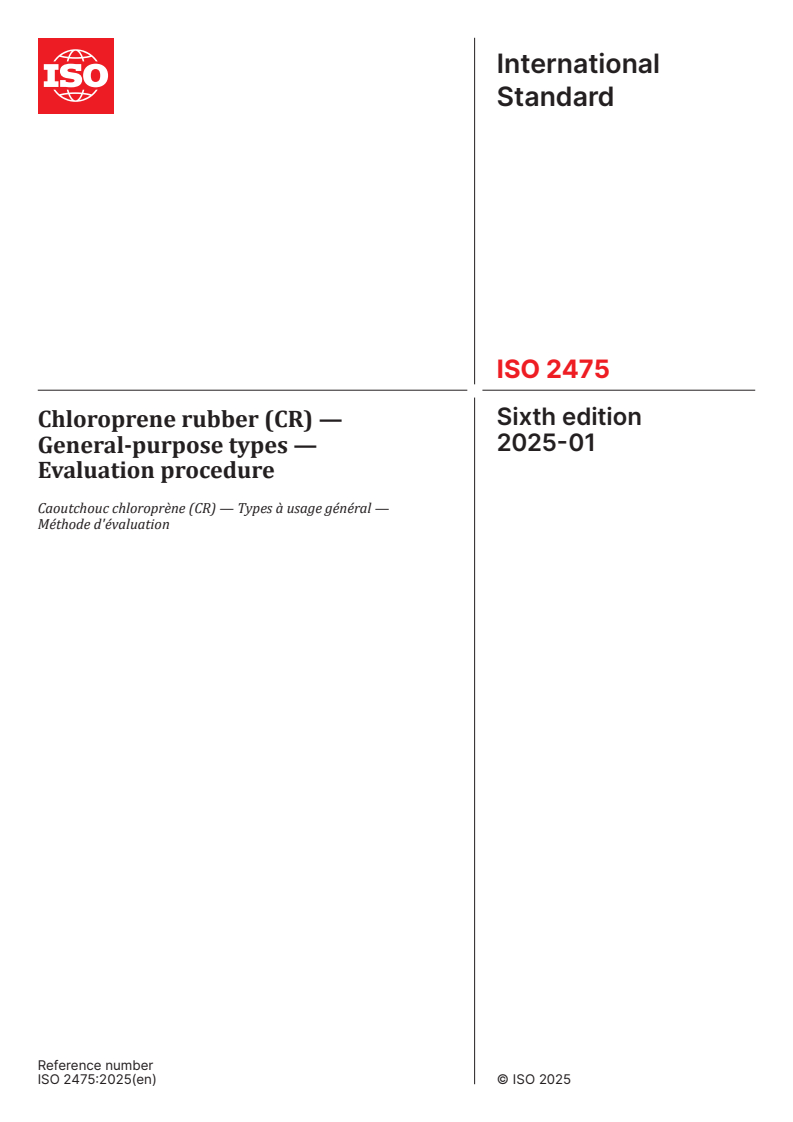
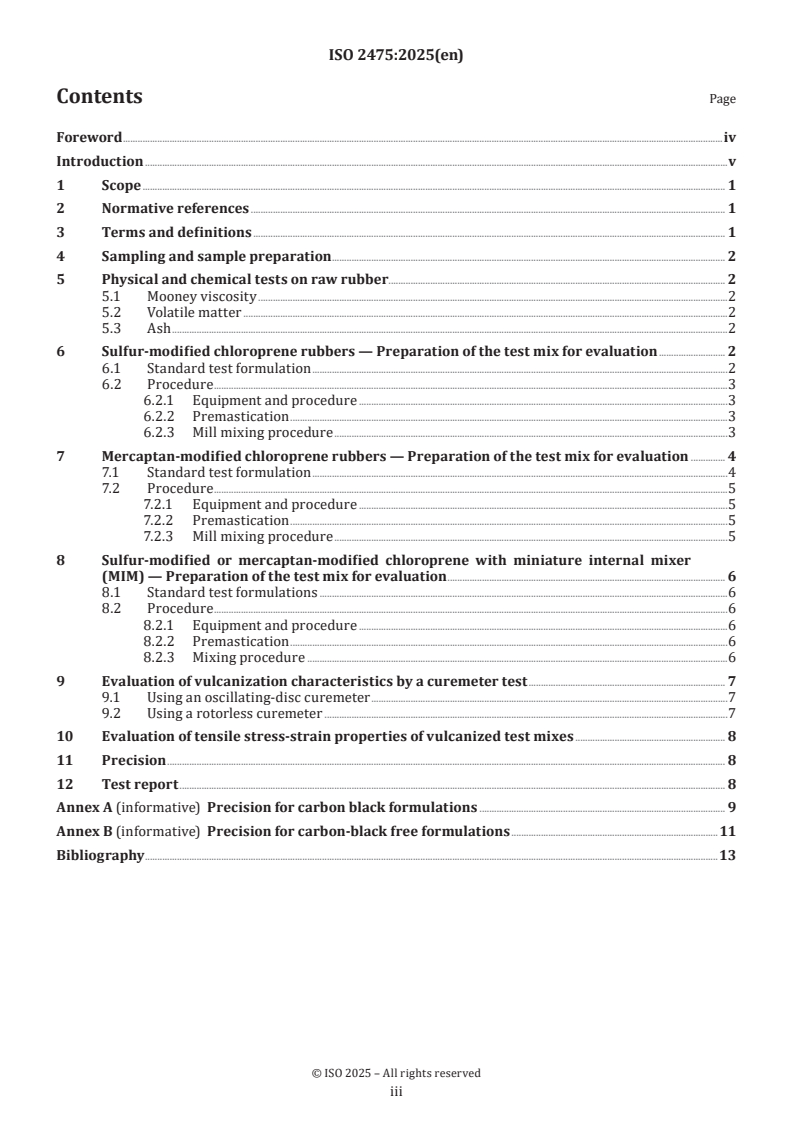
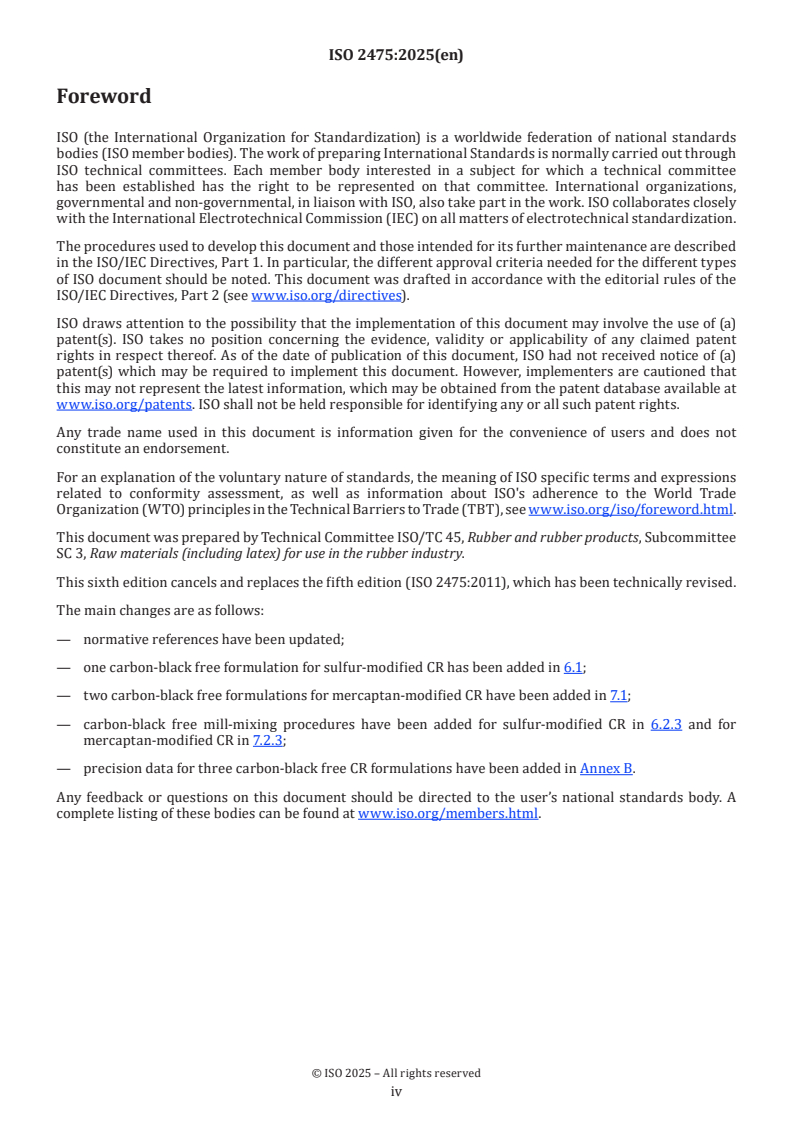
ISO 2475:2025 - Chloroprene rubber (CR) — General-purpose types — Evaluation procedure Released:8. 01. 2025
ISO 2475:2025 - Caoutchouc chloroprene (CR) — Types a usage général — Méthode d'évaluation Released:8. 01. 2025
Overview
ISO 2475:2025 - "Chloroprene rubber (CR) - General-purpose types - Evaluation procedure" (sixth edition) defines laboratory protocols to evaluate the vulcanization and basic physical/chemical properties of general-purpose chloroprene rubbers (CR). The standard covers sampling, sample preparation, required tests on raw rubber, standard test formulations, mixing and processing methods (mill and miniature internal mixer), and cure/vulcanization evaluation procedures. It is intended for consistent, reproducible assessment of sulfur‑modified and mercaptan‑modified CR grades.
Key technical topics and requirements
- Scope and sampling
- Sampling method and test‑portion preparation aligned with ISO 1795; typical sample mass ~1.5 kg.
- Raw‑rubber tests
- Mooney viscosity: ML (1+4) at 100 °C per ISO 289-1.
- Volatile matter: per ISO 248-1 or ISO 248-2 (oven or thermogravimetric methods; hot‑mill method at 50 °C ± 5 °C when applicable).
- Ash content: per ISO 247-1.
- Standard test formulations
- Prescribed formulations for sulfur‑modified (Formulations A and B) and mercaptan‑modified CR (Formulations C–F), including reference materials such as carbon black, stearic acid, magnesium oxide and zinc oxide. Carbon‑black‑free formulations are included in this edition.
- Mixing and processing
- Premastication and mill mixing procedures with specific parameters (example: premasticate 500 g, mill roll temperature 50 °C ± 5 °C; defined nip settings and timing).
- Procedures for miniature internal mixer (MIM) mixing.
- Equipment and general procedures referenced to ISO 2393.
- Vulcanization evaluation
- Curemeter tests using oscillating‑disc and rotorless curemeters (ISO 6502‑2, ISO 6502‑3).
- Tensile and stress–strain testing of vulcanizates (ISO 37).
- Quality and reporting
- Precision data (Annex A for carbon‑black formulations; Annex B for carbon‑black‑free) and requirements for test reporting.
Practical applications and intended users
ISO 2475:2025 is used for:
- Quality control and incoming inspection of chloroprene rubber raw materials.
- R&D and comparative evaluation of CR grades and formulations.
- Compound development and process optimization in rubber manufacturing.
- Third‑party and in‑house testing laboratories performing standardized vulcanization assessments.
- Procurement/specification writers and OEMs requiring consistent material evaluation criteria.
Users should follow normal laboratory safety practices; the document contains a safety notice advising users to establish appropriate safety and health measures.
Related standards (key references)
- ISO 1795 - Sampling and preparative procedures
- ISO 289‑1 - Mooney viscosity determination
- ISO 247‑1 - Ash determination
- ISO 248‑1 / ISO 248‑2 - Volatile matter
- ISO 2393 - Test mix preparation and mixing procedures
- ISO 6502‑2 / ISO 6502‑3 - Curemeter measurements
- ISO 37 - Tensile testing of vulcanizates
Keywords: ISO 2475:2025, chloroprene rubber, CR evaluation procedure, vulcanization characteristics, Mooney viscosity, curemeter, sulfur‑modified CR, mercaptan‑modified CR, rubber test formulations, laboratory mixing.
Relations
- Effective Date
- 02-Jul-2022
Buy Documents
ISO 2475:2025 - Chloroprene rubber (CR) — General-purpose types — Evaluation procedure Released:8. 01. 2025
ISO 2475:2025 - Caoutchouc chloroprene (CR) — Types a usage général — Méthode d'évaluation Released:8. 01. 2025
Get Certified
Connect with accredited certification bodies for this standard

DIN CERTCO
DIN Group product certification.

Smithers Quality Assessments
US management systems and product certification.
Sponsored listings
Frequently Asked Questions
ISO 2475:2025 is a standard published by the International Organization for Standardization (ISO). Its full title is "Chloroprene rubber (CR) — General-purpose types — Evaluation procedure". This standard covers: This document specifies: — the physical and chemical tests on raw rubbers; — the standard materials, the standard test formulations, the equipment and the processing methods to evaluate the vulcanization characteristics for general-purpose chloroprene rubbers (CRs).
This document specifies: — the physical and chemical tests on raw rubbers; — the standard materials, the standard test formulations, the equipment and the processing methods to evaluate the vulcanization characteristics for general-purpose chloroprene rubbers (CRs).
ISO 2475:2025 is classified under the following ICS (International Classification for Standards) categories: 83.060 - Rubber. The ICS classification helps identify the subject area and facilitates finding related standards.
ISO 2475:2025 has the following relationships with other standards: It is inter standard links to ISO 2475:2011. Understanding these relationships helps ensure you are using the most current and applicable version of the standard.
ISO 2475:2025 is available in PDF format for immediate download after purchase. The document can be added to your cart and obtained through the secure checkout process. Digital delivery ensures instant access to the complete standard document.
Standards Content (Sample)
International
Standard
ISO 2475
Sixth edition
Chloroprene rubber (CR) —
2025-01
General-purpose types —
Evaluation procedure
Caoutchouc chloroprène (CR) — Types à usage général —
Méthode d'évaluation
Reference number
© ISO 2025
All rights reserved. Unless otherwise specified, or required in the context of its implementation, no part of this publication may
be reproduced or utilized otherwise in any form or by any means, electronic or mechanical, including photocopying, or posting on
the internet or an intranet, without prior written permission. Permission can be requested from either ISO at the address below
or ISO’s member body in the country of the requester.
ISO copyright office
CP 401 • Ch. de Blandonnet 8
CH-1214 Vernier, Geneva
Phone: +41 22 749 01 11
Email: copyright@iso.org
Website: www.iso.org
Published in Switzerland
ii
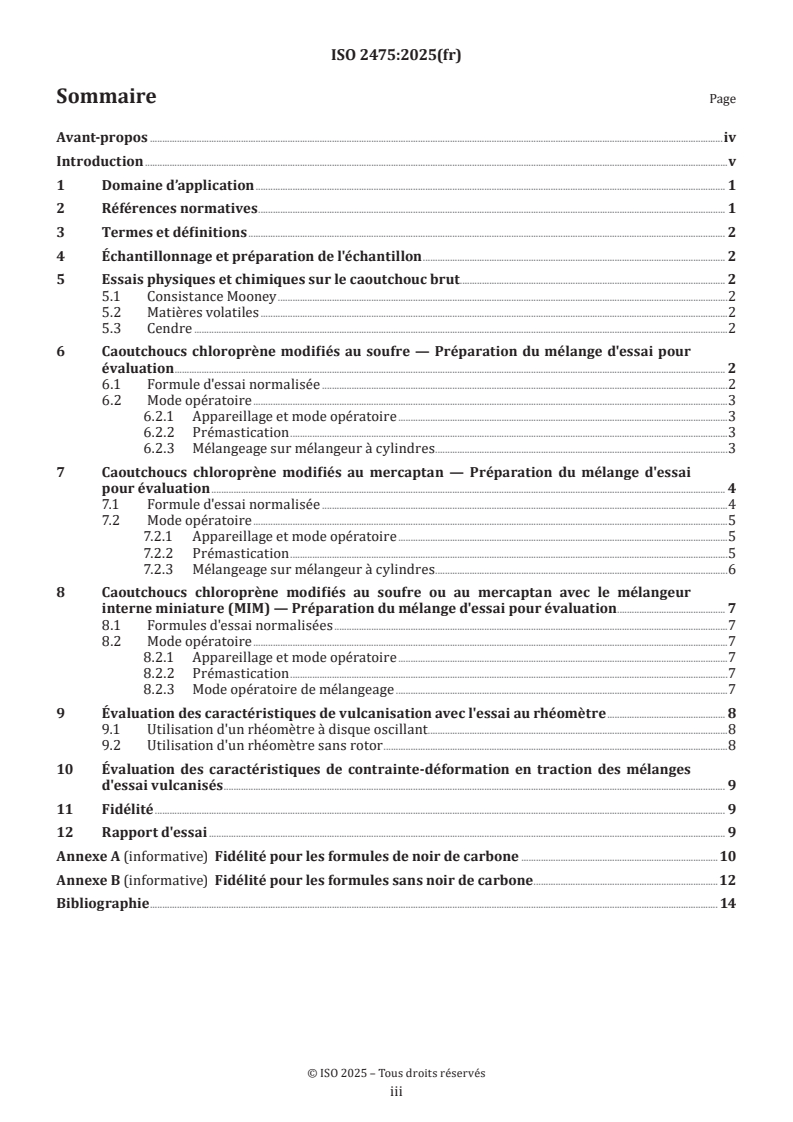
Contents Page
Foreword .iv
Introduction .v
1 Scope . 1
2 Normative references . 1
3 Terms and definitions . 1
4 Sampling and sample preparation . 2
5 Physical and chemical tests on raw rubber . 2
5.1 Mooney viscosity .2
5.2 Volatile matter .2
5.3 Ash .2
6 Sulfur-modified chloroprene rubbers — Preparation of the test mix for evaluation . 2
6.1 Standard test formulation .2
6.2 Procedure .3
6.2.1 Equipment and procedure .3
6.2.2 Premastication .3
6.2.3 Mill mixing procedure .3
7 Mercaptan-modified chloroprene rubbers — Preparation of the test mix for evaluation . 4
7.1 Standard test formulation .4
7.2 Procedure .5
7.2.1 Equipment and procedure .5
7.2.2 Premastication .5
7.2.3 Mill mixing procedure .5
8 Sulfur-modified or mercaptan-modified chloroprene with miniature internal mixer
(MIM) — Preparation of the test mix for evaluation . 6
8.1 Standard test formulations .6
8.2 Procedure .6
8.2.1 Equipment and procedure .6
8.2.2 Premastication .6
8.2.3 Mixing procedure .6
9 Evaluation of vulcanization characteristics by a curemeter test . 7
9.1 Using an oscillating-disc curemeter .7
9.2 Using a rotorless curemeter .7
10 Evaluation of tensile stress-strain properties of vulcanized test mixes . 8
11 Precision . 8
12 Test report . 8
Annex A (informative) Precision for carbon black formulations . 9
Annex B (informative) Precision for carbon-black free formulations .11
Bibliography .13
iii
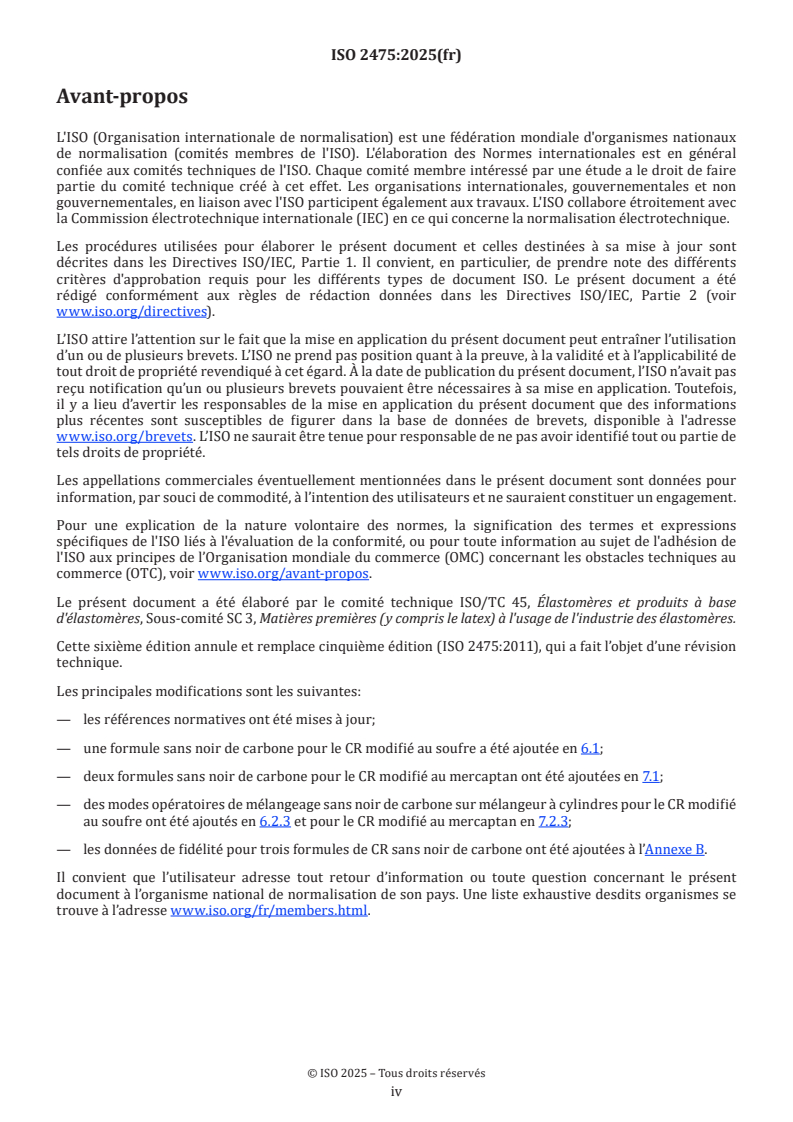
Foreword
ISO (the International Organization for Standardization) is a worldwide federation of national standards
bodies (ISO member bodies). The work of preparing International Standards is normally carried out through
ISO technical committees. Each member body interested in a subject for which a technical committee
has been established has the right to be represented on that committee. International organizations,
governmental and non-governmental, in liaison with ISO, also take part in the work. ISO collaborates closely
with the International Electrotechnical Commission (IEC) on all matters of electrotechnical standardization.
The procedures used to develop this document and those intended for its further maintenance are described
in the ISO/IEC Directives, Part 1. In particular, the different approval criteria needed for the different types
of ISO document should be noted. This document was drafted in accordance with the editorial rules of the
ISO/IEC Directives, Part 2 (see www.iso.org/directives).
ISO draws attention to the possibility that the implementation of this document may involve the use of (a)
patent(s). ISO takes no position concerning the evidence, validity or applicability of any claimed patent
rights in respect thereof. As of the date of publication of this document, ISO had not received notice of (a)
patent(s) which may be required to implement this document. However, implementers are cautioned that
this may not represent the latest information, which may be obtained from the patent database available at
www.iso.org/patents. ISO shall not be held responsible for identifying any or all such patent rights.
Any trade name used in this document is information given for the convenience of users and does not
constitute an endorsement.
For an explanation of the voluntary nature of standards, the meaning of ISO specific terms and expressions
related to conformity assessment, as well as information about ISO's adherence to the World Trade
Organization (WTO) principles in the Technical Barriers to Trade (TBT), see www.iso.org/iso/foreword.html.
This document was prepared by Technical Committee ISO/TC 45, Rubber and rubber products, Subcommittee
SC 3, Raw materials (including latex) for use in the rubber industry.
This sixth edition cancels and replaces the fifth edition (ISO 2475:2011), which has been technically revised.
The main changes are as follows:
— normative references have been updated;
— one carbon-black free formulation for sulfur-modified CR has been added in 6.1;
— two carbon-black free formulations for mercaptan-modified CR have been added in 7.1;
— carbon-black free mill-mixing procedures have been added for sulfur-modified CR in 6.2.3 and for
mercaptan-modified CR in 7.2.3;
— precision data for three carbon-black free CR formulations have been added in Annex B.
Any feedback or questions on this document should be directed to the user’s national standards body. A
complete listing of these bodies can be found at www.iso.org/members.html.
iv
Introduction
General-purpose chloroprene rubbers fall into three broad classes based on the type of polymerization
modifier used in their preparation:
a) sulfur-modified types;
b) mercaptan-modified types;
c) types modified by other products.
For class c), the procedure for either a) or b) may be followed.
v
International Standard ISO 2475:2025(en)
Chloroprene rubber (CR) — General-purpose types —
Evaluation procedure
WARNING — Persons using this document should be familiar with normal laboratory practice. This
document does not purport to address all of the safety problems, if any, associated with its use. It is
the responsibility of the user to establish appropriate safety and health practices.
1 Scope
This document specifies:
— the physical and chemical tests on raw rubbers;
— the standard materials, the standard test formulations, the equipment and the processing methods to
evaluate the vulcanization characteristics
for general-purpose chloroprene rubbers (CRs).
2 Normative references
The following documents are referred to in the text in such a way that some or all of their content constitutes
requirements of this document. For dated references, only the edition cited applies. For undated references,
the latest edition of the referenced document (including any amendments) applies.
ISO 37, Rubber, vulcanized or thermoplastic — Determination of tensile stress-strain properties
ISO 247-1, Rubber — Determination of ash — Part 1: Combustion method
ISO 248-1, Rubber, raw — Determination of volatile-matter content — Part 1: Hot-mill method and oven method
ISO 248-2, Rubber, raw — Determination of volatile-matter content — Part 2: Thermogravimetric methods
using an automatic analyser with an infrared drying unit
ISO 289-1, Rubber, unvulcanized — Determinations using a shearing-disc viscometer — Part 1: Determination
of Mooney viscosity
ISO 1795, Rubber, raw natural and raw synthetic — Sampling and further preparative procedures
ISO 2393, Rubber test mixes — Preparation, mixing and vulcanization — Equipment and procedures
ISO 6502-2, Rubber — Measurement of vulcanization characteristics using curemeters — Part 2: Oscillating
disc curemeter
ISO 6502-3, Rubber — Measurement of vulcanization characteristics using curemeters — Part 3: Rotorless
curemeter
3 Terms and definitions
No terms and definitions are listed in this document.
ISO and IEC maintain terminology databases for use in standardization at the following addresses:
— ISO Online browsing platform: available at https:// www .iso .org/ obp
— IEC Electropedia: available at https:// www .electropedia .org/
4 Sampling and sample preparation
4.1 Take a sample of mass approximately 1,5 kg by the method described in ISO 1795.
4.2 Prepare the test portion in accordance with ISO 1795.
5 Physical and chemical tests on raw rubber
5.1 Mooney viscosity
Determine the Mooney viscosity in accordance with ISO 289-1, on a test portion prepared as indicated in 4.2.
Record the result as ML (1 + 4) at 100 °C.
5.2 Volatile matter
Determine the volatile-matter content in accordance with ISO 248-1 or ISO 248-2. The volatile-matter content
is determined in accordance with ISO 248-1 either by the oven method or, if the rubber is in a suitable form
(which is not the case if it is in chip or powder form), the hot-mill method, but with a mill roll temperature of
50 °C ± 5 °C.
5.3 Ash
Determine the ash in accordance with ISO 247-1.
6 Sulfur-modified chloroprene rubbers — Preparation of the test mix for evaluation
6.1 Standard test formulation
The standard test formulations are given in Table 1.
The materials shall be national or international standard reference materials, unless no standard reference
materials are available, in which case the materials to be used shall be agreed between the interested
parties.
Table 1 — Standard test formulations for evaluation of sulfur-modified chloroprene rubbers
Formulation A Formulation B
Material
parts by mass parts by mass
Chloroprene rubber (CR), sulfur-modified 100,00 100,00
a
Stearic acid (CAS 57-11-4) 0,50 0,50
b
Magnesium oxide (CAS 1309-48-4) 4,00 4,00
c
Carbon black (CAS 1333-86-4) 25,00 —
d
Zinc oxide (CAS 1314-13-2) 5,00 5,00
Total 134,50 109,50
a
See ISO 8312.
b 2 2
The surface area of the magnesium oxide shall be between 130 m /g and 200 m /g. Magnesium oxide absorbs water and
carbon dioxide when exposed to air and this can affect its activity in compounds. Store it in a dry environment.
c
The current industry reference black (IRB), or an equivalent national or international standard reference material, shall be
used.
d
Class B1a (see ISO 9298:2017, Annex D).
6.2 Procedure
6.2.1 Equipment and procedure
The equipment and procedure for preparation, mixing and vulcanization shall be in accordance with
ISO 2393.
6.2.2 Premastication
6.2.2.1 Weigh out 500 g of chloroprene rubber.
6.2.2.2 Adjust the mill-roll temperature to 50 °C ± 5 °C.
6.2.2.3 Band the rubber with a mill opening of 1,5 mm and start the timer at the instant the rubber is banded.
6.2.2.4 Adjust the nip to maintain a rolling bank of approximately 12 mm in diameter. Mill the rubber for
6 min, cutting as necessary to maintain a rolling bank and a tight band.
6.2.2.5 Remove the rubber from the mill and allow it to cool to room temperature prior to mixing.
6.2.3 Mill mixing procedure
The standard laboratory mill batch mass shall be based on four times the recipe mass in grams.
The surface temperature of the rolls shall be maintained at 50 °C ± 5 °C throughout the mixing.
A good rolling bank at the nip of the rolls shall be maintained during mixing. If this is not obtained with the
nip settings specified hereunder, small adjustments to the mill opening can be necessary.
Duration
min
Formulation A Formulation B
a) Band the premasticated rubber on the mill with a nip setting 1,0 1,0
of 1,5 mm or a suitable setting to maintain a rolling bank.
b) Add the stearic acid. 1,0 1,0
c) Add the magnesium oxide slowly, spreading it evenly over 2,0 2,0
the entire width of the band. Ensure complete incorporation
before adding the carbon black.
d) Add the carbon black. Open the nip at intervals to maintain 5,0 —
a rolling bank. Sweep up and add any material which has
fallen into the pan.
e) Add the zinc oxide. 2,0 2,0
f) Make three 3/4 cuts from each side. 2,0 2,0
g) Cut the batch from the mill. Set the nip at 0,8 mm and pass 2,0 2,0
the rolled batch lengthways through the mill six times.
Total time 15,0 10,0
h) Sheet the batch to an approximate thickness of 6 mm and check-weight the batch (see ISO 2393). If the
mass of the batch differs from the theoretical value by more than +0,5 % or –1,5 %, discard the batch and
re-mix. Remove sufficient material for curemeter testing.
i) Sheet the batch to an approximate thickness of 2,2 mm for preparing test slabs and ISO dumbbell speci-
mens (as defined in ISO 37) or to the appropriate thickness for preparing ISO dumbbell or ring specimens
in accordance with ISO 37.
j) Condition the batch for 2 h to 24 h after mixing and prior to vulcanizing, at the standard temperature and
humidity as defined in ISO 23529 if possible.
7 Mercaptan-modified chloroprene rubbers — Preparation of the test mix for
evaluation
7.1 Standard test formulation
The standard test formulations are given in Table 2.
The materials shall be national or international standard reference materials, unless no standard reference
materials are available, in which case the materials to be used shall be agreed between the interested
parties.
Table 2 — Standard test formulations for evaluation of mercaptan-modified
...
Norme
internationale
ISO 2475
Sixième édition
Caoutchouc chloroprène (CR) —
2025-01
Types à usage général — Méthode
d'évaluation
Chloroprene rubber (CR) — General-purpose types — Evaluation
procedure
Numéro de référence
DOCUMENT PROTÉGÉ PAR COPYRIGHT
© ISO 2025
Tous droits réservés. Sauf prescription différente ou nécessité dans le contexte de sa mise en œuvre, aucune partie de cette
publication ne peut être reproduite ni utilisée sous quelque forme que ce soit et par aucun procédé, électronique ou mécanique,
y compris la photocopie, ou la diffusion sur l’internet ou sur un intranet, sans autorisation écrite préalable. Une autorisation peut
être demandée à l’ISO à l’adresse ci-après ou au comité membre de l’ISO dans le pays du demandeur.
ISO copyright office
Case postale 401 • Ch. de Blandonnet 8
CH-1214 Vernier, Genève
Tél.: +41 22 749 01 11
E-mail: copyright@iso.org
Web: www.iso.org
Publié en Suisse
ii
Sommaire Page
Avant-propos .iv
Introduction .v
1 Domaine d’application . 1
2 Références normatives . 1
3 Termes et définitions . 2
4 Échantillonnage et préparation de l'échantillon . 2
5 Essais physiques et chimiques sur le caoutchouc brut. 2
5.1 Consistance Mooney .2
5.2 Matières volatiles .2
5.3 Cendre .2
6 Caoutchoucs chloroprène modifiés au soufre — Préparation du mélange d'essai pour
évaluation . 2
6.1 Formule d'essai normalisée .2
6.2 Mode opératoire .3
6.2.1 Appareillage et mode opératoire .3
6.2.2 Prémastication .3
6.2.3 Mélangeage sur mélangeur à cylindres .3
7 Caoutchoucs chloroprène modifiés au mercaptan — Préparation du mélange d'essai
pour évaluation . 4
7.1 Formule d'essai normalisée .4
7.2 Mode opératoire .5
7.2.1 Appareillage et mode opératoire .5
7.2.2 Prémastication .5
7.2.3 Mélangeage sur mélangeur à cylindres .6
8 Caoutchoucs chloroprène modifiés au soufre ou au mercaptan avec le mélangeur
interne miniature (MIM) — Préparation du mélange d'essai pour évaluation . 7
8.1 Formules d'essai normalisées .7
8.2 Mode opératoire .7
8.2.1 Appareillage et mode opératoire .7
8.2.2 Prémastication .7
8.2.3 Mode opératoire de mélangeage .7
9 Évaluation des caractéristiques de vulcanisation avec l'essai au rhéomètre . 8
9.1 Utilisation d'un rhéomètre à disque oscillant .8
9.2 Utilisation d'un rhéomètre sans rotor .8
10 Évaluation des caractéristiques de contrainte-déformation en traction des mélanges
d'essai vulcanisés . 9
11 Fidélité . 9
12 Rapport d'essai . 9
Annexe A (informative) Fidélité pour les formules de noir de carbone .10
Annexe B (informative) Fidélité pour les formules sans noir de carbone .12
Bibliographie . 14
iii
Avant-propos
L'ISO (Organisation internationale de normalisation) est une fédération mondiale d'organismes nationaux
de normalisation (comités membres de l'ISO). L'élaboration des Normes internationales est en général
confiée aux comités techniques de l'ISO. Chaque comité membre intéressé par une étude a le droit de faire
partie du comité technique créé à cet effet. Les organisations internationales, gouvernementales et non
gouvernementales, en liaison avec l'ISO participent également aux travaux. L'ISO collabore étroitement avec
la Commission électrotechnique internationale (IEC) en ce qui concerne la normalisation électrotechnique.
Les procédures utilisées pour élaborer le présent document et celles destinées à sa mise à jour sont
décrites dans les Directives ISO/IEC, Partie 1. Il convient, en particulier, de prendre note des différents
critères d'approbation requis pour les différents types de document ISO. Le présent document a été
rédigé conformément aux règles de rédaction données dans les Directives ISO/IEC, Partie 2 (voir
www.iso.org/directives).
L’ISO attire l’attention sur le fait que la mise en application du présent document peut entraîner l’utilisation
d’un ou de plusieurs brevets. L’ISO ne prend pas position quant à la preuve, à la validité et à l’applicabilité de
tout droit de propriété revendiqué à cet égard. À la date de publication du présent document, l’ISO n’avait pas
reçu notification qu’un ou plusieurs brevets pouvaient être nécessaires à sa mise en application. Toutefois,
il y a lieu d’avertir les responsables de la mise en application du présent document que des informations
plus récentes sont susceptibles de figurer dans la base de données de brevets, disponible à l'adresse
www.iso.org/brevets. L’ISO ne saurait être tenue pour responsable de ne pas avoir identifié tout ou partie de
tels droits de propriété.
Les appellations commerciales éventuellement mentionnées dans le présent document sont données pour
information, par souci de commodité, à l’intention des utilisateurs et ne sauraient constituer un engagement.
Pour une explication de la nature volontaire des normes, la signification des termes et expressions
spécifiques de l'ISO liés à l'évaluation de la conformité, ou pour toute information au sujet de l'adhésion de
l'ISO aux principes de l’Organisation mondiale du commerce (OMC) concernant les obstacles techniques au
commerce (OTC), voir www.iso.org/avant-propos.
Le présent document a été élaboré par le comité technique ISO/TC 45, Élastomères et produits à base
d'élastomères, Sous-comité SC 3, Matières premières (y compris le latex) à l'usage de l'industrie des élastomères.
Cette sixième édition annule et remplace cinquième édition (ISO 2475:2011), qui a fait l’objet d’une révision
technique.
Les principales modifications sont les suivantes:
— les références normatives ont été mises à jour;
— une formule sans noir de carbone pour le CR modifié au soufre a été ajoutée en 6.1;
— deux formules sans noir de carbone pour le CR modifié au mercaptan ont été ajoutées en 7.1;
— des modes opératoires de mélangeage sans noir de carbone sur mélangeur à cylindres pour le CR modifié
au soufre ont été ajoutés en 6.2.3 et pour le CR modifié au mercaptan en 7.2.3;
— les données de fidélité pour trois formules de CR sans noir de carbone ont été ajoutées à l’Annexe B.
Il convient que l’utilisateur adresse tout retour d’information ou toute question concernant le présent
document à l’organisme national de normalisation de son pays. Une liste exhaustive desdits organismes se
trouve à l’adresse www.iso.org/fr/members.html.
iv
Introduction
Les types de caoutchouc chloroprène à usage général se divisent en trois grandes classes selon le type
d'agent modifiant utilisé pour leur préparation:
a) les types modifiés au soufre;
b) les types modifiés au mercaptan;
c) les types modifiés par d'autres produits.
Pour la classe c), le mode opératoire de a) ou b) peut être suivi.
v
Norme internationale ISO 2475:2025(fr)
Caoutchouc chloroprène (CR) — Types à usage général —
Méthode d'évaluation
AVERTISSEMENT — Il convient que l'utilisateur du présent document connaisse bien les pratiques
courantes de laboratoire. Le présent document n'a pas pour but de traiter tous les problèmes de
sécurité qui sont, le cas échéant, liés à son utilisation. Il incombe à l'utilisateur d'établir des pratiques
appropriées en matière d'hygiène et de sécurité.
1 Domaine d’application
Le présent document spécifie,:
— les méthodes d'essais physiques et chimiques applicables aux caoutchoucs bruts;
— les ingrédients normalisés, les formules d'essai normalisées, l'appareillage et les méthodes d'essai pour
l'évaluation des caractéristiques de vulcanisation
pour les caoutchoucs chloroprène (CR) à usage général.
2 Références normatives
Les documents suivants sont cités dans le texte de sorte qu’ils constituent, pour tout ou partie de leur
contenu, des exigences du présent document. Pour les références datées, seule l’édition citée s’applique. Pour
les références non datées, la dernière édition du document de référence s'applique (y compris les éventuels
amendements).
ISO 37, Caoutchouc vulcanisé ou thermoplastique — Détermination des caractéristiques de contrainte-
déformation en traction
ISO 247-1, Caoutchouc — Détermination du taux de cendres — Partie 1: Technique de combustion sèche
ISO 248-1, Caoutchouc brut — Détermination des matières volatiles — Partie 1: Méthode par mélangeage à
chaud et méthode par étuvage
ISO 248-2, Caoutchouc brut — Détermination des matières volatiles — Partie 2: Méthodes thermogravimétriques
utilisant un analyseur automatique avec une unité de séchage infrarouge
ISO 289-1, Caoutchouc non vulcanisé — Déterminations utilisant un consistomètre à disque de cisaillement —
Partie 1: Détermination de l'indice consistométrique Mooney
ISO 1795, Caoutchouc, naturel brut et synthétique brut — Méthodes d'échantillonnage et de préparation
ultérieure
ISO 2393, Mélanges d'essais à base de caoutchouc — Mélangeage, préparation et vulcanisation — Appareillage
et modes opératoires
ISO 6502-2, Caoutchouc — Mesure des caractéristiques de vulcanisation à l’aide de rhéomètres — Partie 2:
Rhéomètre à disque oscillant
ISO 6502-3, Caoutchouc — Mesure des caractéristiques de vulcanisation à l'aide de rhéomètres — Partie 3:
Rhéomètre sans rotor
3 Termes et définitions
Aucun terme n’est défini dans le présent document.
L’ISO et l’IEC tiennent à jour des bases de données terminologiques destinées à être utilisées en normalisation,
consultables aux adresses suivantes:
— ISO Online browsing platform: disponible à l’adresse https:// www .iso .org/ obp
— IEC Electropedia: disponible à l’adresse https:// www .electropedia .org/
4 Échantillonnage et préparation de l'échantillon
4.1 Prélever un échantillon d'une masse d'environ 1,5 kg par la méthode décrite dans l'ISO 1795.
4.2 Préparer la prise d'essai conformément à l'ISO 1795.
5 Essais physiques et chimiques sur le caoutchouc brut
5.1 Consistance Mooney
Déterminer la consistance Mooney conformément à l'ISO 289-1, sur une prise d'essai préparée comme
indiqué en 4.2. Enregistrer le résultat comme ML (1 + 4) à 100 °C.
5.2 Matières volatiles
Déterminer la teneur en matières volatiles conformément à l'ISO 248-1 ou à l'ISO 248-2. La teneur en matières
volatiles est déterminée conformément à l'ISO 248-1 soit par la méthode par étuvage ou, si le caoutchouc est
sous une forme convenable (s'il n'est pas sous forme de copeaux ou sous forme de poudre), par la méthode
par mélangeage à chaud, mais avec une température des cylindres égale à 50 °C ± 5 °C.
5.3 Cendre
Déterminer les cendres conformément à l'ISO 247-1.
6 Caoutchoucs chloroprène modifiés au soufre — Préparation du mélange d'essai
pour évaluation
6.1 Formule d'essai normalisée
Les formules d'essai normalisées sont données dans le Tableau 1.
Les ingrédients doivent être des matériaux de référence nationaux ou internationaux; lorsqu'aucun matériau
de référence n'est disponible, les matériaux à utiliser doivent faire l'objet d'un accord entre les parties
intéressées.
Tableau 1 — Formules d'essai normalisées pour l'évaluation des caoutchoucs chloroprène
modifiés au soufre
Formule A Formule B
Ingrédient
parties en masse parties en masse
Caoutchouc chloroprène (CR) modifié au 100,00 100,00
soufre
a
Acide stéarique (CAS 57-11-4) 0,50 0,50
b
Oxyde de magnésium (CAS 1309-48-4) 4,00 4,00
c
Noir de carbone (CAS 1333-86-4) 25,00 —
d
Oxyde de zinc (CAS 1314-13-2) 5,00 5,00
Total 134,50 109,50
a
Voir l’ISO 8312.
b 2 2
La surface spécifique de l'oxyde de magnésium doit être comprise entre 130 m /g et 200 m /g. L'oxyde de
magnésium absorbe l'eau et le dioxyde de carbone une fois exposé à l'air et cela peut affecter son activité dans les
mélanges. Le stocker dans un environnement sec.
c
Le noir de référence courant (IRB), ou un matériau de référence normalisé national ou international équivalent,
doit être utilisé.
d
Classe B1a (voir l'ISO 9298:2017, Annexe D).
6.2 Mode opératoire
6.2.1 Appareillage et mode opératoire
L'appareillage et le mode opératoire pour la préparation, le mélangeage et la vulcanisation doivent être
conformes à l'ISO 2393.
6.2.2 Prémastication
6.2.2.1 Peser 500 g de caoutchouc chloroprène.
6.2.2.2 Régler la température des cylindres à 50 °C ± 5 °C.
6.2.2.3 Les cylindres étant écartés de 1,5 mm, former un manchon de caoutchouc et démarrer le
chronomètre à l'instant où le caoutchouc a formé un manchon sur le cylindre.
6.2.2.4 Régler l'écartement des cylindres afin d'obtenir un bourrelet d'environ 12 mm de diamètre.
Mélanger le caoutchouc durant 6 min, couper, si nécessaire, pour obtenir un bourrelet et un manchon
réguliers.
6.2.2.5 Retirer le caoutchouc du mélangeur et le laisser refroidir à température ambiante avant le
mélangeage.
6.2.3 Mélangeage sur mélangeur à cylindres
La masse, en grammes, du mélange normalisé mis en œuvre sur un mélangeur de laboratoire à cylindres
doit être égale à quatre fois la masse correspondant à la formule.
La température de la surface des cylindres doit être maintenue à 50 °C ± 5 °C pendant le mélangeage.
Un bourrelet convenable entre les cylindres doit être maintenu pendant le mélangeage. Si les écartements
de cylindres spécifiés ci-après ne permettent pas d'obtenir ce résultat, ils peuvent être légèrement modifiés.
Durée
min
Formule A Formule B
a) Former un manchon de caoutchouc prémastiqué avec un écartement 1,0 1,0
des cylindres de 1,5 mm ou autre valeur adaptée.
b) Ajouter l'acide stéarique. 1,0 1,0
c) Ajouter lentement l'oxyde de magnésium, en le répartissant 2,0 2,0
uniformément sur toute la longueur du bourrelet. S'assurer que
l'incorporation est complète avant d'ajouter le noir de carbone.
d) Ajouter le noir de carbone. Augmenter l'écartement des cylindres pour 5,0 —
obtenir toujours un bourrelet convenable. Récupérer et ajouter tout
ingrédient tombé dans le bac.
e) Ajouter l'oxyde de zinc. 2,0 2,0
f) Faire trois coupes aux 3/4, de chaque côté du manchon. 2,0 2,0
g) Couper le mélange et le retirer du cylindre. Régler l'écartement à 2,0 2,0
0,8 mm et faire passer le mélange six fois entre les cylindres, en
formant un rouleau et en l'introduisant par l'une ou l'autre de ses
extrémités.
Durée totale 15,0 10,00
h) Tirer en feuille d'épaisseur 6 mm environ et vérifier la masse du mélange (voir l'ISO 2393). Si celle-ci
diffère de plus de +0,5 % ou –1,5 % de la valeur théorique, rejeter le mélange et en refaire un autre.
Prélever une quantité suffisante pour effectuer les essais au rhéomètre.
i) Tirer en feuille d'épaisseur 2,2 mm environ pour la préparation des plaques d'essai et des éprouvettes
haltères (définies dans l’ISO 37) ou d'une autre épaisseur appropriée afin de préparer des éprouvettes
haltères ou éprouvettes ISO en forme d'anneaux conformément à l'ISO 37.
Conditionner le mélange pendant 2 h à 24 h après mélangeage et avant vulcanisation, aux température et
humidité normales comme défini dans l'ISO 23529, si possible.
7 Caoutchoucs chloroprène modifiés au mercaptan — Préparation du mélange
d'essai pour évaluation
7.1 Formule d'essai normalisée
Les formules d'essai normalisées sont données dans le Tableau 2.
Les ingrédients doivent être des matériaux de référence nationaux ou internationaux, lorsqu'aucun matériau
de référence n'est disponible, les matériaux à utiliser doivent faire l'objet d'un accord entre les parties
intéressées.
Tableau 2 — Formules d'essai normalisées pour l'évaluation des caoutchoucs chloroprène
a
modifiés au mercaptan
Formule C Formule D Formule E Formule F
Ingrédient
parties en masse parties en masse parties en masse parties en masse
Caoutchouc chloroprène (CR), modifié au 100,00 100,00 100,00 100,00
mercapt
...