

ISO 24483:2023
(Main)Epoxidized natural rubber — Specifications
General Information
- Abstract
This document specifies the physical and chemical requirements of epoxidized natural rubber (ENR) based on the epoxidation level of the natural rubber.
- Status
- Published
- Publication Date
- 08-Jun-2023
- Drafting Committee
- ISO/TC 45/SC 3/WG 4 - Natural rubber
- Current Stage
- 6060 - International Standard published
- Start Date
- 09-Jun-2023
- Due Date
- 23-Jun-2023
- Completion Date
- 09-Jun-2023
Overview
ISO 24483:2023 - Epoxidized natural rubber (ENR) - Specifications defines the physical and chemical requirements for epoxidized natural rubber (ENR) based on its epoxidation level. The first edition (2023) standard covers grade structure, material composition, sampling, packaging and the test methods needed to verify key properties of ENR grades (notably ENR 25, ENR 50 and their field-latex variants ENR 25 FL / ENR 50 FL). This standard provides a uniform reference for manufacturers, buyers and testing laboratories to specify and verify ENR quality.
Key topics and requirements
- Grades and identification
- ENR 25, ENR 50 (centrifuged latex origin) and ENR 25 FL, ENR 50 FL (field latex origin).
- Numerals indicate mole percentage epoxidation (25 mol% and 50 mol% ± 2 mol%).
- Chemical and physical limits
- Epoxidation level: 25 ± 2 % or 50 ± 2 % (mole fraction) - ISO 5260.
- Ring opening level (max): ENR 25 → 2.0 %; ENR 50 → 4.0 % (mole fraction).
- Ash content (max): 0.25 % (mass fraction) - ISO 247-1.
- Mooney viscosity (ML (1+4) at 100 °C): 70 to 100 - ISO 289-1.
- Glass transition temperature (Tg): ENR 25: −45 ± 2 °C; ENR 50: −22 ± 2 °C - ASTM D3418.
- Nitrogen content (field-latex grades only): max 0.15 % - ISO 1656.
- Lovibond colour index (optional): max 4.0 - ISO 4660.
- Quality control
- Sampling per ISO 1795; each lot must meet agreed grade requirements.
- Packaging typically in bales of nominal 33.3 kg or 35 kg, identified and wrapped (ISO 20299-2 recommended).
Applications and users
ISO 24483:2023 is used by:
- Rubber compounders and product manufacturers specifying ENR feedstock for formulation control.
- Quality assurance and testing laboratories performing conformity checks (epoxidation, ring opening, viscosity, Tg).
- Procurement and specification engineers drafting material purchase requirements.
- Standards bodies and certification organizations harmonizing ENR specifications for trade.
The standard helps ensure consistent ENR quality and supports broader use of chemically modified natural rubber grades across rubber product applications where controlled epoxidation levels and reproducible physical properties are required.
Related standards
Relevant normative references cited in ISO 24483:2023 include:
- ISO 5260 (epoxidation by NMR), ISO 247-1, ISO 289-1, ISO 1656, ISO 1795, ISO 4660, ISO 20299-2; also ASTM D3418 and ISO 2000 for broader NR specification guidance.
Get Certified
Connect with accredited certification bodies for this standard

DIN CERTCO
DIN Group product certification.

Smithers Quality Assessments
US management systems and product certification.
Sponsored listings
Frequently Asked Questions
ISO 24483:2023 is a standard published by the International Organization for Standardization (ISO). Its full title is "Epoxidized natural rubber — Specifications". This standard covers: This document specifies the physical and chemical requirements of epoxidized natural rubber (ENR) based on the epoxidation level of the natural rubber.
This document specifies the physical and chemical requirements of epoxidized natural rubber (ENR) based on the epoxidation level of the natural rubber.
ISO 24483:2023 is classified under the following ICS (International Classification for Standards) categories: 83.060 - Rubber. The ICS classification helps identify the subject area and facilitates finding related standards.
ISO 24483:2023 is available in PDF format for immediate download after purchase. The document can be added to your cart and obtained through the secure checkout process. Digital delivery ensures instant access to the complete standard document.
Standards Content (Sample)
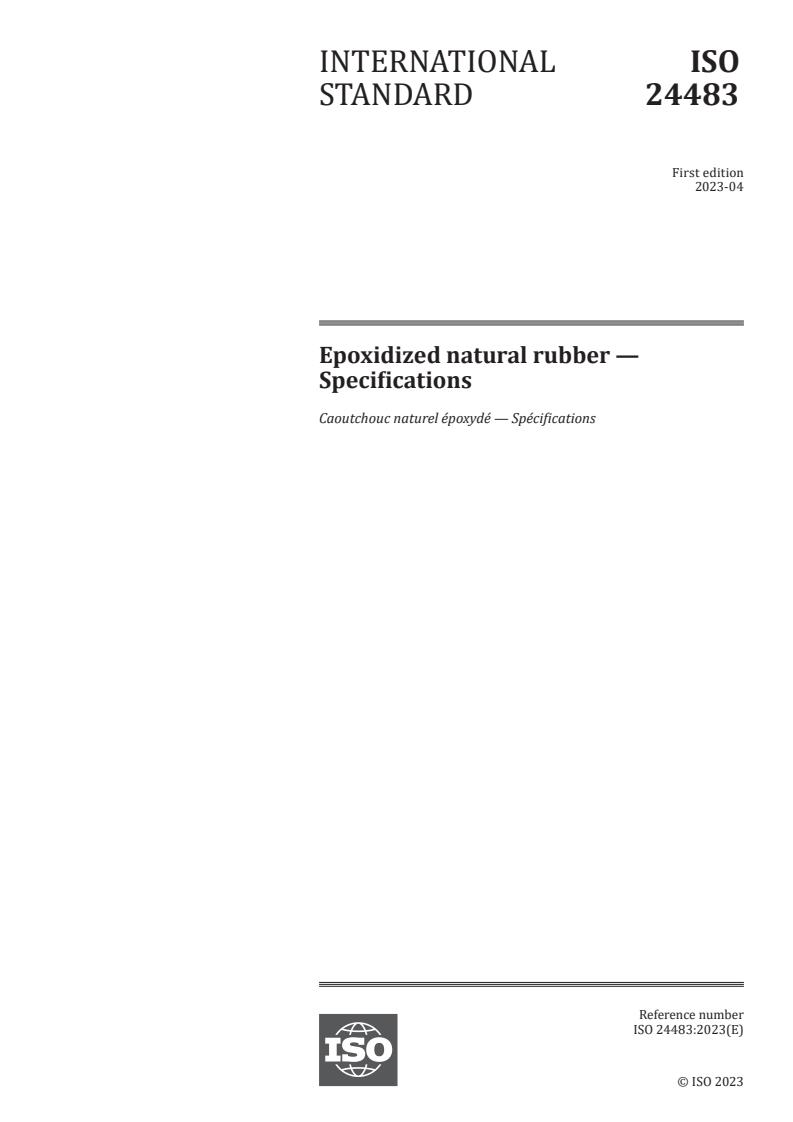
INTERNATIONAL ISO
STANDARD 24483
First edition
2023-04
Epoxidized natural rubber —
Specifications
Caoutchouc naturel époxydé — Spécifications
Reference number
© ISO 2023
All rights reserved. Unless otherwise specified, or required in the context of its implementation, no part of this publication may
be reproduced or utilized otherwise in any form or by any means, electronic or mechanical, including photocopying, or posting on
the internet or an intranet, without prior written permission. Permission can be requested from either ISO at the address below
or ISO’s member body in the country of the requester.
ISO copyright office
CP 401 • Ch. de Blandonnet 8
CH-1214 Vernier, Geneva
Phone: +41 22 749 01 11
Email: copyright@iso.org
Website: www.iso.org
Published in Switzerland
ii
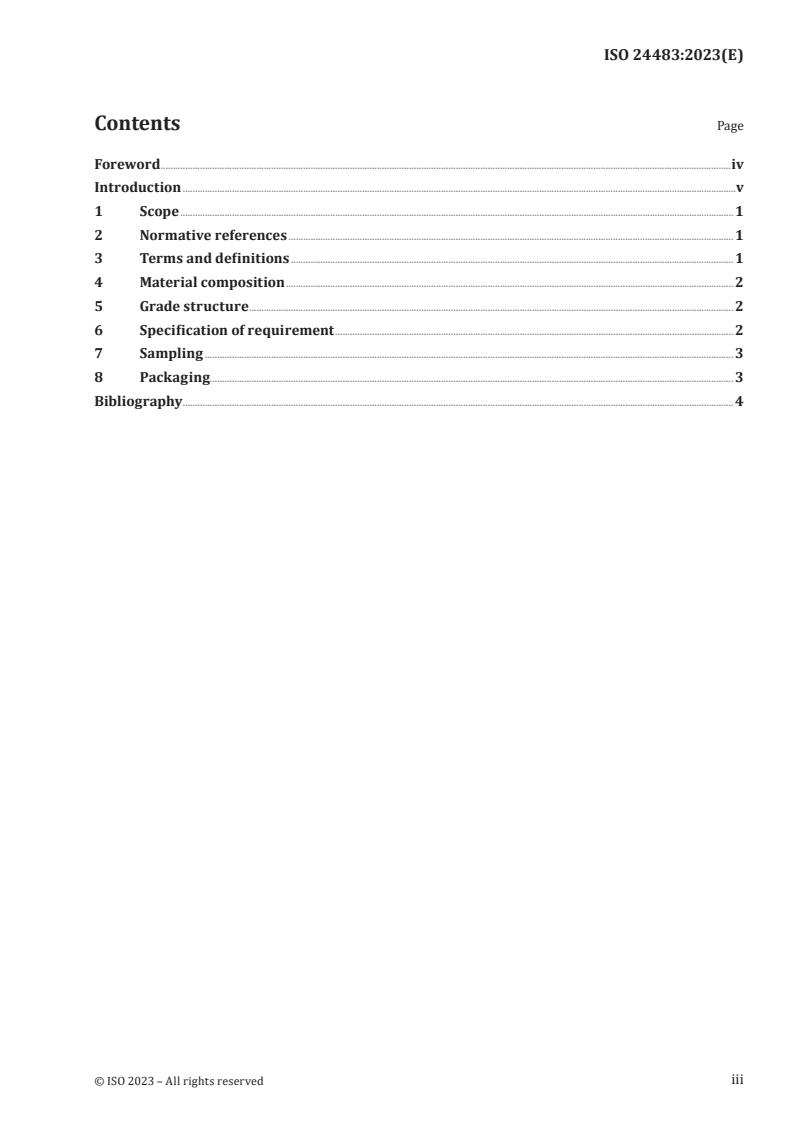
Contents Page
Foreword .iv
Introduction .v
1 Scope . 1
2 Normative references . 1
3 Terms and definitions . 1
4 Material composition .2
5 Grade structure . 2
6 Specification of requirement .2
7 Sampling . 3
8 Packaging. 3
Bibliography . 4
iii
Foreword
ISO (the International Organization for Standardization) is a worldwide federation of national standards
bodies (ISO member bodies). The work of preparing International Standards is normally carried out
through ISO technical committees. Each member body interested in a subject for which a technical
committee has been established has the right to be represented on that committee. International
organizations, governmental and non-governmental, in liaison with ISO, also take part in the work.
ISO collaborates closely with the International Electrotechnical Commission (IEC) on all matters of
electrotechnical standardization.
The procedures used to develop this document and those intended for its further maintenance are
described in the ISO/IEC Directives, Part 1. In particular, the different approval criteria needed for the
different types of ISO documents should be noted. This document was drafted in accordance with the
editorial rules of the ISO/IEC Directives, Part 2 (see www.iso.org/directives).
Attention is drawn to the possibility that some of the elements of this document may be the subject of
patent rights. ISO shall not be held responsible for identifying any or all such patent rights. Details of
any patent rights identified during the development of the document will be in the Introduction and/or
on the ISO list of patent declarations received (see www.iso.org/patents).
Any trade name used in this document is information given for the convenience of users and does not
constitute an endorsement.
For an explanation of the voluntary nature of standards, the meaning of ISO specific terms and
expressions related to conformity assessment, as well as information about ISO's adherence to
the World Trade Organization (WTO) principles in the Technical Barriers to Trade (TBT), see
www.iso.org/iso/foreword.html.
This document was prepared by Technical Committee ISO/TC 45, Rubber and rubber products,
Subcommittee SC 3, Raw materials (including latex) for use in the rubber industry.
Any feedback or questions on this document should be directed to the user’s national standards body. A
complete listing of these bodies can be found at www.iso.org/members.html.
iv
Introduction
Significant developments have taken place in the supply of raw natural rubber, especially in relation to
the number of different grades that are technically specified. The constant viscosity (CV), latex (L) and
gel content (LoV) grades have been added in addition to the initial grades covered in the first edition
of ISO 2000. The development and availability of physical and/or chemically modified grades are now
reported in the technical literature with the aim to expand natural rubber (NR) applications in rubber
products. Demand and acknowledgment of these modified grades grow from year to year. On this note,
it is important to establish a standard reference for the specification related to these modified natural
rubber grades. In this document the emphasis is given to the epoxidized natural rubber (ENR) grade
produced through a chemical modification route on natural rubber.
This document encompasses natural raw rubber specification for ENR produced through a chemical
modification route known as epoxidation reaction. Typically, the most economical epoxidation reaction
route is through the in situ peracid method. Through the process the peracid is formed from hydrogen
peroxide and formic acid. The epoxidation reaction involves with substitution of the NR double bond
structure (C=C) with epoxy ring structure (C-O-C) which later determines the grade of the ENR rubber.
In general, any level of epoxidati
...