

ISO 2230:2026
(Main)Rubber products — Guidelines for storage
General Information
- Abstract
This document gives guidelines for inspection, recording procedures, packaging and storage of products, assemblies and components made from vulcanized or thermoplastic rubber prior to being put into circulation. It is applicable to both solid and cellular rubber products prepared from dry raw rubber, latex or other sources. It is not intended for use with raw rubber in bale, liquid (solution or emulsion) or particulate form, storage guidance for which is given in ISO 7664. NOTE The recommendations for packaging form an integral part of the controlled storage procedure, as well as providing means of identifying the material and product.
- Status
- Published
- Publication Date
- 08-Mar-2026
- Technical Committee
- ISO/TC 45/SC 4 - Products (other than hoses)
- Drafting Committee
- ISO/TC 45/SC 4/WG 7 - Material specification
- Current Stage
- 6060 - International Standard published
- Start Date
- 09-Mar-2026
- Due Date
- 04-Mar-2027
- Completion Date
- 09-Mar-2026
Buy Documents
ISO 2230:2026 - Rubber products — Guidelines for storage
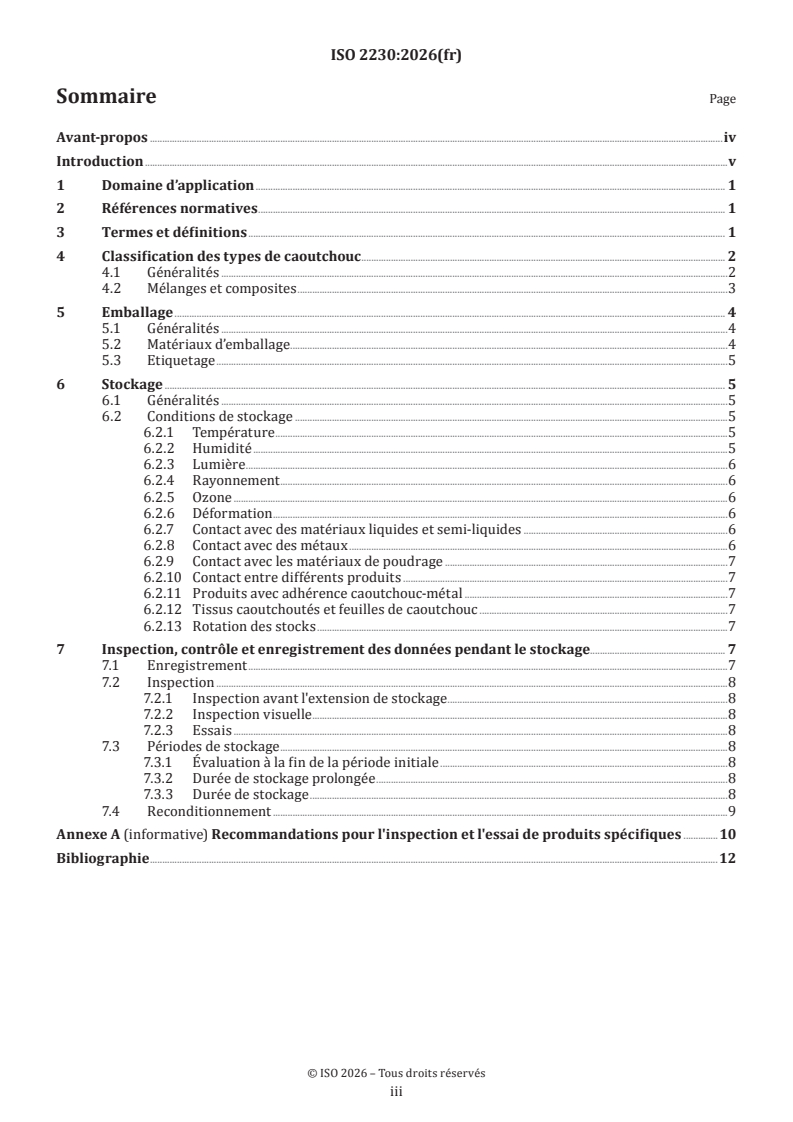
ISO 2230:2026 - Produits à base d'élastomères — Lignes directrices pour le stockage
Overview
ISO 2230:2026, Rubber products - Guidelines for storage, is an international standard published by ISO that provides guidelines for the storage, packaging, inspection, and recording procedures of rubber products, assemblies, and components prior to their distribution. It covers items made from vulcanized or thermoplastic rubber, including both solid and cellular rubber products derived from sources such as dry raw rubber, latex, or similar materials. The standard addresses best practices intended to minimize degradation, deformation, and contamination during extended storage periods, ensuring that rubber products maintain their integrity and performance before being put into use.
Key Topics
ISO 2230:2026 covers several critical areas for preserving the quality and extending the shelf life of rubber products:
- Classification of Rubber Types: Products are classified into groups with varying susceptibility to deterioration (moderate, low, or highly resistant).
- Packaging Guidelines: Detailed recommendations for packaging methods, suitable packaging materials, and labelling requirements help prevent exposure to detrimental elements and ensure traceability.
- Storage Conditions: Provides parameters for storage environments, specifying requirements for temperature, humidity, protection from light, radiation, ozone, and more.
- Inspection and Testing: Details methods and intervals for visual inspection, product testing, and recording of critical data to monitor product condition during storage.
- Duration of Storage: Outlines recommended initial and extension storage periods for each rubber classification to optimize inventory management and product reliability.
- Rotation and Repackaging: Addresses the importance of rotating stock and proper procedures for repackaging items after inspection or removal from storage.
Applications
The practical applications of ISO 2230:2026 are relevant across industries where the reliability of stored rubber components is essential. Key areas include:
- Manufacturing: Producers of rubber goods use the standard to establish controlled storage procedures, select appropriate packaging, and set up inspection routines that preserve product quality.
- Automotive, Aerospace, and Industrial Equipment: Storage guidelines apply to critical components such as seals, hoses, gaskets, and dampers, reducing risk of premature failure due to improper storage.
- Distributors and Warehousing: Logistics providers and storage facilities employ the standard to manage large inventories of rubber parts, ensuring that only serviceable and traceable products reach end users.
- Quality Assurance Programs: Compliance with ISO 2230:2026 helps integrate rubber product storage with broader quality management systems, supporting certification efforts and consistent product performance.
Related Standards
ISO 2230:2026 complements and refers to several other important international standards, including:
- ISO 7664: General guidance on storage of raw rubber.
- ISO 1629: Rubber and latices - Nomenclature
- ISO 1825: Rubber hoses and hose assemblies for aircraft ground fuelling
- ISO 5285: Conveyor belts - Guidelines for storage and handling
- ISO 8331: Rubber and plastic hoses - Guidelines for selection, storage, use, and maintenance
- ISO 9000, ISO 9001, ISO 9004: Quality management systems standards for integrating storage practices within broader organizational quality assurance.
By implementing ISO 2230:2026, organizations can greatly reduce product loss, degradation, and operational risk, while ensuring compliance with industry best practices for the storage and handling of rubber products.
Keywords: ISO 2230:2026, rubber storage guidelines, rubber product packaging, vulcanized rubber storage, thermoplastic rubber components, rubber product inspection, industrial rubber storage standards.
Relations
- Effective Date
- 09-Mar-2024
Buy Documents
ISO 2230:2026 - Rubber products — Guidelines for storage
ISO 2230:2026 - Produits à base d'élastomères — Lignes directrices pour le stockage
Get Certified
Connect with accredited certification bodies for this standard

DIN CERTCO
DIN Group product certification.

Smithers Quality Assessments
US management systems and product certification.
Sponsored listings
Frequently Asked Questions
ISO 2230:2026 is a standard published by the International Organization for Standardization (ISO). Its full title is "Rubber products — Guidelines for storage". This standard covers: This document gives guidelines for inspection, recording procedures, packaging and storage of products, assemblies and components made from vulcanized or thermoplastic rubber prior to being put into circulation. It is applicable to both solid and cellular rubber products prepared from dry raw rubber, latex or other sources. It is not intended for use with raw rubber in bale, liquid (solution or emulsion) or particulate form, storage guidance for which is given in ISO 7664. NOTE The recommendations for packaging form an integral part of the controlled storage procedure, as well as providing means of identifying the material and product.
This document gives guidelines for inspection, recording procedures, packaging and storage of products, assemblies and components made from vulcanized or thermoplastic rubber prior to being put into circulation. It is applicable to both solid and cellular rubber products prepared from dry raw rubber, latex or other sources. It is not intended for use with raw rubber in bale, liquid (solution or emulsion) or particulate form, storage guidance for which is given in ISO 7664. NOTE The recommendations for packaging form an integral part of the controlled storage procedure, as well as providing means of identifying the material and product.
ISO 2230:2026 is classified under the following ICS (International Classification for Standards) categories: 83.060 - Rubber. The ICS classification helps identify the subject area and facilitates finding related standards.
ISO 2230:2026 has the following relationships with other standards: It is inter standard links to ISO 2230:2002. Understanding these relationships helps ensure you are using the most current and applicable version of the standard.
ISO 2230:2026 is available in PDF format for immediate download after purchase. The document can be added to your cart and obtained through the secure checkout process. Digital delivery ensures instant access to the complete standard document.
Standards Content (Sample)
International
Standard
ISO 2230
Third edition
Rubber products — Guidelines for
2026-03
storage
Produits à base d'élastomères — Lignes directrices pour le
stockage
Reference number
© ISO 2026
All rights reserved. Unless otherwise specified, or required in the context of its implementation, no part of this publication may
be reproduced or utilized otherwise in any form or by any means, electronic or mechanical, including photocopying, or posting on
the internet or an intranet, without prior written permission. Permission can be requested from either ISO at the address below
or ISO’s member body in the country of the requester.
ISO copyright office
CP 401 • Ch. de Blandonnet 8
CH-1214 Vernier, Geneva
Phone: +41 22 749 01 11
Email: copyright@iso.org
Website: www.iso.org
Published in Switzerland
ii
Contents Page
Foreword .iv
Introduction .v
1 Scope . 1
2 Normative references . 1
3 Terms and definitions . 1
4 Classification of rubber types . 2
4.1 General .2
4.2 Blends and composites .3
5 Packaging. 3
5.1 General .3
5.2 Packaging materials.4
5.3 Labelling .4
6 Storage . 4
6.1 General .4
6.2 Storage conditions .5
6.2.1 Temperature .5
6.2.2 Humidity .5
6.2.3 Light .5
6.2.4 Radiation .5
6.2.5 Ozone .5
6.2.6 Deformation .6
6.2.7 Contact with liquid and semi-liquid materials .6
6.2.8 Contact with metals.6
6.2.9 Contact with dusting powder .6
6.2.10 Contact between different products .6
6.2.11 Products with rubber-to-metal bonds .6
6.2.12 Proofed fabrics and rubber sheeting .6
6.2.13 Rotation of stocks .6
7 Inspection, testing and recording of data during storage . 7
7.1 Recording .7
7.2 Inspection .7
7.2.1 Inspection before extension storage .7
7.2.2 Visual inspection .7
7.2.3 Testing .7
7.3 Storage periods .7
7.3.1 Assessment at the end of the initial period .7
7.3.2 Extension storage period .8
7.3.3 Duration of storage .8
7.4 Repackaging .8
Annex A (informative) Recommendations for inspection and testing of specific products . 9
Bibliography .11
iii
Foreword
ISO (the International Organization for Standardization) is a worldwide federation of national standards
bodies (ISO member bodies). The work of preparing International Standards is normally carried out through
ISO technical committees. Each member body interested in a subject for which a technical committee
has been established has the right to be represented on that committee. International organizations,
governmental and non-governmental, in liaison with ISO, also take part in the work. ISO collaborates closely
with the International Electrotechnical Commission (IEC) on all matters of electrotechnical standardization.
The procedures used to develop this document and those intended for its further maintenance are described
in the ISO/IEC Directives, Part 1. In particular, the different approval criteria needed for the different types
of ISO document should be noted. This document was drafted in accordance with the editorial rules of the
ISO/IEC Directives, Part 2 (see www.iso.org/directives).
ISO draws attention to the possibility that the implementation of this document may involve the use of (a)
patent(s). ISO takes no position concerning the evidence, validity or applicability of any claimed patent
rights in respect thereof. As of the date of publication of this document, ISO had not received notice of (a)
patent(s) which may be required to implement this document. However, implementers are cautioned that
this may not represent the latest information, which may be obtained from the patent database available at
www.iso.org/patents. ISO shall not be held responsible for identifying any or all such patent rights.
Any trade name used in this document is information given for the convenience of users and does not
constitute an endorsement.
For an explanation of the voluntary nature of standards, the meaning of ISO specific terms and expressions
related to conformity assessment, as well as information about ISO's adherence to the World Trade
Organization (WTO) principles in the Technical Barriers to Trade (TBT), see www.iso.org/iso/foreword.html.
This document was prepared by Technical Committee ISO/TC 45, Rubber and rubber products, Subcommittee
SC 4, Products (other than hoses).
This third edition cancels and replaces the second edition (ISO 2230:2002), which has been technically
revised.
The main changes are as follows:
— addition of new polymers to Tables 1, 2 and 3 in Clause 4;
— revision of the classification of some polymers (Clause 4);
— revision of the temperature range for storage conditions (6.2).
Any feedback or questions on this document should be directed to the user’s national standards body. A
complete listing of these bodies can be found at www.iso.org/members.html.
iv
Introduction
Many rubber products and components are stored for long periods before being put into service, and thus it
is important they are stored in conditions that minimize the unwanted changes in properties. Such changes
can result from degradation, in which case they can potentially include excessive hardening, softening,
cracking, crazing and other surface effects. Other changes can be caused by deformation, contamination or
mechanical damage.
The requirements of different users and the multiplicity of rubber types and products are factors of major
consideration in this document. It is recognized that some rubbers are more susceptible than others to
deterioration by such factors as heat, light, ozone, oxygen and humidity. Exposure to these factors should
therefore be minimized in order to extend storage life. To do so, there must be a system of storage control,
proper packaging and periodic inspection.
A system of recording, for the proper maintenance of storage and inspection data, is included in order to
assist in verifying that the provisions of this document are maintained in association with common elements
associated with product specifications and their verification through conducting of statistically significant
methods of test. Refer to ISO 9000, ISO 9001 and ISO 9004 to supplement the information contained in this
document.
In this document, only the causes of generation of deleterious influences such as ozone and radiation are
mentioned as being prohibited. Methods for measuring concentrations or intensities of these are not within
the scope of this standard.
Recommendations are included in Annex A for the inspection and testing of specific products.
v
International Standard ISO 2230:2026(en)
Rubber products — Guidelines for storage
1 Scope
This document gives guidelines for inspection, recording procedures, packaging and storage of products,
assemblies and components made from vulcanized or thermoplastic rubber prior to being put into
circulation.
It is applicable to both solid and cellular rubber products prepared from dry raw rubber, latex or other
sources. It is not intended for use with raw rubber in bale, liquid (solution or emulsion) or particulate form,
storage guidance for which is given in ISO 7664.
NOTE The recommendations for packaging form an integral part of the controlled storage procedure, as well as
providing means of identifying the material and product.
2 Normative references
There are no normative references in this document.
3 Terms and definitions
For the purposes of this document, the following terms and definitions apply.
ISO and IEC maintain terminology databases for use in standardization at the following addresses:
— ISO Online browsing platform: available at https://www.iso.org/obp
— IEC Electropedia: available at https://www.electropedia.org/
3.1
initial storage period
maximum period, starting from the time of manufacture, for which a rubber product, appropriately
packaged, may be stored under specified conditions before a sample must be inspected or re-tested
3.2
extension storage period
period for which a rubber product, appropriately packaged, may be stored after the initial storage period,
before further inspection and re-testing is necessary
3.3
storage life
maximum period of time that a rubber product, appropriately packaged, may be stored, after which time it is
regarded as unserviceable for the purposes for which it was originally manufactured
Note 1 to entry: The storage life of a rubber product is influenced by its shape and size as well as its composition, with
thick products usually undergoing slower change due to degradation than thinner ones.
3.4
assembly
any product or component containing more than one element, one or more of which is made of rubber
3.5
ageing
irreversible change of material properties during exposure to an environment, for a period of time
4 Classification of rubber types
4.1 General
Unless otherwise specified in the product specification, rubber products should be classified (for the purpose
of storage) in terms of the relative susceptibility to deterioration of the rubber type used, as follows:
a) Group A: Rubbers with moderate susceptibility to deterioration by ageing, as listed in Table 1.
The following additional rubbers are classified as group A:
i) all new vulcanizable rubbers until their storage capabilities have been established;
ii) all thermoplastic rubbers until their storage capabilities have been established;
iii) any rubber that cannot be classified as group B or group C.
b) Group B: Rubbers with low susceptibility to deterioration by ageing, as listed in Table 2.
c) Group C: Rubbers which are highly resistant to deterioration by ageing, as listed in Table 3.
NOTE Attention is drawn to the following:
— resistance to deterioration can be influenced by compounding ingredients other than the type of base rubber;
— products can undergo changes during storage other than those caused by ageing of the rubber.
Table 1 — Group A rubbers
Abbreviation Chemical name (as per ISO 1629) Common name
BR Butadiene rubber Polybutadiene
DPNR Deproteinized natural rubber DPNR
ENR Epoxidised natural rubber ENR
IR Isoprene rubber, synthetic Polyisoprene
NR Natural rubber Natural rubber
SBR Styrene-butadiene rubber SBR
AU Polyester urethane rubber Polyurethane
EU Polyether urethane rubber Polyurethane
Table 2 — Group B rubbers
Abbreviation Chemical name (as per ISO 1629) Common name
BIIR Bromo-isobutene-isoprene rubber Bromobutyl rubber
CIIR Chloro-isobutene-isoprene rubber Chlorobutyl rubber
CO, ECO Polychloromethyloxiran and copolymer Epichlorohydrin
CR Chloroprene rubber Neoprene
HNBR Hydrogenated NBR (with some unsaturation) Hydrogenated nitrile
IIR Isobutene-isoprene rubber Butyl
NBR Acrylonitrile-butadiene rubber Nitrile
NBR/PVC Blend of acrylonitrile-butadiene rubber and poly(vi- Nitrile/PVC
nyl chloride)
XNBR Carboxylic-acrylonitrile-butadiene rubber Carboxylated rubber
Table 3 — Group C rubbers
Abbreviation Chemical name (as per ISO 1629) Common name
ACM Copolymer of ethyl acrylate (or other acrylates) and Acrylic rubber
a small amount of a monomer
AEM Copolymer of ethyl acrylate (or other acrylates) and AEM
ethylene
CM Chloropolyethylene Chlorinated polyethylene
CSM Chlorosulfonylpolyethylene Chlorosulfonated polyethylene
EPDM Terpolymer of ethylene, propylene and a diene with EPDM
the residual uns
...
Norme
internationale
ISO 2230
Troisième édition
Produits à base d'élastomères —
2026-03
Lignes directrices pour le stockage
Rubber products — Guidelines for storage
Numéro de référence
DOCUMENT PROTÉGÉ PAR COPYRIGHT
© ISO 2026
Tous droits réservés. Sauf prescription différente ou nécessité dans le contexte de sa mise en œuvre, aucune partie de cette
publication ne peut être reproduite ni utilisée sous quelque forme que ce soit et par aucun procédé, électronique ou mécanique,
y compris la photocopie, ou la diffusion sur l’internet ou sur un intranet, sans autorisation écrite préalable. Une autorisation peut
être demandée à l’ISO à l’adresse ci-après ou au comité membre de l’ISO dans le pays du demandeur.
ISO copyright office
Case postale 401 • Ch. de Blandonnet 8
CH-1214 Vernier, Genève
Tél.: +41 22 749 01 11
E-mail: copyright@iso.org
Web: www.iso.org
Publié en Suisse
ii
Sommaire Page
Avant-propos .iv
Introduction .v
1 Domaine d’application . 1
2 Références normatives . 1
3 Termes et définitions . 1
4 Classification des types de caoutchouc . 2
4.1 Généralités .2
4.2 Mélanges et composites .3
5 Emballage . 4
5.1 Généralités .4
5.2 Matériaux d’emballage.4
5.3 Etiquetage .5
6 Stockage . 5
6.1 Généralités .5
6.2 Conditions de stockage .5
6.2.1 Température .5
6.2.2 Humidité .5
6.2.3 Lumière .6
6.2.4 Rayonnement .6
6.2.5 Ozone .6
6.2.6 Déformation .6
6.2.7 Contact avec des matériaux liquides et semi-liquides .6
6.2.8 Contact avec des métaux .6
6.2.9 Contact avec les matériaux de poudrage .7
6.2.10 Contact entre différents produits .7
6.2.11 Produits avec adhérence caoutchouc-métal .7
6.2.12 Tissus caoutchoutés et feuilles de caoutchouc .7
6.2.13 Rotation des stocks .7
7 Inspection, contrôle et enregistrement des données pendant le stockage. 7
7.1 Enregistrement .7
7.2 Inspection .8
7.2.1 Inspection avant l'extension de stockage .8
7.2.2 Inspection visuelle .8
7.2.3 Essais .8
7.3 Périodes de stockage .8
7.3.1 Évaluation à la fin de la période initiale .8
7.3.2 Durée de stockage prolongée .8
7.3.3 Durée de stockage .8
7.4 Reconditionnement .9
Annexe A (informative) Recommandations pour l'inspection et l'essai de produits spécifiques .10
Bibliographie .12
iii
Avant-propos
L'ISO (Organisation internationale de normalisation) est une fédération mondiale d'organismes nationaux
de normalisation (comités membres de l'ISO). L'élaboration des Normes internationales est en général
confiée aux comités techniques de l'ISO. Chaque comité membre intéressé par une étude a le droit de faire
partie du comité technique créé à cet effet. Les organisations internationales, gouvernementales et non
gouvernementales, en liaison avec l'ISO participent également aux travaux. L'ISO collabore étroitement avec
la Commission électrotechnique internationale (IEC) en ce qui concerne la normalisation électrotechnique.
Les procédures utilisées pour élaborer le présent document et celles destinées à sa mise à jour sont
décrites dans les Directives ISO/IEC, Partie 1. Il convient, en particulier, de prendre note des différents
critères d'approbation requis pour les différents types de documents ISO. Le présent document a
été rédigé conformément aux règles de rédaction données dans les Directives ISO/IEC, Partie 2 (voir
www.iso.org/directives).
L’ISO attire l’attention sur le fait que la mise en application du présent document peut entraîner l’utilisation
d’un ou de plusieurs brevets. L’ISO ne prend pas position quant à la preuve, à la validité et à l’applicabilité de
tout droit de brevet revendiqué à cet égard. À la date de publication du présent document, l’ISO n'avait pas
reçu notification qu’un ou plusieurs brevets pouvaient être nécessaires à sa mise en application. Toutefois,
il y a lieu d’avertir les responsables de la mise en application du présent document que des informations
plus récentes sont susceptibles de figurer dans la base de données de brevets, disponible à l'adresse
www.iso.org/brevets. L’ISO ne saurait être tenue pour responsable de ne pas avoir identifié tout ou partie de
tels droits de propriété.
Les appellations commerciales éventuellement mentionnées dans le présent document sont données pour
information, par souci de commodité, à l’intention des utilisateurs et ne sauraient constituer un engagement.
Pour une explication de la nature volontaire des normes, la signification des termes et expressions
spécifiques de l'ISO liés à l'évaluation de la conformité, ou pour toute information au sujet de l'adhésion de
l'ISO aux principes de l’Organisation mondiale du commerce (OMC) concernant les obstacles techniques au
commerce (OTC), voir www.iso.org/avant-propos.
Le présent document a été élaboré par le comité technique ISO/TC 45, Élastomères et produits à base
d'élastomères, sous-comité SC 4, Produits (autres que tuyaux).
Cette troisième édition annule et remplace la deuxième édition (ISO 2230:2002), qui a fait l’objet d’une
révision technique.
Les principales modifications par rapport à l’édition précédente sont les suivantes:
— ajout de nouveaux polymères aux Tableaux 1, 2 et 3 (Article 4);
— révision de la classification de certains polymères (Article 4);
— révision de la plage de températures pour les conditions de stockage (6.2).
Il convient que l’utilisateur adresse tout retour d’information ou toute question concernant le présent
document à l’organisme national de normalisation de son pays. Une liste exhaustive desdits organismes se
trouve à l’adresse www.iso.org/fr/members.html.
iv
Introduction
De nombreux produits et composants en caoutchouc sont stockés pendant de longues périodes avant
d'être mis en service, et il est donc important qu'ils soient stockés dans des conditions qui minimisent les
modifications indésirables de leurs propriétés. De telles modifications peuvent résulter d’une dégradation,
auquel cas elles peuvent inclure un excès de durcissement, de ramollissement, de fendillements, de
craquelures et autres dégradations de surface. D'autres modifications peuvent être créées par déformation,
contamination ou dommages mécaniques.
Lors de la préparation de cette révision, les exigences des différents utilisateurs et la multiplicité des types
et des produits de caoutchouc ont été des facteurs importants à prendre en considération. Il est reconnu que
certains caoutchoucs sont plus sensibles que d'autres à la détérioration par des facteurs tels que la chaleur,
la lumière, l'ozone, l'oxygène et l'humidité. Il convient que l'exposition à ces facteurs soit réduite au minimum
afin de prolonger la durée de stockage. Pour ce faire, il doit y avoir un système de contrôle du stockage, un
emballage approprié et un contrôle périodique.
Un système d'enregistrement, pour une maintenance adéquate des données de stockage et d'inspection, est
inclus pour aider à vérifier que les dispositions du présent document sont maintenues en association avec
les éléments communs associés aux spécifications de produits et à leur vérification par la réalisation de
méthodes d'essai statistiquement significatives. Pour compléter les informations contenues dans le présent
document, d'autres lignes directrices peuvent être consultées dans les ISO 9000, ISO 9001 et ISO 9004.
Dans le présent document, seules les causes de génération d'influences nocives telles que l'ozone et les
rayonnements sont mentionnées comme étant interdites. Les méthodes de mesure de leurs concentrations
ou de leurs intensités n'entrent pas dans le domaine d'application de la présente norme.
Des recommandations figurent à l'Annexe A pour l'inspection et les essais de produits spécifiques.
v
Norme internationale ISO 2230:2026(fr)
Produits à base d'élastomères — Lignes directrices pour le
stockage
1 Domaine d’application
Le présent document donne des lignes directrices pour l'inspection, les modes opératoires d'enregistrement,
l'emballage et le stockage des produits, assemblages et composants en caoutchouc vulcanisé ou
thermoplastique avant leur mise en circulation.
Il s'applique aux produits en caoutchouc solide et cellulaire préparés à partir de caoutchouc brut sec, de
latex ou d'autres sources. Il n'est pas destiné à être utilisé pour des caoutchoucs bruts sous forme de balles,
liquides (solution ou émulsion) ou de particules, dont les recommandations en matière de stockage sont
données dans l’ISO 7664.
NOTE Les recommandations relatives à l'emballage font partie intégrante du mode opératoire de stockage
contrôlé, ainsi que les moyens d'identification du matériau et du produit.
2 Références normatives
Le présent document ne contient aucune référence normative.
3 Termes et définitions
Pour les besoins du présent document, les termes et définitions suivants s’appliquent.
L’ISO et l’IEC tiennent à jour des bases de données terminologiques destinées à être utilisées en normalisation,
consultables aux adresses suivantes:
— ISO Online browsing platform: disponible à l’adresse https:// www .iso .org/ obp
— IEC Electropedia: disponible à l’adresse https:// www .electropedia .org/
3.1
durée de stockage initiale
période maximale, à compter de la date de fabrication, pendant laquelle un produit en caoutchouc,
convenablement emballé, peut être stocké dans des conditions spécifiées, avant qu'une inspection ou de
nouveaux essais ne soient nécessaires
3.2
prolongation de la durée de stockage
période pendant laquelle un produit en caoutchouc, convenablement emballé, peut être stocké après la
période de stockage initiale, avant qu'une inspection et de nouveaux essais ne soient nécessaires
3.3
durée de vie de stockage
période maximale pendant laquelle un produit en caoutchouc, convenablement emballé, peut être stocké,
et après laquelle il est considéré comme inutilisable aux fins pour lesquelles il a été originellement fabriqué
Note 1 à l'article: La durée de vie de stockage d'un produit en caoutchouc est influencée par sa forme et sa taille ainsi
que par sa composition, les produits épais se dégradant généralement plus lentement que les produits plus fins.
3.4
assemblage
tout produit ou composant contenant plus d'un élément, dont un ou plusieurs sont en caoutchouc
3.5
vieillissement
changement irréversible des propriétés d'un matériau résultant de l'exposition à un environnement, pendant
une période donnée
4 Classification des types de caoutchouc
4.1 Généralités
Sauf indication contraire dans la spécification de produit, il convient que les produits en caoutchouc soient
classés (pour le stockage) en fonction de la sensibilité à la dégradation du type de caoutchouc utilisé, comme
suit:
a) Groupe A: caoutchoucs présentant une sensibilité modérée à la détérioration par vieillissement, tels que
listés dans le Tableau 1.
Les différents caoutchoucs suivants sont classés dans le groupe A:
i) tous les nouveaux caoutchoucs vulcanisables jusqu'à ce que leurs capacités de stockage aient été
établies;
ii) tous les caoutchoucs thermoplastiques jusqu'à ce que leur capacité de stockage soit établie;
iii) tout caoutchouc qui ne peut être classé dans le groupe B ou dans le groupe C.
b) Groupe B: caoutchoucs présentant une faible sensibilité à la détérioration par vieillissement, tels que
listés dans le Tableau 2.
c) Groupe C: caoutchoucs qui sont fortement résistants à la détérioration par vieillissement, tels que listés
dans le Tableau 3.
NOTE L'attention est attirée sur les points suivants:
— la résistance à la détérioration peut être influencée par des ingrédients de mélange autres que ceux du type de
caoutchouc de base;
— les produits peuvent subir au cours du stockage des modifications autres que celles dues au vieillissement du
caoutchouc.
Tableau 1 — Caoutchoucs de groupe A
Abréviation Nom chimique (dans l’ISO 1629) Nom usuel
BR Caoutchouc butadiène Polybutadiène
DPNR Caoutchouc naturel déprotéiné DPNR
ENR Caoutchouc naturel époxydé ENR
IR Caoutchouc isoprène synthétique Polyisoprène
NR Caoutchouc naturel Caoutchouc naturel
SBR Caoutchouc butadiène-styrène SBR
AU Caoutchouc polyesteruréthane Polyuréthane
EU Caoutchouc polyétheruréthane Polyuréthane
Tableau 2 — Caoutchoucs de groupe B
Abréviation Nom chimique (dans l’ISO 1629) Nom usuel
BIIR Caoutchouc isobutène-isoprène bromé Caoutchouc butyle bromé
CIIR Caoutchouc isobutène-isoprène chloré Caoutchouc butyle chloré
CO, ECO Polychlorométhyloxyrane et copolymère Epichlorhydrine
CR Caoutchouc chloroprène Néoprène
HNBR NBR hydrogéné (conservant une certaine insatura- Nitrile hydrogéné
tion)
IIR Caoutchouc isobutène-isoprène Butyle
NBR Caoutchouc butadiène-nitrile acrylique Nitrile
NBR/PVC Mélange de caoutchouc butadiène-nitrile acrylique et Nitrile/PVC
de polychlorure de vinyle
XNBR Caoutchouc butadiène-nitrile acrylique carboxylé Caoutchouc carboxylé
Tableau 3 — Caoutchoucs de groupe C
Abréviation Nom chimique (dans l’ISO 1629) Nom usuel
ACM Copolymère d’acrylate d’éthyle (ou d’autres Caoutchouc acrylique
acrylates) et d’une petite quantité d’un monomère
AEM Copolymère d’acrylate d’éthyle (ou d’autres AEM
acrylates) et d’éthylène
CM Polyéthylène chloré Polyéthylène chloré
CSM Polyéthylène chlorosulfoné Polyéthylène chlorosulfoné
EPDM Terpolymère d’éthylène, de propylène et d’un diène EPDM
dont la partie non saturée est située dans la chaîne
latérale
EPM Copolymère d’éthylène et de propylène EPM, EPR
EVM Copolymère d’éthylène et d’acétate de vinyle EVM ou EVAC
FFKM Caoutchoucs perfluoré dont tous les groupes subs- FFKM
tituants sont sur la chaîne polymérique, que ces
groupes soient fluorés, perfluoroalkylés ou perfluo-
roalkoxylés
FKM Caoutchouc fluoré substitué sur la chaîne polymé- Fluorocarbone
rique par des groupes fluorés, perfluoroalkylés ou
perfluoroalkoxylés
FMQ Caoutchouc silicone comportant des groupes mé-
thyle et fluor substitués sur la chaîne polymérique
MQ Caoutchouc silicone comportant uniquement des
groupes méthyle substitués sur la chaîne polymé-
rique, tels que le diméthylpolysiloxane
PMQ Caoutchouc silicone comportant des groupes
méthyle et phényle substitués sur la chaîne polymé-
rique
PVMQ Caoutchouc silicone comportant des groupes
méthyle, vinyle et phényle substitués sur la chaîn
...