

ISO 5347-18:1993
(Main)Methods for the calibration of vibration and shock pick-ups — Part 18: Testing of transient temperature sensitivity
General Information
- Abstract
Lays down detailed specifications for the instrumentation and procedure to be used for transient temperature sensitivity testing. Applies to piezoelectric pick-ups, whereby pick-up output due to sudden temperature change is measured.
- Status
- Published
- Publication Date
- 15-Dec-1993
- Technical Committee
- ISO/TC 108 - Mechanical vibration, shock and condition monitoring
- Drafting Committee
- ISO/TC 108/WG 34 - Calibration of vibration and shock transducers
- Current Stage
- 9093 - International Standard confirmed
- Start Date
- 17-Dec-2021
- Completion Date
- 29-Aug-2026
Buy Documents

ISO 5347-18:1993 - Methods for the calibration of vibration and shock pick-ups — Part 18: Testing of transient temperature sensitivity Released:12/16/1993

ISO 5347-18:1993 - Méthodes pour l'étalonnage de capteurs de vibrations et de chocs — Partie 18: Essai de sensibilité de température transitoire Released:12/16/1993

ISO 5347-18:1993 - Méthodes pour l'étalonnage de capteurs de vibrations et de chocs — Partie 18: Essai de sensibilité de température transitoire Released:12/16/1993
Overview
ISO 5347-18:1993 - Methods for the calibration of vibration and shock pick-ups, Part 18: Testing of transient temperature sensitivity - specifies instrumentation and procedures for measuring the transient output of piezoelectric pick-ups when subjected to a sudden temperature change. The standard defines test conditions, apparatus requirements and the method for calculating transient temperature sensitivity (Stls), expressed in SI units (metres per second squared per degree Celsius, m/(s²·°C)).
Key topics and requirements
- Scope: Applies specifically to piezoelectric vibration and shock pick-ups; measures output caused by sudden immersion or rapid temperature change.
- Apparatus:
- Water or alcohol bath maintained to be 20 °C ± 1 °C lower than the pick-up’s actual temperature; bath volume controlled so immersion causes ≤ 1 °C rise.
- Aluminium mounting block with mass ≈ ten times the pick-up; pick-up attached by normal mounting means.
- D.C. oscilloscope or recorder with gigaohm input impedance for direct measurement.
- Recommended preamplifier (if normally used) and other supporting equipment; room temperature maintained at 23 °C ± 3 °C.
- Precautions to prevent bath liquid ingress, connector leakage or lowered electrical leakage resistance.
- Procedure:
- Connect pick-up directly to oscilloscope/recorder if possible; if an amplifier is normally used, repeat test with the amplifier set to its lowest frequency range and record low-frequency cut-off.
- Quickly immerse the pick-up (mounted on the aluminium block) into the bath and record the maximum output and the time from immersion start to peak.
- If the output reverses polarity within the first two seconds and reaches an opposite peak, record that magnitude as well.
- Results:
- Calculate transient temperature sensitivity (Stls) from the change in pick-up output (expressed as acceleration) divided by the temperature change (°C). Be is defined as the temperature difference before and after immersion.
Applications
- Calibration and metrology laboratories performing environmental sensitivity verification of accelerometers and piezoelectric sensors.
- Sensor manufacturers validating transient thermal performance during design and production.
- Test engineers in aerospace, automotive, industrial vibration monitoring and structural health monitoring where transient temperature events can affect measurement accuracy.
- Quality assurance and certification bodies requiring standardized temperature-sensitivity data for vibration/shock transducers.
Who should use this standard
- Calibration labs, instrument manufacturers, test houses, R&D teams, and quality departments working with piezoelectric accelerometers and vibration/shock pick-ups.
Related standards
- ISO 5347 series (Parts 0–20) - includes Part 17: Testing of fixed temperature sensitivity, Part 13: Base strain sensitivity, Part 15: Acoustic sensitivity, Part 20: Primary vibration calibration by reciprocity, etc. Use ISO 5347-18 alongside other parts for a comprehensive calibration program.
Keywords: ISO 5347-18, transient temperature sensitivity, piezoelectric pick-ups, accelerometer calibration, vibration and shock sensor testing, temperature sensitivity testing.
Relations
- Effective Date
- 25-Aug-2026
- Effective Date
- 25-Aug-2026
- Effective Date
- 25-Aug-2026
- Effective Date
- 25-Aug-2026
- Referred By
EN ISO 8041:2005 - Human response to vibration - Measuring instrumentation (ISO 8041:2005) - Effective Date
- 25-Aug-2026
- Effective Date
- 25-Aug-2026
- Effective Date
- 25-Aug-2026
- Effective Date
- 25-Aug-2026
- Effective Date
- 10-Feb-2026
- Effective Date
- 10-Feb-2026
- Effective Date
- 10-Feb-2026
- Effective Date
- 06-Jun-2022
Buy Documents
ISO 5347-18:1993 - Methods for the calibration of vibration and shock pick-ups — Part 18: Testing of transient temperature sensitivity Released:12/16/1993
ISO 5347-18:1993 - Méthodes pour l'étalonnage de capteurs de vibrations et de chocs — Partie 18: Essai de sensibilité de température transitoire Released:12/16/1993
ISO 5347-18:1993 - Méthodes pour l'étalonnage de capteurs de vibrations et de chocs — Partie 18: Essai de sensibilité de température transitoire Released:12/16/1993
Get Certified
Connect with accredited certification bodies for this standard

BSMI (Bureau of Standards, Metrology and Inspection)
Taiwan's standards and inspection authority.
Sponsored listings
Frequently Asked Questions
ISO 5347-18:1993 is a standard published by the International Organization for Standardization (ISO). Its full title is "Methods for the calibration of vibration and shock pick-ups — Part 18: Testing of transient temperature sensitivity". This standard covers: Lays down detailed specifications for the instrumentation and procedure to be used for transient temperature sensitivity testing. Applies to piezoelectric pick-ups, whereby pick-up output due to sudden temperature change is measured.
Lays down detailed specifications for the instrumentation and procedure to be used for transient temperature sensitivity testing. Applies to piezoelectric pick-ups, whereby pick-up output due to sudden temperature change is measured.
ISO 5347-18:1993 is classified under the following ICS (International Classification for Standards) categories: 17.160 - Vibrations, shock and vibration measurements. The ICS classification helps identify the subject area and facilitates finding related standards.
ISO 5347-18:1993 has the following relationships with other standards: It is inter standard links to EN ISO 8041-2:2021, EN ISO 20643:2008, EN ISO 8041-1:2017, EN 30326-1:1994, EN ISO 8041:2005, EN 14253:2003+A1:2007, EN 1032:2003+A1:2008, EN ISO 10326-1:2016, EN 62841-2-21:2019, EN 62841-3-12:2019, EN 62841-1:2015, ISO 14918:1998. Understanding these relationships helps ensure you are using the most current and applicable version of the standard.
ISO 5347-18:1993 is available in PDF format for immediate download after purchase. The document can be added to your cart and obtained through the secure checkout process. Digital delivery ensures instant access to the complete standard document.
Standards Content (Sample)
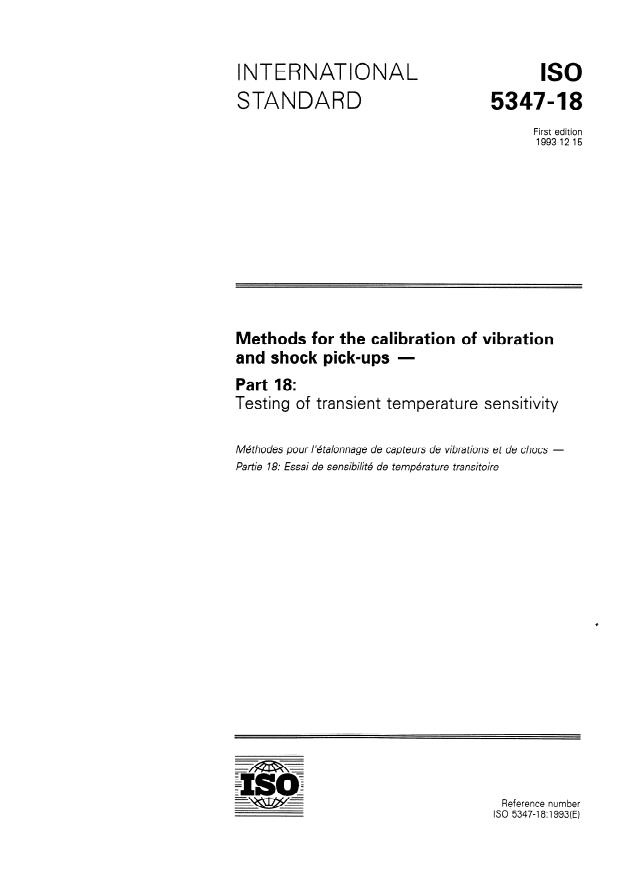
INTERNATIONAL
IS0
STANDARD
5347-18
First edition
1993-l 2-l 5
Methods for the calibration of vibration
and shock pick-ups -
Part 18:
Testing of transient temperature sensitivity
M&hodes pour I’Gtalonnage de capteurs de vibrations et de chocs -
Partie 18: Essai de sensibilit6 de temperature transitoire
Reference number
IS0 5347-l 8:1993(E)
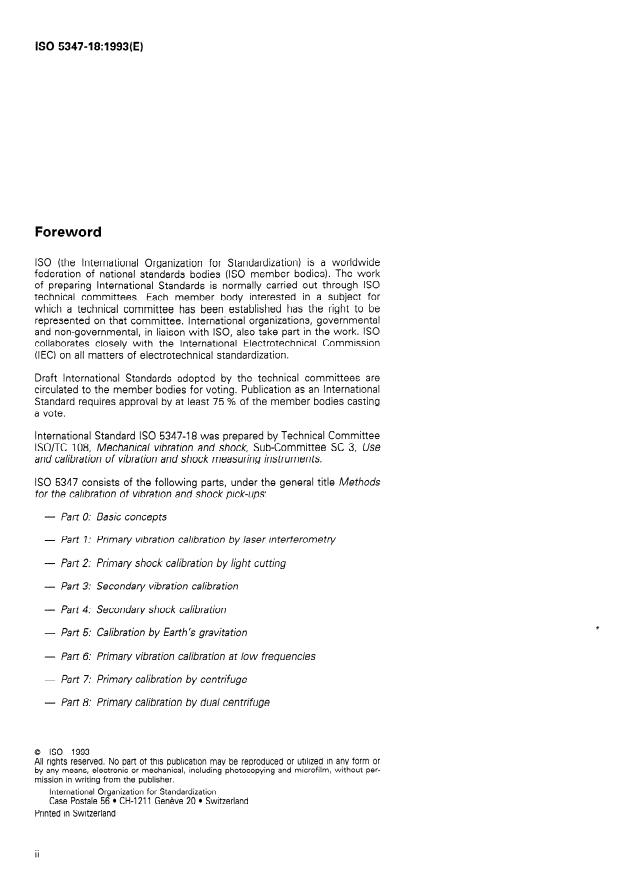
IS0 5347=18:1993(E)
Foreword
IS0 (the International Organization for Standardization) is a worldwide
federation of national standards bodies (IS0 member bodies). The work
of preparing International Standards is normally carried out through IS0
technical committees. Each member body interested in a subject for
which a technical committee has been established has the right to be
represented on that committee. International organizations, governmental
and non-governmental, in liaison with ISO, also take part in the work. IS0
collaborates closely with the International Electrotechnical Commission
(I EC) on all matters of electrotechnical standardization.
Draft International Standards adopted by the technical committees are
circulated to the member bodies for voting. Publication as an International
Standard requires approval by at least 75 % of the member bodies casting
a vote.
International Standard IS0 5347-l 8 was prepared by Technical Committee
ISO/TC 108, Mechanical vibration and shock, Sub-Committee SC 3, Use
and calibration of vibration and shock measuring instruments.
IS0 5347 consists of the following parts, under the general title Methods
for the calibration of vibration and shock pick-ups:
- Part 0: Basic concepts
- Part 1: Primary vibration calibration by laser interferometry
- Part 2: Primary shock calibration by light cutting
- Part 3: Secondary vibration calibration
- Part 4: Secondary shock calibration
- Part 5: Calibration by Earth’s gravitation
- Part 6: Primary vibration calibration at low frequencies
- Part 7: Primary calibration by centrifuge
- Part 8: Primary calibration by dual ten trifuge
0 IS0 1993
All rights reserved. No part of this publication may be reproduced or utilized in any form or
by any means, electronic or mechanical, including photocopying and microfilm, without per-
mission in writing from the publisher.
International Organization for Standardization
Case Postale 56 l CH-121% Geneve 20 l Switzerland
Printed in Switzerland
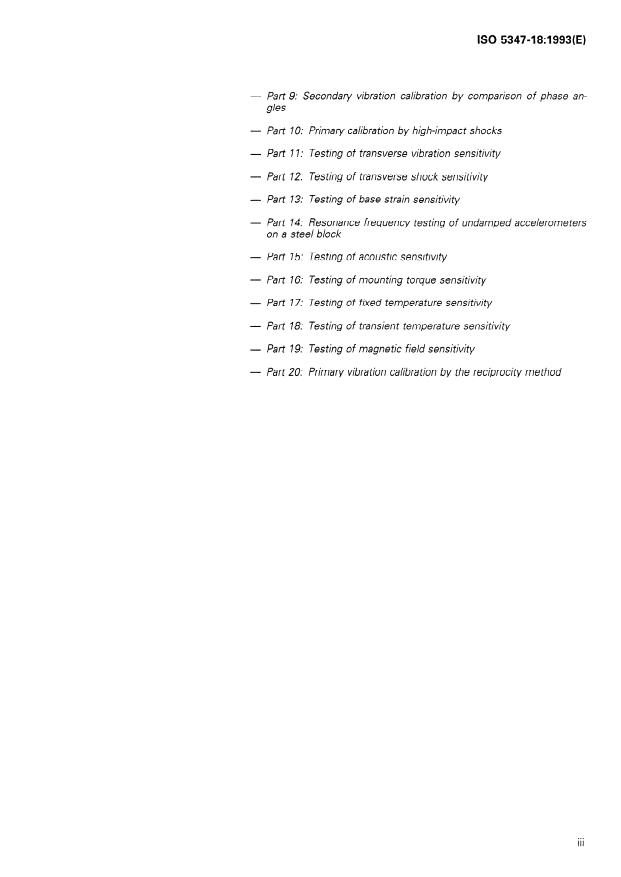
IS0 5347=18:1993(E)
- Part 9: Secondary vibration calibration by comparison of phase an-
gles
- Part IO: Primary calibration by high-impact shocks
- Part I?: Testing of transverse vibration sensitivity
- Part 12: Testing of transverse shock sensitivity
- Part 13: Testing of base strain sensitivity
- Part 14 Resonance frequency testing of undamped accelerometers
on a steel block
- Part 15: Testing of acoustic sensitivity
- Part 16: Testing of mounting torque sensitivity
- Part 17: Testing of fixed temperature sensitivity
- Part 18: Testing of transient temperature sensitivity
- Part 19: Testing of magnetic field sensitivity
- Part 20: Primary vibration ca
...
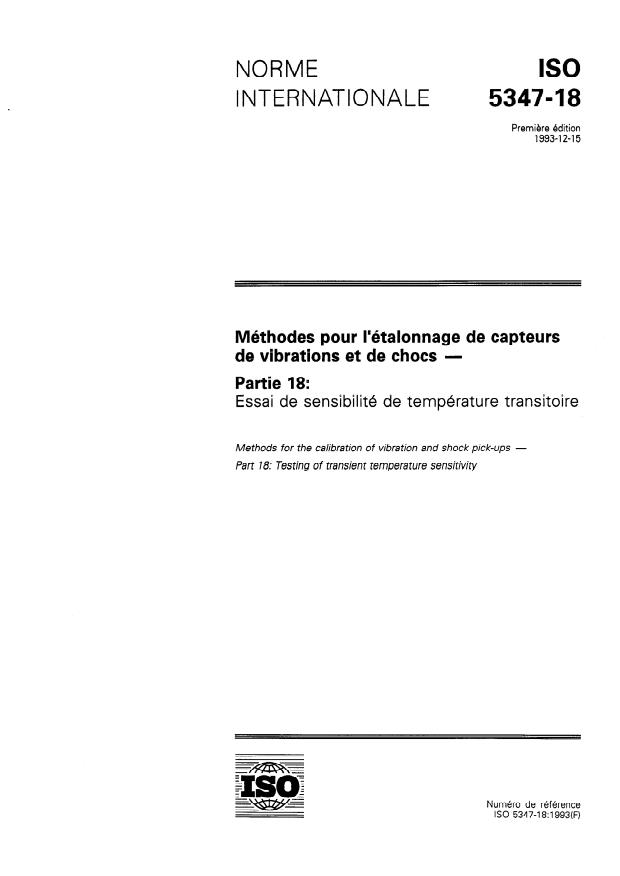
NORME ISO
INTERNATIONALE
Première édition
1993-l 2-l 5
Méthodes pour l’étalonnage de capteurs
de vibrations et de chocs -
Partie 18:
Essai de sensibilité de température transitoire
Methods for the calibration of vibration and shock pick-ups -
Part 18: Testing of transien t tempera ture sensitivity
Numéro de référence
ISO 5347-l 8:1993(F)
ISO 5347=18:1993(FJ)
Avant-propos
L’ISO (Organisation internationale de normalisation) est une fédération
mondiale d’organismes nationaux de normalisation (comités membres de
I’ISO). L’élaboration des Normes internationales est en général confiée aux
comités techniques de I’ISO. Chaque comité membre interessé par une
étude a le droit de faire partie du comité technique creé à cet effet. Les
organisations internationales, gouvernementales et non gouvernemen-
tales, en liaison avec I’ISO participent également aux travaux. L’ISO colla-
bore etroitement avec la Commission électrotechnique internationale (CEI)
en ce qui concerne la normalisation électrotechnique.
Les projets de Normes internationales adoptes par les comites techniques
sont soumis aux comites membres pour vote, Leur publication comme
Normes internationales requiert l’approbation de 75 % au moins des co-
mites membres votants.
La Norme internationale ISO 5347-18 a été élaboree par le comité techni-
que lSO/TC 108, Vibrations et chocs mécaniques, sous-comité SC 3, Uti-
lisa tion et étalonnage des instruments de mesure des vibrations et des
chocs.
L’ISO 5347 comprend les parties suivantes, présentees sous le titre gé-
néral Méthodes pour l’étalonnage de capteurs de vibrations et de chocs:
- Partie 0: Concepts de base
- Partie 1: Étalonnage primaire de vibrations avec interféromètre de
laser
- Partie 2: Étalonnage primaire de chocs par coupe de lumiere
- Partie 3: Étalonnage secondaire de vibrations
- Partie 4: Étalonnage secondaire de chocs
- Partie 5: Étalonnage par gravitation tellurique
- Partie 6: Étalonnage primaire de vibrations aux basses fréquences
- Partie 7: Étalonnage primaire par centrifugeur
- Partie 8: Étalonnage primaire par centrifugeur double
0 ISO 1993
Droits de reproduction réservés. Aucune partie de cette publication ne peut être reproduite
ni utilisee sous quelque forme que ce soit et par aucun procédé, electronique ou mécanique,
y compris la photocopie et les microfilms, sans l’accord écrit de I’editeur,
Organisation internationale de normalisation
Case Postale 56 l CH-1 211 Geneve 20 l Suisse
Imprimé en Suisse
II
ISO 5347=18:1993(F)
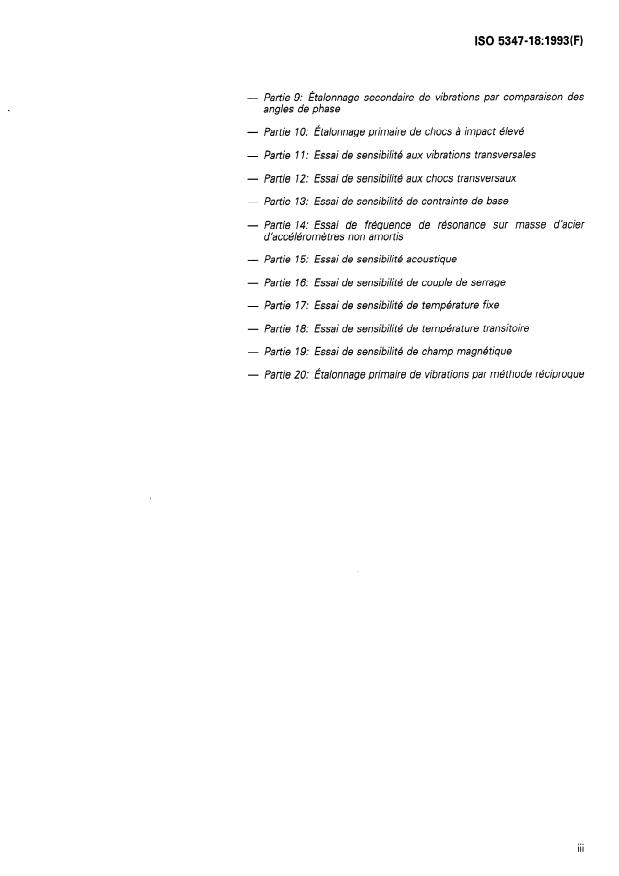
- Partie 9: Étalonnage secondaire de vibrations par comparaison des
angles de phase
- Partie 70: Étalonnage primaire de chocs a impact élevé
- Partie Il: Essai de sensibilité aux vibrations transversales
- Partie 12: Essai de sensibilité aux chocs transversaux
- Partie 13: Essai de sensibilite de contrain te de base
- Partie 14: Essai de fréquence de resonance sur masse d’acier
d’accéleromètres non amortis
- Partie 15: Essai de sensibilité acoustique
- Partie 16: Essai de sensibilite de couple de serrage
- Partie 17: Essai de sensibilite de température fixe
- Partie 18: Essai de sensibilite de température transitoire
- Partie 79s Essai de sensibilite de champ magnétique
- Partie 20: Étalonnage primaire de vibrations par méthode réciproque
. . .
III
-
...
NORME ISO
INTERNATIONALE
Première édition
1993-l 2-l 5
Méthodes pour l’étalonnage de capteurs
de vibrations et de chocs -
Partie 18:
Essai de sensibilité de température transitoire
Methods for the calibration of vibration and shock pick-ups -
Part 18: Testing of transien t tempera ture sensitivity
Numéro de référence
ISO 5347-l 8:1993(F)
ISO 5347=18:1993(FJ)
Avant-propos
L’ISO (Organisation internationale de normalisation) est une fédération
mondiale d’organismes nationaux de normalisation (comités membres de
I’ISO). L’élaboration des Normes internationales est en général confiée aux
comités techniques de I’ISO. Chaque comité membre interessé par une
étude a le droit de faire partie du comité technique creé à cet effet. Les
organisations internationales, gouvernementales et non gouvernemen-
tales, en liaison avec I’ISO participent également aux travaux. L’ISO colla-
bore etroitement avec la Commission électrotechnique internationale (CEI)
en ce qui concerne la normalisation électrotechnique.
Les projets de Normes internationales adoptes par les comites techniques
sont soumis aux comites membres pour vote, Leur publication comme
Normes internationales requiert l’approbation de 75 % au moins des co-
mites membres votants.
La Norme internationale ISO 5347-18 a été élaboree par le comité techni-
que lSO/TC 108, Vibrations et chocs mécaniques, sous-comité SC 3, Uti-
lisa tion et étalonnage des instruments de mesure des vibrations et des
chocs.
L’ISO 5347 comprend les parties suivantes, présentees sous le titre gé-
néral Méthodes pour l’étalonnage de capteurs de vibrations et de chocs:
- Partie 0: Concepts de base
- Partie 1: Étalonnage primaire de vibrations avec interféromètre de
laser
- Partie 2: Étalonnage primaire de chocs par coupe de lumiere
- Partie 3: Étalonnage secondaire de vibrations
- Partie 4: Étalonnage secondaire de chocs
- Partie 5: Étalonnage par gravitation tellurique
- Partie 6: Étalonnage primaire de vibrations aux basses fréquences
- Partie 7: Étalonnage primaire par centrifugeur
- Partie 8: Étalonnage primaire par centrifugeur double
0 ISO 1993
Droits de reproduction réservés. Aucune partie de cette publication ne peut être reproduite
ni utilisee sous quelque forme que ce soit et par aucun procédé, electronique ou mécanique,
y compris la photocopie et les microfilms, sans l’accord écrit de I’editeur,
Organisation internationale de normalisation
Case Postale 56 l CH-1 211 Geneve 20 l Suisse
Imprimé en Suisse
II
ISO 5347=18:1993(F)
- Partie 9: Étalonnage secondaire de vibrations par comparaison des
angles de phase
- Partie 70: Étalonnage primaire de chocs a impact élevé
- Partie Il: Essai de sensibilité aux vibrations transversales
- Partie 12: Essai de sensibilité aux chocs transversaux
- Partie 13: Essai de sensibilite de contrain te de base
- Partie 14: Essai de fréquence de resonance sur masse d’acier
d’accéleromètres non amortis
- Partie 15: Essai de sensibilité acoustique
- Partie 16: Essai de sensibilite de couple de serrage
- Partie 17: Essai de sensibilite de température fixe
- Partie 18: Essai de sensibilite de température transitoire
- Partie 79s Essai de sensibilite de champ magnétique
- Partie 20: Étalonnage primaire de vibrations par méthode réciproque
. . .
III
-
...