

EN 1032:2003+A1:2008
(Main + Amendment)Mechanical vibration - Testing of mobile machinery in order to determine the vibration emission value
- Abstract
This European Standard specifies the determination of whole-body and hand-arm vibration emissions at operator position(s) during testing of mobile machinery. The purpose of this European Standard is to assist technical standardization committees responsible for specific types of machinery in preparing vibration test codes to ensure that such vibration test codes
- are as homogeneous as possible with each individual test code having the same basic structure;
- are in full accordance with basic standards on measurement of vibration emission;
- reflect the latest technical knowledge of methods of determining the vibration emission from the specific family of machinery under consideration;
- provide manufacturers with a standardized method for the determination and declaration of the vibration emission value(s) of their machinery;
- enable the user of the machinery or the member of an inspection body to compare the vibration emission values of different machinery and to verify the vibration emission values provided by the manufacturer.
This European Standard provides requirements for the preparation of vibration test codes, including guidelines for the conditions under which the measurements shall be made (e.g. operating conditions). Information to be included in a typical vibration test code is summarized in annex A.
Vibration test codes based on this European Standard should define measuring procedures which provide accurate and reproducible results which are as far as possible in agreement with values measured under real working conditions. For determination of the magnitude of the vibration to be noted in the instruction handbook, this European Standard requires operating conditions enabling the determination of the 75-percentile of the vibration experienced at the operator's position during the mode of operation causing the highest vibration.
This European Standard applies to sitting and standing positions. It is applicable to all mobile machinery producing
- Status
- Published
- Publication Date
- 25-Nov-2008
- Withdrawal Date
- 27-Dec-2009
- Technical Committee
- CEN/TC 231 - Mechanical vibration and shock
- Drafting Committee
- CEN/TC 231/WG 1 - Whole-body vibration
- Current Stage
- 9093 - Decision to confirm - Review Enquiry
- Start Date
- 29-Sep-2022
- Completion Date
- 07-Oct-2026
- Directive
- 2006/42/EC - Directive 2006/42/EC of the European Parliament and of the Council of 17 May 2006 on machinery, and amending Directive 95/16/EC (recast)OJ Ref: C, C 214 OJ Date: 08-Sep-2009
98/37/EC - MachineryOJ Ref: C, C 74 OJ Date: 28-Mar-2009

Overview
EN 1032:2003+A1:2008 - Mechanical vibration - Testing of mobile machinery in order to determine the vibration emission value (CEN) defines a harmonized framework for measuring and declaring vibration emission from mobile machinery. It specifies how to determine whole‑body and hand‑arm vibration at the operator position(s) during tests, and gives requirements for preparing family‑specific vibration test codes so results are accurate, reproducible and comparable between machines and manufacturers.
Key points:
- Applies to sitting and standing operator positions and to periodic or random vibration (excluding rotational vibration).
- Requires test conditions that allow determination of the 75‑percentile vibration level experienced during the mode of operation causing the highest vibration.
- Aids technical committees, manufacturers, test laboratories, inspection bodies and users in standardizing measurement and declaration practices.
Key Topics and Requirements
- Structure of vibration test codes: Guidance to ensure homogeneity and a common basic structure across machine families.
- Measurement positions and directions: Defines operator locations, axes and transducer mounting to capture relevant whole‑body and hand‑arm exposures.
- Instrumentation and calibration: Requirements for accelerometers, mounting, frequency weighting, integration time and measurement-chain calibration (references to ISO/IEC calibration practices).
- Operating and testing conditions: Specification of machine configuration, optional components (e.g., tyres, seats), test tracks (natural or artificial), operator roles and environmental parameters to ensure representative results.
- Data treatment and reporting: Rules for calculating and declaring vibration emission values (r.m.s. frequency‑weighted acceleration) and guidance for verification and reproducibility.
- Annex guidance: Annex A summarizes typical information to include in a vibration test code; other annexes cover weighting curves, measurement errors, seat methods and test development procedures.
Applications and Users
EN 1032 is practical for:
- Manufacturers preparing standardized vibration declarations for instruction handbooks and product data.
- Standards committees developing type‑C vibration test codes for specific machinery families.
- Test laboratories and certification bodies conducting reproducible vibration measurements and type‑verification.
- Health & safety professionals and fleet buyers comparing vibration performance across models to inform procurement and risk mitigation.
- Inspection and compliance authorities verifying manufacturer declarations.
Keywords: EN 1032:2003+A1:2008, mechanical vibration, mobile machinery, vibration emission, whole‑body vibration, hand‑arm vibration, vibration test code, vibration measurement, operator position, vibration declaration.
Related Standards
- EN 12096 - Declaration and verification of vibration emission values
- EN ISO 8041 - Human response to vibration: measuring instrumentation
- EN 30326-1 / ISO 10326-1 - Vehicle seat vibration laboratory methods
- ISO 2631-1 and EN ISO 5349-1 - Guidance on human exposure to whole‑body and hand‑arm vibration (for health assessment reference)
Relations
- Effective Date
- 18-Jan-2023
- Effective Date
- 25-Aug-2026
- Effective Date
- 25-Aug-2026
- Effective Date
- 25-Aug-2026
- Effective Date
- 25-Aug-2026
- Effective Date
- 25-Aug-2026
- Effective Date
- 25-Aug-2026
- Effective Date
- 25-Aug-2026
- Effective Date
- 25-Aug-2026
- Effective Date
- 25-Aug-2026
- Effective Date
- 25-Aug-2026
- Effective Date
- 25-Aug-2026
- Effective Date
- 25-Aug-2026
- Effective Date
- 25-Aug-2026
- Effective Date
- 25-Aug-2026
Get Certified
Connect with accredited certification bodies for this standard

CIS Institut d.o.o.
Personal Protective Equipment (PPE) certification body. Notified Body NB-2890 for EU Regulation 2016/425 PPE.

Kiwa BDA Testing
Building and construction product certification.
Kmetijski inštitut Slovenije
Agricultural Institute of Slovenia. Soil testing, plant health, agricultural product analysis.
Sponsored listings
Frequently Asked Questions
EN 1032:2003+A1:2008 is a standard published by the European Committee for Standardization (CEN). Its full title is "Mechanical vibration - Testing of mobile machinery in order to determine the vibration emission value". This standard covers: This European Standard specifies the determination of whole-body and hand-arm vibration emissions at operator position(s) during testing of mobile machinery. The purpose of this European Standard is to assist technical standardization committees responsible for specific types of machinery in preparing vibration test codes to ensure that such vibration test codes - are as homogeneous as possible with each individual test code having the same basic structure; - are in full accordance with basic standards on measurement of vibration emission; - reflect the latest technical knowledge of methods of determining the vibration emission from the specific family of machinery under consideration; - provide manufacturers with a standardized method for the determination and declaration of the vibration emission value(s) of their machinery; - enable the user of the machinery or the member of an inspection body to compare the vibration emission values of different machinery and to verify the vibration emission values provided by the manufacturer. This European Standard provides requirements for the preparation of vibration test codes, including guidelines for the conditions under which the measurements shall be made (e.g. operating conditions). Information to be included in a typical vibration test code is summarized in annex A. Vibration test codes based on this European Standard should define measuring procedures which provide accurate and reproducible results which are as far as possible in agreement with values measured under real working conditions. For determination of the magnitude of the vibration to be noted in the instruction handbook, this European Standard requires operating conditions enabling the determination of the 75-percentile of the vibration experienced at the operator's position during the mode of operation causing the highest vibration. This European Standard applies to sitting and standing positions. It is applicable to all mobile machinery producing
This European Standard specifies the determination of whole-body and hand-arm vibration emissions at operator position(s) during testing of mobile machinery. The purpose of this European Standard is to assist technical standardization committees responsible for specific types of machinery in preparing vibration test codes to ensure that such vibration test codes - are as homogeneous as possible with each individual test code having the same basic structure; - are in full accordance with basic standards on measurement of vibration emission; - reflect the latest technical knowledge of methods of determining the vibration emission from the specific family of machinery under consideration; - provide manufacturers with a standardized method for the determination and declaration of the vibration emission value(s) of their machinery; - enable the user of the machinery or the member of an inspection body to compare the vibration emission values of different machinery and to verify the vibration emission values provided by the manufacturer. This European Standard provides requirements for the preparation of vibration test codes, including guidelines for the conditions under which the measurements shall be made (e.g. operating conditions). Information to be included in a typical vibration test code is summarized in annex A. Vibration test codes based on this European Standard should define measuring procedures which provide accurate and reproducible results which are as far as possible in agreement with values measured under real working conditions. For determination of the magnitude of the vibration to be noted in the instruction handbook, this European Standard requires operating conditions enabling the determination of the 75-percentile of the vibration experienced at the operator's position during the mode of operation causing the highest vibration. This European Standard applies to sitting and standing positions. It is applicable to all mobile machinery producing
EN 1032:2003+A1:2008 is classified under the following ICS (International Classification for Standards) categories: 13.160 - Vibration and shock with respect to human beings. The ICS classification helps identify the subject area and facilitates finding related standards.
EN 1032:2003+A1:2008 has the following relationships with other standards: It is inter standard links to EN 1032:2003, ISO 16063-1:1998, ISO 5348:1998, ISO 5347-22:1997, ISO 16063-12:2002, ISO 16063-11:1999, ISO 5347-11:1993, ISO 5347-19:1993, ISO 5347-18:1993, ISO 5347-14:1993, ISO 5347-8:1993, ISO 5347-5:1993, ISO 2041:1990, ISO 16063-13:2001, ISO 5347-10:1993. Understanding these relationships helps ensure you are using the most current and applicable version of the standard.
EN 1032:2003+A1:2008 is associated with the following European legislation: EU Directives/Regulations: 2006/42/EC, 98/37/EC; Standardization Mandates: M/396. When a standard is cited in the Official Journal of the European Union, products manufactured in conformity with it benefit from a presumption of conformity with the essential requirements of the corresponding EU directive or regulation.
EN 1032:2003+A1:2008 is available in PDF format for immediate download after purchase. The document can be added to your cart and obtained through the secure checkout process. Digital delivery ensures instant access to the complete standard document.
Standards Content (Sample)
2003-01.Slovenski inštitut za standardizacijo. Razmnoževanje celote ali delov tega standarda ni dovoljeno.Mehanske vibracije - Preskušanje mobilnih strojev za ugotavljanje vrednosti oddajanja vibracijMechanische Schwingungen - Prüfverfahren für bewegliche Maschinen zum Zwecke der Bestimmung des SchwingungsemissionswertesVibrations mécaniques - Essai des machines mobiles dans le but de déterminer la valeur d'émission vibratoireMechanical vibration - Testing of mobile machinery in order to determine the vibration emission value13.160Vpliv vibracij in udarcev na ljudiVibration and shock with respect to human beingsICS:Ta slovenski standard je istoveten z:EN 1032:2003+A1:2008SIST EN 1032:2004+A1:2009en01-februar-2009SIST EN 1032:2004+A1:2009SLOVENSKI
STANDARD
EUROPEAN STANDARD NORME EUROPÉENNE EUROPÄISCHE NORM
EN 1032:2003+A1
November 2008 ICS 13.160 Supersedes EN 1032:2003English Version
Mechanical vibration - Testing of mobile machinery in order to determine the vibration emission value
Vibrations mécaniques - Essai des machines mobiles dans le but de déterminer la valeur d'émission vibratoire
Mechanische Schwingungen - Prüfverfahren für bewegliche Maschinen zum Zwecke der Bestimmung des Schwingungsemissionswertes This European Standard was approved by CEN on 28 February 2003 and includes Amendment 1 approved by CEN on 5 October 2008.
CEN members are bound to comply with the CEN/CENELEC Internal Regulations which stipulate the conditions for giving this European Standard the status of a national standard without any alteration. Up-to-date lists and bibliographical references concerning such national standards may be obtained on application to the CEN Management Centre or to any CEN member.
This European Standard exists in three official versions (English, French, German). A version in any other language made by translation under the responsibility of a CEN member into its own language and notified to the CEN Management Centre has the same status as the official versions.
CEN members are the national standards bodies of Austria, Belgium, Bulgaria, Cyprus, Czech Republic, Denmark, Estonia, Finland, France, Germany, Greece, Hungary, Iceland, Ireland, Italy, Latvia, Lithuania, Luxembourg, Malta, Netherlands, Norway, Poland, Portugal, Romania, Slovakia, Slovenia, Spain, Sweden, Switzerland and United Kingdom.
EUROPEAN COMMITTEE FOR STANDARDIZATION
COMITÉ EUROPÉEN DE NORMALISATION EUROPÄISCHES KOMITEE FÜR NORMUNG
Management Centre: rue de Stassart, 36
B-1050 Brussels © 2008 CEN All rights of exploitation in any form and by any means reserved worldwide for CEN national Members. Ref. No. EN 1032:2003+A1:2008: ESIST EN 1032:2004+A1:2009
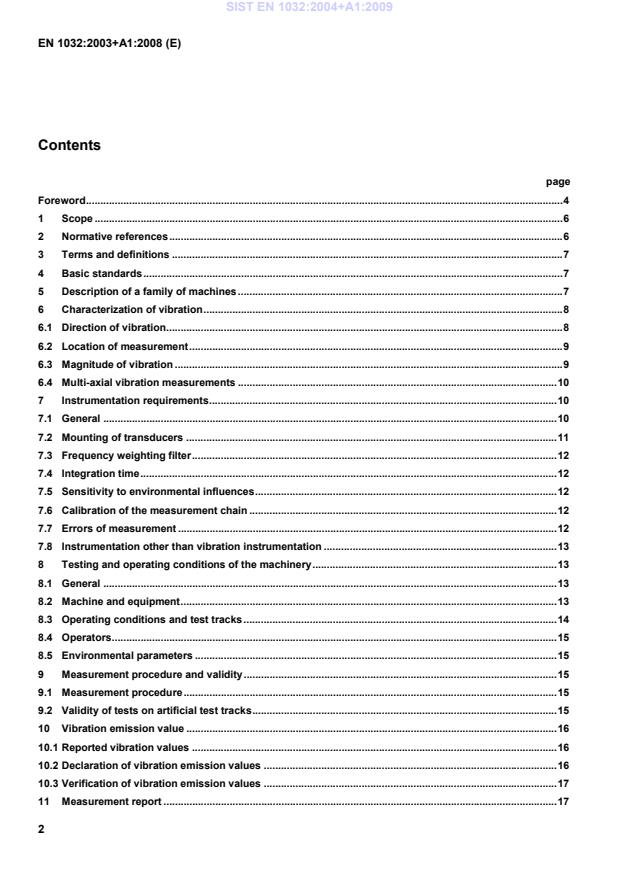
Summary of information to be given in the vibration test code.18 Annex B (informative)
Frequency weighting curves.20 Annex C (informative)
Possible sources of errors of measurement.22 Annex D (informative)
Alternative method for determination of vibration emission value in seats when a machine can be fitted with different models of seats.23 Annex E (informative)
Procedure for developing a test method for a specific category of mobile machines using artificial test track.24 Annex F (informative)
Procedure for developing a test method for a specific category of mobile machines using natural test track.26 Annex ZA (informative)
!Relationship between this European Standard and the Essential Requirements of EU Directive 98/37/EC".30 Annex ZB (informative)
!Relationship between this European Standard and the Essential Requirements of EU Directive 2006/42/EC".31 Bibliography.32
Key 1 Supporting surface NOTE For description of the directions, see 6.1.1. Figure 1 — Directions of the basicentric coordinate system for mechanical whole-body vibration influencing human beings 6.1.2 Translational hand-transmitted vibration from a steering wheel is related to the steering wheel as follows: x-direction: the radial direction, y-direction: the direction tangential to the rim of the steering wheel, z-direction: the direction orthogonal to both the x-direction and the y-direction. These directions are illustrated in Figure 2. SIST EN 1032:2004+A1:2009
NOTE For description of the directions, see 6.1.2. Figure 2 — Directions of measurement on steering wheels 6.2 Location of measurement 6.2.1 For whole-body vibration measurements, vibration should be determined as close as possible to the point or area through which the vibration is transmitted to the body. a) In the case where the exposed persons are sitting, the transducer mounted in a semi-rigid disc (see 7.2) shall be placed on the surface of the seat such that the transducer is located midway between the ischial tuberosities of the seated person. For comfort reasons, it is acceptable if the centre of the disc is located slightly in front (up to 5 cm) of the ischial tuberosities. b) In the case where the exposed persons are standing on a driving or a working platform, the transducer shall be located with the operator standing as in Figure 1 with the transducer midway between the arches of the feet. NOTE Backrest vibration is not dealt with in this European Standard. 6.2.2 For hand-transmitted vibration measurements, vibration should be determined as close as possible to the point or area through which the vibration is transmitted to the hand. Measurements on the steering wheel shall be carried out adjacent to the normal position of a hand guiding the steering wheel. If the test code also requires measurements to be made on controls (e.g. levers), they shall be carried out as close as possible to the hand which touches the control in a normal way. 6.3 Magnitude of vibration The quantity used to describe the magnitude of vibration shall be frequency-weighted acceleration in m/s2, expressed as a root-mean-square (r.m.s.) value aw. Frequency weightings to be used are defined in 7.3. The acceleration aw in accordance with this European Standard is defined as the r.m.s. value of the frequency-weighted acceleration signal aw(t): SIST EN 1032:2004+A1:2009
(1) Requirements for the integration time T are given in 7.4. NOTE 1 Frequency analysis is recommended in order to check the validity of the measurements and to provide information for the improvement of designs. NOTE 2 The measurement of hand-transmitted vibration should be inspected for the effects of operator-induced movements and either these effects removed from the signal or a period selected for analysis which is free of these artefacts. 6.4 Multi-axial vibration measurements The measurements shall normally be made in three directions. The following values shall be determined. For whole-body vibration:
awx, awy, awz
(2a) aw max = max{1,4 awx, 1,4 awy, awz}
(2b) For hand-transmitted vibration:
ahwx, ahwy, ahwz
(3a) []212hwz2hwy2hwxhv/aaaa++=
(3b) where awx, awy and awz (for hand-transmitted vibration ahwx, ahwy and ahwz) are the r.m.s. values of the frequency-weighted acceleration in the x-direction, y-direction and z-direction, respectively. NOTE Where it is shown that there is a dominant direction, the vibration test code can specify that the vibration be measured in one direction only, which needs to be stated. For hand-transmitted vibration, in this case the value ahv is the r.m.s. value of the weighted acceleration in that direction. A direction can be regarded as dominant when the r.m.s. value of the frequency-weighted acceleration in each of the other directions, in the case of whole-body vibration multiplied by 1,4 for x- and y-directions, is less than 66 % of that in the dominant direction. 7 Instrumentation requirements 7.1 General Unless otherwise specified by the relevant vibration test code the dynamic range, sensitivity, accuracy, linearity and overload capacity of the vibration measuring system shall be in accordance with !EN ISO 8041". Measuring equipment may comprise transducers (usually accelerometers), conditioning amplifiers and filters, telemetry set (optional), recorders and/or meters. !The tolerances of the vibration measuring instrumentation are specified in EN ISO 8041." SIST EN 1032:2004+A1:2009
Key 1 Thin metal disc for accelerometer mount and added centre rigidity 2 Appropriate cavity for accelerometer(s) Figure 3 — Design of a semi-rigid mounting disc The disc shall be as thin as possible and be of approximately 80 Shore-A to 90 Shore-A moulded rubber or plastic material. NOTE 1 For practical reasons, it is usually not possible to perfectly align the accelerometers in the disc with the directions of the basicentric coordinate system. In a tolerance range within ± 15° of the appropriate directions the accelerometers can be considered as aligned parallel to these directions. The transducers used for the measurement at the feet of a standing operator shall be rigidly fixed on the working platform. If the working platform is covered by a resilient material, the transducers may be mounted in the middle of a rigid metal plate (about 300 mm × 400 mm) with the operator standing on the plate. The transducers used for hand-transmitted vibration measurements on the steering wheel shall be mounted firmly to the steering wheel, for example by using a threaded stud or clamp. The total mass of the accelerometers and mounting devices (stud or clamp) should not be more than 50 g (and preferably not more than 30 g). The mounting device should be selected to minimize the distance between the accelerometers and the vibrating surface of the steering wheel and the distance should not exceed 15 mm. NOTE 2 There are several problems in making repeatable measurements on a steering wheel. In particular, the measurement can be strongly affected by steering movements made by the operator. Care is needed to minimize these, e.g. by making the measurements during travelling on a straight course. NOTE 3 Tangling of signal carrying wires on the steering column can be eliminated by attaching the wires to a spoke on the steering wheel and trailing them to the centre of the wheel. Alternative mounting conditions or specific formed mounting discs or adaptors may be specified in the specific vibration test code. SIST EN 1032:2004+A1:2009
!EN ISO 8041". 7.6 Calibration of the measurement chain The whole measurement chain shall be checked both before and after a sequence of measurements. NOTE It is also important to check regularly that the whole measurement chain is also calibrated at other frequencies throughout the frequency range of interest. In addition to regular calibration (e.g. every two years), calibration is also necessary after rough handling of any important part of the measurement chain. The results of the calibration check shall be recorded. The transducers shall be calibrated in accordance with ISO 5347 and ISO 16063. The whole measurement chain shall be checked following the requirements in !EN ISO 8041". 7.7 Errors of measurement Annex C provides information on possible sources of errors of measurement. SIST EN 1032:2004+A1:2009
...