


ISO 16812:2019
(Main)Petroleum, petrochemical and natural gas industries - Shell-and-tube heat exchangers
Petroleum, petrochemical and natural gas industries - Shell-and-tube heat exchangers
This document specifies requirements and gives recommendations for the mechanical design, material selection, fabrication, inspection, testing and preparation for shipment of shell-and-tube heat exchangers for the petroleum, petrochemical and natural gas industries. This document supplements API Std 660, 9th edition (2015), the requirements of which are applicable with the exceptions specified in this document. This document is applicable to the following types of shell-and-tube heat exchangers: heaters, condensers, coolers and reboilers. This document is not applicable to vacuum-operated steam surface condensers and feed-water heaters.
Industries du pétrole, de la pétrochimie et du gaz naturel — Échangeurs de chaleur à faisceaux
General Information
- Status
- Published
- Publication Date
- 30-Jan-2019
- Technical Committee
- ISO/TC 67/SC 6 - Processing equipment and systems
- Drafting Committee
- ISO/TC 67/SC 6/WG 8 - Process heat transfer equipment
- Current Stage
- 9093 - International Standard confirmed
- Start Date
- 01-Oct-2024
- Completion Date
- 13-Dec-2025
Relations
- Effective Date
- 06-Jun-2022
- Effective Date
- 05-Aug-2017
Overview
ISO 16812:2019 - Petroleum, petrochemical and natural gas industries - Shell-and-tube heat exchangers - specifies mechanical design, material selection, fabrication, inspection, testing and preparation for shipment of shell‑and‑tube heat exchangers used in the petroleum, petrochemical and natural gas sectors. It supplements API Std 660 (9th ed., 2015) and applies to heaters, condensers, coolers and reboilers (excluding vacuum‑operated steam surface condensers and feed‑water heaters).
Key topics and technical requirements
- Scope of application: Requirements for mechanical design, materials, fabrication, inspection, testing and shipment of shell‑and‑tube heat exchangers for hydrocarbon industries.
- Supplementary rules to API Std 660: ISO 16812:2019 is intended to be used together with API Std 660, with specific exceptions and additions identified in the standard.
- Materials for sour/H2S service: References ISO 15156 (in place of NACE MR0175) and ISO 17945 (in place of NACE MR0103) for carbon steel and other metallic material requirements in H2S‑containing and sulfide stress cracking environments.
- Welding and heat treatment: Weld procedure qualification and heat treatment requirements expanded; ISO references replace some NACE/API references for qualification.
- Service‑specific design provisions: Enhanced guidance for cyclic service, sour service and tube failure in high‑pressure units. ISO 23251 is referenced where API Std 521 was previously cited for certain relief/depressuring considerations.
- Mechanical design updates: Changes include increased minimum bend for U‑tubes in stainless/duplex materials, limits on threaded connections in wet H2S service, restrictions on nozzle reinforcement pads for certain high‑temperature or cyclic hydrogen services, improved girth flange joint options, inlet impingement rod requirements, and enhanced gasket requirements.
- Quality assurance: Significant expansion of QA and recommended practice clauses to support consistent fabrication and inspection.
Applications and users
ISO 16812:2019 is used by:
- Heat exchanger designers and mechanical engineers specifying shell‑and‑tube exchangers
- Fabricators and manufacturers responsible for welding, testing and shipment
- Procurement specialists and purchasers in oil, gas and petrochemical plants
- Inspection, QA and regulatory compliance teams verifying material and fabrication conformance
- Plant operators specifying exchangers for heaters, condensers, coolers and reboilers, especially where sour/H2S or cyclic service is present
Practical uses include preparing purchaser specifications, designing exchanger mechanicals for sour or cyclic environments, selecting materials and welding procedures, and defining inspection/test plans.
Related standards
- API Std 660 (9th ed., 2015) - Shell‑and‑tube heat exchangers (primary reference)
- ISO 15156 (all parts) - Materials for H2S environments
- ISO 17945 - Resistance to sulfide stress cracking
- ISO 23251 - Pressure‑relieving and depressuring systems (referenced for high‑pressure tube failure provisions)
- API Std 521 - (listed in bibliography; ISO 23251 replaces it for specific clauses)
Keywords: ISO 16812:2019, shell‑and‑tube heat exchangers, API Std 660, petroleum, petrochemical, natural gas, sour service, H2S, material selection, fabrication, inspection, testing, heat exchanger design.
Frequently Asked Questions
ISO 16812:2019 is a standard published by the International Organization for Standardization (ISO). Its full title is "Petroleum, petrochemical and natural gas industries - Shell-and-tube heat exchangers". This standard covers: This document specifies requirements and gives recommendations for the mechanical design, material selection, fabrication, inspection, testing and preparation for shipment of shell-and-tube heat exchangers for the petroleum, petrochemical and natural gas industries. This document supplements API Std 660, 9th edition (2015), the requirements of which are applicable with the exceptions specified in this document. This document is applicable to the following types of shell-and-tube heat exchangers: heaters, condensers, coolers and reboilers. This document is not applicable to vacuum-operated steam surface condensers and feed-water heaters.
This document specifies requirements and gives recommendations for the mechanical design, material selection, fabrication, inspection, testing and preparation for shipment of shell-and-tube heat exchangers for the petroleum, petrochemical and natural gas industries. This document supplements API Std 660, 9th edition (2015), the requirements of which are applicable with the exceptions specified in this document. This document is applicable to the following types of shell-and-tube heat exchangers: heaters, condensers, coolers and reboilers. This document is not applicable to vacuum-operated steam surface condensers and feed-water heaters.
ISO 16812:2019 is classified under the following ICS (International Classification for Standards) categories: 27.060.30 - Boilers and heat exchangers; 75.180.20 - Processing equipment. The ICS classification helps identify the subject area and facilitates finding related standards.
ISO 16812:2019 has the following relationships with other standards: It is inter standard links to ISO 702-2:2007, ISO 16812:2007. Understanding these relationships helps ensure you are using the most current and applicable version of the standard.
ISO 16812:2019 is available in PDF format for immediate download after purchase. The document can be added to your cart and obtained through the secure checkout process. Digital delivery ensures instant access to the complete standard document.
Standards Content (Sample)
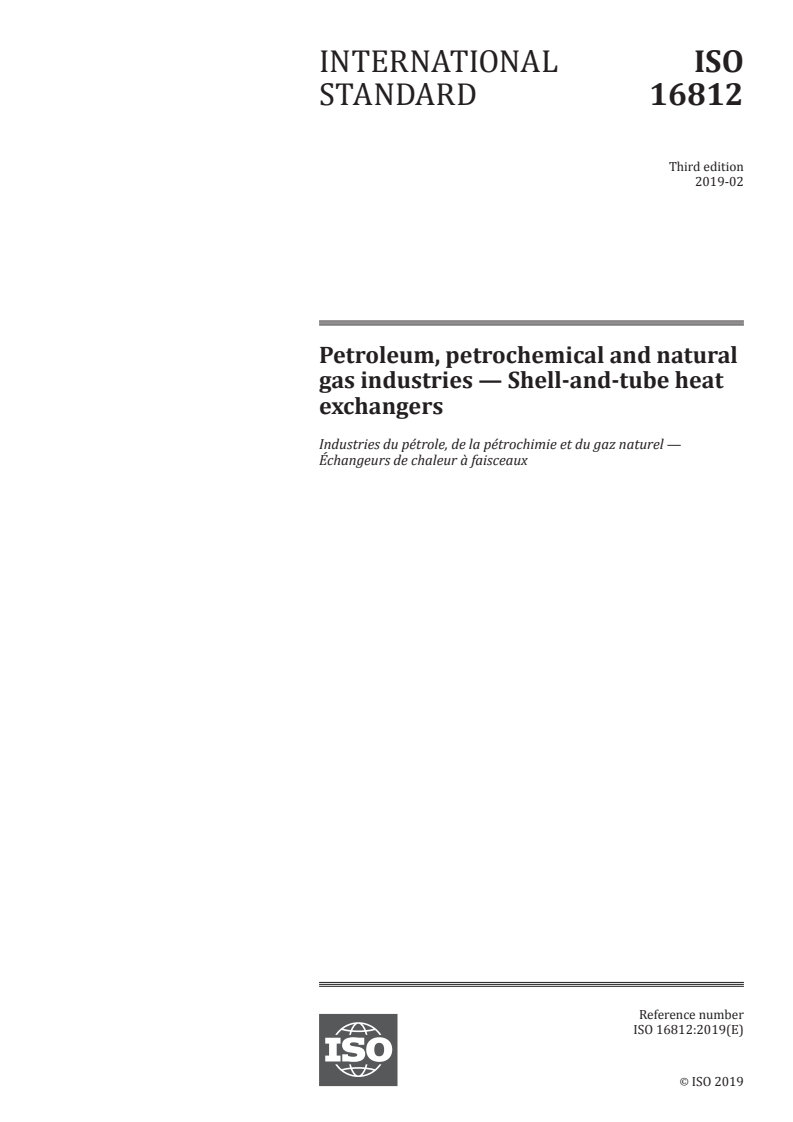
INTERNATIONAL ISO
STANDARD 16812
Third edition
2019-02
Petroleum, petrochemical and natural
gas industries — Shell-and-tube heat
exchangers
Industries du pétrole, de la pétrochimie et du gaz naturel —
Échangeurs de chaleur à faisceaux
Reference number
©
ISO 2019
© ISO 2019
All rights reserved. Unless otherwise specified, or required in the context of its implementation, no part of this publication may
be reproduced or utilized otherwise in any form or by any means, electronic or mechanical, including photocopying, or posting
on the internet or an intranet, without prior written permission. Permission can be requested from either ISO at the address
below or ISO’s member body in the country of the requester.
ISO copyright office
CP 401 • Ch. de Blandonnet 8
CH-1214 Vernier, Geneva
Phone: +41 22 749 01 11
Fax: +41 22 749 09 47
Email: copyright@iso.org
Website: www.iso.org
Published in Switzerland
ii © ISO 2019 – All rights reserved
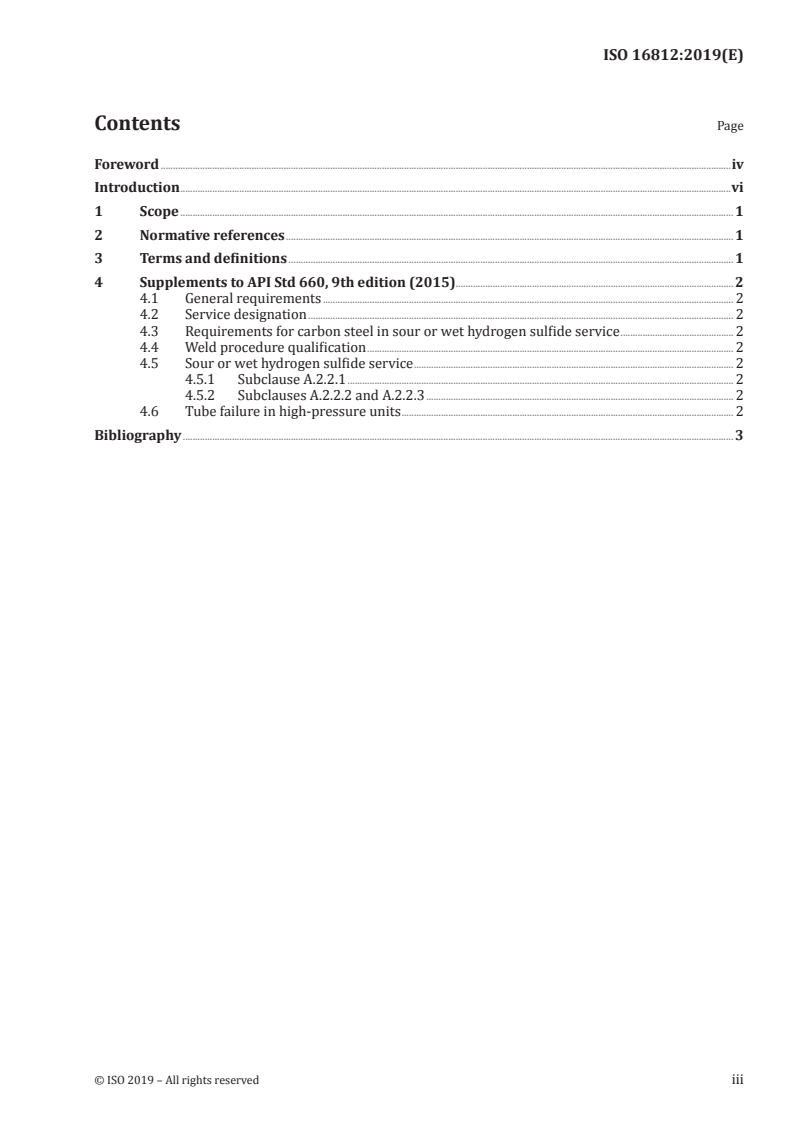
Contents Page
Foreword .iv
Introduction .vi
1 Scope . 1
2 Normative references . 1
3 Terms and definitions . 1
4 Supplements to API Std 660, 9th edition (2015). 2
4.1 General requirements . 2
4.2 Service designation . 2
4.3 Requirements for carbon steel in sour or wet hydrogen sulfide service . 2
4.4 Weld procedure qualification . 2
4.5 Sour or wet hydrogen sulfide service . 2
4.5.1 Subclause A.2.2.1 . 2
4.5.2 Subclauses A.2.2.2 and A.2.2.3 . 2
4.6 Tube failure in high-pressure units . 2
Bibliography . 3
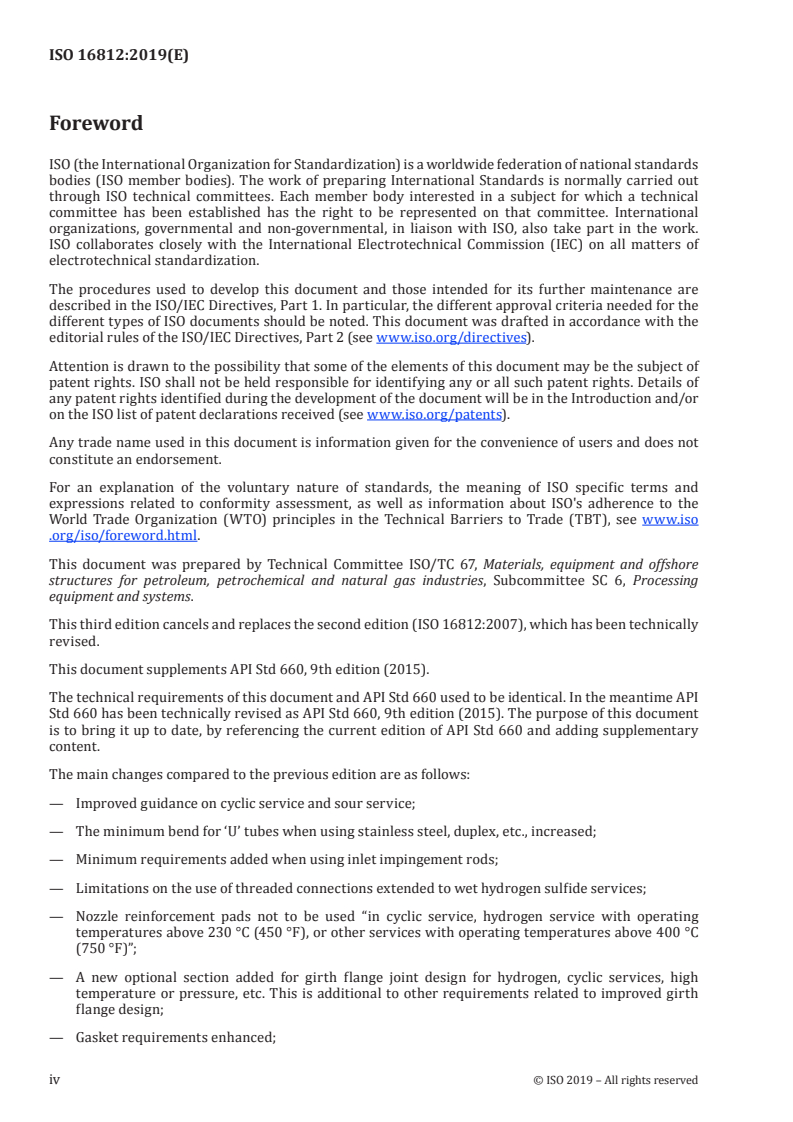
Foreword
ISO (the International Organization for Standardization) is a worldwide federation of national standards
bodies (ISO member bodies). The work of preparing International Standards is normally carried out
through ISO technical committees. Each member body interested in a subject for which a technical
committee has been established has the right to be represented on that committee. International
organizations, governmental and non-governmental, in liaison with ISO, also take part in the work.
ISO collaborates closely with the International Electrotechnical Commission (IEC) on all matters of
electrotechnical standardization.
The procedures used to develop this document and those intended for its further maintenance are
described in the ISO/IEC Directives, Part 1. In particular, the different approval criteria needed for the
different types of ISO documents should be noted. This document was drafted in accordance with the
editorial rules of the ISO/IEC Directives, Part 2 (see www .iso .org/directives).
Attention is drawn to the possibility that some of the elements of this document may be the subject of
patent rights. ISO shall not be held responsible for identifying any or all such patent rights. Details of
any patent rights identified during the development of the document will be in the Introduction and/or
on the ISO list of patent declarations received (see www .iso .org/patents).
Any trade name used in this document is information given for the convenience of users and does not
constitute an endorsement.
For an explanation of the voluntary nature of standards, the meaning of ISO specific terms and
expressions related to conformity assessment, as well as information about ISO's adherence to the
World Trade Organization (WTO) principles in the Technical Barriers to Trade (TBT), see www .iso
.org/iso/foreword .html.
This document was prepared by Technical Committee ISO/TC 67, Materials, equipment and offshore
structures for petroleum, petrochemical and natural gas industries, Subcommittee SC 6, Processing
equipment and systems.
This third edition cancels and replaces the second edition (ISO 16812:2007), which has been technically
revised.
This document supplements API Std 660, 9th edition (2015).
The technical requirements of this document and API Std 660 used to be identical. In the meantime API
Std 660 has been technically revised as API Std 660, 9th edition (2015). The purpose of this document
is to bring it up to date, by referencing the current edition of API Std 660 and adding supplementary
content.
The main changes compared to the previous edition are as follows:
— Improved guidance on cyclic service and sour service;
— The minimum bend for ‘U’ tubes when using stainless steel, duplex, etc., increased;
— Minimum requirements added w
...
Questions, Comments and Discussion
Ask us and Technical Secretary will try to provide an answer. You can facilitate discussion about the standard in here.
Loading comments...