

ISO/IEC 38501-1:2026
(Main)Information technology — Governance of IT implementation guidance — Part 1: General approach
- Abstract
This document provides guidance on the implementation of effective governance of IT in an organization, in accordance with ISO/IEC 38500. It identifies the key activities that an organization can undertake and provides guidance on the design and establishment of the supporting and enabling arrangements for the governance of IT, clarifying the roles and responsibilities of key organizational stakeholders. This document can be used by individuals responsible for governance of IT in an organization, as well as individuals supporting the governance of IT in organizations, and is applicable to organizations of all sizes and types.
- Status
- Published
- Publication Date
- 06-Oct-2026
- Technical Committee
- ISO/IEC JTC 1/SC 40 - IT service management and IT governance
- Drafting Committee
- ISO/IEC JTC 1/SC 40/WG 1 - Governance of InformationTechnology
- Current Stage
- 6060 - International Standard published - 60 Publication
- Start Date
- 07-Oct-2026
- Due Date
- 07-Oct-2026
- Completion Date
- 07-Oct-2026
ISO/IEC 38501-1:2026 is an ISO/IEC International Standard that gives guidance on implementing effective governance of IT in an organization in accordance with ISO/IEC 38500. It explains the key activities, supporting arrangements, and stakeholder roles needed to put governance of IT into practice. The document is written for people responsible for governance of IT, and for those who support that work, in organizations of all sizes and types.
What does ISO/IEC 38501-1:2026 specify?
ISO/IEC 38501-1:2026 specifies a general approach for implementing governance of IT, not a separate set of governance principles. It shows how an organization can organize leadership, decision-making, monitoring, and review so that the use of IT supports organizational goals and responsibilities.
The document is organized into:
- Clause 4 - implementation approach
- Clause 5 - sponsorship
- Clause 6 - enabling mechanisms
- Clause 7 - governance tasks
- Clause 8 - continual review
Clause 4 frames implementation as a cycle that starts with sponsorship and enabling mechanisms, then applies the governance tasks of engage, evaluate, direct, and monitor. In practice, this helps readers see governance of IT as an ongoing management activity rather than a one-time project.
What are the key requirements of ISO/IEC 38501-1:2026?
Clause 4 - implement governance of IT as a cycle
ISO/IEC 38501-1:2026 says implementation should combine the governance tasks with the framework elements from ISO/IEC 38500 and should be repeated over time. The initial cycle establishes a baseline, and later cycles support continual improvement. This matters because organizations change, and their governance arrangements need to be reviewed as IT, business needs, and risks evolve.
Clause 5 - secure sponsorship and leadership
ISO/IEC 38501-1:2026 requires clear leadership and commitment from the governing body and executive managers, with a selected sponsor to lead implementation. It also says the sponsor should be a key influential business, marketing, or operations executive manager, not a risk or governance specialist. In practice, this keeps implementation anchored in business leadership and makes it more likely that changes are accepted across the organization.
Clause 6 - put enabling mechanisms in place
ISO/IEC 38501-1:2026 says effective governance of IT is enabled by a framework, a governance support group, and appropriate governing body committees. The framework in Clause 6.2 has six elements: Direction, Capability, Policy, Delegation, Performance, and Accountability. For readers, this means governance needs named responsibilities, decision paths, and reporting lines, not just policies on paper.
Clause 6.3 describes the governance support group as the body that drives adoption or transformation, coordinates activities, and handles administration and reporting. Clause 6.4 points to committees such as audit, finance, investment, resourcing, and risk committees, and allows a strategic or innovation subcommittee where needed. This helps the governing body manage IT through existing governance structures instead of creating parallel ones.
Clause 7 - engage, evaluate, direct, and monitor
ISO/IEC 38501-1:2026 treats stakeholder engagement as an ongoing task covering internal and external stakeholders. It then uses evaluation to understand the internal and external environment and the current state of IT use, direction to define the desired state and identify gaps, and monitoring to track evidence of success. In practice, this gives organizations a repeatable way to move from understanding their situation to deciding changes and checking results.
Clause 8 - review and improve continuously
ISO/IEC 38501-1:2026 requires continual review after the first cycle has established a baseline. The governing body should use review and, where appropriate, audit and independent assessments to confirm that governance is effective and that the desired outcomes are being achieved. This matters because governance of IT should adapt as the organization, its risks, and its digital environment change.
What terms does ISO/IEC 38501-1:2026 define?
- Information technology (IT) is the subject of the standard - the document is about governing how IT is used, directed, and monitored in the organization.
- Internet of things (IoT) refers to one of the emerging digital technologies named in the introduction as affecting organizational outcomes and IT use.
- Artificial intelligence (AI) is another emerging technology named in the introduction as part of the changing IT landscape.
- Governing body is the body that provides direction and oversight for governance of IT and receives reporting for decisions.
- Governance support group is the small group, or sometimes an individual, that coordinates implementation, administration, and reporting for governance of IT.
- Evidence of success is the set of qualitative or quantitative signs used to show whether the desired state for the use of IT is being achieved.
Who uses ISO/IEC 38501-1:2026?
ISO/IEC 38501-1:2026 is used by governing bodies, executive managers, business managers, IT staff, and people supporting governance, risk, assurance, and compliance activities. It is also relevant to committees such as audit, finance, investment, resourcing, and risk committees. Organizations use it when they need a practical way to set up, run, and review governance of IT across the business.
What changed in ISO/IEC 38501-1:2026 from the previous edition?
- This first edition cancels and replaces ISO/IEC TS 38501:2015.
- The content has been aligned to reflect updates in ISO/IEC 38500:2024.
- Annex A on the assessment scheme and Annex B on sample characteristics by principle were moved to ISO/IEC TS 38501-2 to support alignment and use with ISO/IEC 38503.
Which standards are used with ISO/IEC 38501-1:2026?
| Standard | What it contributes |
|---|---|
| ISO/IEC 38500 | Normative reference; provides the governance of IT principles, model, and framework used throughout the document. |
| ISO/IEC TR 38502 | Provides further guidance on the governance of IT framework and model, including role distinctions. |
| ISO/IEC 38503 | Covers assessment of the governance of IT and is referenced for roles, responsibilities, competencies, and independent assessment. |
| ISO/IEC TS 38501-2:2026 | Provides the assessment scheme and examples used with this part, including sample assessment criteria. |
What does the ISO/IEC 38501-1:2026 document contain?
ISO/IEC 38501-1:2026 contains a figure for the overall implementation approach and a figure for the six-element governance framework. It also contains structured narrative guidance on sponsorship, enabling mechanisms, stakeholder engagement, evaluation, direction, monitoring, and continual review. The body text includes practical lists of considerations for internal and external context, gap analysis, change programmes, and evidence of success.
Relations
- Effective Date
- 31-Oct-2026
Get Certified
Connect with accredited certification bodies for this standard

BSI Group
BSI (British Standards Institution) is the business standards company that helps organizations make excellence a habit.

Bureau Veritas
Bureau Veritas is a world leader in laboratory testing, inspection and certification services.

DNV
DNV is an independent assurance and risk management provider.
Sponsored listings
Frequently Asked Questions
ISO/IEC 38501-1:2026 is a standard published by the International Organization for Standardization (ISO). Its full title is "Information technology — Governance of IT implementation guidance — Part 1: General approach". This standard covers: This document provides guidance on the implementation of effective governance of IT in an organization, in accordance with ISO/IEC 38500. It identifies the key activities that an organization can undertake and provides guidance on the design and establishment of the supporting and enabling arrangements for the governance of IT, clarifying the roles and responsibilities of key organizational stakeholders. This document can be used by individuals responsible for governance of IT in an organization, as well as individuals supporting the governance of IT in organizations, and is applicable to organizations of all sizes and types.
This document provides guidance on the implementation of effective governance of IT in an organization, in accordance with ISO/IEC 38500. It identifies the key activities that an organization can undertake and provides guidance on the design and establishment of the supporting and enabling arrangements for the governance of IT, clarifying the roles and responsibilities of key organizational stakeholders. This document can be used by individuals responsible for governance of IT in an organization, as well as individuals supporting the governance of IT in organizations, and is applicable to organizations of all sizes and types.
ISO/IEC 38501-1:2026 is classified under the following ICS (International Classification for Standards) categories: 03.100.02 - Governance and ethics; 35.020 - Information technology (IT) in general. The ICS classification helps identify the subject area and facilitates finding related standards.
ISO/IEC 38501-1:2026 has the following relationships with other standards: It is inter standard links to ISO/IEC TS 38501:2015. Understanding these relationships helps ensure you are using the most current and applicable version of the standard.
ISO/IEC 38501-1:2026 is available in PDF format for immediate download after purchase. The document can be added to your cart and obtained through the secure checkout process. Digital delivery ensures instant access to the complete standard document.
Standards Content (Sample)
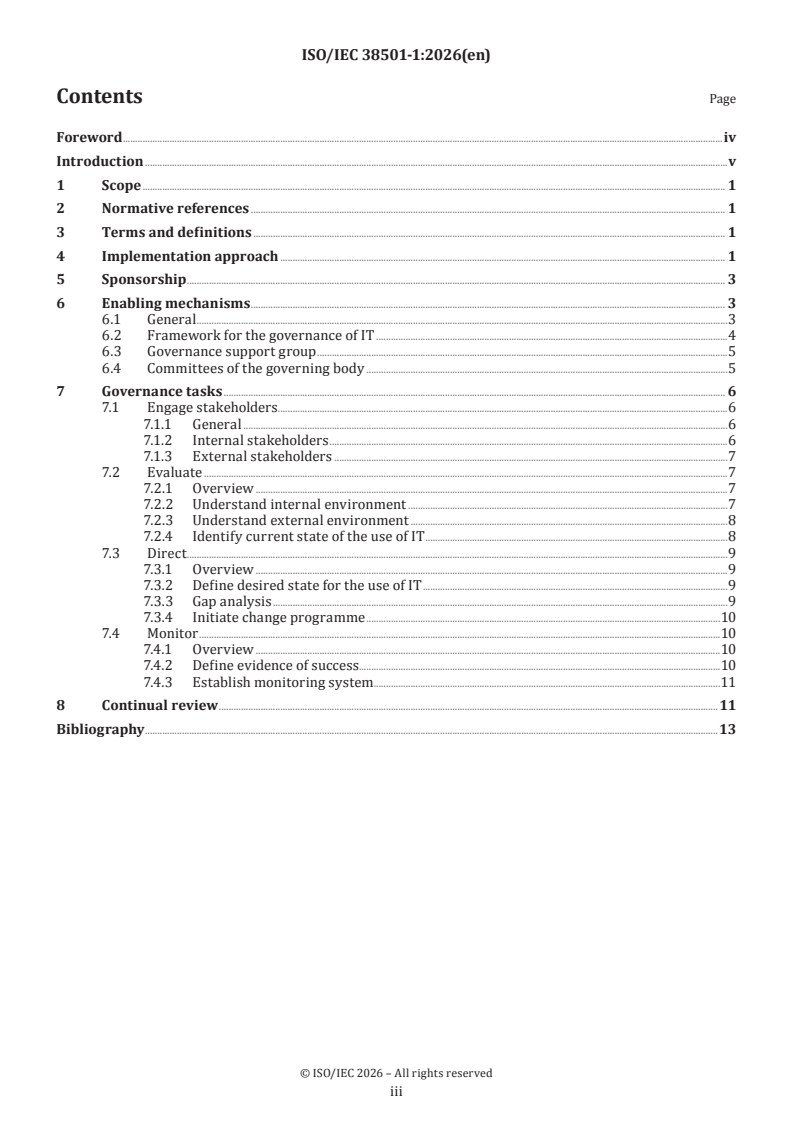
Contents
- Introduction
- 1 Scope
- 2 Normative references
- 3 Terms and definitions
- 4 Implementation approach
- 5 Sponsorship
- 6 Enabling mechanisms
- 6.1 General
- 6.2 Framework for the governance of IT
- 6.3 Governance support group
- 6.4 Committees of the governing body
- 7 Governance tasks
- 7.1 Engage stakeholders
- 7.2 Evaluate
- 7.3 Direct
- 7.4 Monitor
- 8 Continual review
- Bibliography
Introduction
Information technology (IT) is now pervasive in supporting, enabling and transforming the strategy and business opportunities of organizations. The extensive use of data, coupled with the rapid adoption of digital capabilities and powerful emerging technologies, such as cloud computing, the internet of things (IoT) and artificial intelligence (AI), can substantially improve organizational outcomes, thereby enabling organizations to meet the needs and expectations of their various stakeholders. However, the deployment and use of information technology is not without challenges, including the increasing prevalence of cybersecurity threats, stringent legislative and regulatory environments, failure to achieve planned benefits from IT investments, and the potential for financial and reputational damage associated with the above risks.
Governing bodies are increasingly aware of the need for effective and efficient governance of IT to ensure the appropriate and responsible use of IT in the organization. However, they are sometimes uncertain of their responsibilities in this regard, or of what arrangements they need to have in place. This document has therefore been developed to provide guidance on the implementation of the governance of IT within organizations, in accordance with ISO/IEC 38500, to support the key organizational governance outcomes (as defined in ISO/IEC 38500:2024, 4.1) of:
- effective performance;
- responsible stewardship; and
- ethical behaviour.
This document provides guidance on a method for implementing principles-based governance of IT, which uses the principles, model and framework described in ISO/IEC 38500, and the assessment scheme for the governance of IT described in ISO/IEC TS 38501-2.
International Standard ISO/IEC 38501-1:2026(en) Information technology — Governance of IT implementation guidance — Part 1:
General approach
1 Scope
This document provides guidance on the implementation of effective governance of IT in an organization, in accordance with ISO/IEC 38500.
It identifies the key activities that an organization can undertake and provides guidance on the design and establishment of the supporting and enabling arrangements for the governance of IT, clarifying the roles and responsibilities of key organizational stakeholders.
This document can be used by individuals responsible for governance of IT in an organization, as well as individuals supporting the governance of IT in organizations, and is applicable to organizations of all sizes and types.
2 Normative references
The following documents are referred to in the text in such a way that some or all of their content constitutes requirements of this document. For dated references, only the edition cited applies. For undated references, the latest edition of the referenced document (including any amendments) applies. ISO/IEC 38500, Information technology — Governance of IT for the organization
3 Terms and definitions
For the purposes of this document, the terms and definitions given in ISO/IEC 38500 apply. ISO and IEC maintain terminology databases for use in standardization at the following addresses:
- ISO Online browsing platform: available at https:// www .iso .org/ obp
- IEC Electropedia: available at https:// www .electropedia .org/
4 Implementation approach
The implementation of the governance of IT in an organization comprises the application of key governance tasks (i.e. engage stakeholders, evaluate, direct and monitor), while taking into consideration the elements of the governance framework, in the context of the governance of IT principles, and taking into consideration the elements of the governance of IT as presented in ISO/IEC 38500. Successful implementation, however, also requires various supporting and enabling arrangements to be in place, including:
- appropriate sponsorship and engagement from key stakeholders in the organization;
- the establishment of enabling mechanisms that facilitate the governance of IT;
ISO/IEC 38501-1:2026(en) - continual review to ensure that desired outcomes are being achieved and that the governance arrangements are appropriate for the organization.
These supporting and enabling arrangements form an integral part of the governance of IT, facilitating the performance of governance tasks and activities, and ensuring the appropriate flow of governance-related information, both arising from the management of IT and passed through to the governing body, as well as from the governing body for implementation by management.
The distinction between the roles of the governing body and management varies across organizations, and it is important to clearly differentiate their respective responsibilities, decision-making authorities and actions as these relate to the current and future use of IT. These aspects are covered throughout this document and further guidance can also be found in ISO/IEC TR 38502 and ISO/IEC TS 38501-2:2026, Annex A. A cyclic approach, considering the aspects described above, should be followed for the implementation of the governance of IT in the organization. This is depicted in Figure 1. Figure 1 — Implementation approach for the governance of IT, incorporating the model for the governance of IT from ISO/IEC 38500 The implementation cycle would generally commence with establishing sponsorship and enabling mechanisms, with the subsequent application of the governance tasks and framework elements to the principles. This would then form the initial implementation cycle or “baseline”. The duration of a cycle will be different for each organization, depending on various factors, including: the organization's size, its industry, as well as the maturity of the governance of IT in the organization. Subsequent cycles should be undertaken to support and enhance the governance of IT implementation, to achieve continual improvement. It is important to note, however, that the cycle should not be “mechanistically” followed and that it can be appropriate to undertake specific aspects “out of sequence”.
ISO/IEC 38501-1:2026(en) Further detail on each aspect of the implementation is provided as outlined in the clauses below:
- Clause 5: Sponsorship
- Clause 6: Enabling mechanisms, including:
- The framework for the governance of IT
- Governance support group
- Committees of the governing body
- Clause 7: Governance tasks
- Engage stakeholders
- Evaluate
- Direct
- Monitor
- Clause 8: Continual review
5 Sponsorship
The implementation of the governance of IT requires clear leadership and commitment from the governing body and the executive managers of the organization.
The level of engagement of the governing body and executive managers should be proportionate to the importance of the role of IT to the organization, both currently and in the future, as required by the organization's goals and strategy.
This can lead to change in terms of organizational culture and behaviours in respect of the use of IT, in addition to requiring new or improved knowledge and processes related to the governance of IT. A sponsor should be selected to lead the implementation. This should be a key influential business/ marketing/operations executive manager and should not be a risk or governance expert or department. It is important that the governing body and executive managers have the necessary knowledge and skills to fulfil their roles and responsibilities, which includes:
- knowledge of the organization’s context (see 7.2);
- understanding of ISO/IEC 38500 and related standards in the ISO/IEC 38501 series. Further information on key stakeholder roles, responsibilities and competencies can also be found in ISO/IEC 38503.
6 Enabling mechanisms
6.1 General
Effective governance of IT in the organization is facilitated and enabled through mechanisms that support the engagement and collaboration between the governance and management roles of the organization. This includes the framework, comprising the six elements through which this collaboration is effected, support mechanisms (see 6.2), as well as support from existing governance bodies in the organization (see 6.3 and 6.4).
ISO/IEC 38501-1:2026(en)
6.2 Framework for the governance of IT
Effective governance involves establishing an appropriate governance framework based on the strategic requirements of the organization.
The framework for the governance of IT from ISO/IEC 38500 is shown in Figure 2. It comprises six elements which provide guidance on the policies, decision-making structures, behaviours, accountability mechanisms and various other practices that are needed to ensure the effective implementation of the governance of IT. Figure 2 — Framework for the governance of IT Direction - The strategies for the design, development, deployment and use of IT, ensuring alignment with the organization’s purpose, objectives and model for value generation. Capability - The digital capabilities that are required to support and enable the organization’s products and services.
Policy - The policies that are established to guide the organization’s needs, expectations, risks, use and impact of IT.
Delegation - The delegations of authority and responsibility for the use of IT, supported by governance practices and organizational structures - both within the organization as well as beyond the organization’s boundaries, as appropriate.
Performance - The performance requirements and measurements for the use of IT, as well as for the governance of IT.
ISO/IEC 38501-1:2026(en) Accountability - The mechanisms to hold management accountable for policy compliance and performance. These can include audits and reviews, as well as reports, monitoring and alerting systems.
Examples of how the framework elements can be applied when implementing the governance of IT are provided in ISO/IEC TS 38501-2:2026, Annex A.
...