


ISO 15765-2:2004
(Main)Road vehicles — Diagnostics on Controller Area Networks (CAN) — Part 2: Network layer services
Road vehicles — Diagnostics on Controller Area Networks (CAN) — Part 2: Network layer services
ISO 15765-2:2004 specifies a network protocol tailored to meet the requirements of CAN-based vehicle network systems on controller area networks as specified in ISO 11898. It has been defined in accordance with the diagnostic services established in ISO 14229-1 and ISO 15031-5, but is not limited to use with them, and is also compatible with most other communication needs for in-vehicle networks. The protocol specifies an unconfirmed communication.
Véhicules routiers — Diagnostic sur gestionnaire de réseau de communication (CAN) — Partie 2: Services de la couche réseau
General Information
- Status
- Withdrawn
- Publication Date
- 11-Oct-2004
- Withdrawal Date
- 11-Oct-2004
- Technical Committee
- ISO/TC 22 - Road vehicles
- Drafting Committee
- ISO/TC 22 - Road vehicles
- Current Stage
- 9599 - Withdrawal of International Standard
- Start Date
- 15-Nov-2011
- Completion Date
- 12-Feb-2026
Relations
- Effective Date
- 23-May-2009
Get Certified
Connect with accredited certification bodies for this standard

TÜV Rheinland
TÜV Rheinland is a leading international provider of technical services.

TÜV SÜD
TÜV SÜD is a trusted partner of choice for safety, security and sustainability solutions.

AIAG (Automotive Industry Action Group)
American automotive industry standards and training.
Sponsored listings
Frequently Asked Questions
ISO 15765-2:2004 is a standard published by the International Organization for Standardization (ISO). Its full title is "Road vehicles — Diagnostics on Controller Area Networks (CAN) — Part 2: Network layer services". This standard covers: ISO 15765-2:2004 specifies a network protocol tailored to meet the requirements of CAN-based vehicle network systems on controller area networks as specified in ISO 11898. It has been defined in accordance with the diagnostic services established in ISO 14229-1 and ISO 15031-5, but is not limited to use with them, and is also compatible with most other communication needs for in-vehicle networks. The protocol specifies an unconfirmed communication.
ISO 15765-2:2004 specifies a network protocol tailored to meet the requirements of CAN-based vehicle network systems on controller area networks as specified in ISO 11898. It has been defined in accordance with the diagnostic services established in ISO 14229-1 and ISO 15031-5, but is not limited to use with them, and is also compatible with most other communication needs for in-vehicle networks. The protocol specifies an unconfirmed communication.
ISO 15765-2:2004 is classified under the following ICS (International Classification for Standards) categories: 43.040.15 - Car informatics. On board computer systems. The ICS classification helps identify the subject area and facilitates finding related standards.
ISO 15765-2:2004 has the following relationships with other standards: It is inter standard links to ISO 15765-2:2011. Understanding these relationships helps ensure you are using the most current and applicable version of the standard.
ISO 15765-2:2004 is available in PDF format for immediate download after purchase. The document can be added to your cart and obtained through the secure checkout process. Digital delivery ensures instant access to the complete standard document.
Standards Content (Sample)
INTERNATIONAL ISO
STANDARD 15765-2
First edition
2004-10-15
Road vehicles — Diagnostics on
Controller Area Networks (CAN) —
Part 2:
Network layer services
Véhicules routiers — Diagnostic sur gestionnaire de réseau de
communication (CAN) —
Partie 2: Services de la couche réseau
Reference number
©
ISO 2004
PDF disclaimer
This PDF file may contain embedded typefaces. In accordance with Adobe's licensing policy, this file may be printed or viewed but
shall not be edited unless the typefaces which are embedded are licensed to and installed on the computer performing the editing. In
downloading this file, parties accept therein the responsibility of not infringing Adobe's licensing policy. The ISO Central Secretariat
accepts no liability in this area.
Adobe is a trademark of Adobe Systems Incorporated.
Details of the software products used to create this PDF file can be found in the General Info relative to the file; the PDF-creation
parameters were optimized for printing. Every care has been taken to ensure that the file is suitable for use by ISO member bodies. In
the unlikely event that a problem relating to it is found, please inform the Central Secretariat at the address given below.
© ISO 2004
All rights reserved. Unless otherwise specified, no part of this publication may be reproduced or utilized in any form or by any means,
electronic or mechanical, including photocopying and microfilm, without permission in writing from either ISO at the address below or
ISO's member body in the country of the requester.
ISO copyright office
Case postale 56 • CH-1211 Geneva 20
Tel. + 41 22 749 01 11
Fax + 41 22 749 09 47
E-mail copyright@iso.org
Web www.iso.org
Published in Switzerland
ii © ISO 2004 – All rights reserved
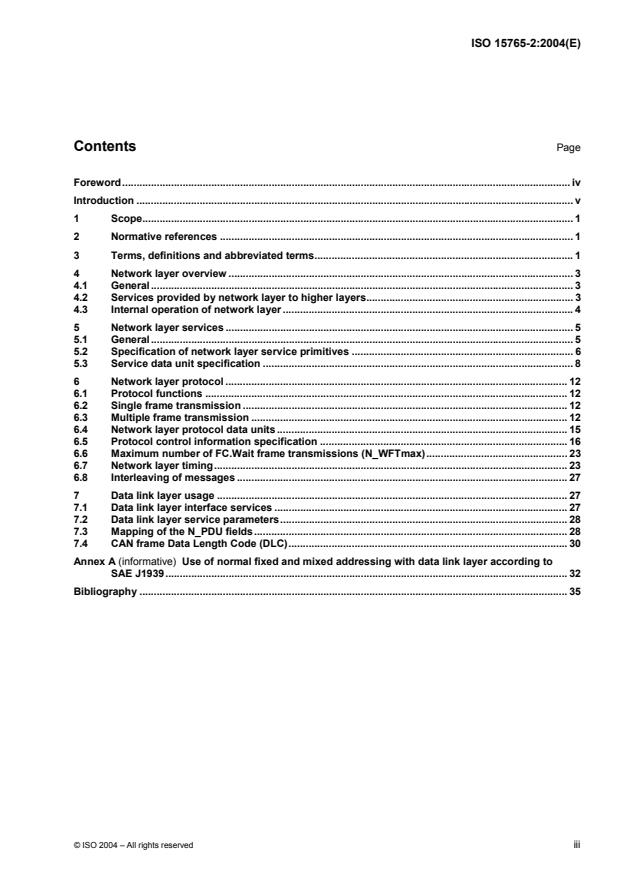
Contents Page
Foreword. iv
Introduction . v
1 Scope. 1
2 Normative references . 1
3 Terms, definitions and abbreviated terms. 1
4 Network layer overview . 3
4.1 General. 3
4.2 Services provided by network layer to higher layers. 3
4.3 Internal operation of network layer . 4
5 Network layer services . 5
5.1 General. 5
5.2 Specification of network layer service primitives . 6
5.3 Service data unit specification . 8
6 Network layer protocol . 12
6.1 Protocol functions . 12
6.2 Single frame transmission . 12
6.3 Multiple frame transmission . 12
6.4 Network layer protocol data units . 15
6.5 Protocol control information specification .16
6.6 Maximum number of FC.Wait frame transmissions (N_WFTmax). 23
6.7 Network layer timing. 23
6.8 Interleaving of messages . 27
7 Data link layer usage . 27
7.1 Data link layer interface services . 27
7.2 Data link layer service parameters. 28
7.3 Mapping of the N_PDU fields. 28
7.4 CAN frame Data Length Code (DLC). 30
Annex A (informative) Use of normal fixed and mixed addressing with data link layer according to
SAE J1939. 32
Bibliography . 35
Foreword
ISO (the International Organization for Standardization) is a worldwide federation of national standards bodies
(ISO member bodies). The work of preparing International Standards is normally carried out through ISO
technical committees. Each member body interested in a subject for which a technical committee has been
established has the right to be represented on that committee. International organizations, governmental and
non-governmental, in liaison with ISO, also take part in the work. ISO collaborates closely with the
International Electrotechnical Commission (IEC) on all matters of electrotechnical standardization.
International Standards are drafted in accordance with the rules given in the ISO/IEC Directives, Part 2.
The main task of technical committees is to prepare International Standards. Draft International Standards
adopted by the technical committees are circulated to the member bodies for voting. Publication as an
International Standard requires approval by at least 75 % of the member bodies casting a vote.
Attention is drawn to the possibility that some of the elements of this document may be the subject of patent
rights. ISO shall not be held responsible for identifying any or all such patent rights.
ISO 15765-2 was prepared by Technical Committee ISO/TC 22, Road vehicles, Subcommittee SC 3,
Electrical and electronic equipment.
ISO 15765 consists of the following parts, under the general title Road vehicles — Diagnostics on Controller
Area Networks (CAN):
Part 1: General information
Part 2: Network layer services
Part 3: Implementation of unified diagnostic services (UDS on CAN)
Part 4: Requirements for emissions-related systems
iv © ISO 2004 – All rights reserved
Introduction
This part of ISO 15765 has been established in order to define common requirements for vehicle diagnostic
systems implemented on a Controller Area Network (CAN) communication link, as specified in ISO 11898.
Although primarily intended for diagnostic systems, it also meets requirements from other CAN-based
systems needing a network layer protocol.
To achieve this, it is based on the Open Systems Interconnection (OSI) Basic Reference Model specified in
ISO/IEC 7498 and ISO/IEC 10731, which structures communication systems into seven layers. When mapped
on this model, the services specified by ISO 15765 are divided into
unified diagnostic services (layer 7), specified in ISO 15765-3,
network layer services (layer 3), specified in this part of ISO 15765,
CAN services (layers 1 and 2), specified in ISO 11898,
in accordance with Table 1.
The application layer services covered by ISO 15765-3 have been defined in compliance with diagnostic
services established in ISO 14229-1 and ISO 15031-5, but are not limited to use only with them. ISO 15765-3
is also compatible with most diagnostic services defined in national standards or vehicle manufacturer's
specifications.
The network layer services covered by this part of ISO 15765 have been defined to be independent of the
physical layer implemented, and a physical layer is only specified for legislated OBD.
For other application areas, ISO 15765 can be used with any CAN physical layer.
Table 1 — Enhanced and legislated OBD diagnostic specifications applicable to the OSI layers
Open Systems Interconnection Vehicle manufacturer enhanced Legislated on-board diagnostics
(OSI) layers diagnostics (OBD)
Diagnostic application User defined ISO 15031-5
Application layer ISO 15765-3 ISO 15031-5
Presentation layer N/A N/A
Session layer ISO 15765-3 N/A
Transport layer N/A N/A
Network layer ISO 15765-2 ISO 15765-4
Data link layer ISO 11898-1 ISO 15765-4
Physical layer User defined ISO 15765-4
INTERNATIONAL STANDARD ISO 15765-2:2004(E)
Road vehicles — Diagnostics on Controller Area Networks
(CAN) —
Part 2:
Network layer services
1 Scope
This part of ISO 15765 specifies a network protocol tailored to meet the requirements of CAN-based vehicle
network systems on controller area networks as specified in ISO 11898. It has been defined in accordance
with the diagnostic services established in ISO 14229-1 and ISO 15031-5, but is not limited to use with them,
and is also compatible with most other communication needs for in-vehicle networks. The protocol specifies
an unconfirmed communication.
2 Normative references
The following referenced documents are indispensable for the application of this document. For dated
references, only the edition cited applies. For undated references, the latest edition of the referenced
document (including any amendments) applies.
ISO 11898-1, Road vehicles — Controller area network (CAN) — Part 1: Data link layer and physical
signalling
ISO/IEC 7498 (all parts), Information technology — Open Systems Interconnection — Basic Reference Model
3 Terms, definitions and abbreviated terms
For the purposes of this document, the terms and definitions given in ISO 7498, and the following abbreviated
terms, apply.
BS block size
CF consecutive frame
confirm confirmation service primitive
ECU electronic control unit
FC flow control
FF first frame
FF_DL first frame data length
FS flow status
indication indication service primitive
Mtype message type
N_AE network address extension
N_AI address information
N_Ar network layer timing parameter Ar
N_As network layer timing parameter As
N_Br network layer timing parameter Br
N_Bs network layer timing parameter Bs
N_ChangeParameter network layer service name
N_Cr network layer timing parameter Cr
N_Cs network layer timing parameter Cs
N_Data network data
N_PCI network protocol control information
N_PCItype network protocol control information type
N_PDU network protocol data unit
N_SA network source address
N_SDU network service data unit
N_TA network target address
N_TAtype network target address type
N_USData network layer unacknowledged segmented data transfer service name
NWL network layer
request request service primitive
r receiver
s sender
SF single frame
SF_DL single frame data length
SN sequence number
STmin separation time min.
2 © ISO 2004 – All rights reserved
4 Network layer overview
4.1 General
This clause describes the overall functionality of the network layer. This part of ISO 15765 specifies an
unconfirmed network layer communication protocol for the exchange of data between network nodes, e.g.
from ECU to ECU, or between external test equipment and an ECU. If the data to be transferred do not fit into
a single CAN frame, a segmentation method is provided.
In order to describe the function of the network layer, services provided to higher layers and the internal
operation of the network layer have to be considered.
4.2 Services provided by network layer to higher layers
The service interface defines a set of services that are needed to access the functions offered by the network
layer, i.e. transmission/reception of data and setting of protocol parameters.
Two types of services are defined.
a) Communication services
These services, of which the following are defined, enable the transfer of up to 4 095 bytes of data.
1) N_USData.request
This service is used to request the transfer of data. If necessary, the network layer segments the
data.
2) N_USData_FF.indication
This service is used to signal the beginning of a segmented message reception to the upper layer.
3) N_USData.indication
This service is used to provide received data to the higher layers.
4) N_USData.confirm
This service confirms to the higher layers that the requested service has been carried out
(successfully or not).
b) Protocol parameter setting services
These services, of which the following are defined, enable the dynamic setting of protocol parameters.
1) N_ChangeParameter.request
This service is used to request the dynamic setting of specific internal parameters.
2) N_ChangeParameter.confirm
This service confirms to the upper layer that the request to change a specific protocol has been
carried out (successfully or not).
4.3 Internal operation of network layer
The internal operation of the network layer provides methods for segmentation, transmission with flow control,
and reassembly. The main purpose of the network layer is to transfer messages that might or might not fit in a
single CAN frame. Messages that do not fit into a single CAN frame are segmented into multiple parts, where
each can be transmitted in a CAN frame.
Figure 1 shows an example of an unsegmented message transmission.
Figure 1 — Example of unsegmented message
Figure 2 shows an example of a segmented message transmission.
Figure 2 — Example of segmented message
4 © ISO 2004 – All rights reserved
Flow control is used to adjust the sender to the network layer capabilities of the receiver. This flow control
scheme allows the use of diagnostic gateways and sub-networks.
ISO 15765 specifies three different addressing formats: normal, extended and mixed.
5 Network layer services
5.1 General
All network layer services have the same general structure. To define the services, three types of service
primitives are specified:
a service request primitive, used by higher communication layers or the application to pass control
information and data required to be transmitted to the network layer;
a service indication primitive, used by the network layer to pass status information and received data to
upper communication layers or the application;
a service confirmation primitive used by the network layer to pass status information to higher
communication layers or the application.
This service specification does not specify an application programming interface, but only a set of service
primitives that are independent of any implementation.
All network layer services have the same general format. Service primitives are written in the form:
service_name.type (
parameter A,
parameter B,
parameter C,
...
)
where “service_name” is the name of the service, e.g. N_USData, “type” indicates the type of the service
primitive, and “parameter A, parameter B, parameter C, .” are the N_SDU as a list of values passed by the
service primitive.
The service primitives define how a service user (e.g. diagnostic application) cooperates with a service
provider (e.g. network layer). The following service primitives are specified in this International Standard:
request, indication and confirm.
Using the service primitive request (service_name.request) a service user requests a service from the
service provider.
Using the service primitive indication (service_name.indication), the service provider informs a service
user about an internal event of the network layer or the service request of a peer protocol layer entity
service user.
With the service primitive confirm (service_name.confirm) the service provider informs the service user
about the result of a preceding service request of the service user.
5.2 Specification of network layer service primitives
5.2.1 N_USData.request
The service primitive requests transmission of with bytes from the sender to the
1)
receiver peer entities identified by the address information in N_SA, N_TA, N_TAtype, and N_AE (see 5.3
for parameter definition).
Each time the N_USData.request service is called, the network layer shall signal the completion (or failure) of
the message transmission to the service user by means of the issuing of an N_USData.confirm service call:
N_USData.request (
Mtype
N_SA
N_TA
N_TAtype
1)
N_AE
)
5.2.2 N_USData.confirm
The N_USData.confirm service is issued by the network layer. The service primitive confirms the completion
of an N_USData.request service identified by the address information in N_SA, N_TA, N_TAtype, and
N_AE 1). The parameter provides the status of the service request (see 5.3 for parameter
definition).
N_USData.confirm (
Mtype
N_SA
N_TA
N_TAtype
1)
N_AE
)
5.2.3 N_USData_FF.indication
The N_USData_FF.indication service is issued by the network layer. The service primitive indicates to the
adjacent upper layer the arrival of a first frame (FF) of a segmented message received from a peer protocol
1)
entity, identified by the address information in N_SA, N_TA, N_TAtype, and N_AE (see 5.3 for parameter
definition). This indication shall take place upon reception of the first frame (FF) of a segmented message.
N_USData_FF.indication (
Mtype
N_SA
N_TA
N_TAtype
1)
N_AE
)
The N_USData_FF.indication service shall always be followed by an N_USData.indication service call from
the network layer, indicating the completion (or failure) of the message reception.
1) Optional.
6 © ISO 2004 – All rights reserved
An N_USData_FF.indication service call shall only be issued by the network layer if a correct first frame (FF)
message segment has been received.
If the network layer detects any type of error in a first frame (FF), then the message shall be ignored by the
network layer and no N_USData_FF.indication shall be issued to the adjacent upper layer.
If the network layer receives a first frame (FF) with a data length value (FF_DL) that is greater than the
available receiver buffer size, then this shall be considered as an error condition and no
N_USData_FF.indication shall be issued to the adjacent upper layer.
5.2.4 N_USData.indication
The N_USData.indication service is issued by the network layer. The service primitive indicates
events and delivers with bytes received from a peer protocol entity identified by the
2)
address information in N_SA, N_TA, N_TAtype, and N_AE to the adjacent upper layer (see 5.3 for
parameter definition).
The parameters and are only valid if equals N_OK.
N_USData.indication (
Mtype
N_SA
N_TA
N_TAtype
2)
N_AE
)
The N_USData.indication service call is issued after the reception of a single frame (SF) message or as an
indication of the completion (or failure) of a segmented message reception.
If the network layer detects any type of error in a single frame (SF), then the message shall be ignored by the
network layer and no N_USData.indication shall be issued to the adjacent upper layer.
5.2.5 N_ChangeParameters.request
The service primitive is used to request the change of an internal parameter’s value on the local protocol entity.
The is assigned to the (see 5.3 for parameter definition).
A parameter change is always possible, except after reception of the first frame (N_USData_FF.indication)
and until the end of the reception of the corresponding message (N_USData.indication).
N_ChangeParameter.request (
Mtype
N_SA
N_TA
N_TAtype
2)
N_AE
)
This is an optional service that can be replaced by implementation of fixed parameter values.
2) Optional.
5.2.6 N_ChangeParameter.confirm
The service primitive confirms the completion of an N_ChangeParameter.Confirmation service applying to a
3)
message identified by the address information in N_SA, N_TA, N_TAtype, and N_AE (see 5.3 for parameter
definition).
N_ChangeParameter.confirm (
Mtype
N_SA
N_TA
N_TAtype
3)
N_AE
)
5.3 Service data unit specification
5.3.1 Mtype, Message type
Type: enumeration
Range: diagnostics, remote diagnostics
Description: The parameter Mtype shall be used to identify the type and range of address information
parameters included in a service call. This part of ISO 15765 specifies a range of two values for
this parameter. The intention is that users of the document can extend the range of values by
specifying other types and combinations of address information parameters to be used with the
network layer protocol specified in this document. For each such new range of address
information, a new value for the Mtype parameter shall be specified to identify the new address
information.
If Mtype = diagnostics, then the address information N_AI shall consist of the parameters
N_SA, N_TA, and N_TAtype.
If Mtype = remote diagnostics, then the address information N_AI shall consist of the
parameters N_SA, N_TA, N_TAtype, and N_AE.
5.3.2 N_AI, Address Information
5.3.2.1 N_AI description
These parameters refer to addressing information. As a whole, the N_AI parameters are used to identify the
source address (N_SA), target address (N_TA) of message senders and recipients as well as the
communication model for the message (N_TAtype) and the optional address extension (N_AE).
5.3.2.2 N_SA, Network Source Address
Type: 1 byte unsigned integer value
Range: 00-FF hex
Description: The N_SA parameter shall be used to encode the sending network layer protocol entity.
3) Optional.
8 © ISO 2004 – All rights reserved
5.3.2.3 N_TA, Network Target Address
Type: 1 byte unsigned integer value
Range: 00-FF hex
Description: The N_TA parameter shall be used to encode the receiving network layer protocol entity.
5.3.2.4 N_TAtype, Network Target Address type
Type: enumeration
Range: physical, functional
Description: The parameter N_TAtype is an extension to the N_TA parameter. It shall be used to encode the
communication model used by the communicating peer entities of the network layer. Two
communication models are specified: 1 to 1 communication, called physical addressing, and
1 to n communication, called functional addressing.
Physical addressing (1-to-1 communication) shall be supported for all types of network layer
messages.
Functional addressing (1-to-n communication) shall only be supported for Single Frame
communication.
5.3.2.5 N_AE, Network Address Extension
Type: 1 byte unsigned integer value
Range: 00-FF hex
Description: The N_AE parameter is used to extend the available address range for large networks, and to
encode both sending and receiving network layer entities of subnets other than the local network
where the communication takes place. N_AE is only part of the addressing information if Mtype
is set to remote diagnostics.
5.3.3
Type: 12 bits
Range: 1-4095
Description: This parameter includes the length of data to be transmitted/received.
5.3.4
Type: string of bytes
Range: not applicable
Description: This parameter includes all data the higher layer entities exchange.
5.3.5
Type: enumeration
Range: STmin, BS
Description: This parameter identifies a parameter of the network layer.
5.3.6
Type: 1 byte unsigned integer value
Range: 0-255
Description: This parameter is assigned to a protocol parameter as indicated in the service
section of this document.
5.3.7
Type: enumeration
Range: N_OK, N_TIMEOUT_A, N_TIMEOUT_Bs, N_TIMEOUT_Cr, N_WRONG_SN, N_INVALID_FS,
N_UNEXP_PDU, N_WFT_OVRN, N_BUFFER_OVFLW, N_ERROR
Description: This parameter contains the status relating to the outcome of a service execution. If two or more
errors are discovered at the same time, then the network layer entity shall use the parameter
value first found in this list in the error indication to the higher layers.
N_OK
This value means that the service execution has completed successfully; it can be issued to
a service user on both the sender and receiver side.
N_TIMEOUT_A
This value is issued to the protocol user when the timer N_Ar/N_As has passed its time-out
value N_As /N_Ar ; it can be issued to service user on both the sender and receiver
max max
side.
N_TIMEOUT_Bs
This value is issued to the service user when the timer N_Bs has passed its time-out value
N_Bs ; it can be issued to the service user on the sender side only.
max
N_TIMEOUT_Cr
This value is issued to the service user when the timer N_Cr has passed its time-out value
N_Cr ; it can be issued to the service user on the receiver side only.
max
N_WRONG_SN
This value is issued to the service user upon reception of an unexpected sequence number
(PCI.SN) value; it can be issued to the service user on the receiver side only.
10 © ISO 2004 – All rights reserved
N_INVALID_FS
This value is issued to the service user when an invalid or unknown FlowStatus value has
been received in a flow control (FC) N_PDU; it can be issued to the service user on the
sender side only.
N_UNEXP_PDU
This value is issued to the service user upon reception of an unexpected protocol data unit;
it can be issued to the service user on the receiver side only.
N_WFT_OVRN
This value is issued to the service user upon reception of flow control WAIT frame that
exceeds the maximum counter N_WFTmax.
N_BUFFER_OVFLW
This value is issued to the service user upon reception of a flow control (FC) N_PDU with
FlowStatus = OVFLW. It indicates that the buffer on the receiver side of a segmented
message transmission cannot store the number of bytes specified by the FirstFrame
DataLength (FF_DL) parameter in the FirstFrame and therefore the transmission of the
segmented message was aborted. It can be issued to the service user on the sender side
only.
N_ERROR
This is the general error value. It shall be issued to the service user when an error has been
detected by the network layer and no other parameter value can be used to better describe
the error. It can be issued to the service user on both the sender and receiver side.
5.3.8
Type: enumeration.
Range: N_OK, N_RX_ON, N_WRONG_PARAMETER, N_WRONG_VALUE
Description: This parameter contains the status relating to the outcome of a service execution.
N_OK
This value means that the service execution has completed successfully; it can be issued to
a service user on both the sender and receiver side.
N_RX_ON
This value is issued to the service user to indicate that the service did not execute since a
reception of the message identified by was taking place. It can be issued to the service
user on the receiver side only.
N_WRONG_PARAMETER
This value is issued to the service user to indicate that the service did not execute due to an
undefined ; it can be issued to the service user on both the receiver and sender
side.
N_WRONG_VALUE
This value is issued to the service user to indicate that the service did not execute due to an
out of range ; it can be issued to the service user on both the receiver
and sender side.
6 Network layer protocol
6.1 Protocol functions
The network layer protocol performs the following functions:
a) transmission/reception of messages up to 4 095 data bytes;
b) reporting of transmission/reception completion (or failure).
6.2 Single frame transmission
Transmission of messages up to six (6) (in case of extended or mixed addressing) or seven (7) (in case of
normal addressing) data bytes is performed via transmission of a unique N_PDU (see 6.4), called SF (see
Figure 3).
Reception of messages up to six (6) or seven (7) data bytes is performed via reception of a unique N_PDU.
Figure 3 — Example of unsegmented message
6.3 Multiple frame transmission
Transmission of longer messages is performed via segmentation of the message and transmission of multiple
N_PDUs. Reception of longer messages is performed via reception of multiple N_PDUs and reassembly of
the received data bytes (concatenation). The multiple N_PDUs are called FirstFrame (for the first N_PDU of
the message) and ConsecutiveFrame (for all the following N_PDUs).
The receiver of a multiple N_PDU message has the possibility of adapting the transmission throughput to its
capability by means of the flow control mechanism using the FlowControl protocol data units (FC N_PDU).
Messages longer than six (6) or seven (7) data bytes are segmented into
12 © ISO 2004 – All rights reserved
a FirstFrame protocol data unit (FF N_PDU), containing the first five (5) — in the case of extended or
mixed addressing — or six (6) — in the case of normal addressing — data bytes, and
one or more ConsecutiveFrame protocol data units (CF N_PDU), containing each six (6) or seven (7)
data bytes. The CF N_PDU contains only the remaining data bytes, and may therefore be less than six
(6) or seven (7) data bytes long.
Figure 4 shows segmentation at the sender side and reassembly at the receiver side.
NOTE The FC N_PDU issued by the receiver in response to the reception of the FF N_PDU is not shown.
Figure 4 — Segmentation and reassembly
The message length is transmitted in the FF N_PDU. All CF N_PDUs are numbered by the sender to help the
receiver re-assemble them in the same order.
The flow control mechanism (see Figure 5) allows the receiver to inform the sender about the receiver’s
capabilities. Since different nodes may have different capabilities, the flow control sent by the receiver informs
the sender about its capabilities. The sender shall conform to the receiver’s capabilities.
These capabilities are defined as follows.
BlockSize (BS): the maximum number of N_PDUs the receiver allows the sender to send, before waiting
for an authorization to continue transmission of the following N_PDUs.
SeparationTimeMin (STmin): the minimum time the sender is to wait between the transmissions of two
CF N_PDUs.
Figure 5 — Flow Control (FC) mechanism
All blocks, except the last one, will consist of BS N_PDUs. The last one will contain the remaining N_PDUs
(1 up to BS).
Each time the sender/receiver waits for an N_PDU from the receiver/sender, a timeout mechanism allows
detection of a transmission failure (see 6.7.2).
By means of FC N_PDUs, the receiver has the possibility of authorizing transmission of the following
CF N_PDUs, to delay transmission of that authorization or to deny the reception of a segmented message in
case the number of bytes to be transferred exceeds the number of bytes that can be stored in the receiver
buffer.
FC.CTS: continue to send, the authorization to continue,
FC.WAIT: the request to continue to wait,
FC.OVFLW: buffer overflow, the indication that the number of bytes specified in the FirstFrame of the
segmented message exceeds the number of bytes that can be stored in the buffer of the receiver entity.
14 © ISO 2004 – All rights reserved
There is a maximum limit to the number of FC.WAIT a receiver is allowed to send in a row: N_WFTmax. This
parameter is a system design constant and is not transmitted in the first FC N_PDU.
6.4 Network layer protocol data units
6.4.1 Protocol data unit types
The communication between the peer protocol entities of the network layer in different nodes is done by
means of exchanging N_PDUs.
This part of ISO 15765 specifies four different types of network layer protocol data units — single-frame
(SF N_PDU), first-frame (FF N_PDU), consecutive-frame (CF N_PDU) and flow-control (FC N_PDU) — which
are used to establish a communication path between the peer network layer entities, to exchange
communication parameters, to transmit user data and to release communication resources.
6.4.2 SF N_PDU
The SF N_PDU is identified by the single-frame protocol control information (SF N_PCI). The SF N_PDU shall
be sent out by the sending network entity and can be received by one or multiple receiving network entities. It
shall be sent out to transfer a service data unit that can be transferred via a single service request to the data
link layer, and to transfer unsegmented messages.
6.4.3 FF N_PDU
The FF N_PDU is identified by the first-frame protocol control information (FF N_PCI). The FF N_PDU shall
be sent out by the sending network entity and received by a unique receiving network entity for the duration of
the segmented message transmission. It identifies the first N_PDU of a segmented message transmitted by a
network sending entity and received by a receiving network entity. The receiving network layer entity shall
start assembling the segmented message on receipt of an FF N_PDU.
6.4.4 CF N_PDU
The CF N_PDU is identified by the consecutive-frame protocol control information (CF N_PCI). The
CF N_PDU transfers segments (N_Data) of the service data unit message data (). All
N_PDUs transmitted by the sending entity after the FF N_PDU shall be encoded as CF N_PDUs. The
receiving entity shall pass the assembled message to the service user of the network receiving entity after the
last CF N_PDU has been received. The CF N_PDU shall be sent out by the sending network entity and
received by a unique receiving network entity for the duration of the segmented message transmission.
6.4.5 FC N_PDU
The FC N_PDU is identified by the flow-control protocol control information (FC N_PCI). The FC N_PDU
instructs a sending network entity to start, stop or resume transmission of CF N_PDUs. It shall be sent by the
receiving network layer entity to the sending network layer entity, when ready to receive more data, after
correct reception of
a) an FF N_PDU, or
b) the last CF N_PDU of a block of consecutive frames, if further consecutive frames need to be sent.
The FC N_PDU can also inform a sending network entity to pause transmission of CF N_PDUs during a
segmented message transmission or to abort the transmission of a segmented message if the length
information (FF_DL) in the FF N_PDU transmitted by the sending entity exceeds the buffer size of the
receiving entity.
6.4.6 Protocol data unit field description
6.4.6.1 N_PDU format
The protocol data unit (N_PDU) enables the transfer of data between the network layer in one node and the
network layer in one or more other nodes (peer protocol entities). All N_PDUs consist of three (3) fields, as
given in Table 2.
Table 2 — N_PDU format
Address information Protocol control information Data field
N_AI N_PCI N_Data
6.4.6.2 Address information (N_AI)
The N_AI is used to identify the communicating peer entities of the network layer. The N_AI information
4)
received in the N_SDU — N_SA, N_TA, N_TAtype, N_AE — shall be copied and included in the N_PDU. If
the message data ( and ) received in the N_SDU is so long that segmentation is
needed for the network layer to transmit the complete message, the N_AI shall be copied and included
(repeated) in every N_PDU that is transmitted.
This field contains address information that identifies the type of message exchanged, and the recipient(s) and
sender between whom data exchange takes place. The address information consists of message addresses.
NOTE For a detailed description of address information, see 5.3.2.
6.4.6.3 Protocol control information (N_PCI)
This field identifies the type of N_PDUs exchanged. It is also used to exchange other control parameters
between the communicating network layer entities.
NOTE For a detailed specification of all N_PCI parameters, see 6.5.
6.4.6.4 Data Field (N_Data)
The N_Data in the N_PDU is used to transmit the service user data received in the
parameter in the N_USData.request service call. The , if needed, is segmented into smaller
parts that each fit into the N_PDU data field before they are transmitted over the network.
The size of N_Data depends on the N_PDU type and the address format chosen.
6.5 Protocol control information specification
6.5.1 N_PCI
Each N_PDU is identified by means of an N_PCI. See Tables 3 and 4.
4) Optional.
16 © ISO 2004 – All rights reserved
Table 3 — Summary of N_PCI bytes
N_PCI bytes
N_PDU name
Byte #1 Byte #2 Byte #3
Bits 7 – 4 Bits 3 – 0
SingleFrame (SF) N_PCItype = 0 SF_DL N/A N/A
FirstFrame (FF) N_PCItype = 1 FF_DL N/A
ConsecutiveFrame (CF) N_PCItype = 2 SN N/A N/A
FlowControl (FC) N_PCItype = 3 FS BS STmin
Table 4 — Definition of N_PCItype values
Hex value Description
0 SingleFrame
For unsegmented messages, the network layer protocol provides an optimized implementation of the
network protocol with the message length embedded in the PCI byte only. SingleFrame (SF) shall be
used to support the transmission of messages that can fit in a single CAN frame.
1 FirstFrame
A FirstFrame (FF) shall only be used to support the transmission of messages that cannot fit in a single
CAN frame, i.e. segmented messages. The first frame of a segmented message is encoded as an FF.
On receipt of an FF, the receiving network layer entity shall start assembling the segmented message.
2 ConsecutiveFrame
When sending segmented data, all consecutive frames following the FF are encoded as
ConsecutiveFrame (CF). On receipt of a CF, the receiving network layer entity shall assemble the
received data bytes until the whole message is received. The receiving entity shall pass the assembled
message to the adjacent upper protocol layer after the last frame of the message has been received
without error.
3 FlowControl
The purpose of FlowControl (FC) is to regulate the rate at which CF N_PDUs are sent to the receiver.
Three distinct types of FC protocol control information are specified to support this function. The type is
indicated by a field of the protocol control information called FlowStatus (FS), as defined hereafter.
4 – F Reserved
This range of values is reserved by this part of ISO 15765.
6.5.2 SingleFrame N_PCI parameter definition
6.5.2.1 SF N_PCI byte
Table 5 provides an overview of the SF N_PCI byte.
Table 5 — Overview of SF N_PCI byte
SF N_PCI byte
N_PDU name
Byte #1
7 6 5 4 3 2 1 0
SF_DL
SingleFrame 0 0 0 0
The parameter SingleFrame DataLength (SF_DL) is used in the SF N_PDU to specify the number of service
user data bytes. See Table 6.
Table 6 — Definition of SF_DL values
Hex value Description
0 Reserved
This value is reserved by part of ISO 15765.
1 – 6 SingleFrame DataLength (SF_DL)
The SF_DL is encoded in the low nibble of N_PCI byte #1 value. It shall be assigned the value of the
service parameter .
7 SingleFrame DataLength (SF_DL) with normal addressing
SF_DL = 7 is only allowed with normal addressing.
8 – F Invalid
This range of values is invalid.
6.5.2.2 SF_DL error handling
If the network layer receives an SF with an SF_DL equal to zero (0), then the network layer shall ignore the
received SF N_PDU.
If the network layer receives an SF with an SF_DL greater than 7 when using normal addressing, or greater
than 6 for extended or mixed addressing, then the network layer shall ignore the received SF N_PDU.
6.5.3 FirstFrame N_PCI parameter definition
6.5.3.1 FF N_PCI bytes
Table 7 provides an overview of the FF N_PCI bytes.
Table 7 — Overview of FF N_PCI bytes
FF N_PCI bytes
N_PDU name
Byte #1 Byte #2
7 6 5 4 3 2 1 0 7 – 0
FF_DL
FirstFrame 0 0 0 1
6.5.3.2 FirstFrame DataLength (FF_DL) parameter definition
The parameter FF_DL is used in the FF N_PDU to specify the number of service user data bytes. See Table 8.
18 © ISO 2004 – All rights reserved
Table 8 — Definition of FF_DL values
Hex value Description
0 – 6 Invalid
This range of values is invalid.
FirstFrame DataLength (FF_DL) with extended addressing or mixed addressing
FF_DL = 7 is only allowed with extended or mixed addressing.
FirstFrame DataLength (FF_DL)
8 – FFF
The encoding of the segmented message length results in a twelve (12) bit length value (FF_DL) where
the least significant bit (LSB) is specified to be bit “0” of the N_PCI byte #2 and the most significant bit
(MSB) is bit three (3) of the N_PCI byte #1. The maximum segmented message length supported is
equal to 4 095 bytes of user data. It shall be assigned the value of the service parameter .
6.5.3.3 FF_DL error handling
If the network layer receives an FF with an FF_DL that is greater than the available receiver buffer size, then
this shall be considered as an error condition. The network layer shall abort the message reception and send
an FC N_PDU with the parameter FlowStatus = Overflow.
If the network layer receives an FF with an FF_DL that is less than (eight) 8 when using normal addressing or
less than 7 when using extended or mixed addressing, then the network layer shall ignore the received
FF N_PDU and not transmit an FC N_PDU.
6.5.4 Consecutiv
...
Questions, Comments and Discussion
Ask us and Technical Secretary will try to provide an answer. You can facilitate discussion about the standard in here.
Loading comments...