


ISO/FDIS 11999-10
(Main)PPE for firefighters — Test methods and requirements for PPE used by firefighters who are at risk of exposure to high levels of heat and/or flame while fighting fires in structures — Part 10: Respiratory protective devices (RPD)
PPE for firefighters — Test methods and requirements for PPE used by firefighters who are at risk of exposure to high levels of heat and/or flame while fighting fires in structures — Part 10: Respiratory protective devices (RPD)
This document specifies minimum design and performance requirements for personal protective equipment (PPE) to be used by firefighters whilst engaged in fighting fires occurring in structures, primarily but not solely to protect against exposure to flame and high thermal loads. The scope of this document does not include PPE for use in high risk fire exposures where, for example, protective clothing with reflective surface according to ISO 15538 might be more appropriate, where exposure to lower levels of heat or flame may be encountered by firefighters engaged in support activities where PPE according to ISO 11613 might be more appropriate, or for use in long term firefighting operations in high ambient temperature (for example, bush, wildland, or forest firefighting) where PPE according to ISO 16073 might be more appropriate. Similarly, this document does not include PPE to protect against chemical and biological hazards, other than against short term and accidental exposure while engaged in firefighting and associated activities when fighting fires occurring in structures. This part of ISO 11999 supports the structure identified in ISO 11999-1 for a harmonised approach across all parts of this series by setting single minimum design and performance requirements for PPE, including optional requirements where identified, and for product markings and manufacturer’s instructions. Selection of an appropriate system of protective clothing is dependent upon an effective risk assessment which identifies the hazards to be faced, evaluates the likelihood of those hazards, and provides the means to reduce or eliminate these hazards (see ISO 21808).
Équipement de protection individuelle pour pompiers — Méthodes d'essai et exigences pour les équipements de protection individuelle utilisés par les pompiers qui risquent d'être exposés à des niveaux élevés de chaleur et/ou de flamme lorsqu'ils combattent des incendies dans des structures — Partie 10: Appareils de protection respiratoire (APR)
General Information
- Status
- Not Published
- Technical Committee
- ISO/TC 94/SC 14 - Firefighters' personal equipment
- Drafting Committee
- ISO/TC 94/SC 14 - Firefighters' personal equipment
- Current Stage
- 5020 - FDIS ballot initiated: 2 months. Proof sent to secretariat
- Start Date
- 29-Dec-2025
- Completion Date
- 29-Dec-2025
Overview
ISO/FDIS 11999-10:2025 specifies minimum design and performance requirements and test methods for respiratory protective devices (RPD) used by firefighters fighting fires in structures. Part of the ISO 11999 series for PPE for firefighters, this document focuses on RPD performance (by referencing ISO 17420‑5), compatibility within PPE ensembles, marking and manufacturer’s instructions, and the role of risk assessment in selecting appropriate respiratory protection. It is intended to reduce injury and occupational exposure to thermal hazards, particulates and short‑term accidental chemical contaminants encountered during structural firefighting.
Key topics and technical requirements
- RPD performance: RPDs shall meet the test methods and minimum performance requirements given in ISO 17420‑5 (see ISO 17420 series for detailed RPD performance and classification).
- Classification: Firefighting RPDs are classified according to differing performance characteristics defined in ISO 17420‑5 and referenced in this part.
- Compatibility: RPD selection must ensure compatibility with other PPE items in an ensemble; ensemble compatibility requirements are set out in ISO 11999‑2.
- Innocuousness: Materials used must not release substances harmful to health under normal use (see ISO 13688).
- Risk‑based selection: Device selection and use are to be based on a documented risk assessment (see ISO/TR 21808 and ISO 17420‑1).
- Marking and instructions: Products must include required markings and manufacturer’s instructions to support correct use, maintenance, inspection and cleaning.
- Scope limits: The standard applies primarily to structural firefighting and does not cover specialized PPE for extreme high‑risk exposures (e.g., reflective suits per ISO 15538), support‑level exposures (ISO 11613), prolonged wildland firefighting (ISO 16073), or routine chemical/biological PPE beyond short‑term accidental exposures.
Applications and who uses it
- Manufacturers and product designers: to design and test RPDs that meet minimum safety and compatibility requirements.
- Testing laboratories and certification bodies: to apply referenced test methods and verify compliance.
- Fire services procurement and safety officers: to specify RPDs for structural firefighting operations and ensure ensemble compatibility.
- Occupational health professionals and trainers: to develop procedures for inspection, maintenance, fit‑testing and safe use.
- Standards committees and regulators: to harmonize PPE requirements across firefighter equipment and operations.
Related standards
- ISO 17420 series (RPD performance and classification), especially ISO 17420‑5
- ISO 11999‑1 (general) and ISO 11999‑2 (compatibility)
- ISO 11999‑3 to ISO 11999‑9 (clothing, helmets, gloves, footwear, hoods)
- ISO/TR 21808 (risk assessment guidance)
- ISO 13688 (protective clothing - general requirements)
- ISO 16972 (RPD vocabulary and symbols)
ISO/FDIS 11999‑10 provides a risk‑focused, harmonized framework for specifying and using respiratory protective devices in structural firefighting, supporting improved firefighter safety and occupational health.

ISO/FDIS 11999-10 - PPE for firefighters — Test methods and requirements for PPE used by firefighters who are at risk of exposure to high levels of heat and/or flame while fighting fires in structures — Part 10: Respiratory protective devices (RPD) Released:15. 12. 2025

REDLINE ISO/FDIS 11999-10 - PPE for firefighters — Test methods and requirements for PPE used by firefighters who are at risk of exposure to high levels of heat and/or flame while fighting fires in structures — Part 10: Respiratory protective devices (RPD) Released:15. 12. 2025
Get Certified
Connect with accredited certification bodies for this standard

NSF International
Global independent organization facilitating standards development and certification.

CIS Institut d.o.o.
Personal Protective Equipment (PPE) certification body. Notified Body NB-2890 for EU Regulation 2016/425 PPE.

Kiwa BDA Testing
Building and construction product certification.
Sponsored listings
Frequently Asked Questions
ISO/FDIS 11999-10 is a draft published by the International Organization for Standardization (ISO). Its full title is "PPE for firefighters — Test methods and requirements for PPE used by firefighters who are at risk of exposure to high levels of heat and/or flame while fighting fires in structures — Part 10: Respiratory protective devices (RPD)". This standard covers: This document specifies minimum design and performance requirements for personal protective equipment (PPE) to be used by firefighters whilst engaged in fighting fires occurring in structures, primarily but not solely to protect against exposure to flame and high thermal loads. The scope of this document does not include PPE for use in high risk fire exposures where, for example, protective clothing with reflective surface according to ISO 15538 might be more appropriate, where exposure to lower levels of heat or flame may be encountered by firefighters engaged in support activities where PPE according to ISO 11613 might be more appropriate, or for use in long term firefighting operations in high ambient temperature (for example, bush, wildland, or forest firefighting) where PPE according to ISO 16073 might be more appropriate. Similarly, this document does not include PPE to protect against chemical and biological hazards, other than against short term and accidental exposure while engaged in firefighting and associated activities when fighting fires occurring in structures. This part of ISO 11999 supports the structure identified in ISO 11999-1 for a harmonised approach across all parts of this series by setting single minimum design and performance requirements for PPE, including optional requirements where identified, and for product markings and manufacturer’s instructions. Selection of an appropriate system of protective clothing is dependent upon an effective risk assessment which identifies the hazards to be faced, evaluates the likelihood of those hazards, and provides the means to reduce or eliminate these hazards (see ISO 21808).
This document specifies minimum design and performance requirements for personal protective equipment (PPE) to be used by firefighters whilst engaged in fighting fires occurring in structures, primarily but not solely to protect against exposure to flame and high thermal loads. The scope of this document does not include PPE for use in high risk fire exposures where, for example, protective clothing with reflective surface according to ISO 15538 might be more appropriate, where exposure to lower levels of heat or flame may be encountered by firefighters engaged in support activities where PPE according to ISO 11613 might be more appropriate, or for use in long term firefighting operations in high ambient temperature (for example, bush, wildland, or forest firefighting) where PPE according to ISO 16073 might be more appropriate. Similarly, this document does not include PPE to protect against chemical and biological hazards, other than against short term and accidental exposure while engaged in firefighting and associated activities when fighting fires occurring in structures. This part of ISO 11999 supports the structure identified in ISO 11999-1 for a harmonised approach across all parts of this series by setting single minimum design and performance requirements for PPE, including optional requirements where identified, and for product markings and manufacturer’s instructions. Selection of an appropriate system of protective clothing is dependent upon an effective risk assessment which identifies the hazards to be faced, evaluates the likelihood of those hazards, and provides the means to reduce or eliminate these hazards (see ISO 21808).
ISO/FDIS 11999-10 is classified under the following ICS (International Classification for Standards) categories: 13.340.10 - Protective clothing; 13.340.30 - Respiratory protective devices. The ICS classification helps identify the subject area and facilitates finding related standards.
ISO/FDIS 11999-10 is available in PDF format for immediate download after purchase. The document can be added to your cart and obtained through the secure checkout process. Digital delivery ensures instant access to the complete standard document.
Standards Content (Sample)
FINAL DRAFT
International
Standard
ISO/TC 94/SC 14
PPE for firefighters — Test methods
Secretariat: SA
and requirements for PPE used
Voting begins on:
by firefighters who are at risk of
2025-12-29
exposure to high levels of heat and/
Voting terminates on:
or flame while fighting fires in
2026-02-23
structures —
Part 10:
Respiratory protective devices
(RPD)
Équipement de protection individuelle pour pompiers —
Méthodes d'essai et exigences pour les équipements de protection
individuelle utilisés par les pompiers qui risquent d'être exposés
à des niveaux élevés de chaleur et/ou de flamme lorsqu'ils
combattent des incendies dans des structures —
Partie 10: Appareils de protection respiratoire (APR)
RECIPIENTS OF THIS DRAFT ARE INVITED TO SUBMIT,
WITH THEIR COMMENTS, NOTIFICATION OF ANY
RELEVANT PATENT RIGHTS OF WHICH THEY ARE AWARE
AND TO PROVIDE SUPPOR TING DOCUMENTATION.
IN ADDITION TO THEIR EVALUATION AS
BEING ACCEPTABLE FOR INDUSTRIAL, TECHNO-
LOGICAL, COMMERCIAL AND USER PURPOSES, DRAFT
INTERNATIONAL STANDARDS MAY ON OCCASION HAVE
TO BE CONSIDERED IN THE LIGHT OF THEIR POTENTIAL
TO BECOME STAN DARDS TO WHICH REFERENCE MAY BE
MADE IN NATIONAL REGULATIONS.
Reference number
FINAL DRAFT
International
Standard
ISO/TC 94/SC 14
PPE for firefighters — Test methods
Secretariat: SA
and requirements for PPE used
Voting begins on:
by firefighters who are at risk of
exposure to high levels of heat and/
Voting terminates on:
or flame while fighting fires in
structures —
Part 10:
Respiratory protective devices
(RPD)
Équipement de protection individuelle pour pompiers —
Méthodes d'essai et exigences pour les équipements de protection
individuelle utilisés par les pompiers qui risquent d'être exposés
à des niveaux élevés de chaleur et/ou de flamme lorsqu'ils
combattent des incendies dans des structures —
Partie 10: Appareils de protection respiratoire (APR)
RECIPIENTS OF THIS DRAFT ARE INVITED TO SUBMIT,
WITH THEIR COMMENTS, NOTIFICATION OF ANY
RELEVANT PATENT RIGHTS OF WHICH THEY ARE AWARE
AND TO PROVIDE SUPPOR TING DOCUMENTATION.
© ISO 2025
IN ADDITION TO THEIR EVALUATION AS
All rights reserved. Unless otherwise specified, or required in the context of its implementation, no part of this publication may
BEING ACCEPTABLE FOR INDUSTRIAL, TECHNO-
LOGICAL, COMMERCIAL AND USER PURPOSES, DRAFT
be reproduced or utilized otherwise in any form or by any means, electronic or mechanical, including photocopying, or posting on
INTERNATIONAL STANDARDS MAY ON OCCASION HAVE
the internet or an intranet, without prior written permission. Permission can be requested from either ISO at the address below
TO BE CONSIDERED IN THE LIGHT OF THEIR POTENTIAL
or ISO’s member body in the country of the requester.
TO BECOME STAN DARDS TO WHICH REFERENCE MAY BE
MADE IN NATIONAL REGULATIONS.
ISO copyright office
CP 401 • Ch. de Blandonnet 8
CH-1214 Vernier, Geneva
Phone: +41 22 749 01 11
Email: copyright@iso.org
Website: www.iso.org
Published in Switzerland Reference number
ii
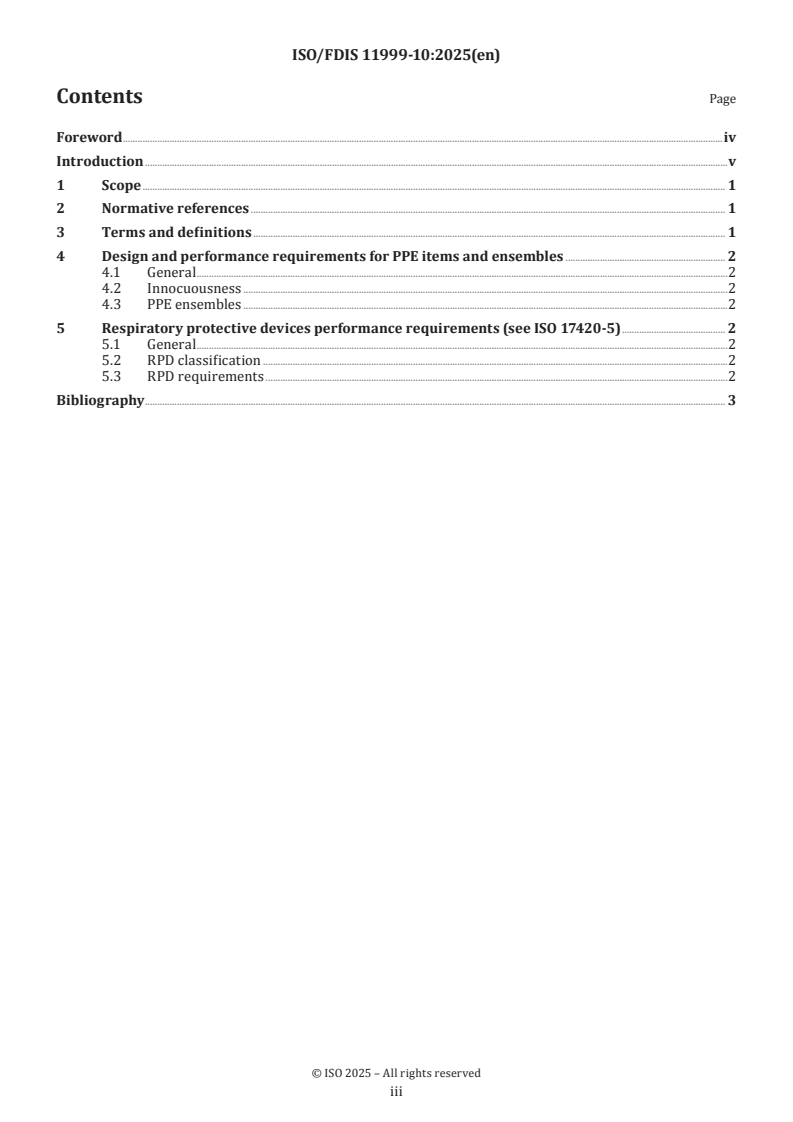
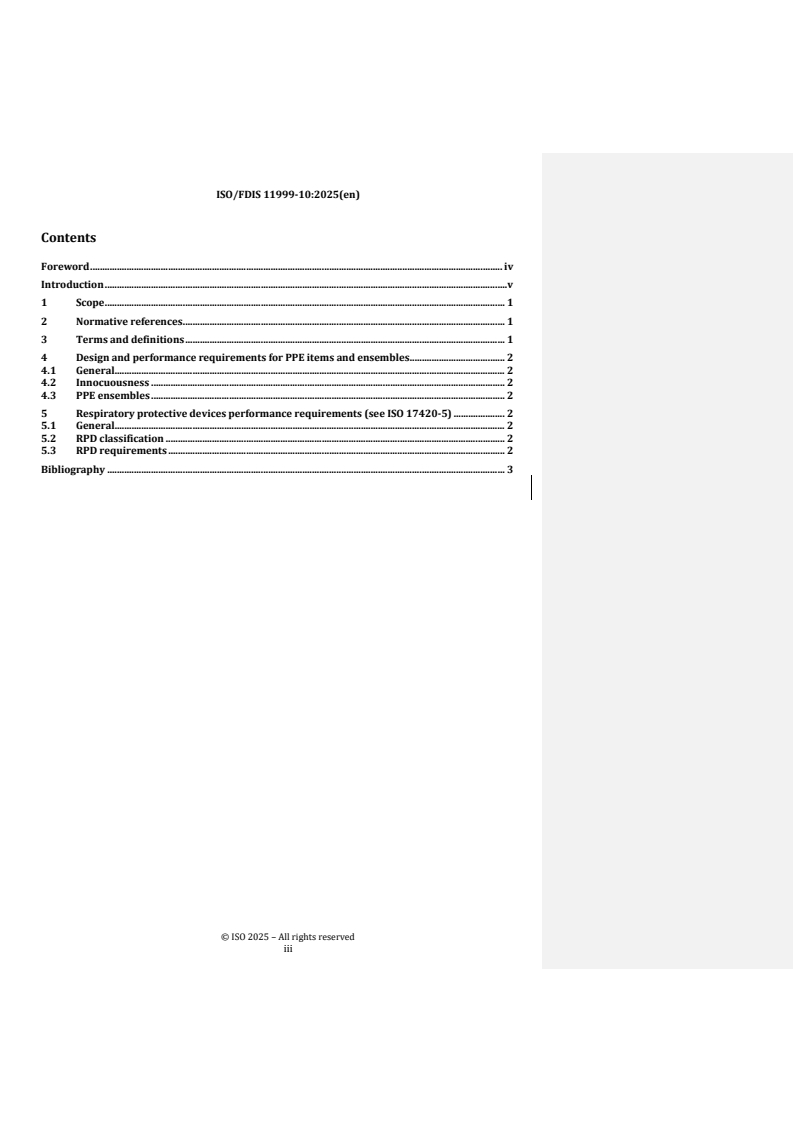
Contents Page
Foreword .iv
Introduction .v
1 Scope . 1
2 Normative references . 1
3 Terms and definitions . 1
4 Design and performance requirements for PPE items and ensembles . 2
4.1 General .2
4.2 Innocuousness .2
4.3 PPE ensembles .2
5 Respiratory protective devices performance requirements (see ISO 17420-5) . 2
5.1 General .2
5.2 RPD classification .2
5.3 RPD requirements .2
Bibliography . 3
iii
Foreword
ISO (the International Organization for Standardization) is a worldwide federation of national standards
bodies (ISO member bodies). The work of preparing International Standards is normally carried out through
ISO technical committees. Each member body interested in a subject for which a technical committee
has been established has the right to be represented on that committee. International organizations,
governmental and non-governmental, in liaison with ISO, also take part in the work. ISO collaborates closely
with the International Electrotechnical Commission (IEC) on all matters of electrotechnical standardization.
The procedures used to develop this document and those intended for its further maintenance are described
in the ISO/IEC Directives, Part 1. In particular, the different approval criteria needed for the different types
of ISO document should be noted. This document was drafted in accordance with the editorial rules of the
ISO/IEC Directives, Part 2 (see www.iso.org/directives).
ISO draws attention to the possibility that the implementation of this document may involve the use of (a)
patent(s). ISO takes no position concerning the evidence, validity or applicability of any claimed patent
rights in respect thereof. As of the date of publication of this document, ISO had received notice of (a)
patent(s) which may be required to implement this document. However, implementers are cautioned that
this may not represent the latest information, which may be obtained from the patent database available at
www.iso.org/patents. ISO shall not be held responsible for identifying any or all such patent rights.
Any trade name used in this document is information given for the convenience of users and does not
constitute an endorsement.
For an explanation of the voluntary nature of standards, the meaning of ISO specific terms and expressions
related to conformity assessment, as well as information about ISO's adherence to the World Trade
Organization (WTO) principles in the Technical Barriers to Trade (TBT), see www.iso.org/iso/foreword.html.
This document was prepared by Technical Committee ISO/TC 94, Personal safety — Protective equipment,
Subcommittee SC 14, Firefighters personal equipment.
A list of all parts in the ISO 11999 series can be found on the ISO website.
Any feedback or questions on this document should be directed to the user’s national standards body. A
complete listing of these bodies can be found at www.iso.org/members.html.
iv
Introduction
In a world where there is an ever-increasing focus on worker occupational health and safety, fire services are
faced with the dilemma of trying to provide firefighters with as safe a work environment as is reasonably
possible whilst also having to deal with the ever-increasing risks our firefighters face whilst fighting fires in
both the urban, rural, industrial and wildland environments.
In the course of their duties, firefighters are exposed to many hazardous chemicals and carcinogens that
include smoke, soot, and the products of combustion such as heavy metals, benzene, perfluoroalkyl and
polyfluoroalkyl substances (PFASs) which are inhaled, ingested, dermally absorbed, or both.
With the recent statement by the World Health Organization (WHO) elevating the classification of
occupational exposure as a firefighter to Group 1, ISO TC94/SC14 Project Group on contaminates are taking
all possible steps to reduce the exposures to firefighters by reviewing all standards pertaining to PPE used
by firefighters and making recommendations to address identified shortfalls.
The following is an extract from the statement released by the WHO:
— International Agency for Research on Cancer (IARC), the cancer agency of the World Health Organization
(WHO), has evaluated the carcinogenicity of occupational exposure as a firefighter
— A Working Group of 25 international experts, including 3 Invited Specialists, from 8 countries was
convened by the IARC Monographs program for a meeting in Lyon
— After thoroughly reviewing the available scientific literature, the Working Group classified occupational
exposure as a firefighter as carcinogenic to humans (Group 1), on the basis of sufficient evidence for
cancer in humans.
ISO/TR 21808 provides guidance on how to carry out a risk assessment, the guidelines were developed
previously based on the work of CEN Technical Committee TC 162, Joint Working Group for fir
...
ISO /TC 94/SC 14/WG 2
Secretariat: SA
Date: 2025-10-29xx
PPE for firefighters — Test methods and requirements for PPE used
by firefighters who are at risk of exposure to high levels of heat
and/or flame while fighting fires in structures — Part 10: Respiratory
Protective Device (RPD) —
Part 10:
Respiratory protective devices (RPD)
Équipement de protection individuelle pour pompiers — Méthodes d'essai et exigences pour les équipements de
protection individuelle utilisés par les pompiers qui risquent d'être exposés à des niveaux élevés de chaleur
et/ou de flamme lorsqu'ils combattent des incendies dans des structures —
Partie 10: Appareils de protection respiratoire (APR)
FDIS stage
All rights reserved. Unless otherwise specified, or required in the context of its implementation, no part of this publication
may be reproduced or utilized otherwise in any form or by any means, electronic or mechanical, including photocopying,
or posting on the internet or an intranet, without prior written permission. Permission can be requested from either ISO
at the address below or ISO’s member body in the country of the requester.
ISO copyright office
CP 401 • Ch. de Blandonnet 8
CH-1214 Vernier, Geneva
Phone: + 41 22 749 01 11
EmailE-mail: copyright@iso.org
Website: www.iso.org
Published in Switzerland
ii
Contents
Foreword . iv
Introduction . v
1 Scope . 1
2 Normative references . 1
3 Terms and definitions . 1
4 Design and performance requirements for PPE items and ensembles . 2
4.1 General. 2
4.2 Innocuousness . 2
4.3 PPE ensembles . 2
5 Respiratory protective devices performance requirements (see ISO 17420-5) . 2
5.1 General. 2
5.2 RPD classification . 2
5.3 RPD requirements . 2
Bibliography . 3
iii
Foreword
ISO (the International Organization for Standardization) is a worldwide federation of national standards
bodies (ISO member bodies). The work of preparing International Standards is normally carried out through
ISO technical committees. Each member body interested in a subject for which a technical committee has been
established has the right to be represented on that committee. International organizations, governmental and
non-governmental, in liaison with ISO, also take part in the work. ISO collaborates closely with the
International Electrotechnical Commission (IEC) on all matters of electrotechnical standardization.
The procedures used to develop this document and those intended for its further maintenance are described
in the ISO/IEC Directives, Part 1. In particular, the different approval criteria needed for the different types of
ISO document should be noted. This document was drafted in accordance with the editorial rules of the
ISO/IEC Directives, Part 2 (see www.iso.org/directives).
ISO draws attention to the possibility that the implementation of this document may involve the use of (a)
patent(s). ISO takes no position concerning the evidence, validity or applicability of any claimed patent rights
in respect thereof. As of the date of publication of this document, ISO had received notice of (a) patent(s) which
may be required to implement this document. However, implementers are cautioned that this may not
represent the latest information, which may be obtained from the patent database available at
www.iso.org/patents. ISO shall not be held responsible for identifying any or all such patent rights.
Any trade name used in this document is information given for the convenience of users and does not
constitute an endorsement.
For an explanation of the voluntary nature of standards, the meaning of ISO specific terms and expressions
related to conformity assessment, as well as information about ISO's adherence to the World Trade
Organization (WTO) principles in the Technical Barriers to Trade (TBT), see www.iso.org/iso/foreword.html.
This document was prepared by Technical Committee ISO/TC 94, Personal safety — Protective equipment,
Subcommittee SC 14, Firefighters personal equipment.
A list of all parts in the ISO 11999 series can be found on the ISO website.
Any feedback or questions on this document should be directed to the user’s national standards body. A
complete listing of these bodies can be found at www.iso.org/members.html.
iv
Introduction
In a world where there is an ever-increasing focus on worker occupational health and safety, fire services are
faced with the dilemma of trying to provide firefighters with as safe a work environment as is reasonably
possible whilst also having to deal with the ever-increasing risks our firefighters face whilst fighting fires in
both the urban, rural, industrial and wildland environments.
In the course of their duties, firefighters are exposed to many hazardous chemicals and carcinogens that
include smoke, soot, and the products of combustion such as heavy metals, benzene, perfluoroalkyl and
polyfluoroalkyl substances (PFASs) which are inhaled, ingested and/or, dermally absorbed, or both.
With the recent statement by the World Health Organization (WHO) elevating the classification of
occupational exposure as a firefighter to Group 1, ISO TC94 /SC14 Project Group on contaminates are taking
all possible steps to reduce the exposures to firefighters by reviewing all standards pertaining to PPE used by
firefighters and making recommendations to address identified shortfalls.
The following is an extract from the statement released by the WHO:
— — International Agency for Research on Cancer (IARC), the cancer agency of the World Health
Organization (WHO), has evaluated the carcinogenicity of occupational exposure as a firefighter
— — A Working Group of 25 international experts, including 3 Invited Specialists, from 8 countries was
convened by the IARC Monographs program for a meeting in Lyon
— — After thoroughly reviewing the available scientific literature, the Working Group classified
occupational exposure as a firefighter as carcinogenic to humans (Group 1), on the basis of sufficient
evidence for cancer in humans.
ISO/TR 21808 provides guidance on how to carry out a risk assessment, the guideline wasguidelines were
developed previously based on the work of CEN Technical Committee TC 162, Joint Working Group for
firefighters personal protective equipment and has been modified to encompass PPE worn by all emergency
service personnel.”.
During incidents being undertaken by emergency service personnel, many different hazards may be
encountered, including exposures to a range of chemicals that are biproducts of fires occurring in the urban
and wildland environment. Where possible, the level of risk that each hazard presents to firefighters is tomust
be eliminated or reduced to an acceptable level. The guidance given in ISO /TR/ 21808 indicates how to carry
out a risk assessment by acknowledging the hazards that may be present, the likelihood of the firefighters
becoming exposed to them and possible consequence of such exposure if not addressed.
This document provides minimum design and performance requirements for respiratory protective devices
(RPD) worn by firefighters, by referencing requirements of ISO 17420-5 which will reduce injury and loss of
life whilst fighting fires occurring in structures. Amongst other hazards faced by firefighters is exposure to
high thermal loads, flames, particulates and other hazardous chemicals.
This document forms part of the ISO 11999 series, ISO 11999-2, specifies design and performance
requirements to achieve compatibility across the PPE covered in parts ISO 11999-3 to ISO 11999-10, when all
the items are worn together, thereby creating a PPE ensemble, whether sold by a manufacturer or composed
by a user. In either case, the PPE ensemble should meet the requirements of ISO 11999-2. This becomes
significantly important when considering the issue of particulate protection and potential health risks posed
to firefighters from exposure to products of combustion.
This document supports the structure identified in ISO 11999-1 for a harmonised approach across all parts of
this series by setting single minimum design and performance requirements for PPE, including optional
requirements where identified, and for product markings and manufacturer’s instructions. Selection of an
v
appropriate system of PPE is dependent upon an effective risk assessment which identifies the hazards to be
faced, evaluates the likelihood of those ha
...
Questions, Comments and Discussion
Ask us and Technical Secretary will try to provide an answer. You can facilitate discussion about the standard in here.
Loading comments...