


ISO/IEC 15426-2:2015
(Main)Information technology — Automatic identification and data capture techniques — Bar code verifier conformance specification — Part 2: Two-dimensional symbols
Information technology — Automatic identification and data capture techniques — Bar code verifier conformance specification — Part 2: Two-dimensional symbols
ISO/IEC 15426-2:2015 defines test methods and minimum accuracy criteria applicable to verifiers using the methodologies of ISO/IEC 15415 for multi-row bar code symbols and two-dimensional matrix symbologies, and specifies reference calibration standards against which these should be tested. It provides for testing of representative samples of the equipment. NOTE ISO/IEC 15426‑1 applies to verifiers for linear bar code symbols.
Technologies de l'information — Techniques automatiques d'identification et de capture des données — Spécifications de conformité des vérificateurs de codes à barres — Partie 2: Symboles bidimensionnels
General Information
- Status
- Withdrawn
- Publication Date
- 09-Aug-2015
- Technical Committee
- ISO/IEC JTC 1/SC 31 - Automatic identification and data capture techniques
- Drafting Committee
- ISO/IEC JTC 1/SC 31/WG 1 - Data carrier
- Current Stage
- 9599 - Withdrawal of International Standard
- Start Date
- 13-Dec-2023
- Completion Date
- 12-Feb-2026
Relations
- Effective Date
- 09-Feb-2026
- Consolidates
ISO 3500:2005 - Gas cylinders — Seamless steel CO2 cylinders for fixed fire-fighting installations on ships - Effective Date
- 06-Jun-2022
- Effective Date
- 06-Jun-2022
- Effective Date
- 17-Jul-2010
Get Certified
Connect with accredited certification bodies for this standard

BSI Group
BSI (British Standards Institution) is the business standards company that helps organizations make excellence a habit.

NYCE
Mexican standards and certification body.
Sponsored listings
Frequently Asked Questions
ISO/IEC 15426-2:2015 is a standard published by the International Organization for Standardization (ISO). Its full title is "Information technology — Automatic identification and data capture techniques — Bar code verifier conformance specification — Part 2: Two-dimensional symbols". This standard covers: ISO/IEC 15426-2:2015 defines test methods and minimum accuracy criteria applicable to verifiers using the methodologies of ISO/IEC 15415 for multi-row bar code symbols and two-dimensional matrix symbologies, and specifies reference calibration standards against which these should be tested. It provides for testing of representative samples of the equipment. NOTE ISO/IEC 15426‑1 applies to verifiers for linear bar code symbols.
ISO/IEC 15426-2:2015 defines test methods and minimum accuracy criteria applicable to verifiers using the methodologies of ISO/IEC 15415 for multi-row bar code symbols and two-dimensional matrix symbologies, and specifies reference calibration standards against which these should be tested. It provides for testing of representative samples of the equipment. NOTE ISO/IEC 15426‑1 applies to verifiers for linear bar code symbols.
ISO/IEC 15426-2:2015 is classified under the following ICS (International Classification for Standards) categories: 35.040 - Information coding; 35.040.50 - Automatic identification and data capture techniques. The ICS classification helps identify the subject area and facilitates finding related standards.
ISO/IEC 15426-2:2015 has the following relationships with other standards: It is inter standard links to CEN/TS 14826:2022, ISO 3500:2005, ISO/IEC 15426-2:2023, ISO/IEC 15426-2:2005. Understanding these relationships helps ensure you are using the most current and applicable version of the standard.
ISO/IEC 15426-2:2015 is available in PDF format for immediate download after purchase. The document can be added to your cart and obtained through the secure checkout process. Digital delivery ensures instant access to the complete standard document.
Standards Content (Sample)
INTERNATIONAL ISO/IEC
STANDARD 15426-2
Second edition
2015-08-01
Information technology — Automatic
identification and data capture
techniques — Bar code verifier
conformance specification —
Part 2:
Two-dimensional symbols
Technologies de l’information — Techniques automatiques
d’identification et de capture des données — Spécifications de
conformité des vérificateurs de codes à barres —
Partie 2: Symboles bidimensionnels
Reference number
©
ISO/IEC 2015
© ISO/IEC 2015, Published in Switzerland
All rights reserved. Unless otherwise specified, no part of this publication may be reproduced or utilized otherwise in any form
or by any means, electronic or mechanical, including photocopying, or posting on the internet or an intranet, without prior
written permission. Permission can be requested from either ISO at the address below or ISO’s member body in the country of
the requester.
ISO copyright office
Ch. de Blandonnet 8 • CP 401
CH-1214 Vernier, Geneva, Switzerland
Tel. +41 22 749 01 11
Fax +41 22 749 09 47
copyright@iso.org
www.iso.org
ii © ISO/IEC 2015 – All rights reserved
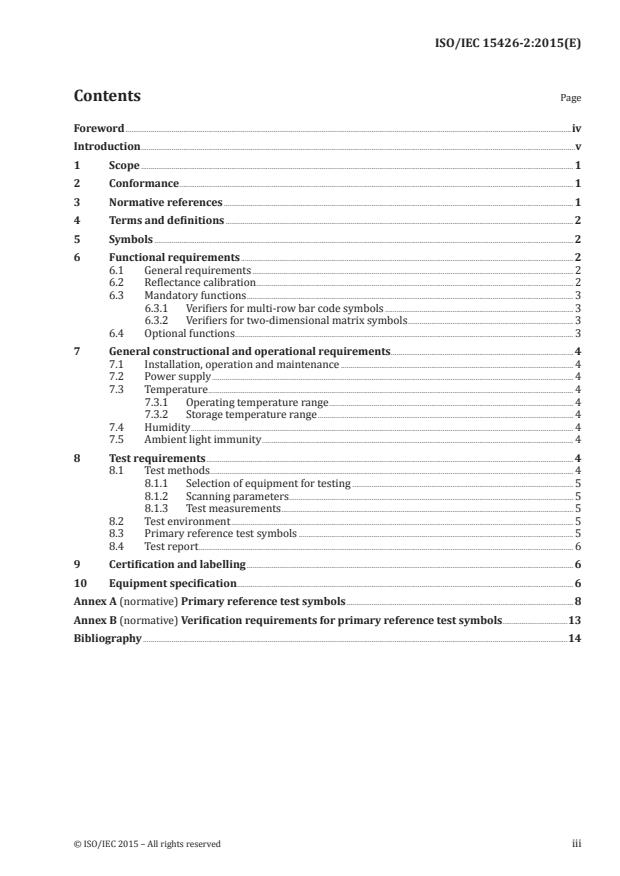
Contents Page
Foreword .iv
Introduction .v
1 Scope . 1
2 Conformance . 1
3 Normative references . 1
4 Terms and definitions . 2
5 Symbols . 2
6 Functional requirements . 2
6.1 General requirements . 2
6.2 Reflectance calibration . 2
6.3 Mandatory functions . 3
6.3.1 Verifiers for multi-row bar code symbols . 3
6.3.2 Verifiers for two-dimensional matrix symbols . 3
6.4 Optional functions . 3
7 General constructional and operational requirements . 4
7.1 Installation, operation and maintenance . 4
7.2 Power supply . 4
7.3 Temperature . 4
7.3.1 Operating temperature range . 4
7.3.2 Storage temperature range . 4
7.4 Humidity . 4
7.5 Ambient light immunity . 4
8 Test requirements . 4
8.1 Test methods . 4
8.1.1 Selection of equipment for testing . 5
8.1.2 Scanning parameters. 5
8.1.3 Test measurements . 5
8.2 Test environment . 5
8.3 Primary reference test symbols . 5
8.4 Test report . 6
9 Certification and labelling . 6
10 Equipment specification . 6
Annex A (normative) Primary reference test symbols . 8
Annex B (normative) Verification requirements for primary reference test symbols .13
Bibliography .14
© ISO/IEC 2015 – All rights reserved iii
Foreword
ISO (the International Organization for Standardization) is a worldwide federation of national standards
bodies (ISO member bodies). The work of preparing International Standards is normally carried out
through ISO technical committees. Each member body interested in a subject for which a technical
committee has been established has the right to be represented on that committee. International
organizations, governmental and non-governmental, in liaison with ISO, also take part in the work.
ISO collaborates closely with the International Electrotechnical Commission (IEC) on all matters of
electrotechnical standardization.
The procedures used to develop this document and those intended for its further maintenance are
described in the ISO/IEC Directives, Part 1. In particular the different approval criteria needed for the
different types of ISO documents should be noted. This document was drafted in accordance with the
editorial rules of the ISO/IEC Directives, Part 2 (see www.iso.org/directives).
Attention is drawn to the possibility that some of the elements of this document may be the subject of
patent rights. ISO shall not be held responsible for identifying any or all such patent rights. Details of
any patent rights identified during the development of the document will be in the Introduction and/or
on the ISO list of patent declarations received (see www.iso.org/patents).
Any trade name used in this document is information given for the convenience of users and does not
constitute an endorsement.
For an explanation on the meaning of ISO specific terms and expressions related to conformity
assessment, as well as information about ISO’s adherence to the WTO principles in the Technical
Barriers to Trade (TBT) see the following URL: Foreword - Supplementary information
The committee responsible for this document is ISO/IEC JTC 1, Information technology, Subcommittee
SC 31, Automatic identification and data capture techniques.
This second edition cancels and replaces the first edition (ISO/IEC 15426-2:2005), which has been
technically revised. It also incorporates the Technical Corrigendum ISO/IEC 15426-2:2005/Cor1:2008.
ISO/IEC 15426 consists of the following parts, under the general title Information technology —
Automatic identification and data capture techniques — Bar code verifier conformance specification:
— Part 1: Linear symbols
— Part 2: Two-dimensional symbols
iv © ISO/IEC 2015 – All rights reserved
Introduction
The technology of bar coding is based on the recognition of patterns encoded, in bars and spaces or in a
matrix of modules of defined dimensions, according to rules defining the translation of characters into
such patterns, known as the symbology specification. Symbology specifications may be categorised
into linear symbols, on the one hand, and two-dimensional symbols on the other; the latter may in turn
be sub-divided into «multi-row bar codes» sometimes referred to as “stacked bar codes”, and “two-
dimensional matrix codes”.
Multi-row bar codes are constructed graphically as a series of rows of symbol characters,
representing data and overhead components, placed in a defined vertical arrangement to form a
(normally) rectangular symbol, which contains a single data message. Each row of the symbol has the
characteristics of a linear bar code symbol and may be read by linear symbol scanning techniques.
Two-dimensional matrix symbols are usually rectangular arrangements of modules placed at the
intersections of a grid of two (sometimes more) axes; the coordinates of each module need to be known
in order to determine its significance, and the symbol must therefore be analysed two-dimensionally
before it can be decoded.
Unless the context requires otherwise, the term “symbol” in this International Standard may refer to
either type of symbology.
The symbol, as a machine-readable data carrier, must be produced in such a way as to be reliably decoded
at the point of use, if it is to fulfil its basic objective. Standard methodologies have been developed for
measuring and assessing the quality of symbols for process control and quality assurance purposes
during symbol production as well as afterwards.
Manufacturers of bar code equipment, the producers of bar code symbols and the users of bar code
technology require publicly available standard conformance specifications for measuring equipment
applying these methodologies, to ensure the accuracy and consistency of performance of this equipment.
This International Standard is intended to be similar in technical content (mutatis mutandis) to
ISO/IEC 15426-1 (the linear bar code verifier conformance standard), on which it has been based. It is
intended to be read in conjunction with the symbology specification applicable to the bar code symbol
being tested, which provides symbology-specific detail necessary for its application.
© ISO/IEC 2015 – All rights reserved v
INTERNATIONAL STANDARD ISO/IEC 15426-2:2015(E)
Information technology — Automatic identification and
data capture techniques — Bar code verifier conformance
specification —
Part 2:
Two-dimensional symbols
1 Scope
This part of ISO/IEC 15426 defines test methods and minimum accuracy criteria applicable to verifiers
using the methodologies of ISO/IEC 15415 for multi-row bar code symbols and two-dimensional matrix
symbologies, and specifies reference calibration standards against which these should be tested. This
part of ISO/IEC 15426 provides for testing of representative samples of the equipment.
NOTE ISO/IEC 15426-1 applies to verifiers for linear bar code symbols.
2 Conformance
The instrument shall be considered to conform with this part of ISO/IEC 15426 if it performs the
functions defined in 6.3 and if the results of measurements of primary reference test symbols carried
out in accordance with Clause 8 demonstrate that the arithmetic means of the 10 measurements (for
multi-row bar code symbols) or five measurements (for two-dimensional matrix symbols) of individual
reported parameters are within the tolerances shown in Table 1 below.
Table 1 — Tolerances for measured parameter values
Parameter Symbology type Tolerance
R and/or R Both ±5 % reflectance
max s
R and/or R Both ±3 % reflectance
min b
UEC Both ±0,0
Decodability Multi-row ±0,08
Defects Multi-row ±0,08
Codeword Yield Multi-row ±0,08
Grid Nonuniformity Matrix ±0,06
Axial Nonuniformity Matrix ±0,02
Contrast Uniformity (Mod- ±0,08 of the MOD value
Matrix
ulation) described in A.3.2
Within calibrated grade
Fixed Pattern Damage Matrix
boundaries
NOTE The tolerances in Table 1 are additional to any tolerances stated by the supplier of the primary
reference test symbols.
3 Normative references
The following documents, in whole or in part, are normatively referenced in this document and are
indispensable for its application. For dated references, only the edition cited applies. For undated
references, the latest edition of the referenced document (including any amendments) applies.
© ISO/IEC 2015 – All rights reserved 1
ISO/IEC 15415, Information technology — Automatic identification and data capture techniques — Bar
code symbol print quality test specification — Two-dimensional symbols
ISO/IEC 15416, Information technology — Automatic identification and data capture techniques — Bar
code symbol quality test specifications — Linear symbols
ISO/IEC 19762-1, Information technology — Automatic identification and data capture (AIDC)
techniques — Harmonized vocabulary — Part 1: General terms relating to AIDC
ISO/IEC 19762-2, Information technology — Automatic identification and data capture (AIDC)
techniques — Harmonized vocabulary — Part 2: Optically readable media (ORM)
4 Terms and definitions
For the purposes of this document, the terms and definitions given in ISO/IEC 15415, ISO/IEC 19762-1,
ISO/IEC 19762-2 and the following apply.
4.1
primary reference test symbol
bar code symbol intended for the testing of the accuracy of bar code verifiers and manufactured to close
tolerances, of at least ten times the precision listed in Table 1, by methods traceable to national standards
5 Symbols
R Bar Reflectance, as defined in ISO/IEC 15416
b
R Maximum reflectance, as defined in ISO/IEC 15416
max
R Minimum reflectance, as defined in ISO/IEC 15416
min
R Space Reflectance, as defined in ISO/IEC 15416
s
6 Functional requirements
6.1 General requirements
The general requirement of a two-dimensional symbol verifier is that it shall provide assessments of the
quality of a bar code symbol which are accurate and consistent, both in relation to measurements of a
specific symbol made with the same instrument over a period of time and in relation to measurements of a
specific symbol made by different instruments. Such consistency is essential to enable valid comparisons
to be made of assessments of a symbol verified at two different times or on two different instruments.
6.2 Reflectance calibration
Verifiers shall have means of calibration and adjustment where necessary of reflectance values against
reference reflectance calibration samples. Two calibration points should be used, one as near the high
reflectance end of the range and the other as near the low reflectance end of the range as possible.
ISO/IEC 15415 defines the reference reflectance material against which these samples shall be calibrated.
2 © ISO/IEC 2015 – All rights reserved
6.3 Mandatory functions
6.3.1 Verifiers for multi-row bar code symbols
A verifier for multi-row bar code symbols applying the methodology defined in ISO/IEC 15415 shall
be capable of:
— collecting reflectance measurements from points along multiple scan paths across a bar code symbol;
— establishing scan reflectance profiles from these measurements;
— analysing the scan reflectance profiles;
— reporting individual scan reflectance profile parameter grades and profile grades;
— reporting the Codeword Yield value and grade;
— reporting the Unused Error Correction value and grade;
— determining and reporting an overall symbol grade;
— reporting the decoded data.
6.3.2 Verifiers for two-dimensional matrix symbols
A verifier for two-dimensional matrix symbols applying the methodology defined in ISO/IEC 15415
shall be capable of:
— collecting reflectance measurements from a sample area framing the test symbol and its quiet
zones, extending for certain symbol sizes 20X beyond the quiet zones (see Clause 10);
— establishing a reference grey-scale image and a binarised image as described in ISO/IEC 15415;
— decoding these images in accordance with the applicable reference decode algorithm;
— reporting individual values and grades for each of the parameters listed in ISO/IEC 15415;
— determining and reporting an overall symbol grade;
— appending an asterisk to the reported overall symbol grade, for certain symbol sizes, under the
additional reflectance check provisions of ISO/IEC 15415;
— reporting the decoded data.
The method of reporting is not specified but may be by means of, for example, a display screen in the
instrument, a printed report, or electronic communication with another device such as a computer.
6.4 Optional functions
Users of verifiers have differing requirements for the amount of detail reported by the instrument, and
a verifier may therefore perform additional functions, for example:
— reporting of number of scan reflectance profiles or images on which the overall symbol grade is based;
— reporting of print growth in one or both axes;
— reporting of symbology verified;
— reporting all decoded symbol characters or codewords;
— print-out or display of all or, at the user’s option, selected scan reflectance profiles or images.
© ISO/IEC 2015 – All rights reserved 3
7 General constructional and operational requirements
7.1 Installation, operation and maintenance
The manufacturer shall specify in documentation provided for or available to the installer, user
and maintainer of the equipment the conditions for installation, operation and maintenance of the
equipment. These documents shall indicate the recommended extent and frequency of maintenance,
if any. When equipment which is the subject of this part of ISO/IEC 15426 is installed, operated and
maintained in accordance with the above conditions, it shall be capable of operating as specified.
7.2 Power supply
The manufacturer shall indicate the minimum and maximum parameters of the power supply at which
the device is able to operate according to its specifications. The accuracy of the bar code verifier shall
not be adversely affected by fluctuations in supply voltage and frequency within th
...
Questions, Comments and Discussion
Ask us and Technical Secretary will try to provide an answer. You can facilitate discussion about the standard in here.
Loading comments...