

ISO 6338:2023
(Main)Method to calculate GHG emissions at LNG plant
General Information
- Abstract
This document provides a method to calculate the GHG emissions from an LNG liquefaction plant, onshore or offshore. The frame of this document ranges from the inlet flange of the LNG plant’s inlet facilities up to and including the offloading arms to truck, ship or railcar loading. The upstream supply of gas up to the inlet flange of the inlet facilities and the distribution of LNG downstream of the loading arms are only covered in general terms. This document covers: — all facilities associated with producing LNG, including reception facilities, condensate unit (where applicable), pre-treatment units (including but not limited to acid gas removal, dehydration, mercury removal, heavies removal), LPG extraction and fractionation (where applicable), liquefaction, LNG storage and loading, Boil-Off-Gas handling, flare and disposal systems, imported electricity or on-site power generation and other plant utilities and infrastructure (e.g. marine and transportation facilities). — natural gas liquefaction facilities associated with producing other products (e.g. domestic gas, condensate, LPG, sulphur, power export) to the extent required to allocate GHG emissions to the different products. — all GHG emissions associated with producing LNG. These emissions spread across scope 1, scope 2 and scope 3 of the responsible organization. Scope 1, 2 and 3 are defined in this document. All emissions sources are covered including flaring, combustion, cold vents, process vents, fugitive leaks and emissions associated with imported energy. The LNG plant is considered “under operation”, including emissions associated with initial start-up, maintenance, turnaround and restarts after maintenance or upset. The construction, commissioning, extension and decommissioning phases are excluded from this document but can be assessed separately. The emissions resulting from boil-off gas management during loading of the ship or any export vehicle are covered by this document. The emissions from a ship at berth, e.g. mast venting are not covered by this document. This document describes the allocation of GHG emissions to LNG and other hydrocarbon products where other products are produced (e.g. LPG, domestic gas, condensates, sulphur, etc.). This document defines preferred units of measurement and necessary conversions. This document also recommends instrumentation and estimations methods to monitor and report GHG emissions. Some emissions are measured and some are estimated. This document is applicable to the LNG industry. Applications include the provision of method to calculate GHG emissions through a standardized and auditable method, a means to determine their carbon footprint.
- Status
- Published
- Publication Date
- 29-May-2023
- Technical Committee
- ISO/TC 67/SC 9 - Liquefied natural gas installations and equipment
- Drafting Committee
- ISO/TC 67/SC 9 - Liquefied natural gas installations and equipment
- Current Stage
- 6060 - International Standard published
- Start Date
- 30-May-2023
- Due Date
- 11-Apr-2025
- Completion Date
- 30-May-2023
Buy Documents



ISO 6338:2023 - Method to calculate GHG emissions at LNG plant Released:30. 05. 2023



ISO 6338:2023 - Méthode pour calculer les émissions de GES dans les usines GNL/18/2023
Overview - ISO 6338:2023 for GHG emissions at LNG plants
ISO 6338:2023 specifies a standardized, auditable method to calculate greenhouse gas (GHG) emissions from liquefied natural gas (LNG) liquefaction plants (onshore or offshore). The inventory boundary runs from the plant inlet flange through LNG storage and loading up to the offloading arms for truck, ship or railcar. The standard addresses operational emissions (including start‑ups, maintenance and turnarounds) and excludes construction, commissioning, extension and decommissioning phases. It covers all GHG sources relevant to LNG production and allocation to co‑products, enabling consistent carbon footprinting for the LNG industry.
Key technical topics and requirements
- GHG inventory boundaries: Defines facility, organizational and reporting boundaries and clarifies which upstream/downstream activities are covered in general terms.
- Scope 1, 2 and 3: Scope definitions and inclusion of direct and indirect emissions relevant to the responsible organization.
- Identification of emission sources: Comprehensive coverage of combustion, flaring, venting (including Boil‑Off‑Gas), cold/process vents, fugitive leaks, imported energy and utilities.
- Quantification approaches: Recommendations for measurement, estimation methods and preferred units of measurement; guidance on frequency and relevant reporting periods.
- Allocation: Methodology to allocate GHG emissions when multiple hydrocarbon products (LNG, LPG, condensate, domestic gas, sulphur, power export) are produced.
- Carbon capture: Guidance on opportunities and how to quantify capture benefits.
- Quality management: Requirements for QA/QC, uncertainty estimation, documentation, archiving and independent review to support an auditable GHG inventory.
- Supporting materials: Informative annexes include conversion factors, international climate initiatives and example allocation calculations.
- Normative references: Aligns with ISO 14064‑1, ISO 14044 and industry methodologies (e.g., API guidance).
Practical applications - who uses ISO 6338:2023
- LNG plant operators and facility engineers seeking a standardized method to measure and report GHG emissions.
- Environmental and sustainability managers preparing auditable carbon footprints and regulatory reports.
- Internal and external auditors, verification bodies and regulators assessing GHG inventories.
- Commercial teams, buyers and investors requiring comparable emissions data for procurement, offsets, carbon trading or low‑carbon product labeling.
- Project teams evaluating carbon reduction options (e.g., energy efficiency, electrification, carbon capture).
Related standards and benefits
- Related to ISO 14064‑1 (organization‑level GHG quantification) and ISO 14044 (life cycle assessment) - helps integrate LNG plant‑level emissions into broader reporting frameworks.
- Benefits include consistency, transparency and traceability of LNG GHG data, improved comparability across facilities, and a practical basis for emissions reduction strategies and market mechanisms (offsets/trading).
Buy Documents
ISO 6338:2023 - Method to calculate GHG emissions at LNG plant Released:30. 05. 2023
ISO 6338:2023 - Méthode pour calculer les émissions de GES dans les usines GNL/18/2023
Get Certified
Connect with accredited certification bodies for this standard

BSI Group
BSI (British Standards Institution) is the business standards company that helps organizations make excellence a habit.

Bureau Veritas
Bureau Veritas is a world leader in laboratory testing, inspection and certification services.

DNV
DNV is an independent assurance and risk management provider.
Sponsored listings
Frequently Asked Questions
ISO 6338:2023 is a standard published by the International Organization for Standardization (ISO). Its full title is "Method to calculate GHG emissions at LNG plant". This standard covers: This document provides a method to calculate the GHG emissions from an LNG liquefaction plant, onshore or offshore. The frame of this document ranges from the inlet flange of the LNG plant’s inlet facilities up to and including the offloading arms to truck, ship or railcar loading. The upstream supply of gas up to the inlet flange of the inlet facilities and the distribution of LNG downstream of the loading arms are only covered in general terms. This document covers: — all facilities associated with producing LNG, including reception facilities, condensate unit (where applicable), pre-treatment units (including but not limited to acid gas removal, dehydration, mercury removal, heavies removal), LPG extraction and fractionation (where applicable), liquefaction, LNG storage and loading, Boil-Off-Gas handling, flare and disposal systems, imported electricity or on-site power generation and other plant utilities and infrastructure (e.g. marine and transportation facilities). — natural gas liquefaction facilities associated with producing other products (e.g. domestic gas, condensate, LPG, sulphur, power export) to the extent required to allocate GHG emissions to the different products. — all GHG emissions associated with producing LNG. These emissions spread across scope 1, scope 2 and scope 3 of the responsible organization. Scope 1, 2 and 3 are defined in this document. All emissions sources are covered including flaring, combustion, cold vents, process vents, fugitive leaks and emissions associated with imported energy. The LNG plant is considered “under operation”, including emissions associated with initial start-up, maintenance, turnaround and restarts after maintenance or upset. The construction, commissioning, extension and decommissioning phases are excluded from this document but can be assessed separately. The emissions resulting from boil-off gas management during loading of the ship or any export vehicle are covered by this document. The emissions from a ship at berth, e.g. mast venting are not covered by this document. This document describes the allocation of GHG emissions to LNG and other hydrocarbon products where other products are produced (e.g. LPG, domestic gas, condensates, sulphur, etc.). This document defines preferred units of measurement and necessary conversions. This document also recommends instrumentation and estimations methods to monitor and report GHG emissions. Some emissions are measured and some are estimated. This document is applicable to the LNG industry. Applications include the provision of method to calculate GHG emissions through a standardized and auditable method, a means to determine their carbon footprint.
This document provides a method to calculate the GHG emissions from an LNG liquefaction plant, onshore or offshore. The frame of this document ranges from the inlet flange of the LNG plant’s inlet facilities up to and including the offloading arms to truck, ship or railcar loading. The upstream supply of gas up to the inlet flange of the inlet facilities and the distribution of LNG downstream of the loading arms are only covered in general terms. This document covers: — all facilities associated with producing LNG, including reception facilities, condensate unit (where applicable), pre-treatment units (including but not limited to acid gas removal, dehydration, mercury removal, heavies removal), LPG extraction and fractionation (where applicable), liquefaction, LNG storage and loading, Boil-Off-Gas handling, flare and disposal systems, imported electricity or on-site power generation and other plant utilities and infrastructure (e.g. marine and transportation facilities). — natural gas liquefaction facilities associated with producing other products (e.g. domestic gas, condensate, LPG, sulphur, power export) to the extent required to allocate GHG emissions to the different products. — all GHG emissions associated with producing LNG. These emissions spread across scope 1, scope 2 and scope 3 of the responsible organization. Scope 1, 2 and 3 are defined in this document. All emissions sources are covered including flaring, combustion, cold vents, process vents, fugitive leaks and emissions associated with imported energy. The LNG plant is considered “under operation”, including emissions associated with initial start-up, maintenance, turnaround and restarts after maintenance or upset. The construction, commissioning, extension and decommissioning phases are excluded from this document but can be assessed separately. The emissions resulting from boil-off gas management during loading of the ship or any export vehicle are covered by this document. The emissions from a ship at berth, e.g. mast venting are not covered by this document. This document describes the allocation of GHG emissions to LNG and other hydrocarbon products where other products are produced (e.g. LPG, domestic gas, condensates, sulphur, etc.). This document defines preferred units of measurement and necessary conversions. This document also recommends instrumentation and estimations methods to monitor and report GHG emissions. Some emissions are measured and some are estimated. This document is applicable to the LNG industry. Applications include the provision of method to calculate GHG emissions through a standardized and auditable method, a means to determine their carbon footprint.
ISO 6338:2023 is classified under the following ICS (International Classification for Standards) categories: 13.020.40 - Pollution, pollution control and conservation; 75.020 - Extraction and processing of petroleum and natural gas. The ICS classification helps identify the subject area and facilitates finding related standards.
ISO 6338:2023 is available in PDF format for immediate download after purchase. The document can be added to your cart and obtained through the secure checkout process. Digital delivery ensures instant access to the complete standard document.
Standards Content (Sample)
INTERNATIONAL ISO
STANDARD 6338
First edition
2023-05
Method to calculate GHG emissions at
LNG plant
Méthode pour calculer les émissions de GES dans les usines GNL
Reference number
© ISO 2023
All rights reserved. Unless otherwise specified, or required in the context of its implementation, no part of this publication may
be reproduced or utilized otherwise in any form or by any means, electronic or mechanical, including photocopying, or posting on
the internet or an intranet, without prior written permission. Permission can be requested from either ISO at the address below
or ISO’s member body in the country of the requester.
ISO copyright office
CP 401 • Ch. de Blandonnet 8
CH-1214 Vernier, Geneva
Phone: +41 22 749 01 11
Email: copyright@iso.org
Website: www.iso.org
Published in Switzerland
ii
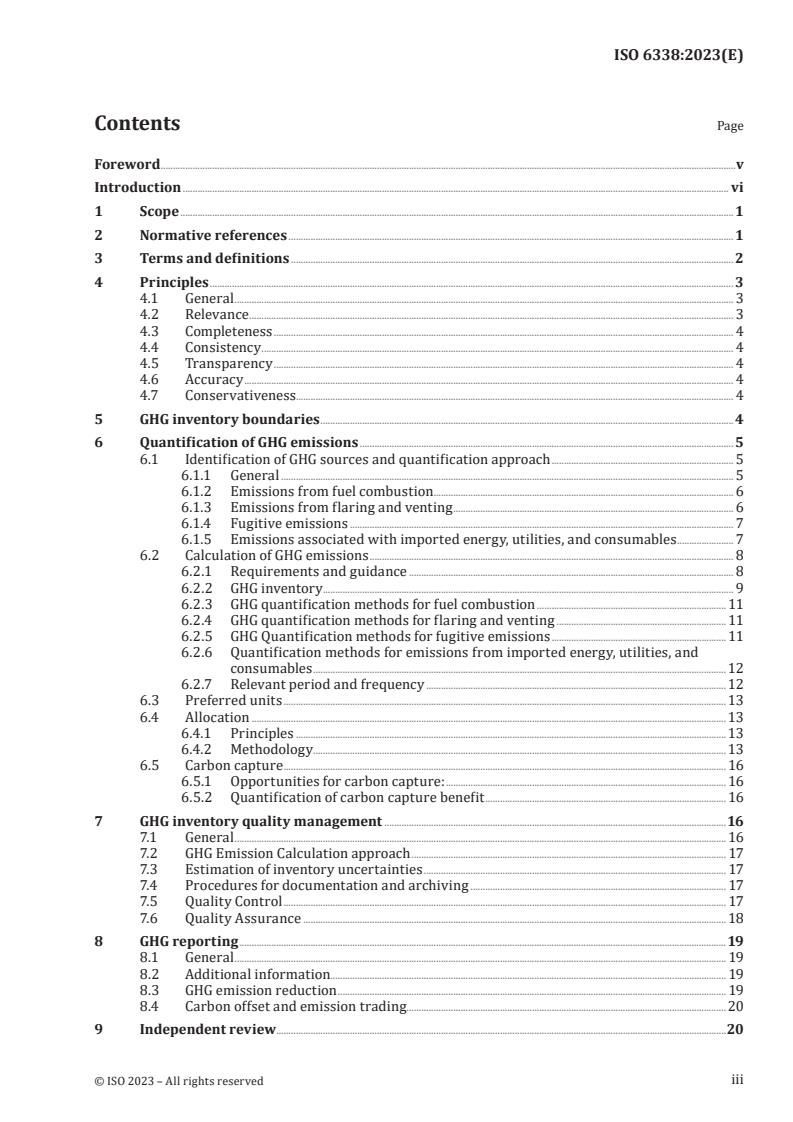
Contents Page
Foreword .v
Introduction . vi
1 Scope . 1
2 Normative references . 1
3 Terms and definitions . 2
4 Principles . 3
4.1 General . 3
4.2 Relevance . 3
4.3 Completeness . 4
4.4 Consistency . 4
4.5 Transparency . 4
4.6 Accuracy . 4
4.7 Conservativeness. 4
5 GHG inventory boundaries .4
6 Quantification of GHG emissions . 5
6.1 Identification of GHG sources and quantification approach . 5
6.1.1 General . 5
6.1.2 Emissions from fuel combustion . . 6
6.1.3 Emissions from flaring and venting . 6
6.1.4 Fugitive emissions . 7
6.1.5 Emissions associated with imported energy, utilities, and consumables . 7
6.2 Calculation of GHG emissions . 8
6.2.1 Requirements and guidance . 8
6.2.2 GHG inventory . . 9
6.2.3 GHG quantification methods for fuel combustion . 11
6.2.4 GHG quantification methods for flaring and venting . 11
6.2.5 GHG Quantification methods for fugitive emissions . 11
6.2.6 Quantification methods for emissions from imported energy, utilities, and
consumables . 12
6.2.7 Relevant period and frequency .12
6.3 Preferred units . 13
6.4 Allocation . 13
6.4.1 Principles .13
6.4.2 Methodology . . 13
6.5 Carbon capture . 16
6.5.1 Opportunities for carbon capture: . 16
6.5.2 Quantification of carbon capture benefit . 16
7 GHG inventory quality management .16
7.1 General . 16
7.2 GHG Emission Calculation approach . 17
7.3 Estimation of inventory uncertainties . 17
7.4 Procedures for documentation and archiving . 17
7.5 Quality Control . 17
7.6 Quality Assurance . 18
8 GHG reporting .19
8.1 General . 19
8.2 Additional information. 19
8.3 GHG emission reduction . 19
8.4 Carbon offset and emission trading . 20
9 Independent review . .20
iii
Annex A (informative) Conversion factors for reference .21
Annex B (informative) International initiatives on climate ambitions .22
Annex C (informative) Example allocation calculation .24
Bibliography .30
iv
Foreword
ISO (the International Organization for Standardization) is a worldwide federation of national standards
bodies (ISO member bodies). The work of preparing International Standards is normally carried out
through ISO technical committees. Each member body interested in a subject for which a technical
committee has been established has the right to be represented on that committee. International
organizations, governmental and non-governmental, in liaison with ISO, also take part in the work.
ISO collaborates closely with the International Electrotechnical Commission (IEC) on all matters of
electrotechnical standardization.
The procedures used to develop this document and those intended for its further maintenance are
described in the ISO/IEC Directives, Part 1. In particular, the different approval criteria needed for the
different types of ISO documents should be noted. This document was drafted in accordance with the
editorial rules of the ISO/IEC Directives, Part 2 (see www.iso.org/directives).
Attention is drawn to the possibility that some of the elements of this document may be the subject of
patent rights. ISO shall not be held responsible for identifying any or all such patent rights. Details of
any patent rights identified during the development of the document will be in the Introduction and/or
on the ISO list of patent declarations received (see www.iso.org/patents).
Any trade name used in this document is information given for the convenience of users and does not
constitute an endorsement.
For an explanation of the voluntary nature of standards, the meaning of ISO specific terms and
expressions related to conformity assessment, as well as information about ISO's adherence to
the World Trade Organization (WTO) principles in the Technical Barriers to Trade (TBT), see
www.iso.org/iso/foreword.html.
This document was prepared by Technical Committee ISO/TC 67, Oil and gas industries including lower
carbon energy, Subcommittee SC 9, Production, transport and storage facilities for cryogenic liquefied
gases.
Any feedback or questions on this document should be directed to the user’s national standards body. A
complete listing of these bodies can be found at www.iso.org/members.html.
v
Introduction
Natural gas will play a key role in the energy transition (e.g. by replacing coal to produce electricity)
and the use of LNG to transport natural gas is expected to increase. The process of liquefying natural
gas is energy-intensive. Gas producers are increasingly accountable for their greenhouse gas (GHG)
emissions and the ambition to reduce them. Furthermore, there is an emerging marketing demand for
GHG data to enable commercial mechanisms such as offsetting to be utilized.
There is no standardized and auditable methodology to calculate the carbon footprint of the whole LNG
chain (including but not limited to the well, upstream treatment, transportation, liquefaction, shipping,
regasification and end user distribution). Various standards indicate possible approaches but these are
not consistent in their results or easily applicable.
vi
INTERNATIONAL STANDARD ISO 6338:2023(E)
Method to calculate GHG emissions at LNG plant
1 Scope
This document provides a method to calculate the GHG emissions from an LNG liquefaction plant,
onshore or offshore.
The frame of this document ranges from the inlet flange of the LNG plant’s inlet facilities up to and
including the offloading arms to truck, ship or railcar loading. The upstream supply of gas up to the
inlet flange of the inlet facilities and the distribution of LNG downstream of the loading arms are only
covered in general terms.
This document covers:
— all facilities associated with producing LNG, including reception facilities, condensate unit (where
applicable), pre-treatment units (including but not limited to acid gas removal, dehydration, mercury
removal, heavies removal), LPG extraction and fractionation (where applicable), liquefaction, LNG
storage and loading, Boil-Off-Gas handling, flare and disposal systems, imported electricity or on-
site power generation and other plant utilities and infrastructure (e.g. marine and transportation
facilities).
— natural gas liquefaction facilities associated with producing other products (e.g. domestic gas,
condensate, LPG, sulphur, power export) to the extent required to allocate GHG emissions to the
different products.
— all GHG emissions associated with producing LNG. These emissions spread across scope 1, scope
2 and scope 3 of the responsible organization. Scope 1, 2 and 3 are defined in this document. All
emissions sources are covered including flaring, combustion, cold vents, process vents, fugitive
leaks and emissions associated with imported energy.
The LNG plant is considered “under operation”, including emissions associated with initial start-up,
maintenance, turnaround and restarts after maintenance or upset. The construction, commissioning,
extension and decommissioning phases are excluded from this document but can be assessed separately.
The emissions resulting from boil-off gas management during loading of the ship or any export vehicle
are covered by this document. The emissions from a ship at berth, e.g. mast venting are not covered by
this document.
This document describes the allocation of GHG emissions to LNG and other hydrocarbon products
where other products are produced (e.g. LPG, domestic gas, condensates, sulphur, etc.).
This document defines preferred units of measurement and necessary conversions.
This document also recommends instrumentation and estimations methods to monitor and report GHG
emissions. Some emissions are measured and some are estimated.
This document is applicable to the LNG industry.
Applications include the provision of method to calculate GHG emissions through a standardized and
auditable method, a means to determine their carbon footprint.
2 Normative references
The following documents are referred to in the text in such a way that some or all of their content
constitutes requirements of this document. For dated references, only the edition cited applies. For
undated references, the latest edition of the referenced document (including any amendments) applies.
ISO 14044, Environmental management — Life cycle assessment — Requirements and guidelines
ISO 14064-1, Greenhouse gases — Part 1: Specification with guidance at the organization level for
quantification and reporting of greenhouse gas emissions and removals
API Consistent Methodology for Estimating Greenhouse Gas Emissions from Liquefied Natural Gas (LNG)
Operations
3 Terms and definitions
For the purposes of this document, the terms and definitions given in ISO 14064-1 and the following
apply.
ISO and IEC maintain terminology databases for use in standardization at the following addresses:
— ISO Online browsing platform: available at https:// www .iso .org/ obp
— IEC Electropedia: available at https:// www .electropedia .org/
3.1
facility
single installation, set of installations or production processes (stationary or mobile), which can be
defined within a single geographical boundary, organizational unit or production process
[SOURCE: ISO 14064-1:2018, 3.4.1]
3.2
global warming potential
GWP
ratio of the time-integrated radiative forcing (warming effect) from the instantaneous release of 1 kg of
the GHG relative to that from the release of 1 kg of CO2
3.3
greenhouse gas
GHG
gaseous constituent of the atmosphere, both natural and anthropogenic, that absorbs and emits
radiation at specific wavelengths within the spectrum of infrared radiation emitted by the Earth’s
surface, the atmosphere and clouds
Note 1 to entry: For a list of GHGs, see the 6th Intergovernmental Panel on Climate Change (IPCC) Assessment
Report.
Note 2 to entry: Water vapour and ozone are anthropogenic as well as natural GHGs, but are not included as
recognized GHGs due to difficulties, in most cases, in isolating the human-induced component of global warming
attributable to their presence in the atmosphere.
[SOURCE: ISO 14064-1:2018, 3.1.1]
3.4
organizational boundary
grouping of activities or facilities in which an organization exercises operational or financial control or
has an equity share
[SOURCE: ISO 14064-1:2018, 3.4.7]
3.5
reporting boundary
grouping of greenhouse gas (GHG) emission or GHG removals reported from within the organizational
boundary, as well as those significant indirect emissions that are a consequence of the organization’s
operations and activities
[SOURCE: ISO 14064-1:2018, 3.4.8]
3.6
scope 1
direct greenhouse gas emissions
direct GHG emissions
emissions coming from sources that are owned or controlled by the facility
Note 1 to entry: This can be the emissions that are directly created by product fabrication or synthesis, for
example, combustion fumes from a refinery.
3.7
scope 2
indirect greenhouse gas emissions from purchased and consumed energy
indirect GHG emissions from purchased and consumed energy
emissions from the generation of imported electricity, steam, and heating/cooling consumed by the
facillity
Note 1 to entry: These emissions physically occur at the facility where electricity, steam and cooling or heating
are generated but as a user of the energy, the consuming party is still responsible for the greenhouse gas
emissions that are being created.
3.8
scope 3
other indirect greenhouse gas emissions
other indirect GHG emissions
emissions from sources that are not owned and not directly controlled by the facility
Note 1 to entry: However, they are related to the company’s activities. This is usually considered to be the
supply chain of the company, so emissions caused by vendors within the supply chain, outsourced activities, and
employee travel and commute. In many industries, other indirect GHG emissions account for the biggest amount
of GHG emissions. This is due to the fact that in today’s economy, many tasks are outsourced and few companies
own the entire value chain of their products.
3.9
quality assurance
QA
planned system of review procedures conducted by personnel not directly involved in the inventory
compilation/development process
3.10
quality control
QC
planned system of review procedures conducted by personnel not directly involved in the inventory
compilation/development process
4 Principles
4.1 General
The application of the following principles is fundamental to guarantee that GHG calculations are a true
and fair account.
4.2 Relevance
Use data, methods, criteria, and assumptions that are appropriate for the intended use of reported
information. The quantification and reporting of GHG emissions shall include only information that
users — both internal and external to the plant — need for their decision-making. This information
shall thus fit the intended purpose of the GHG project and meet the expectations or requirements of
its users. Data, methods, criteria, and assumptions that are misleading or that do not conform to this
document are not relevant and shall not be included.
4.3 Completeness
Consider all relevant information that can affect the accounting and quantification of GHG reductions,
and complete all requirements. All relevant information shall be included in the quantification of GHG
emissions. A GHG monitoring plan shall also specify how all data relevant to quantifying GHG reductions
will be collected.
4.4 Consistency
Use data, methods, criteria, and assumptions that allow meaningful and valid comparisons. The credible
quantification of GHG emissions requires that methods and procedures are always in the same manner,
that the same criteria and assumptions are used to evaluate significance and relevance, and that any
data collected and reported will be compatible enough to allow meaningful comparisons over time.
4.5 Transparency
Provide clear and sufficient information for reviewers to assess the credibility and reliability of GHG
emissions claims. Transparency is critical for quantifying and reporting GHG reductions, particularly
given the flexibility and policy-relevance of many GHG accounting. GHG information shall be compiled,
analysed, and documented clearly and coherently so that reviewers can evaluate its credibility.
Information relating to the GHG assessment boundary, the estimation of baseline emissions shall be
sufficient to enable reviewers to understand how all conclusions were reached.
4.6 Accuracy
Uncertainties with respect to GHG measurements, estimates, or calculations shall be reduced as much as
is practical, and measurement and estimation methods shall avoid bias. Acceptable levels of uncertainty
will depend on the objectives for implementing a GHG project and the intended use of quantified GHG
reductions. Where accuracy is sacrificed, data and estimates used to quantify GHG reductions shall be
conservative.
4.7 Conservativeness
Where data and assumptions are uncertain and where the cost of measures to reduce uncertainty is not
worth the increase in accuracy, make best endeavours to use the most probable data, with an analysis
of the impact of likely uncertainty margins.
5 GHG inventory boundaries
The reporting boundaries of the GHG report for an onshore or offshore LNG liquefaction plant shall
cover all facilities which are associated with the production of LNG. Table 1 provides examples of LNG
plant facilities.
[1]
Table 1 — List of LNG plant facilities
Out of
In scope of
LNG Plant Facility scope of
the report
the report
Natural Gas Production X
Shipping / Pipeline Transport X
Inlet gas Receiving Facilities X
Condensate Unit (where applicable) X
Pre-treatment Units (e.g. acid gas remov-
al, dehydration, mercury removal, heavies X
removal, others)
TTabablele 1 1 ((ccoonnttiinnueuedd))
Out of
In scope of
LNG Plant Facility scope of
the report
the report
LPG Extraction and Fractionation (where
X
applicable)
Liquefaction Unit X
LNG Storage and Loading X
Flare and Disposal Systems X
Carbon Capturing Unit X
Utilities Supply (on-site power generation) X
Utilities Supply (imported) X
Plant Utilities and Infrastructure (e.g.
X
plant piping and marine facilities)
Regasification X
The organization having financial and/or operational control over the LNG liquefaction plant shall
report all GHG emissions and removals within the reporting boundaries at least on an annual average
basis.
6 Quantification of GHG emissions
6.1 Identification of GHG sources and quantification approach
6.1.1 General
The main emission sources to consider derive from fuel combustion, flaring, releases to atmosphere
(including fugitive emissions) and emissions associated with imported energy or consumables. Tables 2
to 5 give an initial checklist of emission sources to consider, and an overview of typical quantification
methods suitable for different emission sources.
The chosen method of quantification per emissions source will differ from one LNG facility to another.
Different plants will have access to a varying number of flow meters, composition analysis equipment
and level meters available.
Operators shall develop a GHG quantification plan to map out how all emission sources can best be
identified in the facility, with a preference to obtain primary data for all major emission sources. The
measurement plan shall also include an assessment of data accuracy and impact on the total GHG
emissions calculation. This assessment will then allow the operator to assess if there is a need to
further improve the amount or accuracy of instruments available for the total assessment. Guidance on
this assessment is detailed in ISO 14064-1:2018, Annex C.
A list of activity data shall be defined based on reliability as primary and secondary data:
— Primary data: quantified value of a process or an activity obtained from a direct measurement or a
calculation based on direct measurements
— Secondary data: data obtained from sources other than primary data
There is always a preference to use primary data. Only in the absence of primary data, secondary data
may be used, that could include estimated quantities and industry average emission factors.
Typically, primary data is recorded to enable GHG quantification contributing >5 % of the site’s total
GHG emissions. For smaller individual sources a calculated approach is acceptable.
The following subclauses describe sources to consider and typical quantification approach for the main
emissions sources.
6.1.2 Emissions from fuel combustion
The quantification approaches for emissions from fuel combustion are described in Table 2.
Table 2 — Emissions from fuel combustion at LNG liquefaction facilities
Source Examples Quantification approach
Gas turbine driv- Primary liquefaction drivers, power Typically, primary data is recorded to enable
ers generation drivers, other refrigeration GHG quantification. As a minimum, fuel gas
drivers (e.g. fractionation), CO sequestra- consumption and composition are required.
tion compressor drivers (Noting that fuel composition at an LNG plant
can vary widely depending on operating mode)
Diesel drivers Firewater pumps, power generation, boil- Operator may report typical annual diesel
er feed water pumps consumption and include resulting annual
emissions as a nominal allowance in the GHG
calculation
Boilers Steam for turbine drivers, steam for pro- Typically, primary data is recorded to enable
cess heating GHG quantification for major fuel consumers
(contributing >5 % of the total GHG emissions.)
As a minimum, fuel gas consumption and com-
position shall be measured
Fired heaters Regeneration gas heater, heating medium If fuel measurements are available, operator
heater, direct fired reboilers should record total fuel gas consumption and
composition. If direct fuel measurements are
not available, a calculation based on operating
duty and efficiency is acceptable
Incinerators Acid gas vent incinerator, thermal oxidiz- As above
ers, catalytic oxidizers, waste disposal
Unburned hydrocarbons shall be taken into account in all sections. If fuel measurements are available, operator should
record total fuel gas consumption combined with combustion efficiency data for the fired equipment used. Ideally,
combustion efficiency should be validated with measured emission data.
6.1.3 Emissions from flaring and venting
The quantification approaches for emissions from flaring and venting are described in Table 3.
Table 3 — Emissions from flaring and venting at LNG liquefaction facilities
Source Examples Quantification approach
Atmospheric Acid gas vent, sulphur plant tail gas Typically, primary data is recorded to enable
waste disposal GHG quantification from venting contribut-
from treating ing >5 % of the site’s total GHG emissions. For
units smaller individual sources a calculated ap-
proach based on heat and material balance data
is acceptable. As a minimum, fuel gas consump-
tion and composition are required
Atmospheric vent- Feed gas pipeline blowdown, storage tank Typically, primary data is recorded for signif-
ing of unburned venting and pressure protection, loading icant venting events, such as pipeline blow-
hydrocarbon arm blowdown, compressor blowdown, down. A calculated approach is acceptable
flare operation with failed ignition for venting events contributing <5 % of total
annual emissions
Flares Process plant pressure protection, depres- Typically, primary data is recorded to enable
suring, storage tank pressure protection, GHG quantification from flaring contributing
boil-off gas management, refrigerant com- >5 % of the site’s total GHG emissions. For
position management, purge gas and pilots smaller individual sources a calculated ap-
proach is acceptable.
Nitrogen vents Nitrogen vents from nitrogen rejection If primary data not available, a calculated
from NRU units can contain methane, and are gener- allowance using licensor composition data may
ally routed to atmosphere be used.
Unburned hydrocarbons shall be taken into account in all sections. Operator should record total flare gas, combined
with combustion efficiency data for the flare tip used. Ideally, combustion efficiency should be validated with measured
emission data.
6.1.4 Fugitive emissions
The quantification approaches for fugitive emissions are described in Table 4.
Table 4 — Fugitive emissions at LNG liquefaction facilities
Source Examples Quantification approach
Permeation Emissions through porous materials Can be calculated with emissions factors for
different materials.
Gas leaks Leaks from pipes and fittings, rotating Typically done via calculation using equipment
equipment seals, storage tank seals count and standard leakage factors. Measured
leakage data from atmospheric monitoring may
be used to adjust the leakage factors applied.
6.1.5 Emissions associated with imported energy, utilities, and consumables
Emissions associated with imports require data from the exporter. Contractual relationship with the
exporter should include a requirement to provide emissions data. In the absence of reliable GHG data
for imports, the calculation shall account for the complete supply chain for the imported commodity.
The cut-off criteria for reporting shall be defined in accordance with ISO 14044.
The quantification approaches for emissions associated with imported energy, utilities and consumables
are described in Table 5.
Table 5 — Emissions associated with imported energy, utilities, and consumables
Source Examples Quantification approach
Electric power Power from third party fossil fuel combus- Primary data is recorded for total power con-
tion, power from grid sumed. GHG quantification requires intensity
data from the supplier. In case of supply from a
grid, the average intensity from all suppliers to
the grid is required
Heat or steam Steam or heating medium from third party Primary data is recorded for total imported
heating utility. GHG quantification requires
intensity data from the supplier. In case of heat
generated from waste heat, emissions from pri-
mary fuel use may be excluded, but supplemen-
tal emissions such as pumping power, or back
up fired heaters or boilers must be included.
Other utilities Cooling, air, nitrogen, water Primary data is recorded for total imported
utility. GHG quantification requires intensity
data from the supplier. Secondary data is ac-
ceptable if primary data is not available.
Imported con- Refrigerant not produced on site Primary data is recorded for quantities con-
sumables sumed. GHG quantification from consumables
requires intensity data from the supplier.
Secondary data is acceptable if primary data is
not available.
6.2 Calculation of GHG emissions
6.2.1 Requirements and guidance
The following paragraphs in this subclause provide requirements and guidance regarding the evaluation
of activity data and emission factors required to convert emission source data to GHG emissions. In
some cases, emissions are measured directly (e.g. in case of venting), but most commonly a calculation
is required to convert measured data to reported emissions (e.g. in case of fuel combustion).
Emission calculations shall be performed in accordance with API (American Petroleum Institute)
Consistent Methodology for Estimating Greenhouse Gas Emissions from Liquefied Natural Gas (LNG)
Operations.
The key input data required to derive an emission factor are flowrate, composition, and combustion
efficiency.
For flowrate, the preferred approach is to use measured data. However, in the absence or failure of
measurement instrumentation, calculated approaches may be used, e.g. based on heat and material
balances, or other data such as pressure drop which may be used to estimate a flowrate.
For composition, the preferred approach is also to use measured data. However, in the absence of
measured data, calculated and estimated approaches may be used, e.g. based on periodic sampling or
calculation from the heat and material balance. For sources with predictable composition (e.g. diesel
fuel) standard emission factors may be used. See API GHG Compendium for emissions standards and
approach.
For combustion efficiency, the preferred approach is also to use measured data. However, in the absence
of directly measured data, the equipment vendor can supply efficiency data based on factory testing of
their equipment or refer to API GHG Compendium for typical values.
Each time a GHG emission evaluation is reported, the calculation approach shall also be stated,
recognising that the quality of data available for this calculation impacts the accuracy of the results.
LNG Plant GHG emissions would be estimated using a combination of methodologies Elements of the
method consists of:
— direct measurements including mass balance approaches;
— emission factors including those provided by equipment manufacturers;
— engineering calculations that are based on process knowledge.
6.2.2 GHG inventory
6.2.2.1 General
A GHG emissions inventory is comprised of measured, calculated and estimated emissions from
individual emission sources that are aggregated to produce the inventory, in accordance with the
following steps;
— Define the purpose and content of the GHG Inventory, GHG emissions sources and assessment
boundary and the reference base year;
— Select activity data and emission factors: provide sector-specific good practice guidance and
references for emission factors (see Clause 6);
— Select measuring technologies or Calculation methods: describe different quantification methods
depending on the availability of site-specific activity data and emission factors;
— Define the Data recording and reporting criteria, and related documentation.
GHG Inventory methodology and process shall include the following elements:
— Base year;
— GHG emission sources;
— Activity data inputs;
— GHG emission factors;
— Global warming potentials.
Plant owner shall define requirements for the GHG Inventory records, reports and documentation and
archive it in a consistent manner.
6.2.2.2 Base year definition
A meaningful and consistent comparison of emissions over time requires that companies set a
performance datum with which to compare current emissions. This performance datum is referred
to as the base year emissions. It describes an activity or a set of activities that result in GHG emissions
against which current activity emissions can be compared for the purpose of quantifying GHG
reductions.
The selection of base year shall represent and be consistent to the following criteria:
— Same boundary of activities
— Same technologies or practices
— Same plant configuration, deployment, implementation, operation,
— Same type, quality, and similar quantity of product(s) or service(s) as the current year.
For consistent tracking of emissions overtime, the past base year emissions shall be recalculated,
according to the new reporting boundary, when significant structural changes occur for any of the
above criteria during the year of reporting.
6.2.2.3 GHG emission sources
Plant owner shall define a GHG assessment boundary through the following steps:
— identify the Plant activities that comprise the GHG project;
— identifying the primary (major sources) and secondary (minor sources) effects associated with each
plant activity listed in 6.1;
— thoroughly analysing the secondary effects to determine which are significant for the purpose of
estimating and quantifying GHG reductions.
For complete, accurate and transparent quantification of GHG reductions, the GHG assessment
boundary shall be clearly defined and reported. The GHG assessment boundary shall include the
primary and significant secondary effects of all operational activities. Specific exclusions or inclusions
shall be clearly identified and justified/explained and exclusions shall not exceed 5 % of the aggregate
GHG emissions in scope 1 and scope 2.
6.2.2.4 GHG Emission Factors
Different types of emission factors are used to convert activity data and upstream/downstream data
into GHG emissions data:
a) Material emission factors
1) Life cycle materials emission factors, which include emissions that occur at every stage of a
material/product’s life, from raw material acquisition or generation of natural resource to end
of life
2) Cradle-to-gate (“upstream”) emission factors, which include all emissions that occur in the life
cycle of a material/product up to the point of sale by the producer.
b) Energy emission factors
1) Life cycle fuel emission factors, which include not only the emissions that occur from
combusting the fuel (Combustion emissions factors) but all other emissions that occur in the
life cycle of the fuel such as emissions from extraction, processing, and transportation of fuels
(Well-to-tank emission factors).
2) Combustion emission factors, which include only the emissions that occur from combusting
the fuel.
c) Upstream & Downstream transportation factors often included in specific international models
such as the GHG Protocol.
Company shall define emission factors used to convert activity data and upstream/downstream data
into GHG emissions data, record and archive it in a consistent manner.
6.2.2.5 GHG global warming potentials
Each GHG has a unique atmospheric lifetime and heat-trapping potential. To express emissions based
on their global warming potential, the mass of emissions of each GHG is multiplied by its corresponding
GWP. The result is referred to as the CO2-equivalent (CO2-eq) emissions. Because the GWP of CO2 is
always 1, the mass emissions of CO2 and the CO2-eq emissions are identical. Global warming potentials
are calculated over different time periods, typically ranging from 20 years to 500 years. The most
common time period for expressing GWPs is 100 years.
The reporting entity shall define GWP reference used to convert GHG data into GHG equivalent and
record and archive it in a consistent manner.
6.2.3 GHG quantification methods for fuel combustion
One of the features of LNG operations is that the carbon content of the fuel gas can vary throughout the
operations chain and can also vary in different operating modes. During liquefaction, the fuel gas used
typically has lower carbon content than the feed stream used for producing the LNG, since it consists
mostly of lower molecular weight boil-off gas and most of the inlet gas stream’s inert nitrogen.
6.2.4 GHG quantification methods for flaring and venting
6.2.4.1 General
GHG quantification shall follow the requirements and should follow the guidance in 6.2.1. Additional
considerations are given in the following clauses.
6.2.4.2 Flaring
The flare system at LNG facilities operates as an emergency facility. It is a critical part of the safety
system and is designed to prevent escalation of accidents and dangerous situations. It is mainly used
to eliminate any discharge from the pressure relief system. Any waste gas sent to the flare (i.e. gas
from the process which is not recovered, such as dehydrator vents or compressor seal gas) is usually
insignificant compared with other industrial processes such as petrochemical or refining.
In principal, operators should avoid operational flaring, however there might be small quantities of
planned releases into the flare system, including fuel for pilots and purging, and exceptional operational
releases such as for defrosting or refrigerant composition management. In these cases, the source gas
entering the flare system should be known, and emissions factors may be derived.
In case of emergency flaring, an incident investigation should identify the source of a release, and this
information may be used to derive an emission factor to apply to the event.
Measurement-based methane destruction efficiency, destruction efficiency determined through the
application of correlations based on representative sampling, or in some cases process simulation and/
or engineering calculations may be used for emissions quantification at the flare. These emissions
quantifications must be validated against relevant field data.
Measured combustion efficiency factors may also be used, recognizing they will provide a conservative
reported value compared to destruction efficiency. More
...
NORME ISO
INTERNATIONALE 6338
Première édition
2023-05
Méthode pour calculer les émissions
de GES dans les usines GNL
Method to calculate GHG emissions at LNG plant
Numéro de référence
DOCUMENT PROTÉGÉ PAR COPYRIGHT
© ISO 2023
Tous droits réservés. Sauf prescription différente ou nécessité dans le contexte de sa mise en œuvre, aucune partie de cette
publication ne peut être reproduite ni utilisée sous quelque forme que ce soit et par aucun procédé, électronique ou mécanique,
y compris la photocopie, ou la diffusion sur l’internet ou sur un intranet, sans autorisation écrite préalable. Une autorisation peut
être demandée à l’ISO à l’adresse ci-après ou au comité membre de l’ISO dans le pays du demandeur.
ISO copyright office
Case postale 401 • Ch. de Blandonnet 8
CH-1214 Vernier, Genève
Tél.: +41 22 749 01 11
E-mail: copyright@iso.org
Web: www.iso.org
Publié en Suisse
ii
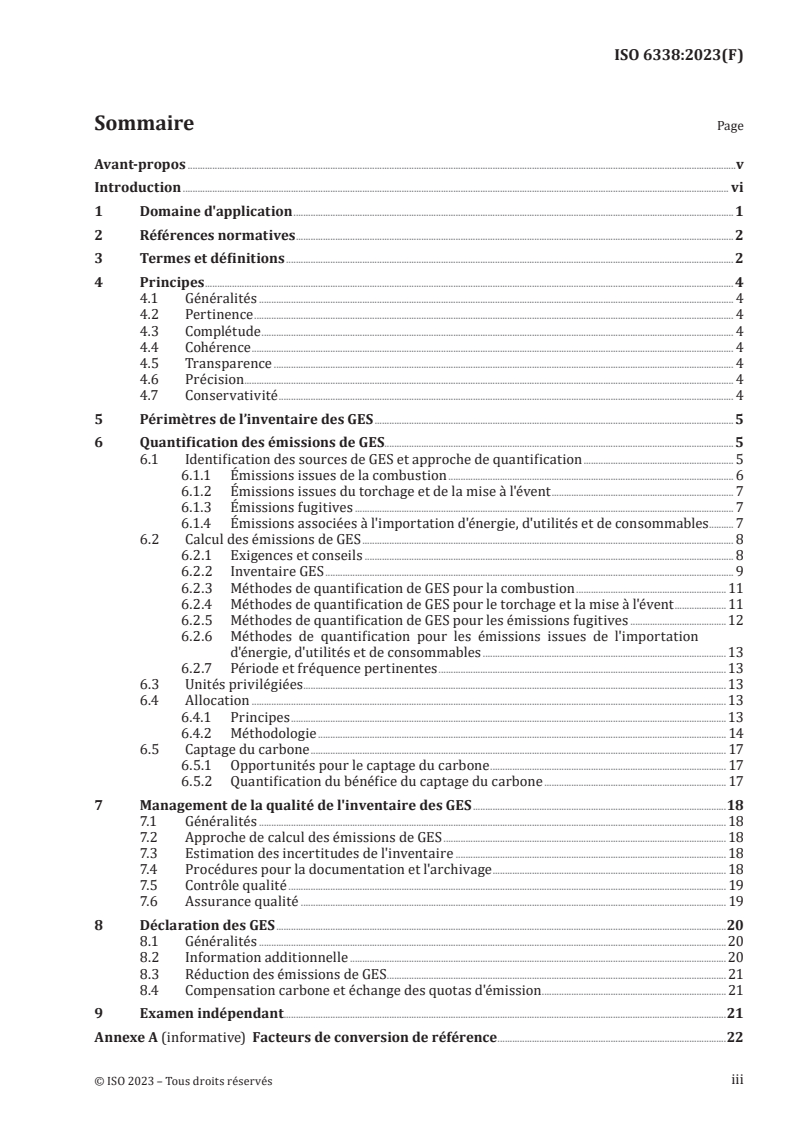
Sommaire Page
Avant-propos .v
Introduction . vi
1 Domaine d'application .1
2 Références normatives .2
3 Termes et définitions . 2
4 Principes . 4
4.1 Généralités . 4
4.2 Pertinence . 4
4.3 Complétude . 4
4.4 Cohérence . 4
4.5 Transparence . 4
4.6 Précision . . . 4
4.7 Conservativité . 4
5 Périmètres de l’inventaire des GES .5
6 Quantification des émissions de GES.5
6.1 Identification des sources de GES et approche de quantification . 5
6.1.1 Émissions issues de la combustion . 6
6.1.2 Émissions issues du torchage et de la mise à l'évent . 7
6.1.3 Émissions fugitives . 7
6.1.4 Émissions associées à l'importation d'énergie, d'utilités et de consommables . 7
6.2 Calcul des émissions de GES . 8
6.2.1 Exigences et conseils . 8
6.2.2 Inventaire GES . 9
6.2.3 Méthodes de quantification de GES pour la combustion . 11
6.2.4 Méthodes de quantification de GES pour le torchage et la mise à l'évent . 11
6.2.5 Méthodes de quantification de GES pour les émissions fugitives .12
6.2.6 Méthodes de quantification pour les émissions issues de l'importation
d'énergie, d'utilités et de consommables .13
6.2.7 Période et fréquence pertinentes . 13
6.3 Unités privilégiées . 13
6.4 Allocation . 13
6.4.1 Principes .13
6.4.2 Méthodologie . 14
6.5 Captage du carbone . 17
6.5.1 Opportunités pour le captage du carbone . 17
6.5.2 Quantification du bénéfice du captage du carbone . 17
7 Management de la qualité de l'inventaire des GES .18
7.1 Généralités . 18
7.2 Approche de calcul des émissions de GES . 18
7.3 Estimation des incertitudes de l'inventaire . 18
7.4 Procédures pour la documentation et l'archivage . 18
7.5 Contrôle qualité . 19
7.6 Assurance qualité . 19
8 Déclaration des GES .20
8.1 Généralités . 20
8.2 Information additionnelle . 20
8.3 Réduction des émissions de GES . 21
8.4 Compensation carbone et échange des quotas d'émission . 21
9 Examen indépendant.21
Annexe A (informative) Facteurs de conversion de référence .22
iii
Annexe B (informative) Initiatives internationales sur les ambitions climatiques .23
Annexe C (informative) Exemple: Allocation des émissions de GES aux coproduits
d'une usine de GNL .26
Bibliographie .33
iv
Avant-propos
L'ISO (Organisation internationale de normalisation) est une fédération mondiale d'organismes
nationaux de normalisation (comités membres de l'ISO). L'élaboration des Normes internationales est
en général confiée aux comités techniques de l'ISO. Chaque comité membre intéressé par une étude
a le droit de faire partie du comité technique créé à cet effet. Les organisations internationales,
gouvernementales et non gouvernementales, en liaison avec l'ISO participent également aux travaux.
L'ISO collabore étroitement avec la Commission électrotechnique internationale (IEC) en ce qui
concerne la normalisation électrotechnique.
Les procédures utilisées pour élaborer le présent document et celles destinées à sa mise à jour sont
décrites dans les Directives ISO/IEC, Partie 1. Il convient, en particulier de prendre note des différents
critères d'approbation requis pour les différents types de documents ISO. Le présent document
a été rédigé conformément aux règles de rédaction données dans les Directives ISO/IEC, Partie 2
(voir www.iso.org/directives).
L'attention est attirée sur le fait que certains des éléments du présent document peuvent faire l'objet de
droits de propriété intellectuelle ou de droits analogues. L'ISO ne saurait être tenue pour responsable
de ne pas avoir identifié de tels droits de propriété et averti de leur existence. Les détails concernant
les références aux droits de propriété intellectuelle ou autres droits analogues identifiés lors de
l'élaboration du document sont indiqués dans l'Introduction et/ou dans la liste des déclarations de
brevets reçues par l'ISO (voir www.iso.org/brevets).
Les appellations commerciales éventuellement mentionnées dans le présent document sont données
pour information, par souci de commodité, à l’intention des utilisateurs et ne sauraient constituer un
engagement.
Pour une explication de la nature volontaire des normes, la signification des termes et expressions
spécifiques de l'ISO liés à l'évaluation de la conformité, ou pour toute information au sujet de l'adhésion
de l'ISO aux principes de l’Organisation mondiale du commerce (OMC) concernant les obstacles
techniques au commerce (OTC), voir: www.iso.org/iso/fr/avant-propos.
Le présent document a été élaboré par le comité technique ISO/TC 67, Industries du pétrole et du gaz, y
compris les énergies à faible teneur en carbone, sous-comité SC 9, Installations de production, de transport
et de stockage de gaz liquéfiés cryogéniques.
Il convient que l’utilisateur adresse tout retour d’information ou toute question concernant le présent
document à l’organisme national de normalisation de son pays. Une liste exhaustive desdits organismes
se trouve à l’adresse www.iso.org/fr/members.html.
v
Introduction
Le gaz naturel jouera un rôle clé dans la transition énergétique (par exemple, en remplaçant le charbon
pour la production d'électricité) et l'utilisation du GNL pour transporter le gaz naturel devrait croître. Le
processus de liquéfaction du gaz naturel est énergivore. Les producteurs de gaz ont une responsabilité
grandissante quant à leurs émissions de gaz à effet de serre (GES) et à la nécessité de les réduire. Il y
a, en outre, une demande commerciale émergente liée aux données sur les GES, afin de rendre possible
certains mécanismes commerciaux tels que la compensation.
Il n'existe pas de méthodologie normalisée et auditable pour calculer l'empreinte carbone de l'ensemble
de la chaîne GNL, sachant que chaque élément de la chaîne y contribue, du puits à l'utilisation finale, cela
inclut l’amont (avec le transport vers l'usine de liquéfaction, le cas échéant), la liquéfaction, le transport
maritime, la regazéification et l'utilisation.
vi
NORME INTERNATIONALE ISO 6338:2023(F)
Méthode pour calculer les émissions de GES dans les
usines GNL
1 Domaine d'application
Le présent document fournit une méthode pour calculer les émissions de GES d'une usine de liquéfaction
GNL, à terre ou en mer.
Le cadre du présent document s’étend des installations d'entrée de l'usine GNL aux bras de déchargement
pour le chargement de camion, bateau ou wagon. L’approvisionnement en gaz en amont jusqu'à la bride
d'entrée des installations d'entrée et la distribution de GNL en aval des bras de chargement ne sont
couverts que de manière générale.
Le présent document couvre:
— toutes les installations associées à la production de GNL, cela inclut les installations de réception,
l'unité de condensats (le cas échéant), les unités de prétraitement (comprenant, entre autres,
l'élimination des gaz acides, la déshydratation, l'élimination du mercure, l'élimination des
hydrocarbures lourds), l'extraction et le fractionnement du GPL (le cas échéant), la liquéfaction, le
stockage et le chargement du GNL, la gestion des gaz d'évaporation, les systèmes de torchage et de
traitements des déchets, l'électricité importée ou la production d'électricité sur site et les autres
utilités et infrastructures de l'usine (par exemple, les installations maritimes et de transport).
— les installations de liquéfaction du gaz naturel associées à la production d'autres produits (tels que
le gaz domestique, le condensat, le GPL, le soufre, l'exportation d'électricité) afin de pouvoir allouer
les émissions de GES aux différents produits.
— les émissions de GES associées à la production de GNL. Ces émissions se répartissent entre la
catégorie 1, la catégorie 2 et la catégorie 3 de l'organisme responsable. Les catégories 1, 2 et 3
sont définies dans le présent document. Toutes les sources d'émission sont couvertes, y compris le
torchage, la combustion, les évents froids, les évents de procédé, les fuites fugitives et les émissions
associées à l'énergie importée.
L'usine GNL est considérée comme étant «en exploitation», cela inclut les émissions associées à la
mise en service, au démarrage initial, à la maintenance, à la révision et aux redémarrages après une
maintenance ou perturbation. Les phases de construction, de mise en service, d'extension et d'abandon
sont exclues, mais peuvent être évaluées séparément.
Les émissions résultant de la gestion des gaz d'évaporation pendant le chargement d'un navire ou de
tout véhicule d'exportation sont couvertes. Les émissions d'un navire à quai, par exemple le dégazage
par le mât, ne sont pas couvertes dans le présent document.
Le présent document décrit l'allocation des émissions de GES au GNL et aux autres produits
d'hydrocarbures lorsque d'autres produits sont produits (par exemple, GPL, gaz domestique,
condensats, soufre, etc.).
Le présent document définit les unités de mesure privilégiées et les conversions nécessaires.
Le présent document recommande également l'instrumentation et les méthodes d'estimation pour
surveiller et déclarer les émissions de GES. Certaines émissions sont mesurées et d'autres estimées.
Le présent document est applicable à l'industrie du GNL.
Les applications incluent la fourniture d'une méthode pour calculer les émissions de GES à travers une
méthode standardisée et auditable, un moyen de déterminer leur empreinte carbone.
2 Références normatives
Les documents suivants sont cités dans le texte de sorte qu’ils constituent, pour tout ou partie de leur
contenu, des exigences du présent document. Pour les références datées, seule l'édition citée s'applique.
Pour les références non datées, la dernière édition du document de référence s'applique (y compris les
éventuels amendements).
ISO 14044, Management environnemental — Analyse du cycle de vie — Exigences et lignes directrices
ISO 14064-1, Gaz à effet de serre — Partie 1: Spécifications et lignes directrices, au niveau des organismes,
pour la quantification et la déclaration des émissions et des suppressions des gaz à effet de serre
API Consistent Methodology for Estimating Greenhouse Gas Emissions from Liquefied Natural Gas (LNG)
Operations
3 Termes et définitions
Pour les besoins du présent document, les termes et définitions donnés dans l'ISO 14064-1 ainsi que les
suivants s'appliquent.
L'ISO et l'IEC tiennent à jour des bases de données terminologiques destinées à être utilisées en
normalisation, consultables aux adresses suivantes:
— ISO Online browsing platform: disponible à l'adresse https:// www .iso .org/ obp
— IEC Electropedia: disponible à l'adresse https:// www .electropedia .org/
3.1
installation
installation unique, groupe d’installations ou de processus de production (fixes ou mobiles), pouvant
être définis à l’intérieur d’un périmètre géographique, d’une unité organisationnelle ou d’un processus
de production unique
[SOURCE: ISO 14064-1:2018, 3.4.1]
3.2
potentiel de réchauffement global
PRG
rapport du forçage radiatif intégré dans le temps (effet de réchauffement) de la libération instantanée
de 1 kg de GES par rapport à celui de la libération de 1 kg de CO
3.3
gaz à effet de serre
GES
constituant gazeux de l'atmosphère, naturel ou anthropique, qui absorbe et émet le rayonnement de
longueurs d'onde spécifiques du spectre du rayonnement infrarouge émis par la surface de la Terre,
l'atmosphère et les nuages
Note 1 à l'article: Pour obtenir la liste des GES, se référer au dernier Rapport d'évaluation du Groupe d'experts
intergouvernemental sur l'évolution du climat (GIEC).
Note 2 à l'article: La vapeur d'eau et l'ozone sont des GES d'origine anthropique et naturelle, mais ils ne figurent
pas parmi les GES reconnus étant donné que, dans la plupart des cas, il est difficile d'isoler la composante de
réchauffement planétaire induite par l'Homme et imputable à leur présence dans l'atmosphère.
[SOURCE: ISO 14064-1:2018, 3.1.1]
3.4
périmètre organisationnel
regroupement d'activités ou d'installations dans lequel un organisme exerce un contrôle opérationnel
ou financier ou possède une part du capital
[SOURCE: ISO 14064-1:2018, 3.4.7]
3.5
périmètre de déclaration
regroupement des émissions de GES ou des suppressions de GES déclarées dans le périmètre
organisationnel, ainsi que des émissions indirectes significatives qui découlent des opérations et
activités de l'organisme
[SOURCE: ISO 14064-1:2018, 3.4.8]
3.6
catégorie 1
émissions directes de gaz à effet de serre
émissions directes de GES
émissions provenant de sources qui appartiennent à l'installation ou qui sont sous son contrôle
Note 1 à l'article: Il pourrait s'agir des émissions résultant directement de la production de biens, par exemple les
fumées d'usine.
3.7
catégorie 2
émissions indirectes de gaz à effet de serre provenant de l'énergie achetée et consommée
émissions indirectes de GES provenant de l'énergie achetée et consommée
émissions provenant de la génération d'électricité, de vapeur et de chaleur/refroidissement importé,
consommé par l'installation
Note 1 à l'article: Ces émissions sont produites physiquement dans les installations où l'électricité, la vapeur et le
refroidissement/la chaleur sont générés. Cependant, en tant qu'utilisateur de l'énergie, la partie consommatrice
reste responsable des émissions de gaz à effet de serre créées.
3.8
catégorie 3
autres émissions indirectes de gaz à effet de serre
autres émissions indirectes de GES
émissions provenant de sources qui n'appartiennent pas à l'installation et qui ne sont pas directement
sous son contrôle
Note 1 à l'article: Elles sont toutefois liées aux activités de l'entreprise. Elles sont généralement considérées
comme faisant partie de la chaîne d'approvisionnement de l'entreprise et comprennent donc les émissions causées
par les fournisseurs au sein de la chaîne d'approvisionnement, les activités externalisées, ainsi que les trajets au
travail et déplacements des employés. Dans de nombreuses industries, les émissions relevant de la catégorie 3
représentent la plus grande part des émissions de GES. En effet, dans l'économie actuelle, de nombreuses tâches
sont externalisées et peu d'entreprises possèdent l'intégralité de la chaîne de valeur de leurs produits.
3.9
assurance qualité
AQ
système planifié de procédures d'examen menées par du personnel qui n'est pas directement impliqué
dans le processus de compilation/d'élaboration de l'inventaire
3.10
contrôle qualité
CQ
système planifié de procédures d'examen menées par du personnel qui n'est pas directement impliqué
dans le processus de compilation/d'élaboration de l'inventaire
4 Principes
4.1 Généralités
L'application des principes suivants est essentielle pour garantir que les calculs relatifs aux GES sont
exacts et justes.
4.2 Pertinence
Utiliser des données, des méthodes, des critères et des hypothèses appropriés à l'utilisation prévue
des informations communiquées. La quantification et la déclaration des émissions de GES ne doivent
inclure que les informations dont les utilisateurs — tant internes qu'externes à la centrale — ont besoin
pour leur prise de décision. Ces informations doivent ainsi correspondre à la finalité du projet GES et
répondre aux attentes ou exigences de ses utilisateurs. Les données, méthodes, critères et hypothèses
qui sont trompeurs ou qui ne sont pas conformes au présent document ne sont pas pertinents et ne
doivent pas être inclus.
4.3 Complétude
Tenir compte de toutes les informations pertinentes qui peuvent affecter la comptabilisation et la
quantification des réductions de GES, et remplissez toutes les exigences. Toutes les informations
pertinentes doivent être incluses dans la quantification des émissions de GES. Un plan de surveillance
des GES doit également préciser comment toutes les données pertinentes pour quantifier les réductions
de GES seront collectées.
4.4 Cohérence
Utiliser des données, des méthodes, des critères et des hypothèses qui permettent des comparaisons
significatives et valides. La quantification crédible des émissions de GES exige que les méthodes et les
procédures soient toujours de la même manière, que les mêmes critères et hypothèses soient utilisés
pour évaluer l'importance et la pertinence, et que toutes les données recueillies et communiquées soient
suffisamment compatibles pour permettre des comparaisons significatives dans le temps.
4.5 Transparence
Fournir des informations claires et suffisantes aux examinateurs pour évaluer la crédibilité et la
fiabilité des déclarations d'émissions de GES. La transparence est essentielle pour quantifier et rendre
compte des réductions de GES, en particulier compte tenu de la flexibilité et de la pertinence politique
de nombreux comptes de GES. Les informations sur les GES doivent être compilées, analysées et
documentées de manière claire et cohérente afin que les examinateurs puissent évaluer leur crédibilité.
Les informations relatives au périmètre d'évaluation des GES, l'estimation des émissions de référence
doivent être suffisantes pour permettre aux examinateurs de comprendre comment toutes les
conclusions ont été tirées.
4.6 Précision
Les incertitudes concernant les mesures, les estimations ou les calculs de GES doivent être réduites
autant que possible, et les méthodes de mesure et d'estimation doivent éviter les biais. Les niveaux
d'incertitude acceptables dépendront des objectifs de mise en œuvre d'un projet de GES et de
l'utilisation prévue des réductions de GES quantifiées. Lorsque l'exactitude est sacrifiée, les données et
les estimations utilisées pour quantifier les réductions de GES doivent être conservatrices.
4.7 Conservativité
Lorsque les données et les hypothèses sont incertaines et lorsque le coût des mesures visant à réduire
l'incertitude ne vaut pas l'augmentation de la précision, s'efforcer d'utiliser les données les plus
probables, avec une analyse de l'impact des marges d'incertitude probables.
5 Périmètres de l’inventaire des GES
Les périmètres de déclaration du rapport GES pour une usine de liquéfaction de GNL à terre ou en
mer doivent couvrir toutes les installations associées à la production de GNL. Le. Tableau 1 donne des
exemples d'installations d'usines de GNL.
[1]
Tableau 1 — Liste des installations de l'usine GNL
Dans le Hors du
Installation de l'usine GNL domaine domaine
d'application d'application
Production de gaz naturel X
Transport maritime/transport par pipeline X
Installations de réception X
Unité de condensats (le cas échéant) X
Unités de prétraitement (par exemple, élimination des gaz
acides, déshydratation, élimination du mercure, élimination X
des hydrocarbures lourds et autres)
Extraction et fractionnement du GPL (le cas échéant) X
Unité de liquéfaction X
Stockage et chargement du GNL X
Systèmes de torchage et de traitement des déchets X
Unité de captage du carbone X
Approvisionnement d'utilités (production d'électricité sur site) X
Approvisionnement d'utilités (importées) X
Utilités et infrastructures de l'usine (par exemple, installations
X
maritimes et de transport)
Regazéification X
L'organisation exerçant un contrôle financier et/ou opérationnel sur l'usine de liquéfaction de GNL doit
déclarer toutes les émissions et absorptions de GES dans les limites de déclaration au moins sur une
base annuelle moyenne.
6 Quantification des émissions de GES
6.1 Identification des sources de GES et approche de quantification
Les principales sources d'émission à prendre en considération proviennent de la combustion, du
torchage, des rejets à l'atmosphère (y compris les émissions fugitives) et des émissions associées à
l'importation d'énergie ou de consommables. Les Tableaux 2 à 5 donnent une première liste des sources
d'émission à considérer, ainsi qu'un aperçu des méthodes de quantification types qui sont adaptées aux
différentes sources d'émission.
La méthode de quantification choisie en fonction de la source d'émission différera d'une installation
GNL à l'autre. Les différentes usines auront accès à un nombre variable de débitmètres, d'équipements
d'analyse de la composition et de dispositifs de mesure du niveau mis à leur disposition.
Les exploitants doivent élaborer un plan de mesure des GES afin d'établir la meilleure façon d'identifier
l'ensemble des sources d'émission dans l'installation, en privilégiant l'obtention de données primaires
pour chacune des principales sources d'émission. Le plan de mesure doit également comporter une
évaluation de l'exactitude des données et de l'impact sur le calcul des émissions de GES totales. Cette
évaluation permettra ensuite à l'exploitant de déterminer s'il est nécessaire d'augmenter davantage le
nombre ou l'exactitude des instruments disponibles pour l'évaluation globale. Des recommandations
relatives à cette évaluation sont données dans l'ISO 14064-1, Annexe C.
Une liste des données d'activité doit être définie en fonction de leur fiabilité en tant que données
primaires et secondaires:
— données primaires: valeurs quantifiées d'un processus ou d'une activité obtenues à partir d'un
mesurage direct ou d'un calcul basé sur des mesurages directs;
— données secondaires: données obtenues à partir de sources autres que les données primaires.
Il y a toujours une préférence pour l'utilisation de données primaires. Ce n'est qu'en l'absence de données
primaires que des données secondaires peuvent être utilisées, qui pourraient inclure des quantités
estimées et des facteurs d'émission moyens de l'industrie.
En règle générale, les données primaires sont enregistrées pour permettre la quantification des GES
contribuant à plus de 5 % des émissions totales de GES du site. Pour les sources individuelles plus
petites, une approche calculée est acceptable.
Les paragraphes suivants décrivent les sources à prendre en considération et l'approche de
quantification type pour les principales sources d'émission.
6.1.1 Émissions issues de la combustion
Les approches de quantification des émissions issues de la combustion sont décrites dans le Tableau 2.
Tableau 2 — Émissions issues de la combustion dans les installations de liquéfaction GNL
Source Exemples Approche de quantification
Entraînements Entraînements primaires pour la liqué- Généralement, les données primaires sont enre-
par turbine à gaz faction, entraînements pour la production gistrées pour permettre la quantification des
d'électricité, autres entraînements pour GES. Au minimum, la consommation et la com-
la réfrigération (par exemple, fraction- position du combustible gazeux sont requises.
nement), entraînements de compresseur (À noter que la composition du combustible
pour la séquestration du CO dans une usine GNL peut varier considérable-
ment en fonction du mode de fonctionnement)
Entraînements Pompes d'eau incendie, production d'élec- L'exploitant peut déclarer la consommation
diesel tricité, pompes pour eau de chaudière annuelle type en diesel et inclure les émissions
annuelles résultantes sous forme d'un quota
nominal pour les calculs de GES
Chaudières Vapeur pour les entraînements à turbine, Généralement, les données primaires sont enre-
vapeur pour le chauffage du procédé gistrées pour permettre la quantification des
GES pour les consommateurs majeurs de com-
bustibles (contribuant à > 5 % des émissions
totales de GES). Au minimum, la consommation
et la composition du combustible gazeux sont
requises.
Chauffages à Chauffage de gaz de régénération, chauf- Si des mesures de combustible sont dispo-
combustion fage système, rebouilleurs à combustion nibles, il convient que l'exploitant enregistre la
directe consommation totale de combustible gazeux
et sa composition. Si les mesures directes du
combustible ne sont pas disponibles, un calcul
reposant sur le rendement opérationnel et l’effi-
cacité est acceptable.
Incinérateurs Incinérateur des évents de gaz acides, Comme ci-dessus
oxydateurs thermiques, oxydateurs cata-
lytiques, élimination des déchets
Les hydrocarbures non brûlés provenant de la combustion doivent être pris en compte dans toutes les sections. Si des
mesures de combustible sont disponibles, il convient que l'exploitant enregistre la consommation totale de combustible
gazeux, combinée aux données d’efficacité de combustion pour les équipements de combustion utilisés. Idéalement, il
convient que l’efficacité de combustion soit validée par des données d'émission mesurées.
6.1.2 Émissions issues du torchage et de la mise à l'évent
Les approches de quantification des émissions issues du torchage et de la mise à l'évent sont décrites
dans le Tableau 3.
Tableau 3 — Émissions issues du torchage et de la mise à l'évent dans les installations
de liquéfaction GNL
Source Exemples Approche de quantification
Élimination des Évent des gaz acides, gaz résiduel d'une Généralement, les données primaires sont
déchets atmos- usine de soufre enregistrées pour permettre la quantification
phériques des uni- des GES issus de la mise à l'évent, contribuant
tés de traitement à > 5 % des émissions totales de GES du site.
Pour les sources individuelles plus petites, une
approche par calcul reposant sur les données
de bilan thermique et de bilan massique est
acceptable. Au minimum, la consommation et
la composition du combustible gazeux sont
requises
Mise à l'évent Purge des canalisations d'alimentation, Généralement, les données primaires sont enre-
atmosphérique mise à l'évent et protection contre la gistrées pour les événements de mise à l'évent
d'hydrocarbures pression des réservoirs de stockage, significatifs, tels que les purges de canalisa-
non brûlés purge des bras de chargement, purge des tions. Une approche par calcul est acceptable
compresseurs, torchage en cas d'échec de pour les événements de mise à l'évent contri-
l'allumage buant à < 5 % des émissions annuelles totales.
Torches Protection contre la pression du procédé Généralement, les données primaires sont
de l’usine, dépressurisation, protection enregistrées pour permettre la quantifica-
contre la pression des réservoirs de tion des GES issus du torchage, contribuant
stockage, gestion des gaz d'évaporation, à > 5 % des émissions totales de GES du site.
gestion de la composition des réfrigérants, Pour les sources individuelles plus petites, une
gaz de purge et veilleuses. approche par calcul est acceptable.
Mises à l'évent de Les mises à l'évent de l'azote par des Si les données primaires ne sont pas dispo-
l'azote des NRU unités de rejet d'azote peuvent contenir nibles, un quota calculé à partir des données de
(unités de rejet du méthane et sont généralement dirigées composition du concédant peut être utilisé.
d'azote) vers l'atmosphère
Les hydrocarbures non brûlés provenant de la combustion doivent être pris en compte dans toutes les sections. Si des
mesures de combustible sont disponibles, il convient que l'exploitant enregistre la consommation totale de combustible
gazeux, combinée aux données d’efficacité de combustion pour les équipements de combustion utilisés. Idéalement, il
convient que l’efficacité de combustion soit validée par des données d'émission mesurées.
6.1.3 Émissions fugitives
Les approches de quantification des émissions fugitives sont décrites dans le Tableau 4.
Tableau 4 — Émissions fugitives dans les installations de liquéfaction GNL
Source Exemples Approche de quantification
Perméation Émissions à travers les matières Peut être calculé avec des facteurs d'émission pour
poreuses différents matériaux.
Fuites de gaz Fuites de tuyaux et de raccords, joints Généralement réalisé par calcul en utilisant le
d'équipements rotatifs, joints de réser- nombre d'équipements et les facteurs de fuite
voirs de stockage standard. Les données de fuites mesurées par la
surveillance atmosphérique peuvent être utilisées
pour ajuster les facteurs de fuites appliqués.
6.1.4 Émissions associées à l'importation d'énergie, d'utilités et de consommables
Les émissions associées aux importations nécessitent des données de la part de l'exportateur. Il
convient que la relation contractuelle avec l'exportateur inclue une exigence de fourniture des données
d'émissions. En l'absence de données fiables sur les GES pour les importations, le calcul doit prendre en
compte la chaîne d'approvisionnement complète de la ressource importée. Les critères de limite pour le
reporting doivent être définis conformément à l'ISO 14044.
Les approches de quantification des émissions associées à l'importation d'énergie, d'utilités et de
consommables sont décrites dans le Tableau 5.
Tableau 5 — Émissions associées à l'importation d'énergie, d'utilités et de consommables
Source Exemples Approche de quantification
Énergie électrique Énergie issue de la combustion de com- Les données primaires sont enregistrées pour
bustibles fossiles par des tiers, énergie l'énergie totale consommée. La quantification des
du réseau électrique GES nécessite des données d'intensité de la part du
fournisseur. En cas d'approvisionnement par un
réseau électrique, l'intensité moyenne de tous les
fournisseurs du réseau est requise.
Chaleur Vapeur ou chauffage par un tiers Les données primaires sont enregistrées pour les
importations totales d'utilités de chauffage. La
quantification des GES nécessite des données d'in-
tensité de la part du fournisseur. En cas de chaleur
produite par la chaleur résiduelle, les émissions
provenant de l'utilisation du combustible primaire
peuvent être exclues, mais les émissions supplé-
mentaires (telles que l'énergie de pompage ou les
chauffages ou chaudières à combustion de secours)
doivent être incluses.
Autres utilités Eau de refroidissement, air, azote, eau Les données primaires sont enregistrées pour les
importations totales d'utilités. La quantification
des GES nécessite des données d'intensité de la
part du fournisseur. Les données secondaires sont
acceptables si les données primaires ne sont pas
disponibles.
Consommables Réfrigérants non produits sur le site Les données primaires sont enregistrées pour les
importés quantités consommées. La quantification des GES
issus des consommables nécessite des données
d'intensité de la part du fournisseur. Les données
secondaires sont acceptables si les données pri-
maires ne sont pas disponibles.
6.2 Calcul des émissions de GES
6.2.1 Exigences et conseils
Les paragraphes suivants fournissent des recommandations relatives à l'évaluation des données
d'activité et des facteurs d'émission requis pour convertir les données de sources d'émission en
émissions de GES. Dans certains cas, les émissions sont mesurées directement (par exemple, en cas de
mise à l'évent), mais, le plus souvent, un calcul est nécessaire pour convertir les données mesurées en
émissions déclarées (par exemple, en cas de combustion).
Les calculs d'émissions doivent être réalisés conformément à la Consistent Methodology for Estimating
Greenhouse Gas Emissions from Liquefied Natural Gas (LNG) Operations de l’API (American Petroleum
Institute).
Les données d'entrée clés, nécessaires pour déterminer un facteur d'émission, sont le débit, la
composition et l’efficacité de combustion.
Pour le débit, l'approche privilégiée consiste à utiliser des données mesurées. Cependant, en l'absence
d'instruments de mesure ou dans le cas de leur défaillance, des approches par calcul et estimation
peuvent être utilisées, par exemple sur la base des bilans thermiques et massiques, ou d'autres données
telles que la perte de charge qui peuvent être utilisées pour estimer un débit.
Pour la composition, l'approche privilégiée consiste également à utiliser des données mesurées.
Cependant, en l'absence de données mesurées, des approches par calcul et estimation peuvent être
utilisées, par exemple sur la base d'un échantillonnage périodique ou d'un calcul à partir des bilans
thermiques et massiques. Pour les sources ayant une composition prévisible (par exemple, le diesel),
des facteurs d'émission standard peuvent être utilisés. Se référer à l'édition en vigueur de l'«API GHG
Compendium» pour les normes et l'approche relatives aux émissions.
Pour l’efficacité de combustion, l'approche privilégiée consiste également à utiliser des données
mesurées. Cependant, en l'absence de données mesurées directement, le fournisseur de l'équipement
peut fournir des données d’efficacité reposant sur les essais en usine de l'équipement ou se référer à
l'édition en vigueur de l'«API GHG Compendium» pour les valeurs types.
Chaque fois qu'une évaluation des émissions de GES est déclarée, l'approche par calcul doit également
être indiquée, en reconnaissant que la qualité des données disponibles pour ce calcul a une incidence
sur l'exactitude des résultats.
Les émissions de GES d'une usine GNL seraient estimées en utilisant une combinaison de méthodologies.
La méthode comprend les éléments suivants:
— les mesures directes, y compris les approches relatives au bilan massique;
— les facteurs d'émission, y compris ceux fournis par les fabricants d'équipements;
— les calculs techniques reposant sur la connaissance du procédé.
6.2.2 Inventaire GES
6.2.2.1 Généralités
Un inventaire des émissions de GES est composé d'émissions mesurées, calculées et estimées provenant
de sources d'émission individuelles qui sont agrégées pour produire l'inventaire, conformément aux
étapes suivantes;
— définir l'objectif et le contenu de l'inventaire des GES, les sources d'émissions de GES et le périmètre
d'évaluation ainsi que l'année de référence;
— sélectionner les données d'activité et les facteurs d'émission: fournir des orientations et des
références de bonnes pratiques spécifiques au secteur pour les facteurs d'émission (voir Article 6);
— sélectionner les technologies de mesure ou les méthodes de calcul: décrire les différentes méthodes
de quantification en fonction de la disponibilité des données d'activité et des facteurs d'émission
spécifiques au site;
— définir les critères d'enregistrement et de rapport des données, ainsi que la documentation connexe.
La méthodologie et le processus de l'inventaire des GES doivent inclure les éléments suivants:
— année de référence;
— sources d'émission de GES;
— entrées de données d'activité;
— facteurs d'émission de GES;
— potentiels de réchauffement global.
Le propriétaire de l'usine doit définir les exigences pour les enregistrements, les rapports et la
documentation de l'inventaire des GES et les archiver de manière cohérente.
6.2.2.2 Définition de l’année de référence
Une comparaison significative et cohérente des émissions au fil du temps nécessite que les entreprises
définissent une donnée de performance avec laquelle comparer les émissions actuelles. Cette donnée
de performance est appelée les émissions de l'année de référence. Il décrit une activité ou un ensemble
d'activités qui entraînent des émissions de GES auxquelles les émissions des activités actuelles peuvent
être comparées dans le but de quantifier les réductions de GES.
La sélection de l'année de référence doit représenter et être conforme aux critères suivants:
— même périmètre d'activités
— mêmes te
...