


ISO 11960:2001
(Main)Petroleum and natural gas industries — Steel pipes for use as casing or tubing for wells
Petroleum and natural gas industries — Steel pipes for use as casing or tubing for wells
La présente Norme Internationale est applicable aux assemblages suivants conformément à l'ISO 10422 ou à l'API Spec 5B : - tube de cuvelage à filetage rond court (STC) - tube de cuvelage à filetage rond long (LC) - tube de cuvelage à filetage Buttress (BC) - tubes de cuvelage extreme-line (XC) ; - tube de production sans refoulement (NU) - tube de production à refoulement extérieur (EU) - tube de production à joint intégral (W). Pour ces assemblages, la présente Norme Internationale spécifie les conditions techniques de livraison des manchons et des protecteurs de filetage. Pour les tubes couverts par la présente Norme internationale, les éléments suivants sont définis : dimensions, masses, épaisseurs, grades et types de finition d'extrémité applicables. La présente Norme Internationale peut être aussi appliquée à des produits tubulaires avec des assemblages non définis dans des normes ISO/API. Les quatre groupes de produits, auxquels la présente Norme internationale est applicable, comprennent les nuances suivantes : - Groupe 1 Tous les tubes de cuvelage et de production de nuances H, J, K et N - Groupe 2 Tous les tubes de cuvelage et de production de nuances C, L, M et T - Groupe 3 Tous les tubes de cuvelage et de production de nuance P - Groupe 4 Tous les tubes de cuvelage de nuance Q. Les dimensions de tubes de cuvelage supérieures à Label 1:4-1/2 mais inférieures à Label 1:10-3/4 peuvent être spécifiées par l'acheteur en tant que «service comme tubes de production» ; voir les Tableaux CA, C.24, C.30 et C.31 ou les Tableaux E.1, E.24, E.30 et E.31.
Industries du pétrole et du gaz naturel — Tubes d'acier utilisés comme cuvelage ou tubes de production dans les puits
General Information
- Status
- Withdrawn
- Publication Date
- 07-Nov-2001
- Withdrawal Date
- 07-Nov-2001
- Technical Committee
- ISO/TC 67/SC 5 - Casing, tubing and drill pipe
- Drafting Committee
- ISO/TC 67/SC 5/WG 1 - Casing, tubing and drill pipe
- Current Stage
- 9599 - Withdrawal of International Standard
- Start Date
- 15-Dec-2004
- Completion Date
- 12-Feb-2026
Relations
- Effective Date
- 12-Feb-2026
- Effective Date
- 28-Feb-2023
- Effective Date
- 06-Jun-2022
- Effective Date
- 15-Apr-2008
- Effective Date
- 15-Apr-2008
- Effective Date
- 15-Apr-2008

Get Certified
Connect with accredited certification bodies for this standard

Element Materials Technology
Materials testing and product certification.

ABS Quality Evaluations Inc.
American Bureau of Shipping quality certification.

ABS Group Brazil
ABS Group certification services in Brazil.
Sponsored listings
Frequently Asked Questions
ISO 11960:2001 is a standard published by the International Organization for Standardization (ISO). Its full title is "Petroleum and natural gas industries — Steel pipes for use as casing or tubing for wells". This standard covers: La présente Norme Internationale est applicable aux assemblages suivants conformément à l'ISO 10422 ou à l'API Spec 5B : - tube de cuvelage à filetage rond court (STC) - tube de cuvelage à filetage rond long (LC) - tube de cuvelage à filetage Buttress (BC) - tubes de cuvelage extreme-line (XC) ; - tube de production sans refoulement (NU) - tube de production à refoulement extérieur (EU) - tube de production à joint intégral (W). Pour ces assemblages, la présente Norme Internationale spécifie les conditions techniques de livraison des manchons et des protecteurs de filetage. Pour les tubes couverts par la présente Norme internationale, les éléments suivants sont définis : dimensions, masses, épaisseurs, grades et types de finition d'extrémité applicables. La présente Norme Internationale peut être aussi appliquée à des produits tubulaires avec des assemblages non définis dans des normes ISO/API. Les quatre groupes de produits, auxquels la présente Norme internationale est applicable, comprennent les nuances suivantes : - Groupe 1 Tous les tubes de cuvelage et de production de nuances H, J, K et N - Groupe 2 Tous les tubes de cuvelage et de production de nuances C, L, M et T - Groupe 3 Tous les tubes de cuvelage et de production de nuance P - Groupe 4 Tous les tubes de cuvelage de nuance Q. Les dimensions de tubes de cuvelage supérieures à Label 1:4-1/2 mais inférieures à Label 1:10-3/4 peuvent être spécifiées par l'acheteur en tant que «service comme tubes de production» ; voir les Tableaux CA, C.24, C.30 et C.31 ou les Tableaux E.1, E.24, E.30 et E.31.
La présente Norme Internationale est applicable aux assemblages suivants conformément à l'ISO 10422 ou à l'API Spec 5B : - tube de cuvelage à filetage rond court (STC) - tube de cuvelage à filetage rond long (LC) - tube de cuvelage à filetage Buttress (BC) - tubes de cuvelage extreme-line (XC) ; - tube de production sans refoulement (NU) - tube de production à refoulement extérieur (EU) - tube de production à joint intégral (W). Pour ces assemblages, la présente Norme Internationale spécifie les conditions techniques de livraison des manchons et des protecteurs de filetage. Pour les tubes couverts par la présente Norme internationale, les éléments suivants sont définis : dimensions, masses, épaisseurs, grades et types de finition d'extrémité applicables. La présente Norme Internationale peut être aussi appliquée à des produits tubulaires avec des assemblages non définis dans des normes ISO/API. Les quatre groupes de produits, auxquels la présente Norme internationale est applicable, comprennent les nuances suivantes : - Groupe 1 Tous les tubes de cuvelage et de production de nuances H, J, K et N - Groupe 2 Tous les tubes de cuvelage et de production de nuances C, L, M et T - Groupe 3 Tous les tubes de cuvelage et de production de nuance P - Groupe 4 Tous les tubes de cuvelage de nuance Q. Les dimensions de tubes de cuvelage supérieures à Label 1:4-1/2 mais inférieures à Label 1:10-3/4 peuvent être spécifiées par l'acheteur en tant que «service comme tubes de production» ; voir les Tableaux CA, C.24, C.30 et C.31 ou les Tableaux E.1, E.24, E.30 et E.31.
ISO 11960:2001 is classified under the following ICS (International Classification for Standards) categories: 75.180.10 - Exploratory, drilling and extraction equipment; 77.140.75 - Steel pipes and tubes for specific use. The ICS classification helps identify the subject area and facilitates finding related standards.
ISO 11960:2001 has the following relationships with other standards: It is inter standard links to EN ISO 11960:2001, ISO/R 74:1958, ISO 11960:2001/Cor 1:2002, ISO 11960:1996, ISO 11960:2004; is excused to ISO 11960:2001/Cor 1:2002. Understanding these relationships helps ensure you are using the most current and applicable version of the standard.
ISO 11960:2001 is available in PDF format for immediate download after purchase. The document can be added to your cart and obtained through the secure checkout process. Digital delivery ensures instant access to the complete standard document.
Standards Content (Sample)
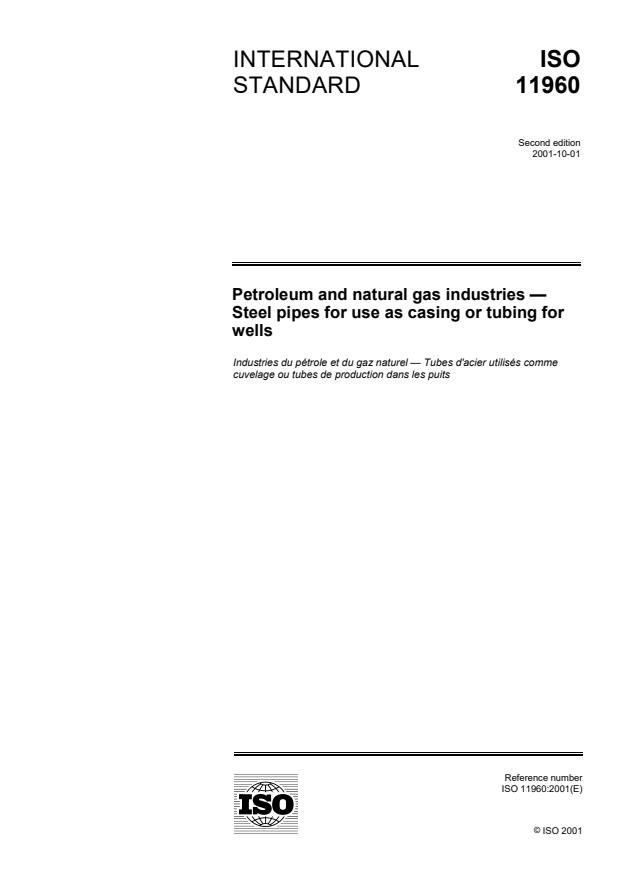
INTERNATIONAL ISO
STANDARD 11960
Second edition
2001-10-01
Petroleum and natural gas industries —
Steel pipes for use as casing or tubing for
wells
Industries du pétrole et du gaz naturel — Tubes d'acier utilisés comme
cuvelage ou tubes de production dans les puits
Reference number
©
ISO 2001
PDF disclaimer
This PDF file may contain embedded typefaces. In accordance with Adobe's licensing policy, this file may be printed or viewed but shall not
be edited unless the typefaces which are embedded are licensed to and installed on the computer performing the editing. In downloading this
file, parties accept therein the responsibility of not infringing Adobe's licensing policy. The ISO Central Secretariat accepts no liability in this
area.
Adobe is a trademark of Adobe Systems Incorporated.
Details of the software products used to create this PDF file can be found in the General Info relative to the file; the PDF-creation parameters
were optimized for printing. Every care has been taken to ensure that the file is suitable for use by ISO member bodies. In the unlikely event
that a problem relating to it is found, please inform the Central Secretariat at the address given below.
All rights reserved. Unless otherwise specified, no part of this publication may be reproduced or utilized in any form or by any means, electronic
or mechanical, including photocopying and microfilm, without permission in writing from either ISO at the address below or ISO's member body
in the country of the requester.
ISO copyright office
Case postale 56 � CH-1211 Geneva 20
Tel. + 41 22 749 01 11
Fax + 41 22 749 09 47
E-mail copyright@iso.ch
Web www.iso.ch
Printed in Switzerland
ii © ISO 2001 – All rights reserved
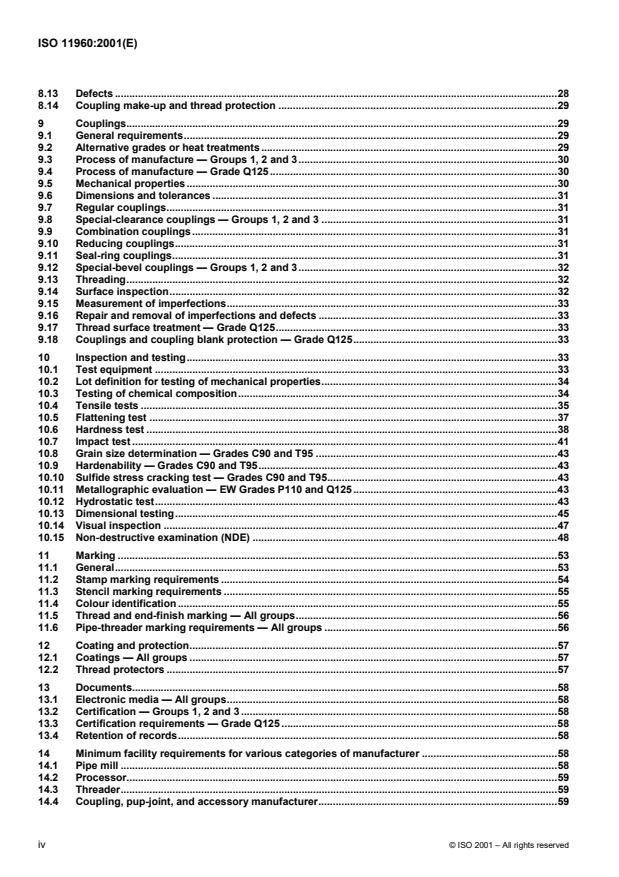
Contents Page
Foreword.vi
Introduction.vii
1 Scope .1
2 Conformance.2
2.1 Normative references .2
2.2 Units of measurement .2
2.3 Tables and figures .2
3 Normative references .2
4 Terms, definitions, symbols and abbreviated terms.4
4.1 Terms and definitions .4
4.2 Symbols and abbreviated terms .8
5 Information to be supplied by the purchaser .9
5.1 Casing .9
5.2 Tubing.10
6 Process of manufacture.12
6.1 General.12
6.2 Heat treatment.12
6.3 Straightening.13
6.4 Traceability.13
7 Material requirements .14
7.1 Chemical composition .14
7.2 Tensile properties.14
7.3 Charpy V-notch test properties — General requirements.15
7.4 Charpy V-notch (CVN) — Absorbed energy requirements for coupling stock, coupling blanks
and couplings.16
7.5 Charpy V-notch — Absorbed energy requirements for pipe .17
7.6 Charpy V-notch test — Absorbed energy requirements for casing and tubing accessories.19
7.7 Hardness maxima .20
7.8 Hardness variation — Grades C90, T95 and Q125 .20
7.9 Process control — Grades C90, T95 and Q125 .20
7.10 Hardenability — Minimum percentage martensite for quenched and tempered products.21
7.11 Grain size — Grades C90 and T95 .21
7.12 Surface condition — Grades L80 9Cr and L80 13Cr .21
7.13 Flattening — Electric-welded pipe .21
7.14 Sulfide stress corrosion cracking (SSCC) test — Grades C90 and T95 .21
8 Dimensions, masses, tolerances, pipe ends and defects .23
8.1 Labels and sizes .23
8.2 Dimensions and masses.23
8.3 Diameter.23
8.4 Wall thickness.24
8.5 Mass.24
8.6 Length.24
8.7 Casing jointers.24
8.8 Height and trim of electric-weld flash.24
8.9 Straightness .25
8.10 Drift requirements.25
8.11 Tolerances on dimensions and masses.26
8.12 Pipe ends.27
8.13 Defects .28
8.14 Coupling make-up and thread protection .29
9 Couplings.29
9.1 General requirements.29
9.2 Alternative grades or heat treatments .29
9.3 Process of manufacture — Groups 1, 2 and 3.30
9.4 Process of manufacture — Grade Q125.30
9.5 Mechanical properties.30
9.6 Dimensions and tolerances .31
9.7 Regular couplings.31
9.8 Special-clearance couplings — Groups 1, 2 and 3 .31
9.9 Combination couplings.31
9.10 Reducing couplings.31
9.11 Seal-ring couplings.31
9.12 Special-bevel couplings — Groups 1, 2 and 3.32
9.13 Threading.32
9.14 Surface inspection.32
9.15 Measurement of imperfections.33
9.16 Repair and removal of imperfections and defects .33
9.17 Thread surface treatment — Grade Q125.33
9.18 Couplings and coupling blank protection — Grade Q125.33
10 Inspection and testing.33
10.1 Test equipment .33
10.2 Lot definition for testing of mechanical properties.34
10.3 Testing of chemical composition.34
10.4 Tensile tests .35
10.5 Flattening test .37
10.6 Hardness test .38
10.7 Impact test .41
10.8 Grain size determination — Grades C90 and T95 .43
10.9 Hardenability — Grades C90 and T95.43
10.10 Sulfide stress cracking test — Grades C90 and T95.43
10.11 Metallographic evaluation — EW Grades P110 and Q125.43
10.12 Hydrostatic test.43
10.13 Dimensional testing.45
10.14 Visual inspection .47
10.15 Non-destructive examination (NDE) .48
11 Marking .53
11.1 General.53
11.2 Stamp marking requirements .54
11.3 Stencil marking requirements .55
11.4 Colour identification .55
11.5 Thread and end-finish marking — All groups.56
11.6 Pipe-threader marking requirements — All groups .56
12 Coating and protection.57
12.1 Coatings — All groups .57
12.2 Thread protectors .57
13 Documents.58
13.1 Electronic media — All groups.58
13.2 Certification — Groups 1, 2 and 3 .58
13.3 Certification requirements — Grade Q125 .58
13.4 Retention of records.58
14 Minimum facility requirements for various categories of manufacturer .58
14.1 Pipe mill .58
14.2 Processor.59
14.3 Threader.59
14.4 Coupling, pup-joint, and accessory manufacturer.59
iv © ISO 2001 – All rights reserved
Annex A (normative) Supplementary requirements.60
Annex B (normative) Purchaser inspection .72
Annex C (normative) Tables in SI units .73
Annex D (normative) Figures in SI (USC) units.136
Annex E (normative) Tables in USC units .158
Annex F (informative) Marking instructions for API licensees.217
Annex G (informative) Procedures used to convert from USC units to SI units .221
Bibliography.234
Foreword
ISO (the International Organization for Standardization) is a worldwide federation of national standards bodies (ISO
member bodies). The work of preparing International Standards is normally carried out through ISO technical
committees. Each member body interested in a subject for which a technical committee has been established has
the right to be represented on that committee. International organizations, governmental and non-governmental, in
liaison with ISO, also take part in the work. ISO collaborates closely with the International Electrotechnical
Commission (IEC) on all matters of electrotechnical standardization.
International Standards are drafted in accordance with the rules given in the ISO/IEC Directives, Part 3.
Draft International Standards adopted by the technical committees are circulated to the member bodies for voting.
Publication as an International Standard requires approval by at least 75 % of the member bodies casting a vote.
Attention is drawn to the possibility that some of the elements of this International Standard may be the subject of
patent rights. ISO shall not be held responsible for identifying any or all such patent rights.
International Standard ISO 11960 was prepared by Technical Committee ISO/TC 67, Materials, equipment and
offshore structures for petroleum and natural gas industries, Subcommittee SC 5, Casing, tubing and drill pipe.
This second edition replaces the first edition (ISO 11960:1996) which has been technically revised. It is the intent of
TC 67 that the first and second editions of ISO 11960 both be applicable, at the user's option, for a period of six
months after the date of publication of this second edition, after which the first edition will no longer be applicable.
Annexes A to E form a normative part of this International Standard. Annexes F and G are for information only.
vi © ISO 2001 – All rights reserved
Introduction
This International Standard is based on API 5CT (Specification for Casing and Tubing).
Users of this International Standard should be aware that further or differing requirements may be needed for
individual applications. This International Standard is not intended to inhibit a vendor from offering, or the purchaser
from accepting, alternative equipment or engineering solutions for the individual application. This may be
particularly applicable where there is innovative or developing technology. Where an alternative is offered, the
vendor should identify any variations from this International Standard and provide details.
This International Standard includes requirements of various nature. These are identified by the use of certain
verbal forms:
� SHALL is used to indicate that a provision is MANDATORY;
� SHOULD is used to indicate that a provision is not mandatory, but RECOMMENDED as good practice;
� MAYis usedto indicatethat aprovision is OPTIONAL.
INTERNATIONAL STANDARD ISO 11960:2001(E)
Petroleum and natural gas industries — Steel pipes for use as
casing or tubing for wells
1 Scope
1.1 This International Standard specifies the technical delivery conditions for steel pipes (casing, tubing, plain
end casing liners and pup-joints) and accessories. This International Standard is applicable to the following
connections in accordance with ISO 10422 or API Spec 5B:
� short round thread casing (STC);
� long round thread casing (LC);
� buttress thread casing (BC);
� extreme-line casing (XC);
� non-upset tubing (NU);
� external upset tubing (EU);
� integral joint tubing (IJ).
For such connections, this International Standard specifies the technical delivery conditions for couplings and
thread protection.
For pipes covered by this International Standard, the sizes, masses, wall thicknesses, grades and applicable end
finishes are defined.
This International Standard may also be applied to tubulars with connections not covered by ISO/API standards.
1.2 The four groups of products to which this International Standard is applicable include the following grades of
pipe:
� Group 1: All casing and tubing in Grades H, J, K and N;
� Group 2: All casing and tubing in Grades C, L, M and T;
� Group 3: All casing and tubing in Grade P;
� Group 4: All casing in Grade Q.
1.3 Casing sizes larger than Label 1: 4-1/2 but smaller than Label 1: 10-3/4 may be specified by the purchaser to
be used in tubing service, see Tables C.1, C.24, C.30 and C.31 or Tables E.1, E.24, E.30 and E.31.
1.4 Supplementary requirements that may optionally be agreed between purchaser and manufacturer, for non-
destructive examination, coupling blanks, upset casing, electric-welded casing, impact testing, seal ring couplings
and certificates are given in annex A.
1.5 This International Standard is not applicable to threading requirements.
NOTE Dimensional requirements on threads and thread gauges, stipulations on gauging practice, gauge specifications, as
well as instruments and methods for inspection of threads are given in ISO 10422 or API Spec 5B. Connections machined to
either of these specifications are the same for practical purposes and are totally interchangeable.
2 Conformance
2.1 Normative references
In the interests of worldwide application of this International Standard, ISO/TC 67 has decided, after detailed
technical analysis, that certain of the normative documents listed in clause 3 and prepared by ISO/TC 67 or other
ISO Technical Committee are interchangeable in the context of the relevant requirement with the relevant
document prepared by the American Petroleum Institute (API), the American Society for Testing and Materials
(ASTM) or the American National Standards Institute (ANSI). These latter documents are cited in the running text
following the ISO reference and preceded by “or”, for example “ISO XXXX or API YYYY”. Application of an
alternative normative document cited in this manner will lead to the same results as the use of the preceding
ISO reference. These documents are thus considered interchangeable in practice.
2.2 Units of measurement
In this International Standard, data are expressed in both the International System (SI) of units and the United
States Customary (USC) system of units. For a specific order item, it is intended that only one system of units be
used, without combining data expressed in the other system.
Products manufactured to specifications expressed in either of these unit systems shall be considered equivalent
and totally interchangeable. Consequently, compliance with the requirements of this International Standard as
expressed in one system provides compliance with requirements expressed in the other system.
For data expressed in the SI, a comma is used as the decimal separator and a space as the thousands separator.
For data expressed in the USC system, a dot (on the line) is used as the decimal separator and a space as the
thousands separator.
In the text, data in SI units are followed by data in USC units in brackets.
2.3 Tables and figures
Separate tables for data expressed in SI units and USC units are given in annex C and annex E respectively. For a
specific order item, only one unit system shall be used.
Figures are contained in annex D and express data in both SI and USC units.
3 Normative references
The following normative documents contain provisions which, through reference in this text, constitute provisions of
this International Standard. For dated references, subsequent amendments to, or revisions of, any of these
publications do not apply. However, parties to agreements based on this International Standard are encouraged to
investigate the possibility of applying the most recent editions of the normative documents indicated below. For
undated references, the latest edition of the normative document referred to applies. Members of ISO and IEC
maintain registers of currently valid International Standards.
ISO 31-0, Quantities and units — Part 0: General principles
ISO 643, Steels — Micrographic determination of the ferritic or austenitic grain size
ISO 6506-1, Metallic materials — Brinell Hardness test — Part 1:Test method
ISO 6508-1, Metallic materials — Rockwell Hardness test —Part 1:Test method (Scales A, B,C,D, E,F,G, H, K,
N, T
ISO 6892, Metallic materials — Tensile testing at ambient temperature
2 © ISO 2001 – All rights reserved
ISO 7500-1, Metallic materials — Verification of static uniaxial testing machines — Part 1: Tensile/compression
testing machines — Verification and calibration of the force-measuring system
ISO 9303, Seamless and welded (except submerged arc-welded) steel tubes for pressure purposes — Full
peripheral ultrasonic testing for the detection of longitudinal imperfections
ISO 9304, Seamless and welded (except submerged arc-welded) steel tubes for pressure purposes — Eddy
current testing for the detection of imperfections
ISO 9305, Seamless steel tubes for pressure purposes — Full peripheral ultrasonic testing for the detection of
transverse imperfections
ISO 9402, Seamless and welded (except submerged arc-welded) steel tubes for pressure purposes — Full
peripheral magnetic transducer/flux leakage testing of ferromagnetic steel tubes for the detection of longitudinal
imperfections
ISO 9598, Seamless steel tubes for pressure purposes — Full peripheral magnetic transducer/flux leakage testing
of ferromagnetic steel tubes for the detection of transverse imperfections
ISO 9764, Electric resistance and induction welded steel tubes for pressure purposes — Ultrasonic testing of the
weld seam for the detection of longitudinal imperfections
ISO 10400, Petroleum and natural gas industries — Formulae and calculation for casing, tubing, drill pipe and line
pipe properties
ISO 10422, Petroleum and natural gas industries — Threading, gauging and thread inspection of casing, tubing
and line pipe threads — Specification
ISO 10474, Steel and steel products — Inspection documents
ISO 11484, Steel tubes for pressure purposes — Qualification and certification of non-destructive testing (NDT)
personnel
ISO 13665, Seamless and welded steel tubes for pressure purposes — Magnetic particle inspection of the tube
body for the detection of surface imperfections
ISO 13678, Petroleum and natural gas industries — Evaluation and testing of thread compounds for use with
casing, tubing and line pipe
ISO/TR 9769, Steel and iron — Review of available methods of analysis
ANSI-ASNT SNT-TC-1A:1984, Personnel qualifications and certification in non.destructive testing
ANSI-NACE TM0177:1996, Laboratory testing of metals for resistance to sulfide stress cracking at ambient
temperature in H S environment
API Bul 5C2, Bulletin on performance properties of casing, tubing and drill pipe
API Bul 5C3, Bulletin on formulas and calculations for casing, tubing, drill pipe and line pipe properties (plus
Supplement 1)
API RP 5A3, Bulletin on thread compounds for casing, tubing and line pipe
API Spec 5B, Specification for threading, gauging and thread inspection of casing, tubing and line pipe threads
API Std 5T1, Imperfection technology
ASTM A370, Standard test methods and definitions for mechanical testing of steel products
ASTM A751, Methods, practices and definitions for chemical analysis of steel products
ASTM A941, Terminology relating to steel, stainless steel, related alloys and ferro-alloys
ASTM E4, Practices for load verification of testing machines
ASTM E10, Standard method of test for Brinell hardness of metallic materials
ASTM E18, Standard methods of test for Rockwell hardness and Rockwell superficial hardness of metallic
materials
ASTM E23, Standard test methods for notched bar impact testing of metallic materials
ASTM E29, Practice for using significant digits in test data to determine conformance with specifications
ASTM E83, Standard practice for verification and classification of extensometers
ASTM E112, Methods for determining average grain size
ASTM E213, Standard practice for ultrasonic examination of metal pipe and tubing
ASTM E273, Standard practice for ultrasonic examination of longitudinal welded pipe and tubing
ASTM E309, Standard practice for eddy-current examination of steel tubular products using magnetic saturation
ASTM E570, Standard practice for flux leakage examination of ferro-magnetic steel tubular products
ASTM E709, Standard practice for magnetic particle examination
4 Terms, definitions, symbols and abbreviated terms
4.1 Terms and definitions
For the purposes of this International Standard, the terms and definitions in ASTM A941 for heat treatment
operations and the following apply.
4.1.1
carload
quantity of pipe loaded on a railway car for shipment from the pipe-making facilities
4.1.2
casing
pipe run from the surface and intended to line the walls of a drilled well
4.1.3
casing and tubing accessory
one-piece tubular section used in a pipe string to provide mechanical and pressure integrity within the pipe string
and facilitate the performance of some other function required of that pipe string
NOTE Examples of accessories are: crossover connectors, swages, nipples, flow couplings, blast joints, etc. Accessories
exclude the other tubular products specifically defined in this International Standard or products included in other ISO (API)
specifications.
4.1.4
connection
threaded assembly of tubular components
4 © ISO 2001 – All rights reserved
4.1.5
controlled cooling
cooling from an elevated temperature in a pre-determined manner to avoid hardening, cracking or internal damage,
or to produce a desired microstructure or mechanical properties
4.1.6
coupling
internally threaded cylinder for joining two lengths of threaded pipe
4.1.7
coupling blank
unthreaded material used to produce an individual coupling
4.1.8
coupling stock
tubular used for the manufacture of coupling blanks
4.1.8
defect
imperfection of sufficient magnitude to warrant rejection of the product based on criteria defined in this International
Standard
4.1.9
electric-welded pipe
pipe having one longitudinal seam formed by electric-resistance or electric-induction welding, without the addition
of filler metal, wherein the edges to be welded are mechanically pressed together and the heat for welding is
generated by the resistance to flow of electric current
4.1.10
handling tight
sufficiently tight that the coupling cannot be removed except by the use of a wrench
4.1.11
heat
metal produced by a single cycle of a batch melting process
4.1.12
heat analysis
chemical analysis representative of a heat as reported by the metal producer
4.1.13
imperfection
discontinuity in the product wall or on the product surface that can be detected by a NDE method included in Table
C.61 or Table E.61 of this International Standard
4.1.14
inspection
process of measuring, examining, testing, gauging or otherwise comparing a unit of product with the applicable
requirements
4.1.15
inspection lot
definite quantity of product manufactured under conditions that are considered uniform for the attribute to be
inspected
4.1.16
inspection lot sample
one or more units of product selected from an inspection lot to represent that inspection lot
4.1.17
inspection lot size
number of units of product in an inspection lot
4.1.18
interrupted quenching
quenching in which the pipe being quenched is removed from the quenching medium while the pipe is at a
temperature substantially higher than that of the quenching medium
4.1.19
ISO/API threads
threads as specified in ISO 10422 or API Spec 5B
4.1.20
label 1
dimensionless designation for the size or specified outside diameter that may be used when ordering pipe
4.1.21
label 2
dimensionless designation for the mass per unit length or wall thickness that may be used when ordering pipe
4.1.22
length
piece of pipe that may be plain-end, threaded, or threaded and coupled, that is in accordance with the range
requirements in Table C.30 or Table E.30 of this International Standard
4.1.23
linear imperfection
imperfection which includes, but is not limited to, seams, laps, cracks, plug scores, cuts and gouges
NOTE See API Std 5T1.
4.1.24
manufacturer
one or more of the following, depending on the context: pipe mill; processor; threader; coupling manufacturer, pup-
joint manufacturer; accessory manufacturer
NOTE Seeclause14.
4.1.25
non-linear imperfection
imperfection which includes, but is not limited to, pits and round bottom die stamping
NOTE See API Std 5T1.
4.1.26
pipe
casing, tubing, plain-end casing liners and pup-joints as a group
4.1.27
pipe mill
firm, company or corporation that operates pipe-making facilities
4.1.28
plain-end casing liner
casing provided unthreaded and with a wall thickness often greater than that specified for J55
4.1.29
processor
firm, company or corporation that operates facilities capable of heat-treating pipe made by a pipe mill
6 © ISO 2001 – All rights reserved
4.1.30
product
pipe, coupling, accessory, coupling stock or coupling blank, either individually or collectively as applicable
4.1.31
pup-joint
casing, tubing or plain-end casing liner of length shorter than Range 1
4.1.32
purchaser
party responsible for both the definition of requirements for a product order and for payment for that order
4.1.33
quench crack
crack in steel resulting from stresses produced during the transformation from austenite to martensite
NOTE This transformation is accompanied by an increase in volume.
4.1.34
seamless pipe
wrought steel tubular product made without a weld seam
NOTE It is manufactured by hot-working steel, and if necessary, by subsequently cold-working or heat-treating, or a
combination of these operations, to produce the desired shape, dimensions and properties.
4.1.35
special end finish
threads with thread form and features, manufacturing specifications, dimensions, connection make-up and
performance properties which are beyond the scope of this International Standard
4.1.36
special processes
final operations which are performed during pipe manufacturing that affect the attributes of product, except its
chemistry and dimensions
NOTE These special processes are:
Manufacturing conditions Special processes
Seamless, as-rolled — Final re-heating practice and hot sizing or
stretch-reducing.
— If applicable, upsetting, coldfinishing.
— Non-destructive examination
Seamless, heat-treated — Heat treatment
— Non-destructive examination
Electric-weld, as-rolled — Sizing and seam welding
— If applicable, seam heat treatment and
upsetting
— Non-destructive examination
Electric-weld, heat-treated — Seam welding and full-body heat treatment
— Non-destructive examination
4.1.37
thread protector
cap or insert used to protect threads and seals during handling, transportation and storage
4.1.38
tubing
pipe placed within a well and serving to produce well fluids or to inject fluids
4.1.39
upper critical temperature
Ar
temperature at which austenite begins to transform to ferrite during cooling
4.2 Symbols and abbreviated terms
BC buttress thread casing connection
C Charpy V-notch impact test minimum absorbed energy
V
D specified outside diameter for pipe
d calculated inside diameter
EMI electromagnetic inspection
EU external upset tubing connection
EW electric-welded process
HBW Brinell hardness, when testing with a tungsten carbide ball
HBS Brinell hardness, when testing with a steel ball
HRC Rockwell hardness C-scale
ID inside diameter
IJ integral joint tubing connection
k a constant used in the calculation of elongation
LC long round thread casing connection
N
�heat-treat process� full-length normalized
N&T normalized and tempered
NDE non-destructive examination
NU non-upset tubing connection
OD outside diameter
Q quenched and tempered
S seamless process
Sc minimum acceptable result of the ANSI-NACE TM0177:1996 Method B test
SCC special clearance coupling
SSCC sulfide stress corrosion cracking
8 © ISO 2001 – All rights reserved
STC short round thread casing connection
t specified wall thickness
T&C threaded and coupled
USC United States customary (units)
UT ultrasonic testing
W specified outside diameter for ISO/API thread couplings other than special clearance couplings
W specified outside diameter of special clearance couplings
c
XC extreme line casing connection
YS specified minimum yield strength
min
5 Information to be supplied by the purchaser
5.1 Casing
5.1.1 When enquiring or placing orders for pipe to be manufactured in accordance with this International
Standard, the purchaser shall specify the following:
Requirement Reference
Standard ISO 11960 or API 5CT
Quantity
Type of pipe or couplings
Casing:
Threaded or plain-end 8.12
Type of connection: round (short or long), buttress, 8.12, Table C.1 or Table E.1
extreme-line threads, or other connection
With or without couplings 8.12
Special clearance couplings 9.8, Tables C.1, C.36 or Tables E.1,
E.36
Liners: 8.12.1, Table C.2 or Table E.2
Label 1 or specified outside diameter Tables C.1, C.2 or Tables E.1, E.2
Label 2 or specified mass or wall thickness Tables C.1, C.2 or Tables E.1, E.2
Grade and type where applicable Tables C.1, C.2, C.5 or Tables E.1,
E.2, E.5
Range length 8.6, Table C.30 or Table E.30
Seamless or electric-welded 6.1, Table C.4 or Table E.4
Critical thickness for special end-finish couplings, stock or blanks 7.6.6
Critical thickness for special end-finish accessories 7.6.6
Wall thickness verification of special end-finish accessories 10.13.4
Delivery date and shipping instructions
Inspection by purchaser Annex B
5.1.2 The purchaser should also state on the purchase agreement his requirements concerning the following
stipulations, which are at the purchaser’soption:
Requirement Reference
Heat treatment 6.2
Lower alternative impact test temperature 7.3.7
Casing jointers 8.7
Alternative drifting requirements 8.10
Casing with couplings detached 8.14
Coupling make-up (other than power-tight) 8.14
Coupling blanks 9.2, A.3 (SR9)
Seal ring couplings 9.11, A.7 (SR13)
Heat and supplementary analyses 10.3
Additional markings 11
Pipe coatings 12.1
Material certification 13.2, A.8 (SR15)
5.1.3 The following may be agreed between purchaser and manufacturer:
Requirement Reference
Cold rotary straightening - Q125 Grade 6.3
Statistical impact testing 7.3.8, A.6 (SR12)
Impact of Group 1 non-heat-treated pipe 7.5.1, A.9 (SR16)
Sulfide stress cracking test - C90 and T95 Grade 7.14
Length of accessories 8.6
Thread and storage compound 8.14
Waiving NDE of Group 1 couplings in Grades H40, J55 and K55 9.14.3
Coupling thread plating - Q125 Grade only 9.17
Additional hardness testing - Grades M65 and L80 10.6.2
Additional hardness testing - C90 and T95 Grade 10.6.4
Reduced section tensile specimens - Q125 Grade 10.4.6
Hydrostatic pressure test for handling-tight make-up, accessories and 10.12.2
Group 4 pup-joints
Alternative hydrostatic test pressures 10.12.3
Plain-end Q125 casing hydrostatic testing 10.12.2
Non-destructive examination 10.15, A.1 (SR1), A.2 (SR2), A.4 (SR10)
and A.5 (SR11)
Marking requirements 11.1
Thread protectors 12.2
Coupling blanks - Q125 Grade only A.3 (SR9)
Upset casing - Q125 Grade only A.4 (SR10)
Electric-weld casing - P110 and Q125 Grade A.5 (SR11)
Alternative F factor in SR 12 - Q125 Grade A.6 (SR12.2)
Special end-finish for casing, couplings, pup-joints or accessories 8.12.8, 9.13.2
Quality assurance requirements
Special wall thickness for Grades C90, T95 and Q125 8.2
5.2 Tubing
5.2.1 When enquiring or placing orders for pipe to be manufactured in accordance with this International
Standard, the purchaser shall specify the following:
Requirement Reference
Standard ISO 11960 or API 5CT
Quantity
Type of pipe or couplings
Tubing:
Non-upset, external-upset or integral joint Table C.3 or Table E.3
Threaded, plain-end, or other connection 8.12
With or without couplings 8.12
Special bevel couplings 9.12, Tables C.3, C.37 and C.38
or Tables E.3, E.37 and E.38
10 © ISO 2001 – All rights reserved
Special clearance couplings 9.8, Tables C.3, C.38
or Tables E.3 and E.38
Label 1 or specified outside diameter Table C.3 or Table E.3
Label 2 or specified mass or wall thickness Table C.3 or Table E.3
Grade and type, where applicable Table C.3 or Table E.3, Table C.5 or
Table E.5
Range length 8.6, Table C.30 or Table E.30
Seamless or electric-welded 6.1, Table C.4 or Table E.4
Critical thickness for special end-finish couplings, stock or blanks 7.4.6
Critical thickness for accessory material 7.6.6
Wall thickness verification of special end-finish accessories 10.13.4
Delivery date and shipping instructio
...
Questions, Comments and Discussion
Ask us and Technical Secretary will try to provide an answer. You can facilitate discussion about the standard in here.
Loading comments...