

ISO 21401:2018
(Main)Tourism and related services — Sustainability management system for accommodation establishments — Requirements
General Information
- Abstract
This document specifies environmental, social and economic requirements to implement a sustainability management system in accommodation establishments in the tourism sector. This document applies to the aspects that can be controlled by the accommodation establishments and over which they can exert influence. This document is applicable to any accommodation establishment, regardless of its type, size or location, that wishes to: a) implement, maintain and improve sustainable practices in their operations; b) ensure conformance with its defined sustainability policy.
- Status
- Published
- Publication Date
- 16-Dec-2018
- Technical Committee
- ISO/TC 228 - Tourism and related services
- Drafting Committee
- ISO/TC 228/WG 13 - Sustainable tourism
- Current Stage
- 9093 - International Standard confirmed
- Start Date
- 05-Jun-2025
- Completion Date
- 29-Aug-2026
Buy Documents



ISO 21401:2018 - Tourism and related services -- Sustainability management system for accommodation establishments -- Requirements

ISO 21401:2018 - Tourism and related services — Sustainability management system for accommodation establishments — Requirements/17/2018
Overview
ISO 21401:2018 - "Tourism and related services - Sustainability management system for accommodation establishments - Requirements" specifies environmental, social and economic requirements for implementing a sustainability management system in accommodation establishments. Applicable to any hotel, hostel, guesthouse, resort or other lodging regardless of type, size or location, the standard covers aspects that the establishment can control or influence. Its primary goals are to help organizations implement, maintain and improve sustainable practices and to ensure conformance with a defined sustainability policy.
Keywords: ISO 21401, sustainability management system, sustainable tourism, accommodation establishments, tourism sustainability.
Key Topics and Requirements
ISO 21401 follows a management-system structure and includes requirements across typical PDCA elements:
- Context of the organization: understanding internal/external issues and interested parties; defining the scope of the sustainability management system.
- Leadership: top management commitment, sustainability policy, roles and responsibilities.
- Planning: identifying risks and opportunities, setting sustainability objectives and plans to achieve them.
- Support: resources, competence, awareness, communication and documented information.
- Operation: operational planning and control, managing modified activities and supply chain influences.
- Performance evaluation: monitoring, measurement, internal audit and management review.
- Improvement: handling nonconformities, corrective actions and continual improvement.
Normative annexes provide the three-dimension requirements:
- Annex A - Environmental requirements (energy, water, waste, biodiversity-related controls)
- Annex B - Social requirements (community engagement, labor practices, guest and local community considerations)
- Annex C - Economic requirements (business planning, local economic benefits, circular economy principles)
- Annex D - Informative examples of sustainable tourism practices
Practical Applications - Who Should Use It
ISO 21401 is designed for organizations that operate accommodation services and want to formalize sustainability efforts. Typical users:
- Hotels, resorts, hostels, B&Bs and serviced apartments
- Property and operations managers, sustainability officers
- Hospitality consultants and auditors implementing or assessing sustainability systems
- Tourism boards and destination managers seeking alignment with sustainable tourism goals
Common uses:
- Developing a sustainability policy and measurable objectives
- Integrating environmental, social and economic controls into daily operations
- Improving supply chain and procurement practices with sustainability criteria
- Preparing for internal/external audits and demonstrating continual improvement
- Communicating sustainability commitment to guests and stakeholders
Related Standards (if applicable)
ISO 21401 is often implemented alongside other management standards such as ISO 14001 (environmental management), ISO 9001 (quality management) and sector-specific sustainability guidance to create an integrated approach to organizational sustainability and compliance.
For accommodation providers aiming to reduce environmental impact, enhance social responsibility, and improve economic resilience, ISO 21401 offers a structured, internationally recognized framework to build and maintain a credible sustainability management system.
Relations
- Effective Date
- 18-Nov-2023
Buy Documents
ISO 21401:2018 - Tourism and related services -- Sustainability management system for accommodation establishments -- Requirements
ISO 21401:2018 - Tourism and related services — Sustainability management system for accommodation establishments — Requirements/17/2018
Get Certified
Connect with accredited certification bodies for this standard

BSI Group
BSI (British Standards Institution) is the business standards company that helps organizations make excellence a habit.

Bureau Veritas
Bureau Veritas is a world leader in laboratory testing, inspection and certification services.

DNV
DNV is an independent assurance and risk management provider.
Sponsored listings
Frequently Asked Questions
ISO 21401:2018 is a standard published by the International Organization for Standardization (ISO). Its full title is "Tourism and related services — Sustainability management system for accommodation establishments — Requirements". This standard covers: This document specifies environmental, social and economic requirements to implement a sustainability management system in accommodation establishments in the tourism sector. This document applies to the aspects that can be controlled by the accommodation establishments and over which they can exert influence. This document is applicable to any accommodation establishment, regardless of its type, size or location, that wishes to: a) implement, maintain and improve sustainable practices in their operations; b) ensure conformance with its defined sustainability policy.
This document specifies environmental, social and economic requirements to implement a sustainability management system in accommodation establishments in the tourism sector. This document applies to the aspects that can be controlled by the accommodation establishments and over which they can exert influence. This document is applicable to any accommodation establishment, regardless of its type, size or location, that wishes to: a) implement, maintain and improve sustainable practices in their operations; b) ensure conformance with its defined sustainability policy.
ISO 21401:2018 is classified under the following ICS (International Classification for Standards) categories: 03.100.70 - Management systems; 03.200.01 - Leisure and tourism in general. The ICS classification helps identify the subject area and facilitates finding related standards.
ISO 21401:2018 has the following relationships with other standards: It is inter standard links to ISO 21401:2018/Amd 1:2024. Understanding these relationships helps ensure you are using the most current and applicable version of the standard.
ISO 21401:2018 is available in PDF format for immediate download after purchase. The document can be added to your cart and obtained through the secure checkout process. Digital delivery ensures instant access to the complete standard document.
Standards Content (Sample)
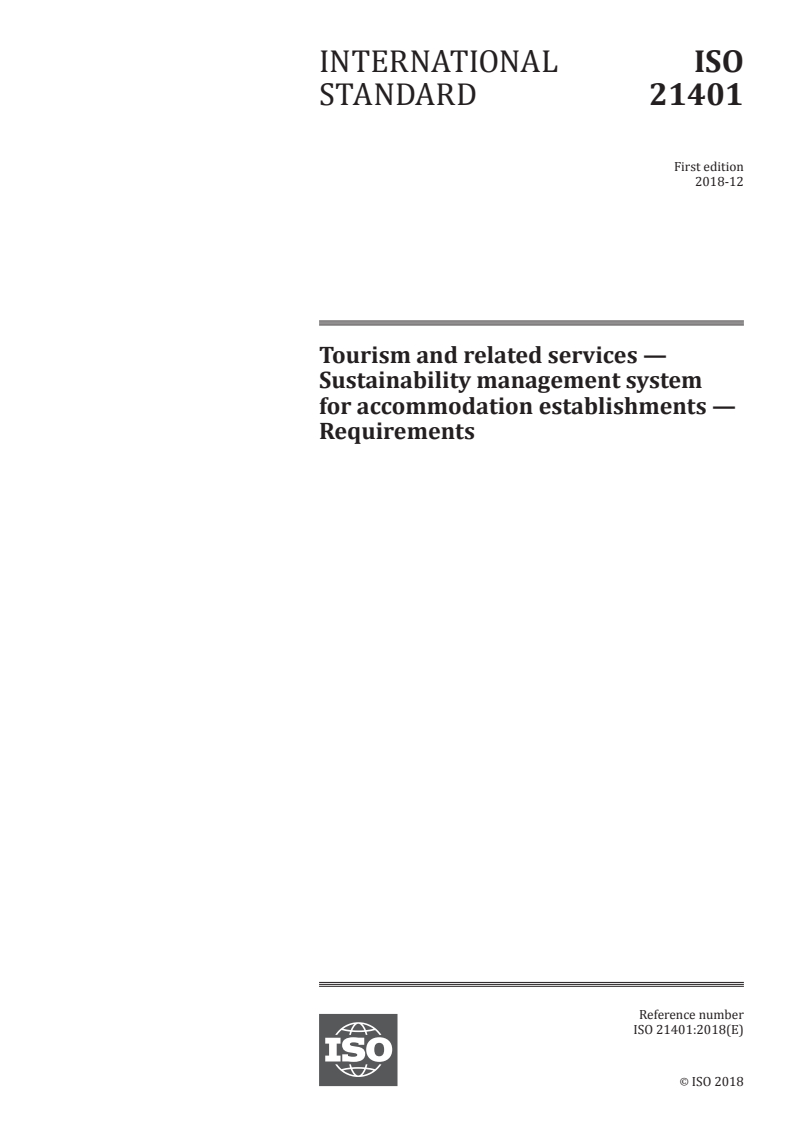
INTERNATIONAL ISO
STANDARD 21401
First edition
2018-12
Tourism and related services —
Sustainability management system
for accommodation establishments —
Requirements
Reference number
©
ISO 2018
© ISO 2018
All rights reserved. Unless otherwise specified, or required in the context of its implementation, no part of this publication may
be reproduced or utilized otherwise in any form or by any means, electronic or mechanical, including photocopying, or posting
on the internet or an intranet, without prior written permission. Permission can be requested from either ISO at the address
below or ISO’s member body in the country of the requester.
ISO copyright office
CP 401 • Ch. de Blandonnet 8
CH-1214 Vernier, Geneva
Phone: +41 22 749 01 11
Fax: +41 22 749 09 47
Email: copyright@iso.org
Website: www.iso.org
Published in Switzerland
ii © ISO 2018 – All rights reserved
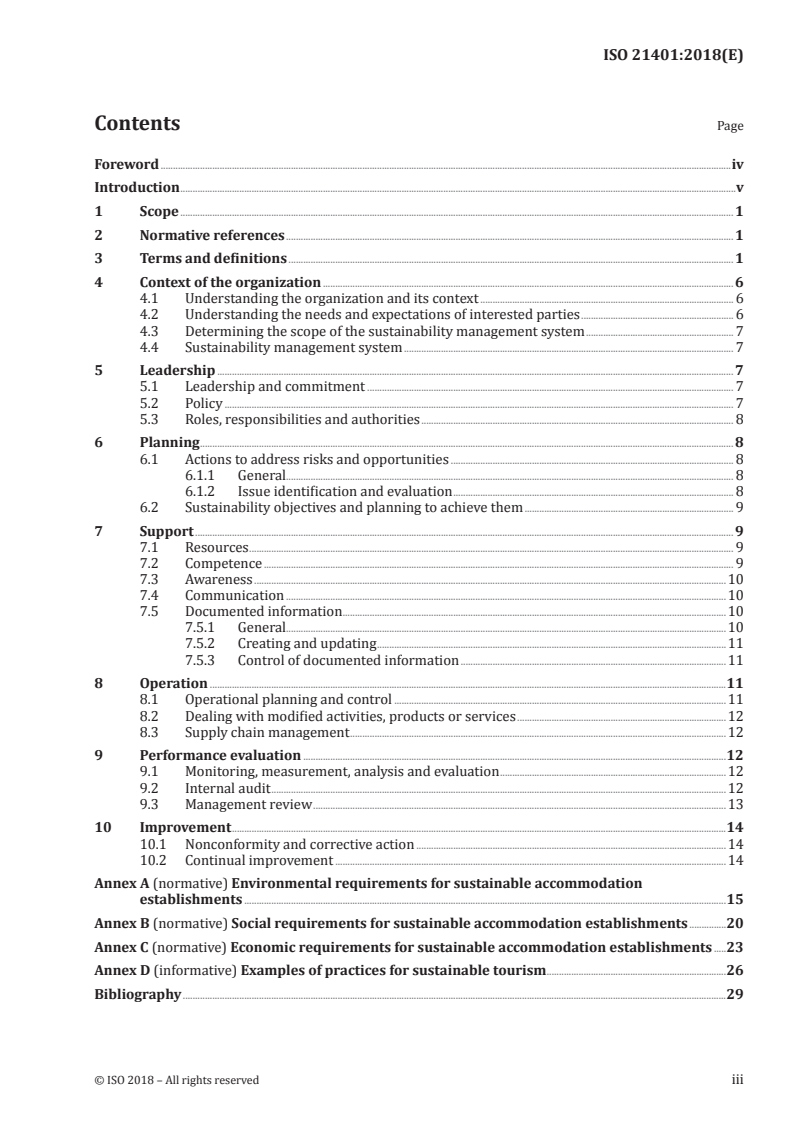
Contents Page
Foreword .iv
Introduction .v
1 Scope . 1
2 Normative references . 1
3 Terms and definitions . 1
4 Context of the organization . 6
4.1 Understanding the organization and its context . 6
4.2 Understanding the needs and expectations of interested parties . 6
4.3 Determining the scope of the sustainability management system . 7
4.4 Sustainability management system . 7
5 Leadership . 7
5.1 Leadership and commitment . 7
5.2 Policy . 7
5.3 Roles, responsibilities and authorities . 8
6 Planning . 8
6.1 Actions to address risks and opportunities . 8
6.1.1 General. 8
6.1.2 Issue identification and evaluation . 8
6.2 Sustainability objectives and planning to achieve them . 9
7 Support . 9
7.1 Resources . 9
7.2 Competence . 9
7.3 Awareness .10
7.4 Communication .10
7.5 Documented information .10
7.5.1 General.10
7.5.2 Creating and updating .11
7.5.3 Control of documented information .11
8 Operation .11
8.1 Operational planning and control .11
8.2 Dealing with modified activities, products or services .12
8.3 Supply chain management .12
9 Performance evaluation .12
9.1 Monitoring, measurement, analysis and evaluation .12
9.2 Internal audit .12
9.3 Management review .13
10 Improvement .14
10.1 Nonconformity and corrective action .14
10.2 Continual improvement .14
Annex A (normative) Environmental requirements for sustainable accommodation
establishments .15
Annex B (normative) Social requirements for sustainable accommodation establishments .20
Annex C (normative) Economic requirements for sustainable accommodation establishments .23
Annex D (informative) Examples of practices for sustainable tourism .26
Bibliography .29
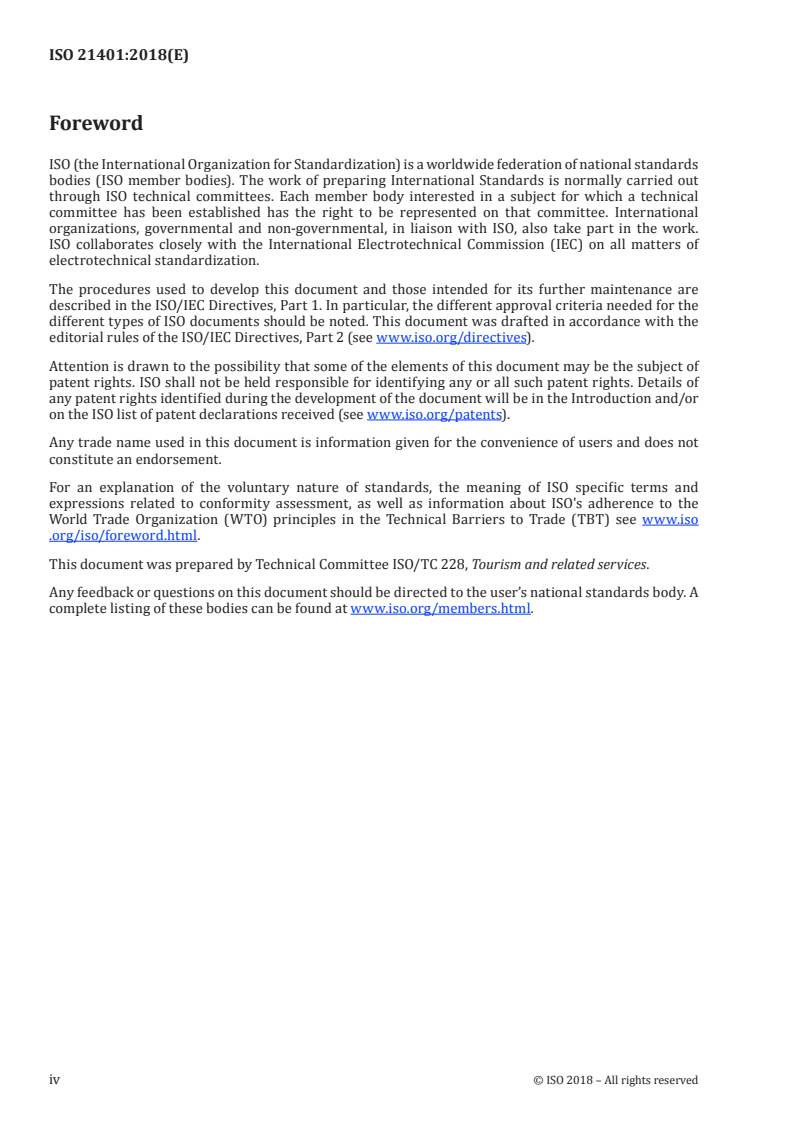
Foreword
ISO (the International Organization for Standardization) is a worldwide federation of national standards
bodies (ISO member bodies). The work of preparing International Standards is normally carried out
through ISO technical committees. Each member body interested in a subject for which a technical
committee has been established has the right to be represented on that committee. International
organizations, governmental and non-governmental, in liaison with ISO, also take part in the work.
ISO collaborates closely with the International Electrotechnical Commission (IEC) on all matters of
electrotechnical standardization.
The procedures used to develop this document and those intended for its further maintenance are
described in the ISO/IEC Directives, Part 1. In particular, the different approval criteria needed for the
different types of ISO documents should be noted. This document was drafted in accordance with the
editorial rules of the ISO/IEC Directives, Part 2 (see www .iso .org/directives).
Attention is drawn to the possibility that some of the elements of this document may be the subject of
patent rights. ISO shall not be held responsible for identifying any or all such patent rights. Details of
any patent rights identified during the development of the document will be in the Introduction and/or
on the ISO list of patent declarations received (see www .iso .org/patents).
Any trade name used in this document is information given for the convenience of users and does not
constitute an endorsement.
For an explanation of the voluntary nature of standards, the meaning of ISO specific terms and
expressions related to conformity assessment, as well as information about ISO's adherence to the
World Trade Organization (WTO) principles in the Technical Barriers to Trade (TBT) see www .iso
.org/iso/foreword .html.
This document was prepared by Technical Committee ISO/TC 228, Tourism and related services.
Any feedback or questions on this document should be directed to the user’s national standards body. A
complete listing of these bodies can be found at www .iso .org/members .html.
iv © ISO 2018 – All rights reserved
Introduction
Tourism is one of the world's major economic segments and is a target of increasing attention due to its
potential to contribute to sustainable development and the impacts that it may have in environmental,
social and economic areas.
Organizations of all types in the tourism sector are increasingly recognizing the need to address
sustainability issues in their practices. This document provides requirements for a sustainability
management system for accommodation establishments that wish to develop and implement
sustainable policies and objectives in the management of their activities, products and services.
This document has been drafted to help accommodation establishments of all sizes, from different
geographical, cultural and social backgrounds, to improve sustainability in their related activities.
This document has four annexes. Annexes A, B and C are normative and refer to each of the three
dimensions of sustainability (environmental, social and economic). Annex D is informative and provides
examples of sustainability practices.
This document can also be used as a reference for accommodation establishments, in order to
consistently implement and maintain practices that contribute to a major goal in sustainable tourism.
INTERNATIONAL STANDARD ISO 21401:2018(E)
Tourism and related services — Sustainability
management system for accommodation establishments —
Requirements
1 Scope
This document specifies environmental, social and economic requirements to implement a sustainability
management system in accommodation establishments in the tourism sector.
This document applies to the aspects that can be controlled by the accommodation establishments and
over which they can exert influence.
This document is applicable to any accommodation establishment, regardless of its type, size or
location, that wishes to:
a) implement, maintain and improve sustainable practices in their operations;
b) ensure conformance with its defined sustainability policy.
2 Normative references
There are no normative references in this document.
3 Terms and definitions
For the purposes of this document, the following terms and definitions apply.
ISO and IEC maintain terminological databases for use in standardization at the following addresses:
— ISO Online browsing platform: available at https: //www .iso .org/obp
— IEC Electropedia: available at http: //www .electropedia .org/
3.1
accommodation
provision of at least sleeping and sanitary facilities
[SOURCE: ISO 18513:2003, 2.1.1]
3.2
accommodation establishment
establishment providing tourist accommodation
3.3
artificial feeding
provision of food or bait to attract animals deliberately for the purpose of tourism
3.4
audit
systematic, independent and documented process (3.32) for obtaining audit evidence and evaluating it
objectively to determine the extent to which the audit criteria are fulfilled
Note 1 to entry: An audit can be an internal audit (first party) or an external audit (second party or third party),
and it can be a combined audit (combining two or more disciplines).
Note 2 to entry: An internal audit is conducted by the organization itself, or by an external party on its behalf.
Note 3 to entry: “Audit evidence” and “audit criteria” are defined in ISO 19011.
3.5
business plan
document that describes and analyses business objectives and the actions to be taken, so that these
objectives are achieved, reducing the risks and uncertainties that contain financial projections and
economic viability
3.6
circular economy
economy that is restorative and regenerative by design, and which aims to keep products, components
and materials at their highest utility and value at all times, distinguishing between technical and
biological cycles
[SOURCE: ISO 20400:2017, 3.1]
3.7
competence
ability to apply knowledge and skills to achieve intended results
3.8
conformity
fulfilment of a requirement (3.34)
3.9
continual improvement
recurring activity to enhance performance (3.29)
3.10
corrective action
action to eliminate the cause(s) of a nonconformity (3.24) and to prevent recurrence
3.11
danger
source or situation with a potential for harm in terms of injury, illness, damage to property, damage to
the workplace environment, or a combination of these
3.12
documented information
information required to be controlled and maintained by an organization (3.26) and the medium on
which it is contained
Note 1 to entry: Documented information can be in any format and media, and from any source.
Note 2 to entry: Documented information can refer to:
— the management system (3.19), including related processes (3.32);
— information created in order for the organization to operate (documentation);
— evidence of results achieved (records).
3.13
effectiveness
extent to which planned activities are realized and planned results achieved
3.14
exotic plant
non-native flora, considered invasive species, which can cause imbalances in the ecosystem and
extinction of native animal and plant species in the region where they proliferate
2 © ISO 2018 – All rights reserved
3.15
guest satisfaction
guest’s perception of the degree to which the guest’s requirements have been fulfilled
Note 1 to entry: Guest complaints are a common indicator of low guest satisfaction, but their absence does not
necessarily imply high guest satisfaction.
Note 2 to entry: Even when guest requirements have been agreed with the guest and fulfilled, this does not
necessarily ensure high guest satisfaction.
[SOURCE: ISO 9000:2015, 3.9.2, term and notes to entry have been modified.]
3.16
handicraft
productive activity that results in objects or artifacts, done manually or with the use of traditional or
rudimentary means, with skill, dexterity, quality and creativity
3.17
interested party
stakeholder
person or organization (3.26) that can affect, be affected by, or perceive itself to be affected by a decision
or activity
3.18
local community
people living in the area influenced by accommodation establishments
Note 1 to entry: The local community is composed of the inhabitants of a country's geographical microregion,
or by inhabitants of municipalities surrounding the municipality where the accommodation establishment is
located.
3.19
management system
set of interrelated or interacting elements of an organization (3.26) to establish policies (3.30) and
objectives (3.25) and processes (3.32) to achieve those objectives
Note 1 to entry: A management system can address a single discipline or several disciplines.
Note 2 to entry: The system elements include the organization’s structure, roles and responsibilities, planning
and operation.
Note 3 to entry: The scope of a management system can include the whole of the organization, specific and
identified functions of the organization, specific and identified sections of the organization, or one or more
functions across a group of organizations.
3.20
measurement
process (3.32) to determine a value
3.21
monitoring
determining the status of a system, a process (3.32) or an activity
Note 1 to entry: To determine the status, there might be a need to check, supervise or critically observe.
3.22
native population
community that maintains an ancestral and cultural relationship with the region in which it lives, using
natural resources and depending on it for its survival
Note 1 to entry: Examples of native populations are indians, caiçaras (original coastal population in Brazil),
maroon, riparian, jangadeiros and rubber tappers.
3.23
natural environment
all living and non-living things that exist on Earth affecting ecosystems and human life
Note 1 to entry: It consists of a set of conditions, laws of nature, chemical, physical and biological infrastructures
and influences that allow, house and govern life in all of its forms.
3.24
nonconformity
non-fulfilment of a requirement (3.34)
3.25
objective
result to be achieved
Note 1 to entry: An objective can be strategic, tactical or operational.
Note 2 to entry: Objectives can relate to different disciplines (such as financial, health and safety, and
environmental goals) and can apply at different levels [such as strategic, organization-wide, project, product and
process (3.32)].
Note 3 to entry: An objective can be expressed in other ways, e.g. as an intended outcome, a purpose, an
operational criterion, a sustainability objective or by the use of other words with similar meaning (e.g. aim, goal
or target).
Note 4 to entry: In the context of sustainability management systems, sustainability objectives are set by the
organization, consistent with the sustainability policy, in order to achieve specific results.
3.26
organization
person or group of people that has its own functions with responsibilities, authorities and relationships
to achieve its objectives (3.25)
Note 1 to entry: The concept of organization includes, but is not limited to, sole-trader, company, corporation, firm,
enterprise, authority, partnership, charity or institution, or part or combination thereof, whether incorporated
or not, public or private.
Note 2 to entry: In this document the term organization refers to accommodation establishments.
3.27
ornamental exotic plant
exotic plant grown for its beauty, widely used in interior architecture and outdoor spaces landscaping
3.28
outsource, verb
make an arrangement where an external organization (3.26) performs part of an organization’s function
or process (3.32)
Note 1 to entry: An external organization is outside the scope of the management system (3.19), although the
outsourced function or process is within the scope.
3.29
performance
measurable result
Note 1 to entry: Performance can relate either to quantitative or qualitative findings.
Note 2 to entry: Performance can relate to the management of activities, processes (3.32), products (including
services), systems or organizations (3.26).
3.30
policy
intentions and direction of an organization (3.26), as formally expressed by its top management (3.42)
4 © ISO 2018 – All rights reserved
3.31
procedure
specified way to carry out an activity or a process
Note 1 to entry: A procedure might not always be formally documented.
[SOURCE: ISO 9000:2015, 3.4.5, modified — Note 1 to entry revised.]
3.32
process
set of interrelated or interacting activities which transforms inputs into outputs
3.33
quality
degree to which a set of inherent characteristics meets the requirements
Note 1 to entry: The term “quality” can be used with adjectives such as poor, good or excellent.
Note 2 to entry: “Inherent”, as opposed to “assigned”, characteristics exist in something as an essential or
permanent feature.
[SOURCE: ISO 9000:2015, 3.6.2, modified.]
3.34
requirement
need or expectation that is stated, generally implied or obligatory
Note 1 to entry: “Generally implied” means that it is custom or common practice for the organization and
interested parties that the need or expectation under consideration is implied.
Note 2 to entry: A specified requirement is one that is stated, for example in documented information.
3.35
risk
effect of uncertainty
Note 1 to entry: An effect is a deviation from the expected — positive or negative.
Note 2 to entry: Uncertainty is the state, even partial, of deficiency of information related to understanding or
knowledge of an event, its consequences or likelihood.
Note 3 to entry: Risk is often characterized by reference to potential “events” (as defined in ISO Guide 73) and
“consequences” (as defined in ISO Guide 73), or a combination of these.
Note 4 to entry: Risk is often expressed in terms of a combination of the consequences of an event (including
changes in circumstances) and the associated “likelihood” (as defined in ISO Guide 73) of occurrence.
3.36
safety and security measures
conditions and factors related to the level of
control and minimization of risks affecting workers, guests or others in accommodation establishments
or tourist operations
3.37
sustainability
state of the global system, including environmental, social and economic aspects, in which the needs
of the present are met without compromising the ability of future generations to meet their own needs
Note 1 to entry: The environmental, social and economic aspects interact, are interdependent and are often
referred to as the three dimensions of sustainability.
[SOURCE: ISO Guide 82:2014, 3.1, modified — Note 2 to entry removed.]
3.38
sustainability aspect
activities, elements, practices, products or services of accommodation establishments in the tourism
sector which can interact with the dimensions of sustainability (environmental, social and economic)
Note 1 to entry: A significant aspect of sustainability is one that has or can have a significant impact.
Note 2 to entry: Some examples of sustainability aspects are energy consumption, solid waste generation,
recyclable packaging and water consumption.
3.39
sustainability impact
positive or negative change to society, economy or the environment, wholly or partially resulting from
past and present decisions and activities of an accommodation establishment
3.40
sustainability management system
set of interrelated or interacting elements of an organization (3.26) to establish policies (3.30) and
objectives (3.25) and processes (3.32) to achieve sustainability objectives
Note 1 to entry: The system elements include the organization’s structure, roles and responsibilities, planning
and operation.
3.41
sustainability policy
intentions and direction of an organization, related to sustainability, as formally expressed by its top
management
3.42
top management
person or group of people who directs and controls an organization (3.26) at the highest level
Note 1 to entry: Top management has the power to delegate authority and provide resources within the
organization.
Note 2 to entry: If the scope of the management system (3.19) covers only part of an organization, then top
management refers to those who direct and control that part of the organization.
4 Context of the organization
4.1 Understanding the organization and its context
The organization shall determine external and internal issues that are relevant to its purpose and that
affect its ability to achieve the intended outcome(s) of its sustainability management system.
4.2 Understanding the needs and expectations of interested parties
The organization shall determine:
a) the interested parties that are relevant to the sustainability management system;
b) the relevant requirements of these interested parties (i.e. their needs and expectations whether
stated, implied or obligatory).
NOTE The interested parties of an accommodation establishment are: owner, manager, employee, productive
chain, guests, suppliers, community, governmental and non-governmental organizations.
6 © ISO 2018 – All rights reserved
4.3 Determining the scope of the sustainability management system
The organization shall determine the boundaries and applicability of the sustainability management
system to establish its scope.
When determining this scope, the organization shall consider:
a) the external and internal issues referred to in 4.1;
b) the requirements referred to in 4.2.
The scope shall be available as documented information.
4.4 Sustainability management system
The organization shall establish, implement, maintain and continually improve a sustainability
management system, including the processes needed and their interactions, in accordance with the
requirements of this document.
5 Leadership
5.1 Leadership and commitment
Top management shall demonstrate leadership and commitment with respect to the sustainability
management system by:
a) ensuring that sustainability policies and objectives are established and are compatible with the
strategic direction of the organization;
b) ensuring the integration of the sustainability management system requirements into the
organization's business processes;
c) ensuring that the resources needed for the sustainability management system are available;
d) communicating the importance of effective sustainability management and of conforming to the
sustainability management system requirements;
e) ensuring that the sustainability management system achieves its intended outcome(s);
f) directing and supporting persons to contribute to the effectiveness of the sustainability
management system;
g) promoting continual improvement;
h) supporting other relevant management roles to demonstrate their leadership as it applies to their
areas of responsibility.
NOTE Reference to “business” in this document can be interpreted broadly to mean those activities that are
core to the purposes of the organization's existence.
5.2 Policy
Top management shall establish a sustainable development policy that:
a) is appropriate to the purpose of the organization;
b) provides a framework for setting sustainability objectives;
c) includes a commitment to satisfy applicable requirements;
d) includes a commitment to continual improvement of the sustainability management system.
The sustainable development policy shall:
— be available as documented information;
— be communicated within the organization;
— be available to interested parties, as appropriate.
5.3 Roles, responsibilities and authorities
Top management shall ensure that the responsibilities and authorities for relevant roles are assigned
and communicated within the organization.
Top management shall assign the responsibility and authority for:
a) ensuring that the sustainability management system conforms to the requirements of this
document;
b) reporting on the performance of the sustainability management system to top management;
c) representing top management for external issues related to the sustainability management system.
6 Planning
6.1 Actions to address risks and opportunities
6.1.1 General
When planning for the sustainability management system, the organization shall consider the issues
referred to in 4.1 and the requirements referred to in 4.2 and determine the risks and opportunities
that need to be addressed to:
— give assurance that the sustainability management system can achieve its intended outcome(s);
— prevent, or reduce, undesired effects;
— achieve continual improvement.
The organization shall plan:
a) actions to address these risks and opportunities;
b) how to:
— integrate and implement the actions into its sustainability management system processes
(see 7.1);
— evaluate the effectiveness of these actions (see 8.2).
When carrying out planning activities, the organization shall ensure operational adherence to, and
the enhancement of, the governing principles of sustainable development relating to organization
management.
6.1.2 Issue identification and evaluation
The organization shall establish, implement and maintain a procedure to identify its sustainable
development issues and to evaluate their significance associated with the accommodation
establishment's activities, products and services within the defined scope of the management system.
The hosting environment shall ensure that the aspects related to these impacts are considered in
defining their sustainability objectives.
8 © ISO 2018 – All rights reserved
The organization shall keep this information updated.
Whenever there are changes in the operation of the organization, the related aspects and impacts shall
be reevaluated.
The identification and evaluation of aspects and impacts shall conform to the requirements described
in Annexes A, B and C.
The criteria used for the evaluation of significance shall be documented and shall include a consideration
of feedback from interested parties and the identification of new emerging issues.
6.2 Sustainability objectives and planning to achieve them
The organization shall establish sustainability objectives at relevant functions and levels.
The sustainability objectives shall:
a) be consistent with the sustainable development policy;
b) be measurable (if practicable);
c) take into account applicable requirements;
d) be monitored;
e) be documented and communicated;
f) be updated as appropriate.
The organization shall retain documented information on the sustainability objectives.
When planning how to achieve its sustainability objectives, the organization shall determine:
— what will be done;
— what resources will be required;
— who will be responsible;
— when it will be completed;
— how the results will be evaluated.
7 Support
7.1 Resources
The organization shall determine and provide the resources needed for the establishment,
implementation, maintenance and continual improvement of the sustainability management system.
NOTE Resources include staffing, competency, training, infrastructure, technology and finance.
7.2 Competence
The organization shall:
a) determine the necessary competence of person(s) doing work under its control that affects its
sustainability performance;
b) ensure that these persons are competent on the basis of appropriate education, training or
experience;
c) where applicable, take actions to acquire the necessary competence, and evaluate the effectiveness
of the actions taken;
d) retain appropriate documented information as evidence of competence;
e) review and update training and development programmes periodically to ensure essential
competencies and associated training needs are identified and provided.
NOTE Applicable actions can include, for example, the provision of training to, the mentoring of or the
reassignment of current employed persons, or the hiring or contracting of competent persons.
7.3 Awareness
Persons doing work under the organization's control shall be aware of:
a) the sustainable development policy;
b) their contribution to the effectiveness of the sustainability management system, including the
benefits of improved sustainability performance;
c) the implications of not conforming with the sustainability management system requirements;
d) the potential consequences of non-observance of specified operating procedures and actual or
potential significant environmental, socio-cultural or economic impacts of the organization's
activities.
7.4 Communication
The organization shall determine the internal and external communications relevant to the
sustainability management system, including:
a) on what it will communicate;
b) when to communicate;
c) with whom to communicate;
d) how to communicate.
The organization shall identify, with its interested parties, the most effective means of communication
and shall take into account the interests of those different groups.
The communications shall include, where appropriate, the following:
— principles, policy and objectives;
— best practice for achieving objectives;
— relevance to interested parties;
— sustainability management system performance;
— feedback from interested parties/stakeholders.
7.5 Documented information
7.5.1 General
The organization's sustainability management system shall include:
a) documented information required by this document;
10 © ISO 2018 – All rights reserved
b) documented information determined by the organization as being necessary for the effectiveness
of the sustainability management system.
NOTE The extent of documented information for a sustainability management system can differ from one
organization to another due to:
— the size of organization and its type of activities, processes, products and services;
— the complexity of processes and their interactions;
— the competence of persons.
7.5.2 Creating and updating
When creating and updating documented information, the organization shall ensure appropriate:
— identification and description (e.g. a title, date, author or reference number);
— format (e.g. language, software version, graphics) and media (e.g. paper, electronic);
— review and approval for suitability and adequacy.
7.5.3 Control of documented information
Documented information required by the sustainability management system and by this document
shall be controlled to ensure:
a) it is available and suitable for use, where and when it is needed;
b) it is adequately protected (e.g. from loss of confidentiality, improper use or loss of integrity).
For the control of documented information, the organization shall address the following activities, as
applicable:
— distribution, access, retrieval and use;
— storage and preservation, including preservation of legibility;
— control of changes (e.g. version control);
— retention and disposition;
— prevention of the use of obsolete information.
Documented information of external origin determined by the organization to be necessary for the
planning and operation of the sustainability management system shall be identified, as appropriate,
and controlled.
NOTE Access can imply a decision regarding the permission to view the documented information only, or
the permission and authority to view and change the documented information.
8 Operation
8.1 Operational planning and control
The organization shall plan, implement and control the processes needed to meet requirements, and to
implement the actions determined in 6.1, by:
a) establishing criteria for the processes;
b) implementing control of the processes in accordance with the criteria;
c) keeping documented information to the extent necessary to have confidence that the processes
have been carried out as planned.
In particular, the organization shall identify operations and activities related to sustainability aspects
that have or can have significant impact, where controlling actions need to be implemented.
When planning and implementing controlling actions, these shall, when appropriate, conform to the
requirements contained in Annexes A, B and C.
The organization shall control planned changes and review the consequences of unintended changes,
taking action to mitigate any adverse effects, as necessary.
The organization shall ensure that outsourced processes are controlled.
8.2 Dealing with modified activities, products or services
When new or modified activities, products or services, or changing operational circumstances, are
encountered, issues, objectives, targets and plan(s) shall be reviewed and amended where relevant to
ensure that the best overall solution is delivered in accordance with the organization's statement of
purpose, values and sustainable development policy.
8.3 Supply chain management
The organization shall establish and communicate the criteria for its selection of suppliers, taking into
consideration the sustainability aspects, impacts and objectives, in order to minimize the sustainability
impacts of its operation.
The organization shall evaluate its suppliers based on the established criteria.
9 Performance evaluation
9.1 Monitoring, measurement, analysis and evaluation
The organization shall determine:
— what needs to be monitored and measured;
— the methods for monitoring, measurement, analysis and evaluation, as applicable, to ensure valid
results;
— when the monitoring and measuring shall be performed;
— when the results from monitoring and measurement shall be analysed and evaluated.
The organization shall retain appropriate documented information as evidence of the results.
The organization shall evaluate the sustainability performance and the effectiveness of the
sustainability management system.
9.2 Internal audit
9.2.1 The organization shall conduct internal audits at planned intervals to provide information on
whether the sustainability management system:
a) conforms to:
— the organization's own requirements for its sustainability management system;
— the requirements of this document;
12 © ISO 2018 – All rights reserved
b) is effectively implemented and maintained.
9.2.2 The organization shall:
a) plan, establish, implement and maintain an audit programme(s), including the frequency, methods,
responsibilities, planning requirements and reporting, which shall take into consideration the
importance of the processes concerned and the results of previous audits;
b) define the audit criteria and scope for each audit;
c) select auditors and conduct audits to ensure objectivity and the impartiality of the audit process;
d) ensure that the results of the audits are reported to relevant managers;
e) retain documented information as evidence of the implementation of the audit programme and the
audit results.
Whenever possible, audits shall be conducted by workers independent from those with direct
responsibility for the activity being examined.
9.3 Management review
Top management shall review the organization's sustainability management system, at planned
intervals, to ensure its continuing suitability, adequacy and effectiveness.
The management review shall include consideration of:
a) the status of actions from previous management reviews;
b) changes in external and internal issues that are relevant to the sustainability management system;
c) information on the sustainability performance, including trends in:
— nonconformities and corrective actions;
— monitoring and measurement evaluation results;
— audit results.
d) opportunities for continual improvement;
e) communications with interested parties and changes in the expectations of interested parties;
f) the extent to which objectives and targets have been met.
Management reviews shall assess the need for changes to the sustainability management system,
including the statement of purpose and values, sustainable development policy, and objectives and
targets, according to monitoring and controlling results, changes and the commitment to continual
improvement.
The outputs of the management review shall include decisions related to continual improvement
opportunities and any need for changes to the sustainability management system.
The organization shall retain documented information as evidence of the results of management
reviews.
10 Improvement
10.1 Nonconformity and corrective action
When nonconformity occurs, the organization shall:
a) identify the nonconformity;
b) react to the nonconformity and, as applicable:
— take action to control and correct it;
— deal with the consequences;
c) evaluate the need for action to eliminate the cause(s) of the nonconformity, in order that it does not
recur or occur elsewhere, by:
— reviewing the nonconformity;
— determining the causes of the nonconformity;
— determining if similar nonconformities exist, or could potentially occur;
d) implement any action needed;
e) review the effectiveness of any corrective action taken;
f) make changes to the sustainability management system, if necessary.
Corrective actions shall be appropriate to the effects of the nonconformities encountered.
The organization shall retain documented information as evidence of:
— the nature of the nonconformities and any subsequent actions taken;
— the results of any corrective action.
10.2 Continual improvement
The organization shall continually improve the suitability, adequacy and effectiveness of the
sustainability management system.
14 © ISO 2018 – All rights reserved
Annex A
(normative)
Environmental requirements for sustainable accommodation
establishments
A.1 General
The organization’s practices shall be sustainable, in order to minimize negative and maximize positive
environmental impacts.
A.2 Preparation and response to environmental emergencies
A.2.1 The organization shall establish and maintain procedures to identify potential risk in order to
prevent and attend to accidents and emergencies in the accommodation establishment and surrounding
areas, as well as to mitigate the environmental impacts of its activities. The organizati
...
INTERNATIONAL ISO
STANDARD 21401
First edition
2018-12
Tourism and related services —
Sustainability management system
for accommodation establishments —
Requirements
Reference number
©
ISO 2018
© ISO 2018
All rights reserved. Unless otherwise specified, or required in the context of its implementation, no part of this publication may
be reproduced or utilized otherwise in any form or by any means, electronic or mechanical, including photocopying, or posting
on the internet or an intranet, without prior written permission. Permission can be requested from either ISO at the address
below or ISO’s member body in the country of the requester.
ISO copyright office
CP 401 • Ch. de Blandonnet 8
CH-1214 Vernier, Geneva
Phone: +41 22 749 01 11
Fax: +41 22 749 09 47
Email: copyright@iso.org
Website: www.iso.org
Published in Switzerland
ii © ISO 2018 – All rights reserved
Contents Page
Foreword .iv
Introduction .v
1 Scope . 1
2 Normative references . 1
3 Terms and definitions . 1
4 Context of the organization . 6
4.1 Understanding the organization and its context . 6
4.2 Understanding the needs and expectations of interested parties . 6
4.3 Determining the scope of the sustainability management system . 7
4.4 Sustainability management system . 7
5 Leadership . 7
5.1 Leadership and commitment . 7
5.2 Policy . 7
5.3 Roles, responsibilities and authorities . 8
6 Planning . 8
6.1 Actions to address risks and opportunities . 8
6.1.1 General. 8
6.1.2 Issue identification and evaluation . 8
6.2 Sustainability objectives and planning to achieve them . 9
7 Support . 9
7.1 Resources . 9
7.2 Competence . 9
7.3 Awareness .10
7.4 Communication .10
7.5 Documented information .10
7.5.1 General.10
7.5.2 Creating and updating .11
7.5.3 Control of documented information .11
8 Operation .11
8.1 Operational planning and control .11
8.2 Dealing with modified activities, products or services .12
8.3 Supply chain management .12
9 Performance evaluation .12
9.1 Monitoring, measurement, analysis and evaluation .12
9.2 Internal audit .12
9.3 Management review .13
10 Improvement .14
10.1 Nonconformity and corrective action .14
10.2 Continual improvement .14
Annex A (normative) Environmental requirements for sustainable accommodation
establishments .15
Annex B (normative) Social requirements for sustainable accommodation establishments .20
Annex C (normative) Economic requirements for sustainable accommodation establishments .23
Annex D (informative) Examples of practices for sustainable tourism .26
Bibliography .29
Foreword
ISO (the International Organization for Standardization) is a worldwide federation of national standards
bodies (ISO member bodies). The work of preparing International Standards is normally carried out
through ISO technical committees. Each member body interested in a subject for which a technical
committee has been established has the right to be represented on that committee. International
organizations, governmental and non-governmental, in liaison with ISO, also take part in the work.
ISO collaborates closely with the International Electrotechnical Commission (IEC) on all matters of
electrotechnical standardization.
The procedures used to develop this document and those intended for its further maintenance are
described in the ISO/IEC Directives, Part 1. In particular, the different approval criteria needed for the
different types of ISO documents should be noted. This document was drafted in accordance with the
editorial rules of the ISO/IEC Directives, Part 2 (see www .iso .org/directives).
Attention is drawn to the possibility that some of the elements of this document may be the subject of
patent rights. ISO shall not be held responsible for identifying any or all such patent rights. Details of
any patent rights identified during the development of the document will be in the Introduction and/or
on the ISO list of patent declarations received (see www .iso .org/patents).
Any trade name used in this document is information given for the convenience of users and does not
constitute an endorsement.
For an explanation of the voluntary nature of standards, the meaning of ISO specific terms and
expressions related to conformity assessment, as well as information about ISO's adherence to the
World Trade Organization (WTO) principles in the Technical Barriers to Trade (TBT) see www .iso
.org/iso/foreword .html.
This document was prepared by Technical Committee ISO/TC 228, Tourism and related services.
Any feedback or questions on this document should be directed to the user’s national standards body. A
complete listing of these bodies can be found at www .iso .org/members .html.
iv © ISO 2018 – All rights reserved
Introduction
Tourism is one of the world's major economic segments and is a target of increasing attention due to its
potential to contribute to sustainable development and the impacts that it may have in environmental,
social and economic areas.
Organizations of all types in the tourism sector are increasingly recognizing the need to address
sustainability issues in their practices. This document provides requirements for a sustainability
management system for accommodation establishments that wish to develop and implement
sustainable policies and objectives in the management of their activities, products and services.
This document has been drafted to help accommodation establishments of all sizes, from different
geographical, cultural and social backgrounds, to improve sustainability in their related activities.
This document has four annexes. Annexes A, B and C are normative and refer to each of the three
dimensions of sustainability (environmental, social and economic). Annex D is informative and provides
examples of sustainability practices.
This document can also be used as a reference for accommodation establishments, in order to
consistently implement and maintain practices that contribute to a major goal in sustainable tourism.
INTERNATIONAL STANDARD ISO 21401:2018(E)
Tourism and related services — Sustainability
management system for accommodation establishments —
Requirements
1 Scope
This document specifies environmental, social and economic requirements to implement a sustainability
management system in accommodation establishments in the tourism sector.
This document applies to the aspects that can be controlled by the accommodation establishments and
over which they can exert influence.
This document is applicable to any accommodation establishment, regardless of its type, size or
location, that wishes to:
a) implement, maintain and improve sustainable practices in their operations;
b) ensure conformance with its defined sustainability policy.
2 Normative references
There are no normative references in this document.
3 Terms and definitions
For the purposes of this document, the following terms and definitions apply.
ISO and IEC maintain terminological databases for use in standardization at the following addresses:
— ISO Online browsing platform: available at https: //www .iso .org/obp
— IEC Electropedia: available at http: //www .electropedia .org/
3.1
accommodation
provision of at least sleeping and sanitary facilities
[SOURCE: ISO 18513:2003, 2.1.1]
3.2
accommodation establishment
establishment providing tourist accommodation
3.3
artificial feeding
provision of food or bait to attract animals deliberately for the purpose of tourism
3.4
audit
systematic, independent and documented process (3.32) for obtaining audit evidence and evaluating it
objectively to determine the extent to which the audit criteria are fulfilled
Note 1 to entry: An audit can be an internal audit (first party) or an external audit (second party or third party),
and it can be a combined audit (combining two or more disciplines).
Note 2 to entry: An internal audit is conducted by the organization itself, or by an external party on its behalf.
Note 3 to entry: “Audit evidence” and “audit criteria” are defined in ISO 19011.
3.5
business plan
document that describes and analyses business objectives and the actions to be taken, so that these
objectives are achieved, reducing the risks and uncertainties that contain financial projections and
economic viability
3.6
circular economy
economy that is restorative and regenerative by design, and which aims to keep products, components
and materials at their highest utility and value at all times, distinguishing between technical and
biological cycles
[SOURCE: ISO 20400:2017, 3.1]
3.7
competence
ability to apply knowledge and skills to achieve intended results
3.8
conformity
fulfilment of a requirement (3.34)
3.9
continual improvement
recurring activity to enhance performance (3.29)
3.10
corrective action
action to eliminate the cause(s) of a nonconformity (3.24) and to prevent recurrence
3.11
danger
source or situation with a potential for harm in terms of injury, illness, damage to property, damage to
the workplace environment, or a combination of these
3.12
documented information
information required to be controlled and maintained by an organization (3.26) and the medium on
which it is contained
Note 1 to entry: Documented information can be in any format and media, and from any source.
Note 2 to entry: Documented information can refer to:
— the management system (3.19), including related processes (3.32);
— information created in order for the organization to operate (documentation);
— evidence of results achieved (records).
3.13
effectiveness
extent to which planned activities are realized and planned results achieved
3.14
exotic plant
non-native flora, considered invasive species, which can cause imbalances in the ecosystem and
extinction of native animal and plant species in the region where they proliferate
2 © ISO 2018 – All rights reserved
3.15
guest satisfaction
guest’s perception of the degree to which the guest’s requirements have been fulfilled
Note 1 to entry: Guest complaints are a common indicator of low guest satisfaction, but their absence does not
necessarily imply high guest satisfaction.
Note 2 to entry: Even when guest requirements have been agreed with the guest and fulfilled, this does not
necessarily ensure high guest satisfaction.
[SOURCE: ISO 9000:2015, 3.9.2, term and notes to entry have been modified.]
3.16
handicraft
productive activity that results in objects or artifacts, done manually or with the use of traditional or
rudimentary means, with skill, dexterity, quality and creativity
3.17
interested party
stakeholder
person or organization (3.26) that can affect, be affected by, or perceive itself to be affected by a decision
or activity
3.18
local community
people living in the area influenced by accommodation establishments
Note 1 to entry: The local community is composed of the inhabitants of a country's geographical microregion,
or by inhabitants of municipalities surrounding the municipality where the accommodation establishment is
located.
3.19
management system
set of interrelated or interacting elements of an organization (3.26) to establish policies (3.30) and
objectives (3.25) and processes (3.32) to achieve those objectives
Note 1 to entry: A management system can address a single discipline or several disciplines.
Note 2 to entry: The system elements include the organization’s structure, roles and responsibilities, planning
and operation.
Note 3 to entry: The scope of a management system can include the whole of the organization, specific and
identified functions of the organization, specific and identified sections of the organization, or one or more
functions across a group of organizations.
3.20
measurement
process (3.32) to determine a value
3.21
monitoring
determining the status of a system, a process (3.32) or an activity
Note 1 to entry: To determine the status, there might be a need to check, supervise or critically observe.
3.22
native population
community that maintains an ancestral and cultural relationship with the region in which it lives, using
natural resources and depending on it for its survival
Note 1 to entry: Examples of native populations are indians, caiçaras (original coastal population in Brazil),
maroon, riparian, jangadeiros and rubber tappers.
3.23
natural environment
all living and non-living things that exist on Earth affecting ecosystems and human life
Note 1 to entry: It consists of a set of conditions, laws of nature, chemical, physical and biological infrastructures
and influences that allow, house and govern life in all of its forms.
3.24
nonconformity
non-fulfilment of a requirement (3.34)
3.25
objective
result to be achieved
Note 1 to entry: An objective can be strategic, tactical or operational.
Note 2 to entry: Objectives can relate to different disciplines (such as financial, health and safety, and
environmental goals) and can apply at different levels [such as strategic, organization-wide, project, product and
process (3.32)].
Note 3 to entry: An objective can be expressed in other ways, e.g. as an intended outcome, a purpose, an
operational criterion, a sustainability objective or by the use of other words with similar meaning (e.g. aim, goal
or target).
Note 4 to entry: In the context of sustainability management systems, sustainability objectives are set by the
organization, consistent with the sustainability policy, in order to achieve specific results.
3.26
organization
person or group of people that has its own functions with responsibilities, authorities and relationships
to achieve its objectives (3.25)
Note 1 to entry: The concept of organization includes, but is not limited to, sole-trader, company, corporation, firm,
enterprise, authority, partnership, charity or institution, or part or combination thereof, whether incorporated
or not, public or private.
Note 2 to entry: In this document the term organization refers to accommodation establishments.
3.27
ornamental exotic plant
exotic plant grown for its beauty, widely used in interior architecture and outdoor spaces landscaping
3.28
outsource, verb
make an arrangement where an external organization (3.26) performs part of an organization’s function
or process (3.32)
Note 1 to entry: An external organization is outside the scope of the management system (3.19), although the
outsourced function or process is within the scope.
3.29
performance
measurable result
Note 1 to entry: Performance can relate either to quantitative or qualitative findings.
Note 2 to entry: Performance can relate to the management of activities, processes (3.32), products (including
services), systems or organizations (3.26).
3.30
policy
intentions and direction of an organization (3.26), as formally expressed by its top management (3.42)
4 © ISO 2018 – All rights reserved
3.31
procedure
specified way to carry out an activity or a process
Note 1 to entry: A procedure might not always be formally documented.
[SOURCE: ISO 9000:2015, 3.4.5, modified — Note 1 to entry revised.]
3.32
process
set of interrelated or interacting activities which transforms inputs into outputs
3.33
quality
degree to which a set of inherent characteristics meets the requirements
Note 1 to entry: The term “quality” can be used with adjectives such as poor, good or excellent.
Note 2 to entry: “Inherent”, as opposed to “assigned”, characteristics exist in something as an essential or
permanent feature.
[SOURCE: ISO 9000:2015, 3.6.2, modified.]
3.34
requirement
need or expectation that is stated, generally implied or obligatory
Note 1 to entry: “Generally implied” means that it is custom or common practice for the organization and
interested parties that the need or expectation under consideration is implied.
Note 2 to entry: A specified requirement is one that is stated, for example in documented information.
3.35
risk
effect of uncertainty
Note 1 to entry: An effect is a deviation from the expected — positive or negative.
Note 2 to entry: Uncertainty is the state, even partial, of deficiency of information related to understanding or
knowledge of an event, its consequences or likelihood.
Note 3 to entry: Risk is often characterized by reference to potential “events” (as defined in ISO Guide 73) and
“consequences” (as defined in ISO Guide 73), or a combination of these.
Note 4 to entry: Risk is often expressed in terms of a combination of the consequences of an event (including
changes in circumstances) and the associated “likelihood” (as defined in ISO Guide 73) of occurrence.
3.36
safety and security measures
conditions and factors related to the level of
control and minimization of risks affecting workers, guests or others in accommodation establishments
or tourist operations
3.37
sustainability
state of the global system, including environmental, social and economic aspects, in which the needs
of the present are met without compromising the ability of future generations to meet their own needs
Note 1 to entry: The environmental, social and economic aspects interact, are interdependent and are often
referred to as the three dimensions of sustainability.
[SOURCE: ISO Guide 82:2014, 3.1, modified — Note 2 to entry removed.]
3.38
sustainability aspect
activities, elements, practices, products or services of accommodation establishments in the tourism
sector which can interact with the dimensions of sustainability (environmental, social and economic)
Note 1 to entry: A significant aspect of sustainability is one that has or can have a significant impact.
Note 2 to entry: Some examples of sustainability aspects are energy consumption, solid waste generation,
recyclable packaging and water consumption.
3.39
sustainability impact
positive or negative change to society, economy or the environment, wholly or partially resulting from
past and present decisions and activities of an accommodation establishment
3.40
sustainability management system
set of interrelated or interacting elements of an organization (3.26) to establish policies (3.30) and
objectives (3.25) and processes (3.32) to achieve sustainability objectives
Note 1 to entry: The system elements include the organization’s structure, roles and responsibilities, planning
and operation.
3.41
sustainability policy
intentions and direction of an organization, related to sustainability, as formally expressed by its top
management
3.42
top management
person or group of people who directs and controls an organization (3.26) at the highest level
Note 1 to entry: Top management has the power to delegate authority and provide resources within the
organization.
Note 2 to entry: If the scope of the management system (3.19) covers only part of an organization, then top
management refers to those who direct and control that part of the organization.
4 Context of the organization
4.1 Understanding the organization and its context
The organization shall determine external and internal issues that are relevant to its purpose and that
affect its ability to achieve the intended outcome(s) of its sustainability management system.
4.2 Understanding the needs and expectations of interested parties
The organization shall determine:
a) the interested parties that are relevant to the sustainability management system;
b) the relevant requirements of these interested parties (i.e. their needs and expectations whether
stated, implied or obligatory).
NOTE The interested parties of an accommodation establishment are: owner, manager, employee, productive
chain, guests, suppliers, community, governmental and non-governmental organizations.
6 © ISO 2018 – All rights reserved
4.3 Determining the scope of the sustainability management system
The organization shall determine the boundaries and applicability of the sustainability management
system to establish its scope.
When determining this scope, the organization shall consider:
a) the external and internal issues referred to in 4.1;
b) the requirements referred to in 4.2.
The scope shall be available as documented information.
4.4 Sustainability management system
The organization shall establish, implement, maintain and continually improve a sustainability
management system, including the processes needed and their interactions, in accordance with the
requirements of this document.
5 Leadership
5.1 Leadership and commitment
Top management shall demonstrate leadership and commitment with respect to the sustainability
management system by:
a) ensuring that sustainability policies and objectives are established and are compatible with the
strategic direction of the organization;
b) ensuring the integration of the sustainability management system requirements into the
organization's business processes;
c) ensuring that the resources needed for the sustainability management system are available;
d) communicating the importance of effective sustainability management and of conforming to the
sustainability management system requirements;
e) ensuring that the sustainability management system achieves its intended outcome(s);
f) directing and supporting persons to contribute to the effectiveness of the sustainability
management system;
g) promoting continual improvement;
h) supporting other relevant management roles to demonstrate their leadership as it applies to their
areas of responsibility.
NOTE Reference to “business” in this document can be interpreted broadly to mean those activities that are
core to the purposes of the organization's existence.
5.2 Policy
Top management shall establish a sustainable development policy that:
a) is appropriate to the purpose of the organization;
b) provides a framework for setting sustainability objectives;
c) includes a commitment to satisfy applicable requirements;
d) includes a commitment to continual improvement of the sustainability management system.
The sustainable development policy shall:
— be available as documented information;
— be communicated within the organization;
— be available to interested parties, as appropriate.
5.3 Roles, responsibilities and authorities
Top management shall ensure that the responsibilities and authorities for relevant roles are assigned
and communicated within the organization.
Top management shall assign the responsibility and authority for:
a) ensuring that the sustainability management system conforms to the requirements of this
document;
b) reporting on the performance of the sustainability management system to top management;
c) representing top management for external issues related to the sustainability management system.
6 Planning
6.1 Actions to address risks and opportunities
6.1.1 General
When planning for the sustainability management system, the organization shall consider the issues
referred to in 4.1 and the requirements referred to in 4.2 and determine the risks and opportunities
that need to be addressed to:
— give assurance that the sustainability management system can achieve its intended outcome(s);
— prevent, or reduce, undesired effects;
— achieve continual improvement.
The organization shall plan:
a) actions to address these risks and opportunities;
b) how to:
— integrate and implement the actions into its sustainability management system processes
(see 7.1);
— evaluate the effectiveness of these actions (see 8.2).
When carrying out planning activities, the organization shall ensure operational adherence to, and
the enhancement of, the governing principles of sustainable development relating to organization
management.
6.1.2 Issue identification and evaluation
The organization shall establish, implement and maintain a procedure to identify its sustainable
development issues and to evaluate their significance associated with the accommodation
establishment's activities, products and services within the defined scope of the management system.
The hosting environment shall ensure that the aspects related to these impacts are considered in
defining their sustainability objectives.
8 © ISO 2018 – All rights reserved
The organization shall keep this information updated.
Whenever there are changes in the operation of the organization, the related aspects and impacts shall
be reevaluated.
The identification and evaluation of aspects and impacts shall conform to the requirements described
in Annexes A, B and C.
The criteria used for the evaluation of significance shall be documented and shall include a consideration
of feedback from interested parties and the identification of new emerging issues.
6.2 Sustainability objectives and planning to achieve them
The organization shall establish sustainability objectives at relevant functions and levels.
The sustainability objectives shall:
a) be consistent with the sustainable development policy;
b) be measurable (if practicable);
c) take into account applicable requirements;
d) be monitored;
e) be documented and communicated;
f) be updated as appropriate.
The organization shall retain documented information on the sustainability objectives.
When planning how to achieve its sustainability objectives, the organization shall determine:
— what will be done;
— what resources will be required;
— who will be responsible;
— when it will be completed;
— how the results will be evaluated.
7 Support
7.1 Resources
The organization shall determine and provide the resources needed for the establishment,
implementation, maintenance and continual improvement of the sustainability management system.
NOTE Resources include staffing, competency, training, infrastructure, technology and finance.
7.2 Competence
The organization shall:
a) determine the necessary competence of person(s) doing work under its control that affects its
sustainability performance;
b) ensure that these persons are competent on the basis of appropriate education, training or
experience;
c) where applicable, take actions to acquire the necessary competence, and evaluate the effectiveness
of the actions taken;
d) retain appropriate documented information as evidence of competence;
e) review and update training and development programmes periodically to ensure essential
competencies and associated training needs are identified and provided.
NOTE Applicable actions can include, for example, the provision of training to, the mentoring of or the
reassignment of current employed persons, or the hiring or contracting of competent persons.
7.3 Awareness
Persons doing work under the organization's control shall be aware of:
a) the sustainable development policy;
b) their contribution to the effectiveness of the sustainability management system, including the
benefits of improved sustainability performance;
c) the implications of not conforming with the sustainability management system requirements;
d) the potential consequences of non-observance of specified operating procedures and actual or
potential significant environmental, socio-cultural or economic impacts of the organization's
activities.
7.4 Communication
The organization shall determine the internal and external communications relevant to the
sustainability management system, including:
a) on what it will communicate;
b) when to communicate;
c) with whom to communicate;
d) how to communicate.
The organization shall identify, with its interested parties, the most effective means of communication
and shall take into account the interests of those different groups.
The communications shall include, where appropriate, the following:
— principles, policy and objectives;
— best practice for achieving objectives;
— relevance to interested parties;
— sustainability management system performance;
— feedback from interested parties/stakeholders.
7.5 Documented information
7.5.1 General
The organization's sustainability management system shall include:
a) documented information required by this document;
10 © ISO 2018 – All rights reserved
b) documented information determined by the organization as being necessary for the effectiveness
of the sustainability management system.
NOTE The extent of documented information for a sustainability management system can differ from one
organization to another due to:
— the size of organization and its type of activities, processes, products and services;
— the complexity of processes and their interactions;
— the competence of persons.
7.5.2 Creating and updating
When creating and updating documented information, the organization shall ensure appropriate:
— identification and description (e.g. a title, date, author or reference number);
— format (e.g. language, software version, graphics) and media (e.g. paper, electronic);
— review and approval for suitability and adequacy.
7.5.3 Control of documented information
Documented information required by the sustainability management system and by this document
shall be controlled to ensure:
a) it is available and suitable for use, where and when it is needed;
b) it is adequately protected (e.g. from loss of confidentiality, improper use or loss of integrity).
For the control of documented information, the organization shall address the following activities, as
applicable:
— distribution, access, retrieval and use;
— storage and preservation, including preservation of legibility;
— control of changes (e.g. version control);
— retention and disposition;
— prevention of the use of obsolete information.
Documented information of external origin determined by the organization to be necessary for the
planning and operation of the sustainability management system shall be identified, as appropriate,
and controlled.
NOTE Access can imply a decision regarding the permission to view the documented information only, or
the permission and authority to view and change the documented information.
8 Operation
8.1 Operational planning and control
The organization shall plan, implement and control the processes needed to meet requirements, and to
implement the actions determined in 6.1, by:
a) establishing criteria for the processes;
b) implementing control of the processes in accordance with the criteria;
c) keeping documented information to the extent necessary to have confidence that the processes
have been carried out as planned.
In particular, the organization shall identify operations and activities related to sustainability aspects
that have or can have significant impact, where controlling actions need to be implemented.
When planning and implementing controlling actions, these shall, when appropriate, conform to the
requirements contained in Annexes A, B and C.
The organization shall control planned changes and review the consequences of unintended changes,
taking action to mitigate any adverse effects, as necessary.
The organization shall ensure that outsourced processes are controlled.
8.2 Dealing with modified activities, products or services
When new or modified activities, products or services, or changing operational circumstances, are
encountered, issues, objectives, targets and plan(s) shall be reviewed and amended where relevant to
ensure that the best overall solution is delivered in accordance with the organization's statement of
purpose, values and sustainable development policy.
8.3 Supply chain management
The organization shall establish and communicate the criteria for its selection of suppliers, taking into
consideration the sustainability aspects, impacts and objectives, in order to minimize the sustainability
impacts of its operation.
The organization shall evaluate its suppliers based on the established criteria.
9 Performance evaluation
9.1 Monitoring, measurement, analysis and evaluation
The organization shall determine:
— what needs to be monitored and measured;
— the methods for monitoring, measurement, analysis and evaluation, as applicable, to ensure valid
results;
— when the monitoring and measuring shall be performed;
— when the results from monitoring and measurement shall be analysed and evaluated.
The organization shall retain appropriate documented information as evidence of the results.
The organization shall evaluate the sustainability performance and the effectiveness of the
sustainability management system.
9.2 Internal audit
9.2.1 The organization shall conduct internal audits at planned intervals to provide information on
whether the sustainability management system:
a) conforms to:
— the organization's own requirements for its sustainability management system;
— the requirements of this document;
12 © ISO 2018 – All rights reserved
b) is effectively implemented and maintained.
9.2.2 The organization shall:
a) plan, establish, implement and maintain an audit programme(s), including the frequency, methods,
responsibilities, planning requirements and reporting, which shall take into consideration the
importance of the processes concerned and the results of previous audits;
b) define the audit criteria and scope for each audit;
c) select auditors and conduct audits to ensure objectivity and the impartiality of the audit process;
d) ensure that the results of the audits are reported to relevant managers;
e) retain documented information as evidence of the implementation of the audit programme and the
audit results.
Whenever possible, audits shall be conducted by workers independent from those with direct
responsibility for the activity being examined.
9.3 Management review
Top management shall review the organization's sustainability management system, at planned
intervals, to ensure its continuing suitability, adequacy and effectiveness.
The management review shall include consideration of:
a) the status of actions from previous management reviews;
b) changes in external and internal issues that are relevant to the sustainability management system;
c) information on the sustainability performance, including trends in:
— nonconformities and corrective actions;
— monitoring and measurement evaluation results;
— audit results.
d) opportunities for continual improvement;
e) communications with interested parties and changes in the expectations of interested parties;
f) the extent to which objectives and targets have been met.
Management reviews shall assess the need for changes to the sustainability management system,
including the statement of purpose and values, sustainable development policy, and objectives and
targets, according to monitoring and controlling results, changes and the commitment to continual
improvement.
The outputs of the management review shall include decisions related to continual improvement
opportunities and any need for changes to the sustainability management system.
The organization shall retain documented information as evidence of the results of management
reviews.
10 Improvement
10.1 Nonconformity and corrective action
When nonconformity occurs, the organization shall:
a) identify the nonconformity;
b) react to the nonconformity and, as applicable:
— take action to control and correct it;
— deal with the consequences;
c) evaluate the need for action to eliminate the cause(s) of the nonconformity, in order that it does not
recur or occur elsewhere, by:
— reviewing the nonconformity;
— determining the causes of the nonconformity;
— determining if similar nonconformities exist, or could potentially occur;
d) implement any action needed;
e) review the effectiveness of any corrective action taken;
f) make changes to the sustainability management system, if necessary.
Corrective actions shall be appropriate to the effects of the nonconformities encountered.
The organization shall retain documented information as evidence of:
— the nature of the nonconformities and any subsequent actions taken;
— the results of any corrective action.
10.2 Continual improvement
The organization shall continually improve the suitability, adequacy and effectiveness of the
sustainability management system.
14 © ISO 2018 – All rights reserved
Annex A
(normative)
Environmental requirements for sustainable accommodation
establishments
A.1 General
The organization’s practices shall be sustainable, in order to minimize negative and maximize positive
environmental impacts.
A.2 Preparation and response to environmental emergencies
A.2.1 The organization shall establish and maintain procedures to identify potential risk in order to
prevent and attend to accidents and emergencies in the accommodation establishment and surrounding
areas, as well as to mitigate the environmental impacts of its activities. The organizati
...