

ISO 10723:2012
(Main)Natural gas — Performance evaluation for analytical systems
General Information
- Abstract
ISO 10723:2012 specifies a method of determining whether an analytical system for natural gas analysis is fit for purpose. It can be used either to determine a range of gas compositions to which the method can be applied, using a specified calibration gas, while satisfying previously defined criteria for the maximum errors and uncertainties on the composition or property or both, or to evaluate the range of errors and uncertainties on the composition or property (calculable from composition) or both when analysing gases within a defined range of composition, using a specified calibration gas.
- Status
- Published
- Publication Date
- 03-Dec-2012
- Technical Committee
- ISO/TC 193/SC 1 - Analysis of natural gas
- Drafting Committee
- ISO/TC 193/SC 1 - Analysis of natural gas
- Current Stage
- 9060 - Close of review
- Completion Date
- 02-Sep-2030
Buy Documents

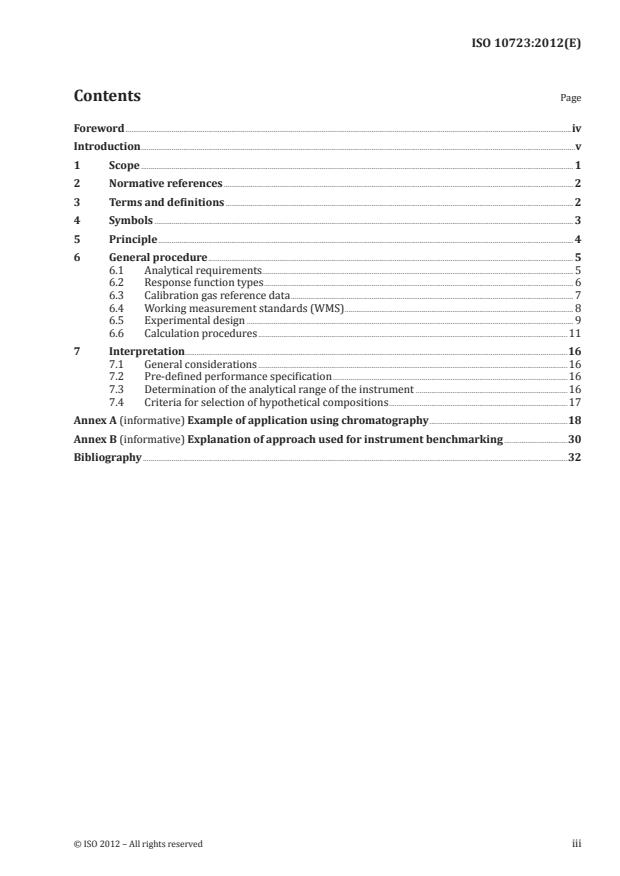

ISO 10723:2012 - Natural gas — Performance evaluation for analytical systems Released:12/4/2012

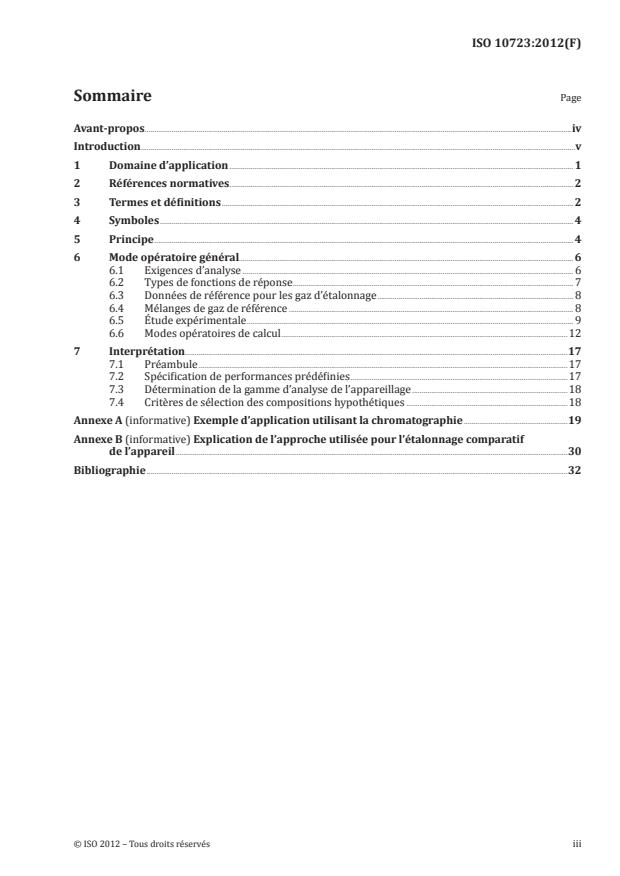

ISO 10723:2012 - Gaz naturel — Évaluation des performances des systemes d'analyse Released:12/4/2012
Overview
ISO 10723:2012 - Natural gas - Performance evaluation for analytical systems specifies a standardized method to determine whether an analytical system for natural gas analysis is fit for purpose. The standard addresses how to use a specified calibration gas to either:
- define the range of gas compositions for which an analytical method meets predefined maximum errors and uncertainties, or
- quantify the errors and uncertainties when analysing gases within a defined composition range.
The method applies to systems that measure individual component amount fractions (for example gas chromatography-based systems used to calculate calorific value, density, Wobbe index and other properties).
Key topics and technical requirements
- Response functions and calibration: Establishes how to identify the instrument’s assumed and true response functions (calibration and analysis functions) and to validate them by regression against reference gas data.
- Calibration gas mixtures (CGM) and working measurement standards (WMS/CRM): Requires known composition and uncertainty of the calibration gas used routinely and explains the role of certified reference gas mixtures (CRMs) and WMSs.
- Experimental design: Specifies multi-point calibration experiments using a designed set of reference gas mixtures covering the intended measurement range, and that the experiment be performed within an interval comparable to routine calibrations.
- Uncertainty and error evaluation: Uses uncertainty principles (referencing the GUM) to calculate standard and expanded uncertainties for component amount fractions and for properties derived from composition.
- Interpretation and benchmarking: Provides procedures to determine analytical ranges, selection of hypothetical compositions for simulation, and guidance for periodic re-evaluation. Informative annexes illustrate application with on-line gas chromatography and provide benchmarking rationale.
Practical applications and users
Who benefits:
- Analytical laboratories and metrology institutes validating gas analysis systems
- Gas transmission and distribution operators verifying on-line or custody-transfer analysers
- Instrument manufacturers benchmarking and selecting calibration gas compositions
- Calibration service providers and QA teams ensuring measurement traceability and uncertainty compliance
Typical uses:
- Determining the composition ranges where a gas analyser meets performance requirements
- Quantifying measurement uncertainty for custody, billing, safety, and process control
- Optimizing calibration gas composition to minimize errors across the operating range
- Establishing periodic performance-evaluation schedules and corrective actions
Related standards
Normative references in ISO 10723:2012 include:
- ISO/IEC Guide 98-3 (GUM) - Uncertainty of measurement
- ISO 6143 - Comparison methods for calibration gas mixtures
- ISO 6974-2 - Uncertainty calculations for GC composition
- ISO 6976 - Calculation of calorific values, density and Wobbe index
Keywords: ISO 10723:2012, natural gas analysis, performance evaluation, calibration gas, measurement uncertainty, gas chromatography, certified reference gas mixture, working measurement standard.
Relations
- Effective Date
- 09-Feb-2026
- Consolidates
EN ISO 10723:2012 - Natural gas - Performance evaluation for analytical systems (ISO 10723:2012) - Effective Date
- 12-Feb-2026
- Effective Date
- 12-Dec-2009
Buy Documents
ISO 10723:2012 - Natural gas — Performance evaluation for analytical systems Released:12/4/2012
ISO 10723:2012 - Gaz naturel — Évaluation des performances des systemes d'analyse Released:12/4/2012
Get Certified
Connect with accredited certification bodies for this standard

Element Materials Technology
Materials testing and product certification.

ABS Group Brazil
ABS Group certification services in Brazil.

ABS Quality Evaluations Inc.
American Bureau of Shipping quality certification.
Sponsored listings
Frequently Asked Questions
ISO 10723:2012 is a standard published by the International Organization for Standardization (ISO). Its full title is "Natural gas — Performance evaluation for analytical systems". This standard covers: ISO 10723:2012 specifies a method of determining whether an analytical system for natural gas analysis is fit for purpose. It can be used either to determine a range of gas compositions to which the method can be applied, using a specified calibration gas, while satisfying previously defined criteria for the maximum errors and uncertainties on the composition or property or both, or to evaluate the range of errors and uncertainties on the composition or property (calculable from composition) or both when analysing gases within a defined range of composition, using a specified calibration gas.
ISO 10723:2012 specifies a method of determining whether an analytical system for natural gas analysis is fit for purpose. It can be used either to determine a range of gas compositions to which the method can be applied, using a specified calibration gas, while satisfying previously defined criteria for the maximum errors and uncertainties on the composition or property or both, or to evaluate the range of errors and uncertainties on the composition or property (calculable from composition) or both when analysing gases within a defined range of composition, using a specified calibration gas.
ISO 10723:2012 is classified under the following ICS (International Classification for Standards) categories: 75.060 - Natural gas. The ICS classification helps identify the subject area and facilitates finding related standards.
ISO 10723:2012 has the following relationships with other standards: It is inter standard links to EN ISO 2613-2:2023, EN ISO 10723:2012, ISO 10723:1995. Understanding these relationships helps ensure you are using the most current and applicable version of the standard.
ISO 10723:2012 is available in PDF format for immediate download after purchase. The document can be added to your cart and obtained through the secure checkout process. Digital delivery ensures instant access to the complete standard document.
Standards Content (Sample)
INTERNATIONAL ISO
STANDARD 10723
Second edition
2012-12-01
Natural gas — Performance evaluation
for analytical systems
Gaz naturel — Évaluation des performances des systèmes d’analyse
Reference number
©
ISO 2012
© ISO 2012
All rights reserved. Unless otherwise specified, no part of this publication may be reproduced or utilized in any form or by any
means, electronic or mechanical, including photocopying and microfilm, without permission in writing from either ISO at the
address below or ISO’s member body in the country of the requester.
ISO copyright office
Case postale 56 • CH-1211 Geneva 20
Tel. + 41 22 749 01 11
Fax + 41 22 749 09 47
E-mail copyright@iso.org
Web www.iso.org
Published in Switzerland
ii © ISO 2012 – All rights reserved
Contents Page
Foreword .iv
Introduction .v
1 Scope . 1
2 Normative references . 2
3 Terms and definitions . 2
4 Symbols . 3
5 Principle . 4
6 General procedure . 5
6.1 Analytical requirements . . 5
6.2 Response function types . 6
6.3 Calibration gas reference data . 7
6.4 Working measurement standards (WMS) . 8
6.5 Experimental design . 9
6.6 Calculation procedures .11
7 Interpretation .16
7.1 General considerations .16
7.2 Pre-defined performance specification .16
7.3 Determination of the analytical range of the instrument .16
7.4 Criteria for selection of hypothetical compositions .17
Annex A (informative) Example of application using chromatography .18
Annex B (informative) Explanation of approach used for instrument benchmarking .30
Bibliography .32
Foreword
ISO (the International Organization for Standardization) is a worldwide federation of national standards
bodies (ISO member bodies). The work of preparing International Standards is normally carried out
through ISO technical committees. Each member body interested in a subject for which a technical
committee has been established has the right to be represented on that committee. International
organizations, governmental and non-governmental, in liaison with ISO, also take part in the work.
ISO collaborates closely with the International Electrotechnical Commission (IEC) on all matters of
electrotechnical standardization.
International Standards are drafted in accordance with the rules given in the ISO/IEC Directives, Part 2.
The main task of technical committees is to prepare International Standards. Draft International
Standards adopted by the technical committees are circulated to the member bodies for voting.
Publication as an International Standard requires approval by at least 75 % of the member bodies
casting a vote.
Attention is drawn to the possibility that some of the elements of this document may be the subject of
patent rights. ISO shall not be held responsible for identifying any or all such patent rights.
ISO 10723 was prepared by Technical Committee ISO/TC 193, Natural gas, Subcommittee SC 1, Analysis
of natural gas.
This second edition cancels and replaces the first edition (ISO 10723:1995), which has been technically
revised. It also incorporates Technical Corrigendum ISO 10723:1995/Cor.1:1998.
iv © ISO 2012 – All rights reserved
Introduction
This International Standard describes a method for evaluating the performance of analytical systems
intended for the analysis of natural gas. Natural gas is assumed to consist predominantly of methane,
with other saturated hydrocarbons and non-combustible gases.
Performance evaluation makes no assumption about equipment for and/or methodology of analysis
but gives test methods which can be applied to the chosen analytical system, including the method,
equipment and sample handling.
This International Standard contains an informative annex (Annex A) that shows the application for an
on-line gas chromatographic system which, as described, is assumed to have a response/concentration
relationship for all components that is represented by a straight line through the origin. This International
Standard contains an additional informative annex (Annex B) that gives a rationale for the approach
used for instrument benchmarking.
INTERNATIONAL STANDARD ISO 10723:2012(E)
Natural gas — Performance evaluation for analytical systems
1 Scope
1.1 This International Standard specifies a method of determining whether an analytical system for
natural gas analysis is fit for purpose. It can be used either
a) to determine a range of gas compositions to which the method can be applied, using a specified
calibration gas, while satisfying previously defined criteria for the maximum errors and uncertainties
on the composition or property or both, or
b) to evaluate the range of errors and uncertainties on the composition or property (calculable from
composition) or both when analysing gases within a defined range of composition, using a specified
calibration gas.
1.2 It is assumed that
a) for evaluations of the first type above, the analytical requirement has been clearly and unambiguously
defined, in terms of the range of acceptable uncertainty on the composition, and, where appropriate,
the uncertainty in physical properties calculated from these measurements,
b) for applications of the second type above, the analytical requirement has been clearly and
unambiguously defined, in terms of the range of composition to be measured and, where appropriate,
the range of properties which may be calculated from these measurements,
c) the analytical and calibration procedures have been fully described, and
d) the analytical system is intended to be applied to gases having compositions which vary over ranges
normally found in gas transmission and distribution systems.
1.3 If the performance evaluation shows the system to be unsatisfactory in terms of the uncertainty on the
component amount fraction or property, or shows limitations in the ranges of composition or property values
measurable within the required uncertainty, then it is intended that the operating parameters, including
a) the analytical requirement,
b) the analytical procedure,
c) the choice of equipment,
d) the choice of calibration gas mixture, and
e) the calculation procedure,
be reviewed to assess where improvements can be obtained. Of these parameters, the choice of the
calibration gas composition is likely to have the most significant influence.
1.4 This International Standard is applicable to analytical systems which measure individual component
amount fractions. For an application such as calorific value determination, the method will be typically
gas chromatography, set up, as a minimum, for the measurement of nitrogen, carbon dioxide, individual
hydrocarbons from C to C and a composite measurement representing all higher hydrocarbons of
1 5
carbon number 6 and above. This allows for the calculation of calorific value and similar properties
with acceptable accuracy. In addition, components such as H S can be measured individually by specific
measurement methods to which this evaluation approach can also be applied.
1.5 Performance evaluation of an analytical system is intended to be performed following initial
installation to ensure that errors associated with assumed response functions are fit for purpose.
Thereafter, periodic performance evaluation is recommended, or whenever any critical component of
the analytical system is adjusted or replaced. The appropriate interval between periodic performance
evaluations will depend upon both how instrument responses vary with time and also how large an
error may be tolerated. This first consideration is dependent upon instrument/operation; the second
is dependent on the application. It is not appropriate, therefore, for this International Standard to offer
specific recommendations on intervals between performance evaluations.
2 Normative references
The following referenced documents are indispensable for the application of this document. For dated
references, only the edition cited applies. For undated references, the latest edition of the referenced
document (including any amendments) applies.
ISO/IEC Guide 98-3:2008, Uncertainty of measurement —Part 3: Guide to the expression of uncertainty in
measurement (GUM:1995)
ISO 6143:2001, Gas analysis — Comparison methods for determining and checking the composition of
calibration gas mixtures
ISO 6974-2, Natural gas — Determination of composition and associated uncertainty by gas
chromatography — Part 2: Uncertainty calculations
ISO 6976:1995, Natural gas — Calculation of calorific values, density, relative density and Wobbe index
from composition
3 Terms and definitions
For the purposes of this document, the following terms and definitions apply.
3.1
uncertainty of measurement
parameter, associated with the result of a measurement, that characterizes the dispersion of values that
can reasonably be attributed to the measurand
NOTE In keeping with ISO/IEC Guide 98-3, in this International Standard the uncertainty of the composition
is expressed as a standard uncertainty or as an expanded uncertainty calculated through the use of an appropriate
coverage factor.
3.2
certified reference gas mixture
CRM
reference gas mixture, characterized by a metrologically valid procedure for one or more specified
properties, accompanied by a certificate that provides the value of the specified property, its associated
uncertainty, and a statement of metrological traceability
[3]
NOTE 1 The above definition is based on the definition of “certified reference material” in ISO Guide 35 .
“Certified reference material” is a generic term; “certified reference gas mixture” is more suited to this application.
NOTE 2 Metrologically valid procedures for the production and certification of reference materials (such as
[4] [3]
certified reference gas mixtures) are given in, among others, ISO Guide 34 and ISO Guide 35 .
[5]
NOTE 3 ISO Guide 31 gives guidance on the contents of certificates.
2 © ISO 2012 – All rights reserved
3.3
working measurement standard
WMS
standard that is used routinely to calibrate or verify measuring instruments or measuring systems
[ISO/IEC Guide 99:2007, 5.7]
NOTE A working measurement standard is usually calibrated against a CRM.
3.4
calibration gas mixture
CGM
gas mixture whose composition is sufficiently well established and stable to be used as a working
measurement standard of composition
NOTE In this International Standard, a CGM is used for routine (e.g. daily) component calibration of the
analyser. It is independent of the WMSs used to perform the evaluation.
3.5
response
output signal of the measuring system for each specified component
NOTE In the case of gas chromatography this will be either peak area or peak height, depending upon the
instrument configuration.
3.6
response function
functional relationship between instrumental response and component content
NOTE 1 The response function can be expressed in two different ways as a calibration function or an analysis
function, depending on the choice of the dependent and the independent variable.
NOTE 2 The response function is conceptual and cannot be determined exactly. It is determined approximately
through calibration.
3.7
calibration function
relationship describing instrument response as a function of component content
3.8
analysis function
relationship describing component content as a function of instrument response
4 Symbols
a parameters of the calibration function (z = 0, 1, 2 or 3)
z
b parameters of the analysis function (z = 0, 1, 2 or 3)
z
x amount fraction of the specified component
xˆ adjusted (estimated) amount fraction from the response function
y′ raw instrumental response
y corrected instrumental response
s standard deviation of response
ˆy adjusted (estimated) response from the response function
F calibration function
G analysis function
M (sample of) reference gas mixture
P general characteristic (physical property)
p pressure (in kPa)
u standard uncertainty
U expanded uncertainty
k coverage factor
Γ goodness-of-fit measure in generalized least squares
δ error in the estimated value
5 Principle
Performance characteristics of the instrument are determined when used in combination with a
specified calibration gas mixture. Therefore, the evaluation procedure can be used to
— determine errors and uncertainties in measured composition and properties over a pre-defined
range for each specified component, and
— determine a range for each specified component over which the errors and uncertainties in measured
composition and properties do not exceed a predefined measurement requirement.
In each case, the performance characteristics are calculated for the instrument when used in combination
with a specified calibration gas mixture of known composition and uncertainty.
NOTE 1 The method can also be used to establish the most appropriate composition of the calibration gas
mixture to be used routinely with the instrument such that the errors and uncertainties are minimized over a
predefined range of use.
A complete assessment of the errors and uncertainties arising from the use of an instrument could be
performed by measuring an infinite series of well-defined reference gas mixtures whose compositions
lie within the specified range of operation. However, this is practically impossible. Instead, the principle
used in this International Standard is to measure a smaller number of well-defined reference gases
and to determine a mathematical description of the response functions for each specified component
over a predefined content range. The performance of the instrument can then be modelled offline using
these “true” response functions, the response functions assumed by the instrument’s data system and
the reference data for the calibration gas mixture specified for the instrument. The measurement of
a large number of gas mixtures can then be simulated offline using numerical methods to determine
performance benchmarks inherent in the measurement system.
The general procedure for determining the performance characteristics of the instrument is
summarized below.
a) Specify the components required to be measured by the instrument and the range for each over
which the instrument shall be evaluated.
b) Establish the functional descriptions of the response functions assumed by the instrument (or the
instrument’s data system) for each specified component.
NOTE 2 These functions are referred to as the assumed response functions of the system at the time of
calibration/evaluation. These are generally analysis functions used by the instrument to determine the amount
from the measured response, x = G ( y).
asm
4 © ISO 2012 – All rights reserved
c) Establish the composition and uncertainty of the calibration gas mixture specified for routine
calibration of the instrument.
d) Design a set of reference gas mixtures with compositions covering all ranges for all components
specified in a).
e) Perform a multi-point calibration experiment by collecting instrument response data to
measurements of the reference gas mixtures designed and produced in accordance with d). The
entire experiment should be conducted within a time period equivalent to that between routine
calibrations.
f) Calculate the calibration functions and analysis functions for each specified component using
regression analysis and validate the compatibility of the functions with the calibration data set.
NOTE 3 These functions are referred to as the true response functions of the system at the time of
calibration/evaluation, y = F (x) and x = G ( y).
true true
g) Calculate instrumental errors and uncertainties for each component and property over a specified
range of compositions using the functions and reference data collated in d), e) and f) above.
h) From the distribution of errors and the unbiased uncertainty estimates calculated in g) above,
determine the mean error and its uncertainty for each measurand.
The mean errors and their uncertainties on component content and properties resulting from step h)
can be compared to performance requirements for the analytical system. If performance benchmarks
are poorer than the analytical requirements of the measurement, then it is clear that the method
fails to provide the desired performance over the fully specified range. The method shall be modified
accordingly and the entire evaluation procedure repeated. Alternatively, the offline calculations shall be
repeated over a restricted range of operation in order to improve system performance. In this case, the
instrument may be shown to perform adequately over a limited range.
It may be possible to modify the data system on the instrument to allow for the difference between
the true response functions and the analysis function assumed by the instrument. In this case, the
instrument should be adjusted following the evaluation to account for this difference. If the function
form of G and G are the same, then the parameters of G in the instrument’s data system can
true asm asm
be updated with those determined for G in step f) above, thereby eliminating systematic errors due
true
to the instrument. However, it is important to remember that the parameters of G are only valid for
true
each component over the content range used to establish the analysis function. That is, the instrument
should not be used outside the ranges defined, designed and evaluated in steps a), b) and c).
6 General procedure
6.1 Analytical requirements
6.1.1 General considerations
Users of this International Standard should first decide which components measured by the instrument
are to be used in the evaluation of the performance. These are termed specified components. For each
specified component, the range of amount fractions over which the response function is to be evaluated
shall then be decided.
6.1.2 Specified components
For measurement systems set up to determine the major components in natural gas, the components
typically specified are nitrogen, carbon dioxide, methane, ethane, propane, 2-methylpropane (iso-butane),
n-butane, 2-methylbutane (iso-pentane) and n-pentane. In addition, some analytical requirements
include 2,2-dimethylpropane (neo-pentane). This component is typically present in very low amounts in
natural gas and might not be specified in many systems for measurement. In a typical chromatography
method, higher hydrocarbons are often specified as a summed component such as hexanes+ (C ) where
6+
all hydrocarbons containing six carbon atoms or greater are included in one specified component. The
instrumental method may measure such a component as an individual chromatographic peak which
is typically backflushed through the system, and all components elute at the same time through the
detector. Alternatively, in systems where valve switching is not possible, the heavier hydrocarbons
elute in a forward fashion through the columns and the component is simply measured as the sum of
individual peaks. However, the system may be set up to measure all hexanes (C s) individually and the
summed peak C + may be specified. This is often the case should the C + amount be significant and a
7 6
more detailed breakdown of this component be required to minimize errors on the measurement. This
principle can be extended such that the system is set up to measure in a C , C , C , C or even C
6+ 7+ 8+ 9+ 10+
mode. Users of this International Standard shall decide which of these components are to be included in
the evaluation of the instrument’s performance based upon the significance of the amounts of each of
the components specified in the instrument set-up.
6.1.3 Component content ranges
Once it is clear which measured components are going to be included in the evaluation, the user shall
determine, for each of these, over what range of amount fractions the instrument is expected to be used.
Such ranges shall generally be greater than that which is expected to be measured by the instrument in
regular duty. If the data from the performance evaluation is used subsequently to update the response
functions assumed by the instrument, then it is vital that the component content ranges used in the
evaluation extend beyond the specified operating range. Should this not be the case, considerable
measurement errors might result from extrapolation outside the determined response function.
6.2 Response function types
6.2.1 Assumed functional descriptions
The instrument data system will assume a relationship between response and content of a component in
the gas. This is the assumed analysis function of the instrument, x = G (y). Many instruments assume
asm
a simple first-order polynomial function in the form x = b y, where b is often referred to as the response
1 1
factor (RF) for that component. In this case a single calibration gas mixture is used and a first-order
response function is assumed, passing through the origin. Alternatively, the instrument may assume a
higher-order polynomial functional description or even an exponential or power function.
In some cases the response, particularly for a minor component, may be calculated as relative to that of
another (reference) component. Such a relative response factor shall have a response function similar to
that of the reference component.
The assumed analysis function for each component, x = G (y), shall be noted and used for subsequent
asm
calculation of the instrument’s performance characteristics described in 6.6.
The function types considered for the treatment of the performance evaluation data shall be matched to
those used by the instrument’s data system.
NOTE Occasionally, functional types other than polynomials, such as exponential relationships, are
implemented by an instrument’s data system. If the instrument uses functional types other than polynomials,
it is appropriate to use these in the determination of the analysis functions. However, for the purposes of this
International Standard, only polynomial functions up to third order are considered.
6.2.2 Selection of function types
The type of function to be used in practice is chosen according to the response characteristics of the
measuring system and that assumed by the instrument’s data system.
Polynomial functions describing the true response/amount fraction relationship can be derived in
either domain. A mathematical description of instrument response as a function of amount fraction is
termed the calibration function, whereas that describing amount fraction as a function of response is
termed the analysis function.
6 © ISO 2012 – All rights reserved
Hence, the true calibration functions, F (x ), determined for each component are in the form
i,true i
2 3
yF==()xa ++ax ax +ax (1)
ii,true ii01 2 ii3
where a are the parameters of the calibration function.
z
Similarly, the true analysis functions, G (y ), are in the form
i,true i
2 3
xG==()yb ++by by +by (2)
ii,true ii01 2 ii3
where b are the parameters of the analysis function.
z
In both cases
y is the mean response of the instrument to component i;
i
x is the amount fraction of component i.
i
The response functions above are shown in a form up to third order. However, simpler forms up to
second order or simply first order may be considered. Choose the form of the response functions with
the following considerations:
a) the simplest form that gives an adequate fit to the data should be used to avoid over-parameterizing
the response function;
b) the number of calibration points, and hence the number of reference gases required to satisfactorily
describe a polynomial, increases with the order of the function (see 6.4.2);
c) if there is an a priori reason to assume that a lower-order polynomial will always be suitable, then
this should be chosen and a lower number of reference gases may be used (see 6.4.2).
6.3 Calibration gas reference data
6.3.1 General considerations
The performance benchmarks from this evaluation procedure are calculated for the instrument used
in combination with the proposed/current calibration gas mixture. This is the working calibration gas
used for routine, often daily, calibration.
NOTE The design of the calibration gas mixture can have significant influence on the distribution of bias
errors for the instrument. Similarly, the uncertainties on the amount fraction of each component in the calibration
gas can make a significant contribution to the uncertainty on the measurement results. Hence, the design and
uncertainty of composition of the calibration mixture shall be chosen carefully.
6.3.2 Composition and uncertainty
The amount fraction, x , and standard uncertainty, u(x ), for each component in the calibration gas
i,cal i,cal
mixture shall be obtained or derived from the certificate of calibration.
If the uncertainty quoted on the certificate is not a standard uncertainty (k = 1), then the standard
uncertainties shall be derived using the manufacturer’s stated coverage factor.
ux()=Ux()/k (3)
ii,,calcertcal
6.4 Working measurement standards (WMS)
6.4.1 Definition
The WMSs used for the determination of the response functions are gas mixtures whose composition
is known with a well-defined uncertainty. They may be multi-component or binary mixtures. In all
cases, the matrix gas should be methane, so that the behaviour of the WMS is as similar as possible to
that of natural gases. Binary mixtures can generally be prepared with lower uncertainties than multi-
component mixtures. However, many more mixtures shall be made; one set for each non-methane
component to be tested. Generally, multi-component mixtures should be used as they allow more repeat
measurements to be performed for each component/amount fraction combination.
The WMS should be chosen so as to be suitable for the intended analytical application as discussed in
6.1. However, it is not practicable to manufacture and calibrate WMSs which contain all the components
in natural gas, given the complexity of the higher hydrocarbons that are commonly found and the
difficulty of preparing high-quality mixtures containing condensable components. In the majority of
applications, the major components in natural gas, nitrogen, carbon dioxide, methane, ethane, propane,
2-methylpropane (iso-butane) and n-butane are generally specified and normally included in the
reference gas mixtures. In addition, 2-methylbutane (iso-pentane), n-pentane and a representative C
6+
component such as n-hexane are often included. If 2,2-dimethylpropane (neo-pentane) is a specified
component in the analytical requirement, it may also be included in the WMS. Any component expected
to be present in an amount fraction greater than 0,01 should be included.
NOTE The WMS used in this evaluation procedure can also be used to define the analysis function of an
analyser when it is initially installed or on other occasions when a primary calibration is required to define the
analysis function assumed by the instrument’s data system.
6.4.2 Composition and uncertainties
For each specified component that will be included in the WMS, the number of levels, calibration points,
at which the evaluation shall be performed depends upon the form of the function type selected for the
evaluation (see 6.2.2).
The minimum number of calibration points recommended to give sufficient degrees of freedom for the
unbiased estimate of the response function is as follows:
3 (three) for a first-order polynomial;
5 (five) for a second-order polynomial;
7 (seven) for a third-order polynomial.
The WMSs shall be selected such that their amount fractions are approximately equally spaced across
the defined evaluation range (see 6.1.3) with one at (or below) the lower limit and one at (or above) the
higher limit.
NOTE 1 Depending on the intended application, the lower end of the range might be close to the limit of
detection, in which case it might not be possible to include a component amount fraction below the lower end of
the application range.
In the design of the recipe of the set of WMSs, the user shall be careful not to include all high-amount
fractions of the higher hydrocarbons together in the same mixture. Should this be the case, the pressure
of the mixture would be limited due to the potential of retrograde hydrocarbon condensation due to the
high dewpoint of the mixture. The higher amounts of higher hydrocarbons should, where possible, be
distributed amongst the set of WMSs.
Once designed and manufactured, the composition and uncertainties of the WMS should be determined
by a comparison method in accordance with ISO 6143. Certified reference gas mixtures (CRMs) of
an appropriate metrological quality shall be used as the source of traceability for this comparison
step. Whether binary or multi-component mixtures are used, each WMS shall have compositional
8 © ISO 2012 – All rights reserved
uncertainties which are small by comparison with the anticipated measurement uncertainties of the
analytical system under evaluation.
NOTE 2 Helium, C and heavier hydrocarbons are usually present at sufficiently low mole fractions that
nonlinearity of response is unlikely to be a problem. If not specified in the reference gas mixtures, the assumption
of a first-order response/amount fraction relationship can be tested using natural gases of certified composition
containing these components covering a range of amount fractions appropriate to the application.
6.5 Experimental design
6.5.1 General considerations
Each WMS shall be measured several times by the instrument in order to obtain a reasonable estimate
of the response functions for each component. It is strongly recommended that each gas be analysed
10 times. However, where this number of repeats would be impractical (for example requiring the test
period to extend beyond the normal calibration interval), a smaller number of repeats may be used,
but not less than six. When changing between WMSs, regulators, valves and tubing need to be fully
purged otherwise the first or more replicates of a fresh WMS may not be fully representative of the gas
contained within the cylinder. The measurement might be biased due to the presence of residues of the
preceding gas or of the ingress of air occurring during changeover.
The entire calibration procedure is likely to take several hours depending upon the instrument cycle
time. Over such a period, it is quite common for the ambient atmospheric pressure to change by as much
as 0,5 % relative and in extreme cases by up to 2 % relative. Gas samples are typically introduced into
analysers by being purged through an injector device to a vent which is at, or referenced to, atmospheric
pressure. Hence, ambient pressure variations cause a change in the effective sample size. This has the
effect of raising or decreasing the response of the instrument to the same gas mixture. Hence, there will
be an inherent drift in the absolute response of the instrument over time, dependent upon the change in
atmospheric pressure over that period. There are other parameters that influence the effective sample
size or the detector sensitivity, but atmospheric pressure variation is the most significant.
There is a choice of procedures for the measurement of each reference gas which depends on the
availability of time and equipment. There are two general approaches to implementing the calibration
procedure which are termed as follows:
a) batch-wise calibration;
b) drift compensation calibration.
The first, in which replicate measurements of each mixture are carried out in sequence, is the most
practical implementation but has the disadvantage of not compensating for the inherent drift in a
system over the time of the calibration. The second, in which replicate measurements of each mixture
are performed separately and independently, will compensate for the inherent instrumental drift over
the time of the calibration but is considerably more time-consuming and more suited to implementation
in an automated system.
Whichever experimental procedure is used, the entire calibration experiment should be conducted
within a time period equivalent to that between routine calibrations.
6.5.2 Batch-wise calibration
The WMSs are introduced in sequence, with all the replicate measurements on the first gas being
completed before the second is introduced and so on. The sampling sequence in time is:
M , M , M , …, M (n replicate measurements in succession on gas M ), then
1,1 1,2 1,3 1,n 1
M , M , M , …, M (n replicate measurements in succession on gas M ), then
2,1 2,2 2,3 2,n 2
M , M , M , …, M (n replicate measurements in succession on gas M ).
p,1 p,2 p,3 p,n p
This is the simplest and most practicable method for a manually implemented field-use application as
it requires only the changeover of p gases on the test instrument. However, the change in atmospheric
pressure during the test will have a greater influence on the variation between the reference gases than
within the repeat measurements for any single one.
Significant instrumental drift between gases will likely give rise to higher residuals and hence poor
goodness-of-fit parameters in the generalized least-squares regression procedure. To minimize the
goodness-of-fit parameters, it may be necessary to correct for the instrumental drift by correcting for
the effective sample size of each reference gas mixture at the time of injection. This can be done by drift
correction (6.5.4).
6.5.3 Drift compensation calibration
This procedure separates the repeat measurements on each reference gas mixture in such a way as to limit
the effect of sample size variations and compensate for the instrumental drift over the calibration period.
The sampling sequence in time is:
M , M , M , …, M (1st repeat measurement on each of p gases), then
1,1 2,1 3,1 p,1
M , M , M , …, M (2nd repeat measurement on each of p gases), then
1,2 2,2 3,2 p,2
th
M , M , M , …, M (n repeat measurement on each of p gases).
1,n 2,n 3,n p,n
The first repeat measurement on reference gas 1 is followed by the first on gas 2 and so on. Then
the second repeat on reference gas 1 follows the completion of the first repeat measurement on all p
reference gases. This procedure is continued throughout the number of repeats required.
This approach ensures that variations due to external influences are shared or smeared out throughout
the repeats on each reference gas. The instrumental drift is effectively compensated for by the
experimental procedure. This occurs in such a way that the within-gas variations may be higher but the
between-gas variations are more consistent. With this approach, the goodness-of-fit parameters in the
generalized least squares regression procedure are usually good.
The major disadvantage to this method is that the gases have to be changed much more frequently. In
addition, after each change, it is advisable for at least one and possibly two analyses to be performed
before data are recorded, to allow for sufficient purging between the gases. This means that the
procedure is much lengthier than the first, and, to be practicable, requires an automated changeover
and purging system to handle the introduction of the reference gases.
6.5.4 Drift correction
During either of the two experimental procedures described above (6.5.2 or 6.5.3), the instrumental
response may be corrected for drift due to changes in atmospheric pressure (for reasons described
earlier). The atmospheric pressure is measured and recorded at the start of each repeat on each of the
WMSs. This allows the pressure-influenced variations in sample size to be corrected to a reference
value. In this way the data will be more consistent both within and between reference gases. While
this approach may be used for the drift-compensation-type calibration (6.5.3), it is often more useful to
correct instrumental responses obtained during batch-wise calibration as the result of this experimental
approach is much more sensitive to instrumental drift.
NOTE If time and automation techniques are available, the combination of a drift compensation experiment
with drift correction for atmospheric pressure will lead to the most precise and inter-consistent calibration data set.
6.5.5 Collation of calibration data
Whichever calibration method is used, the collation of raw calibration data are identical. For each of q
components, (i = [1, ., q]), at each of p amount fractions, ( j = [1, ., p]), collect n (preferably 10) repeat
measurements, (k = [1, ., n]). Collate each instrument response, y′ , with the corresponding component
ijk
amount fraction, x .
ij
10 © ISO 2012 – All rights reserved
If pressure correction (drift correction) is not used, set y equal to y′ . Alternatively, record the
ijk ijk
atmospheric pressure, P , in kPa, at the start of each instrument cycle, and correct the analyser response
ijk
data for atmospheric pressure according to
P
ref
′
y =× y (4)
ijk ijk
P
ijk
where P is a reference pressure in kPa, such as 101,325 kPa.
ref
Group the calibration data by component and level, y , y , y . Inspect each group for outliers or
ij1 ij2 ijn
stragglers using Grubbs’ test or some other suitable outlier test.
NOTE 1 In any set of data, individual results can be found which are not consistent with the other members
of that set. These are regarded as outliers or stragglers, and can be eliminated from the data set according to the
recommendations of the outlier test used. Inspection of the data is the first stage, identifying problems such as
transcription errors. The order in which tests were carried out is also relevant, since rogue results can arise in
cases where the previous test gas was not fully purged from the system before the first results from a new test gas
[7] [8]
are recorded. More detailed information on statistical outlier tests can be found in ISO 5725-1 , ISO 5725-2
[9]
and ISO 5479 .
After rejection of any outliers, calculate the mean response, y , standard deviations, s , and adjusted
ij ij
numbers of analyses, n for q components, (i = [1, ., q]), and at each of p amount fractions, ( j = [1, ., p]).
ij
For the purposes of this method, an estimate of the standard uncertainty on the mean response for each
component at each level, u(y ), is given simply by the standard deviation of repeat measurements, s .
ij ij
NOTE 2 An estimate of u( y ) using the standard deviation of the mean, where u(y ) = s /√n, would most likely
ij ij ij
underestimate the uncertainty as all measurements were likely not made independently under appropriate
reproducibility conditions.
6.6 Calculation procedures
6.6.1 General considerations
The relationship between component amount fraction and instrument response is found by regression
analysis, using the technique of generalized least squares (GLS) in accordance with ISO 6143:2001,A.2.
This procedure takes account of the uncertainties in both the independent and dependent variables, and
allows calculation of overall uncertainty to include contributions from the uncertainties in the reference
gas compositions, analyser response and the parameters of the response functions resulting from the
regression procedure.
NOTE The advice in this section applies to use of GLS to determine regression functions. For ordinary least
[14]
squares (OLS) methods, a statistical test, for example a sequential F-test should be used to determine the
appropriate order of the polynomial function.
In practice, the response functions are calculated independently in both domains, yielding the true
calibration function, F (x ), and the true analysis function, G (y ).
true i true i
The true calibration function is used in combination with the instrument’s assumed analysis function,
and the working calibration gas composition and uncertainty, to determine performance benchmarks in
terms of errors in measured compositions and properties, together with the uncertainties
...
NORME ISO
INTERNATIONALE 10723
Deuxième édition
2012-12-01
Gaz naturel — Évaluation des
performances des systèmes d’analyse
Natural gas — Performance evaluation for analytical systems
Numéro de référence
©
ISO 2012
DOCUMENT PROTÉGÉ PAR COPYRIGHT
© ISO 2012
Droits de reproduction réservés. Sauf prescription différente, aucune partie de cette publication ne peut être reproduite ni utilisée
sous quelque forme que ce soit et par aucun procédé, électronique ou mécanique, y compris la photocopie et les microfilms, sans
l’accord écrit de l’ISO à l’adresse ci-après ou du comité membre de l’ISO dans le pays du demandeur.
ISO copyright office
Case postale 56 • CH-1211 Geneva 20
Tel. + 41 22 749 01 11
Fax + 41 22 749 09 47
E-mail copyright@iso.org
Web www.iso.org
Publié en Suisse
ii © ISO 2012 – Tous droits réservés
Sommaire Page
Avant-propos .iv
Introduction .v
1 Domaine d’application . 1
2 Références normatives . 2
3 Termes et définitions . 2
4 Symboles . 4
5 Principe . 4
6 Mode opératoire général. 6
6.1 Exigences d’analyse . 6
6.2 Types de fonctions de réponse . 7
6.3 Données de référence pour les gaz d’étalonnage . 8
6.4 Mélanges de gaz de référence . 8
6.5 Étude expérimentale . 9
6.6 Modes opératoires de calcul .12
7 Interprétation .17
7.1 Préambule .17
7.2 Spécification de performances prédéfinies .17
7.3 Détermination de la gamme d’analyse de l’appareillage .18
7.4 Critères de sélection des compositions hypothétiques .18
Annexe A (informative) Exemple d’application utilisant la chromatographie .19
Annexe B (informative) Explication de l’approche utilisée pour l’étalonnage comparatif
de l’appareil .30
Bibliographie .32
Avant-propos
L’ISO (Organisation internationale de normalisation) est une fédération mondiale d’organismes
nationaux de normalisation (comités membres de l’ISO). L’élaboration des Normes internationales est
en général confiée aux comités techniques de l’ISO. Chaque comité membre intéressé par une étude
a le droit de faire partie du comité technique créé à cet effet. Les organisations internationales,
gouvernementales et non gouvernementales, en liaison avec l’ISO participent également aux travaux.
L’ISO collabore étroitement avec la Commission électrotechnique internationale (CEI) en ce qui concerne
la normalisation électrotechnique.
Les Normes internationales sont rédigées conformément aux règles données dans les Directives
ISO/CEI, Partie 2.
La tâche principale des comités techniques est d’élaborer les Normes internationales. Les projets de
Normes internationales adoptés par les comités techniques sont soumis aux comités membres pour vote.
Leur publication comme Normes internationales requiert l’approbation de 75 % au moins des comités
membres votants.
L’attention est appelée sur le fait que certains des éléments du présent document peuvent faire l’objet de
droits de propriété intellectuelle ou de droits analogues. L’ISO ne saurait être tenue pour responsable de
ne pas avoir identifié de tels droits de propriété et averti de leur existence.
L’ISO 10723 a été élaborée par le comité technique ISO/TC 193, Gaz naturel, sous-comité SC 1, Analyse
du gaz naturel.
Cette deuxième édition annule et remplace la première édition (ISO 10723:1995), qui a fait l’objet d’une
révision technique. Elle incorpore également le Rectificatif technique ISO 10723:1995/Cor.1:1998.
iv © ISO 2012 – Tous droits réservés
Introduction
La présente Norme internationale décrit une méthode pour l’évaluation des performances des systèmes
d’analyse destinés à l’analyse du gaz naturel. Le gaz naturel est supposé se composer principalement de
méthane, d’autres hydrocarbures saturés et de gaz incombustibles.
L’évaluation des performances ne se fonde sur aucune hypothèse particulière en matière de matériel
et/ou de méthodologie d’analyse mais donne des méthodes d’analyse applicables au système d’analyse
choisi que ce soit pour leur mode opératoire, l’appareillage à utiliser ou le mode d’échantillonnage.
La présente Norme internationale contient une annexe informative (Annexe A) présentant un exemple
d’application pour un système d’analyse par chromatographie en phase gazeuse en ligne qui, dans la forme
décrite, est supposé avoir, pour tous les constituants, une courbe de réponse en fonction de la concentration
linéaire depuis l’origine. La présente Norme internationale contient également une autre annexe (Annexe B)
qui donne une explication de l’approche utilisée pour l’étalonnage comparatif de l’appareil.
NORME INTERNATIONALE ISO 10723:2012(F)
Gaz naturel — Évaluation des performances des
systèmes d’analyse
1 Domaine d’application
1.1 La présente Norme internationale spécifie une méthode permettant de déterminer si un système
d’analyse pour l’analyse du gaz naturel est adapté à l’usage prévu. Elle peut être utilisée pour
a) déterminer une gamme de compositions de gaz à laquelle la méthode peut s’appliquer, en utilisant un
gaz d’étalonnage spécifié, tout en satisfaisant à des critères préalablement définis pour les erreurs
et incertitudes maximales associées à la composition et/ou à la propriété, ou aux deux, ou
b) évaluer la plage d’erreurs et d’incertitudes associées à la composition ou à la propriété (calculable
à partir de la composition), ou aux deux, lors de l’analyse de gaz compris dans une gamme de
composition définie, en utilisant un gaz d’étalonnage spécifié.
1.2 Il est supposé que
a) pour les évaluations du premier type ci-dessus, l’exigence d’analyse a été définie de manière claire et
sans équivoque en ce qui concerne la plage acceptable de l’incertitude associée à la composition et, le
cas échéant, de l’incertitude associée aux propriétés physiques calculées à partir de ces mesurages,
b) dans le cas d’applications du deuxième type ci-dessus, l’exigence d’analyse a été définie de manière
claire et sans équivoque en ce qui concerne la gamme de compositions à mesurer et, le cas échéant,
la gamme des propriétés qui peuvent être calculées à partir de ces mesurages,
c) les modes opératoires d’analyse et d’étalonnage sont décrits de manière exhaustive,
d) le système d’analyse est destiné à s’appliquer à des gaz ayant des compositions qui varient dans les
limites couramment rencontrées dans les réseaux de transport et de distribution de gaz.
1.3 Si l’évaluation des performances montre que le système n’est pas satisfaisant en ce qui concerne
l’incertitude associée aux fractions molaires des constituants ou aux propriétés, ou montre des limites au
niveau des plages de composition ou des valeurs des propriétés mesurables avec l’incertitude requise,
alors les paramètres opérationnels, y compris
— l’exigence d’analyse,
— le mode opératoire d’analyse,
— le choix des équipements,
— le choix du mélange de gaz pour étalonnage, et
— le mode opératoire de calcul,
sont censés être examinés en vue de déterminer les points où des améliorations peuvent être apportées.
Parmi ces paramètres, le choix de la composition du gaz d’étalonnage est probablement celui qui aura
l’incidence la plus notable.
1.4 La présente Norme internationale est applicable aux systèmes d’analyse qui mesurent les fractions
molaires des constituants individuels. Pour une application telle que la détermination du pouvoir
calorifique, la méthode sera en général la chromatographie en phase gazeuse configurée au minimum
pour le mesurage de l’azote, du dioxyde de carbone, des hydrocarbures individuels de C à C et pour un
1 5
mesurage mixte représentant tous les hydrocarbures supérieurs ayant un nombre d’atomes de carbone
supérieur ou égal à six. Ainsi, il est possible de calculer le pouvoir calorifique et les propriétés similaires avec
une exactitude acceptable. En outre, des constituants tels que H S peuvent être mesurés individuellement
par des méthodes de mesure auxquelles cette approche d’évaluation peut être également appliquée.
1.5 Il convient que l’évaluation des performances des systèmes d’analyse se fasse au moment de
l’installation initiale afin de s’assurer que les erreurs associées aux réponses estimées sont adéquates.
Ensuite, il est recommandé d’évaluer les performances périodiquement ou chaque fois qu’un élément
essentiel du système d’analyse est ajusté ou remplacé. L’intervalle approprié entre les évaluations
périodiques des performances dépendra à la fois des variations dans le temps de la réponse de l’appareillage
ainsi que de l’étendue jusqu’à laquelle une erreur peut être tolérée. Cette première considération dépend
de l’appareillage et/ou de son fonctionnement, alors que la deuxième dépend de l’application. Il n’est
donc pas pertinent que la présente Norme internationale donne des recommandations spécifiques sur les
intervalles entre les évaluations des performances.
2 Références normatives
Les documents de référence suivants sont indispensables pour l’application du présent document. Pour
les références datées, seule l’édition citée s’applique. Pour les références non datées, la dernière édition
du document de référence s’applique (y compris les éventuels amendements).
Guide ISO/CEI 98-3, Incertitude de mesure — Partie 3: Guide pour l’expression de l’incertitude de mesure
ISO 6143:2001, Analyse des gaz — Méthodes comparatives pour la détermination et la vérification de la
composition des mélanges de gaz pour étalonnage
ISO 6974-2, Gaz naturel — Détermination de la composition avec une incertitude définie par chromatographie
en phase gazeuse — Partie 2: Calculs d’incertitude
ISO 6976, Gaz naturel — Calcul du pouvoir calorifique, de la masse volumique, de la densité relative et de
l’indice de Wobbe à partir de la composition
3 Termes et définitions
Pour les besoins du présent document, les termes et définitions suivants s’appliquent.
3.1
incertitude de mesure
paramètre, associé au résultat d’un mesurage, qui caractérise la dispersion des valeurs qui pourraient
raisonnablement être attribuées au mesurande
NOTE En accord avec le Guide ‘ISO/CEI 98-3, dans la présente Norme internationale, l’incertitude associée
à la composition est exprimée comme une incertitude-type ou une incertitude élargie calculée en utilisant un
facteur d’élargissement approprié.
3.2
mélange de gaz de référence certifié
MRC
mélange de gaz de référence, caractérisé par une procédure métrologiquement valable pour une ou
plusieurs propriétés spécifiées, accompagné d’un certificat qui fournit la valeur de la propriété spécifiée,
son incertitude associée, et une déclaration de la traçabilité métrologique
NOTE 1 La définition ci-dessus est fondée sur la définition de «matériau de référence certifié» du Guide
[3]
ISO 35 . «Matériau de référence certifié» est un terme générique; «mélange de gaz de référence certifié» est plus
adapté à cette application.
NOTE 2 Des procédures métrologiques valides pour la production et la certification des matériaux de référence
[4]
(tels que certifiés comme mélanges gazeux de référence) sont données, entre autres, dans le Guide ISO 34 et le
[3]
Guide ISO 35 .
[5]
NOTE 3 Le Guide ISO 31 donne des indications sur le contenu des certificats.
2 © ISO 2012 – Tous droits réservés
3.3
étalon de travail
étalon qui est utilisé couramment pour étalonner ou contrôler des instruments de mesure ou des
systèmes de mesure
[GUIDE ISO/CEI 99:2007, 5.7]
NOTE Un étalon de travail est habituellement étalonné par rapport à un étalon de référence.
3.4
mélange de gaz pour étalonnage
MGE
mélange gazeux dont la composition est suffisamment bien établie et stable pour servir d’étalon de
travail d’une composition
NOTE Dans la présente Norme internationale, un MGE est utilisé pour l’étalonnage périodique de constituant
(par exemple journalier). Il est indépendant de l’étalon de travail utilisé pour réaliser l’évaluation.
3.5
réponse
signal de sortie du système de mesure pour chaque constituant spécifié
NOTE En ce qui concerne la chromatographie en phase gazeuse, celui-ci sera soit sous la forme d’une aire, soit
d’une hauteur de pic, selon la configuration de l’appareillage.
3.6
fonction de réponse
relation fonctionnelle entre la réponse de l’appareillage et la teneur en constituants
NOTE 1 La fonction de réponse peut être exprimée de deux manières différentes: soit sous forme de fonction
d’étalonnage, soit sous forme de fonction d’analyse, en fonction du choix de la variable liée et de la variable libre.
NOTE 2 La fonction de réponse est conceptuelle et ne peut pas être déterminée avec exactitude. Elle est
déterminée approximativement grâce au processus d’étalonnage.
3.7
fonction d’étalonnage
relation décrivant les réponses des appareils en fonction de la teneur en constituants
3.8
fonction d’analyse
relation décrivant la teneur en constituants en fonction de la réponse de l’appareil
4 Symboles
a paramètres de la fonction d’étalonnage (z = 0, 1, 2 ou 3)
z
b paramètres de la fonction d’analyse (z = 0, 1, 2 ou 3)
z
x fraction molaire du constituant spécifié
ˆ
x fraction molaire ajustée (estimée) à partir de la fonction de réponse
y’ réponse brute de l’appareillage
y réponse corrigée de l’appareillage
s écart-type de la réponse
ˆ
y réponse ajustée (estimée) à partir de la fonction de réponse
F fonction d’étalonnage
G fonction d’analyse
M (échantillon de) mélange de gaz de référence
P caractéristique générale (propriété physique)
p pression (en kPa)
u incertitude-type
U incertitude élargie
k coefficient de couverture
Γ mesure de l’adéquation en moindre carrés généralisés
δ erreur associée à la valeur estimée
5 Principe
Les caractéristiques de performances de l’appareillage sont déterminées lorsque celui-ci est utilisé
avec un mélange de gaz pour étalonnage spécifié. Par conséquent, le mode opératoire d’évaluation peut
être utilisé pour
— déterminer les erreurs et les incertitudes associées à la composition mesurée et aux propriétés, sur
une plage prédéfinie pour chaque constituant spécifié, et
— déterminer une plage pour chaque constituant spécifié à l’intérieur de laquelle les erreurs et les
incertitudes associées à la composition et aux propriétés mesurées ne dépassent pas une exigence
de mesure prédéfinie.
Dans chaque cas, les caractéristiques de performances sont calculées pour l’appareillage lorsque
celui-ci est utilisé en combinaison avec un mélange de gaz pour étalonnage spécifié de composition et
d’incertitude connues.
NOTE La méthode peut aussi être utilisée pour déterminer la composition de mélange de gaz pour étalonnage
la plus appropriée à utiliser en routine avec l’appareillage de sorte que les erreurs et incertitudes soient réduites
au minimum sur une plage d’utilisation prédéfinie.
Une évaluation complète des erreurs et incertitudes qui découlent de l’utilisation de l’appareillage
pourrait être effectuée en mesurant une série infinie de mélanges de gaz de référence bien définis dont
4 © ISO 2012 – Tous droits réservés
les compositions se situent dans la plage spécifiée de fonctionnement. Cependant, ceci est impossible
dans la pratique. Au lieu de cela, le principe utilisé dans la présente Norme internationale consiste
à mesurer un nombre plus petit de gaz de référence bien définis et de déterminer une description
mathématique des fonctions de réponse pour chaque constituant spécifié sur une plage prédéfinie de
teneurs. Les performances de l’appareillage peuvent ensuite être modélisées indirectement en utilisant
ces fonctions de réponse «vraies», les fonctions de réponse estimées par le système de données de
l’appareillage et par les données de référence pour le mélange de gaz pour étalonnage spécifié pour
l’appareillage. Le mesurage d’un grand nombre de mélanges de gaz peut alors être simulé indirectement
en utilisant des méthodes numériques pour déterminer des indicateurs de performances inhérents au
système de mesurage.
Le mode opératoire général pour déterminer les caractéristiques de performance de l’appareillage est
résumé ci-dessous.
a) Spécifier les constituants que l’appareillage doit mesurer et la plage pour chacun des constituants
sur laquelle l’appareillage doit être évalué.
b) Établir les descriptions fonctionnelles des fonctions de réponse estimées par l’appareillage (ou par
son système de données) pour chaque constituant spécifié.
NOTE Ces fonctions sont appelées fonctions de réponse estimées du système au moment de
l’étalonnage/évaluation. Il s’agit en général des fonctions d’analyse utilisées par l’appareillage pour
déterminer la quantité à partir de la réponse mesurée, x = G ( y).
est
c) Établir la composition et l’incertitude associée au mélange de gaz pour étalonnage spécifié pour
l’étalonnage périodique de l’appareillage.
d) Concevoir un ensemble de mélanges de gaz de référence avec des compositions couvrant toutes les
plages pour les constituants spécifiés en a).
e) Effectuer un essai d’étalonnage multipoints en collectant les données fournies par l’appareillage
en réponse au mesurage des mélanges de gaz de référence conçus et produits conformément à d).
L’essai d’étalonnage dans son intégralité devrait être effectué dans un laps de temps équivalent à
celui qui s’écoule entre des étalonnages de routine.
f) Calculer les fonctions d’étalonnage et les fonctions d’analyse pour chaque constituant spécifié en
utilisant l’analyse de régression et valider la compatibilité des fonctions avec l’ensemble de données
d’étalonnage.
NOTE Ces fonctions sont appelées vraies fonctions de réponse du système au moment de
l’étalonnage/évaluation, y = F (x) et x = G ( y).
vraie vraie
g) Calculer les erreurs et incertitudes associées à l’appareillage pour chaque constituant et chaque
propriété sur une plage spécifiée de compositions en utilisant les fonctions et les données de
référence recueillies aux alinéas d), e) et f) ci-dessus.
h) À partir de la distribution des erreurs et des estimations non biaisées de l’incertitude calculées en
g) ci-dessus, déterminer l’erreur moyenne et son incertitude pour chaque mesurande.
Les erreurs moyennes et leurs incertitudes concernant la teneur en constituant et les propriétés résultant
de l’étape h) peuvent être comparées aux exigences de performances pour le système d’analyse. Si les
indicateurs de performances sont inférieurs aux exigences d’analyse du mesurage, alors la méthode
ne fournit pas les performances souhaitées sur l’ensemble de la plage spécifiée. La méthode doit être
modifiée en conséquence et l’ensemble du mode opératoire d’évaluation doit être répété. En variante,
les calculs indirects doivent être répétés sur une plage restreinte de fonctionnement pour améliorer
les performances du système. Dans ce cas, l’appareillage peut fonctionner de manière adéquate sur une
plage limitée.
Il peut être possible de modifier le système de données sur l’appareillage pour prendre en compte la
différence entre les vraies fonctions de réponse et la fonction d’analyse estimée par l’appareillage. Dans
ce cas, il convient de régler l’appareillage après l’évaluation pour tenir compte de cette différence. Si la
fonction de forme G et G sont identiques, alors les paramètres de G dans le système de données
vraie est est
de l’appareillage peuvent être mises à jour avec ceux déterminés pour G dans l’étape f) ci-dessus,
vraie
éliminant ainsi les erreurs systématiques dues à l’appareillage. Toutefois, il est important de se souvenir
que les paramètres de G ne sont valables que pour chaque constituant sur la plage utilisée pour
vraie
établir la fonction d’analyse. C’est-à-dire qu’il convient de ne pas utiliser l’appareillage en dehors des
plages définies, conçues et évaluées lors des étapes a), b) et c).
6 Mode opératoire général
6.1 Exigences d’analyse
6.1.1 Préambule
Il convient que les utilisateurs de la présente Norme internationale décident d’abord des constituants
devant être mesurés par l’appareillage pour l’évaluation des performances. Ces constituants sont appelés
constituants spécifiés. Pour chaque constituant spécifié, la plage de fractions molaires sur lesquelles les
fonctions de réponse sont à évaluer doit être décidée.
6.1.2 Constituants spécifiés
Pour les systèmes de mesure configurés pour déterminer les constituants principaux du gaz naturel,
les constituants habituellement spécifiés sont l’azote, le dioxyde de carbone, le méthane, l’éthane, le
propane, le 2-méthylpropane (iso-butane), le n-butane, le 2-méthylbutane (iso-pentane) et le n-pentane.
En outre, certaines exigences d’analyse incluent le 2,2-diméthylpropane (néo-pentane). Ce constituant
est en général présent en très petites quantités dans le gaz naturel et peut ne pas être spécifié dans
de nombreux systèmes de mesurage. Dans une méthode de chromatographie type, les hydrocarbures
supérieurs sont souvent spécifiés en tant que constituant global comme les hexanes+ (C ), où tous les
6+
hydrocarbures contenant six atomes de carbone ou plus sont inclus dans un constituant spécifié. La
méthode instrumentale permet de mesurer un tel constituant sous la forme d’un pic chromatographique
individuel qui est habituellement rétrobalayé à travers le système et tous les constituants élutent en
même temps à travers le détecteur. En variante, dans les systèmes où la commutation des vannes n’est
pas possible, les hydrocarbures plus lourds élutent à travers les colonnes, et le constituant est tout
simplement mesuré comme la somme de pics individuels. Cependant, le système peut être configuré
de manière à mesurer tous les hexanes (C s) individuellement et le pic cumulé C peut être spécifié.
6 7+
C’est souvent le cas lorsque la quantité de C est significative et que des informations plus détaillées
6+
sur ce constituant sont nécessaires pour minimiser les erreurs de mesure. Ce principe peut être étendu
de sorte que le système puisse être configuré pour mesurer en mode C , C , C , C ou même C .
6+ 7+ 8+ 9+ 10+
Les utilisateurs de la présente Norme internationale doivent décider des constituants à inclure dans
l’évaluation des performances de l’appareillage, sur la base de l’importance des quantités de chacun des
constituants spécifiés lors de la configuration de ce dernier.
6.1.3 Plages de teneurs en constituants
Une fois que les constituants mesurés devant être inclus dans l’évaluation ont été clairement identifiés,
l’utilisateur doit déterminer, pour chacun d’entre eux, la plage de fractions molaires sur laquelle il
est prévu que l’appareillage fonctionne. De telles plages doivent être en règle générale plus étendues
que celles qui doivent être mesurées par l’appareillage en temps normal. Si les données provenant de
l’évaluation des performances sont utilisées ultérieurement pour mettre à jour les fonctions de réponse
estimées par l’appareillage, les plages de teneurs en constituants utilisées dans l’évaluation doivent,
d’une manière essentielle, être élargies au-delà de la plage de fonctionnement spécifiée. Si tel n’est pas
le cas, des erreurs de mesurages considérables peuvent résulter d’une extrapolation en dehors de la
fonction de réponse déterminée.
6 © ISO 2012 – Tous droits réservés
6.2 Types de fonctions de réponse
6.2.1 Descriptions fonctionnelles estimées
Le système de données de l’appareillage supposera l’existence d’une relation entre la réponse et la
teneur d’un constituant dans le gaz. Cela est la fonction d’analyse estimée de l’appareillage: x = G (y).
est
Beaucoup d’appareils supposent une fonction polynomiale du premier degré sous la forme x = b y où b
1 1
est souvent appelé facteur de réponse (FR) pour le constituant considéré. Dans ce cas, un seul mélange
de gaz pour étalonnage est utilisé et une fonction de réponse du premier degré est supposée, passant par
l’origine. En variante, l’appareillage peut estimer une description fonctionnelle polynomiale de degré
supérieur, ou même une fonction exponentielle ou puissance.
Dans quelques cas, la réponse, notamment pour un constituant mineur, peut être calculée par rapport
à celle d’un autre constituant (de référence). Un tel facteur de réponse relatif doit avoir une fonction de
réponse semblable à celle du constituant de référence.
La fonction d’analyse estimée, x = G (y) doit être notée pour chaque constituant et utilisée pour chaque
est
calcul ultérieur des caractéristiques de performances de l’appareillage décrites en 6.6.
Les types de fonctions envisagés pour le traitement des données d’évaluation des performances doivent
coïncider avec ceux qui sont utilisés par le système de données de l’appareillage.
NOTE Il est rare que des types de fonctions autres que des polynômes soient envisagés par le système de
données d’un appareillage. Si l’appareillage utilise des types de fonctions autres des polynômes, alors il convient
de les utiliser pour déterminer les fonctions d’analyse. Cependant, pour les besoins de la présente Norme
internationale, seules les fonctions polynomiales jusqu’au troisième degré seront envisagées.
6.2.2 Sélection des types de fonctions
Le type de fonction à utiliser dans la pratique est choisi en fonction des caractéristiques de réponse du
système de mesurage et de celles estimées par le système de données de l’appareillage.
Les fonctions polynomiales décrivant la vraie relation entre réponse/fraction molaire peuvent être
dérivées dans les deux domaines. Une description mathématique de la réponse de l’appareillage en
fonction de la fraction molaire est appelée fonction d’étalonnage, tandis que la description de la fraction
molaire en fonction de la réponse est appelée fonction d’analyse.
Ainsi, les véritables fonctions d’étalonnage, F (x), déterminées pour chaque constituant se
i,vraie i
présentent sous la forme:
2 3
yF==()xa ++ax ax +ax (1)
ii,vraie ii01 2 ii3
où a sont les paramètres de la fonction d’étalonnage.
z
De la même manière, les vraies fonctions d’analyse, G (y ), se présentent sous la forme
i,vraie i
2 3
xG==()yb ++by by +by (2)
ii,vraie ii01 2 ii3
où b sont les paramètres de la fonction d’analyse.
z
Dans les deux cas
y est la réponse moyenne de l’appareillage au constituant i,
i
x est la fraction molaire du constitant i.
i
Les fonctions de réponse ci-dessus sont exprimées sous une forme allant jusqu’au troisième degré.
Cependant, des formes plus simples allant jusqu’au second degré, ou même simplement au premier
degré, peuvent être envisagées. Choisir la forme des fonctions de réponse en prenant en considération
les critères suivants:
a) il convient d’utiliser la forme la plus simple donnant un ajustement adéquat des données pour éviter
un paramétrage excessif de la fonction de réponse;
b) le nombre de points d’étalonnage requis pour décrire de façon satisfaisante une fonction polynomiale
augmente avec le degré du polynôme (voir 6.4.2);
c) s’il y a a priori une raison d’estimer qu’une fonction polynomiale sera toujours satisfaisante, il
convient de l’employer et un nombre inférieur de gaz de référence peut être mis en œuvre (voir 6.4.2).
6.3 Données de référence pour les gaz d’étalonnage
6.3.1 Préambule
Les indicateurs de performances résultant de ce mode opératoire d’évaluation sont calculés pour
l’appareillage utilisé conjointement avec le mélange de gaz pour étalonnage proposé/actuel. Il s’agit du
gaz d’étalonnage de travail utilisé pour l’étalonnage courant, souvent quotidien.
NOTE La conception du mélange de gaz pour étalonnage peut avoir une influence significative sur la
distribution des erreurs de justesse pour l’appareillage. De même, les incertitudes associées la fraction de chaque
constituant dans le gaz d’étalonnage peuvent contribuer de manière significative à l’incertitude associée aux
résultats de mesure. La conception de la composition du mélange d’étalonnage et son incertitude associée doit
donc être choisie avec soin.
6.3.2 Composition et incertitude
La fraction molaire, x , et l’incertitude-type, u(x ), pour chaque constituant dans le mélange de gaz
i,étal i,étal
pour étalonnage doivent être obtenues ou dérivées à partir du certificat d’étalonnage.
Si l’incertitude indiquée sur le certificat n’est pas une incertitude-type (k = 1), les incertitudes-type
doivent être dérivées en utilisant le facteur d’élargissement déclaré par le fabricant.
ux()=Ux()/k (3)
ii,,étal cert étal
6.4 Mélanges de gaz de référence
6.4.1 Définition
Les mélanges de gaz de référence utilisés pour déterminer les fonctions de réponse sont des étalons de
travail dont la composition est connue avec une incertitude bien déterminée. Les mélanges peuvent être
binaires ou à constituants multiples. Dans tous les cas, il convient que le gaz matrice soit du méthane,
afin que le comportement des gaz de référence soit aussi proche que possible de celui du gaz naturel. Les
mélanges de référence binaires peuvent être généralement préparés avec des incertitudes inférieures à
celle des mélanges à constituants multiples. Cependant, il est nécessaire de préparer un nombre beaucoup
plus important de mélanges; un ensemble de mélanges pour chaque constituant à tester, autre que le
méthane. En règle générale, il convient d’utiliser des mélanges à constituants multiples car ils permettent
d’effectuer davantage d’essais pour chaque combinaison de fraction molaire et de constituant.
Il convient de choisir les mélanges de gaz étalons qui conviennent pour l’application d’analyse prévue,
comme spécifié en 6.1. Cependant, il n’est pas possible de produire et d’étalonner des étalons de travail
contenant tous les constituants du gaz naturel, étant donné la complexité des hydrocarbures les plus
lourds qui en font couramment partie, et la difficulté qu’il y a à préparer des mélanges de haute qualité
contenant des constituants condensables. Dans la majorité des applications, les constituants majeurs
du gaz naturel, l’azote, le dioxyde de carbone, le méthane, l’éthane, le propane, le 2-méthylpropane (iso-
butane) et le n-butane sont en général spécifiés et inclus dans les mélanges de gaz étalons. En outre, le
2-méthylbutane (iso-pentane), le n-pentane et un constituant C représentatif y sont souvent inclus. Si
6+
8 © ISO 2012 – Tous droits réservés
le 2,2-diméthylpropane (néo-pentane) est un constituant spécifié dans l’exigence d’analyse, il peut aussi
être inclus dans les étalons de travail. Il convient d’inclure tout constituant dont il est probable que la
fraction molaire sera supérieure à 0,01.
NOTE Les étalons de travail utilisés dans ce mode opératoire d’évaluation peuvent aussi servir à déterminer
la fonction d’analyse d’un analyseur lors de l’installation initiale ou à d’autres occasions, lorsqu’un étalonnage
primaire est requis pour déterminer la fonction d’analyse estimée par le système de données de l’appareillage.
6.4.2 Composition et incertitudes
Pour chaque constituant spécifié qui sera inclus dans l’étalon de travail, le nombre de niveaux, points
d’étalonnage, auxquels l’évaluation doit être effectuée dépend de la forme du type de fonction sélectionné
pour l’évaluation (voir 6.2.2).
Le nombre minimal de points d’étalonnage recommandé pour obtenir un nombre suffisant de degrés de
liberté pour permettre une estimation non-biaisée de la fonction de réponse est de:
3 (trois) pour un polynôme du premier degré;
5 (cinq) pour un polynôme du second degré; et
7 (sept) pour un polynôme du troisième degré.
Les étalons de travail doivent être sélectionnés de sorte que leurs fractions molaires soient espacées de
manière à peu près égale sur la plage d’évaluation définie (voir 6.1.3), dont une au niveau (ou au-dessous)
de la limite inférieure et une au niveau (ou au-dessus) de la limite supérieure.
NOTE 1 En fonction de l’application envisagée, la partie inférieure de la plage pourrait être proche de la limite
de détection, auquel cas il pourrait ne pas être possible d’inclure une fraction molaire du composant sous la limite
inférieure de la plage d’application.
Lors de la formulation de la constitution de l’ensemble des étalons de travail, l’utilisateur doit veiller à ne
pas inclure toutes les fractions molaires élevées des hydrocarbures les plus lourds dans le même mélange.
Autrement, la pression du mélange serait limitée par la condensation à posteriori des hydrocarbures
due au point de rosée élevé du mélange. Dans la mesure du possible, il convient de répartir les quantités
plus élevées d’hydrocarbures supérieurs parmi les étalons de travail.
Une fois formulée et produite, il convient de déterminer la composition des étalons de travail avec ses
incertitudes associées en utilisant une méthode comparative conformément à l’ISO 6143. Des mélanges
de gaz de référence certifiés (MRC) d’une qualité métrologique appropriée doivent être utilisés comme
source de traçabilité pour cette étape comparative. Que les mélanges utilisés soient binaires ou à
constituants multiples, la composition de chaque étalon de travail doit être associée à des incertitudes
qui sont faibles comparées aux incertitudes de mesure prévues associées au système d’analyse à évaluer.
NOTE 2 L’hélium, C et les hydrocarbures plus lourds sont habituellement présents à des fractions molaires
suffisamment faibles pour qu’il soit peu probable que la non-linéarité de la réponse pose problème. Si cela n’est
pas spécifié dans les mélanges de gaz de référence, l’hypothèse d’une relation de premier ordre entre réponse et
fraction molaire peut être vérifiée en utilisant des gaz naturels de composition certifiée contenant ces constituants
et couvrant une plage de fractions molaires appropriée pour l’application.
6.5 Étude expérimentale
6.5.1 Préambule
Chaque étalon de travail doit être mesuré plusieurs fois par l’appareillage afin d’établir une estimation
raisonnable des fonctions de réponse pour chaque constituant. Il est fortement recommandé que chaque
gaz soit analysé 10 fois. Cependant, si un tel nombre de répétitions s’avère impossible (par exemple si la
durée de l’essai doit se prolonger au-delà de l’intervalle d’étalonnage normal), il est possible de réduire le
nombre de répétitions, mais pas en-deçà de six. Lors du remplacement d’un mélange de gaz de référence
par un autre, les détendeurs, vannes et canalisations doivent être entièrement purgés; autrement, il se
peut que les premières répétitions d’un étalon de travail fraîchement raccordé ne soient pas totalement
représentatives du gaz contenu dans la bouteille. Le mesurage peut comporter des erreurs de justesse
dues à la présence de résidus du gaz précédent ou à une entrée d’air au moment du remplacement.
L’ensemble du mode opératoire d’étalonnage peut durer plusieurs heures, en fonction de la durée du
cycle de l’appareillage. Pendant ce temps, il n’est pas rare que la pression atmosphérique ambiante varie
jusqu’à 0,5 %, et dans les cas extrêmes jusqu’à 2 %. Les échantillons de gaz sont en général introduits
dans des analyseurs en étant purgés à travers un dispositif d’injection jusqu’à un évent qui est maintenu
ou mis à la pression atmosphérique. Par conséquent, les variations de la pression ambiante ont pour
conséquence une altération de la taille effective de l’échantillon. Il s’ensuit une augmentation ou une
diminution de la réponse de l’appareillage au même mélange gazeux. De ce fait, il y aura une dérive
intrinsèque dans la réponse absolue de l’appareillage dans le temps, qui dépend des variations de la
pression atmosphérique au cours de cette période. Il existe d’autres paramètres ayant une incidence
sur la taille effective de l’échantillon ou sur la sensibilité du détecteur, mais la variation de pression
atmosphérique est le plus important de ces paramètres.
Il est possible de faire le choix entre divers modes opératoires pour le mesurage de chaque gaz de
référence. Ce choix dépend du temps et du matériel disponibles. Les deux méthodes générales pour la
mise en œuvre du mode opératoire d’étalonnage sont indiquées ci-dessous:
d) étalonnage par lot;
e) étalonnage avec compensation de la dérive.
La première méthode, dans laquelle des mesurages répétés de chaque mélange sont effectués
successivement, est la plus pratique mais elle présente l’inconvénient de ne pas compenser la dérive
intrinsèque du système durant l’étalonnage. La seconde méthode, dans laquelle des mesurages répétés de
chaque mélange sont effectués séparément et de façon indépendante, compensera la dérive intrinsèque
de l’appareillage au cours de l’étalonnage, mais elle prend beaucoup plus de temps et est plus adaptée
pour un système automatisé.
Quelle que soit la procédure expérimentale adoptée, il convient que l’essai d’étalonnage dans son intégralité
soit effectué dans un intervalle de temps équivalent à celui qui s’écoule entre deux étalonnages périodiques.
6.5.2 Étalonnage par lot
Les étalons de travail sont introduits successivement, tous les mesurages répétés du premier gaz étant
effectués avant que le second ne soit introduit, et ainsi de suite.
La séquence de l’échantillonnage dans le temps se présente comme suit:
M , M , M , …, M (n mesurages répétés successivement sur le gaz M ), puis
1,1 1,2 1,3 1,n 1
M , M , M , …, M (n mesurages répétés successivement sur le gaz M ), puis
2,1 2,2 2,3 2,n 2
M , M , M , …, M (n mesurages répétés successivement sur le gaz M ).
p,1 p,2 p,3 p,n p
Il s’agit de la méthode la plus simple et la plus pratique pour une application mise en œuvre manuellement
car elle ne nécessite que le changement de gaz p sur l’appareillage d’essai. Cependant, la variation de
pression atmosphérique pendant l’essai aura une influence plus grande sur la variation entre les gaz de
référence que sur les mesurages répétés d’un seul d’entre eux.
Une dérive instrumentale notable entre les gaz donnera probablement lieu à des résidus plus importants
et donc à des paramètres d’ajustement inadéquats dans la méthode de régression des moindres carrés
généralisés. Pour réduire l’influence des défauts d’ajustement, il se peut que l’on soit amené à corriger
la dérive instrumentale en corrigeant la taille effective de l’échantillon de chaque gaz de référence au
moment de l’injection. Cela peut être effectué par correction de la dérive (voir 6.5.4).
10 © ISO 2012 – Tous droits réservés
6.5.3 Étalonnage avec compensation de dérive
Ce mode opératoire sépare les mesurages répétés de chaque gaz de référence de manière à limiter l’effet
des variations de taille d’échantillon et à compenser la dérive instrumentale au cours de l’étalonnage.
La séquence de l’échantillonnage dans le temps se présente comme suit:
er
M , M , M , …, M (1 mesurage répété sur chacun des p gaz), puis
1,1 2,1 3,1 p,1
e
M , M , M , …, (2 mesurage répété sur chacun des p gaz), puis
1,2 2,2 3,2
M
p,2
e
M , M , M , …, (n mesurage répété sur chacun des p gaz).
1,n 2,n 3,n
M
p,n
Le premier mesurage répété sur le gaz de référence 1 est suivi du premier mesurage sur le gaz 2 et ainsi
de suite. Puis, le second mesurage répété sur le gaz de référence 1 suit le premier mesurage répété sur le
gaz de référence p. Ce mode opératoire se poursuit durant le nombre de répétitions requis.
Cette approche permet de s’assurer que les variations causées par les influences extérieures sont
partagées ou étalées sur toute l’étendue des répétitions de chaque gaz de référence. Cette méthode
expérimentale permet de compenser efficacement la dérive instrumentale. Cela se déroule de sorte que
les variations au sein d’un même gaz peuvent être plus importantes, mais les variations entre les gaz sont
plus cohérentes. L’utilisation de cette approche permet en général d’obtenir de très bons paramètres
d’ajustement dans la méthode de régression des moindres carrés généralisés.
L’inconvénient principal de cette méthode réside dans le fait que les gaz doivent être remplacés beaucoup
plus souvent. En outre, après chaque remplacement, il est conseillé de procéder à au moins une et peut-
être deux analyses avant d’enregistrer des données, pour permettre une purge suffisante entre les gaz.
Cela signifie que cette méthode dure beaucoup plus longtemps que la première, et pour la rendre possible,
elle requiert un passeur et s
...