


ISO/IEC 30134-2
(Main)Information technology - Data centres key performance indicators - Part 2: Power usage effectiveness (PUE)
Information technology - Data centres key performance indicators - Part 2: Power usage effectiveness (PUE)
ISO/IEC 30134-2:2016 a) defines the power usage effectiveness (PUE) of a data centre, b) introduces PUE measurement categories, c) describes the relationship of this KPI to a data centre's infrastructure, information technology equipment and information technology operations, d) defines the measurement, the calculation and the reporting of the parameter, e) provides information on the correct interpretation of the PUE. PUE derivatives are described in Annex D.
Titre manque — Partie 2: Titre manque
General Information
- Status
- Not Published
- Technical Committee
- ISO/IEC JTC 1/SC 39 - Sustainability, IT and data centres
- Drafting Committee
- ISO/IEC JTC 1/SC 39 - Sustainability, IT and data centres
- Current Stage
- 6000 - International Standard under publication
- Start Date
- 02-Dec-2025
- Completion Date
- 27-Dec-2025
Relations
- Effective Date
- 11-Jun-2022
- Effective Date
- 11-Jun-2022
Overview
ISO/IEC 30134-2 specifies Power Usage Effectiveness (PUE) as a key performance indicator (KPI) for quantifying energy use in data centres. The standard defines PUE, describes measurement categories, sets out how to measure, calculate and report PUE, and explains correct interpretation of the metric. PUE derivatives (such as iPUE, pPUE, mPUE, dPUE) and guidance for mixed-use buildings and on-site generation are included.
Key topics and requirements
- Definition of PUE: Ratio of total data centre energy consumption to information technology (IT) equipment energy consumption measured across the same continuous 12‑month period.
- Measurement scope and boundary: Clarifies what energy flows are included within the data centre boundary (IT load, cooling, lighting, power distribution losses, etc.).
- Measurement categories: Introduces categories to reflect measurement accuracy and location (metering hierarchy for PDE/SDE/tertiary equipment).
- Derivatives and special cases: Defines interim PUE (iPUE), partial PUE (pPUE), mixed-use building PUE (mPUE), and designed PUE (dPUE).
- Metering and data requirements: Specifies reporting cadence (12‑month rolling period, monthly reporting) and allows kW logging (automated, ≤5‑minute intervals) when kWh meters are not available. On-site generation outputs are to be measured in kWh.
- Reporting and interpretation: Sets reporting requirements and recommendations, and includes guidance on interpreting PUE alongside energy reuse factors (ERF) and other context.
- Normative references: Works with ISO/IEC 30134‑1 (general KPI requirements), IEC metering standards (IEC 62052/62053) and ISO 8601 for time representation.
Applications and who uses it
- Facility managers and data centre operators seeking consistent, auditable metrics for data centre energy efficiency and benchmarking.
- Design engineers and architects using dPUE during planning to estimate expected energy performance.
- Energy auditors, sustainability teams, and colocation providers for compliance, reporting, and investment decisions.
- IT operations and infrastructure teams who implement metering, monitoring and energy‑management programs.
Practical value
- Enables consistent benchmarking of data centre PUE across sites and over time.
- Supports decision-making on cooling, power distribution and IT loads by clarifying where energy is consumed.
- Helps validate energy-efficiency investments and track progress against operational targets (note: ISO/IEC 30134‑2 does not prescribe specific PUE targets).
Related standards
- ISO/IEC 30134‑1 - Overview and general KPI requirements
- IEC 62052 / IEC 62053 - Electricity metering equipment
- ISO 8601-1 - Date and time representations
- ISO/IEC 22237-3 - Power distribution equipment terminology
Keywords: ISO/IEC 30134-2, power usage effectiveness, PUE, data centre KPI, data center energy efficiency, PUE reporting, PUE measurement, dPUE, pPUE, mPUE, iPUE.
ISO/IEC PRF 30134-2 - Information technology — Data centres key performance indicators — Part 2: Power usage effectiveness (PUE) Released:3. 11. 2025
REDLINE ISO/IEC PRF 30134-2 - Information technology — Data centres key performance indicators — Part 2: Power usage effectiveness (PUE) Released:3. 11. 2025
Frequently Asked Questions
ISO/IEC 30134-2 is a draft published by the International Organization for Standardization (ISO). Its full title is "Information technology - Data centres key performance indicators - Part 2: Power usage effectiveness (PUE)". This standard covers: ISO/IEC 30134-2:2016 a) defines the power usage effectiveness (PUE) of a data centre, b) introduces PUE measurement categories, c) describes the relationship of this KPI to a data centre's infrastructure, information technology equipment and information technology operations, d) defines the measurement, the calculation and the reporting of the parameter, e) provides information on the correct interpretation of the PUE. PUE derivatives are described in Annex D.
ISO/IEC 30134-2:2016 a) defines the power usage effectiveness (PUE) of a data centre, b) introduces PUE measurement categories, c) describes the relationship of this KPI to a data centre's infrastructure, information technology equipment and information technology operations, d) defines the measurement, the calculation and the reporting of the parameter, e) provides information on the correct interpretation of the PUE. PUE derivatives are described in Annex D.
ISO/IEC 30134-2 is classified under the following ICS (International Classification for Standards) categories: 27.015 - Energy efficiency. Energy conservation in general; 35.020 - Information technology (IT) in general. The ICS classification helps identify the subject area and facilitates finding related standards.
ISO/IEC 30134-2 has the following relationships with other standards: It is inter standard links to ISO/IEC 30134-2:2016, ISO/IEC 30134-2:2016/Amd 1:2018. Understanding these relationships helps ensure you are using the most current and applicable version of the standard.
You can purchase ISO/IEC 30134-2 directly from iTeh Standards. The document is available in PDF format and is delivered instantly after payment. Add the standard to your cart and complete the secure checkout process. iTeh Standards is an authorized distributor of ISO standards.
Standards Content (Sample)
International
Standard
Second edition
Information technology —
Data centres key performance
indicators —
Part 2:
Power usage effectiveness (PUE)
PROOF/ÉPREUVE
Reference number
© ISO/IEC 2025
All rights reserved. Unless otherwise specified, or required in the context of its implementation, no part of this publication may
be reproduced or utilized otherwise in any form or by any means, electronic or mechanical, including photocopying, or posting on
the internet or an intranet, without prior written permission. Permission can be requested from either ISO at the address below
or ISO’s member body in the country of the requester.
ISO copyright office
CP 401 • Ch. de Blandonnet 8
CH-1214 Vernier, Geneva
Phone: +41 22 749 01 11
Email: copyright@iso.org
Website: www.iso.org
Published in Switzerland
PROOF/ÉPREUVE
© ISO/IEC 2025 – All rights reserved
ii
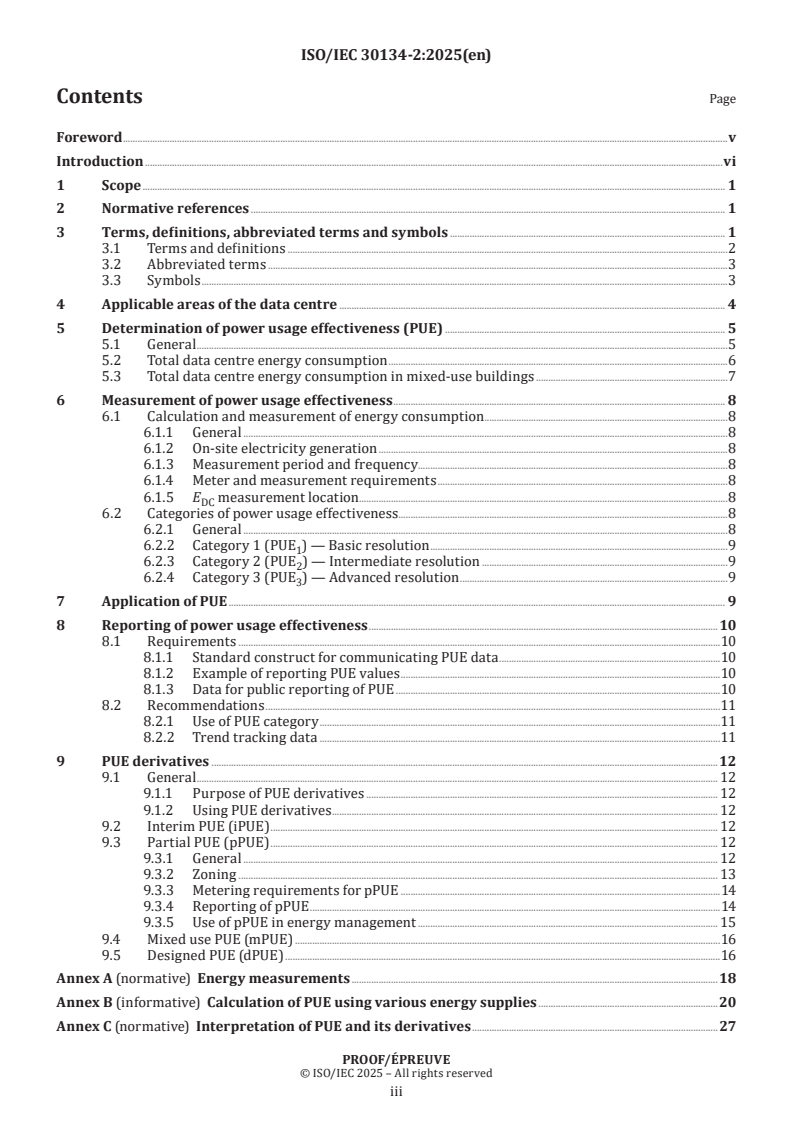
Contents Page
Foreword .v
Introduction .vi
1 Scope . 1
2 Normative references . 1
3 Terms, definitions, abbreviated terms and symbols . 1
3.1 Terms and definitions .2
3.2 Abbreviated terms .3
3.3 Symbols .3
4 Applicable areas of the data centre . 4
5 Determination of power usage effectiveness (PUE) . 5
5.1 General .5
5.2 Total data centre energy consumption .6
5.3 Total data centre energy consumption in mixed-use buildings .7
6 Measurement of power usage effectiveness . 8
6.1 Calculation and measurement of energy consumption .8
6.1.1 General .8
6.1.2 On-site electricity generation .8
6.1.3 Measurement period and frequency.8
6.1.4 Meter and measurement requirements .8
6.1.5 E measurement location.8
DC
6.2 Categories of power usage effectiveness.8
6.2.1 General .8
6.2.2 Category 1 (PUE ) — Basic resolution .9
6.2.3 Category 2 (PUE ) — Intermediate resolution .9
6.2.4 Category 3 (PUE ) — Advanced resolution .9
7 Application of PUE . 9
8 Reporting of power usage effectiveness . 10
8.1 Requirements .10
8.1.1 Standard construct for communicating PUE data .10
8.1.2 Example of reporting PUE values .10
8.1.3 Data for public reporting of PUE .10
8.2 Recommendations .11
8.2.1 Use of PUE category .11
8.2.2 Trend tracking data .11
9 PUE derivatives .12
9.1 General . 12
9.1.1 Purpose of PUE derivatives . 12
9.1.2 Using PUE derivatives . 12
9.2 Interim PUE (iPUE) . 12
9.3 Partial PUE (pPUE) . 12
9.3.1 General . 12
9.3.2 Zoning . 13
9.3.3 Metering requirements for pPUE .14
9.3.4 Reporting of pPUE .14
9.3.5 Use of pPUE in energy management . 15
9.4 Mixed use PUE (mPUE) .16
9.5 Designed PUE (dPUE) .16
Annex A (normative) Energy measurements .18
Annex B (informative) Calculation of PUE using various energy supplies .20
Annex C (normative) Interpretation of PUE and its derivatives .27
PROOF/ÉPREUVE
© ISO/IEC 2025 – All rights reserved
iii
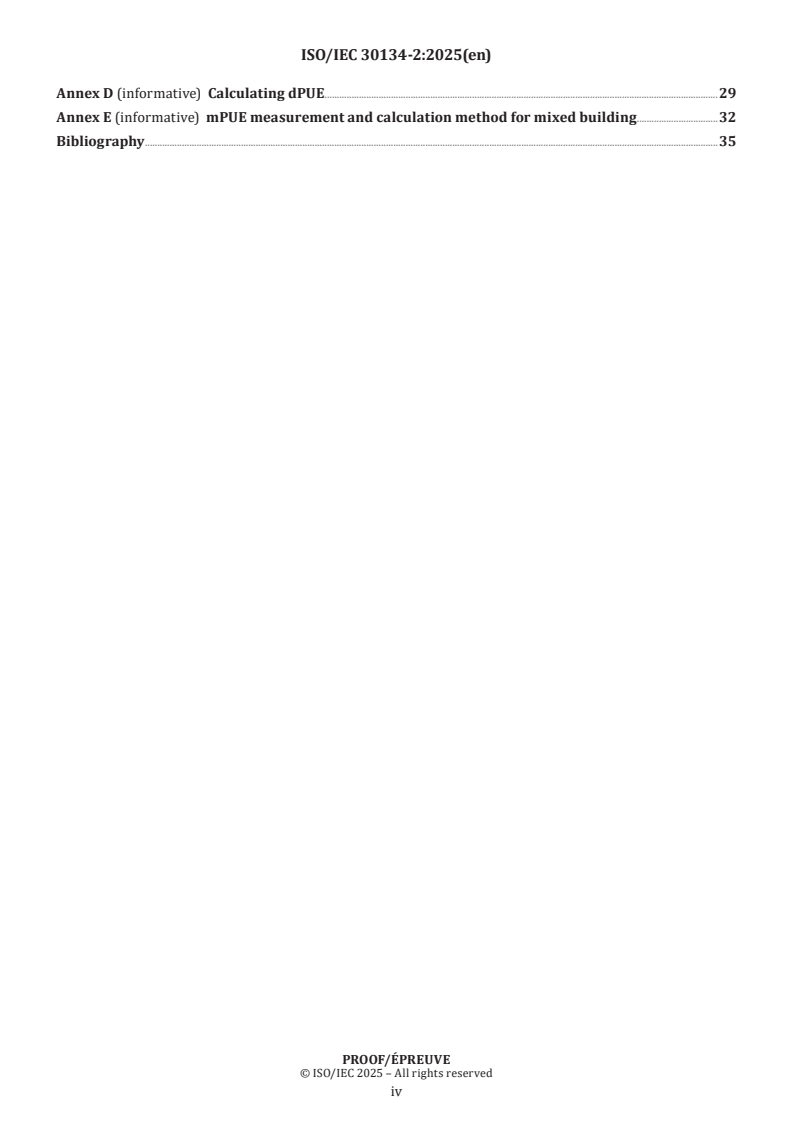
Annex D (informative) Calculating dPUE .29
Annex E (informative) mPUE measurement and calculation method for mixed building .32
Bibliography .35
PROOF/ÉPREUVE
© ISO/IEC 2025 – All rights reserved
iv
Foreword
ISO (the International Organization for Standardization) and IEC (the International Electrotechnical
Commission) form the specialized system for worldwide standardization. National bodies that are
members of ISO or IEC participate in the development of International Standards through technical
committees established by the respective organization to deal with particular fields of technical activity.
ISO and IEC technical committees collaborate in fields of mutual interest. Other international organizations,
governmental and non-governmental, in liaison with ISO and IEC, also take part in the work.
The procedures used to develop this document and those intended for its further maintenance are described
in the ISO/IEC Directives, Part 1. In particular, the different approval criteria needed for the different types
of document should be noted. This document was drafted in accordance with the editorial rules of the ISO/
IEC Directives, Part 2 (see www.iso.org/directives or www.iec.ch/members_experts/refdocs).
ISO and IEC draw attention to the possibility that the implementation of this document may involve the
use of (a) patent(s). ISO and IEC take no position concerning the evidence, validity or applicability of any
claimed patent rights in respect thereof. As of the date of publication of this document, ISO and IEC had not
received notice of (a) patent(s) which may be required to implement this document. However, implementers
are cautioned that this may not represent the latest information, which may be obtained from the patent
database available at www.iso.org/patents and https://patents.iec.ch. ISO and IEC shall not be held
responsible for identifying any or all such patent rights.
Any trade name used in this document is information given for the convenience of users and does not
constitute an endorsement.
For an explanation of the voluntary nature of standards, the meaning of ISO specific terms and expressions
related to conformity assessment, as well as information about ISO's adherence to the World Trade
Organization (WTO) principles in the Technical Barriers to Trade (TBT) see www.iso.org/iso/foreword.html.
In the IEC, see www.iec.ch/understanding-standards.
The document was prepared by Joint Technical Committee ISO/IEC JTC 1, Information technology,
Subcommittee SC 39, Sustainability, IT and data centres.
This second edition cancels and replaces the first edition (ISO/IEC 30134-2:2016), which has been technically
revised.
The main changes are as follows:
— required measurements at the data centre boundary have been updated;
— on-site electricity generation has been changed to be measured in kWh;
— 12 months recording and documentation of E and E has changed;
DC IT
— use of watt meters to measure E and E has changed;
DC IT
— requirement for electrical energy required to export other non-electric energy sources outside the
data centre boundary has been added;
— new requirement has been added for situations when EDC or EIT cannot be accounted for, or
measured, as specified;
— mixed use PUE (mPUE) derivative has been added for mixed use buildings;
— additional provisioning examples of calculating designed PUE (dPUE) have been added.
A list of all parts in the ISO/IEC 30134 series can be found on the ISO and IEC websites.
Any feedback or questions on this document should be directed to the user’s national standards
body. A complete listing of those bodies can be found at www.iso.org/members.html and
www.iec.ch/national-committees.
PROOF/ÉPREUVE
© ISO/IEC 2025 – All rights reserved
v
Introduction
The global economy is now reliant on information and communication technologies and the associated
generation, transmission, dissemination, computation and storage of digital data. All markets have
experienced exponential growth in digital data, for social, educational and business sectors. While the
internet backbone carries the traffic, there are a wide variety of data centres at nodes and hubs within both
private enterprise and shared/collocation facilities.
With many governments having “digital agendas” to provide both citizens and businesses with ever-faster
broadband access, the increase in network speed and capacity will, by itself, generate ever more usage
(Jevons Paradox). Data generation and the consequential increase in data manipulation and storage are
directly linked to increasing power consumption.
With this background, it is clear that data centre growth, and power consumption in particular, is an
inevitable consequence and that growth will demand increasing power consumption despite the most
stringent energy efficiency strategies. This makes the need for key performance indicators (KPIs) that
cover the effective use of resources (including but not limited to energy) and the reduction of CO emissions
essential.
Within the ISO/IEC 30134 series, the term “resource usage effectiveness” is more generally used for KPIs
in preference to “resource usage efficiency”, which is restricted to situations where the input and output
parameters used to define the KPI have the same units.
In order to determine the overall resource effectiveness or efficiency of a data centre, a holistic suite of
metrics is required. This document specifies power usage effectiveness (PUE), which has become a popular
metric to determine the efficient utilization and distribution of energy resources within a data centre.
NOTE 1 The term “efficiency” is employed for PUE but “effectiveness” provides continuity with earlier market
recognition of the term.
This document belongs to a series of standards for such KPIs and has been produced in accordance with
ISO/IEC 30134-1, which defines common requirements for a holistic suite of KPIs for data centre resource
usage effectiveness or efficiency.
The ISO/IEC 30134 series does not specify limits or targets for any KPI and does not describe or imply,
unless specifically stated, any form of aggregation of individual KPIs into a combined nor an overall KPI for
data centre resource usage effectiveness or efficiency.
NOTE 2 The PUE KPI was originally developed by The Green Grid.
PROOF/ÉPREUVE
© ISO/IEC 2025 – All rights reserved
vi
International Standard ISO/IEC 30134-2:2025(en)
Information technology — Data centres key performance
indicators —
Part 2:
Power usage effectiveness (PUE)
1 Scope
This document specifies power usage effectiveness (PUE) as a key performance indicator (KPI) to quantify
the efficient use of energy.
This document:
a) defines the PUE of a data centre;
b) introduces PUE measurement categories;
c) describes the relationship of this KPI to a data centre’s infrastructure, information technology
equipment and information technology operations;
d) defines the measurement, the calculation and the reporting of the parameter;
e) provides information on the correct interpretation of the PUE.
PUE derivatives are described in Clause 9.
2 Normative references
The following documents are referred to in the text in such a way that some or all of their content constitutes
requirements of this document. For dated references, only the edition cited applies. For undated references,
the latest edition of the referenced document (including any amendments) applies.
ISO/IEC 30134-1, Information technology — Data centres — Key performance indicators — Part 1: Overview
and general requirements
IEC 62052 (all parts), Electricity metering equipment (AC) — General requirements, tests and test conditions
IEC 62053 (all parts), Electricity metering equipment (a.c.) — Particular requirements
ISO 8601-1, Date and time — Representations for information interchange — Part 1: Basic rules
3 Terms, definitions, abbreviated terms and symbols
For the purposes of this document, the terms and definitions given in ISO/IEC 30134-1 and the following apply.
ISO and IEC maintain terminology databases for use in standardization at the following addresses:
— ISO Online browsing platform: available at https:// www .iso .org/ obp
— IEC Electropedia: available at https:// www .electropedia .org/
PROOF/ÉPREUVE
© ISO/IEC 2025 – All rights reserved
3.1 Terms and definitions
3.1.1
information technology equipment energy consumption
IT equipment energy consumption
energy consumed, measured in kilowatt-hour (kWh), by equipment that is used to store, process and
transport data within the computer room, telecommunication room and control room spaces (e.g.: servers,
data storage, network, communications and telecommunications equipment, to be referred as a single
definition “IT”, also referred to as “ICT” in the industry)
3.1.2
power usage effectiveness
PUE
calculated ratio of the data centre total energy consumption, within a 12-month continuous period, to
information technology equipment energy consumption measured across the same period
Note 1 to entry: Sometimes the inverse value of PUE, referred to as data centre infrastructure efficiency (DCiE), is used.
3.1.3
partial power usage effectiveness
pPUE
derivative of power usage effectiveness (PUE) (3.1.2), which is the ratio of the total energy consumption
within a defined boundary to the information technology equipment energy consumption within that same
boundary
3.1.4
primary distribution equipment
PDE
equipment which is required to manage, control and convert incoming power supplies (primary,
secondary and, where appropriate, additional) in a form suitable for distribution by secondary distribution
equipment(SDE) (3.1.8)
Note 1 to entry: See ISO/IEC 22237-3.
3.1.5
designed power usage effectiveness
dPUE
derivative of power usage effectiveness (PUE) (3.1.2), which is a projected PUE determined by the design
targets of the data centre
3.1.6
interim power usage effectiveness
iPUE
derivative of power usage effectiveness (PUE) (3.1.2), which is measured over a specified time other than a
continuous 12-month period
3.1.7
mixed use building power usage effectiveness
mPUE
derivative of power usage effectiveness (PUE) (3.1.2), which is the ratio of the total energy consumption of a
data centre within a mixed use building measured and calculated to the information technology equipment
energy consumption within that same data centre
3.1.8
secondary distribution equipment
SDE
equipment which is required to manage, control and distribute the power provided by the primary
distribution equipment to the short-break, protected and unprotected sockets within the data centre and to
the tertiary distribution equipment (3.1.9)
Note 1 to entry: See ISO/IEC 22237-3.
PROOF/ÉPREUVE
© ISO/IEC 2025 – All rights reserved
3.1.9
tertiary distribution equipment
power supply equipment, typically accommodated within the cabinets, frames and racks of the data centre
spaces, which directly feeds the protected sockets therein
Note 1 to entry: See ISO/IEC 22237-3.
3.2 Abbreviated terms
For the purposes of this document, the abbreviated terms given in ISO/IEC 30134-1 and the following apply:
dPUE designed power usage effectiveness
DCiE data centre infrastructure efficiency
DX direct expansion
ERF energy reuse factor
iPUE interim power usage effectiveness
IT information technology
KPI key performance indicator
kW kilowatt
kWh kilowatt-hour
KVM keyboard/video/mouse
PDE primary distribution equipment
PSU power supply unit
mPUE mixed use building power usage effectiveness
pPUE partial power usage effectiveness
PUE power usage effectiveness
r.m.s. root mean square
ROI return on investment
SDE secondary distribution equipment
UPS uninterruptible power system
3.3 Symbols
For the purposes of this document, the following symbols apply:
B data centre boundary
-1 -3
C volumetric specific heat capacity of fluid in J·K m
F
E total data centre energy consumption (continuous 12-month period) in kWh
DC
E total IT equipment energy consumption (continuous 12-month period) in kWh
IT
PROOF/ÉPREUVE
© ISO/IEC 2025 – All rights reserved
E other electrical energy consumption (continuous 12-month period) in kWh (e.g. cooling, air
O
handling, lighting and controllers)
E electrical kWh equivalent of fluid thermal kWh energy (Q ) measured by delta T, flow rate of
T T
fluid and volumetric heat capacity of the fluid type, multiplied by conversion factor
E energy usage of a sub-system (e.g. electrical, computer room cooling, heating-ventalation and
sub
air conditioning (HVAC))
E heat pump energy consumption
HP
M measurement point
Q thermal energy kWh of fluid measured by delta T and flow, multiplied by the volumetric heat
T
capacity of the fluid
S energy supplied by chilled fluid, hot water or steam, purchased from external source and sup-
CW
plied to the data centre
S energy usage supplied by the utility or vendor
E
S energy usage supplied by on-site backup generation (e.g. diesel generator, natural gas generator,
E,O
fuel cell, solar, wind)
T cold fluid, measured in °C or K
C
T hot fluid, measured in °C or K
H
U electrical energy measured in kWh at the boundary
E
V fluid volume in m
η power usage effectiveness
U,P
η interim power usage effectiveness
U,P,I
η designed power usage effectiveness
U,P,d
η partial power usage effectiveness
U,P,p
4 Applicable areas of the data centre
PUE as specified in this document:
— is associated with the data centre infrastructure within its boundaries only, the boundary of the
data centre aligns with industry standards (see ISO/IEC 22237-1:2021 Figure 3, ISO/IEC 30134-1,
ISO/IEC 30134-6), boundary conditions may be based on spatial and logical considerations or include
other parameters;;
— describes the infrastructure’s energy efficiency relative to facilities with given environmental conditions,
IT load characteristics, availability requirements, maintenance and security requirements;
— illustrates the energy allocation of a data centre.
When viewed in the proper context, PUE provides effective guidance and useful insight into the design and
efficiency of power and cooling architectures, the deployment of equipment within those architectures and
the operation of that equipment.
PUE provides a means to determine:
— opportunities for the improvement of the operational efficiency of a data centre;
PROOF/ÉPREUVE
© ISO/IEC 2025 – All rights reserved
— the improvement of the designs and processes of a data centre over time;
— a design target or goal for new data centres across the anticipated IT load range.
PUE does not take into account the:
— energy efficiency of the IT load, its utilization or productivity;
— efficiency of on-site electricity generation;
— efficiency of other resources such as human resource, space or water;
— use of renewable energy resources or accounts for re-use of waste by-products (such as heat).
PUE is not a:
— data centre productivity metric;
— standalone, comprehensive data centre resource efficiency metric.
Derivatives of PUE which are useful in certain circumstances are described in Clause 9.
PUE and PUE derivatives shall not be used to compare different data centres as there are many characteristics
or variables that effect PUE and PUE derivatives and can result in mis-leading comparisons. Some examples
of variables are:
— local weather conditions;
— IT equipment provisioning profile;
— IT equipment utilization;
— the level of data centre critical infrastructure redundancy or resiliency.
5 Determination of power usage effectiveness (PUE)
5.1 General
PUE, η , is defined using Formula (1):
U,P
E
DC
η = (1)
UP,
E
IT
where
E is the total data centre energy consumption (continuous 12-month period), in kWh;
DC
E is the total IT equipment energy consumption (continuous 12-month period), in kWh.
IT
By definition, the calculated PUE is always greater than 1.
E includes but is not limited to:
IT
— IT equipment (e.g. servers, data storage, network, communications and telecommunications);
— supplemental equipment (e.g. KVM switches, monitors and workstations/laptops used to either monitor,
manage or control the IT equipment within the data centre computer room, main distributor, intermediate
distributor or zone distributor space);
— equipment inside cabinets, frames and racks (e.g. tertiary distribution equipment, fans, pumps and
controllers).
PROOF/ÉPREUVE
© ISO/IEC 2025 – All rights reserved
E includes E plus all the energy that is consumed to support the following infrastructures:
DC IT
— electrical system energy losses (e.g. UPS systems, switchgear, transformers, generators, primary
distribution equipment, secondary distribution equipment, losses external to the IT equipment);
— cooling system (when electrical energy required to export other non-electric energy sources outside the
data centre boundary is included in E , energy reuse factor (ERF) shall be reported along with PUE (see
DC
ISO/IEC 30134-6);
— others (e.g. data centre lighting, elevator, security system and fire detection/suppression system);
— servers, data storage, network, communications and telecommunications equipment used solely for the
operations of facility infrastructure such as power, cooling and physical security systems;
— supplemental equipment (e.g. KVM switches, monitors and workstations/laptops used to either monitor,
manage or control the facility infrastructure such as power, cooling and physical security systems).
If on-site electricity generation or stored energy is exported outside the data centre boundary, the exported
electricity energy in kWh shall be measured and not included in E (see IEC TR 23050). On-site electricity
DC
generation or stored energy that is exported outside the data centre boundary, but not measured in kWh,
shall be included in E . Energy consumed by maintenance activities for on-site electricity generation shall
DC
be included in E .
DC
The electrical energy required to export other non-electric energy sources outside the data centre boundary
shall be included in E , and ERF shall be reported along with PUE (see ISO/IEC 30134-6).
DC
5.2 Total data centre energy consumption
The data centre under consideration shall be viewed as a system defined by boundaries through which
energy flows.
The following forms of energy shall be measured at the boundaries:
— electricity;
— fluids for cooling, hot water or steam (comprising either fluid or water, or both, usage when returned
fluid and not evaporated).
The following forms of energy are not required to be measured at these boundaries:
— air for cooling;
— water from natural sources (i.e. requiring no energy consumption in its provision);
— gaseous, fluid or solid fuel.
NOTE Effectiveness of onsite power generation is not included in the PUE metric.
If any of the required forms of energy are not accounted for at the boundaries, or for the on-site generation,
then E is not determined and PUE cannot be calculated. If E or E cannot be accounted for, or measured,
DC DC IT
as specified, the established values shall be reported as a PUE derivative.
All forms of electrical energy at boundaries, or on-site generation, shall be measured in kWh. All forms
of thermal energy from fluids at the boundaries, or on-site energy sources, shall be measured with heat
meters. For existing data centres, if no heat meter is available, the thermal energy can be calculated using
the volumetric heat capacity of the fluid type (C ) at the temperature of the place where the volume (V) is
F
measured, applying Formula (1) (see the EN 1434 series or ASTM E3137/E3137M-18).
For example, Formula (3) illustrates a data centre that receives chilled water from a district cooling system
and uses this to cool the primary load. The chilled water intake temperature is 288 K (15 °C) and the
water return temperature is 298 K (25 °C). The measured volume of chilled water use is 50 000 m at the
PROOF/ÉPREUVE
© ISO/IEC 2025 – All rights reserved
temperature of the place where the volume (V) is measured. The volumetric heat capacity of water at 298 K
3 3
(25 °C) is 4,186 MJ/(m K), which equates to 1,163 kWh/(m K).
QT=−()TV××C (2)
T HC F
Q =−298 288 ××50 000 1,k163 = 581500 Wh (3)
()
T
The contribution to E from fluids for cooling shall be calculated by multiplying the thermal energy Q
DC T
from these fluids with the relevant conversion factor X of the system used to provide the fluid used. The
conversion factor X represents electrical energy (kWh) per kWh thermal energy needed for the creation
(e.g. chiller, dry cooler) and distribution (e.g. pumps) of the thermal energy delivered. The conversion factor
X shall be obtained from the cooling supplier, using data from the same time period as the measured PUE
reporting.
For example, as illustrated in Formula (4), a district cooling supplier delivers 100 000 000 kWh/year thermal
energy through a chilled water loop to multiple consumers. In order to provide this cooling, the cooling
supplier uses 20 000 000 kWh electrical energy per year.
20 000000
X == 02, (4)
100 000000
If the conversion factor is not known, a conversion factor of 0,4 shall be used. Refer to Formula (5) for an
example of a data centre using thermal energy with X = 0,4. In Formula (5), U is electrical energy measured in
E
kWh at the boundary, or at the point of generation within the boundary. And Q multiplied by the conversion
T
factor 0,4 is the electrical equivalent of energy from fluids at the boundary, or on-site fluid energy sources.
Q is measured with heat meters measuring delta T and flow rate of fluid and volumetric heat capacity of the
T
fluid type, to provide the equivalent kWh.
E UQ+×04,
DC ET
η == (5)
UP,
E E
IT IT
Where heat pumps are inside the data centre boundary and used to enable reuse of energy outside the data
centre boundary, the electrical energy consumed by the heat pump is included in E (e.g. see Annex B).
DC
Data centres that provide outsourced network, processing or data storage services to external organizations
(e.g. colocation, hosting services, hyperscale or other data centre service provider) shall include in E all
DC
electrical and thermal energy associated with spaces that are necessary for the operation of the data centre
(e.g. operations control room, site engineering offices, site facility management offices, site security offices,
shipping/receiving, security/reception). This can include tenant ancillary spaces (e.g. offices) necessary
for the operation of the tenant’s IT services. Colocation data centres shall not reduce E values associated
DC
with common spaces shared among tenants (e.g. conference rooms, corridors, tenant office space, shipping/
receiving). Enterprise data centres shall include all electrical and thermal energy for all spaces supporting
the data centre operations (e.g. this can include office space, conference rooms, shipping/receiving).
5.3 Total data centre energy consumption in mixed-use buildings
A mixed-use building is a building that houses a data centre along with spaces and equipment that have no
functional connection to the operations of the data centre.
The total data centre energy consumption for data centres in mixed-used buildings shall be calculated on
the energy use of the data centre only if metering of all shared technical subsystems allows separation of
energy usage.
If energy use of shared systems cannot be measured separately, E cannot be measured and PUE cannot be
DC
calculated. However, pPUE (see 9.3) or mPUE (see 9.4 and Annex E) can be calculated. See ISO/IEC 30134-7
for an example of separation of energy use of shared cooling systems.
PROOF/ÉPREUVE
© ISO/IEC 2025 – All rights reserved
6 Measurement of power usage effectiveness
6.1 Calculation and measurement of energy consumption
6.1.1 General
In order to calculate PUE, it is necessary to measure E and E . This is not a trivial task, especially within
DC IT
existing data centres which can require the installation of instrumentation to collect the data.
Additional monitoring data of logical subsets is necessary to assess areas for potential improvements and
to evaluate the resulting improvements to PUE across the data centre. The PUE derivatives are helpful to
assess logical subsets (see Clause 9).
6.1.2 On-site electricity generation
PUE and PUE derivatives shall include kWh provided from on-site electricity generation. The contribution of
on-site generation shall be the measured output in kWh of the on-site generation.
6.1.3 Measurement period and frequency
The calculation of PUE requires the recording and documenting of E and E over a coincident period of
DC IT
12 months. The recording and documentation of E and E should be reported at least each month based
DC IT
on a 12-month rolling period.
6.1.4 Meter and measurement requirements
Measurement of E and E shall be undertaken using either:
DC IT
— kWh meters that report the actual energy usage (true r.m.s.), through the simultaneous measurement of
the voltage, current and power factor over time; or
— in the case of fluid energy, heat meters measuring delta T and flow rate of fluid and volumetric heat
capacity of the fluid type, to provide the equivalent kWh.
Wh meters shall comply with the IEC 62052 and IEC 62053 series and shall meet accuracy-class 2 or better,
accuracy-class 1 is recommended (see ISO/IEC 22237-3:2021, Clause 8).
For new builds, modernization or upgraded data centres, kWh meters shall be used. For existing data centres
that do not have kWh meters, the equivalent energy consumption may be captured using kW meters only if
the power measurements are automated and logged at intervals not to exceed 5 min. If kW meters are used,
the PUE value shall be reported as PUE
1.
6.1.5 E measurement location
DC
The utility meter is the typical location for measuring the E . For mixed use building, refer to 5.3, 9.3.6 and
DC
Annex E.
6.2 Categories of power usage effectiveness
6.2.1 General
Three categories of PUE are defined as:
— Category 1 (PUE ) — provides a basic level of resolution of energy performance data;
— Category 2 (PUE ) — provides an intermediate level of resolution of energy performance data;
— Category 3 (PUE ) — provides an advanced level of resolution of energy performance data.
PROOF/ÉPREUVE
© ISO/IEC 2025 – All rights reserved
The higher categories provide progressively:
— more granular and accurate measurements of IT energy usage (as the measurements are made closer to
the devices that consume the energy);
— greater insight for energy efficiency improvements.
Table 1 provides a summary of the locations for the measurement of IT equipment energy consumption
associated with each category. In all cases, the total data centre energy consumption measures the electrical
and mechanical equipment used to power, cool and condition the data centre. Per ISO/IEC 22237-3, the
locations where measurement is relevant are defined by the granularity level adopted for the data centre to
support the energy efficiency enablement objectives of ISO/IEC 22237-1.
To properly assess PUE, it is required to account for all systems that support the data centre, in addition to
the environmental conditions, reliability, security and availability requirements independent of which PUE
measurement category is chosen (see ISO/IEC 30134-1:2016, Annex A).
Table 1 — PUE categories
PUE PUE PUE
1 2 3
Location of IT equipment energy con- UPS output or
IT equipment
b
sumption measurement direct current SDE output
c
input
a
supply
d
Granularity level of measurement Level 1 Level 2 Level 3
a
E includes all the losses of PUE plus the effects of losses associated with electrical distribution components
IT 2
and non-IT related equipment between the UPS and SDE.
b
E includes the effects of losses associated with electrical distribution components and non-IT related
IT
equipment fed from the SDE.
c
E includes only IT energy and excludes all other losses.
IT
d
See ISO/IEC 22237-3:2021, 8.1.
6.2.2 Category 1 (PUE ) — Basic resolution
The IT load is measured at the output of the UPS (or equivalent) equipment and may be read
— from the UPS front panel;
— through a meter on the UPS output;
— in cases of multiple UPS modules, through a single meter on the common UPS output bus.
6.2.3 Category 2 (PUE ) — Intermediate resolution
The IT load is measured at the output of the SDEs within the data centre and is typically read from a meter
on the SDE output (with or without transformer, the measurement point is then after the transformer).
6.2.4 Category 3 (PUE ) — Advanced resolution
The IT load is measured at the IT equipment within the data centre. This can be achieved either by meters
within the rack (e.g. plug strips) that monitors aggregate set of IT systems or at the receptacle level or by the
IT device itself. Non-IT loads shall be excluded from these measurements.
7 Application of PUE
PUE can be used by data centre managers to monitor and report total energy consumption related to IT
energy consumption in the data centre. PUE derivatives shall be interpreted in accordance with Annex C.
PROOF/ÉPREUVE
© ISO/IEC 2025 – All rights reserved
This KPI can be used independently, but to obtain a more holistic picture of the resource effectiveness of the
data centre, oter KPIs of the ISO/IEC 30134 series should be considered. Where other ISO/IEC 30134 KPI’s
are reported, the corresponding PUE value should also be reported.
The inverse of PUE is also used to express the data centre infrastructure efficiency (DCiE). A benefit of
reporting DCiE is the resulting value will be between 0 and 1, and can be expressed as a percentage.
8 Reporting of power usage effectiveness
8.1 Requirements
8.1.1 Standard construct for communicating PUE data
In order for a reported PUE to be meaningful, the reporting organization shall provide the following
information:
— data centre (including its boundaries) under inspection;
— PUE value;
— category;
— the termination date of the period of measurement using the format of ISO 8601-1 (e.g. yyyy-mm-dd).
The PUE category shall be provided as a subscript to the name of the metric, e.g. PUE for a Category 2 value.
8.1.2 Example of reporting PUE values
Using the construct of 8.1.1, Table 2 provides examples of specific PUE designations and their interpretation.
PUE reporting shall be rounded to at least the 1/100th value using the half rounding up method.
Table 2 — Examples of PUE reporting
Example PUE designations Interpretation
Data centre X, PUE (2012–12–31) = 2,25 In 2012, the PUE value of data centre X was 2,25. It was a Category 1
PUE.
Data centre Y, PUE (2013–06–30) = 1,75 In the period 2012–07–01 to 2013–06–30, the PUE value of data
centre Y was 1,75. It was a Category 1 PUE.
Data centre Z, PUE (2013–12–31) = 1,50 In 2013, the PUE value of data centre Z was 1,50. It was a Category 2
PUE.
8.1.3 Data for public reporting of PUE
8.1.3.1 Required information
The following data shall be provided when publicly reporting PUE data:
— contact information (at least the organization’s name).
Only the organization’s name or contact shall be displayed in public inquiries.
— data centre location information (at least the country or region).
Measurement results: PUE with appropriate nomenclature including category designation.
PROOF/ÉPREUVE
© ISO/IEC 2025 – All rights reserved
8.1.3.2 Supporting evidence (where required by authorities having jurisdiction)
Information on the data centre which shall be available upon request as a minimum includes:
— the organization’s name, contact information and regional environmental description;
— the measurement results: PUE with appropriate nomenclature;
— E value and E value;
DC IT
— start and measurement(s) dates the assessments were completed;
— the accuracy level (the IEC 62052 series and the IEC 62053 series provide a reference for measurement
of electrical energy);
— report on the size of computer room, entrance room for telecommunications provided equipment and
control room spaces;
— external environmental conditions consisting of altitude, and minimum, maximum and average
temperature and humidity during the reporting period.
8.2 Recommendations
8.2.1 Use of PUE category
The PUE granularity level should be appropriate to the function of the data centre. Reporting of PUE values
of 1,15 or lower should be measured as dictated for PUE Granularity Level 2 or PUE Granularity Level 3.
2 3
— Granularity level 1 or better for existing data centres;
— Granularity level 2 or better for new builds, modernization
...
ISO/IEC DIS 30134-2:2025(en)
ISO/IEC JTC 1/SC ISO/IEC PRF 30134-2
ISO/IEC JTC 1/SC 39
Secretariat: ANSI
Date: 2025-06-2311-03
Information technology — Data centres key performance indicators
— —
Part 2:
Power usage effectiveness (PUE)
FDIS stage
ISO/IEC PRF 30134-2:20xx2025(en)
© ISO/IEC 2025
All rights reserved. Unless otherwise specified, or required in the context of its implementation, no part of this publication
may be reproduced or utilized otherwise in any form or by any means, electronic or mechanical, including photocopying,
or posting on the internet or an intranet, without prior written permission. Permission can be requested from either ISO
at the address below or ISO’s member body in the country of the requester.
ISO copyright office
CP 401 • Ch. de Blandonnet 8
CH-1214 Vernier, Geneva
Phone: + 41 22 749 01 11
EmailE-mail: copyright@iso.org
Website: www.iso.org
Published in Switzerland
© ISO/IEC 2025 – All rights reserved
ii
ISO/IEC DISPRF 30134-2:2025(en)
Contents Page
Foreword . iv
Introduction . vi
1 Scope . 1
2 Normative references . 1
3 Terms, definitions, abbreviated terms and symbols . 1
3.1 Terms and definitions . 2
3.2 Abbreviated terms . 3
3.3 Symbols . 3
4 Applicable areas of the data centre . 4
5 Determination of power usage effectiveness (PUE) . 5
5.1 General . 5
5.2 Total data centre energy consumption . 6
5.3 Total data centre energy consumption in mixed-use buildings . 8
6 Measurement of power usage effectiveness . 8
6.1 Calculation and measurement of energy consumption . 8
6.2 Categories of power usage effectiveness . 9
7 Application of PUE . 10
8 Reporting of power usage effectiveness . 10
8.1 Requirements . 10
8.2 Recommendations . 12
9 PUE derivatives . 12
9.1 General . 12
9.2 Interim PUE (iPUE) . 13
9.3 Partial PUE (pPUE) . 13
9.4 Mixed use PUE (mPUE). 19
9.5 Designed PUE (dPUE) . 19
Annex A (normative) Energy measurements . 21
Annex B (informative) Calculation of PUE using various energy supplies . 24
Annex C (normative) Interpretation of PUE and its derivatives . 34
Annex D (informative) Calculating dPUE . 36
Annex E (informative) mPUE measurement and calculation method for mixed building . 40
Bibliography . 44
© ISO/IEC 2025 – All rights reserved
iii
ISO/IEC PRF 30134-2:20xx2025(en)
Foreword
ISO (the International Organization for Standardization) and IEC (the International Electrotechnical
Commission) form the specialized system for worldwide standardization. National bodies that are members
of ISO or IEC participate in the development of International Standards through technical committees
established by the respective organization to deal with particular fields of technical activity. ISO and IEC
technical committees collaborate in fields of mutual interest. Other international organizations, governmental
and non-governmental, in liaison with ISO and IEC, also take part in the work.
The procedures used to develop this document and those intended for its further maintenance are described
in the ISO/IEC Directives, Part 1. In particular, the different approval criteria needed for the different types of
document should be noted. This document was drafted in accordance with the editorial rules of the ISO/IEC
Directives, Part 2 (see www.iso.org/directives or www.iec.ch/members_experts/refdocs).
ISO and IEC draw attention to the possibility that the implementation of this document may involve the use of
(a) patent(s). ISO and IEC take no position concerning the evidence, validity or applicability of any claimed
patent rights in respect thereof. As of the date of publication of this document, ISO and IEC had not received
notice of (a) patent(s) which may be required to implement this document. However, implementers are
cautioned that this may not represent the latest information, which may be obtained from the patent database
available at www.iso.org/patents and https://patents.iec.ch. ISO and IEC shall not be held responsible for
identifying any or all such patent rights.
Any trade name used in this document is information given for the convenience of users and does not
constitute an endorsement.
For an explanation of the voluntary nature of standards, the meaning of ISO specific terms and expressions
related to conformity assessment, as well as information about ISO's adherence to the World Trade
Organization (WTO) principles in the Technical Barriers to Trade (TBT) see www.iso.org/iso/foreword.html.
In the IEC, see www.iec.ch/understanding-standards.
The document was prepared by Joint Technical Committee ISO/IEC JTC 1, Information technology,
Subcommittee SC 39, Sustainability, IT and data centres.
This second edition cancels and replaces the first edition (ISO/IEC 30134-2:2016), which has been technically
revised.
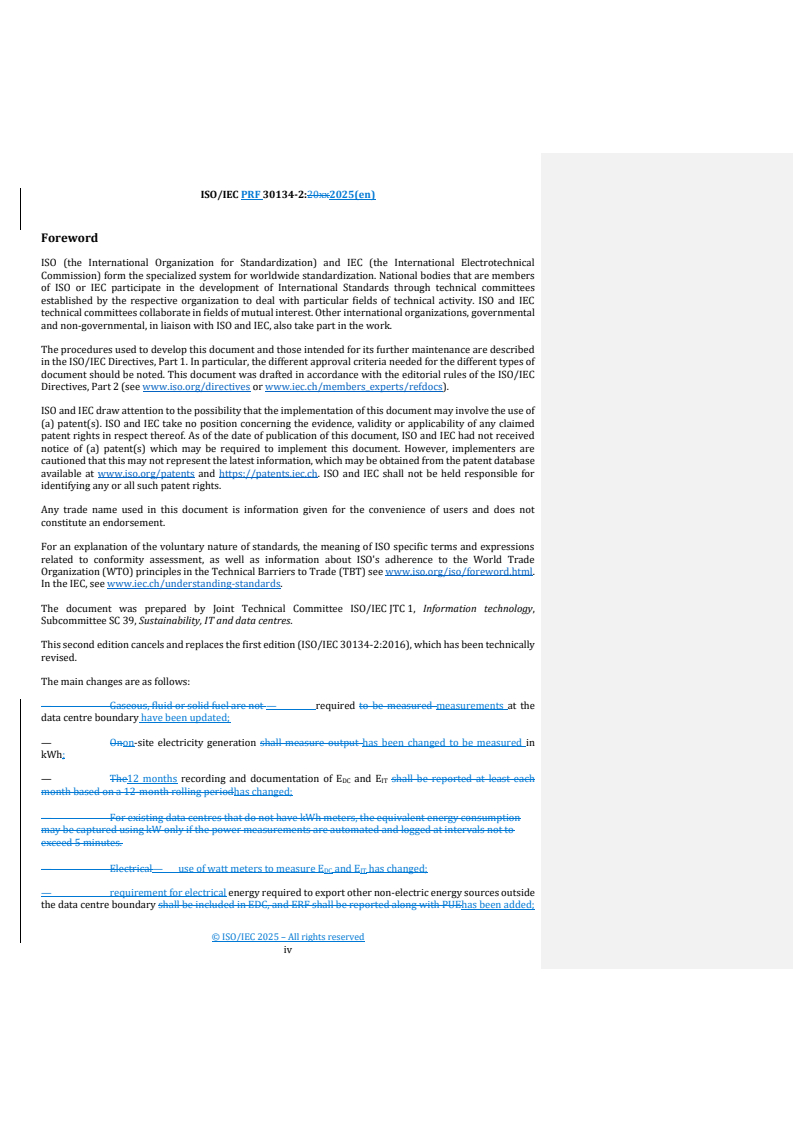
The main changes are as follows:
— Gaseous, fluid or solid fuel are not — required to be measured measurements at the
data centre boundary have been updated;
— Onon-site electricity generation shall measure output has been changed to be measured in
kWh;
— The12 months recording and documentation of E and E shall be reported at least each
DC IT
month based on a 12-month rolling periodhas changed;
— For existing data centres that do not have kWh meters, the equivalent energy consumption
may be captured using kW only if the power measurements are automated and logged at intervals not to
exceed 5 minutes.
— Electrical— use of watt meters to measure EDC and EIT has changed;
— requirement for electrical energy required to export other non-electric energy sources outside
the data centre boundary shall be included in EDC, and ERF shall be reported along with PUEhas been added;
© ISO/IEC 2025 – All rights reserved
iv
ISO/IEC DISPRF 30134-2:2025(en)
— Ifnew requirement has been added for situations when EDC or EIT cannot be accounted for, or
measured, as specified, the established values shall be reported as a PUE derivative.;
— Mixedmixed use PUE (mPUE) derivative has been added for mixed use buildings;
— Additionaladditional provisioning examples of calculating designed PUE (dPUE) arehave been
added.
A list of all parts in the ISO/IEC 30134 series can be found on the ISO and IEC websites.
Any feedback or questions on this document should be directed to the user’s national standards body. A
complete listing of those bodies can be found at www.iso.org/members.html and www.iec.ch/national-
committees.
© ISO/IEC 2025 – All rights reserved
v
ISO/IEC PRF 30134-2:20xx2025(en)
Introduction
The global economy is now reliant on information and communication technologies and the associated
generation, transmission, dissemination, computation and storage of digital data. All markets have
experienced exponential growth in digital data, for social, educational and business sectors. While the internet
backbone carries the traffic, there are a wide variety of data centres at nodes and hubs within both private
enterprise and shared/collocation facilities.
With many governments having “digital agendas” to provide both citizens and businesses with ever-faster
broadband access, the increase in network speed and capacity will, by itself, generate ever more usage (Jevons
Paradox). Data generation and the consequential increase in data manipulation and storage are directly linked
to increasing power consumption.
With this background, it is clear that data centre growth, and power consumption in particular, is an inevitable
consequence and that growth will demand increasing power consumption despite the most stringent energy
efficiency strategies. This makes the need for key performance indicators (KPIs) that cover the effective use
of resources (including but not limited to energy) and the reduction of CO2 emissions essential.
Within the ISO/IEC 30134 series, the term “resource usage effectiveness” is more generally used for KPIs in
preference to “resource usage efficiency”, which is restricted to situations where the input and output
parameters used to define the KPI have the same units.
In order to determine the overall resource effectiveness or efficiency of a data centre, a holistic suite of metrics
is required. This document specifies power usage effectiveness (PUE), which has become a popular metric to
determine the efficient utilization and distribution of energy resources within a data centre.
NOTE 1 The term “efficiency” is employed for PUE but “effectiveness” provides continuity with earlier market
recognition of the term.
This document belongs to a series of standards for such KPIs and has been produced in accordance with
ISO/IEC 30134--1, which defines common requirements for a holistic suite of KPIs for data centre resource
usage effectiveness or efficiency.
The ISO/IEC 30134 series does not specify limits or targets for any KPI and does not describe or imply, unless
specifically stated, any form of aggregation of individual KPIs into a combined nor an overall KPI for data
centre resource usage effectiveness or efficiency.
NOTE 2 The PUE KPI was originally developed by The Green Grid.
© ISO/IEC 2025 – All rights reserved
vi
DRAFT International Standard ISO/IEC DIS 30134-2:2025(en)_
Information technology — Data centres key performance
indicators —
Part 2:
Power usage effectiveness (PUE)
1 Scope
This document specifies power usage effectiveness (PUE) as a key performance indicator (KPI) to quantify the
efficient use of energy.
This document:
a) a) defines the PUE of a data centre;
b) b) introduces PUE measurement categories;
c) c) describes the relationship of this KPI to a data centre’s infrastructure, information technology
equipment and information technology operations;
d) d) defines the measurement, the calculation and the reporting of the parameter;
e) e) provides information on the correct interpretation of the PUE.
PUE derivatives are described in 9Clause 9.
2 Normative references
The following documents are referred to in the text in such a way that some or all of their content constitutes
requirements of this document. For dated references, only the edition cited applies. For undated references,
the latest edition of the referenced document (including any amendments) applies.
ISO/IEC 30134--1, Information technology — Data centres — Key performance indicators — Part 1: Overview
and general requirements
IEC 62052 (seriesall parts), Electricity metering equipment (AC) — General requirements, tests and test
conditions
IEC 62053 (seriesall parts), Electricity metering equipment (a.c.) — Particular requirements
ISO 8601-1, Date and time — Representations for information interchange — Part 1: Basic rules
3 Terms, definitions, abbreviated terms and symbols
For the purposes of this document, the terms and definitions given in ISO/IEC 30134--1 and the following
apply.
ISO and IEC maintain terminology databases for use in standardization at the following addresses:
© ISO/IEC 2025 – All rights reserved
ISO/IEC PRF 30134-2:20xx2025(en)
— — ISO Online browsing platform: available at https://www.iso.org/obp
— — IEC Electropedia: available at https://www.electropedia.org/
3.1 Terms and definitions
3.1.1 3.1.1
information technology equipment energy consumption
IT equipment energy consumption
energy consumed, measured in kilowatt-hour (kWh), by equipment that is used to store, process and transport
data within the computer room, telecommunication room and control room spaces (e.g.: servers, data storage,
network, communications and telecommunications equipment, to be referred as a single definition “IT”, also
referred to as “ICT” in the industry)
3.1.2 3.1.2
power usage effectiveness
PUE
calculated ratio of the data centre total energy consumption, within a 12-month continuous period, to
information technology equipment energy consumption measured across the same period
Note 1 to entry: Sometimes the inverse value of PUE, referred to as data centre infrastructure efficiency (DCiE), is used.
3.1.3 3.1.3
partial power usage effectiveness
pPUE
derivative of power usage effectiveness (PUE) (Error! Reference source not found.(3.1.2),), which is the ratio
of the total energy consumption within a defined boundary to the information technology equipment energy
consumption within that same boundary
3.1.4 3.1.4
primary distribution equipment
PDE
equipment which is required to manage, control and convert incoming power supplies (primary, secondary
and, where appropriate, additional) in a form suitable for distribution by secondary distribution
equipment(SDE) (Error! Reference source not found.(3.1.8))
Note 1 to entry: See ISO/IEC 22237-3.
3.1.5 3.1.5
designed power usage effectiveness
dPUE
derivative of power usage effectiveness (PUE) (Error! Reference source not found.(3.1.2),), which is a
projected PUE determined by the design targets of the data centre
3.1.6 3.1.6
interim power usage effectiveness
iPUE
derivative of power usage effectiveness (PUE) (Error! Reference source not found.(3.1.2),), which is
measured over a specified time other than a continuous 12-month period
3.1.7 3.1.7
mixed use building power usage effectiveness
mPUE
derivative of power usage effectiveness (PUE) (Error! Reference source not found.(3.1.2),), which is the ratio
of the total energy consumption of a data centre within a mixed use building measured and calculated to the
information technology equipment energy consumption within that same data centre
© ISO/IEC 2025 – All rights reserved
ISO/IEC DISPRF 30134-2:2025(en)
3.1.8 3.1.9
secondary distribution equipment
SDE
equipment which is required to manage, control and distribute the power provided by the primary
distribution equipment to the short-break, protected and unprotected sockets within the data centre and to
the tertiary distribution equipment (Error! Reference source not found.(3.1.10))
Note 1 to entry: See ISO/IEC 22237-3.
3.1.9 3.1.10
tertiary distribution equipment
power supply equipment, typically accommodated within the cabinets, frames and racks of the data centre
spaces, which directly feeds the protected sockets therein
Note 1 to entry: See ISO/IEC 22237-3.
3.2 Abbreviated terms
For the purposes of this document, the abbreviated terms given in ISO/IEC 30134--1 and the following apply:
BMS building management system
dPUE designed power usage effectiveness
DCiE data centre infrastructure efficiency
DX direct expansion
ERF energy reuse factor
iPUE interim power usage effectiveness
IT information technology
KPI key performance indicator
kW kilowatt
kWh kilowatt-hour
KVM keyboard/video/mouse
PDE primary distribution equipment
PSU power supply unit
mPUE mixed use building power usage effectiveness
pPUE partial power usage effectiveness
PUE power usage effectiveness
r.m.s. root mean square
ROI return on investment
SDE secondary distribution equipment
UPS uninterruptible power system
3.3 Symbols
For the purposes of this document, the following symbols apply:
© ISO/IEC 2025 – All rights reserved
ISO/IEC PRF 30134-2:20xx2025(en)
B data centre boundary
-1 -3
C volumetric specific heat capacity of fluid in J·K m
F
E total data centre energy consumption (continuous 12-month period) in kWh
DC
E total IT equipment energy consumption (continuous 12-month period) in kWh
IT
EO other electrical energy consumption (continuous 12-month period) in kWh (e.g. cooling, air
handling, lighting and controllers)
E electrical kWh equivalent of fluid thermal kWh energy (Q ) measured by delta T, flow rate of
T T
fluid and volumetric heat capacity of the fluid type, multiplied by conversion factor
E energy usage of a sub-system (e.g. electrical, computer room cooling, heating-ventalation and
sub
air conditioning (HVAC))
E heat pump energy consumption
HP
M measurement point
Q thermal energy kWh of fluid measured by delta T and flow, multiplied by the volumetric heat
T
capacity of the fluid
SCW energy supplied by chilled fluid, hot water or steam, purchased from external source and
supplied to the data centre
SE energy usage supplied by the utility or vendor
S energy usage supplied by on-site backup generation (e.g. diesel generator, natural gas
E,O
generator, fuel cell, solar, wind)
TC cold fluid, measured in °C or K
T hot fluid, measured in °C or K
H
U electrical energy measured in kWh at the boundary
E
V fluid volume in m
η power usage effectiveness
U,P
η interim power usage effectiveness
U,P,I
η designed power usage effectiveness
U,P,d
ηU,P,p partial power usage effectiveness
4 Applicable areas of the data centre
PUE as specified in this document:
— — is associated with the data centre infrastructure within its boundaries only, the boundary of the data
centre aligns with industry standards (see ISO/IEC 22237-1:2021 Figure 3, ISO/IEC 30134-1, ISO/IEC
30134-6), boundary conditions may be based on spatial and logical considerations or include other
parameters;;
— — describes the infrastructure’s energy efficiency relative to facilities with given environmental
conditions, IT load characteristics, availability requirements, maintenance and security requirements;
— — illustrates the energy allocation of a data centre.
When viewed in the proper context, PUE provides effective guidance and useful insight into the design and
efficiency of power and cooling architectures, the deployment of equipment within those architectures and
the operation of that equipment.
© ISO/IEC 2025 – All rights reserved
ISO/IEC DISPRF 30134-2:2025(en)
PUE provides a means to determine:
— — opportunities for the improvement of the operational efficiency of a data centre;
— — the improvement of the designs and processes of a data centre over time;
— — a design target or goal for new data centres across the anticipated IT load range.
PUE does not take into account the:
— — energy efficiency of the IT load, its utilization or productivity;
— — efficiency of on-site electricity generation;
— — efficiency of other resources such as human resource, space or water;
— — use of renewable energy resources or accounts for re-use of waste by-products (such as heat).
PUE is not a:
— — data centre productivity metric;
— — standalone, comprehensive data centre resource efficiency metric.
Derivatives of PUE which are useful in certain circumstances are described in 9Clause 9.
PUE and PUE derivatives shall not be used to compare different data centres as there are many characteristics
or variables that effect PUE and PUE derivatives and can result in mis-leading comparisons. Some examples of
variables are:
— — local weather conditions;
— — IT equipment provisioning profile;
— — IT equipment utilization;
— — the level of data centre critical infrastructure redundancy or resiliency.
5 Determination of power usage effectiveness (PUE)
5.1 General
PUE, η , is defined using 0Formula (1)::
U,P
𝐸
DC
𝜂 = (1)
U,P
𝐸
IT
where
E is the total data centre energy consumption (continuous 12-month period), in kWh;
DC
E is the total IT equipment energy consumption (continuous 12-month period), in kWh.
IT
EDC is the total data centre energy consumption (continuous 12-month period), in kWh;
E is the total IT equipment energy consumption (continuous 12-month period), in kWh.
IT
By definition, the calculated PUE is always greater than 1.
© ISO/IEC 2025 – All rights reserved
ISO/IEC PRF 30134-2:20xx2025(en)
EIT includes but is not limited to:
— — IT equipment (e.g. servers, data storage, network, communications and telecommunications);
— — supplemental equipment (e.g. KVM switches, monitors and workstations/laptops used to either
monitor, manage or control the IT equipment within the data centre computer room, main distributor,
intermediate distributor or zone distributor space);
— — equipment inside cabinets, frames and racks (e.g. tertiary distribution equipment, fans, pumps and
controllers).
E includes E plus all the energy that is consumed to support the following infrastructures:
DC IT
— — electrical system energy losses (e.g. UPS systems, switchgear, transformers, generators, primary
distribution equipment, secondary distribution equipment, losses external to the IT equipment);
— — cooling system (when electrical energy required to export other non-electric energy sources outside
the data centre boundary is included in E , energy reuse factor (ERF) shall be reported along with PUE
DC
(see ISO/IEC 30134-6);
— — others (e.g. data centre lighting, elevator, security system and fire detection/suppression system);
— — servers, data storage, network, communications and telecommunications equipment used solely for
the operations of facility infrastructure such as power, cooling and physical security systems;
— — supplemental equipment (e.g. KVM switches, monitors and workstations/laptops used to either
monitor, manage or control the facility infrastructure such as power, cooling and physical security
systems).
If on-site electricity generation or stored energy is exported outside the data centre boundary, the exported
electricity energy in kWh shall be measured and not included in E (see IEC TR 23050). On-site electricity
DC
generation or stored energy that is exported outside the data centre boundary, but not measured in kWh, shall
be included in E . Energy consumed by maintenance activities for on-site electricity generation shall be
DC
included in E .
DC
The electrical energy required to export other non-electric energy sources outside the data centre boundary
shall be included in E , and ERF shall be reported along with PUE (see ISO/IEC 30134-6).
DC
5.2 Total data centre energy consumption
The data centre under consideration shall be viewed as a system defined by boundaries through which energy
flows.
The following forms of energy shall be measured at the boundaries:
— — electricity;
— — fluids for cooling, hot water or steam (comprising either fluid or water, or both, usage when returned
fluid and not evaporated).
The following forms of energy are not required to be measured at these boundaries:
— — air for cooling;
— — water from natural sources (i.e. requiring no energy consumption in its provision);
© ISO/IEC 2025 – All rights reserved
ISO/IEC DISPRF 30134-2:2025(en)
— — gaseous, fluid or solid fuel.
NOTE Effectiveness of onsite power generation is not included in the PUE metric.
If any of the required forms of energy are not accounted for at the boundaries, or for the on-site generation,
then EDC is not determined and PUE cannot be calculated. If EDC or EIT cannot be accounted for, or measured,
as specified, the established values shall be reported as a PUE derivative.
All forms of electrical energy at boundaries, or on-site generation, shall be measured in kWh. All forms of
thermal energy from fluids at the boundaries, or on-site energy sources, shall be measured with heat meters.
For existing data centres, if no heat meter is available, the thermal energy can be calculated using the
volumetric heat capacity of the fluid type (C ) at the temperature of the place where the volume (V) is
F
measured, applying 0Formula (1) (see the EN 1434 series or ASTM E3137/E3137M-18).
For example, 0Formula (3) illustrates a data centre that receives chilled water from a district cooling system
and uses this to cool the primary load. The chilled water intake temperature is 288 K (15 °C) and the water
return temperature is 298 K (25 °C). The measured volume of chilled water use is 50 000 m at the
temperature of the place where the volume (V) is measured. The volumetric heat capacity of water at 298 K
3 3
(25 °C) is 4,186 MJ/(m K), which equates to 1,163 kWh/(m K).
𝑄 = 𝑇 − 𝑇 ×= (𝑇 − 𝑇 ) × 𝑉 × 𝐶 (2)
( )
𝑇 H C H C FF
𝑄 = (298 − 288) × 50 000 = (298 − 288) × 50000 × 1,163 = 581 500 kWh 581500kWh (3)
𝑇
The contribution to E from fluids for cooling shall be calculated by multiplying the thermal energy Q from
DC T
these fluids with the relevant conversion factor X of the system used to provide the fluid used. The conversion
factor X represents electrical energy (kWh) per kWh thermal energy needed for the creation (e.g. chiller, dry
cooler) and distribution (e.g. pumps) of the thermal energy delivered. The conversion factor X shall be
obtained from the cooling supplier, using data from the same time period as the measured PUE reporting.
For example, as illustrated in 0Formula (4),, a district cooling supplier delivers 100 000 000 kWh/year
thermal energy through a chilled water loop to multiple consumers. In order to provide this cooling, the
cooling supplier uses 20 000 000 kWh electrical energy per year.
20 000 000 20000000
𝑋 = = 0,2 (4)
100 000 000 100000000
If the conversion factor is not known, a conversion factor of 0,4 shall be used. Refer to 0Formula (5) for an
example of a data centre using thermal energy with X = 0,4. In 0Formula (5),, U is electrical energy measured
E
in kWh at the boundary, or at the point of generation within the boundary. And Q multiplied by the conversion
T
factor 0,4 is the electrical equivalent of energy from fluids at the boundary, or on-site fluid energy sources. Q
T
is measured with heat meters measuring delta T and flow rate of fluid and volumetric heat capacity of the fluid
type, to provide the equivalent kWh.
𝐸 𝑈 +𝑄 ×0,4 𝐸 𝑈 +𝑄 ×0,4
DC E T DC E T
𝜂 = = 𝜂 = = (5)
U,P U,P
𝐸 𝐸 𝐸 𝐸
IT IT IT IT
Where heat pumps are inside the data centre boundary and used to enable reuse of energy outside the data
centre boundary, the electrical energy consumed by the heat pump is included in E (e.g. see
DC
Annex BAnnex B).).
Data centres that provide outsourced network, processing or data storage services to external organizations
(e.g. colocation, hosting services, hyperscale or other data centre service provider) shall include in E all
DC
electrical and thermal energy associated with spaces that are necessary for the operation of the data centre
(e.g. operations control room, site engineering offices, site facility management offices, site security offices,
shipping/receiving, security/reception). This can include tenant ancillary spaces (e.g. offices) necessary for
© ISO/IEC 2025 – All rights reserved
ISO/IEC PRF 30134-2:20xx2025(en)
the operation of the tenant’s IT services. Colocation data centres shall not reduce EDC values associated with
common spaces shared among tenants (e.g. conference rooms, corridors, tenant office space,
shipping/receiving). Enterprise data centres shall include all electrical and thermal energy for all spaces
supporting the data centre operations (e.g. this can include office space, conference rooms,
shipping/receiving).
5.3 Total data centre energy consumption in mixed-use buildings
A mixed-use building is a building that houses a data centre along with spaces and equipment that have no
functional connection to the operations of the data centre.
The total data centre energy consumption for data centres in mixed-used buildings shall be calculated on the
energy use of the data centre only if metering of all shared technical subsystems allows separation of energy
usage.
If energy use of shared systems cannot be measured separately, E cannot be measured and PUE cannot be
DC
calculated. However, pPUE (see 9.39.3)) or mPUE (see 9.49.4 and Annex EAnnex E)) can be calculated. See
ISO/IEC 30134-7 for an example of separation of energy use of shared cooling systems.
6 Measurement of power usage effectiveness
6.1 Calculation and measurement of energy consumption
6.1.1 General
In order to calculate PUE, it is necessary to measure EDC and EIT. This is not a trivial task, especially within
existing data centres which can require the installation of instrumentation to collect the data.
Additional monitoring data of logical subsets is necessary to assess areas for potential improvements and to
evaluate the resulting improvements to PUE across the data centre. The PUE derivatives are helpful to assess
logical subsets (see 9Clause 9).).
6.1.2 On-site electricity generation
PUE and PUE derivatives shall include kWh provided from on-site electricity generation. The contribution of
on-site generation shall be the measured output in kWh of the on-site generation.
6.1.3 Measurement period and frequency
The calculation of PUE requires the recording and documenting of EDC and EIT over a coincident period of
12 months. The recording and documentation of E and E should be reported at least each month based on
DC IT
a 12-month rolling period.
6.1.4 Meter and measurement requirements
Measurement of E and E shall be undertaken using either:
DC IT
— — kWh meters that report the actual energy usage (true r.m.s.), through the simultaneous measurement
of the voltage, current and power factor over time; or
— — in the case of fluid energy, heat meters measuring delta T and flow rate of fluid and volumetric heat
capacity of the fluid type, to provide the equivalent kWh.
Wh meters shall comply with the IEC 62052 and IEC 62053 series and shall meet accuracy-class 2 or better,
accuracy-class 1 is recommended (see ISO/IEC 22237-3:2021, Clause 8).
© ISO/IEC 2025 – All rights reserved
ISO/IEC DISPRF 30134-2:2025(en)
For new builds, modernization or upgraded data centres, kWh meters shall be used. For existing data centres
that do not have kWh meters, the equivalent energy consumption may be captured using kW meters only if
the power measurements are automated and logged at intervals not to exceed 5 min. If kW meters are used,
the PUE value shall be reported as PUE
1.
6.1.5 E measurement location
DC
The utility meter is the typical location for measuring the E . For mixed use building, refer to 5.35.3,, 9.3.6
DC
and Annex EAnnex E.
6.2 Categories of power usage effectiveness
6.2.1 General
Three categories of PUE are defined as:
— — Category 1 (PUE1) — provides a basic level of resolution of energy performance data;
— — Category 2 (PUE ) — provides an intermediate level of resolution of energy performance data;
— — Category 3 (PUE ) — provides an advanced level of resolution of energy performance data.
The higher categories provide progressively:
— — more granular and accurate measurements of IT energy usage (as the measurements are made closer
to the devices that consume the energy);
— — greater insight for energy efficiency improvements.
0Table 1 provides a summary of the locations for the measurement of IT equipment energy consumption
associated with each category. In all cases, the total data centre energy consumption measures the electrical
and mechanical equipment used to power, cool and condition the data centre. Per ISO/IEC 22237-3, the
locations where measurement is relevant are defined by the granularity level adopted for the data centre to
support the energy efficiency enablement objectives of ISO/IEC 22237-1.
To properly assess PUE, it is required to account for all systems that support the data centre, in addition to the
environmental conditions, reliability, security and availability requirements independent of which PUE
measurement category is chosen (see ISO/IEC 30134--1:2016, Annex A).
Table 1 — PUE categories
PUE PUE PUE
1 2 3
Location of IT equipment energy UPS output or
IT equipment
b
consumption measurement direct current SDE output
c
input
a
supply
d
Granularity level of measurement Level 1 Level 2 Level 3
a E includes all the losses of PUE plus the effects of losses associated with electrical distribution components and
IT 2
non-IT related equipment between the UPS and SDE.
b EIT includes the effects of losses associated with electrical distribution components and non-IT related equipment
fed from the SDE.
c E includes only IT energy and excludes all other losses.
IT
d See ISO/IEC 22237-3:2021, 8.1.
© ISO/IEC 2025 – All rights reserved
ISO/IEC PRF 30134-2:20xx2025(en)
6.2.2 Category 1 (PUE1) — Basic resolution
The IT load is measured at the output of the UPS (or equivalent) equipment and may be read
— — from the UPS front panel;
— — through a meter on the UPS output;
— — in cases of multiple UPS modules, through a single meter on the common UPS output bus.
6.2.3 Category 2 (PUE ) — Intermediate resolution
The IT load is measured at the output of the SDEs within the data centre and is typically read from a meter on
the SDE output (with or without transformer, the measurement point is then after the transformer).
6.2.4 Category 3 (PUE3) — Advanced resolution
The IT load is measured at the IT equipment within the data centre. This can be achieved either by meters
within the rack (e.g. plug strips) that monitors aggregate set of IT systems or at the receptacle level or by the
IT device itself. Non-IT loads shall be excluded from these measurements.
7 Application of PUE
PUE can be used by data centre managers to monitor and report total energy consumption related to IT energy
consumption in the data centre. PUE derivatives shall be interpreted in accordance with Annex CRefer to
Annex C for additional information on the interpretation of PUE.
This KPI can be used independently, but to obtain a more holistic picture of the resource effectiveness of the
data centre, otheroter KPIs of the ISO/IEC 30134 series should be considered. Where other ISO/IEC 30134
KPI’s are reported, the corresponding PUE value should also be reported.
The inverse of PUE is also used to express the data centre infrastructure efficiency (DCiE). A benefit of
reporting DCiE is the resulting value will be between 0 and 1, and can be expressed as a percentage.
8 Reporting of power usage effectiveness
8.1 Requirements
8.1.1 Standard construct for communicating PUE data
In order for a reported PUE to be meaningful, the reporting organization shall provide the following
information:
— — data centre (including its boundaries) under inspection;
— — PUE value;
— — category;
— — the termination date of the period of measurement using the format of ISO 8601-1 (e.g. yyyy-mm-dd).
The PUE category shall be provided as a subscript to the name of the metric, e.g. PUE2 for a Category 2 value.
© ISO/IEC 2025 – All rights reserved
ISO/IEC DISPRF 30134-2:2025(en)
8.1.2 Example of reporting PUE values
Using the construct of 8.1.18.1.1, Table 2, 0 provides examples of specific PUE designations and their
interpretation. PUE reporting shall be rounded to at least the 1/100th value using the half rounding up
method.
Table 2 — Examples of PUE reporting
Example PUE designations Interpretation
Data centre X, PUE1 (2012–12–31) = 2,25 In 2012, the PUE value of data centre X was 2,25. It was a Category
1 PUE.
Data centre Y, PUE1 (2013–06–30) = 1,75 In the period 2012–07–01 to 2013–06–30, the PUE value of data
centre Y was 1,75. It was a Category 1 PUE.
Data centre Z, PUE (2013–12–31) = 1,50 In 2013, the PUE value of data centre Z was 1,50. It was a Category
2 PUE.
8.1.3 Data for public reporting of PUE
8.1.3.1 Required information
The following data shall be provided when publicly reporting PUE data:
— — contact information (at least the organization’s name).
Only the organization’s name or contact shall be displayed in public inquiries.
— — data centre location information (at least the country or region).
Measurement results: PUE with appropriate nomenclature including category designation.
8.1.3.2 Supporting evidence (where required by authorities having jurisdiction)
Information on the data centre which shall be available upon request as a minimum includes:
— — the organization’s name, contact information and regional environmental description;
— — the measurement results: PUE with appropriate nomenclature;
— — E value and E value;
DC IT
— — start and measurement(s) dates the assessments were completed;
— — the accuracy level (the IEC 62052 series and the IEC 62053 series provide a reference for
measurement of electrical energy);
— — report on the size of computer room, entrance room for telecommunications provided equipment and
control room spaces;
— — external environmental conditions consisting of altitude, and minimum, maximum and average
temperature and humidity during the reporting period.
© ISO/IEC 2025 – All rights reserved
ISO/IEC PRF 30134-2:20xx2025(en)
8.2 Recommendations
8.2.1 Use of PUE category
The PUE granularity level should be appropriate to the function of the data centre. Reporting of PUE values of
1,15 or lower should be measured as dictated for PUE Granularity Level 2 or PUE Granularity Level 3.
2 3
— — Granularity level 1 or better for existing data centres;
— — Granularity level 2 or better for new builds, modernization or upgraded data centres, or for colocation
data centres;
— — Granularity level 3 recommended for all new or modernized data centres that own or manage power
distribution to the IT equipment socket.
8.2.2 Trend tracking data
The following information can be useful in tracking the PUE trends within a data centre:
— — monthly E and E kWh values with PUE calculated each month based on a rolling 12-month period;
DC IT
— — total data centre design load for the facility (e.g. 10,2 MW);
— — name of the possible auditor and method used for auditing;
— — data centre contact information;
— — data centre environmental conditions;
— — data centre commissioned date;
— — average age of facility equipment by type (cooling and power distribution equipment);
— — data centre availability objectives (see ISO/IEC 22237-1 and ISO/IEC 30134--1:2016, Annex A);
— — cooling and air-handling details.
NOTE Other KPIs within the ISO/IEC 30134 series can assist in the recording of the above information.
9 PUE derivatives
9.1 General
9.1.1 Purpose of PUE derivatives
PUE derivatives are useful to support an effective energy management process. Each derivative shall be
accompanied with specific information that describes the specific situation. Each derivative shall always be a
subset of the PUE boundary; parts outside the PUE boundary shall not be part of a PUE derivative boundary.
Refer to Annex CAnnex C for the interpretation of PUE derivatives.
9.1.2 Using PUE derivatives
The PUE derivatives shall be designated and shall be documented as one of the following: pPUE, iPUE, mPUE
and dPUE. Combined use of the terms is permitted to describe specific situations and values. Example uses of
these derivatives are:
© ISO/IEC 2025 – All rights reserved
ISO/IEC DISPRF 30134-2:2025(en)
— — i/p/m/dPUE (20XX-08-01:20XX-08-31) = 3,1 [ref. jjj];
— — [jjj]: boundaries of the data centre, shared cooling, space, physical security (e.g. 40 % IT load;
environmental conditions).
9.2 Interim PUE (iPUE)
The definition of PUE clearly indicates that it is a figure based on a rolling 12-month period and requires
continuous measurement of IT energy and total data centre energy for at least a continuous 12-month period.
Reporting requires accompanying every PUE value with its category and the period of measurement.
For energy management purposes, periods smaller than a continuous 12-month period can be measured and
reported. These values shall be designated as “interim PUE” (iPUE). They shall also be accompanied by its
category, the period of measurement and the other context and reporting information required for PUE.
By decreasing the measurement interval to a minimum, a real-time iPUE can be established.
Interim PUE (iPUE) describes a PUE measured for a period less than a continuous 12-month period. iPUE shall
include, but should not be limited to, the following supporting data:
— — the boundaries of the data centre;
— — time interval(s) under assessment including the start and stop dates of measurements (see
9.1.29.1.2););
— — all other PUE supporting evidence which exists during the defined intervals. (see 8.1.3.18.1.3.1 and
8.1.3.28.1.3.2).).
9.3 Partial PUE (pPUE)
9.3.1 General
While PUE is defined using total data centre energy, pPUE is determined on the energy use of particular and
specified sub-systems of the data centre’s infrastructure. The boundaries of these sub-systems are within the
data centre and pPUE may be applied for al
...
Questions, Comments and Discussion
Ask us and Technical Secretary will try to provide an answer. You can facilitate discussion about the standard in here.
Loading comments...