


ISO/ASTM 51631:2013
(Main)Practice for use of calorimetric dosimetry systems for electron beam dose measurements and dosimetery system calibrations
Practice for use of calorimetric dosimetry systems for electron beam dose measurements and dosimetery system calibrations
ISO/ASTM 51631:2013 covers the preparation and use of semiadiabatic calorimetric dosimetry systems for measurement of absorbed dose and for calibration of routine dosimetry systems when irradiated with electrons for radiation processing applications. The calorimeters are either transported by a conveyor past a scanned electron beam or are stationary in a broadened beam.
Pratique de l'utilisation des systèmes dosimétriques calorimétriques pour pour des mesures de dose délivrée par un faisceau d'électrons et pour l'étalonnage de dosimètres
General Information
- Status
- Withdrawn
- Publication Date
- 21-Mar-2013
- Withdrawal Date
- 21-Mar-2013
- Current Stage
- 9599 - Withdrawal of International Standard
- Start Date
- 25-Feb-2020
- Completion Date
- 12-Feb-2026
Relations
- Effective Date
- 06-Jun-2022
- Effective Date
- 23-Apr-2020
- Effective Date
- 06-Aug-2011
Get Certified
Connect with accredited certification bodies for this standard

BSMI (Bureau of Standards, Metrology and Inspection)
Taiwan's standards and inspection authority.
Sponsored listings
Frequently Asked Questions
ISO/ASTM 51631:2013 is a standard published by the International Organization for Standardization (ISO). Its full title is "Practice for use of calorimetric dosimetry systems for electron beam dose measurements and dosimetery system calibrations". This standard covers: ISO/ASTM 51631:2013 covers the preparation and use of semiadiabatic calorimetric dosimetry systems for measurement of absorbed dose and for calibration of routine dosimetry systems when irradiated with electrons for radiation processing applications. The calorimeters are either transported by a conveyor past a scanned electron beam or are stationary in a broadened beam.
ISO/ASTM 51631:2013 covers the preparation and use of semiadiabatic calorimetric dosimetry systems for measurement of absorbed dose and for calibration of routine dosimetry systems when irradiated with electrons for radiation processing applications. The calorimeters are either transported by a conveyor past a scanned electron beam or are stationary in a broadened beam.
ISO/ASTM 51631:2013 is classified under the following ICS (International Classification for Standards) categories: 17.240 - Radiation measurements. The ICS classification helps identify the subject area and facilitates finding related standards.
ISO/ASTM 51631:2013 has the following relationships with other standards: It is inter standard links to ISO 4074:2015, ISO/ASTM 51631:2020, ISO/ASTM 51631:2003. Understanding these relationships helps ensure you are using the most current and applicable version of the standard.
ISO/ASTM 51631:2013 is available in PDF format for immediate download after purchase. The document can be added to your cart and obtained through the secure checkout process. Digital delivery ensures instant access to the complete standard document.
Standards Content (Sample)
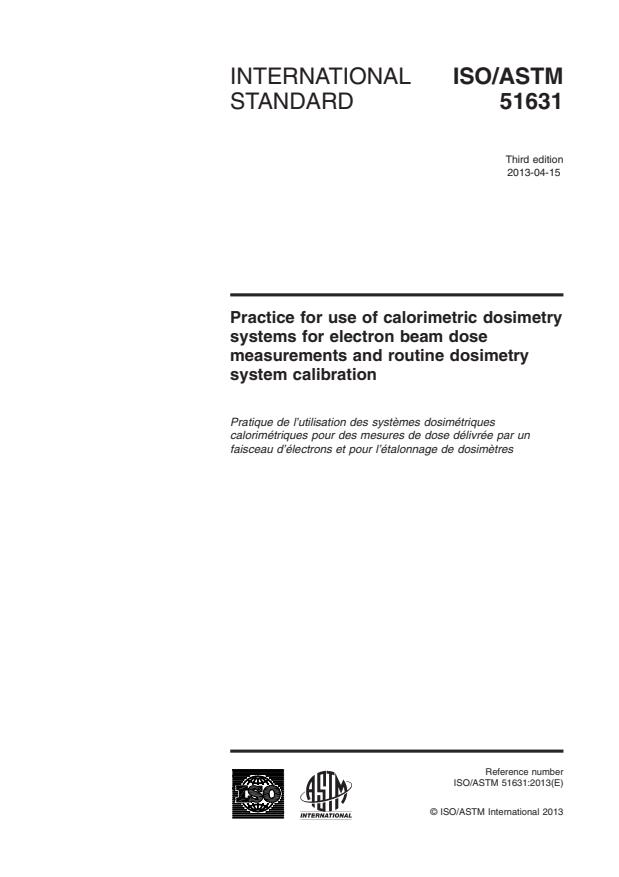
INTERNATIONAL ISO/ASTM
STANDARD 51631
Third edition
2013-04-15
Practice for use of calorimetric dosimetry
systems for electron beam dose
measurements and routine dosimetry
system calibration
Pratique de l’utilisation des systèmes dosimétriques
calorimétriques pour des mesures de dose délivrée par un
faisceau d’électrons et pour l’étalonnage de dosimètres
Reference number
© ISO/ASTM International 2013
PDF disclaimer
ThisPDFfilemaycontainembeddedtypefaces.InaccordancewithAdobe’slicensingpolicy,thisfilemaybeprintedorviewedbutshall
not be edited unless the typefaces which are embedded are licensed to and installed on the computer performing the editing. In
downloading this file, parties accept therein the responsibility of not infringing Adobe’s licensing policy. Neither the ISO Central
Secretariat nor ASTM International accepts any liability in this area.
Adobe is a trademark of Adobe Systems Incorporated.
Details of the software products used to create this PDF file can be found in the General Info relative to the file; the PDF-creation
parameters were optimized for printing. Every care has been taken to ensure that the file is suitable for use by ISO member bodies
and ASTM members. In the unlikely event that a problem relating to it is found, please inform the ISO Central Secretariat or ASTM
International at the addresses given below.
© ISO/ASTM International 2013
Allrightsreserved.Unlessotherwisespecified,nopartofthispublicationmaybereproducedorutilizedinanyformorbyanymeans,electronicormechanical,
including photocopying and microfilm, without permission in writing from either ISO at the address below or ISO’s member body in the country of the
requester. In the United States, such requests should be sent to ASTM International.
ISO copyright office ASTM International, 100 Barr Harbor Drive, PO Box C700,
Case postale 56 • CH-1211 Geneva 20 West Conshohocken, PA 19428-2959, USA
Tel. +41 22 749 01 11 Tel. +610 832 9634
Fax +41 22 749 09 47 Fax +610 832 9635
E-mail copyright@iso.org E-mail khooper@astm.org
Web www.iso.org Web www.astm.org
Published in the United States
ii © ISO/ASTM International 2013 – All rights reserved
Contents Page
1 Scope . 1
2 Referenced documents . 1
3 Terminology . 2
4 Significance and use . 2
5 Interferences . 2
6 Apparatus . 3
7 Calibration Procedures . 4
8 Dose measurement procedures . 6
9 Calibration of other dosimetry systems . 7
10 Documentation . 7
11 Measurement uncertainty . 7
12 Keywords . 8
Annexes . 8
Bibliography . 9
© ISO/ASTM International 2013 – All rights reserved iii
Foreword
ISO(theInternationalOrganizationforStandardization)isaworldwidefederationofnationalstandardsbodies
(ISO member bodies). The work of preparing International Standards is normally carried out through ISO
technical committees. Each member body interested in a subject for which a technical committee has been
established has the right to be represented on that committee. International organizations, governmental and
non-governmental, in liaison with ISO, also take part in the work. ISO collaborates closely with the
International Electrotechnical Commission (IEC) on all matters of electrotechnical standardization.
Draft International Standards adopted by the technical committees are circulated to the member bodies for
voting. Publication as an International Standard requires approval by at least 75% of the member bodies
casting a vote.
ASTM International is one of the world’s largest voluntary standards development organizations with global
participation from affected stakeholders. ASTM technical committees follow rigorous due process balloting
procedures.
A pilot project between ISO and ASTM International has been formed to develop and maintain a group of
ISO/ASTM radiation processing dosimetry standards. Under this pilot project, ASTM Committee E61,
Radiation Processing, is responsible for the development and maintenance of these dosimetry standards with
unrestricted participation and input from appropriate ISO member bodies.
Attention is drawn to the possibility that some of the elements of this document may be the subject of patent
rights. Neither ISO nor ASTM International shall be held responsible for identifying any or all such patent
rights.
International Standard ISO/ASTM 51631 was developed by ASTM Committee E61, Radiation Processing,
through Subcommittee E61.02, Dosimetry Systems, and byTechnical Committee ISO/TC 85, Nuclear energy,
nuclear technologies and radiological protection.
iv © ISO/ASTM International 2013 – All rights reserved
An American National Standard
Standard Practice for
Use of Calorimetric Dosimetry Systems for Electron Beam
Dose Measurements and Routine Dosimetry System
Calibration
This standard is issued under the fixed designation ISO/ASTM51631; the number immediately following the designation indicates the
year of original adoption or, in the case of revision, the year of last revision.
1. Scope 2. Referenced Documents
1.1 This practice covers the preparation and use of semi- 2.1 ASTM Standards:
adiabatic calorimetric dosimetry systems for measurement of E170 TerminologyRelatingtoRadiationMeasurementsand
absorbeddoseandforcalibrationofroutinedosimetrysystems Dosimetry
when irradiated with electrons for radiation processing appli- E666 PracticeforCalculatingAbsorbedDoseFromGamma
cations. The calorimeters are either transported by a conveyor or X Radiation
past a scanned electron beam or are stationary in a broadened E668 Practice for Application of Thermoluminescence-
beam. Dosimetry(TLD)SystemsforDeterminingAbsorbedDose
1.2 This document is one of a set of standards that provides in Radiation-Hardness Testing of Electronic Devices
recommendations for properly implementing dosimetry in E2628 Practice for Dosimetry in Radiation Processing
radiation processing, and describes a means of achieving E2701 Guide for Performance Characterization of Dosim-
compliancewiththerequirementsofASTMPracticeE2628for etersandDosimetrySystemsforUseinRadiationProcess-
a calorimetric dosimetry system. It is intended to be read in ing
conjunction with ASTM Practice E2628. 2.2 ISO/ASTM Standards:
1.3 The calorimeters described in this practice are classified 51261 Practice for Calibration of Routine Dosimetry Sys-
as Type II dosimeters on the basis of the complex effect of tems for Radiation Processing
influence quantities. See ASTM Practice E2628. 51431 Practice for Dosimetry in Electron and X-Ray
1.4 This practice applies to electron beams in the energy (Bremsstrahlung) Irradiation Facilities for Food Process-
range from 1.5 to 12 MeV. ing
1.5 The absorbed dose range depends on the absorbing 51649 Practice for Dosimetry in an Electron Beam Facility
material and the irradiation and measurement conditions. for Radiation Processing at Energies Between 300 keV
Minimumdoseisapproximately100Gyandmaximumdoseis and 25 MeV
approximately 50 kGy. 51707 Guide for Estimating Uncertainties in Dosimetry for
1.6 Theaverageabsorbed-doseraterangeshallgenerallybe Radiation Processing
-1
greater than 10 Gy·s . 2.3 International Commission on Radiation Units and
1.7 The temperature range for use of these calorimetric Measurements (ICRU) Reports:
dosimetry systems depends on the thermal resistance of the ICRU Report 34 The Dosimetry of Pulsed Radiation
materials, on the calibrated range of the temperature sensor, ICRUReport35 RadiationDosimetry:ElectronBeamswith
and on the sensitivity of the measurement device. Energies Between 1 and 50 MeV
1.8 This standard does not purport to address all of the ICRU Report 37 Stopping Powers for Electrons and Posi-
safety concerns, if any, associated with its use. It is the trons
responsibility of the user of this standard to establish appro- ICRU Report 44 Tissue Substitutes in Radiation Dosimetry
priate safety and health practices and determine the applica- and Measurements
bility of regulatory limitations prior to use. ICRU Report 80 Dosimetry Systems for use in Radiation
Processing
This practice is under the jurisdiction of ASTM Committee E61 on Radiation
Processing and is the direct responsibility of Subcommittee E61.02 on Dosimetry
Systems, and is also under the jurisdiction of ISO/TC 85/WG 3. For referenced ASTM and ISO/ASTM standards, visit the ASTM website,
Current edition approved Aug. 16, 2012. Published April 2013. Originally www.astm.org, or contact ASTM Customer Service at service@astm.org. For
ϵ1
published as E1631–94.ASTM E1631–96 was adopted by ISO in 1998 with Annual Book of ASTM Standards volume information, refer to the standard’s
theintermediatedesignationISO15568:1998(E).ThepresentInternationalStandard Document Summary page on the ASTM website.
previous edition ISO/ASTM 51631–2003(E). Woodmont Ave., Suite 800, Bethesda, MD 20814, U.S.A.
© ISO/ASTM International 2013 – All rights reserved
ICRU Report 85a Fundamental Quantities and Units for ible with ICRU Report 85a; that document, therefore, may be
Ionizing Radiation used as an alternative reference.
2.4 Joint Committee for Guides in Metrology (JCGM)
4 4. Significance and use
Reports:
4.1 This practice is applicable to the use of calorimetric
JCGM 100:2008, GUM 1995, with minor corrections,
dosimetry systems for the measurement of absorbed dose in
Evaluation of measurement data – Guide to the Expres-
electron beams, the qualification of electron irradiation facili-
sion of Uncertainty in Measurement
ties, periodic checks of operating parameters of electron
3. Terminology
irradiationfacilities,andcalibrationofotherdosimetrysystems
in electron beams. Calorimetric dosimetry systems are most
3.1 Definitions:
suitablefordosemeasurementatelectronacceleratorsutilizing
3.1.1 primary-standard dosimetry system—dosimetry sys-
conveyor systems for transport of product during irradiation.
tem that is designated or widely acknowledged as having the
highest metrological qualities and whose value is accepted
NOTE 1—For additional information on calorimetric dosimetry system
without reference to other standards of the same quantity.
operation and use, see ICRU Report 80. For additional information on the
3.1.2 reference standard dosimetry system—dosimetry sys- use of dosimetry in electron accelerator facilities, see ISO/ASTM Prac-
tices 51431 and 51649, and ICRU Reports 34 and 35, and Refs (1-3).
tem, generally having the highest metrological quality avail-
able at a given location or in a given organization, from which
4.2 The calorimetric dosimetry systems described in this
measurements made there are derived.
practice are not primary standard dosimetry systems. The
3.1.3 transfer standard dosimetry system—dosimetry sys-
calorimeters are classified as Type II dosimeters (ASTM
tem used as an intermediary to calibrate other dosimetry
E2628). They may be used as internal standards at an electron
systems.
beam irradiation facility, including being used as transfer
3.1.4 type II dosimeter—dosimeter,theresponseofwhichis
standard dosimetry systems for calibration of other dosimetry
affected by influence quantities in a complex way that cannot
systems, or they may be used as routine dosimeters. The
practically be expressed in terms of independent correction
calorimetric dosimetry systems are calibrated by comparison
factors.
with transfer-standard dosimeters.
3.2 Definitions of Terms Specific to This Standard:
4.3 The dose measurement is based on the measurement of
3.2.1 adiabatic—no heat exchange with the surroundings.
the temperature rise in an absorber (calorimetric body) irradi-
3.2.2 calorimeter—assembly consisting of calorimetric
ated by an electron beam. Different absorbing materials are
body (absorber), thermal insulation, and temperature sensor
used, but the response is usually defined in terms of dose to
with wiring.
water.
3.2.3 calorimetric body—mass of material absorbing radia-
NOTE 2—The calorimetric bodies of the calorimeters described in this
tion energy and whose temperature is measured.
practice are made from low atomic number materials. The electron
3.2.4 calorimetric dosimetry system—dosimetry system
fluenceswithinthesecalorimetricbodiesarealmostindependentofenergy
consisting of calorimeter, measurement instruments and their
when irradiated with electron beams of 1.5 MeV or higher, and the mass
associatedreferencestandards,andproceduresforthesystem’s
collision stopping powers are approximately the same for these materials.
use.
4.4 The absorbed dose in other materials irradiated under
3.2.5 endothermic reaction—chemical reaction that con-
equivalent conditions may be calculated. Procedures for mak-
sumes energy.
ing such calculations are given in ASTM Practices E666 and
3.2.6 exothermic reaction—chemical reaction that releases
E668, and Ref (1).
energy.
4.4.1 Calorimeters for use at industrial electron accelerators
3.2.7 heat defect (thermal defect)—amount of energy re-
have been constructed using graphite, polystyrene or a Petri
leased or consumed by chemical reactions caused by the
dish filled with water as the calorimetric body (4-10). The
absorption of radiation energy.
thickness of the calorimetric body shall be less than the range
3.2.8 specific heat capacity—amount of energy required to
of the electrons.
raise 1 kg of material by the temperature of 1 K.
4.4.2 Polymeric materials other than polystyrene may also
3.2.9 thermistor—electrical resistor with a well-defined re-
be used for calorimetric measurements. Polystyrene is used
lationship between resistance and temperature.
becauseitisknowntoberesistanttoradiation(11)andbecause
3.2.10 thermocouple—junction of two metals producing an
almost no exo- or endothermic reactions take place (12).
electrical voltage with a well-defined relationship to junction
temperature.
5. Interferences
3.3 Definitions of other terms used in this standard that
5.1 Extrapolation—The calorimetric dosimetry systems de-
pertain to radiation measurement and dosimetry may be found
scribed in this practice are not adiabatic, because of the
inASTM Terminology E170. Definitions in E170 are compat-
exchange of heat with the surroundings or within the calorim-
eter assembly. The maximum temperature reached by the
Document produced byWorking Group 1 of the Joint Committee for Guides in
Metrology (JCGM/WG 1). Available free of charge at the BIPM website (http://
Theboldfacenumbersinparenthesesrefertothebibliographyattheendofthis
www.bipm.org).
practice.
© ISO/ASTM International 2013 – All rights reserved
calorimetric body is different from the temperature that would 6. Apparatus
have been reached in the absence of that heat exchange. The
6.1 A Typical Graphite Calorimeter is a disc of graphite
temperature drifts before and after irradiation are extrapolated
placed in a thermally-insulating material such as foamed
to the midpoint of the irradiation period in order to determine
plastic (4-6). A calibrated thermistor or thermocouple is em-
the true temperature increase due to the absorbed dose.
bedded inside the disc. Some typical examples of graphite disc
5.2 Heat Defect—Chemical reactions in irradiated material
thicknesses and masses are listed in Table 1 (2).
(resulting in what is called the heat defect or thermal defect)
6.2 A Typical Water Calorimeter is a sealed polystyrene
may be endo- or exothermic and may lead to measurable
Petri dish filled with water and placed in thermally-insulating
temperature changes (3).
foamed plastic (4). A calibrated temperature sensor (thermis-
tor) is placed through the side of the dish into the water. The
5.3 Specific Heat Capacity—The specific heat capacity of
shape and size of the water calorimeter can be similar to the
some materials used as a calorimetric body may change with
shape and size of the polystyrene calorimeter (see 6.3).
accumulated absorbed dose, thereby affecting the response of
6.3 A Typical Polystyrene Calorimeter isapolystyrenedisc
the calorimeters.This is notably the case for polymers, such as
placed in thermally-insulating foamed plastic. A calibrated
polystyrene, and it will therefore be necessary to recalibrate
thermistor or thermocouple is imbedded inside the disc. The
calorimetric dosimetry systems at intervals that will depend on
dimension of the polystyrene disc may be similar to that of the
the total accumulated dose.
graphite and water calorimeters (9). See Fig. 1 as an example
5.4 Influence Quantities—The response of the calorimetric
of a 10 MeV-calorimeter. Fig. 2 shows an example of a
dosimetry systems to absorbed dose does not depend on
polystyrene calorimeter designed for use at 1.5 to 4 MeV
environmental relative humidity and temperature.
electron accelerators.
5.5 Temperature Effects from Accelerator Structure—The
6.4 The thickness of the calorimetric body should be less
calorimetersareoftenirradiatedonaconveyorusedforpassing
than the range of the irradiating electrons, typically not
products and samples through the irradiation zone. Radiated
exceeding ⁄3 of the range of the electrons. That will limit the
heat from the mechanical structures of the irradiation facility
variation of the dose gradients within the calorimetric body.
and from the conveyor may contribute to the measured
6.5 Radiation-resistant components should be used for the
temperature increase in the calorimeters.
parts of the calorimeter that are exposed to the electron beam.
5.6 Thermal Equilibrium—The most reproducible results
This also applies to insulation of electrical wires.
are obtained when the calorimeters are in thermal equilibrium
6.6 Good thermal contact must exist between the tempera-
with their surroundings before irradiation.
ture sensor and the calorimetric body. For graphite and
5.7 Other Materials—The temperature sensors, wires, etc.
polystyrenecalorimeters,thiscanbeassuredbyaddingasmall
of the calorimeter represent foreign materials, which may
amount of heat-conducting compound when mounting the
influence the temperature rise of the calorimetric body. These
temperature sensor.
components should be as small as possible.
6.7 Measurement—The response of the calorimeters is the
5.8 Dose Gradients—Dose gradients will exist within the temperatureriseofthecalorimetricbody.Thistemperaturerise
is usually registered by thermistors or thermocouples.
calorimetric body when it is irradiated with electrons. These
gradients must be taken into account, for example, when other
6.7.1 Thermistor—Ahigh-precision ohm-meter can be used
dosimeters are calibrated by comparison with calorimetric for measurement of thermistor resistance. The meter should
have a reproducibility of better than 60.1% and an accuracy
dosimetry systems.
TABLE 1 Thickness and size of several graphite calorimetric bodies designed at NIST for use at specific electron energies
Electron Range
Calorimeter Disc (30 mm diameter)
A
Electron
in Graphite
B
-3
Energy
Thickness Mass, g
density: 1.7 g cm
MeV
-2 -2
gcm cm g cm cm
4 2.32 1.36 0.84 0.49 5.9
5 2.91 1.71 1.05 0.62 7.5
6 3.48 2.05 1.25 0.74 8.9
8 4.59 2.70 1.65 0.97 11.7
10 5.66 3.33 2.04 1.20 14.4
11 6.17 3.63 2.22 1.31 15.7
12 6.68 3.93 2.40 1.41 16.9
A
This is the continuous-slowing-down approximation (CSDA) range r of electrons for a broad beam incident on a semi-infinite absorber. It is calculated from:
o
E~0!
r 5 1/ S/r! ! dE
~ ~
0 * tot
where:
E = the primary electron energy, and
(S/ρ) = the total mass stopping power at a given electron energy (1).
tot
B
The thicknesses specified are equal to 0.36 r .
o
© ISO/ASTM International 2013 – All rights reserved
of better than 60.2%. It should preferably be equipped for
four-wire type resistance measurements, especially if the
thermistor resistance is less than 10 kΩ. With the four-wire
measurement technique, the effects of resistance in the mea-
surement wires and electrical contacts are minimized.
6.7.2 Otherappropriateinstrumentationmaybeusedforthe
thermistor resistance measurement, for example, a resistance
bridge or commercially calibrated thermistor readers (5).Itis
important for both ohm-meters and resistance bridge measure-
ments to minimize the dissipated power in the thermistor,
preferably below 0.1 mW.
6.7.3 Thermocouple—Ahigh-precision digital voltmeter, or
commercial reader (2), can be used for the measurement. The
reproducibility of the voltmeter should be better than 0.1 µV,
and an accuracy of better than 60.2%.
6.7.4 Suppliers—Some commercial suppliers of calorimet-
ric dosimetry systems are listed in Annex A2.
7. Calibration procedures
7.1 Prior to use, the calorimetric dosimetry system (consist-
ing of calorimeter an
...
Questions, Comments and Discussion
Ask us and Technical Secretary will try to provide an answer. You can facilitate discussion about the standard in here.
Loading comments...