

ISO/ASTM 52701:2013
(Main)Guide for performance characterization of dosimeters and dosimetry systems for use in radiation processing
General Information
- Abstract
ISO/ASTM 52701:2013 provides guidance on determining the performance characteristics of dosimeters and dosimetry systems used in radiation processing. ISO/ASTM 52701:2013 describes the influence quantities that might affect the performance of dosimeters and dosimetry systems and that should be considered during dosimeter/dosimetry system characterization. Users of ISO/ASTM 52701:2013 are directed to existing standards and literature for procedures to determine the effects from individual influence quantities and from combinations of more than one influence quantity. Guidance is provided regarding the roles of the manufacturers, suppliers, and users in the characterization of dosimeters and dosimetry systems.
- Status
- Withdrawn
- Publication Date
- 08-Dec-2013
- Current Stage
- 9599 - Withdrawal of International Standard
- Start Date
- 04-Apr-2025
- Completion Date
- 29-Aug-2026
Buy Documents
ISO/ASTM 52701:2013 - Guide for performance characterization of dosimeters and dosimetry systems for use in radiation processing
ISO/ASTM 52701:2013 - Guide for performance characterization of dosimeters and dosimetry systems for use in radiation processing/9/2013
Overview
ISO/ASTM 52701:2013 - Guide for performance characterization of dosimeters and dosimetry systems for use in radiation processing - provides guidance for evaluating how dosimeters and complete dosimetry systems perform under realistic conditions. The standard defines the influence quantities (e.g., temperature, humidity, dose rate, radiation energy, time) that can affect dosimeter response and directs users to established methods for quantifying those effects. It also clarifies the roles of manufacturers, suppliers, and users in characterizing dosimeter performance and preparing documentation.
Keywords: ISO/ASTM 52701:2013, dosimeter characterization, dosimetry systems, radiation processing, influence quantities
Key topics and requirements
- Performance characteristics - Guidance on useful dose range, reproducibility, linearity, and limits of detection for dosimeters and systems.
- Influence quantities - Identification and consideration of environmental and irradiation variables (temperature, relative humidity, absorbed-dose rate, radiation energy, light exposure, elapsed time) that affect response.
- Measurement instruments - Requirements for instrument operating procedures, calibration, repeatability and reproducibility evidence, and traceability of measurements.
- Experimental design & statistical analysis - Use of design-of-experiments principles and statistical tools (e.g., factorial experiments, ANOVA) to assess single and combined influence effects.
- Documentation & repeatability - Recommendations for documenting characterization procedures, calibration curves, and conditions under which dosimeters were evaluated.
- Roles & responsibilities - Manufacturer/supplier obligations to supply performance data and users’ responsibilities to verify suitability for specific processing applications.
- Measurement uncertainty - Guidance to consider uncertainty components associated with dosimeter response and system calibration (references provided to established uncertainty guides).
Practical applications
- Selecting or qualifying dosimeters for sterilization, food irradiation, polymer crosslinking, and other industrial radiation processing.
- Designing acceptance tests and characterization studies to demonstrate dosimeter suitability for a given process environment.
- Developing calibration curves and operational procedures for routine dosimetry with documented traceability and uncertainty estimates.
- Investigating combined environmental/irradiation effects on dosimeter response to support quality control and regulatory compliance.
Who should use this standard
- Dosimeter manufacturers and suppliers preparing product specifications and performance data.
- Radiation processing facility managers and quality assurance personnel evaluating or qualifying dosimetry systems.
- Metrologists and dosimetrists performing calibration, uncertainty evaluation, and experimental tests of dosimeters.
- Regulators and auditors assessing dosimetry practices in industrial irradiation operations.
Related standards and references
- ISO/ASTM Practice 51261 - Calibration of routine dosimetry systems
- ISO/ASTM Practice 52628 - Dosimetry in radiation processing (applications guidance)
- ISO/ASTM Guide 51707 - Estimating uncertainties in dosimetry
- JCGM GUM / VIM - Measurement uncertainty and metrology vocabulary
Using ISO/ASTM 52701:2013 helps ensure robust dosimeter characterization, reliable absorbed-dose measurements, and better control of radiation-processing quality.
Buy Documents
ISO/ASTM 52701:2013 - Guide for performance characterization of dosimeters and dosimetry systems for use in radiation processing
ISO/ASTM 52701:2013 - Guide for performance characterization of dosimeters and dosimetry systems for use in radiation processing/9/2013
Get Certified
Connect with accredited certification bodies for this standard

BSMI (Bureau of Standards, Metrology and Inspection)
Taiwan's standards and inspection authority.
Sponsored listings
Frequently Asked Questions
ISO/ASTM 52701:2013 is a standard published by the International Organization for Standardization (ISO). Its full title is "Guide for performance characterization of dosimeters and dosimetry systems for use in radiation processing". This standard covers: ISO/ASTM 52701:2013 provides guidance on determining the performance characteristics of dosimeters and dosimetry systems used in radiation processing. ISO/ASTM 52701:2013 describes the influence quantities that might affect the performance of dosimeters and dosimetry systems and that should be considered during dosimeter/dosimetry system characterization. Users of ISO/ASTM 52701:2013 are directed to existing standards and literature for procedures to determine the effects from individual influence quantities and from combinations of more than one influence quantity. Guidance is provided regarding the roles of the manufacturers, suppliers, and users in the characterization of dosimeters and dosimetry systems.
ISO/ASTM 52701:2013 provides guidance on determining the performance characteristics of dosimeters and dosimetry systems used in radiation processing. ISO/ASTM 52701:2013 describes the influence quantities that might affect the performance of dosimeters and dosimetry systems and that should be considered during dosimeter/dosimetry system characterization. Users of ISO/ASTM 52701:2013 are directed to existing standards and literature for procedures to determine the effects from individual influence quantities and from combinations of more than one influence quantity. Guidance is provided regarding the roles of the manufacturers, suppliers, and users in the characterization of dosimeters and dosimetry systems.
ISO/ASTM 52701:2013 is classified under the following ICS (International Classification for Standards) categories: 17.240 - Radiation measurements. The ICS classification helps identify the subject area and facilitates finding related standards.
ISO/ASTM 52701:2013 is available in PDF format for immediate download after purchase. The document can be added to your cart and obtained through the secure checkout process. Digital delivery ensures instant access to the complete standard document.
Standards Content (Sample)
INTERNATIONAL ISO/ASTM
STANDARD 52701
First edition
2013-11-15
Guide for performance characterization
of dosimeters and dosimetry systems for
use in radiation processing
Guide standard pour la caractérisation de la performance des
dosimètres et des systèmes de dosimétrie pour utilization dans
le traitement des radiations
Reference number
© ISO/ASTM International 2013
PDF disclaimer
This PDF file may contain embedded typefaces. In accordance with Adobe’s licensing policy, this file may be printed or viewed but
shall not be edited unless the typefaces which are embedded are licensed to and installed on the computer performing the editing.
In downloading this file, parties accept therein the responsibility of not infringing Adobe’s licensing policy. Neither the ISO Central
Secretariat nor ASTM International accepts any liability in this area.
Adobe is a trademark of Adobe Systems Incorporated.
Details of the software products used to create this PDF file can be found in the General Info relative to the file; the PDF-creation
parameters were optimized for printing. Every care has been taken to ensure that the file is suitable for use by ISO member bodies
and ASTM members. In the unlikely event that a problem relating to it is found, please inform the ISO Central Secretariat or ASTM
International at the addresses given below.
© ISO/ASTM International 2013
All rights reserved. Unless otherwise specified, no part of this publication may be reproduced or utilized in any form or by any means, electronic or
mechanical, including photocopying and microfilm, without permission in writing from either ISO at the address below or ISO’s member body in the
country of the requester. In the United States, such requests should be sent to ASTM International.
ISO copyright office ASTM International,100 Barr Harbor Drive, PO Box C700,
Case postale 56 • CH-1211 Geneva 20 West Conshohocken, PA 19428-2959, USA
Tel. +41 22 749 01 11 Tel. +610 832 9634
Fax +41 22 749 09 47 Fax +610 832 9635
E-mail copyright@iso.org E-mail khooper@astm.org
Web www.iso.org Web www.astm.org
Published in Switzerland
ii © ISO/ASTM International 2013 – All rights reserved
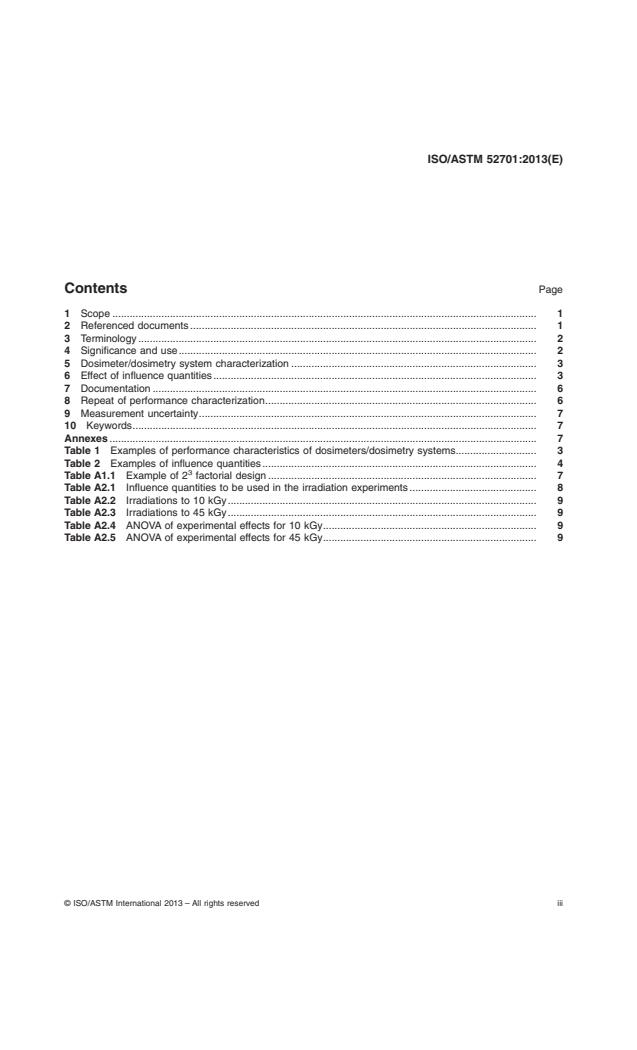
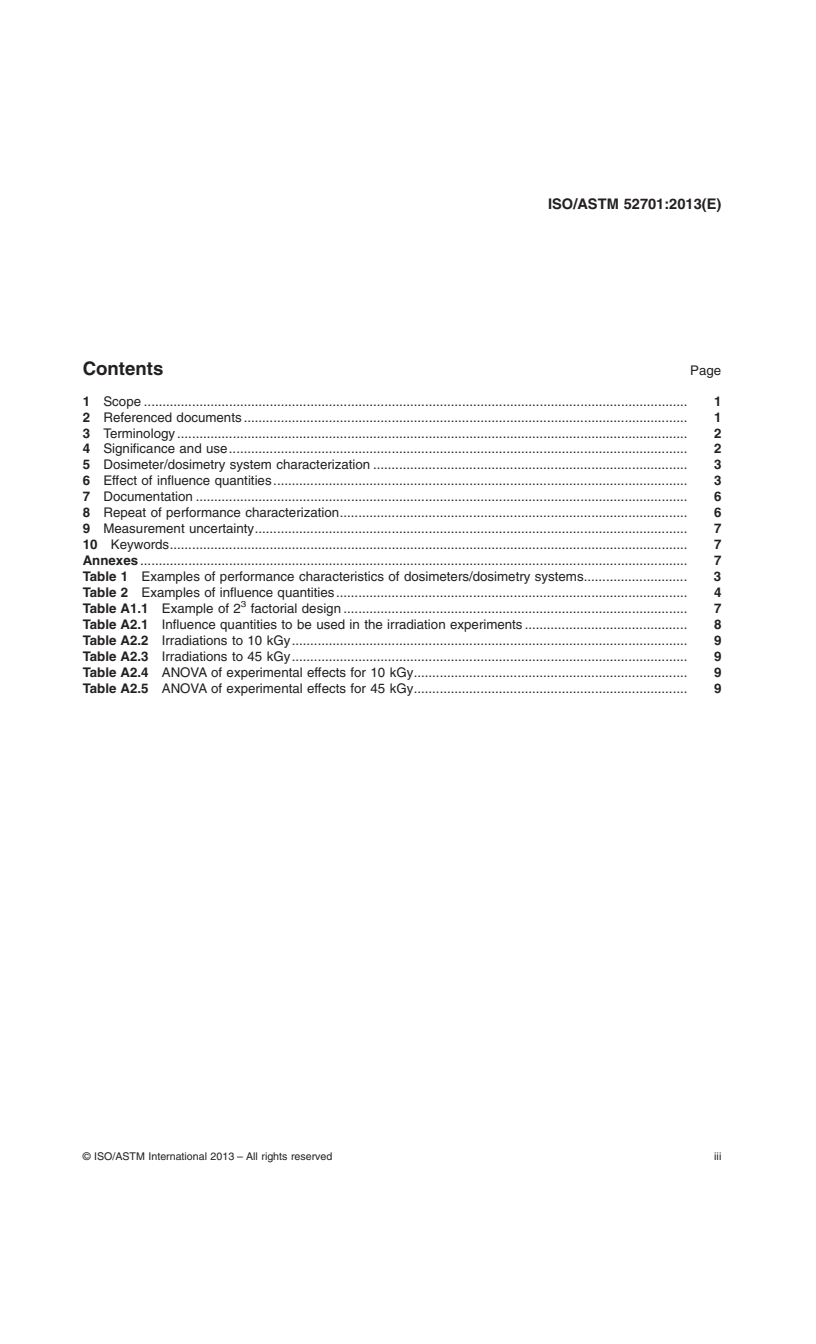
Contents Page
1 Scope. 1
2 Referenced documents. 1
3 Terminology. 2
4 Significance and use. 2
5 Dosimeter/dosimetry system characterization. 3
6 Effect of influence quantities. 3
7 Documentation. 6
8 Repeat of performance characterization. 6
9 Measurement uncertainty. 7
10 Keywords. 7
Annexes. 7
Table 1 Examples of performance characteristics of dosimeters/dosimetry systems. 3
Table 2 Examples of influence quantities. 4
Table A1.1 Example of 2 factorial design. 7
Table A2.1 Influence quantities to be used in the irradiation experiments. 8
Table A2.2 Irradiations to 10 kGy. 9
Table A2.3 Irradiations to 45 kGy. 9
Table A2.4 ANOVA of experimental effects for 10 kGy. 9
Table A2.5 ANOVA of experimental effects for 45 kGy. 9
© ISO/ASTM International 2013 – All rights reserved iii
Foreword
ISO(theInternationalOrganizationforStandardization)isaworldwidefederationofnationalstandardsbodies
(ISO member bodies). The work of preparing International Standards is normally carried out through ISO
technical committees. Each member body interested in a subject for which a technical committee has been
established has the right to be represented on that committee. International organizations, governmental and
non-governmental, in liaison with ISO, also take part in the work. ISO collaborates closely with the
International Electrotechnical Commission (IEC) on all matters of electrotechnical standardization.
Draft International Standards adopted by the technical committees are circulated to the member bodies for
voting. Publication as an International Standard requires approval by at least 75% of the member bodies
casting a vote.
ASTM International is one of the world’s largest voluntary standards development organizations with global
participation from affected stakeholders. ASTM technical committees follow rigorous due process balloting
procedures.
A pilot project between ISO and ASTM International has been formed to develop and maintain a group of
ISO/ASTM radiation processing dosimetry standards. Under this pilot project, ASTM Subcommittee E61,
Radiation Processing, is responsible for the development and maintenance of these dosimetry standards with
unrestricted participation and input from appropriate ISO member bodies.
Attention is drawn to the possibility that some of the elements of this document may be the subject of patent
rights. Neither ISO nor ASTM International shall be held responsible for identifying any or all such patent
rights.
International Standard ISO/ASTM 52701 was developed by ASTM Committee E61, Radiation Processing,
through Subcommittee E61.01 on Dosimetry, and by Technical Committee ISO/TC 85, Nuclear energy,
nuclear technologies and radiological protection.
This first edition of ISO/ASTM 52701 cancels and replaces ASTM E2701-09.
iv © ISO/ASTM International 2013 – All rights reserved
An American National Standard
Standard Guide for
Performance Characterization of Dosimeters and Dosimetry
Systems for Use in Radiation Processing
This standard is issued under the fixed designation ISO/ASTM 52701; the number immediately following the designation indicates the
year of original adoption or, in the case of revision, the year of last revision.
1. Scope E170 Terminology Relating to Radiation Measurements and
Dosimetry
1.1 This guide provides guidance on determining the per-
E456 Terminology Relating to Quality and Statistics
formance characteristics of dosimeters and dosimetry systems
E1026 Practice for Using the Fricke Dosimetry System
used in radiation processing.
E1325 Terminology Relating to Design of Experiments
1.2 This guide describes the influence quantities that might
2.2 ISO/ASTM Standards:
affect the performance of dosimeters and dosimetry systems
51205 Practice for Use of a Ceric-Cerous Sulfate Dosimetry
and that should be considered during dosimeter/dosimetry
System
system characterization.
51261 Practice for Calibration of Routine Dosimetry Sys-
1.3 Usersofthisguidearedirectedtoexistingstandardsand
tems for Radiation Processing
literature for procedures to determine the effects from indi-
51707 Guide for Estimating Uncertainties in Dosimetry for
vidualinfluencequantitiesandfromcombinationsofmorethan
Radiation Processing
one influence quantity.
52628 Practice for Dosimetry in Radiation Processing
2.3 Joint Committee for Guides in Metrology (JCGM)
1.4 Guidance is provided regarding the roles of the
Reports:
manufacturers, suppliers, and users in the characterization of
JCGM 100:2008, GUM 1995, with minor corrections,
dosimeters and dosimetry systems.
Evaluation of measurement data – Guide to the Expres-
1.5 This guide does not address how the dosimeter/
sion of Uncertainty in Measurement
dosimetry system characterization information is to be used in
JCGM 100:2008, VIM , International vocabulary of metrol-
radiation processing applications or in the calibration of
ogy – Basis and general concepts and associated terms
dosimetry systems.
2.4 International Commission on Radiation Units and Mea-
NOTE 1—For guidance on the use of dosimeter/dosimetry system
surements (ICRU) Reports
characterization information for the selection and use of a dosimetry
system, the user is directed to ISO/ASTM Practice 52628.
Report 80 Dosimetry Systems for Use in Radiation Process-
NOTE 2—For guidance on the use of dosimeter/dosimetry system
ing
characterization information for dosimetry system calibration, the user is
Report 85a Fundamental Quantities and Units for Ionizing
directed to ISO/ASTM Practice 51261.
Radiation
1.6 This guide does not purport to address all of the safety
concerns, if any, associated with its use. It is the responsibility
3. Terminology
of the user of this standard to establish appropriate safety and
3.1 Definitions:
health practices and determine the applicability of regulatory
3.1.1 calibration curve—expression of the relation between
limitations prior to use.
indication and corresponding measured quantity value. VIM
3.1.2 dosimeter—device that, when irradiated, exhibits a
2. Referenced documents
quantifiable change that can be related to absorbed dose in a
2.1 ASTM Standards:
given material using appropriate measurement instruments and
procedures.
This guide is under the jurisdiction of ASTM Committee E61 on Radiation
Processing and is the direct responsibility of Subcommittee E61.01 on Dosimetry,
and is also under the jurisdiction of ISO/TC 85/WG 3. Document produced byWorking Group 1 of the Joint Committee for Guides in
Current edition approved July 20, 2013. Published November 2013. Originally Metrology (JCGM/WG 1). Available free of charge at the BIPM website (http://
published asASTM E2701-09. Last previousASTM edition E2701-09. The present www.bipm.org).
International Standard ISO/ASTM 52701-2013(E) replaces ASTM E2701-09. Document produced byWorking Group 2 of the Joint Committee for Guides in
For referenced ASTM and ISO/ASTM standards, visit the ASTM website, Metrology (JCGM/WG 2). Available free of charge at the BIPM website (http://
www.astm.org, or contact ASTM Customer Service at service@astm.org. For www.bipm.org).
Annual Book of ASTM Standards volume information, refer to the standard’s Available from the International Commission on Radiation Units and
Document Summary page on the ASTM website. Measurements, 7910 Woodmont Ave., Suite 800, Bethesda, MD 20814, USA.
© ISO/ASTM International 2013 – All rights reserved
3.1.3 dosimeter batch—quantity of dosimeters made from a 4.2.1 the ability to manufacture batches of the material with
specific mass of material with uniform composition, fabricated evidence demonstrating a reproducible radiation-induced
in a single production run under controlled, consistent condi- change,
tions and having a unique identification code.
4.2.2 the availability of instrumentation for measuring this
change, and
3.1.4 dosimeter/dosimetry system characteristization—
4.2.3 the ability to take into account effects of influence
determination of performance characteristics, such as useful
quantities on the dosimeter response and on the measured
dose range, reproducibilty and the effects of influence
absorbed-dose values.
quantities, for a dosimeter/dosimetry system under defined test
conditions.
4.3 Dosimeter/dosimetry system characterization is con-
ducted to determine the performance characteristics for a
3.1.5 dosimeter response—reproducible, quantifiable effect
dosimeter/dosimetry system related to its capability for mea-
produced in the dosimeter by ionizing radiation.
suring absorbed dose. The information obtained from
3.1.5.1 Discussion—The dosimeter response value, ob-
dosimeter/dosimetry system characterization includes the re-
tained from one or more measurements, is used in the estima-
producibility of the measured absorbed-dose value, the useful
tion of the derived absorbed dose. The response value may be
absorbed-dose range, effects of influence quantities, and the
obtained from such measurements as optical absorbance,
conditions under which the dosimeters can be calibrated and
thickness, mass, peak-to-peak distance in EPR spectra, or
used effectively.
electropotential between solutions.
NOTE 4—When dosimetry systems are calibrated under the conditions
3.1.6 dosimetry system—system used for measuring ab-
of use, effects of influence quantities may be minimized or eliminated,
sorbed dose, consisting of dosimeters, measurement instru-
because the effects can be accounted for or incorporated into the
calibration method (see ISO/ASTM Practice 51261).
ments and their associated reference standards, and procedures
for the system’s use.
4.4 The influence quantities of importance might differ for
different radiation processing applications and facilities. For
3.1.7 influence quantity—quantity that, in a direct
references to standards describing different applications and
measurement, does not affect the quantity that is actually
facilities, see ISO/ASTM Practice 52628.
measured, but affects the relation between the indication and
the measurement result. VIM
4.5 Classification of a dosimeter as a type I dosimeter or a
3.1.7.1 Discussion—In radiation processing dosimetry, this
type II dosimeter (see ISO/ASTM Practice 52628) is based on
term includes temperature, relative humidity, time intervals,
performance characteristics related to the effects of influence
light, radiation energy, absorbed-dose rate, and other factors
quantities obtained from dosimeter/dosimetry system charac-
that might affect dosimeter response, as well as quantities
terization.
associated with the measurement instrument.
4.6 The dosimeter manufacturer or supplier is responsible
3.1.8 quality system—documented organizational structure,
for providing a product that meets the performance character-
responsibilities,procedures,processesandresourcesforimple-
istics defined in product specifications, certificates of
menting quality management.
conformance, or similar types of documents. Dosimeter speci-
fications should be developed based on dosimeter/dosimetry
3.2 Definitions of other terms used in this standard that
system characterization.
pertain to radiation measurement and dosimetry may be found
in ASTM Terminology E170. Definitions in ASTM E170 are
4.7 The user has the responsibility for ensuring that the
compatible with ICRU Report 85a; this document, therefore,
dosimetry requirements for the specific applications are met
may be used as an alternative reference. Definitions of other
and that dosimeter/dosimetry system characterization informa-
terms used in this standard that pertain to statistics and design
tion has been considered in:
of experiments may be found in ASTM Terminologies E456
4.7.1 determining the suitability of the dosimeter or dosim-
and E1325, respectively.
etry system for the specific application (see ISO/ASTM Prac-
tice 52628),
4. Significance and use
4.7.2 selecting the calibration method (see ISO/ASTM
Guide 51261),
4.1 Ionizing radiation produces physical or chemical
changes in many materials that can be measured and related to
4.7.3 establishing dosimetry system operational procedures
absorbed dose. Materials with radiation-induced changes that (see respective dosimetry system practice listed in ISO/ASTM
have been thoroughly studied can be used as dosimeters in
Practice 52628), and
radiation processing.
4.7.4 estimating the uncertainty components in the mea-
sured dose values (see ISO/ASTM Guide 51707).
NOTE 3—The scientific basis for commonly used dosimetry systems
and detailed descriptions of the radiation-induced interactions are given in
4.8 Dosimeter/dosimetry system characterization informa-
ICRU Report 80.
tion provided by manufacturers or suppliers, or available in the
4.2 Before a material can be considered for use as a literature,shouldbereviewedbytheusertodeterminethetests
dosimeter, certain characteristics related to manufacture and that should be performed prior to the use of the dosimeter or
measurement of its response to ionizing radiation need to be dosimetry system. Information on performance characteristics
considered, including: should be verified before using.
© ISO/ASTM International 2013 – All rights reserved
5. Dosimeter/dosimetry system characterization 5.3.3 For performance characterization, dosimeters should
be irradiated in facilities that can provide highly reproducible
5.1 Performance Characteristics:
dose rates and well-quantified values of influence quantities.
5.1.1 Some examples of performance characteristics of
dosimeters/dosimetrysystemsthatmayaffectthemeasurement
NOTE 6—When studying the effects of irradiation conditions such as
of absorbed dose are given in Table 1.
temperature or relative humidity, the conditions experienced by the
dosimeters must be known within established limits. Dosimeter tempera-
5.2 Measurement Instruments:
tures should be monitored. Reliance should not be placed on monitoring
5.2.1 Prior to conducting performance characterization of
the air temperature and assuming that there is temperature equilibrium.
the dosimeters, it is necessary to establish procedures for the Difference between dosimeter temperature and air temperature may be
associatedwithdoseandmayintroducebiasinthecharacterizationresults
operation of the measurement instruments.
over the dose range. For studies on the effects of changes of relative
5.2.2 Operating procedures should be developed to control
humidity, the time required for the water and oxygen content of the
and optimize the performance of all measurement instruments
dosimeters to reach equilibrium should be taken into account. It is
and auxiliary systems, including those used for measuring
necessary to validate controlled irradiation conditions to verify that
specified conditions can be achieved.
mass or thickness or used for a post irradiation heat treatment.
5.2.3 The instruments used in a given dosimetry system
5.3.4 An initial calibration curve may be obtained by
with specific dosimeters should be calibrated with evidence of
irradiating dosimeters over a range of absorbed doses at
traceability and be tested to provide evidence of their suitabil-
defined conditions, for example, specified temperature, relative
ity for use with the dosimeters. This should include a determi-
humidity, and absorbed dose rate, and by measuring dosimeter
nation of repeatability and reproducibility for the specific
response under defined measurement conditions. The defined
measurement methods to be used.
conditions for the irradiation should approximate the expected
5.2.4 The influence on measurement values attributable to
range of values to be encountered during use of the dosimetry
rounding error, short term instrument drift, etc. over the
system.
expected range of use should be determined.
NOTE 7—A calibration curve may be developed using a relationship
5.2.5 The performance of accessories such as dosimeter
expressed by response = f (dose).
holders or dosimeter positioning apparatus within the measure-
5.4 Characterization Information:
ment instrument should be determined.
5.4.1 Information on dosimeter and dosimetry system char-
5.2.6 The supplier of the performance characterization in-
acterization carried out by the dosimeter manufacturer or
formation should provide information on all instrumentation
supplier should be documented and made available to potential
used in the characterization, including relevant performance
users.
specifications for the measurement instruments and character-
5.4.2 The user is responsible for the evaluation of the effect
ization results.
of influence quantities or combinations of influence quantities,
NOTE 5—Characterization results are specific to the measurement
or both, on the dosimetry system performance over the full
instruments and measurement parameters used for the tests. Results
range of its intended use.
cannotbeusedwithothermeasurementinstrumentswithoutadequatedata
to support equivalency.
6. Effect of influence quantities
5.2.7 Information obtained during the measurement system
development to determine optimum or recommended
6.1 Influence Quantities to be Considered:
instruments, including precautions to avoid known sources of
6.1.1 All influence quantities that might affect absorbed-
error, should be made available to potential users.
dose determination should be considered. These influence
quantitiesincludethoserelatedtothedosimeterbefore,during,
5.3 Characterization:
andafterirradiationandthoserelatedtothedosimeterresponse
5.3.1 All dosimeter samples used in the characterization
measurements. Table 2 gives examples of some of these
must be representative of dosimeters supplied by the
influence quantities.
manufacturer/distributor.
5.3.2 The performance of dosimeter/dosimetry system char- 6.1.2 The influence quantities shown with an asterisk (*) in
acterization should be conducted in accordance with an experi- Table 2 can be controlled by packaging the dosimeter material
mental design that can effectively assess both individual and under specific conditions of relative humidity in light-tight
combined effects of the influence quantities being tested. gas-impermeable pouches.When the packaging is essential for
TABLE 1 Examples of performance characteristics of dosimeters/dosimetry systems
Performance Characteristic Description
Absorbed-dose range Range over which the dosimetry system can be used within a
maximum specified uncertainty
Applicable radiation type and energy X-radiation, gamma radiation, and electron beam
Effect of influence quantities Effects from individual influence quantities (see Table 2) and
from combinations of more than one influence quantity (see
6.6)
Uncertainty Achievable maximum level of uncertainty
Spatial resolution Spatial resolution may be limited by dosimeter size, volume or
area over which measurement is taken
© ISO/ASTM International 2013 – All rights reserved
TABLE 2 Examples of influence quantities
Category Section, Influence Quantity Conditions to be Considered
Pre-irradiation conditions 6.2.1 Dosimeter conditioning and packaging Conditioning for optimum/stable response
6.2.2 Time since manufacture Gradual changes in dosimeter over prolonged time intervals
6.2.3 Temperature Long-term & short-term effects at extremes of temperature
*
6.2.4 Relative humidity Long-term & short-term effects at extremes of humidity
*
6.2.5 Exposure to light Long-term & short-term effects on dosimeters from light
Condiitons during irradiation 6.3.1 Irradiation temperature Variation of response with temperature
6.3.2 Absorbed-dose rate Variation of response with absorbed-dose rate
6.3.3 Dose fractionation Effect on response when irradiation is interrupted
*
6.3.4 Relative humidity Variation of response with relative humidity
*
6.3.5 Exposure to light Effect of light on response
6.3.6 Radiation energy Variation of response with radiation energy
Post-irradiation conditions 6.4.1 Storage time Variation of response with time between irradiation & measurement
6.4.2 Storage temperature Variation of response with temperature following irradiation
6.4.3 Conditioning treatment Deliberate exposure to a conditioning treatment to obtain stable
response
*
6.4.4 Storage relative humidity Variation of response with relative humidity
*
6.4.5 Exposure to light Effect of light on response
Response measurement conditions 6.5.1 Light Effect of light during measurement
6.5.2 Temperature Effect of temperature during measurement
6.5.3 Relative humidity Effect of relative humidity during measurement
* See 6.1.2.
the performance of the dosimeter, the packaging and the irradiation;therefore,theeffectoflongtermstorageatdifferent
dosimeter are sometimes collectively referred to as the dosim- temperatures should be determined.
eter. 6.2.3.2 Theeffectontheresponseofdosimetersexposedfor
6.1.3 If only one influence quantity is suspected to have an short periods of time to potential extremes of temperatures
effect on dosimeter performance over the range of dose, the should also be determined. Shipment during summer and
individual effect can be studied by varying its value (see winter represent opposing termperature extremes.
6.2–6.5). 6.2.4 Relative Humidity:
6.1.4 Duetointeractionsbetweeninfluencequantities,com- 6.2.4.1 Changes in relative humidity during storage or
bined effects might differ from the summed individual effects. shipmentofunirradiatednon-packageddosimetersmightresult
The combined effects of several influence quantities can be in changes in oxygen or water content in the dosimeters that
explored and estimated efficiently and effectively when the may affect dosimeter response. The response of dosimeters
influencequantitiesaredealtwithsimultaneously(see6.6).For stored or shipped under extremes of relative humidity should
example, use of design of experiments provides a systematic be determined and this effect quantified. Packaging dosimeters
approach to experimentation that considers several influence in gas-impermeable pouches may be used to control and
quantities simultaneously (see 6.6.2). minimize the influence of relative humidity changes on dosim-
eter response. If pouches are used, the packaging materials
6.2 Influence Quantities Related to Pre-Irradiation Condi-
should be specified and the packaging effectiveness verified.
tions:
6.2.5 Exposure to Light:
6.2.1 Dosimeter Conditioning and Packaging:
6.2.5.1 Exposure to light, especially the ultraviolet compo-
6.2.1.1 Response characteristics of some dosimeters can be
nents from fluorescent lights or sunlight, might affect the
optimized or stabilized by conditioning them prior to irradia-
dosimeter response. Dosimeters should be exposed to expected
tion. Such conditioning involves storage under controlled
light conditions to determine the potential effect. If an effect is
conditions of temperature and humidity for specific periods of
found, the dosimeters should be stored, handled, and measured
time. If conditioning is performed to achieve desired level of
under controlled conditions or supplied and stored in light-
oxygen content or water content, the dosimeters should be
protected pouches to prevent such an effect.
packaged and sealed in gas-impermeable pouches to maintain
those conditions. The packaging materials should be specified 6.3 Influence Quantities Related to Irradiation—For all the
and the package evaluated for integrity. testing described in this section, the response of the irradiated
6.2.2 Time since Manufacture: dosimeters should be measured under the same measurement
6.2.2.1 To determine potential changes in the response for conditionsasusedfortheinitialcalibrationcurve.Theeffectof
both unirradiated and irradiated dosimeters over the life of a the influence quantity should be determined for both the
dosimeter batch, dosimeter response testing should be con- dosimeter response and the derived absorbed dose calculated
ducted periodically, using dosimeters stored under expected using the initial calibration curve.
extremes of storage conditions, to determine the extent of this 6.3.1 Irradiation Temperature:
effect. 6.3.1.1 The effect of irradiation temperature
...
INTERNATIONAL ISO/ASTM
STANDARD 52701
First edition
2013-11-15
Guide for performance characterization
of dosimeters and dosimetry systems for
use in radiation processing
Guide standard pour la caractérisation de la performance des
dosimètres et des systèmes de dosimétrie pour utilization dans
le traitement des radiations
Reference number
© ISO/ASTM International 2013
PDF disclaimer
This PDF file may contain embedded typefaces. In accordance with Adobe’s licensing policy, this file may be printed or viewed but
shall not be edited unless the typefaces which are embedded are licensed to and installed on the computer performing the editing.
In downloading this file, parties accept therein the responsibility of not infringing Adobe’s licensing policy. Neither the ISO Central
Secretariat nor ASTM International accepts any liability in this area.
Adobe is a trademark of Adobe Systems Incorporated.
Details of the software products used to create this PDF file can be found in the General Info relative to the file; the PDF-creation
parameters were optimized for printing. Every care has been taken to ensure that the file is suitable for use by ISO member bodies
and ASTM members. In the unlikely event that a problem relating to it is found, please inform the ISO Central Secretariat or ASTM
International at the addresses given below.
© ISO/ASTM International 2013
All rights reserved. Unless otherwise specified, no part of this publication may be reproduced or utilized in any form or by any means, electronic or
mechanical, including photocopying and microfilm, without permission in writing from either ISO at the address below or ISO’s member body in the
country of the requester. In the United States, such requests should be sent to ASTM International.
ISO copyright office ASTM International,100 Barr Harbor Drive, PO Box C700,
Case postale 56 • CH-1211 Geneva 20 West Conshohocken, PA 19428-2959, USA
Tel. +41 22 749 01 11 Tel. +610 832 9634
Fax +41 22 749 09 47 Fax +610 832 9635
E-mail copyright@iso.org E-mail khooper@astm.org
Web www.iso.org Web www.astm.org
Published in Switzerland
ii © ISO/ASTM International 2013 – All rights reserved
Contents Page
1 Scope. 1
2 Referenced documents. 1
3 Terminology. 2
4 Significance and use. 2
5 Dosimeter/dosimetry system characterization. 3
6 Effect of influence quantities. 3
7 Documentation. 6
8 Repeat of performance characterization. 6
9 Measurement uncertainty. 7
10 Keywords. 7
Annexes. 7
Table 1 Examples of performance characteristics of dosimeters/dosimetry systems. 3
Table 2 Examples of influence quantities. 4
Table A1.1 Example of 2 factorial design. 7
Table A2.1 Influence quantities to be used in the irradiation experiments. 8
Table A2.2 Irradiations to 10 kGy. 9
Table A2.3 Irradiations to 45 kGy. 9
Table A2.4 ANOVA of experimental effects for 10 kGy. 9
Table A2.5 ANOVA of experimental effects for 45 kGy. 9
© ISO/ASTM International 2013 – All rights reserved iii
Foreword
ISO(theInternationalOrganizationforStandardization)isaworldwidefederationofnationalstandardsbodies
(ISO member bodies). The work of preparing International Standards is normally carried out through ISO
technical committees. Each member body interested in a subject for which a technical committee has been
established has the right to be represented on that committee. International organizations, governmental and
non-governmental, in liaison with ISO, also take part in the work. ISO collaborates closely with the
International Electrotechnical Commission (IEC) on all matters of electrotechnical standardization.
Draft International Standards adopted by the technical committees are circulated to the member bodies for
voting. Publication as an International Standard requires approval by at least 75% of the member bodies
casting a vote.
ASTM International is one of the world’s largest voluntary standards development organizations with global
participation from affected stakeholders. ASTM technical committees follow rigorous due process balloting
procedures.
A pilot project between ISO and ASTM International has been formed to develop and maintain a group of
ISO/ASTM radiation processing dosimetry standards. Under this pilot project, ASTM Subcommittee E61,
Radiation Processing, is responsible for the development and maintenance of these dosimetry standards with
unrestricted participation and input from appropriate ISO member bodies.
Attention is drawn to the possibility that some of the elements of this document may be the subject of patent
rights. Neither ISO nor ASTM International shall be held responsible for identifying any or all such patent
rights.
International Standard ISO/ASTM 52701 was developed by ASTM Committee E61, Radiation Processing,
through Subcommittee E61.01 on Dosimetry, and by Technical Committee ISO/TC 85, Nuclear energy,
nuclear technologies and radiological protection.
This first edition of ISO/ASTM 52701 cancels and replaces ASTM E2701-09.
iv © ISO/ASTM International 2013 – All rights reserved
An American National Standard
Standard Guide for
Performance Characterization of Dosimeters and Dosimetry
Systems for Use in Radiation Processing
This standard is issued under the fixed designation ISO/ASTM 52701; the number immediately following the designation indicates the
year of original adoption or, in the case of revision, the year of last revision.
1. Scope E170 Terminology Relating to Radiation Measurements and
Dosimetry
1.1 This guide provides guidance on determining the per-
E456 Terminology Relating to Quality and Statistics
formance characteristics of dosimeters and dosimetry systems
E1026 Practice for Using the Fricke Dosimetry System
used in radiation processing.
E1325 Terminology Relating to Design of Experiments
1.2 This guide describes the influence quantities that might
2.2 ISO/ASTM Standards:
affect the performance of dosimeters and dosimetry systems
51205 Practice for Use of a Ceric-Cerous Sulfate Dosimetry
and that should be considered during dosimeter/dosimetry
System
system characterization.
51261 Practice for Calibration of Routine Dosimetry Sys-
1.3 Usersofthisguidearedirectedtoexistingstandardsand
tems for Radiation Processing
literature for procedures to determine the effects from indi-
51707 Guide for Estimating Uncertainties in Dosimetry for
vidualinfluencequantitiesandfromcombinationsofmorethan
Radiation Processing
one influence quantity.
52628 Practice for Dosimetry in Radiation Processing
2.3 Joint Committee for Guides in Metrology (JCGM)
1.4 Guidance is provided regarding the roles of the
Reports:
manufacturers, suppliers, and users in the characterization of
JCGM 100:2008, GUM 1995, with minor corrections,
dosimeters and dosimetry systems.
Evaluation of measurement data – Guide to the Expres-
1.5 This guide does not address how the dosimeter/
sion of Uncertainty in Measurement
dosimetry system characterization information is to be used in
JCGM 100:2008, VIM , International vocabulary of metrol-
radiation processing applications or in the calibration of
ogy – Basis and general concepts and associated terms
dosimetry systems.
2.4 International Commission on Radiation Units and Mea-
NOTE 1—For guidance on the use of dosimeter/dosimetry system
surements (ICRU) Reports
characterization information for the selection and use of a dosimetry
system, the user is directed to ISO/ASTM Practice 52628.
Report 80 Dosimetry Systems for Use in Radiation Process-
NOTE 2—For guidance on the use of dosimeter/dosimetry system
ing
characterization information for dosimetry system calibration, the user is
Report 85a Fundamental Quantities and Units for Ionizing
directed to ISO/ASTM Practice 51261.
Radiation
1.6 This guide does not purport to address all of the safety
concerns, if any, associated with its use. It is the responsibility
3. Terminology
of the user of this standard to establish appropriate safety and
3.1 Definitions:
health practices and determine the applicability of regulatory
3.1.1 calibration curve—expression of the relation between
limitations prior to use.
indication and corresponding measured quantity value. VIM
3.1.2 dosimeter—device that, when irradiated, exhibits a
2. Referenced documents
quantifiable change that can be related to absorbed dose in a
2.1 ASTM Standards:
given material using appropriate measurement instruments and
procedures.
This guide is under the jurisdiction of ASTM Committee E61 on Radiation
Processing and is the direct responsibility of Subcommittee E61.01 on Dosimetry,
and is also under the jurisdiction of ISO/TC 85/WG 3. Document produced byWorking Group 1 of the Joint Committee for Guides in
Current edition approved July 20, 2013. Published November 2013. Originally Metrology (JCGM/WG 1). Available free of charge at the BIPM website (http://
published asASTM E2701-09. Last previousASTM edition E2701-09. The present www.bipm.org).
International Standard ISO/ASTM 52701-2013(E) replaces ASTM E2701-09. Document produced byWorking Group 2 of the Joint Committee for Guides in
For referenced ASTM and ISO/ASTM standards, visit the ASTM website, Metrology (JCGM/WG 2). Available free of charge at the BIPM website (http://
www.astm.org, or contact ASTM Customer Service at service@astm.org. For www.bipm.org).
Annual Book of ASTM Standards volume information, refer to the standard’s Available from the International Commission on Radiation Units and
Document Summary page on the ASTM website. Measurements, 7910 Woodmont Ave., Suite 800, Bethesda, MD 20814, USA.
© ISO/ASTM International 2013 – All rights reserved
3.1.3 dosimeter batch—quantity of dosimeters made from a 4.2.1 the ability to manufacture batches of the material with
specific mass of material with uniform composition, fabricated evidence demonstrating a reproducible radiation-induced
in a single production run under controlled, consistent condi- change,
tions and having a unique identification code.
4.2.2 the availability of instrumentation for measuring this
change, and
3.1.4 dosimeter/dosimetry system characteristization—
4.2.3 the ability to take into account effects of influence
determination of performance characteristics, such as useful
quantities on the dosimeter response and on the measured
dose range, reproducibilty and the effects of influence
absorbed-dose values.
quantities, for a dosimeter/dosimetry system under defined test
conditions.
4.3 Dosimeter/dosimetry system characterization is con-
ducted to determine the performance characteristics for a
3.1.5 dosimeter response—reproducible, quantifiable effect
dosimeter/dosimetry system related to its capability for mea-
produced in the dosimeter by ionizing radiation.
suring absorbed dose. The information obtained from
3.1.5.1 Discussion—The dosimeter response value, ob-
dosimeter/dosimetry system characterization includes the re-
tained from one or more measurements, is used in the estima-
producibility of the measured absorbed-dose value, the useful
tion of the derived absorbed dose. The response value may be
absorbed-dose range, effects of influence quantities, and the
obtained from such measurements as optical absorbance,
conditions under which the dosimeters can be calibrated and
thickness, mass, peak-to-peak distance in EPR spectra, or
used effectively.
electropotential between solutions.
NOTE 4—When dosimetry systems are calibrated under the conditions
3.1.6 dosimetry system—system used for measuring ab-
of use, effects of influence quantities may be minimized or eliminated,
sorbed dose, consisting of dosimeters, measurement instru-
because the effects can be accounted for or incorporated into the
calibration method (see ISO/ASTM Practice 51261).
ments and their associated reference standards, and procedures
for the system’s use.
4.4 The influence quantities of importance might differ for
different radiation processing applications and facilities. For
3.1.7 influence quantity—quantity that, in a direct
references to standards describing different applications and
measurement, does not affect the quantity that is actually
facilities, see ISO/ASTM Practice 52628.
measured, but affects the relation between the indication and
the measurement result. VIM
4.5 Classification of a dosimeter as a type I dosimeter or a
3.1.7.1 Discussion—In radiation processing dosimetry, this
type II dosimeter (see ISO/ASTM Practice 52628) is based on
term includes temperature, relative humidity, time intervals,
performance characteristics related to the effects of influence
light, radiation energy, absorbed-dose rate, and other factors
quantities obtained from dosimeter/dosimetry system charac-
that might affect dosimeter response, as well as quantities
terization.
associated with the measurement instrument.
4.6 The dosimeter manufacturer or supplier is responsible
3.1.8 quality system—documented organizational structure,
for providing a product that meets the performance character-
responsibilities,procedures,processesandresourcesforimple-
istics defined in product specifications, certificates of
menting quality management.
conformance, or similar types of documents. Dosimeter speci-
fications should be developed based on dosimeter/dosimetry
3.2 Definitions of other terms used in this standard that
system characterization.
pertain to radiation measurement and dosimetry may be found
in ASTM Terminology E170. Definitions in ASTM E170 are
4.7 The user has the responsibility for ensuring that the
compatible with ICRU Report 85a; this document, therefore,
dosimetry requirements for the specific applications are met
may be used as an alternative reference. Definitions of other
and that dosimeter/dosimetry system characterization informa-
terms used in this standard that pertain to statistics and design
tion has been considered in:
of experiments may be found in ASTM Terminologies E456
4.7.1 determining the suitability of the dosimeter or dosim-
and E1325, respectively.
etry system for the specific application (see ISO/ASTM Prac-
tice 52628),
4. Significance and use
4.7.2 selecting the calibration method (see ISO/ASTM
Guide 51261),
4.1 Ionizing radiation produces physical or chemical
changes in many materials that can be measured and related to
4.7.3 establishing dosimetry system operational procedures
absorbed dose. Materials with radiation-induced changes that (see respective dosimetry system practice listed in ISO/ASTM
have been thoroughly studied can be used as dosimeters in
Practice 52628), and
radiation processing.
4.7.4 estimating the uncertainty components in the mea-
sured dose values (see ISO/ASTM Guide 51707).
NOTE 3—The scientific basis for commonly used dosimetry systems
and detailed descriptions of the radiation-induced interactions are given in
4.8 Dosimeter/dosimetry system characterization informa-
ICRU Report 80.
tion provided by manufacturers or suppliers, or available in the
4.2 Before a material can be considered for use as a literature,shouldbereviewedbytheusertodeterminethetests
dosimeter, certain characteristics related to manufacture and that should be performed prior to the use of the dosimeter or
measurement of its response to ionizing radiation need to be dosimetry system. Information on performance characteristics
considered, including: should be verified before using.
© ISO/ASTM International 2013 – All rights reserved
5. Dosimeter/dosimetry system characterization 5.3.3 For performance characterization, dosimeters should
be irradiated in facilities that can provide highly reproducible
5.1 Performance Characteristics:
dose rates and well-quantified values of influence quantities.
5.1.1 Some examples of performance characteristics of
dosimeters/dosimetrysystemsthatmayaffectthemeasurement
NOTE 6—When studying the effects of irradiation conditions such as
of absorbed dose are given in Table 1.
temperature or relative humidity, the conditions experienced by the
dosimeters must be known within established limits. Dosimeter tempera-
5.2 Measurement Instruments:
tures should be monitored. Reliance should not be placed on monitoring
5.2.1 Prior to conducting performance characterization of
the air temperature and assuming that there is temperature equilibrium.
the dosimeters, it is necessary to establish procedures for the Difference between dosimeter temperature and air temperature may be
associatedwithdoseandmayintroducebiasinthecharacterizationresults
operation of the measurement instruments.
over the dose range. For studies on the effects of changes of relative
5.2.2 Operating procedures should be developed to control
humidity, the time required for the water and oxygen content of the
and optimize the performance of all measurement instruments
dosimeters to reach equilibrium should be taken into account. It is
and auxiliary systems, including those used for measuring
necessary to validate controlled irradiation conditions to verify that
specified conditions can be achieved.
mass or thickness or used for a post irradiation heat treatment.
5.2.3 The instruments used in a given dosimetry system
5.3.4 An initial calibration curve may be obtained by
with specific dosimeters should be calibrated with evidence of
irradiating dosimeters over a range of absorbed doses at
traceability and be tested to provide evidence of their suitabil-
defined conditions, for example, specified temperature, relative
ity for use with the dosimeters. This should include a determi-
humidity, and absorbed dose rate, and by measuring dosimeter
nation of repeatability and reproducibility for the specific
response under defined measurement conditions. The defined
measurement methods to be used.
conditions for the irradiation should approximate the expected
5.2.4 The influence on measurement values attributable to
range of values to be encountered during use of the dosimetry
rounding error, short term instrument drift, etc. over the
system.
expected range of use should be determined.
NOTE 7—A calibration curve may be developed using a relationship
5.2.5 The performance of accessories such as dosimeter
expressed by response = f (dose).
holders or dosimeter positioning apparatus within the measure-
5.4 Characterization Information:
ment instrument should be determined.
5.4.1 Information on dosimeter and dosimetry system char-
5.2.6 The supplier of the performance characterization in-
acterization carried out by the dosimeter manufacturer or
formation should provide information on all instrumentation
supplier should be documented and made available to potential
used in the characterization, including relevant performance
users.
specifications for the measurement instruments and character-
5.4.2 The user is responsible for the evaluation of the effect
ization results.
of influence quantities or combinations of influence quantities,
NOTE 5—Characterization results are specific to the measurement
or both, on the dosimetry system performance over the full
instruments and measurement parameters used for the tests. Results
range of its intended use.
cannotbeusedwithothermeasurementinstrumentswithoutadequatedata
to support equivalency.
6. Effect of influence quantities
5.2.7 Information obtained during the measurement system
development to determine optimum or recommended
6.1 Influence Quantities to be Considered:
instruments, including precautions to avoid known sources of
6.1.1 All influence quantities that might affect absorbed-
error, should be made available to potential users.
dose determination should be considered. These influence
quantitiesincludethoserelatedtothedosimeterbefore,during,
5.3 Characterization:
andafterirradiationandthoserelatedtothedosimeterresponse
5.3.1 All dosimeter samples used in the characterization
measurements. Table 2 gives examples of some of these
must be representative of dosimeters supplied by the
influence quantities.
manufacturer/distributor.
5.3.2 The performance of dosimeter/dosimetry system char- 6.1.2 The influence quantities shown with an asterisk (*) in
acterization should be conducted in accordance with an experi- Table 2 can be controlled by packaging the dosimeter material
mental design that can effectively assess both individual and under specific conditions of relative humidity in light-tight
combined effects of the influence quantities being tested. gas-impermeable pouches.When the packaging is essential for
TABLE 1 Examples of performance characteristics of dosimeters/dosimetry systems
Performance Characteristic Description
Absorbed-dose range Range over which the dosimetry system can be used within a
maximum specified uncertainty
Applicable radiation type and energy X-radiation, gamma radiation, and electron beam
Effect of influence quantities Effects from individual influence quantities (see Table 2) and
from combinations of more than one influence quantity (see
6.6)
Uncertainty Achievable maximum level of uncertainty
Spatial resolution Spatial resolution may be limited by dosimeter size, volume or
area over which measurement is taken
© ISO/ASTM International 2013 – All rights reserved
TABLE 2 Examples of influence quantities
Category Section, Influence Quantity Conditions to be Considered
Pre-irradiation conditions 6.2.1 Dosimeter conditioning and packaging Conditioning for optimum/stable response
6.2.2 Time since manufacture Gradual changes in dosimeter over prolonged time intervals
6.2.3 Temperature Long-term & short-term effects at extremes of temperature
*
6.2.4 Relative humidity Long-term & short-term effects at extremes of humidity
*
6.2.5 Exposure to light Long-term & short-term effects on dosimeters from light
Condiitons during irradiation 6.3.1 Irradiation temperature Variation of response with temperature
6.3.2 Absorbed-dose rate Variation of response with absorbed-dose rate
6.3.3 Dose fractionation Effect on response when irradiation is interrupted
*
6.3.4 Relative humidity Variation of response with relative humidity
*
6.3.5 Exposure to light Effect of light on response
6.3.6 Radiation energy Variation of response with radiation energy
Post-irradiation conditions 6.4.1 Storage time Variation of response with time between irradiation & measurement
6.4.2 Storage temperature Variation of response with temperature following irradiation
6.4.3 Conditioning treatment Deliberate exposure to a conditioning treatment to obtain stable
response
*
6.4.4 Storage relative humidity Variation of response with relative humidity
*
6.4.5 Exposure to light Effect of light on response
Response measurement conditions 6.5.1 Light Effect of light during measurement
6.5.2 Temperature Effect of temperature during measurement
6.5.3 Relative humidity Effect of relative humidity during measurement
* See 6.1.2.
the performance of the dosimeter, the packaging and the irradiation;therefore,theeffectoflongtermstorageatdifferent
dosimeter are sometimes collectively referred to as the dosim- temperatures should be determined.
eter. 6.2.3.2 Theeffectontheresponseofdosimetersexposedfor
6.1.3 If only one influence quantity is suspected to have an short periods of time to potential extremes of temperatures
effect on dosimeter performance over the range of dose, the should also be determined. Shipment during summer and
individual effect can be studied by varying its value (see winter represent opposing termperature extremes.
6.2–6.5). 6.2.4 Relative Humidity:
6.1.4 Duetointeractionsbetweeninfluencequantities,com- 6.2.4.1 Changes in relative humidity during storage or
bined effects might differ from the summed individual effects. shipmentofunirradiatednon-packageddosimetersmightresult
The combined effects of several influence quantities can be in changes in oxygen or water content in the dosimeters that
explored and estimated efficiently and effectively when the may affect dosimeter response. The response of dosimeters
influencequantitiesaredealtwithsimultaneously(see6.6).For stored or shipped under extremes of relative humidity should
example, use of design of experiments provides a systematic be determined and this effect quantified. Packaging dosimeters
approach to experimentation that considers several influence in gas-impermeable pouches may be used to control and
quantities simultaneously (see 6.6.2). minimize the influence of relative humidity changes on dosim-
eter response. If pouches are used, the packaging materials
6.2 Influence Quantities Related to Pre-Irradiation Condi-
should be specified and the packaging effectiveness verified.
tions:
6.2.5 Exposure to Light:
6.2.1 Dosimeter Conditioning and Packaging:
6.2.5.1 Exposure to light, especially the ultraviolet compo-
6.2.1.1 Response characteristics of some dosimeters can be
nents from fluorescent lights or sunlight, might affect the
optimized or stabilized by conditioning them prior to irradia-
dosimeter response. Dosimeters should be exposed to expected
tion. Such conditioning involves storage under controlled
light conditions to determine the potential effect. If an effect is
conditions of temperature and humidity for specific periods of
found, the dosimeters should be stored, handled, and measured
time. If conditioning is performed to achieve desired level of
under controlled conditions or supplied and stored in light-
oxygen content or water content, the dosimeters should be
protected pouches to prevent such an effect.
packaged and sealed in gas-impermeable pouches to maintain
those conditions. The packaging materials should be specified 6.3 Influence Quantities Related to Irradiation—For all the
and the package evaluated for integrity. testing described in this section, the response of the irradiated
6.2.2 Time since Manufacture: dosimeters should be measured under the same measurement
6.2.2.1 To determine potential changes in the response for conditionsasusedfortheinitialcalibrationcurve.Theeffectof
both unirradiated and irradiated dosimeters over the life of a the influence quantity should be determined for both the
dosimeter batch, dosimeter response testing should be con- dosimeter response and the derived absorbed dose calculated
ducted periodically, using dosimeters stored under expected using the initial calibration curve.
extremes of storage conditions, to determine the extent of this 6.3.1 Irradiation Temperature:
effect. 6.3.1.1 The effect of irradiation temperature
...