

ISO 11929-3:2025
(Main)Determination of the characteristic limits (decision threshold, detection limit and limits of the coverage interval) for measurements of ionizing radiation — Fundamentals and application — Part 3: Applications to unfolding methods
General Information
- Abstract
The ISO 11929 series specifies a procedure, in the field of ionizing radiation metrology, for the calculation of the “decision threshold”, the “detection limit” and the “limits of the coverage interval” for a non-negative ionizing radiation measurand when counting measurements with preselection of time or counts are carried out. The measurand results from a gross count rate and a background count rate as well as from further quantities on the basis of a model of the evaluation. In particular, the measurand can be the net count rate as the difference of the gross count rate and the background count rate, or the net activity of a sample. It can also be influenced by calibration of the measuring system, by sample treatment and by other factors. ISO 11929 has been divided into four parts covering elementary applications in ISO 11929-1, advanced applications on the basis of the ISO/IEC Guide 98-3:2008/Suppl 1:2008 in ISO 11929-2, applications to unfolding methods in this document, and guidance to the application in ISO 11929-4. ISO 11929-1 covers basic applications of counting measurements frequently used in the field of ionizing radiation metrology. It is restricted to applications for which the uncertainties can be evaluated on the basis of the ISO/IEC Guide 98-3 (JCGM 2008). In ISO 11929-1:2025, Annex A, the special case of repeated counting measurements with random influences is covered, while measurements with linear analogous ratemeters, are covered in ISO 11929-1:2025, Annex B. This document deals with the evaluation of measurements using unfolding methods and counting spectrometric multi-channel measurements if evaluated by unfolding methods, in particular, for alpha- and gamma‑spectrometric measurements. Further, it provides some advice on how to deal with correlations and covariances. ISO 11929-4 gives guidance to the application of the ISO 11929 series, summarizes shortly the general procedure and then presents a wide range of numerical examples. ISO 11929 Standard also applies analogously to other measurements of any kind especially if a similar model of the evaluation is involved. Further practical examples can be found, for example, in ISO 18589[ REF Reference_ref_14 \r \h 7 08D0C9EA79F9BACE118C8200AA004BA90B0200000008000000110000005200650066006500720065006E00630065005F007200650066005F00310034000000 ], ISO 9696[ REF Reference_ref_9 \r \h 2 08D0C9EA79F9BACE118C8200AA004BA90B0200000008000000100000005200650066006500720065006E00630065005F007200650066005F0039000000 ], ISO 9697[ REF Reference_ref_10 \r \h 3 08D0C9EA79F9BACE118C8200AA004BA90B0200000008000000110000005200650066006500720065006E00630065005F007200650066005F00310030000000 ], ISO 9698[ REF Reference_ref_11 \r \h 4 08D0C9EA79F9BACE118C8200AA004BA90B0200000008000000110000005200650066006500720065006E00630065005F007200650066005F00310031000000 ], ISO 10703[ REF Reference_ref_12 \r \h 5 08D0C9EA79F9BACE118C8200AA004BA90B0200000008000000110000005200650066006500720065006E00630065005F007200650066005F00310032000000 ], ISO 7503[ REF Reference_ref_8 \r \h 1 08D0C9EA79F9BACE118C8200AA004BA90B0200000008000000100000005200650066006500720065006E00630065005F007200650066005F0038000000 ], ISO 28218[ REF Reference_ref_15 \r \h 8 08D0C9EA79F9BACE118C8200AA004BA90B0200000008000000110000005200650066006500720065006E00630065005F007200650066005F00310035000000 ], and ISO 11665[ REF Reference_ref_13 \r \h 6 08D0C9EA79F9BACE118C8200AA004BA90B0200000008000000110000005200650066006500720065006E00630065005F007200650066005F00310033000000 ]. NOTE A code system, named UncertRadio, is available for calculations according to ISO 11929- 1 to ISO 11929-3. UncertRadio[ REF Reference_ref_42 \r \h 35 08D0C9EA79F9BACE118C8200AA004BA90B0200000008000000110000005200650066006500720065006E00630065005F007200650066005F00340032000000 ][ REF Reference_ref_43 \r \h 36 08D0C9EA79F9BACE118C8200AA004BA90B0200000008000000110000005200650066006500720065006E00630065005F007200650066005F00340033000000 ] can be downloaded
- Status
- Published
- Publication Date
- 11-Dec-2025
- Technical Committee
- ISO/TC 85/SC 2 - Radiological protection
- Drafting Committee
- ISO/TC 85/SC 2/WG 17 - Radioactivity measurements
- Current Stage
- 6060 - International Standard published
- Start Date
- 12-Dec-2025
- Due Date
- 05-May-2026
- Completion Date
- 12-Dec-2025
Buy Documents

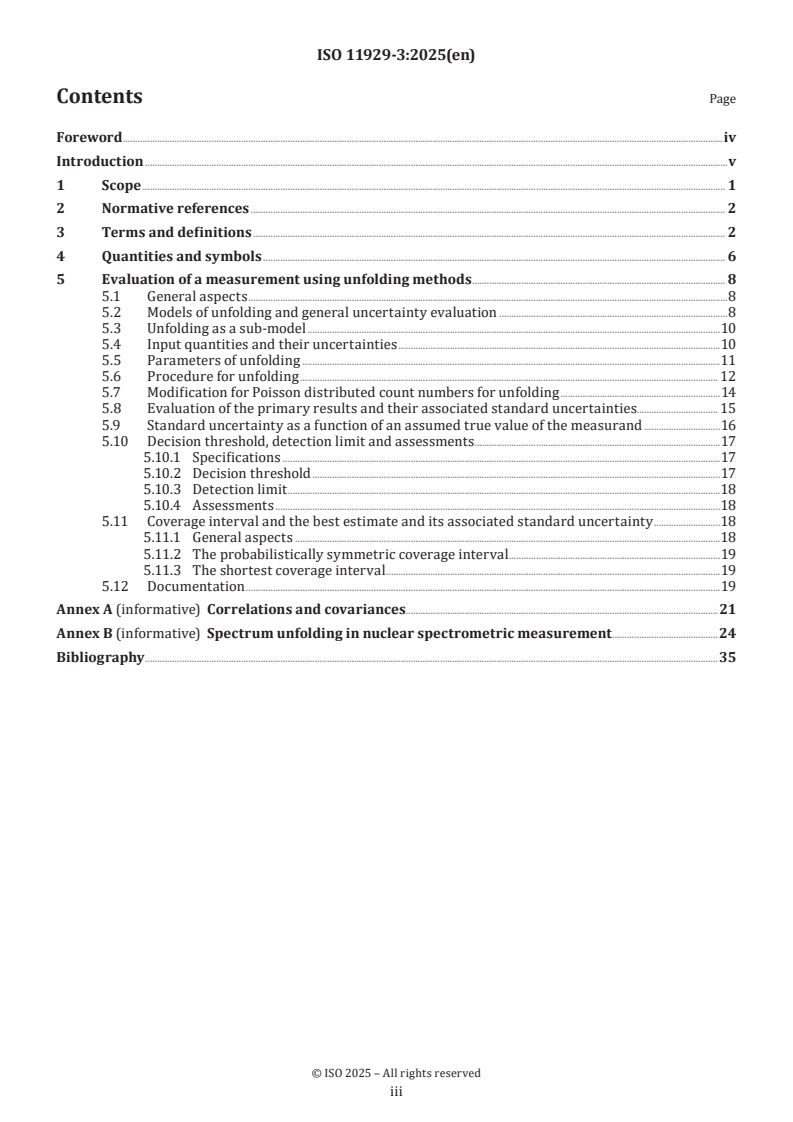

ISO 11929-3:2025 - Determination of the characteristic limits (decision threshold, detection limit and limits of the coverage interval) for measurements of ionizing radiation — Fundamentals and application — Part 3: Applications to unfolding methods Released:12. 12. 2025

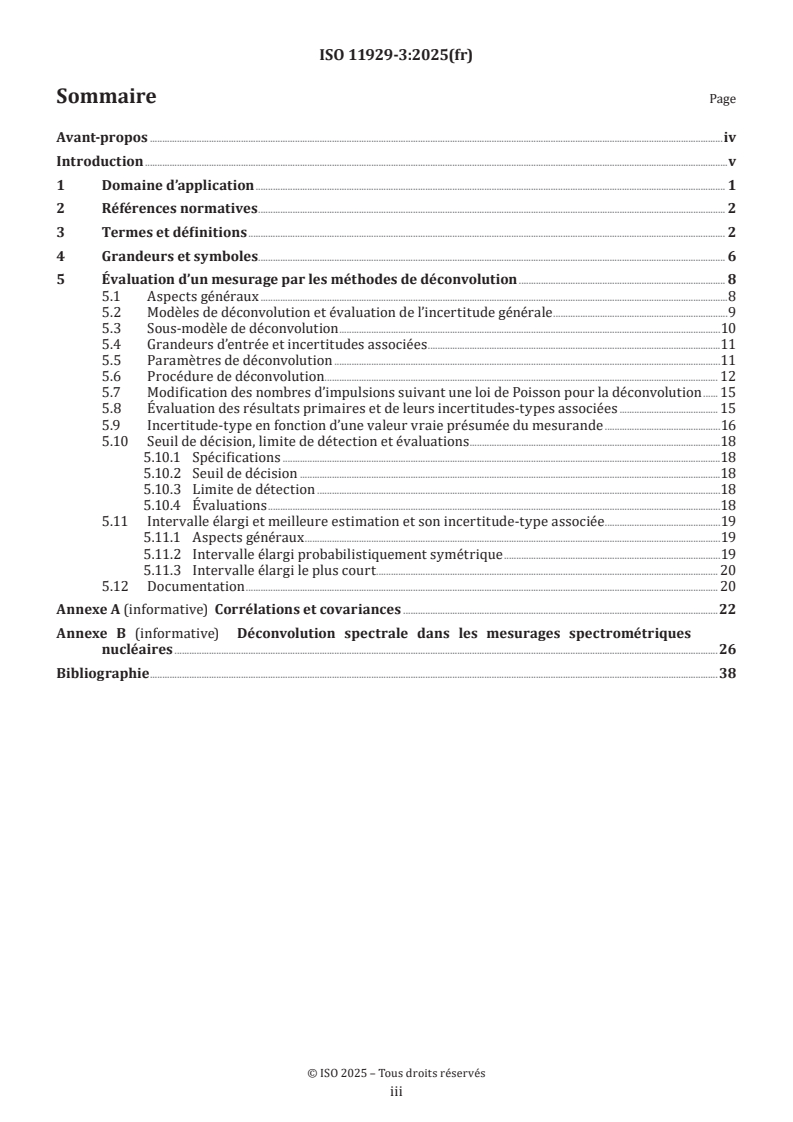
ISO 11929-3:2025 - Détermination des limites caractéristiques (seuil de décision, limite de détection et limites de l’intervalle élargi) pour mesurages de rayonnements ionisants — Principes fondamentaux et applications — Partie 3: Application aux méthodes de déconvolution Released:12. 12. 2025
Overview - ISO 11929-3:2025 in brief
ISO 11929-3:2025 is Part 3 of the ISO 11929 series that defines how to determine characteristic limits - the decision threshold, detection limit and limits of the coverage interval - for measurements of ionizing radiation when using unfolding methods. It applies to non‑negative measurands derived from counting measurements (preselection of time or counts) such as net count rates or net activity, and to multichannel spectrometric data (notably alpha‑ and gamma‑spectrometry) evaluated by unfolding procedures.
The standard is founded on the ISO/IEC Guide 98-3 (GUM) framework and its Monte Carlo supplements, using Bayesian-based probability models for robust treatment of measurement uncertainty and for calculation of the characteristic values.
Key topics and technical requirements
- Characteristic limits: formal definitions and calculation procedures for the decision threshold, detection limit, and coverage interval for a non‑negative measurand.
- Unfolding methods: treatment of spectrum unfolding as a sub-model, including the propagation of uncertainties through the unfolding algorithm.
- Measurement model: measurand derived from gross/background count rates and additional calibration or sample‑treatment influences; explicit handling of calibration factors and other input quantities.
- Uncertainty evaluation: combination of ISO/IEC Guide 98-3 (GUM) methods with Bayesian statistics and Monte Carlo techniques (ISO/IEC Guide 98-3 supplements) to produce PDFs and standard uncertainties for downstream calculation of limits.
- Correlations and covariances: guidance (Annex A) on identifying and handling correlated input quantities arising in multivariate/unfolding analyses.
- Spectrum‑specific guidance: informative guidance on spectrum unfolding in nuclear spectrometric measurement (Annex B).
- Documentation & reporting: procedural requirements for documenting unfolding parameters, input uncertainties, and results used to compute the characteristic limits.
Practical applications and users
ISO 11929-3 is intended for professionals and organizations involved in ionizing radiation metrology and radiological protection, including:
- Laboratory metrologists performing alpha-/gamma‑spectrometry with unfolding algorithms
- Radiation protection laboratories assessing detection capability and reporting limits
- Instrument manufacturers and software developers implementing uncertainty propagation for unfolding
- Regulatory bodies and compliance auditors evaluating reported detection limits and coverage intervals
- Analysts applying Monte Carlo or Bayesian uncertainty propagation to multichannel counting data
Use cases include: assessing minimum detectable activities, reporting measurement uncertainties for environmental or nuclear samples, validating unfolding software, and ensuring traceable assessment of detection capability.
Related standards and tools
- ISO 11929 series: ISO 11929-1, ISO 11929-2, ISO 11929-4 (guidance and examples)
- ISO/IEC Guide 98-3 (GUM) and its Monte Carlo supplements
- Cross-referenced ISO standards for radiological measurements (e.g., ISO 18589, ISO 9696–9698, ISO 11665)
- UncertRadio: a code system cited for calculations according to ISO 11929-1 to ISO 11929-3 (available from the Thünen Institute download pages)
Relations
- Effective Date
- 09-Feb-2026
- Effective Date
- 12-Feb-2026
- Effective Date
- 07-Jan-2025
Buy Documents
ISO 11929-3:2025 - Determination of the characteristic limits (decision threshold, detection limit and limits of the coverage interval) for measurements of ionizing radiation — Fundamentals and application — Part 3: Applications to unfolding methods Released:12. 12. 2025
ISO 11929-3:2025 - Détermination des limites caractéristiques (seuil de décision, limite de détection et limites de l’intervalle élargi) pour mesurages de rayonnements ionisants — Principes fondamentaux et applications — Partie 3: Application aux méthodes de déconvolution Released:12. 12. 2025
Get Certified
Connect with accredited certification bodies for this standard

BSMI (Bureau of Standards, Metrology and Inspection)
Taiwan's standards and inspection authority.
Sponsored listings
Frequently Asked Questions
ISO 11929-3:2025 is a standard published by the International Organization for Standardization (ISO). Its full title is "Determination of the characteristic limits (decision threshold, detection limit and limits of the coverage interval) for measurements of ionizing radiation — Fundamentals and application — Part 3: Applications to unfolding methods". This standard covers: The ISO 11929 series specifies a procedure, in the field of ionizing radiation metrology, for the calculation of the “decision threshold”, the “detection limit” and the “limits of the coverage interval” for a non-negative ionizing radiation measurand when counting measurements with preselection of time or counts are carried out. The measurand results from a gross count rate and a background count rate as well as from further quantities on the basis of a model of the evaluation. In particular, the measurand can be the net count rate as the difference of the gross count rate and the background count rate, or the net activity of a sample. It can also be influenced by calibration of the measuring system, by sample treatment and by other factors. ISO 11929 has been divided into four parts covering elementary applications in ISO 11929-1, advanced applications on the basis of the ISO/IEC Guide 98-3:2008/Suppl 1:2008 in ISO 11929-2, applications to unfolding methods in this document, and guidance to the application in ISO 11929-4. ISO 11929-1 covers basic applications of counting measurements frequently used in the field of ionizing radiation metrology. It is restricted to applications for which the uncertainties can be evaluated on the basis of the ISO/IEC Guide 98-3 (JCGM 2008). In ISO 11929-1:2025, Annex A, the special case of repeated counting measurements with random influences is covered, while measurements with linear analogous ratemeters, are covered in ISO 11929-1:2025, Annex B. This document deals with the evaluation of measurements using unfolding methods and counting spectrometric multi-channel measurements if evaluated by unfolding methods, in particular, for alpha- and gamma‑spectrometric measurements. Further, it provides some advice on how to deal with correlations and covariances. ISO 11929-4 gives guidance to the application of the ISO 11929 series, summarizes shortly the general procedure and then presents a wide range of numerical examples. ISO 11929 Standard also applies analogously to other measurements of any kind especially if a similar model of the evaluation is involved. Further practical examples can be found, for example, in ISO 18589[ REF Reference_ref_14 \r \h 7 08D0C9EA79F9BACE118C8200AA004BA90B0200000008000000110000005200650066006500720065006E00630065005F007200650066005F00310034000000 ], ISO 9696[ REF Reference_ref_9 \r \h 2 08D0C9EA79F9BACE118C8200AA004BA90B0200000008000000100000005200650066006500720065006E00630065005F007200650066005F0039000000 ], ISO 9697[ REF Reference_ref_10 \r \h 3 08D0C9EA79F9BACE118C8200AA004BA90B0200000008000000110000005200650066006500720065006E00630065005F007200650066005F00310030000000 ], ISO 9698[ REF Reference_ref_11 \r \h 4 08D0C9EA79F9BACE118C8200AA004BA90B0200000008000000110000005200650066006500720065006E00630065005F007200650066005F00310031000000 ], ISO 10703[ REF Reference_ref_12 \r \h 5 08D0C9EA79F9BACE118C8200AA004BA90B0200000008000000110000005200650066006500720065006E00630065005F007200650066005F00310032000000 ], ISO 7503[ REF Reference_ref_8 \r \h 1 08D0C9EA79F9BACE118C8200AA004BA90B0200000008000000100000005200650066006500720065006E00630065005F007200650066005F0038000000 ], ISO 28218[ REF Reference_ref_15 \r \h 8 08D0C9EA79F9BACE118C8200AA004BA90B0200000008000000110000005200650066006500720065006E00630065005F007200650066005F00310035000000 ], and ISO 11665[ REF Reference_ref_13 \r \h 6 08D0C9EA79F9BACE118C8200AA004BA90B0200000008000000110000005200650066006500720065006E00630065005F007200650066005F00310033000000 ]. NOTE A code system, named UncertRadio, is available for calculations according to ISO 11929- 1 to ISO 11929-3. UncertRadio[ REF Reference_ref_42 \r \h 35 08D0C9EA79F9BACE118C8200AA004BA90B0200000008000000110000005200650066006500720065006E00630065005F007200650066005F00340032000000 ][ REF Reference_ref_43 \r \h 36 08D0C9EA79F9BACE118C8200AA004BA90B0200000008000000110000005200650066006500720065006E00630065005F007200650066005F00340033000000 ] can be downloaded
The ISO 11929 series specifies a procedure, in the field of ionizing radiation metrology, for the calculation of the “decision threshold”, the “detection limit” and the “limits of the coverage interval” for a non-negative ionizing radiation measurand when counting measurements with preselection of time or counts are carried out. The measurand results from a gross count rate and a background count rate as well as from further quantities on the basis of a model of the evaluation. In particular, the measurand can be the net count rate as the difference of the gross count rate and the background count rate, or the net activity of a sample. It can also be influenced by calibration of the measuring system, by sample treatment and by other factors. ISO 11929 has been divided into four parts covering elementary applications in ISO 11929-1, advanced applications on the basis of the ISO/IEC Guide 98-3:2008/Suppl 1:2008 in ISO 11929-2, applications to unfolding methods in this document, and guidance to the application in ISO 11929-4. ISO 11929-1 covers basic applications of counting measurements frequently used in the field of ionizing radiation metrology. It is restricted to applications for which the uncertainties can be evaluated on the basis of the ISO/IEC Guide 98-3 (JCGM 2008). In ISO 11929-1:2025, Annex A, the special case of repeated counting measurements with random influences is covered, while measurements with linear analogous ratemeters, are covered in ISO 11929-1:2025, Annex B. This document deals with the evaluation of measurements using unfolding methods and counting spectrometric multi-channel measurements if evaluated by unfolding methods, in particular, for alpha- and gamma‑spectrometric measurements. Further, it provides some advice on how to deal with correlations and covariances. ISO 11929-4 gives guidance to the application of the ISO 11929 series, summarizes shortly the general procedure and then presents a wide range of numerical examples. ISO 11929 Standard also applies analogously to other measurements of any kind especially if a similar model of the evaluation is involved. Further practical examples can be found, for example, in ISO 18589[ REF Reference_ref_14 \r \h 7 08D0C9EA79F9BACE118C8200AA004BA90B0200000008000000110000005200650066006500720065006E00630065005F007200650066005F00310034000000 ], ISO 9696[ REF Reference_ref_9 \r \h 2 08D0C9EA79F9BACE118C8200AA004BA90B0200000008000000100000005200650066006500720065006E00630065005F007200650066005F0039000000 ], ISO 9697[ REF Reference_ref_10 \r \h 3 08D0C9EA79F9BACE118C8200AA004BA90B0200000008000000110000005200650066006500720065006E00630065005F007200650066005F00310030000000 ], ISO 9698[ REF Reference_ref_11 \r \h 4 08D0C9EA79F9BACE118C8200AA004BA90B0200000008000000110000005200650066006500720065006E00630065005F007200650066005F00310031000000 ], ISO 10703[ REF Reference_ref_12 \r \h 5 08D0C9EA79F9BACE118C8200AA004BA90B0200000008000000110000005200650066006500720065006E00630065005F007200650066005F00310032000000 ], ISO 7503[ REF Reference_ref_8 \r \h 1 08D0C9EA79F9BACE118C8200AA004BA90B0200000008000000100000005200650066006500720065006E00630065005F007200650066005F0038000000 ], ISO 28218[ REF Reference_ref_15 \r \h 8 08D0C9EA79F9BACE118C8200AA004BA90B0200000008000000110000005200650066006500720065006E00630065005F007200650066005F00310035000000 ], and ISO 11665[ REF Reference_ref_13 \r \h 6 08D0C9EA79F9BACE118C8200AA004BA90B0200000008000000110000005200650066006500720065006E00630065005F007200650066005F00310033000000 ]. NOTE A code system, named UncertRadio, is available for calculations according to ISO 11929- 1 to ISO 11929-3. UncertRadio[ REF Reference_ref_42 \r \h 35 08D0C9EA79F9BACE118C8200AA004BA90B0200000008000000110000005200650066006500720065006E00630065005F007200650066005F00340032000000 ][ REF Reference_ref_43 \r \h 36 08D0C9EA79F9BACE118C8200AA004BA90B0200000008000000110000005200650066006500720065006E00630065005F007200650066005F00340033000000 ] can be downloaded
ISO 11929-3:2025 is classified under the following ICS (International Classification for Standards) categories: 17.240 - Radiation measurements. The ICS classification helps identify the subject area and facilitates finding related standards.
ISO 11929-3:2025 has the following relationships with other standards: It is inter standard links to EN ISO 18589-7:2025, EN ISO 11929-3:2025, ISO 11929-3:2019. Understanding these relationships helps ensure you are using the most current and applicable version of the standard.
ISO 11929-3:2025 is available in PDF format for immediate download after purchase. The document can be added to your cart and obtained through the secure checkout process. Digital delivery ensures instant access to the complete standard document.
Standards Content (Sample)
International
Standard
ISO 11929-3
Third edition
Determination of the characteristic
2025-12
limits (decision threshold, detection
limit and limits of the coverage
interval) for measurements of
ionizing radiation — Fundamentals
and application —
Part 3:
Applications to unfolding methods
Détermination des limites caractéristiques (seuil de
décision, limite de détection et limites de l’intervalle élargi)
pour mesurages de rayonnements ionisants — Principes
fondamentaux et applications —
Partie 3: Application aux méthodes de déconvolution
Reference number
© ISO 2025
All rights reserved. Unless otherwise specified, or required in the context of its implementation, no part of this publication may
be reproduced or utilized otherwise in any form or by any means, electronic or mechanical, including photocopying, or posting on
the internet or an intranet, without prior written permission. Permission can be requested from either ISO at the address below
or ISO’s member body in the country of the requester.
ISO copyright office
CP 401 • Ch. de Blandonnet 8
CH-1214 Vernier, Geneva
Phone: +41 22 749 01 11
Email: copyright@iso.org
Website: www.iso.org
Published in Switzerland
ii
Contents Page
Foreword .iv
Introduction .v
1 Scope . 1
2 Normative references . 2
3 Terms and definitions . 2
4 Quantities and symbols . 6
5 Evaluation of a measurement using unfolding methods . 8
5.1 General aspects .8
5.2 Models of unfolding and general uncertainty evaluation .8
5.3 Unfolding as a sub-model .10
5.4 Input quantities and their uncertainties .10
5.5 Parameters of unfolding .11
5.6 Procedure for unfolding . 12
5.7 Modification for Poisson distributed count numbers for unfolding .14
5.8 Evaluation of the primary results and their associated standard uncertainties. 15
5.9 Standard uncertainty as a function of an assumed true value of the measurand .16
5.10 Decision threshold, detection limit and assessments .17
5.10.1 Specifications .17
5.10.2 Decision threshold .17
5.10.3 Detection limit .18
5.10.4 Assessments .18
5.11 Coverage interval and the best estimate and its associated standard uncertainty .18
5.11.1 General aspects .18
5.11.2 The probabilistically symmetric coverage interval .19
5.11.3 The shortest coverage interval .19
5.12 Documentation .19
Annex A (informative) Correlations and covariances.21
Annex B (informative) Spectrum unfolding in nuclear spectrometric measurement .24
Bibliography .35
iii
Foreword
ISO (the International Organization for Standardization) is a worldwide federation of national standards
bodies (ISO member bodies). The work of preparing International Standards is normally carried out through
ISO technical committees. Each member body interested in a subject for which a technical committee
has been established has the right to be represented on that committee. International organizations,
governmental and non-governmental, in liaison with ISO, also take part in the work. ISO collaborates closely
with the International Electrotechnical Commission (IEC) on all matters of electrotechnical standardization.
The procedures used to develop this document and those intended for its further maintenance are described
in the ISO/IEC Directives, Part 1. In particular, the different approval criteria needed for the different types
of ISO document should be noted. This document was drafted in accordance with the editorial rules of the
ISO/IEC Directives, Part 2 (see www.iso.org/directives).
ISO draws attention to the possibility that the implementation of this document may involve the use of (a)
patent(s). ISO takes no position concerning the evidence, validity or applicability of any claimed patent
rights in respect thereof. As of the date of publication of this document, ISO had not received notice of (a)
patent(s) which may be required to implement this document. However, implementers are cautioned that
this may not represent the latest information, which may be obtained from the patent database available at
www.iso.org/patents. ISO shall not be held responsible for identifying any or all such patent rights.
Any trade name used in this document is information given for the convenience of users and does not
constitute an endorsement.
For an explanation of the voluntary nature of standards, the meaning of ISO specific terms and expressions
related to conformity assessment, as well as information about ISO's adherence to the World Trade
Organization (WTO) principles in the Technical Barriers to Trade (TBT), see www.iso.org/iso/foreword.html.
This document was prepared by ISO/TC 85, Nuclear energy, nuclear technologies, and radiological
protection, Subcommittee SC 2, Radiological protection, in collaboration with the European Committee
for Standardization (CEN) Technical Committee CEN/TC 430, Nuclear energy, nuclear technologies, and
radiological protection, in accordance with the Agreement on technical cooperation between ISO and CEN
(Vienna Agreement).
This third edition of ISO 11929-3 replaces ISO 11929-3:2019, of which it constitutes a minor revision.
The main changes are as follows:
— correction of the internal references within the text;
— correction of the definitions of decision threshold (3.12) and the detection limit (3.13);
— correction of Clause 4 according to comments;
— correction of Formulae (B.2) and (B.4);
th
— correction of the 8 paragraph in B.3.2;
st
— correction of the 1 paragraph B.3.5;
th
— correction of the 7 paragraph B.5.2.
A list of all the parts in the ISO 11929 series can be found on the ISO website.
iv
Introduction
Measurement uncertainties and characteristic values, such as the decision threshold, the detection limit and
limits of the coverage interval for measurements as well as the best estimate and its associated standard
measurement uncertainty, are of importance in metrology in general and for radiological protection in
particular. The quantification of the uncertainty associated with a measurement result provides a basis for
the trust an individual can have in a measurement result. Conformity with regulatory limits, constraints or
reference values can only be demonstrated by taking into account and quantifying all sources of uncertainty.
Characteristic limits provide, at the end, the basis for deciding under uncertainty.
This standard provides characteristic values of a non-negative measurand of ionizing radiation. It is also
applicable for a wide range of measuring methods extending beyond measurements of ionizing radiation.
The limits to be provided according to the ISO 11929 series for specified probabilities of wrong decisions
allow detection possibilities to be assessed for a measurand and for the physical effect quantified by this
measurand as follows:
— the “decision threshold” allows a decision to be made on whether or not the physical effect quantified by
the measurand is present;
— the “detection limit” indicates the smallest true quantity value of the measurand that can still be detected
with the applied measurement procedure; this gives a decision on whether or not the measurement
procedure satisfies the requirements and is therefore suitable for the intended measurement purpose;
— the “limits of the coverage interval” enclose, in the case of the physical effect recognized as present, a
coverage interval containing the true quantity value of the measurand with a specified probability.
Hereinafter, the limits mentioned are jointly called the “characteristic limits”.
NOTE According to ISO/IEC Guide 99:2007 updated by JCGM 200:2012 the term “coverage interval” is used here
instead of “confidence interval” in order to distinguish the wording of Bayesian terminology from that of conventional
statistics.
All the characteristic values are based on Bayesian statistics and on the ISO/IEC 98-3 Guide to the
Expression of Uncertainty in Measurement as well as on the ISO/IEC Guide 98-3:2008/Suppl 1:2008 and
ISO/IEC Guide 98-3:2008/Suppl 2:2011. As explained in detail in ISO 11929-2, the characteristic values are
mathematically defined by means of moments and quantiles of probability distributions of the possible
measurand values.
Since measurement uncertainty plays an important part in ISO 11929, the evaluation of measurements and
the treatment of measurement uncertainties are carried out by means of the general procedures according
to the ISO/IEC Guide 98-3 and to the ISO/IEC Guide 98-3:2008/Suppl 1:2008; see also References [9] to [13]
This enables the strict separation of the evaluation of the measurements, on the one hand, and the provision
and calculation of the characteristic values, on the other hand. The ISO 11929 series makes use of a theory
[14] to [16]
of uncertainty in measurement based on Bayesian statistics (e.g. References [17] to [22]) in order
to allow to take into account also those uncertainties that cannot be derived from repeated or counting
measurements. The latter uncertainties cannot be handled by frequentist statistics.
Because of developments in metrology concerning measurement uncertainty laid down in the
ISO/IEC Guide 98-3, ISO 11929:2010 was drawn up on the basis of the ISO/IEC Guide 98-3, but using Bayesian
statistics and the Bayesian theory of measurement uncertainty. This theory provides a Bayesian foundation
for the ISO/IEC Guide 98-3. Moreover, ISO 11929:2010 was based on the definitions of the characteristic
[9] [10] [11]
values , the standard proposal , and the introducing article . It unified and replaced all earlier parts
of ISO 11929 and was applicable not only to a large variety of particular measurements of ionizing radiation
but also, in analogy, to other measurement procedures.
Since the ISO/IEC Guide 98-3:2008/Suppl 1:2008 has been published, dealing comprehensively with a more
general treatment of measurement uncertainty using the Monte Carlo method in complex measurement
[12]
evaluations. This provided an incentive for writing a corresponding Monte Carlo supplement to
ISO 11929:2010 and to revise ISO 11929:2010. The revised ISO 11929 is also essentially founded on
Bayesian statistics and can serve as a bridge between ISO 11929:2010 and the ISO/IEC Guide 98-3:2008/
v
Suppl 1:2008. Moreover, more general definitions of the characteristic values (ISO 11929-2) and the Monte
Carlo computation of the characteristic values make it possible to go a step beyond the present state of
standardization laid down in ISO 11929:2010 since probability distributions rather than uncertainties can
be propagated. It is thus more comprehensive and extending the range of applications.
The revised ISO 11929, moreover, is more explicit on the calculation of the characteristic values. It corrects
also a problem in ISO 11929:2010 regarding uncertain quantities and influences, which do not behave
randomly in measurements repeated several times. Reference [13] gives a survey on the basis of the revision.
Furthermore, this document gives detailed advice how to calculate characteristic values in the case of
multivariate measurements using unfolding methods. For such measurements, the ISO/IEC Guide 98-3:2008/
Suppl 2:2011 provides the basis of the uncertainty evaluation.
Formulas are provided for the calculation of the characteristic values of an ionizing radiation measurand
via the “standard measurement uncertainty” of the measurand (hereinafter the “standard uncertainty”)
derived according to the ISO/IEC Guide 98-3 as well as via probability density functions (PDFs) of the
measurand derived in accordance with ISO/IEC Guide 98-3:2008/Suppl 1:2008. The standard uncertainties
or probability density functions take into account the uncertainties of the actual measurement as well as
those of sample treatment, calibration of the measuring system and other influences. The latter uncertainties
are assumed to be known from previous investigations.
vi
International Standard ISO 11929-3:2025(en)
Determination of the characteristic limits (decision
threshold, detection limit and limits of the coverage interval)
for measurements of ionizing radiation — Fundamentals and
application —
Part 3:
Applications to unfolding methods
1 Scope
The ISO 11929 series specifies a procedure, in the field of ionizing radiation metrology, for the calculation
of the “decision threshold”, the “detection limit” and the “limits of the coverage interval” for a non-negative
ionizing radiation measurand when counting measurements with preselection of time or counts are carried
out. The measurand results from a gross count rate and a background count rate as well as from further
quantities on the basis of a model of the evaluation. In particular, the measurand can be the net count rate
as the difference of the gross count rate and the background count rate, or the net activity of a sample. It can
also be influenced by calibration of the measuring system, by sample treatment and by other factors.
ISO 11929 has been divided into four parts covering elementary applications in ISO 11929-1, advanced
applications on the basis of the ISO/IEC Guide 98-3:2008/Suppl 1:2008 in ISO 11929-2, applications to
unfolding methods in this document, and guidance to the application in ISO 11929-4.
ISO 11929-1 covers basic applications of counting measurements frequently used in the field of ionizing
radiation metrology. It is restricted to applications for which the uncertainties can be evaluated on the basis
of the ISO/IEC Guide 98-3 (JCGM 2008). In ISO 11929-1:2025, Annex A, the special case of repeated counting
measurements with random influences is covered, while measurements with linear analogous ratemeters,
are covered in ISO 11929-1:2025, Annex B.
This document deals with the evaluation of measurements using unfolding methods and counting
spectrometric multi-channel measurements if evaluated by unfolding methods, in particular, for alpha- and
gamma-spectrometric measurements. Further, it provides some advice on how to deal with correlations and
covariances.
ISO 11929-4 gives guidance to the application of the ISO 11929 series, summarizes shortly the general
procedure and then presents a wide range of numerical examples.
ISO 11929 Standard also applies analogously to other measurements of any kind especially if a similar
[7]
model of the evaluation is involved. Further practical examples can be found, for example, in ISO 18589 ,
[2] [3] [4] [5] [1] [8] [6]
ISO 9696 , ISO 9697 , ISO 9698 , ISO 10703 , ISO 7503 , ISO 28218 , and ISO 11665 .
NOTE A code system, named UncertRadio, is available for calculations according to ISO 11929- 1 to ISO 11929-3.
[35][36]
UncertRadio can be downloaded for free from https:// www .thuenen .de/ en/ institutes/ fisheries -ecology/ fields
-of -activity/ marine -environment/ coordination -centre -of -radioactivity/ uncertradio .The download contains a setup
installation file which copies all files and folders into a folder specified by the user. After installation one has to add
information to the PATH of Windows as indicated by a pop-up window during installation. English language can be
chosen and extensive “help” information is available.
2 Normative references
The following documents are referred to in the text in such a way that some or all of their content constitutes
requirements of this document. For dated references, only the edition cited applies. For undated references,
the latest edition of the referenced document (including any amendments) applies.
ISO 3534-1, Statistics — Vocabulary and symbols — Part 1: General statistical terms and terms used in
probability
ISO 80000-1, Quantities and units — Part 1: General
ISO 80000-10, Quantities and units — Part 10: Atomic and nuclear physics
ISO/IEC Guide 98-3, Uncertainty of measurement — Part 3: Guide to the expression of uncertainty in
measurement (GUM:1995)
ISO/IEC Guide 98-3:2008/Suppl 1:2008, Evaluation of measurement data — Supplement 1 to the “Guide to the
expression of uncertainty in measurement” — a Propagation of distributions using a Monte Carlo method, JCGM
101:2008
ISO/IEC Guide 98-3:2008/Suppl 2:2011, Evaluation of measurement data — Supplement 2 to the “Guide to the
expression of uncertainty in measurement” — Models with any number of output quantities, JCGM 102:2011
ISO/IEC Guide 99, International vocabulary of metrology — Basic and general concepts and associated terms (VIM)
3 Terms and definitions
For the purposes of this document, the terms and definitions given in ISO 80000-1, ISO 80000-10,
ISO/IEC Guide 98-3, ISO/IEC Guide 98-3:2008/Suppl 1:2008, ISO/IEC Guide 98-3:2008/Suppl 2:2011,
ISO/IEC Guide 99 and ISO 3534-1 and the following apply.
— ISO Online browsing platform: available at https:// www .iso .org/ obp
— IEC Electropedia: available at http:// www .electropedia .org/
3.1
quantity value
value of a quantity
value
number and reference together expressing magnitude of a quantity
[SOURCE: JCGM 200:2012, 1.19]
3.2
measurement
process of experimentally obtaining one or more quantity values that can reasonably be attributed to a
quantity
[SOURCE: JCGM 200:2012, 2.1]
3.3
measurand
quantity intended to be measured
[SOURCE: JCGM 200:2012, 2.3]
3.4
coverage interval
interval containing the set of true quantity values of a measurand with a stated probability, based on the
information available
[SOURCE: JCGM 200:2012, 2.36]
Note 1 to entry: A coverage interval does not need to be centred on the chosen measured quantity value (see
JCGM 101:2008).
Note 2 to entry: A coverage interval should not be termed “confidence interval” to avoid confusion with the statistical
concept.
3.5
measurement method
method of measurement
generic description of a logical organization of operations used in a measurement
[SOURCE: JCGM 200:2012, 2.5]
3.6
measurement procedure
detailed description of a measurement according to one or more measurement principles and to a
given measurement method, based on a measurement model and including any calculation to obtain a
measurement result
[SOURCE: JCGM 200:2012, 2.6]
3.7
measurement result
result of measurement
set of quantity values being attributed to a measurand together with any other available relevant information
[SOURCE: JCGM 200:2012, 2.9]
3.8
measured quantity value
value of a measured quantity
measured value
quantity value representing a measurement result
[SOURCE: JCGM 200:2012, 2.10]
3.9
true quantity value
true value of a quantity
true value
quantity value consistent with the definition of a quantity
[SOURCE: JCGM 200:2012, 2.11]
Note 1 to entry: In the Error Approach to describing measurement, a true quantity value is considered unique and, in
practice, unknowable. The Uncertainty Approach is to recognize that, owing to the inherently incomplete amount of
detail in the definition of a quantity, there is not a single true quantity value but rather a set of true quantity values
consistent with the definition. However, this set of values is, in principle and in practice, unknowable. Other approaches
dispense altogether with the concept of true quantity value and rely on the concept of metrological compatibility of
measurement results for assessing their validity.
Note 2 to entry: When the definitional uncertainty associated with the measurand is considered to be negligible
compared to the other components of the measurement uncertainty, the measurand may be considered to have
an “essentially unique” true quantity value. This is the approach taken by the ISO/IEC Guide 98-3 and associated
documents, where the word “true” is considered to be redundant.
3.10
measurement uncertainty
uncertainty of measurement
uncertainty
non-negative parameter characterizing the dispersion of the quantity values being attributed to a
measurand, based on the information used
[SOURCE: JCGM 200:2012, 2.26]
Note 1 to entry: Measurement uncertainty includes components arising from systematic effects, such as components
associated with corrections and the assigned quantity values of measurement standards, as well as the definitional
uncertainty. Sometimes estimated systematic effects are not corrected for but, instead, associated measurement
uncertainty components are incorporated.
Note 2 to entry: The parameter may be, for example, a standard deviation called standard measurement uncertainty
(or a specified multiple of it), or the half-width of an interval, having a stated coverage probability.
Note 3 to entry: Measurement uncertainty comprises, in general, many components. Some of these may be evaluated
by Type A evaluation of measurement uncertainty from the statistical distribution of the quantity values from series
of measurements and can be characterized by standard deviations. The other components, which may be evaluated
by Type B evaluation of measurement uncertainty, can also be characterized by standard deviations, evaluated from
probability density functions based on experience or other information.
Note 4 to entry: In general, for a given set of information, it is understood that the measurement uncertainty is
associated with a stated quantity value attributed to the measurand. A modification of this value results in a
modification of the associated uncertainty.
3.11
model of evaluation
set of mathematical relationships between all measured and other quantities involved in the evaluation of
measurements
Note 1 to entry: The model of evaluation does not need to be an explicit function; it can also be an algorithm realized
by a computer code.
3.12
decision threshold
value of the estimator of the measurand, which when exceeded by the result of an actual measurement using
a given measurement procedure of a measurand quantifying a physical effect, is used to decide that the
physical effect is present
Note 1 to entry: In cases where the measurement result, y, exceeds the decision threshold, y*, it is decided to conclude
that the physical effect is present. The probability of making an erroneous decision in this case is equal to the pre-
selected probability α. An incorrect decision means assuming a physical effect, even though it is, in fact, absent.
Note 2 to entry: If the result, y, is below the decision threshold, y*, it is decided to conclude that the result cannot be
attributed to the physical effect; nevertheless, it cannot be concluded that it is absent.
Note 3 to entry: The probability α is the probability that a measured value exceeds the decision threshold and is
accepted as indicator for a non-zero true value although it is, in fact, zero. In this case, the conclusion ỹ > 0 would be a
wrong decision.
Note 4 to entry: The probability β is hereby the probability that a measured value lies below the decision threshold
#
and the result is therefore not attributed to the physical effect although the true value equals the detection limit y . In
this case, the conclusion ỹ = 0 would be a wrong decision.
3.13
detection limit
smallest true value of the measurand which ensures a specified probability of being detectable by the
measurement procedure
#
Note 1 to entry: The detection limit, y , is the smallest true value for which the probability that the measured value y
falls below the decision threshold (3.12) is the pre-selected probability β. If a measured value falls below the decision
threshold, it is decided to conclude that there is no physical effect, although, in fact, exists. This would result in a wrong
decision being made with the probability β. The probability of making the correct decision is consequently (1- β).
Note 2 to entry: The terms detection limit and decision threshold are used in an ambiguous way in different standards
(e.g. standards related to chemical analysis or quality assurance). If these terms are referred to one has to state
according to which standard they are used.
3.14
limits of the coverage interval
values which define a coverage interval
Note 1 to entry: A coverage interval is sometimes known as a credible interval or a Bayesian interval. Its limits are
calculated in the ISO 11929 series to contain the true value of the measurand with a specified probability (1 − γ).
Note 2 to entry: The definition of a coverage interval is ambiguous without further stipulations. In this standard two
alternatives, namely the probabilistically symmetric and the shortest coverage interval are used.
3.15
best estimate of the true quantity value of the measurand
expectation value of the probability distribution of the true quantity value of the measurand, given the
experimental result and all prior information on the measurand
Note 1 to entry: The best estimate is the one, among all possible estimates of the measurand on the basis of given
information, which is associated with the minimum uncertainty.
3.16
guideline value
value which corresponds to scientific, legal or other requirements with regard to the detection capability
and which is intended to be assessed by the measurement procedure by comparison with the detection limit
Note 1 to entry: The guideline value can be given, for example, as an activity, a specific activity or an activity
concentration, a surface activity or a dose rate.
Note 2 to entry: The comparison of the detection limit with a guideline value allows a decision on whether or not
the measurement procedure satisfies the requirements set forth by the guideline value and is therefore suitable for
the intended measurement purpose. The measurement procedure satisfies the requirement if the detection limit is
smaller than the guideline value.
Note 3 to entry: The guideline value shall not be confused with other values stipulated as conformity requests or as
regulatory limits.
3.17
background effect
measurement effect caused by radiation other than that caused by the object of the measurement itself
Note 1 to entry: The background effect can be due to natural radiation sources or radioactive materials in or around
the measuring instrumentation and also to the sample itself (for instance, from other lines in a spectrum).
3.18
background effect in spectrometric measurement
number of events of no interest in the region of a specific line in the spectrum
3.19
net effect
contribution of the possible radiation of a measurement object (for instance, of a radiation source or radiation
field) to the measurement effect
3.20
gross effect
measurement effect caused by the background effect and the net effect
3.21
shielding factor
factor describing the reduction of the background count rate by the effect of shielding caused by the
measurement object
3.22
relaxation time constant
duration in which the output signal of a linear-scale ratemeter decreases to 1/e times the starting value
after stopping the sequence of the input pulses
4 Quantities and symbols
The symbols for auxiliary quantities and the symbols only used in the annexes are not listed. Physical
quantities are denoted by upper-case letters but shall be carefully distinguished from their values, denoted
by the corresponding lower-case letters.
A response matrix of the spectrometer
A elements of the response matrix A
ik
a , a parameters in an algebraic expression of the standard uncertainty of a net counting rate
0 1
b width of a gamma peak, in channels
c position parameter of a peak j, in gamma-ray or alpha-ray spectrometry
j
diag indicator for a diagonal matrix
D matrix converting measured activities to decay corrected activity concentrations
d set of statistically independent quantities
f function representing the analogue of the total peak area method design factor [1 + b/(2L)] for
B
the peak fitting case (gamma-ray spectrometry)
f self-attenuation correction factor for gamma-line i
att,i
f true-coincidence-summing correction factor for gamma-line i
TCS,i
f decay correction factor including the decay during the measurement
d
G function of the input quantities X (i = 1, …, m)
k i
G column matrix of the G
k
h full width at half-maximum of a peak, in channels
h(.) function as part of an implicit model
H ϑ functional relationship representing the spectral density at ϑ of a multi-channel spectrum
()
i i
i number of a channel in a multi-channel spectrum obtained by a spectrometric nuclear radiation
measurement (i = 1, ., m)
+
J matrix of partial derivatives of y with respect to parameters y
L width of a background region (in channels) adjacent to a gamma peak
L k-th element of a system of functions describing spectral densities, which constitute by superpo-
k
sition the total fitting function
m number of input quantities; or number of channels in the spectrum; number of lines per nuclide
used for activity calculation; or a parameter index
N Poisson-distributed random variable of events counted in channel, i, during the measuring time,
i
t (i =1, …, m)
n number of events counted in a channel, i, during the measuring time, t (i =1, …, m), estimate of N
i i
n number of output quantities in unfolding
n gross counts in a peak region
g
n average background counts per channel (spectrum)
p estimate of an input quantity which is not subject to fitting (parameter); contained in the re-
i
sponse matrix A
p column matrix of the p
i
p values of non-linear parameters held fixed at their calibrated estimates
c
p alpha emission probability of alpha-line i
α,i
p gamma emission probability of gamma-line i
γ,i
q column matrix of input quantities considered as parameters; mainly contained in the matrix D
Q matrix of partial derivatives of y with respect to parameters p
+
Q′ matrix of partial derivatives of y with respect to parameters q
R net counting rate of the peak i of interest
ni
R net counting rate of a background spectrum peak at the position of the peak i of interest
ni,0
R gross counting rate of the peak i of interest
gi
R counting rate of the trapezoidal background continuum of the peak i of interest
Ti
t duration of measurement
X random variable of the rate of events counted in channel i during the measuring time, t, input
i
quantity of the evaluation, X = N /t (i = 1, …, m)
i i
X column matrix of the X
i
x rate of events counted in channel, i, during the measuring time, t, x = n /t (i = 1, …, m), estimate of X
i i i i
x column matrix of the x
i
x column matrix of net counting rates
net
u(x , x ) covariance associated with x and x
i j i j
u(y ) standard uncertainty associated with y
k k
U uncertainty matrix of X
x
U uncertainty matrix of Y
y
T
w column matrix of input estimates; w = (x , …, x , p , p , …) (transposed row matrix)
1 m 1 2
Y output quantity (parameter) derived from the multi-channel spectrum by unfolding methods
k
(k = 1, …, n)
Y column matrix of the Y
k
y estimate of the output quantity Y (k = 1, …, n) resulting from (primary) unfolding
k k
y column matrix y after replacement of y with y
+
Y column matrix of final output quantity values after conversion to decay corrected activity con-
centrations
Y column matrix of background counting rates
z column matrix of values z fitted to the values x
i i
Δ fractional size of a parameter j, used for the parameter increment in partial derivatives with
j
respect to this parameter
ϑ continuous parameter, e.g. energy or time, related to the different channel numbers in a gam-
ma-ray spectrum
ϑ value of ϑ connected with channel (i = 1, …, m)
i
ε detection efficiency of a nuclide i or of a gamma-line i
i
η area fraction of tailing component l of an alpha peak, shape parameter in alpha spectrometry
l
τ tailing parameter of tailing component l of an alpha peak, shape parameter in alpha spectrometry
l
σ width of a Gaussian, parameter in alpha spectrometry
ψ ϑ function describing the shape of an individual spectral line or of a background contribution
()
k
(k = 1, …, n)
5 Evaluation of a measurement using unfolding methods
5.1 General aspects
This clause is based on the ISO/IEC Guide 98-3 and the ISO/IEC Guide 98-3:2008/Suppl 2:2011. The latter
extends the ISO/IEC Guide 98-3 framework to any number of output quantities. Stipulations are made
regarding the evaluation of nuclear radiation counting and spectrometric measurements by unfolding
methods and the calculation of the characteristic values.
5.2 Models of unfolding and general uncertainty evaluation
When simultaneously measuring more than one output quantity, their individual probability distributions
are superimposed with respect to an independent quantity such as radiation energy or time, which may
yield (e.g. an energy spectrum or a time-dependent decay-curve) as the primary output of the measurement.
Most often, the superposition is linear. A problem occurs if their individual probability distributions suffer
from smearing or broadening (e.g. by a non-ideal detector response distribution function). The process of
reconstructing the original probability density functions from the measured one, an energy spectrum or a
decay-curve, and from the (known) detection response density function is termed as “unfolding”.
Thus, measuring values y of physical quantities Y (rank n), like radionuclide-specific activities or counting
rates, starts from measuring values x of X (rank m) (e.g. which represent the channel contents of a
multichannel spectrum (energy spectrum) or measured counting rates forming a time-dependent decay-
curve). In the context of this standard, such a measurement is treated as a linear superposition of the source
activity and background related distribution functions (or contributions) A of the radionuclide k to each of
k,i
the components i of the measured x: xA= y .
ik∑ ,ik
k
Although functional representations of detector response functions A (e.g. gamma line-shape) may
k,i
depend non-linearly on parameters like the width parameter, their associated net areas are always linearly
superimposed.
A measurement of more than one output quantity requires a multivariate measurement model. Such
quantities are generally mutually correlated because they depend on common input quantities.
Depending on how Formulas for evaluating the values of each Y can be formulated, two forms of such a
k
model exist. The case of an explicit model is given, if it is possible to formulate separate functions G (X),
k
depending only on X, for calculating any of the values of Y ; G is the multivariate measurement function
k
(see ISO/IEC Guide 98-3:2008/Suppl 2:2011, Clause 6). An implicit model is encountered, if components of Y
are involved in such functions also, thereby requiring an iterative process for solving. Such a model for Y is
specified by a set of n Formulae (1),
T
hh=(),.,h or hY(),X =0 (1)
1 n
The explicit multivariate model is given by a set of n functional relationships, given in Formula (2) :
YG= XX,., ;,kn=1 ., (2)
() ()
kk 1 m
Estimates y of the n measurands Y are obtained from Formula (2) by inserting estimates x for the m input
k k i
quantities X (i = 1,., m) in Formula (3) :
i
yG= xx,., ;,kn=1 ., (3)
() ()
kk 1 m
The standard uncertainties, u(x ), and covariances, u(x , x ), associated with the x are the elements of the
i i j i
symmetric uncertainty matrix U and meet the relations u(x , x ) = u (x ) and u(x , x ) = u(x , x ). If they are
x i i i i j j i
given, the analogous standard uncertainties u(y ) and covariances u(y ,y ) associated with the y follow
k k l k
from Formula (4) :
m ∂G ∂G
k l
uy ,,y = ⋅ ⋅ux xk;,ln=1,., (4)
() ()
()
kl ij
∑
ij, =1
∂x ∂x
i j
∂G
k
One obtains u()y = u(,yy ) and u(y , y ) = u(y , y ) (k ≠ l). For convenience, the partial derivatives
k l l k
kk k
∂X
i
∂G
k
with all the input quantities X substituted by their estimates x are briefly denoted by in Formula (4)
i i
∂x
i
and in the following.
The model functions G need not be explicitly available as arithmetical expressions. They can also be given
k
as an algorithm, for instance, in form of a computer code. In such cases, or when more complicated model
functions are involved, the partial derivatives possibly cannot be explicitly derived but can numerically be
approximated sufficiently exactly using half of the standard uncertainty u(x ) as an increment of x by using
i i
Formula (5) :
∂G 1
k
= Gx ,.,xu+ xx/,2 ., −−Gx ,.,xu x /,2 .,x (5)
{}[]() [](()
ki11im ki i m
∂xu()x
ii
NOTE 1 Formulas (2) to (4) apply for model functions G which can be taken as sufficiently linear in the uncertainty
k
ranges between x − u(x ) and x + u(x ). Otherwise, more refined procedures can be applied as described in the
i i i i
ISO/IEC Guide 98-3:2008, 5.1.2.
−6
NOTE 2 In practise, u(x ) in Formula (5) is replaced by a much smaller value Δ (e.g. Δ = 2 · 10 x ) for improving the
i j j j
precision of the differential quotient.
It has to be emphasized that in multivariate measurements, it is more convenient to use matrix notation.
Therefore, those quantities, values and functions being denoted by the same symbol are in the following
combined to form a column matrix, written as a transposed row matrix and denoted by the same symbol,
T T T
but in bold face. Examples are x = (x ,., x ) and y = (y ,., y ) and G(x) = (G ,., G ) . In addition, the
1 m 1 n 1 n
uncertainty matrices U = [u(x , x )] and U = [u(y , y )] and also the sensitivity matrix GG=∂ /∂x are
()
x i j y k l xk i
introduced. Formulas (3) and (4) then read Formula (6):
T
yG= ()xU; =GU G (6)
yx xx
An often-encountered situation in multivariate measurements with an explicit model is described by linear
equations which can be combined into a matrix equation of the form X = A · Y. It is solved by the method
of weighted linear least-squares, also called generalized least-squares, if the system of equations is over-
determined.
5.3 Unfolding as a sub-model
The primary output quantities Y obtained from unfolding are activities or counting rates. Most often Y is not
the desired measurand, but activity concentrations. The latter may need to be corrected for radionuclide
dependent radioactive decay, chemical yield or other influences. Therefore, another measurand of interest,
+
Y , has often to be calculated by using Formula (7):
+ +
YD=⋅Y or YD=⋅ YY− (7)
()
with a diagonal matrix D. Its diagonal elements generally are functions D (q,y) of input quantities q; they
j,j
may also depend on Y, if any of the elements y is used in them. The latter occurs if for instance the design of
k
the simultaneous measurement of activities of strontium isotopes is extended such that the measurement of
Sr, added with a known activity to the sample as a radiochemical tracer, is included in unfolding in order
to calculate from it the chemical strontium yield. The second case of Formula (7) may occur for instance in
fitting peak areas in gamma-ray spectrometry, where Y are counting rates of fitted peak areas from which
possible peak contributions Y still are to be subtracted, which are determined from a separately measured
background spectrum.
The extension to a two-step uncertainty propagation implied by utilizing the transformation D is outlined in 5.6.
5.4 Input quantities and their uncertainties
The input quantities encompass all qua
...
Norme
internationale
ISO 11929-3
Troisième édition
Détermination des limites
2025-12
caractéristiques (seuil de décision,
limite de détection et limites de
l’intervalle élargi) pour mesurages
de rayonnements ionisants —
Principes fondamentaux et
applications —
Partie 3:
Application aux méthodes de
déconvolution
Determination of the characteristic limits (decision threshold,
detection limit and limits of the coverage interval) for
measurements of ionizing radiation — Fundamentals and
application —
Part 3: Applications to unfolding methods
Numéro de référence
DOCUMENT PROTÉGÉ PAR COPYRIGHT
© ISO 2025
Tous droits réservés. Sauf prescription différente ou nécessité dans le contexte de sa mise en œuvre, aucune partie de cette
publication ne peut être reproduite ni utilisée sous quelque forme que ce soit et par aucun procédé, électronique ou mécanique,
y compris la photocopie, ou la diffusion sur l’internet ou sur un intranet, sans autorisation écrite préalable. Une autorisation peut
être demandée à l’ISO à l’adresse ci-après ou au comité membre de l’ISO dans le pays du demandeur.
ISO copyright office
Case postale 401 • Ch. de Blandonnet 8
CH-1214 Vernier, Genève
Tél.: +41 22 749 01 11
E-mail: copyright@iso.org
Web: www.iso.org
Publié en Suisse
ii
Sommaire Page
Avant-propos .iv
Introduction .v
1 Domaine d’application . 1
2 Références normatives . 2
3 Termes et définitions . 2
4 Grandeurs et symboles . 6
5 Évaluation d’un mesurage par les méthodes de déconvolution . 8
5.1 Aspects généraux .8
5.2 Modèles de déconvolution et évaluation de l’incertitude générale .9
5.3 Sous-modèle de déconvolution .10
5.4 Grandeurs d’entrée et incertitudes associées .11
5.5 Paramètres de déconvolution .11
5.6 Procédure de déconvolution. 12
5.7 Modification des nombres d’impulsions suivant une loi de Poisson pour la déconvolution . 15
5.8 Évaluation des résultats primaires et de leurs incertitudes-types associées . 15
5.9 Incertitude-type en fonction d’une valeur vraie présumée du mesurande .16
5.10 Seuil de décision, limite de détection et évaluations .18
5.10.1 Spécifications .18
5.10.2 Seuil de décision .18
5.10.3 Limite de détection .18
5.10.4 Évaluations .18
5.11 Intervalle élargi et meilleure estimation et son incertitude-type associée .19
5.11.1 Aspects généraux .19
5.11.2 Intervalle élargi probabilistiquement symétrique .19
5.11.3 Intervalle élargi le plus court . 20
5.12 Documentation . 20
Annexe A (informative) Corrélations et covariances .22
Annexe B (informative) Déconvolution spectrale dans les mesurages spectrométriques
nucléaires .26
Bibliographie .38
iii
Avant-propos
L’ISO (Organisation internationale de normalisation) est une fédération mondiale d’organismes nationaux
de normalisation (comités membres de l’ISO). L’élaboration des Normes internationales est en général
confiée aux comités techniques de l’ISO. Chaque comité membre intéressé par une étude a le droit de faire
partie du comité technique créé à cet effet. Les organisations internationales, gouvernementales et non
gouvernementales, en liaison avec l’ISO participent également aux travaux. L’ISO collabore étroitement avec
la Commission électrotechnique internationale (IEC) en ce qui concerne la normalisation électrotechnique.
Les procédures utilisées pour élaborer le présent document et celles destinées à sa mise à jour sont
décrites dans les Directives ISO/IEC, Partie 1. Il convient, en particulier, de prendre note des différents
critères d’approbation requis pour les différents types de documents ISO. Le présent document
a été rédigé conformément aux règles de rédaction données dans les Directives ISO/IEC, Partie 2
(voir www.iso.org/directives).
L’ISO attire l’attention sur le fait que la mise en application du présent document peut entraîner l’utilisation
d’un ou de plusieurs brevets. L’ISO ne prend pas position quant à la preuve, la validité et l’applicabilité de
tout droit de brevet revendiqué à cet égard. À la date de publication du présent document, l’ISO n’avait pas
reçu notification qu’un ou plusieurs brevets pouvaient être nécessaires à sa mise en application. Toutefois,
il y a lieu d’avertir les responsables de la mise en application du présent document que des informations
plus récentes sont susceptibles de figurer dans la base de données de brevets, disponible à l’adresse
www.iso.org/brevets. L’ISO ne saurait être tenue pour responsable de ne pas avoir identifié de tels droits
de propriété et averti de leur existence.
Les appellations commerciales éventuellement mentionnées dans le présent document sont données pour
information, par souci de commodité, à l’intention des utilisateurs et ne sauraient constituer un engagement.
Pour une explication de la nature volontaire des normes, la signification des termes et expressions
spécifiques de l’ISO liés à l’évaluation de la conformité, ou pour toute information au sujet de l’adhésion de
l’ISO aux principes de l’Organisation mondiale du commerce (OMC) concernant les obstacles techniques au
commerce (OTC), voir www.iso.org/avant-propos.
Le présent document a été élaboré par le comité technique ISO/TC 85, Énergie nucléaire, technologies
nucléaires, et radioprotection, sous-comité SC 2, Radioprotection, en collaboration avec le comité technique
CEN/TC 430, Énergie nucléaire, technologies nucléaires, et radioprotection, du Comité européen de
normalisation (CEN), conformément à l’Accord de coopération technique entre l’ISO et le CEN (Accord de
Vienne).
Cette troisième édition de l’ISO 11929-3 remplace l’ISO 11929-3:2019 dont elle constitue une révision
mineure.
Les principales modifications sont les suivantes:
— correction des références internes dans le texte;
— correction des définitions de seuil de décision (3.12) et de la limite de détection (3.13);
— correction de l’Article 4 conformément aux commentaires;
— correction des Formules (B.2) et (B.4);
e
— correction du 8 alinéa en B.3.2;
er
— correction du 1 alinéa en B.3.5;
e
— correction du 7 alinéa en B.5.2.
Une liste de toutes les parties de la série ISO 11929 se trouve sur le site web de l’ISO.
iv
Introduction
Les incertitudes de mesure et les valeurs caractéristiques telles que le seuil de décision, la limite de détection
et les limites de l’intervalle élargi pour les mesurages, ainsi que la meilleure estimation et son incertitude-
type associée, sont importantes pour la métrologie en général, et pour la radioprotection en particulier.
La quantification de l’incertitude associée à un résultat de mesure sert de base pour déterminer la confiance
qu’une personne peut accorder à ce résultat. Le respect des limites réglementaires, des contraintes ou des
valeurs de référence ne peut être démontré qu’en prenant en compte et en quantifiant la totalité des sources
d’incertitude. Les limites caractéristiques servent, en définitive, de base pour prendre des décisions en
tenant compte de l’incertitude.
La présente norme fournit des valeurs caractéristiques d’un mesurande non négatif de rayonnements
ionisants. Elle peut également s’appliquer à un large éventail de méthodes de mesure allant bien au-delà
du mesurage des rayonnements ionisants.
Les limites à établir conformément à la série ISO 11929, pour les probabilités spécifiées de décisions
incorrectes, permettent d’évaluer les possibilités de détection d’un mesurande ainsi que l’effet physique
quantifié par ce mesurande, comme suit:
— le «seuil de décision» permet de décider si l’effet physique quantifié par le mesurande est présent ou non;
— la «limite de détection» indique la plus petite valeur vraie du mesurande qui peut encore être détectée par
la procédure de mesurage utilisée. Cela permet de décider si la procédure satisfait ou non aux exigences
et si elle est donc adaptée à l’objectif de mesurage prévu;
— les «limites de l’intervalle élargi» comprennent, si l’effet physique est reconnu comme présent, un
intervalle élargi contenant la valeur vraie du mesurande avec une probabilité spécifiée.
Dans la suite du présent document, les limites mentionnées ci-dessus sont collectivement appelées
«limites caractéristiques».
NOTE Conformément au Guide ISO/IEC 99:2007 mis à jour par le JCGM 200:2012, le terme «intervalle élargi» est
utilisé ici à la place de «intervalle de confiance» afin de distinguer la terminologie bayésienne de celle des statistiques
conventionnelles.
Toutes les valeurs caractéristiques sont fondées sur les statistiques bayésiennes et sur l’ISO/IEC 98-3
(Guide pour l’expression de l’incertitude de mesure), ainsi que sur le Guide ISO/IEC 98-3:2008/Suppl 1:2008
et le Guide ISO/IEC 98-3:2008/Suppl 2:2011. Comme l’explique en détail l’ISO 11929-2, les valeurs
caractéristiques sont définies mathématiquement au moyen de moments et de quantiles de lois de probabilité
des valeurs possibles des mesurandes.
Comme l’incertitude de mesure joue un rôle important dans l’ISO 11929, l’évaluation des mesurages et
le traitement des incertitudes associées sont réalisés au moyen de procédures générales conformément
au Guide ISO/IEC 98-3 et au Guide ISO/IEC 98-3:2008/Suppl 1:2008. Voir également les Références [9] à.[13]
Cela permet d’établir une séparation stricte entre, d’une part, l’évaluation des mesurages et, d’autre part,
la mise en place et le calcul des valeurs caractéristiques. La série ISO 11929 utilise une théorie d’incertitude
[14] [16]
de mesurage à reposant sur les statistiques bayésiennes (voir par exemple les Références [17] à [22])
afin de pouvoir également tenir compte de ces incertitudes qui ne peuvent pas être déduites de mesurages
répétés ou de mesurages par comptage. Ces dernières incertitudes ne peuvent pas être traitées par des
statistiques fréquentistes.
Du fait des développements en métrologie concernant l’incertitude de mesure exposés dans le
Guide ISO/IEC 98-3, l’ISO 11929:2010 a été rédigée sur la base du Guide ISO/IEC 98-3, mais en utilisant
les statistiques bayésiennes et la théorie bayésienne de l’incertitude de mesure. Cette théorie sert de base
bayésienne pour le Guide ISO/IEC 98-3. En outre, l’ISO 11929:2010 est fondée sur les définitions des valeurs
[9] [10] [11]
caractéristiques, la proposition de norme et l’article explicatif. Elle a unifié et remplacé toutes
les parties antérieures de l’ISO 11929 et était non seulement applicable à une grande diversité de mesurages
particuliers de rayonnements ionisants, mais aussi, par analogie, à d’autres procédures de mesure.
Depuis, le Guide ISO/IEC 98-3:2008/Suppl 1:2008 a été publié, en examinant de façon exhaustive un
traitement plus général de l’incertitude de mesure en utilisant la méthode de Monte Carlo dans des
v
[12]
évaluations de mesure complexes. Cela a incité à rédiger un supplément à l’ISO 11929:2010 portant sur la
méthode Monte Carlo, et à réviser l’ISO 11929:2010. L’ISO 11929 révisée repose aussi essentiellement sur les
statistiques bayésiennes et peut servir de passerelle entre l’ISO 11929:2010 et le Guide ISO/IEC 98-3:2008/
Suppl 1:2008. En outre, des définitions plus générales des valeurs caractéristiques (ISO 11929-2) et le calcul
des valeurs caractéristiques par la méthode de Monte Carlo permettent d’aller au-delà de l’état actuel de la
normalisation exposé dans l’ISO 11929:2010 car des lois de probabilité peuvent être propagées, et non plus
des incertitudes. Elle est donc plus complète et élargit l’éventail des applications.
En outre, l’ISO 11929 révisée est plus explicite concernant le calcul des valeurs caractéristiques. Elle
corrige également un problème de l’ISO 11929:2010 relatif aux grandeurs et influences incertaines, dont
le comportement n’est pas aléatoire lorsque les mesurages sont répétés plusieurs fois. La Référence [13]
est une enquête fondée sur la révision. Par ailleurs, le présent document fournit des conseils détaillés pour
calculer les valeurs caractéristiques en cas de mesurages à plusieurs variables en utilisant des méthodes
de déconvolution. Pour de tels mesurages, le Guide ISO/IEC 98-3:2008/Suppl 2:2011 sert de base pour
l’évaluation de l’incertitude.
Des formules sont fournies pour le calcul des valeurs caractéristiques d’un mesurande de rayonnement
ionisant par «l’incertitude-type de mesure» du mesurande (ci-après appelée «incertitude-type») déterminée
conformément au Guide ISO/IEC 98-3, ainsi que par les fonctions de densité de probabilité (FDP) du
mesurande déterminées conformément au Guide ISO/IEC 98-3:2008/Suppl 1:2008. Les incertitudes-types
ou les fonctions de densité de probabilité tiennent compte des incertitudes du mesurage réel, ainsi que
de celles du traitement de l’échantillon, de l’étalonnage du système de mesure et d’autres influences. Ces
dernières incertitudes sont présumées être connues grâce à des recherches antérieures.
vi
Norme internationale ISO 11929-3:2025(fr)
Détermination des limites caractéristiques (seuil de
décision, limite de détection et limites de l’intervalle élargi)
pour mesurages de rayonnements ionisants — Principes
fondamentaux et applications —
Partie 3:
Application aux méthodes de déconvolution
1 Domaine d’application
La série ISO 11929 spécifie une procédure applicable, dans le domaine de la métrologie des rayonnements
ionisants, pour le calcul du «seuil de décision», de la «limite de détection» et des «limites de l’intervalle
élargi» pour un mesurande de rayonnement ionisant non négatif, lorsque des mesurages par comptage sont
effectués avec une présélection du temps ou du nombre d’impulsions. Le mesurande résulte d’un taux de
comptage brut et d’un taux de comptage du bruit de fond ainsi que de grandeurs supplémentaires reposant
sur un modèle d’évaluation. En particulier, le mesurande peut être le taux de comptage net défini comme
la différence du taux de comptage brut et du taux de comptage du bruit de fond, ou l’activité nette d’un
échantillon. Il peut également être influencé par l’étalonnage du système de mesure, par le traitement
de l’échantillon et par d’autres facteurs.
L’ISO 11929 a été scindée en quatre parties couvrant les applications élémentaires dans l’ISO 11929-1,
les applications avancées reposant sur le Guide ISO/IEC 98-3:2008/Suppl 1:2008 dans l’ISO 11929-2, les
applications aux méthodes de déconvolution dans le présent document, et les recommandations d’application
dans l’ISO 11929-4.
L’ISO 11929-1 couvre les applications de base des mesurages par comptage souvent utilisées dans le domaine
de la métrologie des rayonnements ionisants. Elle se limite aux applications pour lesquelles il est possible
d’évaluer les incertitudes sur la base du Guide ISO/IEC 98-3 (JCGM 2008). L’ISO 11929-1:2025, Annexe A,
traite du cas particulier des mesurages répétés par comptage avec des influences aléatoires, alors que
l’ISO 11929-1:2025, Annexe B, couvre les mesurages avec des ictomètres analogiques linéaires.
Le présent document traite de l’évaluation des mesurages en utilisant des méthodes de déconvolution ainsi
que de l’évaluation des mesurages multicanaux spectrométriques par comptage en cas d’évaluation par
des méthodes de déconvolution, en particulier pour les mesurages spectrométriques alpha et gamma. Elle
fournit en outre des conseils pour le traitement avec des corrélations et des covariances.
L’ISO 11929-4 fournit des recommandations pour l’application de la série ISO 11929, résume les grandes
lignes de la procédure générale et présente ensuite un large éventail d’exemples numériques.
L’ISO 11929 s’applique également de manière analogue à d’autres mesurages de tout type, notamment si
un modèle d’évaluation similaire est concerné. D’autres exemples pratiques sont, par exemple, disponibles
[7] [2] [3] [4] [5] [1] [8]
dans l’ISO 18589, l’ISO 9696, l’ISO 9697, l’ISO 9698, l’ISO 10703, l’ISO 7503, l’ISO 28218
[6]
et l’ISO 11665 .
NOTE Un logiciel, baptisé UncertRadio, est disponible pour les calculs conformément aux ISO 11929-1 à 11929-
[35][36]
3. UncertRadio peut être téléchargé gratuitement à l’adresse: https:// www .thuenen .de/ en/ institutes/ fisheries
-ecology/ fields -of -activity/ marine -environment/ coordination -centre -of -radioactivity/ uncertradio. Le logiciel
disponible en téléchargement contient un fichier d’installation qui copie tous les fichiers et dossiers à un emplacement
spécifié par l’utilisateur. Après l’installation, des informations doivent être saisies concernant le CHEMIN sous
Windows qui a été indiqué dans une fenêtre contextuelle au cours de l’installation. La langue anglaise peut être choisie
et des informations d’aide étendue sont proposées.
2 Références normatives
Les documents suivants sont cités dans le texte de sorte qu’ils constituent, pour tout ou partie de leur
contenu, des exigences du présent document. Pour les références datées, seule l’édition citée s’applique. Pour
les références non datées, la dernière édition du document de référence s’applique (y compris les éventuels
amendements).
ISO 3534-1, Statistique — Vocabulaire et symboles — Partie 1: Termes statistiques généraux et termes utilisés
en calcul des probabilités
ISO 80000-1, Grandeurs et unités — Partie 1: Généralités
ISO 80000-10, Grandeurs et unités — Partie 10: Physique atomique et nucléaire
Guide ISO/IEC 98-3, Incertitude de mesure — Partie 3: Guide pour l’expression de l’incertitude de mesure
(GUM:1995)
Guide ISO/IEC 98-3:2008/Suppl 1:2008, Incertitude de mesure — Partie 3: Guide pour l’expression de
l’incertitude de mesure (GUM:1995) — Supplément 1: Propagation de distributions par une méthode de Monte
Carlo, JCGM 101:2008
Guide ISO/IEC 98-3:2008/Suppl 2:2011, Incertitude de mesure — Partie 3: Guide pour l’expression de
l’incertitude de mesure (GUM:1995) — Supplément 2: Extension à un nombre quelconque de grandeurs de sortie,
JCGM 102:2011
Guide ISO/IEC 99, Vocabulaire international de métrologie — Concepts fondamentaux et généraux et termes
associés (VIM)
3 Termes et définitions
Pour les besoins du présent document, les termes et les définitions de l’ISO 80000-1, l’ISO 80000-10,
le Guide ISO/IEC 98-3, le Guide ISO/IEC 98-3:2008/Suppl 1:2008, Guide ISO/IEC 98-3:2008/Suppl 2:2011,
le Guide ISO/IEC 99 et l’ISO 3534-1 ainsi que les suivants s’appliquent.
— ISO Online browsing platform: disponible à l’adresse https:// www .iso .org/ obp
— IEC Electropedia: disponible à l’adresse https:// www .electropedia .org/
3.1
valeur d’une grandeur
valeur
ensemble d’un nombre et d’une référence constituant l’expression quantitative d’une grandeur
[SOURCE: JCGM 200:2012, 1.19]
3.2
mesurage
processus consistant à obtenir expérimentalement une ou plusieurs valeurs que l’on peut raisonnablement
attribuer à une grandeur
[SOURCE: JCGM 200:2012, 2.1]
3.3
mesurande
grandeur que l’on veut mesurer
[SOURCE: JCGM 200:2012, 2.3]
3.4
intervalle élargi
intervalle contenant l’ensemble des valeurs vraies d’un mesurande avec une probabilité déterminée,
fondé sur l’information disponible
[SOURCE: JCGM 200:2012, 2.36]
Note 1 à l'article: Un intervalle élargi n’est pas nécessairement centré sur la valeur mesurée choisie (voir le
JCGM 101:2008).
Note 2 à l'article: Il convient de ne pas appeler «intervalle de confiance» un intervalle élargi pour éviter des confusions
avec le concept statistique.
3.5
méthode de mesure
description générique de l’organisation logique des opérations mises en œuvre dans un mesurage
[SOURCE: JCGM 200:2012, 2.5]
3.6
procédure de mesure
description détaillée d’un mesurage conformément à un ou plusieurs principes de mesure et à une méthode
de mesure donnée, fondée sur un modèle de mesure et incluant tout calcul destiné à obtenir un résultat
de mesure
[SOURCE: JCGM 200:2012, 2.6]
3.7
résultat de mesure
résultat d’un mesurage
ensemble de valeurs attribuées à un mesurande, complété par toute autre information pertinente disponible
[SOURCE: JCGM 200:2012, 2.9]
3.8
valeur mesurée
valeur d’une grandeur représentant un résultat de mesure
[SOURCE: JCGM 200:2012, 2.10]
3.9
valeur vraie
valeur vraie d’une grandeur
valeur d’une grandeur compatible avec la définition de la grandeur
[SOURCE: JCGM 200:2012, 2.11]
Note 1 à l'article: Dans l’approche «erreur» de description des mesurages, la valeur vraie est considérée comme unique
et, en pratique, impossible à connaître. L’approche «incertitude» consiste à reconnaître que, par suite de la quantité
intrinsèquement incomplète de détails dans la définition d’une grandeur, il n’y a pas une seule valeur vraie mais plutôt
un ensemble de valeurs vraies compatibles avec la définition. Toutefois, cet ensemble de valeurs est, en principe et
en pratique, impossible à connaître. D’autres approches évitent complètement le concept de valeur vraie et évaluent
la validité des résultats de mesure à l’aide du concept de compatibilité de mesure.
Note 2 à l'article: Lorsque l’incertitude définitionnelle associée au mesurande est considérée comme négligeable par
rapport aux autres composantes de l’incertitude de mesure, il peut être considéré que le mesurande a une valeur vraie
par essence unique. C’est l’approche adoptée dans le Guide ISO/IEC 98-3 et les documents associés, où le mot «vraie»
est considéré comme redondant.
3.10
incertitude de mesure
incertitude
paramètre non négatif qui caractérise la dispersion des valeurs attribuées à un mesurande, à partir des
informations utilisées
[SOURCE: JCGM 200:2012, 2.26]
Note 1 à l'article: L’incertitude de mesure comprend des composantes provenant d’effets systématiques, telles que
les composantes associées aux corrections et aux valeurs assignées des étalons, ainsi que l’incertitude définitionnelle.
Parfois, les effets systématiques estimés ne sont pas corrigés, mais des composantes associées de l’incertitude sont
alors insérées.
Note 2 à l'article: Le paramètre peut être, par exemple, un écart-type appelé incertitude-type (ou un de ses multiples)
ou la demi-étendue d’un intervalle ayant une probabilité déterminée.
Note 3 à l'article: L’incertitude de mesure comprend en général de nombreuses composantes. Certaines peuvent être
évaluées par une évaluation de type A de l’incertitude à partir de la distribution statistique des valeurs provenant
de séries de mesurages et peuvent être caractérisées par des écarts-types. Les autres composantes, qui peuvent être
évaluées par une évaluation de type B de l’incertitude, peuvent aussi être caractérisées par des écarts-types, évalués
à partir de fonctions de densité de probabilité fondées sur l’expérience ou d’autres informations.
Note 4 à l'article: En général, pour des informations données, il est sous-entendu que l’incertitude de mesure est
associée à une valeur déterminée attribuée au mesurande. Une modification de cette valeur entraîne une modification
de l’incertitude associée.
3.11
modèle d’évaluation
ensemble de relations mathématiques entre toutes les grandeurs mesurées et les autres grandeurs
impliquées dans l’évaluation de la mesure
Note 1 à l'article: Le modèle d’évaluation n’est pas nécessairement une fonction explicite. Il peut également être
un algorithme réalisé par un code de calcul informatique.
3.12
seuil de décision
valeur de l’estimateur du mesurande telle que, quand le résultat d’une mesure réelle utilisant une procédure
de mesure donnée d’un mesurande quantifiant le phénomène physique lui est supérieur, il est décidé que
le phénomène physique est présent
Note 1 à l'article: Si le résultat du mesurage, y, dépasse le seuil de décision, y*, il est décidé de conclure que l’effet physique
est présent. La probabilité de prendre une décision erronée dans ce cas est égale à la probabilité présélectionnée α.
Une décision incorrecte consiste à présumer un effet physique, alors qu’il est en fait absent.
Note 2 à l'article: Si le résultat, y, est inférieur au seuil de décision, y*, il est décidé de conclure que le résultat ne peut
être attribué à l’effet physique. Néanmoins, il ne peut pas être conclu que cet effet est absent.
Note 3 à l'article: La probabilité α est la probabilité qu’une valeur mesurée dépasse le seuil de décision et soit acceptée
comme indicateur d’une valeur réelle non nulle alors qu’elle est en fait nulle. Dans ce cas, la conclusion ỹ > 0 serait
une décision incorrecte.
Note 4 à l'article: La probabilité β est la probabilité qu’une valeur mesurée soit inférieure au seuil de décision et que
#
le résultat ne soit donc pas attribué à l’effet physique, bien que la valeur réelle soit égale à la limite de détection y .
Dans ce cas, la conclusion ỹ = 0 serait une décision incorrecte.
3.13
limite de détection
plus petite valeur vraie du mesurande qui garantit une probabilité spécifiée qu’il soit détectable par la
méthode de mesure
#
Note 1 à l'article: La limite de détection, y , est la plus petite valeur vraie pour laquelle la probabilité que la valeur
mesurée y soit inférieure au seuil de décision conformément à 3.12 est la probabilité présélectionnée β. Si une valeur
mesurée est inférieure au seuil de décision, il est décidé de conclure qu’il n’y a pas d’effet physique, alors qu’il existe
bel et bien. Il en résulterait une décision incorrecte avec la probabilité β. La probabilité qu’une décision correcte soit
prise est par conséquent de (1 - β).
Note 2 à l'article: Les termes «limite de détection» et «seuil de décision» sont utilisés de façon ambiguë dans différentes
normes (par exemple les normes liées à l’analyse chimique ou à l’assurance de la qualité). En cas de référence à ces
termes, la norme à laquelle ils se rapportent doit impérativement être précisée.
3.14
limites de l’intervalle élargi
valeurs qui définissent un intervalle élargi
Note 1 à l'article: Un intervalle élargi est parfois appelé intervalle crédible ou intervalle bayésien. Ses limites sont
calculées dans la série ISO 11929 de manière à contenir la valeur vraie du mesurande avec une probabilité spécifiée
(1 − γ).
Note 2 à l'article: La définition d’un intervalle élargi est ambiguë en l’absence d’informations complémentaires.
Dans la présente norme, deux alternatives sont utilisées, à savoir l’intervalle élargi probabilistiquement symétrique
et l’intervalle élargi le plus court.
3.15
meilleure estimation de la valeur vraie du mesurande
valeur attendue de la loi de probabilité de la valeur vraie du mesurande, étant donné le résultat expérimental
et toutes les informations obtenues préalablement à la réalisation du mesurage sur le mesurande
Note 1 à l'article: La meilleure estimation est celle qui, parmi toutes les estimations possibles du mesurande sur la
base des informations données, est associée à l’incertitude minimale.
3.16
valeur de référence
valeur qui correspond aux exigences scientifiques, juridiques ou autres concernant la capacité de détection
et qui est censée être évaluée par la procédure de mesure par comparaison avec la limite de détection
Note 1 à l'article: La valeur de référence peut être donnée, par exemple, comme une activité, une activité spécifique
ou une concentration d’activité, une activité de surface ou un débit de dose.
Note 2 à l'article: La comparaison de la limite de détection avec une valeur de référence permet de déterminer si
la procédure de mesure satisfait ou non aux exigences énoncées par la valeur de référence et de garantir qu’elle est
adaptée à l’objectif du mesurage prévu. La procédure de mesure satisfait à l’exigence si la limite de détection est
inférieure à la valeur de référence.
Note 3 à l'article: La valeur de référence ne doit pas être confondue avec d’autres valeurs stipulées comme des requêtes
de conformité ou des limites réglementaires.
3.17
bruit de fond
effet de mesurage provoqué par des rayonnements autres que ceux occasionnés par l’objet de mesurage lui-même
Note 1 à l'article: Le bruit de fond peut être occasionné par des sources de radiation naturelles ou des substances
radioactives situées dans ou autour de l’appareillage de mesure, ainsi que par l’échantillon lui-même (par exemple
le bruit de fond résultant d’autres raies d’un spectre).
3.18
bruit de fond en mesurage spectrométrique
nombre d’événements sans intérêt dans la région d’une raie considérée du spectre
3.19
comptage net
contribution due aux rayonnements éventuels d’un objet soumis au mesurage (par exemple d’une source
ou d’un champ de rayonnements) sur l’effet du mesurage
3.20
comptage brut
effet du mesurage provoqué par le bruit de fond et par le comptage net
3.21
facteur d’écran
facteur décrivant la réduction du taux de comptage du bruit de fond par l’effet d’écran provoqué par l’objet
du mesurage
3.22
constante de temps de relaxation
durée pendant laquelle le signal de sortie d’un ictomètre à échelle linéaire diminue pour atteindre 1/ème
fois la valeur de départ après l’arrêt de la séquence des impulsions d’entrée
4 Grandeurs et symboles
Les symboles des grandeurs auxiliaires et les symboles utilisés uniquement dans les annexes ne sont
pas répertoriés. Les grandeurs physiques sont désignées par des lettres majuscules mais doivent être
soigneusement distinguées de leurs valeurs, désignées par les lettres minuscules correspondantes.
A matrice réponse du spectromètre
A éléments de la matrice de réponse A
ik
a , a dans une expression algébrique, paramètres de l’incertitude-type d’un taux de comptage net
0 1
b largeur d’un pic de spectre gamma, en canaux
c paramètre de position d’un pic j, en spectrométrie de rayonnement gamma ou alpha
j
diag indicateur d’une matrice diagonale
D matrice de conversion des activités mesurées en concentrations d’activité corrigées en fonction
de la décroissance
d ensemble de grandeurs statistiquement indépendantes
f fonction représentant l’analogue du facteur de conception de la méthode de la surface totale des
B
pics [1 + b/(2L)] pour l’analyse des pics par ajustement (en spectrométrie de rayonnement gamma)
f facteur de correction de l’auto-atténuation pour la raie gamma i
att,i
f facteur de correction de sommation de la coïncidence vraie pour la raie gamma i
TCS,i
f facteur de correction incluant la décroissance pendant le mesurage
d
G fonction des grandeurs d’entrée X (i = 1, …, m)
k i
G matrice colonne de la fonction G
k
h largeur maximale à mi-hauteur d’un pic, en canaux
h(.) fonction dans un modèle implicite
H ϑ fonction représentant la densité spectrale à ϑ d’un spectre multicanal
()
i i
i numéro d’un canal dans un spectre multicanal obtenu lors d’un mesurage par spectrométrie
des rayonnements nucléaires (i = 1, ., m)
+
J matrice des dérivées partielles de y par rapport aux paramètres y
L largeur d’une région de bruit de fond (en canaux) adjacente à un pic de spectre gamma
ème
L k élément d’un système de fonctions décrivant des densités spectrales qui constituent, par su-
k
perposition, la fonction d’ajustement total
m nombre de grandeurs d’entrée; ou nombre de canaux dans le spectre; nombre de raies par nucléide
utilisé pour le calcul de l’activité; ou indice de paramètre
N variable aléatoire d’une distribution de Poisson d’événements comptés dans un canal, i,
i
pendant un temps de mesurage, t (i = 1, …, m)
n nombre d’événements comptés dans un canal, i, pendant un temps de mesurage, t (i = 1, …, m), esti-
i
mation de N
i
n nombre de grandeurs de sortie en déconvolution
n comptages bruts dans une région de pic
g
n comptages moyens du bruit de fond par canal (spectre)
p estimation d’une grandeur d’entrée qui n’est pas soumise à ajustement (paramètre);
i
contenue dans la matrice de réponse A
p matrice colonne des p
i
p valeurs de paramètres non linéaires maintenues fixes à leurs estimations étalonnées
c
p probabilité d’émission alpha de la raie alpha i
α,i
p probabilité d’émission gamma de la raie gamma i
γ,i
q matrice colonne des grandeurs d’entrée considérées comme des paramètres; principalement
contenues dans la matrice D
Q matrice des dérivées partielles de y par rapport aux paramètres p
+
Q′ matrice des dérivées partielles de y par rapport aux paramètres q
R taux de comptage net du pic i d’intérêt
ni
R taux de comptage net d’un pic du spectre de bruit de fond dans la position du pic i d’intérêt
ni,0
R taux de comptage brut du pic i d’intérêt
gi
R taux de comptage du continuum de bruit de fond trapézoïdal du pic i d’intérêt
Ti
t durée du mesurage
X variable aléatoire du taux d’événements comptés dans un canal i pendant le temps de mesurage, t,
i
grandeur d’entrée de l’évaluation, X = N /t (i = 1, …, m)
i i
X matrice colonne des X
i
x taux d’événements comptés dans un canal, i, pendant le temps de mesurage, t, x = n /t (i = 1, …, m),
i i i
estimation de X
i
x matrice colonne des x
i
x matrice colonne des taux de comptage nets
net
u(x , x ) covariance associée à x et x
i j i j
u(y ) incertitude-type associée à y
k k
U matrice d’incertitude de X
x
U matrice d’incertitude de Y
y
T
w matrice colonne des estimations d’entrée; w = (x , …, x , p , p , …) (transposée de la matrice ligne)
1 m 1 2
Y grandeur de sortie (paramètre) dérivée du spectre multicanal par des méthodes de déconvolution
k
(k = 1, …, n)
Y matrice colonne de Yk
y estimation de la grandeur de sortie Y (k = 1, …, n) résultant de la déconvolution (primaire)
k k
y matrice colonne y après remplacement de y par y
+
Y matrice colonne des valeurs finales des grandeurs de sortie après conversion en concentrations
d’activité corrigées en fonction de la décroissance
Y matrice colonne des taux de comptage du bruit de fond
z matrice colonne des valeurs z ajustées aux valeurs x
i i
Δ taille fractionnaire d’un paramètre j, utilisée pour l’incrément du paramètre dans les dérivées par-
j
tielles par rapport à ce paramètre
ϑ paramètre continu, par exemple énergie ou temps, lié aux différents nombres de canaux dans
un spectre gamma
valeur de ϑ associée au canal (i = 1, …, m)
ϑ
i
ε rendement de la détection d’un nucléide i ou d’une raie gamma i
i
η fraction de surface de la composante de traînée l d’un pic alpha; paramètre de forme en spectro-
l
métrie alpha
τ paramètre de traînée de la composante de traînée l d’un pic alpha; paramètre de forme en spectro-
l
métrie alpha
σ largeur d’une gaussienne; paramètre en spectrométrie alpha
fonction décrivant l’allure d’une raie spectrale individuelle ou d’une contribution du bruit de fond
ψϑ
()
k
(k = 1, …, n)
5 Évaluation d’un mesurage par les méthodes de déconvolution
5.1 Aspects généraux
Le présent article est fondé sur le Guide ISO/IEC 98-3 et le Guide ISO/IEC 98-3:2008/Suppl 2:2011, ce dernier
étendant le cadre du Guide ISO/IEC 98-3 à un nombre quelconque de grandeurs de sortie. Des stipulations
sont faites concernant l’évaluation des mesurages par comptage et des mesurages spectrométriques
des rayonnements nucléaires par des méthodes de déconvolution, ainsi que pour le calcul des valeurs
caractéristiques.
5.2 Modèles de déconvolution et évaluation de l’incertitude générale
En cas de mesure simultanée de plusieurs grandeurs de sortie, leurs lois de probabilité individuelles
se superposent par rapport à une grandeur indépendante telle que l’énergie de rayonnement ou le temps,
qui peut devenir (par exemple un spectre d’énergie ou une courbe de la décroissance en fonction du temps)
la sortie primaire du mesurage. La plupart du temps, la superposition est linéaire. Un problème apparaît
si leurs lois de probabilité individuelles subissent un lissage ou un étalement (par exemple par une fonction
de répartition de la réponse du détecteur non idéale). Le processus de reconstruction des fonctions de densité
de probabilité d’origine à partir de celles mesurées, un spectre d’énergie ou une courbe de décroissance, et à
partir des fonctions (connues) de densité de la réponse de détection est appelé «déconvolution».
Ainsi, la mesure des valeurs y des grandeurs physiques Y (rang n), telles que les activités spécifiques des
radionucléides ou les taux de comptage, débute par la mesure des valeurs x de X (rang m) (qui représentent
par exemple les contenus de canaux d’un spectre multicanal (spectre d’énergie) ou taux de comptage
mesurés formant une courbe de décroissance en fonction du temps). Dans le contexte de la présente norme,
un tel mesurage est traité comme une superposition linéaire de l’activité de la source et des fonctions
(ou contributions) de répartition liées au bruit de fond A du radionucléide k, à chacun des composants i
k,i
de la x mesurée: xA= y .
∑
ik,ik
k
Bien que les représentations fonctionnelles des fonctions de réponse du détecteur A (par exemple la
k,i
forme de raie gamma) puissent dépendre non linéairement de paramètres tels que le paramètre de largeur,
leurs surfaces nettes associées sont toujours superposées linéairement.
Le mesurage de plusieurs grandeurs de sortie nécessite un modèle de mesure à plusieurs variables. De telles
grandeurs sont généralement corrélées mutuellement car elles dépendent de grandeurs d’entrée communes.
Selon la manière dont les formules d’évaluation des valeurs de chaque Y peuvent être exprimées, il existe
k
deux formes d’un tel modèle. Le cas d’un modèle explicite se présente lorsqu’il est possible de formuler des
fonctions séparées G (X), dépendant uniquement de X, pour calculer l’une des valeurs de Y ; G est la fonction
k k
de mesure à plusieurs variables (voir Guide ISO/IEC 98-3:2008/Suppl 2:2011, Article 6). Un modèle implicite
est rencontré si les composants de Y sont également impliqués dans de telles fonctions, en imposant ainsi
un processus itératif pour la résolution. Un tel modèle pour Y est spécifié par un ensemble de nFormules (1),
T
hh= ,.,h ou hY,X = 0 (1)
() ()
1 n
Le modèle explicite à plusieurs variables est donné par un ensemble de n relations fonctionnelles, donné
dans la Formule (2):
YG= XX,., ;,kn= 1 ., (2)
() ()
kk 1 m
Les estimations y des n mesurandes Y sont obtenues à partir de la Formule (2) en insérant les estimations
k k
x pour les m grandeurs d’entrée X (i = 1,., m) dans la Formule (3):
i i
yG= xx,., ;,kn= 1 ., (3)
() ()
kk 1 m
Les incertitudes-types, u(x ), et les covariances, u(x , x), associées aux x sont les éléments de la matrice
i i j i
d’incertitude symétrique U et satisfont aux relations u(x , x) = u (x) et u(x , x) = u(x , x). Si elles sont
x i i i i j j i
données, les incertitudes-types analogues u(y ) et les covariances u(y ,y ) associées à y s’ensuivent à partir
k k l k
de la Formule (4):
∂G ∂G
m
k l
uy ,,y = ⋅ ⋅ux xk;,ln=1,., (4)
() () ()
∑
kl ij
ij, =1
∂x ∂x
i j
∂G
k
uy(,)(= uy y ) et u(y , y ) = u(y , y ) (k ≠ l) sont obtenus. Par commodité, les dérivées partielles avec
k l l k
kk k
∂X
i
∂G
k
toutes les grandeurs d’entrée X remplacées par leurs estimations x sont brièvement notées dans
i i
∂x
i
la Formule (4) et ci-après.
Il n’est pas nécessaire que les fonctions de modèles G soient explicitement disponibles sous forme
k
d’expressions arithmétiques. Elles peuvent également être fournies sous forme d’algorithme, par exemple
sous la forme d’un code de calcul informatique. Dans de tels cas ou lorsque des fonctions de modèles plus
complexes sont concernées, il se peut que les dérivées partielles ne soient pas explicitement dérivées
...