

ISO 10225:2013
(Main)Gas welding equipment — Marking for equipment used for gas welding, cutting and allied processes
General Information
- Abstract
ISO 10225:2013 specifies the gas letter code to be used for marking the equipment for gas welding, cutting and allied processes, when the full name of the gas cannot be used.
- Status
- Published
- Publication Date
- 24-Oct-2013
- Technical Committee
- ISO/TC 44/SC 8 - Equipment for gas welding, cutting and allied processes
- Drafting Committee
- ISO/TC 44/SC 8 - Equipment for gas welding, cutting and allied processes
- Current Stage
- 9093 - International Standard confirmed
- Start Date
- 06-May-2024
- Completion Date
- 29-Aug-2026
Buy Documents
ISO 10225:2013 - Gas welding equipment -- Marking for equipment used for gas welding, cutting and allied processes
ISO 10225:2013 - Gas welding equipment — Marking for equipment used for gas welding, cutting and allied processes/25/2013
ISO 10225:2013 - Matériel de soudage aux gaz -- Marquage des matériels de soudage aux gaz, de coupage et pour techniques connexes
ISO 10225:2013 - Matériel de soudage aux gaz — Marquage des matériels de soudage aux gaz, de coupage et pour techniques connexes/25/2013
Overview
ISO 10225:2013 specifies a standardized gas letter code for marking equipment used in gas welding, cutting and allied processes when the full gas name or chemical symbol cannot be used. Published by ISO/TC 44 (Welding and allied processes), this concise standard ensures consistent, unambiguous identification of gases on torches, hoses, fittings and related gas-welding equipment to support safety, compatibility and traceability.
Key Topics and Requirements
- Scope: Applies to marking of gas welding, cutting and allied equipment when full gas names or chemical symbols are impractical.
- Primary requirement: Use the letter codes in Table 1 of ISO 10225:2013 for marking equipment instead of full names.
- Mandatory codes (selected from the standard):
- Oxygen - O
- Air - D
- Nitrogen / inert gases - N
- Carbon dioxide - B
- Acetylene - A
- Hydrogen - H
- MPS - Y
- Natural gas / methane - M
- Propane / butane / LPG - P
- Ethylene - E
- Propylene - L
- Coal gas / town gas - C
- Other combustible gases or mixtures - F
- Special note on code F: If F is used for combustible gases or multi-gas compatibility, the manufacturer must supply instructions that specify the full gas names and detailed compatibility information.
- Traceability and safety: The code system reduces confusion in environments where space on equipment is limited or multilingual markings are required.
Applications
ISO 10225:2013 is practical for:
- Marking torches, torches heads, mixers, hoses, regulators and fittings used in gas welding and cutting.
- Manufacturers and OEMs creating compact labels where full names or chemical symbols won’t fit.
- Safety documentation and labeling programs in workshops, fabrication shops, and industrial plants.
- Procurement and inventory systems to standardize equipment identifiers across suppliers and international operations.
Who should use this standard
- Equipment manufacturers and designers of gas welding/cutting tools
- Safety officers, workshop managers and maintenance teams
- Suppliers, distributors and inspectors handling gas welding equipment
- Standards committees and regulatory bodies coordinating marking and safety guidance
Related Standards
- ISO 10225:2013 was prepared by ISO/TC 44/SC 8 (gas welding equipment). For broader context, consult other ISO welding and gas-handling standards and national regulations covering gas cylinders, fittings and workplace gas safety.
Keywords: ISO 10225:2013, gas welding equipment, marking, gas letter code, gas identification, welding and cutting, acetylene, oxygen, propane, safety labeling.
Relations
- Effective Date
- 11-Feb-2026
- Effective Date
- 09-Feb-2026
- Effective Date
- 09-Feb-2026
- Effective Date
- 09-Feb-2026
- Effective Date
- 09-Feb-2026
- Effective Date
- 09-Feb-2026
- Effective Date
- 09-Feb-2026
Buy Documents
ISO 10225:2013 - Gas welding equipment -- Marking for equipment used for gas welding, cutting and allied processes
ISO 10225:2013 - Gas welding equipment — Marking for equipment used for gas welding, cutting and allied processes/25/2013
ISO 10225:2013 - Matériel de soudage aux gaz -- Marquage des matériels de soudage aux gaz, de coupage et pour techniques connexes
ISO 10225:2013 - Matériel de soudage aux gaz — Marquage des matériels de soudage aux gaz, de coupage et pour techniques connexes/25/2013
Get Certified
Connect with accredited certification bodies for this standard

DVS-ZERT GmbH
German welding certification society.
CARES (UK Certification Authority for Reinforcing Steels)
UK certification for reinforcing steels and construction.
EWF/IIW (European/International Welding Federation)
International welding personnel certification.
Sponsored listings
Frequently Asked Questions
ISO 10225:2013 is a standard published by the International Organization for Standardization (ISO). Its full title is "Gas welding equipment — Marking for equipment used for gas welding, cutting and allied processes". This standard covers: ISO 10225:2013 specifies the gas letter code to be used for marking the equipment for gas welding, cutting and allied processes, when the full name of the gas cannot be used.
ISO 10225:2013 specifies the gas letter code to be used for marking the equipment for gas welding, cutting and allied processes, when the full name of the gas cannot be used.
ISO 10225:2013 is classified under the following ICS (International Classification for Standards) categories: 25.160.30 - Welding equipment. The ICS classification helps identify the subject area and facilitates finding related standards.
ISO 10225:2013 has the following relationships with other standards: It is inter standard links to EN ISO 5175-2:2017, EN ISO 7291:2010, EN ISO 22435:2024, EN ISO 5175-1:2017, EN ISO 2503:2009, EN ISO 5172:2006, EN ISO 9012:2023. Understanding these relationships helps ensure you are using the most current and applicable version of the standard.
ISO 10225:2013 is available in PDF format for immediate download after purchase. The document can be added to your cart and obtained through the secure checkout process. Digital delivery ensures instant access to the complete standard document.
Standards Content (Sample)
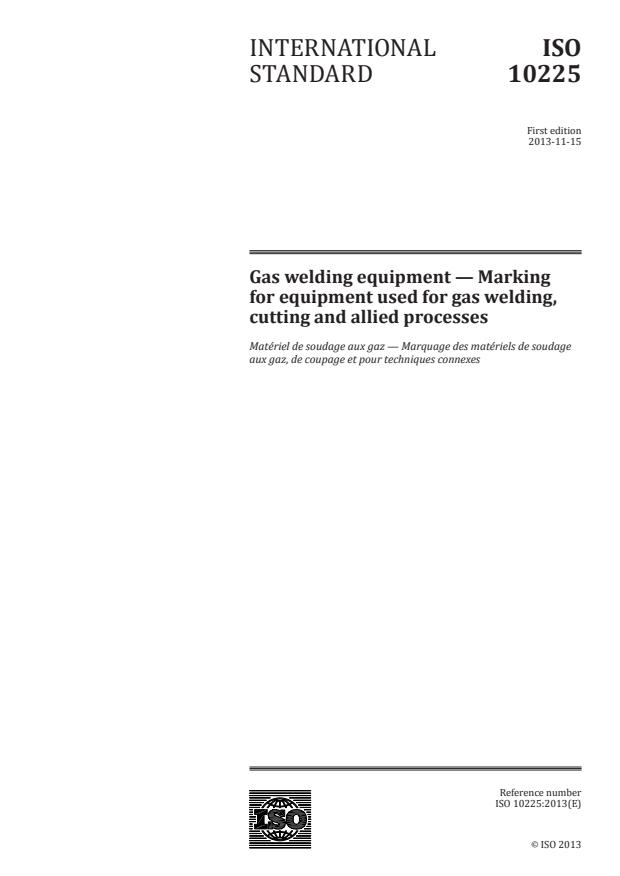
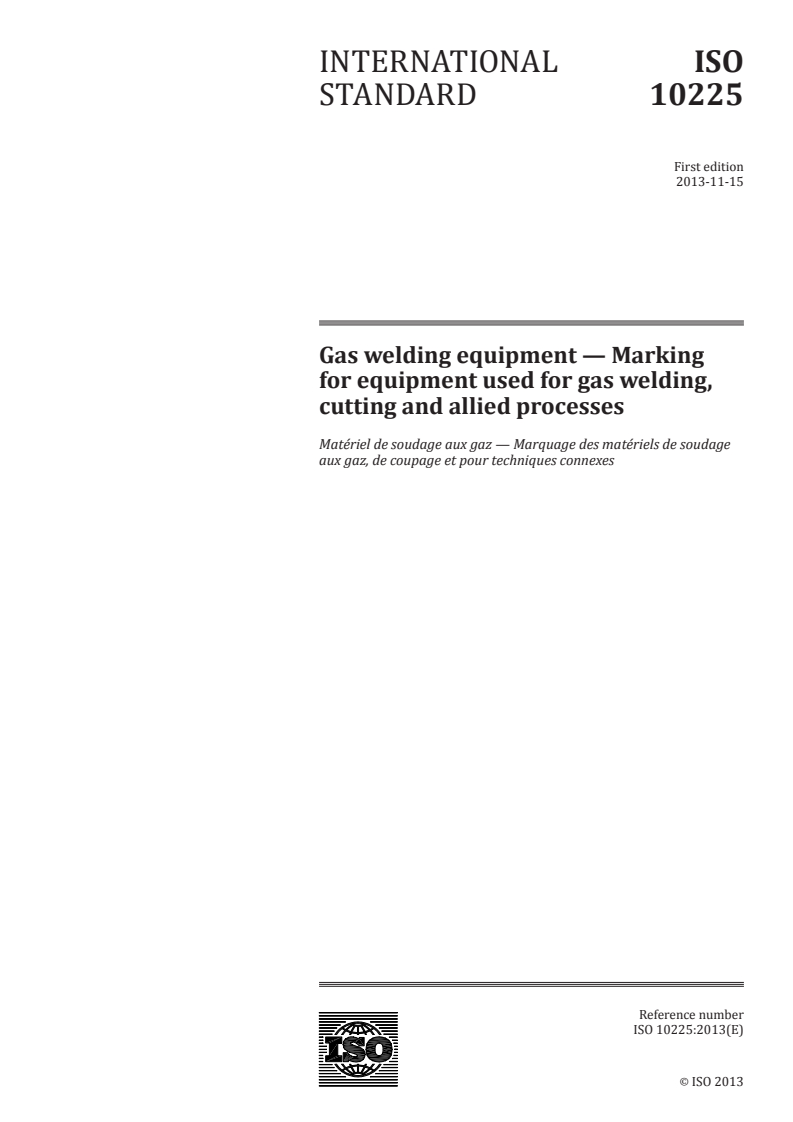
INTERNATIONAL ISO
STANDARD 10225
First edition
2013-11-15
Gas welding equipment — Marking
for equipment used for gas welding,
cutting and allied processes
Matériel de soudage aux gaz — Marquage des matériels de soudage
aux gaz, de coupage et pour techniques connexes
Reference number
©
ISO 2013
© ISO 2013
All rights reserved. Unless otherwise specified, no part of this publication may be reproduced or utilized otherwise in any form
or by any means, electronic or mechanical, including photocopying, or posting on the internet or an intranet, without prior
written permission. Permission can be requested from either ISO at the address below or ISO’s member body in the country of
the requester.
ISO copyright office
Case postale 56 • CH-1211 Geneva 20
Tel. + 41 22 749 01 11
Fax + 41 22 749 09 47
E-mail copyright@iso.org
Web www.iso.org
Published in Switzerland
ii © ISO 2013 – All rights reserved
Contents Page
Foreword .iv
Introduction .v
1 Scope . 1
2 Gas marking . 1
Foreword
ISO (the International Organization for Standardization) is a worldwide federation of national standards
bodies (ISO member bodies). The work of preparing International Standards is normally carried out
through ISO technical committees. Each member body interested in a subject for which a technical
committee has been established has the right to be represented on that committee. International
organizations, governmental and non-governmental, in liaison with ISO, also take part in the work.
ISO collaborates closely with the International Electrotechnical Commission (IEC) on all matters of
electrotechnical standardization.
The procedures us
...
INTERNATIONAL ISO
STANDARD 10225
First edition
2013-11-15
Gas welding equipment — Marking
for equipment used for gas welding,
cutting and allied processes
Matériel de soudage aux gaz — Marquage des matériels de soudage
aux gaz, de coupage et pour techniques connexes
Reference number
©
ISO 2013
© ISO 2013
All rights reserved. Unless otherwise specified, no part of this publication may be reproduced or utilized otherwise in any form
or by any means, electronic or mechanical, including photocopying, or posting on the internet or an intranet, without prior
written permission. Permission can be requested from either ISO at the address below or ISO’s member body in the country of
the requester.
ISO copyright office
Case postale 56 • CH-1211 Geneva 20
Tel. + 41 22 749 01 11
Fax + 41 22 749 09 47
E-mail copyright@iso.org
Web www.iso.org
Published in Switzerland
ii © ISO 2013 – All rights reserved
Contents Page
Foreword .iv
Introduction .v
1 Scope . 1
2 Gas marking . 1
Foreword
ISO (the International Organization for Standardization) is a worldwide federation of national standards
bodies (ISO member bodies). The work of preparing International Standards is normally carried out
through ISO technical committees. Each member body interested in a subject for which a technical
committee has been established has the right to be represented on that committee. International
organizations, governmental and non-governmental, in liaison with ISO, also take part in the work.
ISO collaborates closely with the International Electrotechnical Commission (IEC) on all matters of
electrotechnical standardization.
The procedures us
...
NORME ISO
INTERNATIONALE 10225
Première édition
2013-11-15
Matériel de soudage aux gaz —
Marquage des matériels de soudage
aux gaz, de coupage et pour
techniques connexes
Gas welding equipment — Marking for equipment used for gas
welding, cutting and allied processes
Numéro de référence
©
ISO 2013
DOCUMENT PROTÉGÉ PAR COPYRIGHT
© ISO 2013
Droits de reproduction réservés. Sauf indication contraire, aucune partie de cette publication ne peut être reproduite ni utilisée
sous quelque forme que ce soit et par aucun procédé, électronique ou mécanique, y compris la photocopie, l’affichage sur
l’internet ou sur un Intranet, sans autorisation écrite préalable. Les demandes d’autorisation peuvent être adressées à l’ISO à
l’adresse ci-après ou au comité membre de l’ISO dans le pays du demandeur.
ISO copyright office
Case postale 56 • CH-1211 Geneva 20
Tel. + 41 22 749 01 11
Fax + 41 22 749 09 47
E-mail copyright@iso.org
Web www.iso.org
Publié en Suisse
ii © ISO 2013 – Tous droits réservés
Sommaire Page
Avant-propos .iv
Introduction .v
1 Domaine d’application . 1
2 Marquage des gaz. 1
Avant-propos
L’ISO (Organisation internationale de normalisation) est une fédération mondiale d’organismes
nationaux de normalisation (comités membres de l’ISO). L’élaboration des Normes internationales est
en général confiée aux comités techniques de l’ISO. Chaque comité membre intéressé par une étude
a le droit de faire partie du comité technique créé à cet effet. Les organisations internationales,
gouvernementales et non gouvernementales, en liaison avec l’ISO participent également aux travaux.
L’ISO collabore étroitement avec la Commission électrotechnique internationale (CEI) en ce qui concerne
la normalisation électrotechnique.
Les procédures utilisées pour élaborer le présent document et celles destinées à sa mise à jour sont
décrites dans les Directives ISO/CEI, Partie 1. Il convient, en particulier de prendre note des différents
critères d’approbation requis pour les différents types de documents ISO. Le présent document a été
rédigé c
...
NORME ISO
INTERNATIONALE 10225
Première édition
2013-11-15
Matériel de soudage aux gaz —
Marquage des matériels de soudage
aux gaz, de coupage et pour
techniques connexes
Gas welding equipment — Marking for equipment used for gas
welding, cutting and allied processes
Numéro de référence
©
ISO 2013
DOCUMENT PROTÉGÉ PAR COPYRIGHT
© ISO 2013
Droits de reproduction réservés. Sauf indication contraire, aucune partie de cette publication ne peut être reproduite ni utilisée
sous quelque forme que ce soit et par aucun procédé, électronique ou mécanique, y compris la photocopie, l’affichage sur
l’internet ou sur un Intranet, sans autorisation écrite préalable. Les demandes d’autorisation peuvent être adressées à l’ISO à
l’adresse ci-après ou au comité membre de l’ISO dans le pays du demandeur.
ISO copyright office
Case postale 56 • CH-1211 Geneva 20
Tel. + 41 22 749 01 11
Fax + 41 22 749 09 47
E-mail copyright@iso.org
Web www.iso.org
Publié en Suisse
ii © ISO 2013 – Tous droits réservés
Sommaire Page
Avant-propos .iv
Introduction .v
1 Domaine d’application . 1
2 Marquage des gaz. 1
Avant-propos
L’ISO (Organisation internationale de normalisation) est une fédération mondiale d’organismes
nationaux de normalisation (comités membres de l’ISO). L’élaboration des Normes internationales est
en général confiée aux comités techniques de l’ISO. Chaque comité membre intéressé par une étude
a le droit de faire partie du comité technique créé à cet effet. Les organisations internationales,
gouvernementales et non gouvernementales, en liaison avec l’ISO participent également aux travaux.
L’ISO collabore étroitement avec la Commission électrotechnique internationale (CEI) en ce qui concerne
la normalisation électrotechnique.
Les procédures utilisées pour élaborer le présent document et celles destinées à sa mise à jour sont
décrites dans les Directives ISO/CEI, Partie 1. Il convient, en particulier de prendre note des différents
critères d’approbation requis pour les différents types de documents ISO. Le présent document a été
rédigé c
...