


ISO 7176-14:2008
(Main)Wheelchairs — Part 14: Power and control systems for electrically powered wheelchairs and scooters — Requirements and test methods
Wheelchairs — Part 14: Power and control systems for electrically powered wheelchairs and scooters — Requirements and test methods
ISO 7176-14:2008 specifies requirements and associated test methods for the power and control systems of electrically powered wheelchairs and scooters. It sets safety and performance requirements that apply during normal use and some conditions of abuse and failure. It also specifies methods of measurement of the forces necessary to operate controls and sets limits on the forces needed for some operations. ISO 7176-14:2008 is applicable to electrically powered wheelchairs and scooters with a maximum speed no greater than 15 km/h intended to provide indoor and/or outdoor mobility for one disabled person whose mass lies in the range specified in ISO 7176-11.
Fauteuils roulants — Partie 14: Systèmes d'alimentation et de commande des fauteuils roulants et des scooters électriques — Exigences et méthodes d'essai
General Information
- Status
- Withdrawn
- Publication Date
- 10-Feb-2008
- Technical Committee
- ISO/TC 173/SC 1 - Wheelchairs
- Drafting Committee
- ISO/TC 173/SC 1 - Wheelchairs
- Current Stage
- 9599 - Withdrawal of International Standard
- Start Date
- 04-Mar-2022
- Completion Date
- 12-Feb-2026
Relations
- Effective Date
- 10-Dec-2016
- Effective Date
- 15-Apr-2008




Get Certified
Connect with accredited certification bodies for this standard

BSI Group
BSI (British Standards Institution) is the business standards company that helps organizations make excellence a habit.

TÜV Rheinland
TÜV Rheinland is a leading international provider of technical services.

TÜV SÜD
TÜV SÜD is a trusted partner of choice for safety, security and sustainability solutions.
Sponsored listings
Frequently Asked Questions
ISO 7176-14:2008 is a standard published by the International Organization for Standardization (ISO). Its full title is "Wheelchairs — Part 14: Power and control systems for electrically powered wheelchairs and scooters — Requirements and test methods". This standard covers: ISO 7176-14:2008 specifies requirements and associated test methods for the power and control systems of electrically powered wheelchairs and scooters. It sets safety and performance requirements that apply during normal use and some conditions of abuse and failure. It also specifies methods of measurement of the forces necessary to operate controls and sets limits on the forces needed for some operations. ISO 7176-14:2008 is applicable to electrically powered wheelchairs and scooters with a maximum speed no greater than 15 km/h intended to provide indoor and/or outdoor mobility for one disabled person whose mass lies in the range specified in ISO 7176-11.
ISO 7176-14:2008 specifies requirements and associated test methods for the power and control systems of electrically powered wheelchairs and scooters. It sets safety and performance requirements that apply during normal use and some conditions of abuse and failure. It also specifies methods of measurement of the forces necessary to operate controls and sets limits on the forces needed for some operations. ISO 7176-14:2008 is applicable to electrically powered wheelchairs and scooters with a maximum speed no greater than 15 km/h intended to provide indoor and/or outdoor mobility for one disabled person whose mass lies in the range specified in ISO 7176-11.
ISO 7176-14:2008 is classified under the following ICS (International Classification for Standards) categories: 11.180.10 - Aids and adaptation for moving. The ICS classification helps identify the subject area and facilitates finding related standards.
ISO 7176-14:2008 has the following relationships with other standards: It is inter standard links to ISO 7176-14:2022, ISO 7176-14:1997. Understanding these relationships helps ensure you are using the most current and applicable version of the standard.
ISO 7176-14:2008 is available in PDF format for immediate download after purchase. The document can be added to your cart and obtained through the secure checkout process. Digital delivery ensures instant access to the complete standard document.
Standards Content (Sample)
INTERNATIONAL ISO
STANDARD 7176-14
Second edition
2008-02-15
Wheelchairs —
Part 14:
Power and control systems for
electrically powered wheelchairs and
scooters — Requirements and test
methods
Fauteuils roulants —
Partie 14: Systèmes d'alimentation et de commande des fauteuils
roulants et des scooters électriques — Exigences et méthodes d'essai
Reference number
©
ISO 2008
PDF disclaimer
This PDF file may contain embedded typefaces. In accordance with Adobe's licensing policy, this file may be printed or viewed but
shall not be edited unless the typefaces which are embedded are licensed to and installed on the computer performing the editing. In
downloading this file, parties accept therein the responsibility of not infringing Adobe's licensing policy. The ISO Central Secretariat
accepts no liability in this area.
Adobe is a trademark of Adobe Systems Incorporated.
Details of the software products used to create this PDF file can be found in the General Info relative to the file; the PDF-creation
parameters were optimized for printing. Every care has been taken to ensure that the file is suitable for use by ISO member bodies. In
the unlikely event that a problem relating to it is found, please inform the Central Secretariat at the address given below.
© ISO 2008
All rights reserved. Unless otherwise specified, no part of this publication may be reproduced or utilized in any form or by any means,
electronic or mechanical, including photocopying and microfilm, without permission in writing from either ISO at the address below or
ISO's member body in the country of the requester.
ISO copyright office
Case postale 56 • CH-1211 Geneva 20
Tel. + 41 22 749 01 11
Fax + 41 22 749 09 47
E-mail copyright@iso.org
Web www.iso.org
Published in Switzerland
ii © ISO 2008 – All rights reserved
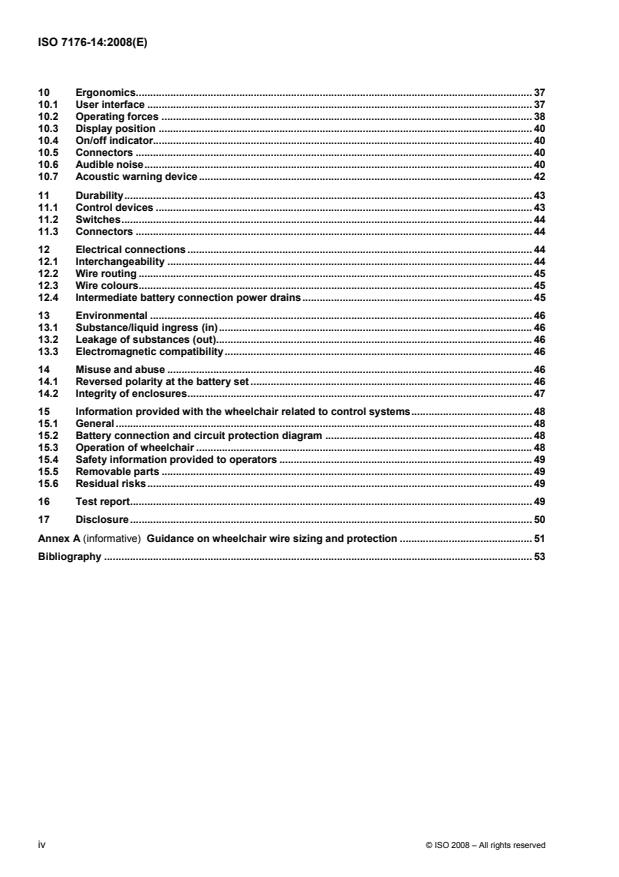
Contents Page
Foreword. v
Introduction . vii
1 Scope . 1
2 Normative references . 1
3 Terms and definitions. 2
4 Apparatus . 5
5 Preparation of test wheelchair . 8
5.1 Wheelchair set-up. 8
5.2 Loading the wheelchair. 8
5.3 Wheelchair attributes . 8
5.4 Wheelchair documentation. 8
5.5 Preparation records. 9
6 Guidance for tests . 9
6.1 Test order . 9
6.2 Batteries. 9
6.3 Test conditions . 9
7 Single fault safety . 9
7.1 Single fault conditions . 9
7.2 Controller command signal processing failure . 10
7.3 Controller output device failure . 12
7.4 Ability to stop when power is removed. 15
8 Design . 17
8.1 On/off switch . 17
8.2 Current consumption while switched off . 17
8.3 Control signal at switch on. 18
8.4 Safe operation as the battery set becomes depleted. 18
8.5 Over-discharge protection. 20
8.6 Controller over-voltage protection. 21
8.7 Switch-off while driving. 22
8.8 Measuring devices. 22
8.9 Drive inhibit during charging. 23
8.10 Charging connection voltage drop . 23
8.11 Non-powered mobility . 24
8.12 Brakes . 26
8.13 Battery enclosures. 27
8.14 Symbols . 28
8.15 Safety of moving parts . 28
8.16 Use in combination with other devices . 28
9 Protection against electric shock, burns, fire and explosion . 28
9.1 Electrical insulation. 28
9.2 Protection from non-insulated electrical parts. 29
9.3 Circuit protection. 29
9.4 Stalled condition protection . 34
9.5 Surface temperatures. 36
9.6 Disconnection of battery system . 37
9.7 Resistance to ignition. 37
10 Ergonomics. 37
10.1 User interface . 37
10.2 Operating forces . 38
10.3 Display position . 40
10.4 On/off indicator. 40
10.5 Connectors . 40
10.6 Audible noise. 40
10.7 Acoustic warning device . 42
11 Durability. 43
11.1 Control devices . 43
11.2 Switches. 44
11.3 Connectors . 44
12 Electrical connections . 44
12.1 Interchangeability . 44
12.2 Wire routing . 45
12.3 Wire colours. 45
12.4 Intermediate battery connection power drains. 45
13 Environmental . 46
13.1 Substance/liquid ingress (in). 46
13.2 Leakage of substances (out). 46
13.3 Electromagnetic compatibility. 46
14 Misuse and abuse . 46
14.1 Reversed polarity at the battery set . 46
14.2 Integrity of enclosures. 47
15 Information provided with the wheelchair related to control systems. 48
15.1 General . 48
15.2 Battery connection and circuit protection diagram . 48
15.3 Operation of wheelchair . 48
15.4 Safety information provided to operators .49
15.5 Removable parts . 49
15.6 Residual risks. 49
16 Test report. 49
17 Disclosure. 50
Annex A (informative) Guidance on wheelchair wire sizing and protection . 51
Bibliography . 53
iv © ISO 2008 – All rights reserved
Foreword
ISO (the International Organization for Standardization) is a worldwide federation of national standards bodies
(ISO member bodies). The work of preparing International Standards is normally carried out through ISO
technical committees. Each member body interested in a subject for which a technical committee has been
established has the right to be represented on that committee. International organizations, governmental and
non-governmental, in liaison with ISO, also take part in the work. ISO collaborates closely with the
International Electrotechnical Commission (IEC) on all matters of electrotechnical standardization.
International Standards are drafted in accordance with the rules given in the ISO/IEC Directives, Part 2.
The main task of technical committees is to prepare International Standards. Draft International Standards
adopted by the technical committees are circulated to the member bodies for voting. Publication as an
International Standard requires approval by at least 75 % of the member bodies casting a vote.
Attention is drawn to the possibility that some of the elements of this document may be the subject of patent
rights. ISO shall not be held responsible for identifying any or all such patent rights.
ISO 7176-14 was prepared by Technical Committee ISO/TC 173, Assistive products for persons with disability,
Subcommittee SC 1, Wheelchairs.
This second edition cancels and replaces the first edition (ISO 7176-14:1997), all clauses of which have been
technically revised.
ISO 7176 consists of the following parts, under the general title Wheelchairs:
⎯ Part 1: Determination of static stability
⎯ Part 2: Determination of dynamic stability of electric wheelchairs
⎯ Part 3: Determination of effectiveness of brakes
⎯ Part 4: Energy consumption of electric wheelchairs and scooters for determination of theoretical distance
range
⎯ Part 5: Determination of dimensions, mass and manoeuvring space
⎯ Part 6: Determination of maximum speed, acceleration and deceleration of electric wheelchairs
⎯ Part 7: Measurement of seating and wheel dimensions
⎯ Part 8: Requirements and test methods for static, impact and fatigue strengths
⎯ Part 9: Climatic tests for electric wheelchairs
⎯ Part 10: Determination of obstacle-climbing ability of electric wheelchairs
⎯ Part 11: Test dummies
⎯ Part 13: Determination of coefficient of friction of test surfaces
⎯ Part 14: Power and control systems for electrically powered wheelchairs and scooters — Requirements
and test methods
⎯ Part 15: Requirements for information disclosure, documentation and labelling
⎯ Part 16: Resistance to ignition of upholstered parts — Requirements and test methods
⎯ Part 19: Wheeled mobility devices for use in motor vehicles
⎯ Part 21: Requirements and test methods for electromagnetic compatibility of electrically powered
wheelchairs and motorized scooters
⎯ Part 22: Set-up procedures
⎯ Part 23: Requirements and test methods for attendant-operated stair-climbing devices
⎯ Part 24: Requirements and test methods for user-operated stair-climbing devices
⎯ Part 26: Vocabulary
vi © ISO 2008 – All rights reserved
Introduction
This part of ISO 7176 specifies some wheelchair tests that are conducted on an inclined test plane. The
intention of these tests is not to evaluate the performance of a wheelchair at the maximum gradient on which it
is capable of operating. Instead, the objective is to reveal any changes in the wheelchair’s behaviour that
might occur under fault conditions, and these changes are more readily discovered when it is operated on a
slope. For convenience, the inclined test plane has a fixed gradient, representative of those on which the
wheelchair might be used.
The range of ambient temperatures under which testing is carried out is limited to allow comparison between
the performance of a wheelchair in normal operation and performance when faults are introduced.
INTERNATIONAL STANDARD ISO 7176-14:2008(E)
Wheelchairs —
Part 14:
Power and control systems for electrically powered wheelchairs
and scooters — Requirements and test methods
WARNING — This part of ISO 7176 calls for the use of procedures that may be injurious to health if
adequate precautions are not taken. It refers only to technical suitability and does not absolve those
carrying out or commissioning the tests from legal obligations relating to health and safety. For tests
that could cause the wheelchair to exhibit dangerous behaviour, it is recommended that prior to
carrying out those tests, the likely outcome is assessed to establish appropriate arrangements to
minimize any risks.
1 Scope
This part of ISO 7176 specifies requirements and associated test methods for the power and control systems
of electrically powered wheelchairs and scooters. It sets safety and performance requirements that apply
during normal use and some conditions of abuse and failure. It also specifies methods of measurement of the
forces necessary to operate controls and sets limits on the forces needed for some operations.
This part of ISO 7176 is applicable to electrically powered wheelchairs and scooters with a maximum speed
no greater than 15 km/h intended to provide indoor and/or outdoor mobility for one disabled person whose
mass lies in the range specified in ISO 7176-11.
2 Normative references
The following referenced documents are indispensable for the application of this document. For dated
references, only the edition cited applies. For undated references, the latest edition of the referenced
document (including any amendments) applies.
ISO 3287, Powered industrial trucks — Symbols for operator controls and other displays
ISO 7176-3, Wheelchairs — Part 3: Determination of effectiveness of brakes
ISO 7176-4, Wheelchairs — Part 4: Energy consumption of electric wheelchairs and scooters for
determination of theoretical distance range
ISO 7176-6, Wheelchairs — Part 6: Determination of maximum speed, acceleration and deceleration of
electric wheelchairs
ISO 7176-9, Wheelchairs — Part 9: Climatic tests for electric wheelchairs
ISO 7176-11, Wheelchairs — Part 11: Test dummies
SO 7176-13, Wheelchairs — Part 13: Determination of coefficient of friction of test surfaces
ISO 7176-15, Wheelchairs — Part 15: Requirements for information disclosure, documentation and labelling
ISO 7176-21, Wheelchairs — Part 21: Requirements and test methods for electromagnetic compatibility of
electrically powered wheelchairs and motorized scooters
ISO 7176-22, Wheelchairs — Part 22: Set-up procedures
ISO 7176-26, Wheelchairs — Part 26: Vocabulary
IEC 60529, Degrees of protection provided by enclosures (IP Code)
IEC 60601-1, Medical electrical equipment — Part 1: General requirements for basic safety and essential
performance
IEC 60601-1-2, Medical electrical equipment — Part 1-2: General requirements for basic safety and essential
performance — Collateral standard: Electromagnetic compatibility — Requirements and tests
IEC 61032, Protection of persons and equipment by enclosures — Probes for verification
IEC 62262, Degrees of protection provided by enclosures for electrical equipment against external mechanical
impacts (IK code)
EN 563, Safety of machinery — Temperatures of touchable surfaces — Ergonomics data to establish
temperature limit values for hot surfaces
EN 12182, Technical aids for disabled persons — General requirements and test methods
EN 30993-1, Biological evaluation of medical devices — Part 1: Guidance on selection of tests
UL 94, Tests for flammability of plastic materials for parts in devices and appliances
3 Terms and definitions
For the purposes of this document, the terms and definitions given in ISO 7176-26 and the following apply.
3.1
nominal voltage
suitable approximate value of the voltage used to designate or identify a battery
[Adapted from IEV 482-03-31]
3.2
command signal
electrical signal from the control device
3.3
control device
device with which the operator indicates the desired speed and/or direction of movement of the wheelchair
NOTE A control device can be an integral part of a controller.
3.4
controller
electrical devices, circuits, and the case(s) in which they are housed that are used to convert the operator's
indication of desired speed and/or direction of movement into the appropriate power to be supplied to the
motor(s)
3.5
pinch point
location at which a moving part comes into contact with or close proximity to another part such that another
object at that location would be cut or crushed
2 © ISO 2008 – All rights reserved
3.6
battery
one or more cells fitted with devices necessary for use, for example case, terminals, marking and protective
devices
[IEV 482-01-04]
3.7
battery compartment
removable or non-removable enclosure for one or more batteries
3.8
battery pack
removable battery compartment that contains one or more batteries
NOTE If there are no removable battery compartments, a battery pack consists of a single battery.
3.9
battery set
set of interconnected batteries used to power a wheelchair
3.10
battery charger
device that is connected to supply mains and to a battery set for the purpose of charging the batteries
3.11
cut-off voltage
specified voltage at which the discharge of a battery is considered finished
3.12
hazardous situation
circumstance in which people, property or the environment are exposed to one or more hazard(s)
[IEC 60601-1]
3.13
hazard
potential source of harm
[IEC 60601-1]
3.14
harm
physical injury or damage to the health of people or animals, or damage to property or the environment
[IEC 60601-1]
3.15
enclosure
part providing protection of equipment against certain external influences and, in any direction, protection
against contact
NOTE 1 Enclosures provide protection of equipment against harmful effects of mechanical impacts.
NOTE 2 Barriers, shapes of openings or any other means – whether attached to the enclosure or formed by the
enclosed equipment – suitable to prevent or limit the penetration of the specified test probes, are considered as a part of
the enclosure, except when they can be removed without the use of a key or tool.
3.16
capacity
〈for cells or batteries〉 electric charge which a cell or battery can deliver under specified discharge conditions
NOTE The SI unit for electric charge, or quantity of electricity, is the coulomb, C [1 C = 1 As (ampere second)] but in
practice, capacity is usually expressed in ampere hours (Ah).
[IEV 482-03-14]
3.17
rated capacity
capacity value of a battery determined under specified conditions and declared by the manufacturer
[IEV 482-03-15]
3.18
discharge rate
electric current at which a battery is discharged
NOTE The discharge rate is calculated as the rated capacity divided by the corresponding discharge time, which
results in an electric current.
[IEV 482-03-25]
3.19
charge rate
〈relating to secondary cells and batteries〉 electric current at which a secondary cell or battery is charged
NOTE The charge rate is expressed as the reference current I = C /n where C is the rated capacity declared by the
t r r
manufacturer and n is the time base in hours for which the rated capacity is declared.
[IEV 482-05-45]
3.20
theoretical state of charge
electric charge added to a fully discharged battery by charging at a known charge rate for a known time, or
estimated to remain in a battery that has been fully charged and then discharged at a known discharge rate
for a known time, and expressed as a percentage of the rated capacity
3.21
terminal
conductive part of a device, electric circuit or electric network, provided for connecting that device, electric
circuit or electric network to one or more external conductors
[IEV 151-12-12]
NOTE Removable bolts, screws and fasteners are not considered part of a terminal.
3.22
analogue signal
signal in which the characteristic quantity representing information may at any instant assume any value within
a continuous interval
NOTE For instance, an analogue signal may follow continuously the values of another physical quantity representing
information.
[IEV 702-04-02]
4 © ISO 2008 – All rights reserved
3.23
leakage current
electric current in an unwanted conductive path other than a short circuit
[IEV 151-15-49]
4 Apparatus
4.1 Inclined test plane, with a surface of sufficient friction (as specified in ISO 7176-13) to cause minimal
wheel slippage, of sufficient size to enable the applicable tests specified in this part of ISO 7176 to be
performed and with a marker from which wheelchair stopping distance can be measured.
The inclined test plane shall be fixed at 3° or 6° to the horizontal. The steeper gradient shall be used unless
the loaded wheelchair (see 5.2) is unable to climb it at a speed greater than 0,5 km/h.
NOTE An inclined test plane of size 6,0 m × 1,5 m will usually be suitable for testing a wheelchair with a maximum
speed of 6 km/h.
4.2 Horizontal test plane, with the same high-friction surface as the inclined test plane (4.1), and of
sufficient size to enable the applicable tests specified in this part of ISO 7176 to be performed.
NOTE A horizontal test plane of size 6,0 m × 1,5 m will usually be suitable for testing a wheelchair with a maximum
speed of 6 km/h.
4.3 Acoustic test area, marked on a horizontal plane in a room with an ambient noise level not exceeding
55 dB(A-weighted) and of sufficient length for the wheelchair to attain its maximum speed before reaching the
test area specified in 10.6 and to stop safely beyond the test area.
4.4 Speedometer, or other means for measuring the speed of a wheelchair within a range of 0 km/h to
20 km/h, to an accuracy of ± 0,5 km/h.
4.5 Means of measuring stopping distance of a wheelchair, to an accuracy of ± 100 mm.
NOTE It is important that the means for measuring the speed (4.4) and stopping distance give the required accuracy.
Suitable methods include:
a) a photocell-operated interrupting switch capable of detecting reflective tape or a light source on the test plane;
b) a “fifth wheel” capable of recording the distance travelled where the recording device can be started by the
interrupting switch.
4.6 Voltage source, with a voltage adjustable in the range 0,25 U to 1,5 U , where U is the nominal
B B B
voltage of the battery set, expressed in volts.
The voltage source shall be capable of supplying the peak current drawn from the battery set during
wheelchair operation and shall be capable of sinking the peak current returned to the battery during
wheelchair operation. Any change in the voltage shall be no greater than 5 % of U while the current is within
B
this range.
4.7 Test probe B, as specified in IEC 61032.
4.8 Test probe 18, as specified in IEC 61032.
4.9 Test probe 11, as specified in IEC 61032, capable of attachment to a force measuring instrument
(4.11). See Figure 1.
Dimensions in millimetres
Key
1 force measuring instrument
2 stop plate
Figure 1 — Test probe 11 (informative)
4.10 Small unjointed test probe, constructed as specified for test probe 18 (4.8), but without joints, and
capable of attachment to a force measuring instrument (4.11) both with and without the handle extension.
4.11 Force measuring instrument, capable of measuring forces in the range of 0 N to 150 N in increments
of 1 N with an accuracy of ± 1 N.
4.12 Force measuring instrument for control devices, capable of measuring forces in a range of 0 N to
10 N in 0,1 N increments with an accuracy of ± 0,1 N, and that can be fitted with a rigid spherical tip of radius
5,0 mm ± 0,2 mm.
4.13 Positive differential air pressure measuring device, capable of measuring positive differential air
pressure, relative to local atmospheric pressure, in a range of 0 kPa to 20 kPa in 200 Pa increments with an
accuracy of ± 200 Pa.
6 © ISO 2008 – All rights reserved
4.14 Negative differential air pressure measuring device, capable of measuring negative differential air
pressure, relative to local atmospheric pressure, in a range of 0 kPa to -20 kPa in 200 Pa increments with an
accuracy of ± 200 Pa.
4.15 Test circuit, that can be arranged as shown in Figure 2 and Figure 3, comprising the following:
a) direct current ammeter, capable of measuring current in the range 0 mA to 10 mA in 1 mA increments
with an accuracy of ± 1 mA, and capable of withstanding a current of 100 mA;
b) a resistor of resistance R ± 5 %, where R (in ohms) is calculated from the following expression:
U
B
R =
0,1
where U is the nominal voltage of the battery set.
B
EXAMPLE At 12 V, R is 120 W; at 24 V, R is 240 W.
The minimum power rating P (in watts) of the resistor is calculated from the following expression:
P = 0,1 × U
B
c) test probe 11 (4.9).
Key
1 test probe
2 wheelchair battery set
Figure 2 — Test circuit in positive configuration
Key
1 test probe
2 wheelchair battery set
Figure 3 — Test circuit in negative configuration
4.16 Circuit breaker, manually operated, capable of interrupting the maximum possible current obtainable
from the battery set or batteries, such that the voltage drop across the circuit breaker and its associated wiring
at that current does not exceed 10 % of the nominal voltage of the battery set.
NOTE Typical wheelchair batteries have maximum short-circuit currents of several hundred amperes.
4.17 Means for supporting the wheelchair, such that it is upright and secure, with all wheels lifted off the
ground and free to revolve.
4.18 Means for measuring sound pressure level, to an accuracy of ± 3 dB(A-weighted).
4.19 Fine wire thermocouples, with suitable means for indicating temperature to an accuracy of ± 2 °C.
4.20 Means for measuring motor current, to an accuracy of ± 5 % of the maximum stall current of the
wheelchair motors.
4.21 Test track, as specified in ISO 7176-4.
4.22 Voltmeter, capable of measuring the voltage of the battery set to an accuracy of ± 1 %.
4.23 Variable resistance, capable of being set within the range 20 kΩ to 1 MΩ.
5 Preparation of test wheelchair
5.1 Wheelchair set-up
Set up the wheelchair in accordance with ISO 7176-22.
NOTE The battery set-up is changed for some tests.
5.2 Loading the wheelchair
If required for a particular test, load the wheelchair using one of the following:
a) a dummy as specified in ISO 7176-22, selected and fitted as specified in that part of ISO 7176;
b) a human test occupant, combined with a mass evenly distributed over the seat of the wheelchair such that
+2
the total is within kg of the mass of the dummy specified in a).
Where a dummy is fitted to a wheelchair that has an anterior pelvic support, the support should be used to
restrain the dummy.
Where a human test occupant is used, it is essential that appropriate precautions be taken to ensure the
person's safety.
NOTE Use of anterior pelvic support by a human test occupant may be hazardous, for example in the event that the
test occupant needs to get out of the chair quickly.
5.3 Wheelchair attributes
Measure and record the maximum speed, v, of the wheelchair on a horizontal surface by the method specified
in ISO 7176-6.
Measure and record the maximum stopping distance, L , at speed (0,5 ± 0,05) × v, of the wheelchair moving
I
down the inclined test plane (4.1) by the method specified in ISO 7176-3 for normal operation.
5.4 Wheelchair documentation
Obtain circuit diagrams for the wheelchair from the wheelchair manufacturer.
8 © ISO 2008 – All rights reserved
5.5 Preparation records
Record the following information for each test:
a) the wheelchair equipment specified for the test;
b) the position of any adjustable parts of a body support system;
c) the battery manufacturer and battery type reference;
d) the mass and configuration of the dummy or human load if used.
6 Guidance for tests
6.1 Test order
The tests used to verify the requirements given in Clauses 7 to 14 may be performed in any order, unless
otherwise stated in the test methods. Reverse any modifications made to the wheelchair for a test before
beginning another test. Repair or replace any parts of the wheelchair damaged during testing before
beginning another test. Record the nature of any such repairs in the test report. Repeat the applicable
procedures specified in Clause 5 after any such repairs.
6.2 Batteries
The manufacturer shall declare the nominal voltage and the cut-off voltage of the battery set.
6.3 Test conditions
Carry out the tests at an ambient temperature of 20 °C ± 5 °C.
7 Single fault safety
7.1 Single fault conditions
7.1.1 General
In the event of a single fault condition arising in a wheelchair, appropriate means should be adopted to
eliminate or reduce as far as possible consequent risks. However, wheelchair control systems are complex
and diverse, making it impractical to write specific requirements. Furthermore, because of the increasing
integration of electronic devices that are commonly used in control systems, it is possible that test personnel
have no direct access to many of the functional elements.
NOTE Software testing is not addressed in this edition of this part of ISO 7176, due to its impracticability.
7.1.2 Requirements
The manufacturer shall adopt appropriate means to eliminate or reduce as far as possible the probability of a
hazardous situation developing in the event of a single fault condition.
NOTE Single fault conditions that have been observed in wheelchairs include:
⎯ short and open circuits of conductors and wiring;
⎯ exposure of electronic components to liquids, such as rainwater and urine;
⎯ component failure, such as leakage, internal short circuit, latched logic state.
The manufacturer shall declare to test personnel the means by which the wheelchair is made safe against
single fault conditions.
7.2 Controller command signal processing failure
7.2.1 General
It is important that a single command signal error due to an open-circuit, short-circuit or leakage current does
not result in a hazardous situation.
7.2.2 Requirements
7.2.2.1 Provision shall be made to ensure that an open-circuit or short-circuit command signal failure
a) does not result in loss of control of the wheelchair other than to stop,
b) does not prevent the wheelchair from stopping when the control device is put in its stop position,
c) does not result in a hazardous situation.
When the wheelchair is tested in accordance with 7.2.3.2 and 7.2.3.3, it shall stop without tipping over within a
distance not exceeding 5 × L .
I
7.2.2.2 Testing the wheelchair in accordance with 7.2.3.4 shall not
a) result in any drive wheel turning with a circumferential speed that is greater than 0,1 m/s,
b) result in movement greater than 10 mm of any part of the wheelchair that usually comes into contact with
the occupant,
c) result in a hazardous situation (e.g. fire).
7.2.3 Test method
WARNING — This test can be hazardous. It is essential that appropriate safety precautions be taken to
protect test personnel. A wide test area is needed since the wheelchair may start moving at maximum
speed in an uncontrolled way.
7.2.3.1 Preparation
7.2.3.1.1 Examine the wheelchair and its circuit diagram to locate
⎯ control device conductors that carry signals involved in the speed and/or direction control of the
wheelchair,
⎯ conductors that supply power and/or reference signals to the control device,
⎯ conductors that carry signals involved in controlling the motion of parts of the wheelchair that usually
come into contact with the occupant,
and which are suitable for introducing disturbances into those signals that could affect the control of the
wheelchair.
NOTE Suitable conductors can include discrete wires, component leads, connector terminals and printed circuit
tracks.
10 © ISO 2008 – All rights reserved
7.2.3.1.2 Identify one point on each of the conductors identified in 7.2.3.1.1 which may be used for
introducing open circuits in them.
7.2.3.1.3 For each of the conductors identified in 7.2.3.1.1, identify all other conductors where it is
reasonably foreseeable that a short circuit could occur between them.
7.2.3.1.4 Among the conductors identified in 7.2.3.1.1, identify each conductor that is used to carry an
analogue signal.
7.2.3.1.5 For each of the conductors identified in 7.2.3.1.4, identify all other conductors where it is
reasonably foreseeable that a current leakage path due to contamination from liquids could occur between
them.
NOTE 1 Examples include: conductors in a cable connecting the control device enclosure to another component or
enclosure; adjacent connector terminals in exposed connectors on the control device enclosure; adjacent conductors
inside the control device enclosure that could get wet if the enclosure were damaged and liquid were to leak into it.
NOTE 2 Examples of conductors not included: conductors in an encapsulated subassembly within the control device
enclosure; tracks or components on a printed circuit card assembly that are conformally coated.
NOTE 3 Enclosures that do not allow ingress of water when subjected to the test specified in 13.1 after being subjected
to the impact test specified in 14.2 may be considered unlikely to allow contamination by liquids, except where such
enclosures have fragile flexible components as part of their environmental protection, such as typical joystick gaiters.
7.2.3.2 Open-circuit test
Make provision for the wheelchair to be driven on the inclined test plane (4.1).
Switch off the controller and disconnect it from the battery set. For one of the points identified in 7.2.3.1.2,
disconnect the conductor to be tested and connect it via a switch back to its original connection. Close the
switch and reconnect the battery set.
Switch on the controller. Note the position of the marker on the test plane and drive the wheelchair forwards in
a straight line down the inclined test plane towards it until a speed of (0,5 ± 0,05) × v is achieved. When the
marker is reached, open the switch.
Measure along the centreline of the track of the driving wheels the distance taken to stop to an accuracy of
± 100 mm.
Switch off the controller and close the switch.
Reset and/or replace any circuit protection devices.
Switch on the controller. Note the position of the marker on the test plane and drive the wheelchair forwards in
a straight line down the inclined test plane towards it until a speed of (0,5 ± 0,05) × v is achieved. When the
marker is reached, open the switch and put the control device to its stop position.
Measure along the centre line of the track of the driving wheels the distance taken to stop to an accuracy of
± 100 mm.
Reset and/or replace any circuit protection devices.
Repeat the test for each of the conductors identified in 7.2.3.1.2.
7.2.3.3 Short-circuit test
Make provision for the wheelchair to be driven on the inclined test plane (4.1).
Switch off the controller and disconnect the battery set.
From those conductor pairs identified in 7.2.3.1.3, make provision for connecting the two conductors via a
switch without changing the original connections (to simulate a short circuit).
Open the switch and reconnect the battery set.
Switch on the controller. Note the position of the marker on the test plane and drive the wheelchair forwards in
a straight line down the inclined test plane towards it until a speed of (0,5 ± 0,05) × v is achieved. When the
marker is reached, close the switch.
Measure along the centreline of the track of the driving wheels the distance taken to stop to an accuracy of
± 100 mm.
Switch off the controller and open the switch.
Reset and/or replace any circuit protection devices.
Switch on the controller. Note the position of the marker on the test plane and drive the wheelchair forwards in
a straight line down the inclined test plane towards it until a speed of (0,5 ± 0,05) × v is achieved. When the
marker is reached, close the switch and put the control device to its stop position.
Measure along the centreline of the track of the driving wheels the distance taken to stop to an accuracy of
± 100 mm.
Reset and/or replace any circuit protection devices.
Repeat the test for every combination of two conductors from those identified in 7.2.3.1.3.
7.2.3.4 Leakage current test
Support the wheelchair by suitable means (4.17) so that it is secure with the drive wheels lifted off the ground
and free to revolve.
Switch off the controller and disconnect the battery set.
From those conductor pairs identified in 7.2.3.1.5, make provision for connecting the two conductors via a
variable resistance (4.23) without changing the original connections (to simulate a leakage current). Set the
variable resistance to its maximum value.
Reconnect the battery set and switch on the controller.
Adjust the variable resistance at a rate of change not exceeding 10 % of the present value of the varia
...
МЕЖДУНАРОДНЫЙ ISO
СТАНДАРТ 7176-14
Второе издание
2008-02-15
Кресла-коляски.
Часть 14.
Системы питания и управления для
кресел-колясок с электроприводом и
скутеров. Требования и методы
испытания
Wheelchairs —
Part 14: Power and control systems for electrically powered wheel-
chairs and scooters — Requirements and test methods
Ответственность за подготовку русской версии несёт GOST R
(Российская Федерация) в соответствии со статьёй 18.1 Устава ISO
Ccылочный номер
©
ISO 2008
Отказ от ответственности при работе в PDF
Настоящий файл PDF может содержать интегрированные шрифты. В соответствии с условиями лицензирования, принятыми
фирмой Adobe, этот файл можно распечатать или смотреть на экране, но его нельзя изменить, пока не будет получена ли-
цензия на интегрированные шрифты и они не будут установлены на компьютере, на котором ведется редактирование. В слу-
чае загрузки настоящего файла заинтересованные стороны принимают на себя ответственность за соблюдение лицензион-
ных условий фирмы Adobe. Центральный секретариат ISO не несет никакой ответственности в этом отношении.
Adobe — торговый знак фирмы Adobe Systems Incorporated.
Подробности, относящиеся к программным продуктам, использованные для создания настоящего файла PDF, можно найти в
рубрике General Info файла; параметры создания PDF были оптимизированы для печати. Были приняты во внимание все ме-
ры предосторожности с тем, чтобы обеспечить пригодность настоящего файла для использования комитетами-членами ISO.
В редких случаях возникновения проблемы, связанной со сказанным выше, просьба проинформировать Центральный секре-
тариат по адресу, приведенному ниже.
ДОКУМЕНТ ЗАЩИЩЕН АВТОРСКИМ ПРАВОМ
© ISO 2008
Все права сохраняются. Если не указано иное, никакую часть настоящей публикации нельзя копировать или использовать в ка-
кой-либо форме или каким-либо электронным или механическим способом, включая фотокопии и микрофильмы, без предвари-
тельного письменного согласия ISO, которое должно быть получено после запроса о разрешении, направленного по адресу,
приведенному ниже, или в комитет-член ISO в стране запрашивающей стороны.
ISO copyright office
Case postale 56 • CH-1211 Geneva 20
Tel. + 41 22 749 01 11
Fax + 41 22 749 09 47
E-mail copyright@iso.org
Web www.iso.org
Опубликовано в Швейцарии
ii © ISO 2008 — Все права сохраняются
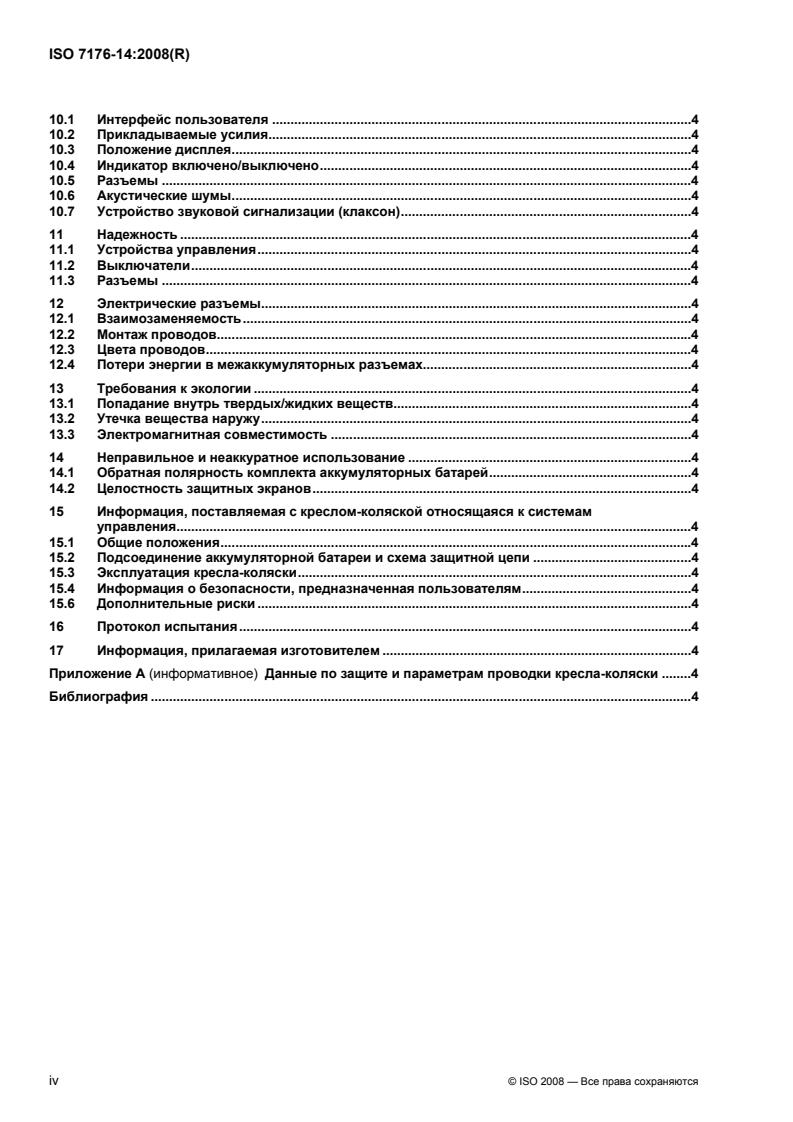
Содержание Страница
Предисловие .iv
Введение .iv
1 Область применения.4
2 Нормативные ссылки .4
3 Термины и определения .4
4 Оборудование для испытания и средства измерений .4
5 Подготовка кресла-коляски к испытаниям .4
5.1 Установка кресла-коляски .4
5.2 Нагрузка кресла-коляски.4
5.3 Характеристики кресла-коляски.4
5.4 Документация на кресло-коляску.4
5.5 Предварительные записи.4
6 Инструкция к испытаниям .4
6.1 Порядок провидения испытания.4
6.2 Аккумуляторные батареи .4
6.3 Условия проведения испытания.4
7 Устойчивость к единичному отказу.4
7.1 Условия единичного отказа.4
7.2 Командный сигнал контроллера в случае возникновения неисправности .4
7.3 Отказ выходного устройства контроллера.4
7.4 Способность остановиться при прекращении подачи питания .4
8 Конструктивные особенности.4
8.1 Выключатель .4
8.2 Потребление тока в выключенном состоянии .4
8.3 Сигнал управления во включенном состоянии .4
8.4 Безопасность функционирования при разрядке комплекта аккумуляторных батарей .4
8.5 Защита от чрезмерной разрядки .4
8.6 Защита контроллера от повышенного напряжения .4
8.7 Отключение во время движения.4
8.8 Средства измерений .4
8.9 Запрет на движение во время зарядки .4
8.10 Падение напряжения на соединительных проводах при зарядке .4
8.11 Подвижность без источника питания.4
8.12 Тормоза .4
8.13 Защитные экраны аккумуляторной батареи.4
8.14 Обозначения.4
8.15 Защита движущихся частей.4
8.16 Использование в сочетании с другими устройствами.4
9 Защита от удара электрическим током, ожогов, возгорания и взрыва .4
9.1 Электроизоляция.4
9.2 Защита от электрически неизолированных частей.4
9.3 Защита электрических цепей .4
9.4 Защита в застопоренном состоянии .4
9.5 Температура поверхности .4
9.6 Отсоединение аккумуляторной батареи.4
9.7 Огнестойкость .4
10 Эргономика .4
10.1 Интерфейс пользователя .4
10.2 Прикладываемые усилия.4
10.3 Положение дисплея.4
10.4 Индикатор включено/выключено.4
10.5 Разъемы .4
10.6 Акустические шумы.4
10.7 Устройство звуковой сигнализации (клаксон).4
11 Надежность .4
11.1 Устройства управления.4
11.2 Выключатели.4
11.3 Разъемы .4
12 Электрические разъемы.4
12.1 Взаимозаменяемость.4
12.2 Монтаж проводов.4
12.3 Цвета проводов.4
12.4 Потери энергии в межаккумуляторных разъемах.4
13 Требования к экологии .4
13.1 Попадание внутрь твердых/жидких веществ.4
13.2 Утечка вещества наружу.4
13.3 Электромагнитная совместимость .4
14 Неправильное и неаккуратное использование .4
14.1 Обратная полярность комплекта аккумуляторных батарей.4
14.2 Целостность защитных экранов.4
15 Информация, поставляемая с креслом-коляской относящаяся к системам
управления.4
15.1 Общие положения.4
15.2 Подсоединение аккумуляторной батареи и схема защитной цепи .4
15.3 Эксплуатация кресла-коляски.4
15.4 Информация о безопасности, предназначенная пользователям.4
15.6 Дополнительные риски .4
16 Протокол испытания.4
17 Информация, прилагаемая изготовителем .4
Приложение A (информативное) Данные по защите и параметрам проводки кресла-коляски .4
Библиография .4
iv © ISO 2008 — Все права сохраняются
Предисловие
Международная организация по стандартизации (ISO) является всемирной федерацией национальных
организаций по стандартизации (комитетов-членов ISO). Разработка международных стандартов
обычно осуществляется техническими комитетами ISO. Каждый комитет-член, заинтересованный в
деятельности, для которой был создан технический комитет, имеет право быть представленным в этом
комитете. Международные правительственные и неправительственные организации, имеющие связи с
ISO, также принимают участие в работах. ISO работает в тесном сотрудничестве с Международной
электротехнической комиссией (IEC) по всем вопросам стандартизации в области электротехники.
Международные стандарты разрабатываются в соответствии с правилами заданными в Директивах
ISO/IEC, Часть 2.
Главной задачей технических комитетов является подготовка международных стандартов. Проект ме-
ждународных стандартов, принятый техническими комитетами распространяется среди членов органи-
зации для утверждения. Публикация в качестве международного стандарта требует одобрения, по
крайней мере, 75 % голосов участвующих в голосовании.
Следует обратить внимание на тот факт, что некоторые элементы этого документа могут являться
объектом авторских прав. ISO не берет на себя ответственность за идентификацию любых авторских
прав.
ISO 7176-14 подготовлен Техническим комитетом ISO/TC 173, Вспомогательные устройства для ин-
валидов, Подкомитет SC 1, Кресла-коляски.
Данное второе издание аннулирует и заменяет первое издание (ISO 7176-14:1997), которое было под-
вергнуто корректуре.
ISO 7176 состоит из следующих частей под общим названием Кресла-коляски:
⎯ Часть 1. Определение статической устойчивости
⎯ Часть 2. Определение динамической устойчивости кресел-колясок с электроприводом
⎯ Часть 3. Определение эффективности тормозов
⎯ Часть 4. Расход энергии кресел-колясок с электроприводом и скутеров для определения
теоретической длины пробега
⎯ Часть 5. Определение размеров, массы и площади маневрирования
⎯ Часть 6. Определение максимальной скорости, ускорения и торможения кресел-колясок с
электроприводом
⎯ Часть 7. Измерение размеров сидения и колес
⎯ Часть 8. Требования и методы испытаний статической импульсной и усталостной прочности
⎯ Часть 9. Климатические испытания кресел-колясок с электроприводом
⎯ Часть 10. Определение способности преодоления препятствий креслами-колясками с
электроприводом
⎯ Часть 11. Испытательные манекены
⎯ Часть 13. Определения коэффициента трения испытательных поверхностей
⎯ Часть 14. Системы питания и управления для кресел-колясок с электроприводом и скутеров.
Требования и методы испытания
⎯ Часть 15. Требования к информационному обеспечению, документации и маркировке
⎯ Часть 16. Огнестойкость обитых материей частей. Требования и методы испытания
⎯ Часть 19. Колесные передвижные устройства, используемые в качестве сидения в
автомобилях
⎯ Часть 21. Требования и методы испытаний кресел-колясок с электроприводом и
моторизованных скутеров на электромагнитную совместимость
⎯ Часть 22. Процедуры установки
⎯ Часть 23. Требования и методы испытаний устройств, для преодоления лестничных ступеней
с сопровождающим
⎯ Часть 24. Требования и методы испытаний устройств, для преодоления лестничных ступеней,
управляемых пользователем
⎯ Часть 26. Словарь
vi © ISO 2008 — Все права сохраняются
Введение
Эта часть ISO 7176 определяет некоторые испытания кресел-колясок, которые проводятся на наклон-
ной испытательной плоскости. Целью таких испытаний не является определение работоспособности
кресла-коляски при максимальных перепадах, при которых оно способно функционировать. Вместо
этого целью испытаний является выявление любых изменений в поведении кресла-коляски, которые
могут произойти в критической ситуации, а эти изменения проще всего обнаружить при ее функциони-
ровании на уклоне. Для удобства, испытательная наклонная плоскость имеет фиксированный перепад,
соответствующий такому перепаду, при котором кресло-коляска может быть использована.
Диапазон температур окружающей среды, при котором проходят испытания, ограничен, для того чтобы
иметь возможность сравнивать характеристики кресла-коляски в условиях нормальной эксплуатации с
характеристиками при возникновении критических ситуаций.
МЕЖДУНАРОДНЫЙ СТАНДАРТ ISO 7176-14:2008(R)
Кресла-коляски.
Часть 14.
Системы питания и управления для кресел-колясок с
электроприводом и скутеров. Требования и методы
испытания
ПРЕДУПРЕЖДЕНИЕ Эта часть ISO 7176 имеет дело с использованием процедур, которые
могут вредить здоровью, если не предприняты адекватные меры предосторожности. Ее
содержание относиться только к технической стороне вопроса и не освобождает персонал,
участвующий в подготовке и проведении испытаний от юридических обязательств,
касающихся здоровья и безопасности на любой стадии испытания.
1 Область применения
Эта часть ISO 7176 определяет требования и связанные с ними методы испытаний систем питания и
управления кресел-колясок с электроприводом и скутеров. Она устанавливает требования к
безопасности и рабочим характеристикам, которые предъявляются при обычном использовании и в
некоторых случаях нарушения условий эксплуатации и отказов. Она также определяет методы
измерения сил, необходимых для осуществления управления и ряд ограничений на усилия
необходимые при некоторых манипуляциях.
Эта часть ISO 7176 применима для кресел-колясок и скутеров с электрическими источниками питания,
предназначенных для перемещения с максимальной скоростью не больше чем 15 км/час внутри и/или
вне помещения одного лица с ограничениями жизнедеятельности, чья масса находиться в диапазоне,
определенном в ISO 7176-11.
2 Нормативные ссылки
Следующие нормативные ссылки являются обязательными при применении данного документа. Для
датированных ссылок, применимы только указанные издания. Для недатированных ссылок,
применимы самые последние издания (включая любые дополнения).
ISO 3287, Тележки грузовые самоходные. Обозначения органов управления и других индикаторов
ISO 7176-3, Кресла-коляски. Часть 3. Определение эффективности тормозов
ISO 7176-4, Кресла-коляски. Часть 4. Расход энергии кресел-колясок с электроприводом и скутеров
для определения теоретической длины пробега
ISO 7176-6, Кресла-коляски. Часть 6. Определение максимальной скорости, ускорения и торможения
кресел-колясок с электроприводом
ISO 7176-9, Кресла-коляски. Часть 9. Климатические испытания кресел-колясок с электроприводом
ISO 7176-11, Кресла-коляски. Часть 11. Испытательные манекены
ISO 7176-13, Кресла-коляски. Часть 13. Определения коэффициента трения испытательных
поверхностей
ISO 7176-15, Кресла-коляски. Часть 15. Требования к информационному обеспечению, документации
и маркировке
ISO 7176-21, Кресла-коляски. Часть 21. Требования и методы испытаний кресел-колясок с
электроприводом и моторизованных скутеров на электромагнитную совместимость
ISO 7176-22, Кресла-коляски. Часть 22. Процедуры установки
ISO 7176-26, Кресла-коляски. Часть 26. Словарь
IEC 60529, Степени защиты, обеспечиваемые защитными экранами (IP код)
IEC 60601-1, Медицинское электрооборудование. Часть 1. Общие требования к основам
безопасности и основным рабочим характеристикам
IEC 60601-1-2, Медицинское электрооборудование. Часть 1-2. Общие требования к основам
безопасности и основным рабочим характеристикам. Вспомогательный стандарт:
Электромагнитная совместимость. Требования и испытания
IEC 61032, Защита персонала и оборудования при помощи защитных экранов. Щупы для проверки
IEC 62262, Степени защиты электрооборудования от внешних механических ударов,
обеспечиваемые защитными экранами (IK код)
EN 563, Безопасность механизмов. Температуры поверхностей доступных соприкосновениям.
Эргономические факторы для установления предельных значений температуры горячих
поверхностей
EN 12182, Вспомогательные средства для лиц с ограничениями жизнедеятельности. Общие
требования и методы испытания
EN 30993-1, Биологическая совместимость медицинского оборудования. Часть 1. Руководство по
выбору испытания
UL 94, Испытания на огнестойкость пластических материалов для частей устройств и приборов
3 Термины и определения
В данном документе используются термины и определения данные в ISO 7176-26 и приведенные ниже.
3.1
номинальное напряжение
nominal voltage
приблизительно соответствующее условиям применения значение напряжения, которое используется
для обозначения или определения аккумуляторной батареи
[Заимствованно из IEV 482-03-31]
3.2
командный сигнал
command signal
электрический сигнал от управляющего устройства
3.3
управляющее устройство
control device
устройство, при помощи которого пользователь задает желаемую скорость и/или направление
движения кресла-коляски
ПРИМЕЧАНИЕ Управляющее устройство может быть составной частью контроллера.
2 © ISO 2008 — Все права сохраняются
3.4
контроллер
controller
электрические устройства, электрические цепи, и корпус(ы), в котором они смонтированы, и которые
служат для преобразования команд пользователя о желаемой скорости и/или направлении движения в
соответствующие усилие двигателя(ей)
3.5
зона защемления
pinch point
положение, при котором одна движущаяся часть может соприкасаться или сближаться с другой частью,
так что некий объект, расположенный в этом месте, может быть срезан или раздавлен
3.6
аккумуляторная батарея
battery
комплект электрически соединенных между собой гальванических элементов вместе с устройствами
необходимыми для использования, например, корпус, выходные клеммы, которые должны быть
промаркированы и снабжены защитными приспособлениями
[IEV 482-01-04]
3.7
аккумуляторный отсек
battery compartment
съемное или стационарное место для размещения одной или нескольких аккумуляторных батарей
3.8
аккумуляторный блок
battery pack
съемный аккумуляторный отсек, который содержит одну или больше аккумуляторных батарей
ПРИМЕЧАНИЕ Если съемный аккумуляторный отсек отсутствует, аккумуляторный блок состоит из одиночной
аккумуляторной батареи
3.9
комплект аккумуляторных батарей
battery set
набор аккумуляторных батарей соединенных друг с другом и служащий для обеспечения питания
кресла-коляски
3.10
зарядное устройство
battery charger
устройство, которое подсоединяется к внешнему источнику питания и комплекту аккумуляторных
батарей для их зарядки
3.11
напряжение отсечки
cut-off voltage
заданное напряжение, при котором аккумуляторная батарея считается полностью разряженной
3.12
опасная ситуация
hazardous situation
обстоятельство, при котором люди, имущество или окружающая среда подвергаются одной или более угрозе(ам)
[IEC 60601-1]
3.13
опасность
hazard
потенциальный источник нанесения ущерба
[IEC 60601-1]
3.14
ущерб
harm
физическое повреждение или нанесение вреда здоровью людей, или нанесение вреда имуществу или
окружающей среде
[IEC 60601-1]
3.15
защитный экран
enclosure
часть конструкции, обеспечивающая защиту оборудования от определенного внешнего воздействия со
всех сторон и препятствующая соприкосновению с ним
ПРИМЕЧАНИЕ 1 Защитные экраны обеспечивают защиту оборудования от возможного нанесения ущерба при
механическом воздействии.
ПРИМЕЧАНИЕ 2 Ограждения, формы отверстий или другие средства, которые либо прикреплены к защитному
экрану, либо образованы скрытым оборудованием, подходят для того, чтобы предотвращать или ограничивать
проникновение определенных пробников, считаются частью защитного экрана, за исключения тех, которые могут
быть сняты без использования ключа или инструмента.
3.16
емкость
capacity
〈для гальванических элементов или аккумуляторных батарей〉 электрический заряд, который можно
снять с гальванического элемента или аккумуляторной батареи при определенных условиях разрядки
ПРИМЕЧАНИЕ В системе СИ единицей электрического заряда (количества электричества) является кулон, Кл
[1 Кл = 1 Ас (ампер·секунда), но на практике, емкость обычно выражают в ампер·часах (Ач).
[IEV 482-03-14]
3.17
номинальная емкость
rated capacity
значение емкости аккумуляторной батареи определенной при заданных условиях и заявленное
изготовителем
[IEV 482-03-15]
3.18
ток разрядки
discharge rate
электрический ток, при котором происходит разрядка аккумуляторной батареи
ПРИМЕЧАНИЕ Ток разрядки вычисляется как частное от деления номинальной емкости на соответствующее
время разрядки в результате прохождения электрического тока.
[IEV 482-03-25]
4 © ISO 2008 — Все права сохраняются
3.19
ток зарядки
charge rate
<по отношению к подзаряжаемым гальваническим элементам и аккумуляторным батареям>
электрический ток, при котором заряжают подзаряжаемый гальванический элемент или
аккумуляторную батарею
ПРИМЕЧАНИЕ Ток зарядки выражается как эталонный ток I = C /n где C – номинальная емкость, заявленная
t r
r
изготовителем и n – время в часах, для которого определена номинальная емкость.
[IEV 482-05-45]
3.20
теоретическое состояние зарядки
theoretical state of charge
электрический заряд, который нужно сообщить полностью разряженной аккумуляторной батареи, для
ее зарядки при заданном токе зарядки за заданное время, или тот заряд, который по оценке заключен
в полностью заряженной аккумуляторной батареи и при условии, что она затем разряжается при
заданном токе разрядки за заданное время, и выраженное как процент от номинальной емкости
3.21
клемма
terminal
электропроводящая часть устройства, электрической цепи или электрической сети, служащая для
подсоединения к этому устройству, цепи или сети одного или более внешних проводников
[IEV 151-12-12]
ПРИМЕЧАНИЕ Болты, винты и зажимы не считаются частями клеммы.
3.22
аналоговый сигнал
analogue signal
сигнал, у которого количественные характеристики представляемой информации могут принимать в
любой момент времени значения в непрерывном диапазоне
ПРИМЕЧАНИЕ Например, аналоговый сигнал может быть непрерывным набором физических параметров,
несущих информацию.
[IEV 702-04-02]
3.23
ток утечки
leakage current
нежелательный ток в электрических цепях, кроме тока короткого замыкания
[IEV 151-15-49]
4 Оборудование для испытания и средства измерений
4.1 Наклонная испытательная плоскость, с достаточно шероховатой поверхностью (как
определено в ISO 7176-13), для обеспечения минимального проскальзывания колес, размеры которой
достаточны для проведения испытаний, определенных в этой части ISO 7176, с нанесенными метками,
при помощи которых можно измерить положение остановившейся кресла-коляски.
Испытательная плоскость должна иметь наклон в 3 или 6 относительно горизонта. Больший наклон
должен использоваться до тех пор, пока нагруженное кресло-коляска (см.5.2) не сможет его
преодолеть на скорости больше чем 0,5 км/ч.
ПРИМЕЧАНИЕ Наклонная испытательная плоскость размера 6,0 м × 1,5 м обычно подходит для испытаний
кресла-коляски с максимальной скоростью 6 км/ч.
4.2 Горизонтальная испытательная плоскость, с таким же высоким коэффициентом трения, что и
у наклонной испытательной плоскости (4.1), и которая тоже имеет достаточные размеры для
проведения испытаний в соответствии с данной частью ISO 7176.
ПРИМЕЧАНИЕ Горизонтальная испытательная плоскость размера 6,0 м × 1,5 м обычно подходит для
испытаний кресла-коляски с максимальной скоростью 6 км/ч
4.3 Акустическая испытательная зона, помеченная на горизонтальной плоскости в помещении с
уровнем внешнего шума не превышающим 55 dB (по шкале A) и достаточной длины, для того чтобы
кресло-коляска достигла максимальной скорости до того, как она достигнет испытательной зоны,
определенной в 10.6 и благополучно остановится вне испытательной зоны.
4.4 Спидометр, или другой прибор для измерения скорости кресла-коляски в диапазоне от 0 км/час
до 20 км/час, с точностью ± 0,5 км/час.
4.5 Средства измерения тормозного пути кресла-коляски, с точностью ± 100 мм.
ПРИМЕЧАНИЕ Важно, чтобы средства измерения (4.4) тормозного пути давали требуемую точность. Для этого
подходят следующие устройства:
a) ключ прерывания на основе фотоэлемента, способного реагировать на отражательную
направляющую ленту или на источник света на испытательной плоскости;
b) “пятое колесо” способное фиксировать пройденное расстояние, причем записывающее
устройство запускается переключателем.
4.6 Источник напряжения, с напряжением, регулируемым в диапазоне от 0,25 U до 1,5 U , где U
B B B
номинальное напряжение комплекта аккумуляторных батарей, выраженное в вольтах.
Источник напряжения должен быть способным выдавать пиковое значения тока, которое может
создать комплект аккумуляторных батарей во время работы кресла-коляски, и выдерживать пиковое
значение тока обратной полярности при возвращении энергии в аккумулятор, возникающее при работе
кресла-коляски. При этом во всем этом диапазоне изменения тока, изменение напряжения не должно
превышать 5 % от U .
B
4.7 Пробник B, как определено в IEC 61032.
4.8 Пробник 18, как определено в IEC 61032.
4.9 Пробник 11, как определено в IEC 61032, может быть оборудован динамометром (4.11). См.
Рисунок 1.
6 © ISO 2008 — Все права сохраняются
Размеры в миллиметрах
Обозначение
1 динамометр
2 стопорная пластина
Рисунок 1 — Пробник 11 (информативное)
4.10 Малый нешарнирный (прямой) пробник, устроенный так же как пробник 18 (4.8), но без шарнира, и с
существованием подсоединения динамометра (4.11) как с удлинением для ручки, так и без него.
4.11 Динамометр, который способен производить измерения сил в диапазоне от 0 Н до 150 Н с
шагом 1 Н и с точностью ± 1 Н.
4.12 Динамометр для устройств управления, который способен измерять усилия в диапазоне от
0 Н до 10 Н с шагом в 0,1 Н и с точностью ± 0,1 Н, и который может быть оснащен сферическим
наконечником с радиусом 5,0 мм ± 0,2 мм.
4.13 Средство для измерения избыточного, относительно атмосферного давления, которое
может измерять избыточное относительно атмосферы давление в диапазоне от 0 кПа до 20 кПа с
шагом 200 кПа с точностью ± 200 Па.
4.14 Устройство для измерения степени разряжения относительно атмосферы, которое может
измерять пониженное относительно атмосферного давление в диапазоне от 0 кПа до -20 кПа с шагом
200 кПа с точностью ± 200 Па.
4.15 Испытательная электрическая цепь, которая собрана по схеме, показанной на Рисунке 2 и на
Рисунке 3, и состоящей из следующих элементов:
a) амперметр постоянного тока, для измерения постоянного тока в диапазоне от 0 мА до 10 мА с
шагом в 1 мА с точностью ± 1 мА, и способный выдерживать ток 100 мА;
b) резистор с сопротивлением R ± 5 %, где R (в Омах) вычисляется из следующего выражения:
U
B
R =
0,1
где U – номинальное напряжение комплекта аккумуляторных батарей.
B
ПРИМЕР При 12 V, R равно 120 Ω; при 24 V, R равно 240 Ω.
Минимальная мощность P (в ваттах) резистора вычисляется из следующего выражения:
P = 0,1 × U
B
c) пробник 11 (4.9).
Обозначение
1 пробник
2 комплект аккумуляторной батареи
Рисунок 2 — Испытательная цепь, при подключении к положительному полюсу
Обозначение
1 пробник
2 комплект аккумуляторной батареи
Рисунок 3 — Испытательная цепь, при подключении к отрицательному полюсу
4.16 Выключатель, которым управляют вручную, и который может отключать максимально
возможный ток комплекта аккумуляторной батареи или батарей, таким образом, чтобы напряжение на
выключателе и подводящих проводах в момент разрыва цепи не превышало 10 % от номинального
напряжения комплекта аккумуляторных батарей.
ПРИМЕЧАНИЕ Типичные аккумуляторные батареи кресла-коляски имеют максимальный ток короткого
замыкания в несколько сотен ампер.
4.17 Средства поддержки кресла-коляски, средства, способные удерживать кресло-коляску
вертикально в безопасном положении, когда все ее колеса приподняты над землей и свободно
вращаются.
4.18 Средства для измерения уровня звукового давления, с точностью ± 3 dB(по шкале A).
4.19 Проволочная термопара, с соответствующим устройством для индикации температуры с
точностью ± 2 °C.
8 © ISO 2008 — Все права сохраняются
4.20 Средства для измерения тока двигателя, с точностью ± 5 % от максимального тока
застопоренного двигателя кресла-коляски.
4.21 Испытательный трек, как определено в ISO 7176-4.
4.22 Вольтметр, способный измерять напряжение комплекта аккумуляторных батарей с точностью
± 1 %.
4.23 Переменный резистор, значение сопротивления которого регулируется в диапазоне от 20 к Ω
до 1 М Ω.
5 Подготовка кресла-коляски к испытаниям
5.1 Установка кресла-коляски
Установите кресло-коляску в соответствии с ISO 7176-22.
ПРИМЕЧАНИЕ Для некоторых испытаний установка аккумуляторной батареи изменена.
5.2 Нагрузка кресла-коляски
Если это необходимо для конкретного испытания, используется одна из следующих нагрузок кресла-
коляски:
a) манекен как определено в ISO 7176-22, который выбирается и подгоняется, как определено в этой
части ISO 7176;
b) человек-испытатель, в сочетании с грузом, равномерно распределенным на сидении кресла-коляски таким
+2
образом, чтобы общая масса в пределах кг соответствовала массе манекена определенной в a).
Если манекен устанавливается на кресло-коляску, которое имеет приспособление для поддержки таза
спереди, необходимо его использовать для фиксации манекена.
Если в качестве нагрузки используется человек-испытатель, необходимо принять меры
предосторожности, гарантирующие его безопасность.
ПРИМЕЧАНИЕ Использование передней поддержки таза человеком-испытателем может оказаться опасным,
например, в случае если необходимо быстро покинуть кресло.
5.3 Характеристики кресла-коляски
Измерьте и запишите максимальную скорость, v, кресла-коляски на горизонтальной поверхности при
помощи метода определенного в ISO 7176-6.
Измерьте и запишите максимальный тормозной путь L , при скорости (0,5 ± 0,05) × v, кресла-коляски
I
движущийся вниз по наклонной плоскости (4.1) при помощи метода описанного в ISO 7176-3 при
нормальных условиях работы.
5.4 Документация на кресло-коляску
Получите схему электрооборудования для кресла-коляски от изготовителя.
5.5 Предварительные записи
Запишите следующую информацию для каждого испытания:
a) оборудование, к креслу-коляске предназначенное для испытания;
b) положение любых регулируемых частей системы поддержки тела;
c) изготовитель аккумуляторной батареи и тип аккумуляторной батареи;
d) масса и положение манекена или человека-испытателя, если таковые используются.
6 Инструкция к испытаниям
6.1 Порядок провидения испытания
Испытания, которые производятся с учетом требований Разделов от 7 до 14, могут быть выполнены в
любом порядке, если только не оговорено иного. Полностью восстановите кресло-коляску от
произведенных модификаций, прежде чем начать другое испытание. Отремонтируйте или замените
любую поврежденную в процессе испытания деталь кресла-коляски, прежде чем начать другое
испытание. Укажите каждый такой ремонт в протоколе испытания. Повторите применимые процедуры,
определенные в Разделе 5 после каждого такого ремонта.
6.2 Аккумуляторные батареи
Изготовитель обязан указать номинальное напряжение и напряжение отсечки комплекта
аккумуляторных батарей.
6.3 Условия проведения испытания
Испытания проводятся при температуре окружающей среды 20 °C ± 5 °C.
7 Устойчивость к единичному отказу
7.1 Условия единичного отказа
7.1.1 Общие положения
В случае возникновения в кресле-коляске условия единичного отказа, должны быть предприняты
соответствующие меры для устранения или, насколько это возможно, для уменьшения возникших
рисков. Однако, системы управления креслом-коляской сложны и разнообразны, что делает
затруднительным вынесение конкретных требований. Кроме того, из-за увеличивающейся интеграции
электронных устройств, которые обычно используются в системах управления, вполне возможно, что
персонал, участвующий в испытаниях не имеет прямого доступа ко многим функциональным
элементам.
ПРИМЕЧАНИЕ В этой части ISO 7176 не обращаются к тестированию программного обеспечения из-за его
невыполнимости.
7.1.2 Требования
Изготовитель должен предпринять соответствующие меры для устранения или уменьшения насколько
это возможно, опасной ситуации, возникающей в случае условия единичного отказа.
10 © ISO 2008 — Все права сохраняются
ПРИМЕЧАНИЕ Условия единичного отказа, наблюдаемые для кресла-коляски заключаются в следующем:
⎯ обрыв и закорачивание проводников и подводящих проводов;
⎯ воздействие на электронные компоненты жидкостей, таких как капли дождя и моча;
⎯ отказ элемента, такой как утечка, внутреннее короткое замыкание, состояние блокировки схемы.
Изготовитель обязан для персонала, принимающего участие в испытаниях, описать меры, которые
обеспечивают безопасность кресла-коляски при возникновении условий единичного отказа.
7.2 Командный сигнал контроллера в случае возникновения неисправности
7.2.1 Общие положения
Важно, чтобы ошибочный командный сигнал, связанный с обрывом цепи, коротким замыканием или
наличием тока утечки не приводил бы к возникновению опасной ситуации.
7.2.2 Требования
7.2.2.1 Должны быть выполнены условия, гарантирующие, что командный сигнал, возникающий в
случаях обрыва цепи или короткого замыкания
a) не приводит к потере управляемости креслом-коляской, кроме как к ее остановке,
b) не препятствует остановке кресла-коляски, если устройство управления приведено в положение
остановки,
c) не приводит к опасной ситуации.
Когда кресло-коляска испытывается в соответствии с 7.2.3.2 и 7.2.3.3, она должна останавливаться, не
продвигаясь на расстояние больше чем 5 × L .
I
7.2.2.2 Испытание кресла-коляски в соответствии с 7.2.3.4 не должно
a) приводить к повороту ведущего колеса, со скоростью разворота более чем 0,1 м/сек,
b) приводить к перемещению больше чем на 10 мм любой части кресла-коляски, которая обычно
соприкасается с пользователем,
c) приводить к опасной ситуации (например, пожару).
7.2.3 Метод испытания
ПРЕДУПРЕЖДЕНИЕ — Это испытание может быть опасным. Весьма важно, чтобы были
приняты соответствующие меры предосторожности для обеспечения безопасности
испытательного персонала. Место испытания должно быть достаточно просторным, чтобы
обеспечить начальное движение кресла-коляски с максимальной скоростью в неуправляемом
режиме.
7.2.3.1 Подготовка к испытанию
7.2.3.1.1 Проверьте кресло-коляску и схему подсоединения, относительно положения
⎯ проводников устройства управления, которые обеспечивают подведение сигналов, отвечающих за
управление скоростью и направлением движения кресла-коляски,
⎯ проводников, которые обеспечивают подведение питания и/или контрольных сигналов к
устройству управления,
⎯ проводников, которые обеспечивают подведение сигналов, участвующих в управлении тех частей
кресла-коляски, которые обычно соприкасаются с пользователем,
и тех проводников, которые могут внести сбой в сигналы, могущие повлиять на управляемость кресла-
коляски.
ПРИМЕЧАНИЕ Соответствующие проводники могут включать в себя отдельные провода, элементы подводки,
клеммы, участки печатных плат.
7.2.3.1.2 Определите по одной точке в каждом из проводников, определенном в 7.2.3.1.1, которая
может быть использована для разрыва цепи в нем.
7.2.3.1.3 Для каждого из проводников, определенных в 7.2.3.1.1, определите все другие проводники
где можно ожидать возникновение короткого замыкания.
7.2.3.1.4 Среди проводников определенных в 7.2.3.1.1, определите те, которые используются для
передачи аналогового сигнала.
7.2.3.1.5 Для каждого из проводников, определенных в 7.2.3.1.4 определите все другие проводники,
между которыми можно ожидать возникновение утечки из-за попадания жидкости.
ПРИМЕЧАНИЕ 1 Примеры, которые включают рассмотренные случаи: проводники кабеля, соединяющего
защитный экран управляющего устройства с другим элементом или защитным экраном; рядом расположенные
клеммы открытых проводников на защитном экране управляющего устройства; рядом расположенные проводники
внутри защитного экрана управляющего устройства, которые могут намокнуть в случае повреждения защитного
экрана и попадании влаги вовнутрь.
ПРИМЕЧАНИЕ 2 Примеры проводников, которые не включают рассмотренные случаи: проводники в
герметизированных блоках внутри защитного экрана управляющего устройства; дорожки или участки печатных
плат.
ПРИМЕЧАНИЕ 3 Можно предположить, что защитные экраны, которые не допускают попадания воды при
проведении испытания, определенного в 13.1 после проведения испытания на удар, определенного в 14.2, вряд
ли пропустят жидкость, за исключением тех которые имеют хрупкие гибкие элементы как часть защиты от
воздействия окружающей среды, наподобие обычного пыльника джойстика.
7.2.3.2 Испытание на разрыв цепи
Выполните условия для проведения испытания кресла-коляски на наклонной испытательной плоскости (4.1).
Выключите контроллер и отсоедините его от комплекта аккумуляторной батареи. Для одной из точек,
определенных в 7.2.3.1.2, отсоедините проводник, который подлежит проверке, и подсоедините его
обратно в исходное состояние через выключатель. Замкните выключатель и снова подсоедините
комплект аккумуляторных батарей.
Включите контроллер. Отметьте положение метки на наклонной испытательной плоскости, и
приведите в движение кресло-коляску вперед прямо вниз по наклонной испытательной плоскости до
тех пор, пока скорость не достигнет (0,5 ± 0,05) × v. Когда кресло-коляска достигнет метки, разомкните
выключатель.
Измерьте вдоль центральной линии колеи ведущих колес расстояние, пройденное до остановки с
точностью ± 100 мм.
Выключите контроллер и замкните выключатель.
Верните в исходное состояние и/или замените устройства защиты цепи.
Включите контроллер. Отметьте положение метки на наклонной испытательной плоскости, и
приведите в движение кресло-к
...
Questions, Comments and Discussion
Ask us and Technical Secretary will try to provide an answer. You can facilitate discussion about the standard in here.
Loading comments...