

ISO 27996:2024
(Main)Aerospace fluid systems — Elastomer seals — Storage and shelf life
General Information
- Abstract
This document specifies the general requirements for data recording procedures, packaging, and storing of elastomeric seals and seal assemblies which include an elastomeric element prior to the seal being assembled into hardware components. This document does not establish limitations or storage times for assembled components, or the operating life of the said components.
- Status
- Published
- Publication Date
- 13-Feb-2024
- Technical Committee
- ISO/TC 20/SC 10 - Aerospace fluid systems and components
- Drafting Committee
- ISO/TC 20/SC 10 - Aerospace fluid systems and components
- Current Stage
- 6060 - International Standard published
- Start Date
- 14-Feb-2024
- Due Date
- 17-Jan-2024
- Completion Date
- 14-Feb-2024
Overview - ISO 27996:2024 (Aerospace fluid systems - Elastomer seals - Storage and shelf life)
ISO 27996:2024 defines requirements for packaging, storage and data recording of elastomeric seals and seal assemblies used in aerospace fluid systems prior to their installation into hardware. The standard covers how manufacturers and suppliers should protect elastomeric (vulcanized) parts from environmental degradation, maintain product identity, and record cure and batch information. It does not set limits for assembled components or their in-service life.
Key SEO phrases: ISO 27996:2024, aerospace fluid systems, elastomer seals, storage and shelf life, cure date, packaging.
Key Topics and Requirements
- Scope and definitions
- Defines terms such as cure date, storage life, limited storage life, and extended storage life.
- Packaging
- Individual sealed envelopes or individually sealed packets in multiple envelopes.
- Packaging performed at ≤65% relative humidity.
- Packaging materials must be free of copper naphthenates/creosote; suitable choices include kraft or polyethylene bags (>0.075 mm) certified UV resistant; salt-free metal foil allowed.
- Labelling / Traceability
- Required label items: part numbers, specification/revision, quantity, manufacturer identity, cure date, batch number, rubber class (per ISO 1629), packager identity.
- Storage conditions
- Temperature: should not exceed 30 °C (temporary excursions excepted); if stored <10 °C, warm to ~20 °C before installation.
- Humidity: prevent condensation; ≤70% (≤65% for polyurethanes) unless sealed in moisture-proof bags.
- Protection from light (UV), ozone, radiation, deformation, contamination, contact with incompatible materials (metals, dusting powders, liquids), and cross-contact between different elastomers.
- Quality controls
- Data recording during storage, stock rotation, criteria for discarding seals, and procedures for extended storage life for class III materials (inspection and testing).
Applications and Who Uses This Standard
- Aerospace OEMs, suppliers and subcontractors manufacturing or handling elastomer seals.
- Procurement and quality assurance teams specifying storage and acceptance criteria.
- MRO organizations and logistics/storage facilities managing inventory of seals.
- Benefits: improves traceability, reduces risk of degraded seals entering assembly, standardizes packaging/storage in procurement documents, and helps determine when reinspection or discard is required.
Related Standards
- ISO 1629 - Rubber and latices - Nomenclature (rubber class designations referenced).
- ISO 5598 - Fluid power systems and components - Vocabulary (terms and definitions used).
ISO 27996:2024 is intended for incorporation into control, storage, and procurement specifications to ensure reliable shelf life and integrity of elastomeric seals in aerospace fluid systems.
Relations
- Effective Date
- 09-Feb-2026
- Effective Date
- 09-Feb-2026
- Effective Date
- 06-Jun-2022
Get Certified
Connect with accredited certification bodies for this standard

BUREAU VERITAS Certification Germany
Bureau Veritas certification in Germany.

DIN CERTCO
DIN Group product certification.

Element Materials Technology
Materials testing and product certification.
Sponsored listings
Frequently Asked Questions
ISO 27996:2024 is a standard published by the International Organization for Standardization (ISO). Its full title is "Aerospace fluid systems — Elastomer seals — Storage and shelf life". This standard covers: This document specifies the general requirements for data recording procedures, packaging, and storing of elastomeric seals and seal assemblies which include an elastomeric element prior to the seal being assembled into hardware components. This document does not establish limitations or storage times for assembled components, or the operating life of the said components.
This document specifies the general requirements for data recording procedures, packaging, and storing of elastomeric seals and seal assemblies which include an elastomeric element prior to the seal being assembled into hardware components. This document does not establish limitations or storage times for assembled components, or the operating life of the said components.
ISO 27996:2024 is classified under the following ICS (International Classification for Standards) categories: 49.080 - Aerospace fluid systems and components; 83.140.50 - Seals. The ICS classification helps identify the subject area and facilitates finding related standards.
ISO 27996:2024 has the following relationships with other standards: It is inter standard links to EN 3049:2025, EN 3050:2025, ISO 27996:2009. Understanding these relationships helps ensure you are using the most current and applicable version of the standard.
ISO 27996:2024 is available in PDF format for immediate download after purchase. The document can be added to your cart and obtained through the secure checkout process. Digital delivery ensures instant access to the complete standard document.
Standards Content (Sample)
International
Standard
ISO 27996
Second edition
Aerospace fluid systems —
2024-02
Elastomer seals — Storage and shelf
life
Systèmes de fluides pour l'aéronautique et l'espace — Joints
élastomères — Stockage et durée de conservation
Reference number
© ISO 2024
All rights reserved. Unless otherwise specified, or required in the context of its implementation, no part of this publication may
be reproduced or utilized otherwise in any form or by any means, electronic or mechanical, including photocopying, or posting on
the internet or an intranet, without prior written permission. Permission can be requested from either ISO at the address below
or ISO’s member body in the country of the requester.
ISO copyright office
CP 401 • Ch. de Blandonnet 8
CH-1214 Vernier, Geneva
Phone: +41 22 749 01 11
Email: copyright@iso.org
Website: www.iso.org
Published in Switzerland
ii
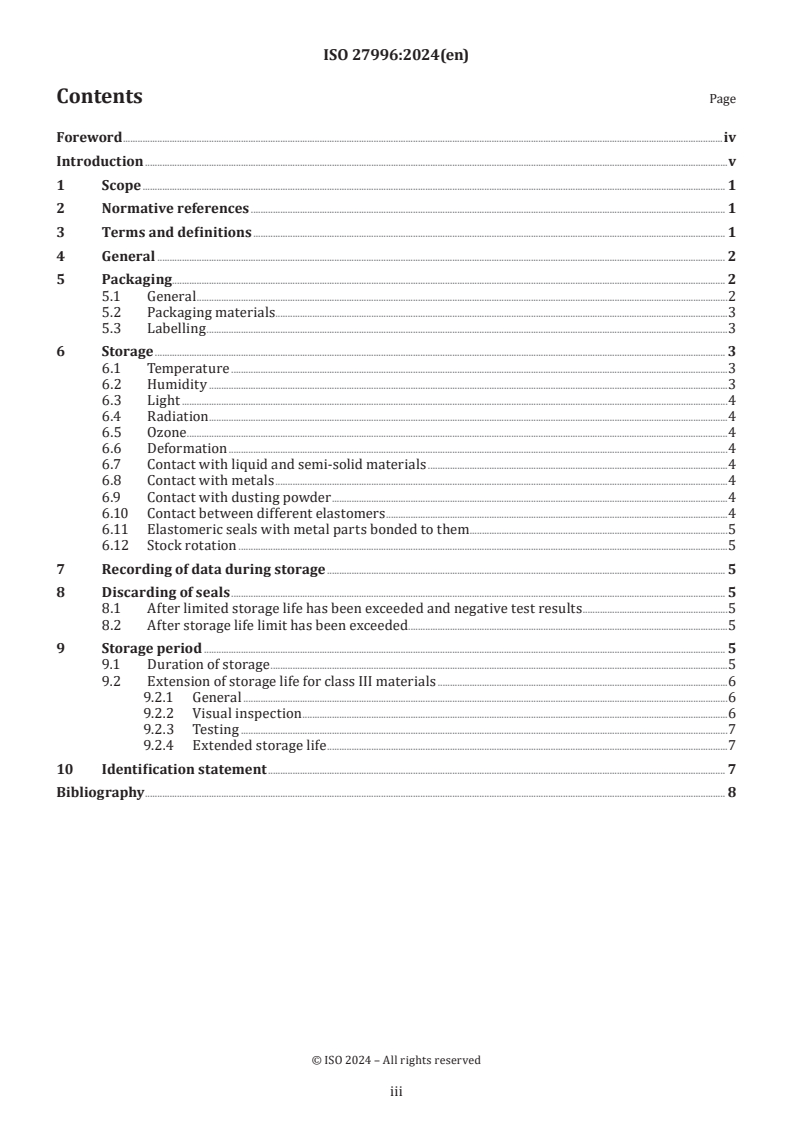
Contents Page
Foreword .iv
Introduction .v
1 Scope . 1
2 Normative references . 1
3 Terms and definitions . 1
4 General . 2
5 Packaging. 2
5.1 General .2
5.2 Packaging materials.3
5.3 Labelling .3
6 Storage . 3
6.1 Temperature .3
6.2 Humidity .3
6.3 Light .4
6.4 Radiation .4
6.5 Ozone .4
6.6 Deformation .4
6.7 Contact with liquid and semi-solid materials .4
6.8 Contact with metals .4
6.9 Contact with dusting powder .4
6.10 Contact between different elastomers .4
6.11 Elastomeric seals with metal parts bonded to them .5
6.12 Stock rotation .5
7 Recording of data during storage . 5
8 Discarding of seals . 5
8.1 After limited storage life has been exceeded and negative test results .5
8.2 After storage life limit has been exceeded.5
9 Storage period . 5
9.1 Duration of storage .5
9.2 Extension of storage life for class III materials .6
9.2.1 General .6
9.2.2 Visual inspection .6
9.2.3 Testing .7
9.2.4 Extended storage life .7
10 Identification statement . 7
Bibliography . 8
iii
Foreword
ISO (the International Organization for Standardization) is a worldwide federation of national standards
bodies (ISO member bodies). The work of preparing International Standards is normally carried out through
ISO technical committees. Each member body interested in a subject for which a technical committee
has been established has the right to be represented on that committee. International organizations,
governmental and non-governmental, in liaison with ISO, also take part in the work. ISO collaborates closely
with the International Electrotechnical Commission (IEC) on all matters of electrotechnical standardization.
The procedures used to develop this document and those intended for its further maintenance are described
in the ISO/IEC Directives, Part 1. In particular, the different approval criteria needed for the different types
of ISO document should be noted. This document was drafted in accordance with the editorial rules of the
ISO/IEC Directives, Part 2 (see www.iso.org/directives).
ISO draws attention to the possibility that the implementation of this document may involve the use of (a)
patent(s). ISO takes no position concerning the evidence, validity or applicability of any claimed patent
rights in respect thereof. As of the date of publication of this document, ISO had not received notice of (a)
patent(s) which may be required to implement this document. However, implementers are cautioned that
this may not represent the latest information, which may be obtained from the patent database available at
www.iso.org/patents. ISO shall not be held responsible for identifying any or all such patent rights.
Any trade name used in this document is information given for the convenience of users and does not
constitute an endorsement.
For an explanation of the voluntary nature of standards, the meaning of ISO specific terms and expressions
related to conformity assessment, as well as information about ISO's adherence to the World Trade
Organization (WTO) principles in the Technical Barriers to Trade (TBT), see www.iso.org/iso/foreword.html.
This document was prepared by Technical Committee ISO/TC 20, Aircraft and space vehicles, Subcommittee
SC 10, Aerospace fluid systems and components.
This second edition cancels and replaces the first edition (ISO 27996:2009), which has been technically
revised.
The main changes are as follows:
— change of the term 3.1 “date of vulcanization” to “cure date”;
— extension of shelf life for EPDM (Table 2) based upon practical experience.
Any feedback or questions on this document should be directed to the user’s national standards body. A
complete listing of these bodies can be found at www.iso.org/members.html.
iv
Introduction
In fluid power systems, power is transmitted and controlled through a fluid (liquid or gas) under pressure
within an enclosed circuit. Testing of components to meet performance requirement provides users a basis
of assurance for determining design application and for checking component compliance with their stated
requirements.
The requirement for packaging is an integral part of the controlled storage procedure and provides a means
of positive product identity from the time of manufacture to the time of assembly into a component.
This information is intended to be utilized by those organizations who do not have specific requirements or
recommendations already in place for the control of elastomeric seals and seal assemblies. This standard
can be specified in control, storage, and procurement documents. However, when the requirements of
this document are in conflict with the customer's requirements or specifications, the requirements of the
customer's detailed specification govern.
v
International Standard ISO 27996:2024(en)
Aerospace fluid systems — Elastomer seals — Storage and
shelf life
1 Scope
This document specifies the general requirements for data recording procedures, packaging, and storing of
elastomeric seals and seal assemblies which include an elastomeric element prior to the seal being assembled
into hardware components.
This document does not establish limitations or storage times for assembled components, or the operating
life of the said components.
2 Normative references
The following documents are referred to in the text in such a way that some or all of their content constitutes
requirements of this document. For dated references, only the edition cited applies. For undated references,
the latest edition of the referenced document (including any amendments) applies.
ISO 1629, Rubber and latices — Nomenclature
ISO 5598, Fluid power systems and components — Vocabulary
3 Terms and definitions
For the purposes of this document, the terms and definitions given in ISO 5598 and the following apply.
ISO and IEC maintain terminology databases for use in standardization at the following addresses:
— ISO Online browsing platform: available at https:// www .iso .org/ obp
— IEC Electropedia: available at https:// www .electropedia .org/
3.1
cure date
the date on which the elastomer (3.2) product was vulcanized, expressed in quarters (Q) of a year
EXAMPLE 4Q04 (October to December, 2004).
3.2
elastomer
material that possesses elastic properties and has undergone vulcanization and/or conversion into a
finished product
Note 1 to entry: The basic building block of the elastomer is the rubber (3.6) polymer it contains.
3.3
extended storage life
period for which an elastomer (3.2) seal (3.7) element moulded from class III material and properly packaged
may be stored after the initial storage period and the successful reinspection and testing of representative
samples
3.4
hardware component
unit in which the elastomeric seal (3.7) element is installed
-------------
...