


ISO/IEC 18000-3:2004
(Main)Information technology — Radio frequency identification for item management — Part 3: Parameters for air interface communications at 13,56 MHz
Information technology — Radio frequency identification for item management — Part 3: Parameters for air interface communications at 13,56 MHz
ISO/IEC 18000-3:2004 provides physical layer, collision management system and protocol values for RFID systems for item identification in accordance with the requirements of ISO 18000-1. It relates solely to systems operating at 13,56 MHz. ISO/IEC 18000-3:2004 has two modes of operation, intended to address different applications. The modes, whilst not interoperable, are non-interfering. The detailed technical differences between the modes are shown in the parameter tables.
Technologies de l'information — Identification par radiofréquence (RFID) pour la gestion d'objets — Partie 3: Paramètres de communications d'une interface d'air à 13,56 MHz
General Information
- Status
- Withdrawn
- Publication Date
- 12-Sep-2004
- Withdrawal Date
- 12-Sep-2004
- Technical Committee
- ISO/IEC JTC 1/SC 31 - Automatic identification and data capture techniques
- Drafting Committee
- ISO/IEC JTC 1/SC 31/WG 4 - Radio communications
- Current Stage
- 9599 - Withdrawal of International Standard
- Start Date
- 29-Aug-2008
- Completion Date
- 12-Feb-2026
Relations
- Effective Date
- 15-Apr-2008

Get Certified
Connect with accredited certification bodies for this standard

BSI Group
BSI (British Standards Institution) is the business standards company that helps organizations make excellence a habit.

NYCE
Mexican standards and certification body.
Sponsored listings
Frequently Asked Questions
ISO/IEC 18000-3:2004 is a standard published by the International Organization for Standardization (ISO). Its full title is "Information technology — Radio frequency identification for item management — Part 3: Parameters for air interface communications at 13,56 MHz". This standard covers: ISO/IEC 18000-3:2004 provides physical layer, collision management system and protocol values for RFID systems for item identification in accordance with the requirements of ISO 18000-1. It relates solely to systems operating at 13,56 MHz. ISO/IEC 18000-3:2004 has two modes of operation, intended to address different applications. The modes, whilst not interoperable, are non-interfering. The detailed technical differences between the modes are shown in the parameter tables.
ISO/IEC 18000-3:2004 provides physical layer, collision management system and protocol values for RFID systems for item identification in accordance with the requirements of ISO 18000-1. It relates solely to systems operating at 13,56 MHz. ISO/IEC 18000-3:2004 has two modes of operation, intended to address different applications. The modes, whilst not interoperable, are non-interfering. The detailed technical differences between the modes are shown in the parameter tables.
ISO/IEC 18000-3:2004 is classified under the following ICS (International Classification for Standards) categories: 35.040 - Information coding; 35.040.50 - Automatic identification and data capture techniques. The ICS classification helps identify the subject area and facilitates finding related standards.
ISO/IEC 18000-3:2004 has the following relationships with other standards: It is inter standard links to ISO/IEC 18000-3:2008. Understanding these relationships helps ensure you are using the most current and applicable version of the standard.
ISO/IEC 18000-3:2004 is available in PDF format for immediate download after purchase. The document can be added to your cart and obtained through the secure checkout process. Digital delivery ensures instant access to the complete standard document.
Standards Content (Sample)
INTERNATIONAL ISO/IEC
STANDARD 18000-3
First edition
2004-09-15
Information technology — Radio
frequency identification for item
management —
Part 3:
Parameters for air interface
communications at 13,56 MHz
Technologies de l'information — Identification par radiofréquence
(RFID) pour la gestion d'objets —
Partie 3: Paramètres pour les communications d'une interface d'air de
13,56 MHz
Reference number
©
ISO/IEC 2004
PDF disclaimer
This PDF file may contain embedded typefaces. In accordance with Adobe's licensing policy, this file may be printed or viewed but
shall not be edited unless the typefaces which are embedded are licensed to and installed on the computer performing the editing. In
downloading this file, parties accept therein the responsibility of not infringing Adobe's licensing policy. The ISO Central Secretariat
accepts no liability in this area.
Adobe is a trademark of Adobe Systems Incorporated.
Details of the software products used to create this PDF file can be found in the General Info relative to the file; the PDF-creation
parameters were optimized for printing. Every care has been taken to ensure that the file is suitable for use by ISO member bodies. In
the unlikely event that a problem relating to it is found, please inform the Central Secretariat at the address given below.
© ISO/IEC 2004
All rights reserved. Unless otherwise specified, no part of this publication may be reproduced or utilized in any form or by any means,
electronic or mechanical, including photocopying and microfilm, without permission in writing from either ISO at the address below or
ISO's member body in the country of the requester.
ISO copyright office
Case postale 56 • CH-1211 Geneva 20
Tel. + 41 22 749 01 11
Fax + 41 22 749 09 47
E-mail copyright@iso.org
Web www.iso.org
Published in Switzerland
ii © ISO/IEC 2004 – All rights reserved
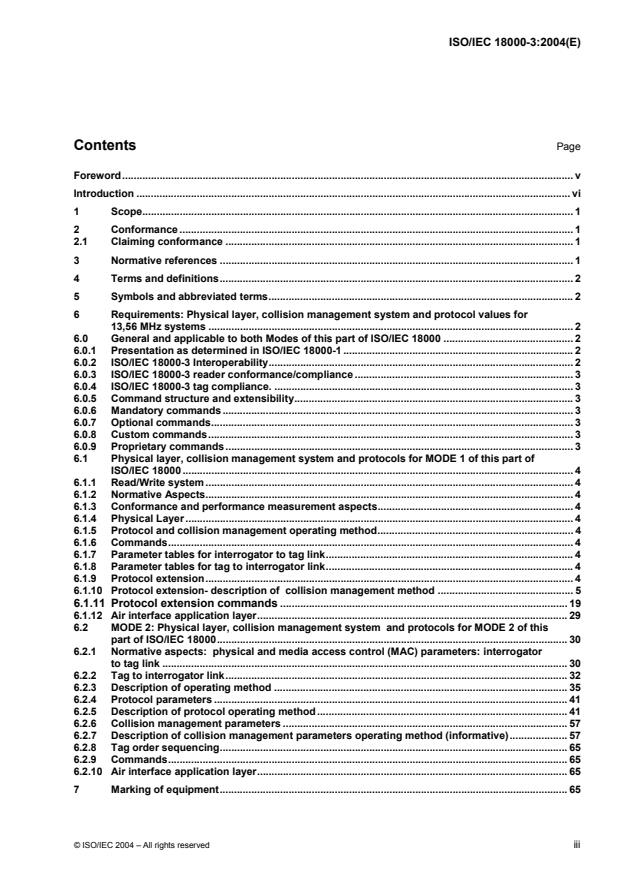
Contents Page
Foreword. v
Introduction . vi
1 Scope. 1
2 Conformance. 1
2.1 Claiming conformance. 1
3 Normative references. 1
4 Terms and definitions. 2
5 Symbols and abbreviated terms. 2
6 Requirements: Physical layer, collision management system and protocol values for
13,56 MHz systems . 2
6.0 General and applicable to both Modes of this part of ISO/IEC 18000 . 2
6.0.1 Presentation as determined in ISO/IEC 18000-1 . 2
6.0.2 ISO/IEC 18000-3 Interoperability. 2
6.0.3 ISO/IEC 18000-3 reader conformance/compliance . 3
6.0.4 ISO/IEC 18000-3 tag compliance. . 3
6.0.5 Command structure and extensibility. 3
6.0.6 Mandatory commands. 3
6.0.7 Optional commands. 3
6.0.8 Custom commands. 3
6.0.9 Proprietary commands. 3
6.1 Physical layer, collision management system and protocols for MODE 1 of this part of
ISO/IEC 18000 . 4
6.1.1 Read/Write system. 4
6.1.2 Normative Aspects. 4
6.1.3 Conformance and performance measurement aspects. 4
6.1.4 Physical Layer. 4
6.1.5 Protocol and collision management operating method. 4
6.1.6 Commands. 4
6.1.7 Parameter tables for interrogator to tag link. 4
6.1.8 Parameter tables for tag to interrogator link. 4
6.1.9 Protocol extension. 4
6.1.10 Protocol extension- description of collision management method . 5
6.1.11 Protocol extension commands . 19
6.1.12 Air interface application layer. 29
6.2 MODE 2: Physical layer, collision management system and protocols for MODE 2 of this
part of ISO/IEC 18000. 30
6.2.1 Normative aspects: physical and media access control (MAC) parameters: interrogator
to tag link . 30
6.2.2 Tag to interrogator link. 32
6.2.3 Description of operating method . 35
6.2.4 Protocol parameters. 41
6.2.5 Description of protocol operating method. 41
6.2.6 Collision management parameters . 57
6.2.7 Description of collision management parameters operating method (informative). 57
6.2.8 Tag order sequencing. 65
6.2.9 Commands. 65
6.2.10 Air interface application layer. 65
7 Marking of equipment. 65
© ISO/IEC 2004 – All rights reserved iii
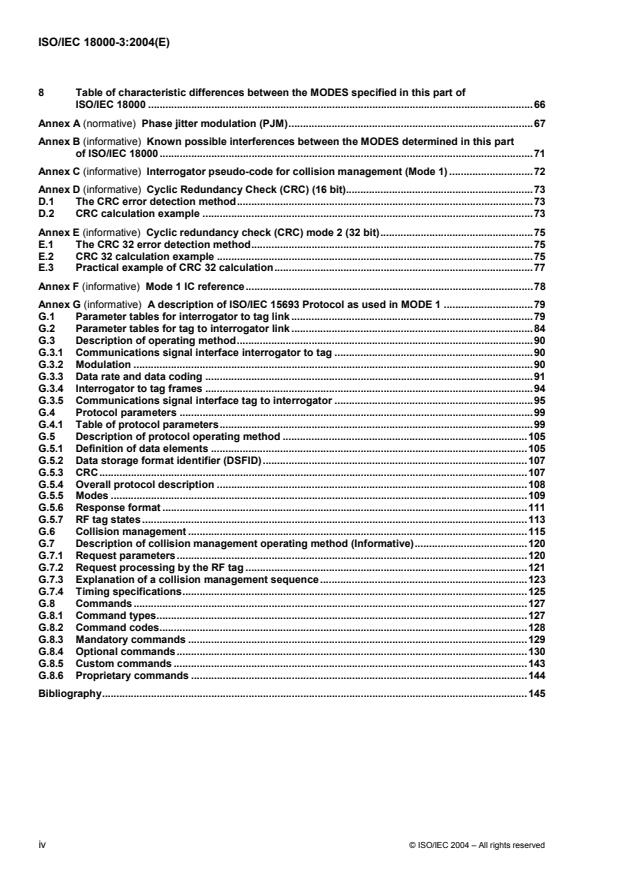
8 Table of characteristic differences between the MODES specified in this part of
ISO/IEC 18000 .66
Annex A (normative) Phase jitter modulation (PJM).67
Annex B (informative) Known possible interferences between the MODES determined in this part
of ISO/IEC 18000.71
Annex C (informative) Interrogator pseudo-code for collision management (Mode 1) .72
Annex D (informative) Cyclic Redundancy Check (CRC) (16 bit).73
D.1 The CRC error detection method.73
D.2 CRC calculation example.73
Annex E (informative) Cyclic redundancy check (CRC) mode 2 (32 bit).75
E.1 The CRC 32 error detection method.75
E.2 CRC 32 calculation example .75
E.3 Practical example of CRC 32 calculation.77
Annex F (informative) Mode 1 IC reference.78
Annex G (informative) A description of ISO/IEC 15693 Protocol as used in MODE 1 .79
G.1 Parameter tables for interrogator to tag link .79
G.2 Parameter tables for tag to interrogator link .84
G.3 Description of operating method.90
G.3.1 Communications signal interface interrogator to tag .90
G.3.2 Modulation.90
G.3.3 Data rate and data coding .91
G.3.4 Interrogator to tag frames .94
G.3.5 Communications signal interface tag to interrogator .95
G.4 Protocol parameters.99
G.4.1 Table of protocol parameters.99
G.5 Description of protocol operating method .105
G.5.1 Definition of data elements .105
G.5.2 Data storage format identifier (DSFID).107
G.5.3 CRC.107
G.5.4 Overall protocol description .108
G.5.5 Modes.109
G.5.6 Response format.111
G.5.7 RF tag states .113
G.6 Collision management.115
G.7 Description of collision management operating method (Informative).120
G.7.1 Request parameters.120
G.7.2 Request processing by the RF tag .121
G.7.3 Explanation of a collision management sequence.123
G.7.4 Timing specifications.125
G.8 Commands.127
G.8.1 Command types.127
G.8.2 Command codes.128
G.8.3 Mandatory commands.129
G.8.4 Optional commands.130
G.8.5 Custom commands.143
G.8.6 Proprietary commands.144
Bibliography.145
iv © ISO/IEC 2004 – All rights reserved
Foreword
ISO (the International Organization for Standardization) and IEC (the International Electrotechnical
Commission) form the specialized system for worldwide standardization. National bodies that are members of
ISO or IEC participate in the development of International Standards through technical committees
established by the respective organization to deal with particular fields of technical activity. ISO and IEC
technical committees collaborate in fields of mutual interest. Other international organizations, governmental
and non-governmental, in liaison with ISO and IEC, also take part in the work. In the field of information
technology, ISO and IEC have established a joint technical committee, ISO/IEC JTC 1.
International Standards are drafted in accordance with the rules given in the ISO/IEC Directives, Part 2.
The main task of the joint technical committee is to prepare International Standards. Draft International
Standards adopted by the joint technical committee are circulated to national bodies for voting. Publication as
an International Standard requires approval by at least 75 % of the national bodies casting a vote.
ISO/IEC 18000-3 was prepared by Joint Technical Committee ISO/IEC JTC 1, Information technology,
Subcommittee SC 31, Automatic identification and data capture techniques.
ISO/IEC 18000 consists of the following parts, under the general title Information technology — Radio
frequency identification for item management:
Part 1: Reference architecture and definition of parameters to be standardized
Part 2: Parameters for air interface communications below 135 kHz
Part 3: Parameters for air interface communications at 13,56 MHz
Part 4: Parameters for air interface communications at 2,45 GHz
Part 6: Parameters for air interface communications at 860 MHz to 960 MHz
Part 7: Parameters for active air interface communications at 433 MHz
© ISO/IEC 2004 – All rights reserved v
Introduction
ISO/IEC 18000 has been developed by ISO/IEC JTC 1, SC 31, WG 4, Radio frequency identification for item
management, in order to provide a framework to define common communications protocols for Internationally
useable frequencies for Radio Frequency Identification (RFID), and, where possible, to determine the use of
the same protocols for ALL frequencies such that the problems of migrating from one to another are
diminished; to minimise software and implementation costs; and to enable system management and control
and information exchange to be common as far as is possible.
This part of ISO/IEC 18000 has been prepared in accordance with the requirements determined in
ISO/IEC 18000-1.
ISO/IEC 18000-1 provides explanation of the concepts behind this part of ISO/IEC 18000.
This part of ISO/IEC 18000 has 2 MODES of operation, intended to address different applications. Clause 8 of
this part of ISO/IEC 18000 summarises the differences between MODE characteristics. The detailed technical
differences between the modes are shown in the parameter tables.
This part of ISO/IEC 18000 relates solely to systems operating at 13,56 MHz.
The International Organization for Standardization (ISO) and International Electrotechnical Commission (IEC)
draw attention to the fact that it is claimed that compliance with this document may involve the use of patents.
The ISO and IEC take no position concerning the evidence, validity and scope of these patent rights.
The holders of these patent rights have assured the ISO and IEC that they are willing to negotiate licences
under reasonable and non-discriminatory terms and conditions with applicants throughout the world. In this
respect, the statements of the holders of these patent rights are registered with the ISO and IEC. Information
may be obtained from the following companies.
NOTE Abstracts of these patents may be found in ISO 18000-1, Annex E.
Affected subclause(s)
Contact details Patent number in this part of
ISO/IEC 18000
Dr. Bertram Koch US005257288
Leiter Patentabteilung OP31
ATMEL Germany GmbH
Theresienstrasse 2
6.1
D-74072 Heilbronn
Germany
Tel: +49-7131-67-3254
Fax: +49-7131-67-2789
Magellan Technology Pty Ltd. US5302954, WO8905549,
(ABN 93 009 137 393) EP0390822, DE3854478D,
65 Johnston Street SG37971, US5485154,
Annandale 09/582341 USA, 09/611658 USA,
6.2
NSW 2038 WO9934526, EP1048126,
Australia JP2002500465T, AU1654099,
10/204159 USA, WO0165712,
Tel: +61 2 9518 7011
EP1266458, 2001-654480 Japan,
Fax: +61 2 9518 7620
AU3711301
vi © ISO/IEC 2004 – All rights reserved
Affected subclause(s)
Contact details Patent number in this part of
ISO/IEC 18000
Matrics Technology US 6002344
8850 Stanford Blvd
Suite 3000
Columbia 21045
6.1, 6.2
USA
Tel: +1 410 872 0300
Fax: +1 443 782 0230
Koninklijke Philips Electronics N.V. CN 1277695, EP 831618, EP845751,
Groenewoudseweg 1 EP-PS 0998792,
NL 5621 BA Eindhoven EP-PS 1098257, IN/PCT/00/00034,
Netherlands JP 00-551498, JP 00-561579,
6.1
US 5,793,324, US 5,929,801,
Tel: +43 1 60 101-14 69
US09/357270, US2001-0013022,
Fax: +43 1 60 101-11 01
WO 98/08328, WO99/62196,
WO00/05673
Spacecode/Intercode US 5808550, EP 96402555.5,
6.1.3.5.1
12 rue des petits Ruisseaux CN 2191794
91370 Verrières Le Buisson
US6177858 B1, EP 96402554.8,
France
6.1.7.4.2
CN 21911788
Tel: +33 1 69 75 21 70
Fax: +33 1 30 11 00 31
US 5426423, EP 90909459.1,
Annex B
CN 2058947
Tagsys Australia EP 0 578 701 B1, AUS 664,544,
212 Pirie St PCT AU 00 01493,
Adelaide PCT AU 98 00017, US 5,523,749,
SA 5000 PCT AU 01 01676, FR 00 01704
6.1.9 - 6.1.11
Australia
Tel: +61 8 8100 8324
Fax: +61 8 8232 3720
Texas Instruments EP1 038257, US 09/315708,
34 Forest Street JP 00-560700, EP 1 034644,
Attleboro US 6442215, CN 1273730A,
MA WO00/04686, EP 0669591B,
6.1
USA AT-PS 401127
Tel: +1 508 236 3314
Fax: + 1 508 236 1960
Attention is drawn to the possibility that some of the elements of this document may be the subject of patent
rights other than those identified above. ISO and IEC shall not be held responsible for identifying any or all
such patent rights.
© ISO/IEC 2004 – All rights reserved vii
INTERNATIONAL STANDARD ISO/IEC 18000-3:2004(E)
Information technology — Radio frequency identification for
item management —
Part 3:
Parameters for air interface communications at 13,56 MHz
1 Scope
1.1 This part of ISO/IEC 18000 provides physical layer, collision management system and protocol values
for RFID systems for Item Identification operating at 13,56 MHz in accordance with the requirements of
ISO/IEC 18000-1
1.2 This part of ISO/IEC 18000 provides definitions for systems for each MODE determined in Clause 6
below.
1.3 This part of ISO/IEC 18000 defines 2 non interfering MODES.
The MODES are NOT interoperable.
The MODES, whilst not interoperable, are non interfering.
2 Conformance
2.1 Claiming conformance
In order to claim conformance with this part of ISO/IEC 18000 it is necessary to comply to all of the relevant
clauses of this part of ISO/IEC 18000 except those marked ‘optional’ and it is also necessary to operate within
the local national radio regulations (which may require further restrictions).
Relevant conformance test methods are defined in ISO/IEC TR 18047-3.
3 Normative references
The following referenced documents are indispensable for the application of this document. For dated
references, only the edition cited applies. For undated references, the latest edition of the referenced
document (including any amendments) applies.
ISO/IEC 7816-6, Identification cards — Integrated circuit cards — Part 6: Interindustry data elements for
interchange
ISO/IEC 15693 (all parts), Identification cards — Contactless integrated circuit(s) cards — Vicinity cards
ISO/IEC 15963, Information technology — Radio frequency identification for item management — Unique
identification for RF tags
ISO/IEC 18000-1, Information technology — Radio frequency identification for item management —
Reference architecture and definition of parameters to be standardized
ISO/IEC TR 18047-3, Information technology — Radio frequency identification device conformance test
methods — Part 3: Test methods for air interface communications at 13,56 MHz
© ISO/IEC 2004 – All rights reserved 1
ISO/IEC 19762 (all parts), Information technology — Automatic identification and data capture techniques —
1)
Harmonized vocabulary
EN 300 330, Electromagnetic compatibility and Radio spectrum Matters (ERM); Short Range Devices (SRD);
Technical Characteristics and test methods for Radio equipment in the frequency range 9 kHz to 30 MHz
4 Terms and definitions
For the purposes of this document, the terms and definitions given in ISO/IEC 19762 (all parts) and the
following apply.
4.1
Phase Jitter Modulation
Modulation technique that transmits data as very small phase changes in the powering field
5 Symbols and abbreviated terms
For the purposes of this document, the symbols and abbreviated terms given in ISO/IEC 18000-1,
ISO/IEC 19762 and the following apply.
≈ MODE 1 -the value is a rounded value (e.g. ≈ 75.52 µs)
PJM Phase Jitter Modulation
6 Requirements: Physical layer, collision management system and protocol values
for 13,56 MHz systems
6.0 General and applicable to both Modes of this part of ISO/IEC 18000
6.0.1 Presentation as determined in ISO/IEC 18000-1
The context, form and presentation of this part, which provides physical layer, collision management system
and protocol value definitions for RFID systems for item identification operating at 13,56 MHz are in
accordance with the requirements of ISO/IEC 18000-1.
6.0.2 ISO/IEC 18000-3 Interoperability
This part of ISO/IEC 18000 specifies two MODES of operation at 13,56 MHz
These MODES are not interoperable, but they are expected to operate without causing any significant
interference with each other. Any known causes of interference are listed in Annex B.
NOTE It is recommended that users select one MODE for any specific application.
NOTE Local national regulations may further limit either power, frequency or bandwidth allocations and such
limitations may reduce the capability of a system within that country. Users shall have the responsibility to ensure that they
use only systems that comply with these regulations. This implies a user responsibility to obtain proofs from manufacturers,
and where appropriate have adequate tests carried out to assure that systems are in compliance.
Informative Comment: At the time of preparation of this part of ISO/IEC 18000, the interrogator to tag link and tag to
interrogator link physical layer emissions may be subject to type approval or certification. It is therefore necessary to make
reference to local or regional radio regulations and radio standards in addition to this part of ISO/IEC 18000. All systems
are required to comply to local radio regulations, which may affect performance.
1) To be published.
2 © ISO/IEC 2004 – All rights reserved
6.0.3 ISO/IEC 18000-3 reader conformance/compliance
To claim compliance with this part of ISO/IEC 18000, an interrogator/ reader shall support either MODE 1 or
MODE 2. The reader may support both modes as an option (the modes are not interoperable).
6.0.4 ISO/IEC 18000-3 tag compliance.
To claim compliance with this part of ISO/IEC 18000, a tag shall support either MODE 1 or MODE 2. The tag
may support both modes as an option (the modes are not interoperable).
6.0.5 Command structure and extensibility
Clauses 6.1 and 6.2, include definition of the structure of command codes between an interrogator and a tag
and indicate how many positions are available for future extensions.
Command specification clauses provide a full definition of the command and its presentation.
Each command is labelled as being ‘mandatory’ or ‘optional’.
In accordance with ISO/IEC 18000-1, the clauses of this part of ISO/IEC 18000 make provision for ‘custom’
and ‘proprietary’ commands.
The types of permitted command options are defined in subclauses 6.0.6 to 6.0.9.
6.0.6 Mandatory commands
A mandatory command shall be supported by all tags that claim to be compliant. Interrogators which claim
compliance shall support all mandatory commands.
6.0.7 Optional commands
Optional commands are commands that are specified within the International Standard. Interrogators shall be
technically capable of performing all optional commands that are specified in the International Standard
(although need not be set up to do so). Tags may or may not support optional commands.
If an optional command is used, it shall be implemented in the manner specified in the International Standard.
6.0.8 Custom commands
Custom commands may be enabled by an International Standard, but they shall not be specified in that
International Standard.
A custom command shall not solely duplicate the functionality of any mandatory or optional command defined
in the International Standard by a different method.
6.0.9 Proprietary commands
Proprietary commands may be enabled by an International Standard, but they shall not be specified in that
International Standard.
A proprietary command shall not solely duplicate the functionality of any mandatory or optional command
defined in the International Standard by a different method.
© ISO/IEC 2004 – All rights reserved 3
6.1 Physical layer, collision management system and protocols for MODE 1 of this part of
ISO/IEC 18000
MODE 1 is not interoperable with any other MODES defined within this International Standard.
6.1.1 Read/Write system
MODE 1 describes a read/write system using a "reader talk first" technique.
6.1.2 Normative Aspects
The physical, collision management and transmission protocols determined in this MODE are consistent with
the approach taken in ISO/IEC 15693. See annex G. Clauses 6.1.3 – 6.1.8 provide normative parts of MODE
1 by reference.
Clause 6.1.9 determines an optional protocol extension compliant with, but an extension to, ISO/IEC
15693.
6.1.3 Conformance and performance measurement aspects
The performance and conformance measurement aspects for MODE 1 will be given in the relevant clauses of
future Technical Reports (ISO/IEC TR 18046 and ISO/IEC TR 18047-3, respectively).
6.1.4 Physical Layer
The Physical layer for the MODE 1 air interface at 13,56 MHz shall be compliant with ISO/IEC 15693-2, 2000.
6.1.5 Protocol and collision management operating method
The collision management operating method for the MODE 1 air interface at 13,56 MHz shall be compliant
with ISO/IEC 15693-3.
6.1.6 Commands
The commands for the MODE 1 air interface at 13,56 MHz shall be compliant with ISO/IEC 15693-3.
6.1.7 Parameter tables for interrogator to tag link
The parameter tables for interrogator to tag link for the MODE 1 air interface at 13,56 MHz shall be compliant
with ISO/IEC 15693-2.
6.1.8 Parameter tables for tag to interrogator link
The parameter tables for tag to interrogator link for the MODE 1 air interface at 13,56 MHz shall be compliant
with ISO/IEC 15693-2.
6.1.9 Protocol extension
6.1.9.1 Protocol extension optional
The protocol extension is optional, tags may support it. If supported request and response shall comply with
the definition given in Clauses 6.1.9 - 6.1.11.
If the tag does not support the protocol extension it shall not return an error code and shall remain silent.
4 © ISO/IEC 2004 – All rights reserved
The request consists of the following fields:
• Flags (see Table 1: Bit 4 set to 1 for protocol extension, Bit 5 - Bit 8 shall be set to 0: RFU)
• Protocol extension byte (Bit 1 and Bit 2 of the Protocol extension byte are reserved for future protocol
extensions and have to be set to 0).
• CRC
6.1.9.2 Request flags
The request flags are shown in Table 1.
Table 1 — Request flags 1 to 4 definition
Bit Nb Flag name State Description/limits
Bit 1 Sub-carrier_flag 0 A single sub-carrier frequency shall be used by the RF tag
1 Two sub-carriers shall be used by the RF tag
Bit 2 Data_rate_flag 0 Low data rate shall be used
1 High data rate shall be used
Bit 3 Response_flag 0 Optional protocol response as specified in 6.1.10.18 &
6.1.10.19, if the tag does not support this response, it shall
remain silent.
1 Optional protocol response as specified in G.8.4.1 Read single
block command, and the response format in Figure G33, using
coding dependant upon bits 1 and 2 above. If the tag does not
support this response, it shall remain silent.
Bit 4 Protocol_Extension_ 1 Protocol format is extended
Flag
Bit 5 RFU 0 RFU
Bit 6 RFU 0 RFU
Bit 7 RFU 0 RFU
Bit 8 RFU 0 RFU
6.1.9.3 Request format
Figure 1 only refers to Protocol extension commands if Bit 1 and Bit 2 of the Protocol extension byte are 0.
SOF Flags Protocol extension byte CRC EOF
8 bits 8 bits 16 bits
Figure 1 — Protocol extension request format
6.1.10 Protocol extension- description of collision management method
6.1.10.1 Collision management in protocol extension
This protocol extension contains two major branches: the non-slotted non-terminating multiple tag reading
branch, described in 6.1.10.2 and the slotted terminating adaptive round multiple tag reading branch
described in 6.1.10.3.
© ISO/IEC 2004 – All rights reserved 5
6.1.10.2 Non-slotted non-terminating multiple tag reading protocol
In the non-slotted non-terminating aloha protocol, a Wake-up command shall cause the RF tags to reply at
random, with self-determined intervals, as long as they continue to be in the energising field. In this protocol,
interrogators will receive, detect and report all replies which arrive without collisions, but will not try to
influence the interrogation process other than through the issuing of additional wake-up signals to introduce
newly arriving tags into the reply process. Programming is performed with 1 RF tag in the field.
This implementation:
• only requires a Wake-up command
• uses a default reply length (length may be programmed by user)
• performs well when one or only a small number of tags are in the interrogation field at one time.
After a Wake-up command the interrogator listens for RF tags. The type of tag forms part of the preamble of
the main reply and is thus signalled to the interrogator which will not try to signal any other commands to a
non-slotted non-terminating tag. It is recommended that the default-reply-time to non-reply-time approximately
forms the ratio 1 to 10.
Figure 2 shows 3 tags working in the non-slotted non-terminating tag protocol.
• The interrogator issued a Wake-up command and all 3 tags responded resulting in a collision.
• Next RF tag 1 and RF tag 3 responded after a varying hold off time resulting in a collision.
• Next RF tag 2 responded alone and was decoded.
• Next RF tag 1 responded alone and was decoded.
• Next RF tag 2 and RF tag 3 responded resulting in a collision.
• Next RF tag 1 and RF tag 2 responded resulting in a collision.
• Finally RF tag 3 responded and was decoded.
6 © ISO/IEC 2004 – All rights reserved
Interrogator
Wake-up command
RF tag 1
RF tag 2
RF tag 3
Figure 2 — Example of RF tag response in non-slotted non-terminating multiple tag reading protocol
6.1.10.3 RF tag states in non-slotted, non-terminating adaptive round protocol
The Power-off and Ready states are the same as in the normal protocol.
The transition from the Ready state to the active state occurs as the result of a protocol extension
non-terminating/non-slotted Wake-up command (Protocol Extension_flag is set).
Power-off
In Field
Out of Field
Any Command
Ready
other than Wake-up
Out of Field
Wake-up
Any Command
Active
Figure 3 — Tag states in non-slotted non-terminating multiple tag reading protocol
6.1.10.4 Slotted terminating adaptive round multiple tag reading protocol
In the slotted terminating adaptive round protocol, after Wake-up and during the interrogation cycle, there is a
continuing dialogue between tags and the interrogator/reader, and a tag shall not continue to reply indefinitely.
The Reader Talks First (RTF) Wake-up can be given frequently for highly dynamic populations. Within a large
population of tags, there will be a diminishing number of tags replying, until all have been read.
In this protocol tags will select a random slot number, from a maximum slot number, in which to offer a reply.
The maximum slot number is set in the tag as a default value, which may be temporarily over-ridden by an
interrogator command. The interrogator signals the start of each slot. The tag keeps track of the number of the
current slot timed from the Wake-up command responsible for it waking and subsequent transition to the
active state. After responding the RF tag will automatically transition from the active state to the quiet state. If
the tag is in the active state when the current slot number equals the maximum slot number, an increment in
the current slot number shall cause the tag to reset its current slot value back to one and recalculate the
© ISO/IEC 2004 – All rights reserved 7
random slot number in which to re-offer its reply. This case arises if the response of a tag collided with another
in its chosen reply slot, or the response contained an error. This cycling of current slot numbers continues until
the tag response is decoded without error and it remains in the quiet state, or the tag leaves the energising
field.
The maximum slot number is referred to as the number of slots in a round. The number of slots in a round
may be expanded and contracted as the tag populations grow and shrink.
6.1.10.5 Example of interrogator to tag dialogue
Upon receiving a Wake-up command, tags do not necessarily reply immediately, but begin self-selecting
within a default round length a randomly chosen reply slot within this first round. The time duration of a tag
reply slot is dependent upon the chosen response format and the number of pages in the default reply. The
number of slots which a tag expects within a reply round is dependent upon initial tag programming, but can
be modified by interrogator commands. The start of each reply slot is signalled by the interrogator.
An example dialogue is shown in Figure 4.
• The interrogator issued a Wake-up command, which moved RF tags in the ready state to the active
state.
• RF tags read their default round size from memory and randomly select a slot in which to respond.
• Slot 0 contained a response from RF tag 1 which after the reply transitions to the quiet state.
• The interrogator issued a Next-slot command, which contained the TEL of RF tag 1 which remains
quiet.
• Slot 1 contained no response, and the interrogator issued a Close-slot (EOF) command.
• Slot 2 contained two responses, the precursors of which vary in their contents, so a collision is
detected and the slot is closed before the main reply. The two RF tags will offer a response again next
round (after the maximum number of slots in the current round have elapsed).
• Slot 3 contained two responses, the collision was not detected during the precursor but was detected
in the CRC check of the main reply, so a collision was detected and the interrogator issued an Ultimate-
error command. The two RF tags will offer a response again next round.
• Slot 4 contained two responses, but one is significantly stronger than the other so it appeared to the
interrogator that only 1 RF tag was in the slot. The interrogator issued a Next-slot command which
contained the TEL of RF tag 6. RF tag 7 will offer a response again after the maximum number of slots in
the current round.
• Slot 5 contained a response of a particular RF tag which, for one of a variety of reasons, needed to be
isolated. The interrogator issued a Selective-stand-by command, which moved RF tag 8 to the active
state. RF tags 1 and 6 stay in the quiet state, while all other tags in the active state moved to the Stand-
by state.
• At this time there is only one RF tag in the active state and there is an opportunity to request more data
or program that tag. The interrogator issued a reply-with-range command, which causes RF tag 8 to
respond with an addressed range (Slot 6).
• The interrogator then issued a Next-slot command, which left RF tag 8 in the quiet state.
• The interrogator then issued a Re-enter-round command, which moved the RF tags in the Stand-by
state back to the active state.
• Slot 7 contained a response from RF tag 9.
8 © ISO/IEC 2004 – All rights reserved
Table 2 — Timing for the slotted terminating adaptive round
Minimum Typical Maximum
t1 4064/f (300µs) 4096/f (302µs) 4128/f (304µs)
c c c
t2 44 bits
t3 992/f (73µs) 1024/f (76µs) 1056/f (78µs)
c c c
Where:
t1 = interrogator/reader to tag & tag to interrogator/reader turn around time
t2 = gap between optional precursor and main reply
t3 = period before close slot command is issued
Note: The time t2 is 44 bits where the duration of 1 bit is 4 pulses of 32/fc. The RF tag only listens for the close slot command after
the nominal 302µs turn around time has elapsed from the end of the precursor modulation.
© ISO/IEC 2004 – All rights reserved 9
Slot 1
Slot 0
SOF Wake-up EOF SOF Next-slot EOF EOF
Interrogator
Precursor 1 Response 1
RF Tags
Timing
t2 t1 t1 t3 t1
t1
Next-slot contains TEL
Comment No RF Tag
No collision
of RF Tag 1 which was
response
decoded
Time
Slot 2 Slot 3
Continued.
EOF SOF Ultimate error EOF
Interrogator
Response 4
Precursor 2 Precursor 4
RF Tags
Precursor 3 Precursor 5 Response 5
Timing
t1 t1 t2 t1 t1
Comment No collision in precursor
Collision in
Collision in response
precursor
Time
Slot 4 Slot 5
Continued.
SOF Next-slot EOF
Interrogator
Precursor 6 Response 6
Precursor 8 Response 8
RF Tags
Response 7
Precursor 7
Timing
t2 t1 t1 t2 t1
No collision in precursor Next-slot contains TEL
Comment
No collision in response
of RF Tag 6 which was
RF Tag 6 suppresses 7
decoded
Time
Slot 6
Continued.
SOF Selective stand-byEOF SOF Reply-with-range EOF
Interrogator
Precursor 8 Response 8
RF Tags
Timing
t1 t1 t2 t1
RF Tag 8 is the only
Selective stand-by contains
Comment
Active tag
TEL of RF Tag 8
Time
Slot 7
Continued.
SOF Next-slot EOF SOF Re-enter round EOF
Interrogator
Precursor 9 Response 9
RF Tags
Timing
t1
t1 t2 t1
Next-slot contains TEL RF Tags in stand-by transition
Comment
from Stand-by to Active
of RF Tag 8 which was
decoded
Time
Figure 4 — Slotted terminating adaptive round
10 © ISO/IEC 2004 – All rights reserved
6.1.10.6 RF tag states in slotted terminating adaptive round protocol
The Power-off, ready, and quiet states are the same as in the normal protocol. The Selected
state of the base protocol can be accessed via the base protocol commands.
The transition from the ready state to the active state occurs as the result of a protocol extension
Wake-up command (Protocol Extension_flag is set).
Power-off
In Field
Out of Field
Any Command
Out of Field
Ready
other than Wake-up
Out of Field
Reset Active
Wake-up
Global reset
Gl b l t
Active
Global reset
Ultimate error and transitioned to
quiet in current slot
Stand-by active
Re-enter round
Automatic transition after reply
Quiet
Stand-by
Selective stand-by and transitioned
to quiet in current slot
Any command
Any command
NOTE 1 The transition to the Power-off state from another state occurs after 300ms when state storage bit is set. If power is removed for >10s the tag
does not remember any previous state. If power is removed between 300ms and 10s the storage action is uncertain.
NOTE 2 The RF tag state transition diagram shows only valid transitions. In all other cases the current RF tag state remains unchanged. When the RF
tag cannot process an interrogator request (e.g. CRC error etc. ), it shall stay in its current state except if it has just
...
Questions, Comments and Discussion
Ask us and Technical Secretary will try to provide an answer. You can facilitate discussion about the standard in here.
Loading comments...