


IWA 30-1:2019
(Main)Competence of standards professionals - Part 1: In companies
Competence of standards professionals - Part 1: In companies
This document specifies the competence, consisting of knowledge, skills and attributes, needed to perform the tasks of standards professionals. This document is applicable to all personnel involved in some aspect of standardization in companies.
Titre manque — Partie 1: Titre manque
General Information
- Status
- Published
- Publication Date
- 14-Oct-2019
- Technical Committee
- ISO/TMBG - Technical Management Board - groups
- Drafting Committee
- ISO/TMBG - Technical Management Board - groups
- Current Stage
- 9599 - Withdrawal of International Standard
- Start Date
- 16-Oct-2025
- Completion Date
- 13-Dec-2025
Overview
IWA 30-1:2019 - "Competence of standards professionals - Part 1: In companies" (ISO) defines the competence needed for personnel involved in standardization activities inside companies. The document specifies the knowledge, skills and attributes required to perform standards-related tasks and structures these requirements around five core task areas. It is a voluntary guidance IWA intended to support competence development, education and career planning for standards professionals working in industry.
Key topics and requirements
- Scope and definitions: Clear definitions of competence, knowledge, skill, attribute, task and company standard; normative references are not required for this IWA.
- Five task areas (T1–T5) that frame required competences:
- T1: Standardization planning and evaluation
- T2: Standards development in companies
- T3: Standards development in external standardization organizations
- T4: Applying company standards
- T5: Applying standards developed by external standardization organizations
- Competence components:
- Common competences shared across roles (common knowledge, skills, attributes).
- Task-specific competences: each T1–T5 includes descriptions and lists of knowledge, skills and attributes needed to carry out that task.
- Supporting material:
- Informative annexes including a survey questionnaire, summary of survey results, and a career roadmap for standards professionals in companies.
- Limitations: The IWA does not set rules for certification of persons and does not focus on conformity assessment competence covered by other ISO/IEC documents (e.g., ISO/IEC 17025).
Practical applications
- Human resources & training: Design job profiles, training curricula and professional development programmes for standards staff.
- Organizational planning: Align internal standardization roles and responsibilities with defined competences for consistent execution of standard-related work.
- Career development: Use the career roadmap and task/competence matrices to create progression paths for standards professionals.
- Cross-functional collaboration: Help engineering, quality, regulatory and procurement teams understand required skills for effective participation in standardization activities.
- Benchmarking: Compare organizational capability against internationally recognized competence elements to identify gaps and development needs.
Who should use this standard
- Standards managers and practitioners in companies
- HR, learning & development professionals in industry
- Corporate governance, compliance and quality leaders involved in standardization activities
- Universities, professional associations and training providers designing standards-related education
Related standards
- ISO/IWA 30-2: Competence of standards professionals - Part 2: In standards-related organizations (companion document)
- ISO/IEC 17025 and ISO 9000:2015 are referenced as related material where conformity assessment or terminology intersects with competence topics.
Keywords: IWA 30-1:2019, competence of standards professionals, standards professionals in companies, standardization planning, standards development, company standards, knowledge skills attributes.


IWA 30-1:2019 - Competence of standards professionals
IWA 30-1:2019 - Competence of standards professionals — Part 1: In companies Released:10/15/2019
Frequently Asked Questions
IWA 30-1:2019 is a standard published by the International Organization for Standardization (ISO). Its full title is "Competence of standards professionals - Part 1: In companies". This standard covers: This document specifies the competence, consisting of knowledge, skills and attributes, needed to perform the tasks of standards professionals. This document is applicable to all personnel involved in some aspect of standardization in companies.
This document specifies the competence, consisting of knowledge, skills and attributes, needed to perform the tasks of standards professionals. This document is applicable to all personnel involved in some aspect of standardization in companies.
IWA 30-1:2019 is classified under the following ICS (International Classification for Standards) categories: 01.120 - Standardization. General rules; 03.100.30 - Management of human resources. The ICS classification helps identify the subject area and facilitates finding related standards.
IWA 30-1:2019 is available in PDF format for immediate download after purchase. The document can be added to your cart and obtained through the secure checkout process. Digital delivery ensures instant access to the complete standard document.
Standards Content (Sample)
INTERNATIONAL IWA
WORKSHOP 30-1
AGREEMENT
First edition
2019-10
Competence of standards
professionals —
Part 1:
In companies
Reference number
©
ISO 2019
© ISO 2019
All rights reserved. Unless otherwise specified, or required in the context of its implementation, no part of this publication may
be reproduced or utilized otherwise in any form or by any means, electronic or mechanical, including photocopying, or posting
on the internet or an intranet, without prior written permission. Permission can be requested from either ISO at the address
below or ISO’s member body in the country of the requester.
ISO copyright office
CP 401 • Ch. de Blandonnet 8
CH-1214 Vernier, Geneva
Phone: +41 22 749 01 11
Fax: +41 22 749 09 47
Email: copyright@iso.org
Website: www.iso.org
Published in Switzerland
ii © ISO 2019 – All rights reserved
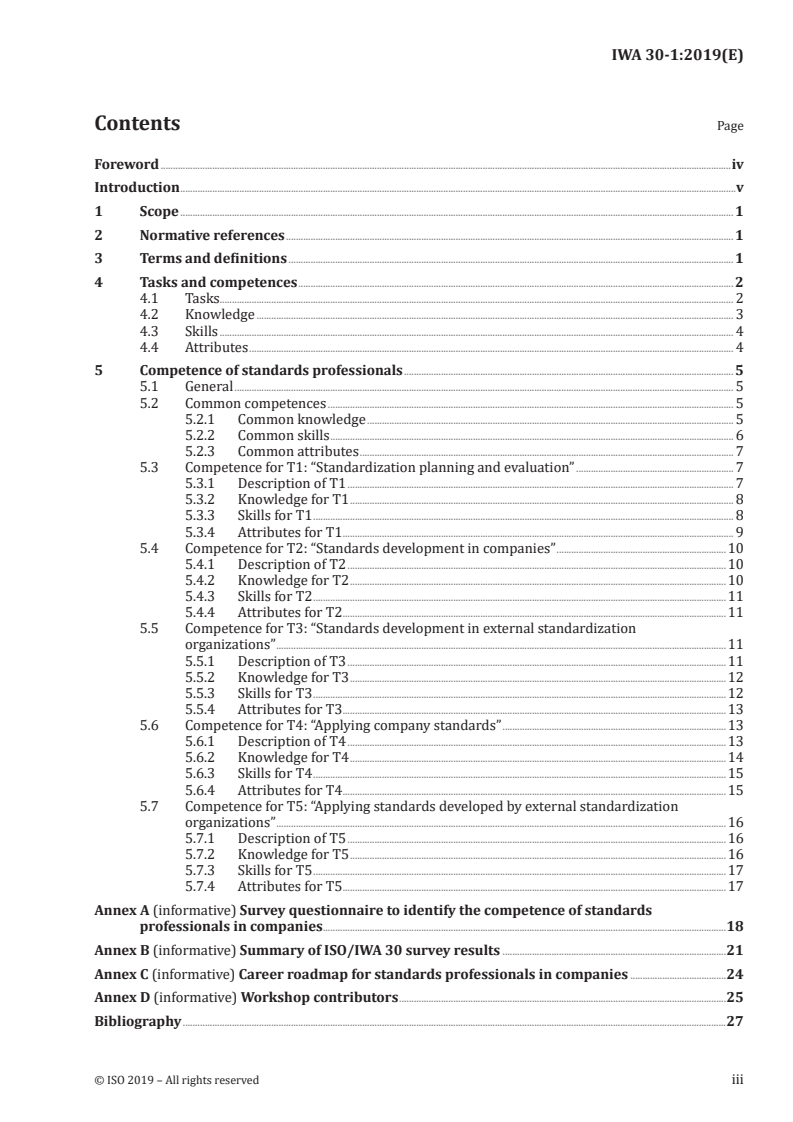
Contents Page
Foreword .iv
Introduction .v
1 Scope . 1
2 Normative references . 1
3 Terms and definitions . 1
4 Tasks and competences . 2
4.1 Tasks. 2
4.2 Knowledge . 3
4.3 Skills . 4
4.4 Attributes . 4
5 Competence of standards professionals . 5
5.1 General . 5
5.2 Common competences . 5
5.2.1 Common knowledge . 5
5.2.2 Common skills . 6
5.2.3 Common attributes . 7
5.3 Competence for T1: “Standardization planning and evaluation” . 7
5.3.1 Description of T1 . 7
5.3.2 Knowledge for T1 . 8
5.3.3 Skills for T1 . 8
5.3.4 Attributes for T1 . 9
5.4 Competence for T2: “Standards development in companies” .10
5.4.1 Description of T2 .10
5.4.2 Knowledge for T2 .10
5.4.3 Skills for T2 .11
5.4.4 Attributes for T2 .11
5.5 Competence for T3: “Standards development in external standardization
organizations” .11
5.5.1 Description of T3 .11
5.5.2 Knowledge for T3 .12
5.5.3 Skills for T3 .12
5.5.4 Attributes for T3 .13
5.6 Competence for T4: “Applying company standards” .13
5.6.1 Description of T4 .13
5.6.2 Knowledge for T4 .14
5.6.3 Skills for T4 .15
5.6.4 Attributes for T4 .15
5.7 Competence for T5: “Applying standards developed by external standardization
organizations” .16
5.7.1 Description of T5 .16
5.7.2 Knowledge for T5 .16
5.7.3 Skills for T5 .17
5.7.4 Attributes for T5 .17
Annex A (informative) Survey questionnaire to identify the competence of standards
professionals in companies .18
Annex B (informative) Summary of ISO/IWA 30 survey results .21
Annex C (informative) Career roadmap for standards professionals in companies .24
Annex D (informative) Workshop contributors .25
Bibliography .27
Foreword
ISO (the International Organization for Standardization) is a worldwide federation of national standards
bodies (ISO member bodies). The work of preparing International Standards is normally carried out
through ISO technical committees. Each member body interested in a subject for which a technical
committee has been established has the right to be represented on that committee. International
organizations, governmental and non-governmental, in liaison with ISO, also take part in the work.
ISO collaborates closely with the International Electrotechnical Commission (IEC) on all matters of
electrotechnical standardization.
The procedures used to develop this document and those intended for its further maintenance are
described in the ISO/IEC Directives, Part 1. In particular, the different approval criteria needed for the
different types of ISO documents should be noted. This document was drafted in accordance with the
editorial rules of the ISO/IEC Directives, Part 2 (see www .iso .org/directives).
Attention is drawn to the possibility that some of the elements of this document may be the subject of
patent rights. ISO shall not be held responsible for identifying any or all such patent rights. Details of
any patent rights identified during the development of the document will be in the Introduction and/or
on the ISO list of patent declarations received (see www .iso .org/patents).
Any trade name used in this document is information given for the convenience of users and does not
constitute an endorsement.
For an explanation of the voluntary nature of standards, the meaning of ISO specific terms and
expressions related to conformity assessment, as well as information about ISO's adherence to the
World Trade Organization (WTO) principles in the Technical Barriers to Trade (TBT) see www .iso
.org/iso/foreword .html.
International Workshop Agreement IWA/30-1 was approved at a workshop hosted by KATS (Korean
Agency for Technology and Standards) and KSA (Korean Standards Association), held in Jeju, Korea, in
May 2019.
Any feedback or questions on this document should be directed to the user’s national standards body. A
complete listing of these bodies can be found at www .iso .org/members .html.
iv © ISO 2019 – All rights reserved
Introduction
Competence development and education for people performing a job or tasks related to standardization
activities is naturally one of the key interests of national standards bodies, standards-developing
organizations and industries involved in standardization activities, as well as for education providers
such as universities, professional associations and consultancy firms. Effective competence
development should be based on the competence requirements of these companies and standards-
developing organizations.
This rationale is why efforts have been made to develop knowledge or skill sets and qualification
programmes for standards professionals at the international, regional and national levels. At the
international level, ISO created a task force team under the Technical Management Board (TMB)
to develop capability requirements for chairs, secretaries and project editors. At the regional level,
relevant projects and activities have been carried out with published results, such as APEC's Education
[25]
Guideline 5 and a research project undertaken by the European Commission (EC). At the national
or organizational level, several countries or organizations have already tried to define a knowledge
system, required skill sets and a qualification programme for standards professionals, including China,
Japan, Korea and the United States.
These efforts have presented a need for competence requirements for standards professionals.
To deliver objectivity in this document, a global survey was carried out to identify the common and
specific competences required and then recommended for standards professionals in companies and
[26]
standards-related organizations. This document is based on APEC's Education Guideline 6 , the
responses to the global survey and an analysis of the responses. It presents the tasks and the related
competences for standards professionals in two separate parts: in companies (this document) and in
standards-related organizations (ISO/IWA 30-2).
This document includes the following topics:
— the structure of tasks and sub-tasks of standards professionals in companies;
— the common competences for standards professionals in companies;
— the competences by task for standards professionals in companies;
— a career roadmap for standards professionals in companies.
This document does not cover the certification of persons or qualifications for personnel issues. Also,
this document in principle does not focus on competence for conformity assessment tasks because this
aspect is defined in other existing ISO and IEC documents, e.g. ISO/IEC 17025.
This document is also the result of collecting the practices of different interested parties and common
competence requirements. It is a voluntary guidance document intended for global use. This document,
in its present or revised form, is intended to serve as a stepping stone for competence development and
education programmes for both ISO and its members.
International Workshop Agreement IWA 30-1:2019(E)
Competence of standards professionals —
Part 1:
In companies
1 Scope
This document specifies the competence, consisting of knowledge, skills and attributes, needed to
perform the tasks of standards professionals.
This document is applicable to all personnel involved in some aspect of standardization in companies.
2 Normative references
There are no normative references in this document.
3 Terms and definitions
For the purposes of this document, the following terms and definitions apply.
ISO and IEC maintain terminological databases for use in standardization at the following addresses:
— ISO Online browsing platform: available at https: //www .iso .org/obp
— IEC Electropedia: available at http: //www .electropedia .org/
3.1
attribute
inherent characteristic of a person
EXAMPLE Visual acuity; sensitivity to others; openness.
[SOURCE: ISO/IEC TS 17027:2014, 2.10]
3.2
competence
ability to apply knowledge (3.3), skills (3.5) and attributes (3.1) to achieve intended results
Note 1 to entry: “Competence” can also be referred to as “competency”.
[SOURCE: ISO 9000:2015, 3.10.4, modified — “attributes” and Note 1 to entry have been added.]
3.3
knowledge
facts, information, truths, principles or understanding acquired through experience or education
[SOURCE: ISO/IEC TS 17027:2014, 2.56]
3.4
responsibility
obligation to act and take decisions to achieve required outcomes
[SOURCE: ISO/IEC 38500:2015, 2.22]
3.5
skill
ability acquired through education, training, experience or other means to perform a task (3.8) or an
activity with a specific intended outcome
[SOURCE: ISO/IEC TS 17027:2014, 2.74, modified — The wording in the definition has been reordered.]
3.6
standards professional
person who has the competence (3.2) to perform a job or tasks (3.8) related to standardization activities
in a company or an organization performing standardization activities
3.7
standards-related organization
organization that carries out standardization activities such as planning and evaluation, development,
adoption, publication and/or dissemination of standards
Note 1 to entry: A standards-related organization is defined as a broader term than a standards-developing
organization. Standards-related organizations include organizations involved in any part of the life cycle of
standards, including planning, developing, publishing, disseminating, applying and evaluating. They include
industry, national, regional and international organizations, both governmental and non-governmental
organizations, and both formal and less formal organizations including consortia or fora.
Note 2 to entry: Some of the primary activities and staff of standards-related organizations are related to
standards, but other activities of standards-related organizations may apply. The number of staff involved
in standards in regulatory agencies or trade associations is limited, but their tasks (3.8) are described in this
document. In that context, standards-related organizations may include governmental agencies and non-
governmental organizations that have and undertake any standards-related function or division.
3.8
task
set of activities undertaken in order to achieve a specific goal
Note 1 to entry: These activities can be physical, perceptual and/or cognitive.
Note 2 to entry: While goals are independent of the means used to achieve them, tasks describe particular means
of achieving goals.
[SOURCE: ISO 9241-11:2018, 3.1.11]
3.9
company standard
standard that is adopted by a company and made available within the company
Note 1 to entry: Company standard can be established in a subdivision of a company, e.g. an individual factory,
workshop or office.
4 Tasks and competences
4.1 Tasks
The tasks of standards professionals in companies generally include, but are not limited to, five tasks
that can be repeated or expanded throughout planning, developing and applying the standards.
The five tasks of standards professionals in companies are:
a) T1: Standardization planning and evaluation;
b) T2: Standards development in companies;
c) T3: Standards development in external standardization organizations;
2 © ISO 2019 – All rights reserved
d) T4: Applying company standards;
e) T5: Applying standards developed by external standardization organizations.
NOTE T# represents a specific task.
Standardization in companies may include, but is not limited to, five tasks based on the feedback
process of ISO Management System Standards: Plan-Do-Check-Act (PDCA).
In conducting standardization tasks in companies, standards professionals should meet the
expectations of research and development (R&D), product development, procurement, manufacturing
and other divisions.
Standardization tasks in companies may involve the company standards themselves and/or additionally
certain external standards, such as domestic, national, regional and international standards.
NOTE The tasks of standards professionals in companies can vary depending on what they perform in their
standardization activities.
To perform the tasks of standards professionals successfully, these professionals need a certain
competence. Competence can be defined as knowledge, skills and attributes, as shown in Figure 1.
Figure 1 — Relationship between task and competence
4.2 Knowledge
The 18 recommended types of knowledge for standards professionals in companies are:
a) K1: Technical knowledge in a specified sector;
b) K2: Knowledge of existing standards/technical regulations in a specified sector;
c) K3: Knowledge of the company standardization principles;
d) K4: Knowledge of methodologies/methods for strategy development;
e) K5: Knowledge of methodologies for performance management;
f) K6: Knowledge of methods for standard/technology analysis and needs analysis;
g) K7: Knowledge of the process and methods to establish a standardization plan(s);
h) K8: Knowledge of the company standardization system;
i) K9: Knowledge of the drafting rules for company standards;
j) K10: Knowledge of the process and procedure for standards development;
k) K11: Knowledge of international standardization activities and related organizations;
l) K12: Knowledge of the process and methods for an impact analysis of standards application;
m) K13: Knowledge of the validation methods for company standards;
n) K14: Knowledge of external standards related to products and technology;
o) K15: Knowledge of the requirements and process for certification;
p) K16: Knowledge of statistical methods;
q) K17: Knowledge of conformity assessment (testing, inspection, certification);
r) K18: Knowledge of metrology (legal metrology, industrial metrology, scientific metrology).
NOTE K# represents a specific type of knowledge.
4.3 Skills
The 16 recommended skills for standards professionals in companies are:
a) S1: Ability to establish a standardization strategy aligned with the company strategy;
b) S2: Ability to conduct performance measurement and analysis for standardization;
c) S3: Ability to determine whether a standard(s) needs to be newly established or revised;
d) S4: Ability to identify standards needs from a standardization environment analysis;
e) S5: Ability to develop technical/engineering standards;
f) S6: Ability to develop Management System Standards;
g) S7: Ability to check on the justification of standards;
h) S8: Ability to measure the effectiveness and/or efficiency of standards;
i) S9: Ability to derive agreement on proposed standards;
j) S10: Ability to undertake an impact analysis for company standards;
k) S11: Ability to teach and explain company standards;
l) S12: Ability to search and purchase external standards;
m) S13: Ability to prepare and respond to a certification audit;
n) S14: Ability to take action for a performance assessment;
o) S15: Ability to take action for a nonconformity;
p) S16: Language and communication skills.
NOTE S# represents a specific skill.
4.4 Attributes
The 20 recommended attributes for standards professionals in companies are:
a) A1: Accurate/precise/meticulous;
b) A2: Adaptable/adjustable/flexible/versatile;
c) A3: Analytical/logical/systematic;
4 © ISO 2019 – All rights reserved
d) A4: Attentive/good listener;
e) A5: Collaborative/cooperative/synergic;
f) A6: Courteous/well-mannered/polite/respectful;
g) A7: Culturally broad-minded/non-discriminatory/unprejudiced;
h) A8: Decisive (able to reach timely conclusions);
i) A9: Diplomatic;
j) A10: Friendly/outgoing;
k) A11: Globally minded (able to work with people worldwide);
l) A12: Intellectual/fast learner;
m) A13: Observant/eagle-eyed;
n) A14: Open-minded;
o) A15: Patient/uncomplaining/tolerant;
p) A16: Perceptive/insightful/incisive;
q) A17: Responsible/accountable;
r) A18: Results-oriented/willing to improve and/or learn;
s) A19: Self-reliant/self-directed;
t) A20: Strong-willed/persistent.
NOTE A# represents a specific attribute.
5 Competence of standards professionals
5.1 General
Standards professionals should have the competence to conduct and support standardization activities
at the company level based on their profile or assigned tasks so as to achieve the objectives of their
company.
They do not have to be technical experts about the company’s products, services and processes, but
they should have sufficient knowledge about these areas to understand how these can benefit from
standards and standardization, and to carry out the applicable standardization tasks.
The competence of standards professionals can be defined as adeptly using required or recommended
technical and non-technical knowledge, managerial and operational skills, and personal attributes
including behaviours and attitudes.
5.2 Common competences
5.2.1 Common knowledge
The common knowledge recommended for standards professionals in companies is defined in Table 1.
Table 1 — Common knowledge recommended for standards professionals
Knowledge Description
K1: Technical knowledge in a Standards professionals should have basic technical and/or professional
specified sector knowledge of a specific industry or a related field, at a level sufficient to
understand the added value of standards and standardization, and to be
able to carry out the applicable standardization tasks.
K2: Knowledge of existing Standards professionals should have knowledge of relevant existing
standards/technical regulations standards and/or technical regulations in a specified sector.
in a specified sector
NOTE International Standards can be searched for using ISO's Online
[31]
browsing platform .
K3: Knowledge of the company Standards professionals should understand the principles and how to
standardization principles develop and apply company standards appropriately to the whole
process of developing and manufacturing products and services.
For the terms and definitions of standardization, see ISO/IEC Guide 2.
EXAMPLE Company standardization principles include:
— alignment with the corporate strategy;
— fitness for purpose;
— coherence/uniformity/consistency;
— compatibility/interchangeability/interoperability;
— expression of the particular state of the art;
— compliance with technical regulations, etc.
NOTE 1 Company standardization can involve engineering standards,
production standards, administrative and financial norms, codes of
practice for manufacturing and maintenance, and codes for conducting
activities such as market surveys and cost estimates.
NOTE 2 For additional information on company standardization, see
Reference [42].
K14: Knowledge of external Standards professionals should have good knowledge of external standards
standards related to products related to products and technology.
and technology
EXAMPLE External standards include:
— International Standards (e.g. ISO, IEC);
— regional standards (e.g. EN);
— national standards;
— industrial standards (association standards);
— forum/consortium standards.
5.2.2 Common skills
The common skills recommended for standards professionals in companies are defined in Table 2.
Table 2 — Common skills recommended for standards professionals
Skills Description
S3: Ability to determine whether Standards professionals should be able to analyse technological and environ-
a standard(s) needs to be newly mental changes in industry and take appropriate decisions about whether it
established or revised is necessary to develop and revise a standard(s) based on knowledge of rele-
vant existing standards and/or technical regulations in a specified sector.
6 © ISO 2019 – All rights reserved
Table 2 (continued)
Skills Description
S1: Ability to establish a Standards professionals should be able to understand the company strategy
standardization strategy and business environment and establish a standardization strategy in such a
aligned with the company way as to strengthen the national and global competitiveness of the company.
strategy
Standards professionals should be able to write a standardization strategy
for the company and to add standardization elements to the overall company
strategy.
Standards professionals should be able to communicate the strategic
relevance of standardization in a convincing way.
S5: Ability to develop technical/ Standards professionals should be able to develop a standard by applying
engineering standards relevant rules for the structure and drafting of standards according to the
internal procedure.
EXAMPLE Technical/engineering standards in companies include product
standards, service standards, process standards, testing standards and
inspection standards.
NOTE The company establishes and maintains one or more procedures or
standards to specify the company standardization system in general (e.g.
procedure for standardization, standard for standards).
S2: Ability to conduct Standards professionals should be able to measure and analyse the
performance measurement performance of standards development and application.
and analysis for standardization
5.2.3 Common attributes
The common attributes recommended for standards professionals in companies are defined in Table 3.
Table 3 — Common attributes recommended for standards professionals
Attributes Description
A5: Collaborative/cooperative/ Standards professionals should be able to facilitate cooperation among inter-
synergic ested parties to reach consensus, which is an essential procedural principle
and the necessary condition for the development of standards.
A1: Accurate/precise/ Standards professionals should be able to manage a whole process for
meticulous standards development from preparation to completion according to
agreed target dates in accordance with the development plan.
A3: Analytical/logical/ Standards professionals should have extensive analytical ability and
systematic talent for a logical and systematic approach to integrating technical and
non-technical knowledge into drafted standards that will be both accepted
and widely used.
A2: Adaptable/adjustable/ Standards professionals should have good flexibility and ongoing
flexible/versatile adaptability to adjust and work with people from different cultural and
technical backgrounds both inside and outside of a company.
5.3 Competence for T1: “Standardization planning and evaluation”
5.3.1 Description of T1
T1: “Standardization planning and evaluation” may include, but is not limited to, the following sub-
tasks or processes:
a) T1-1: Set and implement a medium- to long-term standardization strategic plan to align with and
support the company strategy;
b) T1-2: Develop and implement an action plan(s) based on medium- to long-term strategies;
c) T1-3: Conduct an environment scan and determine the context for standardization;
d) T1-4: Review and evaluate the standardization strategic plan in line with the current company
strategy to provide new opportunities or mitigate risks.
NOTE T#-# represents a specific sub-task. Subtask codes are used in the career roadmap given in Annex C.
The competence required or recommended for T1: “Standardization planning and evaluation” can be
defined using knowledge (see 5.3.2), skills (see 5.3.3) and attributes (see 5.3.4).
5.3.2 Knowledge for T1
The knowledge recommended for T1 “Standardization planning and evaluation” is defined in Table 4.
Table 4 — Knowledge recommended for T1
Knowledge Description
K10: Knowledge of the process Standards professionals should have a basic understanding of the rules and
and procedure for standards procedures associated with standards development, and be able to provide
development appropriate advice.
EXAMPLE Standards professionals developing standards with ISO and IEC
[33][34][35][36][37]
are able to apply the ISO/IEC Directives .
K6: Knowledge of methods for Standards professionals should have knowledge of the various methods for
standard/technology analysis standards and how to conduct technology and related needs analysis.
and needs analysis
K4: Knowledge of Standards professionals should have a basic understanding of strategic man-
methodologies/methods agement and basic knowledge about the benefits and costs of standardization.
for strategy development
Standards professionals should understand how standardization can
contribute to business and society and have knowledge about how to
integrate standardization into other managerial areas such as product
and service portfolio management, marketing management, production
management, purchase management, human resources management,
quality management, environmental management, and occupational
health and safety management.
Standards professionals should have a basic understanding of the
methodologies/methods associated with the strategy development
process and be able to provide appropriate advice.
NOTE For methodologies/methods for the development of a strategy and
roadmap for standardization, the following techniques can be used:
— environmental analysis (context analysis);
— PEST analysis;
— SWOT analysis;
— risk assessment, etc.
K7: Knowledge of the process Standards professionals should have basic knowledge of the process and
and methods to establish a methods to establish a standardization plan(s) based on the company
standardization plan(s) standardization strategies.
K17: Knowledge of conformity Standards professionals should have good knowledge of testing, inspection,
assessment (testing, inspection, certification (products, management systems, persons) and accreditation.
certification)
For the definition of the term “conformity assessment”, see ISO/IEC 17000.
5.3.3 Skills for T1
The skills recommended for T1: “Standardization planning and evaluation” are defined in Table 5.
8 © ISO 2019 – All rights reserved
Table 5 — Skills recommended for T1
Skills Description
S8: Ability to measure the Standards professionals should be able to measure whether the standards
effectiveness and/or can achieve the planned results and how many resources are needed to get
efficiency of standards the results.
S6: Ability to develop Standards professionals should be able to develop and revise Management
Management System System Standards in companies, e.g. ISO 9001, ISO 14001 and ISO 45001.
Standards
For the terms and definitions of a quality management system, see ISO 9000.
NOTE 1 For additional information on the use of Management System
Standards, see Reference [38].
NOTE 2 For additional information on the development of a quality manual,
documented procedures and work instructions, see ISO/TR 10013.
NOTE 3 For additional information on development of quality plans, see
ISO 10005.
S11: Ability to teach and explain Standards professionals should be able to teach or explain how to develop
company standards and apply company standards effectively.
S9: Ability to derive agreement Standards professionals should be able to derive agreement on proposed
on proposed standards standards in a strategic and diplomatic manner.
S16: Language and Standards professionals should be able to communicate in the official
communication skills language(s) for standardization to promote standards development.
NOTE Language skills in the national language(s) and/or English are
essential. In international standardization, additional language skills are
beneficial. For example, the official languages of ISO and IEC are English,
French and Russian, but meetings are conducted in English by default in
[33][34][35][36]
accordance with the ISO/IEC Directives Part 1: 2019, 4.3 .
Language skills are needed to support clear communication and to
ensure that standards written in the national language or English can be
translated into other languages in an unambiguous way.
S4: Ability to identify standards Standards professionals should be able to identify and prioritize the need to
needs from a standardization develop or revise standards based on an analysis of technical and
environment analysis environmental changes.
5.3.4 Attributes for T1
The attributes recommended for T1: “Standardization planning and evaluation” are defined in Table 6.
Table 6 — Knowledge recommended for T1
Attributes Description
A11: Globally minded (able to Standards professionals should be able to understand and respect the
work with people worldwide) political, social and cultural environments of others to ensure that the
views of all are heard and understood.
A8: Decisive (able to reach Standards professionals should be able to reach timely conclusions and
timely conclusions) provide decisive guidance during the process of standards development
even in situations of conflict.
A18: Results-oriented/willing Standards professionals should be results-oriented and willing to improve
to improve and/or learn the effectiveness of the standards development process.
A4: Attentive/good listener Standards professionals should be able to pay close attention to issues in an
acceptable manner.
A17: Responsible/accountable Standards professionals should be able to take responsibility for the overall
management of standards development, including providing advice on the
process, meeting preparation and networking.
5.4 Competence for T2: “Standards development in companies”
5.4.1 Description of T2
T2: “Standards development in companies” may include, but is not limited to, the following sub-tasks or
processes:
a) T2-1: Develop a work plan for company standards;
b) T2-2: Amend/modify the existing standards in accordance with company guidelines;
c) T2-3: Draft new standards for new products and new technology in accordance with company
guidelines;
d) T2-4: Review, verify and validate the draft of company standards;
e) T2-5: Manage and operate the company standards development process;
f) T2-6: Audit and evaluate the implementation and use of (external and company) standards.
The competence required or recommended for T2: “Standards development in companies” can be
defined using knowledge (see 5.4.2), skills (see 5.4.3) and attributes (see 5.4.4).
5.4.2 Knowledge for T2
The knowledge recommended for T2: “Standards development in companies” is defined in Table 7.
Table 7 — Knowledge recommended for T2
Knowledge Description
K7: Knowledge of the process See the description of K7 in 5.3.2 (Knowledge for T1).
and methods to establish a
standardization plan(s)
K10: Knowledge of the process See the description of K10 in 5.3.2 (Knowledge for T1).
and procedure for standards
development
K11: Knowledge of international Standards professionals should have a broad range of practical knowledge for
standardization activities and how International Standards are proposed, developed, voted on and published.
related organizations
K9: Knowledge of the drafting Standards professionals should have substantial knowledge of principles and
rules for company standards rules for the type, structure and drafting of company standards.
K4: Knowledge of methodol- See the description of K4 in 5.3.2 (Knowledge for T1).
ogies/methods for strategy
development
K16: Knowledge of statistical Standards professionals should have knowledge of statistical methods/
methods techniques that can be applied extensively in the field of standardization.
NOTE For additional information on statistical methods/techniques related
to standardization, see ISO/TR 18532.
10 © ISO 2019 – All rights reserved
5.4.3 Skills for T2
The skills recommended for T2: “Standards development in companies” are defined in Table 8.
Table 8 — Skills recommended for T2
Skills Description
S6: Ability to develop See the description of S6 in 5.3.3 (Skills for T1).
Management System Standards
S9: Ability to derive agreement See the description of S9 in 5.3.3 (Skills for T1).
on proposed standards
S4: Ability to identify standards See the description of S4 in 5.3.3 (Skills for T1).
needs from a standardization
environment analysis
S8: Ability to measure the See the description of S8 in 5.3.3 (Skills for T1).
effectiveness and/or efficiency
of standards
S7: Ability to check on the Standards professionals should be able to show or prove to be right for the
justification of standards reasonable needs of standards.
S11: Ability to teach and explain See the description of S11 in 5.3.3 (Skills for T1).
company standards
5.4.4 Attributes for T2
The attributes recommended for T2: “Standards development in companies” are defined in Table 9.
Table 9 — Attributes recommended for T2
Attributes Description
A11: Globally minded (able to See the description of A11 in 5.3.4 (Attributes for T1).
work with people worldwide)
A17: Responsible/accountable See the description of A17 in 5.3.4 (Attributes for T1).
A4: Attentive/good listener See the description of A4 in 5.3.4 (Attributes for T1).
A8: Decisive (able to reach See the description of A8 in 5.3.4 (Attributes for T1).
timely conclusions)
A9: Diplomatic Standards professionals should be able to manage and operate inter-divisions
or international relations by considering different needs and objectives.
5.5 Competence for T3: “Standards development in external standardization
organizations”
5.5.1 Description of T3
T3: “Standards development in external standardization organizations” may include, but is not limited
to, the following sub-tasks or processes:
a) T3-1: (National/domestic) Participate in standards development committees;
b) T3-2: (National/domestic) Provide inputs to standards development;
c) T3-3: (International/foreign) Participate in standards development committees;
d) T3-4: (International/foreign) Provide inputs to standards development.
The competence required or recommended for T3: “Standards development in external standardization
organizations” can be defined using knowledge (see 5.5.2), skills (see 5.5.3) and attributes (see 5.5.4).
5.5.2 Knowledge for T3
The knowledge recommended for T3: “Standards development in external standardization
organizations” is defined in Table 10.
Table 10 — Knowledge recommended for T3
Knowledge Description
K10: Knowledge of the process See the description of K10 in 5.3.2 (Knowledge for T1).
and procedure for standards
development
K11: Knowledge of international See the description of K11 in 5.4.2 (Knowledge for T2).
standardization activities and
related organizations
K7: Knowledge of the process See the description of K7 in 5.3.2 (Knowledge for T1).
and methods to establish a
standardization plan(s)
K4: Knowledge of methodol- See the description of K4 in 5.3.2 (Knowledge for T1).
ogies/methods for strategy
development
K6: Knowledge of methods for See the description of K6 in 5.3.2 (Knowledge for T1).
standard/technology analysis
and needs analysis
K18: Knowledge of metrology Standards professionals should have basic understanding of metrology
(legal metrology, industrial (e.g. quantities and units) referencing measurements.
metrology, scientific
For explanations and examples of quantities and units, see Reference [37].
metrology)
For the terms and definitions of metrology, see ISO/IEC Guide 99.
5.5.3 Skills for T3
The skills recommended for T3: “Standards development in external standardization organizations”
are defined in Table 11.
Table 11 — Skills recommended for T3
Skills Description
S16: Language and communication skills See the description of S16 in 5.3.3 (Skills for T1).
S9: Ability to derive agreement o
...
INTERNATIONAL IWA
WORKSHOP 30-1
AGREEMENT
First edition
2019-10
Competence of standards
professionals —
Part 1:
In companies
Reference number
©
ISO 2019
© ISO 2019
All rights reserved. Unless otherwise specified, or required in the context of its implementation, no part of this publication may
be reproduced or utilized otherwise in any form or by any means, electronic or mechanical, including photocopying, or posting
on the internet or an intranet, without prior written permission. Permission can be requested from either ISO at the address
below or ISO’s member body in the country of the requester.
ISO copyright office
CP 401 • Ch. de Blandonnet 8
CH-1214 Vernier, Geneva
Phone: +41 22 749 01 11
Fax: +41 22 749 09 47
Email: copyright@iso.org
Website: www.iso.org
Published in Switzerland
ii © ISO 2019 – All rights reserved
Contents Page
Foreword .iv
Introduction .v
1 Scope . 1
2 Normative references . 1
3 Terms and definitions . 1
4 Tasks and competences . 2
4.1 Tasks. 2
4.2 Knowledge . 3
4.3 Skills . 4
4.4 Attributes . 4
5 Competence of standards professionals . 5
5.1 General . 5
5.2 Common competences . 5
5.2.1 Common knowledge . 5
5.2.2 Common skills . 6
5.2.3 Common attributes . 7
5.3 Competence for T1: “Standardization planning and evaluation” . 7
5.3.1 Description of T1 . 7
5.3.2 Knowledge for T1 . 8
5.3.3 Skills for T1 . 8
5.3.4 Attributes for T1 . 9
5.4 Competence for T2: “Standards development in companies” .10
5.4.1 Description of T2 .10
5.4.2 Knowledge for T2 .10
5.4.3 Skills for T2 .11
5.4.4 Attributes for T2 .11
5.5 Competence for T3: “Standards development in external standardization
organizations” .11
5.5.1 Description of T3 .11
5.5.2 Knowledge for T3 .12
5.5.3 Skills for T3 .12
5.5.4 Attributes for T3 .13
5.6 Competence for T4: “Applying company standards” .13
5.6.1 Description of T4 .13
5.6.2 Knowledge for T4 .14
5.6.3 Skills for T4 .15
5.6.4 Attributes for T4 .15
5.7 Competence for T5: “Applying standards developed by external standardization
organizations” .16
5.7.1 Description of T5 .16
5.7.2 Knowledge for T5 .16
5.7.3 Skills for T5 .17
5.7.4 Attributes for T5 .17
Annex A (informative) Survey questionnaire to identify the competence of standards
professionals in companies .18
Annex B (informative) Summary of ISO/IWA 30 survey results .21
Annex C (informative) Career roadmap for standards professionals in companies .24
Annex D (informative) Workshop contributors .25
Bibliography .27
Foreword
ISO (the International Organization for Standardization) is a worldwide federation of national standards
bodies (ISO member bodies). The work of preparing International Standards is normally carried out
through ISO technical committees. Each member body interested in a subject for which a technical
committee has been established has the right to be represented on that committee. International
organizations, governmental and non-governmental, in liaison with ISO, also take part in the work.
ISO collaborates closely with the International Electrotechnical Commission (IEC) on all matters of
electrotechnical standardization.
The procedures used to develop this document and those intended for its further maintenance are
described in the ISO/IEC Directives, Part 1. In particular, the different approval criteria needed for the
different types of ISO documents should be noted. This document was drafted in accordance with the
editorial rules of the ISO/IEC Directives, Part 2 (see www .iso .org/directives).
Attention is drawn to the possibility that some of the elements of this document may be the subject of
patent rights. ISO shall not be held responsible for identifying any or all such patent rights. Details of
any patent rights identified during the development of the document will be in the Introduction and/or
on the ISO list of patent declarations received (see www .iso .org/patents).
Any trade name used in this document is information given for the convenience of users and does not
constitute an endorsement.
For an explanation of the voluntary nature of standards, the meaning of ISO specific terms and
expressions related to conformity assessment, as well as information about ISO's adherence to the
World Trade Organization (WTO) principles in the Technical Barriers to Trade (TBT) see www .iso
.org/iso/foreword .html.
International Workshop Agreement IWA/30-1 was approved at a workshop hosted by KATS (Korean
Agency for Technology and Standards) and KSA (Korean Standards Association), held in Jeju, Korea, in
May 2019.
Any feedback or questions on this document should be directed to the user’s national standards body. A
complete listing of these bodies can be found at www .iso .org/members .html.
iv © ISO 2019 – All rights reserved
Introduction
Competence development and education for people performing a job or tasks related to standardization
activities is naturally one of the key interests of national standards bodies, standards-developing
organizations and industries involved in standardization activities, as well as for education providers
such as universities, professional associations and consultancy firms. Effective competence
development should be based on the competence requirements of these companies and standards-
developing organizations.
This rationale is why efforts have been made to develop knowledge or skill sets and qualification
programmes for standards professionals at the international, regional and national levels. At the
international level, ISO created a task force team under the Technical Management Board (TMB)
to develop capability requirements for chairs, secretaries and project editors. At the regional level,
relevant projects and activities have been carried out with published results, such as APEC's Education
[25]
Guideline 5 and a research project undertaken by the European Commission (EC). At the national
or organizational level, several countries or organizations have already tried to define a knowledge
system, required skill sets and a qualification programme for standards professionals, including China,
Japan, Korea and the United States.
These efforts have presented a need for competence requirements for standards professionals.
To deliver objectivity in this document, a global survey was carried out to identify the common and
specific competences required and then recommended for standards professionals in companies and
[26]
standards-related organizations. This document is based on APEC's Education Guideline 6 , the
responses to the global survey and an analysis of the responses. It presents the tasks and the related
competences for standards professionals in two separate parts: in companies (this document) and in
standards-related organizations (ISO/IWA 30-2).
This document includes the following topics:
— the structure of tasks and sub-tasks of standards professionals in companies;
— the common competences for standards professionals in companies;
— the competences by task for standards professionals in companies;
— a career roadmap for standards professionals in companies.
This document does not cover the certification of persons or qualifications for personnel issues. Also,
this document in principle does not focus on competence for conformity assessment tasks because this
aspect is defined in other existing ISO and IEC documents, e.g. ISO/IEC 17025.
This document is also the result of collecting the practices of different interested parties and common
competence requirements. It is a voluntary guidance document intended for global use. This document,
in its present or revised form, is intended to serve as a stepping stone for competence development and
education programmes for both ISO and its members.
International Workshop Agreement IWA 30-1:2019(E)
Competence of standards professionals —
Part 1:
In companies
1 Scope
This document specifies the competence, consisting of knowledge, skills and attributes, needed to
perform the tasks of standards professionals.
This document is applicable to all personnel involved in some aspect of standardization in companies.
2 Normative references
There are no normative references in this document.
3 Terms and definitions
For the purposes of this document, the following terms and definitions apply.
ISO and IEC maintain terminological databases for use in standardization at the following addresses:
— ISO Online browsing platform: available at https: //www .iso .org/obp
— IEC Electropedia: available at http: //www .electropedia .org/
3.1
attribute
inherent characteristic of a person
EXAMPLE Visual acuity; sensitivity to others; openness.
[SOURCE: ISO/IEC TS 17027:2014, 2.10]
3.2
competence
ability to apply knowledge (3.3), skills (3.5) and attributes (3.1) to achieve intended results
Note 1 to entry: “Competence” can also be referred to as “competency”.
[SOURCE: ISO 9000:2015, 3.10.4, modified — “attributes” and Note 1 to entry have been added.]
3.3
knowledge
facts, information, truths, principles or understanding acquired through experience or education
[SOURCE: ISO/IEC TS 17027:2014, 2.56]
3.4
responsibility
obligation to act and take decisions to achieve required outcomes
[SOURCE: ISO/IEC 38500:2015, 2.22]
3.5
skill
ability acquired through education, training, experience or other means to perform a task (3.8) or an
activity with a specific intended outcome
[SOURCE: ISO/IEC TS 17027:2014, 2.74, modified — The wording in the definition has been reordered.]
3.6
standards professional
person who has the competence (3.2) to perform a job or tasks (3.8) related to standardization activities
in a company or an organization performing standardization activities
3.7
standards-related organization
organization that carries out standardization activities such as planning and evaluation, development,
adoption, publication and/or dissemination of standards
Note 1 to entry: A standards-related organization is defined as a broader term than a standards-developing
organization. Standards-related organizations include organizations involved in any part of the life cycle of
standards, including planning, developing, publishing, disseminating, applying and evaluating. They include
industry, national, regional and international organizations, both governmental and non-governmental
organizations, and both formal and less formal organizations including consortia or fora.
Note 2 to entry: Some of the primary activities and staff of standards-related organizations are related to
standards, but other activities of standards-related organizations may apply. The number of staff involved
in standards in regulatory agencies or trade associations is limited, but their tasks (3.8) are described in this
document. In that context, standards-related organizations may include governmental agencies and non-
governmental organizations that have and undertake any standards-related function or division.
3.8
task
set of activities undertaken in order to achieve a specific goal
Note 1 to entry: These activities can be physical, perceptual and/or cognitive.
Note 2 to entry: While goals are independent of the means used to achieve them, tasks describe particular means
of achieving goals.
[SOURCE: ISO 9241-11:2018, 3.1.11]
3.9
company standard
standard that is adopted by a company and made available within the company
Note 1 to entry: Company standard can be established in a subdivision of a company, e.g. an individual factory,
workshop or office.
4 Tasks and competences
4.1 Tasks
The tasks of standards professionals in companies generally include, but are not limited to, five tasks
that can be repeated or expanded throughout planning, developing and applying the standards.
The five tasks of standards professionals in companies are:
a) T1: Standardization planning and evaluation;
b) T2: Standards development in companies;
c) T3: Standards development in external standardization organizations;
2 © ISO 2019 – All rights reserved
d) T4: Applying company standards;
e) T5: Applying standards developed by external standardization organizations.
NOTE T# represents a specific task.
Standardization in companies may include, but is not limited to, five tasks based on the feedback
process of ISO Management System Standards: Plan-Do-Check-Act (PDCA).
In conducting standardization tasks in companies, standards professionals should meet the
expectations of research and development (R&D), product development, procurement, manufacturing
and other divisions.
Standardization tasks in companies may involve the company standards themselves and/or additionally
certain external standards, such as domestic, national, regional and international standards.
NOTE The tasks of standards professionals in companies can vary depending on what they perform in their
standardization activities.
To perform the tasks of standards professionals successfully, these professionals need a certain
competence. Competence can be defined as knowledge, skills and attributes, as shown in Figure 1.
Figure 1 — Relationship between task and competence
4.2 Knowledge
The 18 recommended types of knowledge for standards professionals in companies are:
a) K1: Technical knowledge in a specified sector;
b) K2: Knowledge of existing standards/technical regulations in a specified sector;
c) K3: Knowledge of the company standardization principles;
d) K4: Knowledge of methodologies/methods for strategy development;
e) K5: Knowledge of methodologies for performance management;
f) K6: Knowledge of methods for standard/technology analysis and needs analysis;
g) K7: Knowledge of the process and methods to establish a standardization plan(s);
h) K8: Knowledge of the company standardization system;
i) K9: Knowledge of the drafting rules for company standards;
j) K10: Knowledge of the process and procedure for standards development;
k) K11: Knowledge of international standardization activities and related organizations;
l) K12: Knowledge of the process and methods for an impact analysis of standards application;
m) K13: Knowledge of the validation methods for company standards;
n) K14: Knowledge of external standards related to products and technology;
o) K15: Knowledge of the requirements and process for certification;
p) K16: Knowledge of statistical methods;
q) K17: Knowledge of conformity assessment (testing, inspection, certification);
r) K18: Knowledge of metrology (legal metrology, industrial metrology, scientific metrology).
NOTE K# represents a specific type of knowledge.
4.3 Skills
The 16 recommended skills for standards professionals in companies are:
a) S1: Ability to establish a standardization strategy aligned with the company strategy;
b) S2: Ability to conduct performance measurement and analysis for standardization;
c) S3: Ability to determine whether a standard(s) needs to be newly established or revised;
d) S4: Ability to identify standards needs from a standardization environment analysis;
e) S5: Ability to develop technical/engineering standards;
f) S6: Ability to develop Management System Standards;
g) S7: Ability to check on the justification of standards;
h) S8: Ability to measure the effectiveness and/or efficiency of standards;
i) S9: Ability to derive agreement on proposed standards;
j) S10: Ability to undertake an impact analysis for company standards;
k) S11: Ability to teach and explain company standards;
l) S12: Ability to search and purchase external standards;
m) S13: Ability to prepare and respond to a certification audit;
n) S14: Ability to take action for a performance assessment;
o) S15: Ability to take action for a nonconformity;
p) S16: Language and communication skills.
NOTE S# represents a specific skill.
4.4 Attributes
The 20 recommended attributes for standards professionals in companies are:
a) A1: Accurate/precise/meticulous;
b) A2: Adaptable/adjustable/flexible/versatile;
c) A3: Analytical/logical/systematic;
4 © ISO 2019 – All rights reserved
d) A4: Attentive/good listener;
e) A5: Collaborative/cooperative/synergic;
f) A6: Courteous/well-mannered/polite/respectful;
g) A7: Culturally broad-minded/non-discriminatory/unprejudiced;
h) A8: Decisive (able to reach timely conclusions);
i) A9: Diplomatic;
j) A10: Friendly/outgoing;
k) A11: Globally minded (able to work with people worldwide);
l) A12: Intellectual/fast learner;
m) A13: Observant/eagle-eyed;
n) A14: Open-minded;
o) A15: Patient/uncomplaining/tolerant;
p) A16: Perceptive/insightful/incisive;
q) A17: Responsible/accountable;
r) A18: Results-oriented/willing to improve and/or learn;
s) A19: Self-reliant/self-directed;
t) A20: Strong-willed/persistent.
NOTE A# represents a specific attribute.
5 Competence of standards professionals
5.1 General
Standards professionals should have the competence to conduct and support standardization activities
at the company level based on their profile or assigned tasks so as to achieve the objectives of their
company.
They do not have to be technical experts about the company’s products, services and processes, but
they should have sufficient knowledge about these areas to understand how these can benefit from
standards and standardization, and to carry out the applicable standardization tasks.
The competence of standards professionals can be defined as adeptly using required or recommended
technical and non-technical knowledge, managerial and operational skills, and personal attributes
including behaviours and attitudes.
5.2 Common competences
5.2.1 Common knowledge
The common knowledge recommended for standards professionals in companies is defined in Table 1.
Table 1 — Common knowledge recommended for standards professionals
Knowledge Description
K1: Technical knowledge in a Standards professionals should have basic technical and/or professional
specified sector knowledge of a specific industry or a related field, at a level sufficient to
understand the added value of standards and standardization, and to be
able to carry out the applicable standardization tasks.
K2: Knowledge of existing Standards professionals should have knowledge of relevant existing
standards/technical regulations standards and/or technical regulations in a specified sector.
in a specified sector
NOTE International Standards can be searched for using ISO's Online
[31]
browsing platform .
K3: Knowledge of the company Standards professionals should understand the principles and how to
standardization principles develop and apply company standards appropriately to the whole
process of developing and manufacturing products and services.
For the terms and definitions of standardization, see ISO/IEC Guide 2.
EXAMPLE Company standardization principles include:
— alignment with the corporate strategy;
— fitness for purpose;
— coherence/uniformity/consistency;
— compatibility/interchangeability/interoperability;
— expression of the particular state of the art;
— compliance with technical regulations, etc.
NOTE 1 Company standardization can involve engineering standards,
production standards, administrative and financial norms, codes of
practice for manufacturing and maintenance, and codes for conducting
activities such as market surveys and cost estimates.
NOTE 2 For additional information on company standardization, see
Reference [42].
K14: Knowledge of external Standards professionals should have good knowledge of external standards
standards related to products related to products and technology.
and technology
EXAMPLE External standards include:
— International Standards (e.g. ISO, IEC);
— regional standards (e.g. EN);
— national standards;
— industrial standards (association standards);
— forum/consortium standards.
5.2.2 Common skills
The common skills recommended for standards professionals in companies are defined in Table 2.
Table 2 — Common skills recommended for standards professionals
Skills Description
S3: Ability to determine whether Standards professionals should be able to analyse technological and environ-
a standard(s) needs to be newly mental changes in industry and take appropriate decisions about whether it
established or revised is necessary to develop and revise a standard(s) based on knowledge of rele-
vant existing standards and/or technical regulations in a specified sector.
6 © ISO 2019 – All rights reserved
Table 2 (continued)
Skills Description
S1: Ability to establish a Standards professionals should be able to understand the company strategy
standardization strategy and business environment and establish a standardization strategy in such a
aligned with the company way as to strengthen the national and global competitiveness of the company.
strategy
Standards professionals should be able to write a standardization strategy
for the company and to add standardization elements to the overall company
strategy.
Standards professionals should be able to communicate the strategic
relevance of standardization in a convincing way.
S5: Ability to develop technical/ Standards professionals should be able to develop a standard by applying
engineering standards relevant rules for the structure and drafting of standards according to the
internal procedure.
EXAMPLE Technical/engineering standards in companies include product
standards, service standards, process standards, testing standards and
inspection standards.
NOTE The company establishes and maintains one or more procedures or
standards to specify the company standardization system in general (e.g.
procedure for standardization, standard for standards).
S2: Ability to conduct Standards professionals should be able to measure and analyse the
performance measurement performance of standards development and application.
and analysis for standardization
5.2.3 Common attributes
The common attributes recommended for standards professionals in companies are defined in Table 3.
Table 3 — Common attributes recommended for standards professionals
Attributes Description
A5: Collaborative/cooperative/ Standards professionals should be able to facilitate cooperation among inter-
synergic ested parties to reach consensus, which is an essential procedural principle
and the necessary condition for the development of standards.
A1: Accurate/precise/ Standards professionals should be able to manage a whole process for
meticulous standards development from preparation to completion according to
agreed target dates in accordance with the development plan.
A3: Analytical/logical/ Standards professionals should have extensive analytical ability and
systematic talent for a logical and systematic approach to integrating technical and
non-technical knowledge into drafted standards that will be both accepted
and widely used.
A2: Adaptable/adjustable/ Standards professionals should have good flexibility and ongoing
flexible/versatile adaptability to adjust and work with people from different cultural and
technical backgrounds both inside and outside of a company.
5.3 Competence for T1: “Standardization planning and evaluation”
5.3.1 Description of T1
T1: “Standardization planning and evaluation” may include, but is not limited to, the following sub-
tasks or processes:
a) T1-1: Set and implement a medium- to long-term standardization strategic plan to align with and
support the company strategy;
b) T1-2: Develop and implement an action plan(s) based on medium- to long-term strategies;
c) T1-3: Conduct an environment scan and determine the context for standardization;
d) T1-4: Review and evaluate the standardization strategic plan in line with the current company
strategy to provide new opportunities or mitigate risks.
NOTE T#-# represents a specific sub-task. Subtask codes are used in the career roadmap given in Annex C.
The competence required or recommended for T1: “Standardization planning and evaluation” can be
defined using knowledge (see 5.3.2), skills (see 5.3.3) and attributes (see 5.3.4).
5.3.2 Knowledge for T1
The knowledge recommended for T1 “Standardization planning and evaluation” is defined in Table 4.
Table 4 — Knowledge recommended for T1
Knowledge Description
K10: Knowledge of the process Standards professionals should have a basic understanding of the rules and
and procedure for standards procedures associated with standards development, and be able to provide
development appropriate advice.
EXAMPLE Standards professionals developing standards with ISO and IEC
[33][34][35][36][37]
are able to apply the ISO/IEC Directives .
K6: Knowledge of methods for Standards professionals should have knowledge of the various methods for
standard/technology analysis standards and how to conduct technology and related needs analysis.
and needs analysis
K4: Knowledge of Standards professionals should have a basic understanding of strategic man-
methodologies/methods agement and basic knowledge about the benefits and costs of standardization.
for strategy development
Standards professionals should understand how standardization can
contribute to business and society and have knowledge about how to
integrate standardization into other managerial areas such as product
and service portfolio management, marketing management, production
management, purchase management, human resources management,
quality management, environmental management, and occupational
health and safety management.
Standards professionals should have a basic understanding of the
methodologies/methods associated with the strategy development
process and be able to provide appropriate advice.
NOTE For methodologies/methods for the development of a strategy and
roadmap for standardization, the following techniques can be used:
— environmental analysis (context analysis);
— PEST analysis;
— SWOT analysis;
— risk assessment, etc.
K7: Knowledge of the process Standards professionals should have basic knowledge of the process and
and methods to establish a methods to establish a standardization plan(s) based on the company
standardization plan(s) standardization strategies.
K17: Knowledge of conformity Standards professionals should have good knowledge of testing, inspection,
assessment (testing, inspection, certification (products, management systems, persons) and accreditation.
certification)
For the definition of the term “conformity assessment”, see ISO/IEC 17000.
5.3.3 Skills for T1
The skills recommended for T1: “Standardization planning and evaluation” are defined in Table 5.
8 © ISO 2019 – All rights reserved
Table 5 — Skills recommended for T1
Skills Description
S8: Ability to measure the Standards professionals should be able to measure whether the standards
effectiveness and/or can achieve the planned results and how many resources are needed to get
efficiency of standards the results.
S6: Ability to develop Standards professionals should be able to develop and revise Management
Management System System Standards in companies, e.g. ISO 9001, ISO 14001 and ISO 45001.
Standards
For the terms and definitions of a quality management system, see ISO 9000.
NOTE 1 For additional information on the use of Management System
Standards, see Reference [38].
NOTE 2 For additional information on the development of a quality manual,
documented procedures and work instructions, see ISO/TR 10013.
NOTE 3 For additional information on development of quality plans, see
ISO 10005.
S11: Ability to teach and explain Standards professionals should be able to teach or explain how to develop
company standards and apply company standards effectively.
S9: Ability to derive agreement Standards professionals should be able to derive agreement on proposed
on proposed standards standards in a strategic and diplomatic manner.
S16: Language and Standards professionals should be able to communicate in the official
communication skills language(s) for standardization to promote standards development.
NOTE Language skills in the national language(s) and/or English are
essential. In international standardization, additional language skills are
beneficial. For example, the official languages of ISO and IEC are English,
French and Russian, but meetings are conducted in English by default in
[33][34][35][36]
accordance with the ISO/IEC Directives Part 1: 2019, 4.3 .
Language skills are needed to support clear communication and to
ensure that standards written in the national language or English can be
translated into other languages in an unambiguous way.
S4: Ability to identify standards Standards professionals should be able to identify and prioritize the need to
needs from a standardization develop or revise standards based on an analysis of technical and
environment analysis environmental changes.
5.3.4 Attributes for T1
The attributes recommended for T1: “Standardization planning and evaluation” are defined in Table 6.
Table 6 — Knowledge recommended for T1
Attributes Description
A11: Globally minded (able to Standards professionals should be able to understand and respect the
work with people worldwide) political, social and cultural environments of others to ensure that the
views of all are heard and understood.
A8: Decisive (able to reach Standards professionals should be able to reach timely conclusions and
timely conclusions) provide decisive guidance during the process of standards development
even in situations of conflict.
A18: Results-oriented/willing Standards professionals should be results-oriented and willing to improve
to improve and/or learn the effectiveness of the standards development process.
A4: Attentive/good listener Standards professionals should be able to pay close attention to issues in an
acceptable manner.
A17: Responsible/accountable Standards professionals should be able to take responsibility for the overall
management of standards development, including providing advice on the
process, meeting preparation and networking.
5.4 Competence for T2: “Standards development in companies”
5.4.1 Description of T2
T2: “Standards development in companies” may include, but is not limited to, the following sub-tasks or
processes:
a) T2-1: Develop a work plan for company standards;
b) T2-2: Amend/modify the existing standards in accordance with company guidelines;
c) T2-3: Draft new standards for new products and new technology in accordance with company
guidelines;
d) T2-4: Review, verify and validate the draft of company standards;
e) T2-5: Manage and operate the company standards development process;
f) T2-6: Audit and evaluate the implementation and use of (external and company) standards.
The competence required or recommended for T2: “Standards development in companies” can be
defined using knowledge (see 5.4.2), skills (see 5.4.3) and attributes (see 5.4.4).
5.4.2 Knowledge for T2
The knowledge recommended for T2: “Standards development in companies” is defined in Table 7.
Table 7 — Knowledge recommended for T2
Knowledge Description
K7: Knowledge of the process See the description of K7 in 5.3.2 (Knowledge for T1).
and methods to establish a
standardization plan(s)
K10: Knowledge of the process See the description of K10 in 5.3.2 (Knowledge for T1).
and procedure for standards
development
K11: Knowledge of international Standards professionals should have a broad range of practical knowledge for
standardization activities and how International Standards are proposed, developed, voted on and published.
related organizations
K9: Knowledge of the drafting Standards professionals should have substantial knowledge of principles and
rules for company standards rules for the type, structure and drafting of company standards.
K4: Knowledge of methodol- See the description of K4 in 5.3.2 (Knowledge for T1).
ogies/methods for strategy
development
K16: Knowledge of statistical Standards professionals should have knowledge of statistical methods/
methods techniques that can be applied extensively in the field of standardization.
NOTE For additional information on statistical methods/techniques related
to standardization, see ISO/TR 18532.
10 © ISO 2019 – All rights reserved
5.4.3 Skills for T2
The skills recommended for T2: “Standards development in companies” are defined in Table 8.
Table 8 — Skills recommended for T2
Skills Description
S6: Ability to develop See the description of S6 in 5.3.3 (Skills for T1).
Management System Standards
S9: Ability to derive agreement See the description of S9 in 5.3.3 (Skills for T1).
on proposed standards
S4: Ability to identify standards See the description of S4 in 5.3.3 (Skills for T1).
needs from a standardization
environment analysis
S8: Ability to measure the See the description of S8 in 5.3.3 (Skills for T1).
effectiveness and/or efficiency
of standards
S7: Ability to check on the Standards professionals should be able to show or prove to be right for the
justification of standards reasonable needs of standards.
S11: Ability to teach and explain See the description of S11 in 5.3.3 (Skills for T1).
company standards
5.4.4 Attributes for T2
The attributes recommended for T2: “Standards development in companies” are defined in Table 9.
Table 9 — Attributes recommended for T2
Attributes Description
A11: Globally minded (able to See the description of A11 in 5.3.4 (Attributes for T1).
work with people worldwide)
A17: Responsible/accountable See the description of A17 in 5.3.4 (Attributes for T1).
A4: Attentive/good listener See the description of A4 in 5.3.4 (Attributes for T1).
A8: Decisive (able to reach See the description of A8 in 5.3.4 (Attributes for T1).
timely conclusions)
A9: Diplomatic Standards professionals should be able to manage and operate inter-divisions
or international relations by considering different needs and objectives.
5.5 Competence for T3: “Standards development in external standardization
organizations”
5.5.1 Description of T3
T3: “Standards development in external standardization organizations” may include, but is not limited
to, the following sub-tasks or processes:
a) T3-1: (National/domestic) Participate in standards development committees;
b) T3-2: (National/domestic) Provide inputs to standards development;
c) T3-3: (International/foreign) Participate in standards development committees;
d) T3-4: (International/foreign) Provide inputs to standards development.
The competence required or recommended for T3: “Standards development in external standardization
organizations” can be defined using knowledge (see 5.5.2), skills (see 5.5.3) and attributes (see 5.5.4).
5.5.2 Knowledge for T3
The knowledge recommended for T3: “Standards development in external standardization
organizations” is defined in Table 10.
Table 10 — Knowledge recommended for T3
Knowledge Description
K10: Knowledge of the process See the description of K10 in 5.3.2 (Knowledge for T1).
and procedure for standards
development
K11: Knowledge of international See the description of K11 in 5.4.2 (Knowledge for T2).
standardization activities and
related organizations
K7: Knowledge of the process See the description of K7 in 5.3.2 (Knowledge for T1).
and methods to establish a
standardization plan(s)
K4: Knowledge of methodol- See the description of K4 in 5.3.2 (Knowledge for T1).
ogies/methods for strategy
development
K6: Knowledge of methods for See the description of K6 in 5.3.2 (Knowledge for T1).
standard/technology analysis
and needs analysis
K18: Knowledge of metrology Standards professionals should have basic understanding of metrology
(legal metrology, industrial (e.g. quantities and units) referencing measurements.
metrology, scientific
For explanations and examples of quantities and units, see Reference [37].
metrology)
For the terms and definitions of metrology, see ISO/IEC Guide 99.
5.5.3 Skills for T3
The skills recommended for T3: “Standards development in external standardization organizations”
are defined in Table 11.
Table 11 — Skills recommended for T3
Skills Description
S16: Language and communication skills See the description of S16 in 5.3.3 (Skills for T1).
S9: Ability to derive agreement o
...
Questions, Comments and Discussion
Ask us and Technical Secretary will try to provide an answer. You can facilitate discussion about the standard in here.
Loading comments...