

ISO 1716:2018
(Main)Reaction to fire tests for products — Determination of the gross heat of combustion (calorific value)
General Information
- Abstract
This document specifies a method for the determination of the gross heat of combustion (QPCS) of products at constant volume in a bomb calorimeter. This method is intended to be applied to solid products. NOTE Liquids can be tested with similar equipment and using conditions described in ASTM D240[1], as described in IEC 61039[2] using ISO 1928[3] test equipment. Annex A specifies the calculation of the net heat of combustion, QPCI, when required. Information on the precision of the test method is given in Annex B.
- Status
- Published
- Publication Date
- 03-May-2018
- Technical Committee
- ISO/TC 92/SC 1 - Fire initiation and growth
- Drafting Committee
- ISO/TC 92/SC 1/WG 5 - Small and bench scale fire test methods
- Current Stage
- 9093 - International Standard confirmed
- Start Date
- 01-Nov-2023
- Completion Date
- 29-Aug-2026
Buy Documents


ISO 1716:2018 - Reaction to fire tests for products -- Determination of the gross heat of combustion (calorific value)

ISO 1716:2018 - Reaction to fire tests for products — Determination of the gross heat of combustion (calorific value)/4/2018


ISO 1716:2018 - Essais de réaction au feu de produits -- Détermination du pouvoir calorifique supérieur (valeur calorifique)

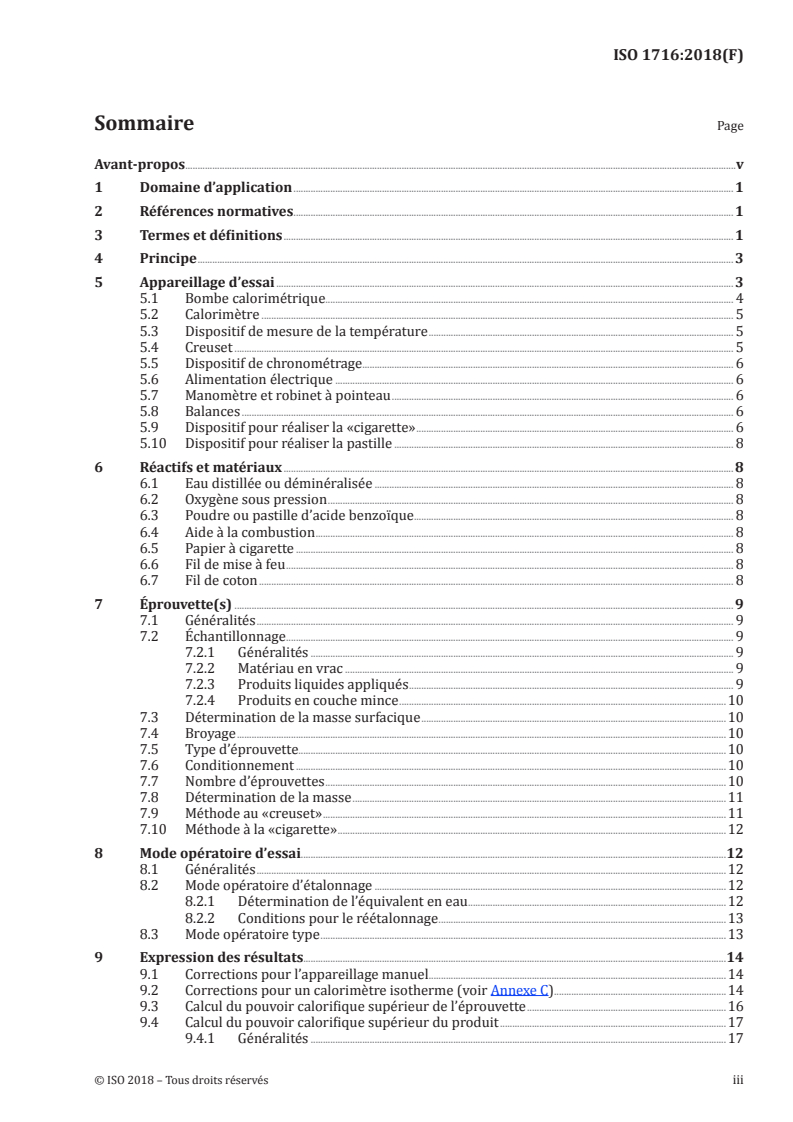
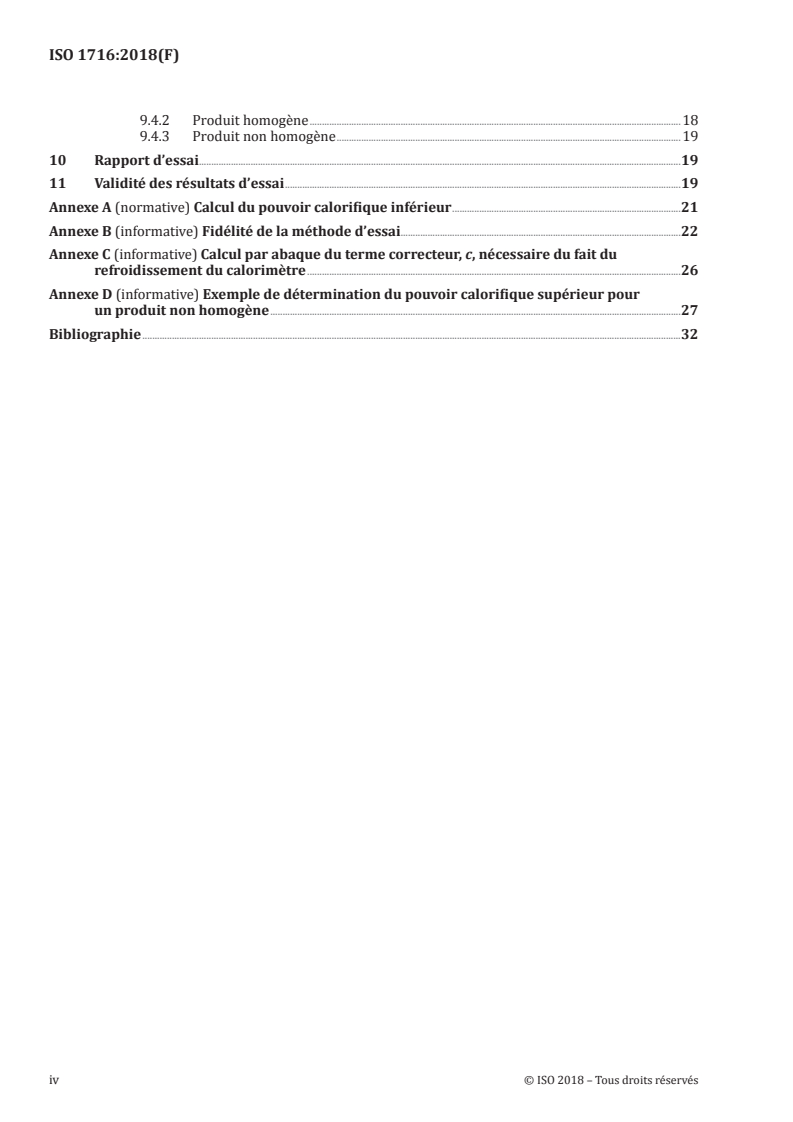
ISO 1716:2018 - Essais de réaction au feu de produits — Détermination du pouvoir calorifique supérieur (valeur calorifique)/4/2018
Overview
ISO 1716:2018 - Reaction to fire tests for products - Determination of the gross heat of combustion (calorific value) - defines a standardized laboratory method to determine the gross heat of combustion (QPCS) of products at constant volume using a bomb calorimeter. Intended primarily for solid products, the method yields the calorific value expressed in MJ/kg and includes procedures for calibration, sample preparation and result calculation. The standard also provides guidance for calculating the net heat of combustion (QPCI) (Annex A) and information on test precision (Annex B).
Key topics and technical requirements
- Scope and applicability: Method for solids; liquids may be tested using related procedures (ASTM D240 / IEC 61039 with ISO 1928 equipment) as noted in the standard.
- Principle: Combust specimen in oxygen-filled bomb calorimeter calibrated against certified benzoic acid; calculate QPCS from measured temperature rise, accounting for heat loss and latent heat of vaporization of water.
- Test apparatus: Detailed bomb calorimeter requirements (example parameters given: volume ≈ 300 ± 50 ml; max mass 3.25 kg; casing thickness criteria) and ancillary equipment (stirrer, calorimetric vessel, crucible, ignition leads).
- Calibration and procedure: Water equivalent determination, calibration frequency/conditions, standard test procedure and corrections (including isothermal calorimeter corrections in Annex C).
- Specimen preparation: Sampling, surface density measurement, grinding, conditioning (referencing ISO 554 and EN 13238), and defined specimen types. Methods include crucible method and “cigarette” method for certain product forms.
- Product classification: Definitions and handling for homogeneous vs non-homogeneous products, and treatment of substantial/non-substantial components.
- Results and reporting: Calculation of gross and net heat values, expression of results, test report content and validity rules. Annex D gives an example for non-homogeneous products.
- Safety: Warnings about hazards (toxic gases, explosion risks), requirement for risk assessment, safety instructions and training.
Practical applications and users
- Fire test laboratories performing reaction-to-fire assessments and calorific value determinations.
- Product manufacturers (construction materials, polymers, composites) needing calorific data for safety labels, specifications or regulatory compliance.
- Fire safety engineers and consultants using calorific values in fire modelling and risk assessments.
- Regulatory and certification bodies evaluating products for building codes and fire performance classifications.
- R&D teams developing lower-combustibility materials where calorific value informs material selection.
Related standards and keywords
- Normative references: ISO 554, EN 13238. Cross-references: ASTM D240, IEC 61039, ISO 1928 for liquids.
- SEO keywords: ISO 1716:2018, gross heat of combustion, calorific value, bomb calorimeter, reaction to fire tests, QPCS, QPCI, net heat of combustion, calibration, sample preparation, homogeneous product, non-homogeneous product.
Relations
- Effective Date
- 12-Feb-2026
- Effective Date
- 06-Jun-2022
- Effective Date
- 21-Nov-2015
Buy Documents
ISO 1716:2018 - Reaction to fire tests for products -- Determination of the gross heat of combustion (calorific value)
ISO 1716:2018 - Reaction to fire tests for products — Determination of the gross heat of combustion (calorific value)/4/2018
ISO 1716:2018 - Essais de réaction au feu de produits -- Détermination du pouvoir calorifique supérieur (valeur calorifique)
ISO 1716:2018 - Essais de réaction au feu de produits — Détermination du pouvoir calorifique supérieur (valeur calorifique)/4/2018
Get Certified
Connect with accredited certification bodies for this standard

DIBt (Deutsches Institut für Bautechnik)
German Institute for Building Technology.
DIN CERTCO
DIN Group product certification.

Kiwa BDA Testing
Building and construction product certification.
Sponsored listings
Frequently Asked Questions
ISO 1716:2018 is a standard published by the International Organization for Standardization (ISO). Its full title is "Reaction to fire tests for products — Determination of the gross heat of combustion (calorific value)". This standard covers: This document specifies a method for the determination of the gross heat of combustion (QPCS) of products at constant volume in a bomb calorimeter. This method is intended to be applied to solid products. NOTE Liquids can be tested with similar equipment and using conditions described in ASTM D240[1], as described in IEC 61039[2] using ISO 1928[3] test equipment. Annex A specifies the calculation of the net heat of combustion, QPCI, when required. Information on the precision of the test method is given in Annex B.
This document specifies a method for the determination of the gross heat of combustion (QPCS) of products at constant volume in a bomb calorimeter. This method is intended to be applied to solid products. NOTE Liquids can be tested with similar equipment and using conditions described in ASTM D240[1], as described in IEC 61039[2] using ISO 1928[3] test equipment. Annex A specifies the calculation of the net heat of combustion, QPCI, when required. Information on the precision of the test method is given in Annex B.
ISO 1716:2018 is classified under the following ICS (International Classification for Standards) categories: 13.220.50 - Fire-resistance of building materials and elements; 91.100.01 - Construction materials in general. The ICS classification helps identify the subject area and facilitates finding related standards.
ISO 1716:2018 has the following relationships with other standards: It is inter standard links to EN ISO 1716:2018, ISO 21415-2:2015, ISO 1716:2010. Understanding these relationships helps ensure you are using the most current and applicable version of the standard.
ISO 1716:2018 is available in PDF format for immediate download after purchase. The document can be added to your cart and obtained through the secure checkout process. Digital delivery ensures instant access to the complete standard document.
Standards Content (Sample)
INTERNATIONAL ISO
STANDARD 1716
Fourth edition
2018-05
Reaction to fire tests for products —
Determination of the gross heat of
combustion (calorific value)
Essais de réaction au feu de produits — Détermination du pouvoir
calorifique supérieur (valeur calorifique)
Reference number
©
ISO 2018
© ISO 2018
All rights reserved. Unless otherwise specified, or required in the context of its implementation, no part of this publication may
be reproduced or utilized otherwise in any form or by any means, electronic or mechanical, including photocopying, or posting
on the internet or an intranet, without prior written permission. Permission can be requested from either ISO at the address
below or ISO’s member body in the country of the requester.
ISO copyright office
CP 401 • Ch. de Blandonnet 8
CH-1214 Vernier, Geneva
Phone: +41 22 749 01 11
Fax: +41 22 749 09 47
Email: copyright@iso.org
Website: www.iso.org
Published in Switzerland
ii © ISO 2018 – All rights reserved
Contents Page
Foreword .iv
1 Scope . 1
2 Normative references . 1
3 Terms and definitions . 1
4 Principle . 3
5 Test apparatus . 3
6 Reagents and materials . 8
7 Test specimens. 8
7.1 General . 8
7.2 Sampling . 9
7.2.1 General. 9
7.2.2 Loose-fill material . 9
7.2.3 Liquid-applied products . 9
7.2.4 Thin film products . 9
7.3 Determination of surface density . 9
7.4 Grinding .10
7.5 Type of specimen .10
7.6 Conditioning .10
7.7 Number of test specimens .10
7.8 Determination of mass .10
7.9 Crucible method .11
7.10 “Cigarette” method .11
8 Test procedure .12
8.1 General .12
8.2 Calibration procedure .12
8.2.1 Determination of the water equivalent .12
8.2.2 Conditions for recalibration .12
8.3 Standard test procedure .12
9 Expression of results .14
9.1 Corrections for manual apparatus .14
9.2 Corrections for isothermal calorimeter (see Annex C) .14
9.3 Calculation of the gross heat of combustion of the specimen .15
9.4 Calculation of the gross heat of combustion of the product .16
9.4.1 General.16
9.4.2 Homogeneous product .17
9.4.3 Non-homogeneous product .17
10 Test report .18
11 Validity of test results .18
Annex A (normative) Calculation of net heat of combustion .20
Annex B (informative) Precision of test method .21
Annex C (informative) Calculation by graph of the corrective term, c, necessarybecause of
the cooling of the calorimeter .24
Annex D (informative) Example of determination of the gross heat ofcombustion of a non-
homogeneous product .25
Bibliography .30
Foreword
ISO (the International Organization for Standardization) is a worldwide federation of national standards
bodies (ISO member bodies). The work of preparing International Standards is normally carried out
through ISO technical committees. Each member body interested in a subject for which a technical
committee has been established has the right to be represented on that committee. International
organizations, governmental and non-governmental, in liaison with ISO, also take part in the work.
ISO collaborates closely with the International Electrotechnical Commission (IEC) on all matters of
electrotechnical standardization.
The procedures used to develop this document and those intended for its further maintenance are
described in the ISO/IEC Directives, Part 1. In particular the different approval criteria needed for the
different types of ISO documents should be noted. This document was drafted in accordance with the
editorial rules of the ISO/IEC Directives, Part 2 (see www .iso .org/directives).
Attention is drawn to the possibility that some of the elements of this document may be the subject of
patent rights. ISO shall not be held responsible for identifying any or all such patent rights. Details of
any patent rights identified during the development of the document will be in the Introduction and/or
on the ISO list of patent declarations received (see www .iso .org/patents).
Any trade name used in this document is information given for the convenience of users and does not
constitute an endorsement.
For an explanation on the voluntary nature of standards, the meaning of ISO specific terms and
expressions related to conformity assessment, as well as information about ISO's adherence to the
World Trade Organization (WTO) principles in the Technical Barriers to Trade (TBT) see the following
URL: www .iso .org/iso/foreword .html.
This document was prepared by Technical Committee ISO/TC 92, Fire safety, Subcommittee SC 1, Fire
initiation and growth.
This fourth edition cancels and replaces the third edition (ISO 1716:2010), which has been technically
revised.
iv © ISO 2018 – All rights reserved
INTERNATIONAL STANDARD ISO 1716:2018(E)
Reaction to fire tests for products — Determination of the
gross heat of combustion (calorific value)
WARNING — The attention of all persons concerned with managing and carrying out this test
is drawn to the fact that fire testing may be hazardous and that there is a possibility that toxic
and/or harmful gases may be evolved during the test. Operational hazards may also arise during
the testing of specimens, such as the possibility of an explosion, and during the disposal of test
residues.
WARNING — An assessment of all the potential hazards and risks to health should be made
and safety precautions should be identified and provided. Written safety instructions should
be issued. Appropriate training should be given to relevant personnel. Laboratory personnel
should ensure that they follow written instructions at all times.
1 Scope
This document specifies a method for the determination of the gross heat of combustion (Q ) of
PCS
products at constant volume in a bomb calorimeter.
This method is intended to be applied to solid products.
[1]
NOTE Liquids can be tested with similar equipment and using conditions described in ASTM D240 , as
[2] [3]
described in IEC 61039 using ISO 1928 test equipment.
Annex A specifies the calculation of the net heat of combustion, Q , when required.
PCI
Information on the precision of the test method is given in Annex B.
2 Normative references
The following documents are referred to in the text in such a way that some or all of their content
constitutes requirements of this document. For dated references, only the edition cited applies. For
undated references, the latest edition of the referenced document (including any amendments) applies.
ISO 554, Standard atmospheres for conditioning and/or testing — Specifications
EN 13238, Reaction to fire tests for building products — Conditioning procedures and general rules for
selection of substrates
3 Terms and definitions
For the purposes of this document, the following terms and definitions apply.
ISO and IEC maintain terminological databases for use in standardization at the following addresses:
— ISO Online browsing platform: available at https: //www .iso .org/obp
— IEC Electropedia: available at https: //www .electropedia .org/
3.1
product
material, element or component about which information is required
3.2
material
single basic substance or uniformly dispersed mixture of substances
EXAMPLE Stone, timber, concrete, mineral wool with a uniformly dispersed binder and polymers.
3.3
homogeneous product
product (3.1) consisting of a single material (3.2) having uniform density and composition throughout
the product (3.1)
3.4
non-homogeneous product
product (3.1) that does not satisfy the requirements of a homogeneous product (3.3) and which is
composed of more than one component, substantial or non-substantial
Note 1 to entry: If a non-homogeneous product cannot be easily separated into its component parts, the individual
components shall be provided separately by the sponsor.
3.5
non-substantial component
material (3.2) that does not constitute a significant part of a non-homogeneous product (3.4) and that
has a layer with a mass/unit area below 1,0 kg/m and a thickness below 1,0 mm
Note 1 to entry: If the non-substantial layers do not comply with the above requirements, together they shall be
considered to be substantial.
Note 2 to entry: Two or more non-substantial layers that are adjacent to each other (i.e. with no substantial
component(s) in between the layers) are regarded as one non-substantial component when they collectively
comply with the requirements for a layer being a non-substantial component.
3.6
substantial component
material (3.2) that constitutes a significant part of a non-homogeneous product (3.4) and that has a layer
with a mass/unit area more than or equal to 1,0 kg/m or a thickness more than or equal to 1,0 mm
Note 1 to entry: Two or more non-substantial layers that are adjacent to each other (i.e. with no substantial
component(s) in between the layers) are regarded as one substantial component when they collectively comply
with the requirements for a layer being a substantial component.
3.7
internal non-substantial component
non-substantial component (3.5) that is covered on both sides by at least one substantial component (3.6)
3.8
external non-substantial component
non-substantial component (3.5) that is not covered on one side by a substantial component (3.6)
3.9
heat of combustion
DEPRECATED: calorific value
Q
thermal energy produced by combustion of unit mass of a given substance
Note 1 to entry: The heat of combustion is expressed in megajoules per kilogram.
[SOURCE: ISO 13943:2008, 4.174, modified — The Note 1 to entry was changed.]
2 © ISO 2018 – All rights reserved
3.10
gross heat of combustion
Q
PCS
heat of combustion (3.9) of a substance when the combustion is complete and any produced water is
entirely condensed under specified conditions
Note 1 to entry: The gross heat of combustion is expressed in megajoules per kilogram.
Note 2 to entry: The acronym PCS is derived from the French term “pouvoir calorifique supérieur”.
3.11
net heat of combustion
Q
PCI
heat of combustion (3.9) of a substance when the combustion is complete and any produced water is in
the vapour state under specified conditions
Note 1 to entry: The net heat of combustion may be calculated from the gross heat of combustion.
Note 2 to entry: The net heat of combustion is expressed in megajoules per kilogram.
Note 3 to entry: The acronym PCI is derived from the French term “pouvoir calorifique inférieur”.
3.12
latent heat of vaporization of water
q
heat which is required to change water from a liquid to a gas
Note 1 to entry: The latent heat of vaporization is expressed in megajoules per kilogram.
3.13
surface density
mass per unit area
Note 1 to entry: The surface density is expressed in kilograms per square metre.
4 Principle
In this test, a test specimen of specified mass is burned under standardized conditions, at constant
volume, in an atmosphere of oxygen, in a bomb calorimeter calibrated by combustion of certified
benzoic acid. The heat of combustion determined under these conditions is calculated on the basis of
the observed temperature rise, taking account of heat loss and the latent heat of vaporization of water.
This is a test method for determining an absolute value of the heat of combustion for a product and it
does not take into account any inherent variability of the product.
5 Test apparatus
The test apparatus (bomb calorimeter) shall be as illustrated in Figure 1, and as detailed in 5.1 to 5.4.
Additional equipment shall be in accordance with 5.5 to 5.10.
Equipment described in 5.1 to 5.4 could also be available as automatic or semi-automatic apparatuses.
Any deviation from these subclauses has to be evaluated by the user according to requirements of
subsequent subclauses.
Key
1 stirrer 7 calorimetric bomb
2 jacket lid 8 crucible
3 ignition leads 9 electrodes
4 temperature measuring device 10 firing wire
5 calorimetric vessel 11 crucible holder
6 jacket
Figure 1 — Test apparatus
5.1 Calorimetric bomb.
The calorimetric bomb shall be constructed with the following characteristics:
a) volume: (300 ± 50) ml;
b) mass not greater than 3,25 kg;
4 © ISO 2018 – All rights reserved
c) casing thickness at least 1/10 of the inner diameter of the body:
The lid is intended to receive the crucible and the electric firing device. The lid, including any seals,
shall be capable of withstanding an internal pressure of 21 MPa.
NOTE These conditions define a bomb in which 1 g of coal under an initial oxygen pressure no greater than
3 MPa (pressure gauge method) is able to withstand, with a sufficient coefficient of safety, the maximum amount
of pressure created under combustion, without a need for a calorimetric bomb of overlarge mass.
The inner surface of the bomb shall be resistant to attack by products of combustion and, even when
“fuels” rich in sulfur are used, it shall resist pitting and inter-crystalline corrosion by acids produced
during combustion.
5.2 Calorimeter.
5.2.1 Jacket.
The jacket shall consist of a double-walled container, which is thermally insulated together with an
insulated lid. The jacket is filled with water. The dimensions of the jacket shall be such that there is at
least 10 mm space around the calorimetric vessel. The calorimetric vessel shall be supported on an as
small as possible area of non-conducting material, preferably a 3-point support.
For an adiabatic calorimeter system, a heater and thermometer system shall be incorporated into the
vessel such that the water temperature in the jacket is maintained at the same temperature as the water
in the calorimetric vessel.
For an isothermal calorimeter system, the temperature of the water in the jacket shall be kept constant.
For an isothermal calorimeter, the necessary corrections shall be made (see 9.2).
5.2.2 Calorimetric vessel.
The calorimetric vessel shall consist of a polished metal container designed to accommodate the bomb.
The dimensions shall be such that the bomb can be immersed in water (see 8.3.8).
5.2.3 Stirrer.
The stirrer shall be driven by a constant-speed motor. To prevent the transfer of heat to and from the
calorimeter, the driving shaft of the stirrer shall have a thermally insulated section in a gasket between
the jacket lid and the jacket. A magnetic stirring device with a similar performance is an acceptable
alternative.
5.3 Temperature measuring device.
The temperature measuring device shall be capable of giving a resolution of 0,005 K. When using a
mercury thermometer, this shall have at least 0,01 K graduations with a device, e.g. a lens, for taking
readings to within 0,005 K. A mechanical vibrator shall also be used to gently tap the thermometer to
ensure that the mercury column does not stick.
5.4 Crucible.
The crucible shall be made of metal, such as platinum, nickel, stainless steel or silica, with a flat base,
25 mm in diameter (maximum dimension if it is truncated) and 14 mm to 19 mm high. The following
wall thickness is recommended:
— metal: 1,0 mm;
— silica: 1,5 mm.
NOTE Several shapes of crucible have proved satisfactory.
5.5 Timing device.
The timing device shall be capable of recording the time elapsed to the nearest second and accurate to
within 1 s in 1 h.
5.6 Electric power source.
The electric power source shall be designed with the voltage to the firing circuit not exceeding 20 V for
the firing.
NOTE An ammeter can be added to the circuit to indicate the breaking of the firing wire. A circuit breaker is
a useful addition to the supply circuit.
5.7 Pressure gauge and needle-valve.
A pressure gauge and a needle valve shall be attached to the oxygen-supply circuit to show the pressure
in the bomb while it is being filled; this pressure shall be indicated with a resolution of 0,1 MPa.
5.8 Balances.
Two balances shall be used with the following characteristics:
— one is an analytical balance with a resolution of 0,1 mg;
— the other is a balance with a resolution of 0,1 g.
5.9 Device for making the “cigarette”.
The device shall be designed as shown in Figure 2, and comprise a mould and a metallic mandrel (not
aluminium).
6 © ISO 2018 – All rights reserved
Dimensions in millimetres
b) Paper in position in the mould after the
a) Shaping the paper over the mandrel
mandrel has been removed, ready to be filled
c) Cigarette completed d) Cigarette placed in the crucible
Key
1 mandrel 3 firing wire 5 electrode 7 crucible
2 mould 4 paper 6 cigarette
NOTE 1 The paper is kept in place by gluing an overlap of the paper using the preglued cigarette-making paper.
NOTE 2 The two ends of the paper are twisted.
NOTE 3 The “cigarette” is put in the crucible and the firing wire is wrapped tightly around the line of the
electrodes.
Figure 2 — Method for preparing the “cigarette”
5.10 Device for making the pellet.
The device is suitable if prefabricated pellets are not available.
6 Reagents and materials
Use only reagents of recognized analytical grade and only distilled water or water of equivalent purity.
6.1 Distilled or demineralized water.
6.2 Pressurized oxygen.
The oxygen used shall be free from any other combustible product (purity ≥ 99,5 %).
WARNING — Oxygen prepared by electrolysis can contain a small percentage of hydrogen, which
makes it unsuitable for this use.
6.3 Powder or pellet of benzoic acid.
Benzoic acid whose gross heat of combustion is guaranteed is used as “reference standard for
calorimetry”.
6.4 Combustion aid.
Combustion aid is a combustible with a known heat of combustion, e.g. paraffin oil.
6.5 Cigarette-making paper.
The cigarette making paper shall be preglued and of minimum dimensions 55 mm × 50 mm with a
known heat of combustion.
NOTE A commercially available cigarette-making paper of 55 mm × 100 mm has been found suitable when
cut into two equal pieces.
6.6 Firing wire.
The firing wire shall be made of pure iron, 0,1 mm in diameter, e.g. piano wire. Other types of metal
wire (e.g. platinum, nickel or chromium) may be used, provided that they break under their own tension
when the switch is closed on the firing circuit and the exact heat of combustion for the wire is known.
When using a metal crucible (5.4), there shall be no contact between the firing wire and the crucible. It
is therefore advisable to wrap the metal wire with a cotton thread.
NOTE Some automatic or semi-automatic apparatuses are working with permanent firing wires in
combination with single use combustible crucibles. Reference has to be made to the instructions of the
manufacturer of such calorimeter systems.
6.7 Thread.
The thread shall be made of white cellulosic cotton (see 6.6).
7 Test specimens
7.1 General
In order to assess a product, each of its components shall be evaluated, taking into account the rules
for non-substantial components. If a non-homogeneous product cannot be easily separated into its
component parts, the individual components shall be provided separately by the sponsor of the test. A
8 © ISO 2018 – All rights reserved
product can be delaminated when it is possible to separate one component from another without any
part of the other component adhering to the component to be evaluated.
Some substantial components cannot be produced without facings. If the facings cannot be delaminated,
a section shall be cut from the central part of the core avoiding the facings and any adhesive or other
non-substantial component on its surface.
If two or more non-substantial layers are adjacent to each other, and when added together they comply
with the definition for a substantial component, then each individual layer shall be tested separately
and they shall be assessed together as substantial. The total calorific value of the adjacent layers,
which are considered substantial, shall be calculated by adding together the relative percentage of the
measured calorific value for each component (see Annex D).
If two or more non-substantial layers are adjacent to each other, and when added together they
comply with the definition for a non-substantial component, then each individual layer shall be tested
separately and they shall be assessed together as non-substantial (see Annex D).
WARNING — Any aluminium or other metallic component of a product shall not be tested in
the bomb calorimeter, with the risk of serious injury to the operator due to overheating and/or
overpressure causing the bomb calorimeter to explode.
If the product tested is made of non-separable multiple layers in which one layer comprises aluminium
or other metallic foils, recommendations of Reference [4] should be applied.
7.2 Sampling
7.2.1 General
From a representative amount of a homogeneous product, or a component of a non-homogeneous
product, compose a sample from at least five randomly selected parts taken from across the thickness.
A minimum mass of 50 g shall be taken from a homogeneous product and a substantial component of a
non-homogeneous product. A minimum mass of 10 g shall be taken for a non-substantial component of
a non-homogeneous product.
7.2.2 Loose-fill material
A sample shall be taken at random from the product of a minimum mass of 50 g.
7.2.3 Liquid-applied products
A sample of a minimum mass of 10 g of dried material shall be prepared. The sample may be prepared
by applying a thin layer of the liquid-applied product to a glass sheet and taking the sample for the test
by scrapping the dried product from the glass surface.
The material shall be cured or dried in accordance with the manufacturer's instructions. Care should
be taken when drying liquid-applied components due to the potential presence of solvents. The method
of curing shall be described in the test report.
7.2.4 Thin film products
The sample shall have a minimum mass of 10 g. The film shall be cut into small pieces for the test which
shall either be tested as a cigarette (7.10) or shall be tested in the crucible. For the crucible method, it
is recommended that 0,5 g of the paraffin oil combustion aid is added to the crucible over the surface of
the film to stop the film from being ejected from the crucible.
7.3 Determination of surface density
Where required, the surface density of each sample of a product shall be determined to an accuracy of
±0,5 % from a minimum area of 250 mm × 250 mm.
For liquid-applied products, the dried mass shall be determined.
7.4 Grinding
The samples defined in 7.2 shall be reduced gradually to provide the final test sample. Grinding shall
be carried out in such a way that no thermal decomposition takes place. Grind the sample and reduce it
with a method of cross-reduction, grinding to a finer powder as reduction proceeds.
If the sample cannot be ground, reduce it by any appropriate method into small granules or pieces
which should be as small as possible, and treat the specimens obtained as a powder.
In the case of homogeneous material which, when ground, clearly separates into components of
different density, so that a 0,5 g sample of the product, when taken from the ground powder, is not
representative of the original product with respect to the proportion of the materials present, reduce
the sample by any appropriate method, e.g. by sawing the sample into thin discs or by cutting it with a
knife into small pieces. If this preparation is not possible, testing shall be conducted on the individual
ingredients used in the manufacture of that product. The individual Q values for these ingredients
PCS
shall be used together with the proportion by mass of the ingredients in the final product to calculate
the overall Q value for the product.
PCS
7.5 Type of specimen
If a fine powder can be obtained by grinding (see 7.4), the test specimen shall be prepared using the
crucible method (see 7.9). If a fine powder cannot be obtained by grinding and/or a complete combustion
cannot be obtained when using the crucible method, the test shall be conducted by using either the
“cigarette” method (see 7.10) or the crucible method utilizing a combustion aid, e.g. paraffin oil.
7.6 Conditioning
The powdered specimen, the benzoic acid and the cigarette-making paper shall be conditioned before
testing in accordance with EN 13238 or ISO 554.
7.7 Number of test specimens
Three test specimens shall be tested following the procedure in 8.3. Two additional test specimens
shall be tested if the requirements for validity of test results are not met (see Clause 11). More than
three specimens may be tested as required for any classification system.
7.8 Determination of mass
Weigh the following elements:
— Approximately 0,5 g of material, with a minimum precision of 0,1 mg;
— Approximatively 0,5 g of benzoic acid, with a minimum precision of 0,1 mg;
— combustion aid, with a minimum precision of 0,1 mg;
— firing wire, cotton thread and cigarette-making paper, if necessary, with a minimum precision
of 0,1 mg.
NOTE For some materials with a low heat of combustion, it can be necessary to increase the gross heat of
combustion of the specimen in order to obtain complete combustion by changing the mass ratio between the
material and the benzoic acid or by adding a combustion aid (e.g. paraffin oil). The benzoic acid and/or combustion
aid can be reduced or excluded if it’s not necessary for combustion of the material.
10 © ISO 2018 – All rights reserved
7.9 Crucible method
The procedure shall be carried out as follows (see Figure 3).
a) Insert the previously weighed mixture of specimen and benzoic acid into the crucible.
b) Connect the previously weighed firing wire to the two electrodes.
c) Loop down the firing wire to touch the powder in the crucible.
NOTE Some automatic apparatus is supplied with a fixed firing wire. For these items of apparatus, loop
down a previously weighed cotton thread to touch the powder in the crucible.
Key
1 firing wire
2 electrodes
3 mixture of benzoic acid and product
4 crucible
5 crucible holder
Figure 3 — Test specimen preparation using the crucible method
7.10 “Cigarette” method
The procedure shall be carried out as follows (see Figure 2).
a) Place a previously weighed firing wire down the centre of the mandrel.
b) Wrap the previously weighed cigarette-making paper around the mandrel and glue the two
overlapping edges together. No additional glue shall be used since the cigarette-making paper is
preglued. Sufficient paper shall be left free at each end to allow this to be twisted around the
firing wire.
c) Twist the paper around the firing wire at the lower end of the mandrel and insert the whole
assembly into the mould. The firing wire shall project through the bottom of the mould.
NOTE A clearance of 0,5 mm between the mandrel and the mould allows for easy positioning of the
assembly.
d) Remove the mandrel.
e) Insert the previously weighed mixture of specimen and benzoic acid into the cigarette-making paper.
f) Remove the filled “cigarette” from the mould and twist together the ends of the paper to seal the
“cigarette”.
g) Weigh the “cigarette” to ensure that the total mass does not vary from the masses of the constituents
by more than 10 mg.
h) Put the “cigarette” into the crucible.
i) Connect the firing wire to the two electrodes.
8 Test procedure
8.1 General
It is recommended that the test be conducted in a room where the temperature remains stable, within
±2 K. Calibration of the apparatus and subsequent testing should be conducted under similar conditions
of temperature and pressure. For manual apparatus, the difference between the room temperature and
the vessel water temperature shall not vary by more than ±2 K.
8.2 Calibration procedure
8.2.1 Determination of the water equivalent
The water equivalent, E, expressed in megajoules per kelvin, of the calorimeter, the bomb and their
accessories shall be determined by making at least five determinations of the gross heat of combustion
of pellets of 0,4 g to 1,0 g of certified benzoic acid.
The calibration procedure shall be carried out as follows.
a) Compress the previously weighed powder of benzoic acid, using a pellet-making machine, to make
a pellet or take a prefabricated pellet. Prefabricated certified pellets of benzoic acid may be used as
an alternative to benzoic acid powder. The certified value provided shall be used in any calculation
of the gross heat of combustion.
b) Weigh the pellet with a minimum precision of 0,1 mg.
c) Put the pellet into the crucible.
d) Connect the firing wire to the two electrodes.
e) Loop down the previously weighed firing wire to touch the pellet.
The test shall be carried out as specified in 8.3. The water equivalent, E, expressed in megajoules per
kelvin, shall be the average of the five determinations. Each individual result shall not deviate by more
than 0,5 % from the water equivalent.
8.2.2 Conditions for recalibration
The procedure given in 8.2.1 shall be carried out at regular intervals, not greater than two months with
continuous use of the apparatus, or when any significant part of the system is changed.
8.3 Standard test procedure
WARNING — Aluminium or other metallic components of a product shall not be tested in
the bomb calorimeter at the risk of serious injury to the operator due to overheating and/or
overpressure causing the bomb calorimeter to explode.
12 © ISO 2018 – All rights reserved
Switch on the apparatus and wait at least 1 h before testing, or until stabilization is reached.
8.3.1 Place the specimen in the crucible.
8.3.2 Place the crucible in the holder.
8.3.3 Attach the firing wire and loop it to touch the specimen.
8.3.4 Check that a good electrical contact is ensured between the two electrodes and the firing wire.
8.3.5 Place the holder in the body of the calorimetric bomb.
1 ml of de-ionized water may be introduced into the body of the calorimetric bomb to absorb any acid
gases produced. Absorption of the acid gases can help reduce the amount of pitting within the bomb vessel.
8.3.6 Adjust the lid and tighten onto the body of the bomb. Connect the bomb to the bottle of oxygen,
then carefully open the bottle's tap and fill the bomb until a pressure of 3,0 MPa to 3,5 MPa is achieved (if
not achieved automatically), without removing the air already there.
8.3.7 Place the bomb in the calorimeter vessel.
8.3.8 Introduce into the calorimeter vessel a quantity of distilled or demineralized water that is
sufficient to cover the upper surface of the bomb cap and weigh. This quantity of water shall be the same,
to the nearest 1 g, as that used in the calibration procedure (see 8.2.1) (if not achieved automatically).
8.3.9 Check that the bomb does not leak (no continuous stream of bubbles).
8.3.10 Place the calorimeter vessel in the water jacket.
8.3.11 Proceed as follows:
a) Set the temperature-measuring device and start the stirrer and the timing device (if this is not
achieved automatically).
b) Bring the water in the calorimeter vessel to a temperature that is approximately equal to that
of the jacket. Note the temperature of the water in the calorimeter vessel at least every minute
until successive readings are identical within ±0,01 K for at least 10 min (if this is not achieved
automatically). Note this temperature as the initial temperature, T .
i
NOTE 1 With some automatic apparatus, the manufacturer of the apparatus states that a shorter time
than 10 min is sufficient. If this is the case, this reduced time can be used on condition that the manufacturer's
information is checked and documented by the laboratory.
c) Close the electric circuit to cause combustion.
d) For an adiabatic calorimeter only: during the rapid temperature-rise phase of the water in the
calorimetric vessel, the temperature of the water in the jacket shall be maintained as close as
possible to that of the calorimetric vessel; the two temperatures shall be to within ±0,01 K as they
get nearer to the maximum temperature. Note the temperature of the water in the calorimetric
vessel at least every minute until successive readings are identical within ±0,01 K for at least
10 min. Note this temperature as the maximum temperature, T .
m
NOTE 2 These processes can be automated in designs of commercially available equipment.
e) Remove the bomb from the calorimeter, then slowly reduce the pressure. Open the bomb. Verify
that complete combustion has taken place, i.e. that there is neither a sooty deposit inside the bomb
nor traces of residual carbon on the sides of the crucible. Rinse and dry the bomb.
f) If complete combustion has not occurred, a different method of test specimen preparation could be
tried, using combustion aid and/or an increased proportion of benzoic acid. With some materials, a
procedure of trial and error is necessary to find the best method.
9 Expression of results
9.1 Corrections for manual apparatus
Correct all the temperatures observed in accordance with the calibration certificate of the thermometer
and taking account of the exposed part of the thermometer stem.
9.2 Corrections for isothermal calorimeter (see Annex C)
Correction of the temperature is necessitated by the exchange of heat with the exterior (see Notes 1,
2 and 3).
This correction factor, c, is given by Formula (1):
c = (t − t ) × T − t × T (1)
I 2 I I
where
t is the time passed, in minutes and fractions of a minute, from the start of the main period
(see Figure 4) until the time when the maximum temperature is reached. This moment is
determined by finding the average of the times at which the temperature stops increasing and
starts decreasing;
t is the time passed, in minutes and fractions of a minute, from the start of the main period at
l
temperature T (see Figure 4) until the moment when the temperature increase is 6/10 of
the total temperature range (T − T ) (see 9.3); this moment is calculated by interpolation
m i
between the two temperature readings nearest to each other;
T is the average temperature drop, in kelvins per minute, of the final period (see Figure 4);
T is the average rise in temperature, in kelvins per minute, of the preliminary period (see
l
Figure 4).
14 © ISO 2018 – All rights reserved
Key
T temperature
t time
1 preliminary period
2 main period
3 final period
4 ignition
5 temperature/time curve of the jacket
t time when the temperature of the water in the crucible vessel is equal to the temperature of the jacket (see
Figure 1) as defined in 8.3.11 b)
a
A1 and A2 respectively represent the hatched areas of temperature/time curve situated above and below the
line of ordinate T .
Figure 4 — Temperature/time curve
NOTE 1 c is null if an adiabatic jacket is used.
NOTE 2 c is null if an automatic correction is made with an automatic apparatus.
NOTE 3 A graphical method for the calculation of c is given in Annex C.
9.3 Calculation of the gross heat of combustion of the specimen
The calculation of the gross heat of combustion, Q , under constant volume, of the test specimen is
PCS
given by Formula (2), expressed in megajoules per kilogram.
With automatic apparatus, the gross heat of combustion, Q , is directly obtained as the result of the test.
PCS
ET()−+Tc −b
mi
Q = (2)
PCS
m
where
Q is the gross heat of combustion, in megajoules per kilogram;
PCS
E is the water equivalent of the calorimeter, the bomb, their accessories and of the water in-
troduced into the bomb, expressed in megajoules per kilogram (see 8.2);
T is the initial temperature, in kelvins;
i
T is the maximum temperature, in kelvins;
m
b is the correction, expressed in megajoules, required for the combustion heat of the “fuels”
used during the test, i.e. firing wire, cotton thread, cigarette-making paper and benzoic acid
or combustion aid;
c is the temperature correction factor, expressed in kelvins, required for the exchange of heat
with the outside (see 9.2); this is null if an adiabatic jacket is used;
m is the mass of the test specimen, in kilograms.
Unless a guaranteed value is given for the cotton thread, the cigarette-making paper and/or the
combustion aid, their gross heats of combustion shall be measured. The test specimen shall be prepared
as specified in 7.9 and the test shall be carried out as specified in 8.3.
Unless a guaranteed value is given for the firing wire, the gross heat of combustio
...
INTERNATIONAL ISO
STANDARD 1716
Fourth edition
2018-05
Reaction to fire tests for products —
Determination of the gross heat of
combustion (calorific value)
Essais de réaction au feu de produits — Détermination du pouvoir
calorifique supérieur (valeur calorifique)
Reference number
©
ISO 2018
© ISO 2018
All rights reserved. Unless otherwise specified, or required in the context of its implementation, no part of this publication may
be reproduced or utilized otherwise in any form or by any means, electronic or mechanical, including photocopying, or posting
on the internet or an intranet, without prior written permission. Permission can be requested from either ISO at the address
below or ISO’s member body in the country of the requester.
ISO copyright office
CP 401 • Ch. de Blandonnet 8
CH-1214 Vernier, Geneva
Phone: +41 22 749 01 11
Fax: +41 22 749 09 47
Email: copyright@iso.org
Website: www.iso.org
Published in Switzerland
ii © ISO 2018 – All rights reserved
Contents Page
Foreword .iv
1 Scope . 1
2 Normative references . 1
3 Terms and definitions . 1
4 Principle . 3
5 Test apparatus . 3
6 Reagents and materials . 8
7 Test specimens. 8
7.1 General . 8
7.2 Sampling . 9
7.2.1 General. 9
7.2.2 Loose-fill material . 9
7.2.3 Liquid-applied products . 9
7.2.4 Thin film products . 9
7.3 Determination of surface density . 9
7.4 Grinding .10
7.5 Type of specimen .10
7.6 Conditioning .10
7.7 Number of test specimens .10
7.8 Determination of mass .10
7.9 Crucible method .11
7.10 “Cigarette” method .11
8 Test procedure .12
8.1 General .12
8.2 Calibration procedure .12
8.2.1 Determination of the water equivalent .12
8.2.2 Conditions for recalibration .12
8.3 Standard test procedure .12
9 Expression of results .14
9.1 Corrections for manual apparatus .14
9.2 Corrections for isothermal calorimeter (see Annex C) .14
9.3 Calculation of the gross heat of combustion of the specimen .15
9.4 Calculation of the gross heat of combustion of the product .16
9.4.1 General.16
9.4.2 Homogeneous product .17
9.4.3 Non-homogeneous product .17
10 Test report .18
11 Validity of test results .18
Annex A (normative) Calculation of net heat of combustion .20
Annex B (informative) Precision of test method .21
Annex C (informative) Calculation by graph of the corrective term, c, necessarybecause of
the cooling of the calorimeter .24
Annex D (informative) Example of determination of the gross heat ofcombustion of a non-
homogeneous product .25
Bibliography .30
Foreword
ISO (the International Organization for Standardization) is a worldwide federation of national standards
bodies (ISO member bodies). The work of preparing International Standards is normally carried out
through ISO technical committees. Each member body interested in a subject for which a technical
committee has been established has the right to be represented on that committee. International
organizations, governmental and non-governmental, in liaison with ISO, also take part in the work.
ISO collaborates closely with the International Electrotechnical Commission (IEC) on all matters of
electrotechnical standardization.
The procedures used to develop this document and those intended for its further maintenance are
described in the ISO/IEC Directives, Part 1. In particular the different approval criteria needed for the
different types of ISO documents should be noted. This document was drafted in accordance with the
editorial rules of the ISO/IEC Directives, Part 2 (see www .iso .org/directives).
Attention is drawn to the possibility that some of the elements of this document may be the subject of
patent rights. ISO shall not be held responsible for identifying any or all such patent rights. Details of
any patent rights identified during the development of the document will be in the Introduction and/or
on the ISO list of patent declarations received (see www .iso .org/patents).
Any trade name used in this document is information given for the convenience of users and does not
constitute an endorsement.
For an explanation on the voluntary nature of standards, the meaning of ISO specific terms and
expressions related to conformity assessment, as well as information about ISO's adherence to the
World Trade Organization (WTO) principles in the Technical Barriers to Trade (TBT) see the following
URL: www .iso .org/iso/foreword .html.
This document was prepared by Technical Committee ISO/TC 92, Fire safety, Subcommittee SC 1, Fire
initiation and growth.
This fourth edition cancels and replaces the third edition (ISO 1716:2010), which has been technically
revised.
iv © ISO 2018 – All rights reserved
INTERNATIONAL STANDARD ISO 1716:2018(E)
Reaction to fire tests for products — Determination of the
gross heat of combustion (calorific value)
WARNING — The attention of all persons concerned with managing and carrying out this test
is drawn to the fact that fire testing may be hazardous and that there is a possibility that toxic
and/or harmful gases may be evolved during the test. Operational hazards may also arise during
the testing of specimens, such as the possibility of an explosion, and during the disposal of test
residues.
WARNING — An assessment of all the potential hazards and risks to health should be made
and safety precautions should be identified and provided. Written safety instructions should
be issued. Appropriate training should be given to relevant personnel. Laboratory personnel
should ensure that they follow written instructions at all times.
1 Scope
This document specifies a method for the determination of the gross heat of combustion (Q ) of
PCS
products at constant volume in a bomb calorimeter.
This method is intended to be applied to solid products.
[1]
NOTE Liquids can be tested with similar equipment and using conditions described in ASTM D240 , as
[2] [3]
described in IEC 61039 using ISO 1928 test equipment.
Annex A specifies the calculation of the net heat of combustion, Q , when required.
PCI
Information on the precision of the test method is given in Annex B.
2 Normative references
The following documents are referred to in the text in such a way that some or all of their content
constitutes requirements of this document. For dated references, only the edition cited applies. For
undated references, the latest edition of the referenced document (including any amendments) applies.
ISO 554, Standard atmospheres for conditioning and/or testing — Specifications
EN 13238, Reaction to fire tests for building products — Conditioning procedures and general rules for
selection of substrates
3 Terms and definitions
For the purposes of this document, the following terms and definitions apply.
ISO and IEC maintain terminological databases for use in standardization at the following addresses:
— ISO Online browsing platform: available at https: //www .iso .org/obp
— IEC Electropedia: available at https: //www .electropedia .org/
3.1
product
material, element or component about which information is required
3.2
material
single basic substance or uniformly dispersed mixture of substances
EXAMPLE Stone, timber, concrete, mineral wool with a uniformly dispersed binder and polymers.
3.3
homogeneous product
product (3.1) consisting of a single material (3.2) having uniform density and composition throughout
the product (3.1)
3.4
non-homogeneous product
product (3.1) that does not satisfy the requirements of a homogeneous product (3.3) and which is
composed of more than one component, substantial or non-substantial
Note 1 to entry: If a non-homogeneous product cannot be easily separated into its component parts, the individual
components shall be provided separately by the sponsor.
3.5
non-substantial component
material (3.2) that does not constitute a significant part of a non-homogeneous product (3.4) and that
has a layer with a mass/unit area below 1,0 kg/m and a thickness below 1,0 mm
Note 1 to entry: If the non-substantial layers do not comply with the above requirements, together they shall be
considered to be substantial.
Note 2 to entry: Two or more non-substantial layers that are adjacent to each other (i.e. with no substantial
component(s) in between the layers) are regarded as one non-substantial component when they collectively
comply with the requirements for a layer being a non-substantial component.
3.6
substantial component
material (3.2) that constitutes a significant part of a non-homogeneous product (3.4) and that has a layer
with a mass/unit area more than or equal to 1,0 kg/m or a thickness more than or equal to 1,0 mm
Note 1 to entry: Two or more non-substantial layers that are adjacent to each other (i.e. with no substantial
component(s) in between the layers) are regarded as one substantial component when they collectively comply
with the requirements for a layer being a substantial component.
3.7
internal non-substantial component
non-substantial component (3.5) that is covered on both sides by at least one substantial component (3.6)
3.8
external non-substantial component
non-substantial component (3.5) that is not covered on one side by a substantial component (3.6)
3.9
heat of combustion
DEPRECATED: calorific value
Q
thermal energy produced by combustion of unit mass of a given substance
Note 1 to entry: The heat of combustion is expressed in megajoules per kilogram.
[SOURCE: ISO 13943:2008, 4.174, modified — The Note 1 to entry was changed.]
2 © ISO 2018 – All rights reserved
3.10
gross heat of combustion
Q
PCS
heat of combustion (3.9) of a substance when the combustion is complete and any produced water is
entirely condensed under specified conditions
Note 1 to entry: The gross heat of combustion is expressed in megajoules per kilogram.
Note 2 to entry: The acronym PCS is derived from the French term “pouvoir calorifique supérieur”.
3.11
net heat of combustion
Q
PCI
heat of combustion (3.9) of a substance when the combustion is complete and any produced water is in
the vapour state under specified conditions
Note 1 to entry: The net heat of combustion may be calculated from the gross heat of combustion.
Note 2 to entry: The net heat of combustion is expressed in megajoules per kilogram.
Note 3 to entry: The acronym PCI is derived from the French term “pouvoir calorifique inférieur”.
3.12
latent heat of vaporization of water
q
heat which is required to change water from a liquid to a gas
Note 1 to entry: The latent heat of vaporization is expressed in megajoules per kilogram.
3.13
surface density
mass per unit area
Note 1 to entry: The surface density is expressed in kilograms per square metre.
4 Principle
In this test, a test specimen of specified mass is burned under standardized conditions, at constant
volume, in an atmosphere of oxygen, in a bomb calorimeter calibrated by combustion of certified
benzoic acid. The heat of combustion determined under these conditions is calculated on the basis of
the observed temperature rise, taking account of heat loss and the latent heat of vaporization of water.
This is a test method for determining an absolute value of the heat of combustion for a product and it
does not take into account any inherent variability of the product.
5 Test apparatus
The test apparatus (bomb calorimeter) shall be as illustrated in Figure 1, and as detailed in 5.1 to 5.4.
Additional equipment shall be in accordance with 5.5 to 5.10.
Equipment described in 5.1 to 5.4 could also be available as automatic or semi-automatic apparatuses.
Any deviation from these subclauses has to be evaluated by the user according to requirements of
subsequent subclauses.
Key
1 stirrer 7 calorimetric bomb
2 jacket lid 8 crucible
3 ignition leads 9 electrodes
4 temperature measuring device 10 firing wire
5 calorimetric vessel 11 crucible holder
6 jacket
Figure 1 — Test apparatus
5.1 Calorimetric bomb.
The calorimetric bomb shall be constructed with the following characteristics:
a) volume: (300 ± 50) ml;
b) mass not greater than 3,25 kg;
4 © ISO 2018 – All rights reserved
c) casing thickness at least 1/10 of the inner diameter of the body:
The lid is intended to receive the crucible and the electric firing device. The lid, including any seals,
shall be capable of withstanding an internal pressure of 21 MPa.
NOTE These conditions define a bomb in which 1 g of coal under an initial oxygen pressure no greater than
3 MPa (pressure gauge method) is able to withstand, with a sufficient coefficient of safety, the maximum amount
of pressure created under combustion, without a need for a calorimetric bomb of overlarge mass.
The inner surface of the bomb shall be resistant to attack by products of combustion and, even when
“fuels” rich in sulfur are used, it shall resist pitting and inter-crystalline corrosion by acids produced
during combustion.
5.2 Calorimeter.
5.2.1 Jacket.
The jacket shall consist of a double-walled container, which is thermally insulated together with an
insulated lid. The jacket is filled with water. The dimensions of the jacket shall be such that there is at
least 10 mm space around the calorimetric vessel. The calorimetric vessel shall be supported on an as
small as possible area of non-conducting material, preferably a 3-point support.
For an adiabatic calorimeter system, a heater and thermometer system shall be incorporated into the
vessel such that the water temperature in the jacket is maintained at the same temperature as the water
in the calorimetric vessel.
For an isothermal calorimeter system, the temperature of the water in the jacket shall be kept constant.
For an isothermal calorimeter, the necessary corrections shall be made (see 9.2).
5.2.2 Calorimetric vessel.
The calorimetric vessel shall consist of a polished metal container designed to accommodate the bomb.
The dimensions shall be such that the bomb can be immersed in water (see 8.3.8).
5.2.3 Stirrer.
The stirrer shall be driven by a constant-speed motor. To prevent the transfer of heat to and from the
calorimeter, the driving shaft of the stirrer shall have a thermally insulated section in a gasket between
the jacket lid and the jacket. A magnetic stirring device with a similar performance is an acceptable
alternative.
5.3 Temperature measuring device.
The temperature measuring device shall be capable of giving a resolution of 0,005 K. When using a
mercury thermometer, this shall have at least 0,01 K graduations with a device, e.g. a lens, for taking
readings to within 0,005 K. A mechanical vibrator shall also be used to gently tap the thermometer to
ensure that the mercury column does not stick.
5.4 Crucible.
The crucible shall be made of metal, such as platinum, nickel, stainless steel or silica, with a flat base,
25 mm in diameter (maximum dimension if it is truncated) and 14 mm to 19 mm high. The following
wall thickness is recommended:
— metal: 1,0 mm;
— silica: 1,5 mm.
NOTE Several shapes of crucible have proved satisfactory.
5.5 Timing device.
The timing device shall be capable of recording the time elapsed to the nearest second and accurate to
within 1 s in 1 h.
5.6 Electric power source.
The electric power source shall be designed with the voltage to the firing circuit not exceeding 20 V for
the firing.
NOTE An ammeter can be added to the circuit to indicate the breaking of the firing wire. A circuit breaker is
a useful addition to the supply circuit.
5.7 Pressure gauge and needle-valve.
A pressure gauge and a needle valve shall be attached to the oxygen-supply circuit to show the pressure
in the bomb while it is being filled; this pressure shall be indicated with a resolution of 0,1 MPa.
5.8 Balances.
Two balances shall be used with the following characteristics:
— one is an analytical balance with a resolution of 0,1 mg;
— the other is a balance with a resolution of 0,1 g.
5.9 Device for making the “cigarette”.
The device shall be designed as shown in Figure 2, and comprise a mould and a metallic mandrel (not
aluminium).
6 © ISO 2018 – All rights reserved
Dimensions in millimetres
b) Paper in position in the mould after the
a) Shaping the paper over the mandrel
mandrel has been removed, ready to be filled
c) Cigarette completed d) Cigarette placed in the crucible
Key
1 mandrel 3 firing wire 5 electrode 7 crucible
2 mould 4 paper 6 cigarette
NOTE 1 The paper is kept in place by gluing an overlap of the paper using the preglued cigarette-making paper.
NOTE 2 The two ends of the paper are twisted.
NOTE 3 The “cigarette” is put in the crucible and the firing wire is wrapped tightly around the line of the
electrodes.
Figure 2 — Method for preparing the “cigarette”
5.10 Device for making the pellet.
The device is suitable if prefabricated pellets are not available.
6 Reagents and materials
Use only reagents of recognized analytical grade and only distilled water or water of equivalent purity.
6.1 Distilled or demineralized water.
6.2 Pressurized oxygen.
The oxygen used shall be free from any other combustible product (purity ≥ 99,5 %).
WARNING — Oxygen prepared by electrolysis can contain a small percentage of hydrogen, which
makes it unsuitable for this use.
6.3 Powder or pellet of benzoic acid.
Benzoic acid whose gross heat of combustion is guaranteed is used as “reference standard for
calorimetry”.
6.4 Combustion aid.
Combustion aid is a combustible with a known heat of combustion, e.g. paraffin oil.
6.5 Cigarette-making paper.
The cigarette making paper shall be preglued and of minimum dimensions 55 mm × 50 mm with a
known heat of combustion.
NOTE A commercially available cigarette-making paper of 55 mm × 100 mm has been found suitable when
cut into two equal pieces.
6.6 Firing wire.
The firing wire shall be made of pure iron, 0,1 mm in diameter, e.g. piano wire. Other types of metal
wire (e.g. platinum, nickel or chromium) may be used, provided that they break under their own tension
when the switch is closed on the firing circuit and the exact heat of combustion for the wire is known.
When using a metal crucible (5.4), there shall be no contact between the firing wire and the crucible. It
is therefore advisable to wrap the metal wire with a cotton thread.
NOTE Some automatic or semi-automatic apparatuses are working with permanent firing wires in
combination with single use combustible crucibles. Reference has to be made to the instructions of the
manufacturer of such calorimeter systems.
6.7 Thread.
The thread shall be made of white cellulosic cotton (see 6.6).
7 Test specimens
7.1 General
In order to assess a product, each of its components shall be evaluated, taking into account the rules
for non-substantial components. If a non-homogeneous product cannot be easily separated into its
component parts, the individual components shall be provided separately by the sponsor of the test. A
8 © ISO 2018 – All rights reserved
product can be delaminated when it is possible to separate one component from another without any
part of the other component adhering to the component to be evaluated.
Some substantial components cannot be produced without facings. If the facings cannot be delaminated,
a section shall be cut from the central part of the core avoiding the facings and any adhesive or other
non-substantial component on its surface.
If two or more non-substantial layers are adjacent to each other, and when added together they comply
with the definition for a substantial component, then each individual layer shall be tested separately
and they shall be assessed together as substantial. The total calorific value of the adjacent layers,
which are considered substantial, shall be calculated by adding together the relative percentage of the
measured calorific value for each component (see Annex D).
If two or more non-substantial layers are adjacent to each other, and when added together they
comply with the definition for a non-substantial component, then each individual layer shall be tested
separately and they shall be assessed together as non-substantial (see Annex D).
WARNING — Any aluminium or other metallic component of a product shall not be tested in
the bomb calorimeter, with the risk of serious injury to the operator due to overheating and/or
overpressure causing the bomb calorimeter to explode.
If the product tested is made of non-separable multiple layers in which one layer comprises aluminium
or other metallic foils, recommendations of Reference [4] should be applied.
7.2 Sampling
7.2.1 General
From a representative amount of a homogeneous product, or a component of a non-homogeneous
product, compose a sample from at least five randomly selected parts taken from across the thickness.
A minimum mass of 50 g shall be taken from a homogeneous product and a substantial component of a
non-homogeneous product. A minimum mass of 10 g shall be taken for a non-substantial component of
a non-homogeneous product.
7.2.2 Loose-fill material
A sample shall be taken at random from the product of a minimum mass of 50 g.
7.2.3 Liquid-applied products
A sample of a minimum mass of 10 g of dried material shall be prepared. The sample may be prepared
by applying a thin layer of the liquid-applied product to a glass sheet and taking the sample for the test
by scrapping the dried product from the glass surface.
The material shall be cured or dried in accordance with the manufacturer's instructions. Care should
be taken when drying liquid-applied components due to the potential presence of solvents. The method
of curing shall be described in the test report.
7.2.4 Thin film products
The sample shall have a minimum mass of 10 g. The film shall be cut into small pieces for the test which
shall either be tested as a cigarette (7.10) or shall be tested in the crucible. For the crucible method, it
is recommended that 0,5 g of the paraffin oil combustion aid is added to the crucible over the surface of
the film to stop the film from being ejected from the crucible.
7.3 Determination of surface density
Where required, the surface density of each sample of a product shall be determined to an accuracy of
±0,5 % from a minimum area of 250 mm × 250 mm.
For liquid-applied products, the dried mass shall be determined.
7.4 Grinding
The samples defined in 7.2 shall be reduced gradually to provide the final test sample. Grinding shall
be carried out in such a way that no thermal decomposition takes place. Grind the sample and reduce it
with a method of cross-reduction, grinding to a finer powder as reduction proceeds.
If the sample cannot be ground, reduce it by any appropriate method into small granules or pieces
which should be as small as possible, and treat the specimens obtained as a powder.
In the case of homogeneous material which, when ground, clearly separates into components of
different density, so that a 0,5 g sample of the product, when taken from the ground powder, is not
representative of the original product with respect to the proportion of the materials present, reduce
the sample by any appropriate method, e.g. by sawing the sample into thin discs or by cutting it with a
knife into small pieces. If this preparation is not possible, testing shall be conducted on the individual
ingredients used in the manufacture of that product. The individual Q values for these ingredients
PCS
shall be used together with the proportion by mass of the ingredients in the final product to calculate
the overall Q value for the product.
PCS
7.5 Type of specimen
If a fine powder can be obtained by grinding (see 7.4), the test specimen shall be prepared using the
crucible method (see 7.9). If a fine powder cannot be obtained by grinding and/or a complete combustion
cannot be obtained when using the crucible method, the test shall be conducted by using either the
“cigarette” method (see 7.10) or the crucible method utilizing a combustion aid, e.g. paraffin oil.
7.6 Conditioning
The powdered specimen, the benzoic acid and the cigarette-making paper shall be conditioned before
testing in accordance with EN 13238 or ISO 554.
7.7 Number of test specimens
Three test specimens shall be tested following the procedure in 8.3. Two additional test specimens
shall be tested if the requirements for validity of test results are not met (see Clause 11). More than
three specimens may be tested as required for any classification system.
7.8 Determination of mass
Weigh the following elements:
— Approximately 0,5 g of material, with a minimum precision of 0,1 mg;
— Approximatively 0,5 g of benzoic acid, with a minimum precision of 0,1 mg;
— combustion aid, with a minimum precision of 0,1 mg;
— firing wire, cotton thread and cigarette-making paper, if necessary, with a minimum precision
of 0,1 mg.
NOTE For some materials with a low heat of combustion, it can be necessary to increase the gross heat of
combustion of the specimen in order to obtain complete combustion by changing the mass ratio between the
material and the benzoic acid or by adding a combustion aid (e.g. paraffin oil). The benzoic acid and/or combustion
aid can be reduced or excluded if it’s not necessary for combustion of the material.
10 © ISO 2018 – All rights reserved
7.9 Crucible method
The procedure shall be carried out as follows (see Figure 3).
a) Insert the previously weighed mixture of specimen and benzoic acid into the crucible.
b) Connect the previously weighed firing wire to the two electrodes.
c) Loop down the firing wire to touch the powder in the crucible.
NOTE Some automatic apparatus is supplied with a fixed firing wire. For these items of apparatus, loop
down a previously weighed cotton thread to touch the powder in the crucible.
Key
1 firing wire
2 electrodes
3 mixture of benzoic acid and product
4 crucible
5 crucible holder
Figure 3 — Test specimen preparation using the crucible method
7.10 “Cigarette” method
The procedure shall be carried out as follows (see Figure 2).
a) Place a previously weighed firing wire down the centre of the mandrel.
b) Wrap the previously weighed cigarette-making paper around the mandrel and glue the two
overlapping edges together. No additional glue shall be used since the cigarette-making paper is
preglued. Sufficient paper shall be left free at each end to allow this to be twisted around the
firing wire.
c) Twist the paper around the firing wire at the lower end of the mandrel and insert the whole
assembly into the mould. The firing wire shall project through the bottom of the mould.
NOTE A clearance of 0,5 mm between the mandrel and the mould allows for easy positioning of the
assembly.
d) Remove the mandrel.
e) Insert the previously weighed mixture of specimen and benzoic acid into the cigarette-making paper.
f) Remove the filled “cigarette” from the mould and twist together the ends of the paper to seal the
“cigarette”.
g) Weigh the “cigarette” to ensure that the total mass does not vary from the masses of the constituents
by more than 10 mg.
h) Put the “cigarette” into the crucible.
i) Connect the firing wire to the two electrodes.
8 Test procedure
8.1 General
It is recommended that the test be conducted in a room where the temperature remains stable, within
±2 K. Calibration of the apparatus and subsequent testing should be conducted under similar conditions
of temperature and pressure. For manual apparatus, the difference between the room temperature and
the vessel water temperature shall not vary by more than ±2 K.
8.2 Calibration procedure
8.2.1 Determination of the water equivalent
The water equivalent, E, expressed in megajoules per kelvin, of the calorimeter, the bomb and their
accessories shall be determined by making at least five determinations of the gross heat of combustion
of pellets of 0,4 g to 1,0 g of certified benzoic acid.
The calibration procedure shall be carried out as follows.
a) Compress the previously weighed powder of benzoic acid, using a pellet-making machine, to make
a pellet or take a prefabricated pellet. Prefabricated certified pellets of benzoic acid may be used as
an alternative to benzoic acid powder. The certified value provided shall be used in any calculation
of the gross heat of combustion.
b) Weigh the pellet with a minimum precision of 0,1 mg.
c) Put the pellet into the crucible.
d) Connect the firing wire to the two electrodes.
e) Loop down the previously weighed firing wire to touch the pellet.
The test shall be carried out as specified in 8.3. The water equivalent, E, expressed in megajoules per
kelvin, shall be the average of the five determinations. Each individual result shall not deviate by more
than 0,5 % from the water equivalent.
8.2.2 Conditions for recalibration
The procedure given in 8.2.1 shall be carried out at regular intervals, not greater than two months with
continuous use of the apparatus, or when any significant part of the system is changed.
8.3 Standard test procedure
WARNING — Aluminium or other metallic components of a product shall not be tested in
the bomb calorimeter at the risk of serious injury to the operator due to overheating and/or
overpressure causing the bomb calorimeter to explode.
12 © ISO 2018 – All rights reserved
Switch on the apparatus and wait at least 1 h before testing, or until stabilization is reached.
8.3.1 Place the specimen in the crucible.
8.3.2 Place the crucible in the holder.
8.3.3 Attach the firing wire and loop it to touch the specimen.
8.3.4 Check that a good electrical contact is ensured between the two electrodes and the firing wire.
8.3.5 Place the holder in the body of the calorimetric bomb.
1 ml of de-ionized water may be introduced into the body of the calorimetric bomb to absorb any acid
gases produced. Absorption of the acid gases can help reduce the amount of pitting within the bomb vessel.
8.3.6 Adjust the lid and tighten onto the body of the bomb. Connect the bomb to the bottle of oxygen,
then carefully open the bottle's tap and fill the bomb until a pressure of 3,0 MPa to 3,5 MPa is achieved (if
not achieved automatically), without removing the air already there.
8.3.7 Place the bomb in the calorimeter vessel.
8.3.8 Introduce into the calorimeter vessel a quantity of distilled or demineralized water that is
sufficient to cover the upper surface of the bomb cap and weigh. This quantity of water shall be the same,
to the nearest 1 g, as that used in the calibration procedure (see 8.2.1) (if not achieved automatically).
8.3.9 Check that the bomb does not leak (no continuous stream of bubbles).
8.3.10 Place the calorimeter vessel in the water jacket.
8.3.11 Proceed as follows:
a) Set the temperature-measuring device and start the stirrer and the timing device (if this is not
achieved automatically).
b) Bring the water in the calorimeter vessel to a temperature that is approximately equal to that
of the jacket. Note the temperature of the water in the calorimeter vessel at least every minute
until successive readings are identical within ±0,01 K for at least 10 min (if this is not achieved
automatically). Note this temperature as the initial temperature, T .
i
NOTE 1 With some automatic apparatus, the manufacturer of the apparatus states that a shorter time
than 10 min is sufficient. If this is the case, this reduced time can be used on condition that the manufacturer's
information is checked and documented by the laboratory.
c) Close the electric circuit to cause combustion.
d) For an adiabatic calorimeter only: during the rapid temperature-rise phase of the water in the
calorimetric vessel, the temperature of the water in the jacket shall be maintained as close as
possible to that of the calorimetric vessel; the two temperatures shall be to within ±0,01 K as they
get nearer to the maximum temperature. Note the temperature of the water in the calorimetric
vessel at least every minute until successive readings are identical within ±0,01 K for at least
10 min. Note this temperature as the maximum temperature, T .
m
NOTE 2 These processes can be automated in designs of commercially available equipment.
e) Remove the bomb from the calorimeter, then slowly reduce the pressure. Open the bomb. Verify
that complete combustion has taken place, i.e. that there is neither a sooty deposit inside the bomb
nor traces of residual carbon on the sides of the crucible. Rinse and dry the bomb.
f) If complete combustion has not occurred, a different method of test specimen preparation could be
tried, using combustion aid and/or an increased proportion of benzoic acid. With some materials, a
procedure of trial and error is necessary to find the best method.
9 Expression of results
9.1 Corrections for manual apparatus
Correct all the temperatures observed in accordance with the calibration certificate of the thermometer
and taking account of the exposed part of the thermometer stem.
9.2 Corrections for isothermal calorimeter (see Annex C)
Correction of the temperature is necessitated by the exchange of heat with the exterior (see Notes 1,
2 and 3).
This correction factor, c, is given by Formula (1):
c = (t − t ) × T − t × T (1)
I 2 I I
where
t is the time passed, in minutes and fractions of a minute, from the start of the main period
(see Figure 4) until the time when the maximum temperature is reached. This moment is
determined by finding the average of the times at which the temperature stops increasing and
starts decreasing;
t is the time passed, in minutes and fractions of a minute, from the start of the main period at
l
temperature T (see Figure 4) until the moment when the temperature increase is 6/10 of
the total temperature range (T − T ) (see 9.3); this moment is calculated by interpolation
m i
between the two temperature readings nearest to each other;
T is the average temperature drop, in kelvins per minute, of the final period (see Figure 4);
T is the average rise in temperature, in kelvins per minute, of the preliminary period (see
l
Figure 4).
14 © ISO 2018 – All rights reserved
Key
T temperature
t time
1 preliminary period
2 main period
3 final period
4 ignition
5 temperature/time curve of the jacket
t time when the temperature of the water in the crucible vessel is equal to the temperature of the jacket (see
Figure 1) as defined in 8.3.11 b)
a
A1 and A2 respectively represent the hatched areas of temperature/time curve situated above and below the
line of ordinate T .
Figure 4 — Temperature/time curve
NOTE 1 c is null if an adiabatic jacket is used.
NOTE 2 c is null if an automatic correction is made with an automatic apparatus.
NOTE 3 A graphical method for the calculation of c is given in Annex C.
9.3 Calculation of the gross heat of combustion of the specimen
The calculation of the gross heat of combustion, Q , under constant volume, of the test specimen is
PCS
given by Formula (2), expressed in megajoules per kilogram.
With automatic apparatus, the gross heat of combustion, Q , is directly obtained as the result of the test.
PCS
ET()−+Tc −b
mi
Q = (2)
PCS
m
where
Q is the gross heat of combustion, in megajoules per kilogram;
PCS
E is the water equivalent of the calorimeter, the bomb, their accessories and of the water in-
troduced into the bomb, expressed in megajoules per kilogram (see 8.2);
T is the initial temperature, in kelvins;
i
T is the maximum temperature, in kelvins;
m
b is the correction, expressed in megajoules, required for the combustion heat of the “fuels”
used during the test, i.e. firing wire, cotton thread, cigarette-making paper and benzoic acid
or combustion aid;
c is the temperature correction factor, expressed in kelvins, required for the exchange of heat
with the outside (see 9.2); this is null if an adiabatic jacket is used;
m is the mass of the test specimen, in kilograms.
Unless a guaranteed value is given for the cotton thread, the cigarette-making paper and/or the
combustion aid, their gross heats of combustion shall be measured. The test specimen shall be prepared
as specified in 7.9 and the test shall be carried out as specified in 8.3.
Unless a guaranteed value is given for the firing wire, the gross heat of combustio
...
NORME ISO
INTERNATIONALE 1716
Quatrième édition
2018-05
Essais de réaction au feu de
produits — Détermination du
pouvoir calorifique supérieur (valeur
calorifique)
Reaction to fire tests for products — Determination of the gross heat
of combustion (calorific value)
Numéro de référence
©
ISO 2018
DOCUMENT PROTÉGÉ PAR COPYRIGHT
© ISO 2018
Tous droits réservés. Sauf prescription différente ou nécessité dans le contexte de sa mise en oeuvre, aucune partie de cette
publication ne peut être reproduite ni utilisée sous quelque forme que ce soit et par aucun procédé, électronique ou mécanique,
y compris la photocopie, ou la diffusion sur l’internet ou sur un intranet, sans autorisation écrite préalable. Une autorisation peut
être demandée à l’ISO à l’adresse ci-après ou au comité membre de l’ISO dans le pays du demandeur.
ISO copyright office
Case postale 401 • Ch. de Blandonnet 8
CH-1214 Vernier, Geneva
Tél.: +41 22 749 01 11
Fax: +41 22 749 09 47
E-mail: copyright@iso.org
Web: www.iso.org
Publié en Suisse
ii © ISO 2018 – Tous droits réservés
Sommaire Page
Avant-propos .v
1 Domaine d’application . 1
2 Références normatives . 1
3 Termes et définitions . 1
4 Principe . 3
5 Appareillage d’essai . 3
5.1 Bombe calorimétrique. 4
5.2 Calorimètre . 5
5.3 Dispositif de mesure de la température . 5
5.4 Creuset . 5
5.5 Dispositif de chronométrage . 6
5.6 Alimentation électrique . 6
5.7 Manomètre et robinet à pointeau . 6
5.8 Balances . 6
5.9 Dispositif pour réaliser la «cigarette» . 6
5.10 Dispositif pour réaliser la pastille . 8
6 Réactifs et matériaux . 8
6.1 Eau distillée ou déminéralisée . 8
6.2 Oxygène sous pression . 8
6.3 Poudre ou pastille d’acide benzoïque . . 8
6.4 Aide à la combustion . 8
6.5 Papier à cigarette . 8
6.6 Fil de mise à feu . 8
6.7 Fil de coton . 8
7 Éprouvette(s) . 9
7.1 Généralités . 9
7.2 Échantillonnage . 9
7.2.1 Généralités . 9
7.2.2 Matériau en vrac . 9
7.2.3 Produits liquides appliqués . 9
7.2.4 Produits en couche mince .10
7.3 Détermination de la masse surfacique .10
7.4 Broyage .10
7.5 Type d’éprouvette.10
7.6 Conditionnement .10
7.7 Nombre d’éprouvettes .10
7.8 Détermination de la masse .11
7.9 Méthode au «creuset» .11
7.10 Méthode à la «cigarette» .12
8 Mode opératoire d’essai.12
8.1 Généralités .12
8.2 Mode opératoire d’étalonnage .12
8.2.1 Détermination de l’équivalent en eau .12
8.2.2 Conditions pour le réétalonnage .13
8.3 Mode opératoire type .13
9 Expression des résultats.14
9.1 Corrections pour l’appareillage manuel .14
9.2 Corrections pour un calorimètre isotherme (voir Annexe C) .14
9.3 Calcul du pouvoir calorifique supérieur de l’éprouvette .16
9.4 Calcul du pouvoir calorifique supérieur du produit .17
9.4.1 Généralités .17
9.4.2 Produit homogène .18
9.4.3 Produit non homogène .19
10 Rapport d’essai .19
11 Validité des résultats d’essai .19
Annexe A (normative) Calcul du pouvoir calorifique inférieur .21
Annexe B (informative) Fidélité de la méthode d’essai.22
Annexe C (informative) Calcul par abaque du terme correcteur, c, nécessaire du fait du
refroidissement du calorimètre .26
Annexe D (informative) Exemple de détermination du pouvoir calorifique supérieur pour
un produit non homogène .27
Bibliographie .32
iv © ISO 2018 – Tous droits réservés
Avant-propos
L'ISO (Organisation internationale de normalisation) est une fédération mondiale d'organismes
nationaux de normalisation (comités membres de l'ISO). L'élaboration des Normes internationales est
en général confiée aux comités techniques de l'ISO. Chaque comité membre intéressé par une étude
a le droit de faire partie du comité technique créé à cet effet. Les organisations internationales,
gouvernementales et non gouvernementales, en liaison avec l'ISO participent également aux travaux.
L'ISO collabore étroitement avec la Commission électrotechnique internationale (IEC) en ce qui
concerne la normalisation électrotechnique.
Les procédures utilisées pour élaborer le présent document et celles destinées à sa mise à jour sont
décrites dans les Directives ISO/IEC, Partie 1. Il convient, en particulier de prendre note des différents
critères d'approbation requis pour les différents types de documents ISO. Le présent document a été
rédigé conformément aux règles de rédaction données dans les Directives ISO/IEC, Partie 2 (voir www
.iso .org/directives).
L'attention est attirée sur le fait que certains des éléments du présent document peuvent faire l'objet de
droits de propriété intellectuelle ou de droits analogues. L'ISO ne saurait être tenue pour responsable
de ne pas avoir identifié de tels droits de propriété et averti de leur existence. Les détails concernant
les références aux droits de propriété intellectuelle ou autres droits analogues identifiés lors de
l'élaboration du document sont indiqués dans l'Introduction et/ou dans la liste des déclarations de
brevets reçues par l'ISO (voir www .iso .org/brevets).
Les appellations commerciales éventuellement mentionnées dans le présent document sont données
pour information, par souci de commodité, à l’intention des utilisateurs et ne sauraient constituer un
engagement.
Pour une explication de la nature volontaire des normes, la signification des termes et expressions
spécifiques de l'ISO liés à l'évaluation de la conformité, ou pour toute information au sujet de l'adhésion
de l'ISO aux principes de l’Organisation mondiale du commerce (OMC) concernant les obstacles
techniques au commerce (OTC), voir le lien suivant: www .iso .org/avant -propos.
Le présent document a été élaboré par le comité technique ISO/TC 92, Sécurité au feu, sous-comité SC 1,
Amorçage et développement du feu.
Cette quatrième édition annule et remplace la troisième édition (ISO 1716:2010), qui a fait l’objet d’une
révision technique.
NORME INTERNATIONALE ISO 1716:2018(F)
Essais de réaction au feu de produits — Détermination du
pouvoir calorifique supérieur (valeur calorifique)
AVERTISSEMENT — L’attention de toutes les personnes chargées de gérer et d’effectuer le présent
essai est attirée sur le fait que les essais au feu peuvent être dangereux et que des gaz toxiques
et/ou nocifs peuvent se dégager pendant l’essai. Des dangers liés au fonctionnement peuvent
également apparaître au cours des essais sur les éprouvettes (par exemple, une explosion) et
lors de la mise au rebut des résidus de l’essai.
AVERTISSEMENT — Il convient d’évaluer tous les dangers et risques potentiels pour la santé
et d’identifier et de prendre les mesures de sécurité appropriées. Il convient de rédiger des
instructions de sécurité. Il convient que le personnel concerné reçoive une formation appropriée.
Il convient que le personnel de laboratoire veille à toujours respecter les consignes de sécurité.
1 Domaine d’application
Le présent document spécifié une méthode permettant de déterminer le pouvoir calorifique supérieur
(Q ) des produits, à un volume constant à l’intérieur d’une bombe calorimétrique.
PCS
Cette méthode est destinée à être appliquée à des produits solides.
NOTE Les liquides peuvent être soumis à l’essai en utilisant un équipement similaire et selon les conditions
[1] [2] [3]
spécifiées dans l’ASTM D240, comme décrit dans l’IEC 61039 en utilisant l’équipement d’essai de l’ISO 1928 .
L’Annexe A spécifie le calcul du pouvoir calorifique inférieur, Q .
PCI
L’Annexe B fournit des informations sur la fidélité de la méthode d’essai.
2 Références normatives
Les documents suivants cités dans le texte constituent, pour tout ou partie de leur contenu, des
exigences du présent document. Pour les références datées, seule l’édition citée s’applique. Pour les
références non datées, la dernière édition du document de référence s’applique (y compris les éventuels
amendements).
ISO 554, Atmosphères normales de conditionnement et/ou d'essai — Spécifications
EN 13238, Essais de réaction au feu des produits de construction — Modes opératoires de conditionnement
et règles générales de sélection des substrats
3 Termes et définitions
Pour les besoins du présent document, les termes et définitions suivants s’appliquent.
L’ISO et l’IEC tiennent à jour des bases de données terminologiques destinées à être utilisées en
normalisation, consultables aux adresses suivantes:
— IEC Electropedia: disponible à l’adresse http: //www .electropedia .org/
— ISO Online browsing platform: disponible à l’adresse https: //www .iso .org/obp
3.1
produit
matériau, élément ou composant sur lequel des informations sont requises
3.2
matériau
substance basique simple ou mélange uniformément dispersé de substances
EXEMPLE Pierre, bois, béton, laine minérale avec un liant uniformément dispersé, polymères.
3.3
produit homogène
produit (3.1) composé d’un seul matériau (3.2) de masse volumique et de composition uniformes dans
tout le produit (3.1)
3.4
produit non homogène
produit (3.1) ne satisfaisant pas les prescriptions d’un produit homogène (3.3). Il s’agit d’un produit
ayant plusieurs composants, substantiels ou non substantiels
Note 1 à l'article: Lorsqu’un produit non homogène ne peut pas être aisément séparé en ses composants, les
composants individuels doivent être fournis séparément par le demandeur.
3.5
composant non substantiel
matériau (3.2) ne constituant pas une part significative d’un produit non homogène (3.4) et dont une
couche présente un rapport masse/surface inférieur à 1,0 kg/m et une épaisseur inférieure à 1,0 mm
Note 1 à l'article: Si les couches non substantielles ne sont pas conformes aux exigences ci-dessus, elles doivent
ensemble être considérées comme étant substantielles.
Note 2 à l'article: Deux couches non substantielles ou plus adjacentes les unes aux autres (c’est-à-dire sans
composant(s) substantiel(s) entre les couches) sont considérées comme un composant non substantiel lorsqu’elles
obéissent ensemble aux exigences d’une couche correspondant à un composant non substantiel.
3.6
composant substantiel
matériau (3.2) constituant une part significative d’un produit non homogène (3.4) et dont une couche
présente un rapport masse/surface supérieur ou égal à 1,0 kg/m et une épaisseur supérieure ou égale
à 1,0 mm
Note 1 à l'article: Deux couches non substantielles ou plus adjacentes les unes aux autres (c’est-à-dire sans
composant(s) substantiel(s) entre les couches) sont considérées comme un composant substantiel lorsqu’elles
obéissent ensemble aux exigences d’une couche correspondant à un composant substantiel.
3.7
composant non substantiel intérieur
composant non substantiel (3.5) qui est couvert des deux côtés par au moins un composant substantiel (3.6)
3.8
composant non substantiel extérieur
composant non substantiel (3.5) qui n’est pas couvert d’un côté par un composant substantiel (3.6)
3.9
chaleur de combustion
DÉCONSEILLÉ: potentiel calorifique, pouvoir calorifique
Q
énergie thermique dégagée par la combustion d’une unité de masse d’une substance donnée
Note 1 à l'article: La chaleur de combustion est exprimée en mégajoules par kilogramme.
[SOURCE: ISO 13943:2008, 4.174, modifiée — La Note 1 à l’article a été modifiée.]
2 © ISO 2018 – Tous droits réservés
3.10
pouvoir calorifique supérieur
Q
PCS
chaleur de combustion (3.9) d’une substance lorsque la combustion est complète et que l’eau produite est
entièrement condensée dans des conditions spécifiées
Note 1 à l'article: Le pouvoir calorifique supérieur est exprimé en mégajoules par kilogramme.
Note 2 à l'article: L’acronyme PCS est issu du terme français «pouvoir calorifique supérieur».
3.11
pouvoir calorifique inférieur
Q
PCI
chaleur de combustion (3.9) d’une substance lorsque la combustion est complète et que l’eau produite
reste à l’état de vapeur dans des conditions spécifiées
Note 1 à l'article: Le pouvoir calorifique inférieur peut être calculé à partir du pouvoir calorifique supérieur.
Note 2 à l'article: Le pouvoir calorifique inférieur est exprimé en mégajoules par kilogramme.
Note 3 à l'article: L’acronyme PCI est issu du terme français «pouvoir calorifique inférieur».
3.12
chaleur latente de vaporisation de l’eau
q
chaleur nécessaire pour faire passer l’eau de l’état liquide à l’état gazeux
Note 1 à l'article: La chaleur latente de vaporisation est exprimée en mégajoules par kilogramme.
3.13
masse surfacique
masse par unité de surface
Note 1 à l'article: La masse surfacique est exprimée en kilogrammes par mètre carré.
4 Principe
Dans cet essai, une éprouvette d’une masse spécifiée est brûlée dans des conditions normalisées,
à un volume constant, dans une atmosphère d’oxygène, à l’intérieur d’une bombe calorimétrique
étalonnée par la combustion d’un acide benzoïque certifié. La chaleur de combustion déterminée dans
ces conditions est calculée d’après l’élévation de température observée en tenant compte de la perte
calorifique et de la chaleur latente de vaporisation de l’eau.
Il s’agit d’une méthode d’essai pour déterminer la valeur absolue de la chaleur de combustion d’un
produit; cette méthode ne prend pas en compte une éventuelle variabilité inhérente au produit.
5 Appareillage d’essai
L’appareillage d’essai (bombe calorimétrique) doit être tel qu’illustré à la Figure 1 et détaillé de 5.1
à 5.4. Le matériel complémentaire doit être conforme aux paragraphes 5.5 à 5.10.
Le matériel décrit aux paragraphes 5.1 à 5.4 peut également être disponible sous forme d’appareils
automatiques ou semi-automatiques. Tout écart par rapport à ces paragraphes doit être évalué par
l’utilisateur conformément aux exigences des paragraphes suivants.
Légende
1 agitateur 7 bombe calorimétrique
2 couvercle de la jaquette 8 creuset
3 têtes d’allumage 9 électrodes
4 dispositif de mesure de la température 10 fil de mise à feu
5 vase calorimétrique 11 support de creuset
6 jaquette
Figure 1 — Appareillage d’essai
5.1 Bombe calorimétrique
La bombe calorimétrique doit être construite de la façon suivante:
a) volume: (300 ± 50) ml;
b) masse inférieure ou égale à 3,25 kg;
4 © ISO 2018 – Tous droits réservés
ème
c) épaisseur du boîtier au moins égale à 1/10 du diamètre interne du corps.
Le couvercle est prévu pour recevoir le creuset et le dispositif de mise à feu électrique. Le couvercle, y
compris toutes les garnitures, doit pouvoir supporter une pression interne de 21 MPa.
NOTE Cette condition définit une bombe contenant 1 g de charbon sous une pression d’oxygène initiale
inférieure ou égale à 3 MPa (méthode du manomètre) et capable de supporter, avec un coefficient de sécurité
suffisant, la pression maximale créée en combustion, sans nécessiter de bombe calorimétrique ayant une masse
excessivement importante.
La surface interne de la bombe doit être résistante aux attaques par les produits de combustion et,
même en cas d’utilisation de «combustibles» riches en soufre, elle doit résister aux piqûres et à la
corrosion intercristalline dues aux acides produits pendant la combustion.
5.2 Calorimètre
5.2.1 Jaquette
La jaquette doit être constituée par un récipient à double paroi isolé thermiquement et muni d’un
couvercle isolant. La jaquette est remplie d’eau. Ses dimensions doivent être telles qu’il existe un espace
d’au moins 10 mm tout autour du vase calorimétrique. Celui-ci doit être soutenu sur la plus petite
surface possible par un matériau non conducteur et, de préférence, par un support à 3 points.
Pour un système calorimétrique adiabatique, un ensemble appareil de chauffage et thermomètre doit
être incorporé dans le vase de façon à maintenir la température de l’eau dans la jaquette à la même
température que l’eau du vase calorimétrique.
Pour un système calorimétrique isotherme, la température de l’eau doit rester constante dans la
jaquette. Pour un calorimètre isotherme, les corrections nécessaires doivent être apportées (voir 9.2).
5.2.2 Vase calorimétrique
Le vase calorimétrique doit être constitué d’un récipient en métal poli conçu pour y mettre la bombe.
Ses dimensions doivent être telles que la bombe puisse être immergée dans l’eau (voir 8.3.8).
5.2.3 Agitateur
L’agitateur doit être entraîné par un moteur à vitesse constante. Afin d’éviter un transfert de chaleur en
provenance du calorimètre et vers celui-ci, l’axe de commande de l’agitateur doit comporter une partie
isolée thermiquement dans un joint d’étanchéité entre le couvercle de la jaquette et cette dernière. Un
dispositif agitateur magnétique ayant des performances équivalentes constitue une variante acceptable.
5.3 Dispositif de mesure de la température
L’appareil de mesure de la température doit avoir une précision de 0,005 K. En cas d’utilisation d’un
thermomètre au mercure, celui-ci doit être gradué au moins tous les 0,01 K et muni d’un dispositif (une
loupe par exemple) permettant de lire à 0,005 K près. Un vibreur mécanique doit également être utilisé
pour tapoter le thermomètre afin de s’assurer que la colonne de mercure ne colle pas.
5.4 Creuset
Le creuset doit être réalisé en métal, tel que platine, nickel, acier inoxydable, ou en silice, avec une base
plane de 25 mm de diamètre (dimension maximale si sa forme est tronquée) et une hauteur de 14 mm
à 19 mm. Les épaisseurs de parois suivantes sont recommandées:
— métal: 1,0 mm;
— silice: 1,5 mm.
NOTE Plusieurs formes de creuset se sont avérées satisfaisantes.
5.5 Dispositif de chronométrage
Le dispositif de chronométrage doit être capable d’enregistrer le temps écoulé à la seconde près et avoir
une précision au moins égale à 1 s sur 1 h.
5.6 Alimentation électrique
L’alimentation électrique doit être conçue pour délivrer au circuit de mise à feu une tension ne dépassant
pas 20 V pour la mise à feu.
NOTE Un ampèremètre peut être inséré dans le circuit afin d’indiquer la rupture du fil de mise à feu. Un
disjoncteur est un accessoire utile dans le circuit d’alimentation.
5.7 Manomètre et robinet à pointeau
Un manomètre et un robinet à pointeau doivent être fixés sur le circuit d’alimentation en oxygène pour
indiquer la pression dans la bombe pendant son remplissage; cette pression doit être indiquée avec une
précision de 0,1 MPa.
5.8 Balances
Deux balances doivent être utilisées et présenter les caractéristiques suivantes:
— une balance analytique avec une précision de 0,1 mg;
— une balance avec une précision de 0,1 g.
5.9 Dispositif pour réaliser la «cigarette»
Le dispositif doit être conçu comme illustré à la Figure 2 et comprendre un moule et un mandrin
métallique (pas en aluminium).
6 © ISO 2018 – Tous droits réservés
Dimensions en millimètres
b) Papier en place dans le moule après avoir
a) Mise en forme du papier sur le mandrin
enlevé le mandrin, prêt au remplissage
c) Cigarette terminée d) Cigarette placée dans le creuset
Légende
1 mandrin 3 fil de mise à feu 5 électrode 7 creuset
2 moule 4 papier 6 cigarette
NOTE 1 Le papier est maintenu en position par collage de la partie du papier à cigarette préencollée en
recouvrement.
NOTE 2 Les deux extrémités du papier sont torsadées.
NOTE 3 La «cigarette» est placée dans le creuset et le fil de mise à feu est enroulé autour des électrodes en le
serrant.
Figure 2 — Méthode de préparation de la «cigarette»
5.10 Dispositif pour réaliser la pastille
Le dispositif est adapté si des pastilles préfabriquées ne sont pas disponibles.
6 Réactifs et matériaux
Utiliser uniquement des réactifs de qualité analytique reconnue et uniquement de l’eau distillée ou de
l’eau de pureté équivalente.
6.1 Eau distillée ou déminéralisée
6.2 Oxygène sous pression
L’oxygène utilisé doit être exempt de tout autre produit combustible (pureté ≥ 99,5 %).
AVERTISSEMENT — De l’oxygène obtenu par électrolyse est susceptible de contenir un petit
pourcentage d’hydrogène, ce qui le rend inapte à cet usage.
6.3 Poudre ou pastille d’acide benzoïque
De l’acide benzoïque dont le pouvoir calorifique supérieur est certifié est utilisé comme «étalon de
calorimétrie».
6.4 Aide à la combustion
L’aide à la combustion est un combustible ayant une chaleur de combustion connue, par exemple de
l’huile de paraffine.
6.5 Papier à cigarette
Le papier à cigarette doit être préencollé et avoir des dimensions d’au moins 55 mm × 50 mm avec une
chaleur de combustion connue.
NOTE Un papier à cigarette commercial de dimensions 55 mm × 100 mm s’est avéré approprié lorsqu’il est
découpé en deux portions égales.
6.6 Fil de mise à feu
Le fil de mise à feu doit être réalisé en fer pur, d’un diamètre de 0,1 mm (fil de clavecin par exemple).
Il est permis d’utiliser un autre type de fil métallique (par exemple en platine, en nickel ou en chrome)
à condition qu’il se casse sous sa propre tension lorsque l’interrupteur est fermé dans le circuit de
mise à feu et que la chaleur de combustion exacte du fil soit connue. En cas d’utilisation d’un creuset
métallique (5.4), il ne doit y avoir aucun contact entre le fil de mise à feu et le creuset. Par conséquent, il
est conseillé d’embobiner le fil métallique dans un fil de coton.
NOTE Certains appareils automatiques ou semi-automatiques fonctionnent avec des fils métalliques
permanents combinés à des creusets combustibles à usage unique. Se référer aux instructions du fabricant de
tels systèmes calorimétriques.
6.7 Fil de coton
Le fil de coton doit être en coton cellulosique blanc (voir 6.6).
8 © ISO 2018 – Tous droits réservés
7 Éprouvette(s)
7.1 Généralités
Pour évaluer un produit, il est nécessaire d’évaluer chacun de ses composants en tenant compte des
règles relatives aux composants non substantiels. Lorsqu’un produit non homogène ne peut pas être
aisément séparé en ses composants, les composants individuels doivent être fournis séparément par le
demandeur de l’essai. Un produit peut être délaminé lorsqu’il est possible de séparer un composant d’un
autre sans qu’une partie de ce dernier n’adhère au composant à évaluer.
Certains composants substantiels ne peuvent pas être produits sans revêtement. Si les revêtements ne
peuvent pas être décollés, une section doit être découpée dans la partie centrale de l’âme en évitant les
revêtements et tout adhésif ou autre composant non substantiel sur sa surface.
Si deux couches non substantielles ou plus sont adjacentes les unes aux autres et obéissent ensemble
aux exigences d’une couche correspondant à un composant substantiel, elles doivent être soumises à
l’essai séparément et évaluées ensemble comme un composant substantiel. Le pouvoir calorifique total
des couches adjacentes considérées comme substantielles doit être calculé en faisant la somme des
pourcentages relatifs des pouvoirs calorifiques mesurés pour chaque composant (voir Annexe D).
Si deux couches non substantielles ou plus sont adjacentes les unes aux autres et obéissent ensemble
aux exigences d’une couche correspondant à un composant non substantiel, elles doivent être soumises
à l’essai séparément et évaluées ensemble comme un composant non substantiel (voir Annexe D).
AVERTISSEMENT — Aucun composant en aluminium ou autre métal d’un produit ne doit être
soumis à l’essai dans la bombe calorimétrique, car cela risque de causer de graves blessures à
l’opérateur suite à un phénomène de surchauffe et/ou à une surpression entraînant l’explosion
de la bombe calorimétrique.
Si le produit soumis à l’essai est constitué de plusieurs couches non séparables dans lesquelles une couche
contient de l’aluminium ou d’autres feuilles métalliques, il convient de suivre les recommandations de
la Référence [4].
7.2 Échantillonnage
7.2.1 Généralités
À partir d’une quantité représentative d’un produit homogène ou d’un composant d’un produit
non homogène, composer un échantillon à partir d’au moins cinq parties prélevées au hasard dans
l’épaisseur du produit. Prélever au moins 50 g pour un produit homogène et un composant substantiel
d’un produit non homogène et prélever au moins 10 g pour un composant non substantiel d’un produit
non homogène.
7.2.2 Matériau en vrac
Prélever au hasard un échantillon d’au moins 50 g dans le produit.
7.2.3 Produits liquides appliqués
Préparer un échantillon d’au moins 10 g d’extrait sec. L’échantillon peut être préparé en appliquant une
mince couche du produit liquide appliqué sur une plaque de verre et en prélevant l’échantillon pour
essai en retirant le produit séché de la surface du verre.
Le matériau doit être polymérisé ou séché conformément aux instructions du fabricant. Il convient
de prendre des précautions lors du séchage de produits liquides appliqués en raison de la présence
éventuelle de solvants. La méthode de séchage doit être décrite dans le rapport d’essai.
7.2.4 Produits en couche mince
L’échantillon doit avoir une masse minimale de 10 g. Pour l’essai, le film doit être découpé en petits
morceaux qui doivent être soumis à l’essai soit sous forme d’une cigarette (7.10) soit dans le creuset.
Pour la méthode «au creuset», il est recommandé d’ajouter 0,5 g d’huile de paraffine comme aide à la
combustion dans le creuset, à la surface du film, pour empêcher ce dernier d’être éjecté du creuset.
7.3 Détermination de la masse surfacique
Le cas échéant, la masse surfacique de chaque échantillon d’un produit doit être déterminée avec une
précision de ± 0,5 % à partir d’une surface d’au moins 250 mm × 250 mm.
Pour les produits liquides appliqués, la masse d’extrait sec doit être déterminée.
7.4 Broyage
Les échantillons définis en 7.2 doivent être réduits progressivement jusqu’à produire l’éprouvette
finale. Le broyage doit être réalisé de telle manière qu’il ne se produit aucune décomposition thermique.
Broyer l’échantillon et le réduire par la méthode de la réduction en croix en augmentant la finesse de la
poudre par broyage au fur et à mesure que la réduction progresse.
Si l’échantillon ne peut pas être broyé, le réduire au moyen d’une autre méthode appropriée en granulés
ou morceaux aussi petits que possible et traiter les éprouvettes obtenues comme une poudre.
Dans le cas d’un matériau homogène qui, lorsqu’il est broyé, se sépare nettement en composants de
masse volumique différente, de sorte qu’un échantillon de 0,5 g de produit prélevé dans la poudre ne
soit pas représentatif du produit initial en ce qui concerne la proportion des matériaux présents, réduire
l’échantillon par une méthode appropriée, par exemple en sciant l’échantillon en disques minces ou en
le découpant en petits morceaux à l’aide d’un couteau. Si cette préparation n’est pas possible, les essais
doivent être effectués sur les ingrédients individuels utilisés pour la fabrication du produit concerné.
Les valeurs individuelles du pouvoir calorifique supérieur (Q ) pour ces ingrédients doivent être
PCS
utilisées avec la proportion pondérale des ingrédients dans le produit final pour calculer la valeur
totale du pouvoir calorifique supérieur (Q ) pour le produit.
PCS
7.5 Type d’éprouvette
Si une poudre fine peut être obtenue par broyage (voir 7.4), l’éprouvette doit être préparée à l’aide de la
méthode «au creuset» (voir 7.9). Si une poudre fine ne peut pas être obtenue par broyage et/ou si une
combustion complète ne peut pas être obtenue en utilisant la méthode «au creuset», l’essai doit être
réalisé soit par la méthode «à la cigarette» (voir 7.10) soit par la méthode «au creuset» en utilisant une
aide à la combustion, par exemple de l’huile de paraffine.
7.6 Conditionnement
L’échantillon réduit en poudre, l’acide benzoïque et le papier à cigarette doivent être conditionnés avant
l’essai conformément à l’EN 13238 ou à l’ISO 554.
7.7 Nombre d’éprouvettes
Soumettre à l’essai trois éprouvettes conformément au mode opératoire indiqué en 8.3. Deux
éprouvettes supplémentaires doivent être soumises à l’essai si les spécifications de validité des
résultats d’essai ne sont pas satisfaites (voir Article 11). Il est permis de soumettre à l’essai plus de trois
éprouvettes lorsqu’un système de classification le requiert.
10 © ISO 2018 – Tous droits réservés
7.8 Détermination de la masse
Peser les éléments suivants:
— environ 0,5 g de matériau, avec une précision minimale de 0,1 mg;
— environ 0,5 g d’acide benzoïque, avec une précision minimale de 0,1 mg;
— l’aide à la combustion, avec une précision minimale de 0,1 mg;
— le fil de mise à feu, le fil de coton et le papier à cigarette si nécessaire, avec une précision minimale
de 0,1 mg.
NOTE Afin d’obtenir une combustion complète pour certains matériaux ayant une faible chaleur de
combustion, il peut être nécessaire d’augmenter le pouvoir calorifique supérieur des éprouvettes en modifiant le
rapport massique entre le matériau et l’acide benzoïque ou en ajoutant une aide à la combustion (par exemple de
l’huile de paraffine). L’acide benzoïque et/ou l’aide à la combustion peuvent être réduits ou exclus s’ils ne sont pas
nécessaires à la combustion du matériau.
7.9 Méthode au «creuset»
Le mode opératoire doit être mis en œuvre comme suit (voir la Figure 3).
a) Placer le mélange préalablement pesé de l’échantillon et de l’acide benzoïque dans le creuset.
b) Brancher le fil de mise à feu préalablement pesé sur les deux électrodes.
c) Former une boucle avec le fil de mise à feu afin qu’il touche la poudre se trouvant dans le creuset.
NOTE Certains appareils automatiques sont munis d’un fil de mise à feu fixe. Pour ces appareils, former une
boucle avec un fil de coton préalablement pesé afin qu’il touche la poudre se trouvant dans le creuset.
Légende
1 fil de mise à feu
2 électrodes
3 mélange d’acide benzoïque et du produit
4 creuset
5 support de creuset
Figure 3 — Préparation de l’éprouvette à l’aide de la méthode au «creuset»
7.10 Méthode à la «cigarette»
Le mode opératoire doit être mis en œuvre comme suit (voir la Figure 2).
a) Placer un fil de mise à feu préalablement pesé au centre du mandrin.
b) Enrouler le papier à cigarette préalablement pesé autour du mandrin et coller les deux bords se
chevauchant. N’utiliser aucune colle supplémentaire car le papier à cigarette est préencollé. Laisser,
à chaque extrémité, une longueur libre de papier suffisante pour pouvoir la torsader autour du fil
de mise à feu.
c) Entortiller le papier autour du fil de mise à feu au niveau de l’extrémité inférieure du mandrin et
introduire le tout dans le moule. Le fil de mise à feu doit dépasser de la partie inférieure du moule.
NOTE Un jeu de 0,5 mm entre le mandrin et le moule facilite le positionnement de l’ensemble.
d) Enlever le mandrin.
e) Placer le mélange préalablement pesé de l’échantillon et de l’acide benzoïque dans le papier à
cigarette.
f) Retirer du moule la «cigarette» remplie et la sceller en torsadant les extrémités du papier.
g) Peser la «cigarette» afin de s’assurer que la masse totale ne s’écarte pas de plus de 10 mg de la
masse des constituants.
h) Placer la «cigarette» dans le creuset.
i) Brancher le fil de mise à feu sur les deux électrodes.
8 Mode opératoire d’essai
8.1 Généralités
Il est recommandé de réaliser l’essai dans une pièce où la température reste stable à ± 2 K près. Il
convient que l’étalonnage de l’appareil et les essais soient effectués dans des conditions similaires de
température et de pression. Pour l’appareillage manuel, la différence entre la température de la pièce et
celle de l’eau du vase ne doit pas être supérieure à ± 2 K.
8.2 Mode opératoire d’étalonnage
8.2.1 Détermination de l’équivalent en eau
L’équivalent en eau, E, exprimé en mégajoules par kelvin, du calorimètre, de la bombe et de leurs
accessoires doit être déterminé en réalisant au moins cinq mesures du pouvoir calorifique supérieur de
pastilles de 0,4 g à 1,0 g d’acide benzoïque certifié.
Le mode opératoire d’étalonnage doit être mis en œuvre comme suit.
a) Comprimer l’acide benzoïque en poudre préalablement pesé, à l’aide d’une presse à pastille, pour
former une pastille, ou bien utiliser une pastille préfabriquée. Il est permis d’utiliser des pastilles
d’acide benzoïque préfabriquées et certifiées à la place de l’acide benzoïque en poudre. La valeur
certifiée fournie doit être utilisée pour le calcul du pouvoir calorifique supérieur.
b) Peser la pastille avec une précision minimale de 0,1 mg.
c) Placer la pastille dans le creuset.
d) Brancher le fil de mise à feu sur les deux électrodes.
e) Former une boucle avec le fil de mise à feu préalablement pesé afin qu’il touche la pastille.
12 © ISO 2018 – Tous droits réservés
L’essai doit être réalisé comme spécifié en 8.3. L’équivalent en eau, E, exprimé en mégajoules par kelvin,
doit être la moyenne des cinq déterminations. Aucun des résultats individuels ne doit s’écarter de plus
de 0,5 % de la valeur de l’équivalent en eau.
8.2.2 Conditions pour le réétalonnage
Le mode opératoire indiqué en 8.2.1 doit être mis en œuvre à intervalles réguliers, espacés de deux
mois au maximum en cas d’utilisation continue de l’appareillage, ou lorsqu’une partie significative du
système est modifiée.
8.3 Mode opératoire type
AVERTISSEMENT — Les composants en aluminium ou autre métal d’un produit ne doivent pas
être soumis à l’essai dans la bombe calorimétrique, car cela risque de causer de graves blessures
à l’opérateur suite à un phénomène de surchauffe et/ou à une surpression entraînant l’explosion
de la bombe calorimétrique.
Mettre l’appareil sous tension au moins 1 h avant les essais ou jusqu’à stabilisation.
8.3.1 Placer l’éprouvette dans le creuset.
8.3.2 Placer le creuset dans le support.
8.3.3 Fixer le fil de mise à feu et former une boucle de manière qu’il touche l’éprouvette.
8.3.4 Vérifier qu’un bon contact électrique est assuré entre les deux électrodes et le fil de mise à feu.
8.3.5 Placer le support dans le corps de la bombe calorimétrique.
Il est permis d’introduire 1 ml d’eau désionisée dans le corps de la bombe calorimétrique pour absorber
les gaz acides éventuellement produits. L’absorption des gaz acides peut aider à réduire la quantité de
piqûres à l’intérieur du vase calorimétrique.
8.3.6 Ajuster le couvercle et le serrer sur le corps de la bombe. Relier la bombe à la bouteille d’oxygèn
...
NORME ISO
INTERNATIONALE 1716
Quatrième édition
2018-05
Essais de réaction au feu de
produits — Détermination du
pouvoir calorifique supérieur (valeur
calorifique)
Reaction to fire tests for products — Determination of the gross heat
of combustion (calorific value)
Numéro de référence
©
ISO 2018
DOCUMENT PROTÉGÉ PAR COPYRIGHT
© ISO 2018
Tous droits réservés. Sauf prescription différente ou nécessité dans le contexte de sa mise en oeuvre, aucune partie de cette
publication ne peut être reproduite ni utilisée sous quelque forme que ce soit et par aucun procédé, électronique ou mécanique,
y compris la photocopie, ou la diffusion sur l’internet ou sur un intranet, sans autorisation écrite préalable. Une autorisation peut
être demandée à l’ISO à l’adresse ci-après ou au comité membre de l’ISO dans le pays du demandeur.
ISO copyright office
Case postale 401 • Ch. de Blandonnet 8
CH-1214 Vernier, Geneva
Tél.: +41 22 749 01 11
Fax: +41 22 749 09 47
E-mail: copyright@iso.org
Web: www.iso.org
Publié en Suisse
ii © ISO 2018 – Tous droits réservés
Sommaire Page
Avant-propos .v
1 Domaine d’application . 1
2 Références normatives . 1
3 Termes et définitions . 1
4 Principe . 3
5 Appareillage d’essai . 3
5.1 Bombe calorimétrique. 4
5.2 Calorimètre . 5
5.3 Dispositif de mesure de la température . 5
5.4 Creuset . 5
5.5 Dispositif de chronométrage . 6
5.6 Alimentation électrique . 6
5.7 Manomètre et robinet à pointeau . 6
5.8 Balances . 6
5.9 Dispositif pour réaliser la «cigarette» . 6
5.10 Dispositif pour réaliser la pastille . 8
6 Réactifs et matériaux . 8
6.1 Eau distillée ou déminéralisée . 8
6.2 Oxygène sous pression . 8
6.3 Poudre ou pastille d’acide benzoïque . . 8
6.4 Aide à la combustion . 8
6.5 Papier à cigarette . 8
6.6 Fil de mise à feu . 8
6.7 Fil de coton . 8
7 Éprouvette(s) . 9
7.1 Généralités . 9
7.2 Échantillonnage . 9
7.2.1 Généralités . 9
7.2.2 Matériau en vrac . 9
7.2.3 Produits liquides appliqués . 9
7.2.4 Produits en couche mince .10
7.3 Détermination de la masse surfacique .10
7.4 Broyage .10
7.5 Type d’éprouvette.10
7.6 Conditionnement .10
7.7 Nombre d’éprouvettes .10
7.8 Détermination de la masse .11
7.9 Méthode au «creuset» .11
7.10 Méthode à la «cigarette» .12
8 Mode opératoire d’essai.12
8.1 Généralités .12
8.2 Mode opératoire d’étalonnage .12
8.2.1 Détermination de l’équivalent en eau .12
8.2.2 Conditions pour le réétalonnage .13
8.3 Mode opératoire type .13
9 Expression des résultats.14
9.1 Corrections pour l’appareillage manuel .14
9.2 Corrections pour un calorimètre isotherme (voir Annexe C) .14
9.3 Calcul du pouvoir calorifique supérieur de l’éprouvette .16
9.4 Calcul du pouvoir calorifique supérieur du produit .17
9.4.1 Généralités .17
9.4.2 Produit homogène .18
9.4.3 Produit non homogène .19
10 Rapport d’essai .19
11 Validité des résultats d’essai .19
Annexe A (normative) Calcul du pouvoir calorifique inférieur .21
Annexe B (informative) Fidélité de la méthode d’essai.22
Annexe C (informative) Calcul par abaque du terme correcteur, c, nécessaire du fait du
refroidissement du calorimètre .26
Annexe D (informative) Exemple de détermination du pouvoir calorifique supérieur pour
un produit non homogène .27
Bibliographie .32
iv © ISO 2018 – Tous droits réservés
Avant-propos
L'ISO (Organisation internationale de normalisation) est une fédération mondiale d'organismes
nationaux de normalisation (comités membres de l'ISO). L'élaboration des Normes internationales est
en général confiée aux comités techniques de l'ISO. Chaque comité membre intéressé par une étude
a le droit de faire partie du comité technique créé à cet effet. Les organisations internationales,
gouvernementales et non gouvernementales, en liaison avec l'ISO participent également aux travaux.
L'ISO collabore étroitement avec la Commission électrotechnique internationale (IEC) en ce qui
concerne la normalisation électrotechnique.
Les procédures utilisées pour élaborer le présent document et celles destinées à sa mise à jour sont
décrites dans les Directives ISO/IEC, Partie 1. Il convient, en particulier de prendre note des différents
critères d'approbation requis pour les différents types de documents ISO. Le présent document a été
rédigé conformément aux règles de rédaction données dans les Directives ISO/IEC, Partie 2 (voir www
.iso .org/directives).
L'attention est attirée sur le fait que certains des éléments du présent document peuvent faire l'objet de
droits de propriété intellectuelle ou de droits analogues. L'ISO ne saurait être tenue pour responsable
de ne pas avoir identifié de tels droits de propriété et averti de leur existence. Les détails concernant
les références aux droits de propriété intellectuelle ou autres droits analogues identifiés lors de
l'élaboration du document sont indiqués dans l'Introduction et/ou dans la liste des déclarations de
brevets reçues par l'ISO (voir www .iso .org/brevets).
Les appellations commerciales éventuellement mentionnées dans le présent document sont données
pour information, par souci de commodité, à l’intention des utilisateurs et ne sauraient constituer un
engagement.
Pour une explication de la nature volontaire des normes, la signification des termes et expressions
spécifiques de l'ISO liés à l'évaluation de la conformité, ou pour toute information au sujet de l'adhésion
de l'ISO aux principes de l’Organisation mondiale du commerce (OMC) concernant les obstacles
techniques au commerce (OTC), voir le lien suivant: www .iso .org/avant -propos.
Le présent document a été élaboré par le comité technique ISO/TC 92, Sécurité au feu, sous-comité SC 1,
Amorçage et développement du feu.
Cette quatrième édition annule et remplace la troisième édition (ISO 1716:2010), qui a fait l’objet d’une
révision technique.
NORME INTERNATIONALE ISO 1716:2018(F)
Essais de réaction au feu de produits — Détermination du
pouvoir calorifique supérieur (valeur calorifique)
AVERTISSEMENT — L’attention de toutes les personnes chargées de gérer et d’effectuer le présent
essai est attirée sur le fait que les essais au feu peuvent être dangereux et que des gaz toxiques
et/ou nocifs peuvent se dégager pendant l’essai. Des dangers liés au fonctionnement peuvent
également apparaître au cours des essais sur les éprouvettes (par exemple, une explosion) et
lors de la mise au rebut des résidus de l’essai.
AVERTISSEMENT — Il convient d’évaluer tous les dangers et risques potentiels pour la santé
et d’identifier et de prendre les mesures de sécurité appropriées. Il convient de rédiger des
instructions de sécurité. Il convient que le personnel concerné reçoive une formation appropriée.
Il convient que le personnel de laboratoire veille à toujours respecter les consignes de sécurité.
1 Domaine d’application
Le présent document spécifié une méthode permettant de déterminer le pouvoir calorifique supérieur
(Q ) des produits, à un volume constant à l’intérieur d’une bombe calorimétrique.
PCS
Cette méthode est destinée à être appliquée à des produits solides.
NOTE Les liquides peuvent être soumis à l’essai en utilisant un équipement similaire et selon les conditions
[1] [2] [3]
spécifiées dans l’ASTM D240, comme décrit dans l’IEC 61039 en utilisant l’équipement d’essai de l’ISO 1928 .
L’Annexe A spécifie le calcul du pouvoir calorifique inférieur, Q .
PCI
L’Annexe B fournit des informations sur la fidélité de la méthode d’essai.
2 Références normatives
Les documents suivants cités dans le texte constituent, pour tout ou partie de leur contenu, des
exigences du présent document. Pour les références datées, seule l’édition citée s’applique. Pour les
références non datées, la dernière édition du document de référence s’applique (y compris les éventuels
amendements).
ISO 554, Atmosphères normales de conditionnement et/ou d'essai — Spécifications
EN 13238, Essais de réaction au feu des produits de construction — Modes opératoires de conditionnement
et règles générales de sélection des substrats
3 Termes et définitions
Pour les besoins du présent document, les termes et définitions suivants s’appliquent.
L’ISO et l’IEC tiennent à jour des bases de données terminologiques destinées à être utilisées en
normalisation, consultables aux adresses suivantes:
— IEC Electropedia: disponible à l’adresse http: //www .electropedia .org/
— ISO Online browsing platform: disponible à l’adresse https: //www .iso .org/obp
3.1
produit
matériau, élément ou composant sur lequel des informations sont requises
3.2
matériau
substance basique simple ou mélange uniformément dispersé de substances
EXEMPLE Pierre, bois, béton, laine minérale avec un liant uniformément dispersé, polymères.
3.3
produit homogène
produit (3.1) composé d’un seul matériau (3.2) de masse volumique et de composition uniformes dans
tout le produit (3.1)
3.4
produit non homogène
produit (3.1) ne satisfaisant pas les prescriptions d’un produit homogène (3.3). Il s’agit d’un produit
ayant plusieurs composants, substantiels ou non substantiels
Note 1 à l'article: Lorsqu’un produit non homogène ne peut pas être aisément séparé en ses composants, les
composants individuels doivent être fournis séparément par le demandeur.
3.5
composant non substantiel
matériau (3.2) ne constituant pas une part significative d’un produit non homogène (3.4) et dont une
couche présente un rapport masse/surface inférieur à 1,0 kg/m et une épaisseur inférieure à 1,0 mm
Note 1 à l'article: Si les couches non substantielles ne sont pas conformes aux exigences ci-dessus, elles doivent
ensemble être considérées comme étant substantielles.
Note 2 à l'article: Deux couches non substantielles ou plus adjacentes les unes aux autres (c’est-à-dire sans
composant(s) substantiel(s) entre les couches) sont considérées comme un composant non substantiel lorsqu’elles
obéissent ensemble aux exigences d’une couche correspondant à un composant non substantiel.
3.6
composant substantiel
matériau (3.2) constituant une part significative d’un produit non homogène (3.4) et dont une couche
présente un rapport masse/surface supérieur ou égal à 1,0 kg/m et une épaisseur supérieure ou égale
à 1,0 mm
Note 1 à l'article: Deux couches non substantielles ou plus adjacentes les unes aux autres (c’est-à-dire sans
composant(s) substantiel(s) entre les couches) sont considérées comme un composant substantiel lorsqu’elles
obéissent ensemble aux exigences d’une couche correspondant à un composant substantiel.
3.7
composant non substantiel intérieur
composant non substantiel (3.5) qui est couvert des deux côtés par au moins un composant substantiel (3.6)
3.8
composant non substantiel extérieur
composant non substantiel (3.5) qui n’est pas couvert d’un côté par un composant substantiel (3.6)
3.9
chaleur de combustion
DÉCONSEILLÉ: potentiel calorifique, pouvoir calorifique
Q
énergie thermique dégagée par la combustion d’une unité de masse d’une substance donnée
Note 1 à l'article: La chaleur de combustion est exprimée en mégajoules par kilogramme.
[SOURCE: ISO 13943:2008, 4.174, modifiée — La Note 1 à l’article a été modifiée.]
2 © ISO 2018 – Tous droits réservés
3.10
pouvoir calorifique supérieur
Q
PCS
chaleur de combustion (3.9) d’une substance lorsque la combustion est complète et que l’eau produite est
entièrement condensée dans des conditions spécifiées
Note 1 à l'article: Le pouvoir calorifique supérieur est exprimé en mégajoules par kilogramme.
Note 2 à l'article: L’acronyme PCS est issu du terme français «pouvoir calorifique supérieur».
3.11
pouvoir calorifique inférieur
Q
PCI
chaleur de combustion (3.9) d’une substance lorsque la combustion est complète et que l’eau produite
reste à l’état de vapeur dans des conditions spécifiées
Note 1 à l'article: Le pouvoir calorifique inférieur peut être calculé à partir du pouvoir calorifique supérieur.
Note 2 à l'article: Le pouvoir calorifique inférieur est exprimé en mégajoules par kilogramme.
Note 3 à l'article: L’acronyme PCI est issu du terme français «pouvoir calorifique inférieur».
3.12
chaleur latente de vaporisation de l’eau
q
chaleur nécessaire pour faire passer l’eau de l’état liquide à l’état gazeux
Note 1 à l'article: La chaleur latente de vaporisation est exprimée en mégajoules par kilogramme.
3.13
masse surfacique
masse par unité de surface
Note 1 à l'article: La masse surfacique est exprimée en kilogrammes par mètre carré.
4 Principe
Dans cet essai, une éprouvette d’une masse spécifiée est brûlée dans des conditions normalisées,
à un volume constant, dans une atmosphère d’oxygène, à l’intérieur d’une bombe calorimétrique
étalonnée par la combustion d’un acide benzoïque certifié. La chaleur de combustion déterminée dans
ces conditions est calculée d’après l’élévation de température observée en tenant compte de la perte
calorifique et de la chaleur latente de vaporisation de l’eau.
Il s’agit d’une méthode d’essai pour déterminer la valeur absolue de la chaleur de combustion d’un
produit; cette méthode ne prend pas en compte une éventuelle variabilité inhérente au produit.
5 Appareillage d’essai
L’appareillage d’essai (bombe calorimétrique) doit être tel qu’illustré à la Figure 1 et détaillé de 5.1
à 5.4. Le matériel complémentaire doit être conforme aux paragraphes 5.5 à 5.10.
Le matériel décrit aux paragraphes 5.1 à 5.4 peut également être disponible sous forme d’appareils
automatiques ou semi-automatiques. Tout écart par rapport à ces paragraphes doit être évalué par
l’utilisateur conformément aux exigences des paragraphes suivants.
Légende
1 agitateur 7 bombe calorimétrique
2 couvercle de la jaquette 8 creuset
3 têtes d’allumage 9 électrodes
4 dispositif de mesure de la température 10 fil de mise à feu
5 vase calorimétrique 11 support de creuset
6 jaquette
Figure 1 — Appareillage d’essai
5.1 Bombe calorimétrique
La bombe calorimétrique doit être construite de la façon suivante:
a) volume: (300 ± 50) ml;
b) masse inférieure ou égale à 3,25 kg;
4 © ISO 2018 – Tous droits réservés
ème
c) épaisseur du boîtier au moins égale à 1/10 du diamètre interne du corps.
Le couvercle est prévu pour recevoir le creuset et le dispositif de mise à feu électrique. Le couvercle, y
compris toutes les garnitures, doit pouvoir supporter une pression interne de 21 MPa.
NOTE Cette condition définit une bombe contenant 1 g de charbon sous une pression d’oxygène initiale
inférieure ou égale à 3 MPa (méthode du manomètre) et capable de supporter, avec un coefficient de sécurité
suffisant, la pression maximale créée en combustion, sans nécessiter de bombe calorimétrique ayant une masse
excessivement importante.
La surface interne de la bombe doit être résistante aux attaques par les produits de combustion et,
même en cas d’utilisation de «combustibles» riches en soufre, elle doit résister aux piqûres et à la
corrosion intercristalline dues aux acides produits pendant la combustion.
5.2 Calorimètre
5.2.1 Jaquette
La jaquette doit être constituée par un récipient à double paroi isolé thermiquement et muni d’un
couvercle isolant. La jaquette est remplie d’eau. Ses dimensions doivent être telles qu’il existe un espace
d’au moins 10 mm tout autour du vase calorimétrique. Celui-ci doit être soutenu sur la plus petite
surface possible par un matériau non conducteur et, de préférence, par un support à 3 points.
Pour un système calorimétrique adiabatique, un ensemble appareil de chauffage et thermomètre doit
être incorporé dans le vase de façon à maintenir la température de l’eau dans la jaquette à la même
température que l’eau du vase calorimétrique.
Pour un système calorimétrique isotherme, la température de l’eau doit rester constante dans la
jaquette. Pour un calorimètre isotherme, les corrections nécessaires doivent être apportées (voir 9.2).
5.2.2 Vase calorimétrique
Le vase calorimétrique doit être constitué d’un récipient en métal poli conçu pour y mettre la bombe.
Ses dimensions doivent être telles que la bombe puisse être immergée dans l’eau (voir 8.3.8).
5.2.3 Agitateur
L’agitateur doit être entraîné par un moteur à vitesse constante. Afin d’éviter un transfert de chaleur en
provenance du calorimètre et vers celui-ci, l’axe de commande de l’agitateur doit comporter une partie
isolée thermiquement dans un joint d’étanchéité entre le couvercle de la jaquette et cette dernière. Un
dispositif agitateur magnétique ayant des performances équivalentes constitue une variante acceptable.
5.3 Dispositif de mesure de la température
L’appareil de mesure de la température doit avoir une précision de 0,005 K. En cas d’utilisation d’un
thermomètre au mercure, celui-ci doit être gradué au moins tous les 0,01 K et muni d’un dispositif (une
loupe par exemple) permettant de lire à 0,005 K près. Un vibreur mécanique doit également être utilisé
pour tapoter le thermomètre afin de s’assurer que la colonne de mercure ne colle pas.
5.4 Creuset
Le creuset doit être réalisé en métal, tel que platine, nickel, acier inoxydable, ou en silice, avec une base
plane de 25 mm de diamètre (dimension maximale si sa forme est tronquée) et une hauteur de 14 mm
à 19 mm. Les épaisseurs de parois suivantes sont recommandées:
— métal: 1,0 mm;
— silice: 1,5 mm.
NOTE Plusieurs formes de creuset se sont avérées satisfaisantes.
5.5 Dispositif de chronométrage
Le dispositif de chronométrage doit être capable d’enregistrer le temps écoulé à la seconde près et avoir
une précision au moins égale à 1 s sur 1 h.
5.6 Alimentation électrique
L’alimentation électrique doit être conçue pour délivrer au circuit de mise à feu une tension ne dépassant
pas 20 V pour la mise à feu.
NOTE Un ampèremètre peut être inséré dans le circuit afin d’indiquer la rupture du fil de mise à feu. Un
disjoncteur est un accessoire utile dans le circuit d’alimentation.
5.7 Manomètre et robinet à pointeau
Un manomètre et un robinet à pointeau doivent être fixés sur le circuit d’alimentation en oxygène pour
indiquer la pression dans la bombe pendant son remplissage; cette pression doit être indiquée avec une
précision de 0,1 MPa.
5.8 Balances
Deux balances doivent être utilisées et présenter les caractéristiques suivantes:
— une balance analytique avec une précision de 0,1 mg;
— une balance avec une précision de 0,1 g.
5.9 Dispositif pour réaliser la «cigarette»
Le dispositif doit être conçu comme illustré à la Figure 2 et comprendre un moule et un mandrin
métallique (pas en aluminium).
6 © ISO 2018 – Tous droits réservés
Dimensions en millimètres
b) Papier en place dans le moule après avoir
a) Mise en forme du papier sur le mandrin
enlevé le mandrin, prêt au remplissage
c) Cigarette terminée d) Cigarette placée dans le creuset
Légende
1 mandrin 3 fil de mise à feu 5 électrode 7 creuset
2 moule 4 papier 6 cigarette
NOTE 1 Le papier est maintenu en position par collage de la partie du papier à cigarette préencollée en
recouvrement.
NOTE 2 Les deux extrémités du papier sont torsadées.
NOTE 3 La «cigarette» est placée dans le creuset et le fil de mise à feu est enroulé autour des électrodes en le
serrant.
Figure 2 — Méthode de préparation de la «cigarette»
5.10 Dispositif pour réaliser la pastille
Le dispositif est adapté si des pastilles préfabriquées ne sont pas disponibles.
6 Réactifs et matériaux
Utiliser uniquement des réactifs de qualité analytique reconnue et uniquement de l’eau distillée ou de
l’eau de pureté équivalente.
6.1 Eau distillée ou déminéralisée
6.2 Oxygène sous pression
L’oxygène utilisé doit être exempt de tout autre produit combustible (pureté ≥ 99,5 %).
AVERTISSEMENT — De l’oxygène obtenu par électrolyse est susceptible de contenir un petit
pourcentage d’hydrogène, ce qui le rend inapte à cet usage.
6.3 Poudre ou pastille d’acide benzoïque
De l’acide benzoïque dont le pouvoir calorifique supérieur est certifié est utilisé comme «étalon de
calorimétrie».
6.4 Aide à la combustion
L’aide à la combustion est un combustible ayant une chaleur de combustion connue, par exemple de
l’huile de paraffine.
6.5 Papier à cigarette
Le papier à cigarette doit être préencollé et avoir des dimensions d’au moins 55 mm × 50 mm avec une
chaleur de combustion connue.
NOTE Un papier à cigarette commercial de dimensions 55 mm × 100 mm s’est avéré approprié lorsqu’il est
découpé en deux portions égales.
6.6 Fil de mise à feu
Le fil de mise à feu doit être réalisé en fer pur, d’un diamètre de 0,1 mm (fil de clavecin par exemple).
Il est permis d’utiliser un autre type de fil métallique (par exemple en platine, en nickel ou en chrome)
à condition qu’il se casse sous sa propre tension lorsque l’interrupteur est fermé dans le circuit de
mise à feu et que la chaleur de combustion exacte du fil soit connue. En cas d’utilisation d’un creuset
métallique (5.4), il ne doit y avoir aucun contact entre le fil de mise à feu et le creuset. Par conséquent, il
est conseillé d’embobiner le fil métallique dans un fil de coton.
NOTE Certains appareils automatiques ou semi-automatiques fonctionnent avec des fils métalliques
permanents combinés à des creusets combustibles à usage unique. Se référer aux instructions du fabricant de
tels systèmes calorimétriques.
6.7 Fil de coton
Le fil de coton doit être en coton cellulosique blanc (voir 6.6).
8 © ISO 2018 – Tous droits réservés
7 Éprouvette(s)
7.1 Généralités
Pour évaluer un produit, il est nécessaire d’évaluer chacun de ses composants en tenant compte des
règles relatives aux composants non substantiels. Lorsqu’un produit non homogène ne peut pas être
aisément séparé en ses composants, les composants individuels doivent être fournis séparément par le
demandeur de l’essai. Un produit peut être délaminé lorsqu’il est possible de séparer un composant d’un
autre sans qu’une partie de ce dernier n’adhère au composant à évaluer.
Certains composants substantiels ne peuvent pas être produits sans revêtement. Si les revêtements ne
peuvent pas être décollés, une section doit être découpée dans la partie centrale de l’âme en évitant les
revêtements et tout adhésif ou autre composant non substantiel sur sa surface.
Si deux couches non substantielles ou plus sont adjacentes les unes aux autres et obéissent ensemble
aux exigences d’une couche correspondant à un composant substantiel, elles doivent être soumises à
l’essai séparément et évaluées ensemble comme un composant substantiel. Le pouvoir calorifique total
des couches adjacentes considérées comme substantielles doit être calculé en faisant la somme des
pourcentages relatifs des pouvoirs calorifiques mesurés pour chaque composant (voir Annexe D).
Si deux couches non substantielles ou plus sont adjacentes les unes aux autres et obéissent ensemble
aux exigences d’une couche correspondant à un composant non substantiel, elles doivent être soumises
à l’essai séparément et évaluées ensemble comme un composant non substantiel (voir Annexe D).
AVERTISSEMENT — Aucun composant en aluminium ou autre métal d’un produit ne doit être
soumis à l’essai dans la bombe calorimétrique, car cela risque de causer de graves blessures à
l’opérateur suite à un phénomène de surchauffe et/ou à une surpression entraînant l’explosion
de la bombe calorimétrique.
Si le produit soumis à l’essai est constitué de plusieurs couches non séparables dans lesquelles une couche
contient de l’aluminium ou d’autres feuilles métalliques, il convient de suivre les recommandations de
la Référence [4].
7.2 Échantillonnage
7.2.1 Généralités
À partir d’une quantité représentative d’un produit homogène ou d’un composant d’un produit
non homogène, composer un échantillon à partir d’au moins cinq parties prélevées au hasard dans
l’épaisseur du produit. Prélever au moins 50 g pour un produit homogène et un composant substantiel
d’un produit non homogène et prélever au moins 10 g pour un composant non substantiel d’un produit
non homogène.
7.2.2 Matériau en vrac
Prélever au hasard un échantillon d’au moins 50 g dans le produit.
7.2.3 Produits liquides appliqués
Préparer un échantillon d’au moins 10 g d’extrait sec. L’échantillon peut être préparé en appliquant une
mince couche du produit liquide appliqué sur une plaque de verre et en prélevant l’échantillon pour
essai en retirant le produit séché de la surface du verre.
Le matériau doit être polymérisé ou séché conformément aux instructions du fabricant. Il convient
de prendre des précautions lors du séchage de produits liquides appliqués en raison de la présence
éventuelle de solvants. La méthode de séchage doit être décrite dans le rapport d’essai.
7.2.4 Produits en couche mince
L’échantillon doit avoir une masse minimale de 10 g. Pour l’essai, le film doit être découpé en petits
morceaux qui doivent être soumis à l’essai soit sous forme d’une cigarette (7.10) soit dans le creuset.
Pour la méthode «au creuset», il est recommandé d’ajouter 0,5 g d’huile de paraffine comme aide à la
combustion dans le creuset, à la surface du film, pour empêcher ce dernier d’être éjecté du creuset.
7.3 Détermination de la masse surfacique
Le cas échéant, la masse surfacique de chaque échantillon d’un produit doit être déterminée avec une
précision de ± 0,5 % à partir d’une surface d’au moins 250 mm × 250 mm.
Pour les produits liquides appliqués, la masse d’extrait sec doit être déterminée.
7.4 Broyage
Les échantillons définis en 7.2 doivent être réduits progressivement jusqu’à produire l’éprouvette
finale. Le broyage doit être réalisé de telle manière qu’il ne se produit aucune décomposition thermique.
Broyer l’échantillon et le réduire par la méthode de la réduction en croix en augmentant la finesse de la
poudre par broyage au fur et à mesure que la réduction progresse.
Si l’échantillon ne peut pas être broyé, le réduire au moyen d’une autre méthode appropriée en granulés
ou morceaux aussi petits que possible et traiter les éprouvettes obtenues comme une poudre.
Dans le cas d’un matériau homogène qui, lorsqu’il est broyé, se sépare nettement en composants de
masse volumique différente, de sorte qu’un échantillon de 0,5 g de produit prélevé dans la poudre ne
soit pas représentatif du produit initial en ce qui concerne la proportion des matériaux présents, réduire
l’échantillon par une méthode appropriée, par exemple en sciant l’échantillon en disques minces ou en
le découpant en petits morceaux à l’aide d’un couteau. Si cette préparation n’est pas possible, les essais
doivent être effectués sur les ingrédients individuels utilisés pour la fabrication du produit concerné.
Les valeurs individuelles du pouvoir calorifique supérieur (Q ) pour ces ingrédients doivent être
PCS
utilisées avec la proportion pondérale des ingrédients dans le produit final pour calculer la valeur
totale du pouvoir calorifique supérieur (Q ) pour le produit.
PCS
7.5 Type d’éprouvette
Si une poudre fine peut être obtenue par broyage (voir 7.4), l’éprouvette doit être préparée à l’aide de la
méthode «au creuset» (voir 7.9). Si une poudre fine ne peut pas être obtenue par broyage et/ou si une
combustion complète ne peut pas être obtenue en utilisant la méthode «au creuset», l’essai doit être
réalisé soit par la méthode «à la cigarette» (voir 7.10) soit par la méthode «au creuset» en utilisant une
aide à la combustion, par exemple de l’huile de paraffine.
7.6 Conditionnement
L’échantillon réduit en poudre, l’acide benzoïque et le papier à cigarette doivent être conditionnés avant
l’essai conformément à l’EN 13238 ou à l’ISO 554.
7.7 Nombre d’éprouvettes
Soumettre à l’essai trois éprouvettes conformément au mode opératoire indiqué en 8.3. Deux
éprouvettes supplémentaires doivent être soumises à l’essai si les spécifications de validité des
résultats d’essai ne sont pas satisfaites (voir Article 11). Il est permis de soumettre à l’essai plus de trois
éprouvettes lorsqu’un système de classification le requiert.
10 © ISO 2018 – Tous droits réservés
7.8 Détermination de la masse
Peser les éléments suivants:
— environ 0,5 g de matériau, avec une précision minimale de 0,1 mg;
— environ 0,5 g d’acide benzoïque, avec une précision minimale de 0,1 mg;
— l’aide à la combustion, avec une précision minimale de 0,1 mg;
— le fil de mise à feu, le fil de coton et le papier à cigarette si nécessaire, avec une précision minimale
de 0,1 mg.
NOTE Afin d’obtenir une combustion complète pour certains matériaux ayant une faible chaleur de
combustion, il peut être nécessaire d’augmenter le pouvoir calorifique supérieur des éprouvettes en modifiant le
rapport massique entre le matériau et l’acide benzoïque ou en ajoutant une aide à la combustion (par exemple de
l’huile de paraffine). L’acide benzoïque et/ou l’aide à la combustion peuvent être réduits ou exclus s’ils ne sont pas
nécessaires à la combustion du matériau.
7.9 Méthode au «creuset»
Le mode opératoire doit être mis en œuvre comme suit (voir la Figure 3).
a) Placer le mélange préalablement pesé de l’échantillon et de l’acide benzoïque dans le creuset.
b) Brancher le fil de mise à feu préalablement pesé sur les deux électrodes.
c) Former une boucle avec le fil de mise à feu afin qu’il touche la poudre se trouvant dans le creuset.
NOTE Certains appareils automatiques sont munis d’un fil de mise à feu fixe. Pour ces appareils, former une
boucle avec un fil de coton préalablement pesé afin qu’il touche la poudre se trouvant dans le creuset.
Légende
1 fil de mise à feu
2 électrodes
3 mélange d’acide benzoïque et du produit
4 creuset
5 support de creuset
Figure 3 — Préparation de l’éprouvette à l’aide de la méthode au «creuset»
7.10 Méthode à la «cigarette»
Le mode opératoire doit être mis en œuvre comme suit (voir la Figure 2).
a) Placer un fil de mise à feu préalablement pesé au centre du mandrin.
b) Enrouler le papier à cigarette préalablement pesé autour du mandrin et coller les deux bords se
chevauchant. N’utiliser aucune colle supplémentaire car le papier à cigarette est préencollé. Laisser,
à chaque extrémité, une longueur libre de papier suffisante pour pouvoir la torsader autour du fil
de mise à feu.
c) Entortiller le papier autour du fil de mise à feu au niveau de l’extrémité inférieure du mandrin et
introduire le tout dans le moule. Le fil de mise à feu doit dépasser de la partie inférieure du moule.
NOTE Un jeu de 0,5 mm entre le mandrin et le moule facilite le positionnement de l’ensemble.
d) Enlever le mandrin.
e) Placer le mélange préalablement pesé de l’échantillon et de l’acide benzoïque dans le papier à
cigarette.
f) Retirer du moule la «cigarette» remplie et la sceller en torsadant les extrémités du papier.
g) Peser la «cigarette» afin de s’assurer que la masse totale ne s’écarte pas de plus de 10 mg de la
masse des constituants.
h) Placer la «cigarette» dans le creuset.
i) Brancher le fil de mise à feu sur les deux électrodes.
8 Mode opératoire d’essai
8.1 Généralités
Il est recommandé de réaliser l’essai dans une pièce où la température reste stable à ± 2 K près. Il
convient que l’étalonnage de l’appareil et les essais soient effectués dans des conditions similaires de
température et de pression. Pour l’appareillage manuel, la différence entre la température de la pièce et
celle de l’eau du vase ne doit pas être supérieure à ± 2 K.
8.2 Mode opératoire d’étalonnage
8.2.1 Détermination de l’équivalent en eau
L’équivalent en eau, E, exprimé en mégajoules par kelvin, du calorimètre, de la bombe et de leurs
accessoires doit être déterminé en réalisant au moins cinq mesures du pouvoir calorifique supérieur de
pastilles de 0,4 g à 1,0 g d’acide benzoïque certifié.
Le mode opératoire d’étalonnage doit être mis en œuvre comme suit.
a) Comprimer l’acide benzoïque en poudre préalablement pesé, à l’aide d’une presse à pastille, pour
former une pastille, ou bien utiliser une pastille préfabriquée. Il est permis d’utiliser des pastilles
d’acide benzoïque préfabriquées et certifiées à la place de l’acide benzoïque en poudre. La valeur
certifiée fournie doit être utilisée pour le calcul du pouvoir calorifique supérieur.
b) Peser la pastille avec une précision minimale de 0,1 mg.
c) Placer la pastille dans le creuset.
d) Brancher le fil de mise à feu sur les deux électrodes.
e) Former une boucle avec le fil de mise à feu préalablement pesé afin qu’il touche la pastille.
12 © ISO 2018 – Tous droits réservés
L’essai doit être réalisé comme spécifié en 8.3. L’équivalent en eau, E, exprimé en mégajoules par kelvin,
doit être la moyenne des cinq déterminations. Aucun des résultats individuels ne doit s’écarter de plus
de 0,5 % de la valeur de l’équivalent en eau.
8.2.2 Conditions pour le réétalonnage
Le mode opératoire indiqué en 8.2.1 doit être mis en œuvre à intervalles réguliers, espacés de deux
mois au maximum en cas d’utilisation continue de l’appareillage, ou lorsqu’une partie significative du
système est modifiée.
8.3 Mode opératoire type
AVERTISSEMENT — Les composants en aluminium ou autre métal d’un produit ne doivent pas
être soumis à l’essai dans la bombe calorimétrique, car cela risque de causer de graves blessures
à l’opérateur suite à un phénomène de surchauffe et/ou à une surpression entraînant l’explosion
de la bombe calorimétrique.
Mettre l’appareil sous tension au moins 1 h avant les essais ou jusqu’à stabilisation.
8.3.1 Placer l’éprouvette dans le creuset.
8.3.2 Placer le creuset dans le support.
8.3.3 Fixer le fil de mise à feu et former une boucle de manière qu’il touche l’éprouvette.
8.3.4 Vérifier qu’un bon contact électrique est assuré entre les deux électrodes et le fil de mise à feu.
8.3.5 Placer le support dans le corps de la bombe calorimétrique.
Il est permis d’introduire 1 ml d’eau désionisée dans le corps de la bombe calorimétrique pour absorber
les gaz acides éventuellement produits. L’absorption des gaz acides peut aider à réduire la quantité de
piqûres à l’intérieur du vase calorimétrique.
8.3.6 Ajuster le couvercle et le serrer sur le corps de la bombe. Relier la bombe à la bouteille d’oxygèn
...