


ISO/TS 20656-1:2017
(Main)Plastics piping systems — General rules for structural design of glass-reinforced thermosetting plastics (GRP) pipes — Part 1: Buried pipes
Plastics piping systems — General rules for structural design of glass-reinforced thermosetting plastics (GRP) pipes — Part 1: Buried pipes
ISO/TS 20656-1:2017 describes how partial factors for buried GRP pipes are developed, and are primarily intended to define the necessary safety measures for GRP pipes that meet the requirements of ISO 10639, ISO 10467 and ISO 25780, and EN 1796 and EN 14364. The same methodology can be utilised for other pipe product standards, although other parameters would apply.
Systèmes de canalisation en matières plastiques - Règles générales pour la conception structurelle des tubes et raccords plastiques thermodurcissables renforcés de verre (PRV) — Partie 1: Tubes enterré
General Information
- Status
- Published
- Publication Date
- 12-Jun-2017
- Drafting Committee
- ISO/TC 138/SC 6/WG 3 - Specifications for pipe systems
- Current Stage
- 9093 - International Standard confirmed
- Start Date
- 15-May-2024
- Completion Date
- 12-Feb-2026
Relations
- Effective Date
- 09-Feb-2026
Overview
ISO/TS 20656-1:2017 - Plastics piping systems - General rules for structural design of glass‑reinforced thermosetting plastics (GRP) pipes - Part 1: Buried pipes - provides a semi‑probabilistic framework for establishing partial factors used in the structural design of buried GRP pipes. The technical specification links GRP product requirements (e.g., ISO 10639, ISO 10467, ISO 25780, EN 1796, EN 14364) to civil design principles defined in ISO 2394 and Eurocode EN 1990, ensuring safety, serviceability and durability for buried piping systems.
Key topics
- Partial factor method: Describes the semi‑probabilistic approach (FORM Level II) to derive partial factors for effects of actions and resistance, converting characteristic values to design values.
- Reliability index (β): Defines target reliability linked to probability of failure and consequence classes (CC1, CC2, CC3), with guidance based on a 50‑year design life.
- Sensitivity index (α): Addresses sensitivity of design values to uncertainties in independent random variables (actions and resistance).
- Effects of actions: Detailed treatment of uncertainties and partial factors for:
- Internal pressure (model uncertainty, pressure variability, long‑term vs short‑term effects, thickness and modulus uncertainty).
- Soil and traffic loads (installation parameters, deflection models, traffic load uncertainty, pipe stiffness, deflection measurement and lag factors).
- Combined pressure and bending effects.
- Resistance factors: Procedure to establish design resistance values, including conversion from short‑term to long‑term properties and recommended conversion factor η.
- Normative annexes: Annex A (recommended pressure safety factors) and Annex B (test data analysis) support practical implementation.
Applications and users
ISO/TS 20656-1:2017 is intended for use by:
- Pipeline designers and structural engineers specifying buried GRP systems for water supply, sewerage, irrigation and similar applications.
- Manufacturers and product standards committees developing GRP pipe specifications and validation tests.
- Specifiers, contractors and asset owners assessing safety margins, installation practices and long‑term performance.
- Regulatory bodies and conformity assessors aligning GRP product standards with structural design codes.
Typical applications include design verification for buried GRP pressure and non‑pressure pipelines, assessment of installation and traffic loading scenarios, and development of manufacturer design guidance using consistent reliability targets.
Related standards (select)
- ISO 2394 - General principles on reliability for structures
- EN 1990 - Eurocode: Basis of structural design
- ISO 10639, ISO 10467, ISO 25780 - GRP product standards
- EN 1796, EN 14364 - GRP piping specifications
Keywords: ISO/TS 20656-1:2017, GRP pipes, glass‑reinforced thermosetting plastics, buried pipes, partial factors, structural design, reliability index, pipe stiffness, internal pressure, soil and traffic load.


Get Certified
Connect with accredited certification bodies for this standard

Institut za varilstvo d.o.o. (Welding Institute)
Slovenia's leading welding institute since 1952. ISO 3834, EN 1090, pressure equipment certification, NDT personnel, welder qualification. Only IIW Au
Sponsored listings
Frequently Asked Questions
ISO/TS 20656-1:2017 is a technical specification published by the International Organization for Standardization (ISO). Its full title is "Plastics piping systems — General rules for structural design of glass-reinforced thermosetting plastics (GRP) pipes — Part 1: Buried pipes". This standard covers: ISO/TS 20656-1:2017 describes how partial factors for buried GRP pipes are developed, and are primarily intended to define the necessary safety measures for GRP pipes that meet the requirements of ISO 10639, ISO 10467 and ISO 25780, and EN 1796 and EN 14364. The same methodology can be utilised for other pipe product standards, although other parameters would apply.
ISO/TS 20656-1:2017 describes how partial factors for buried GRP pipes are developed, and are primarily intended to define the necessary safety measures for GRP pipes that meet the requirements of ISO 10639, ISO 10467 and ISO 25780, and EN 1796 and EN 14364. The same methodology can be utilised for other pipe product standards, although other parameters would apply.
ISO/TS 20656-1:2017 is classified under the following ICS (International Classification for Standards) categories: 23.040.20 - Plastics pipes. The ICS classification helps identify the subject area and facilitates finding related standards.
ISO/TS 20656-1:2017 has the following relationships with other standards: It is inter standard links to CEN/TS 14632:2023. Understanding these relationships helps ensure you are using the most current and applicable version of the standard.
ISO/TS 20656-1:2017 is available in PDF format for immediate download after purchase. The document can be added to your cart and obtained through the secure checkout process. Digital delivery ensures instant access to the complete standard document.
Standards Content (Sample)
TECHNICAL ISO/TS
SPECIFICATION 20656-1
First edition
2017-06
Plastics piping systems — General
rules for structural design of glass-
reinforced thermosetting plastics
(GRP) pipes —
Part 1:
Buried pipes
Systèmes de canalisation en matières plastiques - Règles générales
pour la conception structurelle des
tubes et raccords plastiques thermodurcissables renforcés de verre
(PRV) —
Partie 1: Tubes enterré
Reference number
©
ISO 2017
© ISO 2017, Published in Switzerland
All rights reserved. Unless otherwise specified, no part of this publication may be reproduced or utilized otherwise in any form
or by any means, electronic or mechanical, including photocopying, or posting on the internet or an intranet, without prior
written permission. Permission can be requested from either ISO at the address below or ISO’s member body in the country of
the requester.
ISO copyright office
Ch. de Blandonnet 8 • CP 401
CH-1214 Vernier, Geneva, Switzerland
Tel. +41 22 749 01 11
Fax +41 22 749 09 47
copyright@iso.org
www.iso.org
ii © ISO 2017 – All rights reserved
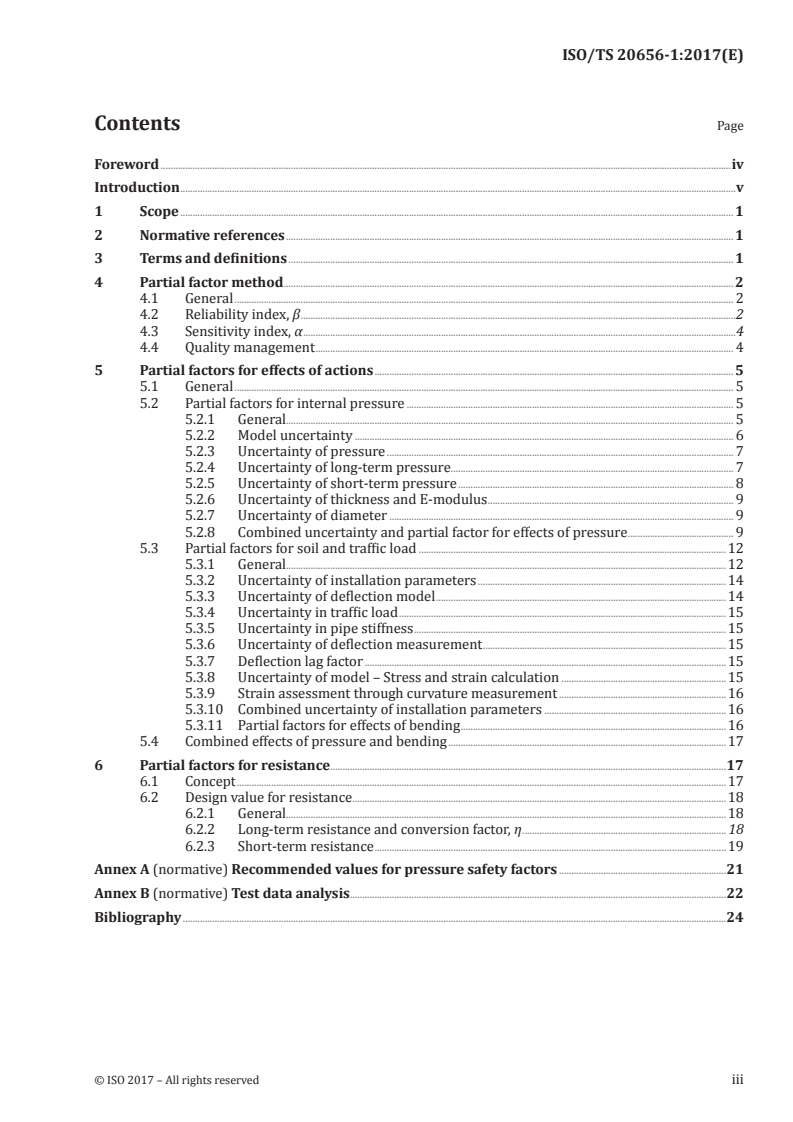
Contents Page
Foreword .iv
Introduction .v
1 Scope . 1
2 Normative references . 1
3 Terms and definitions . 1
4 Partial factor method . 2
4.1 General . 2
4.2 Reliability index, β .2
4.3 Sensitivity index, α .4
4.4 Quality management . 4
5 Partial factors for effects of actions . 5
5.1 General . 5
5.2 Partial factors for internal pressure . 5
5.2.1 General. 5
5.2.2 Model uncertainty . 6
5.2.3 Uncertainty of pressure . 7
5.2.4 Uncertainty of long-term pressure. 7
5.2.5 Uncertainty of short-term pressure . 8
5.2.6 Uncertainty of thickness and E-modulus . 9
5.2.7 Uncertainty of diameter . 9
5.2.8 Combined uncertainty and partial factor for effects of pressure . 9
5.3 Partial factors for soil and traffic load .12
5.3.1 General.12
5.3.2 Uncertainty of installation parameters .14
5.3.3 Uncertainty of deflection model .14
5.3.4 Uncertainty in traffic load .15
5.3.5 Uncertainty in pipe stiffness .15
5.3.6 Uncertainty of deflection measurement .15
5.3.7 Deflection lag factor .15
5.3.8 Uncertainty of model – Stress and strain calculation .15
5.3.9 Strain assessment through curvature measurement .16
5.3.10 Combined uncertainty of installation parameters .16
5.3.11 Partial factors for effects of bending .16
5.4 Combined effects of pressure and bending .17
6 Partial factors for resistance .17
6.1 Concept .17
6.2 Design value for resistance .18
6.2.1 General.18
6.2.2 Long-term resistance and conversion factor, η . 18
6.2.3 Short-term resistance .19
Annex A (normative) Recommended values for pressure safety factors .21
Annex B (normative) Test data analysis .22
Bibliography .24
Foreword
ISO (the International Organization for Standardization) is a worldwide federation of national standards
bodies (ISO member bodies). The work of preparing International Standards is normally carried out
through ISO technical committees. Each member body interested in a subject for which a technical
committee has been established has the right to be represented on that committee. International
organizations, governmental and non-governmental, in liaison with ISO, also take part in the work.
ISO collaborates closely with the International Electrotechnical Commission (IEC) on all matters of
electrotechnical standardization.
The procedures used to develop this document and those intended for its further maintenance are
described in the ISO/IEC Directives, Part 1. In particular the different approval criteria needed for the
different types of ISO documents should be noted. This document was drafted in accordance with the
editorial rules of the ISO/IEC Directives, Part 2 (see www .iso .org/ directives).
Attention is drawn to the possibility that some of the elements of this document may be the subject of
patent rights. ISO shall not be held responsible for identifying any or all such patent rights. Details of
any patent rights identified during the development of the document will be in the Introduction and/or
on the ISO list of patent declarations received (see www .iso .org/ patents).
Any trade name used in this document is information given for the convenience of users and does not
constitute an endorsement.
For an explanation on the voluntary nature of standards, the meaning of ISO specific terms and
expressions related to conformity assessment, as well as information about ISO’s adherence to the
World Trade Organization (WTO) principles in the Technical Barriers to Trade (TBT) see the following
URL: w w w . i s o .org/ iso/ foreword .html.
This document was prepared by ISO/TC 138, Plastics pipes, fittings and valves for the transport of fluids,
SC 6, Reinforced plastics pipes and fittings for all applications.
A list of all the parts in the ISO 20656- series, can be found on the ISO website.
iv © ISO 2017 – All rights reserved
Introduction
This document provides general rules for structural design of buried glass-reinforced thermosetting
plastics (GRP) pipes. It provides the necessary link between the requirements for safety, serviceability
and durability of GRP pipe construction products and the technical provisions for civil works. The basis
for design of structures, as specified in ISO 2394 and Eurocode EN 1990, are addressed in this document
by providing partial factors for effects of actions and resistance for buried GRP pipes.
TECHNICAL SPECIFICATION ISO/TS 20656-1:2017(E)
Plastics piping systems — General rules for structural
design of glass-reinforced thermosetting plastics (GRP)
pipes —
Part 1:
Buried pipes
1 Scope
This document describes how partial factors for buried GRP pipes are developed, and are primarily
intended to define the necessary safety measures for GRP pipes that meet the requirements of
ISO 10639, ISO 10467 and ISO 25780, and EN 1796 and EN 14364. The same methodology can be utilised
for other pipe product standards, although other parameters would apply.
2 Normative references
The following documents are referred to in the text in such a way that some or all of their content
constitutes requirements of this document. For dated references, only the edition cited applies. For
undated references, the latest edition of the referenced document (including any amendments) applies.
ISO 2394:2015, General principles on reliability for structures
ISO 10639, Plastics piping systems for pressure and non-pressure water supply — Glass-reinforced
thermosetting plastics (GRP) systems based on unsaturated polyester (UP) resin
ISO 10467, Plastics piping systems for pressure and non-pressure drainage and sewerage — Glass-reinforced
thermosetting plastics (GRP) systems based on unsaturated polyester (UP) resin
ISO 25780, Plastics piping systems for pressure and non-pressure water supply, irrigation, drainage or
sewerage — Glass-reinforced thermosetting plastics (GRP) systems based on unsaturated polyester (UP)
resin — Pipes with flexible joints intended to be installed using jacking techniques
EN 1796, Plastics piping systems for water supply with or without pressure — Glass-reinforced
thermosetting plastics (GRP) based on unsaturated polyester resin (UP)
EN 1990:2002, Eurocode — Basis of structural design
EN 14364, Plastics piping systems for drainage and sewerage with or without pressure — Glass-reinforced
thermosetting plastics (GRP) based on unsaturated polyester resin (UP) — Specifications for pipes, fittings
and joints
EN/TS 14632, Plastics piping systems for drainage, sewerage and water supply, pressure and non-
pressure — Glass-reinforced thermosetting plastics (GRP) based on unsaturated polyester resin (UP) —
Guidance for the assessment of conformity
3 Terms and definitions
For the purposes of this document the terms and definitions given in ISO 2394 and EN 1990 apply.
ISO and IEC maintain terminological databases for use in standardization at the following addresses:
— IEC Electropedia: available at http:// www .electropedia .org/
— ISO Online browsing platform: available at http:// www .iso .org/ obp
4 Partial factor method
4.1 General
The procedures used here follow the methodology for establishing partial factors for effects of actions
and structural resistance as specified in ISO 2394 and EN 1990. The procedure followed is the semi-
probabilistic method (ISO 2394:2015, Clause 9 and EN 1990, Clause 6), where characteristic values of
actions are defined, and these design values are determined based on the uncertainties involved, both
in terms of actions, material properties and environment. The partial factors are the ratio between
the characteristic values and the design values. The process consists of minimising the risk involved
compared with perceived costs, and defined probability of failure, using level II of the first order
reliability method (FORM, Level II).
In this Clause the method is described briefly as it applies for buried flexible pipes. For a full explanation
of the methodology, refer to ISO 2394 and EN 1990.
The method for establishing partial factors for resistance is based on ISO 2394, 9.4.2 (with reference to
Annex C), as EN 1990, 6.3.3, 6.3.4 and 6.3.5 (with reference to Annex D). The principles are the same in
both standards.
4.2 Reliability index, β
The measure of reliability is conventionally defined by the reliability index, β, which is related to the
probability of failure, P , by:
f
P =× −β (1)
()
f
where Φ is the cumulative distribution function of the standardised normal distribution.
The relation between the probability of failure, P , and the reliability index, β, is given in Table 1.
f
Table 1 — Relationship between probability of failure and reliability index
-1 -2 -3 -4 -5 -6 -7
P 10 10 10 10 10 10 10
f
β 1,28 2,32 3,09 3,72 4,27 4,75 5,20
The probability of failure, P , is expressed through a performance function, g, such that a structure is
f
considered to survive if g > 0 and fail if g ≤ 0:
Pg=≤Prob 0 (2)
()
f
where g is the performance function with:
gR=−E (3)
where
R is the resistance;
E is the effect of actions;
R, E and g are random variables.
2 © ISO 2017 – All rights reserved
For a normal distribution the reliability index β is:
μ
g
β = (4)
σ
g
where
μ is the mean value of g;
g
σ is the standard deviation.
g
We thus have:
μβ−×σ =0
gg
and
Pg=≤Prob 0 =≤Prob g μβ−×σ .
() ()
fg g
Using this function, the partial factors are established, based on the uncertainties associated with the
effects of actions and the uncertainties of resistance.
Since the short-term resistance of plastics is considerably higher than the long-term resistance, the
partial factors for effects of actions need to be determined for both cases, i.e. both for incidental actions
and sustained actions. Partial factors for resistance are determined for short-term material properties
and are converted to long-term material properties as described in Clause 6.
The design value for a normal distribution is (see EN 1990:2002, Table C.3 and ISO 2394:2015,
Clause E.6):
XV=μα−××βσ =×μα1−××β (5)
()
d
where
μ is the mean value;
α is the sensitivity index;
β is the reliability index;
σ is the standard deviation;
V is the coefficient of variation.
Both EN 1990 and ISO 2394 define target reliabilities based on consequences of failure. In addition,
the ISO 2394 includes the relative cost of safety measure as part of the assessment. Table 2 shows the
consequence classes as defined in EN 1990.
Table 2 — Consequence classes as defined in EN 1990:2002, Table B.1
Consequence class Description Examples of pipelines Minimum value
for β
CC3 High consequence for loss of human life, or eco- Major water supply and sewerage pipes 4,2
nomic, social or environmental consequences within cities, transmission lines without
very great. Significant damage to the qualities of back-up, oil and gas pipelines.
the environment contained at national scale but
spreading significantly beyond the surroundings
of the failure event and which can only be partly
restored in a matter of months.
CC2 Medium consequence for loss of human life, econom- Major water supply and sewerage pipes 3,7
ic, social or environmental consequences consid- within cities, transmission lines with
erable. Damage to the qualities of the environment back-up, penstocks where flooding can
limited to the surroundings of the failure event wreak havoc.
and which can be restored in a matter of weeks.
CC1 Low consequence for loss of human life and eco- Irrigation, small and remote penstocks. 3,1
nomic, social or environmental consequences
small or negligible. Damage to the environment
of an order which can be restored completely in
a matter of weeks.
β is based on a 50 year design life.
4.3 Sensitivity index, α
The FORM analysis as defined in ISO 2394 includes a sensitivity factor for the independent random
variables for actions and resistance. The sensitivity factors are summarised in ISO 2394:2015, Table E.3,
and repeated here in Table 3.
Table 3 — Sensitivity factors for actions and resistance
X α
i i
Dominating resistance parameter 0,8
Other resistance parameters 0,4 × 0,8 = 0,32
Dominating load parameter –0,7
Other load parameters –0,4 × 0,7 = –0,28
For non-pressure or low pressure pipes the deflection will be the dominating load parameter. For high
pressure pipes the pressure will be the dominating load parameter. The corresponding resistance
parameters apply.
4.4 Quality management
Quality management shall follow the rules in ISO 2394:2015, Annex A. These can be directly related to
the consequence classes, as shown in Table 4.
In case of buildings, engineering works and engineering systems where high consequence for loss of
human life or economic, social, or environmental consequences are involved, i.e. public buildings where
consequences of failure are high (e.g. a concert hall, grandstand, high-rise building, critical bearing
elements), a quality level QL3 shall be applied. The choice of the required quality level can be based on
reliability-based methods. See Table 4 for quality levels based on consequence class.
4 © ISO 2017 – All rights reserved
Table 4 — Quality levels
Quality level Consequence Description Control organism for specification of requirements and checking
(QL) class
QL3 CC3 Extensive quality level Besides self-control and systematic control, independent party control shall also
associated to extended be executed: specification of requirements for quality management, assurance,
measures for quality and control, as well as the checking performed by an organisation different from
management, inspec- that which has prepared the stage of the life cycle involved.
tion, and control
Intensive supervision and inspection during construction of the structural main
bearing system by well-qualified people with an expert knowledge (e.g. with
respect to design and/or execution of structures).
QL2 CC2 Increased quality level Specification of requirements for quality management, assurance, and control,
as well as the systematic checking performed by self-control, as well as by dif-
ferent persons than those who prepared the stage of the life cycle involved and
in accordance with the procedure of the organisation.
Increased effort with respect to supervision and inspection during the construc-
tion of the structural key elements.
QL1 CC1 Basic quality level Self-control: specification of requirements for quality management, assurance,
and control, as well as the checking performed by the person who has prepared
the stage of the life cycle involved.
To establish default partial factors for GRP pipe product standards, consequence class 2 and quality
level 2 will be assumed in this document. If the requirements for a project deviate from that assumption,
the reliability index and uncertainties shall be revised, to determine the appropriate partial factors.
5 Partial factors for effects of actions
5.1 General
Buried pipelines may be subject to sustained actions from internal (or external) pressure, soil load and
live load from traffic, as well as incidental actions, such as surge or water hammer loads. The resulting
strains (or stresses) shall be compared with the strength of the materials, long-term or short-term as
appropriate. The uncertainties associated with each of these need to be established to compute the
partial factors for effects of actions.
For convenience, the effects of actions are expressed in terms of strain (stress could also be used).
The effects of internal pressure are computed from the elementary hoop stress formula. The effects
of soil load and traffic load are considerably more complex, and involve many variables. There are
three well recognised methods for computing these: the ATV 127 (German), Fascicule 70 (French) and
AWWA M45 (USA).
The effects of external pressure are not addressed in this document, but are given in the documents
mentioned above.
5.2 Partial factors for internal pressure
5.2.1 General
Plastic pipes are commonly classified for a pressure level, standardised pressure class or nominal
pressure. This classification makes logistics and manufacturing simpler, and aids the designer in
selecting the suitable product. To determine the effects of actions, the pressure needs to be converted
into strains.
The effect of internal pressure of a pipe in service is usually computed through the elementary hoop
stress formula:
pD×
σ = (6)
ht
2×t
R
or, in terms of strain:
pD×
ε = (7)
ht
2××tE
Rht
where
σ is the hoop tensile stress;
ht
p is the internal pressure;
D is the diameter;
t is the thickness of the load bearing layers (i.e. excluding liner and protective layers) of the laminate
R
of the pipe in service;
ε is the circumferential tensile strain in the laminate;
ht
E is the circumferential tensile modulus of the laminate.
ht
Of the three parameters defining the effects of this action, one, the pressure, is the action itself. The
other parameters, diameter and thickness, are geometric properties of the pipe. Each has uncertainty
associated with it.
5.2.2 Model uncertainty
In the elementary hoop stress formula the diameter, D, is either taken as the inner diameter or the
mean diameter, depending on convention, or standards. The product standards ISO 10639, ISO 10467,
EN 1796, EN 14364 and ISO 25780, as well as AWWA M45 use mean diameter.
There are several assumptions made in this model. The stress is assumed to be evenly distributed, the
material is assumed to be linear, homogeneous and isotropic.
In Lamé’s solution for thick walled cylinders the stress is not assumed to be evenly distributed:
r ×r
io
pr×+
i
r
σ = (8)
ht
rr−
oi
where
σ is the hoop tensile stress;
ht
p is the internal pressure;
r is the inner radius;
i
r is the outer radius;
o
r is the radius where the stress is computed.
Putting r = r into this formula to compute the maximum hoop tensile stress, σ , and comparing with
i max
the elementary formula, the following expressions are found.
6 © ISO 2017 – All rights reserved
Taking D as inner diameter:
σ rr+
max io
= (9)
σ rr+ ×r
()
ht oi i
Taking D as mean diameter:
σ rr+
max io
=×2 (10)
σ
ht
rr+
()
oi
These can now be compared for various aspect ratios, as shown in Table 5.
Table 5 — Model error related to aspect ratio, σ /σ
max ht
r /r 1 030 1 032 1 034 1 036 1 038 1 040 1 045 1 050 1 100
o i
D = D 1 0152 1 0163 1 0173 1 0183 1 0194 1 0204 1 0230 1 0256 1 0524
i
D = D 1 0002 1 0002 1 0003 1 0003 1 0003 1 0004 1 0005 1 0006 10023
m
The error in the elementary model using inner diameter, compared with Lamé’s equation for these
aspect ratios ranges from 1,5 % to over 5 %. If the average diameter is used, the inaccuracy is a small
fraction, i.e. 0,02 % to 0,2 %.
For GRP pipes a more accurate model would also include the effects of orthotrophy. Numerical analysis
of several types of pipes suggests that the inaccuracy of the elementary formula is closer to 1,0 %, for
orthotropic materials.
Based on the above, a partial factor proportional to the aspect ratio for the pipes should be applied,
whenever the elementary hoop stress formula is used in design. It should be noted that this is not
uncertainty in the sense that it is an unknown variable with a normal or Gumbel distribution. It is an
inaccuracy of the model, which can be accounted for by multiplying the computed strain (or stress) by
the appropriate factor.
The suggested correction factor, when using the mean diameter for the calculation, is thus 1,01, which
accounts for both orthotropy and thin wall approximation.
5.2.3 Uncertainty of pressure
Unlike stochastic loads governed by nature, such as wind, snow and earthquake, the pressure in pipes
is controllable. The system designer usually decides which pressure to design his piping system for, and
the components and conditions that govern the pressure, such as pumps and elevation, are specified
accordingly. The installer then needs to ensure that the specifications are met, and the owner of the
pipeline to ensure that it is operated according to specifications.
All of these factors carry with them a degree of uncertainty, depending on the quality of the work, and
the efforts put in inspections and quality control. Sources of errors could be system analysis, writing
of specifications (e.g. typographical errors), communications, mounting and assembly of components,
operation, start-up and closure of pumps, closing of valves etc.
5.2.4 Uncertainty of long-term pressure
Internal pressure will vary widely throughout the lifetime of a pipeline, from zero pressure during
transport and installation, and during maintenance or inspection periods, to pressure levels exceeding
the design pressure during pressure testing before commissioning.
To determine the partial factor for long-term effects, variations in sustained pressure need to be
addressed. Sustained pressure is the maximum service pressure at which the design engineer expects
the pipeline to be operated, for long time periods. The pressure will usually fluctuate, in some cases
considerably, during normal operation (depending on the application), but the sustained pressure is
the maximum pressure expected on a regular basis, be that daily, or weekly. This is the pressure on
which the designer bases his choice of pressure class for the pipe, the expected pressure in the pipe
throughout its expected lifetime.
The uncertainties related to the sustained pressure depend on how thoroughly the system is designed
and analysed. A carefully designed pipeline, using sophisticated software for transient analysis, where
the effects of all components, such as pumps, pressure relief valves, governors, etc. are included, would
reduce the uncertainty related to pressure. If the analysis is also carefully checked by an independent
expert, the uncertainties are further reduced.
Nevertheless, there will always be some uncertainty involved. Full knowledge of all components, and
how they operate cannot be expected. The computational models are based on certain hypotheses and
have limited accuracy. Topography may not be fully known, the effects of collection of air bubbles in the
pipeline may not be included, etc.
These uncertainties can be difficult to quantify, so certain assumptions, preferably based on experience,
must be made.
If the analysis is mediocre or simplified, the variation will be greater. A common mistake, for example,
is to analyse the pipe based on nominal diameter, rather than the actual diameter of the pipe.
Table 6 provides a guideline to select the expected variation of the computed sustained pressure from
the actual.
Table 6 — Variation of computed pressure from actual pressure
Accuracy of analysis for computing pressure — Expected variation from actual pressure
Quality level
Detailed – QL3 5 %
Medium – QL2 10 %
Simplified – QL1 15 %
Whether and how the pressure is monitored when the pipeline is in service is also of importance. If
the pressure is not monitored there is greater likelihood that it will deviate from assumed value. The
better it is monitored, the less likely it will diverge. Table 7 provides an estimate of the variation of the
assumed service pressure and the actual service pressure.
Table 7 — Variation of assumed service pressure from actual pressure
Effort of monitoring service pressure – Quality level Expected variation from actual pressure
Careful – QL3 3 %
Medium – QL2 5 %
Basic– QL1 10 %
5.2.5 Uncertainty of short-term pressure
Short-term pressures include test pressure(s), computed surge pressure from valve closing or opening,
or pump start-up or shut-down, as well as other incidental pressure fluctuations, that may, or may not,
be foreseen. Each of these pressure occurrences will last a certain time period, from a few seconds or
minutes in case of surges, to several hours or even a few days in case of hydrotesting.
Test pressure is usually predefined, often as a percentage of the pressure rating of the pipe (e.g. 150 %
of the pressure rating), and its time period also defined. The accuracy of the actual pressure is not
always as clear. The pump will usually have ample capacity, the accuracy of the pressure gauge may
be limited and it may not necessary be placed at the intended elevation. The engineer must account for
such uncertainties.
8 © ISO 2017 – All rights reserved
Surge pressures can also deviate considerably from the presumed or calculated values, depending on
the sophistication of the analysis and modelling. Wave celerity may be underestimated, as some parts
of the pipeline may be cast in concrete or otherwise restricted from expansion. The operation of the
pipeline may be different from the intended, resulting in increased pressure.
In lieu of better information, the variations in Table 7 may also be used for short-term pressure.
5.2.6 Uncertainty of thickness and E-modulus
For fibre-reinforced material, the total amount of reinforcement rather than the thickness per se
controls the design. The thickness is a by-product of the wettability of the glass-fibres and the viscosity
of the resin. The amount of fillers used further distort the picture.
The effects of the thickness and the E-modulus need to be examined combined; a thinner pipe may have
higher pressure capacity if it has more reinforcement, but less resin and filler, i.e. a higher reinforcement
percentage. The greater the reinforcement percentage, the higher the E-modulus.
An important quality check is thus to check for the amount of reinforcement, by observation during
manufacturing or direct measurement.
The uncertainty of thickness depends on the manufacturing process and the quality control.
Statistical analysis of data from several manufacturers suggests that the variation of the combined
thickness and E-modulus is approximately 5 %.
5.2.7 Uncertainty of diameter
The diameter of the pipe is determined by the manufacturing process. The three main processes for
GRP pipes, crosswinding, centrifugal cast, and filament winding, use, respectively, fixed inside mandrel,
fixed outside form, and variable inside steel-band mandrel. For a fix inside mandrel the variation in
diameter will be negligible.
For outside-form or variable inside mandrel the accuracy of the diameter will depend on how well
controlled the manufacturing process is.
Irrespective of process, checking the diameter is part of the daily quality control, where deviations
from the specified value are noted.
Statistical analysis of data from several manufacturers reveals that the variation of the measured
diameter is approximately 0,3 % for small diameter pipes and less than 0,1 % for large diameter pipe.
When the pipe is pressurised the diameter increases, and as the material creeps with time the diameter
increases even further. Assuming an initial strain of approximately 0,3 % and 20 % creep, the additional
error of the diameter will be 0,3 % for short-term pressure and 0,36 % for sustained long-term pressure.
5.2.8 Combined uncertainty and partial factor for effects of pressure
The combined uncertainty and the partial factor can now be determined.
For normally distributed functions, the combined standard uncertainty is the positive square root of
[4]
the combined variance, which is given by Formula (11) (see ):
N
∂f
2 2
u = ux (11)
()
σ i
∑
∂x
i
i=1
where
u is the combined uncertainty;
σ
f is the function to be evaluated;
x are the variables;
i
u (x ) are the uncertainties associated with each variable.
i
Using this formula the combined standard uncertainty of the parameters that determine the effects of
pressure can be computed. The function is the strain, as defined by Formula (7). Taking the derivative
with respect to each variable (taking the thickness times the E-modulus as one variable), the following
expression for the uncertainty of the strain is obtained:
2 2
r p pr×
2 2 2 2
u = ×+u ×+u ×u (12)
ε p r tE
tE× tE×
R ht R ht tE
()×
R ht
where
u is the combined uncertainty;
ε
u is the uncertainty of internal pressure;
p
u is the uncertainty of pipe radius;
r
u is the uncertainty of pipe wall thickness and modulus;
tE
r is the mean pipe radius;
p is the internal pressure;
t is the thickness of the load bearing layers (i.e. excluding liner and protective layers) of the laminate
R
of the pipe in service;
E is the circumferential tensile modulus of the laminate.
ht
EXAMPLE Using this expression with the uncertainty parameters in 5.2.3 to 5.2.7, the combined uncertainty
for any given product can be computed. For a typical DN600-PN 10-SN 5000-pipe the numbers would be:
r = 303 mm
t = 10 mm
E = 13000 MPa
ε = 0,00233
10 © ISO 2017 – All rights reserved
2 2
303 2 1 2 303×1
uy = ××10,,1 + ××0 004 3303 + ×
() () ()
10×13000 10×13000
10×13000
()
−−99 −−99
××00,,510×13000 =×54 3100+×,,087 10 +×13 6106=×80, 10
()
or:
u =0,00026 .
ε
With a strain of 0,003 the variation becomes:
v = 0,00026/0,00233 = 0,112.
The error in the model is not part of the uncertainty, but needs to be included in the partial factor as a
pure correction factor.
The design value for pressure is computed as follows:
EV=×μα1−××β (13)
()
d
For the sensitivity factor, α, see Table 3.
To determine the partial factor, the error in the model – a factor of 1,015 –, must also be included
(see 5.2.2). A correction factor for increased diameter under pressure of 1,004 is also recommended.
If pressure is the dominating action the sensitivity factor (see Table 3) is:
α =−07,
For consequence class 2 the probability of failure is:
−4
p =10
f
and the corresponding reliability index:
β =37,
-4
For probability of failure of 10 and a sensitivity factor of –0,7 the partial factor will thus be:
γ =(1+0,7×3,7×0,11)×1,01×1,004
p
γ=1,3 (14)
p
The partial factors for long-term failure pressure for the other consequence classes are computed
similarly, with reliability index from Table 2. Partial factor for long-term pressure for all three
consequence classes are computed similarly, and shown in Table 8.
Table 8 — Partial factor for long-term pressure with pressure as dominating action (α = –0,7)
Consequence class Probability of failure Reliability index Partial factor for
p β pressure
f
γ
p
-5
CC3 10 4,2 1,36
-4
CC2 10 3,7 1,3
-3
CC1 10 3,1 1,28
See Annex A for default values and corresponding minimum safety factor.
Whether the action of pressure or deflection creates the dominating effect, depends on the computed
strains (or stresses). For most GRP pipe designs, the changeover will be for pressure classes PN2 – PN4,
depending on stiffness class.
If the pressure is not the dominating load the sensitivity factor from Table 3 becomes:
α=−0,4×0,7=−0,28
with the corresponding partial factors as shown in Table 9.
Table 9 — Partial factor for long-term pressure with deflection as dominating action (α = –0,28)
Consequence class Probability of failure Reliability index partial factor for
p β pressure
f
γ
p
-5
CC3 10 4,2 1,16
-4
CC2 10 3,7 1,15
-3
CC1 10 3,1 1,13
The partial factor for short-term pressure (one day) is assumed to be the same as for long-term pressure.
For pipes with end-thrust the same partial factors and safety factors apply, since the same uncertainties
are involved.
5.3 Partial factors for soil and traffic load
5.3.1 General
The engineering parameters associated with installation of buried pipe cannot be treated the same
way as for pressure, since these essentially depend on the quality of field work, rather than work in a
factory.
The AWWA M45 design method provides a model for determining stresses and strains that result from
ring bending in the deflected, buried pipe. In the following, this method will be used as an example
to estimate the partial factors for soil and traffic load. Other methods will yield similar results,
since the same variations and uncertainties apply. It must be noted, however, that the characteristic
material values might originate from a different source, and might thus have already been treated for
uncertainty. This shall be ascertained in each case.
There is considerable uncertainty associated with computing deflection. It is therefore required to
measure the initial deflection after installation, to ensure the integrity of the installation. The difference
between the measured and computed deflection reflects the uncertainty, and therefore the associated
partial factor. If there is great difference between the two, it is advised to re-evaluate the installation
parameters, to assure the accuracy of the long-term deflection calculation.
According to AWWA M45 the stresses and strains are linked to the deflection of the pipe as follows.
12 © ISO 2017 – All rights reserved
In terms of stress:
t
Δy
t
σ =×DE× × (15)
bf
D D
In terms of strain:
Δy t
t
ε =×D × (16)
bf
D D
where
σ is bending stress due to deflection;
b
ε is the bending strain due to deflection;
b
D is the shape factor, which depends on installation parameters and pipe stiffness;
f
E is ring flexural modulus of the pipe;
Δy is the deflection of the pipe;
D is the diameter of the pipe;
t is the total wall thickness of the pipe.
t
The uncertainties of all these parameters are examined separately in the following clauses.
It should be noted that the designer may always choose a conservative value for a parameter, thereby
reducing the probability of overloading.
In AWWA M45 the deflection can be expressed by a modified Iowa formula:
DW× +WK×
()
Δy
lc Lx
= (17)
D 80×+STIS ,061×M
s
where
Δy is the deflection of the pipe;
D is the diameter of the pipe;
D is deflection lag factor;
l
W is vertical soil load on pipe;
c
W is vertical traffic load on pipe;
L
K is the bedding coefficient;
x
STIS is the pipe stiffness;
M is the composite soil constrained modulus.
s
Typical values for the composite soil modulus are in the range 1 MPa for weak soil to 30 MPa for good
soil or backfill. With pipe stiffness classes SN 2500, SN 5000 and SN 10000, the contribution of the soil
to resisting the vertical load is thus in the range of being equal to the contribution from the pipe to
being 100 times that of the pipe.
NOTE The effects of external pressure are not addressed in this document, but are given in e.g. ATV 127
(German), Fascicule 70 (French) and AWWA M45 (USA).
5.3.2 Uncertainty of installation parameters
For buried pipe the uncertainties of installation parameters are the dominating factors for determining
the total uncertainty of the effects of bending action. Thus, as with all geotechnical installations, they
will depend on the quality of the work of the engineer, the contractor and the inspector.
The composite constrained soil modulus, M , combines the stiffness of the native soil and the backfill
s
through the ratio of the pipe diameter and the trench width. Other factors included in the model for
the modulus are stress level (burial depth), compaction, and presence of ground water. With all these
parameters known the soil modulus can be determined with a reasonable accuracy.
The main uncertainties are associated with lack of information about the parameters affecting the soil
modulus. The most important of these is the knowledge, or the lack thereof, about the composition of the
native soil. The usual approach is to dig investigating holes along the trajectory of pipeline and analyse
the unearthed material. The inherent variation of the native soil within each hole, and from one hole to
the next, is a source of uncertainty. During excavation of the trench better knowledge can be acquired
and additional analyses conducted. This will, however, not provide full knowledge of the supporting
native soil, since it is the soil at the trench walls, rather than soil from the trench itself, which provides
the support. Direct measurement of the soil stiffness by soil stiffness gauge would provide additional
in
...
Questions, Comments and Discussion
Ask us and Technical Secretary will try to provide an answer. You can facilitate discussion about the standard in here.
Loading comments...