


ISO 582
(Main)Rolling bearings — Chamfer dimensions — Geometrical product specifications (GPS) and values
Rolling bearings — Chamfer dimensions — Geometrical product specifications (GPS) and values
Cancels and replaces the second edition (1979). Specifies the maximum chamfer dimensions of metric series rolling bearings, for which boundary dimensions, including chamfer minimum dimensions, are given in other International Standards. Gives also requirements for the maximum dimensions of the corresponding shaft and housing filet radii. Does not apply to chamfers, for which dimensions are not specified, or for which other dimensions are specified in other International Standards.
Roulements — Dimensions des arrondis — Spécifications géométriques des produits (GPS)
La présente Norme internationale prescrit les dimensions maximales des arrondis des roulements de la série métrique, dont les dimensions d'encombrement, y compris les dimensions minimales d'arrondi, sont données dans d'autres Normes internationales ISO. Elle définit également le rayon maximal correspondant des congés d'arbre et de logement. La présente Norme internationale ne s'applique pas aux arrondis des roulements dont les dimensions ne sont pas normalisées, ou pour lesquels d'autres dimensions sont données dans les Normes internationales ISO correspondantes.
General Information
- Status
- Not Published
- Technical Committee
- ISO/TC 4/SC 4 - Rolling bearings – Geometrical product specifications (GPS)
- Current Stage
- 6000 - International Standard under publication
- Start Date
- 13-Dec-2025
- Completion Date
- 12-Feb-2026
Relations
- Revises
ISO 582:1995/Amd 1:2013 - Rolling bearings — Chamfer dimensions — Maximum values — Amendment 1 - Effective Date
- 06-Jun-2022
- Effective Date
- 06-Jun-2022
Overview
ISO 582 - Rolling bearings - Chamfer dimensions - Geometrical product specification (GPS) and values (FDIS 582:2025) defines how chamfers on metric-series rolling bearings are specified and controlled to ensure interchangeability and reliable assembly. The fourth edition (2025) replaces ISO 582:1995, aligns chamfer representation with ISO GPS rules (ISO 8015) and ISO 21204 transition specifications, and updates symbols and annex material. The standard provides nominal chamfer boundaries and corresponding recommendations for maximum shaft and housing fillet radii.
Key topics and technical requirements
- Scope and purpose: Specifies chamfer least‑material boundaries for rings and washers and the radius maximum‑material boundaries that contain those chamfers. Aims to minimize assembly incompatibility and to ensure adequate ring support surfaces.
- GPS-based representation: Uses Geometrical Product Specification (GPS) transition specifications (ISO 8015, ISO 21204) to show limiting material boundaries - the chamfer least material boundary (CL) and the radius maximum material boundary (RM).
- Symbols and notation: Standardizes symbols (for example c, cr, c1r, r, r1) in accordance with ISO 22872 and relates them to earlier editions (see Annex A).
- Dimensional data tables: Provides tabulated nominal chamfer dimensions for common bearing families (radial bearings, tapered roller bearings, thrust bearings, washers) in Tables 3–7. These tables give the nominal axial and radial extents and the RM radii for specified bore/outside diameter ranges.
- Shaft and housing fillet radii: States that recommended fillet radii of mating shafts and housings should not exceed the nominal radius of the bearing’s RM; guidance and figures illustrate acceptable relations.
- Applicability limits: Does not apply where chamfer dimensions are unspecified or are controlled by other international standards.
Applications and users
ISO 582 is practical for:
- Bearing designers and manufacturers specifying ring and washer chamfers for metric series bearings.
- Mechanical engineers and machine designers ensuring bearing interchangeability and safe assembly.
- Drafting, quality control and inspection teams who interpret GPS transition specifications on drawings.
- Procurement and standards teams verifying component compliance across suppliers.
Practical benefits include easier mounting, reduced risk of interference with mating fillets, consistent drawing notation, and improved cross‑supplier compatibility.
Related standards
- ISO 5593 (rolling bearings vocabulary)
- ISO 8015 (GPS fundamentals)
- ISO 21204 (GPS transition specification)
- ISO 22872 (GPS - bearing vocabulary and symbols)
- Bearing family standards that reference ISO 582 tables: ISO 15, ISO 104, ISO 246, ISO 355, ISO 464, ISO 12043, ISO 12044
Keywords: ISO 582, rolling bearings, chamfer dimensions, GPS, geometrical product specification, bearing chamfer, shaft fillet radius, housing fillet radius, interchangeability, bearing design.

ISO/FDIS 582 - Rolling Bearings — Chamfer dimensions — Geometrical product specification (GPS) and values Released:10/3/2025
REDLINE ISO/FDIS 582 - Rolling Bearings — Chamfer dimensions — Geometrical product specification (GPS) and values Released:10/3/2025
ISO/FDIS 582 - Roulements — Dimensions des arrondis — Spécification géométrique des produits (GPS) Released:10/27/2025
Get Certified
Connect with accredited certification bodies for this standard

BSMI (Bureau of Standards, Metrology and Inspection)
Taiwan's standards and inspection authority.
Sponsored listings
Frequently Asked Questions
ISO 582 is a draft published by the International Organization for Standardization (ISO). Its full title is "Rolling bearings — Chamfer dimensions — Geometrical product specifications (GPS) and values". This standard covers: Cancels and replaces the second edition (1979). Specifies the maximum chamfer dimensions of metric series rolling bearings, for which boundary dimensions, including chamfer minimum dimensions, are given in other International Standards. Gives also requirements for the maximum dimensions of the corresponding shaft and housing filet radii. Does not apply to chamfers, for which dimensions are not specified, or for which other dimensions are specified in other International Standards.
Cancels and replaces the second edition (1979). Specifies the maximum chamfer dimensions of metric series rolling bearings, for which boundary dimensions, including chamfer minimum dimensions, are given in other International Standards. Gives also requirements for the maximum dimensions of the corresponding shaft and housing filet radii. Does not apply to chamfers, for which dimensions are not specified, or for which other dimensions are specified in other International Standards.
ISO 582 is classified under the following ICS (International Classification for Standards) categories: 17.040.40 - Geometrical Product Specification (GPS); 21.100.20 - Rolling bearings. The ICS classification helps identify the subject area and facilitates finding related standards.
ISO 582 has the following relationships with other standards: It is inter standard links to ISO 582:1995/Amd 1:2013, ISO 582:1995. Understanding these relationships helps ensure you are using the most current and applicable version of the standard.
ISO 582 is available in PDF format for immediate download after purchase. The document can be added to your cart and obtained through the secure checkout process. Digital delivery ensures instant access to the complete standard document.
Standards Content (Sample)
FINAL DRAFT
International
Standard
ISO/FDIS 582
ISO/TC 4/SC 4
Rolling Bearings — Chamfer
Secretariat: SIS
dimensions — Geometrical product
Voting begins on:
specification (GPS) and values
2025-10-17
Roulements — Dimensions des arrondis — Spécification
Voting terminates on:
géométrique des produits (GPS)
2025-12-12
RECIPIENTS OF THIS DRAFT ARE INVITED TO SUBMIT,
WITH THEIR COMMENTS, NOTIFICATION OF ANY
RELEVANT PATENT RIGHTS OF WHICH THEY ARE AWARE
AND TO PROVIDE SUPPOR TING DOCUMENTATION.
IN ADDITION TO THEIR EVALUATION AS
BEING ACCEPTABLE FOR INDUSTRIAL, TECHNO
LOGICAL, COMMERCIAL AND USER PURPOSES, DRAFT
INTERNATIONAL STANDARDS MAY ON OCCASION HAVE
TO BE CONSIDERED IN THE LIGHT OF THEIR POTENTIAL
TO BECOME STAN DARDS TO WHICH REFERENCE MAY BE
MADE IN NATIONAL REGULATIONS.
Reference number
ISO/FDIS 582:2025(en) © ISO 2025
FINAL DRAFT
ISO/FDIS 582:2025(en)
International
Standard
ISO/FDIS 582
ISO/TC 4/SC 4
Rolling Bearings — Chamfer
Secretariat: SIS
dimensions — Geometrical product
Voting begins on:
specification (GPS) and values
Roulements — Dimensions des arrondis — Spécification
Voting terminates on:
géométrique des produits (GPS)
RECIPIENTS OF THIS DRAFT ARE INVITED TO SUBMIT,
WITH THEIR COMMENTS, NOTIFICATION OF ANY
RELEVANT PATENT RIGHTS OF WHICH THEY ARE AWARE
AND TO PROVIDE SUPPOR TING DOCUMENTATION.
© ISO 2025
IN ADDITION TO THEIR EVALUATION AS
All rights reserved. Unless otherwise specified, or required in the context of its implementation, no part of this publication may
BEING ACCEPTABLE FOR INDUSTRIAL, TECHNO
LOGICAL, COMMERCIAL AND USER PURPOSES, DRAFT
be reproduced or utilized otherwise in any form or by any means, electronic or mechanical, including photocopying, or posting on
INTERNATIONAL STANDARDS MAY ON OCCASION HAVE
the internet or an intranet, without prior written permission. Permission can be requested from either ISO at the address below
TO BE CONSIDERED IN THE LIGHT OF THEIR POTENTIAL
or ISO’s member body in the country of the requester.
TO BECOME STAN DARDS TO WHICH REFERENCE MAY BE
MADE IN NATIONAL REGULATIONS.
ISO copyright office
CP 401 • Ch. de Blandonnet 8
CH-1214 Vernier, Geneva
Phone: +41 22 749 01 11
Email: copyright@iso.org
Website: www.iso.org
Published in Switzerland Reference number
ISO/FDIS 582:2025(en) © ISO 2025
ii
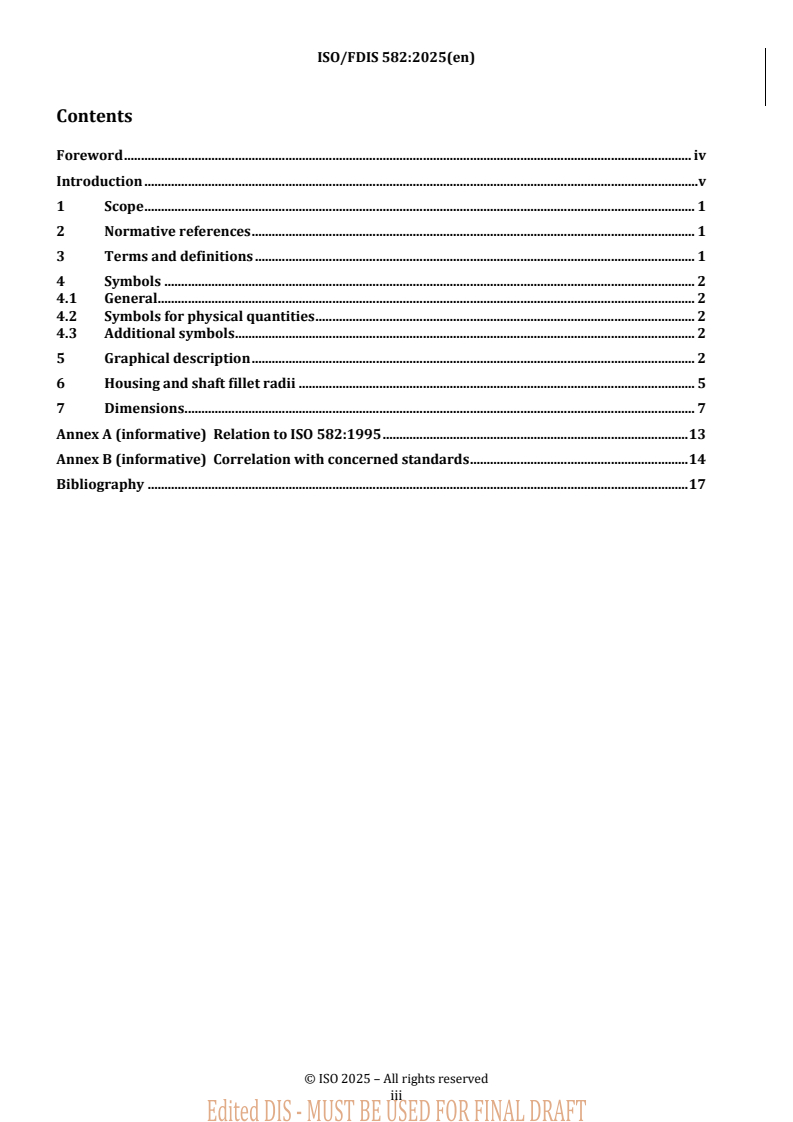
ISO/FDIS 582:2025(en)
Contents Page
Foreword .iv
Introduction .v
1 Scope . 1
2 Normative references . 1
3 Terms and definitions . 1
4 Symbols . 2
4.1 General .2
4.2 Symbols for physical quantities .2
4.3 Additional symbols .2
5 Graphical description . 2
6 Housing and shaft fillet radii . 4
7 Dimensions . 5
Annex A (informative) Relation to ISO 582:1995 . 10
Annex B (informative) Correlation with concerned standards .11
Bibliography .13
iii
ISO/FDIS 582:2025(en)
Foreword
ISO (the International Organization for Standardization) is a worldwide federation of national standards
bodies (ISO member bodies). The work of preparing International Standards is normally carried out through
ISO technical committees. Each member body interested in a subject for which a technical committee
has been established has the right to be represented on that committee. International organizations,
governmental and non-governmental, in liaison with ISO, also take part in the work. ISO collaborates closely
with the International Electrotechnical Commission (IEC) on all matters of electrotechnical standardization.
The procedures used to develop this document and those intended for its further maintenance are described
in the ISO/IEC Directives, Part 1. In particular, the different approval criteria needed for the different types
of ISO document should be noted. This document was drafted in accordance with the editorial rules of the
ISO/IEC Directives, Part 2 (see www.iso.org/directives).
ISO draws attention to the possibility that the implementation of this document may involve the use of (a)
patent(s). ISO takes no position concerning the evidence, validity or applicability of any claimed patent
rights in respect thereof. As of the date of publication of this document, ISO had not received notice of (a)
patent(s) which may be required to implement this document. However, implementers are cautioned that
this may not represent the latest information, which may be obtained from the patent database available at
www.iso.org/patents. ISO shall not be held responsible for identifying any or all such patent rights.
Any trade name used in this document is information given for the convenience of users and does not
constitute an endorsement.
For an explanation of the voluntary nature of standards, the meaning of ISO specific terms and expressions
related to conformity assessment, as well as information about ISO's adherence to the World Trade
Organization (WTO) principles in the Technical Barriers to Trade (TBT), see www.iso.org/iso/foreword.html.
This document was prepared by Technical Committee ISO/TC 4, Rolling bearings, Subcommittee SC 4, Rolling
bearings - Vocabulary, boundary dimensions and geometrical product specifications.
This fourth edition cancels and replaces the third edition (ISO 582:1995), which has been technically revised.
It also incorporates the Amendment ISO 582:1995/Amd 1:2013.
The main changes are as follows:
— implementation of ISO 21204;
— symbols have been revised;
— Annexes A and B have been added.
Any feedback or questions on this document should be directed to the user’s national standards body. A
complete listing of these bodies can be found at www.iso.org/members.html.
iv
ISO/FDIS 582:2025(en)
Introduction
The purpose of this document is to achieve interchangeability of rolling bearings, by specifying the chamfer
dimensions, and to minimize the risk of incompatibility in bearing applications as well as to facilitate the
mounting process.
The specification of the chamfer dimensions also assures a sufficient support surface for the bearing rings.
v
FINAL DRAFT International Standard ISO/FDIS 582:2025(en)
Rolling Bearings — Chamfer dimensions — Geometrical
product specification (GPS) and values
1 Scope
This document specifies the chamfer least material boundary for ring and washer chamfers of metric series
rolling bearings for the corresponding radius maximum material boundaries. The radius maximum material
[1] [2] [3] [4] [5] [6] [7]
boundaries are given in , , , , , , .
Recommendations are given for the corresponding housing and shaft fillet radii.
2 Normative references
The following documents are referred to in the text in such a way that some or all of their content constitutes
requirements of this document. For dated references, only the edition cited applies. For undated references,
the latest edition of the referenced document (including any amendments) applies.
ISO 5593, Rolling bearings — Vocabulary
ISO 8015, Geometrical product specifications (GPS) — Fundamentals — Concepts, principles and rules
ISO 21204:2020, Geometrical product specifications (GPS) — Transition specification
ISO 22872:2024, Rolling bearings — Geometrical product specifications (GPS) — Vocabulary and representation
of symbols
3 Terms and definitions
For the purposes of this document, the terms and definitions given in ISO 5593, ISO 8015, ISO 21204,
ISO 22872 and the following apply.
ISO and IEC maintain terminology databases for use in standardization at the following addresses:
— ISO Online browsing platform: available at https:// www .iso .org/ obp
— IEC Electropedia: available at https:// www .electropedia .org/
3.1
transition feature
single integral feature connecting two or more adjacent integral surfaces
[SOURCE: ISO 21204:2020, 3.1]
3.2
ring chamfer
transition feature (3.1) connecting the bore or outside surface and one of the faces of the ring
3.3
washer chamfer
transition feature (3.1) connecting the bore or outside surface and one of the faces of the washer
ISO/FDIS 582:2025(en)
4 Symbols
4.1 General
The described symbols are illustrated in Figures 1 to 5.
4.2 Symbols for physical quantities
Symbols i
...
ISO/FDIS 582:2025(en)
ISO/TC 4/SC 4
Secretariat: SIS
Date: 2025-07-10-03
Rolling bearingsBearings — Chamfer dimensions — Geometrical
product specificationsspecification (GPS) and values
Roulements — Dimensions des arrondis — Spécification géométrique des produits (GPS)
FDIS stage
ISO #####-#:####(X/FDIS 582:2025(en)
All rights reserved. Unless otherwise specified, or required in the context of its implementation, no part of this publication
may be reproduced or utilized otherwise in any form or by any means, electronic or mechanical, including photocopying,
or posting on the internet or an intranet, without prior written permission. Permission can be requested from either ISO
at the address below or ISO’s member body in the country of the requester.
ISO copyright office
CP 401 • Ch. de Blandonnet 8
CH-1214 Vernier, Geneva
Phone: + 41 22 749 01 11
EmailE-mail: copyright@iso.org
Website: www.iso.org
Published in Switzerland
© ISO #### 2025 – All rights reserved
ii
ISO/FDIS 582:2025(en)
Contents
Foreword . iv
Introduction . v
1 Scope . 1
2 Normative references . 1
3 Terms and definitions . 1
4 Symbols . 2
4.1 General . 2
4.2 Symbols for physical quantities . 2
4.3 Additional symbols . 2
5 Graphical description . 2
6 Housing and shaft fillet radii . 5
7 Dimensions . 7
Annex A (informative) Relation to ISO 582:1995 . 13
Annex B (informative) Correlation with concerned standards . 14
Bibliography . 17
iii
ISO #####-#:####(X/FDIS 582:2025(en)
Foreword
ISO (the International Organization for Standardization) is a worldwide federation of national standards
bodies (ISO member bodies). The work of preparing International Standards is normally carried out through
ISO technical committees. Each member body interested in a subject for which a technical committee has been
established has the right to be represented on that committee. International organizations, governmental and
non-governmental, in liaison with ISO, also take part in the work. ISO collaborates closely with the
International Electrotechnical Commission (IEC) on all matters of electrotechnical standardization.
The procedures used to develop this document and those intended for its further maintenance are described
in the ISO/IEC Directives, Part 1. In particular, the different approval criteria needed for the different types of
ISO document should be noted. This document was drafted in accordance with the editorial rules of the
ISO/IEC Directives, Part 2 (see www.iso.org/directives).
ISO draws attention to the possibility that the implementation of this document may involve the use of (a)
patent(s). ISO takes no position concerning the evidence, validity or applicability of any claimed patent rights
in respect thereof. As of the date of publication of this document, ISO had not received notice of (a) patent(s)
which may be required to implement this document. However, implementers are cautioned that this may not
represent the latest information, which may be obtained from the patent database available at
www.iso.org/patents. ISO shall not be held responsible for identifying any or all such patent rights.
Any trade name used in this document is information given for the convenience of users and does not
constitute an endorsement.
For an explanation of the voluntary nature of standards, the meaning of ISO specific terms and expressions
related to conformity assessment, as well as information about ISO's adherence to the World Trade
Organization (WTO) principles in the Technical Barriers to Trade (TBT), see www.iso.org/iso/foreword.html.
This document was prepared by Technical Committee ISO/TC 4, Rolling bearings, Subcommittee SC 4, Rolling
bearings - Vocabulary, boundary dimensions and geometrical product specifications.
This fourth edition cancels and replaces the third edition (ISO 582:1995), which has been technically revised.
It also incorporates the Amendment ISO 582:1995/Amd 1:2013.
The main changes are as follows:
— — implementation of ISO 21204;
— — symbols have been revised;
— Annexes A— Annexes A and BB have been added.
Any feedback or questions on this document should be directed to the user’s national standards body. A
complete listing of these bodies can be found at www.iso.org/members.html.
© ISO #### 2025 – All rights reserved
iv
ISO/FDIS 582:2025(en)
Introduction
The purpose of this document is to achieve interchangeability of rolling bearings, by specifying the chamfer
dimensions, and to minimize the risk of incompatibility in bearing applications as well as to facilitate the
mounting process.
The specification of the chamfer dimensions also assures a sufficient support surface for the bearing rings.
v
Final Draft International Standard ISO/FDIS 582:2025(en)
Rolling Bearings — Chamfer dimensions — Geometrical product
specificationsspecification (GPS) and values
1 Scope
This document specifies the chamfer least material boundary for ring and washer chamfers of metric series
rolling bearings for the corresponding radius maximum material boundaries. The radius maximum material
[ ] [ ] [ ] [ ] [ ] [ ] [ ]
boundaries are given in 0 , 0 , 0 , 0 , 0 , 0 , 0 [1], [2], [3], [4], [5], [6], [7]. .
Recommendations are given for the corresponding housing and shaft fillet radii.
2 Normative references
The following documents are referred to in the text in such a way that some or all of their content constitutes
requirements of this document. For dated references, only the edition cited applies. For undated references,
the latest edition of the referenced document (including any amendments) applies.
ISO 5593, Rolling bearings — Vocabulary
ISO 8015, Geometrical product specifications (GPS) — Fundamentals — Concepts, principles and rules
ISO 21204:2020, Geometrical product specifications (GPS) — Transition specification
ISO 22872:2024, Rolling bearings — Geometrical product specifications (GPS) — Vocabulary and representation
of symbols
3 Terms and definitions
For the purposes of this document, the terms and definitions given in ISO 5593, ISO 8015, ISO 21204,
ISO 22872 and the following apply.
ISO and IEC maintain terminology databases for use in standardization at the following addresses:
— — ISO Online browsing platform: available at https://www.iso.org/obp
— — IEC Electropedia: available at https://www.electropedia.org/
3.1 3.1
transition feature
single integral feature connecting two or more adjacent integral surfaces
[SOURCE: ISO 21204:2020, 3.1]
3.2 3.2
ring chamfer
transition feature (3.1(3.1)) connecting the bore or outside surface and one of the faces of the ring
ISO #####-#:####(X/FDIS 582:2025(en)
3.3 3.3
washer chamfer
transition feature (3.1(3.1)) connecting the bore or outside surface and one of the faces of the washer
4 Symbols
4.1 General
The described symbols are illustrated in Figures 1Figures 1 to 55.
4.2 Symbols for physical quantities
Symbols in Table 1Table 1 represent nominal physical quantities in the GPS environment.
Table 1 — Symbols for dimensions
Symbol Description Reference
c
a
Nominal extent of a ring or washer chamfer least material boundary
—
in axial direction
c1a
cr
Nominal extent of a ring or washer chamfer least material boundary
—
in radial direction
c1r
D Nominal outside diameter ISO 22872:2024, 3.1.1.4
d Nominal bore diameter ISO 22872:2024, 3.1.1.6
r, r1 Nominal radius of a maximum material boundary of the ring or
—
washer chamfer
Annex A
Annex A shows the relation of the symbols in Table 1Table 1 to the symbols used in the previous edition of
this document.
4.3 Additional symbols
Additional symbols defined in other documents and used in this document are presented in Table 2Table 2 for
information.
Table 2 — Additional symbols defined in other documents
Symbol Description Reference
CL Chamfer least material boundary ISO 21204:2020, 7.5, 7.8
RM Radius maximum material boundary ISO 21204:2020, 6.4, 6.8
Annex B
[ ] [ ]
Annex B shows the correlation of these symbols with standards 0 [1] to 0 [7]. .
5 Graphical description
To express that the ISO GPS system according to ISO 8015 is applied, the transition specifications shall be
included in the technical product documentation (for example, on the drawing).
The limiting material boundaries defined by the transition specification as given in Figure 1Figure 1 are
described in Figure 2Figure 2.
© ISO #### 2025 – All rights reserved
ISO/FDIS 582:2025(en)
All figures in this document have been drawn with dimensions in millimetres.
Key
1 material side
NOTE For other ways of indicating the transition specification symbols see ISO 21204:2020, 5.2.1
...
PROJET FINAL
Norme
internationale
ISO/FDIS 582
ISO/TC 4/SC 4
Roulements — Dimensions
Secrétariat: SIS
des arrondis — Spécification
Début de vote:
géométrique des produits (GPS)
2025-10-17
Rolling Bearings — Chamfer dimensions — Geometrical product
Vote clos le:
specification (GPS) and values
2025-12-12
LES DESTINATAIRES DU PRÉSENT PROJET SONT
INVITÉS À PRÉSENTER, AVEC LEURS OBSERVATIONS,
NOTIFICATION DES DROITS DE PROPRIÉTÉ DONT ILS
AURAIENT ÉVENTUELLEMENT CONNAISSANCE ET À
FOURNIR UNE DOCUMENTATION EXPLICATIVE.
OUTRE LE FAIT D’ÊTRE EXAMINÉS POUR
ÉTABLIR S’ILS SONT ACCEPTABLES À DES FINS
INDUSTRIELLES, TECHNOLOGIQUES ET COM-MERCIALES,
AINSI QUE DU POINT DE VUE DES UTILISATEURS, LES
PROJETS DE NORMES
INTERNATIONALES DOIVENT PARFOIS ÊTRE CONSIDÉRÉS
DU POINT DE VUE DE LEUR POSSI BILITÉ DE DEVENIR DES
NORMES POUVANT
SERVIR DE RÉFÉRENCE DANS LA RÉGLEMENTATION
NATIONALE.
Numéro de référence
ISO/FDIS 582:2025(fr) © ISO 2025
PROJET FINAL
ISO/FDIS 582:2025(fr)
Norme
internationale
ISO/FDIS 582
ISO/TC 4/SC 4
Roulements — Dimensions
Secrétariat: SIS
des arrondis — Spécification
Début de vote:
géométrique des produits (GPS)
2025-10-17
Rolling Bearings — Chamfer dimensions — Geometrical product
Vote clos le:
specification (GPS) and values
2025-12-12
LES DESTINATAIRES DU PRÉSENT PROJET SONT
INVITÉS À PRÉSENTER, AVEC LEURS OBSERVATIONS,
NOTIFICATION DES DROITS DE PROPRIÉTÉ DONT ILS
AURAIENT ÉVENTUELLEMENT CONNAISSANCE ET À
FOURNIR UNE DOCUMENTATION EXPLICATIVE.
DOCUMENT PROTÉGÉ PAR COPYRIGHT
OUTRE LE FAIT D’ÊTRE EXAMINÉS POUR
ÉTABLIR S’ILS SONT ACCEPTABLES À DES FINS
© ISO 2025 INDUSTRIELLES, TECHNOLOGIQUES ET COM-MERCIALES,
AINSI QUE DU POINT DE VUE DES UTILISATEURS, LES
Tous droits réservés. Sauf prescription différente ou nécessité dans le contexte de sa mise en œuvre, aucune partie de cette
PROJETS DE NORMES
INTERNATIONALES DOIVENT PARFOIS ÊTRE CONSIDÉRÉS
publication ne peut être reproduite ni utilisée sous quelque forme que ce soit et par aucun procédé, électronique ou mécanique,
DU POINT DE VUE DE LEUR POSSI BILITÉ DE DEVENIR DES
y compris la photocopie, ou la diffusion sur l’internet ou sur un intranet, sans autorisation écrite préalable. Une autorisation peut
NORMES POUVANT
être demandée à l’ISO à l’adresse ci-après ou au comité membre de l’ISO dans le pays du demandeur.
SERVIR DE RÉFÉRENCE DANS LA RÉGLEMENTATION
NATIONALE.
ISO copyright office
Case postale 401 • Ch. de Blandonnet 8
CH-1214 Vernier, Genève
Tél.: +41 22 749 01 11
E-mail: copyright@iso.org
Web: www.iso.org
Publié en Suisse Numéro de référence
ISO/FDIS 582:2025(fr) © ISO 2025
ii
ISO/FDIS 582:2025(fr)
Sommaire Page
Avant-propos .iv
Introduction .v
1 Domaine d'application . 1
2 Références normatives . 1
3 Termes and définitions . 1
4 Symboles . 2
4.1 Généralités .2
4.2 Symboles pour les grandeurs physiques .2
4.3 Symboles supplémentaires .2
5 Description graphique . 2
6 Rayons des congés d’arbre et de logement . 4
7 Dimensions . 5
Annexe A (informative) Correspondance avec l'ISO 582:1995 .10
Annexe B (informative) Corrélation avec les normes concernées .11
Bibliographie .13
iii
ISO/FDIS 582:2025(fr)
Avant-propos
L'ISO (Organisation internationale de normalisation) est une fédération mondiale d'organismes nationaux
de normalisation (comités membres de l'ISO). L'élaboration des Normes internationales est en général
confiée aux comités techniques de l'ISO. Chaque comité membre intéressé par une étude a le droit de faire
partie du comité technique créé à cet effet. Les organisations internationales, gouvernementales et non
gouvernementales, en liaison avec l'ISO participent également aux travaux. L'ISO collabore étroitement avec
la Commission électrotechnique internationale (IEC) en ce qui concerne la normalisation électrotechnique.
Les procédures utilisées pour élaborer le présent document et celles destinées à sa mise à jour sont
décrites dans les Directives ISO/IEC, Partie 1. Il convient, en particulier, de prendre note des différents
critères d'approbation requis pour les différents types de documents ISO. Le présent document a
été rédigé conformément aux règles de rédaction données dans les Directives ISO/IEC, Partie 2 (voir
www.iso.org/directives).
L’ISO attire l’attention sur le fait que la mise en application du présent document peut entraîner l’utilisation
d’un ou de plusieurs brevets. L’ISO ne prend pas position quant à la preuve, à la validité et à l’applicabilité de
tout droit de propriété revendiqué à cet égard. À la date de publication du présent document, l’ISO n'avait pas
reçu notification qu’un ou plusieurs brevets pouvaient être nécessaires à sa mise en application. Toutefois,
il y a lieu d’avertir les responsables de la mise en application du présent document que des informations
plus récentes sont susceptibles de figurer dans la base de données de brevets, disponible à l'adresse
www.iso.org/brevets. L’ISO ne saurait être tenue pour responsable de ne pas avoir identifié tout ou partie de
tels droits de propriété.
Les appellations commerciales éventuellement mentionnées dans le présent document sont données pour
information, par souci de commodité, à l’intention des utilisateurs et ne sauraient constituer un engagement.
Pour une explication de la nature volontaire des normes, la signification des termes et expressions
spécifiques de l'ISO liés à l'évaluation de la conformité, ou pour toute information au sujet de l'adhésion de
l'ISO aux principes de l’Organisation mondiale du commerce (OMC) concernant les obstacles techniques au
commerce (OTC), voir www.iso.org/iso/foreword.html.
Le présent document a été élaboré par le Comité technique ISO/TC 4, Roulements, sous-comité SC 4,
Roulements - Vocabulaire, dimensions d'encombrement et spécification géométrique des produits.
Cette quatrième édition annule et remplace la troisième édition (ISO 582:1995), qui a fait l'objet d'une
révision technique. Elle incorpore également l'Amendement ISO 582:1995/Amd. 1:2013.
Les principales modifications sont les suivantes:
— implémentation de l'ISO 21204;
— révision des symboles;
— ajout des Annexes A et B.
Il convient que l’utilisateur adresse tout retour d’information ou toute question concernant le présent
document à l’organisme national de normalisation de son pays. Une liste exhaustive desdits organismes se
trouve à l’adresse www.iso.org/fr/members.html.
iv
ISO/FDIS 582:2025(fr)
Introduction
Le but du présent document est d'obtenir l'interchangeabilité des roulements, en spécifiant les dimensions
d'arrondi, et de minimiser le risque d'incompatibilité dans les applications de roulements, ainsi que de
faciliter le processus de montage.
La spécification des dimensions d'arrondi garantit également une surface support suffisante pour les bagues
de roulement.
v
PROJET FINAL Norme internationale ISO/FDIS 582:2025(fr)
Roulements — Dimensions des arrondis — Spécification
géométrique des produits (GPS)
1 Domaine d'application
Le présent document spécifie la limite de l'arrondi au minimum de matière pour les arrondis de bague
et de rondelle de roulements de séries métriques pour les limites de rayon au maximum de matière
correspondantes. Les limites de rayon au maximum de matière sont données dans les Références [1], [2], [3],
[4], [5], [6], [7].
Des recommandations sont données pour les rayons maximaux des congés de logement et d’arbre
correspondants.
2 Références normatives
Les documents suivants sont cités dans le texte de sorte qu’ils constituent, pour tout ou partie de leur
contenu, des exigences du présent document. Pour les références datées, seule l’édition citée s’applique. Pour
les références non datées, la dernière édition du document de référence s'applique (y compris les éventuels
amendements).
ISO 5593, Roulements — Vocabulaire
ISO 8015, Spécification géométrique des produits (GPS) — Principes fondamentaux — Concepts, principes et règles
ISO 21204:2020, Spécifications géométriques des produits (GPS) — Spécification de transition
ISO 22872:2024, Roulements — Spécification géométrique des produits (GPS) — Vocabulaire et représentation
des symboles
3 Termes and définitions
Pour les besoins du présent document, les termes et les définitions de l'ISO 5593, l'ISO 8015, l'ISO 21204 et
l'ISO 22872 ainsi que les suivants s'appliquent.
L'ISO et l'IEC tiennent à jour des bases de données terminologiques destinées à être utilisées en normalisation,
consultables aux adresses suivantes:
— ISO Online browsing platform: disponible à l'adresse https:// www .iso .org/ obp
— IEC Electropedia: disponible à l'adresse https:// www .electropedia .org/
3.1
élément de transition
élément intégral simple reliant au moins deux surfaces intégrales adjacentes
[SOURCE: ISO 21204:2020, 3.1]
3.2
arrondi de bague
élément de transition (3.1) reliant l'alésage ou la surface extérieure et l'une des faces de la bague
3.3
arrondi de rondelle
élément de transition (3.1) reliant l'alésage ou la surface extérieure et l'une des faces de la rondelle
ISO/FDIS 582:2025(fr)
4 Symboles
4.1 Généralités
Les symboles décrits sont illustrés dans les Figures 1 à 5.
4.2 Symboles pour les grandeurs physiques
Les symboles du Tableau 1 représentent les grandeurs physiques nominales dans l'environnement GPS.
Tabl
...
Questions, Comments and Discussion
Ask us and Technical Secretary will try to provide an answer. You can facilitate discussion about the standard in here.
Loading comments...