


ISO/IEC Guide 21:1999
(Main)Adoption of International Standards as regional or national standards
Adoption of International Standards as regional or national standards
Adoption de Normes internationales en tant que normes régionales ou nationales
General Information
- Status
- Withdrawn
- Publication Date
- 10-Feb-1999
- Withdrawal Date
- 10-Feb-1999
- Technical Committee
- ISO/TMBG - Technical Management Board - groups
- Drafting Committee
- ISO/TMBG - Technical Management Board - groups
- Current Stage
- 9599 - Withdrawal of International Standard
- Start Date
- 12-May-2005
- Completion Date
- 12-Feb-2026
Relations
- Effective Date
- 15-Apr-2008
- Effective Date
- 15-Apr-2008
ISO/IEC Guide 21:1999 - Adoption of International Standards as regional or national standards
ISO/IEC Guide 21:1999 - Adoption de Normes internationales en tant que normes régionales ou nationales
Frequently Asked Questions
ISO/IEC Guide 21:1999 is a guide published by the International Organization for Standardization (ISO). Its full title is "Adoption of International Standards as regional or national standards". This standard covers: Adoption of International Standards as regional or national standards
Adoption of International Standards as regional or national standards
ISO/IEC Guide 21:1999 is classified under the following ICS (International Classification for Standards) categories: 01.120 - Standardization. General rules. The ICS classification helps identify the subject area and facilitates finding related standards.
ISO/IEC Guide 21:1999 has the following relationships with other standards: It is inter standard links to ISO/IEC Guide 21-2:2005, ISO/IEC Guide 21-1:2005. Understanding these relationships helps ensure you are using the most current and applicable version of the standard.
ISO/IEC Guide 21:1999 is available in PDF format for immediate download after purchase. The document can be added to your cart and obtained through the secure checkout process. Digital delivery ensures instant access to the complete standard document.
Standards Content (Sample)
bc
GUIDE 21
Adoption of International
Standards as regional or
national standards
Second edition 1999
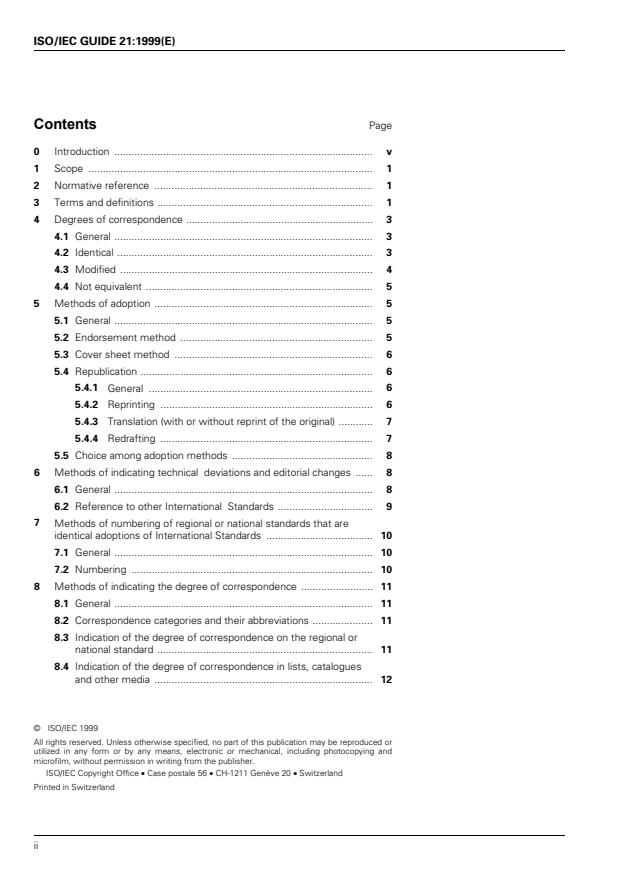
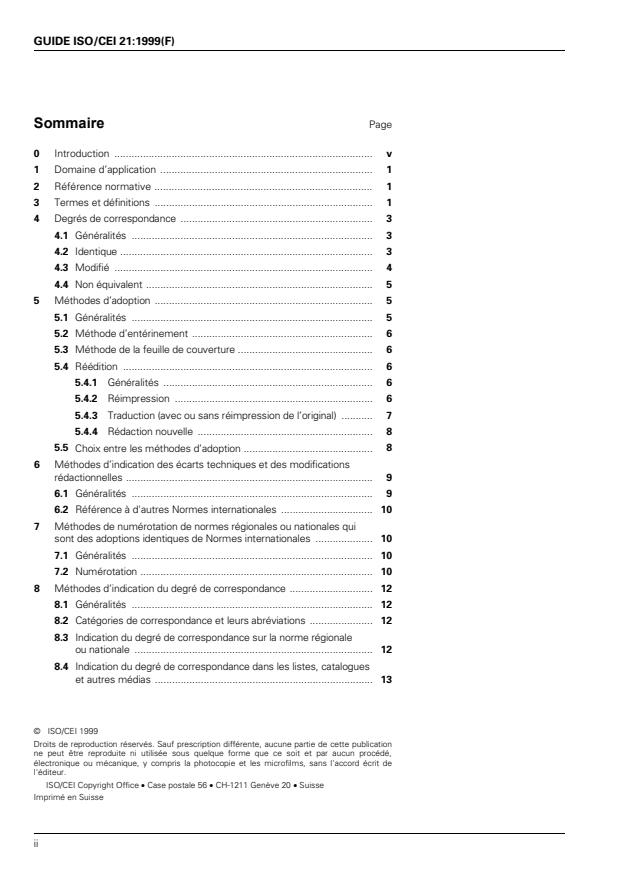
Contents Page
0 v
Introduction .
1 Scope . 1
2 Normative reference . 1
3 Terms and definitions . 1
4 Degrees of correspondence . 3
4.1 General . 3
4.2 Identical . 3
4.3 Modified . 4
4.4 Not equivalent . 5
5 Methods of adoption . 5
5.1 General . 5
5.2 Endorsement method . 5
5.3 Cover sheet method . 6
5.4 Republication . 6
5.4.1 General . 6
5.4.2 Reprinting . 6
5.4.3 Translation (with or without reprint of the original) . 7
5.4.4 Redrafting . 7
5.5 Choice among adoption methods . 8
6 Methods of indicating technical deviations and editorial changes . 8
6.1 General . 8
6.2 Reference to other International Standards . 9
7 Methods of numbering of regional or national standards that are
identical adoptions of International Standards . 10
7.1 General . 10
7.2 Numbering . 10
8 Methods of indicating the degree of correspondence . 11
8.1 General . 11
8.2 Correspondence categories and their abbreviations . 11
8.3 Indication of the degree of correspondence on the regional or
national standard . 11
8.4 Indication of the degree of correspondence in lists, catalogues
and other media . 12
© ISO/IEC 1999
All rights reserved. Unless otherwise specified, no part of this publication may be reproduced or
utilized in any form or by any means, electronic or mechanical, including photocopying and
microfilm, without permission in writing from the publisher.
ISO/IEC Copyright Office • Case postale 56 • CH-1211 Genève 20 • Switzerland
Printed in Switzerland
ii
©
ISO/IEC ISO/IEC GUIDE 21:1999(E)
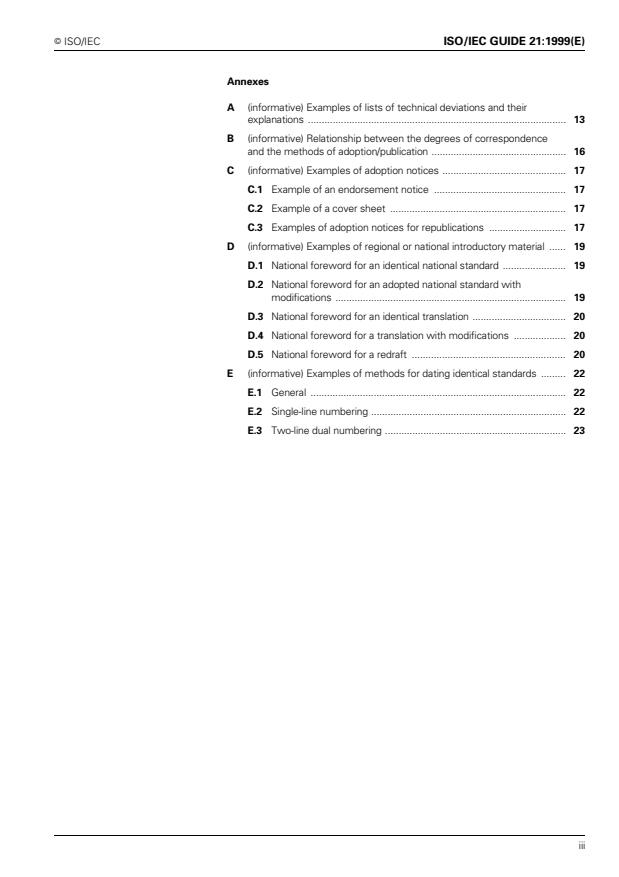
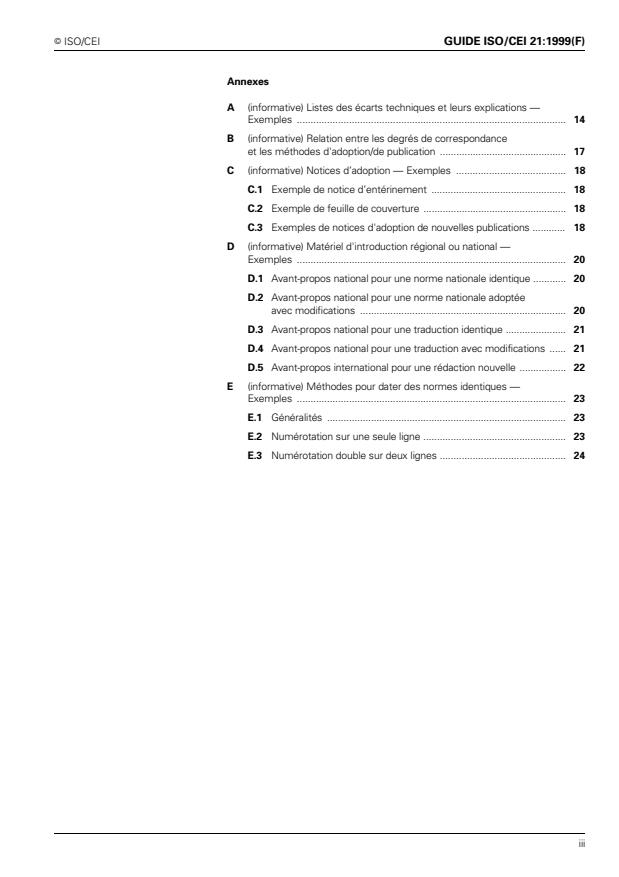
Annexes
A (informative) Examples of lists of technical deviations and their
explanations . 13
B (informative) Relationship between the degrees of correspondence
and the methods of adoption/publication . 16
C (informative) Examples of adoption notices . 17
C.1 Example of an endorsement notice . 17
C.2 Example of a cover sheet . 17
C.3 Examples of adoption notices for republications . 17
D (informative) Examples of regional or national introductory material . 19
D.1 National foreword for an identical national standard . 19
D.2 National foreword for an adopted national standard with
modifications . 19
D.3 National foreword for an identical translation . 20
D.4 National foreword for a translation with modifications . 20
D.5 National foreword for a redraft . 20
E (informative) Examples of methods for dating identical standards . 22
E.1 General . 22
E.2 Single-line numbering . 22
E.3 Two-line dual numbering . 23
iii
©
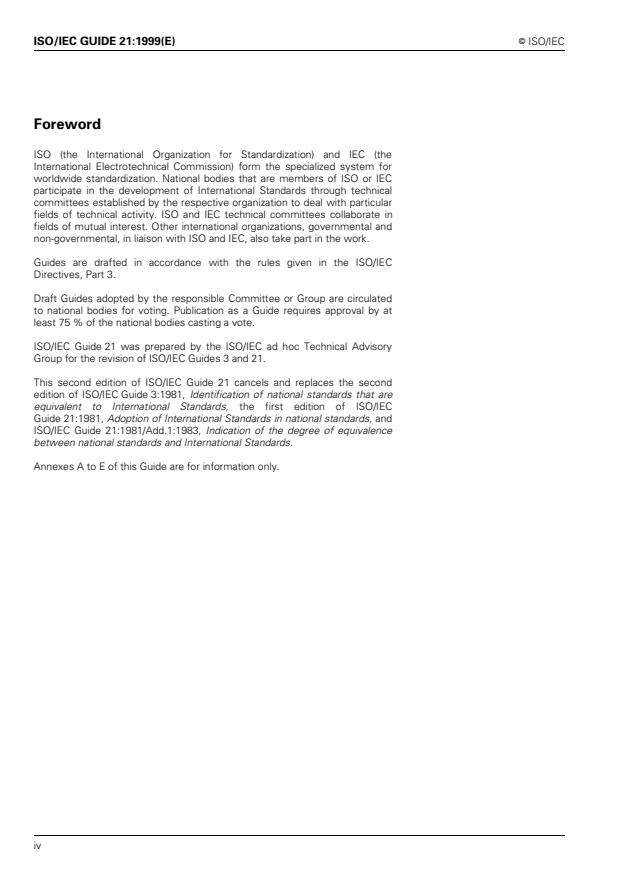
Foreword
ISO (the International Organization for Standardization) and IEC (the
International Electrotechnical Commission) form the specialized system for
worldwide standardization. National bodies that are members of ISO or IEC
participate in the development of International Standards through technical
committees established by the respective organization to deal with particular
fields of technical activity. ISO and IEC technical committees collaborate in
fields of mutual interest. Other international organizations, governmental and
non-governmental, in liaison with ISO and IEC, also take part in the work.
Guides are drafted in accordance with the rules given in the ISO/IEC
Directives, Part 3.
Draft Guides adopted by the responsible Committee or Group are circulated
to national bodies for voting. Publication as a Guide requires approval by at
least 75 % of the national bodies casting a vote.
ISO/IEC Guide 21 was prepared by the ISO/IEC ad hoc Technical Advisory
Group for the revision of ISO/IEC Guides 3 and 21.
This second edition of ISO/IEC Guide 21 cancels and replaces the second
edition of ISO/IEC Guide 3:1981, Identification of national standards that are
equivalent to International Standards, the first edition of ISO/IEC
Guide 21:1981, Adoption of International Standards in national standards, and
ISO/IEC Guide 21:1981/Add.1:1983, Indication of the degree of equivalence
between national standards and International Standards.
Annexes A to E of this Guide are for information only.
iv
©
ISO/IEC ISO/IEC GUIDE 21:1999(E)
0 Introduction
0.1 This Guide provides the methods for adoption of International Standards
as regional or national standards and includes a system for indicating the
degree of correspondence so as to promote coherence in the way regional or
national standards bodies adopt International Standards and indicate the degree
of correspondence with International Standards. It applies equally to the
adoption of other international normative and informative documents such as
Technical Reports. Greater uniformity in the indication of both correspondence
and deviations among countries will aid communication, avoid confusion and
facilitate trade.
0.2 International Standards are widely adopted at the regional or national
level and applied by manufacturers, trade organizations, purchasers,
consumers, testing laboratories, authorities and other interested parties. Since
these standards generally reflect the best experience of industry, researchers,
consumers and regulators worldwide and cover common needs in a variety of
countries, they constitute one of the important bases for the removal of
technical barriers to trade. This has been explicitly acknowledged in the
Agreement on Technical Barriers to Trade of the World Trade Organization
(WTO TBT Agreement).
It is important that every effort should be made to adopt and use International
Standards and, consequently, to withdraw conflicting regional or national
standards as soon as practicable for the reasons mentioned above. Only by
developing a global approach can the benefits of standardization be fully
realized. However, full adoption may not be practicable in all cases for reasons
such as regional or national security, protection of human health or safety, or
protection of the environment, or because of fundamental climatic,
geographical or technological problems. The WTO TBT Agreement recognizes
that these are legitimate reasons for regional or national deviations.
0.3 The adoption of an International Standard as a regional or national
standard will be extremely difficult if the regional or national rules or traditions
concerning structure and layout of regional or national standards differ from
those of the standard being adopted. It is therefore recommended to apply, as
far as possible, the ISO/IEC Directives, Part 3, for the preparation of regional
and national standards.
Even for the cases referred to in 0.2, every effort should be made to reduce the
deviations to a rational minimum. Moreover, where deviations from
International Standards exist, it is important to identify the deviations clearly and
to state the reasons for the deviations. If International Standards are adopted
only by means of a re-edited version, it is extremely difficult to identify the
technical deviations owing to the presentation differences, i.e. differences in
the structure and wording, of the original standard. On the other hand, a clearly
identified deviation will have a tendency to disappear because as long as it
remains visible, the question as to whether it is still necessary will arise
repeatedly, while a hidden deviation may not disappear even when no longer
justified.
0.4 It is recommended that as much information as possible is given about
the correspondence of regional or national standards that adopt International
Standards (or are based on them). This information should be displayed in a
v
©
prominent place on the regional or national standard (preferably on the title
page and in the foreword), in standards lists, catalogues, year-books and any
other media for retrieval purposes. When quoting an International Standard, at
least its number and date of publication should be given. If a regional or national
standard does not exist materially (for example, if the International Standard has
been adopted by the endorsement method), this information about
correspondence should be given in standards listing media as mentioned
above.
0.5 Although the scope of this Guide covers only the adoption of
International Standards as regional or national standards, the methods of
adoption described and the degrees of correspondence may also be applied to
the adoption of regional or national standards by other regional or national
standards.
vi
©
ISO/IEC ISO/IEC GUIDE 21:1999(E)
Adoption of International Standards as regional or national
standards
1 Scope
This Guide provides methods for
determination of the degree of correspondence between regional or national standards and relevant International
Standards (clause 4),
adoption of International Standards as regional or national standards (clause 5),
indication of technical deviations which would facilitate immediate recognition of any deviation (clause 6),
numbering of regional or national standards that are identical adoptions of International Standards (clause 7), and
indication of the degree of correspondence between the regional or national standard and the International
Standard (clause 8).
This Guide does not contain any rules for the use of an International Standard in production, trade, legislation or similar
activities. It also does not deal with
adoption of regional or national standards as International Standards,
adoption of regional or national standards as other regional or national standards,
adoption of regional standards as national standards, or
adoption in or of technical regulations.
2 Normative reference
The following normative document contains provisions which, through reference in this text, constitute provisions
of this Guide. For dated references, subsequent amendments to, or revisions of, this publication do not apply.
However, parties to agreements based on this Guide are encouraged to investigate the possibility of applying the
most recent edition of the normative document indicated below. For undated references, the latest edition of the
normative document referred to applies. Members of ISO and IEC maintain registers of currently valid International
Standards.
ISO/IEC Guide 2:1996, Standardization and related activities — General vocabulary.
3 Terms and definitions
For the purposes of this Guide, the terms and definitions given in ISO/IEC Guide 2 (some of which are repeated below
for convenience) and the following apply.
3.1
standard
document, established by consensus and approved by a recognized body, that provides, for common and repeated
use, rules, guidelines or characteristics for activities or their result, aimed at the achievement of the optimum degree
of order in a given context
©
NOTE Standards should be based on the consolidated results of science, technology and experience, and aimed at the
promotion of optimum community benefits.
[ISO/IEC Guide 2:1996, definition 3.2]
3.2
international standard
standard that is adopted by an international standardizing/standards organization and made available to the public
[ISO/IEC Guide 2:1996, definition 3.2.1.1]
3.3
regional standard
standard that is adopted by a regional standardizing/standards organization and made available to the public
[ISO/IEC Guide 2:1996, definition 3.2.1.2]
3.4
national standard
standard that is adopted by a national standards body and made available to the public
[ISO/IEC Guide 2:1996, definition 3.2.1.3]
3.5
adoption
^of an International Standard in a regional or national standard& publication of a regional or national normative document
based on a relevant International Standard, or endorsement of the International Standard as having the same status as
a national normative document, with any deviations from the International Standard identified
NOTE 1 The term “taking over” is sometimes used to cover the same concept as “adoption”.
NOTE 2 Adapted from ISO/IEC Guide 2:1996, 10.1.
NOTE 3 For the conditions of adoption of an International Standard as a regional or national standard, see 4.1.
3.6
editorial change
^of an International Standard in a regional or national standard& any permitted change that does not alter the technical
content of the standard
NOTE A list of permitted editorial changes is given in 4.2.
3.7
technical deviation
^from an International Standard in a regional or national standard& any difference between the technical content of the
International Standard and that of the regional or national standard
3.8
change in wording
when adopting an International Standard in one of its official languages, the replacement of single words or phrases in
the regional or national standard by synonyms to reflect common language use in the region or country adopting the
International Standard
EXAMPLE The use of “elevators” for “lifts” in certain countries.
©
ISO/IEC ISO/IEC GUIDE 21:1999(E)
3.9
structure
^of a standard& order of the clauses, subclauses, paragraphs, tables, figures, annexes
3.10
vice versa principle
principle whereby anything that is acceptable under the terms of the International Standard is acceptable under the
regional or national standard and vice versa, and thus compliance with the International Standard also means
compliance with the regional or national standard
4 Degrees of correspondence
4.1 General
For comparison of regional or national standards with relevant International Standards, an indication of their
correspondence is essential if their relationship is to be understood quickly. A skeleton classification into three
degrees of correspondence (see 4.2 to 4.4) is sufficient and an over-detailed indication is not reasonable because of
the variety of possible cases. Any comparison will have to be made point by point, and will need to cover both the
scope and the content to discover deviating items.
An International Standard is considered to have been adopted when the regional or national standard is identical (see
4.2) or modified (see 4.3) in relation to the International Standard.
Identical adoption of International Standards ensures transparency, which is fundamental to the facilitation of trade. It
is important to remember that even if two standards bodies introduce deviations or redrafting which they consider not
significant in their regional or national standards against the International Standard, problems may arise because these
changes could add up and lead to non-acceptability between the two regional or national standards. Identical adoption
avoids these problems.
4.2 Identical
The regional or national standard is identical to the International Standard under the following conditions:
a) the regional or national standard is identical in technical content, structure and wording (or is an identical
translation), or
b) the regional or national standard is identical in technical content, although it may contain the following minimal
editorial changes:
substitution of decimal point for a decimal comma;
correction of any misprints (e.g. spelling errors) or pagination changes;
deletion of text in one or several languages from a multilingual International Standard;
inclusion of any technical corrigenda or amendments issued to the International Standard;
changes to the title to be consistent with an existing regional or national series;
substitution of “this regional/national standard” for “this International Standard”;
inclusion of any regional or national informative material (e.g. informative annexes that do not alter, add to or
delete from the provisions of the International Standard); examples of informative material are advice to
users, training guidance or suggested forms or reports;
©
deletion of informative preliminary material from the International Standard;
changes in wording as defined in 3.8;
addition, for informative purposes, of recalculated values of quantity units where a different measurement
system is used in an adopting country.
The “vice versa principle” is fulfilled.
NOTE Any changes in document layout (e.g. in relation to pagination, font type and font size etc.) especially in an electronic
environment, have no impact on the degree of correspondence.
4.3 Modified
The regional or national standard is modified in relation to the International Standard under the following conditions.
Technical deviations are permitted provided they are clearly identified and explained. The regional or national
standard reflects the structure of the International Standard. Changes to the structure are only permitted if an easy
comparison of the content and structure of the two standards continues to be possible.
For transparency and traceability, it is strongly recommended that a national standard adopts only one single
International Standard. Under certain circumstances, it may be appropriate to adopt several International Standards
within one national standard. However, this is only practicable for the user if an easy comparison of the content is
provided in a list identifying and explaining the changes. Modified standards may also include the changes
permitted under identical correspondence.
The “vice versa principle” is not fulfilled.
Modified standards can include such cases as the following.
a) “The regional or national standard contains less”
The regional or national standard only applies a subset of the available choices in the International Standard, has
less stringent requirements, etc.
b) “The regional or national standard contains more”
The regional or national standard adds aspects or types, has more stringent requirements, includes additional tests,
etc.
c) “The regional or national standard alters a part of the International Standard”
Part of the content is identical, but both the regional or national standard and the International Standard contain
some differing requirements.
d) “The regional or national standard provides an alternative choice”
The regional or national standard provides a provision of equal status, which may be used as an alternative to that
given in the International Standard.
See annex A for examples of lists of technical deviations and their explanation.
NOTE A regional or national standard can include an International Standard in its totality and can contain additional technical
provisions, which are not part of the International Standard. In this case, the degree of correspondence to the International
Standard is either “modified” or “not equivalent”, depending on whether or not the differences are clearly indicated and technical
deviations are listed and explained, although the part composed of the included International Standard may not have been subject
to any modifications.
©
ISO/IEC ISO/IEC GUIDE 21:1999(E)
4.4 Not equivalent
The regional or national standard is not equivalent to the International Standard in technical content and structure and
the changes have not been clearly identified. This also can include the case where only a minority in number or
significance of the international provisions remain in the regional or national standard.
NOTE This degree of correspondence does not constitute an adoption.
5 Methods of adoption
5.1 General
5.1.1 This clause describes a range of methods for adoption of International Standards and can apply equally to the
first two degrees of correspondence (see 4.2 and 4.3). It also gives some indications concerning the advantages and
disadvantages of these methods. The preferred methods are given in 5.5 (see also annex B for a summary of the
relationships between the degrees of correspondence and the methods of adoption/publication).
5.1.2 Any regional or national standard which adopts an International Standard by any method shall ensure that the
identification of the International Standard is clearly stated. For adoption by the Cover Sheet method or by
Republication, the identification of the International Standard shall include, in a prominent position such as on the cover
sheet, the reference number, the title (in at least one of the official languages in which the International Standard was
published), date or year of publication and the degree of correspondence (see clause 4).
5.1.3 When adopting an International Standard, all existing amendments and technical corrigenda to the International
Standard shall be included in the regional or national standard.
NOTE Amendments and technical corrigenda published after the adoption of an International Standard, should be adopted as
soon as possible.
5.1.4 With particular reference to the development of electronic versions of standards, standards bodies may find
new methods of adoption which are not covered in this Guide, or may combine the existing ones. In this case the
method used will not be listed here. However, the recommendations regarding choice and indication of
correspondence will still remain applicable.
NOTE Examples of different types of adoption notices are given in annex C.
5.2 Endorsement method
5.2.1 If the International Standard is declared by the regional or national body to have the status of a regional or
national standard, an “endorsement notice” may be issued. The endorsement notice may contain information or
instructions pertinent to this declaration. An endorsement notice should only be issued where condition 4.2 a) is
fulfilled. Each endorsement notice should only refer to one International Standard (including any amendments
and/or technical corrigenda).
5.2.2 The endorsement notice may allocate a unique regional or national reference number to each endorsed
International Standard. Alternatively, the reference number of the International Standard should be used.
5.2.3 The endorsement notice may appear in an official bulletin and/or as an independent document. The text of the
International Standard should not usually be attached to the endorsement notice.
5.2.4 The endorsement method is one of the simplest methods of adoption. It does not require a reprint of the text
of the International Standard. However, the endorsement notice cannot be used without the International Standard
and, therefore, the latter shall be made available in some way. Further, if the endorsement notice does not have its
own identification number, the International Standard may not be easily traceable as having been adopted within the
regional or national standards system.
©
5.3 Cover sheet method
5.3.1 An International Standard (including any amendments and/or technical corrigenda) may be published with a
regional or national cover sheet. The cover sheet should have a regional or national reference number and the
International Standard will become a part of the regional or national standards system if there is an identical (see 4.2)
or modified (see 4.3) degree of correspondence. Each cover sheet should only refer to one International Standard
(including any amendments and/or technical corrigenda). Adhesive labels, stamps or other indications applied to the
International Standards are considered to be equivalent to cover sheets. Since the use of stamps or labels provides
limited space for information, instructions or notes, these should not be used as if they are cover sheets unless the
regional or national standard is identical to the International Standard.
5.3.2 The cover sheet should contain information and instructions regarding the standard as well as information
relating to editorial changes. If necessary, a reference to an annex listing any technical deviations and reasons for them
with reference to the International Standard should be included.
5.3.3 The cover sheet method has the advantages that it does not require a reprint and that the full text of the
International Standard is attached.
5.4 Republication
5.4.1 General
There are three methods of republication, i.e. reprinting (see 5.4.2), translation (see 5.4.3) and redrafting (see 5.4.4).
5.4.2 Reprinting
5.4.2.1 The International Standard is printed as a regional or national standard by direct reproduction of the published
document (e.g. by photography, scanning or from an electronic file). In addition, the regional or national standard may
include the following:
a) a regional or national introduction, preface or foreword (see 5.4.2.2);
b) a translation of the text (see 5.4.3);
c) a different title (see 4.2 and 5.4.2.4);
d) amendments and/or technical corrigenda (see 5.1.3) to the International Standard;
e) regional or national informative material in a regional or national foreword, notes or annexes (see clause 6);
f) editorial changes or technical deviations (see clause 6).
5.4.2.2 A regional or national introduction, preface or foreword may contain information or instructions pertinent to
the regional or national adoption of the standard. Such information would normally include the following:
a) the original parent publication title and reference number (with the year of publication), e.g. ISO 9001:1994, Quality
systems — Model for quality assurance in design, development, production, installation and servicing;
b) the regional or national body responsible for the standard (e.g. technical committee number and title);
c) if appropriate, details of editorial changes;
d) if appropriate, reference to technical deviations and changes in structure together with their explanations or to the
annex giving this information.
NOTE Examples of regional or national introductory material are given in annex D.
©
ISO/IEC ISO/IEC GUIDE 21:1999(E)
5.4.2.3 It is also possible to add technical deviations and any information, instructions, notes, etc. directly to those
clauses to which they refer. However, this additional text shall be clearly identified as being distinct from the original
standard.
5.4.2.4 To align with an established series of regional or national standards, the title of the regional or national
standard may vary from that of the adopted International Standard. However, the title of the International Standard
should be clearly shown on the cover page.
NOTE It is recommended that the explanation for the change of title is provided in the introduction, preface or foreword of the
regional or national standard.
5.4.2.5 Technical corrigenda and amendments to an International Standard are often issued before it is adopted as a
regional or national standard. When adopting an International Standard, all existing amendments and technical
corrigenda shall be included (see 5.1.3).
NOTE For an appropriate method of identifying the included amendments and technical corrigenda, see 6.1.6.
Reference to any included amendments, etc., and an explanation of the markings, should be included in the
regional or national introduction, preface or foreword.
5.4.3 Translation (with or without reprint of the original)
5.4.3.1 If the regional or national standard is solely the translation of an International Standard, it may be published in
a bilingual or monolingual form. In either case a regional or national introduction, preface or foreword is usually
included (see 5.4.2.2).
5.4.3.2 Where there has been a translation, and the monolingual regional or national standard has been declared
“identical”, then compliance with the original International Standard is deemed to be compliance with the translation,
i.e. the vice versa principle applies.
5.4.3.3 Bilingual editions that contain the text of the standard in another language and in an official language of the
international organization by which it was issued, may contain a statement concerning the validity of the original or of
the translation. Where no statement is made, both versions are equally valid.
5.4.3.4 Both monolingual and bilingual editions may contain notes stating editorial changes and/or technical
deviations made with reference to the International Standard. They usually appear after the clause to which they refer
and/or are mentioned in the regional or national introduction, preface or foreword. The degree of correspondence
depends upon the editorial changes and/or technical deviations added.
5.4.3.5 Monolingual editions should indicate which language served as a basis for the translation.
5.4.4 Redrafting
5.4.4.1 If an International Standard is published as a regional or national standard and the regional/national standard is
not a reprint or identical translation of the International Standard, this is considered to be a redraft.
5.4.4.2 If an International Standard is redrafted as a regional or national standard, the regional or national standard
should state that it has been redrafted, whether or not the regional or national standard deviates from the International
Standard. If there are deviations then the reasons for these should be given and the deviations should also be
identified in the text using one of the methods given in clause 6.
©
5.4.4.3 Though redrafting is a valid method of adopting an International Standard, the possibility of overlooking
important technical deviations which may be disguised by the changes in the structure or wording makes the
comparison between the International Standard and the regional or national standard difficult and the degree of
correspondence cannot be easily determined. Redrafting also makes it difficult to verify the degree of correspondence
between such regional or national standards from different countries.
5.5 Choice among adoption methods
5.5.1 If no editorial changes or technical deviations are made, any method of adoption mentioned in 5.2 to 5.4 is
suitable, although reprinting of the full text (see 5.4.2) is the method recommended for those countries whose
language is one of the official ISO/IEC languages. Where a translation is involved, the country should consider binding
the original text with the translation.
5.5.2 If editorial changes or technical deviations are inevitable, it is recommended that the reprint method (see 5.4.2)
or the translation method (see 5.4.3) with the incorporation of deviations within the text or in an annex be used. It may
also be possible to use the cover sheet method depending on the nature of the cover sheet and the amount of
information that has to be conveyed. For the indication of technical deviations and editorial changes, see clause 6.
5.5.3 The redrafting of standards is not recommended for the reasons stated in 0.3 and 5.4.4.3.
NOTE Annex C provides some examples of explanatory notes for the different types of adoption.
6 Methods of indicating technical deviations and editorial changes
6.1 General
6.1.1 The regional or national standards should include
a) an explanation in a regional or national introduction, preface or foreword (in accordance with 5.4.2.2) and, where
appropriate,
b) an annex describing any editorial changes and/or technical deviations which have been made, why they have been
made, and how they are identified in the text.
6.1.2 Where technical deviations (and reasons for them) or editorial changes are few, they may be placed in the
regional or national introduction, preface or foreword.
6.1.3 Specific deviations or advice (with suitable cross reference) may also be included in the regional or national
introduction, preface or foreword. Alternatively, they can be included in the text or in a special regional or national
annex. For paper-based production, the mechanical difficulties of inserting blocks of text makes it preferable to use a
simple, but unambiguous, method of including changes.
NOTE An example of a regional or national introduction and foreword is given in annex D.
6.1.4 If included within the text, any regional or national explanatory notes, editorial changes and/or technical
deviations made with reference to the International Standard should be clearly highlighted in the text, e.g. by inclusion
in a box immediately following the clause to which they relate or by a single vertical bar in the margin against the
applicable text.
©
ISO/IEC ISO/IEC GUIDE 21:1999(E)
They should be introduced by the following titles:
— “regional or national explanatory note” or “regional or national explanation” if their content is limited to editorial
changes, and/or
— “regional or national deviation” if their content is not limited to editorial changes.
6.1.5 An alternative method of indicating explanatory notes, editorial changes or technical deviations, and one which
does not require cutting and assembling the text of the International Standard, is to use a single vertical bar (|) in the
margin to indicate the applicable text of the International Standard which is to be changed. The regional or national
notes, changes and/or deviations are then collected together in an annex at the end of the document. Each variation is
cross-referenced to the clause etc. of the International Standard, usually with normative deviations in one annex,
together with reasons for the deviations, and informative notes and guidance in another.
NOTE See annex D.
6.1.6 Often when adopting an International Standard there will be amendments and/or technical corrigenda. These
can be incorporated into the text or by binding the amendments and/or technical corrigenda at the end of the
document. The changed text should be indicated in the main body of the standard by double marginal bars (||). This
also has the advantage of distinguishing regional or national requirements (single bars) from the International changes.
6.2 Reference to other International Standards
6.2.1 If an adopted International Standard makes normative reference to other International Standards, the
references should be left unchanged within the text, regardless of those standards' validity in the regional or national
adoption or their status as regional or national standards. If other documents have to be substituted for those originally
referenced, they should be identified in a regional or national note. This is most conveniently done in the regional or
national introduction, preface or foreword.
NOTE These recommendations do not need to be applied to references given for information only, although it may be useful to
do so.
6.2.2 If the referenced International Standards have been adopted as regional or national standards, this should be
stated in the regional or national introduction, preface or foreword, and their regional or national reference numbers
should be given. Similarly, where there are no valid regional or national documents this should also be indicated. A
convenient method of indicating these relationships is a list in the introduction, preface or foreword showing the
reference numbers of the corresponding standards and their degree of correspondence. The referenced documents
should be quoted exactly as they appear in the International Standard. The technical committee responsible for the
regional or national standard should review all the cited regional or national standards to ensure they are equivalent and
have validity for the purposes of the standard being adopted.
NOTE If an error in an International Standard has been detected, a regional or national footnote should provide correct reference
information and inform the relevant international organization.
6.2.3 If some of the referenced International Standards have not been adopted as regional or national standards in
the region or country, then the regional or national introduction, preface or foreword should identify the documents
that are to be considered valid in their stead, if reference to the International Standard is not considered appropriate.
Information should also be given regarding any technical deviations in the regional or national documents from the
International Standards replaced by them. When a document other than an identical regional or national standard is
substituted for a referenced International Standard, the referencing standard is considered to contain a technical
deviation and, therefore, to have “modified” correspondence.
©
7 Methods of numbering of regional or national standards that are identical adoptions
of International Standards
7.1 General
When regional or national standards are identical (see 4.2) to International Standards, this should be evident to the
reader immediately and not only after examination of the content.
7.2 Numbering
7.2.1 When the full text of the International Standard has been adopted in the regional or national standard so that
the International Standard is completely reprinted, referred to (in the case of an endorsement notice or cover sheet) or
is identically translated, either of the two numbering systems in 7.2.2 may be used.
7.2.2 The recommended method of identification for identical adoptions consists of including the International
Standard reference number (letters and number) in combination with or in association with the regional or national one
[see a) and b) below]. Depending on the method chosen, in order to improve transparency, the year of publication of
the International Standard and/or that of the regional or national standard should be added to the number wherever
possible (see annex E).
The following methods of numbering are acceptable, method a) being the preferred option.
a) In combination with the regional or national letters only
The regional or national letters may be separated from the international reference number (letters and number) by a
space or any convenient symbol, for example a hyphen.
1)
EXAMPLE In the case of an XYZ standard identical to IEC 61642, the reference number of the regional or national
standard would be:
XYZ IEC 61642:1998
This is often referred to as “single-line numbering” for obvious reasons, and is equivalent to saying that the
number of the regional or national standard is IEC 61642. Use of this method provides an immediate and obvious
identification with the International Standard.
b) In association with the regional or national letters and number
EXAMPLE XYZ 87878:1998
ISO 13616:1996
This is often referred to as “two-line dual numbering”. Reference numbers based on two-line dual numbering may
also be written in one line using a slash to separate the two constituents of the reference number.
EXAMPLE XYZ 87878:1998/ISO 13616:1996
NOTE This method may be particularly useful if a regional or national standard is to be published in a series of separately
published parts only some of which will be identical to an International Standard.
The two methods, single-line and two-line dual numbering, are only applicable for identical adoptions of
International Standards. For modified adoptions, only a regional or national reference number is permitted, i.e.
neither of the alternatives given in a) and b) is permitted.
_______________
1) Taking the example of an imaginary country.
©
ISO/IEC ISO/IEC GUIDE 21:1999(E)
8 Methods of indicating the degree of correspondence
8.1 General
It is recommended that a system of identification that establishes, as clearly as possible for the user, the
correspondence between the International Standard and the regional or national standard be applied. The same
information should also appear in catalogues and other information media.
8.2 Correspondence categories and their abbreviations
Designation Description Abbreviation
identical The regional or national standard is identical to the International Standard if IDT
a) the regional or national standard is identical in technical content, structure
and wording, or
b) the regional or national standard is identical in technical content, although it
may contain the minimal editorial changes specified in 4.2.
The “vice versa principle” is fulfilled.
modified The regional or national standard is modified in relation to the International MOD
Standard if technical deviations, which are permitted, are clearly identified and
explained. The regional or national standard reflects the structure of the Inter-
national Standard, but changes in structure are permitted provided that the al-
tered structure permits easy comparison of the content of the two standards.
Modified standards also include the changes permitted under identical cor-
respondence.
The “vice versa principle” is not fulfilled.
not equivalent The regional or national standard is not equivalent to the International Standard NEQ
in technical content and structure and any changes have not been clearly identi-
fied. No clear correspondence is obvious between the regional/national stand-
ard and the International Standard.
NOTE This category of correspondence does not constitute an adoption.
8.3 Indication of the degree of correspondence on the regional or national standard
For indicating the degree of correspondence, the system recommended in 8.2 should be used. The designation or the
abbreviation for the degree of correspondence should appear after the regional or national standard title and the
reference number of the International Standard, including its date. If the title of the regional/national standard is
different from that of the International Standard resulting from a translation or because it has been changed to be
consistent with an existing regional or national series of stand
...
bc
GUIDE 21
Adoption de Normes
internationales en tant que
normes régionales ou
nationales
Deuxième édition 1999
GUIDE ISO/CEI 21:1999(F)
Sommaire Page
0 Introduction . v
1 Domaine d’application . 1
2 1
Référence normative .
3 Termes et définitions . 1
4 Degrés de correspondance . 3
4.1 Généralités . 3
4.2 Identique . 3
4.3 Modifié . 4
4.4 Non équivalent . 5
5 Méthodes d’adoption . 5
5.1 Généralités . 5
5.2 Méthode d’entérinement . 6
5.3 Méthode de la feuille de couverture . 6
5.4 Réédition . 6
5.4.1 Généralités . 6
5.4.2 Réimpression . 6
5.4.3 Traduction (avec ou sans réimpression de l’original) . 7
5.4.4 Rédaction nouvelle . 8
5.5 Choix entre les méthodes d’adoption . 8
6 Méthodes d’indication des écarts techniques et des modifications
rédactionnelles . 9
6.1 Généralités . 9
6.2 Référence à d'autres Normes internationales . 10
7 Méthodes de numérotation de normes régionales ou nationales qui
sont des adoptions identiques de Normes internationales . 10
7.1 Généralités . 10
7.2 Numérotation . 10
8 Méthodes d’indication du degré de correspondance . 12
8.1 Généralités . 12
8.2 Catégories de correspondance et leurs abréviations . 12
8.3 Indication du degré de correspondance sur la norme régionale
ou nationale . 12
8.4 Indication du degré de correspondance dans les listes, catalogues
et autres médias . 13
© ISO/CEI 1999
Droits de reproduction réservés. Sauf prescription différente, aucune partie de cette publication
ne peut être reproduite ni utilisée sous quelque forme que ce soit et par aucun procédé,
électronique ou mécanique, y compris la photocopie et les microfilms, sans l'accord écrit de
l'éditeur.
ISO/CEI Copyright Office • Case postale 56 • CH-1211 Genève 20 • Suisse
Imprimé en Suisse
ii
©
ISO/CEI GUIDE ISO/CEI 21:1999(F)
Annexes
A (informative) Listes des écarts techniques et leurs explications —
Exemples . 14
B (informative) Relation entre les degrés de correspondance
et les méthodes d'adoption/de publication .
C (informative) Notices d’adoption — Exemples . 18
C.1 Exemple de notice d’entérinement . 18
C.2 Exemple de feuille de couverture . 18
C.3 Exemples de notices d'adoption de nouvelles publications . 18
D (informative) Matériel d'introduction régional ou national —
Exemples . 20
D.1 Avant-propos national pour une norme nationale identique . 20
D.2 Avant-propos national pour une norme nationale adoptée
avec modifications . 20
D.3 Avant-propos national pour une traduction identique . 21
D.4 Avant-propos national pour une traduction avec modifications . 21
D.5 Avant-propos international pour une rédaction nouvelle . 22
E (informative) Méthodes pour dater des normes identiques —
Exemples . 23
E.1 Généralités . 23
E.2 Numérotation sur une seule ligne . 23
E.3 Numérotation double sur deux lignes . 24
iii
©
GUIDE ISO/CEI 21:1999(F) ISO/CEI
Avant-propos
L'ISO (Organisation internationale de normalisation) et la CEI (Commission
électrotechnique internationale) forment ensemble un système consacré à
la normalisation internationale. Les organismes nationaux membres de l'ISO
ou de la CEI participent au développement de Normes internationales par
l'intermédiaire des comités techniques créés par l'organisation concernée
afin de s’occuper des différents domaines particuliers de l'activité technique.
Les comités techniques de l'ISO et de la CEI collaborent dans des domaines
d'intérêt commun. D'autres organisations internationales, gouvernementales
ou non gouvernementales, en liaison avec l'ISO et la CEI participent
également aux travaux.
Les projets de Guides adoptés par le comité ou le groupe responsable sont
soumis au vote des organismes nationaux. La publication en tant que Guide
requiert l'approbation de 75 % au moins des organismes nationaux votants.
Le Guide ISO/CEI 21 a été élaboré par le Groupe technique consultatif ad hoc
de l'ISO/CEI chargé de la révision des Guides ISO/CEI 3 et 21.
Cette deuxième édition du Guide ISO/CEI 21 annule et remplace la deuxième
édition du Guide ISO/CEI 3:1981, Identification des normes nationales qui
sont équivalentes aux Normes internationales, la première édition du Guide
ISO/CEI 21:1981, Adoption des Normes internationales dans les normes
nationales, et du Guide ISO/CEI 21:1981/Add.1:1983, Indication du degré
d'équivalence entre les normes nationales et les Normes internationales.
Les annexes A à E du présent Guide sont données uniquement à titre
d’information.
iv
©
ISO/CEI GUIDE ISO/CEI 21:1999(F)
0 Introduction
0.1 Le présent Guide fournit des méthodes pour l'adoption de Normes
internationales en tant que normes régionales ou nationales et comprend un
système permettant d'indiquer le degré de correspondance afin de promouvoir
une approche cohérente dans la manière dont les organismes nationaux de
normalisation adoptent les Normes internationales et indiquent le degré de
correspondance avec les Normes internationales. Il s'applique également
à l'adoption d'autres documents internationaux normatifs et informatifs tels
que les rapports techniques. Une meilleure uniformité entre les pays dans
la manière d'indiquer à la fois la correspondance et les écarts aidera la
communication, évitera la confusion et facilitera le commerce.
0.2 Les Normes internationales sont largement adoptées au niveau régional
ou national et utilisées par les fabricants, les organisations commerciales, les
acheteurs, les consommateurs, les laboratoires d'essai, les autorités et autres
milieux intéressés. Du moment que ces normes traduisent en général
la meilleure expérience acquise de l'industrie, de la recherche, des
consommateurs et des instances de réglementation du monde entier et
qu'elles recouvrent les besoins communs à des pays très divers, elles
constituent l'une des bases importantes de la suppression des obstacles
techniques au commerce. Ce fait a été explicitement reconnu dans l'Accord sur
les obstacles techniques au commerce de l'Organisation mondiale du
commerce (Accord OTC de l'OMC).
Il importe que tous les efforts soient faits pour adopter et utiliser les Normes
internationales et, par conséquent, pour annuler toute norme régionale ou
nationale contradictoire dès que possible, pour les raisons énoncées ci-dessus.
Ce n'est qu'en adoptant une démarche mondiale que les avantages de la
normalisation pourront être pleinement réalisés. Toutefois, l'adoption intégrale
n'est peut-être pas commode dans tous les cas pour diverses raisons telles
que la sécurité régionale ou nationale, la protection de la santé et de la sécurité
des personnes, ou la protection de l'environnement ou pour des raisons
fondamentales d'ordre climatique, géographique ou technologique. L'Accord
OTC de l'OMC reconnaît qu'il s'agit de raisons légitimes pour des écarts
régionaux ou nationaux.
0.3 L'adoption d'une Norme internationale en tant que norme régionale ou
nationale sera extrêmement difficile si les règles ou les traditions régionales ou
nationales en matière de structure et de présentation diffèrent de celles
applicables aux normes faisant l'objet de l'adoption. Il est recommandé, en
conséquence, d'appliquer dans toute la mesure du possible les Directives
ISO/CEI, Partie 3, dans le cadre de l'élaboration des normes régionales et
nationales.
Même dans les cas évoqués en 0.2, il convient de faire tous les efforts pour
réduire les écarts au minimum qui s'impose. De plus, lorsqu'il existe des écarts
par rapport à la Norme internationale, il importe d'identifier clairement de tels
écarts et d'en préciser les raisons. Si les Normes internationales sont adoptées
par la seule voie de la réédition, il est extrêmement difficile d'identifier les
écarts techniques dus aux différences de présentation, c'est-à-dire aux
différences par rapport à la structure et au libellé de la norme d'origine. Par
ailleurs, un écart clairement identifié aura tendance à disparaître à la longue, car
v
©
GUIDE ISO/CEI 21:1999(F) ISO/CEI
aussi longtemps qu'il restera en évidence, la question de son utilité sera
constamment évoquée, alors qu'un écart caché risque de ne pas disparaître,
même lorsqu'il n'est plus justifié.
0.4 Il est recommandé de fournir autant d'informations que possible à
propos de la correspondance des normes régionales ou nationales qui adoptent
des Normes internationales (ou qui se fondent sur de telles normes). Cette
information doit figurer en bonne place sur la norme (de préférence en page de
couverture et dans l'avant-propos), dans les listes de normes, les catalogues,
les annuaires et tous autres supports destinés à permettre la recherche.
Lorsqu'une Norme internationale est citée, il convient d'en donner au moins le
numéro et la date de publication. Si une norme régionale ou nationale n'existe
pas matériellement (par exemple lorsque la Norme internationale a été adoptée
par voie d'entérinement), cette information en matière de correspondance doit
figurer au moins dans les documents du type mentionné ci-dessus donnant la
liste des normes en question.
0.5 Bien que le domaine d'application du présent Guide couvre uniquement
l'adoption des Normes internationales en tant que normes régionales ou
nationales, les méthodes d'adoption décrites et les degrés de correspondance
peuvent aussi être appliqués à l'adoption de normes régionales ou nationales
par d'autres normes régionales ou nationales.
vi
©
ISO/CEI ISO/CEI GUIDE 21:1999(F)
Adoption de Normes internationales en tant que normes
régionales ou nationales
1 Domaine d’application
Le présent Guide fournit des méthodes pour
la détermination du degré de correspondance entre les normes régionales ou nationales et les Normes
internationales adoptées (article 4),
l’adoption de Normes internationales en tant que normes régionales ou nationales (article 5),
l'indication des écarts techniques, afin de permettre le repérage immédiat de tout écart (article 6),
le numérotage de normes régionales ou nationales qui constituent des adoptions identiques de Normes
internationales (article 7),
et
l'indication du degré de correspondance entre la norme régionale ou nationale et la Norme internationale (article 8).
Le présent Guide ne contient pas de règles pour l'utilisation d'une Norme internationale dans la production, le
commerce, la législation ou des activités similaires. Il ne traite pas non plus
de l'adoption de normes régionales ou nationales en tant que Normes internationales,
de l'adoption de normes régionales ou nationales en tant qu'autres normes régionales ou nationales,
de l'adoption de normes régionales en tant que normes nationales,
ni
de l'adoption de règlements techniques ou dans des règlements techniques.
2 Référence normative
Le document normatif suivant contient des dispositions qui, par suite de la référence qui y est faite, constituent des
dispositions valables pour le présent Guide. Pour les références datées, les amendements ultérieurs ou les révisions
de ces publications ne s'appliquent pas. Toutefois, les parties prenantes aux accords fondés sur le présent Guide sont
invitées à rechercher la possibilité d'appliquer l'édition la plus récente du document normatif indiqué ci-après. Pour les
références non datées, la dernière édition du document normatif en référence s'applique. Les membres de l'ISO et de
la CEI possèdent le registre des Normes internationales en vigueur.
Guide ISO/CEI 2:1996, Normalisation et activités connexes — Vocabulaire général.
3 Termes et définitions
Pour les besoins du présent Guide, les termes et définitions donnés dans le Guide ISO/CEI 2 (dont quelques-uns sont
reproduits ci-dessous pour des raisons pratiques), ainsi que les suivants s’appliquent.
©
GUIDE ISO/CEI 21:1999(F) ISO/CEI
3.1
norme
document, établi par consensus et approuvé par un organisme reconnu, qui fournit, pour des usages communs et
répétés, des règles, des lignes directrices ou des caractéristiques, pour des activités ou leurs résultats, garantissant un
niveau d'ordre optimal dans un contexte donné
NOTE Il convient que les normes soient fondées sur les acquis conjugués de la science, de la technique et de l'expérience et
visent à l'avantage optimal de la communauté.
[Guide ISO/CEI 2:1996, définition 3.2]
3.2
norme internationale
norme qui est adoptée par une organisation internationale à activités normatives/de normalisation et qui est
mise à la disposition du public
[Guide ISO/CEI 2:1996, définition 3.2.1.1]
3.3
norme régionale
norme qui est adoptée par une organisation régionale à activités normatives/de normalisation et qui est mise à
la disposition du public
[Guide ISO/CEI 2:1996, définition 3.2.1.2]
3.4
norme nationale
norme qui est adoptée par un organisme national de normalisation et qui est mise à la disposition du public
[Guide ISO/CEI 2:1996, définition 3.2.1.3]
3.5
adoption
^d'une Norme internationale dans une norme régionale ou nationale& publication d'un document normatif régional ou
national fondé sur une Norme internationale pertinente, ou entérinement de la Norme internationale avec le même
statut qu'un document normatif national, tout écart par rapport à la Norme internationale étant signalé
NOTE 1 Le terme «reprise» est employé parfois pour exprimer la même notion que celle d'«adoption».
NOTE 2 Adaptée du Guide ISO/CEI 2:1996, définition 10.1.
NOTE 3 Pour les conditions d'adoption d'une Norme internationale en tant que norme régionale ou nationale, voir 4.1.
3.6
modification rédactionnelle
^d'une Norme internationale dans une norme régionale ou nationale& toute modification autorisée qui n'altère pas le
contenu technique de la norme
NOTE Une liste des modifications rédactionnelles autorisées est donnée en 4.2.
3.7
écart technique
^d'une Norme internationale dans une norme régionale ou nationale& toute différence entre le contenu technique de la
Norme internationale et celui de la norme régionale ou nationale
©
ISO/CEI GUIDE ISO/CEI 21:1999(F)
3.8
modification du libellé
lors de l'adoption d'une Norme internationale dans l'une de ses langues officielles, remplacement de mots ou de
phrases isolés dans la norme régionale ou nationale par des synonymes usités dans la langue courante de la région ou
du pays adoptant la Norme internationale
EXEMPLE L'emploi de «micheline» à la place d’«autorail» dans certains pays.
3.9
structure
^d'une norme& ordre des articles, paragraphes, alinéas, tableaux, figures, annexes
3.10
principe de réversibilité
tout ce qui est acceptable aux termes de la Norme internationale est acceptable aux termes de la norme régionale
ou nationale et réciproquement; par conséquent, la conformité à la Norme internationale signifie également la
conformité à la Norme régionale ou nationale
4 Degrés de correspondance
4.1 Généralités
Pour comparer les normes régionales ou nationales avec les Normes internationales pertinentes, une indication de leur
correspondance est essentielle pour comprendre rapidement leur relation. Une classification sommaire en trois degrés
de correspondance (voir 4.2 à 4.4) est suffisante et une profusion de détails ne serait pas raisonnable en raison de la
diversité des cas possibles. Toute comparaison devra se faire point par point et nécessitera de couvrir à la fois l'objet
et le contenu, afin de déceler tout élément divergent.
Une Norme internationale est considérée comme ayant été adoptée lorsque la norme régionale ou nationale est
identique (4.2) ou modifiée (4.3) par rapport à la Norme internationale.
L'adoption identique des Normes internationales garantit la transparence, qui est essentielle à la facilitation du
commerce. Il importe de se rappeler que si ne serait-ce que deux organismes de normalisation introduisent dans leurs
normes régionales ou nationales des écarts ou des modifications qu'ils considèrent peu importants par rapport à la
Norme internationale, des problèmes peuvent surgir car ces modifications peuvent avoir un effet cumulatif entraînant
une non-acceptabilité entre les deux normes régionales ou nationales. L'adoption identique permet d'éviter de tels
problèmes.
4.2 Identique
La norme régionale ou nationale est identique à la Norme internationale dans les conditions suivantes:
a) la norme régionale ou nationale est identique du point de vue de son contenu technique, sa structure et son
libellé (ou est une traduction identique),
ou
b) la norme régionale ou nationale est identique du point de vue de son contenu technique, bien qu’elle puisse
comporter les modifications rédactionnelles mineures suivantes:
— remplacement de la virgule décimale par un point décimal;
— corrections d'erreurs typographiques (fautes d'orthographe) ou nouvelle pagination;
— suppression du texte dans une ou plusieurs langues d'une Norme internationale multilingue;
©
GUIDE ISO/CEI 21:1999(F) ISO/CEI
— incorporation de tout rectificatif technique ou amendement paru concernant la Norme internationale;
— modifications apportées au titre afin d'assurer l'homogénéité par rapport à une série régionale ou nationale;
— substitution de «la présente norme régionale/nationale» à «la présente Norme internationale»;
— inclusion de tout matériel informatif régional ou national (par exemple des annexes informatives qui
n'altèrent, ni n'augmentent, ni ne retranchent des dispositions de la Norme internationale). Par exemple:
conseils aux usagers, indications en matière de formation, modèles de formulaires ou de rapports
préconisés;
— suppression d'informations préliminaires de caractère informatif de la Norme internationale;
— modifications de libellé telles que définies en 3.8;
— adjonction, à titre d'information, de valeurs recalculées d'unités de grandeur lorsqu'un système de mesure
différent est employé dans le pays procédant à l'adoption.
Le «principe de réversibilité» est respecté.
NOTE Toute modification dans la présentation d'un document (par exemple liée au foliotage, au type de police et à la taille de
caractère, etc.), en particulier dans un environnement électronique, n'a aucune incidence sur le degré de correspondance.
4.3 Modifié
La norme régionale ou nationale est modifiée par rapport à la Norme internationale sous les conditions suivantes. Les
écarts techniques sont autorisés pour autant qu'ils soient clairement signalés et expliqués. La norme régionale ou
nationale reprend la structure de la Norme internationale. Les modifications de structure ne sont autorisées que s'il
reste possible de comparer aisément le contenu et la structure des deux normes.
Pour des raisons de transparence et de traçabilité, il est vivement recommandé que, pour une norme nationale
donnée, une seule Norme internationale soit adoptée. Dans certaines circonstances, il peut s'avérer souhaitable
d'adopter plusieurs Normes internationales dans le cadre d'une seule norme nationale. Toutefois, cela n'est
pratique pour l'usage que si le contenu peut être aisément comparé grâce à une liste précisant et expliquant les
modifications. Les normes modifiées peuvent également comporter les modifications autorisées en cas de
correspondance identique.
Le «principe de réversibilité» n'est pas respecté.
Les normes modifiées peuvent faire intervenir les cas suivants.
a) «La norme régionale ou nationale contient moins»
La norme régionale ou nationale n'applique qu'un sous-ensemble des choix disponibles dans la Norme
internationale, elle contient des exigences moins rigoureuses, etc.
b) «La norme régionale ou nationale contient plus»
La norme régionale ou nationale ajoute certains aspects ou types, comporte des exigences plus rigoureuses,
des essais supplémentaires, etc.
c) «La norme régionale ou nationale modifie une partie de la Norme internationale»
Une partie du contenu est identique ou techniquement correspondant, mais la norme régionale ou nationale et
la Norme internationale contiennent quelques exigences qui diffèrent.
©
ISO/CEI GUIDE ISO/CEI 21:1999(F)
d) «La norme régionale ou nationale offre une solution de rechange»
La norme régionale ou nationale fournit une disposition de statut égal, qui peut être employée en lieu et place de
celle donnée dans la Norme internationale.
Voir, dans l’annexe A, des exemples de listes d’écarts techniques et leurs explications.
NOTE Une norme régionale ou nationale peut inclure une Norme internationale dans sa totalité et peut contenir des dispositions
techniques supplémentaires qui ne font pas partie de la Norme internationale. Dans ce cas, le degré de correspondance à la
Norme internationale est soit «modifié» soit «non équivalent», selon que les différences sont clairement signalées ou non et que
les écarts techniques sont énoncés dans une liste et expliqués ou non, même si la partie constituée de la Norme internationale
adoptée n'a fait l'objet d'aucune modification.
4.4 Non équivalent
La Norme régionale ou nationale n'est pas équivalente à la Norme internationale du point de vue de son contenu
technique et de sa structure, et les modifications n'ont pas été clairement identifiées. Il peut s'agir aussi du cas où
seul un nombre restreint ou peu significatif des dispositions internationales subsistent dans la norme régionale ou
nationale.
NOTE Ce degré de correspondance ne constitue pas une adoption.
5 Méthodes d'adoption
5.1 Généralités
5.1.1 Le présent article décrit un ensemble de méthodes pour l'adoption de Normes internationales et peut
s'appliquer également aux deux premiers degrés de correspondance (voir 4.2 et 4.3). Il donne également quelques
indications en ce qui concerne les avantages et les désavantages de ces méthodes. Les méthodes préférées sont
données en 5.5 (voir également l'annexe B pour un résumé des rapports entre les degrés de correspondance et les
méthodes d'adoption/publication).
5.1.2 Toute norme régionale ou nationale adoptant une Norme internationale par quelque méthode que ce soit doit
assurer que l’identification de la Norme internationale est clairement énoncée. En cas d’adoption par la méthode de la
feuille de couverture ou par réédition, l’identification de la Norme internationale doit comprendre, dans un
emplacement privilégié comme sur la feuille de couverture, l’indicatif, le titre (dans l’une, au moins, des langues
officielles dans lesquelles la Norme internationale a été publiée), la date ou l’année de parution et le degré de
correspondance (voir l'article 4).
5.1.3 Lors de l’adoption d’une Norme internationale, tous les amendements et rectificatifs techniques existants de la
Norme internationale doivent être inclus dans la norme régionale ou nationale.
NOTE Il convient que les amendements et rectificatifs techniques publiés après l’adoption d’une Norme internationale soient
adoptés dès que possible.
5.1.4 Dans le contexte de l'élaboration de versions électroniques des normes, les organismes de normalisation
peuvent trouver de nouvelles méthodes d'adoption qui ne sont pas couvertes par le présent Guide ou qu'ils associent
des méthodes existantes. Dans ce cas, les méthodes employées ne figureront pas ci-dessous. Néanmoins, les
recommandations en matière de choix et d'indication de la correspondance resteront applicables.
NOTE Des exemples de différents types de notice d’adoption sont donnés dans l’annexe C.
©
GUIDE ISO/CEI 21:1999(F) ISO/CEI
5.2 Méthode d'entérinement
5.2.1 Si la Norme internationale est déclarée par l'organisme régional ou national comme ayant le statut de norme
nationale, un «avis d'entérinement» peut être publié. L'avis d'entérinement peut contenir des informations ou des
instructions pertinentes à cette déclaration. Un avis d'entérinement ne doit être émis que si la condition a) en 4.2
est remplie. Chaque avis d'entérinement ne doit se référer qu'à une seule Norme internationale (y compris tout
amendement et/ou rectificatif technique).
5.2.2 L'avis d'entérinement peut attribuer un numéro de référence régional ou national unique à chaque Norme
internationale reprise. Sinon, il convient que le numéro employé soit celui de la Norme internationale.
5.2.3 L'avis d'entérinement peut paraître dans un bulletin officiel et/ou comme document indépendant. Il y a lieu
que le texte de la Norme internationale ne soit pas habituellement joint à l'avis d'entérinement.
5.2.4 La méthode d'entérinement est l'une des méthodes les plus simples d'adoption. Elle ne nécessite pas la
réimpression du texte de la Norme internationale. Toutefois, l'avis d'entérinement ne peut pas être utilisé sans la
Norme internationale et cette dernière doit donc être rendue disponible d'une manière quelconque. En outre, si
l'avis d'entérinement ne possède pas son propre indicatif, la Norme internationale peut ne pas être facilement
identifiable comme ayant été adoptée dans le cadre du système de normes régional ou national.
5.3 Méthode de la feuille de couverture
5.3.1 La Norme internationale (y compris tout amendement et/ou rectificatif technique) peut être publiée avec une
feuille de couverture régionale ou nationale. Il convient que la feuille de couverture ait un numéro de référence
régional ou national et la Norme internationale fera partie du système de normes régional ou national s'il existe un
degré de correspondance identique (voir 4.2) ou modifié (voir 4.3). Il faut que chaque feuille de couverture ne se
réfère qu'à une seule Norme internationale (y compris tout amendement et/ou rectificatif technique). Les
étiquettes adhésives, les timbres ou autres indications apposées sur la Norme internationale sont considérées
équivalentes à des feuilles de couverture. L'emploi d'étiquettes adhésives ou de timbres ne procurant qu'une place
limitée pour des informations, instructions ou notes, il est de règle de n’employer de tels moyens en tant que
feuille de couverture que si la norme régionale ou nationale est identique à la Norme internationale.
5.3.2 Il convient que la feuille de couverture contienne des renseignements et des instructions concernant la
norme, ainsi que des informations à propos des modifications rédactionnelles. Au besoin, il y a lieu qu'un renvoi à
une annexe donnant la liste de tout écart technique et des raisons de son introduction par rapport à la Norme
internationale y figure.
5.3.3 La méthode de la feuille de couverture présente les avantages de ne pas nécessiter une réimpression et
d'adjoindre le texte complet de la Norme internationale.
5.4 Réédition
5.4.1 Généralités
Il existe trois méthodes de réédition, à savoir: réimpression (voir 5.4.2), traduction (voir 5.4.3) et rédaction nouvelle
(voir 5.4.4).
5.4.2 Réimpression
5.4.2.1 La Norme internationale est imprimée en tant que norme régionale ou nationale par reproduction directe
du document publié (par exemple par reproduction photographique, par numérisation ou à partir d'un fichier
électronique). En outre, la norme régionale ou nationale peut comprendre les élément suivants:
a) une introduction, une préface ou un avant-propos régional ou national (voir 5.4.2.2);
©
ISO/CEI GUIDE ISO/CEI 21:1999(F)
b) une traduction du texte (voir 5.4.3);
c) un titre différent (voir 5.1 et 5.4.2.4);
d) amendements et/ou rectificatifs techniques (voir 5.1.3) à la Norme internationale;
e) matériel informatif régional ou national dans un avant-propos, des notes ou des annexes régionaux ou nationaux
(voir l'article 6);
f) modifications rédactionnelles ou écarts techniques (voir l'article 6).
5.4.2.2 Une introduction, préface ou avant-propos régional ou national peut contenir des informations ou des
instructions pertinentes à l'adoption régionale ou nationale de la norme. De telles informations comprennent
normalement les éléments suivants:
a) le titre et l’indicatif du document d’origine (avec l’année de parution), par exemple ISO 9001:1994, Systèmes
qualité — Modèle pour l’assurance qualité dans la conception, l’élaboration, la production, l’installation et la
maintenance;
b) l'organisme régional ou national responsable de la norme (par exemple, le numéro et le titre du comité
technique);
c) s'il y a lieu, tous détails concernant des modifications rédactionnelles;
d) s’il y a lieu, mention des écarts techniques et des modifications de structure avec les explications correspondantes,
ou renvoi à l’annexe donnant ces renseignements.
NOTE Des exemples de matériel d'introduction régional ou national sont donnés dans l'annexe D.
5.4.2.3 Il est également possible d'ajouter des écarts techniques et toutes informations, instructions, notes, etc.,
directement aux articles auxquels ils se rapportent. Toutefois, ce texte supplémentaire doit être clairement identifié
comme étant distinct de la norme d'origine.
5.4.2.4 Afin d'assurer la cohérence au sein d'un ensemble de normes régionales ou nationales, le titre de la norme
régionale ou nationale peut diverger de celui de la Norme internationale adoptée. Toutefois, il convient que le titre
de la Norme internationale soit indiqué clairement sur la page de couverture.
NOTE Il est recommandé de fournir l’explication de la modification du titre dans l’introduction, la préface ou l’avant-propos de la
norme régionale ou nationale.
5.4.2.5 Des rectificatifs techniques et des amendements à une Norme internationale sont souvent émis avant
qu'elle ne soit adoptée comme norme régionale ou nationale. Lors de l'adoption d'une Norme internationale, tous
amendements et rectificatifs techniques existants doivent être inclus (voir 5.1.3).
NOTE Pour une méthode appropriée permettant d'identifier les amendements et rectificatifs techniques inclus, voir 6.1.6.
Il convient que l'introduction, la préface ou l'avant-propos régional ou national fasse mention de tout amendement,
etc., inclus, avec une explication du système de marquage.
5.4.3 Traduction (avec ou sans réimpression de l'original)
5.4.3.1 Si la norme régionale ou nationale n'est que la traduction d'une Norme internationale, elle peut être publiée
sous une forme bilingue ou monolingue. Dans l'un ou l'autre cas, une introduction, une préface ou un avant-propos
régional ou national est habituellement incorporé (voir 5.4.2.2).
©
GUIDE ISO/CEI 21:1999(F) ISO/CEI
5.4.3.2 Lorsqu'il y a eu traduction et que la norme régionale ou nationale monolingue a été déclarée «identique», la
conformité à la Norme internationale d'origine est considérée comme valant conformité à la traduction, à savoir le
principe de réversibilité s'applique.
5.4.3.3 Les éditions bilingues qui contiennent le texte de la norme dans une autre langue et dans une langue
officielle de l'organisation internationale qui l'a publiée peut contenir une déclaration relative à la validité de l'original
ou de la traduction. Si aucune déclaration ne figure, les deux versions sont valables au même titre.
5.4.3.4 Les éditions monolingues et bilingues peuvent éventuellement contenir des notes indiquant des
modifications rédactionnelles et/ou des écarts techniques apportés par rapport à la Norme internationale. Ces notes
apparaissent habituellement après l’article auquel elles se rapportent et/ou sont mentionnées dans l'introduction, la
préface ou l'avant-propos national. Le degré de correspondance dépend des modifications rédactionnelles et ou
tout écart technique ajoutés.
5.4.3.5 Il convient que les éditions monolingues indiquent la langue qui a servi de base pour la traduction.
5.4.4 Rédaction nouvelle
5.4.4.1 Lorsqu’une Norme internationale est publiée en tant que norme régionale ou nationale et que la norme
régionale/nationale n’est ni une réimpression ni une traduction identique de la Norme internationale, cela est considéré
comme une rédaction nouvelle.
5.4.4.2 Si une Norme internationale est rédigée à nouveau en tant que norme nationale, il est de règle que la
norme régionale ou nationale précise qu'elle a été remaniée et si la norme régionale ou nationale s'écarte ou non
de la Norme internationale et, dans l'affirmative, quels sont ces écarts et leurs raisons. S'il existe des écarts, il
convient d'en donner les raisons et ces écarts devraient également être signalés dans le texte par l'une des
méthodes données à l’article 6.
5.4.4.3 Bien qu'une rédaction nouvelle constitue une méthode valable d'adoption d'une Norme internationale, la
possibilité de laisser échapper des écarts techniques importants qui risquent d'être masqués par les modifications
de présentation ou de rédaction, rend difficile la comparaison entre la Norme internationale et la norme nationale,
ainsi que l'élucidation du degré de correspondance. Une nouvelle rédaction rend également difficile la vérification
du degré de correspondance entre de telles normes régionales ou nationales émanant de différents pays.
5.5 Choix entre les méthodes d'adoption
5.5.1 Si aucune modification rédactionnelle, ni aucun écart technique n'est apporté, toute méthode d'adoption
décrite en 5.2 à 5.4 convient, bien que la réimpression du texte intégral (voir 5.4.2) soit la méthode recommandée
pour les pays dont la langue est l'une des langues officielles de l'ISO/CEI. Lorsqu'intervient une traduction, le pays
doit envisager de relier le texte original avec la traduction.
5.5.2 Lorsque des modifications rédactionnelles ou des écarts techniques sont inévitables, il est recommandé d’avoir
recours à la méthode de réimpression (voir 5.4.2) ou à la méthode de traduction (voir 5.4.3), avec l’incorporation des
écarts dans le texte ou dans une annexe. Il est également possible d’employer la méthode de la feuille de couverture
selon la nature de la feuille de couverture et de la quantité d’information à communiquer. Pour le signalement des
écarts techniques et des modifications rédactionnelles, voir l’article 6.
5.5.3 La nouvelle rédaction des normes n’est pas recommandée pour les raisons invoquées en 0.3 et 5.4.4.3.
NOTE Des exemples de notes explicatives pour les différents types d'adoption sont donnés dans l'annexe C.
©
ISO/CEI GUIDE ISO/CEI 21:1999(F)
6 Méthodes d'indication des écarts techniques et des modifications rédactionnelles
6.1 Généralités
6.1.1 Il y a lieu que les normes régionales ou nationales incluent
a) une explication sous la forme d’une introduction, d’une préface ou d’un avant-propos régional ou national
(conformément à 5.4.2.2) et, selon le cas,
b) une annexe décrivant toutes modifications rédactionnelles et/ou tous écarts techniques apportés, les raisons de
leur introduction et la manière dont ils sont signalés dans le texte.
6.1.2 Lorsque les écarts techniques (et les raisons de leur introduction) ou les modifications rédactionnelles sont
peu nombreux, ils peuvent être placés dans l'introduction, la préface ou l'avant-propos national.
6.1.3 Les écarts ou conseils spécifiques (avec les renvois appropriés) peuvent également figurer dans
l'introduction, la préface ou l'avant-propos régional ou national. Une autre solution consiste à les placer dans le
texte ou dans une annexe régionale ou nationale spéciale. Pour la production sur papier, les difficultés techniques
que comporte l'insertion de blocs de texte font qu'il est préférable d'avoir recours à une méthode simple, mais
sans équivoque, d'inclusion des modifications.
NOTE Des exemples d'introduction et d'avant-propos régional ou national sont donnés dans l'annexe D.
6.1.4 Il convient que les notes explicatives, modifications rédactionnelles et/ou écarts techniques régionaux ou
nationaux par rapport à la Norme internationale, s’il en figure dans le corps du texte, soient clairement signalés
dans ledit texte, par exemple en les faisant figurer en encadré immédiatement à la suite de l'article auquel ils se
rapportent, ou au moyen d’une barre verticale simple dans la marge à côté du texte concerné.
Il est de règle de les introduire par les titres suivants:
— «note explicative régionale ou nationale» ou «explication régionale ou nationale» si leur contenu se limite à des
modifications rédactionnelles,
et/ou
— «écart régional ou national» si leur contenu ne se limite pas à des modifications rédactionnelles.
6.1.5 Une méthode de rechange pour signaler des notes explicatives, des modifications rédactionnelles ou des
écarts techniques, qui ne nécessite pas de découpage/collage du texte de la Norme internationale consiste à
employer une barre verticale (|) dans la marge juxtaposée au texte de la Norme internationale qu'il y a lieu de
modifier. Les notes, modifications et/ou écarts nationaux sont ensuite réunis dans une annexe figurant à la fin du
document. Chaque écart comporte un renvoi à l’article, etc. concerné de la Norme internationale, les écarts
normatifs figurant généralement dans une annexe, accompagnés des raisons de ces écarts et les notes
informatives et autres indications figurant dans une autre.
NOTE Voir l'annexe D.
6.1.6 Lors de l'adoption d'une Norme internationale, il y aura souvent des amendements et/ou des rectificatifs
techniques. Ceux-ci peuvent être incorporés au texte ou joints solidairement aux amendements et/ou rectificatifs
techniques à la fin du document. Le texte modifié devrait être signalé dans le corps de la norme par une double
barre verticale (||). Cela a l'avantage, en outre, de distinguer les exigences régionales ou nationales (trait vertical
simple) des modifications internationales.
©
GUIDE ISO/CEI 21:1999(F) ISO/CEI
6.2 Référence à d'autres Normes internationales
6.2.1 Si une Norme internationale adoptée comporte des références normatives à d'autres Normes
internationales, il convient que les références demeurent inchangées dans le texte, quelle que soit la validité de ces
normes dans l'adoption régionale ou nationale ou quel que soit leur statut en tant que normes régionales ou
nationales. Si d'autres documents doivent être substitués à ceux auxquels il a été fait primitivement référence, il y
a lieu de les identifier dans une note régionale ou nationale. Cela peut se faire commodément dans l'introduction, la
préface ou l'avant-propos régional ou national.
NOTE Ces recommandations n’ont pas besoin d’être appliquées aux références données uniquement à titre d'information, bien
que leur application puisse être utile.
6.2.2 Si les Normes internationales auxquelles il est fait référence sont adoptées comme normes régionales ou
nationales, il convient que cette information apparaisse dans l'introduction, la préface ou l'avant-propos régional ou
national et que leur numéro de référence régional ou national soit donné. De même, lorsqu'il n'y a pas de
documents nationaux en vigueur, il y a également lieu de mentionner ce fait. Une manière commode d'indiquer ces
rapports consiste à inclure, dans l'introduction, la préface ou l'avant-propos, une liste énonçant les indicatifs des
normes correspondantes et leur degré de correspondance. Il est bon que les documents référencés soient cités
exactement comme ils figurent dans la Norme internationale. Il est de règle que le comité technique responsable
de la norme régionale ou nationale examine toutes les normes régionales ou nationales citées afin de s'assurer
qu'elles sont équivalentes et sont valables aux fins de la norme adoptée.
NOTE Si une erreur a été détectée dans une Norme internationale, il convient qu’une note de bas de page régionale ou nationale
fournisse des références correctes et informe l'organisation internationale pertinente.
6.2.3 Si certaines des Normes internationales auxquelles il est fait référence ne sont pas adoptées en tant que
normes régionales ou nationales dans la région ou le pays, il convient que l'introduction, la préface ou l'avant-
propos régional ou national identifie les documents qui devront être considérés comme valides en leur lieu et place
s'il n'est pas jugé approprié de faire référence à la Norme internationale. Il y a lieu de donner également des
informations sur tout écart technique dans les documents nationaux par rapport aux Normes internationales qu'ils
remplacent. Lorsqu'un document autre qu'une norme régionale ou nationale identique est substitué à une Norme
internationale à laquelle il est fait référence, la norme dans laquelle référence est faite est considérée comme
contenant un écart technique et, par conséquent, comme ayant une correspondance «modifiée».
7 Méthodes de numérotation de normes régionales ou nationales qui sont
des adoptions identiques de Normes internationales
7.1 Généralités
Lorsque les normes régionales ou nationales sont identiques (voir 4.2) aux Normes internationales, il convient que
cela apparaisse clairement au lecteur de façon immédiate et pas seulement après examen du contenu.
7.2 Numérotation
7.2.1 Lorsque le texte intégral de la Norme internationale a été adopté dans la norme régionale ou nationale, de sorte
que la Norme internationale est entièrement réimprimée, ou que celle-ci est citée en référence (dans le cas d’un avis
d’entérinement ou d’une feuille de couverture) ou est traduite de façon identique, l’un ou l’autre des systèmes de
numérotation indiqués en 7.2.2 peut être employé.
7.2.2 La méthode recommandée d'identification des adoptions identiques consiste à inclure le numéro de
référence de la Norme internationale (lettres et chiffres) en association ou en juxtaposition avec l'indicatif régional
ou national [voir a) et b) ci-dessous]. Selon la méthode choisie pour améliorer la transparence, il convient d’ajouter
l'année de parution de la Norme internationale et/ou celle de la norme régionale ou nationale au numéro chaque fois
que possible (voir l'annexe E).
©
ISO/CEI GUIDE ISO/CEI 21:1999(F)
Les méthodes de nu
...
Questions, Comments and Discussion
Ask us and Technical Secretary will try to provide an answer. You can facilitate discussion about the standard in here.
Loading comments...