

ISO/TS 8100-22:2024
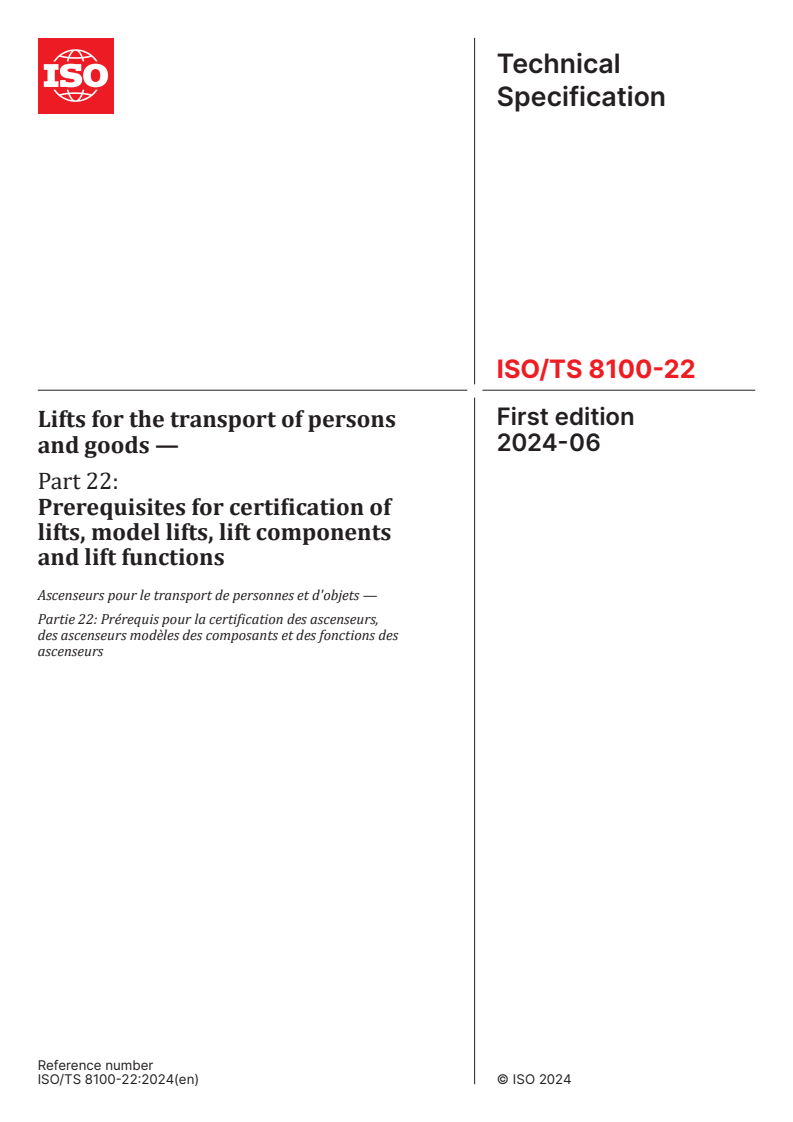
(Main)Lifts for the transport of persons and goods — Part 22: Prerequisites for certification of lifts, model lifts, lift components and lift functions
General Information
- Abstract
This document specifies prerequisite requirements for application for the certification of new lifts (elevators), model lifts, lift components and lift functions. NOTE Hereinafter in this document, the term “lift” is used instead of the term “elevator”.
- Status
- Published
- Publication Date
- 18-Jun-2024
- Technical Committee
- ISO/TC 178 - Lifts, escalators and moving walks
- Drafting Committee
- ISO/TC 178/WG 4 - Safety requirements and risk assessment
- Current Stage
- 6060 - International Standard published
- Start Date
- 19-Jun-2024
- Due Date
- 20-Apr-2025
- Completion Date
- 19-Jun-2024
Overview
ISO/TS 8100-22:2024 is a Technical Specification from ISO that defines prerequisites for certification of new lifts (the document uses the term “lift” instead of “elevator”), model lifts, lift components and lift functions. Published in 2024 as part of the ISO 8100 series, it describes the process applicants must follow before applying for third‑party certification and details the required technical compliance documentation (TCD), risk assessment criteria and implementation of global safety requirements.
Key topics and requirements
- Scope and purpose: Establishes what must be completed before submitting a certification application for lifts, model lifts, lift components or lift functions.
- Process steps (applicant responsibilities):
- Define the object of safety assessment and its safety‑relevant characteristics.
- Identify and implement applicable Global Essential Safety Requirements (GESRs).
- Conduct risk assessment in accordance with ISO 14798 and document results.
- Eliminate or mitigate risks using protective measures and Global Safety Parameters (GSPs) (see ISO/TS 8100-21).
- Produce and submit the Technical Compliance Documentation (TCD) to a Lift Certification Body (LCB).
- Provide representative specimens or installed lifts for assessment; apply marking per Annex A.
- Risk acceptance criteria:
- No risks equivalent to Risk Group I (unacceptable).
- Risks equivalent to Risk Group II require review for additional safeguards.
- Risks at Risk Group III require no further action.
- Technical Compliance Documentation (TCD):
- Must describe design, operation and intended use sufficiently to verify conformity to GESRs.
- For model lifts or ranges, specify all permitted variations and demonstrate similarity (drawings, calculations or descriptions).
- Lifecycle and maintenance: Protective measures must be preserved through the lift life cycle and documented for inspection, testing, rescue, maintenance and repair.
Practical applications and target users
This standard is practical for organizations involved in lift safety, certification and conformity assessment:
- Manufacturers and designers preparing products for certification and market access.
- Installers and authorized representatives responsible for final erection and commissioning.
- Certification bodies (LCBs) and conformity assessors applying ISO/TS 8100-23 certification procedures.
- Suppliers of lift components and functions seeking documented compliance.
- Regulators and asset owners who require documented safety assurance for innovative designs or series‑produced model lifts.
Using ISO/TS 8100-22 supports structured, performance‑based safety assessment and helps streamline certification of novel lift technologies while aligning with quality systems (e.g., ISO 9001).
Related standards
- ISO 8100-20 - Global Essential Safety Requirements (GESRs)
- ISO/TS 8100-21 - Global Safety Parameters (GSPs)
- ISO/TS 8100-23 - Certification procedures for lifts
- ISO 14798 - Risk assessment and reduction methodology
- ISO 9000 / ISO 9001 - Quality management fundamentals
- ISO/IEC 17000 - Conformity assessment vocabulary
Keywords: ISO/TS 8100-22:2024, lifts certification, technical compliance documentation, GESR, GSP, lift components, model lifts, risk assessment, ISO 14798.
Relations
- Effective Date
- 28-Oct-2017
Get Certified
Connect with accredited certification bodies for this standard

BSI Group
BSI (British Standards Institution) is the business standards company that helps organizations make excellence a habit.

Bureau Veritas
Bureau Veritas is a world leader in laboratory testing, inspection and certification services.

DNV
DNV is an independent assurance and risk management provider.
Sponsored listings
Frequently Asked Questions
ISO/TS 8100-22:2024 is a technical specification published by the International Organization for Standardization (ISO). Its full title is "Lifts for the transport of persons and goods — Part 22: Prerequisites for certification of lifts, model lifts, lift components and lift functions". This standard covers: This document specifies prerequisite requirements for application for the certification of new lifts (elevators), model lifts, lift components and lift functions. NOTE Hereinafter in this document, the term “lift” is used instead of the term “elevator”.
This document specifies prerequisite requirements for application for the certification of new lifts (elevators), model lifts, lift components and lift functions. NOTE Hereinafter in this document, the term “lift” is used instead of the term “elevator”.
ISO/TS 8100-22:2024 is classified under the following ICS (International Classification for Standards) categories: 03.120.20 - Product and company certification. Conformity assessment; 91.140.90 - Lifts. Escalators. The ICS classification helps identify the subject area and facilitates finding related standards.
ISO/TS 8100-22:2024 has the following relationships with other standards: It is inter standard links to ISO/TS 22559-3:2011. Understanding these relationships helps ensure you are using the most current and applicable version of the standard.
ISO/TS 8100-22:2024 is available in PDF format for immediate download after purchase. The document can be added to your cart and obtained through the secure checkout process. Digital delivery ensures instant access to the complete standard document.
Standards Content (Sample)
Technical
Specification
ISO/TS 8100-22
First edition
Lifts for the transport of persons
2024-06
and goods —
Part 22:
Prerequisites for certification of
lifts, model lifts, lift components
and lift functions
Ascenseurs pour le transport de personnes et d'objets —
Partie 22: Prérequis pour la certification des ascenseurs,
des ascenseurs modèles des composants et des fonctions des
ascenseurs
Reference number
© ISO 2024
All rights reserved. Unless otherwise specified, or required in the context of its implementation, no part of this publication may
be reproduced or utilized otherwise in any form or by any means, electronic or mechanical, including photocopying, or posting on
the internet or an intranet, without prior written permission. Permission can be requested from either ISO at the address below
or ISO’s member body in the country of the requester.
ISO copyright office
CP 401 • Ch. de Blandonnet 8
CH-1214 Vernier, Geneva
Phone: +41 22 749 01 11
Email: copyright@iso.org
Website: www.iso.org
Published in Switzerland
ii
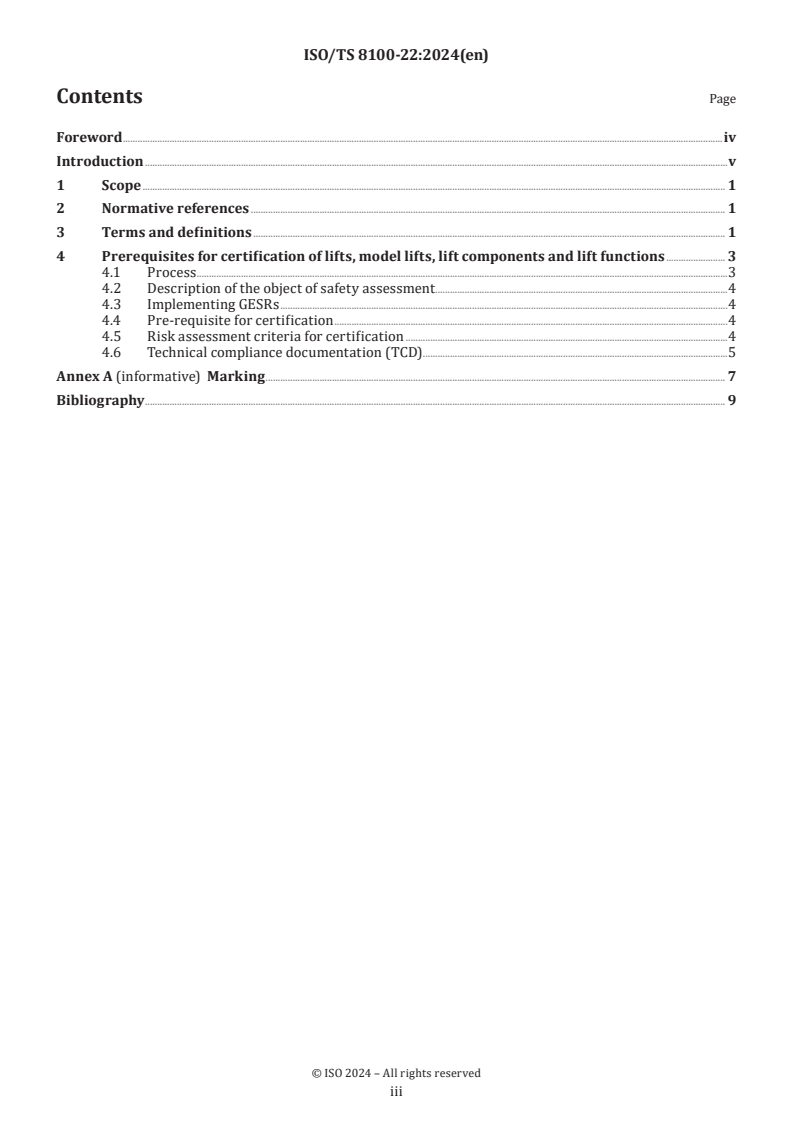
Contents Page
Foreword .iv
Introduction .v
1 Scope . 1
2 Normative references . 1
3 Terms and definitions . 1
4 Prerequisites for certification of lifts, model lifts, lift components and lift functions . 3
4.1 Process .3
4.2 Description of the object of safety assessment .4
4.3 Implementing GESRs .4
4.4 Pre-requisite for certification .4
4.5 Risk assessment criteria for certification .4
4.6 Technical compliance documentation (TCD) .5
Annex A (informative) Marking . 7
Bibliography . 9
iii
Foreword
ISO (the International Organization for Standardization) is a worldwide federation of national standards
bodies (ISO member bodies). The work of preparing International Standards is normally carried out through
ISO technical committees. Each member body interested in a subject for which a technical committee
has been established has the right to be represented on that committee. International organizations,
governmental and non-governmental, in liaison with ISO, also take part in the work. ISO collaborates closely
with the International Electrotechnical Commission (IEC) on all matters of electrotechnical standardization.
The procedures used to develop this document and those intended for its further maintenance are described
in the ISO/IEC Directives, Part 1. In particular, the different approval criteria needed for the different types
of ISO document should be noted. This document was drafted in accordance with the editorial rules of the
ISO/IEC Directives, Part 2 (see www.iso.org/directives).
ISO draws attention to the possibility that the implementation of this document may involve the use of (a)
patent(s). ISO takes no position concerning the evidence, validity or applicability of any claimed patent
rights in respect thereof. As of the date of publication of this document, ISO had not received notice of (a)
patent(s) which may be required to implement this document. However, implementers are cautioned that
this may not represent the latest information, which may be obtained from the patent database available at
www.iso.org/patents. ISO shall not be held responsible for identifying any or all such patent rights.
Any trade name used in this document is information given for the convenience of users and does not
constitute an endorsement.
For an explanation of the voluntary nature of standards, the meaning of ISO specific terms and expressions
related to conformity assessment, as well as information about ISO's adherence to the World Trade
Organization (WTO) principles in the Technical Barriers to Trade (TBT), see www.iso.org/iso/foreword.html.
This document was prepared by Technical Committee ISO/TC 178, Lifts, escalators and moving walks.
This first edition of ISO/TS 8100-22 cancels and replaces ISO/TS 22559-3:2011, which has been technically
revised.
A list of all parts in the ISO 8100 series can be found on the ISO website.
Any feedback or questions on this document should be directed to the user’s national standards body. A
complete listing of these bodies can be found at www.iso.org/members.html.
iv
Introduction
0.1 The objective of the ISO 8100 series of performance-based documents is stated in the Introduction to
ISO 8100-20 and ISO/TS 8100-21.
0.2 ISO 8100-20 has established global essential safety requirements (GESRs) for lifts (elevators) by
addressing hazards and safety risks that may be encountered on a lift (elevator). The GESRs state safety
objectives that a lift (elevator) should achieve.
0.3 ISO/TS 8100-21 sets criteria for achieving conformity with safety requirements of GESRs by specifying
global safety parameters (GSPs) that should be used and implemented, where applicable, in a lift (elevator)
to eliminate hazards or mitigate safety risks addressed in the GESRs.
0.4 This document sets prerequisite requirements that must be fulfilled before applying for certification in
accordance with ISO/TS 8100-23.
0.5 ISO/TS 8100-23 sets procedures for certification of lifts, model lifts, lift components and lift functions,
and supplements related requirements of ISO/IEC 17065 for certification bodies for lifts (LCBs).
0.6 The ISO 8100 series of performance-based documents provides a process for conformity assessment
and certification of lifts, model lifts, lift components and lift functions with the safety requirements specified
in ISO 8100-20. It includes a structured methodology for establishing, documenting and demonstrating that
necessary and appropriate protective measures are taken to eliminate hazards or sufficiently mitigate
risks. This process is particularly useful for establishing safety of lifts, model lifts, lift components and
lift functions involving innovative design or new technologies. If one is using the process, ISO 8100-20,
ISO 8100-21, ISO 8100-22, ISO 8100-23 of the ISO 8100 series should be used.
0.7 This document assumes that the applicant (see 3.1) uses a quality management system, e.g. ISO 9001.
Assessment of conformity to the ISO 8100 series of performance-based documents does not imply conformity
to the quality management system.
v
Technical Specification ISO/TS 8100-22:2024(en)
Lifts for the transport of persons and goods —
Part 22:
Prerequisites for certification of lifts, model lifts, lift
components and lift functions
1 Scope
This document specifies prerequisite requirements for application for the certification of new lifts
(elevators), model lifts, lift components and lift functions.
NOTE Hereinafter in this document, the term “lift” is used instead of the term “elevator”.
2 Normative references
The following documents are referred to in the text in such a way that some or all of their content constitutes
requirements of this document. For dated references, only the edition cited applies. For undated references,
the latest edition of the referenced document (including any amendments) applies.
ISO 8100-20:2018, Lifts for the transport of persons and goods — Part 20: Global essential safety
requirements (GESRs)
ISO/TS 8100-21:2018, Lifts for the transport of persons and goods — Part 21: Global safety parameters (GSPs)
meeting the global essential safety requirements (GESRs)
ISO 9000, Quality management systems — Fundamentals and vocabulary
ISO 14798:2009, Lifts (elevators), escalators and moving walks — Risk assessment and reduction methodology
ISO/IEC 17000:2020, Conformity assessment — Vocabulary and general principles
3 Terms and definitions
For the purposes of this document, the terms and definitions given in ISO 9000, ISO/IEC 17000, ISO 8100-20,
ISO/TS 8100-21 and the following apply.
ISO and IEC maintain terminology databases for use in standardization at the following addresses:
— ISO Online browsing platform: available at https:// www .iso .org/ obp
— IEC Electropedia: available at https:// www .electropedia .org/
3.1
applicant
party that applies for certification of a lift, model lift, lift component or a lift function
Note 1 to entry: An applicant could be the manufacturer or the installer or their authorized representative.
3.2
authorized representative
any natural or legal person established within the country where the lift, model lift, lift component or lift
function will be made available and who has received a written mandate from an installer or a manufacturer
to act on his behalf in relation to specified tasks
3.3
certification
third-party attestation related to an object of conformity assessment, with the exception of accreditation
Note 1 to entry: The object of conformity assessment is a lift, model lift, lift component or a lift function.
[SOURCE: ISO/IEC 17000:2020, 7.6, modified — Note to entry was added]
3.4
designer
person or organization involved in the development of a specific design or function taking into account the
relevant functional and safety aspects
3.5
certification body
third-party conformity assessment body operating certification schemes
Note 1 to entry: Where the term “certification body” is used in ISO/IEC 17065, it shall be understood to mean
certification body for lifts (LCB) in this document (see ISO/TS 8100-23:2024, Clauses 5 and 6).
Note 2 to entry: The LCB performs conformity assessment and certification activities for lifts, model lifts, lift
components and lift functions.
Note 3 to entry: A certification body, accredited in accordance with ISO/TS 8100-23 for this activity by a Multilateral
Recognition Agreement (MLA) member of the International Accreditation Forum (IAF) would normally be assumed to
meet the requirements of an LCB.
[SOURCE: ISO/IEC 17065:2012, 3.12, modified — Note to entry has been replaced.]
3.7
global essential safety requirement GESR
globally agreed upon essential safety requirement
[SOURCE: ISO 8100-20:2018, 3.9]
3.8
global safety parameter GSP
globally agreed upon safety parameter
[SOURCE: ISO/TS 8100-21:2018, 3.10]
3.9
installer
legal or natural person taking responsibility to erect and commission the lift at its final location
3.10
life cycle
period of usage of a lift, lift component or lift function
3.11
lift component
element or part contributing to the composition of the lift
3.12
lift function
mode of action by which a lift, model lift or lift component fulfils its purpose
3.13
manufacturer
organization that takes responsibility for the design and manufacture of the lift, model lift, lift component or
lift function
...