


ISO/IEC 18000-2:2009
(Main)Information technology — Radio frequency identification for item management — Part 2: Parameters for air interface communications below 135 kHz
Information technology — Radio frequency identification for item management — Part 2: Parameters for air interface communications below 135 kHz
ISO/IEC 18000-2:2009 defines the air interface for radio frequency identification (RFID) devices operating below 135 kHz. The purpose of ISO/IEC 18000-2:2009 is to provide a common technical specification for RFID devices that can be used by ISO committees developing RFID application standards. ISO/IEC 18000-2:2009 is intended to allow for compatibility and to encourage inter-operability of products in the international marketplace. ISO/IEC 18000-2:2009 defines the physical layer used for communication between the interrogator and the tag and further defines the communications protocol used in the air interface. Two types of tag are defined by ISO/IEC 18000-2:2009: Type A and Type B, which differ only by their physical layer. Both support the same inventory (anti-collision) and protocol. Type A tags are permanently powered by the interrogator, including during the tag-to-interrogator transmission, and operate at 125 kHz. Type B tags are powered by the interrogator, except during the tag-to-interrogator transmission, and operate at 125 kHz or 134,2 kHz.
Technologies de l'information — Identification par radiofréquence (RFID) pour la gestion d'objets — Partie 2: Paramètres de communications d'une interface d'air à moins de 135 kHz
General Information
- Status
- Published
- Publication Date
- 29-Sep-2009
- Technical Committee
- ISO/IEC JTC 1/SC 31 - Automatic identification and data capture techniques
- Drafting Committee
- ISO/IEC JTC 1/SC 31/WG 4 - Radio communications
- Current Stage
- 9093 - International Standard confirmed
- Start Date
- 15-Dec-2022
- Completion Date
- 12-Feb-2026
Relations
- Effective Date
- 09-Feb-2026
- Effective Date
- 15-Apr-2008
Overview
ISO/IEC 18000-2:2009 specifies the air‑interface parameters for low‑frequency RFID systems used for item management - i.e., radio frequency identification (RFID) communications below 135 kHz. The standard defines the physical layer and the air‑interface protocol for interrogator (reader) and tag interactions to promote compatibility and interoperability of LF RFID products in international markets.
Key points:
- Covers RFID operation at 125 kHz and 134.2 kHz
- Defines two tag types: Type A (FDX) and Type B (HDX), differing only by physical layer
- Specifies power transfer modes, modulation, timing, anti‑collision (inventory) and command structures
Key topics and technical requirements
- Physical layer: Detailed parameters for Type A and Type B tags including power transfer, frequency, interrogator‑to‑tag and tag‑to‑interrogator signaling.
- Power behaviour: Type A tags are continuously powered by the interrogator (including during tag responses); Type B tags are powered except while transmitting back.
- Transmission protocol & MAC: Frame formats (SOF/EOF), CRC checks, timing, MAC parameters and collision‑avoidance (inventory/anti‑collision) mechanisms.
- Commands and services: Mandatory and optional commands such as INVENTORY, READ UII, READ/WRITE BLOCK(S), STAY QUIET, LOCK BLOCK, plus provisions for custom/proprietary commands.
- Tag memory & identifiers: User memory organization, UII (Unique Item Identifier), AFI (Application Family Identifier), DSFID and block security status.
- Conformance & safety: Sections on RF emissions, general population limits, and healthcare settings (emissions and susceptibility).
Applications and practical use
ISO/IEC 18000-2:2009 is suitable for implementation and procurement of low‑frequency (LF) RFID systems in item management applications that require robust near‑field performance and simple tag form factors. Typical uses include:
- Asset and inventory tracking in manufacturing and logistics
- Access control and identification systems where LF read range and penetration are advantageous
- Library, retail and stock‑room item identification
- Environments with metal/liquid proximity where HF/UHF are less reliable
This standard helps system designers, RFID device manufacturers, integrators and test labs ensure interoperability between readers and passive LF tags.
Who should use this standard
- RFID hardware manufacturers (tags, readers)
- System integrators and solution architects
- Standards committees and procurement/spec writers
- Test and certification laboratories
Related standards
- ISO/IEC 18000 series (other parts define HF/UHF air interfaces and parameters)
- Complementary application standards that reference ISO/IEC 18000‑2 for LF air‑interface requirements
Keywords: ISO/IEC 18000-2:2009, RFID, air interface, below 135 kHz, 125 kHz, 134.2 kHz, Type A, Type B, anti-collision, inventory, UII, AFI, LF RFID.
Get Certified
Connect with accredited certification bodies for this standard

BSI Group
BSI (British Standards Institution) is the business standards company that helps organizations make excellence a habit.

NYCE
Mexican standards and certification body.
Sponsored listings
Frequently Asked Questions
ISO/IEC 18000-2:2009 is a standard published by the International Organization for Standardization (ISO). Its full title is "Information technology — Radio frequency identification for item management — Part 2: Parameters for air interface communications below 135 kHz". This standard covers: ISO/IEC 18000-2:2009 defines the air interface for radio frequency identification (RFID) devices operating below 135 kHz. The purpose of ISO/IEC 18000-2:2009 is to provide a common technical specification for RFID devices that can be used by ISO committees developing RFID application standards. ISO/IEC 18000-2:2009 is intended to allow for compatibility and to encourage inter-operability of products in the international marketplace. ISO/IEC 18000-2:2009 defines the physical layer used for communication between the interrogator and the tag and further defines the communications protocol used in the air interface. Two types of tag are defined by ISO/IEC 18000-2:2009: Type A and Type B, which differ only by their physical layer. Both support the same inventory (anti-collision) and protocol. Type A tags are permanently powered by the interrogator, including during the tag-to-interrogator transmission, and operate at 125 kHz. Type B tags are powered by the interrogator, except during the tag-to-interrogator transmission, and operate at 125 kHz or 134,2 kHz.
ISO/IEC 18000-2:2009 defines the air interface for radio frequency identification (RFID) devices operating below 135 kHz. The purpose of ISO/IEC 18000-2:2009 is to provide a common technical specification for RFID devices that can be used by ISO committees developing RFID application standards. ISO/IEC 18000-2:2009 is intended to allow for compatibility and to encourage inter-operability of products in the international marketplace. ISO/IEC 18000-2:2009 defines the physical layer used for communication between the interrogator and the tag and further defines the communications protocol used in the air interface. Two types of tag are defined by ISO/IEC 18000-2:2009: Type A and Type B, which differ only by their physical layer. Both support the same inventory (anti-collision) and protocol. Type A tags are permanently powered by the interrogator, including during the tag-to-interrogator transmission, and operate at 125 kHz. Type B tags are powered by the interrogator, except during the tag-to-interrogator transmission, and operate at 125 kHz or 134,2 kHz.
ISO/IEC 18000-2:2009 is classified under the following ICS (International Classification for Standards) categories: 35.040 - Information coding; 35.040.50 - Automatic identification and data capture techniques. The ICS classification helps identify the subject area and facilitates finding related standards.
ISO/IEC 18000-2:2009 has the following relationships with other standards: It is inter standard links to CEN/TS 17402:2020, ISO/IEC 18000-2:2004. Understanding these relationships helps ensure you are using the most current and applicable version of the standard.
ISO/IEC 18000-2:2009 is available in PDF format for immediate download after purchase. The document can be added to your cart and obtained through the secure checkout process. Digital delivery ensures instant access to the complete standard document.
Standards Content (Sample)
INTERNATIONAL ISO/IEC
STANDARD 18000-2
Second edition
2009-10-01
Information technology — Radio
frequency identification for item
management —
Part 2:
Parameters for air interface
communications below 135 kHz
Technologies de l'information — Identification par radiofréquence
(RFID) pour la gestion d'objets —
Partie 2: Paramètres de communications d'une interface d'air à moins
de 135 kHz
Reference number
©
ISO/IEC 2009
PDF disclaimer
This PDF file may contain embedded typefaces. In accordance with Adobe's licensing policy, this file may be printed or viewed but
shall not be edited unless the typefaces which are embedded are licensed to and installed on the computer performing the editing. In
downloading this file, parties accept therein the responsibility of not infringing Adobe's licensing policy. The ISO Central Secretariat
accepts no liability in this area.
Adobe is a trademark of Adobe Systems Incorporated.
Details of the software products used to create this PDF file can be found in the General Info relative to the file; the PDF-creation
parameters were optimized for printing. Every care has been taken to ensure that the file is suitable for use by ISO member bodies. In
the unlikely event that a problem relating to it is found, please inform the Central Secretariat at the address given below.
© ISO/IEC 2009
All rights reserved. Unless otherwise specified, no part of this publication may be reproduced or utilized in any form or by any means,
electronic or mechanical, including photocopying and microfilm, without permission in writing from either ISO at the address below or
ISO's member body in the country of the requester.
ISO copyright office
Case postale 56 • CH-1211 Geneva 20
Tel. + 41 22 749 01 11
Fax + 41 22 749 09 47
E-mail copyright@iso.org
Web www.iso.org
Published in Switzerland
ii © ISO/IEC 2009 – All rights reserved
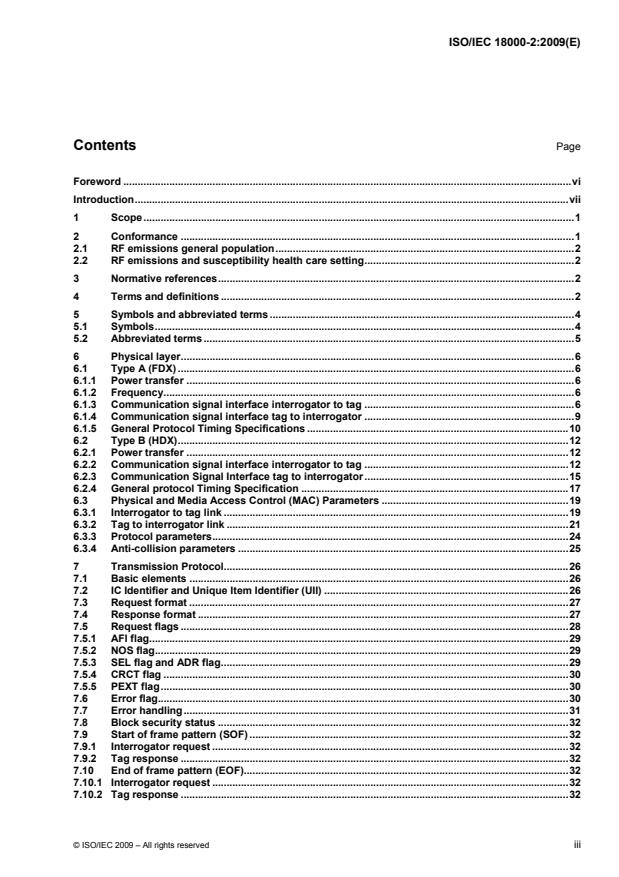
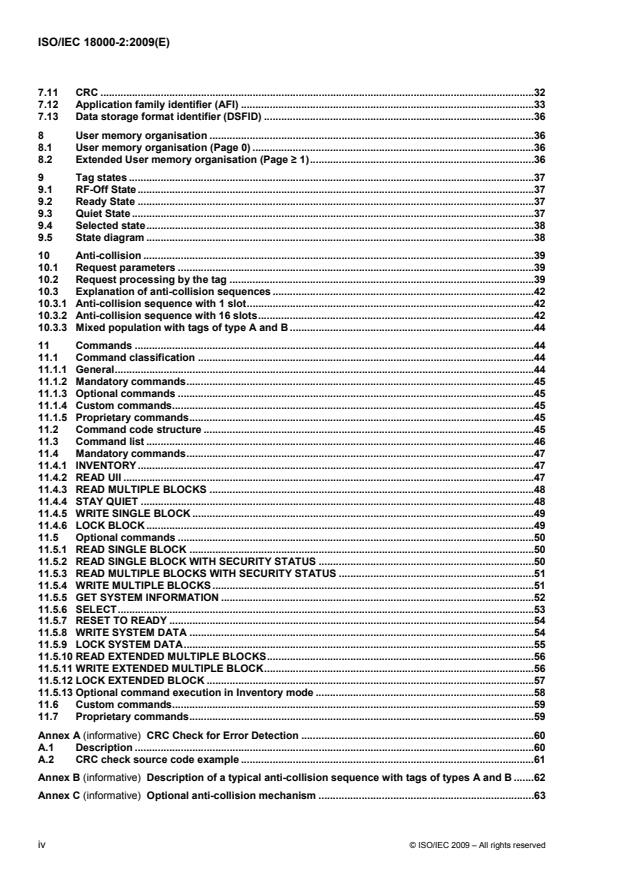
Contents Page
Foreword .vi
Introduction.vii
1 Scope.1
2 Conformance .1
2.1 RF emissions general population.2
2.2 RF emissions and susceptibility health care setting.2
3 Normative references.2
4 Terms and definitions .2
5 Symbols and abbreviated terms .4
5.1 Symbols.4
5.2 Abbreviated terms.5
6 Physical layer.6
6.1 Type A (FDX).6
6.1.1 Power transfer.6
6.1.2 Frequency.6
6.1.3 Communication signal interface interrogator to tag .6
6.1.4 Communication signal interface tag to interrogator .9
6.1.5 General Protocol Timing Specifications .10
6.2 Type B (HDX).12
6.2.1 Power transfer.12
6.2.2 Communication signal interface interrogator to tag .12
6.2.3 Communication Signal Interface tag to interrogator .15
6.2.4 General protocol Timing Specification .17
6.3 Physical and Media Access Control (MAC) Parameters .19
6.3.1 Interrogator to tag link .19
6.3.2 Tag to interrogator link .21
6.3.3 Protocol parameters.24
6.3.4 Anti-collision parameters.25
7 Transmission Protocol.26
7.1 Basic elements.26
7.2 IC Identifier and Unique Item Identifier (UII) .26
7.3 Request format.27
7.4 Response format.27
7.5 Request flags.28
7.5.1 AFI flag.29
7.5.2 NOS flag.29
7.5.3 SEL flag and ADR flag.29
7.5.4 CRCT flag.30
7.5.5 PEXT flag.30
7.6 Error flag.30
7.7 Error handling.31
7.8 Block security status .32
7.9 Start of frame pattern (SOF) .32
7.9.1 Interrogator request.32
7.9.2 Tag response.32
7.10 End of frame pattern (EOF).32
7.10.1 Interrogator request.32
7.10.2 Tag response.32
© ISO/IEC 2009 – All rights reserved iii
7.11 CRC.32
7.12 Application family identifier (AFI) .33
7.13 Data storage format identifier (DSFID) .36
8 User memory organisation .36
8.1 User memory organisation (Page 0) .36
8.2 Extended User memory organisation (Page ≥ 1).36
9 Tag states.37
9.1 RF-Off State.37
9.2 Ready State.37
9.3 Quiet State.37
9.4 Selected state.38
9.5 State diagram.38
10 Anti-collision.39
10.1 Request parameters .39
10.2 Request processing by the tag .39
10.3 Explanation of anti-collision sequences .42
10.3.1 Anti-collision sequence with 1 slot.42
10.3.2 Anti-collision sequence with 16 slots.42
10.3.3 Mixed population with tags of type A and B .44
11 Commands .44
11.1 Command classification .44
11.1.1 General.44
11.1.2 Mandatory commands.45
11.1.3 Optional commands .45
11.1.4 Custom commands.45
11.1.5 Proprietary commands.45
11.2 Command code structure .45
11.3 Command list .46
11.4 Mandatory commands.47
11.4.1 INVENTORY.47
11.4.2 READ UII.47
11.4.3 READ MULTIPLE BLOCKS .48
11.4.4 STAY QUIET.48
11.4.5 WRITE SINGLE BLOCK .49
11.4.6 LOCK BLOCK.49
11.5 Optional commands .50
11.5.1 READ SINGLE BLOCK.50
11.5.2 READ SINGLE BLOCK WITH SECURITY STATUS .50
11.5.3 READ MULTIPLE BLOCKS WITH SECURITY STATUS .51
11.5.4 WRITE MULTIPLE BLOCKS.51
11.5.5 GET SYSTEM INFORMATION .52
11.5.6 SELECT.53
11.5.7 RESET TO READY .54
11.5.8 WRITE SYSTEM DATA .54
11.5.9 LOCK SYSTEM DATA.55
11.5.10 READ EXTENDED MULTIPLE BLOCKS.56
11.5.11 WRITE EXTENDED MULTIPLE BLOCK.56
11.5.12 LOCK EXTENDED BLOCK .57
11.5.13 Optional command execution in Inventory mode .58
11.6 Custom commands.59
11.7 Proprietary commands.59
Annex A (informative) CRC Check for Error Detection .60
A.1 Description.60
A.2 CRC check source code example .61
Annex B (informative) Description of a typical anti-collision sequence with tags of types A and B .62
Annex C (informative) Optional anti-collision mechanism .63
iv © ISO/IEC 2009 – All rights reserved
C.1 Introduction.63
C.2 Description.63
C.3 Physical layer for the Multi-read command.63
C.3.1 Power transfer.64
C.3.2 Frequency.64
C.3.3 Interrogator to tag .64
C.3.4 Tag to interrogator .64
C.3.5 Parameters for optional Multi-read command.65
C.4 Multi-read command .68
C.4.1 Multi-read request format .68
C.4.2 Request flags .69
C.5 Anti-collision mechanism.70
C.5.1 Acknowledgement by the interrogator.70
C.5.2 Acknowledgement by the tag.70
C.5.3 Timing.70
C.5.4 Explanation of an anti-collision sequence.71
C.6 Protocol and anti-collision Parameters.76
C.6.1 Protocol Parameters.76
C.6.2 Anti-collision Protocol .78
Bibliography.79
© ISO/IEC 2009 – All rights reserved v
Foreword
ISO (the International Organization for Standardization) and IEC (the International Electrotechnical
Commission) form the specialized system for worldwide standardization. National bodies that are members of
ISO or IEC participate in the development of International Standards through technical committees
established by the respective organization to deal with particular fields of technical activity. ISO and IEC
technical committees collaborate in fields of mutual interest. Other international organizations, governmental
and non-governmental, in liaison with ISO and IEC, also take part in the work. In the field of information
technology, ISO and IEC have established a joint technical committee, ISO/IEC JTC 1.
International Standards are drafted in accordance with the rules given in the ISO/IEC Directives, Part 2.
The main task of the joint technical committee is to prepare International Standards. Draft International
Standards adopted by the joint technical committee are circulated to national bodies for voting. Publication as
an International Standard requires approval by at least 75 % of the national bodies casting a vote.
ISO/IEC 18000-2 was prepared by Joint Technical Committee ISO/IEC JTC 1, Information technology,
Subcommittee SC 31, Automatic identification and data capture techniques.
This second edition cancels and replaces the first edition (ISO/IEC 18000-2:2004), which has been technically
revised.
ISO/IEC 18000 consists of the following parts, under the general title Information technology — Radio
frequency identification for item management:
⎯ Part 1: Reference architecture and definition of parameters to be standardized
⎯ Part 2: Parameters for air interface communications below 135 kHz
⎯ Part 3: Parameters for air interface communications at 13,56 MHz
⎯ Part 4: Parameters for air interface communications at 2,45 GHz
⎯ Part 6: Parameters for air interface communications at 860 MHz to 960 MHz
⎯ Part 7: Parameters for active air interface communications at 433 MHz
vi © ISO/IEC 2009 – All rights reserved
Introduction
The International Organization for Standardization (ISO) and International Electrotechnical Commission (IEC)
draw attention to the fact that it is claimed that compliance with this document may involve the use of patents.
ISO and IEC take no position concerning the evidence, validity and scope of these patent rights.
The holders of these patent rights have assured ISO and IEC that they are willing to negotiate licences under
reasonable and non-discriminatory terms and conditions with applicants throughout the world. In this respect,
the statements of the holders of these patent rights are registered with ISO and IEC. Information may be
obtained from the following companies.
Patent number Patent title Patent Contact Affected
holder sub clause
Leo Merken, Director of Intellectual
Property
2325 Orchard Parkway, San Jose, CA,
ATMEL
95131 USA
Germany
GmbH Phone 408-436-4251
Fax 408-487-2615
Email leo.merken@atmel.com
Harald Roeggla, Intellectual Property &
Licensing
Gutheil-Schoder-Gasse 8-12
1102 Vienna, Austria
NXP B.V.
Phone 43-1-60-970-1469
Fax 43-1-60-870-1101
harald.roeggla@nxp.com
US 6 177 858
Application 96
402556.3-Patent
EP 0 777 194
CA 2 191 787
Craig Cook, director
CA 2 191 788
12, rue des Petits Ruisseaux, 91370
US 5 923 251
Verrières le Buisson, France
Winstead
Application 96
Assets Ltd Phone +33(0) 169 752 170
402554.8 Patent
EP 0 777 192
Fax +33(0) 160 110 031
US 5 808 550
contact@spacecode-rfid.com
Appication 96
402555.5- Patent
EP 0 777 193
© ISO/IEC 2009 – All rights reserved vii
CA 2 191 794
Application 90
909459.1-Patent
EP 0 476 026
US 5426423
CA 2058 947
EP 0640939,US
5430447,DE
P69428309
Protection Against
Manipulation of Batteryless
Read/Write Transponders
EP831618,
US5929801
(claims 1-15 and
Method for Repeating
corresponding
Interrogations Until Failing
claims of other
to Receive Unintelligible
patents based on
Responses to Identify
Robby Holland
this patent)
Plurality of Transponders
Licensing Manager, Law Department
by an Interrogator
P.o. Box 660199, MS 3999
Texas
Dallas, TX 75266-0199
Instruments Inc
Phone 1-972-917-4367
Fax 1-972-917-4418
US 5793324
Email r-holland3@ti.com
Transponder Signal
Collision Avoidance
System
US 5053774
excluding claims
14-17 and 20 (and
corresponding
Transponder Arrangement
claims of other
patents based on
this patent)
Attention is drawn to the possibility that some of the elements of this document may be the subject of patent
rights other than those identified above. ISO and IEC shall not be held responsible for identifying any or all
such patent rights.
viii © ISO/IEC 2009 – All rights reserved
INTERNATIONAL STANDARD ISO/IEC 18000-2:2009(E)
Information technology — Radio frequency identification for
item management —
Part 2:
Parameters for air interface communications below 135 kHz
1 Scope
This part of ISO/IEC 18000 defines the air interface for radio frequency identification (RFID) devices operating
below 135 kHz. The purpose of this part of ISO/IEC 18000 is to provide a common technical specification for
RFID devices that can be used by ISO committees developing RFID application standards. This part of
ISO/IEC 18000 is intended to allow for compatibility and to encourage inter-operability of products in the
international marketplace. This part of ISO/IEC 18000 defines the physical layer used for communication
between the interrogator and the tag and further defines the communications protocol used in the air interface.
Two types of tag are defined by this part of ISO/IEC 18000: Type A and Type B, which differ only by their
physical layer. Both support the same inventory (anti-collision) and protocol.
Type A tags are permanently powered by the interrogator, including during the tag-to-interrogator transmission,
and operate at 125 kHz.
Type B tags are powered by the interrogator, except during the tag-to-interrogator transmission, and operate
at 125 kHz or 134,2 kHz.
2 Conformance
In order to claim conformance, it is necessary to comply to all of the relevant clauses of this specification,
except those marked ‘optional’. It is also necessary to operate within the local national radio regulations
(which may require further restrictions).
The rules for RFID device conformity evaluation are defined in ISO/IEC TR 18047-2.
The tag shall be of either Type A or B.
NOTE Nothing in this International Standard prevents a tag from being of both types, although for technical reasons,
it is unlikely that such tags are ever marketed.
The interrogator shall support both Types A and B.
The interrogator may be configured as Type A only, Type B only or Types A and B.
When configured as Types A and B, and when in the Inventory phase, the interrogator shall alternate between
Type A and Type B interrogation. See Annex B.
© ISO/IEC 2009 – All rights reserved 1
2.1 RF emissions general population
Device manufacturers claiming conformance to this part of ISO/IEC 18000 shall certify that RF emissions do
not exceed the maximum permitted exposure limits recommended by either IEEE C95.1:2005 or ICNIRP
according to IEC 62369-1. If a device manufacturer is unsure as to which recommendation is to be cited for
compliance, the manufacturer shall certify to ICNIRP limits.
2.2 RF emissions and susceptibility health care setting
Device manufacturers claiming conformance to this part of ISO/IEC 18000 shall certify that RF emissions and
susceptibility comply with IEC 60601-1-2.
3 Normative references
The following referenced documents are indispensable for the application of this document. For dated
references, only the edition cited applies. For undated references, the latest edition of the referenced
document (including any amendments) applies.
IEC 62369-1, Evaluation of human exposure to electromagnetic fields from short range devices (SRDs) in
various applications over the frequency range 0 GHz to 300 GHz — Part 1: Fields produced by devices used
for electronic article surveillance, radio frequency identification and similar systems
IEC 60601-1-2, Medical electrical equipment — Part 1-2: General requirements for basic safety and essential
performance — Collateral standard: Electromagnetic compatibility — Requirements and tests
ISO/IEC 19762 (all parts), Information technology — Automatic identification and data capture (AIDC)
techniques — Harmonized vocabulary
4 Terms and definitions
For the purposes of this document, the terms and definitions given in ISO/IEC 19762 (all parts) and the
following apply.
4.1
anti-collision sequence
algorithm used to prepare for and handle a dialogue between interrogator and one or more tags out of several
in its energizing field
4.2
bit rate
number of bits transmitted per second
4.3
byte
8 bits of data designated b1 to b8, from the most significant bit (MSB, b8) to the least significant bit (LSB, b1)
4.4
carrier off time
time interval when the interrogation field is switched off
4.5
charge up time
time to charge the capacitor of the HDX tag
4.6
commands
interrogator to tag communication
2 © ISO/IEC 2009 – All rights reserved
4.7
differential bi-phase encoding
method of encoding in which data bit 0 is represented by a mid-bit transition, data bit 1 is represented by no
transition, and in which there is always a transition in between two bits
4.8
down-link
communication process from the interrogator to the tag
4.9
encoding
one-to-one relationship between basic information elements and modulation patterns
4.10
FDX
communication protocol for Type A or FDX tags
4.11
frequency shift keying
form of frequency modulation in which binary information is superimposed onto an electromagnetic field
carrier by shifting between discrete frequencies of the field
4.12
full duplex
communication protocol in which information is exchanged while the interrogator transmits the interrogation
field
4.13
half duplex
communication protocol in which information is exchanged after the interrogator has stopped transmitting the
interrogation field (sequential method)
4.14
HDX
communication protocol for Type B or HDX tags
4.15
interrogation field
magnetic field generated by an interrogator to activate a tag and to transfer data to an advanced tag
4.16
interrogation frequency
frequency of the magnetic field generated by the interrogator
4.17
interrogation period
time duration the magnetic field is present
4.18
interrogator request
bit pattern transmitted to the advanced tag to modify the tag status or to read and write information
4.19
manchester encoding
method of encoding in which data bit 0 is represented by a positive mid-bit transition and data bit 1 is
represented by a negative mid-bit transition
© ISO/IEC 2009 – All rights reserved 3
4.20
modulation
method of superimposing information onto an interrogation field by means of varying a specific parameter of
the field
4.21
non-return to zero encoding
method of encoding in which data bit 1 is a high signal and data bit 0 is a low signal
4.22
pulse interval encoding
method of data encoding in which the transmitted information is represented by the time between the falling
edges of fixed length pulses
NOTE The number of received carrier cycles defines data bit values or other code conditions.
4.23
interrogator
device used to communicate with a tag
4.24
tag
electronic device which is activated by the interrogator and communicates with it
4.25
unique item identifier
identification that uniquely identifies a specific entity during its life
5 Symbols and abbreviated terms
5.1 Symbols
NOTE All symbols are expressed with a letter, followed by an upper case letter (A or B or C when referring
respectively to Type A or Type B or Annex C, p when referring to the protocol), followed by letters and/or numbers, as
appropriate. The main symbols are listed below, where X represents A or B or C. Timings are expressed with an upper
case T and according to the above rule. Other symbols specific to A, B or C are specified in the relevant clauses.
f Carrier frequency of the operating field
Xc
T Period of Data Symbol "0"
Xd0
T Period of Data Symbol "1"
Xd1
T Period of carrier frequency (T = 1/f )
Xc Xc Xc
T Code Violation Duration
Xcv
T Tag wait time before transmitting response after end of frame
Apx
T Modulation Coding Time where T = 32 / f
Ad
Ad Ac
etu elementary time unit (1 etu = 16/62,5 kHz)
4 © ISO/IEC 2009 – All rights reserved
5.2 Abbreviated terms
AFI application family identifier
ASK amplitude shift keying
BSS block security status
BWP block write protection
CRC cyclic redundancy check
CRCT response cyclic redundancy check flag
DSFID data storage format identifier
EOF end of frame (pattern)
FDX full duplex – Type A tag
HDX half duplex – Type B tag
ICR IC reference number
kbps unit for transmission speed: 1000 bit/s or 1000 Baud
LSB least significant bit
MFC manufacturer code
MSB most significant bit
MSN manufacturer serial number
NOB number of blocks-1
NOS number of slots (in the anti-collision mode)
NRZ non return to zero
RF radio frequency
RFID radio frequency identification
RFU reserved for future use
SOF start of frame (pattern)
UII unique item identifier (includes ICR, MFC and MSN)
UMS user data memory structure
© ISO/IEC 2009 – All rights reserved 5
6 Physical layer
6.1 Type A (FDX)
6.1.1 Power transfer
Power transfer to the tag is accomplished by radio frequency via coupling antennas in the tag and in the
interrogator. The RF operating field supplies permanently power from the interrogator to the FDX tag. For
communication between interrogator and tag, the field is modulated.
6.1.2 Frequency
The carrier frequency of the RF operating field is f = 125 ±0,1 kHz.
Ac
6.1.3 Communication signal interface interrogator to tag
6.1.3.1 Modulation
Communications between interrogator and tag takes place using ASK modulation with a modulation index of
100%.
T
A1
T T
A2 A3
y
a
x b
envelope of interrogation field
Figure 1 — Modulation details of data transmission from interrogator to tag
Table 1 — Modulation coding times
Min Max
m = (a-b)/(a+b) 90 % 100 %
T 4 * T 10 * T
A1 Ac Ac
T 0 0,5 * T
A2 A1
T 0 0,5 * T
A3 Ad0
x 0 0,05 * a
y 0 0,05 * a
Notes:
T +T +3*T
A1 A3 c Ad0
T = 1/f = 8µs
Ac Ac
6 © ISO/IEC 2009 – All rights reserved
6.1.3.2 Data rate and data coding
The interrogator-to-tag communication uses Pulse Interval Encoding (Figure 2). The interrogator creates
pulses by switching the carrier as described in Figure 1. The time between the falling edges of the pulses
determines either the value of the data bit "0" and "1", a Code violation or a Stop condition.( note: with equal
distributed data bits "0" and "1", the data rate is in the range of 5,1 kbps). Data coding Times are shown in
Table 2.
TAd0
Carrier ON
Data “0”
Carrier OFF
TAp
TAd1
Carrier ON
Data “1”
Carrier OFF
TAp
TACV
Carrier ON
Code
Violation
Carrier OFF
TAp
Data “0”
TASC
Carrier ON
Stop
condition
Carrier OFF
TAp
Figure 2 — Interrogator to tag: Pulse interval encoding
Table 2 — Data coding Times
Meaning Symbol
min max
"Carrier off" time T 4 * T 10 * T
Ap Ac Ac
Data "0" time T 18 * T 22 * T
Ad0 Ac Ac
Data "1" time T 26 * T 30 * T
Ad1 Ac Ac
"Code violation" time T 34 * T 38 * T
Acv Ac Ac
"Stop condition" time T n/a
≥ 42 * T
Asc Ac
NOTE T =1/f = 8 µs.
Ac Ac
© ISO/IEC 2009 – All rights reserved 7
6.1.3.3 Start of frame pattern
The interrogator request starts always with a Start of frame pattern (SOF) for ease of synchronization. The
SOF pattern consists of a data bit "0" pattern and a "Code violation" pattern.
Data “0” “Code violation
TAd0 TAcv
Carrier ON
Carrier OFF
TAp
TAp TAp
SOF
Figure 3 — Start of frame pattern
The tag shall be ready to receive a SOF from the interrogator within 1,2 ms after having sent a response to
the interrogator.
The tag shall be ready to receive a SOF from the interrogator within 2,5 ms after the interrogator has
established the powering field.
6.1.3.4 End of frame pattern
For slot switching during a multi-slot anti-collision sequence, the interrogator request is an EOF pattern. The
EOF pattern is represented by a "Stop condition".
Figure 4 — End of frame pattern
8 © ISO/IEC 2009 – All rights reserved
6.1.4 Communication signal interface tag to interrogator
6.1.4.1 Data rate and data coding
The tag shall communicate with the interrogator via an inductive coupling, where the interrogator carrier is
load modulated as follows:
- 1/T Manchester coded data signal of the tag response
Ad
- 1/(2*T ) dual pattern data coding when responding within the INVENTORY process
Ad
Where T = 32 / f and f is the carrier frequency of the operating field
Ad Ac Ac
NOTE: The slower data rate used during the inventory process allows for improving the collision detection when several
tags are present in the interrogator field, especially if some tags are in the near field and others in the far field.
International Standard
Data Element Inventory command
command
T
T T
Ad
Ad Ad
load off
load off
Data "0"
load on
load on
T T T
Ad Ad Ad
load off load off
Data "1"
load on load on
Figure 5 — Tag to interrogator: load modulation coding
6.1.4.2 Start of frame pattern
The tag response starts always with a Start of frame (SOF) pattern. The SOF pattern is a Manchester coded
bit sequence of "110".
Data “1” Data “1” Data “0”
T
T T
Ad Ad Ad
load off
load on
Figure 6 — Start of frame pattern
6.1.4.3 End of frame pattern
A specific EOF pattern is neither used nor specified for the FDX tag response. An EOF is detected by the
interrogator if there is no load modulation for more than two data bit periods (T ).
Ad
© ISO/IEC 2009 – All rights reserved 9
6.1.5 General Protocol Timing Specifications
For write like requests where an erase and or programming operation is required, the tag shall return its response when it
has completed the write/lock operation and latest either after 20 ms upon detection of the last falling edge of the
interrogator request.
T is not applicable for write like requests.
AP1
6.1.5.1 Waiting Time before Transmitting its Response after an EOF from the Interrogator
When the FDX tag has detected an EOF of a valid interrogator request or when this EOF is in the normal
sequence of a valid interrogator request, it shall wait for a time T before starting to transmit its response to
Ap1
an interrogator request or when switching to the next slot in an inventory process.
T starts from the detection of the falling edge of the EOF received from the interrogator.
Ap1
NOTE The synchronisation on the falling edge of the interrogator to tag EOF is needed to ensure the required
synchronisation of the tag responses.
Request Request (or EOF)
Carrier on
Transceiver
Carrier off
T
T T
Ap2
Ap1
ANRT
Load off
Transponder
Load on
Response
Figure 7 — FDX - General Protocol Timing Diagram
The minimum value of T is T = 204 T
Ap1 Ap1min Ac
The typical value of T is T = 209 T
Ap1 Ap1typ Ac
The maximum value of T is T = 213 T
Ap1 Ap1max Ac
If the FDX tag detects a carrier modulation during this time T , it shall reset its T timer and wait for a
Ap1 Ap1
further time T before starting to transmit its response to an interrogator request or to switch to the next slot
Ap1
when in an inventory process.
6.1.5.2 Interrogator Waiting Time before Sending a Subsequent Request
a) When the interrogator has received a tag response to a previous request other than INVENTORY and
QUIET, it shall wait a time T before sending a subsequent request. T starts from the time the last bit
Ap2 Ap2
has been received from the tag.
b) When the interrogator has sent a QUIET request (which causes no tag response), it shall wait a time T
Ap2
before sending a subsequent request. T starts from the end of the QUIET request’s EOF (falling edge
Ap2
of EOF pulse + 42 T ).
Ac
The minimum value of T is T = 150 T . It ensures that the tags are ready to receive a subsequent
Ap2 Ap2min Ac
request.
NOTE The interrogator should wait at least 2.5 ms after it has activated the electromagnetic field before sending the
first request, to ensure that the tag(s) are ready to receive a request.
c) When the interrogator has sent an inventory request, it is in an inventory process. See the subsequent
clause 6.1.5.3.
10 © ISO/IEC 2009 – All rights reserved
6.1.5.3 Interrogator Waiting Time Before Switching to Next Inventory Slot
An inventory process is started when the interrogator sends an inventory request.
To switch to the next slot, the interrogator sends an EOF after waiting a time specified in the following sub-
clauses.
6.1.5.4 Interrogator Started to Receive One or More FDX Tag Responses
During an inventory process, when the interrogator has started to receive one or more tag responses (i.e. it
has detected a tag SOF and/or a collision), it shall
• wait for the complete reception of the tag responses (i.e. when a tag’s last bit has been received or when
the tag nominal response time T has elapsed),
ANRT
• wait an additional time T and then send an EOF to switch to the next slot, if a 16 slot anti-collision
Ap2
request is processed, or send a subsequent request (which could be again an inventory request).
T starts from the time the last bit has been received from the tag.
Ap2
The minimum value of T is T = 150 T .
Ap2 Ap2min Ac
T is dependant on the anti-collisions current mask value and on the setting of the CRCT flag.
ANRT
6.1.5.5 Interrogator Receives no FDX Tag Response
During an inventory process, when the interrogator has received no tag response, it shall wait a time T
Ap3
before sending a subsequent EOF to switch to the next slot, if a 16 slot anti-collision request is processed, or
sending a subsequent request (which could be again an inventory request).
T starts from the time the interrogator has generated the falling edge of the last sent EOF.
Ap3
The minimum value of T is T = T + T
Ap3 Ap3min Ap1max ApSOF
T is the time duration for a tag to transmit an SOF to the interrogator.
ApSOF
Carrier on
Request Request (or EOF)
Transceiver
Carrier off
T T
Ap1 ApSOF
MAX
T
Ap3
Load off
Transponder
Load on
No Response
Figure 8 — FDX - Protocol Timing Diagram without Tag Response
© ISO/IEC 2009 – All rights reserved 11
Table 3 — Overview timing parameters FDX
Symbol Minimum Maximum
T 3 * T 3 * T
ApSOF
Ad Ad
T 204 T 213 T
Ap1 Ac Ac
T 150 T
Ap2 Ac
T T + T
Ap3 Ap1max ApSOF
6.2
...
Questions, Comments and Discussion
Ask us and Technical Secretary will try to provide an answer. You can facilitate discussion about the standard in here.
Loading comments...