


ISO/ASTM 51940:2002
(Main)Guide for dosimetry for irradiation of insects for sterile release programs
Guide for dosimetry for irradiation of insects for sterile release programs
ISO/ASTM 51940 outlines dosimetric procedures to be followed for the radiation sterilization of live insects for use in pest management programmes. The primary use of irradiated, reproductively sterile insects is in the Sterile Insect Technique, where large numbers of sterile insects are released into the field to mate with and thus control pest populations of the same species. A secondary use of irradiated insects is as benign hosts for rearing insect parasitoids. If followed, the procedures outlined in this International Standard will help to ensure that insects processed with ionizing radiation from gamma, electron or X-ray sources receive absorbed doses within a predetermined range. ISO/ASTM 51940 covers dosimetry in the irradiation of insects for these types of irradiators: self-contained dry-storage 137Cs or 60Co irradiators, larger-scale gamma irradiators and electron accelerators. The absorbed dose for insect sterilization is typically within the range of 20 Gy to 600 Gy. This International Standard specifically refers, throughout the text, to reproductive sterilization of insects. It is equally applicable to radiation sterilization of invertebrates from other taxa (for example, Acarina, Gastropoda) and to irradiation of live insects or other invertebrates for other purposes (e.g., inducing mutations), presuming the absorbed dose is within the range specified above. It also covers the use of radiation-sensitive indicators for the visual and qualitative indication that the insects have been irradiated.
Guide de la dosimétrie pour les programmes de stérilisation des insectes
General Information
- Status
- Withdrawn
- Publication Date
- 17-Apr-2002
- Withdrawal Date
- 17-Apr-2002
- Current Stage
- 9599 - Withdrawal of International Standard
- Start Date
- 25-Oct-2004
- Completion Date
- 12-Feb-2026
Relations
- Effective Date
- 15-Apr-2008
Get Certified
Connect with accredited certification bodies for this standard

BSMI (Bureau of Standards, Metrology and Inspection)
Taiwan's standards and inspection authority.
Sponsored listings
Frequently Asked Questions
ISO/ASTM 51940:2002 is a standard published by the International Organization for Standardization (ISO). Its full title is "Guide for dosimetry for irradiation of insects for sterile release programs". This standard covers: ISO/ASTM 51940 outlines dosimetric procedures to be followed for the radiation sterilization of live insects for use in pest management programmes. The primary use of irradiated, reproductively sterile insects is in the Sterile Insect Technique, where large numbers of sterile insects are released into the field to mate with and thus control pest populations of the same species. A secondary use of irradiated insects is as benign hosts for rearing insect parasitoids. If followed, the procedures outlined in this International Standard will help to ensure that insects processed with ionizing radiation from gamma, electron or X-ray sources receive absorbed doses within a predetermined range. ISO/ASTM 51940 covers dosimetry in the irradiation of insects for these types of irradiators: self-contained dry-storage 137Cs or 60Co irradiators, larger-scale gamma irradiators and electron accelerators. The absorbed dose for insect sterilization is typically within the range of 20 Gy to 600 Gy. This International Standard specifically refers, throughout the text, to reproductive sterilization of insects. It is equally applicable to radiation sterilization of invertebrates from other taxa (for example, Acarina, Gastropoda) and to irradiation of live insects or other invertebrates for other purposes (e.g., inducing mutations), presuming the absorbed dose is within the range specified above. It also covers the use of radiation-sensitive indicators for the visual and qualitative indication that the insects have been irradiated.
ISO/ASTM 51940 outlines dosimetric procedures to be followed for the radiation sterilization of live insects for use in pest management programmes. The primary use of irradiated, reproductively sterile insects is in the Sterile Insect Technique, where large numbers of sterile insects are released into the field to mate with and thus control pest populations of the same species. A secondary use of irradiated insects is as benign hosts for rearing insect parasitoids. If followed, the procedures outlined in this International Standard will help to ensure that insects processed with ionizing radiation from gamma, electron or X-ray sources receive absorbed doses within a predetermined range. ISO/ASTM 51940 covers dosimetry in the irradiation of insects for these types of irradiators: self-contained dry-storage 137Cs or 60Co irradiators, larger-scale gamma irradiators and electron accelerators. The absorbed dose for insect sterilization is typically within the range of 20 Gy to 600 Gy. This International Standard specifically refers, throughout the text, to reproductive sterilization of insects. It is equally applicable to radiation sterilization of invertebrates from other taxa (for example, Acarina, Gastropoda) and to irradiation of live insects or other invertebrates for other purposes (e.g., inducing mutations), presuming the absorbed dose is within the range specified above. It also covers the use of radiation-sensitive indicators for the visual and qualitative indication that the insects have been irradiated.
ISO/ASTM 51940:2002 is classified under the following ICS (International Classification for Standards) categories: 07.080 - Biology. Botany. Zoology; 17.240 - Radiation measurements. The ICS classification helps identify the subject area and facilitates finding related standards.
ISO/ASTM 51940:2002 has the following relationships with other standards: It is inter standard links to ISO/ASTM 51940:2004. Understanding these relationships helps ensure you are using the most current and applicable version of the standard.
ISO/ASTM 51940:2002 is available in PDF format for immediate download after purchase. The document can be added to your cart and obtained through the secure checkout process. Digital delivery ensures instant access to the complete standard document.
Standards Content (Sample)
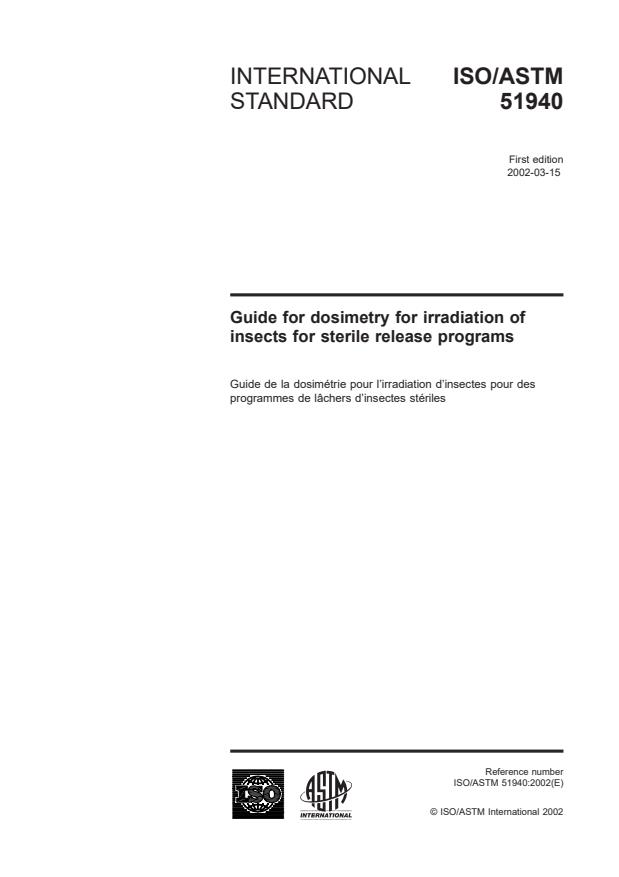
INTERNATIONAL ISO/ASTM
STANDARD 51940
First edition
2002-03-15
Guide for dosimetry for irradiation of
insects for sterile release programs
Guide de la dosimétrie pour l’irradiation d’insectes pour des
programmes de lâchers d’insectes stériles
Reference number
© ISO/ASTM International 2002
PDF disclaimer
This PDF file may contain embedded typefaces. In accordance with Adobe’s licensing policy, this file may be printed or viewed but shall
not be edited unless the typefaces which are embedded are licensed to and installed on the computer performing the editing. In
downloading this file, parties accept therein the responsibility of not infringing Adobe’s licensing policy. Neither the ISO Central
Secretariat nor ASTM International accepts any liability in this area.
Adobe is a trademark of Adobe Systems Incorporated.
Details of the software products used to create this PDF file can be found in the General Info relative to the file; the PDF-creation
parameters were optimized for printing. Every care has been taken to ensure that the file is suitable for use by ISO member bodies
and ASTM members. In the unlikely event that a problem relating to it is found, please inform the ISO Central Secretariat or ASTM
International at the addresses given below.
© ISO/ASTM International 2002
All rights reserved. Unless otherwise specified, no part of this publication may be reproduced or utilized in any form or by any means, electronic or mechanical,
including photocopying and microfilm, without permission in writing from either ISO at the address below or ISO’s member body in the country of the
requester. In the United States, such requests should be sent to ASTM International.
ISO copyright office ASTM International, 100 Barr Harbor Drive, PO Box C700,
Case postale 56 • CH-1211 Geneva 20 West Conshohocken, PA 19428-2959, USA
Tel. +41 22 749 01 11 Tel. +610 832 9634
Fax +41 22 749 09 47 Fax +610 832 9635
E-mail copyright@iso.ch E-mail khooper@astm.org
Web www.iso.ch Web www.astm.org
Printed in the United States
ii © ISO/ASTM International 2002 – All rights reserved
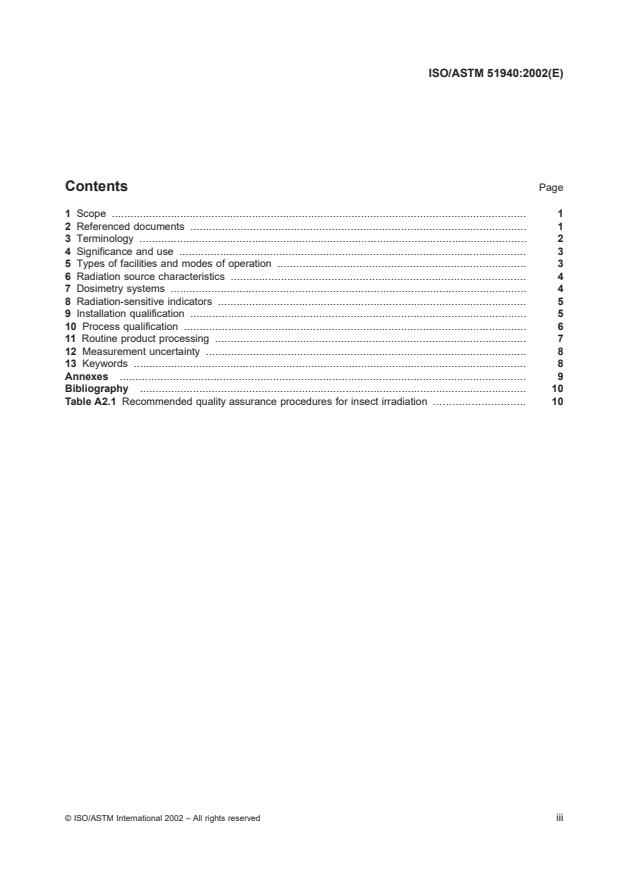
Contents Page
1 Scope . 1
2 Referenced documents . 1
3 Terminology . 2
4 Significance and use . 3
5 Types of facilities and modes of operation . 3
6 Radiation source characteristics . 4
7 Dosimetry systems . 4
8 Radiation-sensitive indicators . 5
9 Installation qualification . 5
10 Process qualification . 6
11 Routine product processing . 7
12 Measurement uncertainty . 8
13 Keywords . 8
Annexes . 9
Bibliography . 10
Table A2.1 Recommended quality assurance procedures for insect irradiation . 10
© ISO/ASTM International 2002 – All rights reserved iii
Foreword
ISO (the International Organization for Standardization) is a worldwide federation of national standards bodies
(ISO member bodies). The work of preparing International Standards is normally carried out through ISO
technical committees. Each member body interested in a subject for which a technical committee has been
established has the right to be represented on that committee. International organizations, governmental and
non-governmental, in liaison with ISO, also take part in the work. ISO collaborates closely with the
International Electrotechnical Commission (IEC) on all matters of electrotechnical standardization.
Draft International Standards adopted by the technical committees are circulated to the member bodies for
voting. Publication as an International Standard requires approval by at least 75% of the member bodies
casting a vote.
ASTM International is one of the world’s largest voluntary standards development organizations with global
participation from affected stakeholders. ASTM technical committees follow rigorous due process balloting
procedures.
A pilot project between ISO and ASTM International has been formed to develop and maintain a group of
ISO/ASTM radiation processing dosimetry standards. Under this pilot project, ASTM Subcommittee E10.01,
Dosimetry for Radiation Processing, is responsible for the development and maintenance of these dosimetry
standards with unrestricted participation and input from appropriate ISO member bodies.
Attention is drawn to the possibility that some of the elements of this International Standard may be the subject
of patent rights. Neither ISO nor ASTM International shall be held responsible for identifying any or all such
patent rights.
International Standard ISO/ASTM 51940 was developed by ASTM Committee E10, Nuclear Technology and
Applications, through Subcommittee E10.01, and by Technical Committee ISO/TC 85, Nuclear Energy.
Annexes A1 and A2 of this International Standard are for information only.
iv © ISO/ASTM International 2002 – All rights reserved
Standard Guide for
Irradiation of Insects for Sterile Release Programs
This standard is issued under the fixed designation ISO/ASTM 51940; the number immediately following the designation indicates the
year of original adoption or, in the case of revision, the year of last revision.
1. Scope priate safety and health practices and determine the applica-
bility of regulatory limitations prior to use.
1.1 This guide outlines dosimetric procedures to be fol-
lowed for the radiation sterilization of live insects for use in
2. Referenced Documents
pest management programs. The primary use of irradiated,
2.1 ASTM Standards:
reproductively sterile insects is in the Sterile Insect Technique,
E 170 Terminology Relating to Radiation Measurements
where large numbers of sterile insects are released into the field
and Dosimetry
to mate with and thus control pest populations of the same
E 177 Practice for Use of the Terms Precision and Bias in
species. A secondary use of irradiated insects is as benign
ASTM Test Methods
“hosts” for rearing insect parasitoids. If followed, the proce-
E 456 Terminology Relating to Quality and Statistics
dures outlined in this guide will help to ensure that insects
E 668 Practice for Application of Thermoluminescence-
processed with ionizing radiation from gamma, electron, or
Dosimetry (TLD) Systems for Determining Absorbed Dose
X-ray sources receive absorbed doses within a predetermined
in Radiation-Hardness Testing of Electronic Devices
range. Information on effective dose ranges for specific appli-
E 1026 Practice for Using the Fricke Reference Standard
cations of insect sterilization, or on methodology for determin-
Dosimetry System
ing effective dose ranges, is not within the scope of this guide.
2.2 ISO/ASTM Standards:
NOTE 1—Dosimetry is only one component of a total quality control
51261 Guide for Selection and Calibration of Dosimetry
program to ensure that irradiated insects are adequately sterilized and fully 2
Systems for Radiation Processing
competitive or otherwise suitable for their intended purpose.
51275 Practice for Use of a Radiochromic Film Dosimetry
1.2 This guide covers dosimetry in the irradiation of insects
System
for these types of irradiators: self-contained dry-storage Cs
51538 Practice for Use of the Ethanol-Chlorobenzene Do-
or Co irradiators, larger-scale gamma irradiators, and elec-
simetry System
tron accelerators. Additional, detailed information on dosimet-
51539 Guide for the Use of Radiation-Sensitive Indicators
ric procedures to be followed in installation qualification,
51540 Practice for Use of a Radiochromic Liquid Dosim-
process qualification, and routine product processing can be
etry System
found in ISO/ASTM Practices 51608 (X-ray, bremsstrahlung
51607 Practice for Use of the Alanine-EPR Dosimetry
facilities), 51649 (electron beam facilities), and 51702 (large-
System
scale gamma facilities).
51608 Practice for Dosimetry in an X-Ray (Bremsstrahl-
1.3 The absorbed dose for insect sterilization is typically
ung) Facility for Radiation Processing
within the range of 20 Gy to 600 Gy.
51649 Practice for Dosimetry in an Electron Beam Facility
1.4 This guide refers, throughout the text, specifically to
for Radiation Processing at Energies Between 300 keV
reproductive sterilization of insects. It is equally applicable to
and 25 MeV
radiation sterilization of invertebrates from other taxa (for
51702 Practice for Dosimetry in a Gamma Irradiation Fa-
example, Acarina, Gastropoda) and to irradiation of live insects
cility for Radiation Processing
or other invertebrates for other purposes (for example, induc-
51707 Guide for Estimating Uncertainties in Dosimetry for
ing mutations), presuming the absorbed dose is within range
Radiation Processing
specified in 1.3.
51956 Practice for Use of Thermoluminescence-Dosimetry
1.5 This guide also covers the use of radiation-sensitive
(TLD) Systems for Radiation Processing
indicators for the visual and qualitative indication that the
2.3 International Commission on Radiation Units and
insects have been irradiated.
Measurements (ICRU) Reports:
1.6 This standard does not purport to address all of the
ICRU 14 Radiation Dosimetry: X-rays and Gamma Rays
safety concerns, if any, associated with its use. It is the
with Maximum Photon Energies Between 0.6 and 50 MeV
responsibility of the user of this standard to establish appro-
ICRU 17 Radiation Dosimetry: X-rays Generated at Poten-
tials of 5 to 150 kV
This guide is under the jurisdiction of ASTM Committee E10 on Nuclear
Technology and Applications and is the direct responsibility of Subcommittee
Annual Book of ASTM Standards, Vol 12.02.
E10.01 on Dosimetry for Radiation Processing, and is also under the jurisdiction of
Annual Book of ASTM Standards, Vol 14.02.
ISO/TC 85/WG 3.
Available from the International Commission on Radiation Units and Measure-
Current edition approved Jan. 22, 2002. Published March 15, 2002. Originally
ments, 7910 Woodmont Ave., Suite 800, Bethesda, MD 20814, USA.
published as ASTM E 1940–98. Last previous ASTM edition E 1940–98.
© ISO/ASTM International 2002 – All rights reserved
ICRU 34 The Dosimetry of Pulsed Radiation be related to absorbed dose in a given material using appro-
ICRU 35 Radiation Dosimetry: Electron Beams with Ener- priate analytical instrumentation and techniques.
gies Between 1 and 50 MeV 3.1.7.1 Discussion—A dosimeter shall exhibit the reproduc-
ICRU 60 Radiation Quantities and Units
ible and quantifiable properties that allow it to be calibrated
2.4 NCRP Publications: and compared to national standards.
NCRP Report No. 69, Dosimetry of X-Ray and Gamma-
3.1.8 dosimetry system—a system used for determining
Ray Beams for Radiation Therapy in the Energy Range 10
absorbed dose, consisting of dosimeters, measurement instru-
keV to 50 MeV, December 1981.
ments and their associated reference standards, and procedures
for the system’s use.
3. Terminology
3.1.9 factory-reared insects—insects that are reared en
3.1 Definitions:
masse in a laboratory or factory setting for use, following
3.1.1 absorbed dose (D)—quantity of ionizing radiation
reproductive sterilization through irradiation, as live animals in
energy imparted per unit mass of a specified material. The SI
pest management programs.
unit of absorbed dose is the gray (Gy), where 1 gray is
3.1.10 irradiator turntable—device used to rotate the can-
equivalent to the absorption of 1 joule per kilogram of the
ister during the radiation process so as to improve the dose
-1
specified material (1 Gy=1J·kg , which is equivalent to 100
uniformity ratio.
rad). The mathematical relationship is the quotient of de¯ by dm,
3.1.10.1 Discussion—An irradiator turntable is often re-
where de¯ is the mean incremental energy imparted by ionizing
ferred to as a turntable. Some irradiator geometries, for
radiation to matter of incremental mass dm (see ICRU 60).
example, with an annular array of radiation sources surround-
D 5 de¯/dm
ing the product, may not need a turntable.
3.1.11 measurement quality assurance plan—a documented
3.1.1.1 Discussion—The discontinued unit for absorbed
program for the measurement process that ensures on a
dose is the rad (1 rad = 1 cGy = 100 erg per gram). Absorbed
continuing basis that the overall uncertainty meets the require-
dose is sometimes referred to simply as dose.
ments of the specified application. This plan requires traceabil-
3.1.2 absorbed-dose mapping—measurement of absorbed-
ity to, and consistency with, nationally or internationally
dose within process load using dosimeters placed at specified
recognized standards.
locations to produce a one-, two- or three-dimensional distri-
3.1.12 measurement traceability—the ability to demonstrate
bution of absorbed dose, thus rendering a map of absorbed-
dose values. by means of an unbroken chain of comparisons that a mea-
surement is in agreement within acceptable limits of uncer-
3.1.3 absorbed-dose rate—the absorbed dose in a material
per incremental time interval, that is, the quotient of dD by dt tainty with comparable nationally or internationally recognized
standards.
(see ICRU 60).
3.1.13 packaging container—a container such as a paper
˙
D 5 dD/dt ~SI unit: Gy · s !
cup with lid, plastic bag, or plastic bottle that is used to hold
3.1.3.1 Discussion—The absorbed-dose rate can be speci-
factory-reared insects during irradiation and, typically, during
˙
fied in terms of average value of D over long-time intervals,
subsequent shipment from the irradiation facility to the release
-1 -1
for example, in units of Gy · min or Gy · h .
site.
3.1.4 calibration—the comparison of a measurement sys-
3.1.14 process load—volume of material with a specified
tem or device of known accuracy that is traceable to national
loading configuration irradiated as a single entity.
standards to detect, correlate, report, or eliminate by adjust-
3.1.15 radiation-sensitive indicator—material such as a
ment any variation from the required performance limits of the
coated or impregnated adhesive-back (or adhesive-front) sub-
unverified measurement system or device.
strate, ink, or coating which may be affixed to or printed on the
3.1.5 canister—a durable, reusable container, usually an
irradiated sample and which undergoes a visual change when
aluminum or steel cylinder, used to house factory-reared
exposed to ionizing radiation (see ISO/ASTM Guide 51539).
insects (in packaging containers) during the radiation process.
3.1.15.1 Discussion—Radiation-sensitive indicators are of-
3.1.5.1 Discussion—Canisters are not used in some appli-
ten referred to as “indicators.” Radiation-sensitive indicators
cations in which the packaging container is sufficiently rigid
cannot be classified as a “label” under certain trade association
and the design of irradiator is appropriate.
guidelines. Indicators may be used to show that products have
3.1.6 dose uniformity ratio—ratio of maximum to minimum
been exposed to ionizing radiation. They can be used to
absorbed dose within the irradiated factory-reared insects. This
provide a visual and qualitative indication of radiation expo-
concept is also referred to as the “max/min ratio.”
sure and can be used to distinguish between irradiated and
3.1.6.1 Discussion—The central plane/minimum dose ratio
unirradiated samples. Indicators cannot be used as a substitute
is not used in this guide.
for proper dosimetry.
3.1.7 dosimeter—a device that, when irradiated, exhibits a
3.1.16 reference–standard dosimeter—a dosimeter of high
quantifiable change in some property of the device which can
metrological quality, used as a standard to provide measure-
ments traceable to and consistent with measurements made
5 with primary–standard dosimeters (see ISO/ASTM Guide
Available from the National Council on Radiation Protection and Measure-
51261).
ments, 7910 Woodmont Ave., Bethesda, MD 20814, USA.
© ISO/ASTM International 2002 – All rights reserved
3.1.17 routine dosimeter—dosimeter calibrated against a insects are irradiated before being offered to parasitoids. This
primary-, reference-, or transfer-standard dosimeter and used eliminates the need to separate unparasitized hosts from
for routine absorbed-dose measurement (see ISO/ASTM Guide parasitoids so that fertile, unparasitized host insects are not
51261). inadvertently released into the field.
3.1.18 simulated product—a mass of material with attenu- 4.3 Factory-reared insects may be treated with ionizing
137 60
ation and scattering properties similar to those of the product, radiation, such as gamma rays from Cs or Co sources,
material or substance to be irradiated. X-rays, and in electron accelerators. Gamma irradiation of
3.1.18.1 Discussion—Simulated product is used during ir- insects is usually carried out in small, fixed-geometry, dry-
radiator characterization as a substitute for the actual product, storage irradiators (6, 7, and 8). Dosimetry methods for gamma
material, or substance to be irradiated. When used in routine irradiation of insects have been demonstrated and include
production runs, it is sometimes referred to as compensating useful procedures for mapping the absorbed dose throughout
dummy. When used for absorbed-dose mapping, simulated the volume of the insect canister in these small irradiators (9)
product is sometimes referred to as a phantom material. as well as larger gamma units (10).
3.1.19 traceability—see measurement traceability. 4.4 Specifications for irradiation of factory-reared insects
3.1.20 transfer–standard dosimeter—a dosimeter, often a include a lower limit of absorbed dose and may include a
reference–standard dosimeter, suitable for transport between central target dose and an upper limit. These values are based
different locations, used to compare absorbed-dose measure- on program requirements and on scientific data on effects of
ments (see ISO/ASTM Guide 51261). absorbed dose on the sterility, viability, and competitiveness of
3.1.21 transit dose—absorbed dose delivered to product the factory-reared insects.
while the product moves from the load position to the irradiate 4.5 For each irradiator, and absorbed-dose rate at a refer-
position, and immediately back to the unload position. ence dose position within the irradiated volume of insects or
3.2 Definitions of other terms used in this standard that simulated product is measured using a reference-standard
pertain to radiation measurement and dosimetry may be found dosimetry system. That reference-standard measurement must
in ASTM Terminology E 170. Definitions in ASTM Terminol- be used to calculate the timer setting, conveyor speed, or other
ogy E 170 are compatible with ICRU 60; that document, parameter required to deliver the specified absorbed dose to the
therefore, may be used as an alternative reference. center of the irradiated sample or other reference position
within the sample. Either relative or absolute absorbed-dose
4. Significance and Use
measurements are performed within the irradiated sample of
4.1 The major use of factory-reared insects is in sterile insects or insect-equivalent material for determining the
absorbed-dose distribution (9). Accurate radiation dosimetry at
release programs (for example, Sterile Insect Technique, or
SIT) for suppressing or eradicating pest populations (1) . Large a reference position which could be the position of the
minimum absorbed dose (D ) or maximum absorbed dose
numbers of reproductively sterile (irradiated) insects are re-
min
leased into an area where a wild “target population” of the (D ) offers a quantitative, independent method of process
max
control.
same species exists. The wild population is reduced to the
extent that the sterile males are successful in mating with wild 4.6 Dosimetry is part of a measurement quality assurance
plan that is applied to ensure that the radiation process meets
females. The irradiation dose absorbed by the factory-reared
insects should be with a range that induces the desired level of predetermined specifications (11, 12).
4.7 Absorbed-dose mapping for establishing locations of
sterility without substantially reducing the ability of factory-
reared males to compete with wild males for mates. Species D and D , is often performed using simulated product (9).
min max
targeted by SIT programs are typically major pests affecting
5. Types of Facilities and Modes of Operation
agriculture or human health, so the assurance by standardized
5.1 Self-Contained Dry-Source Irradiators (see Ref (13))—
dosimetry that insects have been properly irradiated is of
Most insect sterilization is accomplished by using gamma rays
crucial importance to agriculture growers, agricultural regula-
137 60
from either Cs or Co self-contained irradiators. These
tors, public health officials, the public or a combination of these
devices house the radiation source in a protective lead shield
(1, 2, 3, and 4). The irradiator operator must demonstrate by
(or other appropriate high atomic number material), and
means of accurate absorbed-dose measurements within the
usually have a mechanism to rotate or lower the canister from
volume of irradiated insects, or in simulated product, that all
the load position to the irradiation position.
insects will receive an absorbed dose that produces an accept-
5.1.1 A common method of use is to distribute the source in
able level of sterility.
an annular array. The factory-reared insects are located at the
4.2 Another use of factory-reared insects is in the produc-
center of the array, resulting in a relatively uniform absorbed-
tion of parasitoids for release against populations of insect
dose distribution. In this design, irradiator turntables would not
pests (5). Parasitoids are insects that spend the larval stage
normally be necessary.
feeding within the body of a “host” species, typically killing
5.1.2 A second method is to rotate the canister holding the
the host. In some parasitoid programs, factory-reared host
insects on an irradiator turntable in front of the source such that
the only points that remain a fixed distance from the source are
along an axis of rotation.
The boldface numbers in parentheses refer to the bibliography at the end of this
standard.
5.2 Large-Scale Gamma Irradiators—Gamma irradiation
© ISO/ASTM International 2002 – All rights reserved
of insects is also carried out in pool-type irradiators, and 6.2 Electron Accelerator (Electron and Bremmstrahlung
larger-scale dry-storage irradiators could also be used. In these X-ray Modes):
facilities, the source typically consists of a series of rods 6.2.1 Direct-action electron accelerators that employ dc or
60 137
(pencils) containing Co or Cs which can be raised or pulsed high-voltage generators typically produce electron en-
lowered into a large irradiation chamber. When retracted from ergies up to 5 MeV. Indirect-action electron accelerators use
the chamber, the source is shielded by water (pool-type) or microwave or very high frequency (VHF) ac power to produce
lead, or both, or other appropriate high atomic number mate- electron energies typically from 5 MeV to 15 MeV.
rial. 6.2.2 The continuous energy spectrum of the X-rays
5.2.1 For pool irradiators, a common method of use is for (bremsstrahlung) varies from approximately 35 keV up to the
samples of insects to be carried on a conveyor in one or more maximum energy of the electrons incident on the X-ray target
revolutions around a central source, resulting in a relatively (see ISO/ASTM Practice 51608).
uniform absorbed-dose distribution. The source is lowered into
7. Dosimetry Systems
the pool only when the irradiator is not in use or the conveyors
7.1 Dosimetry systems used to determine the absorbed dose
require service.
or dose rate shall cover the absorbed dose range of interest and
5.2.2 An alternative method of use is to distribute the source
shall be calibrated before use.
in an annular array. After the irradiated sample is placed in the
7.2 Description of Dosimeter Classes:
center of the irradiation chamber, the source is raised or
7.2.1 Dosimetry systems are used to determine absorbed
lowered around it for the length of time required to achieve the
dose. They consist of dosimeters, measurements instruments,
desired absorbed dose.
and their associated reference standards, and procedures for the
5.3 Electron Accelerator (Electron and bremsstrahlung
system’s use.
X-ray modes)—Accelerator-generated radiation is in the form
7.2.2 Dosimeters may be divided into four basic classes
of electrons or bremsstrahlung X-rays.
according to their accuracy and areas of application: primary
5.3.1 For an electron accelerator, the two principal beam
standard, reference standard, transfer standard, and routine
characteristics are the energy spectrum and the average beam
dosimeters. ISO/ASTM Guide 51261 provides detailed infor-
current. The electron energy spectrum affects the variation of
mation about the selection of dosimetry systems for different
absorbed dose with depth in a given material, and the average
applications.
beam current affects the absorbed-dose rate.
7.2.2.1 Primary–Standard Dosimeters—Primary–standard
5.3.2 A bremsstrahlung X-ray accelerator emits short-
dosimeters are established and maintained by national stan-
wavelength electromagnetic radiation, similar in energy to
dards laboratories for calibration of radiation environments
nuclear gamma radiation. Although their effects on materials
(fields) and other dosimeters. The two most commonly used
are generally similar, these kinds of radiation differ in their
primary standard dosimeters are ionization chambers and
energy spectra, angular distributions, and absorbed-dose rates.
calorimeters (see ISO/ASTM Guide 51261, ICRU Reports 14,
5.3.3 Insects could be irradiated using a self-contained
17, 34 and 35 and NCRP Report 69).
portable bremsstrahlung X-ray irradiator. The bremsstrahlung
7.2.2.2 Reference–Standard Dosimeters—
X-rays are produced in a conventional manner, but the unit is
Reference–standard dosimeters are used to calibrate radiation
totally self-contained (free standing). Spectrum filtration would
environments and routine dosimeters. Reference–standard do-
be used to reduce the low energy component of the radiation,
simeters may also be used as routine dosimeters. Examples of
thus improving the dose uniformity ratio.
reference–standard dosimeters along with their useful dose
6. Radiation Source Characteristics
ranges are given in a table in ISO/ASTM Guide 51261. For
6.1 Self-Contained Dry-Storage and Large-Scale Gamma insect irradiators, the following reference–standard dosimeters
Irradiators: may be suitable; ferrous sulfate (Fricke) aqueous solution
6.1.1 The radiation source used in the facilities considered (ASTM Practice E 1026), alanine dosimeters (ISO/ASTM
60 137
in this guide consist of sealed elements of Co or Cs which Practice 51607), radiochromic solutions (ISO/ASTM Practice
are typically linear rods or “pencils” arranged in one or more 51540 and Refs (11) and (16)), and ethanol-chlorobenzene
planar or cylindrical arrays. solution (ISO/ASTM Practice 51538).
6.1.2 Cobalt-60 emits photons with energies of approxi- 7.2.2.3 Transfer–Standard Dosimeters—Transfer–standard
mately 1.17 and 1.33 MeV in nearly equal proportions. dosimeters are specially selected dosimeters used for transfer-
Cesium-137 produces photons with energies of approximately ring absorbed-dose information from an accredited or national
0.662 MeV (11). standards laboratory to an irradiation facility in order to
60 137
6.1.3 The half-lives for Co and Cs are approximately establish traceability for the facility. These dosimeters should
5.27 years (14) and 30.1 years, respectively (15). be used under conditions that are carefully controlled by the
6.1.4 For gamma-ray sources, the only variation in the issuing laboratory. Transfer–standard dosimeters may be se-
source output is the known reduction in the activity caused by lected from either reference–standard dosimeters or routine
radioactive decay. The reduction in the source strength, and the dosimeters and shall have performance characteristics that
required increase in the irradiation time, may be calculated (see meet the requirements listed in a table in ISO/ASTM Guide
9.4.7) or obtained from tables provided by the irradiator 51261.
manufacturer. 7.2.2.4 Routine Dosimeters—Routine dosimeters may be
© ISO/ASTM International 2002 – All rights reserved
used for quality control and process monitoring. Proper dosi- and Ref (17)). Indicators do not give a quantitative value of
metric techniques, including calibration, shall be employed to absorbed dose, and therefore are not a substitute for routine
ensure that the measurements are reliable and accurate. Ex- dosimeters used in routine process monitoring.
amples of routine dosimeters along with their useful dose
NOTE 3—This does not preclude the use of calibrated radiochromic film
ranges are given in a table in ISO/ASTM Guide 51261.
as a dosimeter read with a Transmission/Reflectance Densitometer as
Examples of dosimeters that may be useful in routine process-
listed in Annex A1.
ing or absorbed-dose mapping for insect irradiation facilities
9. Installation Qualification
are listed in Annex A1.
9.1 Objective—The purpose of installation qualification is
NOTE 2—In the routine operation of an insect irradiator, absorbed-dose
to obtain and document evidence that the irradiation facility
measurements made on the product at regular intervals provide the
has been provided and installed in accordance with its speci-
operator and regulatory authorities with an independent quality control
fications and that it functions within predetermined limits when
record of the process. When D has been set by the regulatory
min
operated in accordance with the operational instructions. As
authorities, the ability to measure that absorbed dose with proper
statistical control is a critical requisite of Good Manufacturing Practices.
part of this process, dosimetry may, for example, be performed
to: (1) establish relationships between the absorbed dose for a
7.3 Calibration of Dosimetry Systems:
reproducible geometry and the operating parameters of the
7.3.1 Prior to use, dosimetry systems shall be calibrated in
irradiator, (2) characterize absorbed-dose variations when a
accordance with the user’s documented procedure that speci-
facility and processing parameters fluctuate statistically
fies details of the calibration process and quality assurance
through normal operations, (3) measure absorbed-dose distri-
requirements. This calibration procedure shall be repeated at
butions in insect-equivalent material and other reference ma-
regular intervals to ensure that the accuracy of the absorbed
terials, and (4) measure the absorbed-dose rate at one position
dose measurement is maintained within required limits. Irra-
(usually the center of the canister volume) within the canister
diation is a critical component of the calibration of the
filled with insects or simulated product. Table A2.1 gives some
dosimetry system. Detailed calibration procedures are provided
recommended steps in the following areas: installation quali-
in ISO/ASTM Guide 51261.
fication, process qualification, and routine product processing.
7.3.2 Calibration of Reference or Transfer Dosimeters—
The recommended steps in Table A2.1 are not meant to be
Calibration irradiations shall be performed by irradiating the
exhaustive.
reference or transfer–standard dosimeters using a calibration
9.1.1 For self-contained irradiators, installation qualification
facility that provides an absorbed dose or an absorbed-dose rate
may begin prior to the shipment of the irradiator to the
having measurement traceability to nationally or internation-
customer’s site. As part of release-for-shipment criteria, the
ally recognized standards.
irradiator manufacturer may perform absorbed-dose mapping
7.3.3 Calibration of Routine Dosimeters—Calibration irra-
to establish baseline data for evaluating facility effectiveness,
diations may be performed in several ways, including irradi-
predictability, and reproducibility for the range of operating
ating the routine dosimeters using:
conditions. After the unit is installed at the user’s site, irradiator
7.3.3.1 A calibration facility that provides an absorbed dose
qualification is performed as part of the user’s quality assur-
or an absorbed-dose rate having measurement traceability to
ance plan.
nationally or internationally recognized standards, or
9.1.2 Specific information on installation qualification for
7.3.3.2 An in-house calibration facility that provides an
facilities other than self-contained dry-storage gamma irradia-
absorbed dose or and absorbed-dose rate having measurement
tors can be found in ISO/ASTM Practices 51608 (bremsstrahl-
traceability to nationally or internationally recognized stan-
ung X-ray), 51649 (electron beam), and 51702 (large-scale
dards, or
gamma facilities).
7.3.3.3 A production or research irradiation facility together
9.2 Equipment Documentation—Establish and document an
with reference or transfer–standard dosimeters that have mea-
irradiator qualification program that demonstrates that the
surement traceability to nationally or internationally recog-
irradiator is operating within specified limits, and will consis-
nized standards.
tently produce an absorbed-dose distribution in samples of
7.3.4 When a reference or transfer–standard dosimeter is to
insects or simulated product to predetermined specifications.
be used as a routine dosimeter, calibration may also be
Documentation shall be retained for the life of the irradiator
performed as stated in 7.3.3.2 and 7.3.3.3.
and shall include descriptions of instrumentation and equip-
7.4 Analytical Instrument Calibration and Performance
ment for ensuring the reproducibility in absorbed-dose deliv-
Verification—For the calibration of the individual instruments
ery, within specified limits.
used in the analysis of the dosimeters, and for the verification
9.3 Equipment Testing and Calibration:
of instrument performance between calibrations, see ISO/
9.3.1 Processing Equipment—The absorbed dose in irradi-
ASTM Guide 51261.
ated insects or simulated product depends on the operating
8. Radiation-Sensitive Indicators
parameters of the irradiator.
8.1 The purpose of radiation-sensitive indicators is to visu- 9.3.1.1 Test all processing equipment and instrumentation
ally determine whether or not a specific container of insects has that may influence absorbed dose in order to verify satisfactory
been exposed to ionizing radiation, rather than to measure operation of the irradiator within the design specifications.
different absorbed-dose levels (see ISO/ASTM Guide 51539 9.3.1.2 Implement a documented calibration program to
© ISO/ASTM International 2002 – All rights reserved
NOTE 4—In the case of static irradiations (such as when the product is
assure that all processing equipment and instrumentation that
located at the center of an annular source array of a self-contained
may influence absorbed-dose delivery are calibrated periodi-
dry-storage irradiator), the dose mapping should be done in three
cally (for example, the reset timer mechanism on a gamma
dimensions. When product is irradiated on turntables, the dose mapping
irradiator).
may be done in two dimensions, such as on an arbitrary vertical plane
9.3.2 Analytical Equipment—The accuracy of the absorbed-
through the axis of rotation. In this case, the result is a three-dimensional
dose measurement depends on the correct operation and
mapping due to the product rotation.
calibration of the analytical equipment used in the analysis of
9.4.5 Changes in the product handling system (for example,
the dosimeters.
irradiator turntable) and radiation source characteristics require
9.3.2.1 Check the performance of the analytical equipment
a new absorbed-dose mapping.
periodically to ensure that the equipment is functioning accord-
9.4.6 Most manufacturers of insect irradiators use a refer-
ing to performance specifications. Repeat this check following
ence standard dosimetry system to measure the absorbed-dose
any equipment modification or servicing and prior to the use of
rate at a reference location within simulated product (such as
the equipment for a dosimetry system calibration. This check
the center of the product or simulated product volume) in near
may be accomplished by using standards such as calibrated
worst-case geometry (such as when the product nearly com-
optical density filters, wavelength standards, or calibrated
pletely fills the irradiation volume). This measurement is used
thickness gauges supplied by the manufacturer or national or
to calculate the timer setting necessary to deliver the specified
accredited standards laboratories.
absorbed dose to the insects. The continued usage of this timer
9.3.2.2 Implement a documented calibration program to
setting, adjusted for source decay, will help to ensure that
assure that all analytical equipment used in the analysis of
samples of insects which occupy less than the total irradiation
dosimeters is calibrated periodically.
volume will be processed to the specified minimum absorbed
9.4 Irradiator Characterization—The absorbed dose re-
dose. If the insects occupy much less than the available canister
ceived by any portion of product (in this case, insects) depends
volume, care shall be taken to ensure that the D delivered to
max
on the irradiator parameters such as the source activity at the
the insects is still within specification (see 11.2.8).
time of irradiation, the geometry of the source, the source-to-
9.4.7 An important calculation in the use of gamma-ray
product distance, the irradiation geometry and the processing
sources is the correction for radioactivity decay. For a pure
parameters such as the irradiation time, the product composi-
radionuclide source, the exponential loss of activity, A, is given
tion and density, and the loading configuration.
by:
9.4.1 In order to facilitate reproducible absorbed-dose de-
2lt
A 5 A e (1)
t 0
livery to the insects, the transit dose should be small relative to
the total dose delivered to the insects (for example, <1 %). The Where A is the activity at time t, A is the known activity at
t 0
some earlier time (t = 0), and l is the decay constant for the
transit dose caused by movement of the product or source to
and from the irradiation position, and its relation to total given radionuclide. Daily decay constants (l ) for radionu-
d
clides commonly used in gamma-ray sources are:
absorbed dose, should be considered and quantified, if neces-
sary. Procedures for measuring and correcting for transit dose
60 24 21
For Co, l 5 3.60054 3 10 day (2)
d
in terms of transit time are given in ISO/ASTM Guide 51261.
9.4.2 The irradiator characterization process includes map-
137 25 21
For Cs, l 5 6.31119 3 10 day (3)
d
ping the absorbed-dose distributions on samples of insects or
These constants are based on half lives of 5.2708 years for
simulated product (see 10.3). Dosimetry data from previously
60 137
Co (14) and 30.07 years for Cs (15). In practice, absorbed
characterized irradiators of the same design or theoretical
dose rate can be substituted for activity in Eq 1. The absorbed
calculations may provide useful information for determining
dose rate that was initially established during installation
the number and locations of dosimeters needed for this
qualification (or a subsequent calibration of the irradiator with
characterization process.
reference or transfer–standard dosimeters) provides the activity
9.4.3 Ideally, the radiation process is designed to irradiate
at t = 0. The absorbed dose rate at t days later can then be
insects uniformly throughout the irradiated volume; in reality,
computed from Eq 1 using l for the appropriate radionuclide
a certain variation in absorbed-dose through the product will d
from Eq 2 or Eq 3.
exist. Absorbed-dose mapping is used to determine the mag-
nitude and locations of D and D for a given set of
max min
10. Process Qualification
operating parameters (for example, timer setting, product
loading configuration). In many insect irradiator applications,
10.1 Objective—The purpose of dosimetry in process quali-
the product is relatively close to the radiation sources, resulting
fication is to ensure that the absorbed-dose requirements for a
in pronounced absorbed-dose gradients near the periphery of
particular product can be satisfied. This is accomplished by
the volume of the sample. It is important, therefore, to choose
absorbed-dose mapping (see 10.3) of specific products and
a dosimeter that is small enough to detect these gradients (9,
product loading configurations or in simulated product repre-
11).
senting the near-worst case geometry to determine the magni-
tude and location of D and D , and the irradiator timer
9.4.4 Map the absorbed-dose distribution by placing dosim-
max min
eters throughout the actual or simulated product. Select place- setting, conveyor speed, or other parameter(s) necessary to
ment patterns that can identify the locations of D and D . achieve the absorbed doses within the set requirements.
max min
© ISO/ASTM International 2002 – All rights reserved
NOTE 5—Although dosimetry is an important component in process
critical process parameters that can affect the absorbed-dose
qualification, it cannot substitute for biological assessment of the effects of
distribution shall be controlled, monitored, and documented
the irradiation process. In sterile insect programs, for example, tests of
during routine processing to help ensure that the insects are
absorbed dose versus sterility and viability of irradiated insects are critical
processed in accordance with specifications. Examples or these
components of process qualification (12).
parameters are given in Table A2.1. If the operating parameters
10.2 Product Loading Configuration—A loading configura-
deviate from prescribed processing limits, take appropriate
tion for the irradiation should be established for each product
actions.
type. The documentation for this loading configuration shall
11.2 Routine Dosimetry—Routine measurements of ab-
include specifications for parameters that influence the
sorbed dose to the product will help ensure that all insects have
absorbed-dose distribution. For irradiation of insects, these
been treated with the minimum dose prescribed by the process.
parameters could include species, mass or density of the
Often, however, the minimum absorbed dose location is not
insects, size and shape of the packaging container, position of
accessible. In this case, the absorbed dose may be measured at
the packaging container within the canister, and position and
a reference dose position (see 10.3.2).
compos
...
Questions, Comments and Discussion
Ask us and Technical Secretary will try to provide an answer. You can facilitate discussion about the standard in here.
Loading comments...