


ISO/IEC 15419:2001
(Main)Information technology — Automatic identification and data capture techniques — Bar code digital imaging and printing performance testing
Information technology — Automatic identification and data capture techniques — Bar code digital imaging and printing performance testing
Technologies de l'information — Techniques automatiques d'identification et de capture des données — Test de performance de la numérisation digitale et l'impression des codes à barres
General Information
- Status
- Withdrawn
- Publication Date
- 14-Mar-2001
- Withdrawal Date
- 14-Mar-2001
- Technical Committee
- ISO/IEC JTC 1/SC 31 - Automatic identification and data capture techniques
- Current Stage
- 9599 - Withdrawal of International Standard
- Start Date
- 26-May-2009
- Completion Date
- 12-Feb-2026
Relations
- Effective Date
- 15-Apr-2008


Get Certified
Connect with accredited certification bodies for this standard

BSI Group
BSI (British Standards Institution) is the business standards company that helps organizations make excellence a habit.

NYCE
Mexican standards and certification body.
Sponsored listings
Frequently Asked Questions
ISO/IEC 15419:2001 is a standard published by the International Organization for Standardization (ISO). Its full title is "Information technology — Automatic identification and data capture techniques — Bar code digital imaging and printing performance testing". This standard covers: Information technology — Automatic identification and data capture techniques — Bar code digital imaging and printing performance testing
Information technology — Automatic identification and data capture techniques — Bar code digital imaging and printing performance testing
ISO/IEC 15419:2001 is classified under the following ICS (International Classification for Standards) categories: 35.040 - Information coding; 35.040.50 - Automatic identification and data capture techniques. The ICS classification helps identify the subject area and facilitates finding related standards.
ISO/IEC 15419:2001 has the following relationships with other standards: It is inter standard links to ISO/IEC 15419:2009. Understanding these relationships helps ensure you are using the most current and applicable version of the standard.
ISO/IEC 15419:2001 is available in PDF format for immediate download after purchase. The document can be added to your cart and obtained through the secure checkout process. Digital delivery ensures instant access to the complete standard document.
Standards Content (Sample)
INTERNATIONAL ISO/IEC
STANDARD 15419
First edition
2001-03-15
Information technology — Automatic
identification and data capture
techniques — Bar code digital imaging and
printing performance testing
Technologies de l'information — Techniques d'identification automatique et
de capture des données — Test de performance de la numérisation
digitale et l'impression des codes à barres
Reference number
©
ISO/IEC 2001
ISO/IEC 15419:2001(E)
PDF disclaimer
This PDF file may contain embedded typefaces. In accordance with Adobe's licensing policy, this file may be printed or viewed but shall not
be edited unless the typefaces which are embedded are licensed to and installed on the computer performing the editing. In downloading this
file, parties accept therein the responsibility of not infringing Adobe's licensing policy. The ISO Central Secretariat accepts no liability in this
area.
Adobe is a trademark of Adobe Systems Incorporated.
Details of the software products used to create this PDF file can be found in the General Info relative to the file; the PDF-creation parameters
were optimized for printing. Every care has been taken to ensure that the file is suitable for use by ISO member bodies. In the unlikely event
that a problem relating to it is found, please inform the Central Secretariat at the address given below.
© ISO/IEC 2001
All rights reserved. Unless otherwise specified, no part of this publication may be reproduced or utilized in any form or by any means, electronic
or mechanical, including photocopying and microfilm, without permission in writing from either ISO at the address below or ISO's member body
in the country of the requester.
ISO copyright office
Case postale 56 � CH-1211 Geneva 20
Tel. + 41 22 749 01 11
Fax + 41 22 749 09 47
E-mail copyright@iso.ch
Web www.iso.ch
Printed in Switzerland
ii © ISO/IEC 2001 – All rights reserved
ISO/IEC 15419:2001(E)
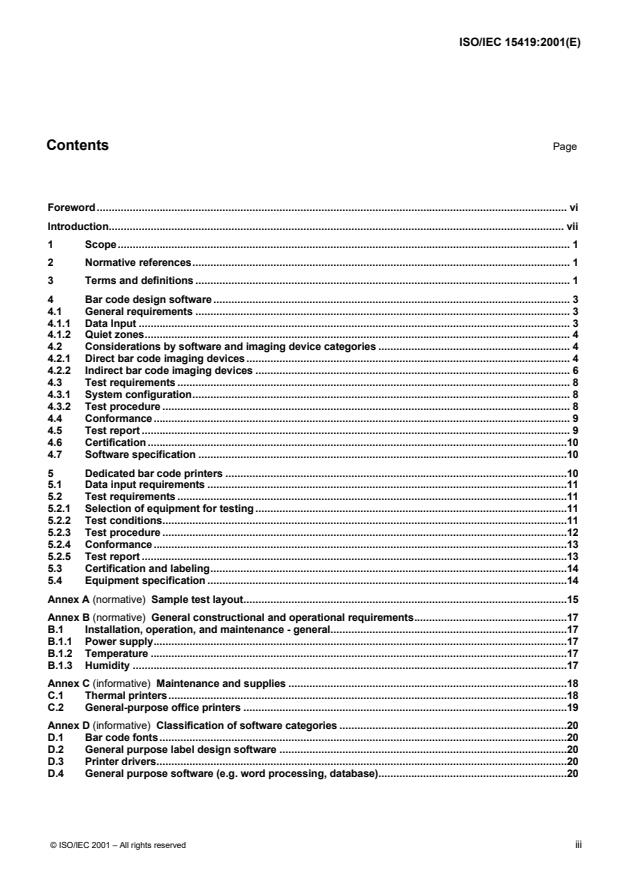
Contents Page
Foreword. vi
Introduction. vii
1 Scope. 1
2 Normative references. 1
3 Terms and definitions . 1
4 Bar code design software . 3
4.1 General requirements . 3
4.1.1 Data Input . 3
4.1.2 Quiet zones. 4
4.2 Considerations by software and imaging device categories . 4
4.2.1 Direct bar code imaging devices. 4
4.2.2 Indirect bar code imaging devices . 6
4.3 Test requirements . 8
4.3.1 System configuration. 8
4.3.2 Test procedure . 8
4.4 Conformance. 9
4.5 Test report . 9
4.6 Certification.10
4.7 Software specification .10
5 Dedicated bar code printers .10
5.1 Data input requirements .11
5.2 Test requirements .11
5.2.1 Selection of equipment for testing .11
5.2.2 Test conditions.11
5.2.3 Test procedure .12
5.2.4 Conformance.13
5.2.5 Test report .13
5.3 Certification and labeling.14
5.4 Equipment specification .14
Annex A (normative) Sample test layout.15
Annex B General constructional and operational requirements.17
B.1 Installation, operation, and maintenance - general.17
B.1.1 Power supply.17
B.1.2 Temperature .17
B.1.3 Humidity .17
Annex C Maintenance and supplies .18
C.1 Thermal printers.18
C.2 General-purpose office printers .19
Annex D Classification of software categories .20
D.1 Bar code fonts.20
D.2 General purpose label design software .20
D.3 Printer drivers.20
D.4 General purpose software (e.g. word processing, database).20
© ISO/IEC 2001 – All rights reserved iii
(informative)
(informative)
(normative)
ISO/IEC 15419:2001(E)
D.5 Bar code controller. 20
D.6 Bar code origination software . 21
Annex E Classification of imaging device categories. 22
Annex F Programmer's examples. 24
F.1 Programmer’s example for general-purpose printers . 24
F.2 Programmer’s example for indirect bar code imaging devices. 26
F.3 Programmer’s example for symbols distorted for plate roll circumference. 28
Annex G Functions of bar code production software. 29
iv © ISO/IEC 2001 – All rights reserved
(informative)
(informative)
(informative)
ISO/IEC 15419:2001(E)
Foreword
ISO (the International Organization for Standardization) and IEC (the International Electrotechnical Commission)
form the specialized system for worldwide standardization. National bodies that are members of ISO or IEC
participate in the development of International Standards through technical committees established by the
respective organization to deal with particular fields of technical activity. ISO and IEC technical committees
collaborate in fields of mutual interest. Other international organizations, governmental and non-governmental, in
liaison with ISO and IEC, also take part in the work.
International Standards are drafted in accordance with the rules given in the ISO/IEC Directives, Part 3.
In the field of information technology, ISO and IEC have established a joint technical committee, ISO/IEC JTC 1.
Draft International Standards adopted by the joint technical committee are circulated to national bodies for voting.
Publication as an International Standard requires approval by at least 75 % of the national bodies casting a vote.
Attention is drawn to the possibility that some of the elements of this International Standard may be the subject of
patent rights. ISO and IEC shall not be held responsible for identifying any or all such patent rights.
International Standard ISO/IEC 15419 was prepared by Joint Technical Committee ISO/IEC JTC 1, Information
technology, Subcommittee SC 31, Automatic identification and data capture techniques.
Annexes A and B form a normative part of this International Standard. Annexes C to G are for information only.
© ISO/IEC 2001 – All rights reserved v
ISO/IEC 15419:2001(E)
Introduction
The technology of bar coding is based on the recognition of patterns encoded in bars and spaces of defined
dimensions according to rules defining the translation of characters into such patterns, known as the symbology
Bar code digital imaging systems must be capable of reliably converting the information to be encoded into a bar
code symbol meeting the symbology specification and application requirements, if the technology is to fulfil its basic
objective. Such systems comprise two major components, namely the hardware device which produces the physical
image of the bar code symbol on paper, photographic film, printing plate, or other substrate, and the associated
software which converts the input data into digital instructions used to drive the hardware device. Each component
Manufacturers of bar code equipment, the producers of bar code symbols and the users of bar code technology
therefore require publicly available standard test specifications for bar code digital imaging systems, to ensure the
accuracy and consistency of performance of these systems. This International Standard is intended to lay down
general principles governing the bar code image generation function in each component, supplemented by more
vi © ISO/IEC 2001 – All rights reserved
specific details applicable to certain major categories of software and hardware.
can take many forms and perform differing functions.
specification.
INTERNATIONAL STANDARD ISO/IEC 15419:2001(E)
Information technology — Automatic identification and data
capture techniques — Bar code digital imaging and printing
performance testing
1 Scope
This International Standard describes the characteristics of, and defines categories of, bar code digital imaging
systems, identifies the attributes of each system which are required to be controlled, and specifies minimum
requirements for those attributes. It defines test methods for assessing the conformance of those attributes with this
International Standard. This standard is intended to be used in conjunction with International Standards which detail
the methodology for assessing the quality of a bar code symbol such as ISO/IEC 15416. This International Standard
2 Normative references
The following normative documents contain provisions which, through reference in this text, constitute provisions of
this International Standard. For dated references, subsequent amendments to, or revisions of, any of these
publications do not apply. However, parties to agreements based on this International Standard are encouraged to
investigate the possibility of applying the most recent editions of the normative documents indicated below. For
undated references, the latest edition of the normative document referred to applies. Members of ISO and IEC
ISO/IEC 15416, Information technology — Automatic identification and data capture techniques — Bar code print
quality test specification — Linear symbols.
ISO/IEC 15417, Information technology — Automatic identification and data capture techniques — Bar code
symbology specification — Code 128.
ISO/IEC 15420, Information technology — Automatic identification and data capture techniques — Bar code
symbology specification — EAN/UPC.
,1- Information technology — Automatic identification and data capture techniques — Bar code verifier
conformance specification — Part 1: Linear symbols.
ISO 2859-1, Sampling procedures for inspection by attributes — Part 1: Sampling schemes indexed by acceptable
quality level (AQL) for lot-by-lot inspection.
EN 1556, Bar coding — Terminology.
3 Terms and definitions
© ISO/IEC 2001 – All rights reserved 1
For the purposes of this International Standard, the terms and definitions given in EN1556 and the following apply.
ISO/IEC 15426
maintain registers of currently valid International Standards.
does not apply to Bar Code Masters that are covered by ISO/IEC 15421.
3.1
addressable imaging resolution
The maximum number of image positions per unit length (e.g. dots per millimeter) along a straight line that can be
addressed by the bar code designer. This resolution would exclude further resolution enhancing techniques
3.2
adjusted BWC
3.3
bar width compensation (BWC)
The extent by which the width of the bars on a machine-readable symbol, Bar Code Master, or digital bar code file is
3.4
bar width increase (BWI)
The extent by which the width of the bars on a machine-readable symbol, Bar Code Master, or digital bar code file is
3.5
bar width reduction (BWR)
The extent by which the width of the bars on a machine-readable symbol, Bar Code Master, or digital bar code file is
3.6
bit map
3.7
consumables
Print media , s that need to be supplied by the user on a regular basis, e.g. ribbons, labels or printing
, ink.
3.8
dedicated bar code printer
3.9
digital bar code file
3.10
digital bar code imaging system
3.11
distortion
The process by which the height to width ratio of a piece of artwork is modified to compensate for the dimensional
change which is introduced to an image, when a flexible, relief printing plate is wrapped around the print cylinder of a
3.12
disproportioning
2 © ISO/IEC 2001 – All rights reserved
See Distortion.
rotary printing press.
A system which comprises the necessary software and hardware components to produce a bar code image.
A bar code which is designed and stored in a digitized format.
A printing device with the resident intelligence capable of converting data into bar code symbols.
toner and substrates
material i.e.
An electronic representation of the individual pixels making up the image to be output by the imaging device.
reduced in order to correct for expected print or imaging gain.
increased in order to correct for expected print or imaging loss.
reduced/increased in order to correct for expected print or imaging gain/loss.
The value of BWC after adjustment to match addressable imaging resolution.
performed by the imaging device or software, which are beyond the control of the designer.
3.13
general purpose printer
A printing device without the resident processing ability to convert data sequences into valid bar code symbol, (e.g.
3.14
imagesetter
A device used to output a computer image at an addressable resolution onto a photographic film, paper, or printing
plate.
3.15
imaging tool
3.16
rounding errors
4 Bar code design software
The testing procedures in this section are intended to report the conditions under which software, in conjunction with
a printing device, is capable of producing quality symbols. The tests performed under the reported conditions will
typically be performed in a controlled setting. Ongoing verification of symbols produced in an operational setting
should be performed using the methodology contained in ISO/IEC 15416. In addition, visual checks should be
performed to confirm the correct formatting of the symbol in accordance with the symbology and other applicable
.
4.1 General requirements
4.1.1 Data Input
The human-readable text and symbol characters for all symbols should, wherever possible, be generated from the
same key entry input. The software should apply appropriate formatting algorithms to meet relevant application
The input process should also allow for the input of relevant symbol parameters such as target X dimension or
magnification factor, wide:narrow ratio, and bar height, where these are user-definable according to the symbology
; such input shall be subject to the capabilities of the imaging or printing system, in particular the
prompts for the entry of only twelve digits for an EAN-13 symbol, the software shall automatically calculate the check
character. Alternatively, the software might prompt for the entry of thirteen digits and indicate an error if the check
It is desirable for the input data to be displayed when the label or layout is designed, subject to the limitations of the
display device, to enable the operator to validate it. Optionally, the software may also display the symbol characters
© ISO/IEC 2001 – All rights reserved 3
encoded.
character input is incorrect. The latter approach assures that valid data has been entered.
Check characters for encoded data shall either be calculated or verified by the software. For example, if the software
adjustment of target element dimensions as described in the subclauses of 4.2.
specification
standards.
found in Annex C. is Further guidance on equipment maintenance and supplies specifications
based on the user’s target dimensions fail to be composed of a consistent number of dots).
An allocation of imaging device dots to bar or space modules in an inconsistent manner, (i.e. where all of the modules
A mechanism that transfers an image directly or indirectly to a printed substrate.
an office printer).
4.1.2 Quiet zones
The software should indicate, either graphically or in text, the appropriate area surrounding the symbol required for
In order to ensure that the minimum quiet zones are respected when printing or positioning the symbol , if
, adjustment of the position of any graphical mark on the digital
4.2 Considerations by software and imaging device categories
4.2.1 Direct bar code imaging devices
This section provides software design requirements for imaging devices that create the final bar code symbol on the
substrate. This category is divided into the two sub-categories, dedicated bar code printer software and general-
4.2.1.1 Dedicated bar code printers
This section provides software requirements for dedicated bar code printers. Dedicated bar code printers contain all
of the low-level software required to generate bar code symbols. This means that various symbol formats are stored
in the printer to create the symbol. These commands typically relate to data characters, element sizes (typically
4.2.1.1.1 Adjustment of target element dimensions
This procedure is intended to produce symbols with a revision in the target module width of the symbol to eliminate
rounding errors. The software must be able to make adjustments to symbol character element widths based on the
output resolution specified. This means the overall symbol width will be adjusted to produce an integer number of
addressable dots consistently across all element widths. For symbols with a fixed aspect ratio, a proportional
These adjustments should be made by rounding down to the closest integer value, provided the value falls within the
range of widths prescribed by the symbology specification or application standard. Rounding down is preferred
because rounding up could cause reduction or interference in the area allocated to the quiet zone. Quiet zone
reduction could result from selecting a label width that is very close to the target symbol width. Quiet zone
interference could result from adjacent graphic layout images remaining constant as the symbol width expands.
When symbol module widths are rounded up, the software should clearly indicate the required quiet zone area to the
4.2.1.1.2 Record of design attributes
Digital bar code files for dedicated bar code printers are generally created for a specific printer make and model at a
the symbol output. When this is not possible and the digital bar code file is transferred between two parties, certain
design attributes should be communicated. The following design attributes should be communicated for dedicated
4 © ISO/IEC 2001 – All rights reserved
bar code printers to ensure symbol quality in the output stage:
specific resolution. It is wise for the party printing the symbol to create the bar code at the production stage closest to
Refer to Annex F for a programmer’s example for an illustration of this procedure.
designer.
of
adjustment should be applied to the module height (Y-dimension).
expressed as a multiple of addressable dots), symbol orientation, and symbol placement.
in the firmware specific to the printer. The bar code design software simply sends commands to address the firmware
purpose printer software.
Refer to Annex D for a review of software categories and Annex E for a review of imaging device categories.
on which, it is to be printed, may be required.
image adjacent to the quiet zone boundary, or of the position of the symbol relative to the edges of the area in which, or substrate
print growth or variations in print to substrate register are expected
for example NOTE
quiet zones.
)
4.2.1.2 General purpose printers
This section provides software requirements for general-purpose printers. General-purpose printers do not contain
4.2.1.2.1 Adjustment of target element dimensions
This procedure is intended to produce symbols with a revision in the target module width of the symbol to eliminate
rounding errors. The software must be able to make adjustments to symbol character element widths based on the
output resolution specified. This means the overall symbol width will be adjusted to produce an integer number of
addressable dots consistently across all element widths. For symbols with a fixed aspect ratio, a proportional
These adjustments should be made by rounding down to the closest integer value, provided the value falls within the
range of widths prescribed by the symbology specification or application standard. Rounding down is preferred
because rounding up could cause reduction or interference in the area allocated to the quiet zone. Quiet zone
reduction could result from selecting a label width that is very close to the target symbol width. Quiet zone
interference could result from adjacent graphic layout images remaining constant as the symbol width expands.
When symbol module widths are rounded up, the software should clearly indicate the required quiet zone area to the
4.2.1.2.2 Adjusted BWC
The printed dot width for general-purpose printers is typically larger than the measurement between the centers of
Figure 1 — General purpose printer dot / pixel comparison
This enlarged dot size causes the bars to be printed wider and the spaces narrower than nominal, unless the
software driving the printer corrects for this condition. BWC is a procedure that is commonly performed during bar
© ISO/IEC 2001 – All rights reserved 5
code design, which compensates for the bar width gain or loss experienced in the printing process.
Dot width equal to pixel width (left) and dot width oversize compared to pixel width (right)
two adjacent dots (pixel dimension) as shown on the right grid in Figure 1.
Refer to Annex F for a programmer’s example for an illustration of this procedure.
designer.
adjustment should be applied to the module height (Y-dimension).
low-level software for generating bar code symbols.
4.2.1.1.1 The adjusted symbol module dimensions based on the specified output resolution (see
The output resolution specified for symbol output
Adjusted BWC is the result of a procedure, which has been introduced to make BWC result in a consistent, integer
number of addressable imaging device dots based on the specified output resolution. The two types of BWC are
BWR and BWI. When print gain is anticipated, BWR is used. Adjustments to BWR should be made by rounding up
to the closest integer value. Rounding up is preferred because slightly narrower bars are preferred to slightly
narrower spaces. When print loss is anticipated, BWI is used. Adjustments to BWI should be made by rounding
4.2.1.2.3 Record of design attributes
If the printer supplies are appropriate and the printer’s operating condition is maintained, the printer should provide
quality symbols when the output conditions match the specified design attributes and the symbol has not been
distorted by importing it into a secondary illustration or page layout software package. It is wise for the party printing
the digital bar code file is transferred between two parties, certain design attributes should be communicated. The
following design attributes should be communicated for general-purpose printers to ensure symbol quality in the
4.2.2 Indirect bar code imaging devices
traditional printing presses. Imagesetters may be used to produce bar code symbols directly where high-resolution
4.2.2.1 Adjustment of target element dimensions
This procedure is intended to produce symbols with a revision in the target module width of the symbol to eliminate
rounding errors. The software must be able to make adjustments to symbol character element widths based on the
output resolution specified. This means the overall symbol width will be adjusted to produce an integer number of
addressable dots consistently across all element widths. For symbols with a fixed aspect ratio, a proportional
These adjustments should be made by rounding down to the closest integer value, provided the value falls within the
range of widths prescribed by the symbology specification or application standard. Rounding down is preferred
because rounding up could cause reduction or interference in the area allocated to the quiet zone. Quiet zone
reduction could result from selecting a label width that is very close to the target symbol width. Quiet zone
interference could result from adjacent graphic layout images remaining constant as the symbol width expands.
When symbol module widths are rounded up, the software should clearly indicate the required quiet zone area to the
6 © ISO/IEC 2001 – All rights reserved
Refer to Annex F for a programmer’s example for an illustration of this procedure.
designer.
adjustment should be applied to the module height (Y-dimension).
symbols are required. Imagesetters can also be used to produce printing plates directly (e.g. direct-to-plate imaging).
process and produce photographic film or paper, which is then used to produce imaging tools (e.g. printing plates) for
This section provides software requirements for indirect imaging devices (e.g. imagesetters). Imagesetters commonly
The adjusted BWC (bar width compensation) based on the specified output resolution
The adjusted symbol module dimensions based on the specified output resolution
The output resolution specified for symbol output
output stage:
the symbol to create the bar code at the production stage closest to the symbol output. When this is not possible and
Refer to Annex F for a programmer’s example for an illustration of this procedure.
narrower spaces.
down to the closest integer value. Rounding down is preferred because slightly narrower bars are preferred to slightly
4.2.2.2 Adjusted BWC (Bar Width Compensation)
BWC refers to a procedure in bar code design, which compensates for the bar width gain or loss experienced in the
printing process. For instance, if a press prints a 0,254 mm bar width as 0,330 mm wide, it would have print gain of
0,038 mm on both sides of the bar. In order to print a bar close to the 0,330 mm target, a BWR of 0,076 mm would
be applied to the bar on the final film and imaging tool. In this example, every bar is reduced in width by 0,076
Adjusted BWC is the result of a procedure, which has been introduced to make BWC result in a consistent, integer
number of addressable imaging device dots based on the specified output resolution. The two types of BWC are
BWR and BWI. When print gain is anticipated, BWR is used. Adjustments to BWR should be made by rounding up
to the closest integer value. Rounding up is preferred because slightly narrower bars are preferred to slightly
narrower spaces. When print loss is anticipated, BWI is used. Adjustments to BWI should be made by rounding
4.2.2.3 Adjustments for planned distortion (disproportioning)
Bar codes are typically imaged in an orientation where the bars run parallel to the press feed direction (picket fence
orientation). In certain cases, running a symbol's bars perpendicular to the press direction (ladder orientation) is
unavoidable and requires distortion of the image in the web direction based on the specified plate roll circumference.
The following software procedure can be used in the bar code design stage to eliminate rounding errors when the
1) Determine the percentage of distortion required to compensate for the plate elongation as it wraps around the
2) Multiply the distortion factor (factor from step 1) by the desired printed symbol X-dimension to determine the target
3) Adjust the target X-dimension of the distorted image (result of step 2) by rounding down to the closest integer of
4) Divide the adjusted target X-dimension (result of step 3) by the distortion factor to determine the X-dimension to
These four steps, together with BWR and any special compensation for the symbol characters described in ,
4.2.2.4 Adjustments for special EAN/UPC symbol characters
The four EAN/UPC symbol characters, which encode the digits 1, 2, 7, and 8, involve "undersize" or "oversize" bars
and spaces as shown in ISO/IEC 15420, Table 8. These adjustments are independent of BWR, which is required to
compensate for uniform print gain. For the characters 1 and 2 in the left half of the EAN/UPC symbol and characters
7 and 8 in the right half of the EAN/UPC symbol, the bar elements are decreased in width by 1/13 of the X-dimension
(1/13X). For the characters 7 and 8 in the left half of the symbol and characters 1 and 2 in the right half of the
Adjustment for special EAN/UPC symbol characters is a procedure to adjust for the bar width corrections made to
symbol characters representing the digits 1, 2, 7, or 8. The amount of adjustment should be the number of
addressable imagesetter dots which provide the closest approximation to 1/13X (rounded up for ³ 0.5 and down for
© ISO/IEC 2001 – All rights reserved 7
symbol, the bar elements are increased in width by 1/13 of the X-dimension (1/13X).
correspond to the steps in the programmers' example shown in Annex F.3.
4.2.2.4
use for designing the bar code in the pre-distorted artwork.
imagesetter dots per module.
X-dimension of the distorted image.
cylinder.
symbol will be distorted at a later production stage:
Refer to Annex F for a programmer’s example for an illustration of this procedure.
narrower spaces.
down to the closest integer value. Rounding down is preferred because slightly narrower bars are preferred to slightly
mm. and every adjacent space is increased by 0,076
mm
< 0.5). The amount of adjustment should always be the same number of dots for every 1, 2, 7, or 8 element. The
software should modify the module widths of symbol characters representing the digits 1, 2, 7, & 8 based on Table 8
4.2.2.5 Record of design attributes
The bar code design process prescribed in through will provide quality symbols when the output
a secondary illustration or page layout software package. It is wise to create the bar code at the production point
when output resolution is known. When this is not possible and the digital bar code file is transferred between two
parties, certain design attributes should be communicated. The following design attributes should be communicated
4.3 Test requirements
4.3.1 System configuration
For each configuration to be tested, the software shall be installed in accordance with the supplier’s instructions, and
-Hardware configuration and associated parameters (computer, interface, make and model of printer, resolution
-
-Additional software, firmware or hardware components needed to enable the functions of the software under
-
4.3.2 Test procedure
. Using the Test Layout in Annex A, for each symbology supported, the following parameters for each
8 © ISO/IEC 2001 – All rights reserved
symbology should be tested:
4.3.1 with
The production system shall be set up and the software under test installed in the configuration defined in accordance
h may affect the test results. Any other constraints or requirements (e.g. consumables) whic
test to be tested;
of software under test including version and revision numbers; Identification
of output)
the following information on the configuration shall be recorded together with the test results:
Where applicable, bar coded item description and name of company specifying (ordering) the bar code 8)
Symbol origination date 7)
Symbol design package used 6)
Name and company name of the digital bar code designer 5)
Intended printing process and symbol orientation 4)
The adjusted BWC based on the specified output resolution 3)
The adjusted symbol module dimensions based on the specified output resolution 2)
The output resolution specified for symbol output 1)
for indirect imaging devices (e.g. imagesetters) to ensure symbol quality in the output stage:
conditions match the specified design attributes and the digital bar code file has not been distorted by importing it into
4.2.2.4 4.2.2.1
Refer to Annex F for a programmer’s example for an illustration of this procedure.
in ISO/IEC 15420.
-
-
- Optional symbology features (e.g. "EAN/UPC" add-on symbols, optional check character, full ASCII encodation,
-
-
-
include data and parameter values expected to be outside the capabilities of the software or symbology, in order to
test handling and reporting of errors. At least one test of each parameter shall be performed but it shall not be
4.4 Conformance
-
-
- Where the software is used as a component of a direct bar code printing system, at least ten samples shall be
tested, all of which shall achieve not less than 62% for decodability according to ISO 15416 for the conditions
- The symbol dimensions have been adjusted in accordance with user inputs to eliminate pixel-rounding errors. If
the software does not provide for the X-dimension or N (the wide to narrow bar width ratio) to be matched
4.5 Test report
The test report shall identify the software under test clearly (including version or revision numbers) and shall give the
-;
-
-
-
-
-
© ISO/IEC 2001– All rights reserved 9
Values of Z and N compared with intended values of X and N
a and whether it matches the input data and values; Decoded output dat
Input data and user-selected parameter values;
Symbology optional features tested and whether the results conform with the symbology specification;
ologies tested and whether the results conform with the symbology specification; Symb
4.3.1 Hardware, software, and consumable configuration as defined in
following information:
achieve such adjustments.
automatically to the printer resolution, the instructions supplied to the user shall provide clear guidance on how to
reported;
The decoded data on all test symbols corresponds with the input;
the relevant symbology specification; with The symbols conform
The software is in conformance with this International Standard if:
ISO/IEC 15426. with The resulting symbols shall be verified using an instrument conforming
required to test every possible combination of options.
If practicable, the entire character set should be tested, if necessary over a series of tests. In addition, the test should
Where available as a user option, BWC
In the case of ratio based symbologies, two wide to narrow ratio values
X-dimensions (at least two values)
specific subsets such as "UCC/EAN-128")
Data string lengths
Random data strings in accordance with the character set of the symbology
-
-
4.6 Certification
The manufacturer shall include with the software documentation a declaration that the software has been tested in
4.7 Software specification
The supplier shall make available to bona fide enquirers on request a specification of the bar code-related features
and functions, which conform this International Standard, including a copy of the test report and (as applicable),
-;
-
-
-
-
-
Annex G gives a list of the more common functions some or all of which may be performed by bar code production
The specification shall also indicate clearly if any additional elements or operations must be performed by the user in
-
-
-
-
5 Dedicated bar code printers
The testing procedures in this section are intended to report the conditions under which dedicated bar code printers
are capable of producing quality symbols. The tests performed under the reported conditions will typically be
performed in a controlled setting. Ongoing verification of symbols produced in an operational setting should be
performed using the methodology contained in ISO 15416. Further guidance on equipment maintenance and
10 © ISO/IEC 2001 – All rights reserved
supplies are found in Annex C.
Symbol format optimizations (e.g. symbol length for “Code 128”)
Code subset selection and optimization.
Specific input of overhead components such as start/stop characters;
Calculation of symbol check character;
order for the software to perform correctly as part of a system, for example:
software.
ctions performed. Other bar code-related features and fun
Other user-selectable symbol parameters including ranges of values of such parameters;
Data input methods/options;
Range of X and Y dimensions and values of N (wide to narrow bar width ratios) supported;
Symbologies and optional features thereof supported;
conformance System configuration(s) on which the software has been tested for
the following:
with
and shall give information as to its availability.
conformity with this International Standard. This documentation shall include a reference(s) to the relevant test report
Results of error handling tests, (e.g. error message reported, failure to output a symbol);
Decodability grade obtained in accordance with International standards such as ISO/IEC 15416;
5.1 Data input requirements
Check characters for encoded data shall either be calculated or verified by the software resident within the printer.
For example, if the software prompts for the entry of only twelve digits for an EAN-13 symbol, the software resident
within the printer shall automatically calculate the check character. Alternatively, the software might prompt for the
entry of thirteen digits and indicate an error if the check character input is incorrect. The latter approach assures that
5.2 Test requirements
5.2.1 Selection of equipment for testing
Printing tests shall be carried out on at least one printer which has been selected from a production batch in
5.2.2 Test conditions
5.2.2.1 Environment
° ±5°
±
5.2.2.2 Equipment configuration
The equipment under test shall be installed in a configuration representative of the expected conditions of application
The means of controlling the printer (necessary to verify that the printed image corresponds to the intended bar code
If the printer under test is a general-purpose printer, then the software in the host computer should generate symbols
© ISO/IEC 2001 – All rights reserved 11
the symbology specification, and should be identified. with capable of conforming
Logical conditions such as the type of data sent to the printer, e.g. ASCII string, bit map.
Physical conditions, e.g. type of interface;
symbol);
and the following information shall be recorded with the test results:
The conditions prevailing at the time of testing shall be recorded with the test results.
a sufficient time to ensure their dimensional stability during the test period.
Consumable materials to be used shall have been stored under the temperature and humidity conditions specified for
10% to be defined by manufacturer; if not specified, 50% Relative humidity:
C. C within a range to be defined by manufacturer; if not specified, 23 Temperature:
test under rated conditions Power supply:
Tests on bar code printing systems shall be executed under the following conditions:
on sampling is given in ISO 2859-1.
Note: It is in the manufacturer's own interest to ensure that the printer selected is representative of its type. Guidance
accordance with the manufacturer's own quality control sampling scheme.
valid data has been entered.
5.2.3 Test procedure
The manufacturer shall select at least one symbology for testing from the range of symbologies which the printing
system is capable of printing, together with data strings in accordance with the character set of the symbology. The
The first result shall be the determination of the smallest X dimension at which a quality grade of not less than 1,5 in
ti:
- ;
- The samples shall be printed in a continuous run of five minutes duration, or sufficient time to produce 100
- ;
-
- The first 50 samples and the last 50 samples from the test run shall be measured in accordance with ISO/IEC
- The X dimension reported shall be the smallest that receives the gra
...
Questions, Comments and Discussion
Ask us and Technical Secretary will try to provide an answer. You can facilitate discussion about the standard in here.
Loading comments...