


ISO/FDIS 21622-1
(Main)Irrigation techniques — Remote monitoring and control for irrigation — Part 1: General considerations
Irrigation techniques — Remote monitoring and control for irrigation — Part 1: General considerations
The scope of this NWIP is to develop standards related to the remote monitoring and control for irrigation systems, using different technologies. This part of the standard is intended to define the general considerations applicable to all kind of RMCS used in irrigation. Additionally, the document includes some specific clauses intended to any RMCS that includes, totally or partially, controllers developed for irrigation. These controllers should be understood as specific hardware developments designed to the particular irrigation monitoring and/or control requirements. It will be clearly identified at the beginning of each clause when it is specific for controllers developed for irrigation
Titre manque — Partie 1: Titre manque
General Information
- Status
- Not Published
- Technical Committee
- ISO/TC 23/SC 18 - Irrigation and drainage equipment and systems
- Drafting Committee
- ISO/TC 23/SC 18/WG 8 - Remote monitoring and control technologies
- Current Stage
- 5020 - FDIS ballot initiated: 2 months. Proof sent to secretariat
- Start Date
- 04-Feb-2026
- Completion Date
- 04-Feb-2026
Relations
- Effective Date
- 03-Dec-2022
Overview
ISO/FDIS 21622-1: Irrigation techniques - Remote monitoring and control for irrigation - Part 1: General considerations provides a foundational framework for the remote monitoring and control of irrigation systems using various technologies. Developed by ISO Technical Committee TC 23/SC 18, this international standard defines terminology, general architecture, design parameters, and essential considerations relevant to all types of remote monitoring and control systems (RMCS) used in agricultural and landscape irrigation.
By outlining essential considerations, ISO/FDIS 21622-1 supports manufacturers, system integrators, irrigation managers, and policymakers in ensuring reliability, interoperability, and safety in irrigation automation.
Key Topics
ISO/FDIS 21622-1 addresses:
- General Concepts for RMCS: Introduces the principle of remote monitoring and control in irrigation, covering all technological solutions including both general-purpose and irrigation-specific controllers.
- RMCS Classification and Characterization: Defines types, classes, and descriptive characteristics of RMCS, considering communications, architecture, power supply, supported components, and operational context.
- Design Parameters: Outlines general requirements for design, including:
- Environmental robustness
- Architecture and system topology
- Communication protocols and interfaces
- Signal connections and data transmission modes
- Power supply and runtime considerations
- Sensor and actuator support
- Wiring and electromagnetic compatibility
- Safety requirements
- Specifications for Controllers Developed for Irrigation: Adds requirements for specialized hardware controllers tailored to irrigation needs, distinguishing them from general-purpose programmable logic controllers (PLCs), remote terminal units (RTUs), industrial PCs (IPCs), or single-board computers (SBCs).
- Documentation: Lists essential documentation practices to ensure traceability, reproducibility, and safe operation of RMCS installations.
Applications
ISO/FDIS 21622-1 finds practical value in numerous contexts worldwide, supporting:
- Automated Irrigation Management: Facilitates efficient and reliable irrigation scheduling based on real-time monitoring of environmental and soil conditions.
- Resource Optimization: Enables precise control of water application, reducing waste and promoting sustainable water use in agriculture and landscaping.
- System Interoperability and Integration: Helps stakeholders deploy solutions that integrate seamlessly with different hardware, software, and communication protocols.
- Safety and Compliance: Guides manufacturers and operators in meeting international safety, electromagnetic compatibility, and documentation requirements, ensuring reliable operation over the system lifecycle.
- Scalability and Flexibility: Supports the deployment of both small-scale farm applications and large-scale irrigation networks with hierarchical architectures and various types of controllers.
Related Standards
ISO/FDIS 21622-1 forms the foundation for a suite of standards covering remote monitoring and control in irrigation. Related documents include:
- ISO 21622-2 – Irrigation techniques - Remote monitoring and control for irrigation - Part 2: Tests
(Covers testing methods for RMCS performance, reliability, and compliance.) - ISO 21622-3 – Irrigation techniques - Remote monitoring and control for irrigation - Part 3: Interoperability
(Focuses on synergy and data exchange between diverse RMCS components and systems.) - IEC 60529 – Degrees of protection provided by enclosures
- IEC 60870-1 series – Telecontrol equipment and systems (General principles, specifications, and operating conditions)
- IPC-A-610 – Acceptability of Electronic Assemblies
Adopting ISO/FDIS 21622-1 helps ensure efficiency, safety, and interoperability in modern irrigation infrastructures-key benefits for manufacturers, system integrators, farm operators, and the environment.
By focusing on general considerations, the standard sets a strong baseline for smart, remote-controlled irrigation systems that are robust, reliable, and future-ready.

ISO/FDIS 21622-1 - Irrigation techniques — Remote monitoring and control for irrigation — Part 1: General considerations Released:21. 01. 2026
REDLINE ISO/FDIS 21622-1 - Irrigation techniques — Remote monitoring and control for irrigation — Part 1: General considerations Released:21. 01. 2026
Get Certified
Connect with accredited certification bodies for this standard

Control Union Certifications
Global certification for agriculture and sustainability.

ECOCERT
Organic and sustainability certification.

Rainforest Alliance Certification
Sustainable agriculture and forestry certification.
Sponsored listings
Frequently Asked Questions
ISO/FDIS 21622-1 is a draft published by the International Organization for Standardization (ISO). Its full title is "Irrigation techniques — Remote monitoring and control for irrigation — Part 1: General considerations". This standard covers: The scope of this NWIP is to develop standards related to the remote monitoring and control for irrigation systems, using different technologies. This part of the standard is intended to define the general considerations applicable to all kind of RMCS used in irrigation. Additionally, the document includes some specific clauses intended to any RMCS that includes, totally or partially, controllers developed for irrigation. These controllers should be understood as specific hardware developments designed to the particular irrigation monitoring and/or control requirements. It will be clearly identified at the beginning of each clause when it is specific for controllers developed for irrigation
The scope of this NWIP is to develop standards related to the remote monitoring and control for irrigation systems, using different technologies. This part of the standard is intended to define the general considerations applicable to all kind of RMCS used in irrigation. Additionally, the document includes some specific clauses intended to any RMCS that includes, totally or partially, controllers developed for irrigation. These controllers should be understood as specific hardware developments designed to the particular irrigation monitoring and/or control requirements. It will be clearly identified at the beginning of each clause when it is specific for controllers developed for irrigation
ISO/FDIS 21622-1 is classified under the following ICS (International Classification for Standards) categories: 65.060.35 - Irrigation and drainage equipment. The ICS classification helps identify the subject area and facilitates finding related standards.
ISO/FDIS 21622-1 has the following relationships with other standards: It is inter standard links to ISO 642:2024. Understanding these relationships helps ensure you are using the most current and applicable version of the standard.
ISO/FDIS 21622-1 is available in PDF format for immediate download after purchase. The document can be added to your cart and obtained through the secure checkout process. Digital delivery ensures instant access to the complete standard document.
Standards Content (Sample)
FINAL DRAFT
International
Standard
ISO/TC 23/SC 18
Irrigation techniques — Remote
Secretariat: SII
monitoring and control for
Voting begins on:
irrigation —
2026-02-04
Part 1:
Voting terminates on:
2026-04-01
General considerations
RECIPIENTS OF THIS DRAFT ARE INVITED TO SUBMIT,
WITH THEIR COMMENTS, NOTIFICATION OF ANY
RELEVANT PATENT RIGHTS OF WHICH THEY ARE AWARE
AND TO PROVIDE SUPPOR TING DOCUMENTATION.
IN ADDITION TO THEIR EVALUATION AS
BEING ACCEPTABLE FOR INDUSTRIAL, TECHNO-
LOGICAL, COMMERCIAL AND USER PURPOSES, DRAFT
INTERNATIONAL STANDARDS MAY ON OCCASION HAVE
TO BE CONSIDERED IN THE LIGHT OF THEIR POTENTIAL
TO BECOME STAN DARDS TO WHICH REFERENCE MAY BE
MADE IN NATIONAL REGULATIONS.
Reference number
FINAL DRAFT
International
Standard
ISO/TC 23/SC 18
Irrigation techniques — Remote
Secretariat: SII
monitoring and control for
Voting begins on:
irrigation —
Part 1:
Voting terminates on:
General considerations
RECIPIENTS OF THIS DRAFT ARE INVITED TO SUBMIT,
WITH THEIR COMMENTS, NOTIFICATION OF ANY
RELEVANT PATENT RIGHTS OF WHICH THEY ARE AWARE
AND TO PROVIDE SUPPOR TING DOCUMENTATION.
© ISO 2026
IN ADDITION TO THEIR EVALUATION AS
All rights reserved. Unless otherwise specified, or required in the context of its implementation, no part of this publication may
BEING ACCEPTABLE FOR INDUSTRIAL, TECHNO-
LOGICAL, COMMERCIAL AND USER PURPOSES, DRAFT
be reproduced or utilized otherwise in any form or by any means, electronic or mechanical, including photocopying, or posting on
INTERNATIONAL STANDARDS MAY ON OCCASION HAVE
the internet or an intranet, without prior written permission. Permission can be requested from either ISO at the address below
TO BE CONSIDERED IN THE LIGHT OF THEIR POTENTIAL
or ISO’s member body in the country of the requester.
TO BECOME STAN DARDS TO WHICH REFERENCE MAY BE
MADE IN NATIONAL REGULATIONS.
ISO copyright office
CP 401 • Ch. de Blandonnet 8
CH-1214 Vernier, Geneva
Phone: +41 22 749 01 11
Email: copyright@iso.org
Website: www.iso.org
Published in Switzerland Reference number
ii
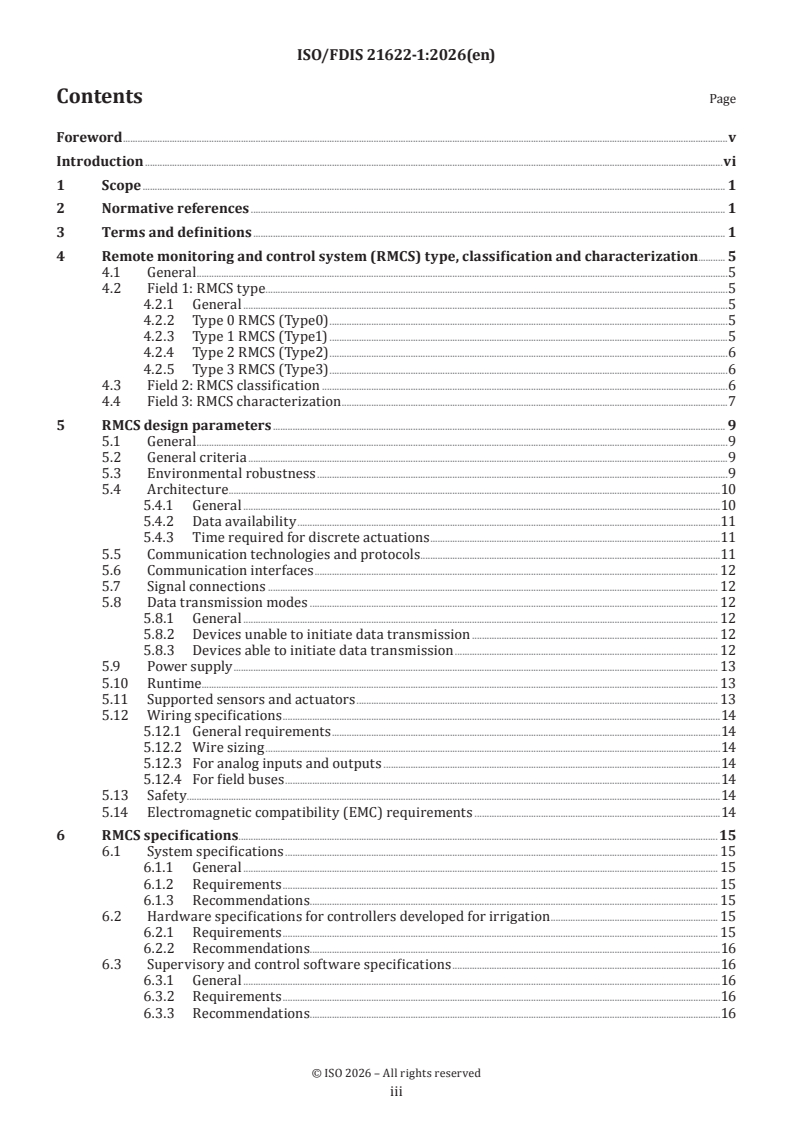
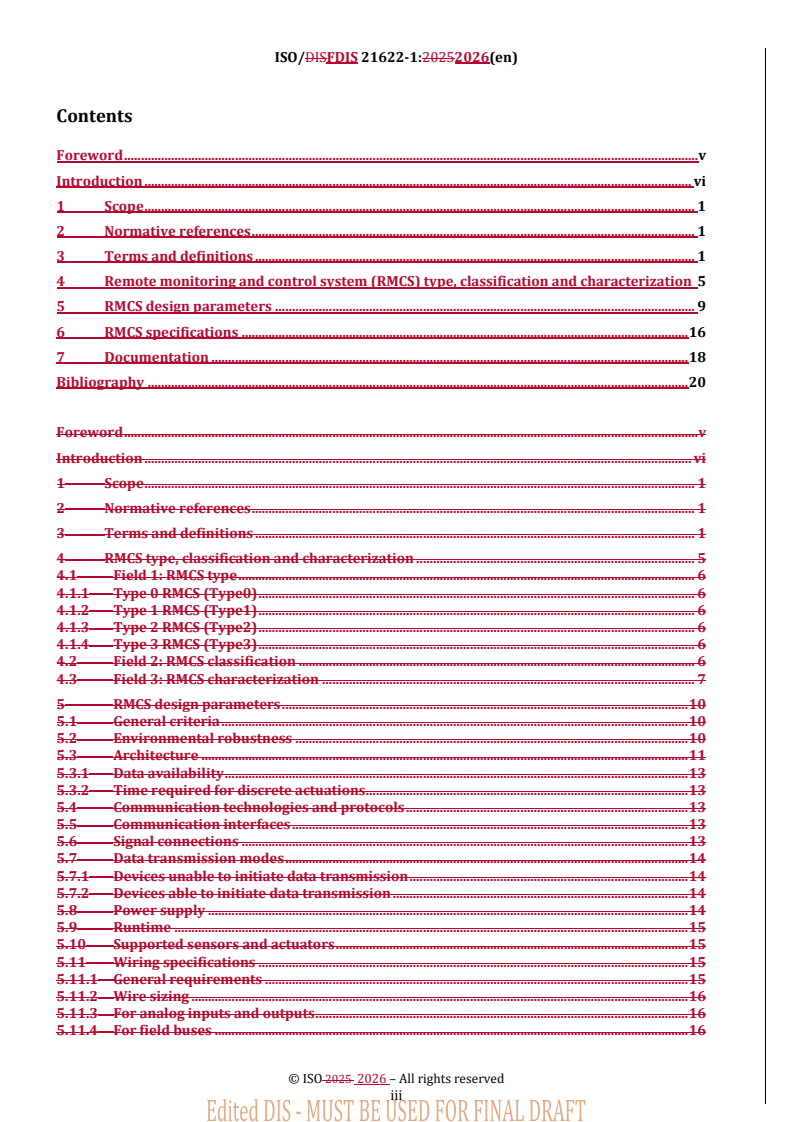
Contents Page
Foreword .v
Introduction .vi
1 Scope . 1
2 Normative references . 1
3 Terms and definitions . 1
4 Remote monitoring and control system (RMCS) type, classification and characterization . 5
4.1 General .5
4.2 Field 1: RMCS type.5
4.2.1 General .5
4.2.2 Type 0 RMCS (Type0) .5
4.2.3 Type 1 RMCS (Type1) .5
4.2.4 Type 2 RMCS (Type2) .6
4.2.5 Type 3 RMCS (Type3) .6
4.3 Field 2: RMCS classification .6
4.4 Field 3: RMCS characterization .7
5 RMCS design parameters . 9
5.1 General .9
5.2 General criteria .9
5.3 Environmental robustness .9
5.4 Architecture .10
5.4.1 General .10
5.4.2 Data availability .11
5.4.3 Time required for discrete actuations .11
5.5 Communication technologies and protocols .11
5.6 Communication interfaces . 12
5.7 Signal connections . 12
5.8 Data transmission modes . 12
5.8.1 General . 12
5.8.2 Devices unable to initiate data transmission . 12
5.8.3 Devices able to initiate data transmission . 12
5.9 Power supply . 13
5.10 Runtime . . . 13
5.11 Supported sensors and actuators . 13
5.12 Wiring specifications .14
5.12.1 General requirements .14
5.12.2 Wire sizing .14
5.12.3 For analog inputs and outputs .14
5.12.4 For field buses .14
5.13 Safety.14
5.14 Electromagnetic compatibility (EMC) requirements .14
6 RMCS specifications .15
6.1 System specifications . 15
6.1.1 General . 15
6.1.2 Requirements . 15
6.1.3 Recommendations. 15
6.2 Hardware specifications for controllers developed for irrigation . 15
6.2.1 Requirements . 15
6.2.2 Recommendations.16
6.3 Supervisory and control software specifications .16
6.3.1 General .16
6.3.2 Requirements .16
6.3.3 Recommendations.16
iii
7 Documentation . 17
Bibliography .18
iv
Foreword
ISO (the International Organization for Standardization) is a worldwide federation of national standards
bodies (ISO member bodies). The work of preparing International Standards is normally carried out through
ISO technical committees. Each member body interested in a subject for which a technical committee
has been established has the right to be represented on that committee. International organizations,
governmental and non-governmental, in liaison with ISO, also take part in the work. ISO collaborates closely
with the International Electrotechnical Commission (IEC) on all matters of electrotechnical standardization.
The procedures used to develop this document and those intended for its further maintenance are described
in the ISO/IEC Directives, Part 1. In particular, the different approval criteria needed for the different types
of ISO document should be noted. This document was drafted in accordance with the editorial rules of the
ISO/IEC Directives, Part 2 (see www.iso.org/directives).
ISO draws attention to the possibility that the implementation of this document may involve the use of (a)
patent(s). ISO takes no position concerning the evidence, validity or applicability of any claimed patent
rights in respect thereof. As of the date of publication of this document, ISO had not received notice of (a)
patent(s) which may be required to implement this document. However, implementers are cautioned that
this may not represent the latest information, which may be obtained from the patent database available at
www.iso.org/patents. ISO shall not be held responsible for identifying any or all such patent rights.
Any trade name used in this document is information given for the convenience of users and does not
constitute an endorsement.
For an explanation of the voluntary nature of standards, the meaning of ISO specific terms and expressions
related to conformity assessment, as well as information about ISO's adherence to the World Trade
Organization (WTO) principles in the Technical Barriers to Trade (TBT), see www.iso.org/iso/foreword.html.
This document was prepared by Technical Committee ISO/TC 23, Tractors and machinery for agriculture and
forestry, Subcommittee SC 18, Irrigation and drainage equipment and systems.
A list of all parts in the ISO 21622 series can be found on the ISO website.
Any feedback or questions on this document should be directed to the user’s national standards body. A
complete listing of these bodies can be found at www.iso.org/members.html.
v
Introduction
In this document, any telecontrol system intended to control and/or monitor processes related to irrigation,
is referred to as remote monitoring and control system (RMCS). Different control devices can be used to
monitor and control an irrigation entity. The different requirements and constrains of the different irrigation
entities will determine and guide the choice of the type of device required in each case.
Monitoring and control of an irrigation entity may be based on different controller technologies (or a
combination thereof) and monitoring data provided by third parties available in the cloud. Some of these
technologies can be used for other purposes unrelated to irrigation. This is the case of programmable
logic controllers (PLCs), remote terminal units (RTUs), industrial personal computers (IPCs) or single
board computers (SBCs), among others. They are normally non-specialized hardware solutions subject to
international standards, such as IEC 61131, using standard programming languages and communication
protocols and supporting other kinds of automation logic. As non-specialized hardware solutions, the
majority are subject to other standards required in industry.
On the other hand, there are controllers that have been developed specifically for irrigation purposes, with
similar capabilities to non-specialized technologies, but which have not been subject to a standardization
process until now.
vi
FINAL DRAFT International Standard ISO/FDIS 21622-1:2026(en)
Irrigation techniques — Remote monitoring and control for
irrigation —
Part 1:
General considerations
1 Scope
This document defines the general considerations applicable to any type of remote monitoring and control
system (RMCS) used in irrigation.
The document also includes some specific clauses on RMCS that fully or partially incorporate controllers
developed for irrigation. These controllers are specific hardware developments designed for specific
irrigation monitoring and/or control requirements.
An indication is given at the beginning of each section that clearly defines when it is specifically intended for
controllers developed for irrigation.
2 Normative references
The following documents are referred to in the text in such a way that some or all of their content constitutes
requirements of this document. For dated references, only the edition cited applies. For undated references,
the latest edition of the referenced document (including any amendments) applies.
ISO 21622-3, Irrigation techniques — Remote monitoring and control for irrigation — Part 3: Interoperability
IEC 60529, Degrees of protection provided by enclosures
IEC 60870-1-1, Telecontrol equipment and systems — Part 1: General considerations — Section One: General
principles
IEC 60870-2-1, Telecontrol equipment and systems — Part 1: Operating conditions — Section 1: Power supply
and electromagnetic compatibility
IEC 60870-2-2, Telecontrol equipment and systems — Part 2: Operating conditions — Section 2: Environmental
conditions (climatic, mechanical and othernon electrical influences)
3 Terms and definitions
For the purposes of this document, the following terms and definitions apply.
ISO and IEC maintain terminology databases for use in standardization at the following addresses:
— ISO Online browsing platform: available at https:// www .iso .org/ obp
— IEC Electropedia: available at https:// www .electropedia .org/
3.1
accumulator
reusable electrical battery which can be charged, discharged with a load, and recharged multiple times
3.2
availability
ability to be in a state to perform as required
[SOURCE: IEV 192-01-23]
3.3
characterization
establishment of descriptive characteristics for some critical components related to communications and
energy supply and relevant to maintenance purposes
3.4
classification
process of establishing descriptive classes of RMCS for irrigation, based on basic information about their
behaviour, in terms of communications and runtime, that is expected at the time they were purchased or
deployed
3.5
component
constituent part of a device which cannot be physically divided into smaller parts without losing its
particular function
[SOURCE: IEV 151-11-21]
3.6
concentrator station
station in a hierarchical telecontrol network where the monitored information coming from outstations is
concentrated for transmission to the master station and where the command information is distributed to
the outstations
Note 1 to entry: In irrigation, this kind of station can also execute the functionalities assigned to a remote station, in
addition to the functionalities related to the RMCS communications.
[SOURCE: IEC 60050-371-06]
3.7
control centre
place where a master station is located
Note 1 to entry: In irrigation, the control centre may be located in local installations or in the cloud.
[SOURCE: IEC 60050-371]
3.8
controller developed for irrigation
electronic controller designed specifically to monitor and control one or more irrigation entity types
Note 1 to entry: In addition to other controllers, a controller developed for irrigation can execute the specific control
tasks required, including input monitoring and output control to perform it. This kind of device may use different
strategies to manage its outputs and inputs, as well as proprietary protocols and programming languages. In this case,
its use shall be limited to monitoring and controlling the irrigation entities for the purpose for which it was designed.
The functionalities of a controller developed for irrigation is normally limited to those that are supported by its
firmware. This means that only the developer/manufacturer of that firmware is able to add or modify functionalities
3.9
dependability
ability to perform as and when required
[SOURCE: IEV 192-01-22]
3.10
device
material element or assembly of the elements that are intended to perform a required function.
Note 1 to entry: In an RMCS, a device is each of the hardware pieces that comprise a system, which are normally:
— Master stations to establish communication links;
— Concentrator stations for data retrieving purposes; and
— Remote stations to control irrigation entities.
Note 2 to entry: – A device may form part of a larger device
[SOURCE: IEV 151-11-20]
3.11
failure
inability to perform as required
[SOURCE: IEV 192-03-01]
3.12
firmware
software contained in a read-only memory device
[SOURCE: IEC60050-192-01]
3.13
irrigation entity
generic name given to a set of equipment designed and built to perform one or more processes related to
irrigation
Note 1 to entry: These processes include, among others, irrigation water intake, adaptation, distribution and
application
Note 2 to entry: An irrigation entity is represented in the physical model, and characterized by a series of properties.
An irrigation entity partially or fully executes a process, depending on the level it occupies in the physical model
3.14
master station
station which performs the control of outstations
Note 1 to entry: In irrigation, this control may be limited to the communication management, without it being
necessary to locate any other operational functionality at this level.
Note 2 to entry: In irrigation, this station need not be a device but a software function.
[SOURCE: IEC60050-371-06-01]
3.15
recoverability
ability to recover from a failure without corrective maintenance
[SOURCE: IEV 192-01-25]
3.16
relay station
radio station which re-transmits a signal carrying the same information as the received signal immediately
or after a delay
[SOURCE: IEV 713-08-06]
3.17
reliability
probability of performing as required for a time interval (t1, t2), under given conditions
[SOURCE: IEV 192-05-05]
3.18
reliability
ability to perform as required, without failure, for a given time interval and under given
conditions
[SOURCE: IEV 192-01-24]
3.19
remote station
station which is monitored or commanded and monitored by a master station
[SOURCE: IEC60050-371-06]
3.20
remote monitoring and control system for irrigation
RMCS
set of hardware devices and software programs used to monitor and/or control – according to predefined
parameters or user decisions – one or more irrigation entities of the physical model.
Note 1 to entry: The usual components of an RMCS are:
— A control application linking data transmission/acquisition and process control; and
— Remote stations.
Note 2 to entry: Additional components may include:
— Front-end communication;
— Concentrator stations; and
— Other intermediate elements such as relay stations, which may be necessary for communication purposes in
retransmitting and/or reducing signal noise.
3.21
runtime
amount of time, in days, during which an RMCS connected to an irrigation entity can continue to operate
without further energy input
EXAMPLE A device connected to a primary 8 Ah battery has an average energy consumption of 0,5 mAh. Based on
this consumption, and assuming that the primary battery is fully charged, its runtime is 16 000 hours (666,67 days).
3.22
software
programs, procedures, rules, documentation and data of an information processing system
[SOURCE: IEC 60050-192-01-07]
3.23
telecontrol
control of operational equipment at a distance using the transmission of information by telecommunication
techniques
Note 1 to entry: Telecontrol may comprise any combination of command, alarm, indication, metering, protection and
tripping facilities without using speech messages.
[SOURCE: IEC 60050-371-01]
4 Remote monitoring and control system (RMCS) type, classification and
characterization
4.1 General
All RMCS can be typified, classified and characterized for descriptive purposes, making it easier for the user
to understand and compare the characteristics of different products as well as the maintenance routines.
The classification and characterization are based on the most critical design parameters for the
geographically-dispersed and isolated conditions that normally exist in irrigation environments:
communications and runtime.
This document proposes the use of codes to typify, classify and characterize an RMCS. The codes shall
contain three fields made up of others:
— Field 1. Related to the RMCS type;
— Field 2. Related to the RMCS class; and
— Field 3. Related to the RMCS characteristics.
For the classification and characterization of an RMCS, multiple power supply and communication options
may be available. In this case, the manufacturer should identify and list them all as part of their product
catalogue. When an option is purchased, the product documentation shall provide information about which
of the possible options it is. When an RMCS does not combine options, the classification and characterization
data shall be valid for the entire RMCS. In the event that the purchase includes two or more options for the
same solution, the manufacturer shall inform the user about those that were purchased, associating each
device with its classification and characterization.
4.2 Field 1: RMCS type
4.2.1 General
The type field establishes descriptive types of RMCS for irrigation, according to their minimum requirements.
The types defined for RMCS for irrigation are based on the minimum requirements established for Type0
RMCS. All other types include Type0 requirements and are related to telecontrol systems with different
reliability levels.
4.2.2 Type 0 RMCS (Type0)
The minimum requirement for this type of RMCS is the ability to monitor the field sensors. Type0 corresponds
to a remote monitoring system without control functions. This type of system includes:
— telemetry systems designed to transmit the values of measure variables from sensors using
telecommunication techniques as defined by IEC 60050-371-01; or
— telemonitoring systems designed to remotely supervise the status of operational equipment using
telecommunication techniques as defined by IEC 60050-371-01.
4.2.3 Type 1 RMCS (Type1)
This type of RMCS is defined by the control functions in its software layer being required to send commands
directly to the actuators under its control. Type1 RMCS is for use in non- critical irrigation entities since its
reliability resides exclusively in its software layer. This system type corresponds to telecontrol systems.
4.2.4 Type 2 RMCS (Type2)
This type of RMCS is defined by the inclusion of concentrator stations supporting the execution of algorithms
and control loops. The Type2 RMCS is more reliable than the Type1 since it distributes the tasks among the
different system devices. This type of system corresponds to telecontrol systems.
4.2.5 Type 3 RMCS (Type3)
This type of system is defined by the capability of its remote stations to execute algorithms and control
loops. It maximizes reliability, making it possible to execute procedures previously sent to the receiving
device, even if other levels of its architecture are not available when the procedure starts or ends. This
system type corresponds to telecontrol systems.
4.3 Field 2: RMCS classification
The classification identifies the basic specifications of an RMCS and defines the expected behaviour of the
RMCS in data refresh terms. In addition, the information related to the power supply provides details about
the energy source of the RMCS devices. The classification code contains data about the communications and
power supply. Each classification code contains two fields with letters and numbers.
— First field, related to communications. The first field contains a Class ID (letter from Table 1) corresponding
to the maximum refresh time for all the irrigation entity data, followed by a 3-figure integer (from 000 to
999), related to the maximum time required to identify and communicate events, indicated in seconds.
— Second field, related to power supply. The second field contains a Class ID (letter from Table 2)
corresponding to the system power generator, followed by a 4-figure number (from 0 000 to 9 999),
related to the runtime provided by the accumulator, indicated in days.
Table 1 — Classification Class ID for communications
Class ID Class definition (maximum refresh time)
A t ≤ 1 second
B 1 s < t ≤ 1 minute
C 1 minute < t ≤ 15 minutes
D 15 minutes < t ≤ 1 hour
E 1 hour < t ≤ 24 hours
F t > 24 hours
Table 2 — Classification Class ID for power supply generators
Class ID Class definition
A No generator
B Kinetic generator
C Electricity grid
D Hydro turbine
E Wind generator
F Photovoltaic panel
G Generator set
H-N Available for new power supply generator classes. Not to be used when the
RMCS uses a technology included in this table.
This l
...
ISO /TC 23/SC 18/WG 8
Date: 2025-08-28
Secretariat: SII
Date: 2026-01-21
Irrigation techniques — Remote monitoring and control for
irrigation systems — —
Part 1:
General considerations
FDIS stage
ISO/DISFDIS 21622-1:2025(E2026(en)
All rights reserved. Unless otherwise specified, or required in the context of its implementation, no part of this publication
may be reproduced or utilized otherwise in any form or by any means, electronic or mechanical, including photocopying,
or posting on the internet or an intranet, without prior written permission. Permission can be requested from either ISO
at the address below or ISO'sISO’s member body in the country of the requester.
ISO Copyright Office copyright office
CP 401 • Ch. de Blandonnet 8
CH-1214 Vernier, Geneva
Phone: + 41 22 749 01 11
Email: copyright@iso.org
E-mail: copyright@iso.org
Website: www.iso.orgwww.iso.org
Published in Switzerland.
ii © ISO 2025 2026 – All rights reserved
ii
ISO/DISFDIS 21622-1:20252026(en)
Contents
Foreword . v
Introduction . vi
1 Scope . 1
2 Normative references . 1
3 Terms and definitions . 1
4 Remote monitoring and control system (RMCS) type, classification and characterization 5
5 RMCS design parameters . 9
6 RMCS specifications . 16
7 Documentation . 18
Bibliography . 20
Foreword . v
Introduction . vi
1 Scope . 1
2 Normative references . 1
3 Terms and definitions . 1
4 RMCS type, classification and characterization . 5
4.1 Field 1: RMCS type . 6
4.1.1 Type 0 RMCS (Type0) . 6
4.1.2 Type 1 RMCS (Type1) . 6
4.1.3 Type 2 RMCS (Type2) . 6
4.1.4 Type 3 RMCS (Type3) . 6
4.2 Field 2: RMCS classification . 6
4.3 Field 3: RMCS characterization . 7
5 RMCS design parameters . 10
5.1 General criteria . 10
5.2 Environmental robustness . 10
5.3 Architecture . 11
5.3.1 Data availability . 13
5.3.2 Time required for discrete actuations. 13
5.4 Communication technologies and protocols . 13
5.5 Communication interfaces . 13
5.6 Signal connections . 13
5.7 Data transmission modes . 14
5.7.1 Devices unable to initiate data transmission . 14
5.7.2 Devices able to initiate data transmission . 14
5.8 Power supply . 14
5.9 Runtime . 15
5.10 Supported sensors and actuators . 15
5.11 Wiring specifications . 15
5.11.1 General requirements . 15
5.11.2 Wire sizing . 16
5.11.3 For analog inputs and outputs . 16
5.11.4 For field buses . 16
iii
ISO/DISFDIS 21622-1:2025(E2026(en)
5.12 Safety. 16
5.13 Electromagnetic compatibility (EMC) requirements . 16
6 RMCS specifications . 16
6.1 System specifications . 16
6.1.1 Required . 17
6.1.2 Desirable . 17
6.2 Hardware specifications for controllers developed for irrigation . 17
6.2.1 Required . 17
6.2.2 Desirable . 17
6.3 Supervisory and control software specifications . 18
6.3.1 Required . 18
6.3.2 Desirable . 18
7 Documentation . 19
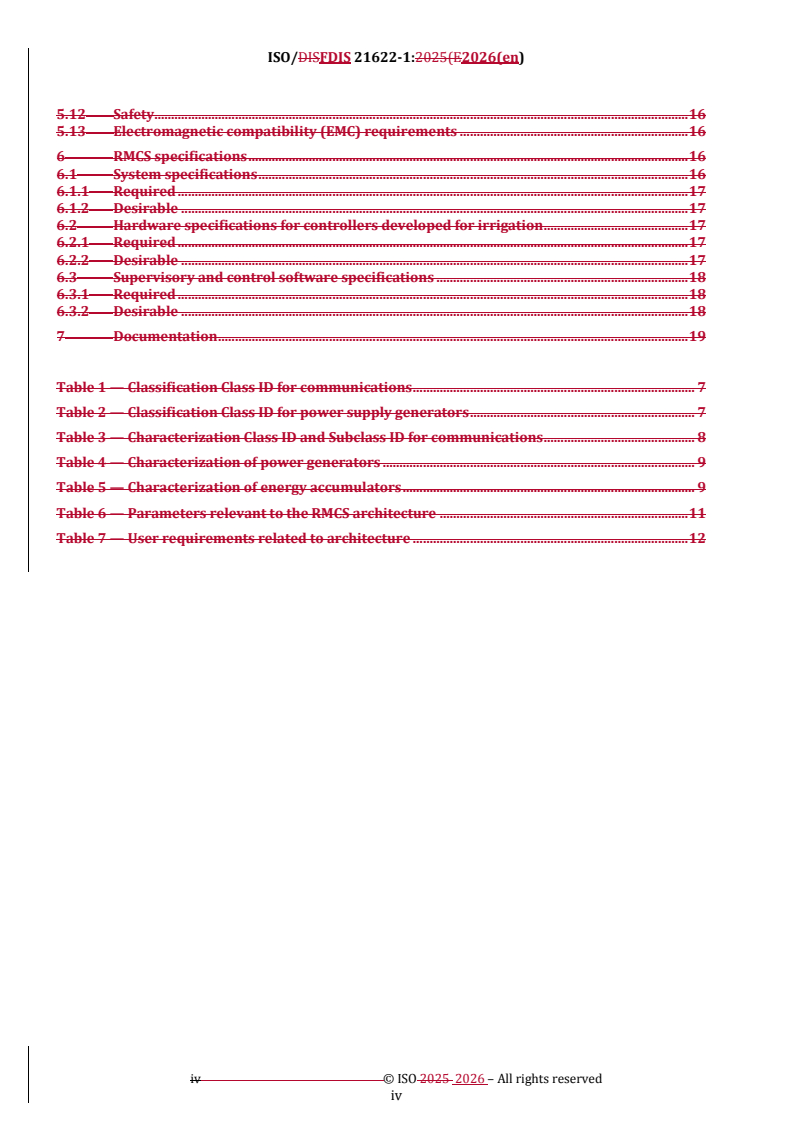
Table 1 — Classification Class ID for communications . 7
Table 2 — Classification Class ID for power supply generators . 7
Table 3 — Characterization Class ID and Subclass ID for communications . 8
Table 4 — Characterization of power generators . 9
Table 5 — Characterization of energy accumulators . 9
Table 6 — Parameters relevant to the RMCS architecture . 11
Table 7 — User requirements related to architecture . 12
iv © ISO 2025 2026 – All rights reserved
iv
ISO/DISFDIS 21622-1:20252026(en)
Foreword
ISO (the International Organization for Standardization) is a worldwide federation of national standards
bodies (ISO member bodies). The work of preparing International Standards is normally carried out through
ISO technical committees. Each member body interested in a subject for which a technical committee has been
established has the right to be represented on that committee. International organizations, governmental and
non-governmental, in liaison with ISO, also take part in the work. ISO collaborates closely with the
International Electrotechnical Commission (IEC) on all matters of electrotechnical standardization.
The procedures used to develop this document and those intended for its further maintenance are described
in the ISO/IEC Directives, Part 1. In particular, the different approval criteria needed for the different types of
ISO document should be noted. This document was drafted in accordance with the editorial rules of the
ISO/IEC Directives, Part 2 (see www.iso.org/directives).
ISO draws attention to the possibility that the implementation of this document may involve the use of (a)
patent(s). ISO takes no position concerning the evidence, validity or applicability of any claimed patent rights
in respect thereof. As of the date of publication of this document, ISO had not received notice of (a) patent(s)
which may be required to implement this document. However, implementers are cautioned that this may not
represent the latest information, which may be obtained from the patent database available at
www.iso.org/patents.www.iso.org/patents. ISO shall not be held responsible for identifying any or all such
patent rights.
Any trade name used in this document is information given for the convenience of users and does not
constitute an endorsement.
For an explanation of the voluntary nature of standards, the meaning of ISO specific terms and expressions
related to conformity assessment, as well as information about ISO's adherence to the World Trade
Organization (WTO) principles in the Technical Barriers to Trade (TBT), see
www.iso.org/iso/foreword.htmlwww.iso.org/iso/foreword.html.
This document was prepared by Technical Committee ISO/TC 23, Tractors and machinery for agriculture and
forestry, Subcommittee SC 18, Irrigation and drainage equipment and systems.
A list of all parts in the ISO 21622 series can be found on the ISO website.
Any feedback or questions on this document should be directed to the user’s national standards body. A
complete listing of these bodies can be found at www.iso.org/members.htmlwww.iso.org/members.html.
v
ISO/DISFDIS 21622-1:2025(E2026(en)
Introduction
In this document, any telecontrol system intended to control and/or monitor processes related to irrigation,
will beis referred to as remote monitoring and control system (RMCS). Different control devices can be used
to monitor and control an irrigation entity. The different requirements and constrains of the different
irrigation entities will determine and guide the choice of the type of device required in each case.
Monitoring and control of an irrigation entity may be based on different controller technologies (or a
combination thereof) and monitoring data provided by third parties available in the cloud. Some of these
technologies can be used for other purposes unrelated to irrigation. This is the case of programmable logic
controllers (PLCs), remote terminal units (RTUs), industrial personal computers (IPCs) or single board
computers (SBCs), among others. They are normally non-specialized hardware solutions subject to
international standards, such as IEC 61131, using standard programming languages and communication
protocols and supporting other kinds of automation logic. As non-specialized hardware solutions, the majority
are subject to other standards required in industry.
On the other hand, there are controllers that have been developed specifically for irrigation purposes, with
similar capabilities to non-specialized technologies, but which have not been subject to a standardization
process until now.
vi © ISO 2025 2026 – All rights reserved
vi
DRAFT International Standard ISO/DIS 21622-1:2025(en)
Irrigation techniques — Remote monitoring and control for irrigation
systems — —
Part 1:
General considerations
1 Scope
This document defines the general considerations applicable to any type of RMCSremote monitoring and
control system (RMCS) used in irrigation.
The document also includes some specific clauses on RMCS that fully or partially incorporate controllers
developed for irrigation. These controllers are specific hardware developments designed for specific irrigation
monitoring and/or control requirements.
An indication is given at the beginning of each section that clearly defines when it is specifically intended for
controllers developed for irrigation.
2 Normative references
The following documents are referred to in the text in such a way that some or all of their content constitutes
requirements of this document. For dated references, only the edition cited applies. For undated references,
the latest edition of the referenced document (including any amendments) applies.
ISO 21622-2, Irrigation techniques — Remote monitoring and control for irrigation — Part 2: Tests
ISO 21622-ISO 21622-3, Irrigation techniques — Remote monitoring and control for irrigation — Part 3:
Interoperability
IEC 60529:2001, Degrees of protection provided by enclosures
IEC 60870--1-1, Telecontrol equipment and systems. — Part 1: General considerations — Section One: General
principles
IEC 60870-1-2, General considerations — Section Two: Guide for specifications
IEC 60870--2-1, Telecontrol equipment and systems -— Part 1: Operating conditions — Section 1: Power supply
and electromagnetic compatibility
IEC 60870--2-2, Telecontrol equipment and systems -— Part 2: Operating conditions — Section 2:
Environmental conditions (climatic, mechanical and othernon electrical influences)
IPC-A-610, Acceptability of Electronic Assemblies
43 Terms and definitions
For the purposes of this document, the following terms and definitions apply.
ISO and IEC maintain terminology databases for use in standardization at the following addresses:
— — ISO Online browsing platform: available at https://www.iso.org/obphttps://www.iso.org/obp
— — IEC Electropedia: available at https://www.electropedia.org/https://www.electropedia.org/
3.1 3.1
accumulator
reusable electrical battery which can be charged, discharged with a load, and recharged multiple times
3.2 3.2
availability
ability to be in a state to perform as required
[SOURCE: IEV 192-01-23]
3.3 3.3
characterization
establishment of descriptive characteristics for some critical components related to communications and
energy supply and relevant to maintenance purposes
3.4 3.4
classification
process of establishing descriptive classes of RMCS for irrigation, based on basic information about their
behaviorbehaviour, in terms of communications and runtime, that is expected at the time they were purchased
or deployed
3.5 3.5
component
constituent part of a device which cannot be physically divided into smaller parts without losing its particular
function
[SOURCE: IEV 151-11-21]
3.6 3.6
concentrator station
station in a hierarchical telecontrol network where the monitored information coming from outstations is
concentrated for transmission to the master station and where the command information is distributed to the
outstations
Note 1 to entry: In irrigation, this kind of station can also execute the functionalities assigned to a remote station, in
addition to the functionalities related to the RMCS communications.
[SOURCE: IEC 60050-371-06: Telecontrol station networks and configurations]
3.7 3.7
control centre
place where a master station is located
Note 1 to entry: In irrigation, the control centre may be located in local installations or in the cloud.
[SOURCE: IEC 60050-371-06: Telecontrol stations networks and configurations]
3.8 3.8
controller developed for irrigation
electronic controller designed specifically to monitor and control one or more irrigation entity types
2 © ISO 2025 2026 – All rights reserved
Note 1 to entry: In addition to other controllers, a controller developed for irrigation can execute the specific control
tasks required, including input monitoring and output control to perform it. This kind of device may use different
strategies to manage its outputs and inputs, as well as proprietary protocols and programming languages. In this case, its
use shall be limited to monitoring and controlling the irrigation entities for the purpose for which it was designed. The
functionalities of a controller developed for irrigation is normally limited to those that are supported by its firmware.
This means that only the developer/manufacturer of that firmware is able to add or modify functionalities
3.9 3.9
dependability
ability to perform as and when required
[SOURCE: IEV 192-01-22]
3.10 3.10
device
material element or assembly of the elements that are intended to perform a required function.
Note 2 1 to entry: In an RMCS, a device is each of the hardware pieces that comprise a system, which are normally:
— — Master stations to establish communication links;
— — Concentrator stations for data retrieving purposes; and
— — Remote stations to control irrigation entities.
Note 1 2 to entry: – A device may form part of a larger device
[SOURCE: IEV 151-11-20]
3.11 3.11
failure
inability to perform as required
[SOURCE: IEV 192-03-01]
3.12 3.12
firmware
software contained in a read-only memory device
[SOURCE: IEC60050-192-01: Basic concepts]
3.13 3.13
irrigation entity
generic name given to a set of equipment designed and built to perform one or more processes related to
irrigation
Note 1 to entry: These processes include, among others, irrigation water intake, adaptation, distribution and application
Note 2 to entry: An irrigation entity is represented in the physical model, and characterized by a series of properties.
An irrigation entity partially or fully executes a process, depending on the level it occupies in the physical model
3.14 3.14
master station
station which performs the control of outstations
Note 1 to entry: In irrigation, this control may be limited to the communication management, without it being necessary
to locate any other operational functionality at this level.
Note 2 to entry: In irrigation, this station need not be a device but a software function.
[SOURCE: IEC60050-371-06: Telecontrol stations networks and configurations-01]
3.15 3.15
recoverability
ability to recover from a failure without corrective maintenance
[SOURCE: IEV 192-01-25]
3.16 3.16
relay station
radio station which re-transmits a signal carrying the same information as the received signal immediately or
after a delay
[SOURCE: IEV 713-08-06]
3.17 3.17
reliability
probability of performing as required for a time interval (t1, t2), under given conditions
[SOURCE: IEV 192-05-05]
3.18 3.18
reliability
ability to perform as required, without failure, for a given time interval and under given conditions
[SOURCE: IEV 192-01-24]
3.19 3.19
remote station
station which is monitored or commanded and monitored by a master station
[SOURCE: IEC60050-371-06: Telecontrol stations networks and configurations]
3.20 3.20
remote monitoring and control system for irrigation
RMCS
set of hardware devices and software programs used to monitor and/or control – according to predefined
parameters or user decisions – one or more irrigation entities of the physical model.
Note 1 to entry: The usual components of an RMCS are:
— — A control application linking data transmission/acquisition and process control; and
— — Remote stations.
Note 2 to entry: Additional components may include:
— — Front-end communication;
— — Concentrator stations; and
— — Other intermediate elements such as relay stations, which may be necessary for communication purposes in
retransmitting and/or reducing signal noise.
4 © ISO 2025 2026 – All rights reserved
3.21 3.21
runtime
amount of time, in days, during which an RMCS connected to an irrigation entity can continue to operate
without further energy input
EXAMPLE A device connected to a primary 8 Ah battery has an average energy consumption of 0,5 mAh. Based on
this consumption, and assuming that the primary battery is fully charged, its runtime is 16 000 hours (666,67 days).
3.22 3.22
software
programs, procedures, rules, documentation and data of an information processing system
[SOURCE: IEC60050IEC 60050-192-01: Basic concepts-07]
3.23 3.23
telecontrol
control of operational equipment at a distance using the transmission of information by telecommunication
techniques
Note 1 to entry: Telecontrol may comprise any combination of command, alarm, indication, metering, protection and
tripping facilities without using speech messages.
[SOURCE: IEC 60050-371-01: General items]
3.24
validation
confirmation, through providing objective evidence, that the requirements for a specific intended use or
application have been fulfilled
[SOURCE: ISO 9000]
54 Remote monitoring and control system (RMCS) type, classification and
characterization
5.14.1 General
All RMCS can be typified, classified and characterized for descriptive purposes, making it easier for the user
to understand and compare the characteristics of different products as well as the maintenance routines.
The classification and characterization isare based on the most critical design parameters for the
geographically-dispersed and isolated conditions that normally exist in irrigation environments:
communications and runtime.
This document proposes the use of codes to typify, classify and characterize an RMCS. The codes shall contain
three fields made up of others:
— — Field 1. Related to the RMCS type;
— — Field 2. Related to the RMCS class; and
— — Field 3. Related to the RMCS characteristics.
For the classification and characterization of an RMCS, multiple power supply and communication options
may be available. In this case, the manufacturer should identify and list them all as part of their product
catalogue. When an option is purchased, the product documentation shall provide information about which of
the possible options it is. When an RMCS does not combine options, the classification and characterization
data shall be valid for the entire RMCS. In the event that the purchase includes two or more options for the
same solution, the manufacturer shall inform the user about those that were purchased, associating each
device with its classification and characterization.
5.24.2 Field 1: RMCS type
4.2.1 General
The type field establishes descriptive types of RMCS for irrigation, according to their minimum requirements.
The types defined for RMCS for irrigation are based on the minimum requirements established for Type0
RMCS. All other types include Type0 requirements and are related to telecontrol systems with different
reliability levels.
5.2.14.2.2 Type 0 RMCS (Type0)
The minimum requirement for this type of RMCS is the ability to monitor the field sensors. Type0 corresponds
to a remote monitoring system without control functions. This type of system includes:
— — telemetry systems designed to transmit the values of measure variables from sensors using
telecommunication techniques as defined by IEC 60050-371-01:,; or;
— — telemonitoring systems designed to remotely supervise the status of operational equipment using
telecommunication techniques as defined by IEC 60050-371-01.
5.2.24.2.3 Type 1 RMCS (Type1)
This type of RMCS is defined by the control functions in its software layer being required to send commands
directly to the actuators under its control. Type1 RMCS is for use in non- critical irrigation entities since its
reliability resides exclusively in its software layer. This system type corresponds to telecontrol systems.
5.2.34.2.4 Type 2 RMCS (Type2)
This type of RMCS is defined by the inclusion of concentrator stations supporting the execution of algorithms
and control loops. The Type2 RMCS is more reliable than the Type1 since it distributes the tasks among the
different system devices. This type of system corresponds to telecontrol systems.
5.2.44.2.5 Type 3 RMCS (Type3)
This type of system is defined by the capability of its remote stations to execute algorithms and control loops.
It maximizes reliability, making it possible to execute procedures previously sent to the receiving device, even
if other levels of its architecture are not available when the procedure starts or ends. This system type
corresponds to telecontrol systems.
5.34.3 Field 2: RMCS classification
The classification identifies the basic specifications of an RMCS and defines the expected behaviour of the
RMCS in data refresh terms. In addition, the information related to the power supply provides details about
the energy source of the RMCS devices. The classification code contains data about the communications and
power supply. Each classification code contains two fields with letters and numbers.
— — First field, related to communications. The first field contains a Class ID (letter from Table 1 –
Classification Class ID for communications)0) corresponding to the maximum refresh time for all the
irrigation entity data, followed by a 3-figure integer (from 000 to 999), related to the maximum time
required to identify and communicate events, indicated in seconds.
6 © ISO 2025 2026 – All rights reserved
— — Second field, related to power supply. The second field contains a Class ID (letter from Table 2 –
Classification Class ID for power supply)0) corresponding to the system power generator, followed by a
4-figure number (from 0 000 to 9 999), related to the runtime provided by the accumulator, indicated in
days.
Table 1 — Classification Class ID for communications
Class ID Class definition (maximum refresh time)
A t ≤ 1 second
B 1 s < t ≤ 1 minute
C 1 minute < t ≤ 15 minutes
D 15 minutes < t ≤ 1 hour
E 1 hour < t ≤ 24 hours
F t > 24 hours
Table 2 — Classification Class ID for power supply generators
Class ID Class definition
A No generator
B Kinetic generator
C Electricity grid
D Hydro turbine
E Wind generator
F Photovoltaic panel
G Generator set
H-N Available for new power supply generator classes. Not to be used when the
RMCS uses a technology included in this table.
This list may be extended by adding new power generator technologies (from H to N).
5.44.4 Field 3: RMCS characterization
The characterization of an RMCS identifies technical specifications for maintenance purposes. The
characterization code contains extended data about communications and power supply. Each characterization
code contains three fields with letters and numbers.
— — First field, related to communications. The first field contains a Class ID (letter) and Subclass ID (2-
figure number), both from Table 3;0;
— — Second field, related to the power generation. The second field contains a Class ID (letter) and Subclass
ID (1-figure number) both from Table 4;0; and
— — Third field, related to the energy accumulator. The third field contains a Class ID (2-figure number
from Table 5).0).
Table 3 — Characterization Class ID and Subclass ID for communications
Class ID Class description Subclass ID Subclass description
O Optical fiberfibre 01 Single-mode
Class ID Class description Subclass ID Subclass description
02 Multi-mode
P Electricity cable 01 BUS with power supply
02 BUS without power supply
Q Infrared 00 Default value
R Radiofrequency 01 VHF with license
02 UHF ISM 433
03 UHF ISM 868/869/915
04 UHF with license
05 GSM/GPRS/UMTS
06 WIFI 2.,4 GHz
07 WIFI 5 GHz
08 WIMAX
09 Bluetooth
10 Zigbee
11 Microwave
12 One-way satellite
13 Two-way satellite
14 VHF ISM 169
15-99 Available for other radio technologies other than
...
Questions, Comments and Discussion
Ask us and Technical Secretary will try to provide an answer. You can facilitate discussion about the standard in here.
Loading comments...