

ISO 37158:2019
(Main)Smart community infrastructures — Smart transportation using battery-powered buses for passenger services
General Information
- Abstract
This document specifies a procedure for the introduction of smart transportation to city centres by means of battery-powered buses. This service contributes to a clean atmosphere and a relatively quiet environment while offering services that provide safe and comfortable rides for citizens.
- Status
- Published
- Publication Date
- 01-Aug-2019
- Current Stage
- 9093 - International Standard confirmed
- Start Date
- 04-Jul-2025
- Completion Date
- 29-Aug-2026
Buy Documents

ISO 37158:2019 - Smart community infrastructures -- Smart transportation using battery-powered buses for passenger services
ISO 37158:2019 - Smart community infrastructures — Smart transportation using battery-powered buses for passenger services/2/2019
Overview
ISO 37158:2019 - Smart community infrastructures: Smart transportation using battery-powered buses for passenger services specifies a procedure for introducing battery-powered buses into city-centre transit. The standard focuses on maintaining or improving service quality while reducing air pollution, greenhouse gas (GHG) emissions, noise and vibration. It promotes substitution of internal-combustion-engine buses with battery-powered buses without disrupting existing schedules, facilities or passenger services.
Key Topics
- Scope and intent: Guidance for planning and operating battery-powered bus services that deliver safe, comfortable rides and a cleaner, quieter urban environment.
- Minimum operational requirements:
- Recharging: Recharging (or battery swap/wireless charging if it does not disturb operations) must fit existing work schedules and terminal stand-by times. Electrical capacity and renewable energy options are considered.
- Scheduling / dispatching: Timetables and dispatch processes should continue to support current service performance when replacing diesel buses with electric buses.
- Maintenance: Cleaning, inspection and overhaul should be integrated into current maintenance schedules as far as practical.
- Passenger services: Fare payment, boarding, seating and capacity must not be degraded by the transition.
- Safety & ride comfort: Battery-powered buses should provide safer, smoother acceleration/braking than combustion buses; use published metrics to demonstrate improvement.
- Operational conditions: Operate under same weather, climate and driving conditions as conventional buses; no special driver skills should be necessary (though emergency procedures may differ).
- Energy saving: Optimize schedules and driving performance to minimize battery energy consumption.
- Quality maintenance:
- Monitor parameters such as traffic flow, share of battery-bus transport, air pollution level (including GHGs), noise/vibration, and onboard safety incidents.
- Modify operating conditions if observed parameters do not improve or remain unchanged.
Applications
ISO 37158:2019 is practical for:
- City planners and municipal governments planning low-emission urban transport solutions.
- Transit agencies and operators transitioning fleets to battery-powered buses while preserving service quality.
- Vehicle manufacturers and system integrators designing buses and charging infrastructure compatible with existing operations.
- Energy utilities and infrastructure providers assessing charging capacity and renewable integration.
- Policy makers and sustainability officers who need standardized guidance to reduce urban air pollution and noise.
Related Standards
- ISO 37101:2016 (sustainable cities and communities) is referenced as a related purpose framework. Work was prepared by ISO/TC 268 (Sustainable cities and communities).
Keywords: ISO 37158:2019, smart community infrastructures, smart transportation, battery-powered buses, electric buses, recharging, scheduling, maintenance, ride comfort, energy saving, air pollution, GHG, urban transit.
Relations
- Consolidated By
ISO 15027-3:2026 - Immersion suits — Part 3: Test methods - Effective Date
- 06-Jun-2022
Buy Documents
ISO 37158:2019 - Smart community infrastructures -- Smart transportation using battery-powered buses for passenger services
ISO 37158:2019 - Smart community infrastructures — Smart transportation using battery-powered buses for passenger services/2/2019
Get Certified
Connect with accredited certification bodies for this standard

BSI Group
BSI (British Standards Institution) is the business standards company that helps organizations make excellence a habit.

Bureau Veritas
Bureau Veritas is a world leader in laboratory testing, inspection and certification services.

DNV
DNV is an independent assurance and risk management provider.
Sponsored listings
Frequently Asked Questions
ISO 37158:2019 is a standard published by the International Organization for Standardization (ISO). Its full title is "Smart community infrastructures — Smart transportation using battery-powered buses for passenger services". This standard covers: This document specifies a procedure for the introduction of smart transportation to city centres by means of battery-powered buses. This service contributes to a clean atmosphere and a relatively quiet environment while offering services that provide safe and comfortable rides for citizens.
This document specifies a procedure for the introduction of smart transportation to city centres by means of battery-powered buses. This service contributes to a clean atmosphere and a relatively quiet environment while offering services that provide safe and comfortable rides for citizens.
ISO 37158:2019 is classified under the following ICS (International Classification for Standards) categories: 03.220.20 - Road transport; 13.020.20 - Environmental economics. Sustainability. The ICS classification helps identify the subject area and facilitates finding related standards.
ISO 37158:2019 has the following relationships with other standards: It is inter standard links to ISO 15027-3:2026. Understanding these relationships helps ensure you are using the most current and applicable version of the standard.
ISO 37158:2019 is available in PDF format for immediate download after purchase. The document can be added to your cart and obtained through the secure checkout process. Digital delivery ensures instant access to the complete standard document.
Standards Content (Sample)
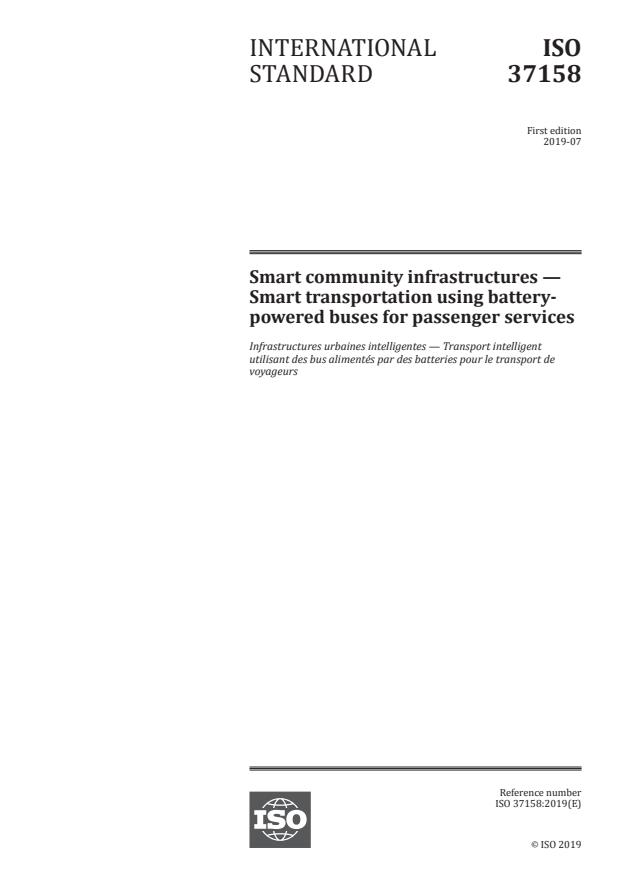
INTERNATIONAL ISO
STANDARD 37158
First edition
2019-07
Smart community infrastructures —
Smart transportation using battery-
powered buses for passenger services
Infrastructures urbaines intelligentes — Transport intelligent
utilisant des bus alimentés par des batteries pour le transport de
voyageurs
Reference number
©
ISO 2019
© ISO 2019
All rights reserved. Unless otherwise specified, or required in the context of its implementation, no part of this publication may
be reproduced or utilized otherwise in any form or by any means, electronic or mechanical, including photocopying, or posting
on the internet or an intranet, without prior written permission. Permission can be requested from either ISO at the address
below or ISO’s member body in the country of the requester.
ISO copyright office
CP 401 • Ch. de Blandonnet 8
CH-1214 Vernier, Geneva
Phone: +41 22 749 01 11
Fax: +41 22 749 09 47
Email: copyright@iso.org
Website: www.iso.org
Published in Switzerland
ii © ISO 2019 – All rights reserved
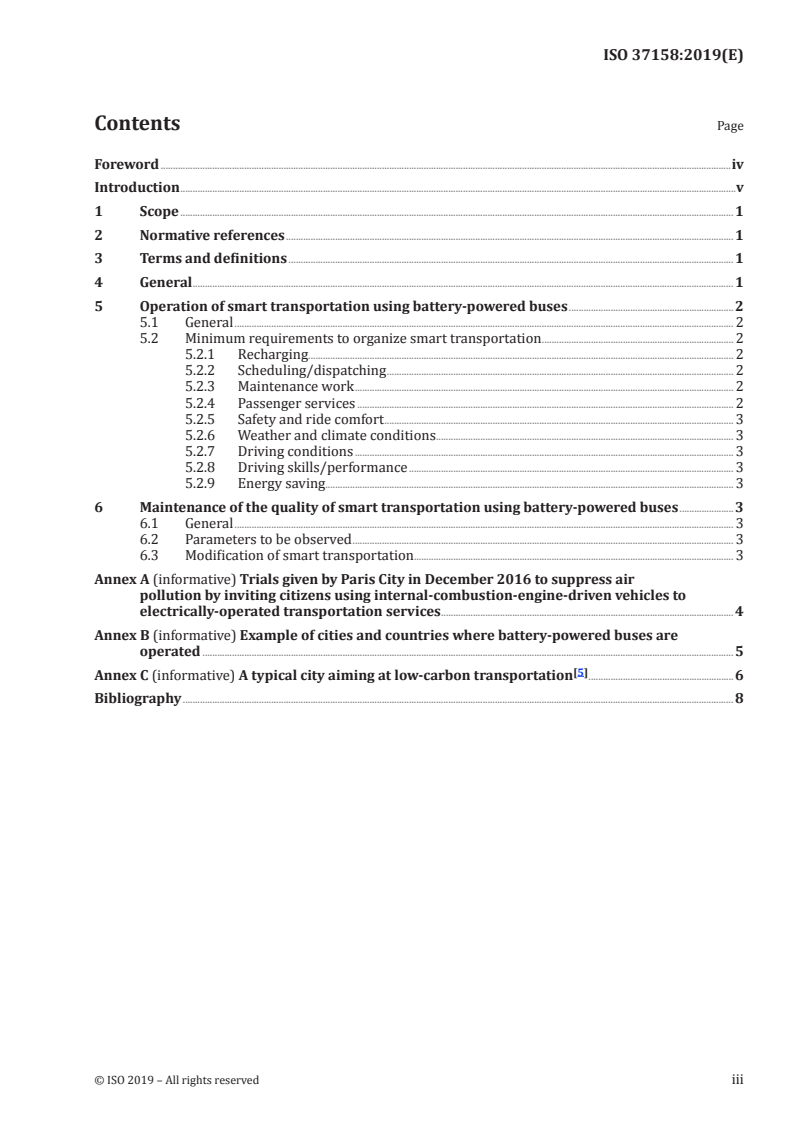
Contents Page
Foreword .iv
Introduction .v
1 Scope . 1
2 Normative references . 1
3 Terms and definitions . 1
4 General . 1
5 Operation of smart transportation using battery-powered buses . 2
5.1 Gener al . 2
5.2 Minimum requirements to organize smart transportation . 2
5.2.1 Recharging . . 2
5.2.2 Scheduling/dispatching . 2
5.2.3 Maintenance work . 2
5.2.4 Passenger services . 2
5.2.5 Safety and ride comfort . 3
5.2.6 Weather and climate conditions . 3
5.2.7 Driving conditions . 3
5.2.8 Driving skills/performance . 3
5.2.9 Energy saving . . . 3
6 Maintenance of the quality of smart transportation using battery-powered buses .3
6.1 General . 3
6.2 Parameters to be observed . 3
6.3 Modification of smart transportation. 3
Annex A (informative) Trials given by Paris City in December 2016 to suppress air
pollution by inviting citizens using internal-combustion-engine-driven vehicles to
electrically-operated transportation services . 4
Annex B (informative) Example of cities and countries where battery-powered buses are
operated . 5
[5]
Annex C (informative) A typical city aiming at low-carbon transportation .6
Bibliography . 8
Foreword
ISO (the International Organization for Standardization) is a worldwide federation of national standards
bodies (ISO member bodies). The work of preparing International Standards is normally carried out
through ISO technical committees. Each member body interested in a subject for which a technical
committee has been established has the right to be represented on that committee. International
organizations, governmental and non-governmental, in liaison with ISO, also take part in the work.
ISO collaborates closely with the International Electrotechnical Commission (IEC) on all matters of
electrotechnical standardization.
The procedures used to develop this document and those intended for its further maintenance are
described in the ISO/IEC Directives, Part 1. In particular, the different approval criteria needed for the
different types of ISO documents should be noted. This document was drafted in accordance with the
editorial rules of the ISO/IEC Directives, Part 2 (see www .iso .org/directives).
Attention is drawn to the possibility that some of the elements of this document may be the subject of
patent rights. ISO shall not be held responsible for identifying any or all such patent rights. Details of
any patent rights identified during the development of the document will be in the Introduction and/or
on the ISO list of patent declarations received (see www .iso .org/patents).
Any trade name used in this document is information given for the convenience of users and does not
constitute an endorsement.
For an explanation of the voluntary nature of standards, the meaning of ISO specific terms and
expressions related to conformity assessment, as well as information about ISO's adherence to the
World Trade Organization (WTO) principles in the Technical Barriers to Trade (TBT) see www .iso
.org/iso/foreword .html.
This document was prepared by Technical Committee ISO/TC 268, Sustainable cities and communities,
Subcommittee SC 1, Smart community infrastructures.
Any feedback or questions on this document should be directed to the user’s national standards body. A
complete listing of these bodies can be found at www .iso .org/members .html.
iv © ISO 2019 – All rights reserved
Introduction
City centres, often small areas, are frequently congested with internal-combustion-engine-driven
vehicles. This creates significant city issues, including air pollution from greenhouse gases (GHGs)
and irritation to citizens from noise and vibration. The number of internal-combustion-engine-driven
private vehicles nowadays is small. Heavy trucks, which are commonly driven by internal combustion
engines, are not allowed in city centres. Thus, the main source of such air pollution and environmental
irritation is now commercial vehicles, i.e. buses equipped with internal combustion engines (see
Annex A). Fuel energy is more efficiently converted to driving forces by motors consuming electric
power generated from fuel than by engines directly burning fuel. Therefore, motor-driven or battery-
powered buses are suitable options for transportation vehicles.
Bus transportation systems offer convenient and casual transport for citizens in all cities as they can
operate in narrow streets in accordance with passenger flow changes in a city and require minimum
facilities for bus stops. However, although bus journeys are popular among citizens, the ride comfort is
not always of a high quality due to sudden stops to avoid collisions or traffic accidents, and irritating
jerky movements caused by the traction mechanism in the internal combustion engine driving systems.
Such behaviour can give passengers motion sickness or discomfort or even lead to injuries.
At the same time as promoting modal shifts from conventional to alternative systems, service
performance and quality should be maintained or improved, in particular regarding low environmental
impact, safe and steady operation and passenger ride comfort. Battery-powered bus transportation
systems are now commonly used for short-distance transportation and contribute to solving the issues
mentioned previously in a number of cities across the world (see Annex B).
INTERNATIONAL STANDARD ISO 37158:2019(E)
Smart community infrastructures — Smart transportation
using battery-powered buses for passenger services
1 Scope
This document specifies a procedure for the introduction of smart transportation to city centres by
means of battery-powered buses. This service contributes to a clean atmosphere and a relatively quiet
environment while offering services that provide safe and comfortable rides for citizens.
2 Normative references
There are no normative references in this document.
3 Terms and definitions
For the purposes of this document, the following terms and definitions apply.
ISO and IEC maintain terminological databases for use in standardization at the following addresses:
— ISO Online browsing platform: available at https: //www .iso .org/obp
— IEC Electropedia: available at http: //www .electropedia .org/
3.1
battery-powered bus
bus run by electric power that is provided only with onboard rechargeable batteries
3.2
rechargeable battery
battery which can be recharged within an allowable waiting time for the next operation
Note 1 to entry: Batteries which do not cause any change to currently organized bus service operations are to
be used in smart transportation. In this case, battery recharging should be completed in the same bus operation
schedule as already adopted so that buses currently in service can simply and successfully be replaced with
battery-powered buses.
3.3
recharging
putting an electrical charge back into battery-powered buses
Note 1 to entry: Recharging can be done by directly applying voltage to batteries onboard or, if the work can be
completed in the current allowable waiting time, by swapping discharged and fully charged batteries. Wireless
charging while battery-powered buses are running could be another way to recharge batteries onboard, if this
procedure does not disturb current bus operation.
4 General
Battery-powered buses are driven with traction motor
...
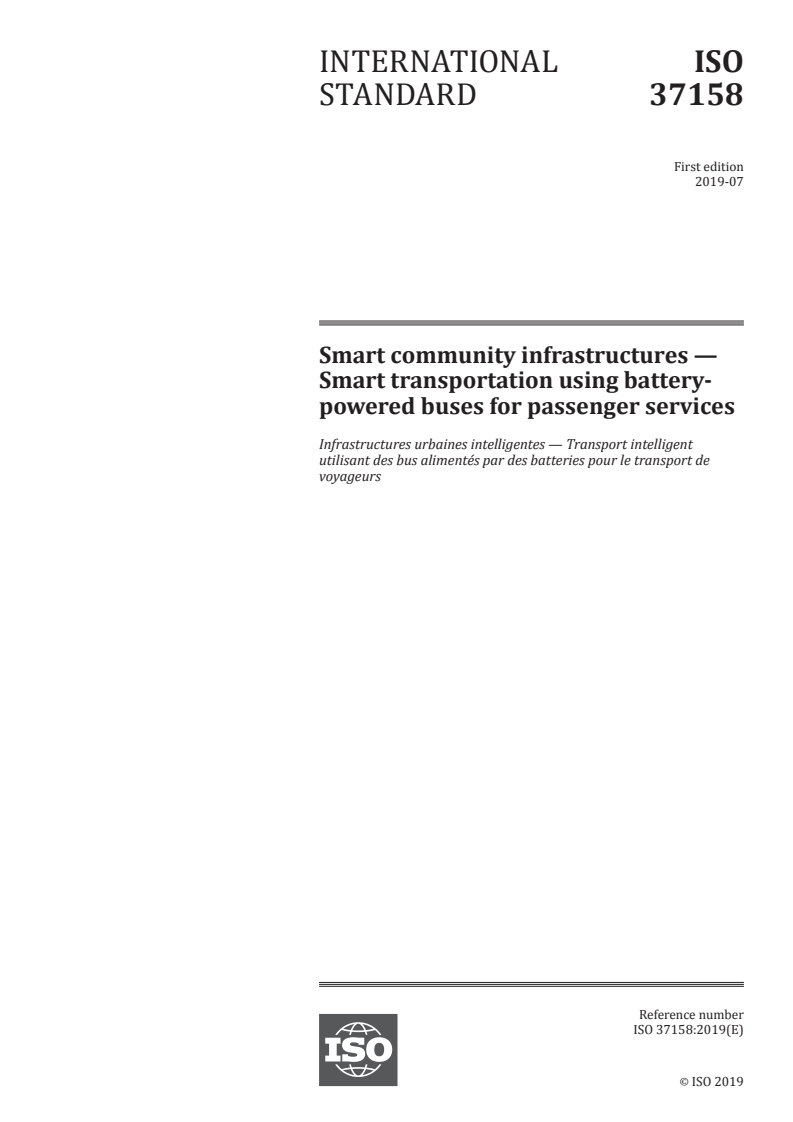
INTERNATIONAL ISO
STANDARD 37158
First edition
2019-07
Smart community infrastructures —
Smart transportation using battery-
powered buses for passenger services
Infrastructures urbaines intelligentes — Transport intelligent
utilisant des bus alimentés par des batteries pour le transport de
voyageurs
Reference number
©
ISO 2019
© ISO 2019
All rights reserved. Unless otherwise specified, or required in the context of its implementation, no part of this publication may
be reproduced or utilized otherwise in any form or by any means, electronic or mechanical, including photocopying, or posting
on the internet or an intranet, without prior written permission. Permission can be requested from either ISO at the address
below or ISO’s member body in the country of the requester.
ISO copyright office
CP 401 • Ch. de Blandonnet 8
CH-1214 Vernier, Geneva
Phone: +41 22 749 01 11
Fax: +41 22 749 09 47
Email: copyright@iso.org
Website: www.iso.org
Published in Switzerland
ii © ISO 2019 – All rights reserved
Contents Page
Foreword .iv
Introduction .v
1 Scope . 1
2 Normative references . 1
3 Terms and definitions . 1
4 General . 1
5 Operation of smart transportation using battery-powered buses . 2
5.1 Gener al . 2
5.2 Minimum requirements to organize smart transportation . 2
5.2.1 Recharging . . 2
5.2.2 Scheduling/dispatching . 2
5.2.3 Maintenance work . 2
5.2.4 Passenger services . 2
5.2.5 Safety and ride comfort . 3
5.2.6 Weather and climate conditions . 3
5.2.7 Driving conditions . 3
5.2.8 Driving skills/performance . 3
5.2.9 Energy saving . . . 3
6 Maintenance of the quality of smart transportation using battery-powered buses .3
6.1 General . 3
6.2 Parameters to be observed . 3
6.3 Modification of smart transportation. 3
Annex A (informative) Trials given by Paris City in December 2016 to suppress air
pollution by inviting citizens using internal-combustion-engine-driven vehicles to
electrically-operated transportation services . 4
Annex B (informative) Example of cities and countries where battery-powered buses are
operated . 5
[5]
Annex C (informative) A typical city aiming at low-carbon transportation .6
Bibliography . 8
Foreword
ISO (the International Organization for Standardization) is a worldwide federation of national standards
bodies (ISO member bodies). The work of preparing International Standards is normally carried out
through ISO technical committees. Each member body interested in a subject for which a technical
committee has been established has the right to be represented on that committee. International
organizations, governmental and non-governmental, in liaison with ISO, also take part in the work.
ISO collaborates closely with the International Electrotechnical Commission (IEC) on all matters of
electrotechnical standardization.
The procedures used to develop this document and those intended for its further maintenance are
described in the ISO/IEC Directives, Part 1. In particular, the different approval criteria needed for the
different types of ISO documents should be noted. This document was drafted in accordance with the
editorial rules of the ISO/IEC Directives, Part 2 (see www .iso .org/directives).
Attention is drawn to the possibility that some of the elements of this document may be the subject of
patent rights. ISO shall not be held responsible for identifying any or all such patent rights. Details of
any patent rights identified during the development of the document will be in the Introduction and/or
on the ISO list of patent declarations received (see www .iso .org/patents).
Any trade name used in this document is information given for the convenience of users and does not
constitute an endorsement.
For an explanation of the voluntary nature of standards, the meaning of ISO specific terms and
expressions related to conformity assessment, as well as information about ISO's adherence to the
World Trade Organization (WTO) principles in the Technical Barriers to Trade (TBT) see www .iso
.org/iso/foreword .html.
This document was prepared by Technical Committee ISO/TC 268, Sustainable cities and communities,
Subcommittee SC 1, Smart community infrastructures.
Any feedback or questions on this document should be directed to the user’s national standards body. A
complete listing of these bodies can be found at www .iso .org/members .html.
iv © ISO 2019 – All rights reserved
Introduction
City centres, often small areas, are frequently congested with internal-combustion-engine-driven
vehicles. This creates significant city issues, including air pollution from greenhouse gases (GHGs)
and irritation to citizens from noise and vibration. The number of internal-combustion-engine-driven
private vehicles nowadays is small. Heavy trucks, which are commonly driven by internal combustion
engines, are not allowed in city centres. Thus, the main source of such air pollution and environmental
irritation is now commercial vehicles, i.e. buses equipped with internal combustion engines (see
Annex A). Fuel energy is more efficiently converted to driving forces by motors consuming electric
power generated from fuel than by engines directly burning fuel. Therefore, motor-driven or battery-
powered buses are suitable options for transportation vehicles.
Bus transportation systems offer convenient and casual transport for citizens in all cities as they can
operate in narrow streets in accordance with passenger flow changes in a city and require minimum
facilities for bus stops. However, although bus journeys are popular among citizens, the ride comfort is
not always of a high quality due to sudden stops to avoid collisions or traffic accidents, and irritating
jerky movements caused by the traction mechanism in the internal combustion engine driving systems.
Such behaviour can give passengers motion sickness or discomfort or even lead to injuries.
At the same time as promoting modal shifts from conventional to alternative systems, service
performance and quality should be maintained or improved, in particular regarding low environmental
impact, safe and steady operation and passenger ride comfort. Battery-powered bus transportation
systems are now commonly used for short-distance transportation and contribute to solving the issues
mentioned previously in a number of cities across the world (see Annex B).
INTERNATIONAL STANDARD ISO 37158:2019(E)
Smart community infrastructures — Smart transportation
using battery-powered buses for passenger services
1 Scope
This document specifies a procedure for the introduction of smart transportation to city centres by
means of battery-powered buses. This service contributes to a clean atmosphere and a relatively quiet
environment while offering services that provide safe and comfortable rides for citizens.
2 Normative references
There are no normative references in this document.
3 Terms and definitions
For the purposes of this document, the following terms and definitions apply.
ISO and IEC maintain terminological databases for use in standardization at the following addresses:
— ISO Online browsing platform: available at https: //www .iso .org/obp
— IEC Electropedia: available at http: //www .electropedia .org/
3.1
battery-powered bus
bus run by electric power that is provided only with onboard rechargeable batteries
3.2
rechargeable battery
battery which can be recharged within an allowable waiting time for the next operation
Note 1 to entry: Batteries which do not cause any change to currently organized bus service operations are to
be used in smart transportation. In this case, battery recharging should be completed in the same bus operation
schedule as already adopted so that buses currently in service can simply and successfully be replaced with
battery-powered buses.
3.3
recharging
putting an electrical charge back into battery-powered buses
Note 1 to entry: Recharging can be done by directly applying voltage to batteries onboard or, if the work can be
completed in the current allowable waiting time, by swapping discharged and fully charged batteries. Wireless
charging while battery-powered buses are running could be another way to recharge batteries onboard, if this
procedure does not disturb current bus operation.
4 General
Battery-powered buses are driven with traction motor
...