

ISO 7176-5:2008
(Main)Wheelchairs — Part 5: Determination of dimensions, mass and manoeuvring space
General Information
- Abstract
ISO 7176-5:2007 specifies methods for the determination of wheelchair dimensions and mass. This includes specific methods for the determination of outside dimensions when the wheelchair is occupied by a reference occupant and the required manoeuvring space needed for wheelchair manoeuvres commonly carried out in daily life. ISO 7176-5:2007 specifies requirements for the disclosure of the dimensions and masses and contains five informative annexes. Annex A specifies methods for the determination of technical dimensions that can be important to the performance of the wheelchair. Annex B provides detailed information about pivot width and reversing width. Annex C provides detailed information about the turning diameter. Annex D provides details on determining the wheelchair longitudinal axis and wheelchair centre-point. Annex E provides technical guidelines and interpretation for many of the measurements specified to facilitate improved understanding, design and construction of wheelchairs. ISO 7176-5:2007 is applicable to manual wheelchairs and electrically powered wheelchairs (including scooters).
- Status
- Published
- Publication Date
- 25-May-2008
- Technical Committee
- ISO/TC 173/SC 1 - Wheelchairs
- Drafting Committee
- ISO/TC 173/SC 1/WG 1 - Test methods
- Current Stage
- 9093 - International Standard confirmed
- Start Date
- 12-Jul-2023
- Completion Date
- 29-Aug-2026
Buy Documents
ISO 7176-5:2008 - Wheelchairs — Part 5: Determination of dimensions, mass and manoeuvring space Released:5/26/2008


ISO 7176-5:2008 - Wheelchairs — Part 5: Determination of dimensions, mass and manoeuvring space Released:6/11/2010
Overview
ISO 7176-5:2008 - "Wheelchairs - Part 5: Determination of dimensions, mass and manoeuvring space" specifies standardized methods to measure and report the important physical characteristics of wheelchairs. The standard defines how to determine outside dimensions and total mass when a wheelchair is occupied by a reference occupant, and how to measure the manoeuvring space required for typical daily wheelchair movements. ISO 7176-5 applies to manual wheelchairs and electrically powered wheelchairs (including scooters).
Key topics
- Scope and applicability: measurement methods for dimensions, mass and space requirements for manual and powered wheelchairs.
- Reference occupant and pre-selection: use of a reference occupant size to ensure repeatable, comparable results across wheelchair models.
- Test preparation and apparatus: procedures for selection, set-up, adjustment, loading and positioning of the test wheelchair prior to measurement.
- Required measurements: full overall length, occupied dimensions, overall width, handgrip height, stowage dimensions, total mass, mass of heaviest part, pivot width, reversing width, turning diameter, ground clearance, corridor/doorway widths.
- Manoeuvring space: methods to determine turning diameter, pivot and reversing widths to estimate real-world accessibility needs.
- Information disclosure and reporting: standardized requirements for publishing measured dimensions and masses on specification sheets and in test reports.
- Informative annexes (A–E): technical dimensions (Annex A), detailed pivot/reversing width guidance (B), turning diameter details (C), wheelchair longitudinal axis/centre-point (D), and practical design/measurement guidelines (E).
Applications and users
ISO 7176-5 provides practical value for:
- Manufacturers and designers - to quantify product physical characteristics, support design decisions and prepare compliant specification sheets.
- Test laboratories and certification bodies - to perform repeatable, standardized measurements and create test reports.
- Prescribers, clinicians and wheelchair providers - to compare models and select wheelchairs suitable for a user’s physical and environmental needs.
- Architects and public authorities - to evaluate building access, doorway and corridor dimensions against real manoeuvring space needs for wheelchair users.
- Occupants and caregivers - to understand size, portability and manoeuvrability when assessing suitability for everyday environments.
Related standards
ISO 7176-5 is part of the ISO 7176 series. Relevant related parts include:
- ISO 7176-7 (seating and wheel dimensions)
- ISO 7176-11 (test dummies)
- ISO 7176-13 (coefficient of friction of test surfaces)
- ISO 7176-15 (information disclosure and labelling)
- ISO 7176-22 (set-up procedures)
- ISO 7176-26 (vocabulary)
Using ISO 7176-5 helps ensure consistent, comparable data on wheelchair dimensions, mass and manoeuvring space, supporting accessibility planning, procurement and compliant product information.
Relations
- Revises
ISO 7176-5:1986 - Wheelchairs — Part 5: Determination of overall dimensions, mass and turning space - Effective Date
- 15-Apr-2008
Buy Documents
ISO 7176-5:2008 - Wheelchairs — Part 5: Determination of dimensions, mass and manoeuvring space Released:5/26/2008
ISO 7176-5:2008 - Wheelchairs — Part 5: Determination of dimensions, mass and manoeuvring space Released:6/11/2010
Get Certified
Connect with accredited certification bodies for this standard

BSI Group
BSI (British Standards Institution) is the business standards company that helps organizations make excellence a habit.

TÜV Rheinland
TÜV Rheinland is a leading international provider of technical services.

TÜV SÜD
TÜV SÜD is a trusted partner of choice for safety, security and sustainability solutions.
Sponsored listings
Frequently Asked Questions
ISO 7176-5:2008 is a standard published by the International Organization for Standardization (ISO). Its full title is "Wheelchairs — Part 5: Determination of dimensions, mass and manoeuvring space". This standard covers: ISO 7176-5:2007 specifies methods for the determination of wheelchair dimensions and mass. This includes specific methods for the determination of outside dimensions when the wheelchair is occupied by a reference occupant and the required manoeuvring space needed for wheelchair manoeuvres commonly carried out in daily life. ISO 7176-5:2007 specifies requirements for the disclosure of the dimensions and masses and contains five informative annexes. Annex A specifies methods for the determination of technical dimensions that can be important to the performance of the wheelchair. Annex B provides detailed information about pivot width and reversing width. Annex C provides detailed information about the turning diameter. Annex D provides details on determining the wheelchair longitudinal axis and wheelchair centre-point. Annex E provides technical guidelines and interpretation for many of the measurements specified to facilitate improved understanding, design and construction of wheelchairs. ISO 7176-5:2007 is applicable to manual wheelchairs and electrically powered wheelchairs (including scooters).
ISO 7176-5:2007 specifies methods for the determination of wheelchair dimensions and mass. This includes specific methods for the determination of outside dimensions when the wheelchair is occupied by a reference occupant and the required manoeuvring space needed for wheelchair manoeuvres commonly carried out in daily life. ISO 7176-5:2007 specifies requirements for the disclosure of the dimensions and masses and contains five informative annexes. Annex A specifies methods for the determination of technical dimensions that can be important to the performance of the wheelchair. Annex B provides detailed information about pivot width and reversing width. Annex C provides detailed information about the turning diameter. Annex D provides details on determining the wheelchair longitudinal axis and wheelchair centre-point. Annex E provides technical guidelines and interpretation for many of the measurements specified to facilitate improved understanding, design and construction of wheelchairs. ISO 7176-5:2007 is applicable to manual wheelchairs and electrically powered wheelchairs (including scooters).
ISO 7176-5:2008 is classified under the following ICS (International Classification for Standards) categories: 11.180.10 - Aids and adaptation for moving. The ICS classification helps identify the subject area and facilitates finding related standards.
ISO 7176-5:2008 has the following relationships with other standards: It is inter standard links to ISO 7176-5:1986. Understanding these relationships helps ensure you are using the most current and applicable version of the standard.
ISO 7176-5:2008 is available in PDF format for immediate download after purchase. The document can be added to your cart and obtained through the secure checkout process. Digital delivery ensures instant access to the complete standard document.
Standards Content (Sample)
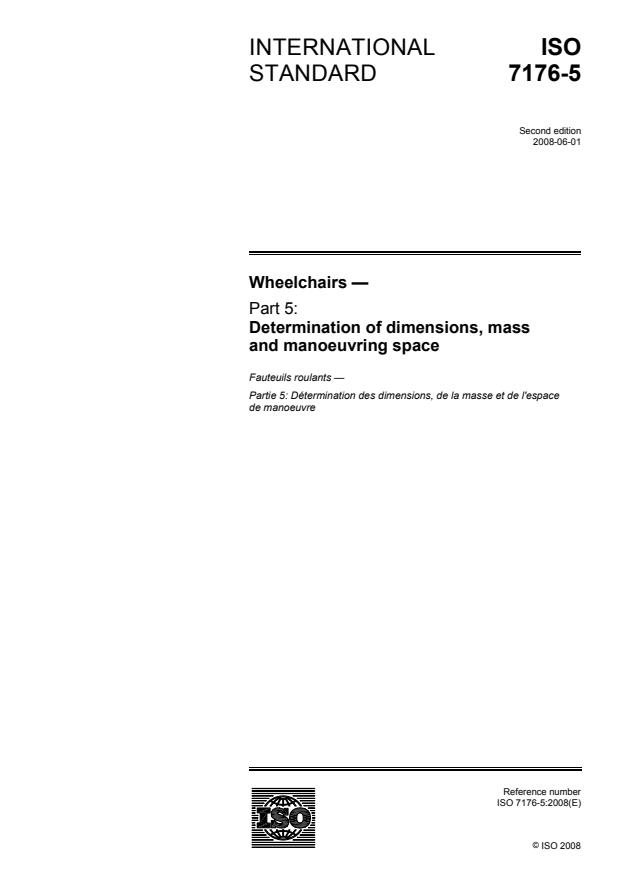
INTERNATIONAL ISO
STANDARD 7176-5
Second edition
2008-06-01
Wheelchairs —
Part 5:
Determination of dimensions, mass
and manoeuvring space
Fauteuils roulants —
Partie 5: Détermination des dimensions, de la masse et de l'espace
de manoeuvre
Reference number
©
ISO 2008
PDF disclaimer
This PDF file may contain embedded typefaces. In accordance with Adobe's licensing policy, this file may be printed or viewed but
shall not be edited unless the typefaces which are embedded are licensed to and installed on the computer performing the editing. In
downloading this file, parties accept therein the responsibility of not infringing Adobe's licensing policy. The ISO Central Secretariat
accepts no liability in this area.
Adobe is a trademark of Adobe Systems Incorporated.
Details of the software products used to create this PDF file can be found in the General Info relative to the file; the PDF-creation
parameters were optimized for printing. Every care has been taken to ensure that the file is suitable for use by ISO member bodies. In
the unlikely event that a problem relating to it is found, please inform the Central Secretariat at the address given below.
© ISO 2008
All rights reserved. Unless otherwise specified, no part of this publication may be reproduced or utilized in any form or by any means,
electronic or mechanical, including photocopying and microfilm, without permission in writing from either ISO at the address below or
ISO's member body in the country of the requester.
ISO copyright office
Case postale 56 • CH-1211 Geneva 20
Tel. + 41 22 749 01 11
Fax + 41 22 749 09 47
E-mail copyright@iso.org
Web www.iso.org
Published in Switzerland
ii © ISO 2008 – All rights reserved
Contents Page
Foreword. v
Introduction . vii
1 Scope . 1
2 Normative references . 1
3 Terms and definitions. 2
4 Wheelchair classes and occupant mass groups. 22
4.1 General. 22
4.2 Classes of electrically powered wheelchairs. 22
4.3 Occupant mass groups. 22
5 Test apparatus . 22
6 Selection of the test wheelchair . 26
7 Preparation of the test wheelchair . 27
7.1 General. 27
7.2 Wheelchair equipment. 27
7.3 Wheelchair adjustment. 27
7.4 Final check . 32
7.5 Positioning . 32
7.6 Loading of the wheelchair . 32
7.7 Records. 34
7.8 Use of hand space gauge and foot space gauges . 34
7.9 Wheel rotation . 34
7.10 Asymmetrical design of test wheelchair .35
8 Required measurements. 35
8.1 General. 35
8.2 Full overall length . 36
8.3 Overall width . 36
8.4 Handgrip height . 36
8.5 Stowage length . 36
8.6 Stowage width. 37
8.7 Stowage height . 37
8.8 Rising . 37
8.9 Total mass . 37
8.10 Mass of heaviest part . 37
8.11 Pivot width. 38
8.12 Reversing width . 38
8.13 Turning diameter. 38
8.14 Ground clearance . 39
8.15 Required width of angled corridor. 39
8.16 Required doorway entry depth. 39
8.17 Required corridor width for side opening.39
9 Disclosure of information . 41
9.1 General. 41
9.2 Wheelchairs with handrims . 41
9.3 Wheelchairs without handrims. 41
10 Test report . 42
10.1 Requirements . 42
10.2 Recommendations. 43
Annex A (informative) Technical dimensions. 45
Annex B (informative) Pivot width and reversing width . 59
Annex C (informative) Turning diameter . 69
Annex D (informative) Wheelchair longitudinal axis and wheelchair centre-point. 74
Annex E (informative) Guidelines and recommendations for wheelchair design and performance . 75
Bibliography . 79
iv © ISO 2008 – All rights reserved
Foreword
ISO (the International Organization for Standardization) is a worldwide federation of national standards bodies
(ISO member bodies). The work of preparing International Standards is normally carried out through ISO
technical committees. Each member body interested in a subject for which a technical committee has been
established has the right to be represented on that committee. International organizations, governmental and
non-governmental, in liaison with ISO, also take part in the work. ISO collaborates closely with the
International Electrotechnical Commission (IEC) on all matters of electrotechnical standardization.
International Standards are drafted in accordance with the rules given in the ISO/IEC Directives, Part 2.
The main task of technical committees is to prepare International Standards. Draft International Standards
adopted by the technical committees are circulated to the member bodies for voting. Publication as an
International Standard requires approval by at least 75 % of the member bodies casting a vote.
Attention is drawn to the possibility that some of the elements of this document may be the subject of patent
rights. ISO shall not be held responsible for identifying any or all such patent rights.
ISO 7176-5 was prepared by Technical Committee ISO/TC 173, Assistive products for persons with disability,
Subcommittee SC 1, Wheelchairs.
This second edition cancels and replaces the first edition (ISO 7176-5:1986) which has been technically
revised.
ISO 7176 consists of the following parts, under the general title Wheelchairs:
⎯ Part 1: Determination of static stability
⎯ Part 2: Determination of dynamic stability of electric wheelchairs
⎯ Part 3: Determination of effectiveness of brakes
⎯ Part 4: Energy consumption of electric wheelchairs and scooters for determination of theoretical distance
range
⎯ Part 5: Determination of dimensions, mass and manoeuvring space
⎯ Part 6: Determination of maximum speed, acceleration and deceleration of electric wheelchairs
⎯ Part 7: Measurement of seating and wheel dimensions
⎯ Part 8: Requirements and test methods for static, impact and fatigue strengths
⎯ Part 9: Climatic tests for electric wheelchairs
⎯ Part 10: Determination of obstacle-climbing ability of electrically powered wheelchairs
⎯ Part 11: Test dummies
⎯ Part 13: Determination of coefficient of friction of test surfaces
⎯ Part 14: Power and control systems for electrically powered wheelchairs and scooters — Requirements
and test methods
⎯ Part 15: Requirements for information disclosure, documentation and labelling
⎯ Part 16: Resistance to ignition of upholstered parts — Requirements and test methods
⎯ Part 19: Wheeled mobility devices for use as seats in motor vehicles
⎯ Part 21: Requirements and test methods for electromagnetic compatibility of electrically powered
wheelchairs and motorized scooters, and battery chargers
⎯ Part 22: Set-up procedures
⎯ Part 23: Requirements and test methods for attendant-operated stair-climbing devices
⎯ Part 24: Requirements and test methods for user-operated stair-climbing devices
⎯ Part 26: Vocabulary
vi © ISO 2008 – All rights reserved
Introduction
The purpose of this part of ISO 7176 is to provide technical definitions together with appropriate measurement
procedures for measuring important dimensions and masses of manual wheelchairs and electrically powered
wheelchairs including scooters, which can be used to estimate the appropriateness for a given environment.
A new approach is used for the pre-selection of the reference size from a wheelchair model with a range of
various dimensions by introducing reference dimensions of the intended occupant. This new approach
ensures repeatable and comparable test results.
The information in this part of ISO 7176 is intended for three main reader groups:
⎯ prescribers and occupants of wheelchairs;
⎯ architects and public authorities;
⎯ manufacturers, wheelchair providers, clinicians and test laboratories.
Features that are important to wheelchair occupants, architects and public authorities, such as overall
dimensions and the estimation of the space needed and general manoeuvrability, are contained in Clause 8.
Values for the different features are disclosed in the wheelchair's specification sheet. The values can be used
to determine, before purchase, the wheelchair's suitability in relation to specific requirements and needs.
The technical features of a wheelchair which are of importance to manufacturers, wheelchair providers,
clinicians and test laboratories, such as items to be considered when manufacturing, setting up, adjusting,
repairing or testing wheelchairs, are included in Annex A.
[1]
Technical Report ISO/TR 13570-1 is also available, giving a simplified explanation of the different parts of
ISO 7176.
[2]
Technical Report, ISO/TR 13570-2 , is under consideration.
INTERNATIONAL STANDARD ISO 7176-5:2008(E)
Wheelchairs —
Part 5:
Determination of dimensions, mass and manoeuvring space
1 Scope
This part of ISO 7176 specifies methods for the determination of wheelchair dimensions and mass.
This includes specific methods for the determination of outside dimensions when the wheelchair is occupied
by a reference occupant and the required manoeuvring space needed for wheelchair manoeuvres commonly
carried out in daily life.
This part of ISO 7176 specifies requirements for the disclosure of the dimensions and masses and contains
five informative annexes.
Annex A specifies methods for the determination of technical dimensions that can be important to the
performance of the wheelchair.
Annex B provides detailed information about pivot width and reversing width.
Annex C provides detailed information about the turning diameter.
Annex D provides details on determining the wheelchair longitudinal axis and wheelchair centre-point.
Annex E provides technical guidelines and recommendations for many of the measurements specified to
facilitate improved understanding, design and construction of wheelchairs.
This part of ISO 7176 is applicable to manual wheelchairs and electrically powered wheelchairs (including
scooters).
2 Normative references
The following referenced documents are indispensable for the application of this document. For dated
references, only the edition cited applies. For undated references, the latest edition of the referenced
document (including any amendments) applies.
ISO 7176-7, Wheelchairs — Part 7: Measurement of seating and wheel dimensions
ISO 7176-11, Wheelchairs — Part 11: Test dummies
ISO 7176-13, Wheelchairs — Part 13: Determination of coefficient of friction of test surfaces
ISO 7176-15, Wheelchairs — Part 15: Requirements for information disclosure, documentation and labelling
ISO 7176-22:2000, Wheelchairs — Part 22: Set-up procedures
ISO 7176-26, Wheelchairs — Part 26: Vocabulary
3 Terms and definitions
For the purposes of this document, the terms and definitions given in ISO 7176-26 and the following apply.
3.1
castor wheel misalignment
lateral distance between the ground contact point of the castor wheel and that point where the castor stem
axis intersects with the ground
See Figure 1.
NOTE 1 Measurement is in accordance with A.22.
NOTE 2 A non-zero value usually indicates a misalignment. The value is positive if the ground contact point of the
castor wheel is medial to the point of intersection of the castor stem axis with the ground, zero if in the desired neutral
position and negative if the ground contact point of the castor wheel is lateral to the point of intersection of the castor stem
axis with the ground.
NOTE 3 Sketches a), b) and c) in front view; d) in top view.
a) shifted wheel b) conical wheel c) tilted axle d) oblique axle
Key
1 castor wheel misalignment
Figure 1 — Castor wheel misalignment (exaggerated)
2 © ISO 2008 – All rights reserved
3.2
fixed wheel
wheel that cannot change its axial orientation relative to the wheelchair during motion
EXAMPLE Drive wheel, manoeuvring wheel or guide wheel.
3.3
front wheel track
distance between the ground contact points of the front wheels
See Figure 2.
NOTE 1 Measurement is in accordance with A.15.
NOTE 2 Sketch in front view.
Key
1 front wheel track
Figure 2 — Front wheel track (example)
3.4
full occupied length
distance between the most forward and most rearward point of the wheelchair including lower leg support
assemblies and a reference occupant
See Figure 3.
NOTE 1 Measurement is in accordance with A.8.
NOTE 2 This measurement applies where the wheelchair has fixed leg supports and/or foot supports or where the leg
supports and/or foot supports are removable but not removed.
Key
1 full occupied length
2 reduced occupied length
3 occupied width
4 occupied height
Figure 3 — Dimensions of the wheelchair when occupied
4 © ISO 2008 – All rights reserved
3.5
full overall length
distance between the most forward and most rearward point of the wheelchair when assembled and ready for
use with any leg supports, foot supports and any anti-tipping devices fitted
See Figure 4.
NOTE 1 Measurement is in accordance with 8.2.
NOTE 2 This measurement applies where the wheelchair has fixed leg supports and/or foot supports or where the leg
supports and/or foot supports are removable but not removed.
Key
1 full overall length
2 reduced overall length
3 overall width
4 overall height
Figure 4 — Overall wheelchair dimensions
3.6
ground clearance
minimum clearance between the occupied wheelchair and the ground
See Figure 5.
NOTE Measurement is in accordance with 8.14.
Key
1 typical critical points
2 ground clearance
a
Wheels, adjustable leg/foot supports and anti-tip devices are not considered.
Figure 5 — Ground clearance (example)
3.7
ground contact point
midpoint of the area where the wheel contacts the ground
See Figure 6.
NOTE 1 One means of identifying the ground contact point is to place four feeler gauges of equal thickness, and with
at least one straight edge, on the test plane (an example of a feeler gauge is a piece of tin or other rigid material,
0,5 mm ± 0,2 mm thick). Push two of them from the front and rear under the wheels with their straight edges horizontal
and perpendicular to the wheelchair longitudinal axis and push the other two of them, from both sides, under the wheels
with their straight edges parallel to the wheelchair longitudinal axis. Push all feeler gauges until they contact the wheel.
The ground contact point is located in the middle of the rectangle created by the straight edges of the four feeler gauges.
NOTE 2 Sketch a) in side view; b) in front view; c) in 3/4 view with wheelchair removed.
6 © ISO 2008 – All rights reserved
a) b)
c)
Key
1 area of contact between wheel and ground
2 front feeler gauge
3 rear feeler gauge
4 right feeler gauge
5 left feeler gauge
6 ground contact point
Figure 6 — Identification of ground contact point
3.8
handgrip height
vertical distance from the ground to the handgrip reference points of the wheelchair
NOTE Measurement is in accordance with 8.4.
3.9
handgrip reference point
outermost lateral point at half length of the handgrip
See Figure 7.
Key
1 handgrip reference point
Figure 7 — Handgrip reference point
3.10
lateral handrim deviation
deviation of the handrim from a flat plane that is perpendicular to the axle
NOTE 1 Measurement is in accordance with A.7.
NOTE 2 Lateral handrim deviation is expressed as the difference between the position of the innermost and outermost
points of the outermost continuous surface of the handrim, measured in the direction of the axis of the wheel. A non-zero
value usually indicates a misalignment.
3.11
lateral wheel deviation
deviation of the rim of the wheel from a flat plane that is perpendicular to the wheel axle
See Figure 8.
NOTE 1 Measurement is in accordance with A.5.
NOTE 2 Lateral wheel deviation is expressed as the difference between the position of the innermost and outermost
points of the outermost continuous surface of the rim of the wheel, measured in the direction of the axis of the wheel. A
non-zero value usually indicates a misalignment.
3.12
mass of heaviest part
mass of the heaviest part (or assembly of parts) of the wheelchair when dismantled for transport or stowing
purposes
NOTE Measurement is in accordance with 8.10.
3.13
movable wheel
wheel that can change its axial orientation relative to the wheelchair during motion
EXAMPLE Pivot wheel, pivot drive wheel or castor wheel.
8 © ISO 2008 – All rights reserved
a) wheel with skew axle b) wheel with lateral bump c) uneven wheel
Figure 8 — Some wheels with lateral wheel deviation
3.14
occupied height
vertical distance from the test plane to the uppermost point of the head of a reference occupant
See Figure 3.
NOTE 1 Measurement is in accordance with A.11.
NOTE 2 The occupied height measurement takes the presence of a seat cushion into account.
3.15
occupied width
horizontal distance across the wheelchair including a reference occupant
See Figure 3.
NOTE 1 Measurement is in accordance with A.10.
NOTE 2 Occupied width includes the hands of the occupant if the wheelchair has handrims.
3.16
pivot width
minimum distance between two vertical and parallel walls between which a wheelchair with full differential
steering can turn through 180° with one single and continuous turning manoeuvre
See Figure 9 and B.2.
NOTE Measurement is in accordance with 8.11.
Key
1 pivot width
Figure 9 — Pivot width
3.17
radial handrim deviation
deviation of the handrim from a true circle that is concentric to the axle
NOTE 1 Measurement is in accordance with A.6.
NOTE 2 Radial handrim deviation is expressed as the difference between the longest and the shortest outer radius of
each handrim. A non-zero value usually indicates a misalignment.
10 © ISO 2008 – All rights reserved
3.18
radial wheel deviation
deviation of the outer circumference of the wheel from a true circle that is concentric to the axle
See Figure 10.
NOTE 1 Measurement is in accordance with A.4.
NOTE 2 Radial wheel deviation is expressed as the difference between the longest and the shortest radius of the
wheel. A non-zero value usually indicates a misalignment.
a) eccentric wheel b) wheel with flat part c) wheel with bump d) elliptical wheel
Figure 10 — Some wheels with radial wheel deviation
3.19
ramp transition angle
angle between ramp and horizontal on which the transition to level ground can be negotiated without
contacting the ramp or the ground with any part other than the wheels
See Figure 11.
NOTE 1 Measurement is in accordance with A.12.
NOTE 2 Ramp transition angle concerns the smallest of the three angles achieved when driving over a transition
between level ground and a ramp:
a) with front parts at the lower transition;
b) with rear parts at the lower transition;
c) with parts that are located between the wheels at the upper transition.
The ramp transition angle is expressed in degrees.
NOTE 3 Since architects express the angles of ramps in percent, the ramp transition angle may also be expressed as
a percentage. The ramp transition angle can be converted from degrees to percent as follows:
PD=
where P is the angle in percent and D is the angle in degrees (for angles below 10° the error is less than 1 %, and below
20° the error is less than 4 %).
a) front parts at the lower b) rear parts at the lower c) parts located between the
transition transition wheels at the upper transition
Figure 11 — Ramp transition angle
3.20
rear wheel track
distance between the ground contact points of the rear wheel
See Figure 12.
NOTE 1 Measurement is in accordance with A.14.
NOTE 2 Sketch is a rear view.
Key
1 rear wheel track
Figure 12 — Rear wheel track (example)
12 © ISO 2008 – All rights reserved
3.21
reduced occupied length
distance between the most forward and most rearward point of the wheelchair without lower leg support
assemblies but including a reference occupant
See Figure 3.
NOTE 1 Measurement is in accordance with A.9.
NOTE 2 This measurement applies where the wheelchair is delivered without leg supports and/or foot supports or
where the leg supports and/or foot supports are removable and removed.
3.22
reduced overall length
distance between the most forward and the most rearward point of the wheelchair when assembled and ready
for use without lower leg support assemblies
See Figure 4.
NOTE 1 Measurement is in accordance with A.2.
NOTE 2 This measurement applies where the wheelchair is delivered without leg supports and/or foot supports or
where the leg supports and/or foot supports are removable and removed.
3.23
required corridor width for side opening
minimum width of a corridor necessary to permit the wheelchair to move forwards into or out of the corridor
through an open doorway of defined width in one wall
See Figure 13.
NOTE Measurement is in accordance with 8.17.
a) exiting
b) entering
Key
1 800 mm wide side opening
2 required corridor width for side opening when exiting
3 required corridor width for side opening when entering
Figure 13 — Required corridor width for side opening
14 © ISO 2008 – All rights reserved
3.24
required doorway entry depth
minimum distance between the wall containing the door and the most remote point of the wheelchair when
opening an 800 mm wide door that is located 600 mm from the side wall
See Figure 14.
NOTE Measurement is in accordance with 8.16.
Key
1 800 mm wide door opening
2 600 mm side distance
3 required doorway entry depth
Figure 14 — Required doorway entry depth
3.25
required width of angled corridor
minimum width of a corridor with a right angled turn in which the wheelchair can be driven in both forward and
rearward directions
See Figure 15.
NOTE Measurement is in accordance with 8.15.
Key:
1 required width of angled corridor
Figure 15 — Required width of angled corridor
16 © ISO 2008 – All rights reserved
3.26
reversing width
minimum distance between two vertical and parallel walls between which the wheelchair with direct steering or
limited differential steering can turn through 180° with one initial forward drive, one rearward drive and one
final forward drive (i.e. a three-point turn)
See Figure 16 and Clause B.3.
NOTE Measurement is in accordance with 8.12.
Key
1 reversing width
Figure 16 — Reversing width (example with scooter)
3.27
rising
distance between the ground and the lowermost point of the front wheels when the anti-tip devices are in
contact with the ground
See Figure 17.
NOTE Measurement is in accordance with 8.8.
Key
1 anti-tip device contacting the ground
2 rising
Figure 17 — Rising
18 © ISO 2008 – All rights reserved
3.28
skew
relative position of a pair of fixed wheels, where one wheel is ahead of the other
See Figure 18.
NOTE 1 Measurement is in accordance with A.18.
NOTE 2 A non-zero value usually indicates a misalignment. The value is positive if the left wheel is located in front of
the right wheel, zero is the desired neutral position, and is negative if the right wheel is located in front of the left wheel.
Key
1 Skew
Figure 18 — Skew (exaggerated)
3.29
wheel median line
imaginary circle, having the same diameter as a wheel, which passes through the ground contact point of the
wheel as the wheel is rotated
See Figure 19.
NOTE If the wheel is a torus, the wheel median line runs around the wheel at its greatest diameter. If the wheel is a
cylinder, the wheel median line is at the half width of the surface. In case of a twin wheel, the wheel median line is in the
middle of the two wheels (on the same hub).
a) wheel median line b) wheel median line c) wheel median line
of a torus wheel of a cylindrical wheel of a twin wheel
Figure 19 — Wheel median line
3.30
wheelbase
longitudinal distance between the ground contact points of the front and rear wheels with any castor wheels in
the forward trailing position
See Figure 20.
NOTE 1 Measurement is in accordance with A.13.
NOTE 2 Sketch is a side view.
Key
1 wheelbase
Figure 20 — Wheelbase
20 © ISO 2008 – All rights reserved
3.31
wheelchair centre-point
midpoint of the line between the centres of the fixed wheels
See Figure 21 and Annex D.
NOTE If there is only one fixed wheel, the wheelchair centre-point is at the midpoint of that wheel; if there is more
than one axis with fixed wheels, the wheelchair centre-point is on the axis with the larger wheel diameters; if all fixed
wheels have the same diameter, the wheelchair centre-point is on the axis that bears the higher proportion of load of the
occupied wheelchair.
Key
1 centre of fixed wheel
2 wheelchair centre-point
a
Wheelchair longitudinal axis.
Figure 21 — Wheelchair centre-point and wheelchair longitudinal axis
3.32
wheelchair longitudinal axis
imaginary horizontal line through the wheelchair centre-point, running in the direction of straight
forward/rearward travel
See Figure 21 and Annex D.
4 Wheelchair classes and occupant mass groups
4.1 General
The dimensions of a wheelchair are mainly influenced by its class (electrically powered wheelchairs only) and
by its intended occupant mass group.
4.2 Classes of electrically powered wheelchairs
Electrically powered wheelchairs are classified in one or more of the following three classes, dependant upon
their intended field of use.
⎯ Class A: compact, manoeuvrable wheelchair not necessarily capable of negotiating outdoor obstacles.
⎯ Class B: wheelchair sufficiently compact and manoeuvrable for some indoor environments and capable
of negotiating some outdoor obstacles.
⎯ Class C: wheelchair, usually larger in size, not necessarily intended for indoor use but capable of
travelling over longer distances and negotiating outdoor obstacles.
NOTE 1 Typically, class A wheelchairs are intended to be used primarily indoors, class B wheelchairs are intended to
be used both indoors and outdoors and class C wheelchairs are intended to be used primarily outdoors.
NOTE 2 Scooters are included in the classes above.
4.3 Occupant mass groups
Wheelchairs are intended for one of the following three wheelchair occupant mass groups:
⎯ Occupant mass group I: occupant with a mass below 50 kg.
⎯ Occupant mass group II: occupant with a mass between 50 kg and 125 kg.
⎯ Occupant mass group III: occupant with a mass above 125 kg.
5 Test apparatus
5.1 Test plane, rigid horizontal plane of sufficient size to accommodate the wheelchair and the adjustable
barriers (5.2) during testing, such that the whole surface is sufficiently flat that it is contained between two
imaginary horizontal parallel planes 5 mm apart per 1 000 mm and 25 mm apart per 6 000 mm, with a
coefficient of friction conforming to ISO 7176-13.
5.2 Adjustable barriers, vertical planes capable of touching or detecting the outer dimensions and the
operating area of the wheelchair on the test plane, such that the plane of each barrier is sufficiently flat that it
is contained between two imaginary vertical parallel planes 5 mm apart per 1 000 mm.
EXAMPLES Physical planes, light beams or any other appropriate means for providing a flat and vertical plane.
5.3 Test dummy, conforming to ISO 7176-11, modified as follows: replace the lower leg portions of the test
dummies with two foot space gauges, each having a shape as indicated in Figure 22 and a mass of
2 kg ± 0,5 kg for occupant mass group I and of 3,5 kg ± 0,5 kg for occupant mass groups II and III.
22 © ISO 2008 – All rights reserved
Dimensions in millimetres
a) occupant mass group I b) occupant mass groups II and III
Key
a
Front.
b
Heel.
NOTE 1 Pieces of plywood, 15 mm ± 5 mm thick, attached to steel blocks may be used.
NOTE 2 Sketches in top view with the front of the foot pointing to the top
Figure 22 — Foot space gauges
5.4 Knee space gauge, substituting the reference occupant’s knees and which:
⎯ has a shape as indicated in Figure 23;
⎯ adds to the respective test dummy’s lap section to achieve a total length of 520 mm ± 3 mm for occupant
mass group I and 650 mm ± 3 mm for occupant mass groups II and III when measured parallel to the seat
plane and between the most forward point of the knee space gauge and the intersection point of the seat
plane with the back support plane of the test dummy;
⎯ has a width of 270 mm ± 3 mm for occupant mass group I, 340 mm ± 3 mm for occupant mass group II
and 390 mm ± 3 mm for occupant mass group III;
⎯ has a radius of 50 mm ± 2 mm for occupant mass group I and 60 mm ± 2 mm for occupant mass groups
II and III.
NOTE 1 A piece of plywood, 15 mm ± 5 mm thick, may be used.
[3]
NOTE 2 Dimensions are in accordance with DIN 33402 and ISO 7176-11.
Key
1 test dummy
2 knee space gauge
3 intersection point of seat plane with back support plane of test dummy
4 total length of dummy including knee space gauge
5 width
6 radius
Figure 23 — Knee space gauge
5.5 Length measuring device, means for measuring linear dimensions in increments of 0,5 mm in the
range of 0 mm to 150 mm, in increments of 1 mm in the range of 150 mm to 2 000 mm and in increments of
2 mm in the range of 2 000 mm to 5 000 mm.
5.6 Hand space gauges, means of substituting the reference occupant’s hands on the handrims. They
shall add 75 mm ± 1 mm to each handrim in a radial direction and 50 mm ± 1 mm in a lateral direction when
measured at the top (see Figure 24). They shall extend at least 30° in the rearward direction and 60° in the
forward direction when measured from the top of the handrim.
EXAMPLE A piece of flexible material that bends around the handrim.
24 © ISO 2008 – All rights reserved
Dimensions in millimetres
NOTE In the side view of the wheel, the forward direction is to the right.
Figure 24 — Hand space gauge
5.7 Right angle, means of establishing a straight edge normal to the test plane, to an accuracy of ± 1 mm
per 1 000 mm.
EXAMPLE Engineers' square, sheet-metal square.
5.8 Deviation identification device, capable of identifying both radial and lateral deviation of a wheel or
handrim.
NOTE Radial deviation of a wheel or handrim is its deviation from a true circle that is concentric to its axis and lateral
deviation of a wheel or handrim is its deviation from a plane that is perpendicular to its axis.
EXAMPLE A rack placed on the test plane equipped with a piece of chalk, felt pen or micro switch with roller
actuator.
5.9 Ramp gauge A, flat rectangular piece of rigid material about 500 mm × 500 mm and 2 mm ± 0,5 mm
thick.
5.10 Ramp gauge B, two flat rectangular pieces of rigid material about 500 mm × 500 mm and
2 mm ± 0,5 mm thick and hinged together at one edge (see Figure 25).
Key
1 hinge
Figure 25 — Ramp gauge B (example)
5.11 Angle measuring device, means for measuring angles to an accuracy of ± 0,5°.
5.12 Castor axis indicator, means of establishing a line parallel to the castor axis.
NOTE See example in Figures A.5 and A.6.
5.13 Mass measuring device, means for measuring masses to an accuracy of ± 0,2 kg.
5.14 Test environment, environment within which the tests are conducted at an ambient temperature of
20°C ± 5°C.
6 Selection of the test wheelchair
The wheelchair selected for test purposes shall be drawn from normal production.
Pre-production units may be used provided they have the intended production dimensions.
For the purpose of allowing comparison between different wheelchair models, reference set-up values are
specified for each of the three occupant mass groups I, II and III. These reference set-up values shall be used
when selecting a wheelchair whose dimensions need to be specified when ordering/purchasing the wheelchair
but cannot be adjusted later.
NOTE Seat depth, seat width, back support height, etc. are examples for dimensions that usually need to be selected
when ordering/purchasing the wheelchair.
Select a wheelchair with nominal dimensions:
⎯ according to the reference set-up values specified in Table 1 (see 7.3.1) for wheelchairs with handrims;
⎯ according to the reference set-up values specified in Table 2 (see 7.3.2) for wheelchairs without handrims.
If the correct dimensions are not available, dimensions as close as possible to the reference set-up values
shall be used.
26 © ISO 2008 – All rights reserved
Record the actual dimensions of the test wheelchair. Record any deviation from the specifications in Clause 8
and reasons for deviation.
7 Preparation of the test wheelchair
7.1 General
When a particular test procedure has specific set-up requirements, use the set-up procedure specified in that
particular test procedure. All other set-up procedures shall be carried out in accordance with 7.2 to 7.9.
7.2 Wheelchair equipment
The wheelchair shall be ready for use if the body support system or any of its features is available in various
options: a sling seat, a sling back support, two removable full-length arm supports and two separated,
removable, angle adjustable foot support assemblies with anterior heel supports shall be fitted. If any of these
options is not available, choose those options recommended by the manufacturer and record this in the test
report.
If the wheelchair can be delivered with wheels of various diameters, select the wheel diameter recommended
by the manufacturer. If there is no recommendation, select the largest diameter.
If the wheelchair can be delivered with anti-tip devices and/or kerb-climbing devices, these devices shall be
used.
Unless they are an integral part of the body support system, postural support device components such as
head supports, any loose seat cushions, etc. shall be removed.
NOTE Removable seat cushions that are provided with the wheelchair, are necessary for normal use, and that are
fixed with hook and loop fasteners, should not be considered loose and should not be removed.
The wheelchair shall not be equipped with any accessories.
7.3 Wheelchair adjustment
7.3.1 Wheelchairs with handrims
NOTE Wheelchairs with handrims comprise wheelchairs with manual handrim propulsion and handrim activated
power assisted wheelchairs (HAPAW).
Set any adjustable dimensions of the wheelchair as close as possible to the reference set-up values specified
in Table 1 with an accuracy of ± 3 mm or ± 1°, except where otherwise stated.
If the reference set-up value is not available/possible, adjust the dimension to the nearest greater value, or, if
this value is also not available/possible, adjust as close as possible to the reference set-up value.
Adjust any anti-tip devices as recommended by the manufacturer. If there is no recommendation, adjust so
that it is as close as possible to the following position.
⎯ Set the rising (see 3.27) to 25 mm ± 3 mm.
⎯ When the wheelchair is standing on level ground the anti-tippers protrude to the rear as far as possible.
⎯ If it is not possible to achieve both settings at one time, give priority to the setting of the rising.
⎯ If the manufacturer recommends more than one setting, use the recommended setting closest to these
default settings.
If any of the adjustments results in an unwanted setting, e.g. the castor wheels contact any other part of the
wheelchair, increase/decrease the adjustment just enough to ensure a proper function of the wheelchair and
record the actual dimension together with the reason.
7.3.2 Wheelchairs without handrims
NOTE Wheelchairs without handrims comprise electrically powered wheelchairs and manual wheelchairs with lever
propulsion and push wheelchairs.
Set any adjustable dimensions of the wheelchair as close as poss
...
МЕЖДУНАРОДНЫЙ ISO
СТАНДАРТ 7176-5
Второе издание
2008-06-01
Кресла-коляски.
Часть 5.
Определение размеров, массы и
площади для маневрирования
Wheelchairs —
Part 5: Determination of dimensions, mass and manoeuvring space
Ответственность за подготовку русской версии несёт GOST R
(Российская Федерация) в соответствии со статьёй 18.1 Устава ISO
Ссылочный номер
©
ISO 2008
ii
ДОКУМЕНТ ЗАЩИЩЕН АВТОРСКИМ ПРАВОМ
© ISO 2008
Все права сохраняются. Если не указано иное, никакую часть настоящей публикации нельзя копировать или использовать в
какой-либо форме или каким-либо электронным или механическим способом, включая фотокопии и микрофильмы, без
предварительного письменного согласия ISO, которое должно быть получено после запроса о разрешении, направленного по
адресу, приведенному ниже, или в комитет-член ISO в стране запрашивающей стороны.
ISO copyright office
Case postale 56 • CH-1211 Geneva 20
Tel. + 41 22 749 01 11
Fax + 41 22 749 09 47
E-mail copyright@iso.org
Web www.iso.org
Опубликовано в Швейцарии
ii © ISO 2008 — Все права сохраняются
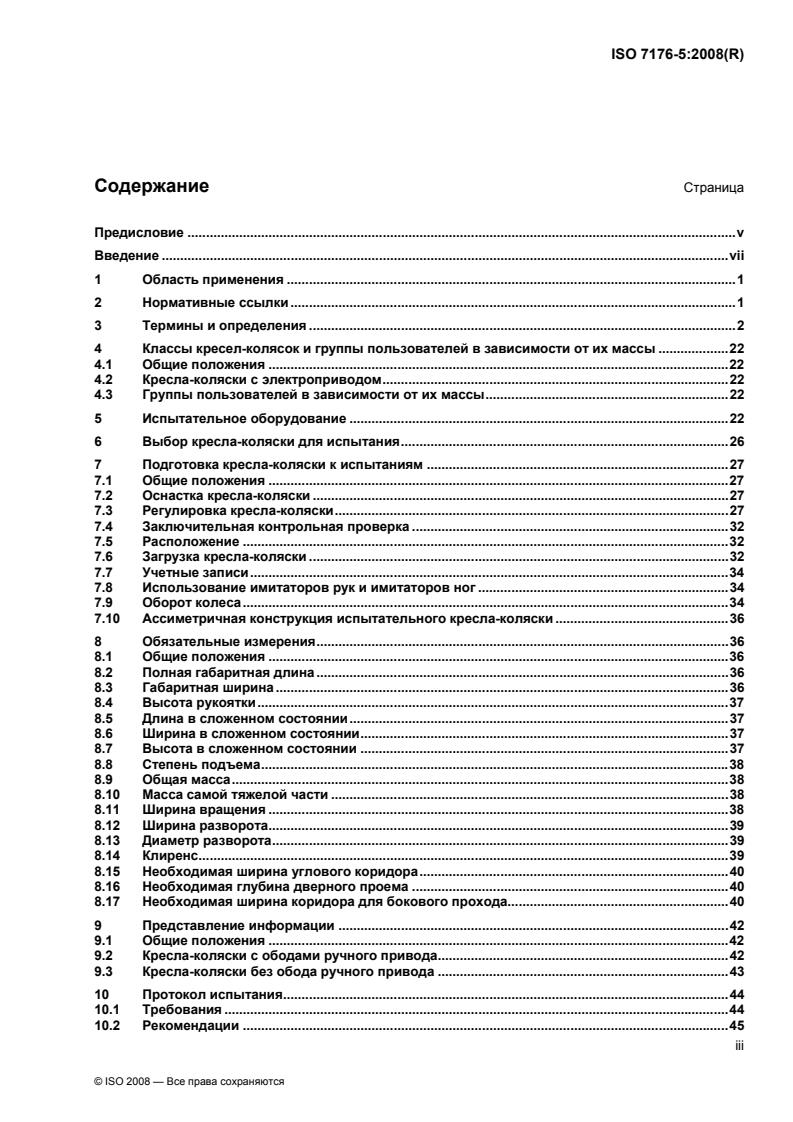
Содержание Страница
Предисловие . v
Введение . vii
1 Область применения . 1
2 Нормативные ссылки . 1
3 Термины и определения . 2
4 Классы кресел-колясок и группы пользователей в зависимости от их массы . 22
4.1 Общие положения . 22
4.2 Кресла-коляски с электроприводом . 22
4.3 Группы пользователей в зависимости от их массы . 22
5 Испытательное оборудование . 22
6 Выбор кресла-коляски для испытания . 26
7 Подготовка кресла-коляски к испытаниям . 27
7.1 Общие положения . 27
7.2 Оснастка кресла-коляски . 27
7.3 Регулировка кресла-коляски . 27
7.4 Заключительная контрольная проверка . 32
7.5 Расположение . 32
7.6 Загрузка кресла-коляски . 32
7.7 Учетные записи . 34
7.8 Использование имитаторов рук и имитаторов ног . 34
7.9 Оборот колеса . 34
7.10 Ассиметричная конструкция испытательного кресла-коляски . 36
8 Обязательные измерения . 36
8.1 Общие положения . 36
8.2 Полная габаритная длина . 36
8.3 Габаритная ширина . 36
8.4 Высота рукоятки . 37
8.5 Длина в сложенном состоянии . 37
8.6 Ширина в сложенном состоянии . 37
8.7 Высота в сложенном состоянии . 37
8.8 Степень подъема . 38
8.9 Общая масса . 38
8.10 Масса самой тяжелой части . 38
8.11 Ширина вращения . 38
8.12 Ширина разворота . 39
8.13 Диаметр разворота . 39
8.14 Клиренс . 39
8.15 Необходимая ширина углового коридора . 40
8.16 Необходимая глубина дверного проема . 40
8.17 Необходимая ширина коридора для бокового прохода. 40
9 Представление информации . 42
9.1 Общие положения . 42
9.2 Кресла-коляски с ободами ручного привода . 42
9.3 Кресла-коляски без обода ручного привода . 43
10 Протокол испытания . 44
10.1 Требования . 44
10.2 Рекомендации . 45
iii
Приложение A (информативное) Технические характеристики .47
Приложение B (информативное) Ширина вращения и ширина разворота .63
Приложение C (информативное) Диаметр разворота .73
Приложение D (информативное) Продольная ось кресла-коляски и центральная точка кресла-
коляски .78
Приложение E (информативное) Указания и рекомендации по конструированию и
эксплуатации кресел-колясок .79
Библиография .83
iv © ISO 2008 — Все права сохраняются
Предисловие
Международная организация по стандартизации (ISO) – это всемирная федерация, состоящая из
национальных представительств по стандартизации (членов ISO). Работа по подготовке
Международных Стандартов обычно осуществляется через технические комитеты ISO. Каждый член
организации, заинтересованный в вопросе, который является областью компетенции некоего
технического комитета, имеет право представительства в этом комитете. Любые правительственные и
неправительственные международные организации, связанные с ISO, также принимают участие в
этой работе. ISO тесно сотрудничает с Международной Электротехнической Комиссией (IEC) по всем
вопросам стандартизации в области электротехники.
Международные стандарты разрабатываются в соответствии с правилами заданными в Директивах
ISO/IEC, Часть 2.
Главной задачей технических комитетов является подготовка международных стандартов. Проект
международных стандартов, принятый техническими комитетами распространяется среди членов
организации для утверждения. Публикация в качестве международного стандарта требует одобрения,
по крайней мере, 75 % голосов участвующих в голосовании.
Следует обратить внимание на тот факт, что некоторые элементы этого документа могут являться
объектом авторских прав. ISO не берет на себя ответственность за идентификацию любых авторских
прав.
ISO 7176-5 подготовлен Техническим комитетом ISO/TC 173, Вспомогательные устройства для
инвалидов, Подкомитетом SC 1, Кресла-коляски.
Данное второе издание аннулирует и заменяет первое издание (ISO 7176-5:1986), которое было
технически пересмотрено.
ISO 7176 состоит из следующих частей под общим названием Кресла-коляски:
Часть 1. Определение статической устойчивости
Часть 2. Определение динамической устойчивости кресел-колясок с электроприводом
Часть 3. Определение эффективности тормозов
Часть 4. Расход энергии кресел-колясок с электроприводом и скутеров для определения
теоретической длины пробега
Часть 5. Определение размеров, массы и площади маневрирования
Часть 6. Определение максимальной скорости, ускорения и торможения кресел-колясок с
электроприводом
Часть 7. Измерение размеров сидения и колес
Часть 8. Требования и методы испытания статической импульсной и усталостной прочности
Часть 9. Климатические испытания кресел-колясок с электроприводом
Часть 10. Определение способности преодоления препятствий креслами-колясками с
электроприводом
v
Часть 11. Испытательные манекены
Часть 13. Определения коэффициента трения испытательных поверхностей
Часть 14. Источники питания и системы управления кресел-колясок с электроприводом и
скутеров. Требования и методы испытания
Часть 15. Требования к информационному обеспечению, документации и маркировке
Часть 16. Огнестойкость обитых материей частей. Требования и методы испытания
Часть 19. Колесные передвижные устройства, используемые в качестве сидения в
автомобилях
Часть 21. Требования и методы испытания кресел-колясок с электроприводом и
моторизованных скутеров на электромагнитную совместимость и зарядку аккумуляторной
батареи
Часть 22. Процедуры установки
Часть 23. Требования и способы испытания устройств, для преодоления лестничных ступеней
с сопровождающим
Часть 24. Требования и методы испытания устройств, для преодоления лестничных ступеней,
управляемых пользователем
Часть 26. Словарь
vi © ISO 2008 — Все права сохраняются
Введение
Целью данной части ISO 7176 является определение технических характеристик, а также описание
соответствующих методов измерений габаритных размеров и массы кресел-колясок с ручным и
электроприводом, включая и скутеры, которые могут быть использованы для оценки их совместимости
с условиями окружающей среды.
При этом используется новый подход к предварительному выбору основных размеров из всего набора
моделей кресел-колясок за счет учета основных параметров предполагаемого пользователя. Такой
подход гарантирует сопоставимость и воспроизводимость полученных результатов испытания.
Результаты этой части ISO 7176 предназначены для трех основных групп читателей:
потенциальные и настоящие пользователи кресла-коляски;
проектировщики и специалисты по благоустройству;
изготовители и поставщики кресел-колясок, сотрудники клинических и испытательных
лабораторий.
Те свойства, которые важны для пользователей кресел-колясок и для проектировщиков и
специалистов по благоустройству, а именно, габаритные размеры и оценка площади необходимой при
маневрировании, содержатся в Разделе 8. Значения разных характеристик приведены в реестре
спецификации кресел-колясок. Эти значения могут быть использованы перед покупкой для
определения пригодности кресел-колясок по отношению к особым требованиям и потребностям.
Те технические особенности кресла-коляски, которые важны для изготовителей, поставщиков кресел-
колясок, сотрудников клинических и испытательных лабораторий, то есть, то, что требует учета при
изготовлении, установке, регулировании, ремонте или испытании кресел-колясок, включены в
Приложение A.
[1]
В настоящее время действует Технический отчет ISO/TR 13570-1 , предоставляя упрощенное
объяснение различных частей ISO 7176.
[2]
Технический отчет ISO/TR 13570-2 находится в стадии разработки.
vii
МЕЖДУНАРОДНЫЙ СТАНДАРТ ISO 7176-5:2008(R)
Кресла–коляски.
Часть 5.
Определение размеров, массы и площади для
маневрирования
1 Область применения
Эта часть ISO 7176 определяет методы определения размеров и массы кресел–колясок.
Она включает специальные методы определения внешних размеров кресла-коляски, когда оно занято
контрольным седоком и при этом существует достаточно площади для маневрирования, характерной
для повседневных условий.
Эта часть ISO 7176 определяет требования к измерению размеров и массы и содержит пять
информативных приложений.
Приложение A определяет методы для определения размеров, которые могут быть важны для
функционирования кресла - коляски.
Приложение B содержит подробную информацию о ширине вращения и ширине разворота.
Приложение C содержит информацию о диаметре разворота.
Приложение D содержит подробную информацию по определению продольной оси кресла-коляски и
центральной точки кресла-коляски.
Приложение E содержит техническое руководство и рекомендации для многих измерений, служащих
для лучшего понимания устройства и конструкции кресел-колясок.
Эта часть ISO 7176 распространяется на кресла–коляски с ручным и электроприводом (включая
скутеры).
2 Нормативные ссылки
Следующие нормативные ссылки являются обязательными при применении данного документа. Для
датированных ссылок, применимы только указанные издания. Для недатированных ссылок,
применимы самые последние издания (включая любые дополнения).
ISO 7176-7, Кресла-коляски. Часть 7. Измерение размеров сидения и колес
ISO 7176-11, Кресла-коляски. Часть 11. Испытательные манекены
ISO 7176-13, Кресла-коляски. Часть 13. Определения коэффициента трения испытательных
поверхностей
ISO 7176-15, Кресла-коляски. Часть 15. Требования к информационному обеспечению, документации
и маркировке
ISO 7176-22:2000, Кресла-коляски. Часть 22. Процедуры установки
ISO 7176-26, Кресла-коляски. Часть 26. Словарь
3 Термины и определения
В данном документе используются термины и определения данные в ISO 7176-26 и приведенные ниже.
3.1
рассогласование самоориентирующегося колеса
castor wheel misalignment
поперечное расстояние между точкой контакта с землей самоориентирующегося колеса и той точкой,
где ось шарнира самоориентирующегося колеса пересекается с землей
См. Рисунок 1.
ПРИМЕЧАНИЕ 1 Измерение в соответствии с A.22.
ПРИМЕЧАНИЕ 2 Не нулевой результат обычно указывает на наличие рассогласования. Полученное значение
положительно, если точка контакта с землей самоориентирующегося колеса смещена внутрь относительно точки
пересечения оси шарнира с землей, равно нулю, если занимает нужное нейтральное положение, отрицательно,
если точка контакта с землей самоориентирующегося колеса смещена наружу от точки пересечения шарнира
самоориентирующегося колеса с землей.
ПРИМЕЧАНИЕ 3 Эскизы a), b) и c) вид спереди; d) вид сверху.
a) смещенное колесо b) коническое колесо c) наклонная ось d) косая ось
Обозначение
1 рассогласование самоориентирующегося колеса
Рисунок 1 — Рассогласование самоориентирующегося колеса (утрировано)
3.2
фиксированное колесо
fixed wheel
колесо, которое не может менять ориентацию своей оси относительно кресла-коляски во время
движения
ПРИМЕР Приводное колесо, поворотное колесо или рулевое колесо.
3.3
передняя колея колес
front wheel track
расстояние между точками контакта передних колес с землей
См. Рисунок 2.
ПРИМЕЧАНИЕ 1 Измерение в соответствии с A.15.
ПРИМЕЧАНИЕ 2 Эскиз дан в виде спереди.
Обозначение
1 передняя колея колес
Рисунок 2 — Передняя колея колес (пример)
3.4
полная длина загруженного кресла-коляски
full occupied length
расстояние между самой передней и самой задней точкой кресла-коляски, включая нижние элементы
опоры ног и эталонного пользователя
См. Рисунок 3.
ПРИМЕЧАНИЕ 1 Измерение в соответствии с A.8.
ПРИМЕЧАНИЕ 2 Это измерение применимо, если кресло-коляска имеет фиксированные опоры для ног и/или
опоры ступней или если опоры для ног и/или опоры ступней являются съемными, но не сняты.
Обозначение
1 полная длина в загруженном состоянии
2 уменьшенная длина в загруженном состоянии
3 ширина в загруженном состоянии
4 высота в загруженном состоянии
Рисунок 3 — Размеры кресла-коляски в загруженном состоянии
3.5
полная габаритная длина
full overall length
расстояние между передней и задней точкой кресла-коляски, когда оно собрано и готово к
использованию, при этом на нем смонтированы опоры для ног, опоры для ступней и
антиопрокидыватель
См. Рисунок 4.
ПРИМЕЧАНИЕ 1 Измерения в соответствии с 8.2.
ПРИМЕЧАНИЕ 2 Эти измерения применимы, если кресло-коляска имеет фиксированные опоры ног и/или опоры
ступней или если опоры ног и/или опоры ступней съемные но не сняты.
Обозначение
1 полная габаритная длина
2 укороченная габаритная длина
3 габаритная ширина
4 габаритная высота
Рисунок 4 — Габаритные размеры кресла-коляски
3.6
клиренс
ground clearance
минимальное расстояние между загруженным креслом-коляской и землей
См. Рисунок 5.
ПРИМЕЧАНИЕ Измерения в соответствии с 8.14.
Обозначение
1 типичные критические точки
2 клиренс
a
Колеса, регулируемые опоры ног/ступней и антиопрокидыватель во внимание не принимаются.
Рисунок 5 — Клиренс (пример)
3.7
точка контакта с землей
ground contact point
средняя точка области соприкосновения колеса с землей
См. Рисунок 6.
ПРИМЕЧАНИЕ 1 Один из способов определения точки контакта с землей заключается в том, что помещают
четыре тонких щупа равной толщины и, по крайней мере, с одним ровным краем, на испытательную плоскость
(примером тонкого щупа может служить кусок жести или другого жесткого материала толщиной 0,5 мм ± 0,2 мм).
Протолкните два из них спереди и сзади колеса так, чтобы их ровная сторона была горизонтальна и
перпендикулярна продольной оси кресла-коляски, а затем протолкните другие два с двух боковых сторон под
колеса так, чтобы их ровные края располагались параллельно продольной оси кресла-коляски. Толкайте все щупы,
пока они не упрутся в колесо. Точка контакта с землей находится посередине прямоугольника, образованного
ровными краями четырех щупов.
ПРИМЕЧАНИЕ 2 Вид a) сбоку; b) спереди; c) 3/4 полного оборота кресла-коляски.
a) b)
c)
Обозначение
1 область контакта колеса с землей
2 передний щуп
3 задний щуп
4 правый щуп
5 левый щуп
6 точка контакта с землей
Рисунок 6 — Определение точки контакта с землей
3.8
высота рукоятки
handgrip height
вертикальное расстояние от земли до контрольной точки рукоятки кресла-коляски
ПРИМЕЧАНИЕ Измерение в соответствии с 8.4.
3.9
контрольная точка рукоятки
handgrip reference point
самая удаленная боковая точка посередине рукоятки
См. Рисунок 7.
Обозначение
1 контрольная точка рукоятки
Рисунок 7 — Контрольная точка рукоятки
3.10
боковое отклонение обода ручного привода
lateral handrim deviation
отклонение обода ручного привода от плоскости перпендикулярной оси
ПРИМЕЧАНИЕ 1 Измерение в соответствии с A.7.
ПРИМЕЧАНИЕ 2 Боковое отклонение обода ручного привода выражается как разница между положениями
самой внутренней и самой внешней точкой сплошной плоскости обода ручного привода, измеренная в
направлении оси колеса. Отличное от нуля значение обычно указывает на рассогласование.
3.11
боковое отклонение колеса
lateral wheel deviation
отклонение обода колеса от плоскости, которая перпендикулярна к оси колеса
См. Рисунок 8.
ПРИМЕЧАНИЕ 1 Измерение в соответствии с A.5.
ПРИМЕЧАНИЕ 2 Боковое отклонение обода колеса выражается как разница между положениями самой
внутренней и самой внешней точкой сплошной плоскости обода колеса, измеренная в направлении оси колеса.
Отличное от нуля значение обычно указывает на рассогласование.
3.12
масса самой тяжелой части
mass of heaviest part
масса самой тяжелой части (или комплекта частей) кресла-коляски в разобранном для
транспортировке состоянии
ПРИМЕЧАНИЕ Измерения в соответствии с 8.10.
3.13
подвижное колесо
movable wheel
колесо, которое может менять ориентацию оси относительно кресла-коляски во время движения
ПРИМЕР Вращающееся колесо, вращающееся приводное колесо или самоориентирующееся колесо.
a) колесо со смещенной b) колесо с боковой c) искривленное колесо
осью “грыжей”
Рисунок 8 — Некоторые боковые отклонения колес
3.14
высота в загруженном состоянии
occupied height
вертикальное расстояние от испытательной плоскости до самой верхней точки головы эталонного
пользователя
См. Рисунок 3.
ПРИМЕЧАНИЕ 1 Измерение в соответствии с A.11.
ПРИМЕЧАНИЕ 2 При измерении высоты в загруженном состоянии принимается во внимание наличие подушки
сиденья.
3.15
ширина в загруженном состоянии
occupied width
горизонтальное расстояние поперек кресла-коляски с учетом эталонного пользователя
См. Рисунок 3.
ПРИМЕЧАНИЕ 1 Измерение в соответствии с A.10.
ПРИМЕЧАНИЕ 2 Ширина в загруженном состоянии включает руки пользователя, если кресло-коляска имеет
обод ручного привода.
3.16
ширина вращения
pivot width
минимальное расстояние между двумя вертикальными и параллельными стенами, между которых
кресло-коляска с полностью дифференциальным ручным управлением может развернуться на 180° в
процессе одиночного непрерывного маневра
См. Рисунок 9 и B.2.
ПРИМЕЧАНИЕ Измерение в соответствии с 8.11.
Обозначение
1 ширина вращения
Рисунок 9 — Ширина вращения
3.17
радиальное отклонение обода ручного привода
radial handrim deviation
отклонение обода ручного привода от правильной окружности концентричной оси
ПРИМЕЧАНИЕ 1 Измерение в соответствии с A.6.
ПРИМЕЧАНИЕ 2 Радиальное отклонение обода ручного привода выражается как разница между самым
большим и самым маленьким радиусом каждого обода ручного привода. Отличное от нуля значение указывает на
наличие асимметрии.
3.18
радиальное отклонение колеса
radial wheel deviation
отклонение внешней окружности колеса от правильного круга, концентричного оси
См. Рисунок 10.
ПРИМЕЧАНИЕ 1 Измерение в соответствии с A.4.
ПРИМЕЧАНИЕ 2 Радиальное отклонение колеса выражается как разница между самым большим и самым
маленьким радиусом колеса. Отличное от нуля значение указывает на наличие асимметрии.
a) эксцентричное b) колесо с плоской c) колесо с “грыжей” d) эллиптическое
колесо частью колесо
Рисунок 10 — Несколько колес с радиальным отклонением
3.19
угол изменения наклона
ramp transition angle
угол между наклонной и горизонтальной частью пути, который можно преодолеть, не соприкасаясь со
скатом или ровной поверхностью ни какой частью кроме колес
См. Рисунок 11.
ПРИМЕЧАНИЕ 1 Измерение в соответствии с A.12.
ПРИМЕЧАНИЕ 2 Под углом изменения наклона понимается наименьший угол из трех возникающих при
преодолении наклонной и ровной части пути:
a) с передней частью у нижнего перехода;
b) с задней частью у нижнего перехода;
c) с той частью, которая располагается между колес в верхней точке изменения наклона.
Угол изменения наклона выражается в градусах.
ПРИМЕЧАНИЕ 3 Так как архитекторы выражают углы наклона в процентах, угол изменения наклона может быть
также выражен в процентах. Перевод угла изменения наклона из градусов в проценты задается следующим
соотношением:
P= D
где P – угол в процентах, а D – угол в градусах (для углов меньше 10° ошибка меньше чем 1 %, и для углов
меньше 20° ошибка меньше чем 4 %).
a) передняя часть у нижнего b) задняя часть у нижнего c) часть располагающаяся
перехода перехода между колес в верхней точке
изменения наклона
Рисунок 11 — Угол изменения наклона
3.20
колея задних колес
rear wheel track
расстояние между точками контакта с землей задних колес
См. Рисунок 12.
ПРИМЕЧАНИЕ 1 Измерение в соответствии с A.14.
ПРИМЕЧАНИЕ 2 Эскиз вида сзади.
Обозначение
1 колея задних колес
Рисунок 12 — Колея задних колес (пример)
3.21
уменьшенная длина в загруженном состоянии
reduced occupied length
расстояние между самой передней и самой задней точкой кресла-коляски без нижних элементов
опоры ног, но при наличии эталонного пользователя
См. Рисунок 3.
ПРИМЕЧАНИЕ 1 Измерение в соответствии с A.9.
ПРИМЕЧАНИЕ 2 Это определение применимо, если кресло-коляска поставляется без опор для ног и/или опор
ступней или если опоры для ног и/или опоры ступней съемные и они сняты.
3.22
уменьшенная габаритная длина
reduced overall length
расстояние между самой передней и самой задней точкой кресла-коляски, собранной и
подготовленной к использованию без нижних частей опоры для ног
См. Рисунок 4.
ПРИМЕЧАНИЕ 1 Измерение в соответствии с A.2.
ПРИМЕЧАНИЕ 2 Это определение применимо, если кресло-коляска поставляется без опор для ног и/или опор
ступней или если опоры для ног и/или опоры ступней съемные и они сняты.
3.23
необходимая ширина коридора для бокового прохода
required corridor width for side opening
минимальная ширина коридора, которая позволяет креслу-коляске въехать в коридор или выехать из
коридора через свободный проход определенной ширины в одной из стен
См. Рисунок 13.
ПРИМЕЧАНИЕ Измерение в соответствии с 8.17.
a) выход
b) вход
Обозначение
1 800 мм ширина бокового прохода
2 необходимая ширина бокового прохода при выходе
3 необходимая ширина бокового прохода при входе
Рисунок 13 — Необходимая ширина коридора для бокового прохода
3.24
необходимая глубина дверного проема
required doorway entry depth
минимальное расстояние между стеной с дверью и самой удаленной точкой кресла-коляски при
открывающейся двери 800 мм ширины, при положении кресла-коляски в 600 мм от боковой стены
См. Рисунок 14.
ПРИМЕЧАНИЕ Измерение в соответствии с 8.16.
Обозначение
1 открывающаяся дверь 800 мм ширины
2 расстояние до стены 600 мм
3 необходимая глубина дверного проема
Рисунок 14 — Необходимая глубина дверного проема
3.25
необходимая ширина углового коридора
required width of angled corridor
минимальная ширина коридора с правым углом поворота, в котором кресло-коляска может двигаться в
обоих направлениях как вперед, так и назад
См. Рисунок 15.
ПРИМЕЧАНИЕ Измерение в соответствии с 8.15.
Обозначение
1 необходимая ширина углового коридора
Рисунок 15 — Необходимая ширина углового коридора
3.26
ширина разворота
reversing width
минимальное расстояние между двумя вертикальными и параллельными стенами, между которыми
кресло-коляска с прямым рулевым управлением или ограниченным дифференциальным управлением
может развернуться на 180° посредством одного начального движения вперед, одного движения назад
и завершающего движения вперед (т.е. разворот в три этапа)
См. Рисунок 16 и Раздел B.3.
ПРИМЕЧАНИЕ Измерение в соответствии с 8.12.
Обозначение
1 ширина разворота
Рисунок 16 — Ширина разворота (пример скутера)
3.27
степень подъема
rising
расстояние между землей и самой нижней точкой передних колес, в положении, когда
антиопрокидыватель упирается в землю
См. Рисунок 17.
ПРИМЕЧАНИЕ Измерение происходит в соответствии с 8.8.
Обозначение
1 антиопрокидыватель, контактирующий с землей
2 степень подъема
Рисунок 17 — Степень подъема
3.28
смещение
skew
относительное положение пары фиксированных колес, если одно колесо находится перед другим
См. Рисунок 18.
ПРИМЕЧАНИЕ 1 Размеры соответствуют A.18.
ПРИМЕЧАНИЕ 2 Ненулевое значение смещения обычно указывает на несносность. Его значение положительно,
если левое колесо расположено перед правым, равно нулю при желательном нейтральном положении, и
отрицательно, если правое колесо находится перед левым.
Обозначение
1 Смещение
Рисунок 18 — Смещение (утрировано)
3.29
средняя линия колеса
wheel median line
воображаемая окружность, имеющая диаметр такой же, как у колеса и проходящая через точку
контакта колеса с землей при вращении колеса
См. Рисунок 19.
ПРИМЕЧАНИЕ Если колесо выпуклое, средняя линия колеса его наибольший диаметр. Если колесо
цилиндрическое, средняя линия колеса расположена на середине его поверхности. В случае двойного колеса,
средняя линия колеса расположена посередине двух колес (на той же втулке).
a) средняя линия выпуклого b) средняя линия c) средняя линия двойного
колеса цилиндрического колеса колеса
Рисунок 19 — Средняя линия колеса
3.30
колесная база
wheelbase
продольное расстояние между точками контакта переднего и заднего колес с любым из рулевых колес
развернутых в сторону движения
См. Рисунок 20.
ПРИМЕЧАНИЕ 1 Измерение в соответствии с A.13.
ПРИМЕЧАНИЕ 2 Эскиз вида сбоку.
Обозначение
1 колесная база
Рисунок 20 — Колесная база
3.31
центральная точка кресла-коляски
wheelchair centre-point
средняя точка на линии, соединяющей центры фиксированных колес
См. Рисунок 21 и Приложение D.
ПРИМЕЧАНИЕ Если фиксированное колесо одно, центральная точка кресла-коляски находится в центре этого
колеса; если осей с фиксированными колесами более одной, центральная точка кресла-коляски находится на оси
с колесом большего диаметра; если все фиксированные колеса имеют одинаковый диаметр, центральная точка
кресла-коляски находится на оси, на которую приходится большая часть нагрузки загруженного кресла-коляски.
Обозначение
1 центр фиксированного колеса
2 центральная точка кресла-коляски
a
Продольная ось кресла-коляски.
Рисунок 21 — Центральная точка кресла-коляски и продольная ось кресла-коляски
3.32
продольная ось кресла-коляски
wheelchair longitudinal axis
воображаемая горизонтальная линия, проходящая через центральную точку кресла-коляски, причем
она совпадает с прямой, соответствующей направлению движения вперед/назад
См. Рисунок 21 и Приложение D.
4 Классы кресел-колясок и группы пользователей в зависимости от их массы
4.1 Общие положения
Размеры кресла-коляски главным образом определяются его классом (только для кресел-колясок с
электроприводом), и предполагаемой группой пользователей в зависимости от их массы.
4.2 Кресла-коляски с электроприводом
Кресла-коляски с электроприводом относятся к одному или более из следующих трех классов, в
зависимости от предполагаемых условий использования.
Класс A: компактное маневренное кресло-коляска, не обязательно способное преодолевать
препятствия вне помещений.
Класс B: кресло-коляска, достаточно компактное и маневренное при некоторых условиях внутри
помещения, и способное преодолевать некоторые препятствия вне помещений.
Класс C: кресло-коляска, обычно большего размера, не обязательно предназначенное для
использования внутри помещения, но способное преодолевать более длинные расстояния, и
преодолевать препятствия вне помещений.
ПРИМЕЧАНИЕ 1 Как правило, к классу A относятся кресла-коляски предназначенные прежде всего для
использования в закрытых помещениях, к классу B кресла-коляски, которые используются как в закрытых
помещениях, так и вне помещения, и к классу С кресла-коляски используемые в основном вне помещений.
ПРИМЕЧАНИЕ 2 К приведенной выше классификации относятся и скутеры.
4.3 Группы пользователей в зависимости от их массы
Кресла-коляски предназначены для одной из следующих трех групп пользователей в зависимости от
их массы:
Группа I: пользователи с массой меньше чем 50 кг.
Группа II: пользователи с массой от 50 кг до 125 кг.
Группа III: пользователи с массой больше 125 кг.
5 Испытательное оборудование
5.1 Испытательная плоскость, жесткая горизонтальная площадка достаточного для размещения
на ней кресла-коляски размера и оборудованная съемными бортиками (5.2) во время проведения
испытаний, ее поверхность достаточно плоская, что ее можно полностью поместить между двумя
воображаемыми горизонтальными параллельными поверхностями, отстоящими друг от друга на
расстоянии 5 мм на каждые 1 000 мм ее длины или 25 мм на 6 000 мм, с коэффициентом трения
соответствующим ISO 7176-13.
5.2 Съемные бортики, вертикальные планки, которые определяют и обозначают наружные
размеры, и рабочую зону для кресла-коляски на испытательной поверхности, такие, что плоскость
каждого бортика настолько ровная, что может быть помещена между двумя воображаемыми
параллельными вертикальными плоскостями, отстоящими одна от другой на 5 мм на каждые 1 000 мм.
ПРИМЕРЫ Для того чтобы обеспечить ровный вертикальный бортик можно использовать реальную
материальную планку, световые лучи либо другие подходящие средства.
5.3 Испытательный манекен, в соответствии с ISO 7176-11, изменен следующим образом: нижние
части ног заменены двумя колодками ступни, причем они имеют форму, указанную на Рисунке 22 и
массу 2 кг ± 0,5 кг для группы I и 3,5 кг ± 0,5 кг для групп II и III.
Размеры в миллиметрах
a) группа I b) группы II и III
Обозначение
a
Носок.
b
Пятка.
ПРИМЕЧАНИЕ 1 Могут быть использованы куски фанеры, толщиной 15 мм ± 5 мм, соединенные со стальными
блоками.
ПРИМЕЧАНИЕ 2 На приведенных проекциях носок ступни находится сверху.
Рисунок 22 — Колодка стопы
5.4 Имитатор колена, заменяющий колени пользователя, который:
имеет форму, показанную на Рисунке 23;
добавляет к соответствующей секции коленей испытательного манекена дополнительный размер
таким образом, чтобы их длина достигала общей длины 520 мм ± 3 мм для пользователей группы I и
650 мм ± 3 мм для пользователей групп II и III, при замере параллельно плоскости сиденья между
передней точкой имитатора колена и точкой пересечения плоскости сиденья с плоскостью задней
спинки, поддерживающей испытательный манекен;
имеет ширину 270 мм ± 3 мм для пользователей группы I, 340 мм ± 3 мм для пользователей
группы II and 390 мм ± 3 мм для пользователей группы III;
имеет радиус закругления 50 мм ± 2 мм для пользователей группы I и 60 мм ± 2 мм для
пользователей групп II и III.
ПРИМЕЧАНИЕ 1 Могут быть использованы куски фанеры, толщиной 15 мм ± 5 мм.
[3]
ПРИМЕЧАНИЕ 2 Размеры соответствуют DIN 33402 и ISO 7176-11.
Обозначение
1 испытательный манекен
2 имитатор колена
3 точка пересечения плоскости сиденья с плоскостью задней спинки, поддерживающей испытательный
манекен
4 общая длина манекена, включая имитатор колена
5 ширина
6 радиус закругления
Рисунок 23 — Имитатор колена
5.5 Устройство для измерения длин, приспособление для измерения линейных размеров с ценой
деления 0,5 мм в диапазоне от 0 мм до 150 мм, с ценой деления 1 мм в области от 150 мм до 2 000 мм
и с ценой деления 2 мм в области от 2 000 мм до 5 000 мм.
5.6 Имитаторы рук, приспособления, заменяющие руки пользователя, расположенные на ободах
ручного привода. Они должны добавлять 75 мм ± 1 мм к каждому ободу ручного привода в радиальном
направлении и 50 мм ± 1 мм в боковом направлении при измерении в верхней части (см. Рисунок 24).
Они должны распространяться, по крайней мере, на 30° назад и на 60° вперед, при измерении в
верхней части обода ручного привода.
ПРИМЕР Кусок эластичного материала обвернутого вокруг обода ручного привода.
Размеры в миллиметрах
ПРИМЕЧАНИЕ В проекции со стороны колеса, направление вперед соответствует направлению направо.
Рисунок 24 — Имитатор руки
5.7 Прямой угол, средство для установки ровных кромок перпендикулярно к испытательной
плоскости с точностью ± 1 мм на 1 000 мм.
ПРИМЕР Слесарный угольник, металлический шаблон квадрата.
5.8 Устройство определения отклонений, устройство, с помощью которого можно определять как
радиальное, так и боковое отклонение колеса или обода ручного привода.
ПРИМЕЧАНИЕ Радиальное отклонение колеса или обода ручного привода это отклонение от правильной
окружности с центром на оси вращения, а боковое отклонение это отклонение от плоскости перпендикулярной
этой оси.
ПРИМЕР Штатив, помещенный на испытательной плоскости с меткой, нанесенной мелом или фломастером
или с микро выключателем, связанным с вращающимся приводом.
5.9 Имитатор пандуса A, ровный прямоугольный кусок из жесткого материала размером
500 мм × 500 мм и 2 мм ± 0,5 мм толщиной.
5.10 Имитатор пандуса B, две ровные прямоугольные части из жесткого материала размером
500 мм × 500 мм и 2 мм ± 0,5 мм толщины, шарнирно соединенные вместе с одной стороны (см
Рисунок 25).
Обозначение
1 шарнир
Рисунок 25 — Имитатор пандуса B (пример)
5.11 Устройство для измерения углов, средство для измерения углов с точностью ± 0,5°.
5.12 Индикатор оси самоориентирующегося колеса, средство для установления линии
параллельной оси шарнира самоориентирующегося колеса.
ПРИМЕЧАНИЕ См. пример на Рисунках A.5 и A.6.
5.13 Устройство для измерения массы, средство для измерения масс с точностью ± 0,2 кг.
5.14 Условия проведения испытаний, состояние окружающей среды, в пределах которого
проводятся испытания при комнатной температуре 20°C ± 5°C.
6 Выбор кресла-коляски для испытания
Для проведения испытания необходимо выбирать кресло-коляску серийного производства.
Могут быть использованы и опытные образцы, если только они имеют параметры, планируемые при
производстве.
Для того, чтобы можно было сравнивать разные модели кресел-колясок, контрольные параметры
настроек определяются для трех групп I, II и III пользователей. Эти контрольные параметры
необходимо использовать при выборе тех кресел-колясок, размеры которых должны определяться на
стадии заказа/покупки кресла-коляски и не должны меняться впоследствии.
ПРИМЕЧАНИЕ Глубина и ширина сиденья, высота задней спинки и т.д. – вот примеры размеров, которые
определяются на стадии заказа/покупки кресла-коляски.
Выберете кресло-коляску с номинальными размерами:
в соответствии с контрольными значениями настроек, определенными в Таблице 1 (см 7.3.1) для
кресел-колясок с ободом ручного привода;
в соответствии с контрольными значениями настроек, определенными в Таблице 2 (см 7.3.2) для
кресел-колясок без обода ручного привода.
Если установить точные размеры невозможно, необходимо их установить как можно ближе к
контрольным значениям настроек.
Запишите реально установленные размеры кресла-коляски. Запишите любые отклонения от значений,
указанных в Разделе 8 и причину, по которой эти отклонения допущены.
7 Подготовка кресла-коляски к испытаниям
7.1 Общие положения
Если для проведения конкретной процедуры существуют специальные требования к настройкам,
используйте процедуру настройки, определенную в этой конкретной процедуре испытаний. Все другие
процедуры настройки должны проводиться в соответствии с 7.2 - 7.9.
7.2 Оснастка кресла-коляски
Кресло-коляска готово к применению, если система опоры тела или любые ее элементы могут
существовать в различных вариантах: натяжное сиденье, натяжная задняя спинка, два съемных
подлокотника на всю длину руки и два отдельных, съемных, регулируемая по углу система поддержки
ступни, с заранее установленной системой поддержки пятки. Если любой из этих вариантов недоступен,
выберете те варианты, которые рекомендованы изготовителем и запишите это в протокол испытания.
Если кресло-коляска может поставляться с колесами различного диаметра, выберите диаметр колес,
рекомендованный изготовителем. Если таких рекомендаций нет, выберите колеса максимального диаметра.
Если кресло-коляска может поставляться с антиопрокидывателем и/или с устройством для
преодоления препятствий, эти приспособления необходимо использовать.
Если только они не являются неотъемлемой частью системы опоры тела, элементы постуральной
системы опоры, такие
...