


ISO 19118:2005
(Main)Geographic information — Encoding
Geographic information — Encoding
ISO 19118:2005 specifies the requirements for defining encoding rules to be used for interchange of geographic data within the ISO 19100 series of International Standards. ISO 19118:2005 specifies requirements for creating encoding rules based on UML schemas, requirements for creating encoding services, an informative XML based encoding rule for neutral interchange of geographic data. ISO 19118:2005 does not specify any digital media, it does not define any transfer services or transfer protocols, nor does it specify how to encode inline large images.
Information géographique — Codage
General Information
- Status
- Withdrawn
- Publication Date
- 14-Aug-2005
- Withdrawal Date
- 14-Aug-2005
- Technical Committee
- ISO/TC 211 - Geographic information/Geomatics
- Drafting Committee
- ISO/TC 211/WG 4 - Geospatial services
- Current Stage
- 9599 - Withdrawal of International Standard
- Start Date
- 10-Oct-2011
- Completion Date
- 12-Feb-2026
Relations
- Consolidated By
ISO 7396-1:2016 - Medical gas pipeline systems — Part 1: Pipeline systems for compressed medical gases and vacuum - Effective Date
- 06-Jun-2022
- Effective Date
- 15-Apr-2008
Get Certified
Connect with accredited certification bodies for this standard

BSI Group
BSI (British Standards Institution) is the business standards company that helps organizations make excellence a habit.

NYCE
Mexican standards and certification body.
Sponsored listings
Frequently Asked Questions
ISO 19118:2005 is a standard published by the International Organization for Standardization (ISO). Its full title is "Geographic information — Encoding". This standard covers: ISO 19118:2005 specifies the requirements for defining encoding rules to be used for interchange of geographic data within the ISO 19100 series of International Standards. ISO 19118:2005 specifies requirements for creating encoding rules based on UML schemas, requirements for creating encoding services, an informative XML based encoding rule for neutral interchange of geographic data. ISO 19118:2005 does not specify any digital media, it does not define any transfer services or transfer protocols, nor does it specify how to encode inline large images.
ISO 19118:2005 specifies the requirements for defining encoding rules to be used for interchange of geographic data within the ISO 19100 series of International Standards. ISO 19118:2005 specifies requirements for creating encoding rules based on UML schemas, requirements for creating encoding services, an informative XML based encoding rule for neutral interchange of geographic data. ISO 19118:2005 does not specify any digital media, it does not define any transfer services or transfer protocols, nor does it specify how to encode inline large images.
ISO 19118:2005 is classified under the following ICS (International Classification for Standards) categories: 35.240.70 - IT applications in science. The ICS classification helps identify the subject area and facilitates finding related standards.
ISO 19118:2005 has the following relationships with other standards: It is inter standard links to ISO 7396-1:2016, ISO 19118:2011. Understanding these relationships helps ensure you are using the most current and applicable version of the standard.
ISO 19118:2005 is available in PDF format for immediate download after purchase. The document can be added to your cart and obtained through the secure checkout process. Digital delivery ensures instant access to the complete standard document.
Standards Content (Sample)
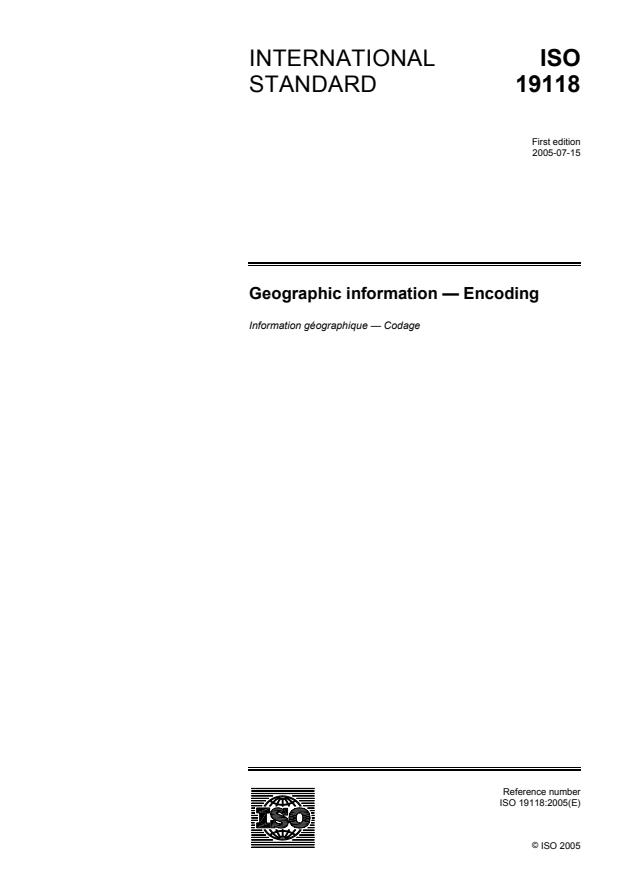
INTERNATIONAL ISO
STANDARD 19118
First edition
2005-07-15
Geographic information — Encoding
Information géographique — Codage
Reference number
©
ISO 2005
PDF disclaimer
This PDF file may contain embedded typefaces. In accordance with Adobe's licensing policy, this file may be printed or viewed but
shall not be edited unless the typefaces which are embedded are licensed to and installed on the computer performing the editing. In
downloading this file, parties accept therein the responsibility of not infringing Adobe's licensing policy. The ISO Central Secretariat
accepts no liability in this area.
Adobe is a trademark of Adobe Systems Incorporated.
Details of the software products used to create this PDF file can be found in the General Info relative to the file; the PDF-creation
parameters were optimized for printing. Every care has been taken to ensure that the file is suitable for use by ISO member bodies. In
the unlikely event that a problem relating to it is found, please inform the Central Secretariat at the address given below.
© ISO 2005
All rights reserved. Unless otherwise specified, no part of this publication may be reproduced or utilized in any form or by any means,
electronic or mechanical, including photocopying and microfilm, without permission in writing from either ISO at the address below or
ISO's member body in the country of the requester.
ISO copyright office
Case postale 56 • CH-1211 Geneva 20
Tel. + 41 22 749 01 11
Fax + 41 22 749 09 47
E-mail copyright@iso.org
Web www.iso.org
Published in Switzerland
ii © ISO 2005 – All rights reserved
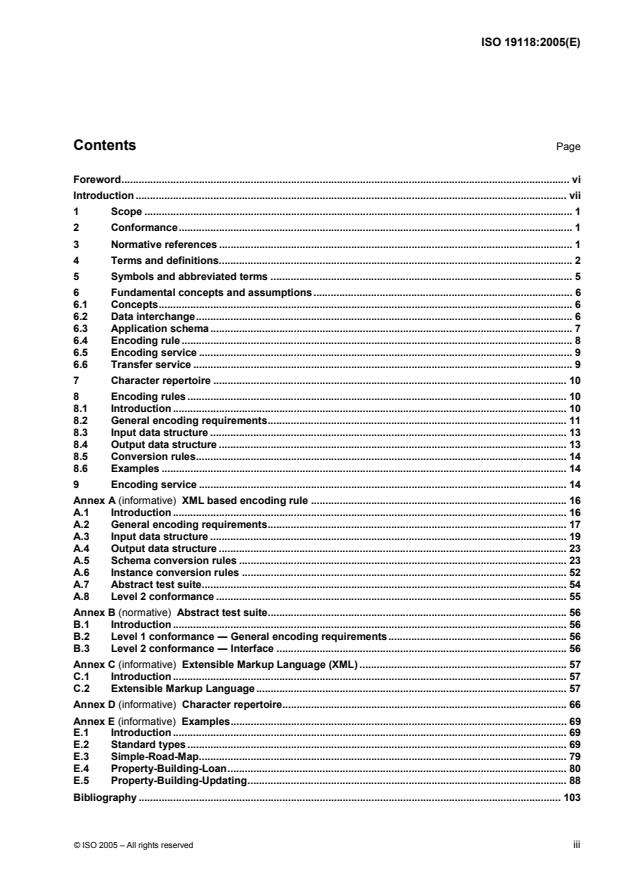
Contents Page
Foreword. vi
Introduction . vii
1 Scope . 1
2 Conformance. 1
3 Normative references . 1
4 Terms and definitions. 2
5 Symbols and abbreviated terms . 5
6 Fundamental concepts and assumptions. 6
6.1 Concepts. 6
6.2 Data interchange. 6
6.3 Application schema. 7
6.4 Encoding rule . 8
6.5 Encoding service . 9
6.6 Transfer service . 9
7 Character repertoire . 10
8 Encoding rules . 10
8.1 Introduction . 10
8.2 General encoding requirements. 11
8.3 Input data structure . 13
8.4 Output data structure . 13
8.5 Conversion rules. 14
8.6 Examples . 14
9 Encoding service . 14
Annex A (informative) XML based encoding rule . 16
A.1 Introduction . 16
A.2 General encoding requirements. 17
A.3 Input data structure . 19
A.4 Output data structure . 23
A.5 Schema conversion rules . 23
A.6 Instance conversion rules . 52
A.7 Abstract test suite. 54
A.8 Level 2 conformance . 55
Annex B (normative) Abstract test suite. 56
B.1 Introduction . 56
B.2 Level 1 conformance ― General encoding requirements. 56
B.3 Level 2 conformance ― Interface . 56
Annex C (informative) Extensible Markup Language (XML) . 57
C.1 Introduction . 57
C.2 Extensible Markup Language . 57
Annex D (informative) Character repertoire. 66
Annex E (informative) Examples. 69
E.1 Introduction . 69
E.2 Standard types . 69
E.3 Simple-Road-Map. 79
E.4 Property-Building-Loan. 80
E.5 Property-Building-Updating. 88
Bibliography . 103
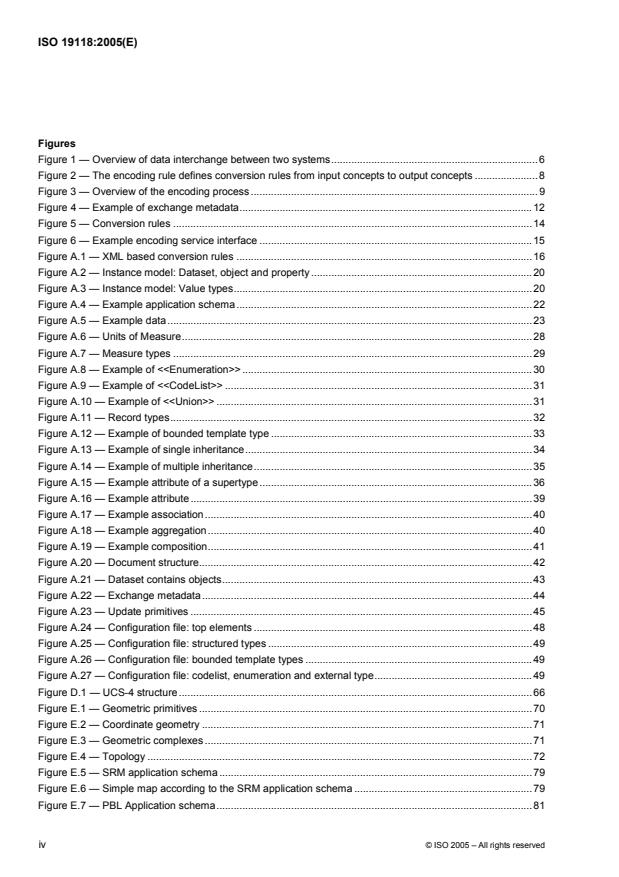
Figures
Figure 1 — Overview of data interchange between two systems.6
Figure 2 — The encoding rule defines conversion rules from input concepts to output concepts .8
Figure 3 — Overview of the encoding process .9
Figure 4 — Example of exchange metadata.12
Figure 5 — Conversion rules .14
Figure 6 — Example encoding service interface .15
Figure A.1 — XML based conversion rules .16
Figure A.2 — Instance model: Dataset, object and property .20
Figure A.3 — Instance model: Value types.20
Figure A.4 — Example application schema .22
Figure A.5 — Example data.23
Figure A.6 — Units of Measure.28
Figure A.7 — Measure types .29
Figure A.8 — Example of <> .30
Figure A.9 — Example of <> .31
Figure A.10 — Example of <> .31
Figure A.11 — Record types.32
Figure A.12 — Example of bounded template type .33
Figure A.13 — Example of single inheritance.34
Figure A.14 — Example of multiple inheritance.35
Figure A.15 — Example attribute of a supertype .36
Figure A.16 — Example attribute.39
Figure A.17 — Example association.40
Figure A.18 — Example aggregation.40
Figure A.19 — Example composition.41
Figure A.20 — Document structure.42
Figure A.21 — Dataset contains objects.43
Figure A.22 — Exchange metadata.44
Figure A.23 — Update primitives .45
Figure A.24 — Configuration file: top elements .48
Figure A.25 — Configuration file: structured types .49
Figure A.26 — Configuration file: bounded template types .49
Figure A.27 — Configuration file: codelist, enumeration and external type.49
Figure D.1 — UCS-4 structure.66
Figure E.1 — Geometric primitives .70
Figure E.2 — Coordinate geometry .71
Figure E.3 — Geometric complexes .71
Figure E.4 — Topology .72
Figure E.5 — SRM application schema .79
Figure E.6 — Simple map according to the SRM application schema .79
Figure E.7 — PBL Application schema.81
iv © ISO 2005 – All rights reserved
Figure E.8 — PBL example data . 81
Figure E.9 — Property-Building-Updating application schema . 88
Figure E.10 — Feature types by inheritance . 88
Figure E.11 — Example data. 89
Tables
Table A.1 — Stereotypes on classes. 18
Table A.2 — Summary of relationship between UML and the instance model . 21
Table A.3 — Mapping of attributes with multiplicity and collection type . 22
Table A.4 — Multiplicity mapping for attributes . 38
Table A.5 — Multiplicity mapping for content elements. 39
Table C.1 — DTD attribute types. 61
Table C.2 — Two special purpose XML attributes . 61
Table C.3 — XLink attributes. 62
Table D.1 — UTF8 byte sequences to represent a character. 67
Foreword
ISO (the International Organization for Standardization) is a worldwide federation of national standards bodies
(ISO member bodies). The work of preparing International Standards is normally carried out through ISO
technical committees. Each member body interested in a subject for which a technical committee has been
established has the right to be represented on that committee. International organizations, governmental and
non-governmental, in liaison with ISO, also take part in the work. ISO collaborates closely with the
International Electrotechnical Commission (IEC) on all matters of electrotechnical standardization.
International Standards are drafted in accordance with the rules given in the ISO/IEC Directives, Part 2.
The main task of technical committees is to prepare International Standards. Draft International Standards
adopted by the technical committees are circulated to the member bodies for voting. Publication as an
International Standard requires approval by at least 75 % of the member bodies casting a vote.
Attention is drawn to the possibility that some of the elements of this document may be the subject of patent
rights. ISO shall not be held responsible for identifying any or all such patent rights.
ISO 19118 was prepared by Technical Committee ISO/TC 211, Geographic information/Geomatics.
vi © ISO 2005 – All rights reserved
Introduction
This International Standard specifies the requirements for defining encoding rules to be used for interchange
of geographic data within the ISO 19100 series of International Standards. An encoding rule allows
geographic information defined by application schemas and standardized schemas to be coded into a system-
independent data structure suitable for transport and storage. The encoding rule specifies the types of data to
be coded and the syntax, structure and coding schemes used in the resulting data structure. The resulting
data structure may be stored on digital media or transferred using transfer protocols. It is intended to be read
and interpreted by computers, but may be in a form that is human readable.
The choice of one encoding rule for neutral data interchange does not exclude application domains and
individual nations from defining and using their own encoding rules that can be platform dependent or more
effective with regards to data size or processing complexity. XML is a subset of ISO/IEC 8879 and has been
chosen because it is independent of computing platform and interoperable with the World Wide Web.
This International Standard is divided into three logical sections. The requirements for creating encoding rules
based on UML schemas are specified in Clauses 6 to 8. The requirements for creating encoding service are
specified in Clause 9, and the XML based encoding rule is specified in Annex A.
The XML based encoding rule is intended to be used for neutral data interchange. It relies on the Extensible
Markup Language (XML) and the ISO/IEC 10646 character set standards. Introductions to XML and
ISO/IEC 10646 are given in Annexes C and D, respectively. Annex E contains examples of the application of
this International Standard.
The geographic information standards are organized in the ISO 19100 series of International Standards. The
background, the overall structure of this series of International Standards and the fundamental description
techniques are defined in ISO 19101, ISO/TS 19103 and ISO 19104.
Users of this International Standard will develop application schemas to capture the semantics of geographic
information. An application schema is compiled by integrating elements from a set of standardized conceptual
schemas developed in ISO 19107, ISO 19108, ISO 19110, ISO 19111, ISO 19112, ISO 19113, ISO 19115
and ISO 19117, including eventually new standardized conceptual schemas. How this integration will take
place is described in ISO 19109. The ISO 19100 series of International Standards also defines a set of
common services that shall be available when developing geographic information applications. The common
services are generally defined in ISO 19119 and will cover access to and processing of geographic
information according to the common information model. Two service areas are defined more closely in
ISO 19116 and ISO 19117. ISO 19105, ISO 19106, ISO 19114 and this International Standard cover
implementation issues.
INTERNATIONAL STANDARD ISO 19118:2005(E)
Geographic information — Encoding
1 Scope
This International Standard specifies the requirements for defining encoding rules to be used for interchange
of geographic data within the ISO 19100 series of International Standards.
This International Standard specifies
requirements for creating encoding rules based on UML schemas,
requirements for creating encoding services,
an informative XML based encoding rule for neutral interchange of geographic data.
This International Standard does not specify any digital media, it does not define any transfer services or
transfer protocols, nor does it specify how to encode inline large images.
2 Conformance
Two conformance levels are defined for this International Standard. The conformance levels are defined in the
abstract test suite in Annex B.
3 Normative references
The following referenced documents are indispensable for the application of this document. For dated
references, only the edition cited applies. For undated references, the latest edition of the referenced
document (including any amendments) applies.
ISO/IEC 10646, Information technology — Universal Multiple-Octet Coded Character Set (UCS)
ISO 8601, Data elements and interchange formats — Information interchange — Representation of dates and
times
ISO/TS 19103:2005, Geographic information — Conceptual schema language
ISO 19109:2005, Geographic information — Rules for application schema
Extensible Markup Language (XML) 1.0 (Second Edition), W3C Recommendation 6 October 2000. Available
at
XML Schema Part 1: Structures, W3C Recommendation 2, May 2001. Available at
XML Schema Part 2: Datatypes, W3C Recommendation 2, May 2001. Available at
4 Terms and definitions
For the purposes of this document, the following terms and definitions apply.
4.1
application schema
conceptual schema for data required by one or more applications
[ISO 19101]
NOTE An application schema describes the content, the structure and the constraints applicable to information in a
specific application domain.
4.2
character
member of a set of elements that is used for the representation, organization, or control of data
[ISO/IEC 2382-1]
4.3
code
representation of a label according to a specified scheme
4.4
conceptual model
model that defines concepts of a universe of discourse
[ISO 19101]
4.5
conceptual schema
formal description of a conceptual model
[ISO 19101]
4.6
conceptual schema language
formal language based on a conceptual formalism for the purpose of representing conceptual schemas
[ISO 19101]
EXAMPLE UML, EXPRESS, IDEF1X.
NOTE A conceptual schema language may be lexical or graphical.
4.7
conversion rule
rule for converting instances in the input data structure to instances in the output data structure
4.8
data
reinterpretable representation of information in a formalized manner suitable for communication, interpretation,
or processing
[ISO/IEC 2382-1]
4.9
data element
unit of data that, in a certain context, is considered indivisible
2 © ISO 2005 – All rights reserved
4.10
data interchange
delivery, receipt and interpretation of data
4.11
data transfer
movement of data from one point to another over a medium
NOTE Transfer of information implies transfer of data.
4.12
data type
specification of a value domain with operations allowed on values in this domain
[ISO/TS 19103]
EXAMPLE Integer, Real, Boolean, String and Date.
NOTE A data type is identified by a term, e.g. Integer. Values of the data types are of the specified value domain, e.g.
all integer numbers between –65537 and 65536. The set of operations can be +, −, ÷ and × and is semantically well
defined. A data type can be simple or complex. A simple data type defines a value domain where values are considered
atomic in a certain context, e.g. Integer. A complex data type is a collection of data types which are grouped together. A
complex data type may represent an object and can thus have identity.
4.13
dataset
identifiable collection of data
[ISO 19115]
4.14
encoding
conversion of data into a series of codes
4.15
encoding rule
identifiable collection of conversion rules that define the encoding for a particular data structure
EXAMPLE XML, ISO 10303-21, ISO/IEC 8211.
NOTE An encoding rule specifies the types of data to be converted as well as the syntax, structure and codes used
in the resulting data structure.
4.16
encoding service
software component that has an encoding rule implemented
4.17
feature
abstraction of real world phenomena
[ISO 19101]
NOTE A feature may occur as a type or an instance. Feature type or feature instance is used when only one is meant.
4.18
file
named set of records stored or processed as a unit
[ISO/IEC 2382-1]
4.19
geographic data
data with implicit or explicit reference to a location relative to the Earth
[ISO 19109]
4.20
geographic information
information concerning phenomena implicitly or explicitly associated with a location relative to the Earth
[ISO 19101]
4.21
identifier
label that uniquely identifies an item or group of items
4.22
information
knowledge concerning objects, such as facts, events, things, processes, or ideas, including concepts, that
within a certain context has a particular meaning
[ISO/IEC 2382-1]
4.23
instance model
representation model for storing data according to an application schema
4.24
interface
named set of operations that characterize the behaviour of an element
[ISO/IEC 19501]
4.25
interoperability
capability to communicate, execute programs, or transfer data among various functional units in a manner
that requires the user to have little or no knowledge of the unique characteristics of those units
[ISO/IEC 2382-1]
4.26
medium
substance or agency for storing or transmitting data
[1]
EXAMPLE Compact disc, internet , radio waves, etc.
4.27
model
abstraction of some aspects of reality
[ISO 19109]
4.28
schema
formal description of a model
[ISO 19101]
4 © ISO 2005 – All rights reserved
4.29
schema model
representation model for storing schemas
EXAMPLE Representation model for a schema repository.
4.30
stereotype
new type of modelling element that extends the semantics of the metamodel
[ISO/IEC 19501]
NOTE Stereotypes must be based on certain existing types or classes in the metamodel. Stereotypes may extend
the semantics, but not the structure of pre-existing types and classes. Certain stereotypes are predefined in the UML,
others may be user defined. Stereotypes are one of three extensibility mechanisms in UML; the others are constraint and
tagged value.
4.31
transfer protocol
common set of rules for defining interactions between distributed systems
4.32
universe of discourse
view of the real or hypothetical world that includes everything of interest
[ISO 19101]
4.33
value domain
set of accepted values
[ISO/TS 19103]
EXAMPLE The range 3-28, all integers, any ASCII character, enumeration of all accepted values (green, blue, white).
5 Symbols and abbreviated terms
API Application Programming Interface
DTD Document Type Definition
ID Identifier
IDREF An XML ID reference type
OMG Object Management Group
UCS Universal Multiple-Octet Coded Character Set
UML Unified Modelling language
URI Uniform Resource Identifier
UTF UCS Transfer Format
UUID Universal Unique Identifier
XMI XML Metadata Interchange
XML Extensible Markup Language
XPointer XML Pointer language
XSD XML Schema Document
6 Fundamental concepts and assumptions
6.1 Concepts
The purpose of the ISO 19100 series of International Standards is to enable interoperability between
heterogeneous geographic information systems. To achieve interoperability between heterogeneous systems
two fundamental issues need to be determined. The first issue is to define the semantics of the content and
the logical structures of geographic data. This shall be done in an application schema. The second issue is to
define a system and platform-independent data structure that can represent data corresponding to the
application schema.
Subclauses 6.2 to 6.6 describe the fundamental concepts of data interchange, i.e. the procedure based on the
application schema for encoding, delivery, receipt and interpretation of geographic data. 6.2 describes an
overview of the data interchange process; 6.3 introduces application schemas that allow interpretation of
geographic data; 6.4 describes the importance of the encoding rule for producing system-independent data
structures; 6.5 describes a software component, called the encoding service, for executing the encoding rule;
and 6.6 describes the procedure for delivery and receipt called the transfer service.
6.2 Data interchange
An overview of a data interchange is shown in Figure 1. System A wants to send a dataset to system B. To
ensure a successful interchange, A and B must decide on three things, i.e. a common application schema I,
which encoding rule R to apply, and what kind of transfer protocol to use. The application schema is the basis
of a successful data transfer and defines the possible content and structure of the transferred data, whereas
the encoding rule defines the conversion rules for how to code the data into a system-independent data
structure.
Figure 1 — Overview of data interchange between two systems
6 © ISO 2005 – All rights reserved
Both systems, A and B, store data in an internal database according to an internal schema, but the schemas
are usually different, i.e. schema A ≠ schema B. The following logical steps must be taken in order to transfer
a dataset from A's internal database to B's internal database.
a) The first step for system A is to translate its internal data into a data structure that is according to the
common application schema I. Here this is done by defining a mapping from the concepts of the internal
schema to the concepts defined in the application schema and by writing appropriate mapping software to
translate the data instances. In Figure 1 this mapping is denoted M . The result is an application schema
AI
specific data structure i . The data structure is stored in memory or on an intermediate file and is system
A
dependent and thus not suitable for transfer.
b) The next step is to use an encoding service, which applies the encoding rule R to create a data structure
that is system independent and therefore suitable for transfer. This encoded dataset is called d and may
be stored in a file system or transferred using a transfer service.
c) System A then invokes a transfer service to send the encoded dataset d to system B. The transfer service
follows a transfer protocol for how to do packaging and how the actual transportation over an on-line or
off-line communication medium should take place. Both parties must agree upon the transfer protocol
used.
d) The transfer service on system B receives the transferred dataset, and according to the protocol the
dataset is unpacked and stored as an encoded dataset d, e.g. on an intermediate file.
e) In order to get an application schema specific data structure i , system B applies the inverse encoding
B
−1
rule R to interpret the encoded data.
f) To use the dataset, B must translate the application schema specific data structure i into its internal
B
database. This is done by defining a mapping from the application schema into its internal schema and by
writing software that does the actual translation. In Figure 1 this mapping is denoted M .
IB
This International Standard only specifies the requirements for creating encoding rules and the encoding
services and not the whole data interchange process. Thus, only steps b) and e) are standardized. Steps c)
and d) use general information technology transfer services.
6.3 Application schema
An application schema is a conceptual schema for applications with similar data requirements. The application
schema is the basis of a successful data interchange and defines the possible content and structure of the
data. It is also the basis for implementing application schema specific data structures for local storage of data.
The application schema used for encoding in compliance with this International Standard shall be written in
the UML conceptual schema language, in accordance with ISO/TS 19103 and ISO 19109. These two
standards specify a framework for how to write application schemas. The rules include specifications on how
to use standardized schemas to define feature types. Both a sender and a receiver of data must have access
to the application schema.
Implementation of application schema specific data structures may be semi-automated, e.g. by using a
compiler for the lexical part or by using a graphical modelling tool with support for code generation.
The application schema shall be accessible to both ends of a data interchange to ensure a successful result.
The application schema has to be transferred before data interchange takes place so that both the receiver
and sender can prepare their systems by implementing mappings and data structures according to the
application schema. It may be transferred together with the dataset, or it may be stored in a public place and
referenced from the dataset.
The application schema may be interchanged by paper or electronic based methods. The XML Metadata
Interchange (XMI) developed by the Object Management Group (OMG) is the recommended electronic
method for data interchange of an application schema.
6.4 Encoding rule
6.4.1 Concept
An encoding rule is an identifiable collection of conversion rules that defines the encoding for a particular data
structure. The encoding rule specifies the data types to be converted, as well as the syntax, structure and
coding schemes used in the resulting data structure. An encoding rule is applied to application schema
specific data structures to produce system-independent data structures suitable for transport or storage. In
order to define an encoding rule three important aspects must be specified, i.e. the input data structure, the
output data structure and the conversion rules between the elements of the input and the output data
structures. Both the input and output data structures are written using a conceptual schema language and the
concepts in the languages are used to define the encoding rule.
6.4.2 Input data structure
The input data structure is an application schema specific data structure. The data structure can be thought of
as a set of data instances, i.e. i = { i , ., i }, see Figure 1. Each data instance i is an instance of a concept I
1 p k l
defined in an application schema. The application schema defines a set of concepts defined in the application
schema I = { I , ., I }.
1 m
The application schema is a conceptual schema c written in a conceptual schema language C. The conceptual
schema defines a set of concepts c = { c , ., c } by instantiating the concepts of the conceptual schema
1 m
language C = { C , ., C }. Since the application schema is a conceptual schema c = I.
1 r
6.4.3 Output data structure
The output data structure is defined by a schema D = { D , ., D }. D is the schema for the output structure
1 s
and is not shown in Figure 1. The output data structure can be thought of as a set of data instances,
i.e. d = { d , ., d } where each data instance d is an instance of a concept D .
1 q k l
The schema D defines the syntax, structure and coding schemes of the output data structure.
6.4.4 Conversion rules
A conversion rule specifies how a data instance in the input data structure shall be converted to zero, one, or
more instances in the output data structure. The conversion rules are defined and based on the concepts of
the conceptual schema language C and on the concepts of the output data structure schema D. We need to
specify a conversion rule R for each of the legal combinations of concepts in the conceptual schema language.
i
The set of conversion rules are R = { R , ., R }, where R is the i-th conversion rule and C is the i-th legal
i
1 n i
combination of instances from the schema language. A conversion table for all possible C can be set up,
i
where each C maps to a production of instances in the output data structure D. Figure 2 shows the
i
relationship between the input and output conceptual schema language and the encoding rule.
Figure 2 — The encoding rule defines conversion rules from input concepts to output concepts
NOTE The conversion rules are defined based on the two schema languages and not on any particular application
schema. This is a generic approach that allows developers to write application schema independent encoding services,
which can be used for different application schemas as long as the schemas are defined in the same conceptual schema
language.
8 © ISO 2005 – All rights reserved
6.5 Encoding service
An encoding service is a software component that has implemented the encoding rule and provides an
interface to encoding and decoding functionality. It is an integrated part of data interchange.
Figure 3 presents the details of an encoding service and its relationships to important specification schemas.
The encoding service shall be able to read the input data structure and convert the instances to an output data
structure and vice versa. It shall also be able to read the application schema declarations and write the
corresponding output data structure schema. The input data structure is defined by an application schema.
The application schema is defined using concepts of the conceptual schema language. The output data
structure is also described with a schema, called the data structure schema, which defines the possible
content, structure and coding schemes of the output data structure. The data structure schema is described
with a schema language. The encoding rule specifies conversion rules at two levels, the first is at the schema
level and the second is at the instance level. At the schema level, the conversion rules define a mapping for
each of the concepts defined in the application schema to corresponding concepts in the data structure
schema. At the instance level the conversion rules define a mapping for each of the instances in the input data
structure to corresponding instances in the output data structure. The instance conversion rules are normally
deduced from the schema conversion rules.
Figure 3 — Overview of the encoding process
An encoding service shall at least provide interfaces for encoding and decoding functionality. Examples of
such interfaces are for encoding d = encode (i, I ), and for decoding: i = decode (d, I ). Here, i is a reference to
an application schema specific data structure, I is a reference to the application schema and d is a reference
to the system independent data structure.
6.6 Transfer service
A transfer service is a software component that has implemented one or more transfer protocols, which allows
data transfer between distributed information systems over off-line or on-line communication media. To
successfully transfer data between two systems, the sender and receiver need to agree on the transfer
protocol to be used.
Different transfer protocols can be defined. One example is off-line transfer protocols where data is stored on
optical or magnetic media and delivered using postal services or other dedicated delivery services. Another
example is on-line transfer protocols where data is compressed and included as an email attachment,
delivered using a file transfer protocol or transferred using other distributed information technology services
which rely on an underlying network service.
This International Standard does not prescribe any preferred transfer protocols.
7 Character repertoire
This International Standard adopts the international character set standards defined in ISO/IEC 10646.
ISO/IEC 10646 defines an internationally recognized repertoire of characters called the Universal Character
Set (UCS) and their character-encoding schemes.
The character-encoding schemes that may be supported by international profiles of this International Standard
are the following:
a) 8-bit variable size UCS Transfer Format UTF-8;
b) 16-bit variable size UCS Transfer Format UTF-16;
c) 16-bit fixed size Universal Character Set UCS-2;
d) 32-bit fixed size Universal Character Set UCS-4.
International encoding rules that claim conformance with this International Standard shall support one or more
of these character-encoding schemes. Within national profiles and system implementations different
character-encoding schemes may be used. The fixed size character-encoding schemes are often used in
database implementations and the variable size is often used for data interchange purposes.
The character set standards adopted specify only the repertoire of characters and give no indication of which
language is actually used. In cases where it is important to distinguish between different languages in text
strings special mechanisms to indicate the language used shall be used. International profiles of this
International Standard may support language-tagging mechanisms as defined in ISO/IEC 11179-3.
ISO/IEC 10646 defines mechanisms for creating composite characters. Composite characters are characters
produced by superimposing one or more additional characters on a base character. ISO/IEC 10646 defines a
set of precomposed characters and their defined decomposition. Since mixing composite characters with their
precomposed equivalents may lead to interpretation problems, the use of a composite character if a
precomposed character exists is deprecated, i.e. the precomposed character shall always be used.
To summarize an encoding rule shall
support one or more character-encoding schemes;
support language tagging mechanisms if necessary;
not use composite characters if equivalent precomposed characters exist.
EXAMPLE The precomposed character ö has the defined decompositio
...
Questions, Comments and Discussion
Ask us and Technical Secretary will try to provide an answer. You can facilitate discussion about the standard in here.
Loading comments...