

ISO 10349-2:1992
(Main)Photography — Photographic-grade chemicals — Test methods — Part 2: Determination of matter insoluble in water
General Information
- Abstract
The method is based on transfer of the test portion in a conical flask containing water, heating on a steam bath, filtering through a dry porous crucible, washing with hot water, drying the crucible plus residue, and reweighing.
- Status
- Published
- Publication Date
- 29-Dec-1992
- Technical Committee
- ISO/TC 42 - Photography
- Drafting Committee
- ISO/TC 42 - Photography
- Current Stage
- 9093 - International Standard confirmed
- Start Date
- 20-Dec-2023
- Completion Date
- 29-Aug-2026

Overview
ISO 10349-2:1992 specifies a laboratory test method for the determination of matter insoluble in water in photographic‑grade chemicals. The procedure defines how to transfer a test portion into water, extract soluble material by heating, collect insoluble residue on a porous filter crucible, dry and reweigh the residue, and calculate the percentage of insoluble matter. This part is intended to ensure the purity and performance of chemicals used in photographic processes.
Key topics and requirements
- Scope: A general method for measuring water‑insoluble matter in photographic chemicals.
- Apparatus:
- Oven capable of maintaining 105 °C to 115 °C.
- Porous filter crucible with 10 µm to 15 µm retention.
- Procedure (as specified in the standard):
- Place the specified test portion in a 125 ml conical flask containing 100 ml of water.
- Heat on a steam bath for 30 minutes.
- Filter through a dry porous crucible (10 µm–15 µm retention) and wash with hot water.
- Dry the crucible plus residue at 105 °C for 4 hours, then reweigh.
- Calculation: Express the content of insoluble matter as a percentage by mass using the masses:
- m0 = mass of test portion (g)
- m1 = mass of empty crucible (g)
- m2 = mass of crucible + residue after drying (g)
- Percentage insoluble = ((m2 − m1) / m0) × 100%
- Test report: Must specify method used, the numerical result, sample identification, and any deviations or incidents affecting results.
Applications and who uses it
- Quality control laboratories in photographic chemical manufacturing to verify product purity.
- Incoming inspection for chemical suppliers and procurement teams assessing conformance to specifications.
- Analytical and testing laboratories performing routine photography chemical tests to prevent particulate contamination that can cause image defects.
- Conservation and restoration labs that evaluate chemical reagents for film processing or photographic material treatment.
Practical value
- Ensures consistency and reliability of photographic developers, fixers, and other reagents by quantifying insoluble contaminants.
- Helps prevent processing defects such as spots, streaks or uneven development caused by particulate matter.
- Supports compliance with product specifications and facilitates supplier qualification and batch release.
Related standards
- ISO 10349-1:1992 - Photography - Photographic‑grade chemicals - Test methods - Part 1: General (reagents, glassware, hazard codes).
- Other parts in the ISO 10349 series cover residuals, heavy metals, halides, alkalinity, volatile matter and additional analytes (Parts 3–12).
Keywords: ISO 10349-2, photographic-grade chemicals, test methods, determination of matter insoluble in water, filter crucible, quality control, photography.
Relations
- Consolidated By
ISO 18812:2003 - Health informatics — Clinical analyser interfaces to laboratory information systems — Use profiles - Effective Date
- 06-Jun-2022
Frequently Asked Questions
ISO 10349-2:1992 is a standard published by the International Organization for Standardization (ISO). Its full title is "Photography — Photographic-grade chemicals — Test methods — Part 2: Determination of matter insoluble in water". This standard covers: The method is based on transfer of the test portion in a conical flask containing water, heating on a steam bath, filtering through a dry porous crucible, washing with hot water, drying the crucible plus residue, and reweighing.
The method is based on transfer of the test portion in a conical flask containing water, heating on a steam bath, filtering through a dry porous crucible, washing with hot water, drying the crucible plus residue, and reweighing.
ISO 10349-2:1992 is classified under the following ICS (International Classification for Standards) categories: 37.040.30 - Photographic chemicals. The ICS classification helps identify the subject area and facilitates finding related standards.
ISO 10349-2:1992 has the following relationships with other standards: It is inter standard links to ISO 18812:2003. Understanding these relationships helps ensure you are using the most current and applicable version of the standard.
ISO 10349-2:1992 is available in PDF format for immediate download after purchase. The document can be added to your cart and obtained through the secure checkout process. Digital delivery ensures instant access to the complete standard document.
Standards Content (Sample)
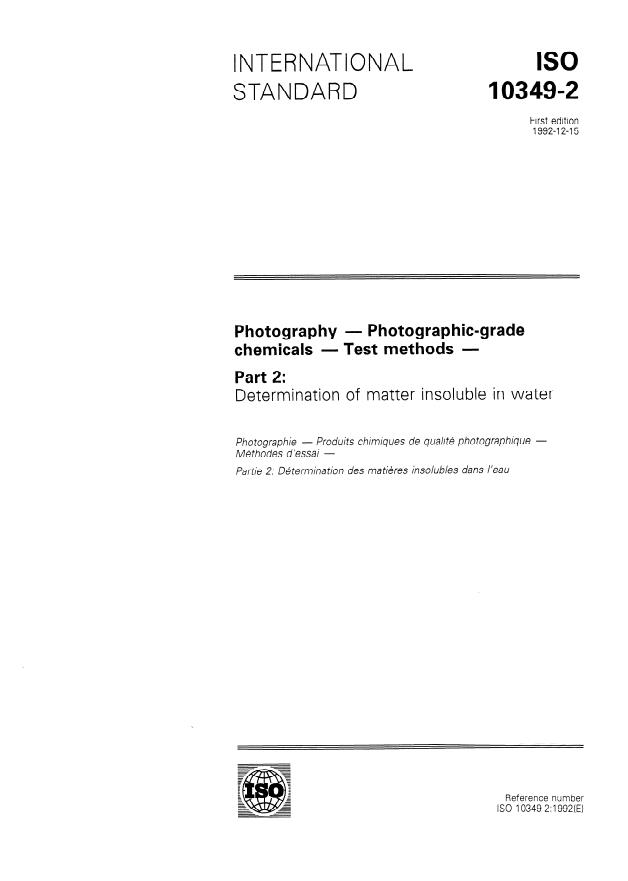
INTERNATIONAL ISO
10349-2
STANDARD
First edition
1992-12-15
- Photographit-grade
Photography
chemicals - Test methods -
Part 2:
Determination of matter insoluble in water
Produits chimiques de quake photographique -
Photographie -
Mkthodes d ’essai -
Partie 2: Determination des ma tieres insolubles dans I’eau
Reference number
ISO 10349=2:1992(E)
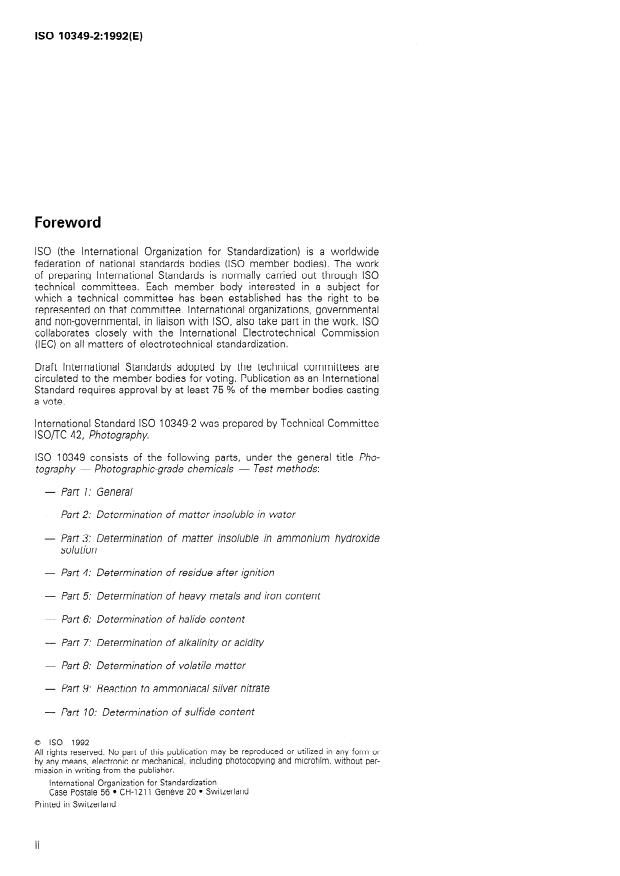
Foreword
ISO (the International Organization for Standardization) is a worldwide
federation of national Standards bodies (ISO member bodies). The work
of preparing International Standards is normally carried out through ISO
technical committees. Esch member body interested in a subject for
which a technical committee has been established has the right to be
represented on that committee. International organizations, governmental
and non-governmental, in liaison with ISO, also take part in the work. ISO
collaborates closely with the International Electrotechnical Commission
(IEC) on all matters of electrotechnical standardization.
Draft International Standards adopted by the technical committees are
circulated to the member bodies for voting. Publication as an International
Standard requires approval by at least 75 % of the member bodies casting
a vote.
International Standard ISO 10349-2 was prepared by Technical Committee
lSO/TC 42, Photography.
ISO 10349 consists of the following Parts, under the general title Pho-
tography - Photographit-grade chemicals - Test methods:
- Part 1: General
- Part 2: Determination of matter insoluble in wa ter
in ammonium
- Part 3: Determjna tion of matter ins oluble h ydroxide
solution
- Part 4: Determination of residue after ignition
- Part 5: Determination of heavy metals and ion content
- Part 6: Determination of halide content
- Part 7: Determination of alkalinity or acidity
- Part 8: Determination of vola tile matter
- Part 9: Reaction to ammoniacal silver nitrate
- Part IO: Determination of sulfide content
0 ISO 1992
All rights reserved. No patt of this publication may be reproduced or utilized in any ferm or
by any means, electronie or mechanical, including photocopying and microfilm, without per-
mission in writing from the publisher.
International Organization for Standardization
Case Postale 56 l CH-l 211 Geneve 20 l Switzerland
Printed in Switzerland
ii
ISO 10349=2:1992(E)
- Part 11: Determination of specific gravity
- Part 12: Determination of density
This page intentionally left blank
INTERNATIONAL STANDARD
ISO 10349=2:1992(E)
Photography - Photographit-grade chemicals - Test
methods
...