

ISO 10349-8:2002
(Main)Photography — Photographic-grade chemicals — Test methods — Part 8: Determination of volatile matter
General Information
- Abstract
ISO 10349-8:2002 specifies a general test method for the determination of volatile matter in photographic-grade chemicals.
- Status
- Published
- Publication Date
- 07-Nov-2002
- Technical Committee
- ISO/TC 42 - Photography
- Drafting Committee
- ISO/TC 42 - Photography
- Current Stage
- 9093 - International Standard confirmed
- Start Date
- 06-Jun-2026
- Completion Date
- 29-Aug-2026
Buy Documents
ISO 10349-8:2002 - Photography -- Photographic-grade chemicals -- Test methods
ISO 10349-8:2002 - Photography — Photographic-grade chemicals — Test methods — Part 8: Determination of volatile matter/8/2002
Overview
ISO 10349-8:2002 - part of the ISO 10349 series - specifies a general test method for the determination of volatile matter in photographic‑grade chemicals. The standard provides a repeatable gravimetric procedure (oven drying and weighing) to quantify mass loss due to volatile components. It is intended for use with photographic chemicals where control of volatile matter affects product stability, performance and safety.
Key topics and requirements
- Scope and normative references
- Relies on ISO 10349-1 for general provisions on reagents, glassware, hazards and sampling.
- Apparatus (examples specified)
- Low‑form, glass‑stoppered weighing bottle (50 ml capacity).
- Oven capable of maintaining temperatures in the range 70 °C to 150 °C.
- Analytical balance with high precision (example accuracy indicated in the standard).
- Desiccator with suitable desiccant for cooling samples to room temperature before weighing.
- Procedure (general)
- Weigh a specified test portion into a dried weighing bottle.
- Dry the sample in the oven at the temperature and for the time specified for the particular material (see the appropriate International Standard or product method).
- Cool in a desiccator to room temperature and reweigh to the precision required.
- Calculation
- Express volatile matter as a percentage by mass: determine the mass loss on drying (mass before drying minus mass after drying) divided by the initial sample mass (mass before drying minus mass of the empty bottle), multiplied by 100.
- Test reporting
- Report the method used, test result and all operating details not specified in ISO 10349‑8 (e.g., drying temperature/time used), any incidents affecting results, and full sample identification.
Applications and users
- Who uses it
- Quality control and analytical laboratories in photographic and imaging chemical manufacturing.
- Raw material inspectors, R&D chemists developing photographic formulations, and regulatory/compliance personnel overseeing product specifications.
- Why it matters
- Controls volatile impurities that can affect chemical stability, image quality, shelf life and worker/environmental safety.
- Provides a standard, reproducible method for contract testing, supplier qualification and batch release.
Related standards
- ISO 10349-1:2002 (General) and other parts of ISO 10349 covering insoluble matter, heavy metals, halide content, pH, density and related test methods for photographic‑grade chemicals.
Keywords: ISO 10349-8:2002, volatile matter, photographic-grade chemicals, test methods, oven drying, gravimetric determination, quality control.
Relations
- Effective Date
- 06-Jun-2022
- Effective Date
- 15-Apr-2008
Buy Documents
ISO 10349-8:2002 - Photography -- Photographic-grade chemicals -- Test methods
ISO 10349-8:2002 - Photography — Photographic-grade chemicals — Test methods — Part 8: Determination of volatile matter/8/2002
Frequently Asked Questions
ISO 10349-8:2002 is a standard published by the International Organization for Standardization (ISO). Its full title is "Photography — Photographic-grade chemicals — Test methods — Part 8: Determination of volatile matter". This standard covers: ISO 10349-8:2002 specifies a general test method for the determination of volatile matter in photographic-grade chemicals.
ISO 10349-8:2002 specifies a general test method for the determination of volatile matter in photographic-grade chemicals.
ISO 10349-8:2002 is classified under the following ICS (International Classification for Standards) categories: 37.040.30 - Photographic chemicals. The ICS classification helps identify the subject area and facilitates finding related standards.
ISO 10349-8:2002 has the following relationships with other standards: It is inter standard links to ISO 1628-1:2009, ISO 10349-8:1992. Understanding these relationships helps ensure you are using the most current and applicable version of the standard.
ISO 10349-8:2002 is available in PDF format for immediate download after purchase. The document can be added to your cart and obtained through the secure checkout process. Digital delivery ensures instant access to the complete standard document.
Standards Content (Sample)
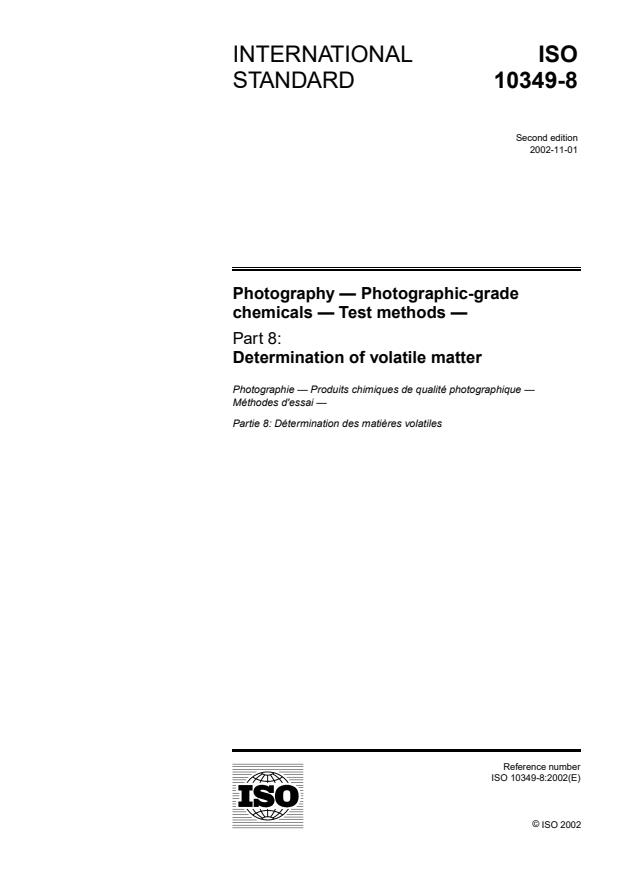
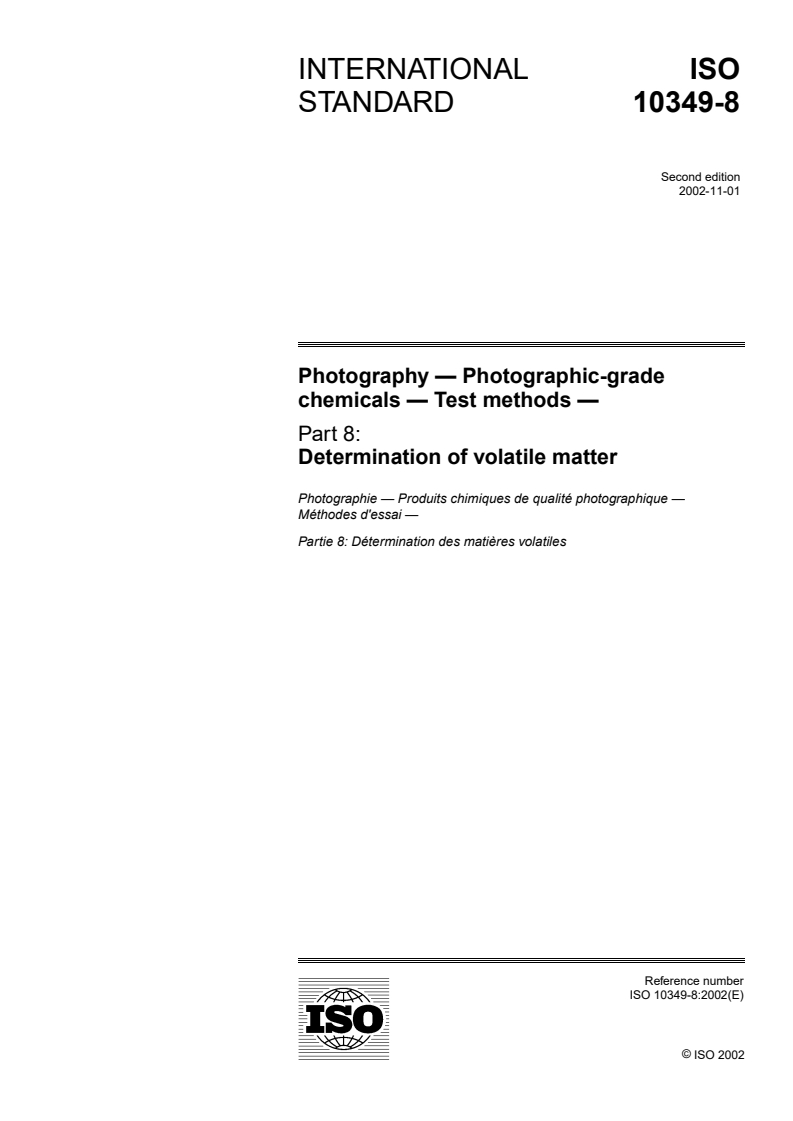
INTERNATIONAL ISO
STANDARD 10349-8
Second edition
2002-11-01
Photography — Photographic-grade
chemicals — Test methods —
Part 8:
Determination of volatile matter
Photographie — Produits chimiques de qualité photographique —
Méthodes d'essai —
Partie 8: Détermination des matières volatiles
Reference number
PDF disclaimer
This PDF file may contain embedded typefaces. In accordance with Adobe's licensing policy, this file may be printed or viewed but shall not be
edited unless the typefaces which are embedded are licensed to and installed on the computer performing the editing. In downloading this file,
parties accept therein the responsibility of not infringing Adobe's licensing policy. The ISO Central Secretariat accepts no liability in this area.
Adobe is a trademark of Adobe Systems Incorporated.
Details of the software products used to create this PDF file can be found in the General Info relative to the file; the PDF-creation parameters
were optimized for printing. Every care has been taken to ensure that the file is suitable for use by ISO member bodies. In the unlikely event
that a problem relating to it is found, please inform the Central Secretariat at the address given below.
All rights reserved. Unless otherwise specified, no part of this publication may be reproduced or utilized in any form or by any means,
electronic or mechanical, including photocopying and microfilm, without permission in writing from either ISO at the address below or ISO's
member body in the country of the requester.
ISO copyright office
Case postale 56 CH-1211 Geneva 20
Tel. + 41 22 749 01 11
Fax + 41 22 749 09 47
E-mail copyright@iso.ch
Web www.iso.ch
Printed in Switzerland
©
ii ISO 2002 – All rights reserved
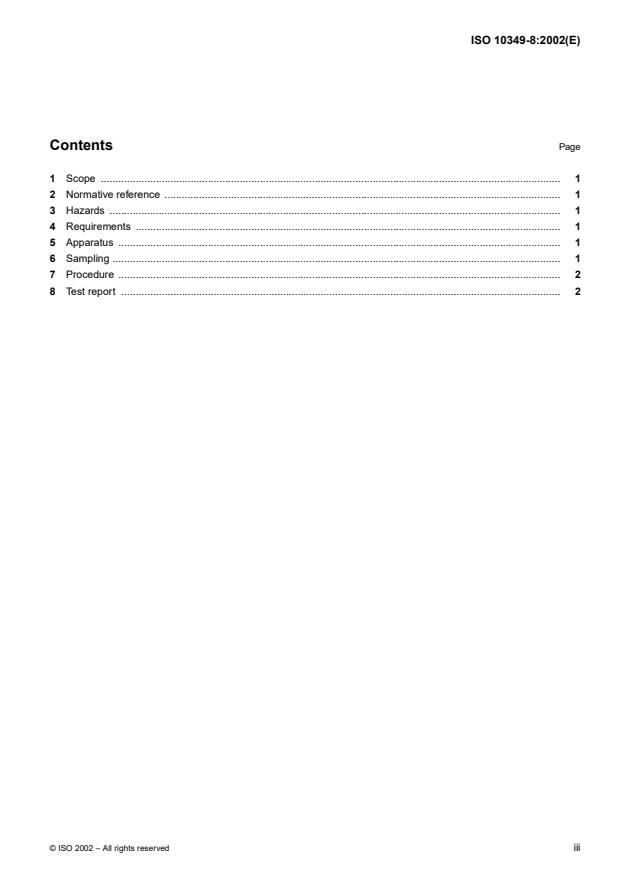
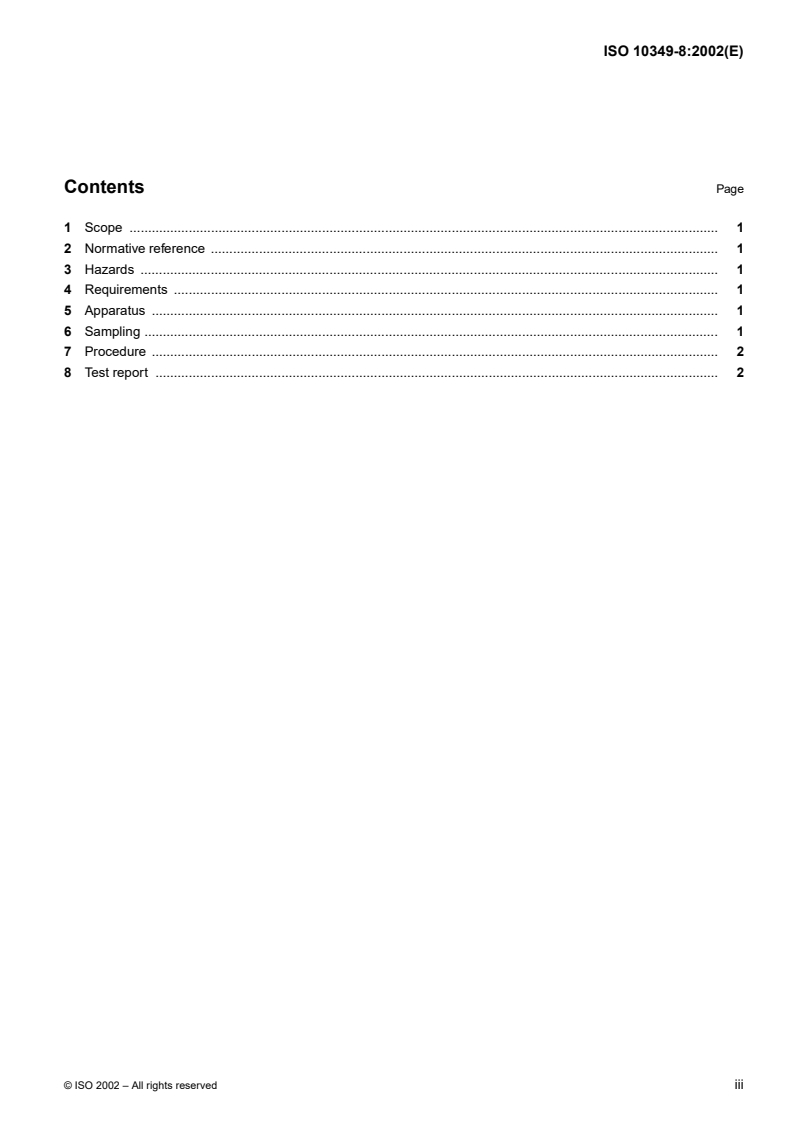
Contents Page
1 Scope . 1
2 Normative reference . 1
3 Hazards . 1
4 Requirements . 1
5 Apparatus . 1
6 Sampling . 1
7 Procedure . 2
8 Test report . 2
©
ISO 2002 – All rights reserved iii
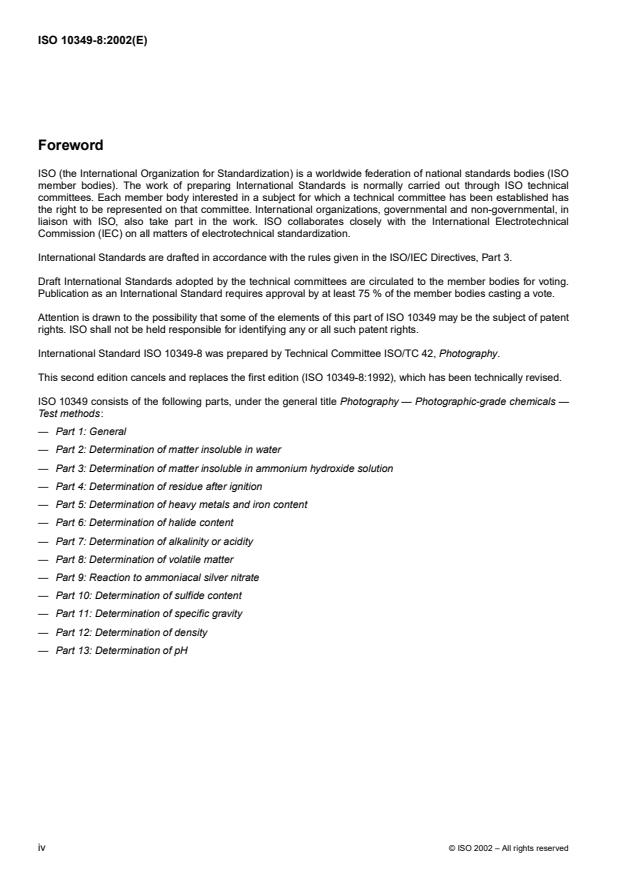
Foreword
ISO (the International Organization for Standardization) is a worldwide federation of national standards bodies (ISO
member bodies). The work of preparing International Standards is normally carried out through ISO technical
committees. Each member body interested in a subject for which a technical committee has been established has
the right to be represented on that committee. International organizations, governmental and non-governmental, in
liaison with ISO, also take part in the work. ISO collaborates closely with the International Electrotechnical
Commission (IEC) on all matters of electrotechnical standardization.
International Standards are drafted in accordance with the rules given in the ISO/IEC Directives, Part 3.
Draft International Standards adopted by the technical committees are circulated to the member bodies for voting.
Publication as an International Standard requires approval by at least 75 % of the member bodi
...
INTERNATIONAL ISO
STANDARD 10349-8
Second edition
2002-11-01
Photography — Photographic-grade
chemicals — Test methods —
Part 8:
Determination of volatile matter
Photographie — Produits chimiques de qualité photographique —
Méthodes d'essai —
Partie 8: Détermination des matières volatiles
Reference number
PDF disclaimer
This PDF file may contain embedded typefaces. In accordance with Adobe's licensing policy, this file may be printed or viewed but shall not be
edited unless the typefaces which are embedded are licensed to and installed on the computer performing the editing. In downloading this file,
parties accept therein the responsibility of not infringing Adobe's licensing policy. The ISO Central Secretariat accepts no liability in this area.
Adobe is a trademark of Adobe Systems Incorporated.
Details of the software products used to create this PDF file can be found in the General Info relative to the file; the PDF-creation parameters
were optimized for printing. Every care has been taken to ensure that the file is suitable for use by ISO member bodies. In the unlikely event
that a problem relating to it is found, please inform the Central Secretariat at the address given below.
All rights reserved. Unless otherwise specified, no part of this publication may be reproduced or utilized in any form or by any means,
electronic or mechanical, including photocopying and microfilm, without permission in writing from either ISO at the address below or ISO's
member body in the country of the requester.
ISO copyright office
Case postale 56 CH-1211 Geneva 20
Tel. + 41 22 749 01 11
Fax + 41 22 749 09 47
E-mail copyright@iso.ch
Web www.iso.ch
Printed in Switzerland
©
ii ISO 2002 – All rights reserved
Contents Page
1 Scope . 1
2 Normative reference . 1
3 Hazards . 1
4 Requirements . 1
5 Apparatus . 1
6 Sampling . 1
7 Procedure . 2
8 Test report . 2
©
ISO 2002 – All rights reserved iii
Foreword
ISO (the International Organization for Standardization) is a worldwide federation of national standards bodies (ISO
member bodies). The work of preparing International Standards is normally carried out through ISO technical
committees. Each member body interested in a subject for which a technical committee has been established has
the right to be represented on that committee. International organizations, governmental and non-governmental, in
liaison with ISO, also take part in the work. ISO collaborates closely with the International Electrotechnical
Commission (IEC) on all matters of electrotechnical standardization.
International Standards are drafted in accordance with the rules given in the ISO/IEC Directives, Part 3.
Draft International Standards adopted by the technical committees are circulated to the member bodies for voting.
Publication as an International Standard requires approval by at least 75 % of the member bodi
...